Passetto del Biscione
In short. The Passetto del Biscione is the covered passage that links Via di Grotta Pinta to Piazza del Biscione, a step from Campo de' Fiori, in the Parione district: the entrance on the square side opens under Palazzo Orsini Pio Righetti, the…
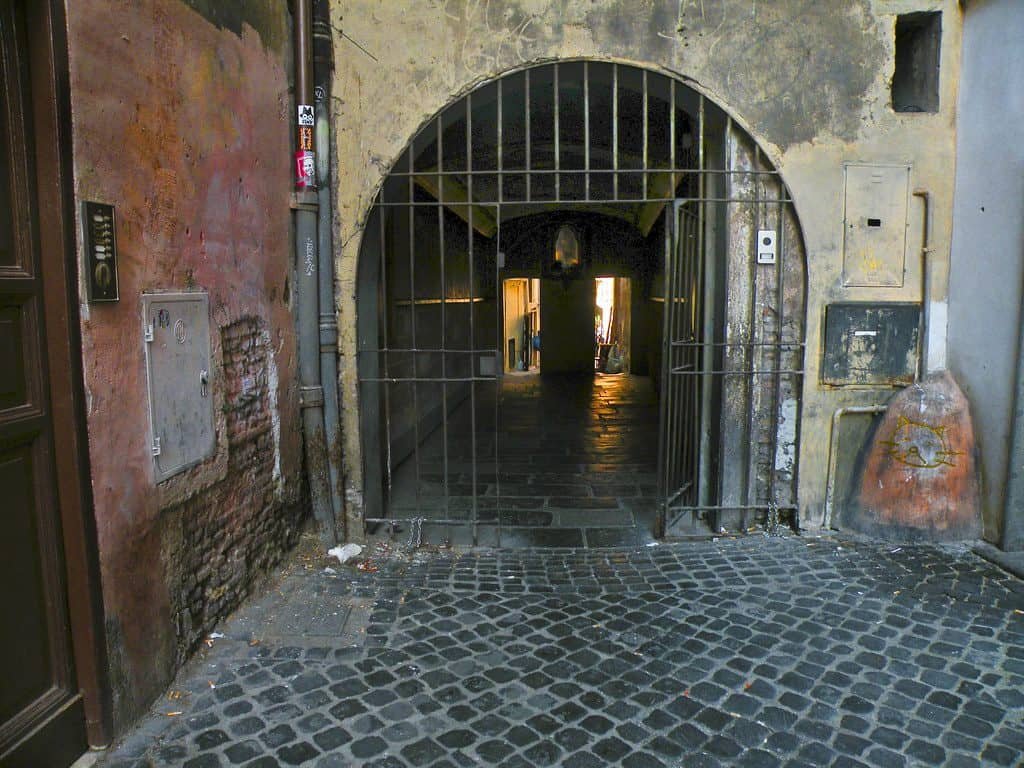
The Passetto del Biscione is the covered passage that links Via di Grotta Pinta to Piazza del Biscione, a step from Campo de' Fiori, in the Parione district: the entrance on the square side opens under Palazzo Orsini Pio Righetti, the opposite one comes down into Via di Grotta Pinta, the little crescent-shaped street behind the Cinema Farnese. Access is free, there is no ticket office and no need to book. The passage can be walked during the day and is closed in the evening, so it's best to get there in daylight. The useful transport is that of Corso Vittorio Emanuele II and Largo di Torre Argentina: buses 40, 46, 62, 64, 70, 87, 190F, 492 and 916 stop at Corso Vittorio Emanuele II/Navona or at Largo Argentina, tram 8 reaches Largo Argentina from Trastevere, and from the Spagna stop on Metro line A or Colosseo on line B you change to a surface bus anyway. On foot it is five minutes from Piazza Navona, four from Campo de' Fiori, seven from the Largo Argentina archaeological area. The restoration and care of the frescoes are owed to the Centro Studi Cappella Orsini, based in the former church of Santa Maria in Grottapinta on the same block. For any special openings of the Chapel it's best to contact them directly.
If you are building a walking tour in this quadrant, it is worth reading the page on Campo de' Fiori too: the Passetto is less than 200 meters from the monument to Giordano Bruno and the two places are best told together.

Where the Passetto del Biscione Really Is
The problem with the Passetto del Biscione is not distance, it's the threshold. Anyone coming from Campo de' Fiori and turning into Piazza del Biscione finds a narrow little square, taken up by tables and signs, and the mouth of the passage looks more like a service door than a monument. You walk past it three times before noticing. It's worth keeping two physical landmarks in mind: the side of Palazzo Orsini Pio Righetti with its pediments inhabited by lions and eagles, and the Cinema Farnese sign on the opposite corner of the big square. The opening is between the two.
Piazza del Biscione Entrance
From this side the Passetto del Biscione appears as a low arch set into the curtain of buildings. It's the entrance almost all visitors use, because Piazza del Biscione is the natural continuation of Campo de' Fiori toward the east. The arch was partly walled up at the end of the 18th century to give a more decorous setting to the Marian tabernacle kept there: the narrow, slightly crooked form you see today is not the original one, it is the result of that devotional intervention. Anyone who looks up before going in already sees the start of the decorated vault.
Via di Grotta Pinta Entrance
On the other side you come out in Via di Grotta Pinta, and this is the exit I recommend, because it produces the right effect: you leave a dark corridor and find yourself on a curved street, without immediately understanding why it is curved. The curve is not a medieval whim. It is the profile of the cavea of the Theater of Pompey, left imprinted in the building fabric like a fossil. The name of the street, after all, comes precisely from the passage: for centuries it was called Arco di Grotta Dipinta, because in Rome any dark recess was called a grotta, and this recess was painted.
How to Reach the Passetto del Biscione by Public Transport
No metro line reaches this sector of the historic center, and it's good to know that from the start. The practical terminus is Largo di Torre Argentina, served by tram 8 and a lot of buses. From there you walk along Corso Vittorio Emanuele II for 200 meters, turn down Via dei Chiavari or Via del Paradiso and in five minutes you are in Piazza del Biscione. Coming from the Vatican or Piazza Venezia, the stops at Corso Vittorio Emanuele II/Navona are just as convenient. By taxi or car there's no point insisting: the area is pedestrian or limited-traffic almost permanently, and the sampietrini cobblestones of Via di Grotta Pinta discourage even the most determined.
What You See Inside the Passetto del Biscione
The passage is a few dozen meters long and is crossed in under a minute, but it is one of those places where hurry is the real enemy. Anyone who enters with a phone in hand and head elsewhere comes out the other side having seen nothing. Anyone who stops for 30 seconds and looks up notices that the vault is entirely decorated, that the walls preserve fake architecture and that at the end, above an aedicule, there is an image of the Madonna.
The Painted Vault of the Passetto del Biscione
The decoration recovered by the restoration is of late 16th- and 17th-century taste: putti, fake columns, plant festoons, painted architectural frames in trompe-l'oeil perspective. It is not an authored cycle and no serious source attributes a famous name to it: it is decorative workshop painting, the kind that in Rome covered thousands of square meters of entrance halls, stairs and passages and that for this very reason is almost all lost. Its value is the rarity of the survivor, not the signature. Part of the decoration was reintegrated during the restoration following the original design, and this must be said for honesty: what you see is partly recovery, partly philological reconstruction.
The Angel on the Vault and the Marian Aedicule
On the vault appears the figure of an angel, and it is the detail almost everyone photographs. Below, the aedicule now holds a painting of the Madonna by the contemporary painter Raffaella Curti, placed on the occasion of the recovery. It is not a historical fake and does not pretend to be: it is a declared replacement, which puts back in its place a devotional function interrupted for decades. The 17th-century original is no longer here, and we come back to this shortly.
The Ancient Structures Visible from the Passetto del Biscione
In the basements of the buildings surrounding the passage, masonry in opus reticulatum survives belonging to the substructures of the ancient theater. They cannot be visited from the Passetto: they are part of cellars, storerooms and private premises, some of which now host restaurants and hotels that show them to guests. The Passetto del Biscione is, however, the only point where that system of accesses remains walkable by anyone, free of charge, without asking permission from anybody. That is its singularity.
The Theater of Pompey Under the Passetto del Biscione
To understand the Passetto del Biscione you have to stop looking at it as an alley and start looking at it as a door. Above and around is Baroque Rome. Below and inside is the first permanent masonry theater ever built in the city, a building that changed the urban layout of the southern Campus Martius and that no Roman today has ever seen in full.
Why Gnaeus Pompey the Great Built a Masonry Theater
Until the middle of the 1st century BC Rome had wooden theaters, put up for festivals and taken down right afterward. The reason was ideological before it was technical: the Senate considered a permanent theater a school of Greek idleness and had obstructed its construction repeatedly. Pompey, back from the campaigns in the East loaded with glory and money, decided to force the custom. The building site ran between 61 and 55 BC and produced a monumental complex with no parallel in Italy.
The Temple of Venus Victrix at the Top of the Cavea
The expedient with which Pompey got around the hostility of the conservatives is told by the ancient sources and has become a classic of architectural history: at the top of the seating he had a temple built dedicated to Venus Victrix, the goddess to whom he attributed his victories. In this way the seating could be presented as the monumental staircase of a sanctuary, and the building as a whole took on a sacred character. Scholars still debate if the formula was a real legal trick or a reading elaborated by later historians. The ancient sources report it as fact, modern criticism scales it down to a propaganda justification.
The Numbers of the Cavea and the Profile You Can Still Read Today
The figures handed down speak of a cavea about 150 meters in diameter and an estimated capacity of around 30,000 spectators: numbers to be taken as orders of magnitude, not as test measurements. What you can instead measure with your feet is the profile. Walking along Via di Grotta Pinta you follow exactly the inner curve of the seating. The buildings put up in the following centuries leaned on the ancient structures instead of demolishing them, and inherited their shape. It is one of the few cases in the world where the plan of a vanished monument can be read by walking along an inhabited street.
The Portico, the Plane Trees and the 14 Statues
Behind the stage extended an enormous portico, on the order of 180 by 135 meters, with granite columns, groves of plane trees, fountains and works of art: one of the first large public green areas of Rome, designed for strolling and for shelter from the rain during performances. The sources mention a series of 14 statues representing the nations subjugated by Pompey, a political declaration disguised as urban furnishing. Of that monumental garden nothing remains on the surface today, but its extent covered a large part of the area between the Passetto del Biscione and Largo di Torre Argentina.
The Inauguration of 55 BC
The opening lasted days and was, by Roman standards, immense: Greek tragedies, comedies, shows with hundreds of animals, distributions of wine and food to the crowd. The ancient sources report spectacular figures, 600 mules brought on stage and thousands of wine vessels, which should be read as propaganda figures rather than inventories. Cicero, who attended, wrote about it with annoyance: he found the pomp vulgar and the shows with wild beasts painful. On one point, though, all the authors agree: Rome had never seen anything like it.
The Ides of March, 44 BC
Attached to the portico was a great hall, the Curia of Pompey, which the Senate used when the Curia in the Forum was unusable. There, on March 15, 44 BC, Gaius Julius Caesar was assassinated. The sources tell that he fell at the foot of the statue of Pompey, a detail the ancients immediately read as a posthumous revenge of the rival defeated at Pharsalus. The hall has been identified in the structures behind Temple B of the Largo Argentina sacred area, now visible from the archaeological path: anyone who crosses the Passetto del Biscione and then walks seven minutes eastward arrives, literally, at the site of one of the most famous political murders in history. It's best to tell it with caution: the identification is largely accepted by archaeologists, but it is not an epigraphic certainty.
What Happened to the Theater of Pompey
The theater was burned and restored several times in the imperial era, then, with the end of the ancient world, stopped functioning. In the Middle Ages it became a quarry: the marbles were carried off to be reused or reduced to lime, the concrete structures were absorbed into houses, towers and churches. The Orsini family set up their own urban fortifications there. In 1864 excavations in the area brought out a colossal gilded bronze statue of Hercules, about four meters tall, now kept in the Vatican Museums: one of the most sensational finds of 19th-century Rome.

Why It's Called Passetto del Biscione
The place name Biscione has marked this area since at least the 15th century and its origin has two competing explanations. Neither is proven by a document, and anyone who tells you otherwise is simplifying.
The Orsini Eel
The first hypothesis, and the one most credited by scholars of Roman toponymy, ties the name to the coat of arms of a branch of the Orsini family, in which the figure of an eel appears. The Orsini owned here the palace we now call Palazzo Orsini Pio Righetti and controlled the whole block built on the ruins of the theater. A people who see an eel carved on a noble doorway call it a biscia, a grass snake, and from biscia to biscione is a short step.
The Milanese Inn and the Visconti Serpent
The second hypothesis tells of an inn run by Milanese people which displayed as its sign the serpent of the Visconti, lords of Milan from 1277. It's a fascinating and much repeated explanation, but no source documents its existence. It should be treated as oral tradition, not as established fact. It does have one merit: it reminds us that in this square the inn signs were the real address system of a city without street numbers.
Arco di Grotta Dipinta, the Old Name of the Passetto del Biscione
Before the current name took hold, the passage was known as Arco di Grotta Dipinta, and from that name comes that of the street that comes out into it, Via di Grotta Pinta. The term grotta, in Rome, did not mean a natural cave: it designated any dark, vaulted space, including buried ancient ruins. Dipinta, because the vault was decorated. The name, in short, is a description: the painted hole.
A Curiosity About Passetto del Biscione
From this passage, according to Roman tradition, comes the saying cercare Maria per Roma, to look for Maria all over Rome, still used today when someone sets out chasing something impossible to find. The image of the Madonna kept in the aedicule was so hidden, in a dark recess wedged between two streets that almost nobody walked, that pilgrims and devotees who arrived in the city with the generic instruction to go and venerate that Virgin could wander for hours without finding it. The popular legend is almost certainly an after-the-fact reconstruction, one of those affectionate etymologies Romans build to explain their own expressions. But it says something true about the place, namely that the Passetto del Biscione has always been hard to find even for those looking for it on purpose.
The curiosity widens if you think of how many Roman proverbs are born from a precise physical place and outlive the place itself. Here the opposite happened: the saying stayed alive in the spoken language, and the place that generated it stayed alive too, escaping demolitions, 19th-century gutting and decades of neglect. It's worth going in thinking about this: you are walking inside a proverb. And there is a detail few notice: the saying still works because the Passetto has never had a sign. No tourist plaque, no illuminated board. Anyone who gets there gets there because they were looking for it.
Santa Maria in Grottapinta and the Orsini Chapel
Next to the Passetto del Biscione, on the same block, stands a religious building almost no visitor links to the passage: the former church of Santa Maria in Grottapinta, set on the structures of the cavea. Its origins go back to the 11th century. The documented consecration is from 1343. In 1599 the Orsini reworked its Romanesque layout, turning it into the family chapel of their palace. In the 19th century it hosted an orphans' institute, then was deconsecrated and abandoned. In 1889, curiously, the first seat of the Roman Academy of Cooks and Pastry Chefs settled in it.
The Centro Studi Cappella Orsini and the Passetto del Biscione
Today the space is assigned to the Centro Studi Cappella Orsini, an art school and center for cultural and anthropological research, which in 2013 obtained the authorizations to work on the passage and which funded the restoration site entirely, without public contributions. It is a rare case: a private party spending to recover an asset that then stays open to all and free. Anyone passing who finds the Chapel's door open for an event should take a step inside: the hall preserves the curved course of the ancient structures and you understand in an instant where you are.
One Thing Nobody Tells You About Passetto del Biscione
The sacred image that made the passage famous is no longer inside the passage, and no guidebook explains this clearly. The historic painting is the work of Scipione Pulzone da Gaeta, a painter active in Rome in the second half of the 16th century, and dates to 1594. It came from the nearby church of Santa Maria in Grottapinta and was then moved, according to the sources in 1663, to the church of San Carlo ai Catinari, where it is kept. The sources waver on the Marian title by which the work should be called, and prudence requires referring simply to Pulzone's Madonna: anyone who wants to see the original has to go to San Carlo ai Catinari, four minutes on foot along Via dei Giubbonari and Via Arenula, not to the Passetto.
The second part of the thing nobody says concerns the later period. After Pulzone's work was taken away, other devotional images alternated in the aedicule for two centuries, systematically stolen or damaged. In the 20th century the passage became a trash dump and an enclosed urinal, and for decades nobody went through except out of necessity. The phrase the promoter of the restoration used to describe that situation has stuck: nobody walked in the passetto anymore. The painting you see in the aedicule today is therefore the third or fourth chapter of a story of replacements, not a surviving original. Knowing it takes nothing away from the place: it gives back its true nature as a living thing, remade and put back in use several times.
Palazzo Orsini Pio Righetti and Piazza del Biscione
The palace looming over the Passetto del Biscione deserves a few more minutes than the average tourist gives it. The first building dates to around 1450 and is owed to Cardinal Francesco Condulmer. In 1494 the building passed to the Orsini, who added a clock on the tower called Arpacata, so that Romans took to calling it Palazzo dell'Orologio, the Clock Palace. The layout we see today dates from 1667 and is owed to the architect Camillo Arcucci, who redesigned the facade on two orders with the window pediments populated by lions and eagles, heraldic emblems of the Pio di Savoia. The surname Righetti comes later, with the family that acquired the property in the 19th century.
The Relief of the Carriages for Hire
On the opposite side of the little square survives a small decorated building that was first the palace's stable and then a depot for carriage rental. The relief with the inscription recalling Augusto Pisani's carriages for hire is still legible: it's the kind of detail that gets photographed little and tells more than a plaque, because it documents the passage from the Rome of the nobles to that of the urban services of the late 19th century.
My Advice for Visiting Passetto del Biscione
Go early in the morning, between 8:00 and 9:30, and walk it from Piazza del Biscione toward Via di Grotta Pinta. The reason is practical before it is aesthetic: at that hour the tables of the cafes haven't yet invaded the little square, the raking light comes in through the arch and lights the vault without any need for flash, and above all there is nobody. A passage a few meters long with four people photographing inside stops working. At 8 in the morning it's you and the attendant opening the bar.
Second piece of advice, and here I am categorical: don't treat it as a single attraction. On its own, the Passetto del Biscione disappoints anyone expecting a monument. It works inside a walk of an hour and a half that starts from Largo Argentina, crosses Via dei Barbieri and Via dei Chiavari, enters the passage, comes out on Via di Grotta Pinta following the curve of the cavea, emerges at Campo de' Fiori and continues toward Palazzo Spada and the Tiber. Told this way, it becomes the hinge of a stroll. Told as an isolated stop, it becomes an alley.
Third: bring a flashlight or use the one on your phone, but point it at the vault and not into the eyes of people coming from the other side. The decoration reads much better with raking light than with full sun, and in the winter months the passage stays dark all day. If you are traveling with a group, let them in in batches of four or five people: it is the only way to really get them to see it.
Another Well-Known Fact, Yet Rarely Cited
On July 9, 1796 the Madonna of the Passetto del Biscione is said to have moved her eyes. The account, handed down by the devotional chronicles of the time, describes an image that opens and closes its eyelids, follows the crowd that rushed there with its pupils and takes on a brighter color. The episode is known to Romans keen on local history, but it is almost never framed where it should be framed, namely inside a collective phenomenon.
In the summer of 1796 the French armies were advancing in Italy and the Papal States were in open crisis. Between June and autumn of that year similar episodes were reported in Rome and in dozens of cities of the State: Marian images that moved their eyes, wept or changed expression. The ecclesiastical authorities opened informative proceedings, collected hundreds of sworn testimonies and officially recognized part of the cases. Modern historians read that wave as a collective reaction to the political and military anguish of the moment, without this requiring us to call the witnesses liars.
The material consequence, for the Passetto del Biscione, was concrete: to give the tabernacle a more dignified setting and to manage the influx of devotees it was decided to partly close one of the passage's two entrances. The narrow, asymmetrical form the Passetto keeps today comes from that devotional building site of the late 18th century. Anyone who enters from Piazza del Biscione and finds the arch lower than expected is walking through the architectural consequence of an alleged miracle.

The Right Photo to Take at Passetto del Biscione
The photograph that works is just one and has to be constructed, not improvised. You stand inside the passage, back to the aedicule, and frame the exit arch toward Via di Grotta Pinta, keeping the painted vault in the upper part of the frame and the rectangle of street light at the far end. The contrast between the decorated darkness and the outside light is the subject: the vault tells of the 17th century, the cut of light tells of the curved street of the ancient theater. You need to rest the phone or camera against a wall, because without stabilization the image comes out blurred: here exposure times always get longer.
Two recurring mistakes. The first is using flash: it flattens the vault and erases precisely the fake architecture you wanted to show. The second is photographing the aedicule head-on and full, getting a banal image that looks like a thousand other Roman aedicules. Much better to leave it cut off, in half-light, at the edge of the frame.
The second shot to take home is not inside the passage but outside: exit onto Via di Grotta Pinta, walk about 20 meters and turn around. From there you see the street bend in a regular arc, with the facades following the curve. That photo, apparently banal, is the only existing image of the cavea of the Theater of Pompey: there is no other way to photograph a building that vanished 2,000 years ago. If you have a wide-angle lens, use it here and not inside the Passetto del Biscione.
Some Important Events That Happened Here in History
The first event is the building site itself, between 61 and 55 BC: the construction of Rome's first permanent masonry theater, with the expedient of the temple of Venus Victrix at the top of the seating, changed forever the way the city conceived spaces for spectacle. All later Roman theaters, from the Theater of Marcellus on down, descend from that model.
The second is the inauguration of 55 BC, with days of performances, hunts and distributions to the plebs, and with the annoyed reaction of Cicero, who in his letters judged the pomp excessive and the shows with animals unpleasant. It is one of the first surviving theater reviews in Western history, and it's a pan.
The third is March 15, 44 BC: the assassination of Caesar in the Curia attached to Pompey's portico, a few hundred meters from where the Passetto del Biscione opens today. That single afternoon produced the civil war, the end of the republic and the principate of Augustus.
The fourth is the long medieval dissolution: the dismantling of the theater as a materials quarry, the absorption of the structures into the houses and fortifications of the Orsini, the birth of that curved building fabric which today preserves the memory of the monument better than any excavation.
The fifth is July 9, 1796, with the episode of the Madonna moving her eyes and the consequent partial closure of an entrance of the passage.
The sixth is 1864, when excavations in the area returned the gilded bronze statue of Hercules about four meters tall, now in the Vatican Museums: one of the very few great ancient bronzes to have reached us, and the find that more than any other reminded the Romans of the 19th century what they had under their feet.
The seventh and last is very recent: the restoration site promoted and funded by the Centro Studi Cappella Orsini, authorized in 2013, carried out in the following years and concluded with the official reopening of the passage in 2016. A place that had become a dump is again a street you can walk and a small decorated space you can visit free of charge.
Who Passed Through Passetto del Biscione
The first name is that of Gnaeus Pompey the Great, who built his own political monument here and who from the seating of his theater looked at the Rome he had conquered. The second is Gaius Julius Caesar, who met his death in the Pompeian complex in 44 BC: not exactly in the passage, but in the hall attached to the same portico, a few minutes' walk away. The third is Marcus Tullius Cicero, reluctant spectator of the inauguration and written witness of those days.
Coming down the centuries, the place belongs to the Orsini, who from 1494 dominated the block from their palace with the clock, and to the Pio di Savoia, who inherited the property and left their eagles and lions on the window pediments. For the 17th century the name that counts is Scipione Pulzone da Gaeta, whose 1594 painting made the passage a devotional destination. Camillo Arcucci is instead the architect who in 1667 gave the palace its current facade.
Then there are the anonymous passersby who made the place's fame: the pilgrims who looked for the Madonna and didn't find her, generating the proverb. The devotees who rushed in crowds in July 1796. The residents of the Parione district who for generations used the Passetto del Biscione as a domestic shortcut between two streets, without knowing they were crossing an access of the Theater of Pompey.
In the present, the name to remember is that of the painter Raffaella Curti, author of the painting of the Madonna now displayed in the aedicule, and those of the promoters of the Centro Studi Cappella Orsini who paid for the restoration. I add the film directors and photographers: the square and the passage, with the Cinema Farnese a step away, have appeared in more than one film and in countless photo features on the less beaten Rome. Anyone walking here walks in a place that has had many lives and no plaque.
From Neglect to the Reopening of the Passetto del Biscione
For much of the 20th century the passage was abandoned. The tabernacle stayed empty or occupied by images of little importance, regularly stolen or vandalized. The space served as a night shelter and a dumping ground for garbage. The frescoes were covered by a black layer of dirt and smoke. The surrounding area, between Campo de' Fiori and Piazza del Biscione, lived through its season of nightlife and the Passetto collected the leftovers.
The Building Site and the Reopening of 2016
The operation started with the Centro Studi Cappella Orsini, which in 2013 obtained the necessary authorizations from the city administration and the heritage protection bodies, and which funded the work with its own resources. The site involved cleaning the surfaces, consolidating the plasters, recovering the stuccoes and reintegrating the lost parts of the decoration following the surviving design. The passage was handed back to the city in 2016 with the new Marian image in the aedicule. Since then the Passetto del Biscione has become again what it was: a shortcut Romans use and a small marvel visitors discover by chance.
What to See Around the Passetto del Biscione
Within a 10-minute walk lies one of the greatest densities of monuments in Europe. Here is how to organize the route.
Campo de' Fiori, Two Minutes from the Passetto del Biscione
The square takes its name from the flowering meadow and the gardens that occupied it in the 15th century. It was paved under Callixtus III around 1456 and became a junction on the pilgrims' route to Saint Peter's. Here on February 17, 1600 Giordano Bruno was burned alive, and the bronze monument that recalls him, the work of Ettore Ferrari, was inaugurated on June 9, 1889 amid great controversy between State and Church. The fruit and vegetable market moved here from Piazza Navona in 1869. The full story is in the page on Campo de' Fiori.
The Largo Argentina Sacred Area and Caesar's Curia
Seven minutes on foot toward the east. The four Republican temples, conventionally indicated with the letters A, B, C and D, emerged during the demolitions of 1926 and the area was inaugurated in 1929. Since June 2023 the site can be walked on accessible walkways, with tactile panels and two exhibition spaces. Behind Temple B are the structures identified with the Curia of Pompey. The official website of the Capitoline Superintendency gives a full ticket of 7 euros and a reduced one of 4 euros for non-residents, open Tuesday to Sunday with hours that change between the winter and summer seasons: check before leaving. The dedicated page is the one on Largo Argentina, and it is worth reading the one on the Crypta Balbi as well, which explains the stratification of the Campus Martius better than any other Roman museum.
Palazzo Spada, Piazza Navona and the Campus Martius
Five minutes to the west is the Galleria Spada with the Borromini perspective that everyone tries to photograph and almost nobody manages to render. To the north, beyond Corso Vittorio Emanuele II, Piazza Navona opens on the shape of Domitian's stadium, and not far away are Palazzo Altemps, the church of San Luigi dei Francesi with the Caravaggios of the Contarelli Chapel and the church of Sant'Ivo alla Sapienza. On the Corso, the basilica of Sant'Andrea della Valle is 300 meters from the Passetto del Biscione and has the second tallest dome in Rome.
Toward the Tiber, the Ghetto and the Tiber Island
Taking Via dei Giubbonari you reach Via Arenula and from there the Jewish quarter, with the Jewish Museum of Rome and the Synagogue. One bridge farther on is the Tiber Island. In the opposite direction, along Via del Pellegrino and Via Giulia, you meet the basilica of San Giovanni dei Fiorentini. Anyone who wants to close the day with antiquity can go up to the Capitoline Museums, and anyone traveling on a tight budget will do well to consult the page on free museums in Rome.
The Passetto del Biscione with Kids
It works, and works better than many museums. A dark tunnel with a painted angel on the ceiling and a story of statues that move their eyes holds an eight-year-old far more than a room of sarcophagi. A game that works: let the kids in from Piazza del Biscione without saying anything, have them come out on Via di Grotta Pinta and ask them why the street is curved. When you explain that they are walking inside the outline of a theater for 30,000 people that vanished 2,000 years ago, it hits home. The passage is short, has no demanding steps and doesn't require silence: two features that count with kids.
Accessibility of the Passetto del Biscione
The passage is flat and has no steps, but it is narrow, with irregular sampietrini paving and a level difference where it joins the two streets. A manual wheelchair with a companion gets through. A large electric one may have difficulty at the tightest point, and the access streets are also in sampietrini. There are no restrooms, no dedicated lighting beyond the minimum, no staff on site. Anyone with vision problems should keep in mind that the interior is very dark even in daytime.
When to Go to the Passetto del Biscione
Early in the morning, in any season. From April to October the little square fills with tables by 11:00 and the passage loses its character. In winter darkness comes early and by 17:00 you can't see anything of the vault. The market days at Campo de' Fiori, Monday to Saturday morning, are perfect for combining the two: you do the market at 8:30 and the Passetto at 9:00. On Sunday the area is quieter but there is no market. Avoid Friday and Saturday evenings: the nightlife of Campo de' Fiori reaches all the way here, and it's not the right moment to look at a fresco.
Quick Questions About Passetto del Biscione
Where is the Passetto del Biscione?
Between Piazza del Biscione and Via di Grotta Pinta, in the Parione district, a few dozen meters from Campo de' Fiori, under Palazzo Orsini Pio Righetti.
How much does it cost to visit the Passetto del Biscione?
Nothing. It is a public passage with free access, with no ticket office and no reservation.
What are the hours of the Passetto del Biscione?
The passage can be walked during the day and is closed in the evening. There is no museum schedule: for openings of the adjacent Orsini Chapel it's best to contact the Centro Studi that manages it.
Do you need to book to enter the Passetto del Biscione?
No, no reservation is needed and there are no tickets.
How long does it take to visit the Passetto del Biscione?
Five minutes if you stop to look at the vault, 10 if you also read the context of Piazza del Biscione and Via di Grotta Pinta. An hour and a half if you include it in a walk from Largo Argentina to Campo de' Fiori.
Can you take photographs in the Passetto del Biscione?
Yes, freely. Better without flash and with the phone resting against a wall, because the space is very dark.
Is the Passetto del Biscione wheelchair accessible?
Largely yes, being flat and without steps, but the sampietrini surface and the narrowness of the central point make passage difficult for large electric wheelchairs.
Is the Passetto del Biscione suitable for children?
Very. It is short, dark enough to be adventurous and lets you explain in two minutes what a Roman theater was.
What does the Theater of Pompey have to do with the Passetto del Biscione?
The passage follows one of the accesses that connected the cavea of the theater with the outside: it is the only stretch of that system still freely walkable.
Why is Via di Grotta Pinta curved?
Because it follows the inner profile of the seating of the Theater of Pompey: later buildings leaned on the ancient structures, inheriting their shape.
Was Julius Caesar killed in the Passetto del Biscione?
No. He was killed on March 15, 44 BC in the Curia attached to Pompey's portico, identified in the structures behind Temple B of the Largo Argentina sacred area, seven minutes on foot from the passage.
Why is it called Biscione?
Because of the eel on the coat of arms of a branch of the Orsini family, owners of the adjacent palace, according to the most credited hypothesis. An alternative tradition speaks of the Visconti serpent on an inn sign, but it is not documented.
Where is the Madonna of the Passetto del Biscione today?
The historic painting by Scipione Pulzone da Gaeta, from 1594, is kept in the church of San Carlo ai Catinari, a few minutes' walk away. In the aedicule of the passage there is now a painting by the contemporary painter Raffaella Curti.
What does cercare Maria per Roma mean?
It means chasing something impossible to find. Tradition has the expression born precisely from the difficulty of finding the Marian image kept in the passage.
Who manages the Passetto del Biscione?
The restoration and care of the passage are owed to the Centro Studi Cappella Orsini, based in the former church of Santa Maria in Grottapinta. The area remains public land all the same.
When was the Passetto del Biscione restored?
The authorizations were obtained in 2013, the site ran in the following years and the official reopening took place in 2016.
Is there a restroom or an information point at the Passetto del Biscione?
No. There are no services, ticket offices or staff: the cafes of Piazza del Biscione and Campo de' Fiori are the nearest reference points.
What is the best time of day for the Passetto del Biscione?
First thing in the morning, when the light comes in through the arch and the little square is not yet taken over by tables.
Is the Passetto del Biscione dangerous in the evening?
No more than any alley in the center, but in the evening it is closed or little frequented and the surrounding area is crowded by the nightlife: the visit makes sense in daytime.
Can you visit the Orsini Chapel next to the Passetto del Biscione?
The former church of Santa Maria in Grottapinta is a private space used for events and cultural activities: access depends on the calendar of the Centro Studi that manages it.
What is the difference between the Passetto del Biscione and the Passetto di Borgo?
They are two different things and are constantly confused. The Passetto di Borgo is the fortified corridor about 800 meters long that connects the Vatican to Castel Sant'Angelo. The Passetto del Biscione is a passage a few dozen meters long near Campo de' Fiori, carved out of an access of the Theater of Pompey.
Is the Passetto del Biscione worth going to?
Yes, on one condition: that it be included in a walk and not treated as an attraction on its own. Alone it lasts five minutes. Within a route, it is one of the best doors for understanding how Rome is made.
One last thing, before you go in. Rome doesn't keep the Theater of Pompey in an archaeological enclosure with signs and a ticket: it keeps it in the shape of the streets, in the cellars of restaurants and in this painted corridor where people pass on their way to buy bread. It is a less spectacular way of preserving the past than an excavation area, and infinitely more alive. Go in slowly, look up, and then go out and look at the curve of the street: in three minutes you will have understood more about Rome than half a day of lines would explain.
Frequently Asked Questions About Passetto del Biscione
Where is the Passetto del Biscione?
The Passetto del Biscione is between Piazza del Biscione and Via di Grotta Pinta, in Rome's Parione district, a few dozen meters from Campo de' Fiori, under Palazzo Orsini Pio Righetti. It is a short passage and easy to walk through without noticing, so much so that many visitors walk past it several times before seeing it.
How much does it cost to visit the Passetto del Biscione?
Visiting the Passetto del Biscione costs nothing, because it is a public passage with free access, with no ticket office and no need to book. All you need is to walk it during one of its opening hours to see the decorated vault and the aedicule with the sacred image.
What is inside the Passetto del Biscione?
Inside the Passetto del Biscione there is an entirely decorated vault, with walls that preserve painted fake architecture and, at the end, above an aedicule, a sacred image. The passage is a few dozen meters long and is crossed in under a minute, but it's worth stopping for 30 seconds to look up, because anyone who enters distracted comes out having seen nothing.
What is under the Passetto del Biscione?
Under the Passetto del Biscione lie the remains of the Theater of Pompey, the first permanent masonry theater ever built in Rome, commissioned by Gnaeus Pompey the Great between 61 and 55 BC. That building changed the urban layout of the southern Campus Martius and all later Roman theaters descend from it, starting with the Theater of Marcellus.
Is the Passetto del Biscione wheelchair accessible?
The Passetto del Biscione is flat and has no steps, but it is narrow, with irregular sampietrini paving and a level difference where it joins the two streets that bound it. A manual wheelchair with a companion manages to get through, while a large electric one may have difficulty at the tightest point of the passage.
Is the Passetto del Biscione suitable for children?
Yes, the Passetto del Biscione works well with children, often better than a museum: a dark tunnel with a painted angel on the ceiling and a story of statues that move their eyes holds an eight-year-old longer than a room of sarcophagi. An effective game is to have them enter from Piazza del Biscione and come out on Via di Grotta Pinta, then ask why the street is curved.
When is the best time to go to the Passetto del Biscione?
The best time to visit the Passetto del Biscione is early in the morning, in any season, and ideally between 8:00 and 9:30. At that hour the tables of the cafes haven't yet invaded the little square, the raking light comes in through the arch and lights the vault without any need for flash, and the passage is almost deserted.
Why is it called Passetto del Biscione?
The name Biscione has marked this area since at least the 15th century and has two competing explanations, neither proven by a certain document. The one most credited by scholars of Roman toponymy ties it to the coat of arms of a branch of the Orsini family, in which the figure of an eel appears, the biscione precisely.
Article written by the editorial team of TourLeaderPro, contact them for Private/Corporate/V.I.P. Tours and Experiences. Anyone organizing groups in this quadrant of the historic center will find the professional accompaniment services on TourLeaderPro Roma, and the page on tourist accompaniment explains how group management in the city works.
Planning a trip to Rome? The English guides for visiting the city are on ItalyPlanner.com. To organize your Roman days around a walk like this one, the guide best things to do in Rome and the itinerary Rome in 3 days are useful.