Jewish Museum of Rome
In short. The Jewish Museum of Rome occupies the underground rooms of the Great Synagogue, on Lungotevere de' Cenci, and the visitor entrance opens on Via Catalana, the side of the complex that faces the Sant'Angelo district and Portico d'Ottavia.
The Jewish Museum of Rome occupies the underground rooms of the Great Synagogue, on Lungotevere de' Cenci, and the visitor entrance opens on Via Catalana, the side of the complex that faces the Sant'Angelo district and Portico d'Ottavia. The full ticket costs €12, the reduced ticket for partner agreements €10, and students up to 25 years old pay €6. Admission is free for children under 10, for visitors with a disability above 74 percent and for the companion when the person is not self-sufficient, for holders of an ICOM or ICOMOS card, for law enforcement and for professional journalists. Anyone buying online pays a €1 fee per transaction and the ticket is non-refundable. The price covers two distinct things: the visit to the museum with a free audioguide, which you activate with a QR code on your own phone and which is available in seven languages, and entry to the Great Synagogue with a guided tour, because you can't enter the synagogue on your own. Reservations are made on the portal prenotazioni.museoebraico.roma.it. The switchboard answers at 06 68400661.
The hours change five times over the year and it's worth having them clear before you leave home. From April 1 to September 30 the museum is open Sunday to Thursday from 10:00 to 18:00, with last entry at 17:15, and on Friday from 10:00 to 16:00, last entry at 15:15. From October 1 to 26 and then from February 9 to March 31 closing moves up to 17:00 Sunday to Thursday, last entry at 16:15, while on Friday it opens at 9:00 and closes at 14:00, last entry at 13:15. From October 27 to November 9 and from January 12 to February 8 the weekday hours shorten to 16:30, last entry at 15:45. From November 10 to January 11 it closes at 16:00, last entry at 15:15. The winter Friday is always 9:00 to 14:00. These hours look convoluted, but they have a precise logic: on Friday afternoon the community gets ready for Shabbat, and the museum closes earlier.
The Jewish Museum of Rome is closed every Saturday, without exceptions, and on Jewish holidays. The 2026 calendar published by the museum lists these closures: Purim on March 3, Pesach on April 1, 2, 3, 8 and 9, Yom Ha'azmaut on April 22, Shavuot on May 21 and 22, Tisha Be Av on July 23, Rosh Hashanah from September 11 to 13, Yom Kippur on September 20 and 21, Sukkot from September 25 to 27, Simchat Torah on October 4. Jewish holidays follow a lunisolar calendar and begin the evening before, so the hours may be shortened on the eve: before setting a visit on those days it's worth checking the hours page on the museum's official website. Anyone arriving in Rome for a few days with Saturday as their only free day needs to know this in advance, because there is no exception.
Getting there takes no effort. On Lungotevere de' Cenci, a few tens of meters from the synagogue, buses 23, 63 and 280 stop. Tram 8 runs along Via Arenula, connecting Trastevere and the Gianicolense to Largo Argentina. At Largo di Torre Argentina, a 10-minute walk, lines C3, H, 40, 46, 62, 64, 70, 81, 87, 130, 190, 492 and 916 converge. The nearest metro station is Circo Massimo, on line B, a little over a kilometer away. You walk along the Theater of Marcellus, and it's a walk worth doing on foot rather than waiting for a connection. You don't come by car: the area is inside the limited traffic zone of the Historic Center and parking spots on the Lungotevere are a mirage.
The museum is part of the circuit of the Museums of Rome and is visited together with the Great Synagogue, which sits above the visitors' heads and is part of the same ticket.
What the Jewish Museum of Rome Really Holds
Under the floor of the largest synagogue in Italy there are 700 square meters of exhibition rooms that tell the history of the oldest Jewish community in the Western diaspora. That's not a figure of speech: Jews have been in Rome for over 22 centuries without interruption, and this museum is the only place in the world where that continuity can be seen lined up, object after object. The collection counts about 1,500 furnishings, among them Roman silver of the 17th and 18th centuries, fine textiles that arrived from all over Europe, illuminated parchments, marbles, casts, vestments and sacred objects. Almost everything comes from the Palazzo delle Cinque Scole, the ghetto building that housed the city's five synagogues under one roof and was dismantled with the demolition of the neighborhood.
The museum has displayed its treasures since 1960, when the whole collection fit in a single room. The display you visit today is the one inaugurated in 2005, laid out along a thematic route that starts from the Gallery of Ancient Marbles and continues through numbered rooms. In 1967 the heritage was enriched by the arrival of the Jews of Libya, about 4,000 people forced to leave Tripoli and Benghazi, who brought their rites, their objects and their memory to Rome. The visitor count runs around 100,000 a year, a notable figure for a museum of that size, and one that says a lot about how much Rome cares about this history.
This is one of the three or four Roman museums where the ratio between time spent and things learned is highest. An hour and a half inside the Jewish Museum of Rome teaches more of the city's history than three hours in certain much more famous archaeological museums, because here history is not an abstraction: it's the history of families who still live on the same streets, 200 meters from where their ancestors' silver is on display.

22 Centuries: The Jewish Community of Rome Before the Jewish Museum of Rome
From the 2nd Century Before the Common Era
The Jewish presence in Rome begins in the 2nd century before the Common Era, when the city is still an expanding republic and the Colosseum doesn't even exist in the plans. The museum places the start of the story there, and it's not a symbolic date chosen at a desk: it's the moment when the sources begin to record stable diplomatic and commercial relations between Rome and Judea. Since then the community has never been interrupted, never been expelled as a whole, never disappeared. This is what makes the Jewish community of Rome the oldest of the diaspora outside the Land of Israel, older than those of Salonica, Prague and Amsterdam, all born centuries later.
The Roman rite, which Jews call minhag benè Romi, is the only Jewish rite that belongs neither to the Ashkenazi nor to the Sephardic tradition: it was born here, formed here and stayed here. A Roman Jew who prays at the Great Synagogue today uses liturgical formulas that have a history parallel to that of the city. When they tell you that in Rome everything stratifies, keep in mind that this is the longest and least visible stratification of all.
The Jewish Catacombs and the Synagogue of Ostia
Room 2 of the museum, the one titled From Judaei to Giudei: Rome and Its Jews, displays casts of the tombstones from the Jewish catacombs of Rome and from the synagogue of Ostia Antica. They are extraordinary documents, because the funerary inscriptions are the oldest material proof of that presence: names, trades, greeting formulas, the seven-branched candelabrum carved into the tuff. Rome has Jewish catacombs just as it has Christian catacombs, and they are in part older. The museum also displays a virtual reconstruction of the synagogue of Ostia Antica, the oldest synagogue building in the West, which is in the city's port and which most tourists walk through without knowing what it is.
Next to the casts there are medieval manuscripts and topographical maps of the city. The maps serve a precise function: to show how Jewish settlements shifted over time, from the left bank to Trastevere and then back toward the Tiber, before the ghetto fixed their position by force. The medieval Roman community lived largely across the river, and the very name of certain Trastevere streets preserves that memory.
The Ghetto of 1555: The History the Jewish Museum of Rome Keeps
The Bull Cum nimis absurdum
On July 14, 1555 Pope Paul IV, born Gian Pietro Carafa, issued the bull Cum nimis absurdum. The Latin title means Since it is utterly absurd, and the absurdity it refers to is the coexistence of Jews and Christians in the same city without separation. The bull ordered the Jews of Rome to reside in a closed area of the Sant'Angelo district, the lowest and most unhealthy in the city, squeezed between the Tiber and Portico d'Ottavia. It imposed a distinguishing mark on clothing, limited the permitted trades to dealing in rags and used clothes, banned the ownership of real estate and prescribed a single synagogue.
That measure would last three centuries and a quarter. This is the fact to keep in mind on entering the museum: it's not an episode, it's 15 generations born and dead inside an enclosure. The collection admired today for its beauty was produced under those conditions, and this contradiction is the real subject of the Jewish Museum of Rome.
The Gates, the Curfew, the Floods
At the beginning the ghetto had two gates, closed at sunset and reopened at dawn. With later enlargements they became three, then five, finally eight. In 1586 the area reached an extent of about three hectares for a population that at the start of the 19th century came close to 10,000 people. That means a density with no parallel in the Rome of the time, with houses that grew in height because they could not grow in width. The ban on owning real estate did the rest: nobody invested in the upkeep of houses that did not belong to them.
Then there was the river. Before the embankment walls, financed in 1875, the Tiber entered the ghetto at every flood and withdrew leaving mud on the facades. Old photographs show bands of different color on the walls, one for each flood, like the rings of a trunk. It's a detail that comes back in the museum in the documents and the maps, and that explains why in the 19th-century reconstruction the neighborhood was raised above the level of the river.
Forced Sermons and Permitted Trades
In 1572 Pope Gregory XIII imposed on the Roman Jews the obligation to attend conversion sermons. They were held in a few churches near the ghetto, among them Sant'Angelo in Pescheria, backed against Portico d'Ottavia, and San Gregorio al Ponte Quattro Capi, the one that faces Tiber Island. The obligation held until 1848, when Pius IX revoked it. Walking past those facades today knowing what they were used for changes the way you look at them, and it's one of the reasons to visit the museum first and the neighborhood after, never the reverse.
The restriction on trades produced a lasting historical effect. Roman Jews could trade in rags and used clothes: from that constraint came a centuries-old competence in the clothing sector that the community carried with it even after emancipation, and that can still be read in the place names and in the memory of the neighborhood's trades. Judeo-Roman cuisine, which is celebrated today as one of the great cuisines of the city, is born of the same arithmetic: poor ingredients, discarded cuts, seasonal vegetables, and a highly refined technique to make them good.
1870 and 1888: The End of the Enclosure and the End of the Neighborhood
On September 20, 1870, with the annexation of Rome to the Kingdom of Italy, the ghetto was abolished. It wasn't the first time it had been tried: in 1848 Pius IX had already ordered the walls torn down, but the papal restoration had put things back as they were. In 1870 the closure really ended, and the Roman Jews were granted the civil rights of all other citizens.
In 1888, 18 years later, the new master plan brought down almost everything. The neighborhood was demolished, leveled, raised and rebuilt with regular blocks and new streets, among them Via del Portico d'Ottavia in its present form. Of that world there remain four blocks, a few scraps of old fabric in Via della Reginella, Piazza delle Cinque Scole with its name that recalls a building that no longer exists, and the objects now seen in the museum's display cases. The Jewish Museum of Rome exists, in a certain sense, because that neighborhood no longer exists: it is the storehouse of memory of an erased place.

The Five Scole and Their Furnishings at the Jewish Museum of Rome
Five Communities Under One Roof
The bull of 1555 allowed a single synagogue. The Jews of Rome, who were not a homogeneous group but the sum of different traditions arrived in different eras, solved the problem with an invention both legal and architectural: they built a single building and put five prayer rooms inside it, formally one synagogue, in fact five. They were the Scola Tempio and the Scola Nova, of Roman rite, that is of the Jews who had always been in the city. The Scola Catalana and the Scola Castigliana, of the refugees expelled from Spain in 1492. The Scola Siciliana, of the Jews who arrived from the island after the expulsion decreed by the Aragonese crown.
The building stood in the old Piazza delle Scole. Its neoclassical facade, with the clock and the marble columns, dates from 1835. The Scola Catalana was rebuilt in 1628 to a design by Girolamo Rainaldi, a name you meet in Rome at Sant'Agnese in Agone and in half the Baroque world. That an architect of that rank worked for the ghetto community says how much less impermeable that world was than we imagine it.
What Happened to the Furnishings
When the Palazzo delle Cinque Scole disappeared with the demolition of the neighborhood, the furnishings were not lost. Silver, textiles, polychrome marbles and inscriptions were preserved by the community and ended up for the most part in the Jewish Museum of Rome: that's why Room 4 is called The Treasures of the Five Scole. In 1948 part of the marble furnishings was reused to set up the Spanish Temple in the basement of the Great Synagogue, recreating the atmosphere of the old ghetto synagogues in a new space.
The oldest piece is the Aron of the Scola Catalana, dated 1523: the sacred ark in which the Torah scrolls are kept, the oldest preserved in Rome. It is 32 years older than the ghetto. Whoever looks at it is looking at an object built when the Roman Jews were still free to live where they wanted, and that went through the whole confinement without breaking.
The Visit Room by Room at the Jewish Museum of Rome
The Gallery of Ancient Marbles
The route begins from the Gallery of Ancient Marbles, which gathers slabs and inscriptions between the 16th and 19th centuries. These are marbles that were an integral part of the decoration of the Cinque Scole and that today read like a public archive carved in stone. Some recall the bequests of certain families to the community, others document the acquisition of the land for the cemetery, still others concern the activities of the confraternities, which in the ghetto carried out religious and social assistance functions together.
My advice is not to cross it in a hurry to reach the display cases. The inscriptions are in Hebrew and often in Italian, and reading them is the most direct way to understand how a community worked that had to provide by itself for its own health care, its own education, its own poor and its own dead, because nobody else did. The gallery is the part of the museum that distracted visitors skip and that scholars frequent the most.
Room 1 of the Jewish Museum of Rome: The Textile Wardrobe
The first room is dedicated to textiles, and anyone expecting a few vestments in a display case is thrown off: the museum owns about 900 of them, and what you see is a rotating selection. There are Renaissance velvets decorated with gold thread, Baroque embroideries and lace, French lampas and brocades of the 17th and 18th centuries. Many are meilim, the mantles that cover the Torah scrolls, and parochot, the curtains that cover the Aron.
The story of these textiles is that of a very poor community that spent the little it had on objects of worship, and of families who donated to the synagogue the precious fabrics received as dowry, sewing and embroidering them by hand. Many pieces still carry the inscription with the donor's name and the date. Not all of them stay in the display cases: some textiles are still in use in the synagogues of Rome, which makes this collection one of the few in the world that has never stopped working. Conservation requires low light and periodic changes, so the room you will see won't be identical to the one described here.
Room 2 of the Jewish Museum of Rome: From Judaei to Giudei
Room 2, titled From Judaei to Giudei: Rome and Its Jews, is the room of the long span. Casts of tombstones from the Roman catacombs and from the synagogue of Ostia Antica, manuscripts of the Middle Ages, topographical maps of the city: together they visually reconstruct 2,000 years of uninterrupted presence. The title of the room is a history lesson in three words, because it tells of the passage from the Latin term Judaei, which indicated an ethnic and religious group among others in the empire, to the Italian word that over the centuries of the ghetto took on an entirely different weight.
If you have little time and must choose just one room to slow down in, choose this one. It's the one that reorders your head and makes the rest of the route understandable: without the long chronology, the following rooms look like a collection of beautiful things, when they are chapters of a single story.
Room 3 of the Jewish Museum of Rome: Holidays of the Year, Holidays of Life
The third room is dedicated to the events that mark the time of Judaism: daily prayer, the Sabbath, the holidays of the liturgical year and the holidays of the life cycle, from birth to marriage. Here you see the concrete objects of the rite, often placed in the reconstruction of real scenes of domestic life, which is the smartest display choice of the whole installation: instead of lining objects up under glass, the museum puts them back in their place inside a house, a table, a ceremony.
For a non-Jewish visitor this is the room that does the most teaching. It explains why the museum closes on Saturday, what Pesach, Shavuot, Rosh Hashanah, Yom Kippur, Sukkot and Simchat Torah are without reducing them to a list of exotic names, and what the relation is between a lunisolar calendar and the life of an urban community. On leaving this room the calendar of closures you read before setting out stops looking like a whim.
Room 4 of the Jewish Museum of Rome: The Treasures of the Five Scole
Room 4 is the heart of the collection: silver, precious textiles and polychrome marbles that the Jews of the ghetto donated to their synagogues. There are rimonim, the silver finials that slip onto the staves of the Torah scrolls and that often carry bells. There are crowns, reading pointers, lamps, basins. Roman silverwork of the 17th and 18th centuries is one of the great craft specialties of the city, and these pieces were made by the same workshops that worked for the churches and for noble families, with the iconography adapted to the Jewish patrons.
The room also has an explanatory function: it doesn't just display, it explains what each object was used for within the liturgy. It's information that is almost always missing in sacred art museums, and its presence here is worth the ticket by itself. My advice is to look at the rimonim slowly and to look for the engraved dates: you go from the 16th to the 19th century in two meters of display case, and the whole history of the Roman style runs before your eyes.
Room 5 of the Jewish Museum of Rome: Life and Synagogues in the Ghetto
The fifth room is the most anthropological. It tells of the language, the food, the urban space, the architecture, the education and the welfare bodies: that is, how people really lived inside those three hectares. Judeo-Roman, the speech of the community with its borrowings from Hebrew grafted onto the dialect of the city, finds its showcase here. So do the confraternities that managed dowries, the sick and burials, and the schools that kept literacy alive even when everything else was forbidden.
In this room there is also the interactive table that lets you walk in three dimensions through the lanes of the old ghetto as they were before the demolition of 1888. It's a tool that children use with enthusiasm and adults with disbelief, because seeing the vanished blocks rebuilt radically changes the perception of what you'll see when you step out onto the street. If you have children between eight and 14, it's the point in the museum where they'll stay longest.
Room 6 of the Jewish Museum of Rome: From Emancipation to Today
Room 6 covers the 20th century, and it's the hardest room on the route. Works of art and documents tell the community's path after 1870: entry into Italian civil life, the professions finally opened, the construction of the Great Synagogue as a public act of belonging to the city. Then the racial laws of 1938, the persecution, October 16, 1943, the postwar period. The room was recently restored with a new display made possible by the contribution of the Ruth Stanton Foundation.
It's the room where words are needed least. No commentary is needed: the documents are explicit, the names are the names of families who still live in the neighborhood, and the distance between the display case and the street is a few meters. Whoever visits with very small children can walk through without stopping. With teenagers, instead, it's exactly the opposite, and it's the reason this museum should be on every Roman school trip.
Room 7 of the Jewish Museum of Rome: Libyan Judaism
The seventh room, inaugurated in 2009, is dedicated to Libyan Judaism. Documents, objects and photographs reconstruct the history of an ancient and flourishing community, that of Tripoli and Benghazi, and its arrival in Rome in 1967, when about 4,000 people left Libya in a few weeks. The Jewish community of Rome welcomed them and came out transformed: rites, cuisine, liturgical music and surnames were added to the Roman heritage, and today the Jewish life of the city is incomprehensible without that component.
It's a room that foreign visitors almost always find unexpected, because the Judaism of the Arab countries is a chapter little told in Europe. It's worth lingering on the textiles and the clothes, very different from those of the earlier rooms, and on the photographs of Tripoli in the 1950s. They tell of a world that disappeared as radically as the Roman ghetto, and much more recently.
Room 8 of the Jewish Museum of Rome: The Silver Room
To the historical route has been added a room dedicated specifically to precious metals, made with the contribution of the Lazio Region. It focuses attention on liturgical silverwork and lets you observe techniques, hallmarks and workshops up close: it's the natural complement to Room 4, and it turns what was a selection into a systematic reading. Anyone with an interest in the applied arts finds first-rate material here, and anyone without one still comes out with the far from obvious notion that Roman goldsmithing had a prominent Jewish clientele for centuries.

October 16, 1943 and the Shoah in the Account of the Jewish Museum of Rome
The 50 Kilos of Gold
On September 26, 1943, three weeks after the German occupation of the city, Herbert Kappler, commander of the security police in Rome, summoned the leaders of the Jewish community and demanded 50 kilos of gold within two days, threatening deportation in case of refusal. The gold was collected, also thanks to the contribution of non-Jewish Romans who brought what they had. The handover took place. The raids on community offices and libraries went on all the same, and the implicit promise of safety turned out to be what it was.
This episode is the premise of everything that follows and has to be told in full, because it's the point where the community believed a deal could be made. The libraries of the community and of the Rabbinical College, among the most important Jewish collections in Europe, were looted and shipped to Germany. Part of them never came back.
The Raid on the Ghetto
At dawn on Saturday, October 16, 1943 the SS surrounded the neighborhood and began the roundup house by house. 1,259 people were seized: according to the reconstruction of the Fondazione Fossoli, 689 women, 363 men and 207 children. They were gathered in the military college on Via della Lungara, in Trastevere, where they stayed two days. 237 people were released because they were classified as foreigners or as spouses and children of mixed marriages.
On October 18, 1943 the remaining ones, 1,023 people, were loaded onto 28 cattle cars at Tiburtina station and sent to Auschwitz-Birkenau. The journey lasted more than four days. On arrival, at the selection, 820 people were sent immediately to the gas chambers, while 149 men and 47 women were registered and sent to forced labor. It was the first major deportation from Italy.
16 came back. 15 men and one woman, Settimia Spizzichino, who survived Bergen-Belsen as well and who for decades told about that day in the schools of Rome. 16 out of 1,023. These numbers need no adjectives and in the museum they are presented for what they are: documents.
Where You See All This
The community's 20th century is told in Room 6 of the Jewish Museum of Rome, the one dedicated to the path from emancipation to today. It's not a room designed as a stand-alone memorial: it's the final part of a story 22 centuries long, and this display choice has a precise sense, because it prevents reading the Shoah as an isolated chapter and gives it back to the continuity of a history that begins before and goes on after.
Outside, the neighborhood is full of signs. The stumbling stones, the brass sampietrini set in front of doorways with the name, the date of birth, the date of arrest and the place of death of those who lived there, number in the tens and you run into them while walking, without looking for them. Largo 16 Ottobre 1943, in front of Portico d'Ottavia, carries the date in its name. Anyone who wants to deepen the Roman picture of the war and the occupation should pair this visit with that of the Historic Museum of the Liberation on Via Tasso, which was the prison of the German police, and that of the Ardeatine Caves Mausoleum. They are three places that explain each other and that it's best not to take on all on the same day.
October 9, 1982
There is a second date the neighborhood has not forgotten. On Saturday, October 9, 1982, around 11:55, a commando of five men attacked the worshippers coming out of the Great Synagogue, throwing hand grenades and firing automatic weapons. It was the festival of Shemini Atzeret, the conclusion of the Sukkot cycle, and the synagogue was especially crowded because it was the day of the blessing of the children. Stefano Gaj Taché, two years old, died. About 40 were wounded.
The attack is attributed to a Palestinian terrorist group linked to Abu Nidal's organization. Five perpetrators were identified, and none of them served a sentence in Italy for these acts. It remains the gravest antisemitic act to take place in Italy since the end of the Second World War. The square in front of the synagogue, on the Lungotevere, today carries the name of Stefano Gaj Taché: you will cross it on entering, and it's worth knowing whose name that is before stepping on it.
The security checkpoint you meet at the entrance of the museum and the synagogue comes from here. It's not a bureaucratic nuisance and it's not excess zeal: it's the direct consequence of that Saturday morning. Anyone who joins the line with this awareness waits two minutes in a different spirit.
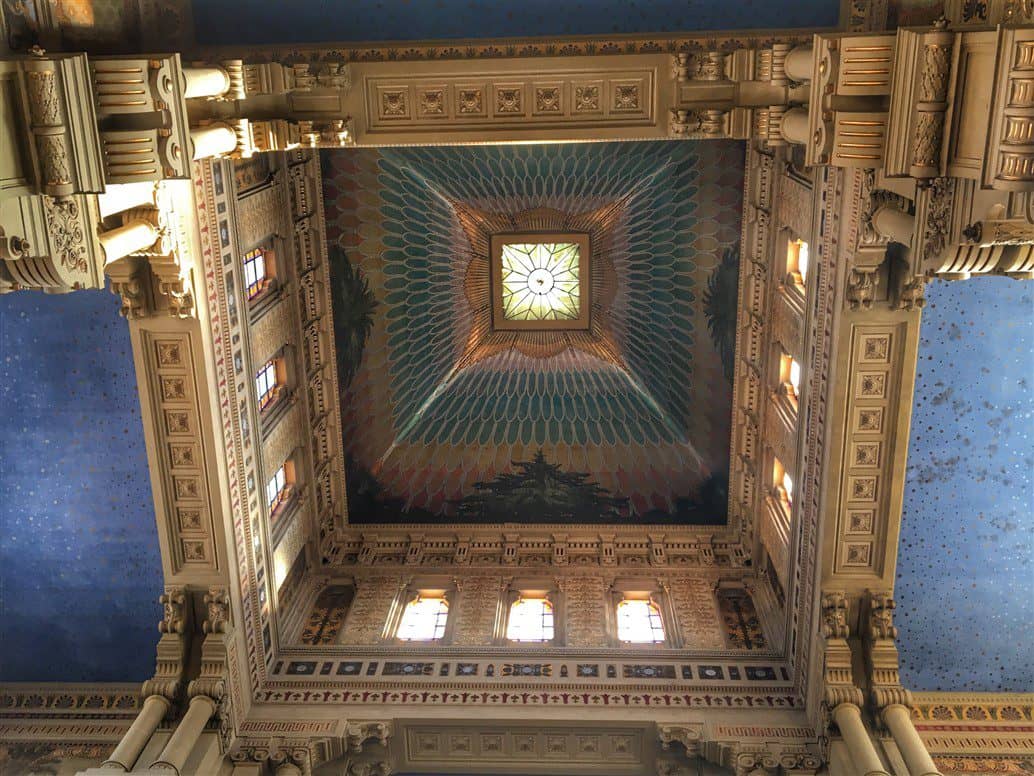
The Great Synagogue, Included in the Ticket of the Jewish Museum of Rome
The Competition, the Architects, the Construction
After emancipation, the community decided to build a monumental synagogue on the land freed by the demolition of the ghetto, in one of the four large blocks created by the plan of 1888. The first stone was laid in June 1901 and the work wrapped up in 1904. The winning design was by Osvaldo Armanni and Vincenzo Costa, who took over after Attilio Muggia withdrew. The building was consecrated in July 1904. A few weeks earlier, King Victor Emmanuel III had visited the by then finished site, and that public gesture was worth as much as a speech.
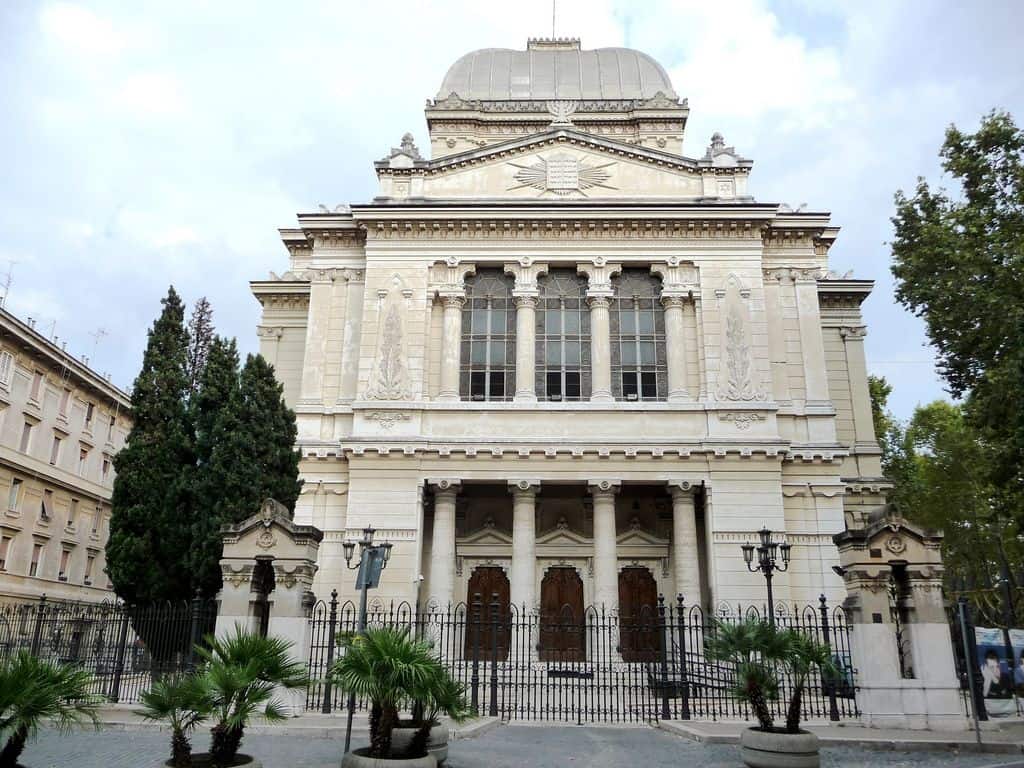
The choice to build tall and visible was deliberate. For three centuries the community had been allowed a single synagogue, hidden inside an anonymous palazzo. In 1904 it put on the Lungotevere a building that can be seen from the Janiculum, from the Aventine and from half the city. The Rome Synagogue is an affirmation of citizenship written in masonry, and that's how it should be read.
The Square Dome
The sign that makes the Great Synagogue recognizable from a distance is the pavilion dome on a square base, clad in aluminum. In a city of hemispherical domes, a square dome is an anomaly you read at once: you recognize it from Ponte Garibaldi, from the Vittoriano, from the Janiculum promenade. That was exactly the intention of the designers, who wanted a profile distinguishable from that of the churches and at the same time up to the monumental Roman context.
The style is eclectic. Armanni and Costa drew on Assyrian, Egyptian and above all Greek repertoires, with the idea of evoking the ancient Kingdom of Israel while adapting it to the taste and architectural context of Rome at the start of the 20th century. Some have called it Assyrian Babylonian, others Liberty. The truth is that the Great Synagogue belongs to that international season in which the great European synagogues looked for a language of their own, distinct from both the Gothic and Christian classicism.
The Interior, the Aron and the Tevà
The prayer hall has a Greek-cross plan and is decorated with a richness that surprises whoever enters expecting austerity. The stained-glass windows are by Cesare Picchiarini, the master glassmaker who worked for half the city in Rome. The wall paintings and ceilings are by Domenico Bruschi and Annibale Brugnoli, two leading names in Roman decoration between the 19th and 20th centuries. Palms, geometric motifs, starry skies: the non-figurative apparatus respects the Jewish precept and at the same time achieves an overall effect that few contemporary churches equal.
The Aron ha Qodesh, the cabinet of the Torah scrolls, and the Tevà, the pulpit from which the reading is done, are placed together in the apse area, following a 19th and 20th century practice that departs from the traditional layout of the Roman rite, where the Tevà stood at the center of the hall. It's a detail the museum's guides always explain and that is worth listening to, because it tells how even the oldest community in the West took on European models at the moment it entered modernity.
The Spanish Temple, the Scoletta
In the basement of the complex, since 1932, is the Spanish Temple, which Romans call the Scoletta. It hosts the Spanish rite, celebrated in Rome since at least 1492 with the arrival of the Jews expelled from Spain. In 1948 it was enriched with the marble furnishings from the Cinque Scole, and so today it is the space that comes closest to the look of the old ghetto synagogues.
The admission ticket includes the guided tour of the Great Synagogue. Access to the Spanish Temple depends on the type of visit and on the day's liturgical commitments, because it is a place of worship in use and not a museum room. If you care about it, ask at the ticket office when booking: the full guided tours of the museum and the synagogues, bookable as a separate service, are the surest route.
Bene Romi: The Ghetto in Augmented Reality
Since July 2025 the Foundation for the Jewish Museum of Rome has offered Bene Romi, Children of Rome, an immersive route with three-dimensional headsets that reconstructs the ghetto between 1555 and 1870. The itinerary is divided into five stops inside the vanished lanes and lets you see buildings that no longer exist, starting with the Palazzo delle Cinque Scole. The project was carried out by the Foundation with the technological support of Sagitek, the Department of Cultural Activities of the Jewish Community, the Roman Center for Jewish Studies of the University of Rome Tor Vergata and the Jewish Community of Turin.
The museum lists the experience in Italian and English, with a supplement over the ordinary ticket and an operator accompanying. For exact length, recommended minimum age and availability, it's best to check when booking on the museum's portal, because the time slots are capped. It's one of the few augmented reality applications in a Roman museum that isn't a toy. Here the technology serves to show something that was physically destroyed, which is the only case in which a digital reconstruction really has a reason to exist.
How to Really Visit the Jewish Museum of Rome
How Long It Takes and in What Order
The museum route takes a good hour if you read at a calm pace, an hour and a half if you listen to the whole audioguide. To that add the guided tour of the Great Synagogue, which the museum runs in shifts during the day and which generally lasts about 30 minutes. So count on two full hours to do things properly, and don't squeeze the next appointment in 30 minutes later, because the synagogue tours don't leave on command.
The right order is museum first, synagogue after. Not because the rules say so, but because the Great Synagogue becomes a much more readable building once you've understood where the community that built it comes from. Whoever enters the synagogue without having seen the Cinque Scole in the display cases below sees a beautiful decorated hall. Whoever enters after sees the end point of a story of three and a half centuries of confinement.
Security at the Entrance
The complex is a sensitive target and the checks at the entrance are serious: metal detector, inspection of bags and backpacks, security staff. Bring an ID and allow for a few minutes of waiting at peak hours. Don't show up with large luggage or a wheeled suitcase, because there's no equipped storage to receive them and you risk not getting in. If you're traveling with a day pack, empty out the unnecessary beforehand.
In the synagogue a code of behavior applies that holds in any place of worship in use: shoulders and knees covered, men are asked to cover their heads and a courtesy kippah is available at the entrance. Phones silent. These are minimal and reasonable requests, and explaining them beforehand avoids embarrassment afterward.
Photography
Photographs and video inside the museum and the synagogue are subject to restrictions. The prudent rule is not to shoot until you're told explicitly that you may, and in any case never during services. The museum rooms also have low lighting for the conservation of textiles, so flash is out of the question technically as well as by regulation. Ask the staff at the ticket office: the answer changes depending on the spaces and the moments.
Accessibility of the Jewish Museum of Rome
The entrance is set up for overcoming architectural barriers and access is allowed with wheelchairs and strollers. The synagogue is reported as fully accessible. In the museum the first level is fully usable, while the second is only in part. Anyone who gets around in a wheelchair and wants to be sure of the practicable route on the chosen day does well to phone the museum first, because the building is historic and some solutions depend on staff availability.
On the fare side, admission is free for visitors with a certified disability above 74 percent, with a free companion in the case of people who are not self-sufficient. The captions along the route are written in Italian, English and Hebrew, and the QR-code audioguide covers seven languages: whoever travels with foreign relatives doesn't have to interpret for two hours.
The Jewish Museum of Rome with Children
Under 10 you get in free, which makes a family visit economically sensible. The points that work with children are the interactive ghetto table in Room 5, the silver with the little bells of the rimonim in Room 4 and the room of the holidays, where the objects are set in scenes of daily life and so are immediately understandable. The museum runs educational workshops for groups of children, bookable separately.
On Room 6 parents need to make a conscious decision. With children under 10 you can walk through without lingering. With middle and high school kids it is instead the main reason to bring them here, provided you talk about it before and after. It happens that school classes come out of this visit in silence, and it's not the silence of boredom.
When to Go and When to Avoid
The best time is early morning, at the 10:00 opening, Sunday to Thursday. On Friday the hours are reduced and everything gets concentrated in the morning: if you can, avoid it. On Saturday the museum is closed, and Jewish holidays have to be checked on the calendar. In the warm months the advantage of the morning visit is double, because the underground rooms are cool but the neighborhood outside, with no shade, is not.
The week around October 16 is dense with commemorations and the neighborhood takes part: it's a moment of great civic intensity, but not the most comfortable moment for an ordinary tourist visit. Whoever wants to understand the neighborhood in those days should go with that spirit. On bridge days and long weekends reservations sell out, so the online ticket is worth it, €1 fee or not.
What's Around the Jewish Museum of Rome
The Jewish Quarter Today
The quarter extends over four blocks and includes Via Catalana, Via del Tempio, Via del Portico d'Ottavia, Via della Reginella, Piazza delle Cinque Scole and Largo Stefano Gaj Taché, from the Lungotevere to the church of San Gregorio. Via della Reginella is the only street that keeps something of the narrow, tall layout of the old ghetto, and it's there that you understand with your feet what you saw in the museum with your eyes.
Portico d'Ottavia, the great complex of the Augustan age rebuilt by Septimius Severus, is the backdrop of the main street. Under its arches the fish market was held for centuries, hence the name of the church of Sant'Angelo in Pescheria that was grafted into it. A few steps away rise the arches of the Theater of Marcellus, begun by Caesar and inaugurated by Augustus, which in the Middle Ages became a fortress and then a noble palace: that's why today it has inhabited apartments above the Roman arches.
10 Minutes on Foot
From Ponte Fabricio, the oldest Roman bridge still in use in Rome, you reach Tiber Island in 30 seconds and Trastevere in three minutes. Toward the north, in 10 minutes you reach Largo di Torre Argentina with its Republican sacred area and the cat sanctuary, and from there Campo de' Fiori. Toward the south, the Capitoline Cordonata leads to the Capitoline Museums in a quarter of an hour of walking and elevation gain.
If you have to build a single day, the itinerary is this: Jewish Museum of Rome at opening, Great Synagogue with the guide, lunch in the neighborhood, slow stroll along Via della Reginella and Piazza delle Cinque Scole, Portico d'Ottavia, Theater of Marcellus, Ponte Fabricio, Tiber Island and Trastevere for the evening. It's barely three kilometers and 2,000 years.
Where to Eat, Without Random Advice
Judeo-Roman cuisine has a precise canon: carciofo alla giudia, baccalà fillets, concia di zucchine, aliciotti with endive, Boccione's Jewish pizza. The neighborhood is full of restaurants, some under rabbinical supervision and others not. If kashrut matters to you, the certification has to be checked on the spot or with the community, because it changes over time and can't be deduced from the sign. Be wary of tourist menus translated into six languages with photos, as anywhere else in the center of Rome.
A Curiosity About the Jewish Museum of Rome
The curiosity concerns the arithmetic of the Cinque Scole. The bull of Paul IV granted the Jews of Rome one synagogue only: one, not five. But the community shut up in the ghetto was not a homogeneous block, it was the sum of different traditions. There were the Romans of the most ancient rite, the Spanish refugees expelled in 1492 divided between Catalans and Castilians, the Sicilians driven out of the Aragonese island. Each group had its own liturgy, its own melodies, its own customs, and giving them up meant disappearing as a community within the community.
The solution was one of perfect administrative cunning: a single building, formally a single synagogue, inside which five distinct prayer rooms were carved out, each with its own Aron, its own furnishings, its own worshippers. On paper the ban was respected to the letter. In practice the ghetto had its five synagogues, and kept them for three centuries. The palazzo stood in the old Piazza delle Scole, received in 1835 a neoclassical facade with the clock and marble columns, and the Scola Catalana had been redone in 1628 to a design by Girolamo Rainaldi.
That palazzo is gone: it went with the demolition of the neighborhood. But its furnishings are down here, and Room 4 of the museum is called The Treasures of the Five Scole for precisely this reason. When you look at those silver pieces and those marbles, you're looking at the furniture of five churches inside a single house. It's the best possible metaphor for three centuries of Roman Jewish life: obeying the letter of the law and continuing to be themselves.
Something Nobody Tells You About the Jewish Museum of Rome
No tourist guide writes it for you, and yet it changes the planning of an entire trip: the Jewish Museum of Rome doesn't close only on Saturday. It also closes on about 10 other days scattered through the year, which shift from year to year because they follow a lunisolar calendar and not the Gregorian one. In 2026 the museum lists closures for Purim on March 3, for Pesach on April 1, 2, 3, 8 and 9, for Yom Ha'azmaut on April 22, for Shavuot on May 21 and 22, for Tisha Be Av on July 23, for Rosh Hashanah from September 11 to 13, for Yom Kippur on September 20 and 21, for Sukkot from September 25 to 27 and for Simchat Torah on October 4.
The most insidious case is Pesach, which in 2026 falls right in the Christian Easter period: whoever organizes an Easter long weekend counting on this visit risks finding the door closed on exactly the days they booked the hotel for. The same goes for the first half of September and for the last 10 days, when the autumn holidays follow one another. There are no extraordinary compensating openings.
The second thing nobody says is that this museum is neither a state nor a municipal museum: it's a museum of the Jewish Community of Rome, run through its Foundation. So it doesn't take part in the initiatives of the public circuit, doesn't apply the ministry's free Sundays, and isn't part of the cumulative cards of the civic museums. Whoever arrives with a pass in their pocket convinced they'll get in without paying makes a wasted trip. The trade-off is that the collection belongs to the community that produced it and that still uses it: part of the textiles shown on rotation is still in service in the synagogues of the city.
The Advice I Give You for Visiting the Jewish Museum of Rome
Advice number one is banal and nobody follows it: book online and take the first slot of the morning, at 10:00, on Sunday, Monday, Tuesday or Wednesday. Thursday is already busier, Friday has the short hours and Saturday doesn't exist. At the first slot the security check moves fast, the rooms are empty, and above all the guided tours of the Great Synagogue leave with small groups, which makes an enormous difference when the guide speaks in a hall with the acoustics of a cathedral.
Advice number two concerns the audioguide. It's included in the price and downloads to your own phone with a QR code, so bring your own earbuds and a charged battery: without earbuds you'll end up holding the phone to your ear or listening at low volume in a noisy room, and you'll miss half the commentary. If you travel as two, bring two pairs: sharing one earbud for an hour and a half is a guarantee of a marital quarrel.
Advice number three is about the schedule. Don't put the Jewish Museum of Rome in the same afternoon as the Vatican Museums or the Galleria Borghese. It's not a matter of physical tiredness, it's a matter of register: this is a museum that asks for attention to documents, numbers and names, and after three hours of masterpieces the brain is no longer in a condition to read a tombstone. Pair it instead with a slow stroll in the neighborhood, which is its natural second part, or with Via Tasso if you have the head for it.
One last thing: you don't come here with the attitude of an attraction collector. You come with a minimum of preparation, you read, you listen, and you leave with something. Anyone looking for a selfie opportunity in half an hour has 20 other options within a kilometer and had better use them.
Another Well-Known Fact, Yet Rarely Cited
Everyone knows the Jewish community of Rome is very ancient. Far fewer focus on what exactly the word uninterrupted implies. Jews have been in Rome since the 2nd century before the Common Era and have never left: there was no general expulsion as in England in 1290, in France in 1394, in Spain in 1492, in Sicily and the Kingdom of Naples shortly after. Rome is the only major European city in which a Jewish community lives in the same place, with the same rite, for over 22 centuries.
The consequence is that the Roman rite, the minhag benè Romi, is a liturgical unicum: it's not Ashkenazi, not Sephardic, and it's older than both. The prayers and chants heard at the Great Synagogue have a line of transmission that starts before the destruction of the Second Temple and has never broken. The bitter paradox is that this continuity was guaranteed, for three centuries, precisely by segregation: the ghetto kept the Roman Jews from leaving and forced them to stay, and by staying they preserved.
A second fact rarely cited concerns the catacombs. Rome has Jewish catacombs beside the Christian ones, and some are older. The casts of their tombstones can be seen in Room 2 of the Jewish Museum of Rome, and they are the archaeological proof of that early presence: Greek, Latin and Hebrew names, trades, community offices, and the seven-branched candelabrum dug into the tuff centuries before anyone thought of a ghetto. It's the part of the route that archaeologists know and tourists don't.
The Right Photo to Take at the Jewish Museum of Rome
First the uncomfortable part: the right photo, inside, often isn't taken. Filming in the museum and the synagogue is subject to restrictions and you don't shoot during services. The museum rooms also have deliberately low lights to protect the textiles, so flash is excluded technically as well. Ask at the ticket office, respect what they tell you, and don't try to be clever with the phone in your pocket: this is a place of worship in use, with a history you know.
The photograph worth building is the exterior one, and it's just one. Cross Ponte Garibaldi toward Trastevere, stop halfway and turn your gaze upstream: the square aluminum-clad dome stands out above the line of the plane trees of the Lungotevere, and in the same frame come the river, the 19th-century embankment walls and, if you widen out, the profile of the Janiculum. It's the photograph that explains everything: a building built to be seen, in a city that for three centuries had forced that community not to be seen.
The best light is that of the late afternoon in winter, when the low sun catches the aluminum of the dome from the west and lights it up. In summer, early morning is better, because at noon the metal burns against the light and the river is a white sheet. A second good frame is from Ponte Fabricio, with the Great Synagogue on the left and the arches of the Theater of Marcellus in the background: in a single photo there are 2,000 years of Rome and 120 of citizenship.
Outside the complex, the neighborhood deserves detail photographs more than panoramic ones: the brass stumbling stones in front of the doorways, the plaque of Largo 16 Ottobre 1943, the ancient fragments walled into the facades of Via del Portico d'Ottavia. Stumbling stones can be photographed, but with your head: they are memorial stones, not street furniture.
Some Important Events That Happened Here in History
The first event is July 14, 1555. Paul IV promulgates the bull Cum nimis absurdum and orders the Roman Jews shut into a fenced area of the Sant'Angelo district, with a distinguishing mark on clothing, a ban on owning real estate, trades reduced to dealing in rags and used clothes, and a single synagogue allowed. The gates close at sunset and reopen at dawn. The segregation will last until 1870.
The second is September 20, 1870. With the annexation of Rome to the Kingdom of Italy the ghetto is abolished and the Roman Jews are granted civil rights. In 1888 the master plan demolishes the neighborhood and rebuilds it above the level of the river. In June 1901 the first stone of the Great Synagogue is laid, and it is consecrated in July 1904 to a design by Osvaldo Armanni and Vincenzo Costa. In less than 35 years the community goes from the closed enclosure to a building visible from half the city.
The third event is September 26, 1943. Herbert Kappler summons the leaders of the community and demands 50 kilos of gold within two days, threatening deportation. The gold is collected and handed over, with the contribution of non-Jewish citizens as well. The raids on the community's offices and the looting of the libraries of the Rabbinical College go on all the same.
The fourth is October 16, 1943. At dawn on Saturday the SS surround the neighborhood and round up house by house. The people seized number 1,259, according to the reconstruction of the Fondazione Fossoli 689 women, 363 men and 207 children, gathered at the military college on Via della Lungara. 237 are released. On October 18 the other 1,023 leave from Tiburtina station on 28 cattle cars for Auschwitz-Birkenau. After more than four days of travel, at the selection 820 people are sent immediately to the gas chambers, while 149 men and 47 women are registered. 16 came back: 15 men and one woman, Settimia Spizzichino.
The fifth event is October 9, 1982. At 11:55 on a Saturday, the day of Shemini Atzeret and of the blessing of the children, a commando of five men attacks the worshippers leaving the Great Synagogue with hand grenades and automatic weapons. Stefano Gaj Taché, two years old, dies. About 40 are wounded. It is the gravest antisemitic act to take place in Italy since the postwar period. The attribution is to a Palestinian terrorist group linked to Abu Nidal's organization. None of the five identified has served a sentence in Italy for these acts.
The sixth is April 13, 1986, the visit of John Paul II to the Great Synagogue: the first time a pope entered a synagogue. In the speech that day the pontiff defines the Jews as beloved brothers and, in a certain way, elder brothers of the Christians. The visit of Benedict XVI on January 17, 2010 and that of Francis on January 17, 2016 followed. None of these three appointments has erased the earlier dates, and the Roman community has never asked that they do.
Who Has Passed Through the Jewish Museum of Rome
The complex has received three pontiffs. John Paul II entered on April 13, 1986, welcomed by Chief Rabbi Elio Toaff, in what remains the first visit of a pope to a Jewish place of worship. Benedict XVI came on January 17, 2010. Francis came on January 17, 2016. The three dates are the backbone of the relationship between the Church of Rome and the Jewish community of the same city, a relationship as long as the two institutions and as complicated as their history.
Even earlier, in July 1904, King Victor Emmanuel III visited the just-finished building, a few weeks before the consecration. For a community out of the ghetto for little more than 30 years, the sovereign's visit to its new temple had an explicit political value: it meant that the Roman Jews were Italian citizens like the others.
Among the figures the museum tells about, the most present is Settimia Spizzichino, the only woman to survive the deportation of October 16, 1943. She went through Auschwitz-Birkenau and Bergen-Belsen, returned to Rome and devoted the rest of her life to telling about those days in the schools of the city. Anyone who heard one of her testimonies knows there was nothing rhetorical in her way of speaking: there were dates, addresses, names of neighbors.
On the side of artists and craftsmen, some important names of Baroque and modern Rome pass through the Jewish Museum of Rome in the form of works. Girolamo Rainaldi designed the reconstruction of the Scola Catalana in 1628. In the Great Synagogue visited with the same ticket, Cesare Picchiarini worked on the stained glass and Domenico Bruschi and Annibale Brugnoli on the wall paintings and ceilings: three professionals who in the Rome between the 19th and 20th centuries decorated churches, palazzi and institutional seats, and who here took on a worksite of an entirely different meaning.
Finally, about 100,000 visitors come through here every year, and a not small part are Roman Jews themselves: for them it's not a cultural visit, it's the family archive. You sometimes see someone standing in front of a display case who points to an object and says the great-grandmother's surname. That's the reason the visitors' tone of voice in this museum lowers by itself.
Quick Questions About the Jewish Museum of Rome
How much does the ticket to the Jewish Museum of Rome cost?
Full €12, reduced for partner agreements €10, students up to 25 years old €6. Online booking adds a €1 fee per transaction and the ticket is non-refundable.
Does the ticket also include the synagogue?
Yes. The admission price includes the visit to the museum with audioguide and entry to the Great Synagogue with a guided tour. You don't enter the synagogue on your own: you enter accompanied, in the shifts scheduled during the day.
Can you also visit the Spanish Temple?
The Spanish Temple, the Scoletta, is in the basement of the complex and is a place of worship in use. Access depends on the type of visit and on the day's liturgical commitments: if you're interested, ask when booking or choose a full guided tour of the museum and the synagogues.
When is the Jewish Museum of Rome closed?
Every Saturday and on Jewish holidays. For 2026 the museum lists closures on March 3, April 1, 2, 3, 8 and 9, April 22, May 21 and 22, July 23, September 11 to 13, September 20 and 21, September 25 to 27 and October 4. The calendar still needs to be checked on the official website before you leave.
What are the hours of the Jewish Museum of Rome?
From April 1 to September 30, Sunday to Thursday 10:00-18:00 and Friday 10:00-16:00. From October 1 to 26 and from February 9 to March 31, Sunday to Thursday 10:00-17:00 and Friday 9:00-14:00. From October 27 to November 9 and from January 12 to February 8, Sunday to Thursday 10:00-16:30 and Friday 9:00-14:00. From November 10 to January 11, Sunday to Thursday 10:00-16:00 and Friday 9:00-14:00. Last entry is always set between 45 minutes and one hour before closing.
How long does the visit to the Jewish Museum of Rome take?
An hour and a half for the museum route with audioguide, plus about 30 minutes for the guided tour of the Great Synagogue. Allow two full hours.
Do you need to book?
It's not mandatory at every moment, but it's strongly recommended on weekends, bridge days and in high season. Reservations are made on the portal prenotazioni.museoebraico.roma.it.
Do children pay?
Under 10, admission is free. Students up to 25 years old pay €6.
Is the Jewish Museum of Rome suitable for children?
Yes, with some care. The interactive ghetto table and the liturgical silver work very well with the youngest. The room dedicated to the 20th century, instead, requires a conscious choice by the parents. The museum runs educational workshops for groups of children, bookable separately.
Can you take photographs inside?
Filming is subject to restrictions and you never shoot during services. The prudent rule is to ask at the ticket office and follow what you're told. The rooms have low lighting for the conservation of textiles and flash is excluded in any case.
Is the Jewish Museum of Rome wheelchair accessible?
The entrance is set up for overcoming architectural barriers and access is allowed with wheelchairs and strollers. The synagogue is fully accessible, the first level of the museum is fully usable, the second only in part. For the practicable route on the day you choose, it's best to phone the museum first.
Is there free admission on the first Sunday of the month?
No. The museum belongs to the Jewish Community of Rome, not to the state circuit or the municipal one, and it doesn't apply the ministry's free Sundays or the cumulative cards of the civic museums.
What checks are there at the entrance?
The complex is a sensitive target: you pass a metal detector, bags and backpacks are inspected and there is security staff. Bring an ID and don't show up with wheeled suitcases or large luggage.
How do you dress to enter the synagogue?
Shoulders and knees covered. Men are asked to cover their heads and a courtesy kippah is available at the entrance. Phones silent.
In what languages can you visit the Jewish Museum of Rome?
The QR-code audioguide included in the ticket is available in seven languages. The captions along the route are in Italian, English and Hebrew.
How do you get to the Jewish Museum of Rome?
Buses 23, 63 and 280 on the Lungotevere, a few tens of meters away. Tram 8 on Via Arenula. At Largo di Torre Argentina, lines C3, H, 40, 46, 62, 64, 70, 81, 87, 130, 190, 492 and 916. The nearest metro is Circo Massimo, line B, a little over a kilometer away.
What is the exact address?
The visitor entrance is on Via Catalana, on the side of the synagogue complex that faces toward the quarter. The complex extends along Lungotevere de' Cenci, in the Sant'Angelo district.
How many rooms does the Jewish Museum of Rome have?
The route covers about 700 square meters and winds through the Gallery of Ancient Marbles plus the numbered thematic rooms, dedicated to textiles, the Jewish presence in Rome, the holidays, the treasures of the Cinque Scole, life in the ghetto, from emancipation to today, Libyan Judaism and silver.
What were the Cinque Scole?
The five synagogues of the ghetto, gathered in a single building because the bull of 1555 allowed just one: Scola Tempio and Scola Nova of Roman rite, Catalana and Castigliana of the Spanish refugees, Siciliana of the Jews driven from the island. Their furnishings are today in the museum.
What is the oldest object on display?
The Aron of the Scola Catalana, dated 1523: the sacred ark for the Torah scrolls, the oldest preserved in Rome. It precedes the establishment of the ghetto by 32 years.
What is the difference between the Jewish Museum of Rome and the Jewish quarter?
The museum is inside the synagogue complex and keeps the objects. The quarter is the urban fabric outside, rebuilt after 1888 on four blocks between Via del Portico d'Ottavia, Via della Reginella, Piazza delle Cinque Scole and the Lungotevere. The museum also runs guided tours of the quarter, bookable separately.
Is there an augmented reality tour of the ghetto?
Yes. Since July 2025 the Foundation for the Jewish Museum offers Bene Romi, Children of Rome, an immersive route with headsets that reconstructs the ghetto between 1555 and 1870 in five stops, in Italian and English, with a supplement over the ordinary ticket. The time slots are capped and must be booked.
Can you take group guided tours?
Yes. The museum offers guided tours of the museum and the synagogues for families and adult groups of up to 25 people at a cost of €100 plus tickets, and for school and university groups at €50 plus student tickets. For the Jewish quarter there are separate rates depending on the number of participants.
How many visitors does the Jewish Museum of Rome have?
Around 100,000 a year, a considerable figure for a museum of 700 square meters and an excellent measure of how much the city cares about this history.
Is it worth visiting if I have little time in Rome?
If you have three days and have never been to Rome, the Vatican Museums and the Colosseum come first. If you have five days, or if you've been before, this museum teaches you things about the city that you won't find elsewhere, and in two hours.
What can you see nearby?
Portico d'Ottavia and the church of Sant'Angelo in Pescheria, Theater of Marcellus, Ponte Fabricio and Tiber Island, Trastevere across the river, Largo di Torre Argentina to the north and the Capitoline Hill with the Capitoline Museums to the south. All within a quarter of an hour on foot.
Why I Keep Coming Back to the Jewish Museum of Rome
We leave you with something worth more than any practical tip: leave the museum, turn left and walk slowly to Via della Reginella, then come back to Largo 16 Ottobre 1943 and stand still for a minute. The Jewish Museum of Rome doesn't end at the door. It ends 300 meters further on, when in the doorways, in the brass stones set among the sampietrini and in the voices coming out of the windows you recognize the same community whose silver you've just seen. Few museums in the world have their own continuation within walking distance, and none has the good fortune and the responsibility of having it for 22 centuries.
Article written by the editorial team of TourLeaderPro, contact them for Private/Corporate/V.I.P. Tours and Experiences.
Planning a trip to Rome? The English guides for visiting the city are on ItalyPlanner.com.