Cat Sanctuary at Largo Argentina
In short. There is one spot in Rome where the Roman Republic, an antipope, an Alsatian master of ceremonies, Julius Caesar and about 50 cats sleeping in the sun all turn up in the same quadrilateral of travertine and tuff.
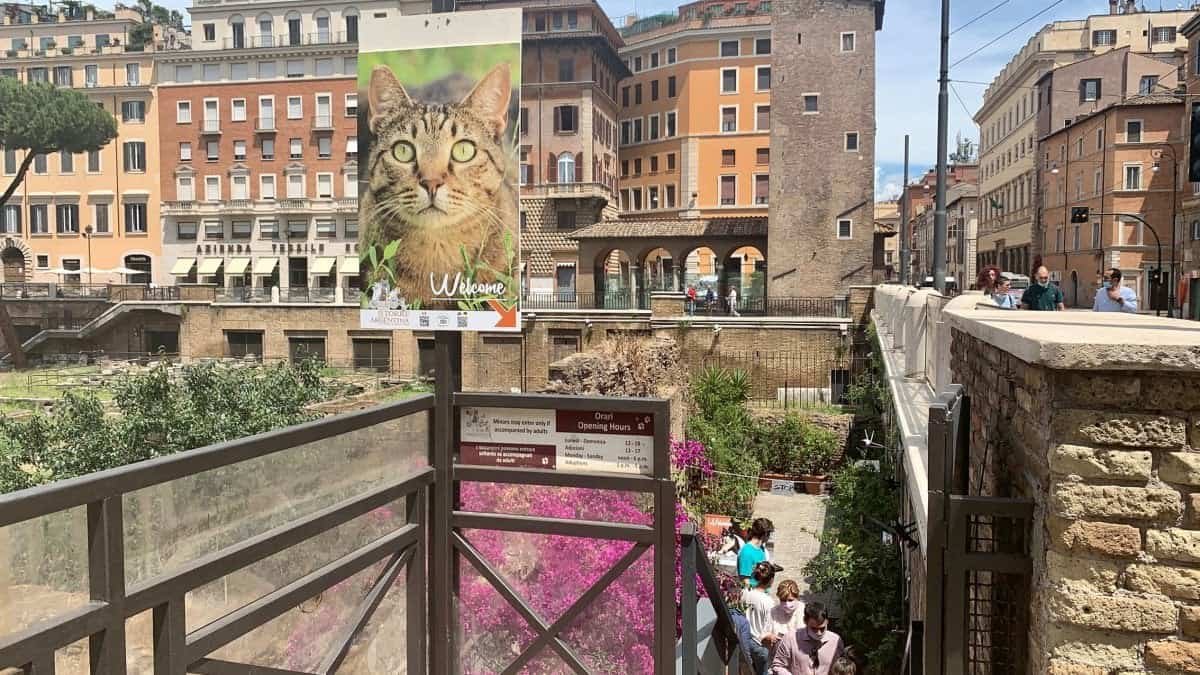
There is one spot in Rome where the Roman Republic, an antipope, an Alsatian master of ceremonies, Julius Caesar and about 50 cats sleeping in the sun all turn up in the same quadrilateral of travertine and tuff. It's called Largo di Torre Argentina, and for most Romans it's mainly a bus terminus. It is actually one of the most instructive places there is, because it shows, all at once, how Rome buries, how Rome forgets, and how Rome, without saying so too loudly, takes care of what remains. The Cat Sanctuary at Largo Argentina is the living part of that story.
I'll tell you upfront so we're clear: it's not a zoo, it's not a feline museum, it's not an attraction built for tourists. It's a shelter run by volunteers, set below street level, in spaces no one had ever designed for that purpose, inside a first-rate archaeological area. It runs on donations, many hours of unpaid work and a fair dose of Roman stubbornness. If you come with that in mind, the visit will stay with you for years.
What the Cat Sanctuary at Largo Argentina Really Is
Let's start with the most honest definition possible. The Cat Sanctuary at Largo Argentina is the shelter for the cat colony that lives in the Sacred Area of Largo di Torre Argentina, in the rione Pigna, on the border with Sant'Eustachio and Sant'Angelo. It occupies a few rooms below the street level, at the corner of via Arenula and the square, and it takes in cats that for different reasons can no longer live on the street: elderly cats, chronically ill cats, blind cats, deaf cats, amputees, and cats taken from colonies where they would not survive. Dozens of people rotate in and out to clean, give medications, manage adoptions and answer visitors' questions.
The difference between a sanctuary and a pound or a cat shelter comes down to this: there is no deadline. Whoever comes in and isn't adopted stays. And since Italian law prohibits the killing of healthy stray animals, the shelter is by definition a no-kill facility. In practical terms, that means every extra cat is a commitment that lasts years, not weeks. It's an ethical choice with a cost, and someone pays that cost: in this case, the donors and the volunteers.
A Shelter Inside an Archaeological Site
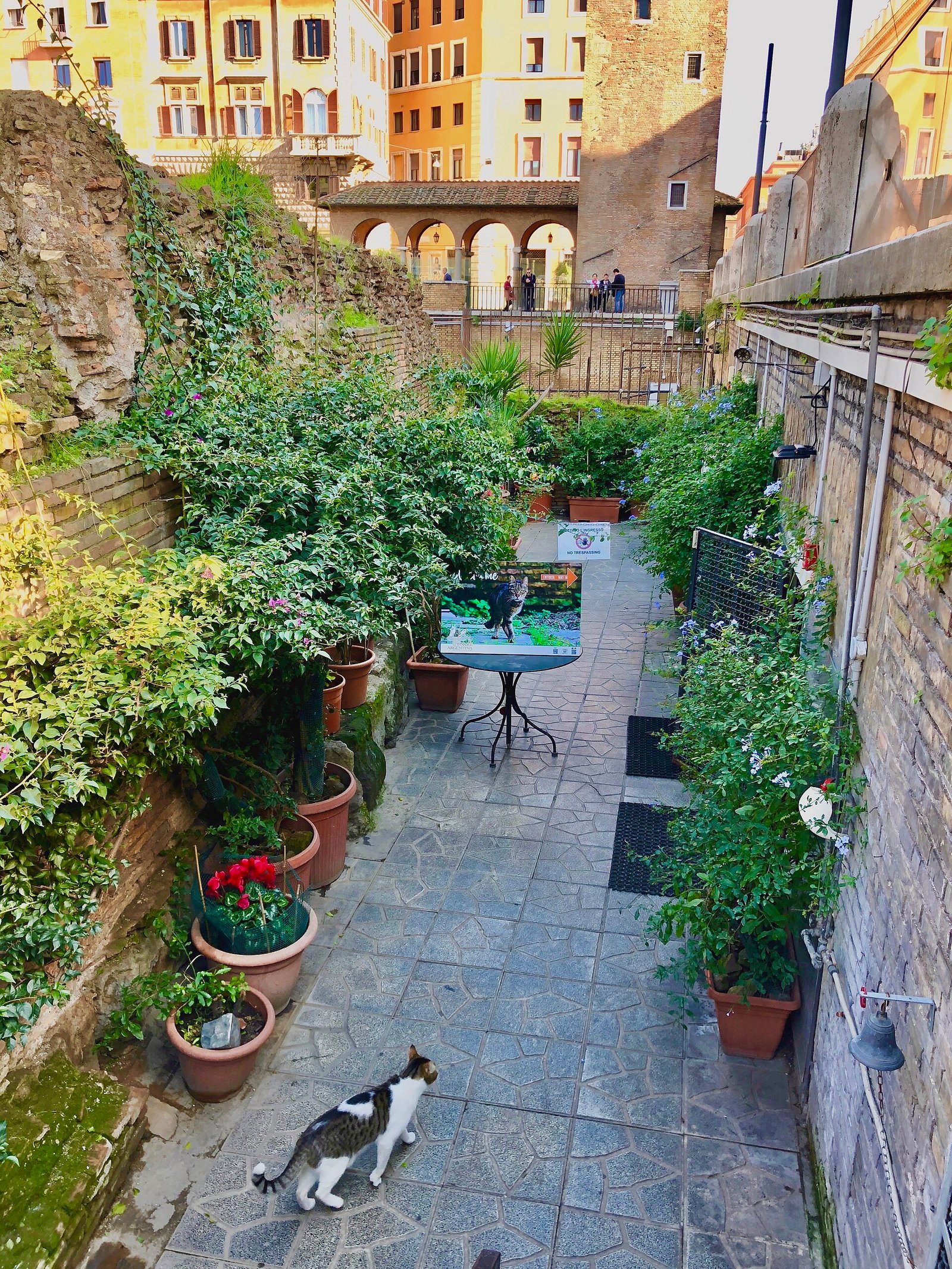
The location is what strikes most people who arrive for the first time. You're in the heart of Campo Marzio, the tram 8 runs overhead, in front of you stand four Republican temples, among the oldest in Rome still legible, and beside them there's a door with a sign pointing to the shelter. Go down a flight of stairs, and the temperature changes. The traffic noise fades. And you find yourself in a room with open cages, beds, blankets, bowls, a small table for donations and a smell of disinfectant and kibble that is the universal scent of every shelter in the world.
It's not a stage set. It's a repurposed storeroom, with the limits that come with that: low ceilings, bare-bones facilities, no public toilet because there is no adequate sewer connection. The volunteers talk about this openly, and they're right to. The appeal of this place lies precisely in the fact that it doesn't pretend to be something it isn't.
The Colony and the Shelter Are Not the Same Thing
A useful clarification, because it causes quite a bit of confusion. The feral cat colony is the group of free-roaming cats living in the archaeological area: they move among the temple podiums, slip into the niches, sleep on the column bases, and come out to eat when the volunteers pass by with food. The shelter is the enclosed facility where the cats that need ongoing care stay. The two worlds overlap, but they are not the same. Seeing a cat curled up on a block of tuff from the 3rd century BC doesn't mean that cat is "on display": it means the cat has picked the warmest spot in the neighborhood, something cats are absolute masters at.
That these cats have a legally recognized home always draws an incredulous smile. Yet it's true: Italian national law and the Lazio regional regulations protect free-roaming cats in their habitat and prohibit removing them. The Cat Sanctuary at Largo Argentina also exists because those rules exist, and because someone decided to take them seriously.
Exactly Where the Cat Sanctuary at Largo Argentina Is
The practical address is the corner between largo di Torre Argentina and via Arenula, on the southwest side of the square, where the staircase descends below street level. You're halfway between the Pantheon and Isola Tiberina, five minutes from the Ghetto, eight from Piazza Navona, and 12 minutes from Campo de' Fiori at a leisurely pace. It's one of the busiest crossroads in the Historic Center and, paradoxically, one of the most overlooked: people cross it to catch the bus and never look up.
The square is bounded by via di Torre Argentina to the north, corso Vittorio Emanuele II just beyond it, via Florida and via delle Botteghe Oscure to the east, via Arenula to the southwest, and via di San Nicola de' Cesarini on the side of the Teatro Argentina. This last street has become important since 2023, because it is where you access the archaeological area proper.
The Ancient Level and Today's Level
The first thing to understand is the difference in height. The walking surface of the Republican era sits about six meters below today's asphalt. It is neither an accident nor a local oddity: it is the rule across all of Rome. 20 centuries of collapses, fires, Tiber floods, demolitions, reused rubble, and new construction have gradually raised the level of the city. When you look down at Largo Argentina from the railing, you are looking into a well of time, and the bottom of that well is the Rome of Sulla and Caesar.
The Cat Sanctuary at Largo Argentina sits right on this change in height. The shelter is built within the thickness between the modern street and the excavated area, in rooms that look out onto the archaeology. It is a location no designer would ever have drawn up at a drafting table, and that is exactly why it works: the cats have a sheltered inside and a vast outside, protected by railings and free of cars.
Rione Pigna, the Neighborhood You Don't Expect
We are in Rione Pigna, the ninth rione of Rome, named after the large bronze pine cone from the Roman era, today kept in the courtyard of the same name in the Vatican Museums. It is a small, dense rione with a dual character: on one side, offices, the historic party headquarters on via delle Botteghe Oscure, and university bookshops, on the other, the alleys that climb toward the Pantheon and Sant'Ignazio. Walking for 10 minutes around the Cat Sanctuary at Largo Argentina, you cross two millennia without noticing.
It is worth remembering that here, in the imperial era, was the administrative heart of the grain distributions, meaning the system through which Rome gave grain to eligible citizens. The rione that today has canteens, bars, and grocery stores was already, 2,000 years ago, the place where food and lists of recipients were handled. Some urban vocations are more stubborn than walls.
How to Get to the Cat Sanctuary at Largo Argentina
It may be the easiest place to reach in the entire Historic Center, and that is not an exaggeration. Largo Argentina is one of the main hubs of Rome's surface public transport: tram number eight converges here, connecting Trastevere and Gianicolense to the center, and many bus lines pass through, crossing the central part of the city. Anyone coming to Rome from outside by train can get off at Termini and take a direct line, or use the metro to the nearest stops and continue on foot for about 10 minutes.
The advice is to walk there if you can. Walking from Piazza Venezia along via delle Botteghe Oscure takes six or seven minutes, and you pass Palazzo Venezia, with the bulk of the Vittoriano behind you, and then the side of the Crypta Balbi. Coming from the Pantheon, go down via di Torre Argentina and cross corso Vittorio Emanuele II, the great 19th-century artery that tore through the medieval fabric: one of those moments when the urban history of Rome explains itself right under your feet.
By Car: The Short Answer Is No
Rome's Historic Center is a limited traffic zone for much of the day, and surface parking around the square is practically nonexistent. If you're driving, leave the car in a park-and-ride lot and continue by public transport. This isn't a moralizing tip, it's just arithmetic: the time you'd spend looking for a space is more than the travel time by tram.
For people with mobility difficulties, the situation changes: taxis can pull up around the edge of the square, and the archaeological route was designed without level changes, with a platform lift. The shelter, on the other hand, is reached by a staircase, and it's good to know that in advance.
By Bike and on Foot from the Tiber
If you're getting around by bike or scooter, arriving along the Tiber embankment is the most pleasant option: head up via Arenula from Ponte Garibaldi, and in three minutes you're at the square. It's an almost flat route, which is not a given in Rome. Keep in mind, though, that the area around the Cat Sanctuary at Largo Argentina is very crowded with pedestrians and people waiting for the bus: get off and walk your bike through the last stretch, a courtesy that costs nothing.
A final note for anyone coming from the Ghetto: by taking via Florida or via delle Botteghe Oscure, you arrive on the east side, where you can see Temple D best. It is the largest of the four and is still partly buried under the modern street. It is the best approach, because it shows you all at once how little of ancient Rome has been excavated compared with how much still lies under the asphalt.
The Square Above the Cat Sanctuary at Largo Argentina: Why It Has That Name
Let's start with the most common misunderstanding, which I hear repeated at least once a week: Largo Argentina has nothing to do with South American Argentina. Nothing. Zero. The name comes from a tower, the Torre Argentina, and the tower takes its name from a man who came from Strasbourg.
The man's name was Johannes Burckard. He came from Alsace and served as papal master of ceremonies between the late 1400s and the early 1500s, during the years of Alexander VI Borgia. In the Latin documents of the time, Strasbourg was called Argentoratum, and people from there were called argentinensis. Burckard, who had a very Renaissance taste for self-promotion, had a small palazzo with a tower built in the area, the Casa del Burcardo, and from there the name spread first to the tower, then to the street, and finally to the square and the theater.
Burckard's Diary, a source worth its weight in gold
It's worth adding something that is rarely told to visitors. Burckard was not only a builder and patron. He was also an extraordinary chronicler. His Liber notarum, the diary of the papal ceremonies, is one of the most valuable and most merciless sources on the court of Alexander VI. It contains detailed descriptions of rites, processions, burials and scandals, recorded with the professional coldness of a man whose main job was to note the exactness of protocol.
It's amusing to think that the name of the cats' square comes, indirectly, from an Alsatian bureaucrat obsessed with ceremonial order. Rome has a particular talent for these ironies: the rigor of a master of ceremonies who ends up naming the most anarchic place in the city.
The Torre del Papito, which everyone confuses
On the side facing Via Florida stands a medieval brick tower that almost everyone calls, mistakenly, Torre Argentina. It is actually the Torre del Papito, a defensive structure probably from the XIV century, usually attributed to the Papareschi family. The popular name "papito," that is, "papetto," traditionally refers to the antipope Anacletus II, the Roman Pietro Pierleoni, who challenged Innocent II for the papal throne in the XII century and whose family dominated this part of the city.
The tower was dismantled and rebuilt several times during the twentieth-century works, and it was moved from its original position. Today it has a function no medieval builder would have imagined: it now houses the ticket office for the archaeological area. If you have a few minutes, look at it carefully. The masonry tells of repairs, infills and reuse of ancient material. It's a kind of vertical summary of Roman building history.
The Teatro Argentina, the illustrious neighbor
On the west side of the square stands the Teatro Argentina, inaugurated in 1732 by will of the Sforza Cesarini family and today the permanent home of the Teatro di Roma. It is one of the most important historic theaters in Italy, and it hosted one of the most famous and disastrous first performances in the history of opera: on the evening of February 20, 1816, Gioachino Rossini's Il barbiere di Siviglia premiered there, greeted with whistles, laughter and stage accidents. The fiasco was legendary. A few performances later, the same opera was a triumph, and it has remained one for two centuries.
For those visiting the Cat Sanctuary at Largo Argentina, this anecdote is a lesson in perspective. In the same square where an absolute masterpiece was rejected in a single evening, there is now a volunteer organization that lives between institutional mistrust and international affection. Rome has a long tradition of not immediately recognizing the value of what it has at home.
The Sacred Area surrounding the Cat Sanctuary at Largo Argentina
Now let's lift our eyes from the cats and look at the stones, because without the stones the rest doesn't make sense. The Sacred Area of Largo di Torre Argentina is a complex of four Republican-era temples, conventionally labeled with the letters A, B, C and D, aligned on a common platform and facing east, toward what is now Via delle Botteghe Oscure.
The alphabetical naming is an archaeological expedient. When the temples were excavated, it was not known for certain which deities they were dedicated to, so letters were used to work with them. Over time, research has proposed reasonable attributions for each one, but the letters have remained, and they are now part of the vocabulary of Rome. Together, the four temples span a chronological range that runs roughly from the IV-III century BC to the interventions of the Imperial age.
Why four temples together
The most frequent question is: why so close together? The answer lies in the logic of the Republican Campus Martius. This was an area outside the pomerium, that is, the sacred boundary of the city proper, where things could be done that were forbidden or inconvenient inside Rome: military assemblies, drills and, above all, the building of votive temples by victorious generals.
It worked like this: a commander about to go into battle promised the god the construction of a temple in exchange for victory. If he won, he paid for the building with the spoils of war. The temple became at once an act of devotion, a monument to his own glory and a tool of political propaganda. The Campus Martius thus filled with sacred buildings financed by military campaigns, and Largo Argentina preserves an extraordinarily concentrated sample of them.
An alignment that explains the city
Looking at the plan from above, you can see that the four buildings are not perfectly aligned with each other. They have slightly different orientations, a sign that they were built at different times, each following its own logic, and only later were they brought into line by a common platform. It's a detail that says a great deal about how Republican Rome grew: through successive additions, without a master plan, through constant adjustments.
There is a decisive moment in this story: the walking surface of the area was raised by about 1.40 meters, almost certainly after a major fire that the sources place in 111 BC. Raising the level meant shortening the access staircases, redoing the pavements, and moving the altars. It is the same process that raised all of Rome by six meters, captured here in a single datable event.
The Portico Minucia, the Structure Nobody Notices
Around the temples extended a large porticoed complex, the Porticus Minucia, built in 106 BC by Marcus Minucius Rufus with the spoils of his campaign against the Scordisci, a people of the Balkan Peninsula. In the imperial era, part of this complex, called the Minucia Frumentaria, became the administrative center for grain distribution to Roman citizens.
This is a detail I love telling alongside the Cat Sanctuary at Largo Argentina, because it creates a curious continuity. 2,000 years ago, at this exact spot, a public structure distributed food to those entitled to it according to strict lists. Today, a few meters away, an association of women volunteers distributes food to about 100 cats on an equally strict schedule. The beneficiaries change. The function of the place, in a way, endures.
Temple C and Temple A, the Oldest Stones Beside the Cat Sanctuary at Largo Argentina
If I had to point out just one spot in the area to look at closely, I would say Temple C. It is the oldest of the four, datable to between the 4th and 3rd centuries BC, and its most striking feature is the podium: a very tall block of tufa that rises to almost four meters. When you look at it from the railing, it seems like a base out of proportion with what once stood on top of it, and in fact it was: the monumental podium served to make the temple visible and dominant in an area that was then much less built up.
The most widely accepted attribution assigns it to Feronia, an ancient Italic deity associated with fertility, woodlands, and, according to some traditions, the freeing of slaves. She is a Sabine goddess, predating the official pantheon, and her presence here is a trace of the archaic religious world of Latium, which Rome absorbed as it took in neighboring peoples. Feronia's most famous sanctuary was at Lucus Feroniae, in the countryside north of Rome.
The Inscription from 174 BC
In front of Temple C an altar was found with an inscription bearing the name of a member of the gens Postumia, in connection with Aulus Postumius Albinus, which scholars date to 174 BC. It seems like a scholarly detail, but it is one of the pillars of the chronology of the entire area: that altar, together with its position relative to the different floor levels, makes it possible to tie the phases of ground-level raising to an absolute date.
This passage debunks the romantic idea of archaeology as a treasure hunt. The real work looks like this: an altar, a name, a date, and from there a chain of deductions that puts centuries of stratigraphy back in order. The colossal marble head makes headlines, it is the anonymous inscription that makes the science.
Temple A and Its Christian Second Life
Temple A dates to the mid-3rd century BC and is most likely attributed to Juturna, a nymph of springs and water sources, sister of Turnus in the Aeneid. The dedication is said to be linked to a naval victory in the First Punic War, which makes sense: those who return from the sea thank the gods of water.
What is fascinating about Temple A is that it had a very long second life. In the late Republican period it was rebuilt with a peristasis in the Greek style, that is, surrounded by columns on all sides. Later, in the Middle Ages, its structure was absorbed into a church: San Nicola de' Calcarario, later called San Nicola de' Cesarini. The two medieval apses that can still be seen today, with masonry clearly different from the ancient work, belong to that church.
The name "de' Calcarario" deserves an explanation, because it is both grim and instructive. In this area, for centuries, there were lime kilns: furnaces where ancient marble was burned to make lime. Statues, cladding, inscriptions, capitals: anything that was marble could end up in the furnace and be reused as building material. An incalculable amount of Roman sculpture disappeared this way, not out of barbarism but out of building economics.
Temple B and Temple D, Facing the Cat Sanctuary at Largo Argentina
Temple B is the one everyone photographs, even without knowing its name: it's the round temple, with its surviving columns arranged in a circle, the one that dominates the images of Largo Argentina. It's the only circular-plan temple of the four and also the most recent, dating between the late 2nd and early 1st century BC.
Its history is one of the best-documented. It was vowed by Quintus Lutatius Catulus, consul and colleague of Gaius Marius, to the goddess Fortuna Huiusce Diei, that is, the "Fortune of This Day." The context is the Battle of the Campi Raudii, near Vercelli, fought in 101 BC against the Cimbri, one of the decisive clashes of the Cimbrian Wars that saved Italy from the invasion of Germanic peoples on the move.
The Fortune of the Present Day
Let's pause on the name of the goddess, because it's disconcertingly modern. Fortuna Huiusce Diei is not fortune in general, it's not fate, it's not providence: it's the luck of today, of this specific day, of the hour when the fighting happens. A general about to send his men against an army far larger than his own doesn't pray to abstract Fortune: he prays to the luck of the next six hours.
This is a concept I gladly explain next to the Cat Sanctuary at Largo Argentina, because it also describes well the life of a shelter: you don't govern the general fate of Rome's cat population, you govern today, today's meals, today's treatments. Fortuna Huiusce Diei is, if you think about it, the titular deity of all volunteer work in the world.
The Colossal Head That Emerged from the Ground in 1926
Inside Temple B stood a cult statue made with the acrolithic technique: a method in which the head, hands and feet were carved in marble while the rest of the body was made with a core of less precious material covered in bronze or cloth. During the excavations of the 1920s, the colossal head and some limbs of that statue came to light. The head alone measures about 1 meter and 46 centimeters in height: an image of a goddess that, overall, stood several meters tall.
That head is no longer here: it's kept at the Centrale Montemartini, the museum set up in a former thermoelectric power station on the Ostiense, where ancient sculptures coexist with turbines and diesel engines. If the Cat Sanctuary at Largo Argentina has sparked your curiosity, that's the natural second stop: seeing the face of the goddess who stood right above the heads of the cats you just looked at.
Temple D, the Giant Still Buried
Temple D is the largest of the four and, paradoxically, the least visible, because a considerable part of its structure still lies under Via Florida and under modern buildings. What you see from the excavated area is only a portion of the original building.
The chronology is precise and verifiable in the literary sources: the temple was vowed in 190 BC by Lucius Aemilius Regillus after the naval victory at Myonnesus against the fleet of Antiochus III of Syria, and it was dedicated in 179 BC. The deities it is dedicated to are the Lares Permarini, the protective Lares of those who sail. A temple to the protectors of the sea, built with the spoils of a naval battle: the logic of do ut des is crystal clear.
The original podium was built in concrete and later faced with travertine in the late Republican period. When you look over from the side of Via delle Botteghe Oscure and see the structures disappear under the road, you're looking at the exact measure of how little of ancient Rome has been brought to light. Beneath the Historic Center, the ancient city continues under every building, every garage, every foundation.
Pompey's Curia and the Ides of March, a Few Meters from the Cat Sanctuary at Largo Argentina
Now we come to the reason this square appears in every world history book. West of Temples B and C are the remains of a tuff podium that scholars identify as the Curia of Pompey: the large hall attached to the Theater of Pompey complex, Rome's first permanent stone theater, inaugurated in 55 BC.
The Curia served as a meeting hall for the Senate when it did not meet in the Curia in the Forum. And in that hall, on the Ides of March, 44 BC, that is, March 15, Gaius Julius Caesar was assassinated by a group of conspirators led by Marcus Junius Brutus and Gaius Cassius Longinus.
What the Sources Really Say
It's worth separating facts from legend, because all kinds of embellishments have piled up around this episode. The main sources are Suetonius in his Life of Caesar, Plutarch in his Parallel Lives, Appian, and Cassius Dio. They agree on some points: the Senate session called in the Curia attached to Pompey's portico, the attack by a large group of senators, and death from multiple wounds. Suetonius speaks of 23 blows.
Plutarch reports that Caesar fell at the foot of the base that held the statue of Pompey, his former ally turned rival, who had been defeated and killed in Egypt three years earlier. It's the detail that has made the episode irresistible to literature for two millennia: the most powerful man in the world dying at the feet of the statue of the enemy he had defeated.
As for the most quoted line, that "tu quoque, Brute, fili mi," it's best to be honest. Suetonius reports that some say Caesar spoke a line in Greek addressed to Brutus, but he explicitly adds that, according to others, Caesar died without saying anything. The Latin version we all know is a later construction, made immortal by Elizabethan theater. This clarification is almost always the part people remember most.
The Cursed Site and Augustus' Wall
After the murder, the site was considered cursed. Ancient sources say that the Curia was closed and walled up by order of Augustus, and that a commemorative structure was placed at the spot of the assassination to prevent its use forever. In the Roman mindset, it was a locus sceleratus: a place contaminated by the crime, which had to be neutralized physically.
In 2012, a Spanish research group from the Consejo Superior de Investigaciones Científicas, coordinated by archaeologist Antonio Monterroso, proposed identifying a mass of opus caementicium found in the area with that very structure, suggesting that they had precisely located the spot where Caesar died. The proposal sparked a heated debate. Among others, Andrea Carandini challenged the reading, offering a different interpretation of the structure's position relative to the entrance and the statue niche.
But I find it instructive to tell visitors this: the exact square meter where Caesar died is still a matter of scientific debate. This isn't a flaw in the research, it's how research normally works. If someone tells you "here, right here, Caesar fell," pointing to a spot with absolute certainty, know that they are simplifying things a lot.
Caesar, the Cats and a Sense of Proportion
There is an inevitable clash here, and it has become one of the defining features of the Cat Sanctuary at Largo Argentina: in the same area where the most famous political murder in Western history took place, a tabby cat now sleeps in the sun on a block of tufa. Some find this irreverent. It is the most Roman image possible.
Rome is the city that has watched emperors, popes, armies, sackings and revolutions pass through, and it has always carried on unperturbed with its own affairs. The cat stretching on the ruins of the Curia of Pompey does not offend Caesar's memory: it puts it in the right perspective. Power passes, the sun on the stone remains.
The 1920s Excavations and the Creation of the Square of the Cat Sanctuary at Largo Argentina
The Largo Argentina you see today did not exist before the 1900s. In its place was an extremely dense urban fabric of houses, shops, alleys and churches, built up over the centuries on top of and inside the ancient structures, without anyone knowing exactly what lay beneath.
As part of the major urban planning projects that, from Unification onward, reshaped Rome as the capital, it was decided to open a connection between via Arenula and corso Vittorio Emanuele II, that is, to route traffic through that tangle. Demolition work began in 1926 and quickly produced an unexpected result: a colossal marble head and the arms of a large statue emerged from the rubble.
The Demolition That Became a Discovery
That find changed everything. The excavations that followed, carried out between 1926 and 1928 and then resumed at intervals until the 1970s, brought to light the entire complex of the four temples. At that point, the political question arose: demolish and build as planned, or preserve?
The decision, made in 1928, was to preserve. The arrangement of the area was entrusted to architect and archaeologist Antonio Muñoz, a central and controversial figure in Roman urban planning of those years, and the Sacred Area was inaugurated on April 21, 1929, Rome's birthday, in the presence of Benito Mussolini.
It's important to say things as they are, without hagiography. The demolitions of that period destroyed an enormous amount of medieval and Renaissance urban fabric, and the families who lived there were moved to the outskirts. At the same time, in this specific case, that period produced the preservation of a Republican complex that today belongs to everyone. Both things coexist and both should be told.
An Enclosure With No Purpose
The result of the 1929 arrangement was paradoxical: an excavated archaeological area, fenced off, visible from above and not open to the public. For nearly a century, Largo Argentina has been a basin of ruins that you could look at from the railing but not walk through. A huge, splendid dry aquarium in the middle of traffic.
And it is exactly in this administrative void that the story we're interested in took hold. A site closed to the public, with no continuous supervision, with hundreds of sheltered crevices, right in the Historic Center, in a city with tens of thousands of free-roaming cats: it was only a matter of time. The cats arrived almost immediately, already during the years of the excavations, and they never left.
How the Cats Came to the Cat Sanctuary at Largo Argentina
The most widely accepted chronology says the first cats settled in the area during and right after the excavations, so already at the end of the 1920s. There's nothing surprising about it: a freshly uncovered area, with hundreds of cavities, low walls, niches, understairs spaces from the Imperial era and sheltered rooms, is for a free-roaming cat the equivalent of a luxury condo with central heating. Tuff and travertine store the heat of the sun and give it back in the evening.
On top of this came something very Roman: the square was, and still is, a transport hub surrounded by bars, trattorias, canteens and grocery stores. Where there is food, there are rats. Where there are rats, cats arrive. Where there are cats, sooner or later someone arrives to feed them. It's an inevitable chain, and in Rome it has repeated itself identically at dozens of archaeological sites, from the Colosseum to the Pyramid of Cestius, from the Verano to the Aurelian Walls.
Antonio Crast and the First Protectors
Among the people who from the 1950s on steadily looked after the square's cats, the actor Antonio Crast is remembered. He had the keys to the storeroom below street level and brought food regularly. Those keys then passed from hand to hand, from person to person, for decades, until they reached the person who would found the sanctuary proper.
It's a beautiful detail: the continuity of this place did not pass through an administrative act, a decree or a funding. It passed through a bunch of keys handed from hand to hand. The Cat Sanctuary at Largo Argentina was born from an informal relay lasting almost half a century.
Anna Magnani and the Patronage of Artists
Among the colony's historical supporters, names from Italian theater and film are remembered, starting with Anna Magnani, who is almost a symbolic image of Rome's cats, and other actresses such as Franca Stoppi. It's no coincidence that they were people from the entertainment world: the Teatro Argentina is right there, a few meters away, and those who worked on stage would step out in the evening into the empty square and meet the cats.
Over the years, many stories have been built around Anna Magnani, some verifiable and others frankly legendary. I prefer to stick to the solid fact: her name constantly recurs in the collective memory of Rome's cats, and the image of the actress bringing food to the strays is part of the affectionate self-portrait this city has of itself. If in some tale reality has been rounded off a bit, well, this is Rome, and Rome has always rounded things off.
The Cat Ladies of Rome, a Story That Explains the Cat Sanctuary at Largo Argentina
You can't understand this place at all without understanding the figure of the gattara. The word in Italian originally carries a mocking nuance: the elderly, lonely, somewhat eccentric lady who walks around with bags of scraps and talks to the animals. For decades it was used as an affectionate insult, and often just as an insult.
The truth is that gattare provided, for half a century, at their own expense and without any recognition, a service of urban hygiene and population control that no institution provided. They fed, they treated, they took cats to the vet paying out of their own pockets, they kept track of which cat had been missing for three days. They were an informal, capillary network, almost entirely female, and essentially invisible.
From Ridiculed Figure to Recognized Figure
The decisive turn came with legislation. The national framework law on companion animals and the prevention of stray animals, Law 281 of 1991, established a simple and revolutionary principle: free-roaming cats living in colonies are protected and cannot be removed from their habitat. In parallel, regional regulations built the practical system, with the census of colonies, the role of colony representatives, and sterilization entrusted to public veterinary services.
In Lazio, the reference framework is the regional law on the protection of companion animals and the prevention of stray animals, approved in 1997, which gave a legal framework to the colonies and to the people who look after them. Within a few years the gattara had become, formally, a feline colony representative: a role with rights and duties, no longer a neighborhood eccentricity.
In front of the Cat Sanctuary at Largo Argentina, the effect is always the same: people stop seeing a group of ladies feeding cats and start seeing a system for managing urban wildlife. Which is exactly what it is.
Why Sterilization Is the Heart of It All
There's a technical point that needs to be explained without sentimentality. Feeding a colony without sterilizing it is, in the long run, harmful. A female cat can have more than one litter a year. With plenty of food and no reproductive control, a colony doubles in a very short time, infant mortality explodes, infectious diseases spread, and the situation degenerates into suffering.
The method that works, now adopted all over the world, is trap, neuter and return: cats are caught with non-traumatic traps, neutered, vaccinated, identified with a small cut to the ear, and returned to where they lived. The colony remains, but it stops growing, and over time it naturally shrinks. The Cat Sanctuary at Largo Argentina defines itself, not by chance, first of all as a center for promoting sterilization, and only secondarily as a shelter.
The Birth of the Cat Sanctuary at Largo Argentina: Lia Dequel and Silvia Viviani
Now let's get to the actual founding, which is a story about two women and a chance meeting. In November 1993, Silvia Viviani, an opera singer, met Lia Dequel in the Torre Argentina archaeological area. Both were already doing, each on her own, what generations of cat ladies had done before them: bringing food to the cats in the square.
The difference is that they decided to get organized. They cleaned up and made usable the abandoned spaces below street level, got water, electricity, a phone, and a space to store food and blankets, and in the course of 1994 they set up a stable structure. When they started, the area's cat population already numbered about 90 animals and was steadily growing because of abandonments.
Who Lia Dequel Was
Those who knew Lia Dequel remember her as an elegant, cultured, austere woman, with an extraordinary determination and a real organizational ability. A widow since 1985 of the sculptor Oreste Dequel, with whom she had shared almost 20 years of life, after her husband's death she chose a quiet life and poured her energy into the cats.
She worked at the shelter every day: food, cleaning, treatments, management. She read in English and French, went to the cinema once a week, and for the rest of the time she stayed here. She died on July 3, 2013, after a rapid illness, and is buried in Trieste next to her husband. The Cat Sanctuary at Largo Argentina is, in a very literal sense, her legacy.
Silvia Viviani and the International Volunteers
Silvia Viviani continued the work and for years was the living memory of the shelter. Around the two founders, over the years, a group of volunteers of different nationalities gathered: Italian, French, German, American, British, Dutch, and Brazilian. It is one of the most distinctive features of this place and one of the reasons for its international reputation.
The practical point is that at the shelter's front desk you can almost always find someone who speaks English, and often a second or third language. For a volunteer-run organization with no paid staff, it is a level of public service that many museums only dream of.
Support from Abroad
International animal protection organizations played an important role in the shelter's growth, in particular the Anglo-Italian Association for the Protection of Animals, which has worked alongside the project since the mid-1990s. Around this, a fundraising network was built, made up of charity dinners, small markets, raffles, and above all individual donations from foreign tourists, largely Anglo-Saxon.
There is one aspect worth pointing out without rhetoric: the Cat Sanctuary at Largo Argentina is better known abroad than in Rome. English-language guides have listed it for years as one of the experiences not to miss, and many Romans find out it exists when a friend from Chicago or Manchester tells them about it. It is a small short circuit that says something about the relationship this city has with its minor heritage.
How the Cat Sanctuary at Largo Argentina Works Today
Let's look at the daily mechanics, because it's the part people know least about and perhaps the most interesting. The shelter runs on shifts: some people open in the morning, some prepare and hand out meals, some take care of cleaning the litter boxes and the spaces, some give treatments to cats that need daily medication, some handle adoption paperwork, and some staff the front desk to welcome visitors.
Then there is the outside work, which the public almost never sees: trips to bring food to other colonies around the city, trapping for sterilization, transport to the vet, and rescues of injured cats reported by residents. The shelter at Largo Argentina is the visible point of a network that extends across dozens of Roman colonies.
How Many Cats There Really Are
This is the most frequently asked question, and the honest answer is: it depends on the moment. The numbers reported over time vary quite a lot, from a few dozen to several hundred, because the conditions vary: abandonments, capacity, adoptions, emergencies. In the summer of 2002, for example, an impressive peak was recorded, with hundreds of cats abandoned at the site over the course of the season.
So be wary of anyone who gives you a flat, definitive number. A reasonable order of magnitude for the number of cats housed permanently in the shelter is a few dozen, often around 100, but it's a figure that keeps changing. What doesn't change is the principle: the shelter mainly takes in cats that have no alternative, meaning those that wouldn't survive on the street.
The summer of abandonments
It's worth explaining why summer is the critical season. It's the time when people leave for vacation, and even today it's the period with the largest number of abandonments: cats left in cardboard boxes in front of the gate, litters dropped off at night, elderly animals taken from home and released in an area where "someone will look after them anyway."
The volunteers talk about it with a weariness you recognize right away. Abandoning animals is a crime under the Italian penal code, yet the scene repeats itself every year. And every cat dumped in front of an already full shelter is one fewer spot for a cat that would really need it.
The cycle of food and care
Feeding about 100 cats is no simple matter. Some cats eat only wet food, some need kidney diets, some are diabetic and need strict schedules, and some are elderly and have no teeth. The stock of dry food and canned food fills an entire warehouse, and it comes largely from material donations from visitors.
The same goes for medicine and medical supplies. If you want to help in a concrete way and aren't sure how, there's a simple route: ask the volunteers what they need at that moment. The answer is often less romantic than one might imagine, and it covers litter, disinfectants, blankets and syringes.
Sterilizing, treating, adopting: the work of the Cat Sanctuary at Largo Argentina
If you look at the shelter only as a place where cats live, you miss the most important part. The real output of this facility isn't the cats you see, but the cats you will never see: those that were never born because the mother was sterilized in time, and those that were treated and returned to their original colony.
The overall numbers the association has reported over the years show the scale of the effort: tens of thousands of cats sterilized and vaccinated over a decade, with interventions reaching thousands of colonies across the city, and annual figures that count in the thousands of operations. These are numbers no single shelter could handle alone. They presuppose a network of partner veterinarians, volunteer transporters, and neighborhood contacts.
The capture, explained properly
Many people imagine that sterilizing a free-roaming cat is a matter of grabbing it. Anyone who has tried knows it's exactly the opposite. Non-traumatic snap traps are used, baited with particularly appealing food. The traps must be checked constantly because an animal can't stay in them for long. A captured cat has to be kept in the dark and sheltered to reduce stress. After the procedure, a recovery period is needed before release.
It's also necessary to know the colony: which individuals are already sterilized, which females are pregnant, which cats actually belong to someone who lets them out. This is why the role of the colony contact is irreplaceable. It's a skill built on daily observation, one that can't be transferred with a manual.
Adoptions and criteria
The Cat Sanctuary at Largo Argentina adopts out a considerable number of cats every year, with documented peaks exceeding 100. But it's not a store, and it's best to make that clear before getting your hopes up. Anyone adopting is heard out, and they're asked about their home, their habits, whether there are other animals, and whether they're willing to take on any treatments that may be needed.
Some cats are placed only with experienced people, because they have chronic conditions or difficult behavior. There are elderly cats that they try to place in pairs, because they wouldn't tolerate being separated from their cage mate. There are feral cats that will never be couch cats, and they are relocated to protected colonies, not to apartments.
This strictness, which some may find excessive, has a very simple reason: the shelter doesn't want the cat to come back. A failed adoption is a trauma for the animal and a place occupied twice.
Long-distance adoptions at the Cat Sanctuary at Largo Argentina
Here we come to one of the smartest ideas of this facility, and to one of the reasons for its international reputation. Not everyone can bring a cat home: people who rent with pet restrictions, people who travel constantly, people who are allergic, people who live on the other side of the world. Long-distance adoption solves the problem at its root.
The mechanism is simple: you choose a cat from among those living permanently in the shelter, often one of the individuals that would struggle to find a home, and you help cover its upkeep with a regular donation. In return, you receive updates on its life, its condition, and what's happening with it. The cat stays where it is, looked after by people who know how, but it has someone who chose it.
Why it works so well
It works for a clear psychological reason: it turns an anonymous donation into a relationship. Someone who donates to a general association doesn't know where their money goes. Someone who sponsors a cat from a distance knows exactly which animal they are supporting, and that creates a bond that lasts for years. Some people come to Rome from other continents mainly to see the cat they have been supporting for a long time.
There is also a financial side that is not insignificant. Long-distance adoptions are predictable income, spread over time, which makes it possible to plan expenses. For a facility that receives no public funding, the predictability of income is worth as much as the amount.
Other Ways to Support
Besides long-distance adoption, there are open donations, bequests, donations of materials, and direct volunteering. The shelter needs above all people who can guarantee a regular presence. A fixed weekly shift is worth infinitely more than 10 hours concentrated in one weekend and never repeated.
For occasional visitors there is an easier route: the stand at the entrance, with gadgets, calendars, T-shirts, and postcards. Buying a Rome cat calendar is a tiny gesture, but multiplied by thousands of visitors a year it becomes the difference between paying the bills and not paying them.
The Special Cats of the Cat Sanctuary at Largo Argentina
If you go into the shelter, sooner or later you'll notice that quite a few of the residents have something different about them. A cat that walks with an odd gait, one with no eye, one that doesn't react to noise, one that moves along the walls, touching them. It's no accident: over the years the sanctuary has specialized precisely in taking in the cats that no one else would take.
There are the blind cats, who learn the layout of the shelter by heart with a precision that is astonishing, and who are never moved to a different spot because they would lose their landmarks. There are the deaf cats, often white, for whom congenital deafness is a known condition. There are the tripods, who readjust their balance within a few weeks after the amputation of a limb. There are cats with chronic renal failure, who need special diets and fluid therapy.
The Nursery and the Difficult Cases
Part of the space is set aside for fragile animals: orphaned kittens that have to be bottle-fed every few hours, convalescents, and animals that must be kept apart from the group for health reasons. It is the area that requires the most time and expertise, and it is the one that absorbs the largest share of veterinary costs.
Anyone who visits the Cat Sanctuary at Largo Argentina expecting to find a picturesque spot should know that behind the purring there is complex health management, with protocols, therapy records, and isolation of infectious cases. Admiring the tenderness is fine, but it's good to know how much technical work sustains it.
Names, Which Are a Chapter of Their Own
Every cat has a name, and the names tell the story of the people who gave them. There are Latin names that nod to the archaeological setting, names of actresses, English names left by foreign volunteers, and pure Roman dialect names. It's a small onomastic archive that reflects 30 years of people who have passed through here.
Ask the volunteers about the story of one particular cat, if you have time and it isn't crowded. Almost always a story comes out of it: where it was found, in what condition, how many months it took before it let itself be touched. These are the stories that make this place different from any other tourist stop in Rome.
The Difficulties and Battles of the Cat Sanctuary at Largo Argentina
It would be dishonest to describe this place as a fairy tale. Living side by side with a shelter for animals and a protected archaeological area is, administratively speaking, a complicated matter, and over the years it has produced serious tensions.
The core issue is well known: the spaces used by the shelter are within the perimeter of a cultural asset of primary importance and were not originally intended for that use. In 2012 the issue exploded publicly, with the concrete prospect of an eviction. The reaction was massive: tens of thousands of signatures collected in petitions in Italy and abroad, articles in the international press, and political stances taken.
How Coexistence Was Achieved
The most reasonable position, also supported at the institutional level, has always been the same: no eviction without an adequate alternative location. In parallel, a more mature idea has gained ground, namely that the feline colony was not a problem to be removed but a recognized part of the identity of the place. In public debate in Rome, people have come to speak explicitly of the colony as a biocultural heritage of the city, a phrase that sums up the issue well: here urban nature and material culture have become so intertwined that they can no longer be separated.
When the large redevelopment project for the area got underway, the city administration of Rome clearly reaffirmed the line: the feline oasis is not to be touched, and the visitor route was also designed with the protection of the cats in mind. It's a line the volunteers often quote, with the tone of people who had to fight to get it.
The Fragilities That Remain
That said, the situation is not resolved once and for all. The shelter continues to operate in a legally delicate condition, without public funding, relying entirely on donations and volunteers. Space remains insufficient, services are minimal, and maintenance is burdensome. Every year, the books have to be balanced from scratch.
I say this because I believe one aware visitor is worth more than 10 enthusiastic ones. If the Cat Sanctuary at Largo Argentina strikes you as a nice place, remember that its existence is not guaranteed by any budget law. It is guaranteed by people who give their time and by people who give their money. If you like, you can be one of the two.
The Reopening of the Sacred Area and Coexistence with the Cat Sanctuary at Largo Argentina
June 20, 2023 is a date that marks a before and after for this square. After almost a century in which the Sacred Area could only be viewed from above, the site was opened to the public with a visitor route that descends to the ancient level and lets you walk among the temples.
The project was carried out thanks to a cultural patronage initiative by the Bulgari maison, a historic Roman jewelry house, in agreement with the Capitoline administration, for an investment on the order of 1 million euros. The scientific direction is by the Capitoline Superintendency for Cultural Heritage.
How to Visit the Area Today
The entrance is on Via di San Nicola de' Cesarini, on the side of the Teatro Argentina. From there you go down, via walkways free of architectural barriers and with a lift platform, to the level of the excavations. The route runs alongside the four temples, allows you to observe the tuff podium of the Curia of Pompey up close, and leads to the exhibition spaces carved out below street level and in the portico of the Torre del Papito, where the medieval tower also houses the ticket office.
In the exhibition spaces you can see inscription fragments, sarcophagi, architectural decorations and two colossal heads of deities. Signage is bilingual, in Italian and English, and three-dimensional tactile panels with Braille text have been installed for visitors with visual impairments. It is one of the most carefully done displays among those recently completed in Rome.
For hours and costs, I'm giving you a method rather than a fact that could go stale. Check the website of the Capitoline Superintendency or the information service of the Comune di Roma before you go. Opening hours change between standard time and daylight saving time, there are weekly closing days, and residents of Rome and the metropolitan city have special conditions. Checking takes two minutes and saves you a wasted trip.
The Cats and the Walkway
The question everyone asks is: what about the cats, where did they go? They stayed where they've always been. The visitor route was designed so as not to interfere with the shelter area or the spaces the cats normally use. Walking along the walkway, you very often see one curled up on a column base or crossing with the solemn slowness of someone who knows they're at home.
It has to be said, the cat has won across the board. Before, it had an archaeological area closed off entirely to itself. Now it has a restored archaeological area, lit with LEDs and patrolled by staff, still entirely to itself, plus an admiring public that passes behind a railing. I don't know of any other urban renovation where the existing occupant came out so well.
Two Separate Visits, One Place
It's important to understand that the archaeological area and the shelter are two separate things, with different entrances. The first is entered from Via di San Nicola de' Cesarini with a ticket. The second is entered from the corner of Via Arenula, going down the small staircase, and visits are free during the time slots when volunteers are present, typically in the afternoon.
My suggestion, if you have time, is to do both in the same outing, and in this order: first the archaeological area, to understand where you are and what is under your feet, then the shelter, to understand who lives there today. In this sequence the visit makes narrative sense and doesn't reduce to two disconnected stops.
The Rules of Good Manners at the Cat Sanctuary at Largo Argentina
This is the chapter that, if it were up to me, I would print and hang at the entrance in 10 languages. Most of the problems the volunteers have to handle with visitors don't come from ill will but from misdirected enthusiasm.
Rule number one: cats are not picked up. Many of the guests are animals with trauma, illness, or years of living wild behind them. Being lifted by a stranger is a terrifying experience for them, and a frightened cat may scratch or bite in self-defense. If a cat wants to come closer, it will do so on its own. That is its way of giving you permission.
Rule number two: don't give them food. It seems like a kind gesture, but it is actually a serious problem. Many cats follow special diets for kidney, diabetic, or gastrointestinal conditions. A treat offered with the best intentions can undo weeks of therapy. If you want to contribute to their food, the way to do it is to donate, not to dispense food.
The Volume of Your Voice and Children
Rule number three: speak in low voices. The shelter is an enclosed space, with low ceilings, where dozens of animals sleep for most of the day. Cats have hearing that is enormously more sensitive than ours. A group that walks in talking as if they were at the bar turns a restful space into a source of chronic stress.
If you're with children, explain this to them before entering, not inside. Children can be asked for almost anything, as long as you ask in advance and give an understandable reason: "the cats in here are sick or elderly and need silence" works much better than a "shh" repeated 10 times in front of the cages.
Photos: yes, but with judgment
Rule number four: no flash. This applies inside the shelter and even more so with the animals, whose eyes are adapted to dim light. A flash fired half a meter from a sleeping cat is a small act of aggression. Today's phone cameras work very well with the available light. Turn off the flash at the entrance and don't think about it again.
Rule number five, the most delicate: don't obstruct the work. If a volunteer is administering treatment or cleaning, step back and wait. It seems obvious, and it isn't. At the busiest times the shelter becomes very cramped, and those who work there need to be able to get through.
And outside, in the archaeological area
In the excavated area, the free-roaming cats should only be watched. Don't climb over railings, don't go into unauthorized areas, and don't throw food or objects from above. Besides being dangerous to the safety of the ancient structures and to the animals, it is prohibited.
If you see a cat that seems injured or in distress, don't improvise a rescue. Alert the shelter volunteers or the staff of the archaeological area. They know how to tell which animals are already under care, which have results from past interventions, and which really need attention.
Visiting the Cat Sanctuary at Largo Argentina with children
It is one of the most effective destinations in Rome for children, and I say this after recommending it to many families. It has three advantages: it's short, it's concrete, and it's emotionally understandable at any age. After three days of churches, museums and lines, an hour among cats and temples puts families back at peace with their vacation.
It also works as a teaching tool. Standing at the railing, you can explain in five minutes why the ancient city lies six meters lower, what it means to "vow a temple," and why the Romans built temples with war booty. These are abstract concepts that, with the stones in plain sight and a cat walking over them, instantly become graspable.
How to tell a child about Caesar
Caesar's death is a powerful story, and it should be tailored to the child's age. With the youngest children, it's best to skip the details and stick to the core: there was an extremely powerful man, many people thought he wanted to become king, and his enemies killed him right here, in a hall that no longer exists. With older kids you can get into the political side, which is far more interesting than the act itself.
The point that always strikes them is the final paradox: the conspirators killed Caesar to save the Republic, and got the opposite result. After 13 years of civil wars the empire was born, and Caesar's very name became the title of rulers, all the way to the Tsar and the Kaiser. It's a history lesson in three sentences.
The agreement to make before going in
With children, the secret is to set the agreement beforehand. Low voices, hands at your sides, no running around, and anyone who keeps the agreement can stay as long as they want to watch the cats. Add that cats choose who they spend time with and that they choose the calm ones. It's a foolproof reason, and on top of that it's true.
Almost all children leave here wanting to adopt a cat. Before saying yes in a moment of emotion, remember that the Cat Sanctuary at Largo Argentina doesn't hand out animals on the spot to passing tourists, and it's the right call. If the wish survives the trip home, the right path is to contact a shelter in your own city.
When to visit the Cat Sanctuary at Largo Argentina
The shelter is open to the public in the afternoon, when the volunteers are on site and have finished the most intense part of the day's work. Hours can change, so the right approach is to check them in advance on the association's channels. Showing up early in the morning almost always means finding it closed.
If your goal is to see the free-roaming cats in the archaeological area, though, the best times are early morning and late afternoon, when the cats are active. During the midday hours of a Roman summer day, you'll only find motionless shapes in the shade of the walls. Cats have a very clear idea of how to survive July.
Seasons
Spring is the ideal season: long daylight, mild temperatures, active cats, and a livable piazza. April and May are also the busiest months in Rome, so plan on some waiting in line at the archaeological area ticket office, while the shelter rarely has long lines.
Summer is hard on everyone, cats included. If you come in July or August, aim for late afternoon and bring water. Autumn is the season I prefer: the low October light on the tufa podiums is worth the trip, and the square empties out. Winter has its own melancholy appeal, with the cats curled up in their shelters and traffic flowing gray above the ruins.
How Much Time You Need
For the shelter, 20 or 30 minutes is enough, unless you want to stop and talk with the volunteers, in which case time stretches out pleasantly. For the archaeological area, plan on 40 minutes to an hour, longer if you read all the panels and stop in the exhibition spaces.
All in all, a good hour and a half lets you do both at a relaxed pace. It fits nicely into the middle of the day, between a morning at the Pantheon and an afternoon in the Ghetto, or as a light ending to a heavy day.
What's Around the Cat Sanctuary at Largo Argentina
The location is so central that the challenge is not finding something to see nearby but choosing. Here is a half-day itinerary for understanding Rome without rushing.
Start at the Crypta Balbi, a short walk away on via delle Botteghe Oscure. It is the least visited branch of the National Roman Museum, and perhaps the most clever, because it tells the story of stratification: how an ancient building becomes a warehouse, then a convent, then public housing. Anyone who has grasped the height difference at Largo Argentina will find the full explanation there.
Toward the Ghetto and Isola Tiberina
Heading down via Arenula, you reach the Portico d'Ottavia and the Jewish quarter in a few minutes. It is one of the city's most intense places, with the synagogue, the Theater of Marcellus, and ruins emerging between the houses. From there, Ponte Fabricio, the oldest Roman bridge still in use in Rome, leads to Isola Tiberina.
It is a 20-minute walk that crosses 2,000 years without any hills. And along the way, if you look into the corners, you'll meet other cats. The colony at Largo Argentina is the most famous, but it is by no means the only one in the Historic Center.
Toward the Pantheon and Campo de' Fiori
In the opposite direction, going back up via di Torre Argentina, you'll reach the Pantheon rotunda in five minutes. Turning west instead, past corso Vittorio Emanuele II, you come to Campo de' Fiori and the statue of Giordano Bruno, and a little farther on, Piazza Farnese.
For those who love lesser-known details, I'd point out the Theater of Pompey complex: its structures are built into the buildings between Campo de' Fiori and via del Biscione, and the curve of the cavea can still be read in the layout of the streets. It is the same complex the Curia where Caesar died was part of. Walking from Largo Argentina to there means crossing, in modern terms, the footprint of one single gigantic ancient monument.
Where to Eat
On the subject of food, I'll give you a structural tip rather than addresses that change every two years. Around a square this busy, places facing directly onto the tourist flow are rarely the best. Just move 200 or 300 meters, toward the Ghetto or the alleys north of corso Vittorio, to find more serious cooking at more reasonable prices.
Be wary of menus translated into six languages with photos of the dishes, places with someone at the door inviting you in, and carbonara served at 11 in the morning. These signs are as reliable as a thermometer.
Accessibility and Services at the Cat Sanctuary at Largo Argentina
This topic needs to be addressed precisely, because the situation differs between the two spaces. The archaeological area, reopened in 2023, was designed according to universal accessibility standards: walkways without level changes, a platform lift to bridge the height difference between the street and the excavation level, three-dimensional tactile panels with Braille captions, and signage in Italian and English.
The shelter, on the other hand, is located in pre-existing rooms and is reached by a staircase. As things stand, it is not fully accessible to people with significant mobility difficulties, and it's good to know this in advance so you won't face an unpleasant surprise. Anyone with specific needs can contact the association ahead of time.
Essential Services
The shelter has no public restrooms, for a technical reason already mentioned: the necessary utility connections are lacking in a protected setting. It's a minor detail but a practical one, especially if you're traveling with kids. There are many bars in the area, and nobody will give you a dirty look if you buy something before asking.
The square is served by a busy surface bus terminus, so there is almost always activity even in the evening. As in all areas with a high density of tourists, keep an eye on your bags and backpacks: not because the place is dangerous, but because crowds are a pickpocket's best ally in any city in the world.
Traveling with Pets
If you're traveling with your dog, the answer is what you'd expect: other animals are not allowed in the shelter. This is not about disliking animals. It is about health and stress for animals that are already fragile. The standard rules for cultural sites also apply in the archaeological area, so check ahead.
Anyone who arrives with their own cat, planning to leave it here, will get, rightly, a very clear answer. The shelter has been full for years and only takes in animals with no other option. Abandonment is a crime, and it also takes a place away from the animals who really need one.
The most common mistakes made by visitors to the Cat Sanctuary at Largo Argentina
There are quite a few, and almost all of them come from wrong expectations. The first mistake is arriving expecting an organized attraction, with a ticket office, a set route and a bookshop. It isn't like that: it's a shelter, and like all shelters it has tight spaces, smells, noise and a rhythm set by the needs of the animals, not the visitors.
The second mistake is confusing the shelter with the archaeological area and believing that a ticket for one is valid for the other. They are run separately, with different entrances and different rules. The third mistake is thinking the shelter receives public funds, so a donation is unnecessary. It doesn't receive them, and a donation is necessary.
The most widespread mistake of all
The most frequent one, though, is another: going in, looking at the cats for three minutes, leaving, and not understanding anything about where you've been. The Cat Sanctuary at Largo Argentina is not a place you take in just by looking. It's a place you understand by asking two or three questions of the people who work there.
Ask how long they have been volunteering, how that cat with one eye came to be here, how many colonies they look after in the city, and what is really needed at this moment. These questions take 30 seconds and give you a piece of Rome that no printed guide can give you.
A note on compassionate tourism
In contemporary tourism there is a trend toward seeking experiences with animals that end up being harmful to the animals themselves. This place is the exact opposite: it doesn't offer you anything to do, it doesn't promise interactions, it doesn't sell contact. What it asks of you instead is to stay still, speak quietly and let the cats decide.
It is a more mature form of tourism, and it's good that Rome has such a clear example of it. If you leave here with a blurry photo of a gray cat and the feeling that you disturbed them very little, the visit has been a complete success.
Why the Cat Sanctuary at Largo Argentina tells the story of Rome better than many monuments
Let's wrap up the descriptive part with one consideration, perhaps while walking back up toward the Pantheon. Rome has hundreds of monuments more imposing than this one. None of them, however, explains three deep characteristics of this city as well as this place does.
The first is stratification: a temple from the 3rd century BC, a medieval church built inside it, a early 20th-century urban demolition, a colony of cats, and a restoration funded by a jewelry house. Five eras coexisting in the same square block, with none of them having erased the others.
The second: informality that becomes an institution
The second characteristic is the way things in Rome start out as private initiatives, almost clandestine, and then become consolidated until they are part of the recognized landscape. An actor who brought scraps to the cats in the 1950s, a set of keys passed from hand to hand, two women who decided to organize in 1993, and 30 years later an administration that publicly declares the feline oasis is not to be touched.
It is the same mechanism that produced half of this city's institutions. Rome rarely plans. Much more often it legitimizes after the fact what someone has already done. It isn't always a virtue, but it is undoubtedly a form of adaptive intelligence.
The third: the coexistence of the sublime and the everyday
The third characteristic is the hardest to explain to someone who isn't Roman. Here, the site where Julius Caesar was assassinated is not a secular sanctuary surrounded by reverent silence: it's a square with bus stops, an animal shelter, a theater, newsstands and traffic. And this, instead of diminishing the history, makes it bearable.
A city that constantly lived up to its past would be unlivable. Rome solved the problem by putting a bus terminus above the Curia of Pompey and letting the cats sleep on the temples. It is an irreverent and deeply wise solution, and the Cat Sanctuary at Largo Argentina is its daily proof.
A curiosity about the Cat Sanctuary at Largo Argentina
The most entertaining curiosity concerns the name of the place, and it's a small riddle. Asked where the name "Argentina" comes from, nine out of 10 visitors offer some South American guess: an embassy, a community of immigrants, an Argentine donor. The truth is that the name comes from Strasbourg, which in Latin was called Argentoratum, and from an Alsatian papal master of ceremonies who lived between the 1400s and 1500s, Johannes Burckard, who had his house with a tower built here.
The curious thing doesn't end there. In Rome's place names, this square has ended up generating two overlapping misunderstandings. The first, indeed, concerns the South American country. The second concerns the medieval tower you can see from the square, the brick one, which everyone calls Torre Argentina but which is actually the Torre del Papito, of a completely different origin and a completely different family. Burckard's real tower is part of the Casa del Burcardo, a short distance away, and today it is linked to the history of the Italian theater.
There is also a small extra irony worth pointing out. The cat is probably the most anarchic and least ceremonious animal there is, and this colony indirectly bears the name of a man who devoted his life to protocol, precedence and the order of papal processions. Burckard recorded with obsessive care who had to walk in front of whom. Five centuries later, in the place that bears his name, precedence is decided by a red cat stretched out in the middle of the walkway. I don't think he would have taken it well, and that is exactly why I find it one of the most elegant revenges Rome has ever staged.
Something Nobody Tells You About the Cat Sanctuary at Largo Argentina
The thing almost nobody says is that this place doesn't come from an animal protection project, but from an administrative void. The Sacred Area was excavated, fenced and opened in 1929, and then left for almost a century in a suspended state: visible but not visitable, protected but not enhanced, looked after intermittently. In that legal and practical space, left unguarded, the colony settled first, then the structure that looks after it.
This leads to a consequence that is rarely admitted: the Cat Sanctuary at Largo Argentina also exists because for decades no one managed to decide what to do with this area. If a visiting route with guards and gates had opened in 1930, in all likelihood the colony would never have taken hold, and this story wouldn't exist. It is a case where institutional inefficiency produced, by pure chance, a cultural value.
The second thing nobody tells is how fragile the shelter's position is on a formal level. The spaces occupied were not born with that purpose, the association has no public funding, and the question of regularization has reopened several times, with moments of real tension, particularly around 2012, when people began openly talking about eviction and tens of thousands of signatures were collected around the world. The formula that has allowed things to continue has always been the same: no relocation without a suitable alternative site.
There is finally a practical aspect that visitors only discover once inside. The shelter has no public restrooms, because the sewer connections needed on a heritage-protected site like this do not exist. It's a mundane detail, but it says more than many speeches about the real conditions in which people work here: dozens of chronic animals are cared for in spaces that were not designed to house either them or the people who look after them.
The Advice I Give for Visiting the Cat Sanctuary at Largo Argentina
My main advice is to reverse the mental order in which most people approach this stop. Don't come "to see the cats" and then, if there's time left, take a look at the ruins. Do the opposite: spend the first half hour at the archaeological area, following the route that goes down to the ancient level, and only afterward go down to the shelter. The difference in understanding is huge, because you arrive at the cats knowing exactly what they are sleeping on top of.
Second tip, a practical one: check the opening hours before you set out. The archaeological area is run like a museum, with closing days and hours that change between standard time and daylight saving time, while the shelter opens in the afternoon depending on whether volunteers are present. These are two different schedules that don't always match, and turning up at random is the surest way to see only a gate.
Third tip, which works as a rule of behavior and as a state of mind: go into the shelter and do nothing. Don't reach out your hands, don't call the cats, don't offer food, don't chase whatever looks most beautiful to you. Find a spot where you won't block the path, stay still for two or three minutes and let the space settle around you. In the large majority of cases, it will be a cat that comes closer, and at that point you will have gotten something no noisy visitor will ever get.
Fourth and last: bring a few coins or small bills and leave them, or buy something at the stall. This isn't about generic charity, it's about concrete sustainability. This place lives on donations, and the amount that is irrelevant to you, multiplied by the flow of visitors, is what keeps the shelter open. If you enjoyed the visit, the most consistent way to say so is to contribute.
Another Well-Known Fact, Yet Rarely Mentioned
The fact is this: everyone knows Julius Caesar was killed on the Ides of March in 44 BC, and almost everyone assumes it happened in the Senate, picturing the Curia in the Roman Forum. In fact, the Senate was meeting that day in the Curia attached to the Theater of Pompey complex, that is, right here, in what is today Largo di Torre Argentina. The Curia in the Forum was under reconstruction at the time.
The less often mentioned detail is what happened afterward. The site was considered tainted by the murder, a locus sceleratus, and ancient sources report that Augustus ordered it permanently closed, having the space walled up and a structure placed on the spot to prevent its use forever. It was not a sentimental gesture but an act of religious and political hygiene at once: the space of the murder was physically erased, and at the same time it was consecrated as a warning.
In recent years, an interesting scientific debate has opened about this structure. In 2012, a Spanish research group led by archaeologist Antonio Monterroso proposed identifying a mass of opus caementicium in the area with that Augustan monument, claiming it had pinpointed the exact spot where Caesar died. The hypothesis has been discussed and challenged, among others by Andrea Carandini, who offered a different topographical reading. The discussion is not closed.
So the little-known fact is not only that Caesar died here. It is that the exact spot remains an open question, and that the landscape you see today still preserves, in the form of a tufa podium, the trace of the removal ordered by Augustus. When you walk the walkway and see a cat stretched out nearby, know that it is occupying, with complete indifference, one of the most debated square meters in Western historiography.
The Right Photo to Take at the Cat Sanctuary at Largo Argentina
The photo I recommend is not a close-up of the cat. There are millions of them, they all look alike, and none of them shows where you are. The right photo combines the two layers of the story: the feline in the foreground and the recognizable ancient architecture behind it. In practice: a cat curled up on a block of tufa or on a column base, with the surviving columns of the round temple in the background.
Technically, the easiest way to get it is to lower yourself. Most photos taken here are shot from above, because people look over the railing or point the phone downward, and the result flattens everything. If you get down to the subject's level, or as low as the railings allow, you immediately gain depth, and the architectural backdrop comes into the frame.
As for light, the best hours are early morning and late afternoon, when low, raking sunlight brings out the warm color of the tufa and travertine and casts shadows across the podiums. At midday, the harsh light flattens the shapes and bleaches the pale stones. In winter, the afternoon is almost always perfect. In summer, wait for the last hours before sunset, which in Rome in July comes very late.
Inside the shelter, there is one rule, and it is not negotiable: no flash, ever. Cats' eyes are adapted to dim light, and a close flash is aggressive and painful. Use the available light, rest your phone on a steady surface if needed, and accept a bit of digital noise. And always ask the volunteers before photographing the work areas or people: it's basic courtesy, and in a place like this it counts double.
Some Important Events in the History of This Place
The first major event is the construction of the four temples themselves, spread over two centuries and tied to specific military episodes. Temple D was vowed in 190 BC by Lucius Aemilius Regillus after the naval victory at Myonnesus against the fleet of Antiochus III, and it was dedicated in 179. Temple B was commissioned by Quintus Lutatius Catulus for Fortuna Huiusce Diei after the battle against the Cimbri fought near Vercelli in 101 BC. Every stone in this area is, quite literally, the accounting record of a military campaign.
The second event is the major fire that the sources place in 111 BC, which made it necessary to raise the walking surface by about 1.40 meters, with the resulting reorganization of the staircases and altars. A second fire in the imperial era led, after 80 AD, to a new pavement of travertine slabs, still visible today. To non-specialists these episodes may seem minor, but they physically rewrote the entire area.
The third is, of course, March 15, 44 BC, with the assassination of Caesar in Pompey's Curia and the closing of the building that followed, ordered by Augustus. It is the event that made this quadrilateral a place of universal memory, cited in every literature, rewritten by Shakespeare, and repeated in schools around the world.
The fourth event belongs to the 20th century: the demolitions begun in 1926 to connect via Arenula with corso Vittorio Emanuele II, the chance discovery of the colossal head and marble arms, the excavation campaign that followed, and the 1928 decision to preserve the area rather than cover it. The layout was entrusted to Antonio Muñoz, and the Area Sacra was inaugurated on April 21, 1929, the day of Rome's birthday.
The fifth concerns the cats and the people: the colony's settlement already during the excavation years, the informal care carried on for decades, the meeting in November 1993 between Silvia Viviani and Lia Dequel, and the 1994 founding of an organized facility in the rooms below street level. From then on came the growth of a sterilization network across dozens of Roman colonies, thousands of adoptions, and international renown.
The sixth and most recent is the reopening of the Area Sacra to the public on June 20, 2023, after a restoration and display project backed by the patronage of the Bulgari maison and scientifically directed by the Capitoline Superintendency. For the first time in almost a century, it became possible to walk among the temples, and the feline colony was explicitly protected in the design of the route.
Who Has Passed Through the Cat Sanctuary at Largo Argentina
Let's begin with the ancient figures, who are of the first rank. Within this area passed Gaius Julius Caesar, who died here, Marcus Junius Brutus and Gaius Cassius Longinus, who killed him, Mark Antony, who was held outside the chamber while the plot was carried out inside, and the memory of Gnaeus Pompey the Great, whose statue stood in the Curia and at whose feet, according to Plutarch, Caesar fell. Even earlier, generals such as Lucius Aemilius Regillus and Quintus Lutatius Catulus had tied their names to the temples you still see today.
In the Renaissance, the area is dominated by the figure of Johannes Burckard, the Alsatian master of ceremonies of Alexander VI, author of the Liber notarum, one of the most detailed and most merciless sources on the Borgia papal court. The square owes its name to him, by an indirect route.
In the 18th and 19th centuries, the scene shifts to the theater side. The Teatro Argentina, which opened in 1732, hosted the world premiere of Gioachino Rossini's The Barber of Seville on February 20, 1816, an evening remembered for its resounding flop and the immediate comeback in the performances that followed. Two centuries of Italian music and theater have passed across that stage.
In the 20th century, archaeologists and urban planners arrived: Antonio Muñoz, who oversaw the layout of the area, and the teams who uncovered the temples between 1926 and 1928 and again on several occasions up to the 1970s. Benito Mussolini attended the inaugural ceremony on April 21, 1929, in a political climate that made extensive propaganda use of the discovery.
Then come the people who made the colony's history, and they are the ones who matter most. The actor Antonio Crast, who from the 1950s brought food to the cats and kept the keys to the storeroom. The actresses who supported the colony, among whom Anna Magnani is always remembered, an iconic symbol of the bond between Rome and its cats. And finally Lia Dequel and Silvia Viviani, who from 1993 turned an informal habit into a stable structure. Lia Dequel, who died on July 3, 2013, is the founding figure of this place in the most literal sense of the term.
Finally, in very recent times, the world of cultural patronage has also passed through here, with the involvement of the Bulgari maison, which made the restoration and the opening of the visitor route possible. And an astonishing number of volunteers of every nationality have passed through and continue to pass through, and the sum of their unpaid hours represents the true intangible heritage of the Cat Sanctuary at Largo Argentina.
Quick Questions About the Cat Sanctuary at Largo Argentina
Where the Cat Sanctuary at Largo Argentina Is
You'll find it at the corner of Largo di Torre Argentina and via Arenula, on the southwest side of the square, where a staircase descends below street level. You're in Rione Pigna, halfway between the Pantheon and Isola Tiberina, five minutes from the Ghetto and eight from Piazza Navona. The shelter is built into the thickness between the modern street and the excavated area, with rooms that look out onto the temples.
How to Get to the Cat Sanctuary at Largo Argentina
You can get there by surface transport, since Largo Argentina is one of the main hubs of Rome's public transit. Tram number eight converges here, connecting Trastevere and Gianicolense to the center, and many bus lines pass through. On foot from Piazza Venezia, along via delle Botteghe Oscure, it takes six or seven minutes. Leave your car in a park-and-ride lot, since the center is a limited traffic zone and there are practically no spaces around the square.
Do You Have to Pay to Enter the Cat Sanctuary at Largo Argentina?
No, the visit to the shelter is free during the hours when the volunteers are present. The ticket is required for the archaeological area instead, which is a separate thing, with its entrance on via di San Nicola de' Cesarini and the ticket office in the Torre del Papito. The shelter receives no public funding and runs on donations, so it's worth bringing some coins or buying something at the stand at the entrance, where you'll find gadgets, calendars, T-shirts and postcards.
When is the cat shelter open
The shelter opens to the public in the afternoon, when the volunteers are on site and have finished the most demanding part of the work. Hours can change and should be checked beforehand on the association's channels. If you show up early in the morning, you'll almost always find it closed. The archaeological area has a different schedule, with closing days and hours that change between standard time and daylight saving time, to be checked on the website of the Sovrintendenza Capitolina.
How much time the visit takes
For the shelter, 20 or 30 minutes is enough, more if you stop to talk with the volunteers. For the archaeological area, plan on 40 minutes to an hour, especially if you read the panels and stop in the exhibition spaces. A good hour and a half lets you do both at a comfortable pace. It's best to start with the archaeological area and go down to the shelter only afterward, so you reach the cats knowing what they sleep on.
The Cat Sanctuary at Largo Argentina is suitable for children
Yes, it's one of the places in Rome that works best with children, because it's short, concrete and understandable at any age. Set the rules before you go in: low voices, hands at your sides, no running around. The cats are not picked up, and they are not fed. Keep in mind that the shelter has no public restrooms and that it is reached by a staircase.
Article written by the editorial team at TourLeaderPro, contact them for Private/Corporate/V.I.P. Tours and Experiences.
Planning a trip to Rome? English-language guides for visiting the city are available at ItalyPlanner.com.