Capitoline Cordonata
In short. The Capitoline Cordonata is the stepped ramp that climbs from Piazza d’Aracoeli to Piazza del Campidoglio, in the Campitelli rione, in the exact heart of Rome.
The Capitoline Cordonata is the stepped ramp that climbs from Piazza d’Aracoeli to Piazza del Capitoline Hill, in the Campitelli rione, in the exact heart of Rome. It sits on the left side of the Vittoriano complex for anyone looking at the monument from Piazza Venezia, and on the right side for anyone coming down from the hill and looking toward the city. It is free, open 24 hours a day, with no ticket, no turnstiles, and no opening hours: you just walk up. It is also, very likely, the most photographed stretch of stairs in Rome after the one at Trinità dei Monti, and at the same time one of the monuments that is most often walked across without being looked at, because whoever climbs it has the square waiting at the top in mind and not the stage machinery that is carrying them up. The design is by Michelangelo Buonarroti, within the large 16th-century redesign of the Capitoline Hill commissioned by Pope Paul III. The actual construction, however, belongs to the decades after the artist's death, and that is why many guides who dismiss the ramp with the phrase “Michelangelo's staircase” only tell half the story. Anyone who wants to understand where the climb leads should also read the pages on the Capitoline Hill, the Capitoline Museums, the Palazzo dei Conservatori and the Basilica of Santa Maria in Aracoeli, which is the Cordonata's older, steeper big sister.

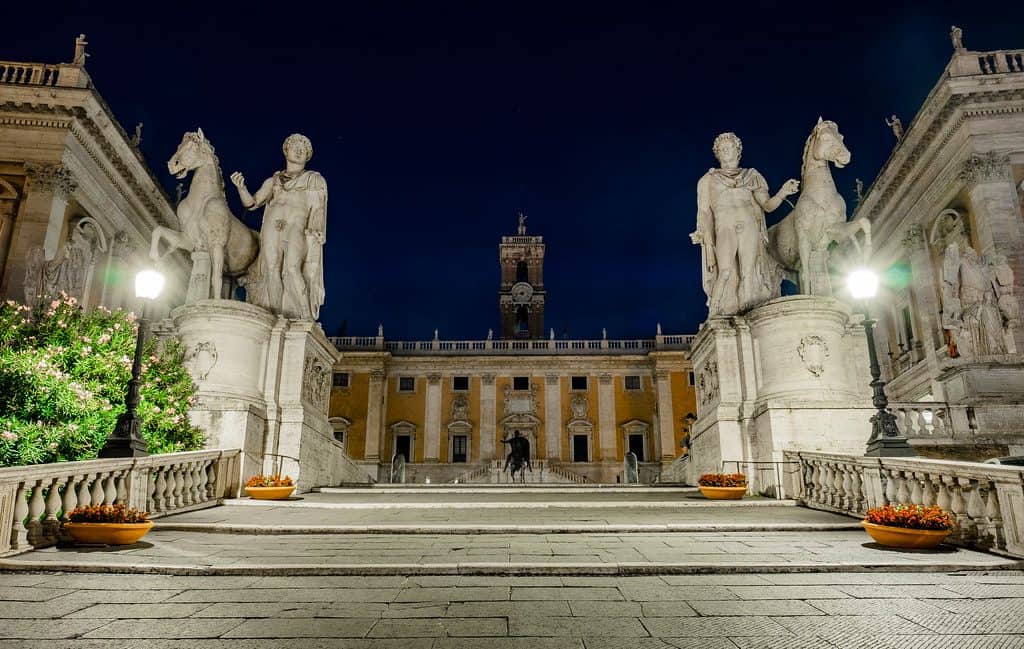
The “Capitoline Cordonata,” also called the “Cordonata del Campidoglio”: the ramp seen from below, with the balustrade at the top and the statues of the Dioscuri closing the view. From this point you immediately understand the trick of Michelangelo's design: the side parapets move farther apart as they go up, and the eye reads the ramp as shorter and wider than it really is.
Where the Capitoline Cordonata is and how to actually get there
The Cordonata starts from Piazza d’Aracoeli, a small open space just behind Piazza Venezia, and reaches Piazza del Campidoglio. In practical terms, anyone standing in front of the Vittoriano just has to go around its left side, walk about 40 steps along Via del Teatro di Marcello, and find themselves at the foot of the ramp. You don't need to look for directions, because the pair of twin staircases opening there is unmistakable: on the left, the long, straight, very steep staircase leading to the Basilica of Santa Maria in Aracoeli, and on the right, the gentler and wider ramp with the white balustrade, which is the Cordonata.
On foot, which is the right way
Almost everyone who gets here comes on foot, and that makes sense. From the Colosseum, follow Via dei Fori Imperiali all the way to the end, come out at Piazza Venezia, and turn left: 20 minutes of walking, all on level ground, with the Imperial Forums Museum at Trajan's Markets on your right and the archaeological areas on your left. From the Pantheon and Piazza Navona, the walk takes about 15 minutes, crossing the Sant’Eustachio rione and passing by Largo di Torre Argentina, where the Area Sacra del Campo Marzio is located. From Piazza di Spagna, go all the way down Via del Corso, and in 25 minutes of shop windows you arrive right in front of the Vittoriano. From the Ghetto and the Portico d’Ottavia, 10 minutes is enough, climbing up Via del Teatro di Marcello.
Subway, bus and tram
The most useful metro stop is Colosseo, on Line B, from which it's about a 20-minute walk along via dei Fori Imperiali. Those arriving on Line A can get off at Barberini or Spagna and walk, or change at Termini and take Line B. Many buses serve Piazza Venezia, and they change over time, so the sensible thing is to set the destination to “piazza Venezia” or “piazza d’Aracoeli” in the transit company's app and check which lines are running that day, because Piazza Venezia hub is reorganized often, and during the construction of the Line C metro the routes were moved several times. Tram number eight comes from Trastevere and its terminus is just a few steps away, on via delle Botteghe Oscure.
By car, scooter, or taxi
Driving here is a terrible idea, and it's worth saying so right away. The whole area is inside the Limited Traffic Zone of the Historic Center, with electronic gates active over wide time bands, and there are very few surface car parks, almost all of them reserved. Anyone who really has to get around by car leaves it in a park-and-ride lot along the metro lines, or in the paid garages around via del Teatro di Marcello and the lungotevere, and finishes the trip on foot. Taxis, on the other hand, can drop off in Piazza d'Aracoeli or on via del Teatro di Marcello without trouble, and are the most convenient option for people with mobility difficulties or traveling with small children and a stroller.
Accessibility: the real point
The Cordonata is a stepped ramp, not a smooth one: the cordons still create a change in level with every step, however small. A manual wheelchair pushed by an attendant tackles it with effort and a certain amount of bumping, an electric wheelchair copes better going uphill than downhill. Anyone who needs a route completely free of steps can reach Piazza del Campidoglio from the back, climbing from via del Teatro di Marcello along the driveway that circles the hill and comes out on the side of the Palazzo Senatorio. It's a longer route, but it's paved and continuous. Another useful access for those who want to avoid the outdoor climb is the one inside the Capitoline Museums, which has elevators, but it requires a museum ticket and follows opening hours, so it doesn't solve the problem in the evening.
What a cordonata really is, and why this is not a staircase
The word matters, because it contains the explanation of the entire project. A cordonata is a sloped road fitted with crosswise elements of stone or brick, called cordons, that project only very slightly from the inclined surface and serve to give a grip to the foot, the hoof, and the wheel. It is not a staircase, because there is no riser-to-tread ratio that defines a step. It is not even a smooth ramp either, because on a smooth ramp of that slope a shod horse would slip. It is a third thing, halfway between the two, and it is a solution that Italian building tradition has used for centuries whenever something heavier than a pedestrian has to be brought up a significant change in level.
In the sixteenth century, the practical point was exactly this. Piazza del Campidoglio was meant to become the stage for Rome's civic government and the place where the city's authority received important visitors. An important visitor in the sixteenth century arrived on horseback or in a litter, and would not dismount at the foot of a staircase to climb on foot like any ordinary pilgrim: that would have been a symbolic demotion. Michelangelo solves the problem with a ramp that allows riders to go up on horseback, with a gentle slope and low cordons, and places it beside a devotional staircase, the one of the Aracoeli, which by contrast is openly strenuous because the effort is part of its religious meaning. The two staircases stand side by side and say two opposite things: the one on the left speaks to the faithful, the one on the right speaks to the citizen and his guest.
The other cordonate in Rome
The Capitoline Cordonata is the most famous, but it is not the only one in the city, nor the only one to bear that name. In the Trevi rione, a few steps from the Quirinal Palace, there is another cordonata that even gave its name to a street, via della Cordonata, and that Romans use as a shortcut between the via Nazionale area and the Quirinal hill: anyone who searches a map for “cordonata” without specifying “capitolina” risks being sent there, and it's a mistake that often happens to foreign visitors. In the EUR there is also a monumental twentieth-century cordonata, the one that connects viale Europa to the Basilica dei Santi Pietro e Paolo, built in a completely different language but with the same functional logic: climbing a change in level without breaking it into steps. Other minor cordonate can be found on the Janiculum, on the Aventine, and in several convent complexes, where they helped carts carrying foodstuffs climb the slope.
Measurements, or what is not worth making up
Figures for the exact number of steps on the Capitoline Cordonata vary widely, depending on whether or not you count the steps of the two intermediate landings and the final stretch that opens onto the square. The same goes for the overall length and the width at both ends. Popular sources copy one another, and the measurements you find around rarely cite a survey. I prefer to say clearly that a reliable measurement is not available to consult here, rather than give a number and let it circulate again. What can be stated without risk is that the ramp visibly widens as it rises and that the slope stays even and gentle along the whole route, so much so that a person in normal condition climbs it without stopping and without getting out of breath in two or three minutes.
Michelangelo's Capitoline Cordonata: the design, the construction site, the hands that finished it
In the early 16th century the Capitoline Hill had none of the solemnity it has today. It was a lopsided hill, with the Palazzo Senatorio built over the ruins of the Tabularium and still facing the Forum, a misaligned Palazzo dei Conservatori, and a muddy open area used as a market and as a goat pasture, so much so that the area was called Monte Caprino. Access from the city came by irregular little streets and by the Aracoeli staircase, which from 1348 climbed very steeply toward the Franciscan church. The hill that had been the sacred and political center of ancient Rome was, in the Renaissance, one of the most neglected spots in the city.
The change came with Pope Paul III Farnese. Sources agree in placing the commission given to Michelangelo for an overall redesign of the hill around the middle of the 1530s, and in tying the project to the need to provide a dignified setting for official visits, starting with that of Emperor Charles V to Rome in 1536. Michelangelo envisions a unified system: a trapezoidal square closed on three sides by coordinated facades, with the Palazzo Senatorio at the far end, the Palazzo dei Conservatori on the right, and a mirror-image palace on the left, which will become the Palazzo Nuovo. In the center is an equestrian monument as the pivot. Toward the city is a monumental ascent that reverses the hill's orientation.
The reversal of the axis, which is the real invention
This is the part worth understanding, because it is the reason the Cordonata exists. For all of antiquity and throughout the Middle Ages, the Capitoline Hill faced the Roman Forum. The official approach climbed from below, from the area of the temples and civic basilicas, and the hill turned its back on the Campo Marzio. But in the 16th century the Forum was the Campo Vaccino, an expanse of buried ruins and pastures, while the living city had moved to the bend of the Tiber, toward the Campo Marzio, the Corso, and the palaces of the great families. Michelangelo takes note of the real geography and turns the hill 180 degrees. The Palazzo Senatorio gets a new facade with a double staircase facing the square, the square opens toward the west, and the Cordonata becomes the direct link between city government and the modern city. From then on, anyone who wants to reach Rome's civic power no longer climbs up from the imperial ruins. They climb from Piazza d'Aracoeli.
Who physically built the ramp
Precision is needed here, because the common phrase "Michelangelo's staircase" is true only at the level of the design. Michelangelo dies in 1564, and at his death only one part of the great Capitoline plan had been carried out. Sources point in particular to the double staircase of the Palazzo Senatorio among the works the artist was able to see completed. The completion of the system proceeds for decades under the direction of other architects, among whom Giacomo Della Porta is remembered especially. To him are due the rebuilding of the Palazzo dei Conservatori and the completion of the facade of the Palazzo Senatorio. The Cordonata belongs to this posthumous phase. The idea, the slope, and the relationship with the square are in Michelangelo's style, but the physical execution is by craftsmen who work when the author of the design is no longer there. The exact start and end dates of the ramp's construction vary from source to source, and I am not able to give one with certainty. What is established is that the sculptural elements decorating it are placed in the last quarter of the 16th century, which gives a measure of when the ramp was ready to receive them.
The Palazzo Nuovo, the third side of the square, comes even later, in the 17th century, and completes the symmetry. The paving of the square with the famous 12-pointed star pattern, which does appear in 16th-century drawings, is carried out only in 1940 by Antonio Muñoz following the original design. This means the Capitoline Hill you see on reaching the top of the Cordonata is a work begun in the 16th century and finished in the 20th, with 400 years of construction behind it.
A curiosity about Capitoline Cordonata
The effect is a deliberate optical illusion, and it's the reason the Cordonata looks so good in photographs even when the person taking the picture doesn't know why. The two side walls that flank it are not parallel: they diverge, meaning they gradually move farther apart as the ramp rises. The width at the top is greater than the width at the bottom.
Natural perspective would do exactly the opposite: any pair of parallel lines that recede from the observer seems to converge toward a vanishing point, and a ramp of constant width seen from below would look very narrow at the top, high, distant, and tiring to climb. By widening the sides as they go up, the design compensates for perspective: the two lines seem to stay parallel, the ramp looks short and wide, and the square at the top looks close. The effect is an invitation: the climb seems easy, and in fact it is easy.
The same principle governs the square that opens at the top, which is a trapezoid and not a rectangle, with the short sides diverging and the buildings on either side moving apart as they go toward the Palazzo Senatorio. Here too the goal is to correct perception and enlarge a space that, on its own, would be narrow and lopsided. The Cordonata and the square form a single optical mechanism: the visitor climbs inside a space that expands and emerges into a space that keeps expanding. The result is that the Capitoline Hill looks much bigger than it is, and anyone who has visited it remembers a vast square, when in reality it is one of the most compact monumental spaces in Rome.
One detail is worth adding that almost no one notices: the divergence of the walls means the statues of the Dioscuri, placed at the top of the two sides, end up farther apart than the logic of the design would suggest. Seen from below, they appear to be in proportion with the ramp, as you climb, they grow. When you get right next to them, you discover they are much larger than they appeared.
The Statues of the Capitoline Cordonata: Dioscuri, Trophies, Lions and Columns
The ramp is also a small outdoor museum, free and permanent, that gathers ancient pieces reassembled at different times with criteria that today we would call casual. It's worth walking it slowly and looking at the objects lining it one by one, because each has a story that comes from another place in Rome.
The Lions at the Base
Start at the bottom, with two crouching lions in dark stone, Egyptian in style, that guard the entrance to the ramp. They come from the area of the Isiac sanctuary of the Campus Martius, the complex dedicated to Isis and Serapis that stood in the area now occupied by the neighborhood between the Pantheon and Largo di Torre Argentina, and that over the centuries yielded obelisks, sphinxes, and Egyptian sculptures now scattered throughout the city. Sources place their installation at the base of the Cordonata in 1582, later they were turned into fountains, with water coming out of their jaws, and for a long time they worked as a water supply point as well as decoration. The originals were later moved indoors for conservation reasons, and the ones you see on site today are copies: a detail that practically no guidebook mentions, and that explains why the surface looks so crisp compared with an object exposed for centuries to Rome's rain.
Cola di Rienzo Halfway Up
On the left side, about halfway up the ramp, in a position deliberately set off from the central axis, stands the monumental statue of Cola di Rienzo. The character deserves a paragraph of his own, further on. For now, let's just go over the basic details of the work: the monument was made by Girolamo Masini, with the base designed by Francesco Azzurri, and it was placed in 1887, and so in the climate of Rome as the capital of the Kingdom of Italy. The choice of this spot is not accidental: it is near the place where, according to tradition, the tribune was killed in 1354 while trying to flee the Capitoline Hill as it burned.
The Dioscuri at the Top
At the top of the ramp, at the two ends of the balustrade, two marble colossi hold the reins of two horses. They are Castor and Pollux, the Dioscuri, the divine twins whom Roman tradition regarded as protectors of the city and helpers in battle. They have nothing to do with Michelangelo or with the original design for that position: they are ancient sculptures found during the sixteenth century in the Ghetto area, during the works that affected that district, and later restored and moved to the top of the hill. Their condition when found was mediocre, and the restoration work to fill in the missing parts was extensive, as was systematically the case at the time: what you see today is an ancient work reassembled with Renaissance criteria.
The Trophies of Marius, Which Aren't Marius's
Next to the Dioscuri, on the same balustrade, are two sculptural groups of arms, cuirasses, shields and standards piled up together: the so-called Trophies of Marius. The name is a long-established historical error. Throughout the Middle Ages they were attributed to Gaius Marius and his victories over the Cimbri and the Teutons, and under that name they entered the place names and the memory of the city. Later analyses established instead that these are sculptures from the Domitianic age, referable to the military campaigns Domitian waged against the Chatti and the Dacians around 89 AD.
Their origin is another Roman monument that is still visible: the monumental nymphaeum on the Esquiline known as Trofei di Mario or Ninfeo di Alessandro, the scenic terminal of an aqueduct, which today stands in the center of Piazza Vittorio Emanuele II. The sculptural groups were removed from there and placed on the balustrade at the top of the Cordonata starting in 1590. If you are in the Esquiline area, you can go and see the empty spot they came from. Mentally connecting the two places is one of the most instructive exercises you can do in Rome, because it shows how freely the city has moved its ancient pieces to compose new stage sets.
The Statues of Constantine and Constantine II
Two large imperial statues from the Baths of Constantine on the Quirinal, traditionally identified as Constantine and his son Constantine II, complete the top of the balustrade. These too arrived here from a different place and a different era than Michelangelo's design. Overall, the balustrade at the top of the Cordonata works like a sentence built from words borrowed from five or six different monuments, held together by the symmetry of the design.

Something No One Tells You About the Capitoline Cordonata
The thing almost no guide tells you is that the Cordonata, today, no longer leads where it used to lead. Michelangelo's Capitoline Hill was conceived as the face of the city's civic government turned toward the city itself. The ramp was the road by which the Roman citizen climbed to his magistrates, and by which the magistrates came down among the people. In the proper sense, it was the main entrance to Rome's city hall.
Over the course of the twentieth century, this relationship was turned upside down. The square at the top remains the seat of the city government, but the actual administrative access, the one used by those who work there and those who have to go there for paperwork, happens at the back, on the vehicle side that wraps around the hill. The Cordonata has become a tourist and ceremonial route. People climb it to take photos, to visit the museums, or to attend a civil wedding or an official ceremony. The day-to-day flow of municipal life avoids it.
There's a second element, even less cited. The building of the Vittoriano between the late 19th and early 20th centuries radically changed the context of the ramp. To build the monument to Victor Emmanuel II, an entire fabric of houses, churches and convents on the north flank of the hill was demolished, and the white mass that emerged ended up crushing the Cordonata against the Capitoline Hill. Michelangelo had conceived the ramp as an ascent that branches off from a small, dense urban fabric, with low buildings on either side, a contrast of scale that made the square at the top grand. Today that ascent starts next to a monument that surpasses it in height, width and whiteness, and the contrast is reversed. Anyone who wants to get an idea of how the area looked before can look at the 19th-century photographs kept in the Capitoline collections, or take a stroll through the Central Museum of the Risorgimento and the Ala Brasini of the Vittoriano Complex, where the story of the area's urban transformations feels at home.
Third element, the most concrete of all: the Cordonata is one of the very few monumental entrances in Rome on which no ticket, turnstile or opening hours have ever been imposed. That's not a given. The Trinità dei Monti staircase is subject to rules that prohibit sitting on the steps, access to many archaeological sites in the center is paid, even some historic squares are closed for events. The Cordonata stays open 24 hours a day, every day of the year, and that makes it the most accessible Michelangelo monument in the world: you can climb it at three in the morning without anyone asking for anything.
My advice for visiting the Capitoline Cordonata
The advice is simple and goes against everyone's habit: climb the Cordonata twice, at two different times of day, and the second time stop halfway.
Do the first climb early in the morning, between seven and 8:30, when the light comes from behind, the hill casts its shadow toward Piazza Venezia and the ramp is empty. In that time slot you find the Cordonata practically deserted even in high season, because organized groups start moving around 9:30 and individual tourists even later. Climb slowly, stop two or three times, turn your head and look back: the view that opens toward Via del Teatro di Marcello and toward the rooftops of the Campo Marzio changes at every landing, and seeing it with nobody in front of you is a privilege that costs only an early alarm.
Do the second climb in the last hour before sunset. At that hour the light hits the balustrade and the Dioscuri full on, the marble turns orange, and the square at the top fills with that low, raking light that makes the paving pattern very easy to read. It's also the hour when the museums close and the square gradually empties, so you only need 20 minutes of patience to find yourself in one of the most beautiful spaces in Europe with very few people around.
The part almost everyone misses
Once at the top, don't stop in the square: cross it, pass to the right of the Palazzo Senatorio and take the small street that runs along the building. At the end opens the terrace overlooking the Roman Forum, one of the most extraordinary viewpoints in the city and completely free. From there, with a single glance, you take in the Arch of Septimius Severus, Via Sacra, the remains of the civil basilicas, the Curia and, in the background, the Colosseum and the Arch of Constantine. It is the reward for the climb, and it is why the Cordonata deserves to be considered the start of a route and not an isolated photo.
Shoes, water bottles, backpacks
The curbs are stone and become slippery when it rains, especially going downhill. Anyone wearing smooth soles finds out the hard way. In summer the ramp has no shade at all: anyone climbing at noon in July gets sun from every side, including the reflection off the white marble of the Vittoriano, which acts like a mirror. The closest public drinking fountain is in Piazza d'Aracoeli and another in Piazza del Campidoglio, so you can refill your bottle at both ends without trouble. Free public restrooms in the area are scarce, and museum restrooms require a ticket.
Cola di Rienzo, the ghost who guards the climb
The statue halfway up the ramp deserves to be told about, because the figure it depicts is the reason the Capitoline Hill became, in the Italian imagination, the symbol of city self-government.
Nicola di Lorenzo Gabrini, known as Cola di Rienzo, was the son of an innkeeper from the Regola rione, born around 1313. A notary by training and an avid reader of the ancient inscriptions that surfaced everywhere in 14th-century Rome, he became convinced that the city could return to its ancient role if only it took its government back into its own hands. These were the years when the papacy resided in Avignon and Rome was in fact abandoned to itself, divided among the great baronial families who fought each other street by street, with a population reduced to a few tens of thousands inside a city wall built for 1 million.
In 1347 Cola di Rienzo seized power in an essentially bloodless coup, taking the title of tribune and proclaiming from the Capitoline Hill a restoration of the Roman republic. He imposed peace among the barons, reorganized justice, and went so far as to summon representatives of the Italian cities to a project of unity that anticipated by five centuries discussions that would return during the Risorgimento. The whole arc lasted only a few months: the hostility of the barons, the distrust of the papacy, the ceremonial excesses of the tribune himself and finally a popular revolt brought him down. He fled, returned years later with papal backing in the role of senator, and in October 1354 was killed by an angry crowd while trying to slip away from the Capitoline Hill in disguise.
The 19th-century statue shows him standing, wrapped in his cloak, arm outstretched and gaze turned toward the city. Placed there in 1887 without any particular ceremony, at a time when relations between the Italian state and the papacy were extremely tense, it was an explicit political message: the new Kingdom claimed continuity with those who, five centuries earlier, had tried to take Rome out of the hands of the popes. Anyone who climbs the ramp today walks past this message without noticing it, and perhaps that is the fairest way to treat it, but it's worth stopping for 30 seconds to read the inscription.
Another well-known fact, yet rarely mentioned
The well-known fact is that next to the Cordonata is the staircase of the Aracoeli, and anyone who has seen a photograph of Piazza d'Aracoeli has seen it. What almost no one tells is the context in which it was built and its relationship with Michelangelo's ramp.
The staircase that climbs to the Basilica of Santa Maria in Aracoeli was built in 1348, that is, in the year of the Black Death, and tradition links it to a vow made by the city for the end of the epidemic. It is a penitential staircase: straight, without generous landings, with a slope that makes it demanding even for those who are fit. For centuries Romans climbed it on their knees out of devotion, and even today you can see worshippers making their way up it at a pace that has nothing touristy about it. The number of its steps is the subject of conflicting counts, as always happens with famous stairs, and in this case too it's wise to be wary of figures that circulate without a source.
The interesting point is the comparison. The two climbs start a few meters apart and reach almost the same height. One belongs to the communal and religious 14th century, the other to the papal and civic 16th century. One is vertical, narrow, penitential, dedicated to the Madonna. The other is oblique, wide, ceremonial, dedicated to the government of the city. Anyone standing in Piazza d'Aracoeli has before their eyes, at the same time, two opposing ideas of what it means to climb to a sacred place: the first says that the sacred costs effort, the second says that power must be reachable with elegance. 200 years of European history pass in those few meters of distance.
It should be added that the two staircases are connected: halfway up the ramp, on the left side, a passage lets you leave the Cordonata and head toward the side of the basilica and the side entrance of the Aracoeli, which can also be reached from Piazza del Campidoglio through a little door that is almost invisible to anyone who isn't looking for it. This is the shortcut Romans use to enter the basilica without tackling the steps of 1348, and it's information that is worth the whole reading: the church has a convenient entrance, and it is located up high, not down low.
The right photo to take at the Capitoline Cordonata
The photo everyone takes is the frontal shot from below, standing in the middle of the ramp, with the Dioscuri at the top and the sky above. It's a good photo and worth taking, but it's also the most predictable one in the center of Rome. Anyone who wants to bring home something different has at least four better alternatives.
The comparison between the two staircases
Step back to the far side of Piazza d'Aracoeli, nearly to the arcades, and frame the shot horizontally, keeping both climbs in: the Aracoeli staircase on the left and the Cordonata on the right, with the basilica up top and the balustrade on the right. It's the photo that tells the story instead of just showing a monument, and surprisingly very few people take it. It works best in the late afternoon, when the raking light separates the levels.
The morning backlight from above
Climb to the top, stand between the two Dioscuri and shoot downward, with the ramp narrowing in perspective. In the first hours of the day the light comes from behind you and the paving of the ramp lights up all the way down, while the backdrop is the traffic and life of Piazza Venezia. It's a photograph nobody takes because everyone, once at the top, turns toward the square and forgets to look back.
The Detail of the Trophies
Get close to the Trophies of Marius, within a couple of meters, and frame tight on the piled-up arms: the helmets, the oval shields, the breastplates, the greaves. With a medium lens and the raking light of sunset, the eroded marble gives back an extraordinary texture, and whoever looks at the photograph can't immediately tell what they are looking at. It's the kind of image that stands on its own, without needing context.
The Night
After sunset, the artificial lighting of the ramp and the balustrade produces a theatrical effect that daytime photography doesn't capture. With a stable support, even just the low side wall, you get very clean long exposures. The best moment is the blue hour: it lasts about 20 minutes, and in that stretch of time the Cordonata lets itself be photographed like a stage.

Some Important Events That Happened Here in History
A ramp is not a building and has no chronicle of its own, but everything that happened at the top of the hill passed through here, and the Capitoline is one of the places densest with events in all of European history.
The Hill Before the Ramp
Before the Cordonata existed, the Capitolium housed the temple of Jupiter Optimus Maximus, the central sanctuary of the Roman state, where triumphs ended and where consuls took office. On the opposite side was the Tarpeian Rock, from which traitors were thrown. Between the two poles the hill contained the state archive, the Tabularium, whose structures still hold up the Palazzo Senatorio today and can be visited from inside the Capitoline Museums. All of this functioned oriented toward the Forum, that is, with its back to the spot where centuries later the ramp would be born.
1348: The Plague and the Aracoeli Staircase
The great epidemic that devastated Europe is tied to the construction of the twin staircase, the one that climbs to the basilica. Since then the two climbs have coexisted, and for almost 200 years the Aracoeli staircase remained the only monumental access to the hill from the city side.
1347 and 1354: Cola di Rienzo
The proclamation of the Roman republic by the tribune and his killing seven years later both took place on the hill. The second episode played out exactly in the area where the ramp stands today, and that is why the 19th-century statue is placed halfway up the climb and not elsewhere.
1536: The Visit of Charles V
The emperor's arrival in Rome, just nine years after the sack of 1527, is the occasion that pushed the papacy to intervene on the Capitoline. The sources connect that event to the start of Michelangelo's project and to the decision to give the hill an access worthy of state visits. The Cordonata is therefore born, indirectly, from a question of diplomatic protocol.
From 1538 Onward: Marcus Aurelius at the Center
The transfer of the equestrian statue of Marcus Aurelius from the Lateran to the Capitoline Hill is the move that fixes the center of the piazza and the vanishing point of the whole system, the Capitoline Cordonata included. The bronze survived the medieval melting down thanks to a lucky mistake: it was believed to depict Constantine, the first Christian emperor, and this protected it. The original is now kept indoors in the Exedra of the Capitoline Museums, and a copy stands in the piazza, placed after the restorations of the second half of the twentieth century.
1870 and 1887: Rome as Capital
With the capture of Rome, the Capitoline Hill became the seat of the city government of the capital of the Kingdom of Italy, and the ramp took on a new political meaning. The monument to Cola di Rienzo from 1887 is the most visible sign of this reclaiming.
1911 and 1925: The Vittoriano Changes the Scene
The inauguration of the monument to Victor Emmanuel II and the completions that followed transformed the northern flank of the hill. The demolitions wiped out Paul III's tower, the Aracoeli convent and an entire neighborhood, and changed forever the way the Cordonata appears to those arriving from Piazza Venezia.
1957: The Signing of the Treaties of Rome
On March 25, 1957, in the Hall of the Horatii and Curiatii in the Palazzo dei Conservatori, representatives of six states signed the treaties that established the European Economic Community and the European Atomic Energy Community. The delegations climbed to the Capitoline Hill, and the images of that day, reproduced all over Europe, show the piazza and the ramp. It is probably the most important event to take place here in the last five centuries, and the fact that so few visitors know this as they climb is one of the most curious paradoxes of Rome's tourism. In 2017, for the sixtieth anniversary, the heads of state and government of the European Union gathered in the same hall for a solemn declaration.
Who Has Passed Through the Capitoline Cordonata
The list could be very long, because for five centuries anyone who had reason to meet the government of Rome has climbed here. It's worth naming a few to understand what this climb really means.
Michelangelo Buonarroti is its designer and, in all likelihood, walked the hill many times during the years of the project, even without seeing the finished ramp.
Giacomo Della Porta directed the works on the Capitoline for years and completed key parts of the system after Michelangelo's death.
Charles V of Habsburg, whose 1536 visit is the origin of the entire project, arrived on the hill when the ramp did not yet exist, and this is the paradox of the story: the Cordonata was born for a guest who could not use it.
Johann Wolfgang von Goethe, during his Italian journey in the 1780s, spent a long time in the area and described the Capitoline with that mix of admiration and melancholy that marks his Roman pages.
Stendhal, Charles Dickens, Henry James, Nathaniel Hawthorne and the long line of Grand Tour travelers all climbed up here, and their descriptions of the hill are among the best sources for understanding what the area looked like before the nineteenth-century demolitions.
Giuseppe Garibaldi and the protagonists of the Roman Republic of 1849 made the Capitoline one of the symbolic centers of the story, and the reference to Cola di Rienzo was explicit in the rhetoric of those years.
Konrad Adenauer, Paul-Henri Spaak, Antonio Segni, Gaetano Martino, Christian Pineau, Joseph Bech and the other signatories of 1957 climbed the ramp to sign the Treaties of Rome.
The mayors of Rome, from Ernesto Nathan onward, have climbed this slope on the day of their swearing-in, and the photograph of the newly elected mayor climbing the Cordonata is a ritual of Italian political news.
And then there's the movies. The Capitoline Hill and its ramp appear in dozens of Italian and international films, from comedies Italian style to great historical epics, often as the backdrop to scenes of power or courtship. Anyone who has the Rome of neorealism or La Dolce Vita in mind recognizes the balustrade and the Dioscuri even without knowing their name.
When to Climb the Capitoline Cordonata and When to Avoid It
Since it is always open and free, the Cordonata doesn't have a right season in the strict sense, but it has times that are clearly better than others.
The months
October, November, March and April are the ideal months: manageable temperatures, low, warm light, and crowds that are bearable. December and January offer a clear, empty Rome in the early hours, with the advantage of the Capitoline Hill decorated for the holidays. July and August are the worst months for the central part of the day, because the ramp has no shade and the glare is considerable, but they are excellent in the evening, when the center empties and the temperature drops. May and September are splendid but are also the months of greatest crowding, with organized groups filling the ramp in continuous waves.
The hours
Before eight 30 in the morning the ramp is empty. Between 10 and 18 it is walked continuously, with the worst peaks around noon. After 19 it gradually empties out and after sunset it becomes one of the quietest places in the historic center. At night the area is well lit and busy on Piazza Venezia side, less so on Via del Teatro di Marcello side.
Days to Avoid
Days of official ceremonies, state funerals or demonstrations can mean temporary closures of the square at the top or security posts on the ramp. On April 21, the anniversary of the founding of Rome, the hill is at the center of celebrations and the area is very crowded. The same goes for June 2 and for days of big events at Piazza Venezia. Anyone with a rigid schedule would do well to check the city's institutional calendar the day before.
What Is Around the Cordonata Capitolina
The ramp is the geometric center of the historic center, and from here you can reach on foot in a few minutes a quantity of places that elsewhere would take days.
At the top open the Capitoline Museums, the oldest public museum in the world, divided between the Palazzo dei Conservatori and the Palazzo Nuovo, connected underground by the Galleria Lapidaria and by the Tabularium with its view over the Forum. Next to it is the Basilica of Santa Maria in Aracoeli, with the gilded wooden ceiling and the Bufalini chapel frescoed by Pinturicchio.
At the base of the ramp, on Piazza Venezia side, the Vittoriano complex houses the Altar of the Fatherland, the Central Museum of the Risorgimento and the Brasini Wing, home of temporary exhibitions. On the opposite side of the square is the National Museum of Palazzo Venezia.
Going down toward the Tiber along Via del Teatro di Marcello you meet the ancient theater that gives the street its name, the Jewish quarter, the Forum Boarium with its Republican temples and the Mouth of Truth, and a little farther the Tiber Island. Continuing you reach the Circus Maximus and the slopes of the Palatine.
On the opposite side, toward the Forums, in a few minutes you reach the Mamertine Prison, the Trajan's Markets with the Museum of the Imperial Forums, and in 20 minutes the Colosseum with the Arch of Constantine. Toward the Campus Martius you meet Largo di Torre Argentina and the Sacred Area, the Basilica of Santa Maria sopra Minerva, and farther on Piazza Navona and the Trevi Fountain.
Quick Questions About the Cordonata Capitolina
Do you pay to climb the Cordonata Capitolina? No. Access is completely free and open, with no ticket and no reservation. You only pay for admission to the Capitoline Museums at the top, which are another matter.
What time does it open and close? It doesn't open or close: it's a public street, walkable at any hour of the day and night, all year. Temporary closures can happen only for public order reasons or for ceremonies.
Did Michelangelo really design it? The design is his, within the overall redesign of the Campidoglio commissioned by Pope Paul III. The actual construction, however, belongs to the decades after his death, which occurred in 1564, and was carried forward by other architects following the design.
How many steps does it have? They aren't steps but ribs, that is, transverse elements on an inclined plane. The figures that circulate on their number are inconsistent and can't be verified on a reliable source, so it's best not to trust any of them.
How long does it take to climb it? Two or three minutes walking without stopping. By contrast, a visit that includes the statues, the balustrade, the square at the top and the terrace over the Forum takes at least 40 minutes.
Is it accessible to people who use a wheelchair? With difficulty, because the ridges still create a continuous change in level. The alternative route is the vehicle road that climbs the back of the hill from Via del Teatro di Marcello.
Are the statues at the top original? The Dioscuri, the Trophies of Marius and the imperial statues on the balustrade are ancient. They come from other monuments in Rome and were moved here between 1582 and 1590, with Renaissance restorations and additions. The lions at the base that you see today are copies, and the originals are kept indoors.
What is the difference between the Cordonata and the Aracoeli staircase? The Cordonata is the wide, sloping ramp on the right, sixteenth-century and ceremonial in character. The Aracoeli staircase is the straight, steep stair on the left, dating from 1348 and devotional in nature. Both reach the top, but they lead to two different places.
Frequently asked questions about the Capitoline Cordonata
Do you have to pay to climb the Capitoline Cordonata?
No, the Capitoline Cordonata is completely free of charge, with no ticket or booking required. You only pay to enter the Capitoline Museums at the top, which are a separate tourist attraction from the ramp itself.
What time does the Capitoline Cordonata open and close?
The Capitoline Cordonata doesn't open or close. It's a public street that can be walked at any hour of the day or night, all year round. Temporary closures can only happen for exceptional reasons tied to events or maintenance.
How do you get to the Capitoline Cordonata?
The Capitoline Cordonata starts from Piazza d'Aracoeli, a small open space just behind Piazza Venezia, and reaches Piazza del Campidoglio. Anyone standing in front of the Vittoriano only has to go around its left side and walk about 40 steps along Via del Teatro di Marcello.
Why doesn't the Capitoline Cordonata have steps like a normal staircase?
The Capitoline Cordonata is a sloping street fitted with transverse stone ridges that project slightly from the inclined surface. They are designed to give grip to the foot, the hoof and the wheel. So it isn't a staircase in the true sense, because it lacks the relationship between riser and tread typical of steps.
Who designed the Capitoline Cordonata?
The Capitoline Cordonata was designed by Michelangelo as part of the sixteenth-century arrangement of the Capitoline Hill, when the hill didn't yet have the solemnity it has today. The construction was later carried on by others, including Giacomo Della Porta, and Michelangelo never saw the finished ramp.
When is the best time to visit the Capitoline Cordonata to find it uncrowded?
The best time is early in the morning, between seven and half past eight, when the light comes from behind and the hill casts its shadow toward Piazza Venezia. During this time window the Capitoline Cordonata is practically deserted, even in high season. October, November, March and April are the ideal months.
What is at the top of the Capitoline Cordonata?
At the top of the Capitoline Cordonata are the Capitoline Museums, the oldest public museum in the world. They are spread across the Palazzo dei Conservatori and Palazzo Nuovo and connected underground by the Galleria Lapidaria and the Tabularium, which offers a view of the Roman Forum.
Article written by the editorial team of TourLeaderPro. For guided visits of the Capitoline Hill, the Capitoline Museums and the Forums with tour leaders and licensed guides, or for private, corporate and V.I.P. tours, start from the TourLeaderPro contact page. Tour operators that build itineraries for Rome find the consulting service in the section dedicated to tour operators.
Are you planning a trip to Rome? English guides to visiting the city are on ItalyPlanner.com, where you'll find itineraries, practical tips and in-depth articles on the monuments of the Historic Center.