Capitoline Hill
In short. Capitoline Hill is the hill at Piazza del Campidoglio 1, 00186 Rome, behind Piazza Venezia.
Capitoline Hill is the hill at Piazza del Campidoglio 1, 00186 Rome, behind Piazza Venezia. You can walk up to it from the Cordonata that starts at Piazza d'Aracoeli. On three sides of the square stand the Palazzo Senatorio, seat of the City of Rome, the Palazzo dei Conservatori and the Palazzo Nuovo, which together house the Capitoline Museums. The museums are open every day from 9.30 to 19.30, with last entry one hour before closing. On December 24 and 31 the hours shorten to 9.30-14.00, on January 1 they run from 11.00 to 20.00, and the two annual closing days are May 1 and December 25. The ticket depends on the exhibitions on show. Until September 6, 2026, with the Vasari and Angeli exhibitions included, the full price for non-residents is €20.50 and the reduced price is €15. From September 7 to November 1, 2026, with only the Angeli exhibition, the full price drops to €16.50 and the reduced price to €11. The Capitolini Card, valid for seven days for the Capitoline Museums and the Centrale Montemartini, costs €15.50 full price and €11.50 reduced. From February 2, 2026, entry is free for residents of Rome and the Metropolitan City who show their identity card at the ticket office, and for everyone on the first Sunday of the month. Online advance booking carries a €1 presale fee, and pre-booked tickets are neither refundable nor changeable. The call center for information and group bookings is 060608, open from 9.00 to 19.00. The square, the Cordonata and the belvedere of the Palazzo Senatorio are always open and free. You only pay to enter the museums.
Anyone who wants to place the hill within the rest of the city can start from the page on Tourist Attractions in Rome and then come back here, because the Capitoline Hill is not a stop on its own. It is the pivot around which the Forum, the Trajan's Markets and Piazza Venezia revolve.

Where Capitoline Hill is and how to get there
The hill is the lowest and smallest of the seven, and for that very reason it is deceptive. Anyone arriving from Piazza Venezia sees it as a theatrical backdrop at the top of a ramp, not as a hill. Yet the elevations speak clearly. The northern summit, the Arx, where the basilica of Santa Maria in Aracoeli stands today, reaches 48 meters above sea level. The central saddle, the Asylum, which corresponds to the current Piazza del Campidoglio, stands at 35.9 meters. The southern summit, the Capitolium proper, where the Palazzo Caffarelli is, reaches 44.7 meters. There is a 13-meter difference in height between the two horns of the hill. It is not much, but it is enough to give the whole the shape of a saddle, and to explain why for centuries people have spoken of two distinct peaks rather than one.
The exact address and the three ways up to Capitoline Hill
The address of the museums is Piazza del Campidoglio 1, 00186 Rome. There are three ways up, and they are not equal. The first is the Michelangelesque Cordonata, which starts from Piazza d'Aracoeli. It has very low, gently sloping steps, designed to be climbed even on horseback, and it is the climb to make the first time, because it is the one the square was designed for. The second is the Aracoeli staircase, to the left of the Cordonata, very steep and leading to the basilica. It is a different thing altogether, and you take it only if you want to visit the church. The third is Via delle Tre Pile, the drivable road that climbs with wide curves from Piazza d'Aracoeli side and reaches Piazzale Caffarelli. It is the only one passable with a wheelchair or a heavy stroller, and it is worth remembering.
Buses and trams to Capitoline Hill
The main hub is Piazza Venezia, 200 meters from the foot of the Cordonata. The surface lines that ATAC lists for the area, with stop changes linked to the construction site at the Venezia station on Metro C, include the 30, 40, 46, 60, 62, 63, 64, 70, 80, 81, 87, 119, 170, 628, C3 and H, along with the night lines N5, N8, N11, N90, N201, N543, N716, N904 and N913. Tram eight, which runs up from Casaletto and Trastevere, terminates at Venezia. Because the Metro C construction site moves and removes stops at intervals, it is worth checking the exact stop on the ATAC website on the day itself. The right line is not enough: you need the right pole.
The metro and Piazza Venezia construction site
There is no subway stop at the Capitoline Hill today. The closest is Colosseum, on Line B, from which you walk up via dei Fori Imperiali for about one kilometer with the Colosseum behind you and the Forums on your left and right: 15 minutes at a tourist pace, and it's one of the most beautiful walks in Europe, so the kilometer doesn't weigh much. The Venezia station on Metro C is under construction, and its worksite takes up part of the square below. Anyone arriving by train at Termini can take the 40 or the 64 and get off at piazza Venezia. These are the two most direct lines, and also the most crowded.
Getting to the Capitoline Hill by Car, Taxi, or Wheelchair
The hill is inside the limited traffic zone of the Historic Center: if you don't have a permit, you can't enter, and the electronic gates don't forgive. Taxis can reach piazza d'Aracoeli and, if you ask, go up via delle Tre Pile as far as piazzale Caffarelli. Anyone with a disabled parking permit can drive up via delle Tre Pile, where a few spaces are reserved. According to the museum, the three accessible routes by wheelchair to the square are the one from piazza dell'Ara Coeli via delle Tre Pile, the one from piazza della Consolazione via di Monte Tarpeo, and the one from via San Pietro in Carcere. They are all uphill, and all of them require a push.
Capitoline Hill at a Glance: What to Visit and How Long It Takes
The first question, always, is how much time you need. I answer with three estimates. For the square alone, with the Cordonata, the Dioscuri, the paving and the viewpoint over the Forum behind the Palazzo Senatorio, 40 minutes is enough, and you don't need a ticket. For an honest visit to the Capitoline Museums, meaning the two palaces and the Tabularium without rushing, you need three hours. For a complete visit, with the Pinacoteca looked at room by room, the Medagliere and a stop on the terrace, you reach five. The average visitor plans an hour and a half and then stays inside twice that long. It's the most underestimated museum in Rome in terms of the time it takes, and I say that after watching it happen hundreds of times.
The logical sequence of the visit is this: you enter through the Palazzo dei Conservatori, walk through the Appartamento dei Conservatori and the archaeological rooms, go down to the Galleria Lapidaria and pass into the Tabularium, go back up to the Palazzo Nuovo, and finish by coming back to the Pinacoteca on the top floor of the Conservatori. Anyone who reverses the order reaches the Pinacoteca exhausted and gets through it in 10 minutes. It's the most common mistake, and it costs you the Caravaggio.
Tickets, Hours and Free Admission at the Capitoline Museums on the Capitoline Hill
How Much It Costs to Enter the Capitoline Museums
The ticket system for Rome's civic museums changed on February 2, 2026, and the change is a deep one. From that date, admission to all the museums and archaeological areas of the Sistema is free for citizens residing in Rome and in the Città Metropolitana, who only need to show their identity card at the ticket office. This covers the Capitoline Museums, the Trajan's Markets, the Ara Pacis Museum, the Centrale Montemartini, the Museo di Roma, the Galleria d'Arte Moderna, the Villa Torlonia Museums, the Museo Civico di Zoologia and other sites. In the same move, five museums that used to be free became paid for non-residents, at €7.50 full and €6 reduced: the Museo Barracco, the Museo Carlo Bilotti, the Museo Pietro Canonica, the Museo Napoleonico and the Villa di Massenzio.
For non-residents, the price of the Capitoline Museums varies with the exhibitions being hosted. Until September 6, 2026, the combined ticket with the Vasari and Roma e Angeli exhibitions costs €20.50 full and €15 reduced. From September 7 to November 1, 2026, when only the Angeli exhibition remains, it drops to €16.50 full and €11 reduced. The Diego Rivera exhibition, from June 9 to December 13, 2026, has its own ticket at €15 full and €13 reduced. Video guides cost €6, audio guides €4, the version for children aged six to 12 also €4, and group radio guides €18. Since prices move with the exhibition calendar, check the price of the day on the museum's official website before you go.
Free Admission and Discounts at the Capitoline Hill
Admission is free for everyone on the first Sunday of the month. It's free for children under six, for people with disabilities and one companion, for licensed tour guides and interpreters from the European Union, for ICOM and ICOMOS members, for teachers and university students from the European Union in certain courses, for school groups with their teachers, for journalists with a professional press card and, since February 2026, for residents of Rome and the Città Metropolitana. The reduced rate applies to non-residents between six and 25 years old, to permanent teachers in state and municipal schools, to Bibliocard holders, to groups of at least 20 people and to annual ATAC and Metrebus pass holders. There is also a 50 percent discount for non-residents every Wednesday in the last two hours of opening: if budget matters more than peace and quiet, that's the time to go.
The MIC Card and Its Real Value
The Roma MIC Card costs 5 euro and gives free, unlimited access for 12 months to the Sistema Musei di Roma Capitale. It makes sense for people who live or study in Rome, not for the passing visitor. With the free admission introduced for residents in February 2026, its value has changed, and it's worth checking the official website to see who it's issued to today and what it includes: the rules of a subscription change faster than opening hours.
Do you need to book for the Capitoline Museums?
For a single visitor, booking is not required: you buy your ticket at the ticket office of the Palazzo dei Conservatori and go in. Booking online in advance, with a one euro online booking fee, only serves to skip the ticket line, which on busy days is still much shorter than the one at the Vatican Museums. For groups of 11 to 25 people, booking is free and is done at 060608, for schools it is mandatory and free. If someone suggests a different way to buy, know that the museum authorizes an online reseller listed on its official website, and that's the only one to use.
The shape of the hill: Arx, Asylum and Capitolium
To understand the Capitoline Hill, you have to take it apart into three parts. A saddle, the Asylum, separated the northern summit, the Arx, from the southern one, the Capitolium proper. The Arx was the stronghold, the lookout point and the place for taking omens, the Capitolium housed the city's most important temple, the saddle in between, also called inter duos lucos, meaning between the two sacred groves, was the space of the asylum, the place where, according to tradition, Romulus welcomed fugitives and people without a homeland to populate his new city. That saddle, leveled and redesigned, is the square we walk on today.
The position explains everything else. The hill rises between the plain of the Roman Forum and the Tiber, near the ford of the Tiber Island: controlling that point meant controlling the crossing of the river and the outlet of the salt road. For this reason the Capitoline Hill was the acropolis of the city, and for this reason it was never a residential neighborhood like the Palatine or the Aventine: it was a place of worship and power, not of everyday life.
The Tarpeian Rock, the spur everyone looks for and few find
A spur of the southern summit, the Tarpeian Rock, was the place from which traitors were thrown. It is the part of the Capitoline Hill that visitors ask about most often and find least easily, because the modern ground level has softened the drop and because the exact spot has been debated for centuries. The stretch of rock is visible from via di Monte Tarpeo and from the garden overlooking the Forum Boarium: those who expect a precipice are disappointed, those who expect a place of execution understand that the drop, from the top of the ancient rock, was more than enough. The name comes from Tarpeia, the vestal who, according to tradition, betrayed the Romans by opening the citadel to the Sabines, and the coincidence between the name of the traitor and the name of the place of traitors is one of those short circuits that Roman memory has worked on for centuries.

The Capitoline Hill in the Protohistoric and Regal Ages
Saturn, Hercules and the hill's first inhabitants
According to Roman tradition, the first settlement on the hill was founded by the god Saturn, to whom a temple was dedicated, and Greeks led by Hercules were welcomed there. It is myth, not chronicle, and it should be said: no one can date a divine foundation. Archaeology, however, confirms that the hill was inhabited at least from the Bronze Age, and it confirms this with concrete materials, namely the ceramics found at the foot of the rise, in the Sant'Omobono area and in the excavation near the so-called Giardino Romano, right under the current Exedra of Marcus Aurelius. Anyone who enters the Capitoline Museums and looks at the masonry remains under the floor is looking at the oldest part of the Roman stratigraphy open to the public.
Titus Tatius, Tarquinius Priscus and the skull that gave the hill its name
Tacitus writes that the Capitoline Hill, like the Roman Forum below it, was added to Romulus's Roma Quadrata by Titus Tatius, the Sabine king who ruled alongside him. Other works on the hill are attributed to Tarquinius Priscus, the fifth king of Rome, to whom tradition assigns the construction of the triumphal entrance. The most famous story, however, concerns a discovery. During excavations for the foundations of the Capitoline temple, a human skull was found, and the soothsayer Calenus drew from it the prophecy that Rome would become the first city of the universe. The skull was attributed to Aulo Vipsania, or Vibenna, one of the companions of the hero Mastarna, that is Servius Tullius. The other companion was his brother Celio Vipsania. From that caput Auli, the head of Aulus, the name Capitolium and then Campidoglio is thought to derive. It is an ancient and fascinating etymology, handed down by Latin sources, and it should be taken for what it is: a Roman explanation of the name, not a modern linguistic proof.
Tarpeia and the Capture of the Citadel
The story of the Sabines' capture of the citadel is tied to the Capitoline Hill. Led by Titus Tatius, the Sabines attacked the Romans to avenge the abduction of their women. They took the citadel thanks to the betrayal of Tarpeia, and they drew the Romans into a war that ended only when the abducted women, by then wives and mothers of Romans, threw themselves between the two armies. It is one of the founding scenes of the city, and it is frescoed five meters above visitors' heads in the Hall of the Horatii and Curiatii: the Rape of the Sabine Women painted by the Cavalier d'Arpino between 1635 and 1636. The Capitoline Hill tells its own origin story on the walls of the room where the City of Rome still receives heads of state today.
The Capitoline Hill in the Republican Era
The Occupation by Appius Herdonius
In 460 BC the hill was occupied by the 4,000 armed men of the Sabine Appius Herdonius, who with that surprise move tried to make himself master of the city. Herdonius resisted for four days and was finally defeated, captured and killed by the Romans led by the consul Valerius Publicola, who also died as a result of the fighting. After the war with the Sabines, the Capitoline Hill and the Quirinal were permanently included in the city. It is an episode worth keeping in mind when looking at the Renaissance square: the hill was a military position, and only 4,000 determined men were enough to take it.
The Clivus Capitolinus and the Auguraculum
The ancient carriage road was the Clivus Capitolinus, the continuation of Via Sacra, which began near the Temple of Saturn. A notable stretch is still visible past the Portico of the Dei Consentes. Farther up, the road has collapsed along with a large part of the hill's southern slopes. It probably continued in a straight line, then turned and opened out in front of the Temple of Jupiter. The triumphal procession climbed this road, and on this road the victor walked the last meters of his day of glory.
The auguraculum, the augural enclosure, was very ancient: a consecrated space oriented according to the cardinal points, from which auspices were taken. The magistrate sat there, used the lituus to mark off the quadrant of sky to observe, and waited for signs. Political and military decisions depended on this act, repeated for centuries on the Arx: the founding of colonies, the departure of armies, the validity of assemblies. In 216 BC a temple dedicated to Concordia was also built there, separate from the one in the Roman Forum.
The Temple of Jupiter Optimus Maximus, the Largest in the Archaic Roman World
The Temple of Capitoline Jupiter, or Temple of Jupiter Optimus Maximus, was dedicated to the Capitoline triad: Jupiter, Juno and Minerva. It occupied the southern summit, where there had once been only an altar. The dimensions, derived from the excavated foundations, are impressive: about 62 meters by 54, an almost square plan, with three cellas for the three deities and colonnades along the sides. The floor level roughly matched that of today's Caffarelli Terrace, which gives a sense of how much the temple loomed over the lower city.
The construction was commissioned by the kings Tarquinius Priscus and Tarquinius Superbus in the sixth century BC, with Etruscan workers. The statue of Jupiter and probably the quadriga that crowned the roof were the work of the sculptor Vulca of Veii. The temple was finished only at the beginning of the Republic and dedicated on September 13, 509 BC by the consul Marcus Horatius Pulvillus. This was where the final sacrifice of the triumphal ceremonies took place, which had previously ended at the Temple of Jupiter Feretrius, traditionally dating back to Romulus. The name of that temple perhaps refers to the sacred oak that grew on the hill, on which Romulus hung the weapons taken from the enemy king, the spolia opima. The larger temple also enclosed the shrines of Terminus and Iuventas, which Roman religious traditionalism preferred to incorporate rather than destroy. The gods are not evicted.
The building went through many restorations and rebuildings, especially in the first century BC and under Domitian. Today, inside the museum, you can see its monumental foundations, the podium of cappellaccio blocks from the Tarquinian era, and the so-called Roman Wall, the only part of the podium preserved up to its top, restored and displayed after excavations concluded in 2000. In the lit gallery overlooking the Giardino Caffarelli are displayed reconstruction drawings, models, and materials: this is the section that shows you in five minutes what the ancient Capitoline Hill really was.
The Capitoline Geese and Juno Moneta
During the Gallic invasion of 390 BC, the Capitoline Hill was the setting for one of the most famous episodes in Roman memory: the sacred geese kept in the sacred enclosure of the temple of Juno gave away the Gauls' attempted night attack with their squawking. In memory of the episode, the temple of Juno Moneta, meaning "the Admonisher," was built in 345-344 BC. Next to that temple was Rome's first mint, the officina moneta, and that is where the word "money" comes from, a word we still use today in Italian and in much of Europe. The hill where the name of money was born is the same one where the City of Rome now draws up its budget: the coincidence is too good not to mention.
The Walls, Gates, and Staircases of the Ancient Capitoline Hill
Right after the Gallic siege of 390 BC, the defenses were strengthened with a wall running across the central depression, which served both as a substructure, that is, a retaining wall for the slopes, and as a fortification. It soon fell out of use after the Servian Walls were built in 378 BC. Several gates opened in that defensive wall. One, on the side facing the Roman Forum, is recalled by different names in the sources: the Porta Saturnia, near the temple of Saturn, or the Porta Capitolini Mons, or the Porta Tarpeia, or else the Porta Pandana, meaning "always open," because it was said to remain open for the Sabines following the agreement between Romulus and Titus Tatius. From there one reached the clivus Capitolinus, the road used by the processions of triumphant generals.
A second gate, the Porta Catularia, opened on the opposite side, onto a steep road coming from the Campus Martius. A third, the Porta Carmentalis toward the southwest, led onto the staircase of the Centum Gradus, whose name evokes the 100 steps that descended from the Fornix Calpurnius on the side of the Tarpeian Rock toward the Theater of Marcellus. Other names have been handed down by the sources: the Porta Flumentana, perhaps toward the northwest, and the Porta Fontinalis, or perhaps Ratumenna, to the northeast.
Another access point from the Roman Forum was the Scalae Gemoniae, which climbed toward the Arx, perhaps where the current staircase stands, passing between the Carcer and the temple of Concord. The bodies of those executed in the nearby prison, the Mamertine Prison, were thrown down these steps, people condemned for lese-majesty under the emperor Tiberius. The gradus Monetae, the staircase leading to the temple of Juno Moneta, was probably an extension of the Scalae Gemoniae at the highest point of the citadel. It is worth pausing on this: the same hill that housed the temple of divine justice also housed the stairway where the corpses of the condemned were displayed, a few dozen meters away.
The Temple of Veiovis Beneath the Square
In the saddle between the two peaks, the Asylum, which is today's Capitoline Square, stood the temple of Veiovis, completed in 192 BC, with a cella wider than it is long, an unusual shape explained by the limited space available. Its remains can still be seen in the basements of the Capitoline Museums, along the route leading to the Tabularium: you pass right by the cella, and almost no one notices, because the sign is small and everyone is in a hurry. Veiovis was a young and menacing Jupiter, an ambiguous underworld deity, and the fact that his temple stood in the place of the asylum, that is, of refuge, says a lot about the ambiguity of that space.
Tiberius Gracchus, the Fire of 83 BC, and the Tabularium
In 133 BC, during a public assembly near the Capitoline temple, Tiberius Gracchus was killed in a riot provoked by the aristocracy. He probably fell at the top of the staircase that descended toward the Campus Martius, where a statue of him, greatly revered by the people, was later erected. It was the first political murder of the Republic, and it happened here.
In 83 BC a severe fire destroyed the Capitoline Hill, including the venerable temple of Jupiter. The rebuilding was entrusted to Sulla's supporter Quintus Lutatius Catulus, who completed the Tabularium, the state archive, in 78 BC. The Tabularium covered the side of the hill facing the Forum, creating a backdrop of remarkable effect. Work on the hill went on until 69 BC. The inscription commemorating Catulus's inspection can still be read on the outside of the building, along Via di San Pietro in Carcere: it is one of the very few cases where the name of the ancient patron and the wall that survives him still look each other in the face.

The Capitoline Hill in the Imperial Age
Augustus, Mars Ultor, and the New Year Gifts
On the Capitolium, Augustus had a small temple built to Mars Ultor, before the dedication of the much larger temple of the same name in the Forum of Augustus. Suetonius tells us that on the Kalends of January people brought gifts to the Capitoline Hill, and kept doing so even when Augustus was away from Rome. With the money collected, Octavian had many statues of gods built and dedicated them in the city's districts: that of Apollo Sandaliarius, that of Jupiter Tragoedus, and many others. This detail says more than 10 pages of constitutional history could: the hill was where the city voluntarily taxed itself to honor the prince, and the prince returned the money to the city in sacred form.
The Fires of AD 69 and AD 80
During the anarchic period that followed Nero's death and the successions of Galba and Otho, in AD 69 the partisans of Vespasian barricaded themselves on the hill, pressed by Vitellius's troops. The hill and its monuments were set on fire, and the area was devastated again. Vespasian, once he became emperor, restored the buildings, and the temple of Jupiter was reopened in AD 75. Shortly after, in AD 80, under Titus, the fire blazed again, climbing the slopes from the Campus Martius. Reconstruction took place under Domitian, starting in AD 81. To that phase belong the temples of the Dii Consentes and of Vespasian and Titus, on the slopes of the hill facing the Forum: anyone looking today from the belvedere of the Palazzo Senatorio sees them directly below, on the left.
Trajan, Hadrian, Marcus Aurelius, and the Cutting of the Slopes
Hadrian and Marcus Aurelius added new embellishments to the hill, which by then had become only a place of worship and the destination of processions and triumphs. In Trajan's time, following the removal of the saddle of the hill to make room for the Forum of Trajan, the cut along the eastern slopes of the hill was regularized with a brick facade marked by large niches, partly still visible near the current entrance to the Museum of the Risorgimento. Those who climb to the Vittoriano pass a few meters from that wall without realizing it is the mark of the largest earthmoving project in ancient Rome.
The Isolation of the Hill Between 1926 and 1930
Residential buildings had risen on the slopes, repeatedly remodeled over the centuries. Some were removed to build the Vittoriano and during the works to isolate the hill carried out between 1926 and 1930, which spared only the remains of an insula, still visible near the Aracoeli staircase. That insula is one of the rare Roman tenement houses to survive in the city: four floors of rental apartments, with shops on the ground floor, wedged between the staircase and the wall. It is worth the 30-second detour to take a look.
The Medieval and Modern Capitoline Hill
From the Tabularium to the Palazzo Senatorio
The remains of the ancient Tabularium were reused as a fortified residence by the Corsi family. With the rise of communal institutions, in 1143 the Renovatio Senatus gave Rome a city senate again, and the palace became the seat of that re-established Senate, that is, the Palazzo Senatorio. The original seat of the magistracy is traditionally identified with the present Gallery of Sixtus IV, a two-aisled hall renovated by the pope in 1477. The building saw alterations and additions up to the major project to reorganize the square commissioned by Pope Paul III Farnese and entrusted to Michelangelo.
Michelangelo, Paul III, and the Reversal of the Hill
Michelangelo began work on the Campidoglio in 1537 and designed the square in 1540. His idea was radical and you only understand it by standing in the middle of it: he turned the hill around. Throughout antiquity the Capitoline faced the Roman Forum, that is the past. With the Cordonata and the new square Michelangelo made it face the Campo Marzio, that is the living city of his time, and St. Peter's basilica. It was a political gesture before an architectural one. The square is trapezoidal, not rectangular: the two side palaces converge toward the Palazzo Senatorio like the wings of a theater, and the forced perspective makes the square seem deeper than it is.
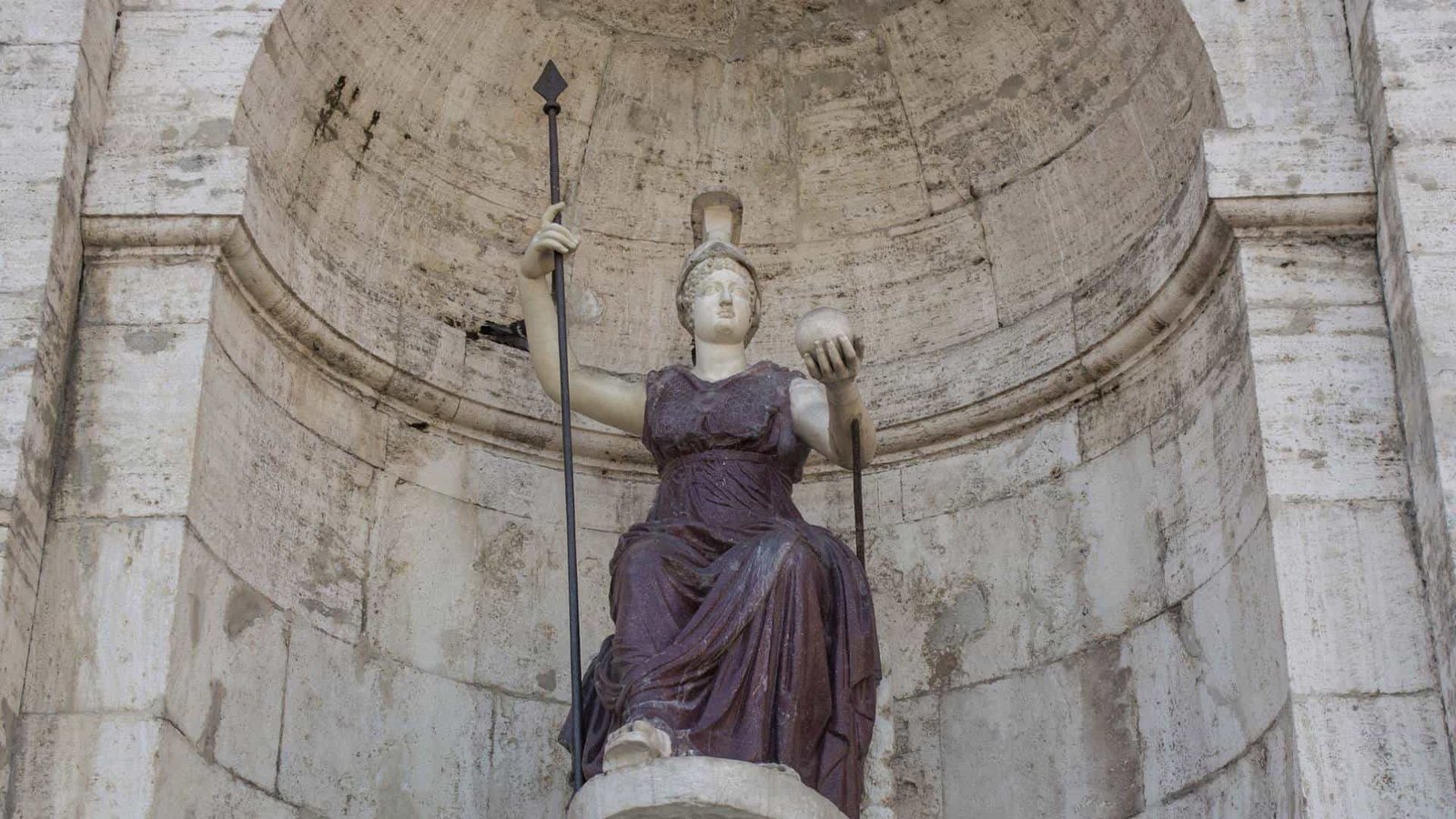
For the Palazzo Senatorio Michelangelo designed the double-ramp stairway, built between 1542 and 1554, which serves both as monumental entrance and as backdrop for the ancient river statues of the Nile and the Tiber. The facade, with rusticated base and giant order of pilasters with Corinthian capitals, was completed between 1593 and 1598. Giacomo della Porta added the basin in which the ancient statue of Minerva transformed into Roma is placed. The bell tower, designed by Martino Longhi the Elder in the sixteenth century, has three superimposed orders and houses bells cast in 1804 and 1805.
The Cordonata of the Campidoglio
The Cordonata is the access ramp designed by Michelangelo, with low, sloping steps, the cordoni, that allow the climb on horseback too. Wide at the bottom and slightly narrower at the top, it guides the gaze toward the square, lengthening its perception. At the foot of the ramp are two Egyptian basalt lions, turned into fountains. Along the way, on the left, the 1887 statue of Cola di Rienzo marks the point where the tribune was killed in 1354. The Cordonata should be climbed slowly, watching how the Dioscuri emerge little by little from the profile of the sky: it's a calculated effect, and hurry cancels it.
The Dioscuri and the statues of the balustrade
At the top of the Cordonata, on the balustrade, are the two colossal marble groups of the Dioscuri, Castor and Pollux, sons of Jupiter and Leda, placed there in 1583. They were found in a fragmentary state between 1561 and 1565 in the Ghetto area and their dating varies: mid-first century BC, mid-first century AD, mid-second century AD, depending on the scholars. They should not be confused with the Dioscuri of the Quirinal, which are much larger and of a completely different provenance. Next to them, on the same balustrade, the so-called Trophies of Marius, which have nothing to do with Marius, the statues of Constantine and Constantius II and two milestones of Via Appia. It's an open-air collection put together in different eras, and this explains why it has no chronological coherence.
The starred paving of Piazza del Campidoglio
Michelangelo imagined the equestrian statue of Marcus Aurelius at the center of an oval space decorated with a star design. The square, however, remained packed earth for a long time, and the star design was made only in 1940, during the excavation works for the underground gallery that connects the three palaces. This is the fact that most surprises visitors, and it should be stated precisely: the design is Michelangelesque in conception, twentieth-century in execution. The star has 12 points and is really only legible from above, from the tower of the Palazzo Senatorio or from an aerial photograph. From the ground it is perceived as an undulating movement of the pavement, because the oval is slightly convex, swollen at the center. In October 2019 the Capitoline Superintendency carried out restoration work on the paving in the part of the square toward Via delle Tre Pile, together with the restoration of the base of the Palazzo dei Conservatori.
Palazzo dei Conservatori and Palazzo Nuovo
The Palazzo dei Conservatori was built in the mid-fifteenth century as the seat of the elected magistracy that administered Rome: it had a portico on the ground floor and Guelph-cross windows on the main floor, surmounted by a row of small mezzanine windows. Michelangelo transformed its facade with giant-order Corinthian pilasters on high pedestals, flanked by columns in the ground-floor portico, and crowned it with balustrade and statues, like the Palazzo Senatorio. The internal layout was also revised to fit the new elevation. Giacomo della Porta, later, enlarged the central window well beyond the measures planned by Michelangelo, departing from the master's design: if you feel that window weighs too much, it's not just your impression.
The Palazzo Nuovo was built from scratch to a design by Michelangelo to complete the square facing the Palazzo dei Conservatori. Unlike its twin, which is the result of a facade applied to an existing building, the Palazzo Nuovo shows a symmetrical balance of spaces and architectural elements, because it was conceived that way from the start. It was opened to the public as a museum in 1734 by Pope Clement XII, who had bought the important Albani collection of 418 sculptures the year before. To these were added the works donated by Pius V in 1566 and the sculptures that no longer had room in the Palazzo dei Conservatori. The collections are still arranged according to eighteenth-century display criteria, and that is one of the things that make the visit so special: you look at antiquity through the eyes of the eighteenth century.
Santa Maria in Aracoeli and the Tower of Paul III
The basilica of Santa Maria in Aracoeli had risen on the remains of the Temple of Juno Moneta. You reach it by a very steep staircase, and it stands alongside its important convent and the massive papal palace commonly known as the Torre di Paolo III. The convent and tower were demolished in the 1880s to clear the space needed to build the Vittoriano. All the poetic coronation ceremonies have been held on the Capitoline Hill, starting with that of Francesco Petrarca, who received the laurel crown in 1341.

The Fountain of the Dea Roma, the Tiber and the Nile
Author: Matteo Bartolani from Città di Castello. Dating: 1588-1589. Materials: marble. Original water supply: Felice Aqueduct. The fountain is a double marble basin with a mixtilinear plan, set between the two river statues of the Nile and the Tiber, and decorated with only five coats of arms. It was only possible to build it after the Felice Aqueduct, commissioned by Sixtus V between 1585 and 1590, finally brought running water to the hill. Until then the Capitoline Hill was a hill without water, and this detail explains why the most solemn square in Rome has the most modest fountain. In 1593 the statue in the central niche was replaced with a smaller figure in porphyry and marble from the Domitianic period, reinterpreted as Dea Roma instead of Minerva. It is the statue you see today, seated between the two rivers: small for that niche, and that is exactly why it is moving.
The Capitoline Museums on the Capitoline Hill, Room by Room
The Capitoline Museums are the oldest public museum in the world: their founding date is 1471, when Pope Sixtus IV donated a group of ancient bronzes to the Roman people. They occupy the Palazzo dei Conservatori and the Palazzo Nuovo, connected under the square by the Galleria Lapidaria and the Tabularium. The most recent renovation of the archaeological wing was completed in 2005. What follows is the route in visiting order.
The Courtyard of the Palazzo dei Conservatori and the Colossus of Constantine
You walk in and are immediately faced with a hand as tall as a man. The courtyard houses monumental architectural elements and fragments of colossal ancient sculptures, and the piece that stops everyone in their tracks is the Colossus of Constantine, emperor from 306 to 337 AD, unearthed in 1486 in the Basilica of Maxentius. It was an acrolithic statue: the bare parts in marble were mounted on a wooden frame covered in bronze, a technique that allowed sizes that were otherwise impossible. What remains are the head, the hand, a foot, a knee, an arm. On the right you can see the pointed arches that once led to the statuary hall, and on the back wall the reliefs from the Temple of the Deified Hadrian, added at the end of the 1800s, with personifications of the provinces subject to the Empire at the height of its extent. In 1720 the courtyard was enlarged to house the sculptures from the Cesi collection bought by Clement XI: a monumental Roma and two statues of barbarian prisoners.
The Staircase and the Large Reliefs
The monumental staircase of the Palazzo dei Conservatori is climbed while looking at the historical reliefs set into the walls: panels that depict imperial ceremonies and that, removed from their original monuments, now work as a gallery of Roman propaganda. It is a climb that visitors rush through. Stop: the quality of the marble carved under the pontificate of Marcus Aurelius is not inferior to that of certain pieces that have a room all to themselves at the Louvre.
The Hall of the Horatii and Curiatii at the Capitoline Museums
It is the reception hall of the City of Rome and the civic heart of the Capitoline Hill. The fresco decoration was carried out by the Cavalier d'Arpino, that is Giuseppe Cesari, between the late sixteenth century and the following decades: work began in 1595 and was only finished in 1640, with long interruptions. The six main frescoes illustrate episodes from the origins of Rome as Livy tells them: the Finding of the She-Wolf with Romulus and Remus, of 1596, the Battle of Tullus Hostilius, between 1597 and 1601, the Combat between the Horatii and the Curiatii, between 1612 and 1613, the Rape of the Sabine Women, between 1635 and 1636, Numa Pompilius establishing the cult of the Vestals, between 1636 and 1638, and Romulus tracing the sacred furrow of the city, between 1638 and 1639. In the hall there are two papal statues: Urban VIII in marble, by Gian Lorenzo Bernini, between 1635 and 1640, and Innocent X in bronze, by Alessandro Algardi, between 1645 and 1650. It is here, beneath those frescoes, that the Treaties of Rome were signed on March 25, 1957.
The Hall of the Captains, the Hall of Hannibal, the Chapel and the Hall of the Tapestries
The Apartment of the Conservators occupies the first floor of the palace. The rooms were used by the Conservators for activities connected with their office, and the decoration, which includes frescoes, stuccoes, ceilings and carved doors, has as its constant theme the history of Rome from its origins to the Republican age. The Hall of the Captains celebrates the commanders of the city militias. The Hall of Hannibal holds a fifteenth-century cycle on the war against Carthage, and it is the oldest surviving painted decoration in the palace. The Chapel was the private oratory of the magistracy. The Hall of the Tapestries takes its name from the eighteenth-century tapestries woven in the San Michele workshop. These are rooms that visitors pass through quickly to get to the She-Wolf, and that's a shame: it is the noble floor of a Renaissance town hall still in use, something very rare in Europe.
The She-Wolf Hall and the Capitoline Fasti
The hall was originally an open loggia with three arches. Between 1508 and 1513 it received a fresco cycle conventionally attributed to Jacopo Ripanda, today preserved in fragmentary form because large marble slabs were installed there later. An ancient mosaic floor, discovered in 1893, completes the ensemble. On the back wall are displayed the Capitoline Consular and Triumphal Fasti, marble tablets listing the consuls and commanders who were awarded a triumph, from the Republic to the Augustan age. They were part of a triumphal arch erected in 19 BC in honor of Augustus, were found in fragments in the Roman Forum in the sixteenth century, and were assembled into the present marble structure in 1586. Those who love names might get lost reading them: it's the register of Roman power carved in stone.
The Capitoline She-Wolf, the Symbol of Rome
At the center of the hall is the Capitoline She-Wolf, a bronze 75 centimeters tall, inventory MC1181. The museum dates it to the fifth century BC, according to the established scholarly tradition, and indicates its origin in Etruscan or Magna Graecia workshops. The statue came to the Capitoline with the 1471 donation of Sixtus IV to the Roman people. It was displayed on the sixteenth-century loggia of the palace facing the city and brought indoors during the Michelangelesque works. The two twins are not ancient: they were added in the Renaissance and are attributed by some critics to Pollaiolo. It was that addition that turned an ancient symbol of justice from the Lateran into the Mater Romanorum, the mother of the Romans. It's worth looking at the animal for what it is: a she-wolf that has just given birth, with swollen teats, probably not originally part of the story of the founding of Rome. The meaning we give her was built on top of the statue, not inside it.
The Hall of the Geese and Bernini's Medusa
The Hall of the Geese houses the Bust of Medusa by Gian Lorenzo Bernini, an artist who lived between 1598 and 1680. It is a marble that almost nobody expects to find here, and that visitors discover by chance: a female head with serpents in her hair, caught at the instant she herself turns to stone. If I had to name the most underrated work in the entire Capitoline, I would point to this one without hesitation.
The Hall of Triumphs, the Spinario and the Capitoline Brutus
The Hall of Triumphs is decorated with a continuous frieze depicting the triumph of consul Lucius Aemilius Paullus over Perseus, king of Macedonia, celebrated in 167 BC and painted by Michele Alberti and Jacopo Rocchetti in 1569. The scene faithfully follows the description of the ceremony handed down by Plutarch, and in the background of the procession appear the monuments of Renaissance Rome, including the Palazzo dei Conservatori, just built. The coffered wooden ceiling, executed in 1568 by Flaminio Bolonger, is the only one surviving among those made in the palace, and the recent restoration has given back its color and carving.
In the hall there are three major bronzes. The Spinario, the boy pulling a thorn from his foot, a work of eclectic taste from the first century BC, donated by Sixtus IV in 1471. The Capitoline Brutus, one of the oldest Roman portraits, datable to between the 4th and 3rd centuries BC, arrived on the Capitoline Hill in 1564. The Camillus, a young attendant at religious rites, a bronze from the first century AD, also donated by Sixtus IV in 1471. Three pieces gathered in a single room: in almost all other museums in Europe, any one of these bronzes would be the highlight.
The Castellani Halls and the Modern Fasti
The Castellani Halls house the collection donated by the goldsmith and antiquarian Augusto Castellani, with Greek and Etruscan vases and archaic materials: they are the part of the museum that children walk through most willingly, because the display cases are low and full of black-figure and red-figure pieces. The Halls of the Modern Fasti take their name from the lists of Capitoline magistrates of the modern age, the ideal continuation of the ancient Fasti displayed in the Sala della Lupa.
The Halls of the Horti: Lamiani, Tauriani, Vettiani and Maecenas
An entire section of the museum is dedicated to sculptures from the horti, the large villas with gardens that surrounded Rome on the Esquiline and Caelian Hills. The Horti Lamiani Halls display the marbles found on the imperial property that once belonged to Aelius Lamia, with portraits and luxury furnishings, the Horti Tauriani and Vettiani Halls and the Galleria degli Horti continue the story, the Horti of Maecenas Halls gather the sculptures from the complex linked to the name of the great patron of Virgil and Horace. The latter are temporarily closed for maintenance work: before planning a visit to those halls, it's worth reading the notices on the museum's official website. This is the section where you understand best what private luxury in Rome was: not gold, but Greek sculpture bought for its weight in gold and placed in the garden.
The Exedra of Marcus Aurelius and the Original Equestrian Statue
The Exedra is a large glass hall built inside what was the Roman Garden of the Palazzo dei Conservatori, designed by architect Carlo Aymonino, and it connects the historic part of the museum with the more recent sections. At the center is the bronze equestrian monument of Marcus Aurelius, the original, which stood at the center of Piazza del Campidoglio and has been replaced outdoors by a copy for conservation reasons. Ancient sources do not mention it, it was probably made in 176 AD, on the occasion of the emperor's triumph over the Germanic peoples, or in 180, right after his death. It survived being melted down because in the Middle Ages it was mistakenly identified as the Christian emperor Constantine: an identification error saved the only ancient bronze equestrian statue that has come down to us.
In the same hall some of the great bronzes from the original core of the Capitoline collections are displayed: the Hercules in gilded bronze from the Forum Boarium and the remains of the Constantinian bronze colossus of the 4th century AD, with its monumental head and left hand. You can also see the monumental remains of the foundations of the Temple of Capitoline Jupiter and the Hellenistic sculptural group of the Lion Attacking the Horse, in marble. Looking at Marcus Aurelius from two meters away, with his outstretched hand and without stirrups because stirrups had not yet arrived in the West, is an experience the copy in the piazza cannot offer.
The Area of the Temple of Capitoline Jupiter Inside the Museum
Excavations completed in 2000 uncovered the foundations of the great temple, which you can today walk through inside the museum. The bright gallery overlooking the Giardino Caffarelli displays reconstruction drawings, models and finds, the Muro Romano, the only part of the podium preserved up to its top, is the highlight. Looking at the height of that podium and then imagining a temple of 62 meters by 54 on top of it is the only real way to get an idea of the skyline of Republican Rome.
The Medieval Hall and the Palazzo Clementino Caffarelli
The Medieval Hall gathers materials that document life on the hill between the end of antiquity and the communal age, the period of which less visible traces remain on the Capitoline Hill. The Palazzo Clementino Caffarelli, incorporated into the route, houses exhibition spaces and the Medagliere Capitolino, with coins, medals, gems and goldsmith work: a collection you have to seek out on purpose, because you won't come across it by chance along the main route.
The Pinacoteca Capitolina
The Pinacoteca was established between 1748 and 1750 with the purchase of paintings from the 16th and 17th centuries from the Sacchetti and Pio di Savoia collections: it was the first public painting museum in Rome. It is laid out in eight rooms plus the Galleria Cini. Sala I is dedicated to central Italy from the Middle Ages to the Renaissance. Sala II is dedicated to 16th-century Ferrara. Sala III is dedicated to Venice and the Venetian mainland in the 16th century, with Titian and Lorenzo Lotto. Sala IV is dedicated to the artistic currents of 17th-century Rome. Sala V is dedicated to the transition between the 16th and 17th centuries, between Emilia and Rome. Sala VI is dedicated to Bolognese painting from the Carracci to Guido Reni. The Sala di Santa Petronilla is dedicated to the great 17th-century painting in Rome. The Sala Pietro da Cortona is dedicated to Baroque painting and the followers of the master. The Galleria Cini displays European and Oriental porcelain, resulting from the bequest of Count Francesco Cini in 1881.
Caravaggio's The Fortune Teller at the Capitoline Museums
In the Sala di Santa Petronilla hangs Caravaggio's The Fortune Teller, oil on canvas, 115 by 150 centimeters, datable to between 1596 and 1597, from the Pio collection, inventory PC 131. A gypsy woman reads the palm of an elegant young man and, while holding his right hand, slips the ring off his finger. Caravaggio painted this scene in his first years in Rome, when he was just over 25, and a second version exists at the Louvre: the debate over which canvas came first has accompanied critics for decades. Look at the hands, not the faces: the whole story is there, and the young man will never notice. This is the painting that makes it worth reaching the Pinacoteca with energy still in your legs.
Caravaggio's Saint John the Baptist and the Other Masterpieces
In the same room is Caravaggio's Saint John the Baptist, a naked boy who hugs a ram and laughs, which was the subject of a restoration documented by the museum. Beside it is Guercino's Burial of Saint Petronilla, the monumental canvas that gives the room its name. In the other rooms you'll find Titian, Lotto, Rubens, Pietro da Cortona, Guido Reni and the Carracci: a collection that in any other city would be the main museum, and that in Rome, up on the top floors of the Capitoline, many visitors skip out of exhaustion. It's the most common mistake, and it's worth saying again.
The Galleria Lapidaria and the Tabularium
From the Palazzo dei Conservatori you go down underground beneath the square and walk through the Galleria Lapidaria, with the Capitoline collection of inscriptions arranged along the modern corridor that connects the two palaces. From there you enter the foundation rooms of the Tabularium, the archive of the Roman state, where laws and official documents were kept on bronze tablets. The building was tested by Quintus Lutatius Catulus in 78 BC during his consulship, and the inscription commemorating it is still visible outside, along Via di San Pietro in Carcere. The plan is trapezoidal and has a recess on the western side so as not to encroach on the oldest temple of Veiove, which can be seen along the route.
The View from the Tabularium over the Roman Forum
The corridor opens onto an open gallery that looks down on the Roman Forum, framed by the ancient arches. It's the best view you can get of the Forum without paying for a Forum ticket, and for many visitors it's the high point of the day. From there you can make out the Temple of Saturn, the columns of the Temple of Vespasian and Titus, the Portico of the Dei Consenti, the Arch of Septimius Severus, the Curia, the Basilica of Maxentius at the far end and, beyond it, the Colosseum. Go there around five in the afternoon in winter, around seven in summer: the low, raking light comes in under the arches and the stone turns orange.

The Courtyard of the Palazzo Nuovo and the Marforio
Go back up into the Palazzo Nuovo, and the first thing you come to is the courtyard with the Marforio fountain: a colossal Roman statue from the second century AD depicting a river god, which arrived on the Capitoline in 1594 after having stayed for centuries in the Roman Forum. In the Renaissance it was one of Rome's talking statues: the pasquinades, satirical compositions against the papal government, were posted at its feet, and Marforio answered Pasquino. The courtyard also has three large granite columns with relief scenes of Egyptian priests, coming from the great Temple of Isis in the Campus Martius of the imperial age, and two statues of Satyrs from the Della Valle collection, originally intended for the architectural decoration of the Theater of Pompey, placed in niches on the walls. An inscription commemorates the founding of the museum in 1734 and the construction of the fountain under Clement XII.
The Egyptian Hall, the Atrium, the Ground-Floor Rooms and the Staircase
The Egyptian Hall displays material of Egyptian and Egyptianizing subject from the Isiac sanctuaries of Rome. The Atrium and the ground-floor small rooms house sarcophagi, reliefs and statues. The Scalone leads to the upper floor, where the best of the collection is concentrated. It's a ground floor that almost everyone crosses in a hurry to go up: do it slowly, because the ground-floor sarcophagi have reliefs that tell of work, marriage, mourning, that is the private Roman life that you don't see in the noble rooms.
The Gallery and the Hall of the Doves
The Gallery connects the rooms of the first floor and is lined with statues and portraits. The Hall of the Doves takes its name from the mosaic displayed there: four doves on the rim of a bronze vase, one of which is drinking, composed with very tiny tesserae, found in 1737 at Hadrian's Villa at Tivoli, where it decorated the emperor's residence. In the same room is the statue of the Girl with a Dove, a work of the Hellenistic age in which a child protects her bird from a dog attacking her, with the snake the result of modern restoration. A second mosaic depicts theatrical masks of the New Comedy, a young woman and a slave. Along the walls are arranged about 80 portrait busts of public and private figures, and in the display cases are kept fragments of Tabulae Iliacae, small tablets illustrated with scenes of the Trojan War and Greek inscriptions, and bronze tablets with Roman decrees, among them the text of the oldest surviving senatus consultum, of 78 BC.
The Cabinet of Venus and the Capitoline Venus
The Cabinet of Venus is a small octagonal room designed for a single statue, and that statue is the Capitoline Venus: fine marble, probably Parian, 193 centimeters tall, so just larger than life. It's a Roman copy of an original by Praxiteles of the fourth century BC, of the Aphrodite of Knidos type. It was found near the basilica of San Vitale, on the Viminal, between 1666 and 1670, and was purchased and donated to the Capitoline collections by Benedict XIV in 1752. It defined the so-called Capitoline type, of which about a hundred replicas are known today, and scholars consider it among the oldest and most faithful copies, originally intended to adorn an imperial complex. The advice is banal and useful: enter the cabinet alone, wait for the previous group to leave, walk around her. She was conceived to be seen from all sides and up close, not in a photograph.
The Hall of the Emperors and the Hall of the Philosophers
The Hall of the Emperors is the portrait gallery that makes the Capitoline Museums unique: dozens of imperial busts arranged on shelving, in chronological sequence, from Augustus onward, with their wives, mothers and daughters. It's the place where you learn to tell a Hadrianic beard from a Flavian hairstyle, and where you understand that the Roman portrait is a political machine. Next to it, the Hall of the Philosophers lines up the effigies of Greek poets, orators and thinkers: blind Homer, Socrates, Euripides. Between the two rooms is the difference between power and thought, lined up on two shelves, and it's a history lesson that needs no captions.
The Great Hall and the Hall of the Faun
The Great Hall is the largest room of the Palazzo Nuovo, with large statues arranged according to the eighteenth-century layout. The Hall of the Faun takes its name from the Faun in rosso antico marble, one of the most characteristic pieces of the collection: the coral-red color of the marble makes it immediately recognizable. In the same room is the Lex de imperio Vespasiani, the bronze tablet that confers powers on the emperor Vespasian: a Roman constitutional document, displayed in a museum, in a room where everyone looks at the faun.
The Hall of the Gladiator and the Capitoline Gaul
The room takes its name from the so-called Dying Gladiator, who is not a gladiator: he is the Capitoline Gaul, a wounded Celtic warrior, lying on his shield. White Docimian marble, 93 centimeters tall, base of 0.89 by 1.865 meters, inventory S 747, datable between 60 and 40 BC. It's the replica of one of the sculptures of the votive group dedicated at Pergamon by Attalus I for the victories over the Galatians between the third and second century BC. He is recognized by the mustache, the hair disheveled in long locks and the torque, the collar typical of the Gauls. Next to him the oval shield with central boss and the curved trumpet, the cornu. His recent history is hard: from 1737 to 1797 on the Capitoline, from 1797 to 1816 in France, carried off during the Napoleonic occupation and then returned. Look at his face. The victor, for once, had the vanquished sculpted with respect: it's an idea of dignity that Hellenistic art left us and that still holds today.
In the same room are the Wounded Amazon attributed to Phidias, fifth century BC, made for an art competition in the sanctuary of Artemis at Ephesus, and the Resting Satyr, a Roman copy after an original by Praxiteles from the fourth century BC, from Villa d'Este in Tivoli, and a Juno, an original Hellenistic work from the third century BC from the Cesi collection, and a Cynic Philosopher, an original from the third century BC of the Pergamene school, and the group of Cupid and Psyche, derived from an original from the second century BC, and the Capitoline Antinous from the Hadrianic age, and a statue of Isis from the Hadrianic age, between 117 and 138 AD.
Santa Maria in Aracoeli, the Church on Top of the Capitoline Hill
The basilica stands on the northern summit of the hill, the Arx, on the site of the temple of Juno Moneta. The name Aracoeli comes from a corruption of Arx Capitolina, and tradition links it to the legend of the Sibyl who supposedly announced to Augustus the coming of the Son of God with the words Haec est ara Filii Dei. A church of Santa Maria in Capitolio appears in documents from 880. One tradition attributes its founding to Gregory the Great in 590. The Romanesque church was built in the middle of the twelfth century. The current Gothic building was inaugurated in 1348. The address is Piazza dell'Arce Capitolina, 00186 Rome, and the morning opening hours are 9.00 to 12.30, with afternoon hours that vary by season. Before going up, it's best to call the basilica's phone number.
The Aracoeli Staircase
The marble staircase of 124 steps, added in 1348, was built as a votive offering for the end of the plague that was devastating Europe. Many Romans considered it a sacred place, and they climbed it on their knees, women to ask for fertility, mothers to ask for a grace for their children. Tradition says Cola di Rienzo inaugurated it. At the top is a column with a Corinthian capital and a cross, placed in memory of the earthquake of 1703. The climb is tiring and there is no shade: if it's hot, take the Cordonata and reach the church from the side entrance at the top of the hill, which in July is the most sensible choice.
Inside Aracoeli
The interior is divided into three aisles by 22 spolia columns, all different, recovered from ancient buildings. Look at them one by one, because they tell the story of Roman reuse all by themselves. The coffered ceiling has naval motifs that celebrate the victory of Marcantonio Colonna at Lepanto in 1571. The Bufalini Chapel holds frescoes by Pinturicchio with the stories of Saint Bernardino of Siena. Works attributed to Pietro Cavallini and Benozzo Gozzoli are also linked to the church. Francesco Petrarca was crowned poet here in 1341. The famous wooden Santo Bambino, according to tradition carved from olive wood from Gethsemane and venerated since 1591, was stolen in 1994. The one on display today is a copy, and the story of that theft is still an open wound for Romans.
The Vittoriano Next to the Capitoline Hill
At the foot of the hill stands the Vittoriano, the monument to Victor Emmanuel II, with the Altar of the Fatherland designed by Giuseppe Sacconi and decorated by the sculptor Angelo Zanelli, which has housed the Tomb of the Unknown Soldier since 1921. Its construction erased the Aracoeli convent and the Tower of Paul III, and forever reshaped the northern flank of the Capitoline Hill. Today the complex, together with Palazzo Venezia, is managed by the VIVE institute and is open every day from 9.30 to 19.30, with last entry at 18.45. Entry to the Vittoriano and the gardens of Palazzo Venezia is free. The ticket that includes the Panoramic Terrace, the Museo del Risorgimento and Palazzo Venezia costs €18 full price and €5 reduced for ages 18 to 24. It is valid for seven days and is free for minors under 18, for people with disabilities, and for everyone on the first Sunday of the month. Two panoramic elevators go from the Terrazza Italia up to the Panoramic Terrace at the top. The Ala Brasini hosts many of the major exhibitions in Rome.
Frequently asked question: is the terrace of the Vittoriano better than the one on the Capitoline Hill? Clear answer. From the Vittoriano you see Rome, but you don't see the Vittoriano, which is the biggest eyesore in the view. From the Capitoline Hill you see the Forum the way no other point in the city shows it. If time is short, the Tabularium wins.
Things to See Around the Capitoline Hill in 10 Minutes on Foot
The Capitoline Hill is the geometric center of ancient Rome, and that means everything that matters is within walking distance. Heading down toward the Forum, you reach the Mamertine Prison, the Roman state prison under the church of San Giuseppe dei Falegnami. Continuing along Via dei Fori Imperiali, you arrive at the Trajan's Markets and, after one kilometer, the Colosseum and the Palatine. On the opposite side, heading down toward the river, you'll find the Forum Boarium with its two Republican-era temples, the Mouth of Truth and, across the bridge, the Tiber Island. North, past Piazza Venezia, lie the Campo Marzio with the sacred area of Largo Argentina and, a little farther on, the Palazzo Madama. A full loop of this circuit, without going into any of them, takes two hours and is worth a whole day.
A half-day itinerary starting from the Capitoline Hill
Frequently asked questions about the Capitoline Hill
How much does it cost to enter the Capitoline Museums on the Capitoline Hill?
The price to visit the Capitoline Hill depends on the exhibitions on display: from September 7 to November 1, 2026, with only the Angeli exhibition, the full ticket costs €16.50 and the reduced ticket €11. Starting February 2, 2026, entry to the city museums, including the Capitoline Museums, is free for residents of Rome and the Metropolitan City with an identity card.
Can you visit Piazza del Campidoglio without paying for a ticket?
Yes: for Piazza del Campidoglio alone, with the Cordonata, the Dioscuri, the paving and the viewpoint over the Forum behind the Palazzo Senatorio, about 40 minutes is enough and no ticket is needed.
How long does it take to visit the Capitoline Hill and the Capitoline Museums?
For an honest visit to the Capitoline Museums on the Capitoline Hill, meaning both palaces and the Tabularium without rushing, about three hours is needed. For a full visit including the Pinacoteca, the time gets even longer.
Is the Capitoline Hill suitable for children?
Yes, it works better than you might think, as long as you choose the right spots: the colossus of Constantine in the courtyard, the Capitoline Wolf and the Spinario are the highlights that grab the attention of even the youngest visitors right away.
Are the Capitoline Hill and the Capitoline Museums accessible by wheelchair?
Partly: visitors with a disabled parking permit can drive up to Via delle Tre Pile, where some spaces are reserved, along three drivable routes, all uphill. Inside the museum, a lift platform is in operation in the courtyard of the Palazzo dei Conservatori.
What is the best time to photograph the Capitoline Hill?
Early in the morning, between seven and eight, Piazza del Campidoglio is deserted and the light comes in low from the east, the best time for photos. After sunset, the night lighting draws the palaces and the star in the pavement like a stage set.
Why is the Capitoline Hill considered the seat of the City of Rome?
The Palazzo Senatorio, on Piazza del Campidoglio, still today houses the offices of the Mayor of Rome, the council hall named after Julius Caesar and other representative rooms, including the Protomoteca, the gallery of busts of illustrious men commissioned at the beginning of the 19th century.
What can you see near the Capitoline Hill within a few minutes on foot?
Going down toward the Forum from the Capitoline Hill, you reach the Carcere Mamertino, the ancient Roman state prison. Continuing along Via dei Fori Imperiali, you arrive at the Mercati di Traiano and, after about one kilometer, the Colosseum and the Palatine.
The suggested itinerary starts at half past nine sharp at the Capitoline Museums, when they open and there's no one there. It continues into the Tabularium around noon, comes out into the square, goes down Via del Teatro di Marcello to the Foro Boario, and ends with lunch near Piazza della Consolazione, where mass tourists don't make it. If you have just three days in Rome and want to figure out how to fit the Capitoline Hill in with the rest, you'll find a proven setup in the three-day Rome itinerary prepared in English by ItalyPlanner, which solves the problem of mandatory reservations before even the question of kilometers.
The Capitoline Hill with Children
It works better than you'd think, provided you choose. The colossus of Constantine in the courtyard is the twist you need in the first two minutes: a hand bigger than the child looking at it. The She-Wolf is the symbol everyone recognizes, even the smallest. The Spinario tells a scene that any child understands without explanation. The low display cases of the Castellani Rooms and the sarcophagi on the ground floor of the Palazzo Nuovo hold attention. The Gaul, on the other hand, needs explaining, and with children under 10 it's best to skip it. The museum offers an audio guide for children between six and 12 at 4 euros, and children under six enter free. Rule of thumb: 90 minutes, not one more, and the ice cream after the Cordonata as part of the program declared at the start.
Accessibility of the Campidoglio and the Capitoline Museums
Those with a disabled permit can drive up to Via delle Tre Pile, where some spaces are reserved. The three roads passable by wheelchair toward the square are the one from Piazza dell'Ara Coeli via Via delle Tre Pile, the one from Piazza della Consolazione via Via di Monte Tarpeo and the one from Via San Pietro in Carcere: they are all uphill. Inside the museum there is a lift platform in the courtyard of the Palazzo dei Conservatori, elevators connecting the floors and stairlifts connecting the two palaces and making it possible to reach the underground Galleria Lapidaria. The maximum load of the stairlifts is 300 kilograms and the smallest measures 77 centimeters wide by 83 long. The museum lends wheelchairs on request. Entry is free for people with disabilities, and staff assist during the visit. The museum recommends phoning ahead at 0667102071 to report the visit, and checking the notices section because maintenance work may temporarily limit some routes. A warning: the Cordonata is not passable by wheelchair, so don't try.
When to go to the Campidoglio
The square is beautiful twice a day and in two different ways. Early in the morning, between seven and eight, it is deserted and the light comes in low from the east: it's the moment for photographs. After sunset the night lighting draws the palaces and the star in the pavement like a stage set, and for an hour the square goes back to being what Michelangelo had in mind, that is a theater. The museum, instead, should be taken at opening, at 9.30, or in the last two hours, when the organized groups have already left. On Wednesday in the last two hours non-residents pay half price, and that is the best slot of all for the ratio of price to calm. The first Sunday of the month is free for everyone, and for that very reason it's the worst day for anyone looking for silence: if you go that day, enter at opening. In August the square is an oven, without a tree and without a meter of shade between 11 and 16. In January it's windy and almost empty, and it's the most beautiful month to go up.
The Campidoglio today: the seat of the Municipality of Rome
The Campidoglio is the representative seat of the Municipality of Rome. In the Palazzo Senatorio are the mayor's offices, the council chamber, named after Julius Caesar, and other representative rooms, among them the Protomoteca, the gallery of busts of illustrious men commissioned at the beginning of the nineteenth century. In the Hall of the Horatii and Curiatii on March 25, 1957 the Treaties of Rome were signed, that is the treaty establishing the European Economic Community, the one establishing Euratom and the convention on common institutions. For Italy signed the prime minister Antonio Segni and the foreign minister Gaetano Martino, for Belgium Paul-Henri Spaak, for France Christian Pineau, for the Federal Republic of Germany Konrad Adenauer, for Luxembourg Joseph Bech, for the Netherlands Joseph Luns. On the Capitoline, in July 1998, the founding Statute of the International Criminal Court was also signed, which takes the name Rome Statute from that signing. The English term capitol, which indicates the building that houses a governing administration, and the word capital itself derive from the Capitoline Hill: two words that half the world uses every day were born on 35 meters of tuff above the Tiber.

Visiting the Campidoglio with a guide
The Capitoline Hill is one of those places where the difference between looking and understanding is made by a person who talks. The square is an architectural discourse, and the museum is a layering of papal collections. Without someone to hold the thread together, you leave with a photo album and no story. Those who organize groups, corporate trips or private visits will find certified escorts and tour leaders from TourLeaderPro a Roma, who work every day in this quadrant of the city. For groups arriving from out of town who need a professional to handle logistics and timing, the page dedicated to tour escorting explains how the service works. Those who plan the trip on their own, maybe for foreign friends, can rely on the English-language guide to the best things to do in Rome, where the Capitoline Museums appear among the masterpieces that distracted visitors miss.
A curiosity about the Capitoline Hill
The star everyone photographs on the square's pavement was not trodden by Michelangelo. The master imagined the equestrian statue of Marcus Aurelius at the center of an oval space decorated with a star design, and he drew it. But the square remained in packed earth for four centuries, and the star design was only carried out in 1940, during the excavation work for the underground tunnel that still today connects the three palaces. Whoever walks on the star walks on a twentieth-century pavement that carries out a sixteenth-century idea. This takes nothing away from the square, quite the contrary. It shows how Rome really works, where projects wait for centuries and then get completed.
There's more, and it concerns the shape. The oval is not flat: it is slightly convex, swelling at the center, and this means that whoever enters the square from the Cordonata sees the pavement rise imperceptibly toward the equestrian monument and then descend again. The star has 12 points and can really only be read from above. From ground level it is perceived as a movement, not as a design. That is why the most famous photo of the Capitoline is an aerial photo, and it is also why, climbing the tower of the Palazzo Senatorio when it is accessible, many visitors say they understand the square for the first time.
A second curiosity, less well known, concerns the orientation of the square. Michelangelo rotated the Capitoline by 180 degrees relative to its ancient orientation. The hill that for 1,000 years had looked toward the Roman Forum was turned toward the Campus Martius, that is, toward the inhabited city of the sixteenth century and toward Saint Peter's. The Palazzo Senatorio, built on the ruins of the Tabularium, turns its back on the Forum. That gesture is the reason why today the visitor who wants to see the Forum from the Capitoline must walk around the palace. It is not in front of them when they reach the top of the Cordonata. The disappointment is common, and this is the explanation.
Something no one tells you about the Capitoline Hill
The Marcus Aurelius you see in the square is a copy, and many people say so. What almost no one says is why the original still exists. Of the dozens of bronze equestrian statues that adorned Rome, practically none has survived. The ancient bronze was melted down and recast for centuries, to make cannons, bells and church doors. Marcus Aurelius was saved by a misunderstanding. In the Middle Ages it was believed to be a portrait of Constantine, the first Christian emperor, and a statue of Constantine was not to be touched. Ancient sources never mention it. It was probably made in 176 AD, for the emperor's triumph over the Germanic peoples, or in 180, right after his death. An attribution error preserved for 1,800 years the only bronze equestrian monument from classical antiquity that we can still look at.
The original is today inside the museum, in the Esedra designed by Carlo Aymonino inside the ancient Giardino Romano of the Palazzo dei Conservatori. This is the second thing almost no one knows before going in: you can stand two meters from the horse, under the same light, without glass. Look at it in profile. There are no stirrups, because they had not yet arrived in the West, and the rider's position is all about balance. The right hand is extended in a gesture that scholars have debated for centuries, somewhere between clemency toward the defeated and the address to the troops. Under the raised front hoof of the horse, according to a recurring tradition, there was a fallen enemy, now lost. It's a hypothesis, not a fact, and it should be taken that way.
Third thing no one will tell you: the ticket to the Capitoline Museums is also valid for the Centrale Montemartini, if you get the Capitolini Card for €15.50, which lasts seven days. The Centrale Montemartini is an old power station converted into a museum, where ancient statues are displayed among turbines and diesel engines. It is the natural complement to the Capitoline Hill. Almost no visitors know about it, and the two visits together cost less than a single integrated ticket that includes the exhibitions.
The advice I give you for visiting the Capitoline Hill
Walk up the Cordonata slowly, without looking at your phone. The ramp is designed so that the Dioscuri and the balustrade emerge gradually above the skyline. If you climb quickly or while looking down, you lose that effect and it doesn't come back. Once you reach the top, don't cross the square right away. Stop on the threshold, in line with the equestrian statue, and look at how the two side buildings converge toward the Palazzo Senatorio. The square is trapezoidal, not rectangular, and that convergence is calculated: it lengthens the perspective and makes the backdrop more imposing than it really is. 30 seconds standing there is worth half an hour of reading.
Second tip, a practical one: enter the Capitoline Museums at 9.30 sharp on the day you visit, and start with the Palazzo dei Conservatori. At 9.30 the courtyard with the colossus of Constantine is empty, and the Sala degli Orazi e Curiazi can be viewed in silence. After 11:00 the school groups arrive, and the Lupa becomes impossible to get close to. If you can't go in the morning, then go on Wednesday during the last two hours, with a 50 percent discount for non-residents: you enter at 17.30, you have until 19.30, and the museum empties while you walk through it.
Third tip, the one almost nobody follows: save the Pinacoteca for last, but while your legs still have some strength, meaning not after three hours of marble. If you feel tiredness setting in, skip one archaeological section and go up. The Fortune Teller by Caravaggio deserves 20 minutes of real attention, and 20 minutes of real attention can't be found at the end of a marathon. Last one: don't leave without walking around behind the Palazzo Senatorio, from the side of Via del Campidoglio, to the viewpoint over the Forum. It's free, it's open to everyone, and for many people it's the most beautiful part of the whole day.
Another well-known fact, yet one rarely mentioned
You'll read everywhere that the Capitoline Museums are the oldest public museum in the world. What is rarely mentioned is what that date means in detail. In 1471, Pope Sixtus IV gave the Roman people a group of ancient bronzes that until then had been at the Lateran: the Lupa, the Spinario, the Camillus, the colossal head of Constantine. He didn't give them to a family or a church. He handed them to the people, that is, to the civic magistracy of the Conservatori, and had them placed on the facade and in the courtyard of their palace. From there came the modern idea of a public collection, and it was born on the Capitoline, three centuries before the Louvre.
The second little-cited detail is that the 1471 donation changed the meaning of the works. At the Lateran, the Lupa was a symbol of justice displayed where papal law was administered. Brought to the Capitoline and completed with the twins during the Renaissance, it became the Mater Romanorum, the mother of Rome. By changing location and receiving two bronze children, an Etruscan or Magna Graecia statue became the symbol of a city and then of a nation. It's a textbook case of how collective memory works, and it all happened in a room on the first floor of the Palazzo dei Conservatori.
Third detail: the collection formed through successive additions that are still visible. Pius V donated sculptures in 1566 to clear the Vatican of pagan marbles. Clement XII bought the Albani collection in 1733, 418 sculptures, and opened the Palazzo Nuovo to the public in 1734. Benedict XIV donated the Capitoline Venus in 1752, and between 1748 and 1750 he set up the Pinacoteca with the Sacchetti and Pio di Savoia paintings. Count Francesco Cini left the porcelain in 1881. The museum was not designed. It accumulated, pope after pope, and the eighteenth-century arrangement of the rooms in the Palazzo Nuovo still keeps that way of displaying things.
The right photo to take on the Capitoline
The photo everyone tries is the square from the top of the Cordonata, and it almost always comes out badly: the wide-angle lens flattens the convergence of the buildings and the star in the pavement disappears. The right photo is a different one, and it's behind the Palazzo Senatorio. Pass to the right of the palace, from Via del Campidoglio, reach the belvedere terrace, and frame the Roman Forum with the Temple of Saturn in the foreground on the left, the Arch of Septimius Severus in the center, the Basilica of Maxentius in the background, and the Colosseum on the horizon. It's the only spot in Rome where the Forum can be read all at once, from above and with no barriers in front. The best time is late afternoon, when the sun comes from the west, behind the photographer, and lights up the marble.
The second shot I recommend is vertical and is taken from the base of the Cordonata, in Piazza d'Aracoeli, in line with the ramp. The staircase climbs, the balustrade closes the top, the two Dioscuri watch over the sides, and the facade of the Palazzo Senatorio appears beyond. It's the photo that captures the idea behind Michelangelo's design, a climb that builds up to a revelation. Earlier is better, in the early morning before 8, when nobody is sitting on the steps yet.
The third is the hardest and the most beautiful: the square at night, with the lights on, taken with a long exposure, resting the camera on the balustrade of the Cordonata. Artificial light makes the star pattern of the pavement easier to read than daylight does, and the palaces become theatrical backdrops. A tip from someone who has watched hundreds of people try: no flash, which does nothing at that distance, and no bulky tripod, because the square is still a public space, used even late at night. Inside the museum, photography without flash or tripod is generally allowed, but the rules can change for temporary exhibitions and should be read at the entrance.
Some important events that took place here in history
The Capitoline Hill is the hill where the history of Rome changed direction several times, and not always gracefully. In 390 BC, during the Gallic invasion, the citadel held off a night attack thanks to the cackling of the sacred geese of Juno. In memory of the episode, the temple of Juno Moneta was erected in 345-344 BC, near which the first Roman mint was located. In 460 BC, the Sabine Appius Herdonius occupied the hill with 4,000 armed men and held out for four days, before being defeated and killed by the Romans led by the consul Valerius Publicola, who also died in the fighting. In 133 BC, during a public assembly at the Capitoline temple, Tiberius Gracchus was killed in a riot provoked by the aristocracy. The first political murder of the Roman Republic happened here, probably at the top of the stairway that led down toward the Campo Marzio.
The hill burned three times. In 83 BC, a very serious fire destroyed the Capitol and the Temple of Jupiter, and the reconstruction was entrusted to Quintus Lutatius Catulus, who completed the Tabularium in 78 BC. In 69 AD, during the civil war between Vitellius and Vespasian, the supporters of the latter barricaded themselves on the hill and the monuments were set on fire. Vespasian reopened the Temple of Jupiter in 75. In 80, under Titus, the fire climbed the slopes again from the Campo Marzio, and the reconstruction took place under Domitian starting in 81. Three fires in 160 years on the same hill: the Rome of stone that we imagine was, for a large part, a Rome of timber and roofs.
In modern times the Capitoline Hill has once again become the stage of politics. In 1143, the Renovatio Senatus installed the Senate of the Roman commune there. In 1341, Francesco Petrarch received the laurel crown in Aracoeli. In 1354, Cola di Rienzo was killed at the foot of the slope, where a statue from 1887 now commemorates him. In 1348, the Aracoeli staircase was built as a votive offering for the end of the plague. On March 25, 1957, in the Hall of the Horatii and Curiatii, representatives of six countries signed the Treaties of Rome, which established the European Economic Community and Euratom. In July 1998, the founding statute of the International Criminal Court was signed on the Capitoline Hill. Between Caleno's prophecy about the skull and the signing of the treaty that founded a united Europe lie 25 centuries, and all of them passed over these 35 meters of rock.
Who has passed through the Capitoline Hill
The list begins with the kings and consuls, but the names that can be pinned down with precision are others. Marcus Horatius Pulvillus, consul, inaugurated the Temple of Jupiter Optimus Maximus on September 13, 509 BC. Lucius Aemilius Paulus climbed to the hill in triumph in 167 BC after his victory over Perseus of Macedon, and that triumph is painted on the walls of the Hall of Triumphs by Michele Alberti and Jacopo Rocchetti in 1569. Augustus had a small temple to Mars Ultor built there and received the gifts of the people there on the Kalends of January, as Suetonius tells. Vespasian, Domitian, Hadrian and Marcus Aurelius rebuilt and beautified the hill, and Marcus Aurelius remains, in bronze, the only Roman emperor we can still look at on horseback.
In the Middle Ages and the Renaissance, the Capitoline Hill was a required stop for popes, poets and artists. Francesco Petrarch was crowned poet in Aracoeli in 1341. Cola di Rienzo, the tribune who tried to restore the republic to Rome, died at the foot of the hill in 1354. Pope Sixtus IV donated the ancient bronzes to the Roman people in 1471, the birth certificate of the museum. Pope Paul III Farnese called in Michelangelo Buonarroti, who worked on the hill from 1537 and designed the square in 1540. After him, Giacomo della Porta, Martino Longhi the Elder, Giuseppe Cesari, known as the Cavalier d'Arpino, Gian Lorenzo Bernini with the Urban VIII and the Bust of Medusa, and Alessandro Algardi with the Innocent X all contributed. Pope Clement XII opened the Palazzo Nuovo in 1734 after buying the Albani collection. Benedict XIV donated the Capitoline Venus in 1752 and founded the Pinacoteca.
In contemporary times the hill has seen heads of state and government pass through. On March 25, 1957, the Treaties of Rome were signed by Antonio Segni and Gaetano Martino for Italy, Paul-Henri Spaak for Belgium, Christian Pineau for France, Konrad Adenauer for the Federal Republic of Germany, Joseph Bech for Luxembourg and Joseph Luns for the Netherlands. Every Mayor of Rome, from Italian unification to today, has their own office in the Palazzo Senatorio, and every head of state on an official visit to Rome goes up to the Capitoline Hill to sign the book of honor. I would add one name that people usually forget: Carlo Aymonino, the architect who in recent years built the glass Esedra inside the Giardino Romano, that is, the latest intervention that changed the way you look at the Marcus Aurelius statue.
Quick questions about the Capitoline Hill
How much does it cost to enter the Capitoline Museums on Capitoline Hill?
It depends on the exhibitions on at the time. Until September 6, 2026, the full price for non-residents is €20.50 and the reduced price is €15 with the Vasari and Angeli exhibitions included. From September 7 to November 1, 2026, with only the Angeli exhibition, the full price is €16.50 and the reduced price is €11. The seven-day Capitolini Card, also valid for the Centrale Montemartini, costs €15.50 full price and €11.50 reduced. Check the current price on the official museum website.
Can you go up to Capitoline Hill for free?
Yes. The square, the Cordonata, the balustrade with the Dioscuri and the belvedere terrace over the Roman Forum behind the Palazzo Senatorio are public spaces, always accessible and free. You only pay for entry to the Capitoline Museums.
What are the opening hours of the Capitoline Museums?
Every day from 9.30 to 19.30, with last entry one hour before closing. On December 24 and 31 the hours are 9.30-14.00, and on January 1, 11.00-20.00.
When are the Capitoline Museums closed?
On May 1 and December 25. On the other days of the year the museum is open, including Mondays and holidays.
Do residents of Rome enter the Capitoline Hill for free?
Yes. From February 2, 2026, entry is free for residents of Rome and the Metropolitan City, who must show their ID card at the ticket office. Free entry applies to the entire Civic Museums System.
Is entry free on the first Sunday of the month?
Yes, on the first Sunday of the month entry is free for everyone. It's also the busiest day of the whole month: if you go, enter at 9.30.
Do you need to book a visit to the Capitoline Hill?
For an individual visitor, no: you buy the ticket at the ticket office and go in. Booking online carries a €1 advance sales fee and only serves to avoid the queue at the ticket counter. For groups of 11 to 25 people, booking is free at 060608, for school groups it is mandatory and free.
How long does a visit to the Capitoline Museums take?
Three hours for a complete visit of the two palaces and the Tabularium without rushing, five hours if you look at the Picture Gallery room by room. The square alone, with the Cordonata and the belvedere, takes 40 minutes.
How do you get to the Capitoline Hill by public transport?
The hub is Piazza Venezia, 200 meters from the foot of the Cordonata: among the lines ATAC lists for the area are the 30, 40, 46, 60, 62, 63, 64, 70, 80, 81, 87, 119, 170, 628, C3 and H, and tram 8 terminates there. Stops change because of work on Metro Line C, so check the exact stop on the ATAC website on the same day.
Is there a metro stop at the Capitoline Hill?
No. The nearest is Colosseum, on Line B, about one kilometer along Via dei Fori Imperiali, that is 15 minutes on foot. The Venezia station on Line C is under construction.
Is the Capitoline Hill accessible by wheelchair?
The Cordonata is not. You go up by Via delle Tre Pile from Piazza dell'Ara Coeli, or by Via di Monte Tarpeo from Piazza della Consolazione, or by Via San Pietro in Carcere: these are uphill routes open to vehicles. Inside the museum, a platform lift works in the Courtyard of the Conservatori, and there are elevators and stairlifts between the two palaces and toward the Galleria Lapidaria. The museum lends wheelchairs and recommends calling 0667102071 before your visit.
Is the Marcus Aurelius statue in the square the original?
No, the one in the square is a copy. The original in bronze is displayed inside the museum, in the Esedra di Marco Aurelio, and was removed from the open air for conservation reasons.
Where is the Capitoline Wolf?
In the Sala della Lupa, on the first floor of the Palazzo dei Conservatori, together with the Fasti Capitolini. It is a bronze 75 centimeters tall, with the twins added in the Renaissance and attributed by critics to Pollaiolo.
Where is the Dying Gaul?
In the Sala del Gladiatore, on the first floor of the Palazzo Nuovo. The exact name is Galata Capitolino: it is not a gladiator, it is a wounded Celtic warrior, a copy of an original from the Pergamene group of Attalus I.
Are there works by Caravaggio at the Capitoline Museums?
Yes, two, both in the Sala di Santa Petronilla of the Pinacoteca Capitolina: the Buona Ventura, oil on canvas measuring 115 by 150 centimeters, datable to between 1596 and 1597, and the San Giovanni Battista.
Can you take photographs at the Capitoline Museums?
Photography without flash and without a tripod is generally allowed in the permanent collection, but temporary exhibitions may have their own rules. You'll find them posted at the entrance to the exhibition.
What's the difference between the Capitoline Hill and the Capitoline Museums?
The Capitoline Hill is the hill and the square. The Capitoline Museums are the museum that occupies two of the three palaces facing that square, namely the Palazzo dei Conservatori and the Palazzo Nuovo. The third one, the Palazzo Senatorio, is the seat of the City of Rome and is not part of the regular museum route.
Can you see the Roman Forum from the Capitoline Hill?
Yes, in two ways. For free from the belvedere terrace behind the Palazzo Senatorio, on via del Campidoglio. From inside the museum, with a ticket, from the open gallery of the Tabularium, which is the most beautiful view of all.
Is the Capitoline Hill suitable for children?
Yes, with a short, focused visit: the colossus of Constantine in the courtyard, the Lupa, the Spinario, and the display cases in the Sale Castellani. 90 minutes is enough. Children under six enter free, and there's an audio guide for the six to 12 age group for 4 euros.
How high is the Capitoline Hill?
The Arx, where Santa Maria in Aracoeli stands, reaches 48 meters above sea level. The Asylum, that is, the present-day square, is 35.9 meters. The Capitolium proper, where the Palazzo Caffarelli is, is 44.7 meters. It is the lowest of the Seven Hills.
Why is it called the Capitoline Hill?
The name derives from the Latin Capitolium. Ancient sources explain it with the discovery of a human skull, caput Auli, during the excavations for the foundations of the Temple of Jupiter. This is the explanation the Romans gave themselves, and it should be taken as such and not as linguistic proof.
How long is the wait in line at the Capitoline Hill?
Much less than you might fear. On ordinary days the line at the ticket office moves in a few minutes. The exceptions are the first Sunday of the month, holiday long weekends, and the opening days of a major exhibition. Advance online booking is mainly useful on those occasions.
Where can I buy tickets for the Capitoline Museums?
At the ticket office of the Palazzo dei Conservatori, by calling the call center at 060608, or online through the authorized reseller indicated by the museum on its official website. Pre-purchased tickets are neither refundable nor changeable.
Can you visit the Sala degli Orazi e Curiazi?
Yes, it is included in the Capitoline Museums route, on the first floor of the Palazzo dei Conservatori. It is the hall where the Treaties of Rome were signed on March 25, 1957, and the City of Rome still uses it for official ceremonies. On those occasions it may be temporarily closed to the public.
How much does it cost to go up to the Vittoriano next to the Capitoline Hill?
Admission to the Vittoriano and the gardens of Palazzo Venezia is free. The ticket that includes the panoramic terrace, the Museum of the Risorgimento and Palazzo Venezia costs 18 euros full price and 5 euros reduced for ages 18-24. It is valid for seven days and is free for visitors under 18 and on the first Sunday of the month. Opening hours are 9.30-19.30, with last entry at 18.45.
Is it worth going into Santa Maria in Aracoeli?
Yes, and admission is free. The Lepanto ceiling, the 22 spolia columns that are all different, and the Bufalini chapel with the frescoes by Pinturicchio are reason enough on their own to make the detour. The morning opening hours listed are 9.00 to 12.30, with afternoon hours that vary by season.
The final advice
If I could save only one moment of the Capitoline Hill, I wouldn't choose the Lupa or even the Caravaggio. I'd choose the three minutes when you step out of the dark corridor of the Tabularium and the Roman Forum suddenly appears all at once, framed by an arch two millennia old, with the Colosseum in the distance. It costs the same as the ticket, and nobody advertises it. Go toward the end of your visit, when the light fades. Stay quietly there until they send you away, then go out into the square and walk around behind the Palazzo Senatorio to see the same scene from the outside, for free, as darkness falls. That's the right way to close a day on this hill.
Article written by the editorial team at TourLeaderPro, contact them for Private/Corporate/V.I.P. Tours and Experiences.
Planning a trip to Rome? English-language guides for visiting the city are available at ItalyPlanner.com.