Largo Torre Argentina – Sacred Area of Campo Marzio
In short. Largo di Torre Argentina, archaeological area of the four Republican temples: the visitors' entrance is on Via di San Nicola de' Cesarini, opposite number 10, with the ticket office set at the foot of the Torre del Papito.
Largo di Torre Argentina, archaeological area of the four Republican temples: the visitors' entrance is on Via di San Nicola de' Cesarini, opposite number 10, with the ticket office set at the foot of the Torre del Papito. Open Tuesday to Sunday, from 9.30 to 19.00 during daylight saving time (last entry at 18.45) and from 9.30 to 16.00 during standard time (last entry at 15.45). On December 24 and 31 the hours are shorter, from 9.30 to 14.00. Closed Monday, December 25 and May 1. Full ticket for non-residents €7, reduced €4, plus €1 advance booking fee. Admission is free for residents of Rome and the Metropolitan City and for the categories entitled to it. Advance booking is mandatory, with a maximum of five tickets per purchase, and entries are limited every 20 minutes: the visit lasts about 45 minutes. Groups of five to 25 people book free of charge at 060608, active every day from 9.00 to 19.00. Inside the area there are no restrooms. Small dogs are allowed in a carrier. The square is one of the surface transport hubs of the Historic Center, served by trams and by many bus lines, while no subway station opens onto the largo: for the lines and stops of the day, check the public transport company's website before setting out.
If you prefer to build a Roman day on a budget, this area fits fully in the circuit described on our page about free museums in Rome, because for those who live in the city the ticket isn't paid at all.

What You See Today in the Sacred Area of Largo Torre Argentina
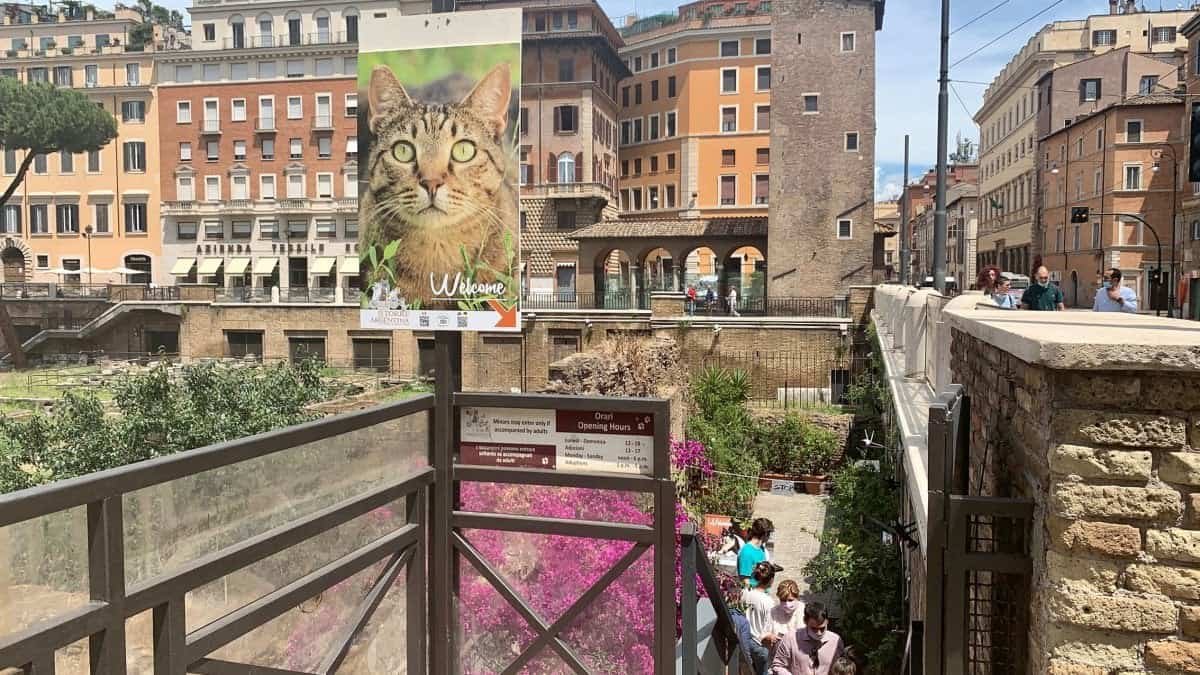
For almost a century this enclosure was the most famous hole in Rome: you looked at it from above, leaning on the railing, with the cats dozing on the column drums four meters below. Since June 20, 2023 the situation has changed. A walkway route descends into the area and for the first time lets you get close to the structures, walking at the level of the podiums instead of above the roofs of the modern city. Everything changes, and I don't say that lightly: Temple C seen from the sidewalk is a rectangle of tufa, Temple C seen from the walkway is a building with a height, a staircase and an altar in front.
The view from the balustrade is still one of the best in Rome, and it's still free. But anyone who stops there misses the black and white mosaic inside the cella of Temple C, the apses of the medieval church incorporated into Temple A, the physical difference between the three superimposed levels of paving. The verdict is blunt: the €7 ticket is one of the best spent in the Historic Center, and anyone who skips it to save 40 minutes is making a very bad deal.
The area occupies the center of the square over a surface that reads at a glance as a sunken quadrilateral. Inside are four temples of the Republican age, marked with the letters A, B, C and D from north to south, the remains of the Porticus Minucia, the tufa base that studies connect to the Curia of Pompey, traces of the portico called the Hecatostylum and the late walls that connect the fronts of the temples. Above, traffic and pines. Below, five centuries of Republican and imperial history compressed into a little over one hectare.
The Name of Largo Torre Argentina: Burckardt, Strasbourg and a Tower That No Longer Exists
The name of the square has nothing to do with South America, and this is the first thing to make clear. It comes from Johannes Burckardt, born in Strasbourg around 1445 and died in 1506, a career prelate who from 1483 was master of papal ceremonies under five popes: Sixtus IV, Innocent VIII, Alexander VI Borgia, Pius III and Julius II. A man who saw Renaissance Rome up close in its most violent and most creative phase, and who left a Latin diary of extraordinary coldness.
Burckardt signed his acts as Argentinus, because the Latin name of Strasbourg is Argentoratum. He bought a plot in this area, over the remains of the Theater of Pompey complex, demolished the medieval buildings that were there and built his own palace, which the Romans immediately called Casa del Burcardo, at Via del Sudario 44. The crenellated turret that characterized it became for everyone the Torre Argentina, and the name slid from the building to the square. In the 19th century the tower was lopped off and then swallowed by an added story: today it is unrecognizable, but it has left its name to one of the most spoken addresses in Rome.
The brick tower you actually see in the square, the one with the battlements on the corner toward Via Florida, is a different story: it's the Torre del Papito, a Medieval construction that has no connection to the Torre Argentina. Confusing the two is the most common mistake I hear from improvised guides, and it even happens in serious publications. If someone points to the Torre del Papito and says it gives the square its name, know that it's false.
After 1730, part of the Burcardo property was used to build the Teatro Argentina, and the theatrical vocation of the area, which went back to the Pompey complex, was perpetuated for the third time in 2,000 years. The restored small palazzo later became the seat of the SIAE, with the Burcardo theater library and museum, one of the richest collections on the history of performing arts in Italy.

From the Demolished Neighborhood to the Foro Argentina: The 1926 Excavations
The square we see is the result of a demolition. In 1909 the master plan for the capital of the young Kingdom of Italy called for rebuilding this sector of Campo Marzio: the plans included the Torre del Papito and the remains of a temple within the new buildings, after razing the existing urban fabric, of Medieval and sixteenth-century origin. Between 1926 and 1929 the bulldozers did their work. The church of San Nicola dei Cesarini was also torn down.
It was then that marble began to emerge from the ground. The decisive discovery was fragments of a colossal, gigantic statue, with a head that alone measures 1.46 meters. Systematic archaeological excavations began from there, carried out until 1928 and then resumed repeatedly at least until the 1970s, which uncovered a sacred area from the Republican era that was intact in its layout.
The planned use of the area remained uncertain for a long time: some people wanted to build over it, as planned. The complex was saved by an appeal from archaeologist Giuseppe Marchetti Longhi addressed directly to Benito Mussolini. The area was set up as an archaeological enclosure and opened in April 1929 under the name Foro Argentina. It's worth pausing for a second on this paradox: the same regime that tore down entire neighborhoods in Rome to open its avenues saved four temples that no plan wanted to preserve.
The Teatro Argentina, built in 1732 by Duke Giuseppe Cesarini Sforza, survived the demolition and today belongs to the Comune di Roma: it's the hall where the premiere of Rossini's Il Barbiere di Siviglia was staged in 1816, met with one of the most famous protests in opera history. Anyone who loves the repertoire will find the city's other historic stages on the page dedicated to Rome Opera House.
The Porticus Minucia and the Topography of the Sacred Area of Campo Marzio
The topographic identification of the area rests on a building that is not a temple: the porticus Minucia vetus, built in 106 BC by Marcus Minucius Rufus with the spoils of his triumph over the Scordisci, a Celtic people of the Balkans. The colonnades visible on the north and east sides of the square belong to this portico and were never rebuilt in the Imperial age, which makes them a precious fossil.
The tufa floor of the porticus is later than temples A, C and D and earlier than temple B. It's a simple stratigraphic sequence, and for that reason decisive: from that single level it was possible to reconstruct the relative chronology of the entire complex. Anyone who works on Roman archaeology knows how rare such a clean situation is in the Historic Center.
The four temples face onto a paved road that was rebuilt in the Imperial age after the fire of 80 AD, shortly after the expansion of the porticus Minucia, which in its late phase, known as Frumentaria, came to encompass the entire area. The name is no accident: the Minucia Frumentaria was the place where public distribution of grain to the Roman plebs took place. Beneath your feet, as you walk the walkway, ran one of the longest and most orderly lines in antiquity.

The Four Temples of Largo Torre Argentina, One by One
The letters A, B, C and D were assigned by archaeologists working from north to south, and they've stayed because none of the four dedications is certain. No dedicatory inscription has been found in situ. Everything that follows should be read with this warning in mind: the chronology is solid, the attribution is a reasoned hypothesis. In order of age, the sequence is C, then A, then D, then B.
Temple C of the Sacred Area of the Campus Martius, possibly dedicated to Feronia
The oldest of the four, datable to between the IV and III century BC. It rests on a very tall tuff podium, about 3.80 meters, topped by a simple molding of archaic taste. The plan is that of a peripteral temple sine postico, meaning surrounded by columns on three sides and closed at the back by a continuous wall: an Italic formula, not a Greek one. The walls of the cella are in brick. How many columns it had on the front is not known exactly, probably four or six. Some bases remain on the sides.
The dating has been built on three converging clues: the archaic appearance of the building, fragments of architectural decoration in terracotta, and some inscriptions. The attribution to Feronia, an ancient Italic goddess of fertility and protector of woods and crops, remains a hypothesis based on the testimony of ancient calendars that placed her cult in the Campus Martius. If it is correct, the sources would confirm the presence of a temple to Feronia in this area at least from 217 BC. The link with the grain distributed nearby has its own appeal, but it is a topographical suggestion, not a proof.
The temple had its own paved platform, replaced at a later stage, perhaps in connection with the construction of Temple D. On this second level rest the remains of the peperino altar, which an inscription found on site dates to 174 BC: it was set up by Aulo Postumio Albino, descendant of Aulo Postumio Albino Lusco, consul in 180 BC, on the occasion of a measure known as the Lex Plaetoria, about which we know little. The second floor was then covered by a third paving, much higher, which buried the altar and imposed six steps on the front. This is the level of the porticus Minucia of 80 AD, common to the whole area after the fire. On that occasion the mosaic of white and black tesserae was laid inside the cella, which can be seen well from the walkway with the right light.
There is an aesthetic consequence that almost no one talks about: as the walking surfaces rose, the podium looked lower. Late Republican taste preferred temples less raised up, and nature went along with the trend. The remains of a female acrolith found between this temple and Temple B are usually attributed to the second, but it is not impossible that they belonged to Temple C.
Temple A at Largo Torre Argentina, possibly Aedes Iuturnae
Second in age, 3rd century BC, then rebuilt in the 1st century BC. Originally it was a small building in antis, with a pair of columns in front of the cella, or perhaps a prostyle of the Tuscan order, with a podium 10 feet high and severe moldings: tall plinths with cushion-shaped profiles on the edges. The platform was in tuff and an altar in peperino rested on it, preserved only in part. Above this, a second tuff platform was built, with an altar in opus caementicium, corresponding to the level of the porticus Minucia, which became common to the whole area. To avoid burying the podium, it was rebuilt reproducing the same cornice profiles: a detail of philological respect that Roman builders did not always practice.
The major rebuilding probably took place in the Sullan period. Around the old building a peristasis was built, that is, a perimeter colonnade, and the ancient temple became the cella of the new one, in the Greek manner. The columns were nine on the long side and six on the rear, and perhaps also on the front, with bases and capitals in travertine and shafts in tuff covered with stucco. The travertine columns visible today belong to a later restoration. The new podium received Hellenizing moldings, similar to those of the nearby Temple B.
There are two proposals for the identification, both linked to the gens Lutatia and to the same year, 241 BC. The first is the temple of Juturna, the nymph of the springs, built in the Campus Martius by Gaius Lutatius Catulus, the consul who won at the Aegadian Islands. The second is the temple of Iuno Curritis, attributed to Gaius Lutatius Cerco after the victory over Falerii. The most probable identification remains the first, because a passage in Ovid's Fasti recalls that the temple of Juturna stood near the outlet of the Acqua Vergine, that is, next to the Baths of Agrippa, immediately north of this area. The fact that the adjacent Temple B was the work of another Lutatius Catulus points in the same direction: a family that marks its own sacred territory.
Above Temple A, the church of San Nicola dei Cesarini was built in the Medieval period, and its remains are still legible: two apses and an altar, set into the ancient podium. It is my favorite stratigraphy in the whole area, because it shows, in three square meters, how Rome never threw anything away.
Temple D of the Sacred Area, possibly Aedes Larum Permarinum
The largest of the four and the third in chronological order, starting in the second century BC and rebuilt in the first. The current attribution is to the temple of the Lares Permarini, the Lares protectors of sailors, vowed in 190 BC by Lucius Aemilius Regillus after the naval victory over Antiochus III and dedicated in 179 BC by the censor Marcus Aemilius Lepidus. The link comes from the Fasti Prenestini, which place the temple of the Lares Permarini near the porticus Minucia.
Only part of this temple can be seen. Most of the building lies below the street level of Via Florida and under the modern blocks, and for now there is no excavation project. The visible portion shows the oldest structure in opus caementicium, rebuilt in the first century BC in travertine. The plan is archaizing, with a large rectangular cella preceded by a hexastyle pronaos, with six columns, as deep as three intercolumnar modules. Today what is mainly legible is the first-century travertine podium, with sharp, slightly projecting moldings, for a height of about three meters.
In front of temple D, it's best to look at the edge of the excavation and imagine the rest under the asphalt. It's the best way to understand that the archaeological area of Largo Argentina is not a complete site, but a slice of a huge complex, of which the modern city preserves a cast above itself.
Temple B, the Fortuna of the Present Day
The most recent of the four and the only one with a circular plan: a tholos, with a round cella surrounded by a colonnade. It is also the most recognizable in photographs, because six of its columns still stand. The identification, supported by good arguments, is with the Aedes Fortunae Huiusce Diei, the Fortune of the Present Day, built by Quintus Lutatius Catulus, colleague of Gaius Marius in the consulship, for the victory over the Cimbri at the Campi Raudii in 101 BC.
The podium is molded, with bulging moldings of Hellenizing taste, what architectural historians call, with some license, a Baroque profile. The cella is circular, built in opus incertum. The columns were in tufa covered with stucco, with travertine bases and capitals. The existence of a tetrastyle pronaos has been hypothesized, but no archaeological trace of it remains. At an uncertain point in the imperial age, perhaps under Domitian and in any case after AD 80, the cella walls were demolished and rebuilt as slender tufa partitions between column and column, following the pseudoperipteral type. On the same occasion the podium was widened, and shortly after the outer facade was also closed.
Inside this temple, or next to it, stood the colossal statue whose fragments changed the history of the square. It was an acrolith, a mixed technique in which the nude parts of the figure are marble and the rest is covered by a robe, here of bronze, later melted down and dispersed. The head, 1.46 meters tall, the arms, and the legs have been found. Today they can be seen at the Centrale Montemartini, the old Ostiense electric power plant transformed into a museum, and I recommend planning the two visits for the same weekend: seeing the temple without the goddess, and then the goddess without the temple, teaches more about Roman archaeology than 10 information panels.
The Great Raising: How the Four Temples Became a Single Complex
At the beginning, temples A and C were independent, built on the original ground level, separated by a fairly wide space, each with its own enclosed area raised a few steps above the surrounding ground. Then temple D was built. The total transformation came when the walking surface was raised by about 1.40 meters, probably following a fire, likely the one of 111 BC.
On that occasion a single tufa pavement was laid for the three temples, and perhaps the enclosure was also built with a colonnaded portico, of which traces remain on the north and west sides. The podiums were cut at half height, and each temple reacted in its own way. Nothing was added to temple C. The cladding of temple A was redone with new blocks. Temple D underwent a considerable enlargement, perhaps a little later, cladding everything in travertine.
There remained a problem of symmetry. The empty space between temples A and C, with the new continuous pavement, looked unbalanced, and it was then that temple B, the tholos, was inserted there. A sacred building also built, if not primarily, for reasons of urban composition. The dating of that pavement rests on the inscription on the altar of temple C, which is covered by the tufa and therefore earlier: the new floor must date to after the middle of the second century BC.

Why the Sacred Area of Campo Marzio Is the Measuring Stick of Republican Architecture
This is the reason the name Largo Argentina appears in every manual of Roman archaeology, and it has nothing to do with Caesar or the cats. The study of the architecture of this area has provided the main chronological paradigm for all the sacred buildings of Rome and central Italy: when an archaeologist needs to date a podium or a cornice in a sanctuary in Lazio or Umbria, the comparison is sought here.
From the four plans, the evolution of taste during the Republican era can be read in sequence: from the most archaic plan forms, Temple C, Temple D and the first phase of Temple A, to the imported Hellenized layouts, the tholos and the peripteral temple. The profiles of the podiums also tell the same story, with clear links to the Etruscan and Italic world between the 4th and 3rd centuries BC and the appearance, from the 2nd century, of profiles of Greek derivation. And there is a constant tendency, over time, to reduce the height of the podiums: the temple stops dominating from above and descends toward whoever is looking at it.
Four buildings, four moments, one enclosure. No other place in Rome offers such a compact series. If the subject interests you, the sequence is completed nicely with a visit to the Crypta Balbi, a few steps away, where the same stratigraphic method is applied to the transition between antiquity and the Middle Ages.
The Imperial-era transformations in the Sacred Area
Apart from ordinary maintenance, the replacement of some columns, and the redecoration of walls and floors, the sacred area underwent two major interventions in the imperial era.
The first dates to after the fire of 80 AD, the one that under Titus devastated the Campus Martius along with the Pantheon and the Baths of Agrippa. It consisted of a general repaving in travertine, which shortened the entrance staircases, which at the time had travertine cheek walls, and involved replacing the external altars with altars placed inside the staircases, following an imperial fashion well documented elsewhere. Anyone visiting the Pantheon sees the other face of the same Domitianic and Hadrianic reconstruction.
The second intervention dates to the late 3rd century. A wall was built joining the fronts of the temples, certainly those of Temples A and B at least, creating a series of service rooms between one temple and the next. It is very likely that the offices overseeing the aqueducts and the grain distribution were housed there, unified in the era of Septimius Severus into a single administration led by a curator aquarum et Minuciae, and moved elsewhere in the Constantinian era. A sanctuary that becomes a ministry: the most Roman way possible of reusing a sacred place.
The restoration of the ancient paving, dating to the Domitianic era and laid in travertine blocks, has been underway for some time. Some sectors may be inaccessible depending on the state of the work, and it is worth checking on the official website of the Sovrintendenza Capitolina before setting out.

The other remains: Hecatostylum, Curia of Pompey and Torre del Papito
Not everything visible in the enclosure belongs to the four temples, and this is a constant source of confusion.
The eastern sector is occupied by the remains of the porticus Minucia. The northern sector preserves some traces of the great portico known as the Hecatostylum, meaning the 100 columns, which belonged to the monumental complex of the Theater of Pompey and extended westward, beneath the city blocks between Via dei Chiavari and Campo de' Fiori. To the west, behind Temples B and C, a large tuff base is visible, which studies now connect with very broad consensus to the Curia of Pompey, the hall where the Senate met when the Forum's Curia was unusable.
The Curia of Pompey and the Ides of March, 44 BC
On March 15, 44 BC, Gaius Julius Caesar was killed while presiding over a session of the Senate gathered in the Curia Pompeiana. Not in the Forum, not on the Campidoglio: here, in this corner of the Campus Martius, behind the temples you now view from the walkway. The institutional seat that inherits that function today is another, and it can be visited a short walk away: Palazzo Madama.
Investigations carried out in 2012 by a group of Spanish archaeologists together with the Sovrintendenza identified in that sector a concrete structure interpreted as the monumental sealing of the crime scene, decided by Augustus: the exact spot would have been walled up and made inaccessible because it was considered cursed. If the interpretation holds, we are looking at the first documented case of damnatio of a place for a political assassination.
Also in 2012, Andrea Carandini proposed that Caesar fell on the pulpit placed under the niche that housed the statue of Pompey, next to the senators' seats. The hypothesis fits the famous passage from Plutarch: Caesar collapsed against the pedestal on which the statue of Pompey stood. He was drenched in blood, so that it seemed Pompey himself was directing the punishment of his rival, who lay at his feet. That is from the Parallel Lives, and it is a literary text written more than a century after the events: beautiful, but not an official report. I say this because in this square, literature is often passed off as archaeology.
In the square there is also the Torre del Papito, isolated from the urban context that used to explain it, and the Teatro Argentina, which since 1732 has kept the theatrical vocation of the area alive.
The Cat Colony of Largo Torre Argentina
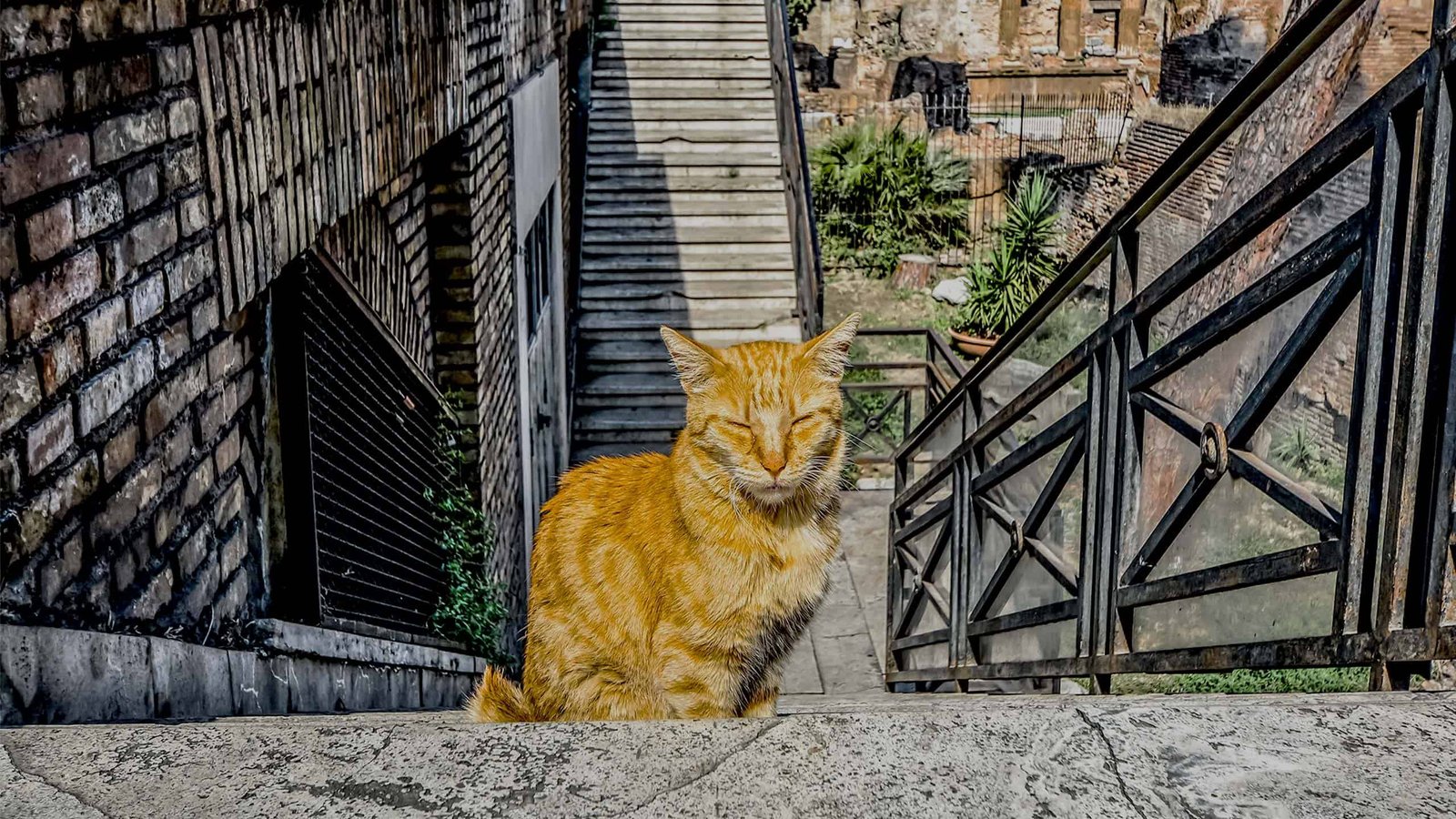
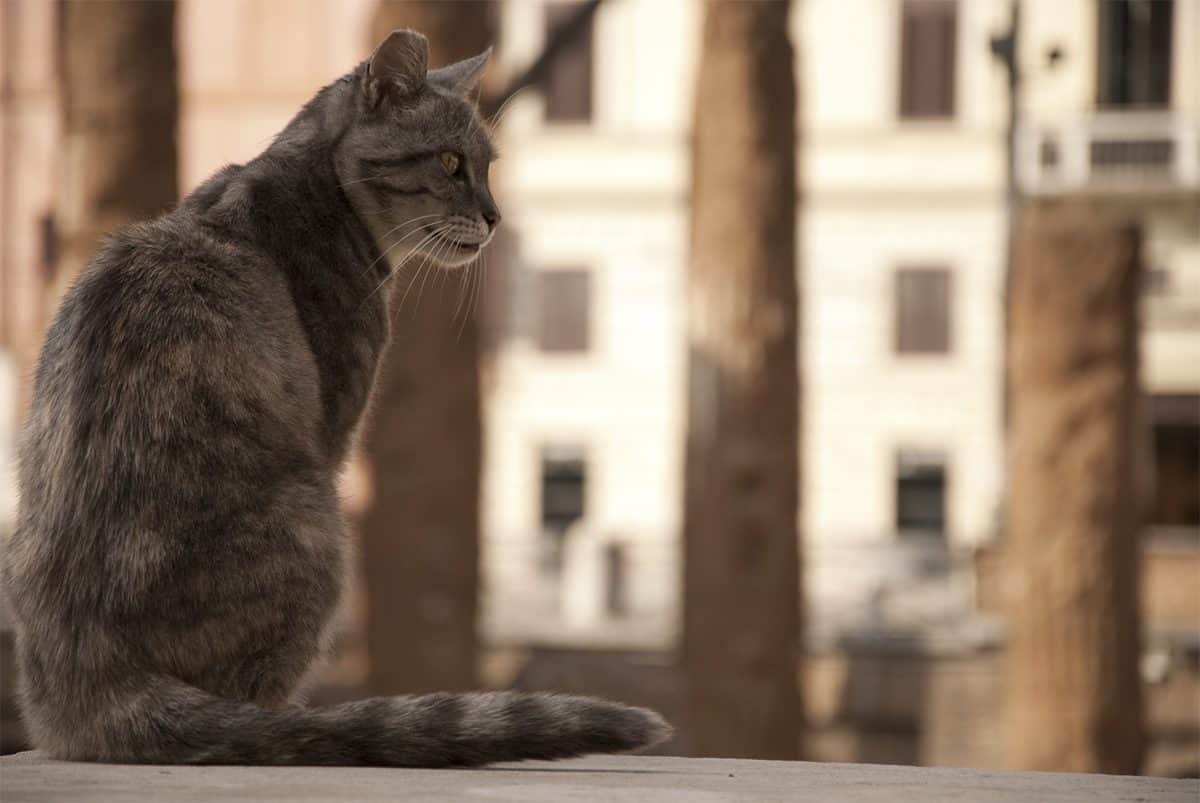
Since the sacred area was rediscovered, cats have taken over the ruins, and for decades a recognized cat colony has lived among the podiums, cared for by volunteers who run a shelter in a room below street level, on the side of via Florida. Spaying and neutering, veterinary care, remote adoptions: this is serious work, done by people who ask the tourists for nothing more than decent behavior.
The shelter has its own opening hours, separate from those of the archaeological area, and it's worth checking them on the association's website before going down. We dedicated an entire page to the Cat Sanctuary at Largo Argentina, with the history of the colony and the right way to support it.
A warning: don't feed the cats, don't climb over the railing to take photos of them, and don't bring loose dogs. And above all, don't bring a cat here that you no longer want. The colony is not a dumpster, and abandoning animals is still a crime.
A Curiosity About Largo Torre Argentina - Area Sacra del Campo Marzio
The best curiosity concerns the floor, not the temples. Under the walkway there are three overlapping levels of ground, and the distance between the first and the last is more than two and a half meters. It's not a geological phenomenon: it's Rome rising on its own, fire after fire, flood after flood. The Campus Martius was a floodplain of the Tiber, flooded regularly until the construction of the 19th-century embankments, and every flood deposited silt. The Romans didn't dig down: they raised the ground.
The consequence is counterintuitive. The temples you see didn't sink into the ground because they are ancient: they sank because the city grew upward around them, and every time the floor rose, the podium looked lower. Temple C, which was originally built with a podium almost four meters high, eventually had only a few steps left above ground. Late Republican architects, instead of fighting the phenomenon, grew fond of it: the fashion for low podiums also comes from here, from an adaptation to a plain that was burying itself.
Second curiosity, minor but memorable. The inscription on the altar of Temple C, the one from 174 BC, is one of the oldest epigraphic documents found in situ in the Campus Martius, and it has the feature of having been found sealed under the tuff: which means no one has moved it, reused it or reworked it in 22 centuries. In Roman urban archaeology, where everything gets recycled, an object that never moved is worth as much as a rare one.
Third, if you want a detail to tell over dinner: the square owes its name to Strasbourg. Argentoratum, Argentinus, Argentina. No link to Latin America, no link to silver.
Something Nobody Tells You About Largo Torre Argentina - Area Sacra del Campo Marzio
The point no audio guide covers is the distribution of grain. The porticus Minucia Frumentaria, which in its late phase enclosed the entire sacred area, was where Roman citizens enrolled on the lists collected their monthly share of public wheat. We are talking about roughly 200,000 eligible recipients in the imperial era, each with a token, each assigned to a counter and a specific day.
This means that this square, for at least three centuries, was a very crowded public office. The four temples were not a quiet sanctuary: they were the monumental backdrop of an enormous system of lines, registers and checks, the administrative machine that kept the social peace of a metropolis of 1 million inhabitants. And the rooms built in the 3rd century between one temple and the next were, in all likelihood, the offices of that service, united with those of the aqueducts under a single official, the curator aquarum et Minuciae.
There's more, and it concerns the way we look at the ruins. We're used to imagining ancient temples as places of quiet reflection. Here the opposite is documented: the sacred and the bureaucratic coexisted within the same enclosure, with citizens queuing in front of the podiums and priests sacrificing at the altars a few meters away. Nobody found it strange. The separation between religious and administrative space is a modern invention that we project backward without realizing it.
One last little-known detail: most of Temple D lies beneath via Florida and the modern buildings. The visitable area is one section, not a complete complex. When someone says they've seen the sacred area, they've seen perhaps two thirds of what there is.
My advice for visiting Largo Torre Argentina - Area Sacra del Campo Marzio
Book the first entry of the day, the 9:30 one, and go on a weekday. Entries are limited to one every 20 minutes, and the visit lasts about 45 minutes. With the first slot, you'll find the walkway almost empty and the low light coming in from the east, the best for reading the profiles of the podiums. The late afternoon in summer works just as well, but the flow is denser.
Second tip, practical and not very romantic: bring water and take care of the bathroom beforehand, because there are no restrooms inside the area. The route is short but completely exposed, with no shade: between June and August, at noon, it's an oven. Hat required, closed shoes recommended.
Third, and worth the trip: do the visit in two stages. First, the walk around the railing from above, free of charge, starting from the corner of via di Torre Argentina and completing the loop clockwise, to understand the overall layout. Then go down with your ticket and retrace the same buildings up close. 10 minutes up top, 45 below. Those who skip the first part lose the understanding of the floor plan, and those who skip the second lose everything else.
Fourth: buy the ticket in advance, always. One euro more, and it saves you the line at the ticket office at Torre del Papito and the risk, on spring weekends, of finding the slot sold out. Residents of Rome and the Metropolitan City enter for free but must still have an entry ticket: free doesn't mean without a ticket.
Fifth, and the most direct of all: don't come here as an isolated stop. This area makes sense in sequence with the Crypta Balbi and the Centrale Montemartini. If you have only one day and want someone to really take you inside the texts and sources, there are tailor-made formats for small groups that you can find among the customized small-group experiences in Rome.

Another well-known fact, yet rarely mentioned
Everyone knows that Julius Caesar was killed on the Ides of March. Almost no one connects that fact to this address. The murder did not take place in the Curia in the Roman Forum, which was under reconstruction, but in the Curia Pompeiana, the hall for senate sessions attached to the Theater of Pompey complex. The tuff base behind Temples B and C belongs to that building.
So the well-known fact is that Caesar died in Rome on March 15, 44 BC. The little-mentioned detail is that he died here, in a building dedicated to his rival, under the statue of Pompey, in a place that Augustus later had walled up. The coincidence was too perfect not to become literature: Plutarch openly exploits it, Shakespeare inherits it from Plutarch, and cinema inherits it from Shakespeare. It's 2,000 years of storytelling built on a topographical location.
I'll add the detail that's usually missing: that was not an improvised choice by the conspirators. The Senate session was regularly scheduled there, and the conspirators knew that gladiatorial games were being held at the same time in the Pompey complex, which guaranteed armed friends a short distance away. It was an ambush planned in a place chosen for its logistics, not a burst of violence in just any square.
Finally, it's worth remembering that the Curia is not open to visitors: you see its base, not the hall. Anyone who arrives hoping to enter the room where Caesar died will be disappointed, and it's better to know that before buying your ticket.
The right photo to take at Largo Torre Argentina - Area Sacra del Campo Marzio
The photo everyone takes is from above, from the railing on the via di Torre Argentina side, with the six columns of Temple B in the foreground. It works, and it makes a good postcard. But it's a flat photo, because it flattens the podiums and doesn't show the heights.
The photo I recommend is a different one: from the walkway, low down, aiming the lens upward along the side of temple C, so that the tuff podium cuts diagonally across the frame and, in the background, the Umbertine buildings of the square. It's the only shot that conveys the leap of 20 centuries in a single click, and it can only be taken from the inside. Moderate wide angle, not extreme: the vertical lines fall away quickly.
For the light: early in the morning it lights up the eastern facades, and late afternoon cuts across the columns of the tholos from the side and brings out their fluting. The winter golden hour, around 15:30, with opening hours on solar time until 16.00, offers the best combination of the year. After sunset the area closes, but the night lighting of the enclosure, seen from the balustrade, remains a free show, with the golden stone and the cats emerging from the shadows. If you pass by in the evening after dinner, stop for two minutes and look down.
One last technical tip and a rule of good manners. The tripod on the walkway is impractical, because of the space and the limited flow: bring a fast lens and raise the ISO. And cats are photographed from where you stand, without leaning out and without calling them. Those looking for shots of the nearby monuments will also find good tips in our pages on Piazza Navona and the Trevi Fountain.
Some important events that happened here in history
241 BC The gens Lutatia begins to leave its mark on this sector of the Campus Martius. The victory at the Egadi Islands and the campaign against Falerii are linked to the two proposals for identifying temple A, the Aedes Iuturnae and the temple of Iuno Curritis.
217 BC Literary sources attest to a cult of Feronia in the Campus Martius. It is the indirect but valuable link for the hypothesis that temple C was dedicated to that goddess.
190 and 179 BC Lucius Aemilius Regillus vows the temple of the Lares Permarini after the naval victory over Antiochus III. The censor Marcus Aemilius Lepidus dedicates it 11 years later. This is the story attributed to temple D.
174 BC The peperino altar is placed in front of temple C, with the inscription that fixes its date and that will later be sealed under the next floor.
111 BC A fire, almost certainly the one recorded by the sources for that year, requires raising the walking surface by about 1.40 meters and creating the single pavement that turns three separate sanctuaries into a unified complex.
106 BC Marcus Minucius Rufus builds the porticus Minucia vetus with the spoils of his triumph over the Scordisci. It is the building that made it possible to identify the entire area topographically.
101 BC Quintus Lutatius Catulus, colleague of Gaius Marius, defeats the Cimbri at the Campi Raudii. The construction of the tholos of Fortuna of the Present Day, temple B, is linked to the victory.
March 15, 44 BC Gaius Julius Caesar is killed in the Curia of Pompey, behind temples B and C. It is the most famous event ever to have happened within this perimeter.
80 AD The fire that devastates the Campus Martius under Titus requires rebuilding the paved road and repaving in travertine, with the staircases shortened and the altars moved inside the ramps.
3rd century AD Under Septimius Severus, the offices of the aqueducts and of grain distribution merge into a single administration. Shortly after, a wall connects the facades of the temples, creating service rooms between one building and the next.
Late 15th century. Johannes Burckardt buys the land, demolishes the existing structures, and builds the Casa del Burcardo with the tower that will give the square its name.
1732. Duke Giuseppe Cesarini Sforza has the Teatro Argentina built, which in 1816 will host the much-contested premiere of The Barber of Seville.
1926-1929. Demolitions for the new urban layout bring the sacred area to light. The colossal statue emerges from the excavations. Giuseppe Marchetti Longhi's plea to Mussolini saves the complex, which is inaugurated as the Foro Argentina in April 1929.
2012. Investigations by a group of Spanish archaeologists with the Soprintendenza identify in the western sector the structure interpreted as the Augustan enclosure of the site of Caesar's assassination.
June 20, 2023. The area reopens with the new walkway route and becomes visitable up close for the first time, with access for people with motor disabilities and tactile panels for people with visual disabilities.
Who Has Passed Through Largo Torre Argentina - Sacred Area of the Campus Martius
Gaius Julius Caesar entered it for the last time on March 15, 44 BC, to preside over the Senate session in the Curia Pompeiana. He did not leave alive. It is the most famous episode and the best documented in the ancient sources, from Suetonius to Plutarch to Cassius Dio.
Marcus Minucius Rufus, consul in 110 BC and triumphant over the Scordisci, commissioned the porticus Minucia vetus in 106 BC. Without his Balkan booty, this square would not have the portico that makes it identifiable.
Quintus Lutatius Catulus, colleague of Gaius Marius in the consulship of 102 BC, linked his name to the tholos of Fortuna of the Present Day after the campaign against the Cimbri, which ended in 101 BC.
Marcus Aemilius Lepidus, censor, dedicated the temple of the Lares Permarini in 179 BC, a temple vowed by Lucius Aemilius Regillus. Two members of the same family, 11 years apart, following a common practice in mid-Republican Rome.
Johannes Burckardt, master of ceremonies for Sixtus IV, Innocent VIII, Alexander VI, Pius III and Julius II, lived here straddling the Quattrocento and Cinquecento, and left the square his Latin nickname. His diary remains one of the coldest and most informed first-hand sources on the Borgia court.
Gioachino Rossini passed by the Teatro Argentina, on the west side of the square, for the world premiere of The Barber of Seville on February 20, 1816. It was a disastrous evening, with whistles and incidents on stage, followed by one of the most lasting triumphs in the history of opera.
Giuseppe Marchetti Longhi, archaeologist, is the man to whom the area's very existence is materially owed. His petition to Mussolini convinced the regime to give up construction and to set up the archaeological enclosure.
Andrea Carandini proposed in 2012 a reconstruction of how Caesar died, next to the pulpit under the statue of Pompey. It is a contested reading that continues to fuel debate between archaeologists and historians.
And then, without name or date, the hundreds of thousands of Roman citizens who came here for three centuries to collect grain. They are the real regular visitors to this square, and no plaque remembers them.
Largo Torre Argentina with Children
The site works well with children from seven years old and up, and for a precise reason: the walkway brings them to the right height to understand that these are not random stones but buildings. Under seven, the risk of boredom is high, because there are no immersive reconstructions or multimedia displays. The draw of the cats, however, works at every age and solves many situations.
The short visit, 45 minutes, works in its favor. Two games work well with families: count the three overlapping floor levels along the side of Temple C, and look for the two apses of the medieval church inside Temple A. The second one works especially well, because it forces you to tell medieval brick apart from ancient tuff.
Watch out for strollers: the area is accessible thanks to the lift platform and the removal of level changes, but the path remains narrow and one-way at busy times. With a bulky stroller, it's better to book the 9.30 slot. There are no toilets inside the enclosure, and with small children this is the constraint that weighs most, so plan ahead.
Accessibility of the Sacred Area of Campo Marzio
The new 2023 layout has made the area accessible to people with motor disabilities through a lift platform, and it has removed level changes and steps along the route, which can therefore be done in a wheelchair. For visually impaired and blind visitors, tactile panels and 3D-scanned finds are available, an apparatus still rare at Roman archaeological areas and which here was designed together with the route.
Two limits should be known in advance: the absence of toilets and the complete lack of shade. For those with walking difficulties or problems regulating body temperature, the hot months should be faced only in the first time slot. Small dogs enter in a carrier. For guide dogs, it's advisable to report your presence at the Torre del Papito ticket office upon entry.
Those who organize group visits with specific needs can book for free at 060608, which manages bookings for groups of five to 25 people and for school groups.
How Much It Costs and How to Save at Largo Torre Argentina
Seven euros for a full ticket for non-residents, four for reduced, and a one-euro advance booking fee. Admission is free for residents of Rome or the Metropolitan City, as well as for the categories entitled to it under the civic museum rules. It is one of the cheapest tickets in the historic center and, given what you see, the best value per euro spent among the city's paid archaeological sites.
The real saving, however, is time: if you book a slot, you don't queue. There is also a money saving I recommend to anyone with more days: build an itinerary that links the areas of the civic circuit, from the Capitoline Museums to the Centrale Montemartini, where the same free-admission formula for residents applies uniformly. If you want an overview of the city's collections, you'll find it on our page about museums in Rome.
A warning about tickets: never buy from anyone who stops you on the street offering fast-track entry. The ticket is bought in advance through the channel indicated by the authority on its official website, or at the ticket office at the foot of the Torre del Papito, and there are no paid priority lanes for this area.
What's around Largo Torre Argentina within 10 minutes on foot
Few squares in Rome have a 10-minute radius this dense. Heading north, past via del Sudario and via dei Barbieri, you reach the Pantheon in about 8 minutes and Piazza Navona in 10, passing the underground areas of the Stadium of Domitian, which show the ancient level just as the walkway at Largo Argentina does.
Heading west, a little under 5 minutes gets you to Campo de' Fiori, walking over the cavea of the Theater of Pompey, whose shape can still be read in the curve of via di Grotta Pinta. Heading south, the Forum Boarium and the Tiber Island are reached in a good 15 minutes along via delle Botteghe Oscure and the Ghetto.
Heading east, just a couple of steps away, is the Crypta Balbi and then the National Museum of Palazzo Venezia, a little farther on, the Capitoline Museums. And if you have half an hour to spare, the Galleria Doria Pamphilj on the Corso is the most surprising private collection in the city.
When to go and when to avoid Largo Torre Argentina
The best months are April, May, October, and November. In those weeks the opening hours partly follow daylight saving time, the light is low and warm, and the enclosure is not an oven. January and February work very well for anyone who doesn't mind the cold: opening hours are reduced, but the walkway is nearly empty, and the winter light on the tufa podiums is the best of the year for taking photos.
Avoid: spring Sundays between 11.00 and 14.00, when slots sell out early and the route runs at full capacity, and the central hours of July and August, due to a total lack of shade. There's no arguing with Mondays: it's closed, and every year I see people show up without knowing it.
One observation worth making: this area changes a lot in the rain. Wet tufa darkens, and the three floor levels stand out better, because water pools differently on the surfaces. A gray day here is not a wasted day. In fact, it's when the stratigraphy is easiest to read.
What to eat in the Largo Torre Argentina area
We're on the border between three different Roman cuisines, and it's good to know that. To the south, toward the Portico d'Ottavia, begins Jewish-Roman cuisine: carciofo alla giudia, filetti di baccalà, aliciotti con l'indivia, and pizza ebraica, the one with dried fruit that has nothing of pizza about it. To the west, toward Campo de' Fiori, is the classic Roman trattoria for first courses: cacio e pepe, gricia, amatriciana, carbonara. To the north, toward the Pantheon, is the territory of historic bars and coffee.
My advice, without naming places that change with the seasons: walk at least 300 meters away from the edge of the square before you sit down. Largo Argentina is a public transport terminus, and restaurants around terminuses in every city in the world rely on passing trade, not repeat customers. Three blocks is enough to completely change the balance between quality and price.
If you want a practical rule, look for small dining rooms, a short menu, a handwritten daily specials sign, and customers speaking Italian at lunch on weekdays. It works here the same way it does in Trastevere. If you're planning a trip and want to read in English about how people really eat in Rome, you'll find an honest picture in the guide best things to do in Rome.

How to Organize a Guided Visit to Largo Torre Argentina
For groups of five to 25 people, booking is free and is made by calling 060608. School groups follow the same procedure. The entry limit of every 20 minutes means a large group gets split up, so it's worth agreeing on a meeting point at the exit in advance.
The official duration of the visit, 45 minutes, is realistic for a guided route that covers the four temples, the porticus and the base of the Curia. With an attentive group you can comfortably reach one hour, but the flow of later entries requires discipline: here, you don't improvise long stops in front of a single podium.
Those looking for professional escorts for organized groups, business trips or incentives can turn to the network of certified tour leaders, while team building and group formulas for Rome are gathered on the Rome page at TourLeaderPro. For those traveling independently and wanting to fit the sacred area into three well-planned days, the three-day Rome itinerary, in English, is a good starting point.
Quick Questions About Largo Torre Argentina: Area Sacra del Campo Marzio
How much does a ticket to the Area Sacra di Largo Torre Argentina cost?
Full price is 7 euros and reduced is 4 euros for non-residents, plus a 1 euro booking fee. Free for residents of Rome and the Metropolitan City, and for eligible categories.
What are the opening hours of Largo Torre Argentina?
Tuesday to Sunday: 9.30-19.00 during daylight saving time, last entry at 18.45, 9.30-16.00 during standard time, last entry at 15.45. On December 24 and December 31, the hours are 9.30-14.00.
When is the Area Sacra del Campo Marzio closed?
Every Monday, December 25 and May 1.
Do I need to book to visit Largo Torre Argentina?
Yes. Advance booking is mandatory, with a maximum of five tickets per purchase, and entry is limited to every 20 minutes.
How long is the visit to Largo Torre Argentina?
About 45 minutes, according to the indication from the managing body. With an attentive guide you can reach one hour.
Where is the entrance to the Area Sacra di Largo Argentina?
On Via di San Nicola de' Cesarini, opposite number 10. The ticket office is at the foot of the Torre del Papito.
Can you see Largo Torre Argentina for free?
Yes, from above: the walk along the balustrade around the edge of the square is free and lets you read the entire plan. To go down onto the walkway, you need a ticket.
Is Largo Torre Argentina wheelchair accessible?
Yes. A lift platform provides access, and the route has been cleared of level changes. Tactile panels and 3D artifacts are available for visitors with visual impairments.
Are there restrooms inside the archaeological area?
No. There are no restrooms inside the enclosure. Plan ahead before entering.
Can you bring dogs to Largo Torre Argentina?
Small dogs are allowed in a carrier.
How many temples are there in the Area Sacra del Campo Marzio?
Four, labeled A, B, C and D from north to south. No dedication is certain, but the current proposals are Iuturna for Temple A, the Fortuna del Giorno Presente for Temple B, Feronia for Temple C, and the Lari Permarini for Temple D.
What is the oldest temple at Largo Torre Argentina?
Temple C, datable to between the 4th and 3rd centuries BC. Next come Temple A, Temple D, and finally Temple B.
Was Julius Caesar killed at Largo Torre Argentina?
Yes, in the Curia of Pompey, whose tufa base is visible to the west, behind Temples B and C. The Curia can't be visited: you see its base, not the chamber.
Why is it called Largo di Torre Argentina?
From the tower of the house of Johannes Burckardt, who signed himself Argentinus because he was born in Strasbourg, in Latin Argentoratum. No connection with South American Argentina.
Is the Torre del Papito the Torre Argentina?
No. The Torre del Papito is a medieval structure that has nothing to do with the Torre Argentina, which is now absorbed into a building on Via del Sudario.
Where is the colossal statue found at Largo Argentina?
At the Centrale Montemartini. It is an acrolith: what remains are the head, 1.46 meters tall, the arms and the legs.
Can you see the cats of Largo Argentina?
Yes. The feline colony lives in the area, and the volunteers' shelter is on Via Florida side, with its own hours, different from those of the archaeological area.
Can you visit Largo Torre Argentina with children?
Yes, and it works well for children from age seven up. The short visit and the cats help. However, there are no multimedia displays or restrooms.
When is the best time to visit Largo Torre Argentina?
The first entry at 9.30 on a weekday, preferably between April and May or between October and November. In summer, only the first time slot, because there's no shade.
What's the difference between Largo Torre Argentina and the Crypta Balbi?
Largo Argentina shows four Republican temples in an outdoor enclosure. The Crypta Balbi, 200 meters away, shows under a single building how a city block changed from antiquity to the Medieval period. The two visits complement each other.
How far is Largo Torre Argentina from the Pantheon?
About eight minutes on foot to the north. Piazza Navona is 10 minutes away and Campo de' Fiori is five.
I'll leave you with an opinion. For a century this square was looked at from above, the way you look at an aquarium, and it ended up becoming the symbol of Roman archaeology to be observed without touching. The walkway has flipped the perspective, and now four temples that in textbooks are letters of the alphabet are once again buildings with a staircase, a threshold and an altar. Seven euros and 45 minutes is a ridiculous price for such a clear change of perspective. Go early in the morning, stay quiet for two minutes in front of Temple C, and you'll notice that the sound of traffic over your heads is exactly the same sound that was here when 200,000 Romans came to line up for grain.
Article written by the editorial team of TourLeaderPro, contact them for Private/Corporate/V.I.P. Tours and Experiences.
Planning a trip to Rome? English guides for visiting the city are available at ItalyPlanner.com.