Palazzo Doria Pamphilj
In short. Palazzo Doria Pamphilj has the entrance to the Gallery at Via del Corso 305, 00186 Roma, about 100 meters from Piazza Venezia.

Palazzo Doria Pamphilj has the entrance to the Gallery at Via del Corso 305, 00186 Roma, about 100 meters from Piazza Venezia. Phone: +39 06 6797323. Information and group bookings at info@dopart.it. The single ticket costs 16,00 euro at the ticket office and 17,00 euro if you book online. There is no standard reduced ticket. Entry is free for children under 12 and for visitors with disabilities who hold an Italian or European Union Disability Card (online, the free ticket is issued for 1,00 euro). Hours are 9.00-19.00 Monday to Thursday, with last entry at 18.00, and 10.00-20.00 Friday to Sunday, with last entry at 19.00. The ticket office closes one hour earlier. Closed every Wednesday, plus January 1, Easter Sunday, and December 25. Booking online is the option the Gallery recommends. It warns that without a reservation, entry is not guaranteed on busy days. The audio guides in Italian, English, French and Spanish are included in the price, while supplies last. There is no cloakroom, and backpacks, bags and medium or large luggage are not allowed in. Only small bags are permitted. By bus, the most direct route according to the Gallery is line 64 from Termini, seven stops to Piazza Venezia, and then 100 meters on foot along Via del Corso. From Barberini metro station (line A), take lines 95, 175, 492, 62 or 630 on Via del Tritone and get off at the intersection with Via Minghetti. From Colosseo metro station (line B), lines 85 or 850 serve the area, and you get off where Via del Corso meets Via dei Santi Apostoli. You can't reach it by car. We are inside the ZTL of the Historic Center, and without a permit you have to park beforehand. Plan on an hour and a half for your visit. That is the duration the Gallery itself suggests, and it should be treated as the bare minimum.
This guide is part of the index of museums of Rome, where you'll find the city's other collections organized by neighborhood and type.

What Palazzo Doria Pamphilj really is: a home, not a state museum
Let's start with the point that changes everything else. Palazzo Doria Pamphilj is not a state museum, not a civic museum, and not a banking foundation that bought a collection and hung it in a converted building. It is the home of a family that has lived here since the 1600s, and that decided to open to the public the wing where it keeps its paintings. The descendants still live in the palazzo, behind the doors you see closed along the route. When you walk through the four wings of the Gallery, you're walking inside an absurdly large private apartment, and the difference is felt in every room: no giant educational panels, no immersive rooms, no set path with arrows on the floor.
Where to buy tickets. The Galleria Doria Pamphilj is private and sells directly through its own website, doriapamphilj.it, with the audio guide included in the price. Tickets are also available on GetYourGuide. Verified on September 28, 2026.
It is also the largest private palazzo in Rome. It grew through successive purchases, absorbing houses and entire blocks between Via del Corso, Via della Gatta, Via Lata and Via del Plebiscito. It occupies a quadrilateral that takes a good 10 minutes to walk around. The fact that it has remained intact, with the collection still inside the rooms it was bought for, is a European rarity. Most Roman noble collections were broken up, sold abroad or taken over by the State between the 1800s and the early 1900s. Not here. Here the picture gallery still hangs where the manuscript of 1767 says it hung.
In our view, for anyone with half a day in central Rome who has already seen the sights you can't skip, this is the museum to choose. Not the Musei Capitolini, which are huge and tiring. Not the Galleria Borghese, which is wonderful but requires a timed-entry reservation and a trip to Villa Borghese. This one is because it is 100 meters from Piazza Venezia, because you can see everything in 90 minutes, and because it holds three or four paintings that are worth the ticket to a national museum on their own.
How to get to Palazzo Doria Pamphilj
On foot, which is the right way
The palace is in a position that makes taking any transport almost ridiculous. From the Pantheon you go along Via della Minerva and reach Piazza del Collegio Romano in barely five minutes. From the Trevi Fountain you take Via delle Muratte, come out on Via del Corso and go down toward Piazza Venezia for 300 meters: seven minutes, and these are the directions the Galleria itself gives. From Piazza Venezia, number 305 is 100 meters on the right going up the Corso, right after the Galleria Alberto Sordi if you come from the other direction.
Watch out for one thing that throws one visitor in three: the monumental portal you see on Via del Corso is not the museum entrance. It is the palace's formal entrance. The Galleria's ticket office is at number 305, and whoever arrives from Piazza del Collegio Romano side sees yet another front. If you have the impression of going around a block without finding the door, it is not your fault: the block is all its own.
By bus and by metro to Palazzo Doria Pamphilj
There is no metro stop at Piazza Venezia, and there won't be until the Line C station opens, whose construction site is the one you see fenced off in the middle of the square. So you arrive at street level. The bus line the Galleria lists first is the 64, which leaves from Termini and in seven stops drops you at Piazza Venezia. It is also the most crowded line and the one most frequented by pickpockets in Rome, so keep your bag in front and your phone in a closed pocket. If you get off at Metro A Barberini you can take lines 95, 175, 492, 62 or 630 on Via del Tritone and get off at Via Minghetti, then 150 meters toward Piazza Venezia. If you arrive from Metro B at Colosseo, take the 85 or the 850 and get off where Via del Corso crosses Via dei Santi Apostoli.
The practical advice is different from all these combinations: get off at Piazza Venezia with whatever comes along, or come on foot. The area is served by a quantity of lines that all converge there, and discussing which one to take is wasted time. What matters is that surface traffic in the center is very slow: if you are 20 minutes away on foot, walking is faster.
Entry, luggage and the rules of Palazzo Doria Pamphilj
Here is a rule that ruins the day for anyone who doesn't know it. The Galleria has no cloakroom and forbids entry with backpacks, bags and luggage of medium and large size. Only small bags are allowed in. There is no storage where you can leave your rolling suitcase, and there is no fallback solution inside the palace. Whoever arrives from the station with a suitcase, whoever has a trekking backpack, whoever carries a gym bag, stays outside. The elevator is not available to visitors either.
It is not meanness: these are private rooms, the paintings hang at arm's length and there are no safety corridors. A backpack swinging on one shoulder in a room where the paintings start 70 centimeters off the ground is a real risk. But you have to know it beforehand. If you arrive in Rome in the morning and want to squeeze the Galleria in between the station and the hotel, it doesn't work: go by the hotel first, then come.
The four families of Palazzo Doria Pamphilj
The double name is not a heraldic whim: it is the snapshot of two centuries of arranged marriages. And before the two families that give the name there were two others, who built the walls inside which you walk today. It is worth following the thread, because every change of ownership left a wing, a facade or a collection.
The fifteenth-century origins and Cardinal Fazio Santoro
The oldest core dates to the mid-fifteenth century and is due to Cardinal Nicolò Acciapacci. At the beginning of the sixteenth century Cardinal Fazio Santoro rebuilt it between 1505 and 1507, and it is to him that we owe the Renaissance arcades still visible today in the courtyard, the famous quadriporticus of Bramantesque descent. Then comes Julius II, who is the Della Rovere pope and not a man of half measures: the palace is acquired and passes to a nephew of his. It is the first of the four surnames the building has carried.
The Aldobrandini and Cardinal Pietro
In 1601 the palace is bought by Cardinal Pietro Aldobrandini, nephew of Pope Clement VIII, one of the great collectors of early seventeenth-century Rome. Aldobrandini enlarges the building substantially and above all brings into it a first-rate collection, which includes pieces that arrived by inheritance from the Este of Ferrara. Many of the paintings you see in the Galleria today have this provenance: the Pamphilj did not buy them, they inherited them.
The Pamphilj: the 1647 dowry and Innocent X
The decisive step comes in 1647. Olimpia Aldobrandini, princess of Rossano and sole heir to the family estate, brings the palace into the marriage as her dowry when she marries Camillo Pamphilj, nephew of the reigning pope. The reigning pope is Innocent X, and from that moment the building becomes the Roman residence of the papal family. Camillo Pamphilj is the one who starts the large-scale building projects from 1654 on. When the pope dies in 1655, the family holds one of the richest collections in the city and a house large enough to contain it.
The Genoese Doria and the joined surname
The last addition comes from Liguria. In the late 17th century Anna Pamphilj (1652-1728), daughter of Camillo and Olimpia, marries the prince Giovanni Andrea III Doria, of that Genoese family that had given Europe the admiral Andrea Doria. The two houses merge, the Landi are also added through inheritance, and for a couple of centuries the family's full name is Doria Landi Pamphili. Andrea IV Doria Pamphilj Landi (1747-1820), prince of Melfi, is the first to use the surname in the shortened form we all know today. Four families, one palace, and each time the collection grows instead of scattering. This is why Palazzo Doria Pamphilj holds what it holds.
Innocent X, the pope who presides over Palazzo Doria Pamphilj
Giovanni Battista Pamphilj was born in Rome in 1574 and was elected pope on September 15, 1644, taking the name Innocent X. He died in 1655. 11 years of pontificate that coincide with the most violent and most creative season of Roman Baroque: he is the pope of Piazza Navona, of the Fountain of the Four Rivers, of Sant'Agnese in Agone, of the reorganization of the Collegio Romano. And he is, from the point of view of this page, the reason the most famous painting in the Gallery exists.
His reputation among his contemporaries was not a bright one. They considered him distrustful, touchy, capable of very long grudges. His character is written on his face in Velázquez's portrait, and this is exactly what makes that painting one of the three or four most important portraits in the history of European painting. Anyone who comes to the Gallery expecting a pope in a devotional pose instead finds a man who looks at you as if he were calculating how much it would cost to buy you.
Olimpia Maidalchini, the sister-in-law who was in charge
Beside Innocent X, throughout the pontificate, is his sister-in-law Olimpia Maidalchini (1592-1657), widow of the pope's brother and mother of Camillo. Rome at the time called her by a nickname that was also a cruel pun, and attributed to her a de facto power over appointments, finances and audiences. That she was the pope's confidante and chief advisor is documented. The rest, including the malicious rumors about the nature of the relationship, belongs to the satirical pamphlets of the time and should be taken for what it is.
The fact that matters for the visit is a different one: it was Olimpia Maidalchini who commissioned Velázquez to paint her brother-in-law's portrait, around 1650, for the Holy Year. And the Gallery also holds her portrait in white Carrara marble sculpted by Alessandro Algardi, which is one of the most intelligent female portraits of 17th-century Roman sculpture. Algardi didn't soften anything, and you can see a 60-year-old woman with the jaw of someone who never asked permission.
The palace: facades, courtyard, staircase
Gabriele Valvassori's facade on Via del Corso
The main facade, the long one you walk along when you're on the Corso, is the work of Gabriele Valvassori and was built between 1731 and 1734. It is considered one of the most original architectures of the early 18th-century Roman Baroque, and the reason is that Valvassori takes Borromini's vocabulary, the moving cornices, the concave and convex profiles, the windows framed as if they were mirrors, and applies it to a very long facade that has to keep pace with people walking by. Look at it from the opposite sidewalk, at the height of the Galleria Alberto Sordi: from there you understand the rhythm, which gets lost when you're right under it.
It is, most likely, the most underrated facade in Rome. Thousands of people walk past it every day looking at the shop windows across the street, and no one looks up. The Corso has this flaw: people walk with their heads down. Look up for 30 seconds.
The quadriportico, the courtyard and the other facades
The inner courtyard has two orders of arcades, partly 16th-century and attributable to the intervention of Fazio Santoro. The four wings of the Gallery run around this courtyard, and that is why the visit takes the form of a ring: you walk around an empty square, looking through the arcades every now and then. The sense of being inside a secular cloister is precise and intentional.
Other sides were worked on by different architects at different times. Antonio Del Grande, under the patronage of Innocent X, designed the facades on Via Lata and Via della Gatta. Paolo Ameli built Via del Plebiscito wing between 1739 and 1744 and the noble staircase between 1748 and 1749. In the 19th century Andrea Busiri Vici intervened with new facades on Via della Gatta and Vicolo Doria. The result is that the palace changes face four times depending on which side you view it from, and none of the four is a copy of another.
If you have 10 extra minutes, walk the full loop of the block before going in. Start on the Corso, head down toward Piazza Venezia, turn onto Via del Plebiscito, take Via della Gatta, and head back up past the Collegio Romano. It's the only way to grasp how big the thing you're about to visit really is, and to look for the little marble cat perched on a cornice at the corner, the one that gave the street its name.
The Picture Gallery of Palazzo Doria Pamphilj: why the display is what makes it unique
Step inside, and the first thing that hits you isn't a painting: it's the wall. The paintings hang in stacked rows, three, four, in some places five on top of each other, from the baseboard to the ceiling cornice, fitted together like a mosaic, with no breathing room, no large labels, no apparent hierarchy between the masterpiece and the supporting piece. This is called a quadreria arrangement, and it's how painting was displayed in European noble houses between the 17th and 18th centuries.
The arrangement you see dates back to 1731-1734, when Prince Camillo Pamphilj junior commissioned Gabriele Valvassori to remodel the older building of the palace, the hanging follows the late-18th-century layout documented by a manuscript from 1767. Put simply: you aren't looking at a curatorial choice made today. You're looking at the choice of a prince from two and a half centuries ago, kept out of philological fidelity.
The difference from a state museum is total and should be stated clearly, because it's the reason to come. In a national museum, the important painting has its own wall, its own light, its own panel, and it's served to you like a course. Here the Caravaggio hangs in the middle of the others, at the same height as the others, and you have to find it yourself. Some visitors leave frustrated. The opposite is true: this is the only place in Rome where you can physically understand what a private collection was before the modern idea of the museum took hold, and the effort of searching is part of the experience.
A practical warning nobody gives you: bring distance glasses and don't trust the light. The upper rows are four meters above the floor, the lighting is natural light from the windows plus a few spotlights, and on gray January days some paintings up high are hard to see. It's the price of fidelity to the original.
The first wing of the Doria Pamphilj Gallery
The tour starts in the wing decorated in Chinese style by Ginesio del Barba, with that taste for chinoiserie that spread across 18th-century Europe and appears here in a Roman, restrained version. Almost nobody looks at these decorations, caught up as people are in the paintings, that's a mistake, because they show the exact moment a Roman princely house decided to be fashionable on an international scale.
Two strong presences stand out in this wing. The Aldobrandini Lunettes by Annibale Carracci, that is, the group of landscapes painted for the Aldobrandini palace chapel and brought here with the inheritance of 1647: it is landscape painting that invents a genre, with the human figure reduced to a pretext and nature promoted to protagonist. Among them is the Landscape with the Flight into Egypt (oil on canvas, 122 x 230 cm), which art historians cite when they need to explain the birth of classical Italian landscape.
And then there are the Claude Lorrain paintings, including the Landscape with Dancing Figures, also known as The Marriage of Isaac and Rebecca (oil on canvas, 150,5 x 198 cm), and the Procession to the Temple at Delphi. Claude was the Frenchman who spent his life in Rome painting the Roman countryside as if it were Arcadia, without him there would be no 18th-century English landscape painting, and perhaps not even Turner. Look at how he handles low sunlight: it's almost always backlit, a technically daring choice for his century.
The second wing: the Gallery of Mirrors at Palazzo Doria Pamphilj
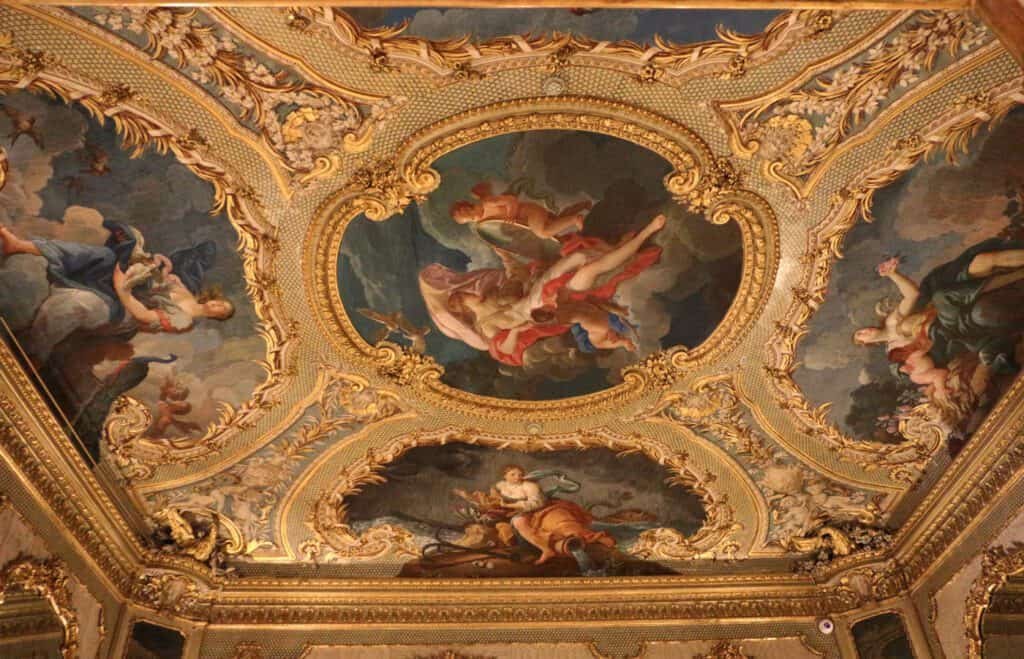
This is the room everyone photographs, and for once the fame is deserved. The Gallery of Mirrors is the second wing of the quadriportico: a bright enfilade with a ceiling frescoed with the Stories of Hercules by Aureliano Milani, painted between 1731 and 1734, and with large, precious mirrors brought in from Venice in the early 18th century. Between the mirrors stand ancient statues from the family collection.
The comparison everyone makes is the Hall of Mirrors at Versailles, and it helps you understand the logic but not the scale. Here we're in a Roman house, not a royal palace, and the effect is more intimate and more refined. In the eighteenth century, a mirror was a pure luxury item, extremely expensive, and covering an entire wall with them was like putting your bank statement on display. The optical function, however, is the same: mirrors multiply the windows, bounce light off the frescoed ceiling, and make the room look twice its actual size.
Blunt advice: go into the Galleria degli Specchi at 10:00 on a sunny morning, and you'll see why it was built. On a cloudy afternoon it's a pleasant room. The early morning is something else.

The third arm and the battle in the port of Naples
The third arm was decorated again by Ginesio del Barba in the 1730s, and it houses what I think is the most surprising painting in the whole Galleria: Battle in the Port of Naples by Pieter Bruegel the Elder (oil on panel, 42.2 x 71.2 cm), which also appears in the literature as View of the Port of Naples.
Bruegel the Elder is the Flemish painter of peasants, snow, and illustrated proverbs. Here, though, he paints the Mediterranean, with the mole of Naples drawn as a perfect geometric curve and a naval battle in progress, ships firing on each other and plumes of smoke rising. It's a small painting that needs at least five minutes of close looking: every ship has its crew, every broadside its target. Bruegel was in Italy around 1552-1554, and this panel comes from that trip. The rendering of the port is topographically recognizable, which is rare in Northern painting of the time.
If you happen to visit the Galleria with someone who gets bored in front of paintings, bring them to this one. It always works, even with kids, because it's a painting you read like a comic strip.
The fourth arm of the Galleria Doria Pamphilj
The last arm has nineteenth-century grotesques on the walls, so its decoration is later than the other three, and it houses works by Parmigianino and Jan Brueghel the Elder. By Parmigianino there is the Nativity (oil on panel, 58.3 x 34.5 cm), a very narrow vertical format in which Emilian Mannerism tightens until it becomes a flame: long necks, elongated gestures, a nervous elegance that looks like nothing else in the room.
By Jan Brueghel the Elder, son of Pieter and nicknamed Velvet Brueghel, there is the Earthly Paradise with the Original Sin, oil on copper, 50.3 x 80.1 cm. Copper as a support is the choice of someone who wants a surface as smooth as enamel in order to paint fur, feathers, and leaves one by one. Count the animals: it's an exercise that keeps a child busy for a quarter of an hour and an adult for 20 minutes.
This wing also has the Saint John the Baptist attributed to Caravaggio, which critics have debated for decades. Several versions of the composition exist, and whether the Roman panel is autograph is a matter of debate among scholars. It's worth mentioning in the interest of honesty, not as a certain third Caravaggio.
Velázquez's cabinet: the Portrait of Innocent X
In 1927 the family made a decision that we would today call museographic, ahead of its time: they detached the Portrait of Pope Innocent X Pamphilj by Diego Velázquez (oil on canvas, 141 x 119 cm) from the shared wall and gave it a small room of its own, together with the white Carrara marble bust that Gian Lorenzo Bernini had carved of the same pope. A cabinet, that is, a small room, containing the two most famous images of a single man, one painted and one sculpted.
The painting was done around 1650, during Velázquez's second stay in Rome, and it was commissioned by the pope's sister-in-law, Olimpia Maidalchini, for the Holy Year. According to tradition, also reported by the Galleria, Innocent X called it too true. It's the best art criticism ever made by a client.
What to really look at in front of the Velázquez
Three things, in order. The first: the red. Velázquez builds almost all of the painting on a scale of reds that runs from the crimson of the mozzetta to the pink of the face to the brown of the armchair. The technical difficulty of holding 10 different reds together without them canceling each other out is what has made painters cry miracle for three and a half centuries. The second: the left hand, which grips a sheet of paper, and the wrist coming out of the sleeve with an almost imperceptible twist of impatience. The third: the eyes. They aren't looking at you. They glance slightly to the side, like someone who has just heard something they didn't like and is deciding what to do about it.
The portrait had an enormous legacy in twentieth-century painting: Francis Bacon drew from it a long series of variations, the so-called screaming popes, starting in the late 1940s. You don't need to know them to appreciate the original, but if you've seen them, you'll understand why Bacon returned to it dozens of times.
Bernini's Bust in the Cabinet of Palazzo Doria Pamphilj
Next to the painting is the marble. Bernini portrays Innocent X with the same ruthlessness as Velázquez, but with opposite tools. Where the painter works on color, the sculptor works on the surface, and he achieves the soft skin under the jaw, the short, bristly beard, the mouth slightly open as if the pope were about to speak. Bernini was the official portraitist of Roman power and knew very well how far he could push it. Here he pushed to the point where likeness stops being a tribute and becomes a judgment.
The room is small, and at peak hours it gets crowded. If you find 10 people inside, step out, take another lap of the gallery, and come back. In 20 minutes the room empties, and it's a painting that wants to be looked at alone.

The Two Caravaggios of Palazzo Doria Pamphilj
Rome is the city where you can see the most Caravaggios in the world, and most of them are in free churches such as San Luigi dei Francesi with the Contarelli Chapel and Santa Maria del Popolo. Here there are two Caravaggios, certain and early, and they hang in the same small room, a few meters from each other.
Rest During the Flight into Egypt
Oil on canvas, 135.5 x 166.5 cm, from the last years of the sixteenth century. It is the most tender painting Caravaggio ever made, and perhaps the only openly lyrical one in his entire output. At the center, an angel seen from behind, nude, with dark wings, plays the violin. On the left, Saint Joseph holds the score with the face of a tired and obedient man. On the right, the Madonna has fallen asleep with the little girl in her arms, her head tilted and her red hair loose.
Two details that will change your visit. The first: the score Joseph holds is legible, and it has been identified as a real polyphonic motet from the sixteenth century. Caravaggio painted notes that could be played. The second: look at the landscape on the right, with the water and the poplars. Caravaggio painted very few landscapes in his life, and this is the most extensive one. When people say Caravaggio couldn't do landscapes, bring them in front of this canvas.
Penitent Magdalene
Oil on canvas, 122.5 x 98.5 cm, contemporary with the Rest, and considered by critics a work linked to the same phase. A very young girl sits on a low chair, her head tilted onto one shoulder, her hair still damp, her hands in her lap. On the floor, tossed aside: a pearl necklace, some jewels, a jar of ointment. There is no halo, no sky, and no sign that we are looking at a saint.
This is Caravaggio's revolution in a single canvas. The penitence of Mary Magdalene, which centuries of painting had told with skulls, caves and gazes toward heaven, is here a girl who has finished crying and is sitting still. The tear on her cheek is painted with a single touch of white lead. If you have time for only one painting in the whole Gallery, the famous one is the Velázquez, but the painting that stays with you is this one.
Raphael's Double Portrait at Palazzo Doria Pamphilj
Oil on canvas, 77 x 111 cm. The Gallery displays it as a work by Raphael, and under that name it appears in the official list of the collection's masterpieces. It is only right, though, to say where things stand critically. The attribution to Raphael is the one the Gallery supports, while the identity of the two sitters remains debated, and during the twentieth century alternative attributions were proposed. Anyone who tells you this is a settled matter is oversimplifying.
That said, look at it. Two half-length men dressed in dark clothes, one slightly ahead of the other, one looking out of the picture and the other turning away. The psychological construction of the relationship between the two, the sense that they have been interrupted while talking, has a modernity that doesn't need a label to work. The painting is in the Sala Aldobrandini, together with frescoes from 1507 and Titian's Salome.
Better to look at it before reading anything about the attribution. A painting that has survived two centuries of debate among specialists clearly has something worth having, whoever painted it.
Titian, Correggio and the Other Italians in the Collection
Titian's Salome with the Head of the Baptist
Oil on canvas, 89,5 x 73 cm, in the Aldobrandini Room. Titian takes on a gruesome subject with a calm that makes it even more unsettling: Salome holds the platter, the Baptist's head is there, and the girl looks away with the expression of someone who has carried out a task. Look at the handling of the fabric and the complexion, the area where the Venetian has no rivals, and look at how the color is applied, in overlapping glazes that you only see up close.
Allegory of Virtue by Correggio
Tempera on canvas, 149,5 x 85,5 cm. Correggio is the painter who, in Parma, invented the illusionistic dome painting and taught the Baroque how to paint a body twisting in the air. This allegorical canvas is rarer and more demanding than his devotional work: tempera on canvas gives a matte, velvety surface, almost like woven fabric. It's one of the pieces most visitors walk past without stopping, and they're making a mistake.
Lorenzo Lotto's Self-Portrait
Oil on canvas, 96,5 x 81 cm. Lotto was the great loner of 16th-century Venetian painting, a man who worked on the margins of the system, constantly moving between Bergamo, the Marche and Venice, and who ended his days as an oblate at the Holy House of Loreto. His portraits have a quality no contemporary matched: the sitter seems caught in a private moment and slightly uneasy. If you're interested in portraiture as a genre, this gallery has Lotto, Velázquez, Raphael and Titian within a few dozen meters, a concentration that's hard to find anywhere else.
Erminia Finds the Wounded Tancredi by Guercino
Oil on canvas, 145 x 185 cm. The subject comes from Torquato Tasso's Jerusalem Delivered, the poem that in the 17th century did for painting what a hit series does today: it supplied scenes, characters and emotional situations the audience already knew. Guercino chooses the moment of discovery, with Erminia cutting her hair to bandage Tancredi's wounds. His golden light and the broad, soft brushwork of his early phase are fully on display here.
Annibale Carracci, Guido Reni, Domenichino, Dosso Dossi
From the Bolognese school, beyond the Lunettes, the gallery also holds a Susanna and the Elders by Annibale Carracci on panel (56,8 x 86,1 cm) and Guido Reni's Battle of Putti (oil on canvas, 120 x 152 cm), a strange and enjoyable painting, almost an exercise in child anatomy turned into a brawl. There's a Landscape with a Ford (47 x 59,5 cm) by Domenichino, small and precious. Dosso Dossi, the visionary painter from Ferrara at the Este court, is represented by a Dido (oil on canvas, 95,5 x 75 cm) that came into the collection through the Aldobrandini line of Ferrarese inheritances. And Giorgio Vasari, the Aretine who wrote the Lives and was also a serious painter, is represented by a large Deposition from the Cross on panel, 297 x 188 cm.
The Flemish and early painters of Palazzo Doria Pamphilj
The Salone Verde holds mostly panel paintings, and it's the part of the gallery that rushed visitors skip. That's a mistake, because it houses Filippo Lippi's Annunciation (tempera on panel, 117 x 173 cm), a first-rate Florentine 15th-century work, and Hans Memling's Lamentation over the Body of Christ with a Donor (oil on panel, 68,5 x 52,5 cm), a Flemish painter from Bruges, with a microscopic precision that lets you count the threads in the garments.
Alongside them is a small selection of panel painting spanning two centuries: Giovanni di Paolo di Grazia's Birth of the Virgin, tempera and gold on panel only 20,6 x 33,5 cm, Sienese and still medieval in structure, Domenico Beccafumi's Mystic Marriage of Saint Catherine, a tondo 94 centimeters in diameter, Bernardo Parentino's Temptations of Saint Anthony Abbot (46,4 x 58,2 cm), populated with monsters that look like they came from Bosch, Jan van Scorel's Portrait of Agatha van Schoonhoven (38,3 x 27,1 cm), the Dutchman who had worked in the Vatican for Adrian VI, Jacopo Bassano's Earthly Paradise (77 x 109 cm) and Paris Bordone's Venus, Mars and Cupid (118 x 151 cm), both Venetian.
My advice: give the Salone Verde a full 10 minutes, hands behind your back, no photos. The paintings are small and should be viewed from 30 centimeters away, one at a time. Anyone who just photographs them hasn't really seen them.
The reception rooms of Palazzo Doria Pamphilj
The Aldobrandini Room
This room takes its name from the family that brought half the collection as a dowry, and it holds frescoes from 1507, decoration that dates to the same period as the reconstruction by Fazio Santoro. Hanging here are Raphael's Double Portrait and Titian's Salome. If you have little time and want the single room with the highest density of masterpieces, this is it.
The Velvet Room
It takes its name from the fabrics that cover its walls, and it was decorated by Liborio Marmorelli in 1768. Among others, it houses an Agar e l'Angelo by Pasquale Chiesa. It is a room that explains a principle well: in noble homes, the textile wall covering often cost more than the paintings hung on it, and it provided the colored background that made the gilded frames stand out.
The permanent exhibition on landscape painting in the Doria Pamphilj villas
A set of rooms in the palace has been adapted as exhibition space and hosts a permanent exhibition dedicated to landscape painting in the Doria Pamphilj villas. It is a theme that seems minor and isn't: the family owned and still owns one of the largest green properties in Rome, and landscape painting is the way a noble household looked at itself in the mirror. If after your visit you feel like seeing real greenery, Villa Doria Pamphilj is the largest public park in the city, on the Janiculum, and it's free.

The private apartments and the Throne Room
Palazzo Doria Pamphilj has been the home of princes and princesses since the 1600s, and the rooms on the noble floor are still lived in today by the family's descendants. The Appartamenti Privati include the Sala del Trono, the Sala Azzurra, the Saletta Verde, the Saletta Gialla, the Saletta Rossa and the Toletta di Venere. Each room was furnished according to the taste of the owner of the moment, which means that moving from one room to the next you pass through two centuries of fashion.
The Throne Room deserves an explanation, because it is the thing that surprises most people who don't know Roman ceremonial. Roman princely families with the rank of prince assistant to the papal throne kept a room in their palace with a throne meant for the pope, facing the wall and never used: it was ready for a papal visit that, if it didn't happen, left the throne turned around. The message was that in that house the place of honor belonged to someone else. It is a detail of etiquette that tells you more about the relationship between Roman nobility and the papacy than 20 pages of history.
A practical note that will save you a disappointment: the visit to the Appartamenti Segreti is not included in the ordinary Galleria ticket and follows a separate circuit and ticket office. If you're interested in that part, check availability and procedures on the official website before planning your day, because openings are limited.
The Chapel of Palazzo Doria Pamphilj and the body of Saint Theodora
The Chapel was designed by Carlo Fontana between 1689 and 1691 and modified and enriched over the following centuries. On the vault there is an Incoronazione della Vergine by Tommaso Minardi, the Purist painter who painted it in the middle of the 1800s. In the antechapel, a monochrome decoration with false perspective creates the illusion of a dome that doesn't exist, one of the favorite tricks of Roman Baroque, used here in a late and domestic version.
The piece that strikes everyone, though, is another one. The chapel holds the perfectly preserved relics of Saint Theodora, who tradition says was miraculously protected from the flames, and the relics of a martyr called Centurione. They are displayed inside an altar, dressed and arranged according to the custom of the Christian catacombs reopened between the 1500s and 1700s. It is not a display for the squeamish, and it is right to warn anyone visiting with small children or sensitive people.
The chapel also has ceramics from Castelli with the Stations of the Cross and a bronze pendant lamp, gilded, made from a design by Gian Lorenzo Bernini. And it is still a living space. The family still holds its ceremonies here. Walking through a seventeenth-century private chapel where baptisms and weddings still take place is an experience no state museum can offer.
How to really visit Palazzo Doria Pamphilj
Duration, pace and audio guide
The Galleria recommends setting aside an hour and a half. The advice is realistic for a normal visit, that is, four arms of the gallery, Velázquez's cabinet, the room with the Caravaggios, the state rooms and the chapel. Anyone who looks slowly at the small paintings in the Salone Verde comfortably reaches two hours and 15 minutes. Anyone who goes in only to see the Velázquez and the two Caravaggios takes 40 minutes, but is throwing the ticket away.
Audio guides are included in the ticket price and available in Italian, English, French and Spanish, while devices last. Ask for one as soon as you get to the entrance, because they run out on busy days. It's one of the few Roman museums where the audio guide isn't an eight-euro supplement, and it's worth taking advantage of.
Photography, bookshop and café
There is a café inside the palazzo, and it's a good place to sit down halfway through. There's also the bookshop. On photography, ask about the rules at the ticket office when you enter, because for a private collection the conditions can change and are not comparable to those of state museums. In any case, flash is banned everywhere for conservation reasons, and in a gallery lit by natural light, flash ruins the photo anyway.
Guided tours and groups at Palazzo Doria Pamphilj
Guided tours are arranged on request by writing to info@dopart.it, which is also the contact for booking and buying group tickets. For a school class or a company group, this is the only route: showing up with 25 people without having written first means being turned away.
Palazzo Doria Pamphilj with children
It works better than you might think, under two conditions. The first is length: 90 minutes is the upper limit for a child under 10, so go in knowing you'll leave sooner. The second is giving them something to do. Three exercises work well: counting the animals in Paradiso Terrestre by Jan Brueghel, counting the ships in Battaglia nel porto di Napoli by Bruegel the Elder, and looking for the violin in Riposo durante la Fuga in Egitto by Caravaggio. Three treasure hunts in three different rooms, and time passes.
Admission is free for children under 12, which makes the visit financially painless for a family. A large stroller, however, is a problem in a palazzo with no elevator available to visitors and with monumental staircases. If you have a small child, consider a baby carrier. And remember the ban on backpacks: an extra large mom bag falls into the prohibited category.
A note about the chapel with the relics of Santa Teodora: a curious child will love it, an impressionable child will not. You know your child, so decide for yourself, and if needed, skip it.
Accessibility at Palazzo Doria Pamphilj
This is the point where I have to be frank, because an optimistic piece of information would do harm. The Gallery states that use of the elevator is not provided for, and that there is no cloakroom service. We're in a noble palazzo from the sixteenth and eighteenth centuries, with monumental staircases and routes not designed for wheelchairs.
In terms of price, admission is free for people with disabilities holding an Italian or European Union Disability Card (when booked online, the free ticket is issued at the symbolic cost of 1,00 euro). But anyone who uses a wheelchair or has serious mobility difficulties must absolutely call 06 6797323 or write to info@dopart.it before coming, explaining their situation and asking what is actually accessible. Don't trust what you read around, including this paragraph: call.
Anyone who walks well but tires easily should know that the route is all on flat ground once you've climbed up, and that there aren't many benches along the arms of the gallery. The café inside the palazzo is the natural place to stop.
How much Palazzo Doria Pamphilj costs and how to save
The price list is remarkably simple: single ticket 16,00 euro, or 17,00 euro if booked online. There are no reduced fares for students, people over 65 or residents. There is no evening rate and no pass. Free for children under 12 and for people with disabilities holding an Italian or European Union Disability Card, with the free ticket issued at 1,00 euro if booked online. Purchased tickets are non-refundable, and cancellations or changes to issued tickets are not allowed.
One clarification that saves wasted time: since Palazzo Doria Pamphilj is a private collection, the free admission offered by state and civic museums doesn't apply here. There's no free entry on the first Sunday of the month, no municipal museum card, and no free entry with the pass that works elsewhere. Anyone who arrives on the first Sunday expecting to get in for free will pay like on any other day.
So how do you really save? In only one way: buying the ticket on site instead of online, if you're willing to risk the line, because the difference is exactly one euro. That euro is the best you'll spend in Rome. On weekends and long weekends, the Gallery warns that without a reservation, access cannot be guaranteed.
When to go to Palazzo Doria Pamphilj and when to avoid it
The best day is Thursday morning, right when it opens at 9:00. The museum opens early only from Monday to Thursday, and the first two hours of those days are the window when the Gallery is almost empty. On Friday, Saturday and Sunday it opens at 10:00 and closes at 20:00, so there's more time, but all of Rome is there too.
The day to mark in red is Wednesday, because it's closed, and that surprises almost everyone: most Roman museums close on Monday. Also closed on January 1, Easter Sunday, and December 25.
On seasons: the Galleria lives on natural light, so in December and January, with the low sky, the tall rows of paintings are harder to see. May and September are the ideal months for light. August is the best bet for solitude and the worst for heat, but inside the palace you'll be comfortable. And if you come in late afternoon in winter, arrive at least an hour and a half before the last entry: entering at 17.50 on a Monday means having 10 real minutes of useful visiting time.
Things to see around Palazzo Doria Pamphilj in 10 minutes on foot
The location is among the luckiest in Rome and allows you to build entire half-days without ever taking transport. I'm listing things in order of real distance.
Two minutes. Via del Corso, which starts at Piazza Venezia and reaches Piazza del Popolo in a straight line for a kilometer and a half, and the Galleria Alberto Sordi, the Liberty-style shopping arcade with the glass vault that is worth going into just for the ceiling.
Three minutes. Piazza Venezia with the Vittoriano, and inside the palace that gives it its name the National Museum of Palazzo Venezia, which is the natural comparison with this Galleria: two enormous palaces facing the same square, one private and lived in, the other state-run and turned into a museum. Also three minutes away, the Chiesa di Sant'Ignazio di Loyola with the false dome painted by Andrea Pozzo.
Five minutes. The Pantheon, which from here you reach via Via della Minerva, passing the Basilica of Santa Maria sopra Minerva, the only Gothic church in Rome, with Bernini's little elephant on the square. And the Galleria Colonna, the other major private Roman collection still in the hands of the family, which opens only a few hours a week.
Seven minutes. The Trevi Fountain by way of Via delle Muratte, Piazza Colonna with the column of Marcus Aurelius, and Largo Argentina with the sacred area of the four Republican temples and the cat colony.
10 minutes. Crypta Balbi, the museum that explains how ancient Rome became medieval Rome, and it is the most intelligent and least visited in the city. Palazzo Cipolla on the Corso for temporary exhibitions. The Domus Romane of Palazzo Valentini under the Palazzo della Provincia.
The itinerary I recommend to anyone with only one day: Galleria Doria Pamphilj at 9:00, coffee at the Collegio Romano, Sant'Ignazio, Pantheon at noon when the beam of light from the oculus is most vertical, lunch, Santa Maria sopra Minerva, Largo Argentina, and closing in Piazza Venezia with the climb up to the Vittoriano for sunset. All on foot, with one single mandatory ticket.
Palazzo Doria Pamphilj and Rome's other private collections
Rome is the only European capital where you can visit, in the same afternoon, three or four noble collections that remain in the homes for which they were formed. Together with those of the Colonna and the Pallavicini Rospigliosi, this is one of the largest private art collections in the city. The Galleria Colonna has only one room worth the trip, the grand hall, but it opens only a few hours a week. The Galleria Spada is smaller and has Borromini's perspective in the courtyard. The Galleria Corsini in Trastevere has passed to the State, but it keeps its 18th-century display of paintings in layered rows.
If you have to choose just one, the choice is Doria Pamphilj. It has the largest number of absolute masterpieces, the most generous hours, it does not require a timed reservation, and the ratio between what you see and what you pay is the best of the four. The comparison with state museums is instead made with Palazzo Barberini, which has more space and less soul, and with the Capitoline Museums, which are something else again.

A curiosity about Palazzo Doria Pamphilj
The first curiosity involves a date that looks administrative but is actually political: 1950. That was a Jubilee year, and Prince Filippo Andrea VI Doria Pamphilj opened the collection to the public for the first time. Until then, anyone who wanted to see the Velázquez needed to know someone who knew someone. A family that opened its home to paying visitors in 1950, five years after the war ended, in a country that had just sent its king away, wasn't doing charity: it was understanding, ahead of others, that heritage is protected by showing it.
The second curiosity goes back even further, to 1927, when the Portrait of Innocent X was taken off the shared wall and placed in a dedicated room with Bernini's bust. It was a modern museum gesture made in a private home at a time when many public museums in Europe still crowded their paintings together. Someone in that family had understood that a masterpiece on its own is worth twice as much as one lined up in a row.
The third curiosity is the subtlest, and it concerns the 1767 manuscript that documents the late-18th-century arrangement of the picture gallery. As you walk along the four wings, the paintings you see aren't arranged by a modern logic of school or chronology. They follow a decorative balance of symmetry, format and color devised in the 1700s. That's why a Caravaggio can hang next to a minor painting from a school: it's not an oversight, it's the logic by which the wall was composed like wall covering. In this sense, Palazzo Doria Pamphilj is one of the very few places in the world where the way things are displayed is itself a museum piece.
Something nobody tells you about Palazzo Doria Pamphilj
Here it is in one line, then the explanation: there is no reduced ticket here. That matters, because planning a day in Rome revolves around discounts. Students, over-65s, journalists, teachers, residents: anyone who arrives with the card that lowers the price at every state museum pays the full 16,00 euros here. The only exemptions are children under 12 and people with disabilities who hold an Italian or EU Disability Card. No free first Sunday, no city card, no museum week.
The second thing nobody mentions is trickier: there is no cloakroom and not even an emergency luggage deposit. The gallery bans backpacks, bags and medium or large luggage, and offers no alternative inside the palace. Every day someone arrives from the station with a rolling suitcase, gets turned away at the door, and has to give up or go back. At a state museum you can always find a solution. Here you can't, because it's not a state museum, it's someone else's home.
The third is the most useful for planning: the elevator isn't available to visitors. That changes the plans for anyone with bad knees, a late-stage pregnancy, a stroller, or an elderly parent in tow. The gallery is entirely on the noble floor, reached by monumental staircases, and there is no alternative route, the kind that a public museum takes for granted. Anyone with specific needs should call ahead at 06 6797323: it's the only way to know for sure what's accessible.
My advice for visiting Palazzo Doria Pamphilj
I have just one piece of advice, and it runs opposite to what everyone does: start from the back. The vast majority of visitors walk in, pick up the audio guide, enter the first wing and file in single file toward the Velázquez Cabinet, arriving half an hour later along with everyone who came in during that same half hour. The result: the gallery's most important painting gets viewed by 12 people at a time.
Do the opposite. Walk in, ask where the Velázquez Cabinet is, and go straight there. In the first 10 minutes after opening, that room is empty or nearly so. Stay as long as it deserves, which is at least a quarter of an hour, then go back and follow the normal route at your own pace. At the end, pass by the Velázquez again for one last look, now knowing everything else: it will seem like a different painting.
The second tip is about pace. Don't try to see everything. In a picture gallery with stacked rows, the paintings number in the hundreds, and trying to see them all only gives you a headache. Choose: the two or three lower rows, at eye level, and then only the high paintings the audio guide points out. That's exactly how the 18th-century owner lived with his rooms, having hung the high paintings to fill the wall.
Third: ask for the audio guide as soon as you walk in, before you even leave the desk. It's included in the ticket and available in four languages, but the gallery specifies it's provided while supplies last. On busy days, anyone who asks after noon may go without. And in a museum with few panels and small labels, touring without an audio guide means cutting in half what you take home.
Another well-known fact, though rarely mentioned
The well-known fact is that the palazzo belongs to the Doria Pamphilj. What is rarely mentioned is how it got there: not by purchase, not by conquest, but as a marriage dowry. In 1647 Olimpia Aldobrandini, princess of Rossano, marries Camillo Pamphilj and brings with her the building bought in 1601 by Cardinal Pietro Aldobrandini, along with a collection built up over two generations. Rome's largest private residence changed families because two people got married.
This mechanism repeats itself. Anna Pamphilj marries Giovanni Andrea III Doria, and the Roman house is joined with the Genoese one. Through inheritance the Landi also arrive, and for a couple of centuries the family is called Doria Landi Pamphili before simplifying. Andrea IV Doria Pamphilj Landi, prince of Melfi, who lived between 1747 and 1820, is the first to use the surname in its short form.
The result is what you see hanging on the walls. The Doria, Pamphilj, Landi and Aldobrandini collections were not brought together by a curator. They were added up through successions. When you stand in front of a Ferrarese painting and wonder what it's doing in a Roman palazzo, the answer is always the same: it arrived with an inheritance. That's why this collection has such a strange and such a rich character, with Florentine Quattrocento works alongside Flemish and Venetian ones, without the logical thread that a deliberately assembled collection would have.
And there is a second little-mentioned fact that explains why it has survived intact: the fedecommesso entail that, in the great Roman houses, prevented the sale of the artistic heritage and passed it undivided to the heir. That legal mechanism, now abolished, is the reason the historic Roman collections that survived stayed in their palazzi, while elsewhere they were sold piece by piece.
The right photo to take at Palazzo Doria Pamphilj
The right photo is not the Velázquez. For that painting, filming conditions must be checked at the ticket desk, and in any case an amateur photo of a painting behind glass in natural light is always a failure: reflections, yellow cast, skewed perspective.
The right photo is the Galleria degli Specchi, taken vertically, from the center of the enfilade, with the phone held low, at chest height. Why vertically: because that way the ceiling with the Stories of Hercules by Aureliano Milani gets in, and that is the most beautiful part. Why from the center: because the symmetry of the mirrors only works if you're on the axis. Why low: because that way the archaeological statues in the foreground gain weight and the room looks as tall as it really is.
Timing matters more than equipment. From Monday to Thursday it opens at nine, and in the first hour the side light coming through the windows bounces off the mirrors with an effect that no longer exists at three in the afternoon. Add a person at the far end of the gallery, standing with their back to the camera, to give scale. Without a human figure, the same photo looks like a render.
The second photo to take home is outdoors and free: the facade by Valvassori on via del Corso, shot from the opposite sidewalk, at an angle, with a wide-angle lens and the low morning sun carving out the moldings. The Corso is narrow and you can't frame it head-on. At an angle, though, the sequence of windows creates a perspective that conveys the sense of length. Try the courtyard with the arcades too. From there, with the square of sky overhead, you get an image that looks like no postcard of Rome.
Some important events that happened here in history
The first event is from 1505-1507, when Cardinal Fazio Santoro rebuilds the Quattrocento building and designs the courtyard with the arcades that you can still walk through. Shortly after, Julius II acquires it for a nephew. A Della Rovere pope taking a palace for the family was standard practice of the time, and that practice is the reason Rome has the palazzi it has.
The second is 1601, the purchase by Cardinal Pietro Aldobrandini, who enlarges the building and fills the house with paintings. The third is 1647, the marriage of Olimpia Aldobrandini and Camillo Pamphilj. The fourth is around 1650, when Velázquez, in Italy for his second trip, paints the Portrait of Innocent X, commissioned by Olimpia Maidalchini for the Holy Year. The fifth covers the years 1731-1734, the construction work of Gabriele Valvassori, which gives the palazzo its facade on via del Corso and gives the Galleria the layout it still keeps, with Aureliano Milani frescoing the Stories of Hercules in the Galleria degli Specchi.
Then comes the Novecento, which is the most dramatic part. Prince Filippo Andrea VI Doria Pamphilj (1886-1958) was an openly declared antifascist in an environment, the Roman aristocracy, that had almost entirely accommodated itself to the regime. On June 4, 1944, the first units of the Allied armies entered Rome. On June 10, 1944, with the favorable mediation of the Comitato di Liberazione Nazionale, Filippo Andrea VI was chosen as mayor of the city. On June 13, 1944, he gave his inaugural speech from the Michelangelesque balcony of the Capitoline Hill, ending it with a phrase that has remained proverbial in Rome: da romano ai romani, volemose bene. He remained mayor until 1946.
The seventh event is 1950, the opening of the collection to the public for the Holy Year, wanted by Filippo Andrea VI himself. The eighth is the long season of restorations in the second half of the twentieth century led by Donna Orietta Doria Pamphilj and her husband Don Frank Pogson Doria Pamphilj, who added her surname to his own. After their deaths, which took place in 1998 and 2000 respectively, the care of the palace and the collection passed to their children Don Jonathan Doria Pamphilj and Donna Gesine Pogson Doria Pamphilj, who live in the palace. A building where, from the seventeenth century to today, the same family has continued to sleep.
Who has passed through Palazzo Doria Pamphilj
Diego Velázquez, first of all. The court painter of Philip IV of Spain arrives in Rome on his second Italian trip and around 1650 paints the portrait that will earn him his definitive European fame. If the pope called it too true to life, as the tradition reported by the Gallery has it, it means that painting was discussed in those rooms while the ink of the chronicle was still fresh.
Gian Lorenzo Bernini, the absolute director of Baroque Rome, who carved the white Carrara marble bust of Innocent X and, for the palace chapel, even designed a hanging lamp in gilded bronze. Bernini had a complicated relationship with the Pamphilj: at the start of the pontificate he fell from favor over the affair of the bell towers of St. Peter's, then returned to the game by winning the contest for the Fountain of the Four Rivers in Piazza Navona.
Alessandro Algardi, Bernini's great rival from Bologna, who left here the marble portrait of Olimpia Maidalchini. Carlo Fontana, who designed the chapel between 1689 and 1691. Gabriele Valvassori, Paolo Ameli, Antonio Del Grande, Andrea Busiri Vici: four centuries of Roman architects have worked on these facades.
A considerable part of the history of the Church has also passed through here. Giovanni Battista Pamphilj, pope from September 15, 1644 to 1655, and with him the pope's brother, the all-powerful sister-in-law Olimpia Maidalchini, the nephew cardinal Camillo Pamphilj, who gave up the purple to marry Olimpia Aldobrandini and from 1651 was prince of Valmontone. And Cardinal Benedetto Pamphilj (1653-1730), bibliophile, poet and musical patron, who in late seventeenth-century Rome was one of the most important patrons of the composers active in the city.
In the nineteenth century two English noblewomen passed through here, whom the palace absorbed without missing a beat: Mary Alethea Beatrix Talbot (1815-1858), wife of Filippo Andrea V, and Emily Augusta Mary Pelham Clinton (1863-1919), who coordinated charitable works during the Great War. The British side of the family is not a piece of gossip: it explains why, in the Novecento, the Doria Pamphilj found themselves, through ties and culture, on the opposite side from the regime.
And finally Teresa Orsini di Gravina (1788-1829), who founded a religious congregation and was beatified in 2009: in the long list of residents of this palace there is also a blessed woman.
Quick questions about Palazzo Doria Pamphilj
How much is the ticket for Palazzo Doria Pamphilj?
Single ticket 16,00 euro at the box office, 17,00 euro with online booking. There is no regular reduced ticket.
Where exactly is Palazzo Doria Pamphilj?
The entrance to the Gallery is at Via del Corso 305, 00186 Roma, about a hundred meters from Piazza Venezia, heading up the Corso.
What are the opening hours of Palazzo Doria Pamphilj?
Monday through Thursday 9.00-19.00, with last entry at 18.00, Friday through Sunday 10.00-20.00, with last entry at 19.00. The box office closes one hour before the Gallery.
What day is Palazzo Doria Pamphilj closed?
Every Wednesday. It is also closed on January 1, Easter Sunday and December 25. It is a Roman exception: almost all the other museums in the city close on Mondays.
Do I need to book to visit Palazzo Doria Pamphilj?
Online booking is strongly recommended by the Gallery, which warns that without a booking, entry cannot be guaranteed. It costs one euro more than the ticket at the box office.
How long does a visit to Palazzo Doria Pamphilj take?
The Gallery recommends booking an hour and a half. Visitors who stop at the small paintings take a good two hours, while those who come in just for the Velázquez spend 40 minutes.
Is the audio guide included in the ticket?
Yes. Audio guides in Italian, English, French, and Spanish are included with the entry ticket, while supplies last. It's best to ask for one as soon as you go in.
Which famous paintings are at Palazzo Doria Pamphilj?
Velázquez's Portrait of Innocent X and the bust of the same pope by Gian Lorenzo Bernini, two Caravaggios (Rest on the Flight into Egypt and Penitent Magdalene), Raphael's Double Portrait, Titian's Salome, Correggio's Allegory of Virtue, Parmigianino's Nativity, Pieter Bruegel the Elder's Battle in the Port of Naples, Lorenzo Lotto's Self-Portrait, Guercino's Erminia and Tancredi, and Filippo Lippi's Annunciation.
Can you take photos at Palazzo Doria Pamphilj?
Ask at the ticket office when you enter about the rules for filming. Since this is a private collection, the rules for state museums don't apply automatically. Flash is still ruled out.
Is there a coat check at Palazzo Doria Pamphilj?
No. The Gallery does not have a coat check and does not allow entry with luggage, backpacks, or medium or large bags. Only small bags are permitted. There is no alternative storage space inside the palace.
Is Palazzo Doria Pamphilj wheelchair accessible?
The Gallery states that use of the elevator is not provided for. Anyone with serious mobility difficulties should call 06 6797323 or write to info@dopart.it before the visit to find out what is actually passable.
Is entry free on the first Sunday of the month?
No. Palazzo Doria Pamphilj is a private collection, so the free-admission rules for state and municipal museums don't apply. No first Sunday, no municipal card.
Do children pay?
Entry is free for children under 12. When booking online, the free ticket is issued for a symbolic fee of 1,00 euro.
Is there a discount for students or people over 65?
No, there is one ticket price. The only exemptions are children under 12 and people with disabilities who hold an Italian or European Union Disability Card.
How do you get to Palazzo Doria Pamphilj from Termini?
The Gallery suggests bus 64, seven stops to Piazza Venezia, and then a 100-meter walk along via del Corso. On foot it takes about 25 minutes.
What is the nearest metro stop to Palazzo Doria Pamphilj?
There is no metro stop at Piazza Venezia. From Line A, get off at Barberini and take lines 95, 175, 492, 62, or 630 on via del Tritone. From Line B, get off at Colosseum and take the 85 or the 850.
Can you drive to Palazzo Doria Pamphilj?
No, unless you have a permit. We are inside the limited traffic zone of the Historic Center, so you need to park before entering the ZTL.
Can you visit the private apartments?
Visits to the Appartamenti Segreti are not included in the regular Gallery ticket. They follow a separate route and ticket office, with limited opening times. The current details are on the official website.
Is the chapel included in the visit?
Yes, the chapel designed by Carlo Fontana between 1689 and 1691 is part of the route and holds relics of Saint Theodora and a hanging lamp to a design by Bernini.
Is there a bar or café inside Palazzo Doria Pamphilj?
Yes, inside the palace there is a café and a bookshop. It's a natural stopping point halfway through the route.
Can guided tours and group visits be arranged?
Yes, on request by writing to info@dopart.it, which is also the contact for booking and buying group tickets.
Is Palazzo Doria Pamphilj suitable for kids?
Yes, as long as you keep the visit within an hour and give them something to look for: the animals in Jan Brueghel's Earthly Paradise, the ships in the Battle in the Port of Naples, and the violin of Caravaggio's angel. The chapel with the relics should be evaluated case by case.
What is the difference between Palazzo Doria Pamphilj and the Galleria Colonna?
They are the two great private collections in Rome that are still owned by the families. The Galleria Colonna has a spectacular great hall but very limited opening hours. Palazzo Doria Pamphilj is open six days a week, has more true masterpieces, and does not require time slots.
How long is the wait at Palazzo Doria Pamphilj?
Much less than at the big-draw museums. On weekdays, if you arrive when it opens, the line is usually short or nonexistent. On weekends and holiday long weekends, it's best to have a reservation, because without one the Gallery does not guarantee entry.
When is the best time to visit Palazzo Doria Pamphilj?
Thursday morning at nine, which falls in the early-opening window on weekdays. May and September give the best natural light for the high rows of paintings.
Why is Palazzo Doria Pamphilj different from other museums in Rome?
Because it is a lived-in home and not a state museum: the paintings are hung in stacked rows according to a late 18th-century arrangement documented by a manuscript from 1767, the family still lives in the palazzo, and the display itself is a historic piece to be preserved.
The Galleria Doria Pamphilj is the only place in Rome where I always leave with the same feeling: that I was a guest, not a visitor. If you have to choose just one museum in the center and don't want the effort of large complexes, come here on a Thursday at nine, ask for the audio guide, go straight to the Velázquez while the room is empty, and then take your time. It costs €16 and an hour and a half. I don't know of another Roman ticket that gives you as much.
Article written by the editorial team of TourLeaderPro, contact them for Tours and Private/Corporate/V.I.P. Experiences.
Planning a trip to Rome? English-language guides for visiting the city are on ItalyPlanner.com.