Galleria Colonna
In short. Galleria Colonna is visited at Palazzo Colonna, via della Pilotta 17, rione Trevi: on Saturday mornings you enter from here, while on Friday mornings you enter from piazza Santi Apostoli 66, which also remains the entrance for people…

Galleria Colonna is visited at Palazzo Colonna, via della Pilotta 17, rione Trevi: on Saturday mornings you enter from here, while on Friday mornings you enter from piazza Santi Apostoli 66, which also remains the entrance for people with mobility difficulties and for private visits. On Saturdays, public opening begins at 9,15 and the last entry is at 13,15. The short route, which includes the Appartamento Galleria, the Padiglione Pio and the gardens, costs €15, while the full route, which adds the Appartamento della Principessa Isabelle, costs €25, with a reduction to €20 for FAI members. On Friday mornings you can enter only with a guided tour: a full route of about two hours at €35, €30 for FAI members, in Italian, English, French and Spanish. On Saturdays, the audio guide in 10 languages costs €5 more, while a dedicated group escort can be booked for €150 in addition to the entrance tickets, with groups of up to 15 people. Admission is free for children up to 12 years old, up to two for each paying adult, and for the companion of a person with a disability. From Sunday to Thursday, and on Friday and Saturday afternoons, the palace opens only for private visits by reservation: write to info@galleriacolonna.it or call 06 6784350. Tickets can also be bought online through TicketOne, and admission is one of the sites accepted with the Roma Pass. Check hours and prices on the official website before you go, because the schedule of a private house changes more easily than that of a state museum.
This guide is part of Estate Romana's collection of museums in Rome.
What you visit is not a museum built around a collection: it is a collection that stayed inside the house that generated it. The Colonna still live in the palace, and the part open to the public is the reception wing the family used for receiving guests. The difference is felt right away, and it's worth the price of admission: no display cases, no intrusive educational panels, paintings hung where the patron wanted them, furniture in its place, light coming in through the real windows. If you've already seen the Galleria Borghese and Palazzo Doria Pamphilj, here you'll find the third corner of the triangle of Rome's great private painting collections, and on many days of the year, the least crowded of the three.
Where Galleria Colonna is and how to get there
Palazzo Colonna takes up the entire city block bounded by piazza Santi Apostoli, via Ventiquattro Maggio, via Quattro Novembre and piazza della Pilotta. It is an enormous mass of buildings that most Romans walk past without noticing. Those walking down via Ventiquattro Maggio toward piazza Venezia pass under the arches of an overpass that span via della Pilotta, and mentally link that bend in the road to a stage set, not an inhabited palace. The property, including the villa on the flank of the Quirinale, covers about three hectares, and the family cites it as the largest continuous private holding in the Historic Center.
On foot to Galleria Colonna
From piazza Venezia it takes three minutes: take via Cesare Battisti, keep left toward piazza Santi Apostoli, and via della Pilotta opens right behind the basilica. From the Trevi Fountain it is seven or eight minutes downhill along via delle Muratte and via dell'Umiltà. From the Quirinal Palace it takes about 10 minutes, going down the hill on via Ventiquattro Maggio. From the Trajan's Markets the walk is five minutes along via Quattro Novembre, and this topographical detail explains more than many pages of history: via della Pilotta follows the route of the ancient via Biberatica, the service road of the Trajan's Markets, and the Colonna built their medieval fortune precisely by building up against those ruins.
Public transport to Galleria Colonna
The main stop is piazza Venezia, where tram 8 terminates and where a bundle of bus lines converges from Termini, the Lungotevere and Trastevere. The construction site for the Venezia station on Metro C has changed the position of some stops: it's worth checking your own line on the same day, because the temporary arrangement changes periodically. The most convenient metro station is Barberini on Line A, about 10 minutes on foot downhill along via del Tritone and via dell'Umiltà. On Line B, get off at Cavour or Colosseo, with a 15-minute walk. By taxi, ask for piazza Santi Apostoli: via della Pilotta is a narrow one-way street, and on Saturday mornings, loading and unloading in front of the front gate is inconvenient.
Parking and Limited Traffic Zone
We are inside the ZTL historic center zone: anyone without a permit can't drive in during the activation hours, and the checkpoints are monitored by cameras. The nearest underground car park is the Quirinale one, on via Ventiquattro Maggio, two minutes from the piazza Santi Apostoli entrance. My advice is simple: here, a car is a mistake. The palace sits in the middle of a block that is better covered on foot than by any other means.
Tickets and opening hours of Galleria Colonna
The ticket structure of Galleria Colonna is complex, and understanding it before you reach the ticket office avoids the most common disappointment, which is discovering you bought the wrong ticket and can't see the Appartamento della Principessa Isabelle.
The short Saturday tour
€15 gives you access to the Appartamento Galleria, that is, the monumental sequence that culminates in the Sala Grande, the Padiglione Pio and the gardens on the hill. That's already a lot: this is the famous part of the palace, the one everyone has seen in photographs. If you have less than an hour and want to spend little, it's a good idea to stop here.
The full Saturday tour
€25 adds the Appartamento della Principessa Isabelle on the ground floor, with the 37 views by Vanvitelli and the rooms left as they were when the princess received guests there. FAI members pay €20. Put plainly: the €10 difference is the best investment you can make in this palace, and anyone who skips the Appartamento to save money goes home having seen half the visit.
Friday morning with a guide
On Fridays there are no visits without a guide: you enter from piazza Santi Apostoli 66 accompanied, for a full tour of about two hours, at €35 (€30 for FAI members), in Italian, English, French or Spanish. This is the option I recommend to first-time visitors with no background in art history: two guided hours in this palace are worth three self-guided visits.
Free admission, discounts and booking
Children up to 12 years old enter for free, with a limit of 2 for each paying adult, and the companion of a person with a disability enters free as well. The museum is privately owned: the free Sundays of state and municipal museums don't apply here, there are no museum weeks, and there are no reduced rates for residents. Booking is not always required for Saturday morning, but on long weekends and in the spring months the palace fills up, so writing to info@galleriacolonna.it or calling 06 6784350 a few days in advance is wise. The museum explicitly warns that it is not responsible for tickets resold at inflated prices by intermediaries, and this is a warning to take seriously: buy from the official website, from TicketOne or at the ticket office.
The Colonna family and five centuries of construction work
No other Roman palace has such a long and such an uneven building history. Palazzo Colonna was not designed: it was accumulated. Houses, towers, fortresses, small palaces, gardens and churches were incorporated one after another over 600 years, and then stitched together in the 17th century by a single unified direction. Anyone visiting Galleria Colonna is walking through the final result of that stitching.
The medieval settlement of the Colonna
From the 12th century, the sources record a Colonna palace and castle in this part of the city, together with other buildings of the same family. The inhabited core gathered around the basilica dei Santi XII Apostoli and was the center of a very large property, which stretched from the Quirinale to the Monte Acceptorium, today's Montecitorio, and included the areas where Palazzo Odescalchi and Palazzo Sciarra stand today. Even earlier, already in the 10th century, the court of Alberico di Roma was documented here, who called himself Princeps atque Senator omnium Romanorum. The Colonna descend from the Counts of Tuscolo, and the continuous possession of this piece of Rome is one of the longest documented cases in Europe.
The main body of the palace was torn down by Pope Boniface VIII, during the war that set the pontiff against the Colonna at the end of the late 13th century. It was rebuilt quickly, and already in the 14th century it hosted prominent figures: in 1328 Emperor Louis the Bavarian and Castruccio Castracani, and later Francesco Petrarca, a friend of the house, in the years when, in 1341, he was crowned poet on the Capitoline Hill. In 1347 the tribune Cola di Rienzo, an open enemy of the nobility and of the Colonna in particular, drove them out of the city, and the family took refuge in their fiefs at Marino. The struggle ended in 1354, when Cola was killed by a commoner on the Capitoline Hill while trying to flee: the body was dragged as far as this palace and hung there for two days and a night. No panel commemorates it, but the scene took place a few tens of meters from the gate you came through.
Palazzo Colonna in the 15th and 16th centuries
At the beginning of the fifteenth century, Giordano Colonna, lord of Genazzano and from 1419 prince of Salerno, the older brother of the future Pope Martin V, lived in the palace that overlooked Piazza dell'Olmo, today Piazza della Pilotta. It doesn't seem to be the same building depicted by Maarten van Heemskerck between 1534 and 1536, known since the 1300s as the Loggia dei Colonnesi, later absorbed into the so-called Palazzo dell'Olmo and demolished in 1926 to make room for the Pontifical Gregorian University. Ferdinando Gonzaga lived in that small palace for a few years as a tenant of the Colonna, and from the seventeenth century the building was normally rented to cardinals. A project that was never carried out, visible in the view of the Colonna garden engraved by Giuseppe Vasi in the mid-1700s, planned to enclose the small palace and the ruins called anticaglie, attributed to the probable Temple of the Sun or the Temple of Serapis, inside a Casino nuovo. In Giovanni Battista Nolli's map, the complex is number 258, labeled Palazzo e giardino del Connestabile Colonna con Ruine antiche. Toward the Quirinal, behind the building, stood the Torre Mesa, demolished for good in 1574.
The building where Giordano lived with his nephew Antonio and the relatives of the Genazzano branch was probably the one called del Vaso, also near the square and Via della Pilotta, the ancient Via Biberatica, behind and on the left side of the Basilica of the Holy Apostles. According to Pasquale Adinolfi, it was the oldest of the buildings, which came to the Colonna from the counts of Tusculum, and it was extended to Piazza dei Santi Apostoli by the Della Rovere, who took possession of it in the second half of the fifteenth century. On the right side of the basilica, since at least the thirteenth century, another family building served as the residence of the Colonna cardinals. Cardinal Oddone, the future Martin V, lived there. After his death the property passed temporarily to others, including Cardinal Bessarione, who expanded the building on the left side of the basilica, incorporating the remains of the ancient church of Sant'Andrea de Biberatica, which must have stood where the present second courtyard is. Later it went to relatives of Sixtus IV, among them Giuliano della Rovere, the future Julius II, who had the palazzina of the same name built there with frescoes by Pinturicchio. The complex returned to the Colonna in 1517 with a papal bull from Leo X. Passages were opened between the palace and the basilica that allowed family members to attend ceremonies from reserved galleries, still visible, without setting foot on the street.
Oddone Colonna, elected pope in 1417 with the name Martin V, is the pontiff who ended the Avignon period and the Great Schism by bringing the papal seat back to Rome. He found a city in disastrous condition, squalid and abandoned, in Platina's phrase. He put Rome back in order, and he put the family palace back in order too, which was his residence until his death in 1431. For about a decade this block functioned in every respect as the seat of the papacy, a detail visitors tend to forget, and one that explains why two rooms of the Galleria are dedicated to him.
In 1527, during the Sack of Rome, the palace hosted Isabella d'Este, Marchioness of Mantua. Her presence saved the building. She was the mother of Ferrante I Gonzaga, one of the commanders of the Landsknechts, and Palazzo Colonna was the only major Roman palace spared from the sack. The rescue was partial, though, because the more than 2,000 people who had taken refuge there were captured and forced to pay a ransom to regain their freedom. Still in 1535, according to van Heemskerck's view, the Palazzo dell'Olmo stood on the ruins of the imperial temples, presumably the Serapeum of the Quirinal. In the sixteenth century the Colonna regained possession of the Riario and Della Rovere palaces, which had been theirs in the Middle Ages and were lost because of the hostility of Popes Eugene IV and Sixtus IV. At the beginning of the seventeenth century, six palaces of the family could be counted in this area. The Palazzo Colonna della Rovere, already called del Vaso, after probable abandonment following the sacks and fires of the first half of the century, was ceded by Cardinal Ascanio to the Friars Minor Conventual by order of Sixtus V in 1589, at a price far below its real value, and it became the seat of the Minister and the General Curia of the order. The friars, who since the mid-1400s had complained that they could not build a monastery because the basilica was surrounded by Colonna properties, thus got what they had been asking for over 140 years.
The Baroque palace and the birth of Galleria Colonna
In 1649, Cardinal Girolamo Colonna, son of Constable Filippo and Lucrezia Tomacelli Cybo, launched the project that would give the complex its present form: joining the separate building blocks into a single architectural unit. In that phase, the Sala Grande and the Turkish Hall were painted and decorated by Giacinto Brandi and Giovanni Battista Magni, known as Modanino. Supervision of the work was entrusted to Antonio Del Grande and, after his death in 1671, to Girolamo Fontana. Work continued under the Grand Constable Lorenzo Onofrio, the cardinal's nephew, and under Filippo II until 1714. In 1730 Fabrizio IV, son of Filippo II, commissioned new work from Nicola Michetti, who designed the facade on Piazza Santi Apostoli. Between 1757 and 1764, Cardinal Girolamo II had the Sienese architect Paolo Posi build the second gallery with the so-called rustic oval hall, left unfinished in its interior decoration, on via della Pilotta, together with two of the four bridge arches that connect the palazzo to the villa garden and to the actual facade beyond the curtain wall on the square.
The most famous wing, the Gallery, was commissioned by Girolamo I and begun by Antonio Del Grande in 1654. Work resumed under Girolamo Fontana in 1693, and the hall was inaugurated by Constable Filippo II at the dawn of the 1700s. Gian Lorenzo Bernini, Johann Paul Schor, and Carlo Fontana also took part in the final phase of the decoration. Its purpose was clear from the start: to house the family collection begun by Filippo I, which would become one of the most important in the city for painting, and to celebrate the Christian fleet's victory over the Turks at Lepanto in 1571 under the command of Marcantonio II Colonna. It is not a gallery of paintings with a few political hints. It is a political monument that also happens to hold paintings.
In the second half of the 17th century, Lorenzo Onofrio I Colonna and his wife Maria Mancini were among the leading promoters of musical and theatrical performances in Rome. In the palazzo's theater, already active in 1610 when Girolamo Rainaldi worked on it, Jacopo Melani's Il Girello had its world premiere in 1668, and in 1676 Donna ancora è fedele by Bernardo Pasquini had its premiere there, where he staged other works of his. In 1681 Carlo Fontana built a new theater on the ground floor of the building next to the Basilica of the Holy Apostles. The later history is the same as that of all the great Roman houses. To help the Papal State meet the demands of the Treaty of Tolentino, the Colonna had to sell much of their jewelry and silverware and some of their most important works, including paintings by Raphael, Titian, Veronese, Correggio, Reni, and Guercino, only partly replaced by later acquisitions. In 1802, from the rooms of this palazzo, Charles Emmanuel IV, King of Sardinia, abdicated in favor of Victor Emmanuel I.

The Hall of the War Column
The tour of the Galleria Apartment begins here, and the name is not decorative. In the center of the room, on a pedestal, rises a red marble column. It is the family coat of arms turned into an object, the column that gives the Colonna family its name, and visitors see it before they see any paintings. The inlays on the pedestal depict scenes of daily life in ancient Rome, and this pairing of modern heraldry with ancient Roman history is the programmatic statement of the entire apartment. The Colonna present themselves as heirs of the city, not as just one family among others.
The vault is frescoed by Giuseppe Bartolomeo Chiari and depicts Marcantonio II Colonna being presented to the Virgin in heaven. It deserves close attention, because it sets the tone for everything that follows. The victor of Lepanto is celebrated not as an admiral but as an instrument of Providence, and the military apotheosis becomes a religious one.
On the walls is the first masterpiece of the route, Venus, Cupid, and Satyr by Agnolo Bronzino. It is a cool, polished canvas with a sensuality carefully planned, like all the best Florentine Mannerism: the flesh is not flesh, it is enamel. Above the Bronzino hangs La Notte by Michele di Ridolfo del Ghirlandaio, and on the opposite wall two other large canvases by the same painter, L'Aurora and Venere e Amore. Michele Tosini, known as Michele di Ridolfo del Ghirlandaio, worked for a long time on Michelangelesque models: his reclining figures derive from the allegories on the Medici tombs in San Lorenzo, and recognizing this changes how the room reads. These are works the hurried visitor skips because they are already heading toward the Sala Grande. That is a mistake.
The 1849 cannonball on the staircase of Galleria Colonna
Between the Hall of the War Column and the Great Hall, a short ramp of steps leads down. Halfway down the ramp, embedded in the marble, is a cannonball. It is not a collector's piece, and it was not placed there for effect. It arrived on its own, at that exact spot, in 1849.
These were the months of the Roman Republic. Pius IX had fled to Gaeta. The triumvirate of Mazzini, Armellini, and Saffi governed the city. A French expeditionary force under General Oudinot had been sent to restore papal power. The toughest front was the Janiculum, where the defenders held out for weeks. Once positioned on the hill, the French batteries were shelling the center. One shot came through the Gallery window, through the glass, and stopped on the staircase. The Colonna family did not have it removed. They left it where it had fallen and built a small family story around it.
It is worth remembering: between a fresco and a woven hanging worth as much as an apartment, the object that strikes visitors most is an iron sphere the size of a melon. It is the most recent piece of history in the room, and the only one nobody wanted. Stop for two minutes, look at the path it was supposed to follow, lift your eyes to the high windows: the geometry still works.
The Great Hall of Galleria Colonna
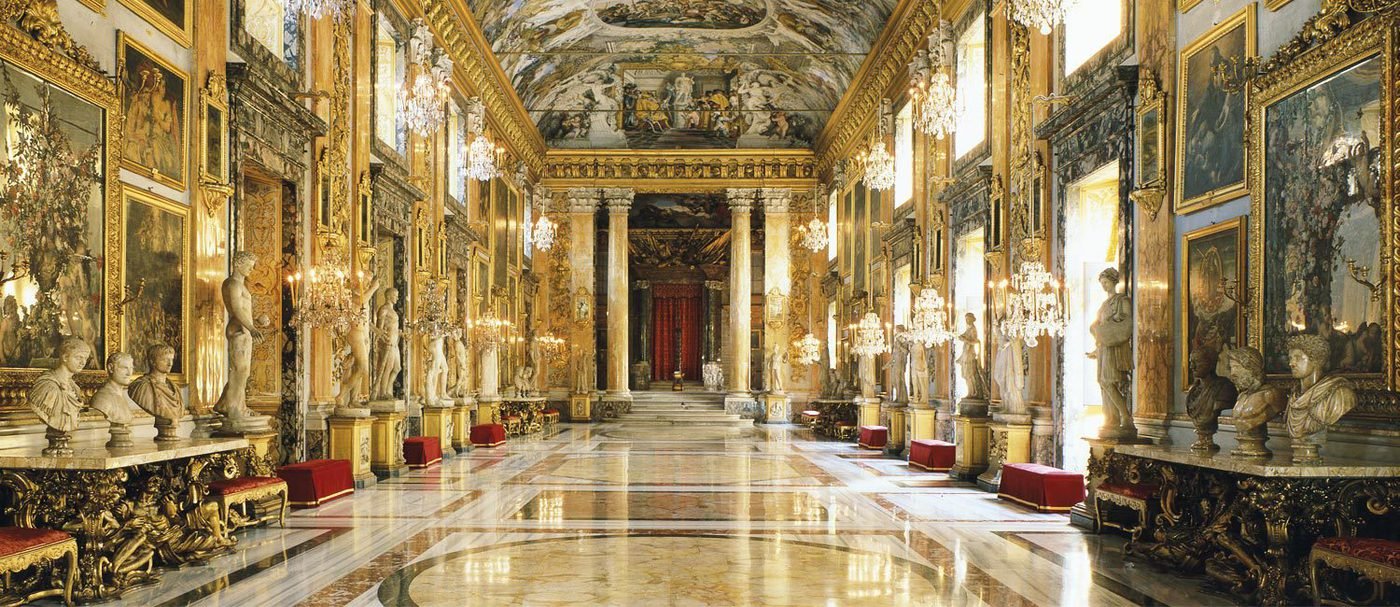
You go down the ramp and find yourself in one of the few Roman halls that can stand comparison with Versailles: a monumental enfilade marked by columns faced in yellow Siena marble, mirrors, gilded stucco, and one continuous vault overhead. Those who arrive early in the morning, with light coming in through the high windows and no one in front of them, have the spectacle that makes the whole ticket worth it.
The Vault with the Battle of Lepanto
The Gallery vault was frescoed by Giovanni Coli and Filippo Gherardi, two painters from Lucca trained on Venetian models, and its central subject is the Battle of Lepanto on October 7, 1571. Marcantonio II Colonna, commander of the papal fleet in the Holy League, appears several times along the entire vault: in the naval action, in the triumph, and in the heavenly ascent. Look at it calmly and from several points in the room, because the layout is built to be read while walking, not while standing still. It is official display painting, openly propagandistic, and for that very reason it is a first-hand historical document: it tells us how a Roman family chose to present its highest hour, 30 years after living it.
The Painted Mirrors and Furniture of the Great Hall
The four large mirrors are painted by Mario dei Fiori, Giovanni Stanchi, and Carlo Maratta. They are objects that are hard to classify today: reflective surfaces painted with flowers and putti, halfway between a painting and a piece of furniture. Mario Nuzzi, known as Mario dei Fiori, was the leading Roman specialist in floral still life in the 17th century, and these mirrors are among his best-known works. Look at the play: the painted flower reflects in the mirror beside it and multiplies the room. It is an effect designed for candlelight, not electric light.
All the consoles in the Gallery, like the two large cabinets in the Hall of Landscapes, rest on figures of submissive prisoners: they are the Turks defeated at Lepanto, turned into supports for furniture. Anyone looking for an example of how Baroque power spoke through everyday objects has one right in front of them.
The Paintings in the Great Hall
Along the Gallery, canvases by Guercino, Salvator Rosa, Jacopo Tintoretto, Francesco Salviati, Guido Reni, and Giovanni Lanfranco follow one another. Salvator Rosa deserves a pause: a Neapolitan who was a poet and actor as well as a painter, he invented a dramatic, untamed landscape that in the next century became the model of sublime taste for English travelers on the Grand Tour. Guido Reni stands at the opposite extreme, with his calculated beauty and no harshness. Having them in the same room, a few meters apart, is the best lesson in art history you can get in Rome without opening a book.
The Entail and the Survival of the Collection
The family art collections are bound by an entail dating to the 19th century: they are tied to the palazzo's walls, inalienable and indivisible. This legal clause is the reason we still see together what we see. Roman picture collections almost all broke up between the 19th and 20th centuries, sold piece by piece to foreign museums. Here, the entail acted as a dam. It is not a legal technicality. It is the explanation for the visit.
The Hall of Landscapes and Gaspard Dughet
Past the two columns faced in yellow Siena marble, you enter the Hall of Landscapes, named after the series of rural paintings by Gaspard Dughet. Dughet, French by birth and Roman by training, was Nicolas Poussin's brother-in-law and lived almost always in Rome. His landscapes of the Lazio countryside, with Tivoli and the Prenestine Mountains in the background, trained the eye of two generations of European travelers. Anyone who has seen only 18th-century views of ruins finds here the model that came before them.
The vault, with an Allegory of the Battle of Lepanto, was painted at the end of the 17th century by Sebastiano Ricci, the Venetian who would become one of the links between late Baroque and European Rococo. The large ebony and ivory cabinet by the German Steinhart brothers depicts scenes from the Old and New Testaments and, in its central part, reproduces Michelangelo's Last Judgment from the Sistine Chapel in miniature. On the opposite wall, a second cabinet, made of sandalwood and hardstones, reproduces a Roman villa. Look at them closely: the most interesting part is not the whole, but the drawers and doors, each with its own little scene.

The Hall of the Apotheosis of Martin V
The name comes from the large canvas by Benedetto Luti at the center of the ceiling, showing the family pope being presented in heaven. But this room is above all the palazzo's true picture gallery: most of the paintings an enthusiast comes looking for are concentrated here.
Annibale Carracci's The Bean Eater
Annibale Carracci's The Bean Eater is the most famous painting in Galleria Colonna and one of the most important works of Italian naturalism. A peasant sits at a table in front of a bowl of beans, spoon raised, his gaze turning toward the viewer. Bread, spring onions, a jug, a crumpled tablecloth. No saint, no allegory, no nobility. At the end of the 16th century this was a revolutionary gesture, and Annibale, from Bologna, makes it first and independently of Caravaggio. The dating fluctuates, but the critical consensus firmly places it in the painter's Bolognese years.
It is often said the painting inspired Van Gogh and Degas: that is a modern critical comparison, not a documented fact, and it should be taken for what it is, a suggestion for reading. What can be stated without hesitation, however, is that The Bean Eater is at the root of all Italian genre painting of the 17th century. It is worth looking at it up close and then from three meters away. Up close it is raw material, from far away it is a psychological portrait.
Bronzino and the Paintings Above the Fireplace
Above The Bean Eater hangs a panel by Agnolo Bronzino showing the Virgin, the sleeping Christ Child, Saint Anne, and the young Saint John the Baptist: pure Florentine enamel, acid colors, sharp contours. The pairing of Bronzino and Carracci, one above the other, is one of the most instructive comparisons Rome has to offer: two opposite ways of understanding painting, 40 years apart.
To the right of the fireplace, up high, is Saint Julian the Hospitaller by Perin del Vaga, a pupil of Raphael and a key figure in the artistic diaspora that followed the Sack of Rome in 1527. Below it is the Portrait of the composer Adrian Willaert at the spinet by Jacopo Tintoretto. Willaert was chapel master at St. Mark's in Venice and the founder of the Venetian polyphonic school: a Flemish musician portrayed by a Venetian and ending up in a Roman house, which is a perfect summary of artistic circulation in the 16th century.
The Central Wall and Other Masterpieces
On the central wall, the following are lined up: Time Abducting Beauty by the Cavaliere d'Arpino, Francesco Albani's The Abduction of Europa, Saint Jerome Penitent in the Desert by Perugino, and the Holy Family with Saint Sebastian, Saint Jerome, and Mary Magdalene by Paris Bordone. Then the Madonna Incoronata by Andrea del Sarto, the Self-Portrait with Cameo, and the Raising of Lazarus by Francesco Salviati. I recommend not treating the Perugino as a passing piece: it shows Raphael's teacher in an ascetic and landscape-focused version that is rarely seen.
At the center of the entrance wall, above a 17th-century Roman console table, stands the Carrara marble bust of Cardinal Girolamo I Colonna, patron of the Gallery, sculpted by Orfeo Boselli around the middle of the 17th century. On the left is a painting by Jacopo Tintoretto showing Onofrio Panvinio, an Augustinian historian who was very well known in his time and one of the founders of Roman antiquarian scholarship. On the right is Paolo Veronese's The Gentleman, one of those Venetian portraits in which the clothing matters as much as the face.
The Throne Room of Galleria Colonna
The next room is again dedicated to Oddone Colonna, elected pope on November 11, 1417, the feast day of Saint Martin, which is why he chose the name Martin V. His papacy lasted until 1431, and for about 10 years the family palazzo was in effect a papal seat.
At the center is the piece everyone photographs: the chair beneath the papal portrait. Following the custom of the great Roman princely houses, every family entitled to receive the pope kept a throne room with a chair reserved for his visit, and the chair stayed turned toward the wall until the pope arrived. Papal visits to Roman patrician palazzi stopped in 1870, with the end of the temporal power. Since then, that chair has waited for a guest who never came back. It is an object that tells the story of Rome better than an entire textbook chapter, and it costs nothing to stand in front of it for 30 extra seconds.
On either side of the portrait of Martin V are two small portraits of Marcantonio II Colonna, the victor of Lepanto, and his wife Felice Orsini, by Scipione Pulzone, a portraitist from Gaeta with almost photographic precision. On the same wall are the two oldest paintings in the entire collection: the Madonna with Angels by Stefano da Verona, from the 14th century, and the Crucifixion by Jacopo Avanzi, also from the 14th century. These are two small panels, easy to walk past, and they are the chronological starting point for everything seen so far.
The Hall of the Woven Hanging
It is named after the large 17th-century woven hanging of Italian manufacture that shows Queen Artemisia examining the design for the tomb of her husband Mausolus, the monument that gave its name to all mausoleums. The Artemisia cycle, designed in France in the early 17th century, enjoyed enormous success across Europe, and the Colonna own several pieces, spread across different rooms.
On the walls, paintings of excellent quality: The Massacre of the Innocents by Jacopo del Sellaio, a 15th-century Florentine close to Botticelli, The Reconciliation of Esau and Jacob by Peter Paul Rubens, a record of the Flemish master's time in Rome, and an Ecce Homo by Francesco Bassano the Younger, from the family of Venetian painters that made genre painting a family specialty.
The Yellow Room and the Chapel Room
The Yellow Room is the entrance to the Galleria Apartment from inside the palazzo, located between the Woven Hanging Hall and the Chapel Room. The wall frescoes are by the brothers Giuseppe and Stefano Pozzi for the figures, and by Giovanni Angeloni for the landscapes and decorative elements, painted around the mid-1750s. They show ideal views of villas with trompe l'oeil effects, linked to the vault by two raised stucco garlands. It is a passageway room that almost nobody looks at: give it a minute, because it is where the palazzo changes century before your eyes.
Through two doors you reach the Chapel Room, which holds more woven hangings from the Artemisia series: the two beside the window and the one on the entrance wall are dated to the early 17th century and come from the Parisian workshop on Boulevard Saint Marcel. Among the paintings, the standout is Pietro da Cortona's Resurrection of Christ and of some members of the Colonna family at the end of time, a dizzying subject in which the patrons have themselves depicted rising again. In the same room is Guercino's Moses with the Tablets of the Law. Overhead hangs the largest chandelier in the palazzo, made in Murano in the 18th century.
The room opens onto the small family chapel, where above the altar hangs a Holy Family by Giuseppe Bartolomeo Chiari and, on the right, a Deposition by 16th-century painter Paolo Farinati. On the left, a 19th-century stained-glass window depicts the translation of the body of Blessed Margherita Colonna from Castel San Pietro to the Roman church of San Silvestro in Capite, which took place in 1283. Margherita, who died young in 1280, is the family saint: a family that gave the Church a pope, an admiral, and a blessed has filled every available slot in medieval Rome.
The Hall of the Primitives
Crossing back through the Yellow Room, you enter the Hall of the Primitives, dominated by a large early-17th-century French woven hanging, also from the Parisian Boulevard Saint Marcel workshop, showing Queen Artemisia watching her son, young Prince Lygdamis, at a riding lesson. The hanging was cleaned and restored in Brussels at the Royal De Wit Manufactory between 2011 and 2012: a long and costly intervention, and the result shows in how the blues have held up.
The room houses a collection of mainly sacred paintings between the fifteenth and seventeenth centuries. Two small panels by Cosmè Tura, the great Ferrarese painter of the Este court, depict the Madonna and Child, also called the Madonna of the Zodiac for the zodiac signs in the background, and the Virgin Annunciate: sharp line, metallic colors, a hardness that resembles nothing Roman. Next to them, the Saint Augustine by Carlo Crivelli, a Venetian transplanted to the Marche and master of a precious, angular painting. The Madonna and Child with Saints by Jacopo Palma the Younger. Two panels by Pietro Alemanno with Saint Anthony Abbot and a Bishop Saint. Two works by Bernardino di Mariotto with The Adoration of the Shepherds and Christ among the Doctors. And finally two small panels by the so-called Master of the Colonna Predella, with The Birth of the Virgin and Two Kneeling Donors in a Landscape. That conventional name, Master of the Colonna Predella, was born precisely from these panels: an anonymous painter christened by the collection that preserves him.
A clear opinion: this is the room that visitors cross most quickly and the one that, for those who love painting, contains the best things. The two Turas alone justify a 10-minute stop.
The Sala dei Ricami
The name comes from the Indian-style tapestries of the mid-seventeenth century that cover the walls, woven with gold thread and silk. The central canopy bears the Colonna and Pamphilj coats of arms, the heraldic union of the marriage between Filippo II Colonna, son of Lorenzo Onofrio and Maria Mancini Mazzarino, and Olimpia Pamphilj, celebrated in 1697. These are the same alliances you read in the rooms of Palazzo Doria Pamphilj, less than 10 minutes on foot from here: two palaces, a single network of kinship.
From the Sala dei Ricami you pass into a small vestibule with mirrors, frescoed in the mid-eighteenth century, which leads back into the Sala dell'Apoteosi di Martino V and closes the circuit of the Appartamento Galleria.
The Padiglione Pio of the Galleria Colonna
The Padiglione Pio is dedicated to Princess Donna Sveva Colonna (1912-1999), married in 1932 to the Spanish prince Don Alfonso Pio Falcò (1903-1967). Sveva was the elder of the two children of Princess Isabelle Colonna Sursock and sister of Prince Aspreno Colonna, father of the current princes. She had no children. You meet her twice in these rooms: in the large portrait by the Spanish painter Ignacio Zuloaga (1870-1945), which shows her at 25 with the dog Whisky in front of Villa Mombello in Imbersago, in the province of Lecco, her husband's property, and in a bronze bust by Antonio Berti (1904-1990).
The rooms that today make up the Pavilion were part of the cardinal's apartment inhabited by three Colonna cardinals: Ascanio in the sixteenth century, Girolamo I in the seventeenth and Girolamo II in the eighteenth. The six large seventeenth-century tapestries from the French Gobelins manufactory tell episodes from the life of Alexander the Great and come from the collection of Filippo III Colonna, in the eighteenth century. From the Pio collection come instead the bust of Pope Benedict XIV, born Prospero Lambertini (1675-1758), the portrait and busts of Donna Sveva and that of King Philip IV of Spain (1605-1665).

The Sala della Cornucopia
The ceiling of the Sala della Cornucopia and that of the following Sala del Baldacchino were decorated in the late sixteenth century, between 1588 and 1592, in the great campaign promoted by Cardinal Ascanio Colonna (1560-1608), and restored in the mid-seventeenth century by Cardinal Girolamo I (1604-1666). To this last phase date the door frames with the inscription HIERONYMUS CARDINALIS COLUMNA DUX ET PRINCEPS, the floral decorations of the lunettes at the base of the vaults and the restoration of the sixteenth-century paintings.
The ceiling is a heraldic machine: on a gold ground, around the great Colonna coat of arms, are arranged the collar of the Order of the Golden Fleece, Turkish banners and flags with the insignia of Pope Pius V, pontiff from 1566 to 1572, and of the Spanish kingdom of Castile and Leon. They all recall Lepanto: Pius V was the architect of the Holy League, Spain was its naval power, the Turkish banners are the spoils. The frescoes celebrate the cultural and ecclesiastical role of Ascanio through allegorical figures of Virtue and emblems of episcopal, cardinalate and papal power held by winged figures and putti. In the four ovals around the coat of arms run Stories of the Old Testament: the Creation of Adam, the Creation of Eve, the Original Sin, the Expulsion of Our First Parents from the Earthly Paradise.
The wall decoration with woven hangings and painted fabric panels dates to the renovation entrusted by Cardinal Girolamo II (1708-1763) to architect Paolo Posi between 1756 and 1763. The four Gobelins hangings were woven in Paris in the 17th century from the cartoons of a famous cycle of paintings made for Louis XIV by Charles Le Brun (1619-1690), superintendent of the French royal manufactories. Lorenzo Onofrio Colonna (1637-1689) bought them for 982 scudi, a figure worth keeping in mind to understand the relationship between the price of woven hangings and the price of paintings in the 17th century: back then, the hangings cost more than the paintings. They depict the Stories of Alexander the Great and should be read clockwise, starting from the wall opposite the windows: the Battle of the Granicus in 334 BC, the first clash with the Persian army in Asia Minor, the family of Darius paying homage to Alexander after Issus in 333 BC, the Battle of the Hydaspes River in 326 BC, the last great Macedonian battle, fought against the Indian king Porus in the Punjab, and the defeat of Porus, also in 326 BC.
In the spaces left free by the hangings, the brothers Stefano and Giuseppe Pozzi painted seven fabric panels in the 18th century, showing putti and military trophies in plant-based pigments that imitate the effect of a real woven hanging and create a continuous surface. The yellow Siena marble floor, with an inlaid cornucopia at the center and four red French bows at the corners, dates instead to 1948: it was commissioned by Donna Isabelle Sursock Colonna (1889-1984) from the Medici firm, based on a design by architect Clemente Busiri Vici. A 16th-century room is therefore walked on a postwar floor, and the remarkable thing is that it does not clash.
The Hall of the Canopy
Here too the vault belongs to the campaign of Cardinal Ascanio, with restorations from the mid-17th century. At the center is the Colonna coat of arms, topped by the crown and the bifid mermaid, flanked by two putti holding banners with papal insignia and the arms of Castile and León. Around it runs a grotesque decoration on a white ground, full of motifs alluding to fame and triumph. On the pendentives are military trophies on gold backgrounds, very similar to those in the Tempest Hall and the Dughet Hall of the Princess Isabelle Apartment. The prevalence of military imagery celebrates the family's military feats and, in particular, the fame born from Lepanto.
On the main walls, two hangings from the Alexander the Great series, woven in Paris in the 17th century by the Gobelins after Le Brun's paintings, complete the cycle of the Hall of the Cornucopia: the Battle of Arbela, or Gaugamela, in 331 BC, fought against Darius III not far from the ancient Assyrian capital of Nineveh, near modern-day Mosul, and Alexander's triumphal entry into Babylon in October of the same year.
The room also holds a Portrait of Pope Martin V Colonna, painted in oil on panel in the 16th century, the oldest likeness of the pope kept in the palazzo. A marble bust of Benedict XIV, pope from 1740 to 1758, by Pietro Bracci (1700-1773), the sculptor who made the Ocean for the Trevi Fountain. A portrait of Sveva Colonna Pio by Zuloaga. And several landscape canvases from the 17th and 18th centuries by Gaspard Dughet and Frans van Bloemen. The geometric marble floor, with panels in Pyrenean red marble and squares in Aosta green, was laid in 1947 at the wish of Donna Isabelle Sursock Colonna by the Medici firm, based on a design by Clemente Busiri Vici.
The Little Gallery
This is a small passageway created during the mid-18th-century works commissioned by Cardinal Girolamo II and painted in the same years, between 1756 and 1763, by Giovanni Angeloni and the brothers Stefano and Giuseppe Pozzi: a painted open loggia illusionistically opens onto views of gardens with statues, antique-style vases, and fountains. It houses a bronze bust of Philip IV of Spain from the Pio Falcò collection. It is the smallest space on the route and one of the most successful: the trompe l'oeil still works, and if you stand in the center you will understand why, in the 18th century, this kind of painting was paid as much as a museum painting.
The Majolica Hall
Also renovated between 1756 and 1763 under Girolamo II, with elaborate gilded stucco decoration on the walls. On the wall facing the windows, a fireplace clad in Giallo Antico and green marble is topped by a large mirror with a carved and gilded frame, crowned with the monogram of Prince Lorenzo Onofrio Colonna. The room holds a bronze bust of Sveva Colonna Pio made by Antonio Berti in July 1939, from the Pio Falcò collection. The wooden ceiling with Colonna heraldic emblems is 19th-century, while the floor is 18th-century Vietri majolica tiles: a Campanian floor in a Roman house, brought here with the family's southern estates.
The Princess Isabelle Apartment
On the ground floor opens the part of the palazzo that the full route adds, and it is the main reason to come to Galleria Colonna. The Colonna princes left Princess Isabelle's apartment exactly as it was when she lived there: the same furniture, the same family photographs on the side tables, the same arrangement of objects. It is not a museum display imitating a home. It is a home.

The 37 views by Vanvitelli
The collection holds 37 views by Gaspar van Wittel, the Dutchman who became Vanvitelli in Rome and who was the father of the modern Italian veduta, as well as the father of Luigi Vanvitelli, the architect of the Royal Palace of Caserta. Van Wittel painted Rome with a topographical precision that no one had achieved before. His views are urban documents as well as paintings. Anyone who wants to know what Piazza Navona, the Tiber, or the Quirinal looked like before the 19th-century interventions finds here a visual source of top quality, and 37 pieces together is a number that very few collections in the world can display.
The Sala della Fontana and the night clock
The Sala della Fontana keeps the only surviving section of the old Venetian-style floor. In the other rooms, the princess had it replaced with polished Eastern marble, a choice perhaps linked to her Lebanese origins. Here is one of the rarest objects in the house, a painted night clock, kept between two antique-style trunks. Inside, a silent mechanism moves the numbers, backlit by a candle. Night clocks were a Roman invention of the 17th century, designed for people who wanted to know the time without being woken by the ticking. A little further on is a S-shaped double sofa, what furniture historians call a confidenza, made for talking while looking each other in the face.
At the start of the route, a porphyry crocodile greets the visitor. It is one of the few surviving traces of the Roman sanctuary on which this wing of the palace stands, the Temple of Serapis. The crocodile belongs to the Egyptian iconography of the Isiac and Serapic cults spread in Rome from the imperial age, and seeing it here, in a 20th-century salon, is one of those short circuits that happen all the time in Rome.

The Sala delle Feste, the Sala del Dughet and the Sala del Mascherone
The sequence of salons includes the Sala del Vanvitelli, the Sala delle Feste, the Sala della Fontana, the Sala del Dughet and the Sala del Mascherone. On the walls and ceilings, artists such as Pinturicchio, Pomarancio and Cavalier Tempesta have alternated. Cavalier Tempesta was Pieter Mulier the Younger, a Dutch painter specialized in seascapes and storms, who earned his nickname in Rome from the subject he painted best. In the rooms you can still recognize the canopy with the family symbol and, in the center, the gilded wood console with the chained Turks that recall Lepanto. It is the same motif as the noble apartment, repeated on the ground floor.
Maria Mancini and Olimpia Pamphilj
In these salons you meet two women who deserve more than one note. Maria Mancini, niece of Cardinal Mazarin, is preserved in the portrait by Simon Vouet, painter at the court of Louis XIV. She was the first love of the young Louis XIV, removed from the court for reasons of state and married to Lorenzo Onofrio Colonna. In her diaries she recounted the misadventures of an unhappy marriage and her flight from Rome. To force her to return, her husband had all the doors of the salons of Europe closed to her. Yet the beginning had been different. The ceiling painted by Giacinto Gimignani shows the meeting of an ancient column and a pair of fish, the heraldic emblem of the Mancini. Carlo Maratta and Gaspard Dughet portrayed the two spouses as Venus and Paris, as they perhaps liked to appear at the costume balls they organized.
Olimpia Pamphilj is evoked by the doves with an olive branch painted on the ceilings of the first salons: the emblem of the Pamphilj, brought into the Colonna house by the marriage of 1697. Beside the double portrait in costume, Jan Brueghel the Elder left nine small fantastical landscapes painted on copper, a support chosen to make the warmth of the reds and the transparency of the blues stand out. They are tiny and should be looked at from very close up.
Who was Princess Isabelle
Isabelle Colonna, née Sursock, came from a family of Byzantine origin that had settled in Lebanon since the seventeenth century. She married Prince Marcantonio Colonna and moved to Rome, where she managed to fit into the capital's society during the years of Mussolini's rise. When she died on November 18, 1984, Laura Laurenzi remembered her in la Repubblica as a grand lady of the court, intelligent, cultured, conservative in the purest and most consistent sense, who after the fall of the monarchy found herself replacing Maria José as an unofficial queen. She hosted royal receptions that only crowned heads were invited to and, among the bourgeoisie, only financiers and bankers, as long as they weren't divorced. In her last years she showed her apartment only to her closest friends. Today it is open to visitors on Saturdays with a €25 ticket, and this shift from a very private salon to a museum route is perhaps the most interesting fact in the recent history of the palazzo.
The garden of Galleria Colonna and the Temple of Serapis
The garden climbs the flank of the Quirinale and is connected to the palazzo by four overpass arches that span Via della Pilotta. It is included in both visit routes and it is the part visitors underestimate most. Going up, you'll come across the wall remains that the antiquarian sources called the anticaglie: Imperial-era structures that scholars now attribute sometimes to the Temple of the Sun and sometimes to the Temple of Serapis, the great sanctuary that occupied the slope of the hill. The ruins were so imposing that even in the sixteenth century, as Maarten van Heemskerck's view shows, the palazzo dell'olmo leaned against them.
The Serapeum of the Quirinale, built in the Severan period, was one of the largest complexes in Imperial Rome, and its monumental staircase linked the hill to the valley below. What remains of it is built into the structures of the palazzo and the garden, and it is partly visible from Via della Pilotta and from the climb up to the Quirinale. It's better to see the garden not as a green break between two rooms, but as the archaeological floor the entire palazzo rests on. The terrace overlooking the inner garden is opened to visitors in good weather, and on clear mornings in April and October it is the best spot of the whole visit.
Galleria Colonna and Roman Holiday
The final scene of Roman Holiday, William Wyler's 1953 film with Audrey Hepburn and Gregory Peck, was filmed here. The press conference where Princess Anna meets foreign journalists takes place in the Sala Grande of the Galleria: it's there that the princess steps down from her seat to greet the reporters one by one, receives Irving's photographs of her Roman holiday, and says goodbye to Joe with a last silent smile. If you have that shot in mind, you'll recognize the yellow Siena marble columns and the mirrored wall as soon as you enter.
One thing needs saying, because the misunderstanding is common: in the film, that room represents an embassy, not a private palazzo. The production was looking for a space that gave the feel of a European court, and it found one in a Roman house. That's why thousands of visitors arrive every year with the wrong expectation: don't look for the film's throne, look for the room. The real throne sits two rooms earlier, and it faces the wall.
How long a visit to Galleria Colonna takes
The short route can be covered in 50 minutes if you walk, or in an hour and a quarter if you stop in front of the paintings. The full route, including the Princess Isabelle Apartment and the gardens, takes two full hours, and two and a half hours if you're an expert or if you bring an audio guide. The guided visit on Fridays lasts about two hours.
The calculation I'd suggest is a different one, though. On Saturdays the last entry is at 13,15: anyone who arrives at the last minute with a full-route ticket ends up rushing through the Isabelle Apartment. Showing up between 9,15 and 10,30 completely changes the experience. It's not just a matter of convenience: the light changes. In the early morning, natural light comes in through the high windows of the Sala Grande and crosses it at an angle, and that is the hour the room was designed for.
When to visit Galleria Colonna
The palazzo opens to the public two mornings a week, and paradoxically this spreads visitors out better than many museums open six days out of seven: those who arrive in Rome without checking don't end up here by chance. The busiest periods are spring weekends, holiday long weekends, and Saturdays in December. The quietest are the mornings of January, February, and November.
In August Rome empties and the rooms are almost deserted, but the palazzo is not air-conditioned like a modern museum: at 11 in the morning on an August Saturday, the Sala Grande is hot. If you have to pick one month, pick October: low, clear light, the terrace over the garden still open, and temperatures right for walking up to the Quirinale after your visit. If you have to pick one time, pick exactly 9,15.
Galleria Colonna with children
Children up to 12 years old enter for free, with a limit of two per paying adult, and this is one of the most generous policies among privately run museums in Rome. That said, you should choose carefully what to show them: a sequence of gilded rooms wears out a six-year-old quickly.
What always works are three things: the cannonball stuck in the staircase, which you can see and touch, and which comes with a three-sentence story, the porphyry crocodile at the entrance to the Appartamento Isabelle, and the chained Turks holding up the tables, a natural treasure hunt you can set up room by room. With middle schoolers, the Lepanto vault also works, if you tell it as a naval battle with real numbers: over 200 Christian ships lined up, in a single day, on October 7, 1571. In the garden, kids can finally move around. There are no strollers to borrow, and the historic rooms don't like wheels. A baby carrier or a backpack carrier is the best solution.
Accessibility of Galleria Colonna
The entrance for people with disabilities is at Piazza Santi Apostoli 66, including on Saturday mornings when the public enters from Via della Pilotta 17. A companion of a person with a disability enters for free. The palace remains a historic building on multiple levels, with a flight of steps between the Sala della Colonna Bellica and the Sala Grande, and with the garden sloping up the hill. Before coming, it's best to call 06 6784350 and arrange your route, because the staff know the internal alternatives better than any written description. Saturday audio guides are available in 10 languages.
Things to see around Galleria Colonna
Few areas of Rome concentrate so many places to visit within a 10-minute walk. This is the real reason I recommend the Saturday morning visit: you leave at 11:30, and the day has only just begun.
Piazza Venezia and the Vittoriano
Three minutes away is Piazza Venezia, with the Altar of the Fatherland and its panoramic terraces, and the National Museum of Palazzo Venezia, which occupies a 15th-century palace just as layered as this one and far less visited than it deserves. Climbing the cordonata brings you to the Capitoline Museums, on the Capitoline Hill, where the day can end with the Marcus Aurelius statue and the Lupa.
The Trevi Fountain and the rione
Seven minutes of gentle uphill and you reach the Trevi Fountain, which is set into the facade of Palazzo Poli: a detail almost no one notices, because everyone looks at the water and no one looks up at the building. A few steps away is the Galleria Sciarra, a Liberty-style courtyard frescoed with the female virtues, open and free, and one of the most beautiful and least visited spots in the city center.
The Quirinale and the Scuderie
Climbing Via Ventiquattro Maggio, in 10 minutes you reach the square of the Quirinal Palace, with the Dioscuri and the obelisk, and the Scuderie del Quirinale, the exhibition venue that hosts the major Roman Exhibitions. Just beyond, toward Via delle Quattro Fontane, is Palazzo Barberini: if you want a fully Baroque day, you can pair the two vaults, the one by Coli and Gherardi here and the one by Pietro da Cortona over there.
The Basilica dei Santi XII Apostoli and the Trajan's Markets
The Basilica dei Santi XII Apostoli is attached to the palace, has free entrance from the square of the same name, and houses the funerary monument of Clement XIV by Antonio Canova. You're inside in three minutes, and it's worth the stop, even just to understand the physical connection between the Colonna family's home and their church. On the other side, five minutes along Via Quattro Novembre, are the Trajan's Markets, with Via Biberatica explaining the shape of Via della Pilotta.
A curiosity about Galleria Colonna
The curiosity concerns the name. It is often read, even in serious guidebooks, that the Colonnas would be called that because of their closeness to Trajan's Column. It's a fascinating explanation and has circulated for centuries, but it remains a scholarly tradition, not a documented fact. Medieval sources trace the name to the fief of Colonna, in the Alban Hills, which the family owned and from which the descendants of the counts of Tusculum took their surname in the 11th century. Trajan's monument is a few hundred meters away, the Colonnas dominated that part of the city, and the association arose on its own.
What is documented, and that almost no one tells, is how the family used that ambiguity. A house that has a column for its coat of arms and owns the neighborhood where the most famous column of antiquity stands has an enormous symbolic advantage, and the Colonna exploited it without ever denying the legend. The red marble column in the center of the Sala della Colonna Bellica works exactly like this: an ancient shaft set on a modern pedestal, which makes the visitor think of that very monument. The message is simple: we were here before you, and our emblem is carved in the marble of Rome.
A curious footnote: in Lazio there are still today the town of Colonna, the Colonna castles of Genazzano and Castelnuovo di Porto, and the Rocca di Marino. The geography of names in this region is almost entirely feudal, and its map can still be read on the road signs.
One thing nobody tells you about the Galleria Colonna
The 15 euro ticket and the 25 euro ticket are not two versions of the same visit, but two different visits. The short route shows the representation wing, that is, the palace the Colonna showed to others. The full route adds the ground floor, that is, the palace where the Colonna lived. They are two opposite registers: above, the magnificence built to impress ambassadors, below, family photographs on small tables and a sofa for conversation. Anyone who wants to really understand how a Roman princely home worked should see both, and in this order.
The second thing nobody mentions concerns the gardens. They are included in the ticket, both routes include them, and a great many visitors leave without seeing them because they ran out of time in the rooms or because they think it is a service flowerbed. It isn't: you climb up along the side of the Quirinal, pass under the bridge arches, and walk over the remains of the Serapeum. The terrace over the inner garden is opened in good weather.
Third thing, the one about your wallet: the museum clearly warns that it is not responsible for tickets sold at inflated prices by resellers. Packages circulate online at prices well above the official price list, often with added services that are of no use. Buy on the official website, on TicketOne, with the Roma Pass, or directly at the ticket office. There is no advantage in doing otherwise, and in a museum that opens two mornings a week, the line is never the problem.
My advice for visiting the Galleria Colonna
Take the full route on a Saturday and enter at 9,15, as soon as they open. Then do something counterintuitive: don't start with the Sala Grande. Walk through it, glance at it quickly, and go straight down to the Princess Isabelle's Apartment, and give it a clean 40 minutes while there's no one there. Come back up afterward. The Sala Grande handles crowds much better than the apartment, because it is huge and because it is built to hold people. The apartment, on the other hand, is a home, and with 20 people inside you can no longer make anything out.
Second part of the advice: take the audio guide if you come on a Saturday, or come on a Friday with a guided tour. This palace, without someone explaining it, is a sequence of gilded rooms that all start to look alike after half an hour. With an explanation, it becomes the story of a family that moved through 1,000 years of Roman history as a main character. Five euros for the audio guide on a 25 euro ticket is the most worthwhile expense of the day.
Third part, and it needs to be said clearly: don't make the Galleria Colonna your only visit of the morning. The palace closes at half past 12 and leaves you in the middle of one of the densest areas of Rome. Plan something for a second block of time, whether it's the Quirinal, the Basilica of the Holy Apostles, the Vittoriano, or a walk toward Palazzo Doria Pamphilj. Leaving here and going back to your hotel is a waste.
Another well-known fact, yet rarely mentioned
That Palazzo Colonna was the seat of the papacy. It appears on every info sheet, and no one stops to consider what it means. Oddone Colonna was elected pope on November 11, 1417, at the Council of Constance, ending the Great Western Schism that had divided Christendom for 40 years. He returned to Rome in 1420 and found a depopulated city, with basilicas without roofs and wolves in the streets: filthy and abandoned, in Platina's words. He did not move into the Vatican or the Lateran, which were uninhabitable. He went to his own home, in this block, and from here he governed the universal Church until his death in 1431.
It means that for about a decade, the diplomatic correspondence of half of Europe arrived at this address, that cardinals climbed these stairs, and that papal bulls were signed a few dozen meters from where you now buy your ticket. It also means that the rebuilding of Rome, the building work that would lead to the Roman Renaissance, was directed from here.
The palazzo keeps memory of it in two rooms, the Sala dell'Apoteosi di Martino V and the Sala del Trono, and in a 16th-century portrait in the Padiglione Pio, which is the oldest likeness of the pope still in the house. No plaque, no themed route, no panel explaining it to the distracted visitor. The most important event in this address's history is also the one told with the least emphasis, and I like that restraint: it's the way a very old family treats its own past, without having to shout about it.
The right photo to take at the Galleria Colonna
The photo everyone tries to take is the Sala Grande on axis, from the top of the flight of steps: you can see the receding line of yellow Siena columns, the Lepanto vault and the far end of the room. It's the shot from Roman Holiday, and it works, under two conditions. The first is to arrive early, because with 10 people on the axis the photo is ruined. The second is to expose for the windows, not the walls: the room has much more contrast than it looks to the eye, and most shots come home with blown-out windows and an unreadable vault. If your phone has HDR mode, this is the time to use it.
The photo I recommend instead, the one nobody takes, is a detail: the cannonball on the staircase, shot from below, with the chipped marble in the foreground and the Gallery's perspective blurred behind it. It tells everything this palazzo is in a single image: a beautiful home that has lived through history and still carries its marks.
Third option, for those visiting in good weather: the terrace over the inner garden, with the overpass arches of via della Pilotta and the greenery climbing toward the Quirinal. It's the only spot where you can grasp the property's real extent. Flash is useless everywhere and should be turned off, both for the artworks and because on gilded surfaces and mirrors it only produces a white flash. Photography rules and tripod use should be checked at the ticket office: in private homes the rules change more often than in public museums.
Some important events that took place here in history
The first is the most brutal. In 1354 Cola di Rienzo, back in Rome after exile and once again master of the city, was killed by a commoner on the Capitoline while trying to escape in disguise. His body was dragged to the Colonna palace, the enemies he had persecuted, and hung for two days and a night. The end of the 14th-century republican dream literally played out in front of this doorway.
The second is the Sack of Rome in 1527. While the Landsknechts were ravaging the city, Palazzo Colonna was the only major palace spared, because Isabella d'Este, Marchioness of Mantua and mother of Ferrante I Gonzaga, one of the imperial commanders, was staying there. It wasn't a clean rescue, though: the more than 2,000 people who had taken refuge here were captured and had to pay a ransom to regain their freedom.
The third is the abdication of 1802. Charles Emmanuel IV, King of Sardinia, who had been living in exile in Rome as a guest of the Colonnas after the French invasion of Piedmont, renounced the throne in favor of his brother Victor Emmanuel I right in these rooms. A European crown changed heads inside this palazzo.
The fourth is 1849. During the French siege of the Roman Republic, a cannonball fired from the batteries on the Janiculum crossed the Gallery and stopped on the staircase, where it still is. The fifth, much milder, is 1953: William Wyler's crew took over the Sala Grande to shoot the final sequence of Roman Holiday, and since then millions of people have seen this room without knowing where it was.
Who has passed through the Galleria Colonna
The list is long because the palazzo is old. In the 14th century, Emperor Louis the Bavarian and Castruccio Castracani, lord of Lucca, were hosted here in 1328. Francesco Petrarca was a friend of the Colonna family: he served Cardinal Giovanni Colonna and was crowned poet on the Capitoline in 1341, in the years of his time in Rome with the family. Oddone Colonna, Pope Martin V, did not just pass through: he lived here for a decade, bringing the papal court with him.
In the 16th century Isabella d'Este arrived during the Sack. In the same century Cardinal Ascanio Colonna, a scholar and book collector, started the large decorative project whose ceilings can be seen in the Padiglione Pio. In the 17th century the palazzo became one of the capitals of Roman music: Bernardo Pasquini and Jacopo Melani had operas receive their world premieres here, and Maria Mancini, niece of Mazarin and first love of Louis XIV, was its hostess. Gian Lorenzo Bernini, Carlo Fontana and Johann Paul Schor worked on the Gallery in its final phase.
In the 18th century, papal visits were a ritual: the Throne Room exists for that. In 1802 Charles Emmanuel IV of Savoy lived here and abdicated here. In the 20th century Princess Isabelle Sursock turned the ground floor into the most exclusive salon in Rome, where crowned heads and European high finance came through, and her daughter Sveva was painted by Ignacio Zuloaga. In 1953 Audrey Hepburn and Gregory Peck were here, shooting the final scene of Roman Holiday in the Sala Grande. If you're looking for a place where Italian history stopped more than once in the same salon, this is one of the very few possible addresses.
Quick questions about Galleria Colonna
How much is the ticket for Galleria Colonna?
On Saturday mornings the short route costs €15 and the full route costs €25, with a reduced price of €20 for FAI members. On Friday mornings, with a mandatory guided tour, the full route costs €35, or €30 for FAI members.
When is Galleria Colonna open?
To the public on Friday mornings and Saturday mornings. On Saturday, opening starts at 9:15 and the last entry is at 13:15. On other days, entry is only by private visit, by reservation.
What is the entrance to Galleria Colonna?
On Saturday mornings you enter from Via della Pilotta 17. On Friday and for private visits, you enter from Piazza Santi Apostoli 66, which is also the entrance for people with disabilities.
Do I need to book to visit Galleria Colonna?
For Saturday mornings it's not always required, but during peak periods it's strongly recommended. For Friday, for groups and for private visits, booking is necessary: 06 6784350 or info@galleriacolonna.it.
Is the Apartment of Princess Isabelle included in the ticket?
Only in the full €25 route on Saturday, in the Friday guided tour and in private visits. The short €15 route does not include it.
How long does a visit to Galleria Colonna take?
The short route takes about one hour, and the full route about two hours. The Friday guided tour lasts about two hours.
Are there guided tours of Galleria Colonna?
Yes. On Friday mornings, entry is exclusively with a guided tour, in Italian, English, French and Spanish. On Saturdays you can book a dedicated guide service for €150 in addition to the tickets, for groups of up to 15 people.
Is there an audio guide for Galleria Colonna?
Yes, on Saturday mornings, in 10 languages, with a supplement of €5.
Do children pay for the ticket to Galleria Colonna?
Children up to 12 years old enter for free, with a limit of two children for each paying adult.
Is Galleria Colonna accessible to people with disabilities?
The dedicated entrance is from Piazza Santi Apostoli 66, and the companion enters for free. Since it is a historic palace on several levels, it's best to arrange your route by calling 06 6784350.
Can you take photographs at Galleria Colonna?
The rules for private collections change fairly often. The photography rules, the use of flash and the use of tripods should be checked at the ticket office when you enter. In any case, flash on mirrors and gilding is pointless.
Is Galleria Colonna free on the first Sunday of the month?
No. Free Sundays apply to state museums and those in the municipal system. This is a private museum, with its own price list and no recurring free openings.
Can you use the Roma Pass at Galleria Colonna?
The museum lists the Roma Pass among its access options. It's still worth checking the current conditions of the card before you count on it.
Where can I buy tickets for Galleria Colonna?
On the official website, on TicketOne, with the Roma Pass, or directly at the ticket office. The museum warns that it is not responsible for tickets resold at a higher price by intermediaries.
Is the garden included in the visit to Galleria Colonna?
Yes, the gardens are included in both the short route and the full route. The terrace overlooking the inner garden is opened to visitors in good weather.
What is the most important work in Galleria Colonna?
The Mangiafagioli by Annibale Carracci, in the Hall of the Apotheosis of Martin V, is the most famous work. For many scholars, the two panels by Cosmè Tura in the Hall of the Primitives are just as important, as are the 37 views by Vanvitelli in the Apartment of Princess Isabelle.
Why is there a cannonball on the staircase?
It landed there in 1849, fired from the French batteries of General Oudinot on the Janiculum during the siege of the Roman Republic. The family chose to leave it where it stopped.
Why is the throne facing the wall?
According to the custom of Roman princely houses, the seat reserved for the pontiff stayed turned toward the wall and was only turned around for a papal visit. After 1870, those visits stopped.
Where was the final scene of Roman Holiday filmed?
In the Great Hall of the Gallery, inside Palazzo Colonna. It's the room where Princess Anna greets the journalists at the press conference.
What is the difference between Galleria Colonna and Palazzo Doria Pamphilj?
They are two private Roman picture galleries still inhabited by the owning families. Doria Pamphilj is open every day and has a larger collection, including the Velazquez and the Caravaggios. Galleria Colonna is open two mornings a week and offers a more compact and spectacular Baroque reception setting, along with an inhabited apartment preserved as it was.
Is Galleria Colonna the same as Piazza Colonna?
No, and the confusion is common. Piazza Colonna, with the Column of Marcus Aurelius, is a few minutes' walk away and has no connection to the family's palace. The Trajan's Column, also nearby, is an ancient monument and does not belong to the Colonna family.
Is the palace still lived in by the Colonna family?
Yes. The rooms open to the public are the representation wing and the museum spaces. The rest of the complex remains the private residence of the Colonna princes.
How big is Palazzo Colonna?
The property, including the villa on the Quirinal hill, covers about three hectares and occupies the entire block between Piazza Santi Apostoli, Via Ventiquattro Maggio, Via Quattro Novembre and Piazza della Pilotta.
Is there a cloakroom at Galleria Colonna?
As in every historic residence, large bags and backpacks must be carried in front of you or left at the entrance, and you should ask about the exact deposit conditions at the ticket office when you arrive. Rolling suitcases and large luggage are best not brought at all. If you're coming from the station, stop at your hotel or a left-luggage deposit first.
Is there a bookshop at Galleria Colonna?
Yes, the bookshop is at Via della Pilotta 17.
Is Galleria Colonna worth visiting with little time in Rome?
If you're in Rome for the first time and have two days, no. If you come back and want to see the private Rome, the one that hasn't entered the mass-tourism circuits, then it's among the three or four things I'd recommend first, together with Palazzo Doria Pamphilj and the Galleria Borghese.
Our opinion on Galleria Colonna
It's the place where Rome explains itself best, with the fewest words. Not for the Sala Grande, which does take your breath away and which everyone photographs. For the rest: a cannonball left where it fell, a chair turned toward the wall waiting for a guest who will never come, an Egyptian crocodile in a 20th-century sitting room, a 1948 floor under a 1590 ceiling. None of these objects was staged for us. They stayed there because nobody removed them.
If I could give only one piece of advice: buy the €25 ticket, arrive at 9:15, and don't look at your watch. And if you can choose the month, go in October.
Article written by the editorial team of TourLeaderPro, contact them for Tours and Private/Corporate/V.I.P. Experiences.
Planning a trip to Rome? The English-language guides for visiting the city are on ItalyPlanner.com.