Palazzo Poli
In short. Palazzo Poli occupies the block between piazza dei Crociferi, via Poli and piazza di Trevi, in the Trevi rione.
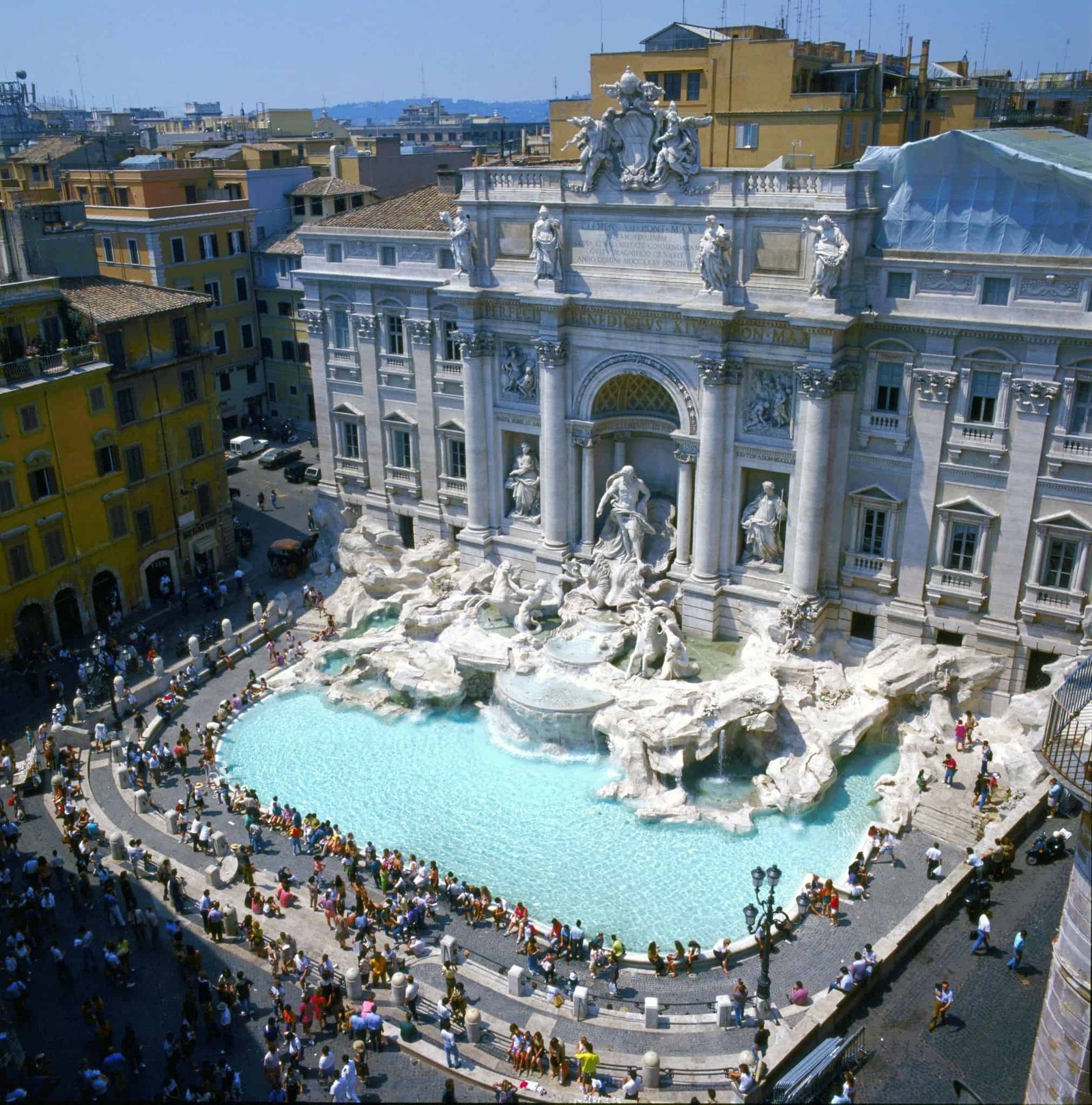
Palazzo Poli occupies the block between piazza dei Crociferi, via Poli and piazza di Trevi, in the Trevi rione. The entrance to the exhibitions is at via Poli 54, while the administrative seat of the Istituto Centrale per la Grafica, which occupies it, is at via della Stamperia 6, 00187 Rome. The switchboard is 06 699801, the email address ic-gr@cultura.gov.it. The exhibition spaces of Palazzo Poli are open Tuesday to Sunday, from 10:00 to 19:00, closed on Monday, with last entry one hour before closing. Between one exhibition and the next the palace stays closed, so it's best to check the Institute's website before setting out. Many exhibitions are free entry, others are not: the cartographic exhibition of summer 2026 listed six euros full price and two reduced, with the exemptions required by law. The surface stop is Tritone/Fontana di Trevi, served by lines 52, 53, 62, 63, 71, 83, 85, 117, 160, 492 and C3. The useful metro is line A, Barberini station, five minutes on foot downhill along via del Tritone. Booking is not necessary for ordinary exhibitions. For the study room for drawings and prints and for the library, instead, you get in only by appointment.
If you're putting together a tour of the center, the tourist attractions page helps you fit Palazzo Poli together with the rest of the rione.
What Palazzo Poli really is, beyond the fountain
Almost everyone has photographed it without knowing. The columns, the niches, the attic with the papal coat of arms behind Oceanus don't belong to the fountain: they belong to Palazzo Poli, a 16th-century noble palace that in the 18th century was cut down, reorganized and turned into a stage backdrop. The Trevi Fountain leans against a real, inhabited building, with courtyards, stairs, cellars and a piano nobile, not against a theater set built for the purpose.
The correct name would be Palazzo Conti di Poli, from the family that owned it for 130 years and took its title from the fief of Poli, in the Prenestini mountains. Today the palace is the property of the Italian State and, together with the adjoining Palazzo della Calcografia, houses the Istituto Centrale per la Grafica, one of the autonomous institutes of the Ministry of Culture. Inside there are over 170,000 prints, 27,000 engraved matrices, 24,000 drawings and 17,000 photographs. Outside there's the line for the selfie. It's the most violent gap I know in all of Rome between what a place shows and what a place contains.
The verdict, in short: Palazzo Poli is the most seen and least looked at building in Italy. 30 or 50 thousand people a day point a camera at it, and maybe one in a thousand knows they're framing a palace with a name, a history and a museum inside.
Where Palazzo Poli is and how to get there
Palazzo Poli doesn't have one front, it has three, and this confuses people looking for it for the first time. The most famous side faces piazza di Trevi and is the one incorporated into the fountain. The oldest front, the 16th-century one, faces piazza dei Crociferi, the old piazza di Ceri. The third side is on via Poli, the street that runs down toward piazza San Silvestro, and that's where, at number 54, you enter for the exhibitions.
On foot to Palazzo Poli
From piazza di Spagna it's a bare 10 minutes: take via Propaganda, cross largo del Tritone and go down via della Stamperia, which comes out exactly on the side of the palace. From piazza Colonna the trip is even shorter, seven or eight minutes along via dei Sabini and via delle Muratte. From via del Corso, at the church of Santa Maria in Via Lata, you turn onto via delle Muratte and reach the fountain in four minutes, but during the day you walk in the middle of a river of people.
Public transport to Palazzo Poli
The bus stop is called Tritone/Fontana di Trevi and is on via del Tritone: daytime lines 52, 53, 62, 63, 71, 83, 85, 117, 160, 492 and C3 stop there, and at night the n5, n46, n90, n201 and n543. The metro doesn't reach Trevi: the nearest station is Barberini on line A, from which you walk down along via del Tritone in five minutes. If you're coming from Termini you can take the 71 direct, which is often the most convenient solution, or metro A to Barberini.
By car and by taxi
Not recommended: the whole area is a limited traffic zone of the historic center and there is no surface parking. A taxi leaves you at largo del Tritone or in piazza San Silvestro, never in piazza di Trevi, which is pedestrian. With luggage, the reasonable choice is to get out in piazza San Silvestro and walk up via Poli: 200 meters on a slight uphill.
Hours, tickets and entry at Palazzo Poli
The practical rule is this: Palazzo Poli opens when there's an exhibition. It's not a museum open all year round with a permanent collection on stable display, it's a conservation and research institute that opens its rooms to the public for temporary exhibitions. During setup and takedown periods the door at via Poli 54 stays closed, and no sign explains it to the tourists who show up.
Palazzo Poli opening hours
When an exhibition is on, the hours declared by the Institute are Tuesday to Sunday from 10:00 to 19:00, with last entry at 18:00. Monday is a closing day. Exhibitions also tend to close on major civil and religious holidays, but this varies from one show to another.
How much it costs to enter Palazzo Poli
It depends on the exhibition. A large part of the Institute's shows are free entry, and it's one of the reasons it's always worth taking a look at the door on via Poli when you pass by. Some exhibitions do have a ticket: the show on the cartography of the Romanian Principalities and the Italian peninsula, open from July 8 to September 13, 2026, listed six euros full price and two euros reduced, with the exemptions provided by current regulations and sales both on site and on the portal of Italian museums. Before going, check the price on the Institute's official website: it changes with the exhibition.
Do you need to book for Palazzo Poli
For exhibitions, no, you just walk in. A prior request is needed, however, to consult the collections: the study room for drawings and prints and the library specialized in graphic arts receive scholars and enthusiasts by appointment, during office hours. The calcoteca, meaning the storage for the engraved matrices, can also be visited by appointment. It's a possibility almost no tourist considers and that is nevertheless open to anyone with a serious reason to ask.

The origins of Palazzo Poli: the Del Monte palace and the Duke of Ceri
The oldest core of the building, the one with its front on the present piazza dei Crociferi, was born in the first half of the 16th century as the palace of the Del Monte family, the house that had given the Church Pope Julius III. In 1566 the property passed to Lelio Cesi, Duke of Ceri, who decided not to limit himself to working on what existed: he bought the neighboring properties and commissioned a new palace to take them all in.
The commission went to Martino Longhi the Elder, one of the most sought-after architects of Rome under Gregory XIII, the man who had worked on the Chiesa Nuova and on Palazzo Altemps. Longhi died in 1591 with the site still open, and the work passed to Ottaviano Nonni, known as il Mascarino, the Bolognese who had built the elliptical spiral staircase of the Quirinal Palace. The facade on what was then called piazza di Ceri was closed in the very first years of the 17th century.
It should be said clearly, because it's the point almost all captions skip: the palace we see behind the fountain is, in its frame, a late Mannerist building from the end of the 16th century. Everything that came after, including the 18th-century scenery, rested on walls that had already been standing for 130 years.
From the Borromeo to the Conti: how Palazzo Poli got its name
In 1614 the palace passed to the Borromeo through marriage, with the wedding of Giovanna Cesi and Giulio Cesare Borromeo, and the new owners continued the policy of enlargements. In 1678 the building was bought by Lucrezia Colonna, who shortly after married Giuseppe Lotario Conti, Duke of Poli. From that marriage comes the name the palace still bears today, and which ended up naming the piazza too: from piazza di Ceri to piazza Poli.
The Conti were not just any family. They descended from the lords of Segni and Poli, had given the Church Innocent III, Gregory IX and Alexander IV, and in the 18th century were still powerful enough to put another of their own on the throne of Peter. Giuseppe Lotario was the brother of Cardinal Michelangelo Conti, who in 1721 would become Pope Innocent XIII.
The 1712 enlargement and the future pope's apartment
In 1712 Duke Conti obtained permission from Clement XI to enlarge the building to make room for Cardinal Michelangelo's apartment. The work was entrusted to Giovan Battista Contini, a pupil and continuer of Carlo Fontana, and on that occasion the site took in a stretch of the Acqua Vergine aqueduct: the aqueduct that, a few dozen meters farther on, would feed the fountain. Contini was also responsible, in 1719, for the terrace with its parapet.
In 1723 the Conti scooped up the last properties separating them from piazza di Trevi: the small palace formerly Schiavo of the Carpegna and the house of the Arte della Lana, formerly Vitelleschi. At this point the palace touched the piazza of the old fountain, and the trouble began.
Stefano Conti and the palace that reaches piazza di Trevi
Duke Stefano Conti, son of Giuseppe Lotario and nephew of Innocent XIII, is the man who gave Palazzo Poli its definitive boundaries. Between 1728 and 1730 he renovated the newly absorbed parts, and in 1729 he obtained authorization to unify the facade, that is, to give a single face to an organism that until then had been a sum of different houses bought at different times.
Two years later came the blow. Clement XII had announced the competition for the new display of the Acqua Vergine, and the winning project called for the fountain to lean against that very front. The duke found himself having to demolish the central part of his newly fixed-up palace to make room for a public monument. It wasn't an act of generosity: it was a negotiation, and the palace came out crippled in the middle and glorious at the sides.
This is the reason the plan of Palazzo Poli, seen from above, looks like a building with a bite taken out. The bite is the fountain.
1732: Palazzo Poli becomes the backdrop of the Trevi Fountain
In 1732 Nicola Salvi opened the site. The fountain was built against the southern front of Palazzo Poli, which stopped being a noble elevation and became ceremonial architecture: a triumphal arch in the giant order, with Corinthian pilasters tying together the two main floors, four free-standing columns framing the central niche, the attic with the coat of arms of Clement XII and the statues of the Seasons. Salvi died in 1751 and the work was completed in 1762 by Giuseppe Pannini, under Clement XIII.
On the role of Luigi Vanvitelli in defining that elevation, historians do not agree: some studies assign him the design of the facade under Salvi's direction, others rule it out. The writer prefers to stop at the solid fact, namely that the overall design and direction were Salvi's.
The result is an architectural paradox with no equal in Rome. Palazzo Poli is the only palace in the city whose main facade is no longer visible as a facade: it can be read only as the background of another work. Look at it while mentally removing the water, the rocks and the statues, and you'll be left with an elevation of great dignity, with a rhythm of solids and voids that would work very well even on its own.
The hydraulic and artistic history of the fountain, the competition, the coins, the rules for visitors and the legends are told at length on the Trevi Fountain page: here the protagonist remains the palace.

The facade of Palazzo Poli, read piece by piece
It's worth taking apart with your eyes what's in front of you, because 90 percent of visitors read only the lower part, the one with the water.
The giant order and the pilasters
Four free-standing Corinthian columns and a sequence of pilasters, also Corinthian, run across two whole floors. It's the giant order in the Michelangelo tradition, the one of the Campidoglio: a device that gives vertical unity to a wide front and erases the floor-by-floor reading. On a private palace it's an almost impertinent choice, and in fact here it serves a public monument.
The attic and the coat of arms
Above the entablature runs the attic with the dedicatory inscription and the coat of arms of Clement XII, the Corsini pope who announced the competition. At the sides, the four allegorical statues of the Seasons with the gifts the earth offers thanks to water. They're the highest point of the monument and almost nobody photographs them: they stand 17.5 meters above the ground, in a position the phone always crops out.
The palace's real windows
The detail that reveals the scenic deception is to the right and left of the central body: ordinary windows, with iron grilles, shutters, sills. They are the windows of the Institute's offices and storerooms. Behind that facade people work, catalog, restore. The fountain is the public face of a workplace.
The front on piazza dei Crociferi
Turn the corner and you find another palace. The 16th-century elevation on piazza dei Crociferi is severe, Mannerist, with a sober portal and framed windows, and has nothing to do with the theatricality of the Trevi side. A few steps are enough to go from the most spectacular Baroque in Rome to the driest Mannerism. This is perhaps the best free lesson in architectural history the center of Rome offers.
Palazzo Poli in the 19th century: changes of hands, via del Tritone, expropriation
The 18th century ended and the Conti family died out. In 1808, on the death of Duke Michelangelo Conti without children, the palace passed to a distant cousin, Duke Francesco Sforza Cesarini, who already in 1812 sold it to Luigi Boncompagni Ludovisi. For 70 years it remained a large aristocratic rental house, with apartments let to illustrious tenants.
In 1882 the property ended up with the builders Belloni, Basevi and Vitali, who in post-unification Rome bought to speculate. They are the ones who upended the oldest part, that of the old Palazzo Ceri, already wounded by the works to open via del Tritone. The opening of the new street, in 1884 and 1885, cut in two an organism that until then had run from via del Pozzetto to piazza di Trevi.
The 1888 expropriation
In 1888 the Comune di Roma expropriated the part of Palazzo Poli that was still intact. The stated reason was safeguarding the fountain: demolishing any more would have put the monument at risk. The building was assigned to municipal offices, and the long bureaucratic 20th century of the palace began. In 1939 the Governatorato handed it over to private parties as payment in kind for the construction of new offices on via del Mare.
Roma Segreta calls it, in an expression I find exact, the slave of the fountain. A palace sacrificed for three centuries to the fame of what was leaned against it.
The Sala Dante of Palazzo Poli
If Palazzo Poli has a heart, it's the Sala Dante. It's the largest and most significant room in the building, and it has the only privileged view of the fountain, the one anyone would want to have.
The hall was built in the 1720s by Stefano Conti, Duke of Poli, to house the family library. A library of that size, in a family that had given the Church three popes, was a political manifesto before being a place for reading. Soon the hall was also used as a party salon, and in the 19th century it changed jobs several times: in the early years of the century the painter Francesco Manno, a Sicilian, academician of San Luca, author of altarpieces and large historical canvases, set up his studio there.
Why it's called Sala Dante
The name does not come from a fresco or from an ancient dedication. It comes from a private initiative of the 19th century, that of the cavaliere Romualdo Gentilucci, and it's one of the most curious stories of pre-unification Rome.
The Galleria Dantesca of Palazzo Poli
Between 1865 and 1866 Romualdo Gentilucci rented and renovated the large hall to house the Galleria Dantesca: 27 canvases of enormous size, four meters by six each, commissioned by him from well-known painters of the time and taken from drawings by Filippo Bigioli.
The way of viewing them was the most surprising thing. The paintings were not all hung together as in a picture gallery: they were shown alternately to the public with special devices and play of light, one at a time, like in a show. This was 10 years before cinema, and at Palazzo Poli someone had already understood that a large image, isolated in the dark and lit by a controlled source, strikes the viewer differently from a painting seen in full daylight.
The inauguration took place on February 26, 1866 and was a top-level society event: Franz Liszt's Dante Symphony was performed for full orchestra and choirs, a learned speech was declaimed and new verses were read, composed especially on the scenes of the Divine Comedy illustrated by the canvases.
The occasion was not random: in 1865 Italy had celebrated the sixth centenary of Dante's birth, and still-papal Rome found itself having to do so in a city that distrusted the Ghibelline poet. A private, paid Dante gallery, 200 meters from the papal Quirinale, was a cultural operation with a good dose of politics inside.
The initiative, much appreciated by contemporaries, faded after very few years. Of the 27 canvases almost every exhibition trace has been lost: it's one of the biggest holes in the history of 19th-century Roman art.

Concerts and parties: Palazzo Poli as a music hall
With the Galleria Dantesca gone, the Sala Dante immediately found another job, and for 30 years it was one of the places where Rome made music.
Right after the unification of Italy the hall was rented to the violinist and teacher Tullio Ramacciotti, a central figure in the Roman musical life of the time. Ramacciotti sublet it to anyone: to banking and commercial companies for meetings, to clubs for dance parties, to other musicians, and very often to the Società Orchestrale Romana. In 1891 that Society signed the lease directly with the Comune di Roma, while continuing the system of subleases.
Until the end of the century the Sala Dante was one of the names that recur in Roman music chronicles for concerts, and it also hosted lectures and parties of illustrious people. Among the musicians linked to this hall appear Giacomo Puccini and Jules Massenet.
An observation: before the Augusteo and before the Auditorium, Rome made symphonic music in halls like this one, carved out inside readapted noble palaces. Whoever listens to a concert today at the Parco della Musica can hardly imagine that the chain starts from an 18th-century hall overlooking the Trevi Fountain.
Palazzo Poli in the 20th century
The first half of the century is the least glorious phase. The large room of the Sala Dante was turned into the Comune's registry offices: shelving, desks, birth and death registers inside the hall of the Dukes of Poli. The palace entered a long season of functional neglect, in which it was anything but a monument.
1978 and the transfer to the State
The turning point came when the Istituto di San Paolo of Turin bought the property and the Italian State exercised its right of preemption: in 1978 Palazzo Poli became public state property. The goal was precise, and for once bureaucracy hit it: to unify in physical space as well the Calcografia Nazionale and the Gabinetto Nazionale delle Stampe, which had been merged on paper in 1975.
The restoration and the return of the Sala Dante
With the arrival of the Institute and with the functional restoration overseen by the architect Agostino Tropea, the Sala Dante went back to being a cultural and exhibition center after decades of neglect. Today, when an exhibition includes it in the route, you can walk into that hall and look out of the windows that face the fountain from the inside.
In 2014, with the reorganization of the Ministry, the Istituto Centrale per la Grafica became an institute with special autonomy, with its own budget and its own management. It's not an administrative detail: it means the exhibitions of Palazzo Poli are decided by Palazzo Poli.
The Istituto Centrale per la Grafica inside Palazzo Poli
Palazzo Poli is not an empty container waiting for exhibitions: it's the seat of one of the most important conservation institutes in Europe in the field of graphic arts. It's worth knowing what it holds, because it's material almost nobody associates with this address.
The prints
Over 170,000 sheets. The core comes from two historic collections: about 114,000 prints from the Gabinetto Nazionale delle Stampe and about 45,000 from the Calcografia Nazionale, which together tell the story of European engraving from the 16th to the 19th century. There are sheets by Andrea Mantegna, Étienne Dupérac, Luca Ciamberlano, and modern acquisitions that reach as far as Carrà and Morandi.
The engraved matrices
Almost 24,000 matrices in every material, copper, zinc, lead, steel, wood, linoleum: the Institute defines it as the largest and most representative collection of its kind in the world, and the digital catalog counts 27,000 among all types. An engraved matrix is the absolute original of a print: the sheet is the copy, the copper is the work. Few collections in the world allow you to reason about this gap.
The drawings
24,000 sheets of European drawing from the 15th century onward, organized in three main collections, including the famous Corsini collection. It's a heritage for the study room more than for the display case: drawn paper can't withstand permanent exposure to light, and that's the reason Palazzo Poli does not have, and cannot have, a permanent collection always on view.
The photographs
About 17,000 pieces from the mid-19th century to today, daguerreotypes and early formats included, plus the more than 5,000 photographic plates of the historic Studio Vasari. For anyone studying 19th-century Rome it's a gold mine.
The laboratories and the historic print shop
Inside the complex are the paper restoration laboratories and an art print shop still active, where proofs are pulled by press from the historic matrices and contemporary artist editions are printed. It's not industrial archaeology: it's a craft that continues, in the same block where it has been practiced since the 18th century.
The Palazzo della Calcografia, the twin of Palazzo Poli
Next to Palazzo Poli, and connected to it, there's a second building almost nobody tells apart: the Palazzo della Calcografia, at via della Stamperia 6. It was built by Giuseppe Valadier between August 1835 and June 1837, and it's one of the last works of the great Roman neoclassical architect.
How to recognize it from the street
Two floors plus an attic, a portal topped by a balcony on the piano nobile, and at the sides six arched shop windows. Those windows are not decorative: they were used to sell prints, and Valadier devised a mechanical system of shutters there that is itself a small piece of the history of commerce. A state shop for engravings, designed by a first-rank architect.
The semicircular courtyard
Inside, Valadier carved out a semicircular courtyard to connect misaligned building blocks. At the center there was a fountain with a sarcophagus decorated with stories of Medea. In 1926 it was replaced by an ancient sarcophagus from the Museo Nazionale Romano. On the first-floor loggia stands an allegorical statue of Engraving by Luigi Amici, the only one made of a planned pair.
The Calcografia Camerale of 1738
The institution is older than its palace. The Calcografia Camerale was founded on February 15, 1738 by Clement XII, the same pope of the fountain competition, and was born with a very concrete aim: to prevent the heritage of engraved plates of the old Roman print shop of Lorenzo Filippo de' Rossi from being sold to English merchants. A law on the export of cultural property disguised as a purchase, almost three centuries ahead of international conventions.
Before Valadier's palace the Calcografia occupied the neighboring palazzo della Stamperia, at number 8 on the same street, rebuilt by Pius VI in 1777.
Piranesi's matrices at Palazzo Poli
This is the real treasure, and it deserves a chapter of its own. The Institute holds the complete collection of the matrices engraved by Giambattista Piranesi: 1,191 plates, the largest collection of Piranesi matrices in the world, larger than that of the Chalcographie du Louvre in Paris and that of the Academy of San Fernando in Madrid.
They are the plates of the Vedute di Roma, the Antichità Romane, the Carceri d'invenzione: the plates from which came the images that built the idea of Rome in the head of cultured Europe between the 18th and 19th centuries. Grand Tour travelers bought those sheets here, a few dozen meters from the fountain, and took them home to London, Weimar, Saint Petersburg.
Why the plates were in danger
Between the end of the 19th century and the early 20th the matrices were steel-faced by galvanic process, meaning covered with a very thin layer of steel that allowed more copies to be pulled without wearing out the copper. That layer, over time, oxidized. In addition, the plates had been protected with a bituminous varnish that darkened with age, drowning the engraved lines. The result was that the work existed but could no longer be read.
The Piranesi Project
Since 2009 the Institute has been carrying out a systematic restoration program of the matrices, financed partly with ministerial funds and partly through the Art Bonus, in batches of 168 matrices at a time. The first batch was completed in November 2021. It's very slow, surgical work, and understanding it changes the way you look at an old print.
How to see them
The matrices are kept in the calcoteca and can be consulted by appointment, Monday to Friday in the morning and early afternoon. Every so often they appear in exhibitions, displayed next to the sheets derived from them. If you happen upon one of those shows, go in: seeing the copper and the print side by side is a lesson worth a day of museum.

Exhibitions at Palazzo Poli
The exhibition program is the reason the door at via Poli 54 opens. The shows revolve around three strands: the Institute's historic collections, contemporary graphics and photography, and international collaborations.
In the summer of 2026, to give the kind of thing you find there, the palace hosted an exhibition on the Romanian Principalities and the Italian peninsula in 17th- and 18th-century cartography, from July 8 to September 13, promoted together with the Embassy of Romania in Italy and the Romanian Academy in Rome, under the High Patronage of the presidents of the two countries as part of the Romania-Italy Cultural Year.
The practical advice is trivial but nobody follows it: check the calendar before coming, because an exhibition of antique cartography a couple of steps from the fountain is exactly the kind of thing people discover they missed by two days.
The Palazzo Poli terrace project
For years there has been talk of turning Palazzo Poli into a real museum route, starting from the rooms of the piano nobile, passing through the rooms of the third floor and climbing, by a small spiral staircase, to the terrace overlooking the fountain and the rooftops of the rione.
The idea was presented by the Institute's management as a feasibility study, with the definition of safety works and a reception plan between staff and ticket office. The stated aim is to make Palazzo Poli known and tell its long history, with the view from above as the culminating point of the route.
Our opinion: it would be the biggest tourist novelty in the center of Rome in a long time, and at the same time the smartest way to rebalance the pressure on piazza di Trevi, moving a few thousand people a day from in front to above. Until there is an official announcement of opening, however, the terrace remains a project and not a visit you can book.
A curiosity about Palazzo Poli
The best curiosity concerns water, and it runs inside the walls. When in 1712 Duke Conti enlarged the building to make room for Cardinal Michelangelo's apartment, Giovan Battista Contini's site took in a stretch of the Acqua Vergine aqueduct. That means a piece of the aqueduct that Marcus Vipsanius Agrippa had built in 19 BC, and restored countless times over the centuries, runs inside the masonry of an 18th-century noble palace, which 20 years later would become the backdrop of the terminal display of that very same aqueduct.
Try putting the dates in order: a Roman aqueduct of the 1st century BC, a Mannerist palace of the late 16th century, a Baroque enlargement of 1712 that finds it inside, and a fountain of 1732 that celebrates its arrival at the surface. Four eras in 30 meters of masonry, with no break in function: the water that gushes in front of you is the same that flowed when Agrippa inaugurated his baths in the Campus Martius.
There's a second curiosity, minor but tasty, and it concerns the name. Poli is not a Roman surname: it's a town in the Prenestini mountains, 40 kilometers from the capital, a fief of the Conti. Millions of people a year pronounce the name of a small town in Lazio believing they're naming a palace in the center of Rome, and the vast majority of them don't pronounce it at all, because that palace, for the world, is simply called the Trevi Fountain.
I add the detail that always amuses groups: the piazza on which the old front faces was called piazza di Ceri, after the previous duke, and it changed name because it changed owner. In Rome the street names followed notarial deeds for centuries, and piazza Poli is the most elegant proof I know of.
Something nobody tells you about Palazzo Poli
That you can go in, for free, almost always, and that practically nobody does.
The thousands of people crowding the steps in front of the fountain have, 20 meters away, a door, the one at via Poli 54, which during exhibition periods is open from 10:00 to 19:00 and very often doesn't ask a cent. Inside there's coolness, silence, restrooms, and the rooms of the palace they're photographing from outside. The ratio between the crush outside and the emptiness inside is one of the most absurd imbalances in Roman tourism.
The reason for this imbalance is purely signage. No sign in piazza di Trevi tells the visitor that the building behind the fountain has a name, has an entrance and has a museum. The fountain has absorbed the identity of the palace to the point that the palace has become invisible while being the most photographed thing in the city.
The second little-known fact concerns access to the collections. You don't need to be a university professor to ask to consult a drawing or a matrix: the study room receives by appointment anyone with a reasoned request, students included. It happens that academy students arrive there with a form and find an original Piranesi in front of them, half a meter from their eyes, under the supervision of an official. In almost no great European museum is the distance between an ordinary citizen and a masterpiece on paper so short.
A third thing no guide in the piazza will tell you: the administrative address of the Institute and the entrance to the exhibitions are different. Whoever looks for via della Stamperia 6 finds a door that on exhibition days may not be the right one, and whoever looks for the museum on a map risks going around the block. You enter from via Poli 54.
My advice for visiting Palazzo Poli
First piece of advice, the one that really counts: come early or come late. Palazzo Poli opens at 10:00 and closes at 19:00, and the difference between 10:00 and 15:00 is not 10 minutes of line, it's one of experience. At 10:00 the piazza in front is already crowded but still passable, there's no one inside the palace, and the light coming through the windows on the Trevi side is the good kind. From 17:00 on the outside pressure drops a little and you can do the route in reverse: first the exhibition, then the fountain at sunset.
Second piece of advice: walk all the way around the block before going in. 10 minutes, no more. Start from piazza di Trevi, go up via della Stamperia looking at the arched shop windows of Valadier's palace, reach piazza dei Crociferi and look at the 16th-century front, then go down to via Poli as far as number 54. You'll have understood with your legs, and not with a caption, that Palazzo Poli is an enormous, layered organism and not a backdrop.
Third piece of advice, practical and unromantic: check the Institute's website the same day you go. The exhibition calendar has gaps, and during setup periods the door is closed without notice in the piazza. Whoever comes to Rome for two days and puts Palazzo Poli on the schedule without checking risks finding the door shut and not understanding why.
Fourth: combine the visit with a nearby stop instead of making it a trip of its own. Palazzo Poli takes from 40 minutes to an hour and a half, depending on the exhibition. It's the perfect time to fit it between the Galleria Sciarra, which is three minutes away and free, and the climb up to the Quirinal Palace.
Fifth and last: if you travel in a group, book a licensed guide. A hall like the Sala Dante, told well, is worth three times what it is worth looked at in silence. Told badly, it's an empty room with nice windows.
Another well-known fact, yet rarely mentioned
Everyone knows the Trevi Fountain leans against a palace. Very few know that the palace was demolished in the middle to make room for it, and that the facade we see is new compared with the building it supports.
The well-known fact is therefore this: Palazzo Poli was not born as a backdrop. It became a backdrop against its will, and Duke Stefano Conti, who had just finished unifying the facade in 1730 after 30 years of purchases and building sites, found himself two years later with a papal construction site demolishing his central body.
The architectural consequence is cited even less. That operation made Palazzo Poli the only great Roman palace that nobody can photograph in full. Try it: from piazza di Trevi you can't frame the building because it's covered by the fountain, and from piazza dei Crociferi you can't frame the fountain because it's covered by the building. The palace and its masterpiece hide each other.
I add the detail of dimensions, which usually surprises: the front of the palace that supports the fountain reaches 26 meters in height, and the monument measures about 17.5. What sticks out above the Seasons, and in photographs looks like a decorative cornice, is in fact the upper floors of a palace inhabited by offices, storerooms and laboratories.
A last note on this point: the front on via del Tritone that we now consider definitive is a wound from 1885. The building used to reach via del Pozzetto, and Umbertine Rome cut it to let a street through. Rome treated the palace of its most famous fountain as an obstacle to traffic, twice in two centuries.

The right photo to take at Palazzo Poli
The photo everyone takes is the frontal one, shot from the balustrade, with the fountain in the center and 30 heads in the foreground. It's a photograph that already exists in a billion copies and that nobody will look at again. I suggest four better ones.
The vertical crop on the attic
Stand at the mouth of via della Stamperia, on the left side as you face the fountain, and frame vertically only the upper part: the attic with the coat of arms of Clement XII, the statues of the Seasons, the sky. Remove the water from the frame completely. What you get is a portrait of Palazzo Poli, not of the fountain, and it's an image nobody around you is shooting.
The windows that reveal the palace
Point at the side windows, the ones with shutters and iron grilles, including in the corner a bit of the fountain's rock. It's the photograph that explains everything: an ordinary building and an extraordinary monument in the same frame. It works very well in black and white.
The Mannerist front on piazza dei Crociferi
Get out of the crush and go around the back. The 16th-century elevation of Palazzo Poli, first thing in the morning, with the raking light cutting across the window frames, is a photograph of real Rome, with no tourist in it. Whoever sees that shot never guesses which building it is, and when you tell them they don't believe it.
From inside, toward the fountain
If the current exhibition includes the rooms overlooking piazza di Trevi, the photograph to take home is the backlit one from the windows: the dark opening, the sill, and below the crowd in the piazza. It's the only point of view on the Trevi Fountain that 99 percent of visitors will never have, and you get it with a ticket of a few euros or even for free.
The rules to respect
In the Institute's rooms, photography without flash and without a tripod is normally tolerated, but some exhibitions with outside loans ban it entirely: the sign at the entrance decides, not habit. Flash is never used on old paper, for any reason. And in the piazza, by municipal law, you don't climb on the edge of the fountain and you don't go into the water.
Some important events that took place here in history
Palazzo Poli has lived through four centuries of Roman history and bears the marks. Here are the facts that really matter.
1566, the birth of the palace
Lelio Cesi, Duke of Ceri, buys the Del Monte palace and starts the site of Martino Longhi the Elder. It's the founding act of the building as we know it, and the reason the piazza behind it was long called piazza di Ceri.
1712, the cardinal's apartment and the aqueduct
Clement XI authorizes the enlargement for Cardinal Michelangelo Conti, the future Innocent XIII. Giovan Battista Contini's site takes in a stretch of the Acqua Vergine. In 1719 the same architect builds the terrace with its parapet.
1730 and 1732, the unification and the demolition
Stefano Conti completes the unification of the front, and two years later Nicola Salvi opens the fountain site against that same front, which is gutted in the middle. It's the moment when the palace loses its figurative autonomy and trades it for immortality.
February 26, 1866, the inauguration of the Galleria Dantesca
In the hall that has been called Sala Dante ever since, the gallery of Romualdo Gentilucci is inaugurated, with Liszt's Dante Symphony performed for full orchestra and choir. It's one of the great cultural events of Rome in the last papal years, and one of the first Italian experiments in spectacularized display.
1884 and 1885, the opening of via del Tritone
Rome as capital cuts the block to let the new artery through. Palazzo Poli loses the portion that reached toward via del Pozzetto and takes on its present, reduced perimeter.
1888, the municipal expropriation
The Comune expropriates the surviving part of the palace, declaring it wants to safeguard the fountain. It's one of the first times in Rome that a private building is acquired by the public hand in the name of protecting a monument: an administrative precedent of some weight.
1939, the transfer to private parties
The Governatorato hands the property over to private parties in exchange for the construction of new offices on via del Mare. For 40 years the palace of the Trevi Fountain went back to being a real estate bargaining chip.
1975 and 1978, the birth of the Institute and the return to the State
In 1975 the Calcografia Nazionale and the Gabinetto Nazionale delle Stampe were merged into a single institute. In 1978 the State exercised preemption on Palazzo Poli and finally reunited the two collections under the same roof. In 2014 the Institute obtained special autonomy.
From 2009, the Piranesi Project
The systematic restoration of the 1,191 Piranesi matrices begins, with the first batch completed in November 2021. It doesn't make news like an inauguration, but it is the most important event of the last 20 years for the history of European graphic arts.
Who has passed through Palazzo Poli
The list of residents and guests of this palace is out of proportion to the building's fame, and says a lot about what the Trevi block was before it became a place to photograph.
Innocent XIII
Michelangelo Conti, elected pope in 1721 with the name Innocent XIII, had his cardinal's apartment here, in the wing his brother had built expressly for him in 1712. The family palace of a pontiff, 200 meters from the Quirinale.
Francesco Manno
The Palermo painter, academician of San Luca, kept his studio in the early 19th century in the very large hall that would become the Sala Dante. An atelier measuring four meters by 20 with a view of the fountain: few Roman painters had a privilege like that.
Giuseppe Gioachino Belli
The greatest Roman-dialect poet lived at Palazzo Poli between 1816 and 1837, and according to local sources it was right here that he wrote the largest part of his sonnets. It's a fact worth weighing: the plebeian, foul-mouthed and fierce Rome of Belli was born behind the most elegant facade in the city, with the sound of the fountain under the window.
Zinaida Volkonskaya
The Russian princess, poet and singer, held a salon in this palace around the 1830s, and she is also remembered on the oldest page of the site with her name in the form Zinaida Aleksandrovna Belosel'skaya, from her birth family. Her Roman salon was one of the meeting points between traveling Russian aristocracy and Italian artists.
Nikolai Gogol
The writer of Dead Souls frequented that salon during his long Roman stays. Gogol loved Rome like few foreigners, and part of his social life in the city passed through the rooms of this palace.
Franz Liszt, Giacomo Puccini, Jules Massenet
Liszt's music opened the Sala Dante in 1866. In the following decades, when the hall was one of the most sought-after concert halls in the city, the names of Puccini and Massenet became tied to it. For 30 years, between 1866 and the end of the century, anyone making music in Rome passed through here.
Tullio Ramacciotti and the Società Orchestrale Romana
The violinist who rented the hall right after Unification and the Società Orchestrale Romana that took over the contract in 1891 are the two names that kept the musical vocation of the place alive, and without whom the Sala Dante would have no story to tell today.
Nicola Salvi and Giuseppe Pannini
The two architects of the fountain worked for 30 years against and inside this palace: Salvi from 1732 until his death in 1751, Pannini until the completion of the work in 1762. Their site is the longest and most invasive that Palazzo Poli has ever hosted.
Giuseppe Valadier
The architect of piazza del Popolo and the Pincio built the Palazzo della Calcografia right next door between 1835 and 1837, and directed the institution for a long time. He is the last great name of Roman architecture tied to this block.
Palazzo Poli with kids
Honestly: an exhibition of old prints is not the natural place for a six-year-old. But there are two subjects that almost always work, and I've used them for years with families.
The first is the matrix. Showing an engraved copper next to the printed sheet, explaining that the image is mirrored, that the ink goes into the grooves and that the press squeezes the paper into the metal, is a lesson in technology that kids understand right away and that adults have almost never seen explained. If the current exhibition displays matrices, take them.
The second is the story of the palace demolished to make room for the fountain. Told as a spat between a pope and a duke, it lasts three minutes and leaves a memory. After that you go out, look at the facade from outside and have the kids point out where the fountain ends and the palace begins: it becomes a game.
On the practical side, Palazzo Poli has no space for strollers in the piazza, because access to the door at via Poli 54 requires crossing a dense crowd in the middle hours. With very small children, come at 10:00 sharp.
Accessibility of Palazzo Poli
The entrance at via Poli 54 is at street level and the Institute's exhibition spaces can be reached by elevator, but the configuration changes from exhibition to exhibition, because not all shows occupy the same rooms and some rooms on the piano nobile have historic thresholds and changes in level. Anyone with specific needs does well to call the Institute's number in advance and ask about the current exhibition.
One obstacle should be flagged that doesn't depend on the palace: piazza di Trevi, at peak hours, is extremely hard to cross in a wheelchair. The most convenient access to via Poli 54 doesn't go through the fountain but from piazza San Silvestro, going up via Poli, or from largo del Tritone going down via della Stamperia. These routes are flat or on a slight slope, with narrow but passable sidewalks.
What to see around Palazzo Poli within a 10-minute walk
The Trevi rione is dense like few others, and Palazzo Poli is the pivot of a walk worth a whole morning.
Two minutes away
The fontanella degli innamorati, on the right side of the basin as you face the fountain, with its ritual: couples who drink there together, tradition says, stay in love and faithful. It started as a farewell to a fiancé leaving, when distances were long. The church of Santi Vincenzo e Anastasio, in front of the fountain, keeps the precordia of the popes. The Galleria Sciarra, three minutes toward via del Corso, is a frescoed Liberty-style courtyard that you can cross for free and that almost nobody knows.
Five minutes away
Bernini's Triton Fountain in piazza Barberini, going up via del Tritone. The Palazzo Barberini with the Galleria Nazionale d'Arte Antica, which is the neighborhood's great painting museum and the natural complement to a morning of graphic arts. The church of Sant'Ignazio di Loyola, with Andrea Pozzo's vault and painted dome, toward the Pantheon.
10 minutes away
The Quirinal Palace and the Scuderie del Quirinale, going up via della Dataria. The Galleria Colonna, open Saturday mornings, which is the most sumptuous private gallery in Rome. Piazza di Spagna with the Barcaccia Fountain, and along the way Palazzo Ruspoli and piazza Colonna.
Frequently asked questions about Palazzo Poli
What is Palazzo Poli really?
Palazzo Poli is a Roman noble palace of 16th-century origin, against whose southern front the Trevi Fountain leans. The columns, niches and attic with the papal coat of arms seen behind the statue of Oceanus in fact belong to the building, not to the fountain, and today Palazzo Poli is state property and houses the Istituto Centrale per la Grafica.
How much does it cost to visit Palazzo Poli?
During exhibition periods, Palazzo Poli on via Poli 54 opens from 10:00 to 19:00 and very often entry doesn't ask a cent. It's one of the few places in the center of Rome where you can go in for free a few steps from the fountain crowd, enjoying cool, quiet rooms.
Is Palazzo Poli always open?
No. Palazzo Poli opens when there's an exhibition: it's not a museum open all year round with a permanent collection on stable display, but a conservation and research institute that opens its rooms to the public for temporary exhibitions. During setup and takedown periods the door stays closed.
Where exactly is Palazzo Poli?
Palazzo Poli is in the Trevi rione, between piazza di Trevi, via Poli and piazza dei Crociferi in Rome. The entrance to the exhibitions is at via Poli 54, while the seat of the Istituto Centrale per la Grafica is at via della Stamperia 6.
What is kept inside Palazzo Poli?
Inside Palazzo Poli, seat of the Istituto Centrale per la Grafica, are kept over 170,000 sheets of prints and the complete collection of the matrices engraved by Giambattista Piranesi, 1,191 plates, the largest collection of Piranesi matrices in the world, larger than that of the Louvre in Paris.
Is Palazzo Poli accessible to people with mobility difficulties?
The entrance at via Poli 54 of Palazzo Poli is at street level and the Institute's exhibition spaces can be reached by elevator, but the configuration changes from exhibition to exhibition, because some rooms on the piano nobile have historic thresholds and changes in level. Anyone with specific needs does well to call in advance.
Which came first, Palazzo Poli or the Trevi Fountain?
Palazzo Poli came before the Trevi Fountain, by almost two centuries: in 1566, when Lelio Cesi started the site of his palace, in piazza di Trevi there was still a much more modest water display. The monumental fountain we see today was begun in 1732 and completed in 1762.
When to go to Palazzo Poli and when to avoid it
There are three good moments: 10:00 on a weekday morning, late afternoon after 17:00, and any rainy day. Rain empties the piazza and has no effect on the inside of the palace: it's the ideal condition.
The moments to avoid are weekends between 11:00 and 16:00 from April to October, long holiday weekends, and the week between Christmas and Epiphany, when piazza di Trevi is simply impassable. On Monday the palace is closed, so it's not even a question of crowding.
One last seasonal warning: in August the exhibition program can have a gap, and in that case the door stays closed for weeks. Anyone coming to Rome in August should put Palazzo Poli among the maybes, not among the sure things.
Anyone organizing a trip to Rome for a group, and wanting to fit Palazzo Poli into a program that holds together schedules, guides and transfers, will find a professional partner in the tourist accompaniment service of TourLeaderPro, which works in Rome and Lazio with licensed guides.

Palazzo Poli and the Trevi Fountain: which came first
The question comes back on every guided visit, and the answer is clear: the palace. By almost two centuries.
In 1566, when Lelio Cesi started the site of his palace, in piazza di Trevi there was a much more modest water display, reworked by Leon Battista Alberti for Nicholas V in the mid-15th century and then touched up several times. The monumental fountain we know began in 1732 and ended in 1762. Between the founding of the palace and the completion of the fountain, 196 years pass.
This chronological order explains everything else: it explains why the fountain leans against it and is not freestanding, why it occupies a palace front and not a basin in the middle of the piazza, why the most famous monument in Rome is in fact a facade. Anyone who wants the complete story of the monument, with the competition, the materials, the water and the rites, will find it on the page dedicated to the Trevi Fountain. For English-language readers, the historical reconstruction of the fountain is collected in the Trevi Fountain History on ItalyPlanner guide, while the practical part on lines, hours and rules is in the Fontana di Trevi guide.
Quick questions about Palazzo Poli
What is Palazzo Poli
It's the Roman noble palace, of 16th-century origin, against whose southern front the Trevi Fountain leans. Today it is state property and houses the Istituto Centrale per la Grafica.
Where is Palazzo Poli
In the Trevi rione, between piazza di Trevi, via Poli and piazza dei Crociferi. The entrance to the exhibitions is at via Poli 54. The Institute's seat is at via della Stamperia 6, 00187 Rome.
Can you go into Palazzo Poli
Yes, when an exhibition is on. Outside exhibition periods the palace cannot be visited, except for extraordinary openings announced by the Institute.
How much is the ticket for Palazzo Poli
It depends on the exhibition: many shows are free, others have a ticket. The cartographic exhibition of summer 2026 listed six euros full price and two reduced. The updated price is on the official website of the Istituto Centrale per la Grafica.
What are the opening hours of Palazzo Poli
During exhibitions, Tuesday to Sunday from 10:00 to 19:00, with last entry at 18:00. Closed on Monday.
Do you need to book to visit Palazzo Poli
Not for exhibitions. Yes, by appointment, for the study room for drawings and prints, for the library and for the calcoteca.
How long does the visit to Palazzo Poli last
From 40 minutes to an hour and a half, depending on the size of the exhibition. Anyone who wants to take a good look at the palace's rooms too should allow a full hour.
Can you take photographs inside Palazzo Poli
Normally yes, without flash and without a tripod, but some exhibitions with works on loan ban photos: the sign at the entrance is what counts.
Is Palazzo Poli wheelchair accessible
The entrance at via Poli 54 is at ground level and the exhibition spaces are served by an elevator, but the configuration changes with the exhibition. It's best to call the Institute's switchboard first, 06 699801.
Can you go up to the terrace of Palazzo Poli
Not at the moment. The museum route that should lead to the terrace overlooking the fountain is a project of the Institute, not a visit you can book.
Can you see the Trevi Fountain from inside Palazzo Poli
From the windows of the rooms facing piazza di Trevi, yes, when those rooms are included in the route of the current exhibition. It's not guaranteed for every show.
What is the Sala Dante of Palazzo Poli
The large 18th-century hall built by Stefano Conti as a family library, then home of the Galleria Dantesca in 1865 and 1866 and for 30 years one of Rome's concert halls. Today it is an exhibition space.
Why is it called Palazzo Poli
From the title of the Dukes of Poli, a branch of the Conti family, who owned it from 1678. Poli is a town in the Prenestini mountains, in the province of Rome.
Who built Palazzo Poli
The main core was started in 1566 for Lelio Cesi, Duke of Ceri, to a design by Martino Longhi the Elder and, after his death, by Ottaviano Nonni known as il Mascarino. Later enlargements are due to Giovan Battista Contini and to the commissions of the Conti.
Who built the facade of Palazzo Poli facing the fountain
The monumental front was born with the fountain site started by Nicola Salvi in 1732 and concluded by Giuseppe Pannini in 1762. On the role of Luigi Vanvitelli in the design of the elevation, studies do not agree.
Is Palazzo Poli older than the Trevi Fountain
Yes, by almost two centuries: the palace dates from 1566, the monumental fountain from 1732.
What does the Istituto Centrale per la Grafica hold
Over 170,000 prints, about 24,000 engraved matrices, 24,000 drawings and 17,000 photographs, in addition to the Studio Vasari collections and the Corsini collection.
How many Piranesi matrices are there at Palazzo Poli
1,191 plates, the complete collection of Giambattista Piranesi's matrices and the largest collection of its kind in the world.
Can you see the Piranesi matrices
They are consulted in the calcoteca by appointment, and appear periodically in the Institute's exhibitions. They are not on permanent display.
What's the difference between Palazzo Poli and the Palazzo della Calcografia
They are two adjoining buildings of the same institution. Palazzo Poli is the historic palace of the fountain. The Palazzo della Calcografia, at via della Stamperia 6, was built by Giuseppe Valadier between 1835 and 1837 for the Calcografia Camerale.
What is the bus stop for Palazzo Poli
Tritone/Fontana di Trevi, on via del Tritone, served by lines 52, 53, 62, 63, 71, 83, 85, 117, 160, 492 and C3.
What is the nearest metro to Palazzo Poli
Barberini, line A, about five minutes on foot along via del Tritone.
Is there a coat check at Palazzo Poli
Exhibitions provide a storage service for backpacks and bulky bags according to the rules of the individual setup. With large suitcases you don't get in.
Is Palazzo Poli suitable for children
It depends on the exhibition. Shows that display matrices and presses work very well even with kids. Those of drawings on paper alone, much less.
How long is the wait in line at Palazzo Poli
Almost none. It's the paradox of the place: in front of the fountain there's the crowd, in front of the palace door there's almost never a line.
Is entry free at Palazzo Poli on the first Sunday of the month
The ministerial first-Sunday benefit concerns paid state museums. Since the exhibitions at Palazzo Poli are often already free entry and the arrangement changes with the show, the thing to do is check the Institute's website for the current month.
Can Palazzo Poli be visited with a guide
Yes, with licensed tourist guides, and for groups it's the solution I recommend, because without a story the rooms say little.
What to see near Palazzo Poli
The Trevi Fountain, the fontanella degli innamorati, the Galleria Sciarra, the church of Santi Vincenzo e Anastasio, and a few minutes away Palazzo Barberini, the Quirinale, piazza Colonna and piazza di Spagna.
What was Palazzo Poli called before
Palazzo Del Monte, then Palazzo Ceri after Duke Lelio Cesi, and finally Palazzo Conti di Poli after 1678.
The verdict on Palazzo Poli
If I had to name a single place in the center of Rome that pays back more than it promises, I'd name this door at via Poli 54. Outside there's the most photographed monument in Europe and the worst crowd in the city. Inside there's one of the most important graphic arts collections in the world, silence, and every so often the chance to look out at the fountain from an 18th-century windowsill.
The final advice is to reverse the order in which everyone makes this visit. Don't come to see the Trevi Fountain and then, if there's time left, the palace: come to see Palazzo Poli, and on your way out look at the fountain knowing what you have behind you. It changes everything. Anyone organizing trips and groups in Rome who wants to build an itinerary that holds the Trevi rione together without suffering its crowd will find the services dedicated to the city on the TourLeaderPro page on Rome.
Article written by the editorial team of TourLeaderPro, contact them for Private/Corporate/V.I.P. Tours and Experiences.
Planning a trip to Rome? The English guides for visiting the city are on ItalyPlanner.com.