Triton Fountain
In short. There is a spot in Rome where the traffic never stops, the noise is that of an urban artery in full swing, and in the middle of all this a stone man with a fish tail kneels on a shell and blows into a sea conch, and has been doing so for almost four centuries.
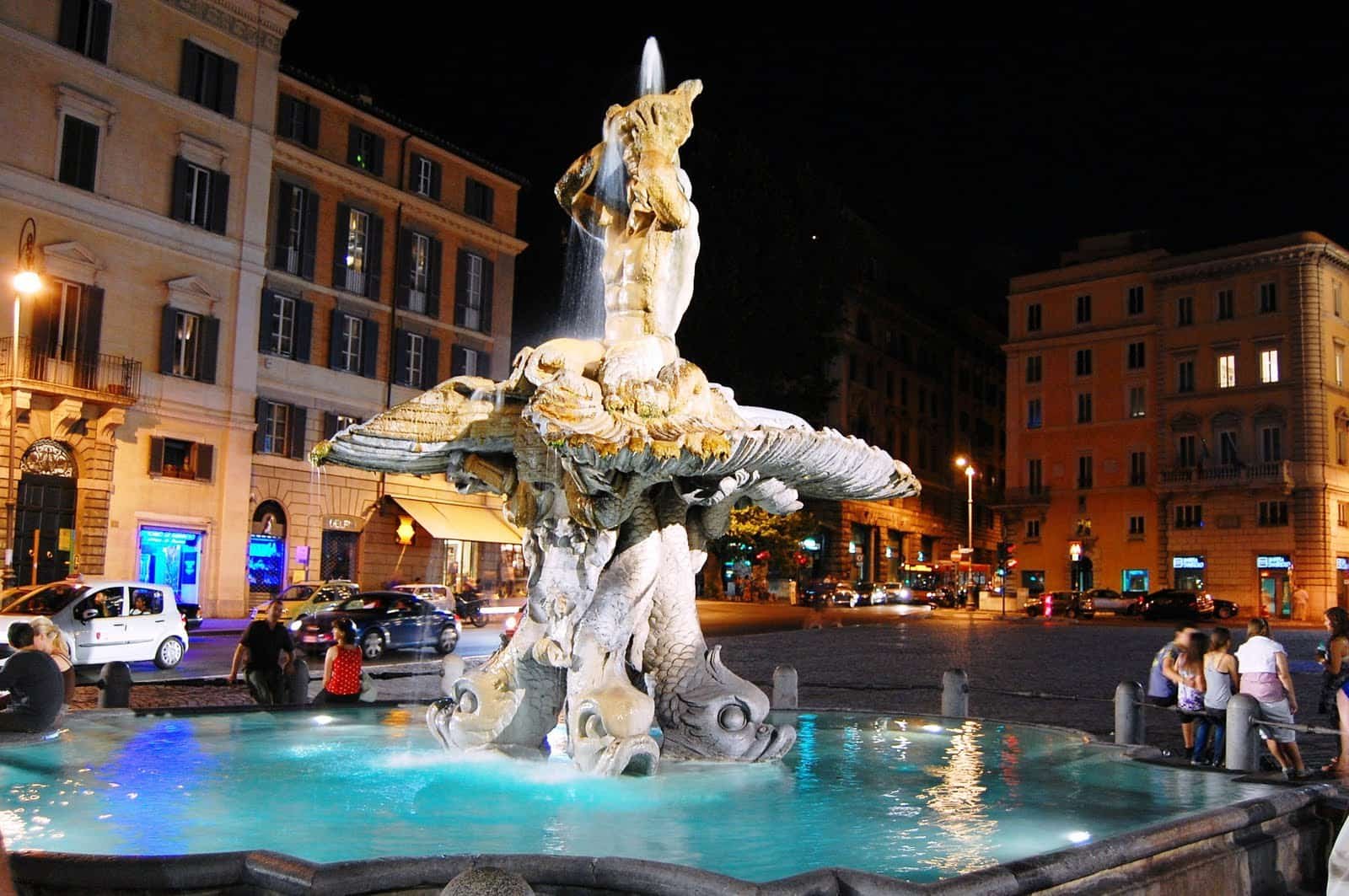
There is a spot in Rome where the traffic never stops, the noise is that of an urban artery in full swing, and in the middle of all this a stone man with a fish tail kneels on a shell and blows into a sea conch, and has been doing so for almost four centuries. It is the Triton Fountain, and it is worth stopping to look at it for the time it deserves, which is much more than the 40 seconds the average tourist gives it while crossing Piazza Barberini to reach Via Veneto or head down toward the Trevi Fountain.
This fountain is one of the severest tests of a visitor's patience. It is not isolated in a silent square like the one of Sant'Ignazio, it doesn't have the theatrical staging of the Trevi Fountain, it doesn't enjoy the shelter of a staircase like the Barcaccia. It stands in the middle of an intersection, with cars circling around it, buses puffing a few meters away, the subway entrance constantly spewing out passengers. And yet it is an absolute masterpiece, and it is probably the clearest document of what Gian Lorenzo Bernini had in mind when he invented, literally invented, a new way of making fountains in Europe.
Here is everything you need to know about the Triton Fountain: who wanted it, who made it, with what money, with what water, with what idea in mind, and how to look at it today, when things have grown up around it that Bernini would never have imagined, from the subway to the cafes with plastic tables. I promise that afterward, when you walk past it, you won't be able to think of it as a mere obstacle on the sidewalk.
Where exactly the Triton Fountain is
The Triton Fountain occupies the center of Piazza Barberini, in the Trevi rione, in that stretch of the city where the slope of the Quirinal descends toward the valley floor that then takes the name Via del Tritone and continues to Via del Corso. The square is a traffic hub and a history hub at the same time: from here Via Vittorio Veneto starts, climbing toward the Ludovisi district, from here Via delle Quattro Fontane starts, climbing toward the Sistine crossroads, from here Via Sistina starts, leading to Trinità dei Monti, from here Via del Tritone starts, descending toward the center. Four directions, four different slopes, and a fountain in the middle.

Those who arrive by subway come out directly into the square: the Barberini station of Line A faces the southern side, and the first thing you see coming up the escalators is the sculptural group itself, usually backlit if it is morning. Those who arrive on foot from Via del Tritone see it appear at the end of the climb, those who come down from Via Veneto find it at the bottom, those who arrive from Quattro Fontane meet it at the end of a rather steep descent. The Triton Fountain, in short, is the point where four streets decide to meet, and this has precise consequences for how it is perceived.
The name of the square and the name of the street
One thing almost nobody connects: Via del Tritone is named that precisely because of this fountain, not the other way around. The street name came after the monument, as often happens in Rome, where place names follow presences and not plans. The square, on the other hand, takes its name from the Barberini family, who had built their urban palace here between the 1620s and 1630s. Before becoming Piazza Barberini the area was known as Piazza Grimana, from the Grimani who owned a vineyard there: a memory of when this sector of Rome was still a landscape of gardens, vineyards and farmhouses, inside the walls but outside the dense city.
It is a piece of information that seems like an erudite detail and instead serves to understand the fountain. The Triton Fountain was not born as furnishing for an already formed square: it was born as the founding act of a square that was coming into being together with the Barberini palace. It is the family pontiff marking out territory with water, stone and coats of arms. Rome has always worked like this, and the popes of the 17th century knew it better than anyone.
Who made the Triton Fountain: Gian Lorenzo Bernini
The author of the Triton Fountain is Gian Lorenzo Bernini, born in Naples in 1598 to a Tuscan father and a Neapolitan mother, and died in Rome in 1680 after rewriting the face of the city more than any other artist since antiquity. When he designs this fountain Bernini is just over 40, is already the official artist of the pontificate, has behind him the Baldacchino of St. Peter's, the Apollo and Daphne, the Rape of Proserpina, the David, and is in the full swing of that season when the pope entrusts him with practically everything in Rome that requires chisel, drawing or invention.
You have to keep in mind that Bernini was not only a sculptor. He was an architect, a stage designer, an author of comedies, an inventor of theatrical machines, an organizer of festivals, and this theatrical dimension explains the Triton Fountain better than any treatise. The fountain is a stage set: it has a lead actor, it has a base that works as a stage, it has a special effect that is the jet of water, and it has an audience that walks around it. If you look at it with the mind of someone who designs ephemeral apparatus for Baroque festivals, all the choices become legible.
The moment in his career when the Triton Fountain was born
The early 1640s are, for Bernini, a period of glory that is about to crack. The Barberini pontificate is in its twilight, the papal finances are strained by wars, and soon the artist will go through the most difficult season of his professional life, that of the bell towers of St. Peter's being demolished and the criticism raining down on him. The Triton Fountain still belongs to the full moment, the one in which the Bernini machine works without friction and the relationship with the patron is perfect.
This can be seen in the ease of the invention. There is nothing cautious about the Triton Fountain: no traditional basin, no niche, no supporting architecture, no respect for established types. It is the work of an artist who knows he can do what he wants and who has a patron willing to follow him.
Urban VIII Barberini, the pope who wanted the Triton Fountain
The commission came from Urban VIII, born Maffeo Barberini, Florentine by origin, pope from 1623 to 1644. 21 years of pontificate, one of the longest of the century, and one of the most visible on the urban fabric of Rome. Urban VIII is the pope who consecrates St. Peter's, who has the Baldacchino built, who promotes Bernini as court artist, who writes Latin verse and who, together with his nephews, turns the Barberini family into a leading Roman power.
The Triton Fountain is, in this picture, a gesture of ordinary extraordinariness. The pope had just finished, or almost, having the great family palace built on the hill, and the square below was the natural vestibule of that residence. Putting a fountain there meant three things at once: providing a public service, because water available to the citizens was a concrete necessity. Making an act of magnificence, because the fountain was beautiful and costly. And making family propaganda, because on the stone there would be the Barberini bees and the pontiff's emblems, visible to anyone passing by.
The bees and the reputation of the Barberini
The Barberini coat of arms bears three golden bees on a blue field. In 17th-century Rome those bees multiply beyond measure: they are on portals, on ceilings, on architraves, on funerary monuments, on the Baldacchino of St. Peter's, on fountains. They become a brand so pervasive that it generates irony. The most famous of the Roman pasquinades, the one that reads quod non fecerunt barbari, fecerunt Barberini, was born precisely from popular resentment toward a family accused of having stripped ancient monuments to melt bronze for its own projects.
It is a context to remember when looking at the Triton Fountain, because the bees found there are a political signature, put there to be read. Rome in the 17th century read those emblems as we read a logo, and read them very well. A Roman citizen of 1643 passing through Piazza Barberini knew perfectly well whose water that was and whom he had to thank.
The construction site of the Triton Fountain between 1642 and 1643
The Triton Fountain was built in a short span of time, between 1642 and 1643. These are dates worth pronouncing slowly, because they are the same handful of months in which many things were happening in Rome: Borromini was working on Sant'Ivo alla Sapienza, the War of Castro was draining the papal coffers, and Bernini was emerging from the disaster of the Vatican bell towers. In the middle of all this, the square below the family palace received its fountain.
On the building site itself we have fewer details than we would like. We know that they worked in travertine, we know that the group was assembled from separate blocks, we know that the physical execution involved, as always in Bernini's workshop, a considerable number of collaborators under the master's direction. Bernini drew, modeled the model in clay or plaster, defined the proportions, intervened on the critical points, and left the more mechanical part of the rough-hewing to the stonecutters.
What it really meant to make a fountain in the 17th century
A Roman Baroque fountain works like a hydraulic system, and the sculpture is its visible part. You had to guarantee the connection to a pipeline, calculate the height at which the water arrived relative to the level of the basin, size the channels inside the sculptural group, provide for drainage, and make sure the flow granted was sufficient. Water concessions were a good administered with rigor, measured in units of flow, and obtaining one was a privilege that went through formal acts.
This explains why Roman fountains are almost always tied to the name of a pope: the reason is administrative, because only the pontiff could dispose of the water of the restored aqueducts. Whoever controlled the water controlled the very possibility of building a fountain, and whoever built a fountain put his own coat of arms on the water. The Triton Fountain is, from this point of view, an administrative document carved in travertine.
The iconographic invention of the Triton Fountain
Let's get to the most interesting part, that is, what exactly you see. Let's start from the bottom. There is a basin on the ground, of mixtilinear shape, that collects the water. From this basin four dolphins rise, arranged in pairs, with their heads down, their muzzles immersed toward the pool and their tails raised upward. They are heraldic dolphins, with no pretense of realism: sea creatures with sturdy, sinuous forms, as centuries of decorative repertoire had imagined and repeated them, from ancient sarcophagi to Renaissance fountains.
The tails of these four dolphins intertwine and hold up, above their shoulders, a large open bivalve shell. It is the most surprising element of the composition: an enormous shell, with its two valves thrown open to the sky like an open book, the ribbed veining radiating from the hinge. On top of this shell, resting with his knees on the two valves, is the Triton.
The Triton and his buccina
The Triton is a male figure bare to the waist, muscular, with legs that turn into a scaly tail, a disheveled beard, tousled hair falling along the temples. He is kneeling, the torso thrown backward, the head bent upward, and with both hands he grips an elongated shell that he brings to his mouth. That shell is the buccina, the wind instrument of the tritons of mythology. From the buccina, instead of sound, water comes out: a vertical jet that rises high and falls back as rain on the group and into the basin below.
This is where the genius of the idea kicks in. Bernini takes a mythological attribute of sound, the shell that sounds, and turns it into a hydraulic attribute. Sound becomes water. The Triton produces not a noise but a jet, and the jet falling produces a noise, closing the circle. I don't know many figurative inventions more elegant than this, and 400 years have passed.
The twist of the body
Look closely at the Triton's position and you realize it is a position impossible to hold for more than 30 seconds. The knees are spread over the two valves, the pelvis is rotated, the chest is arched backward, the arms are raised above the head, the neck is stretched to the extreme. It is the pose of maximum effort, of a blow that requires all the breath of the body. Bernini sculpts the instant, not the pose: it is his trademark, the same principle as the Apollo and Daphne or the Saint Teresa.
And there is a detail that I always point out: the muscles of the chest and abdomen are treated so as to suggest the volume of held air. It is narrative anatomy, built to tell of an effort. The body of the Triton tells what he is doing, and tells it to those who look from below, from three meters away, with the sun striking him at a slant.
The ancient source behind the Triton Fountain
The figure of the triton blowing into the shell has a precise and very noble literary source: the first book of Ovid's Metamorphoses, where Neptune, to make the waters recede after the universal flood, calls the triton and orders him to blow into his shell. At the sound of the instrument the waters obey and withdraw, rivers and seas return to their beds, the world re-emerges.
Whoever knows that passage understands instantly what the Triton Fountain is saying. The playing triton is the figure of command over water, of ordering dominion that puts the elements back in their place. Applied to a pontiff who was restoring aqueducts and distributing water to the city, the message is transparent: as the triton orders the waters of the flood, so the pope orders the waters of Rome. You don't need a treatise on iconology to get there, you only need to have read Ovid, and in the 17th century anyone who had attended a school had read him.
A humanism you can see with the naked eye
It is worth noting that this cultured layering does not weigh the fountain down. You can know nothing about Ovid and find it just as beautiful: it works as an image before it works as an allegory. It is a quality Bernini possessed at a level few have reached, the ability to build works legible on two levels at once, the immediate and sensory one and the cultured and allusive one, without the second smothering the first.
It is also the reason the Triton Fountain keeps working in a city that no longer reads Latin. The image of a fish-man blowing water toward the sky is understandable to a six-year-old child. The rest is a bonus for those who want to go deeper.
Why the Triton Fountain is a sculpture in the round
Here we arrive at the historically most important point of the whole story, the one that is worth the trip even if you don't care about mythology at all. The Triton Fountain is one of the first Roman fountains conceived as a sculpture in the round, that is, as an autonomous object placed at the center of a space, to be looked at by walking around it, and not as a display set against a wall or a facade.
Up to that moment the Roman tradition of monumental fountains was largely a tradition of fronts. The display of an aqueduct was a frontal architecture: a backdrop with niches, columns, inscriptions, recessed statues, water coming down from a wall. Think of the display of the Acqua Felice in Piazza San Bernardo, with its Moses at the center of a triumphal arch, or think of the Trevi Fountain, which comes a century later but remains a backdrop set against a palace. These are fountains that have a front and a back, and the back doesn't exist.
What changes when the fountain becomes an object
The Triton Fountain has no front and back. It has four dolphins arranged symmetrically, a Triton who can be looked at from every angle, a group that holds the gaze from any point of the square. This entails a completely different design job: you have to think the composition in space at 300 60 degrees, every point of view has to offer an interesting profile, the lines of force must not collapse when you move.
It is a revolution that Bernini would then take to its extreme consequences with the Fountain of the Four Rivers in Piazza Navona, between 1648 and 1651, where the central rock with the obelisk is conceived exactly as an object you can walk around. But the prototype, the dress rehearsal, the idea in its pure state is here, in Piazza Barberini, a few years earlier. When they tell you that the Triton Fountain is important in the history of art, this is the reason.
A practical consequence for those who visit it
If the fountain is in the round, then looking at it from one side only means seeing a quarter of it. It is the reason it is always best to make the full circuit, sidewalk permitting. The profiles change enormously: on one side the twist of the torso prevails, on another the play of the dolphins' tails, on yet another the relationship between the thrown-back head and the line of the sky. They are four different sculptures inside the same sculpture, and Bernini calculated them all.
The heraldic bees and the papal keys of the Triton Fountain
Between the intertwined tails of the dolphins, in the connecting zone between the lower part of the group and the bivalve shell, the emblems are found. There are the Barberini bees, arranged according to the family's usual heraldic scheme, and there are the papal insignia, that is, the crossed keys with the tiara, the sign of papal power.
The choice to place them there is anything but random. They are in a low position, inside the play of natural forms, almost camouflaged in the organic design of the tails. They are incorporated into the structure, as if they emerged from the material itself, far from the idea of a coat of arms stuck on a plaque. It is a refined way of doing propaganda, much more effective than a sign. The message is there, but it doesn't shout, and for that very reason it stays.
How to recognize the bees when you walk past
The bees are not very easy to see if you don't look for them, especially in summer when the overhead sun flattens the reliefs. The best moment is raking light, that is, first thing in the morning or late afternoon, when the shadows lengthen into the grooves of the chisel and the profiles emerge. Go up to the basin on the side facing Via Sistina, look at the point where the dolphins' tails knot together, and you'll find them.
There is also a game I always suggest to those traveling with children: counting how many bees you can find within 200 meters around the Triton Fountain. Between the fountain itself, the nearby Fontana delle Api and the decorations of the palace, the total is surprising, and it helps you understand what a papal family was in 17th-century Rome.
The travertine of the Triton Fountain
The Triton Fountain is carved in travertine, and this is a choice that says a lot. Travertine is the stone of Rome par excellence: a calcareous sedimentary rock, formed by chemical precipitation in spring-water environments, quarried above all in the Tivoli area, rich in cavities and veining, of a warm color ranging from off-white to golden blond depending on the quarry and the exposure.
The Colosseum, the facade of St. Peter's, the colonnade of St. Peter's Square, half a hundred Baroque palaces are made of travertine. It is an inexpensive stone compared to statuary marble, it works well, it withstands the outdoors, and above all it has a porous surface that absorbs light instead of reflecting it as a polished marble would. On an outdoor fountain this matters quite a lot: wet travertine darkens, flowing water draws visible paths, the stone ages in a way that blends with the environment.
The limits of travertine and the conservation problems
The flip side is that travertine is fragile in its details. Its natural cavities make it vulnerable: water penetrates, salts crystallize, frost works in the cracks, limescale deposits accumulate on the surfaces touched by the jet, forming white crusts and concretions. If you add four centuries of exposure, and in the last century the smog of one of the busiest crossroads in Rome, you understand why the Triton Fountain has required and continues to require continuous maintenance.
The most exposed parts are the thinnest: the fingers, the ends of the buccina, the edges of the shell's valves, the tips of the tails. They are the areas where time eats first, and they are the areas that have required the most attention in the restorations. When you look at the fountain up close and see differences in tone in the stone, you are often looking at the stratigraphy of the conservation work.
Why not to expect a perfect surface
Many visitors are slightly disappointed by the surface of the Triton Fountain: they find it dark, stained, less crisp than they expected from a masterpiece. It is a misunderstanding worth clearing up. An outdoor sculpture, fed by limescale water, in the middle of traffic, cannot look like a museum piece. The dark glazes, the patinas, the concretions are part of its biography. Removing them all, besides being impossible, would mean erasing the history of the object.
The Acqua Felice, the aqueduct that feeds the Triton Fountain
The water that comes out of the Triton's buccina arrives from the Felice Aqueduct, the great aqueduct wanted by Pope Sixtus V, born Felice Peretti, and inaugurated in 1587. It is the first aqueduct built in Rome since antiquity with an intervention of that scale, and it changes the urban history of the city radically.
Until then modern Rome had relied almost only on the Acqua Vergine, the restored ancient aqueduct that serves the low area of the Campo Marzio and that still feeds the Trevi Fountain and the Barcaccia today. The Acqua Vergine has a structural defect: it arrives at a low elevation, with little hydraulic head, and therefore does not allow high jets. The Acqua Felice, on the other hand, arrives from the countryside east of Rome with a much higher arrival elevation, and this makes it possible to feed the hill areas, the Quirinal, the Viminal, the Esquiline, and to obtain vertical jets of some force.
Sixtus V, the urban planner who made the Triton Fountain possible
Sixtus V reigned very briefly, from 1585 to 1590, but in five years he did more than many popes in 20. He opened straight streets through the Rome of vineyards, connected the basilicas with visual axes, planted obelisks at crossroads, and brought water to the hills. Without that water on the hills, the neighborhood that would grow up around Piazza Barberini would not have been habitable, and without that hydraulic head the Triton Fountain as we know it would not have been technically possible.
I always find it fascinating that a Bernini masterpiece of 1643 depends, in order to exist, on an infrastructure decision made more than 50 years earlier by a completely different pope. It is a useful reminder: urban art is not born in a vacuum, it is born where someone has already brought water, opened the road, leveled the ground.
The display of the Acqua Felice and the Moses
The great terminal display of the Acqua Felice is the fountain in Piazza San Bernardo, the one with the colossal statue of Moses at the center, not far from Piazza Barberini, in the direction of the Baths of Diocletian. I recommend going if you want to truly understand the novelty of the Triton Fountain: there you see a frontal architectural backdrop, three arches, statues in the niches, the structure of a triumphal arch. It is the model that Bernini leaps beyond. The two fountains are about 10 minutes apart on foot and together they tell of a change of paradigm.
The hydraulics of the Triton Fountain: pressure, elevation, jet
The vertical jet that comes out of the buccina is the technical signature of this fountain and is also its most fragile element, because it depends entirely on the available pressure. In a gravity system like that of the historic Roman aqueducts, the pressure at a point depends on the difference in height between the elevation of the source or reservoir and the elevation of the nozzle. The higher the drop, the higher the jet rises.
Piazza Barberini is at the foot of the Quirinal, in a position that, relative to the route of the Acqua Felice, allowed sufficient head to push the water up above the Triton's head. We are not talking about spectacular jets like those of certain suburban villas, but about a full, continuous and clearly visible jet, capable of producing that light mist that on windy days drifts sideways and wets whoever passes too close.
Why the jet changes during the day
If you observe the Triton Fountain at different times you will notice that the height of the jet is not always the same. It is normal: pressure in the network varies according to overall consumption, and a historic system integrated into the modern network is affected by these fluctuations. In the hours of lowest consumption the jet tends to be more decisive, at peak hours it drops a little.
It is an observation I recommend making, because it makes the fountain a living object. It is a machine that reacts to the conditions of the city around it, and changes over the course of the day. The Triton blows harder at six in the morning than at noon, and this is one of the small involuntary poems of urban hydraulics.
The Triton Fountain and the Barcaccia: two opposite solutions
To truly understand the Triton Fountain it helps to put it next to the Barcaccia in Piazza di Spagna, the fountain in the shape of a half-sunken boat built under the pontificate of Urban VIII, at the end of the 1620s, and tied to the name of the Berninis, father and son. The two fountains are a few minutes' walk apart, have the same family patron, and are each the reverse of the other.
The Barcaccia is low, sunken, almost at ground level, with water that overflows and trickles from the edges without ever rising. The Triton Fountain is tall, vertical, with a jet pointing at the sky. The reason for this difference lies in the water, not in taste. Piazza di Spagna is served by the Acqua Vergine, which arrives with very little head and does not allow jets. Piazza Barberini is served by the Acqua Felice, which has plenty of it.
The constraint that becomes invention
This is, for me, one of the most beautiful lessons Rome teaches. Faced with the technical limit of the Acqua Vergine, the invention was to turn weakness into subject: if the water can't rise, then let's make a sinking boat, and the trickling water becomes the image of a hull taking on water. Faced with the availability of the Acqua Felice, the invention was the opposite: if the water can rise, then let's make a triton who blows upward.
Two opposite engineering problems generate two opposite masterpieces. It's best to see both on the same day, because the pair explains more than any talk on the Baroque.
The Fontana delle Api, little sister of the Triton Fountain
A short distance from the Triton Fountain, at the mouth of Via Vittorio Veneto, there is another Bernini fountain, much smaller and much less photographed: the Fontana delle Api, built in 1644, that is, the year immediately after, and also for Urban VIII.
It is a tiny object compared to the Triton and has a completely different function. It is a watering fountain, designed to give water to people and animals: a large open shell valve set against the wall, with three Barberini bees arranged on the lower edge and the spouts from which the water comes out. Bernini designs it as an urban detail, not as a monument, and for that very reason it is fascinating: it shows that the same artist who invented scenographic machines also knew how to design the small furnishings of the city.
The relocation and the reassembly
The Fontana delle Api is no longer where Bernini placed it. The urban transformations of the 19th century, when Piazza Barberini was redesigned to adapt it to the new road system of the capital, led to the dismantling of the little fountain, which remained unassembled for years. It was put back together in the first decades of the 20th century in its current position, at the corner with Via Veneto, with the missing parts supplied.
It has to be said honestly: what you see today is in part a reconstruction, not the intact object of 1644. It is a very common condition for Roman street furniture and takes nothing away from the pleasure of looking at it, but it is right to know it. I recommend giving it two minutes after seeing the Triton Fountain: the pair of fountains, the large and the small, the monumental and the utilitarian, tells of the double nature of Barberini patronage.
Piazza Barberini before and after the Triton Fountain
The square you see today resembles the one of 1643 in almost nothing, except for the presence of the fountain and the bulk of the palace on the hill. In the 17th century this was the edge of the built city: behind the palace began the gardens, the vineyards, the great noble properties that occupied the entire sector between the Quirinal and the Aurelian walls, what would later become the Ludovisi district.
The square was irregular, sloping, with low buildings, and the fountain stood in it like a focal point in a space still formless. The monumental arrangement we take for granted today is largely 19th and early 20th century, when Rome becomes the capital of the Kingdom of Italy and this sector is built up intensively, with apartment buildings, hotels and offices.
The fountain and the changes in elevation
One of the lesser-known effects of those transformations concerns the ground level. The road works of the 19th and 20th centuries changed the walking surface of the square, and the original relationship between the basin of the Triton Fountain and the surrounding ground is no longer exactly the one Bernini conceived. The position of the monument within the square also turns out to be changed compared to its original placement: the fountain was moved on the occasion of urban redevelopments, as happened to very many Roman furnishings.
It is no small detail for anyone who wants to understand the work. A sculpture conceived to be seen from a certain distance, with a certain background, from a certain angle, changes visual meaning when it changes position. The Triton Fountain today has 19th-century facades and illuminated signs behind it, not the low houses of the 17th century.
Palazzo Barberini, the context of the Triton Fountain
Raising your eyes from the fountain toward the southeast you see the front of Palazzo Barberini, which stands at the top of a ramp and is reached from the entrance on Via delle Quattro Fontane. It is one of the most important buildings of the Roman Baroque and houses, together with Palazzo Corsini, the Gallerie Nazionali d'Arte Antica.
The construction of the palace begins in 1627 on a design by Carlo Maderno, with the collaboration of Francesco Borromini, who was his relative and collaborator. At Maderno's death, in 1629, the direction passes to Gian Lorenzo Bernini, who brings the building to completion in the early 1630s. Borromini stays on site and leaves his mark in some of the most original elements of the building.
The structure of the palace
Palazzo Barberini does not have the traditional form of the Roman palace with a closed courtyard. It has an open plan, a block with two wings that extend outward, a front with three orders of superimposed loggias, and a relationship with the garden behind that recalls a suburban villa more than an urban palace. It is a hybrid type that answers a precise ambition: to build a family residence that was both a city palace and a villa of delights.
Inside, the main hall is covered by Pietro da Cortona's great fresco of the Triumph of Divine Providence, painted between 1632 and 1639. It is one of the most famous ceilings of the Roman Baroque, with fictive architecture that opens onto the sky, allegorical figures that break through the frame and, of course, the Barberini bees flying at the center of the composition. If you have time, it's worth going in.
What you see in the Galleries
The collections of Palazzo Barberini include first-rate masterpieces. They hold famous works of Italian and European painting between the 15th and 18th centuries, including Raphael's Fornarina, Caravaggio's Judith Beheading Holofernes and the portrait of Henry VIII by Hans Holbein the Younger. For those who arrive at the Triton Fountain and have half a day available, it is the natural continuation of the visit: first the fountain, then the climb to the palace.
The two staircases of Palazzo Barberini, a few steps from the Triton Fountain
There is a very specific reason why it's worth going up to Palazzo Barberini after looking at the Triton Fountain, and it has nothing to do with the paintings. It has to do with the staircases. The palace has two monumental ones, one per wing, and they are the work of the two greatest architects of the century, in competition with each other.
The square staircase, rectangular in plan with straight flights around a central well, is attributed to Bernini: it is solemn, clear, measured, supported by columns, conceived as a representative route in which the guest climbs in an orderly way toward the piano nobile. It is architecture as ceremonial.
Borromini's helical staircase
The other is Francesco Borromini's helical staircase, and whoever sees it for the first time usually falls silent for a few seconds. It is a continuous spiral supported by paired columns, with the central void that winds upward and gives back, looking up, a perfect geometric vertigo. There is nothing ceremonial about it: it is pure spatial invention, an exercise in mathematical control of form.
Lining up the Triton Fountain, Bernini's staircase and Borromini's staircase in the same morning is one of the best possible routes for understanding the Roman Baroque. You see in three nearby objects three different ways of solving the same problem: how to set space in motion.
Bernini and Borromini: the rivalry that brushes against the Triton Fountain
You can't talk about this area of Rome without addressing the question of the two rivals. Gian Lorenzo Bernini and Francesco Borromini, born in 1599 in the Canton of Ticino and died in Rome in 1667, are the two poles of Roman Baroque architecture and had a complicated relationship, which begins as collaboration and ends as antagonism.
Borromini worked under Maderno and then under Bernini on the Palazzo Barberini site and on that of St. Peter's. He was an extraordinary technician, a draftsman of absolute rigor, a man of difficult character. Bernini was the opposite: worldly, brilliant, extremely skilled in court relations, able to handle a patron like few others. When the two part ways, the rift is not only one of character but of culture: Bernini thinks in figures and scenes, Borromini thinks in geometries and surfaces.
How to read the rivalry without falling into fiction
Be careful, though, not to turn everything into a serial novel. Many of the anecdotes that circulate about alleged revenge and mutual spite belong to popular tradition and literature, not to documentary sources. I prefer to stick to verifiable facts: the two worked together, then split, had partly different patrons, and their competition is attested by 17th-century sources without any need to embroider legends on it.
That said, the geography of the rivalry is all around the Fontana del Tritone. Going up Via delle Quattro Fontane you reach the Sistine crossroads where Borromini built San Carlo alle Quattro Fontane, and a few steps away Bernini built Sant'Andrea al Quirinale. Two small churches, close together, opposite in everything. It is a comparison you can make in 20 minutes of walking and it is worth a university course.
The restorations of the Fontana del Tritone over time
An outdoor fountain is a permanent construction site. From the 17th century to today the Fontana del Tritone has gone through many campaigns of maintenance and restoration, some routine, others more demanding, which concerned the cleaning of the surfaces, the removal of limescale deposits, the consolidation of degraded parts, the revision of the hydraulic system and the integration of lost portions.
The underlying problem is always the same: travertine exposed to water and to the urban atmosphere degrades. In the 20th century a new and violent factor was added, namely pollution from vehicle traffic, which in Piazza Barberini is particularly intense. The black crusts that form on surfaces not washed by rain are the result of the interaction between atmospheric particulate and the sulfates that form on limestone. It is a phenomenon that restorers know well and that requires periodic interventions.
What a restoration does on a fountain
An intervention on a monument like this generally involves a phase of diagnostic investigation, the survey of the state of conservation, cleaning calibrated with different methods depending on the type of deposit, consolidation of the zones that have lost cohesion, filling of the cracks, possible reintegration of missing parts and finally protection of the surfaces. Added to this is the maintenance of the system: pipes, nozzles, recirculation system, water treatment to reduce encrustations.
When you happen to find the Fontana del Tritone surrounded by scaffolding or with the basin empty, the typical reaction of the visitor is disappointment. It pays to do the opposite: a restoration site on a Bernini is a rare opportunity to see the monument up close, sometimes from a different height, often with explanatory panels that tell the story of the intervention. It is an unusual perspective, and it pays to take advantage of it.
The visual fortune of the Fontana del Tritone
Since the 17th century the Fontana del Tritone has entered the repertoire of images of Rome. It appears in engravings, views, travelers' notebooks, model books for architects and decorators, and later in 19th-century photography, when Piazza Barberini enters the fixed repertoire of the photographers who sell souvenirs to Grand Tour travelers.
The reason for the success is recognizability. A male figure kneeling on a shell and blowing into a sea shell is an image that is memorized at first glance and easily redrawn. It requires no explanation of an architectural context, it doesn't need the square around it: it detaches from the background and works alone. It is exactly the quality that makes a monument an icon.
The model that travels
In the following centuries the type of the triton playing the buccina spreads widely in the repertoire of European fountains, with countless variants and reprises. It is not always a matter of direct citations of Bernini's work in Piazza Barberini, because the mythological theme was already circulating. But it is reasonable to say that the Berninian formulation set a visual standard that very many sculptors looked to.
When, traveling through Europe, you happen to find fountains with marine figures blowing into shells, it is worth asking how much of that image derives, directly or indirectly, from the Roman invention of 1643. In most cases something does.
Via Veneto, the Dolce Vita and the Fontana del Tritone
From the Fontana del Tritone, Via Vittorio Veneto starts climbing, the curving street that rises toward Porta Pinciana crossing what was the park of the Villa Ludovisi. The street was born with the late-19th-century subdivision, when the great noble property was sold and built up, and it takes its definitive name from the Italian victory of 1918.
In the second half of the 20th century Via Veneto becomes the international symbol of Roman high society: luxury hotels, cafes with tables on the sidewalk, embassies, actors, film producers, photographers lying in wait. It is the season that cinema immortalized and that made the name of the street synonymous with a certain idea of Italian dolce vita.
Fellini and the image of this area
The film that fixed all this in the world's imagination is La dolce vita by Federico Fellini, released in 1960. There is a fact that always surprises: for the shoot Fellini had Via Veneto rebuilt in the Cinecittà studios, because working on the real street would have been impractical. The most famous image of Via Veneto is therefore, in large part, a set.
The Fontana del Tritone stands at the foot of this street and is its entrance gate. If you walk Via Veneto from top to bottom, the fountain appears to you at the end of the descent, set among the buildings. It is one of the best ways to approach the monument: arrive from above, slowly, and watch it grow in front of you.
What remains and what has changed
I'll be frank: Via Veneto today is no longer the street of the dolce vita. The hotels are still there, the historic cafes too, the architecture is the same, but Rome's nightlife and high society moved elsewhere decades ago. Anyone who arrives expecting the Rome of 1960 is disappointed. Anyone who walks it for what it is, a fine example of Umbertine urban planning with notable buildings and a very elegant curve, enjoys it.
What is around the Triton Fountain
The Triton Fountain's greatest advantage is its position. You are at the point where the Roman Baroque is concentrated with an almost excessive density, and everything is reachable on foot in a few minutes.
Going up Via delle Quattro Fontane you reach the Quattro Fontane crossroads, the scenographic intersection wanted by Sixtus V at the end of the 16th century with four corner fountains depicting river deities and allegorical figures. From there, looking along the four axes, you see obelisks and distant facades lined up: it is one of the most extraordinary exercises in urban perspective in existence. On the corner is Borromini's San Carlo alle Quattro Fontane, tiny and prodigious. A little farther along, on Via del Quirinale, Bernini's Sant'Andrea al Quirinale, with its semicircular facade and elliptical interior.
The Capuchin Church and the crypt
At the beginning of Via Veneto, on the right going up, is the church of Santa Maria della Concezione dei Cappuccini, tied to the Barberini family: its foundation is owed to Cardinal Antonio Barberini, brother of Urban VIII, in the third decade of the 17th century. Beneath the church is the famous crypt decorated with the friars' bones, one of the most singular and most debated places in Rome.
I speak of it with caution, because it is not a place for everyone: some find it a very powerful meditation on transience and some find it simply macabre. In our view it is an extraordinary document of the Baroque culture of death, and it should be visited with respect and in silence, not as a thrill attraction.
Toward the center and toward Trevi
Going down Via del Tritone you reach in a few minutes the fork that leads to the Trevi Fountain, and a little farther Via del Corso. Taking Via Sistina instead you climb toward Trinità dei Monti and come down onto Piazza di Spagna by the staircase. Within a 10-minute walk of the Triton Fountain you have covered three of the most famous fountains in the city and two of the most visited squares.
How to get to the Triton Fountain
The Triton Fountain is one of the easiest Roman monuments to reach by public transport, because the subway station is literally in the square. The Barberini stop is on Line A, the one that crosses the city from northwest to southeast, and lets you get here from many areas of the city without changes.
On foot, if you are in the historic center, the times are short: from the Trevi Fountain it is an uphill walk of about 10 minutes, from Piazza di Spagna you get here in about a quarter of an hour via Via Sistina, from Termini station you walk a little under 20 minutes along Via Nazionale or Via Barberini. The square is also served by several city bus lines.
A tip on the direction of arrival
The directions of approach are not equivalent from the point of view of the experience. Arriving up Via del Tritone means seeing the fountain appear gradually at the end of the climb, and it's nice. Coming out of the subway means finding it suddenly on top of you, and it is effective but abrupt. Coming down from Via Veneto is the best choice: the street curves, the sculptural group appears at the bottom, framed by the buildings, and grows larger as you walk.
When to visit the Triton Fountain
The fountain is in a public square, so it can be seen at any hour, but not all hours are equal. The difference is made by the light and the traffic.
Early morning is the golden moment. The square is relatively calm, the light comes in low and raking, the travertine reliefs light up, and the jet stands out sharply against the facades still in shadow. Late afternoon offers the same quality of light from the other side, with warmer tones. In the middle hours of the day, especially in summer, the overhead sun flattens everything and the square becomes noisy and unpleasant.
The seasons
The Roman spring, between April and the first half of June, is the ideal season for this area: temperatures hold up, the days are long, the light is good. Full summer is hard, because Piazza Barberini has little shade and a lot of asphalt, and the reflected heat is considerable. If you come in July or August, come early in the morning. Autumn, between late September and November, is perhaps the most beautiful season of all for Rome, with crisp light and reduced crowds.
Winter has an advantage almost nobody considers: the clear days of January offer a transparent light and a deep sky that show off the travertine like no other season. On the other hand, the cold wind that comes down from the hill is not pleasant if you stand still looking for 20 minutes, so dress accordingly.
Traffic and the Triton Fountain today
It has to be said clearly: the Triton Fountain lives in difficult environmental conditions. The square is a road hub of primary importance, with continuous flows of cars, taxis, buses and scooters. The noise is constant, the particulate too, and the experience of contemplation is objectively compromised compared to what other Roman fountains offer.
There is no point pretending otherwise. Anyone who arrives here expecting the seclusion of a tucked-away square is thrown off. The right way to deal with it is to accept the context and adapt: choose the time, choose the vantage point, give the fountain concentrated time instead of scattered time. 10 minutes well spent at eight in the morning are worth more than half an hour at noon.
Safety and common sense
The basin is surrounded by the roadway and the sidewalks around it are narrow. To make the full circuit you have to cross, and it must be done on the crosswalks and with attention, because traffic arrives from several directions with priorities that are not always obvious. It is not a place to get distracted looking up while walking, and it is not a place to let small children run freely.
I add the note that holds for all the crowded places in the center: watch your belongings, especially near the subway exit, where the density of people is high and so are the distractions.
How to look at the Triton Fountain: a route in four stations
Since the Triton Fountain is a sculpture in the round, the correct way to look at it is to move. I suggest a route in four stations, one per side, that takes about 10 minutes and completely changes your understanding of the work.
First station, from the side facing Via del Tritone, that is, downhill. From here the group stands out against the rise of the Quirinal and the bulk of Palazzo Barberini behind. It is the point of view from which the verticality of the composition reads best: from the bottom of the basin to the tip of the buccina there is a continuous ascending line, and the jet extends it into the air.
Second station, from Via Veneto side. Here the morning light arrives at an angle and the profile of the Triton reads in backlight. It is the point where the twist of the torso is most evident, because you see the offset between the axis of the legs and that of the chest. If you have only one frame available, the best is this one.
The other two stations
Third station, from Via delle Quattro Fontane side. From here you appreciate above all the lower part: the intertwining of the dolphins' tails, the way the four bodies arrange themselves to form a support that seems unstable and is instead perfectly balanced, and the area of the heraldic emblems. It is the best spot to look for the bees.
Fourth station, from Via Sistina side, looking toward the mouth of Via Veneto. Here the group is seen with the 19th-century urban background, which is how the fountain presents itself to the city today. It is a less noble view but a more honest one: it photographs the monument in its real condition, not in an ideal condition that no longer exists for two centuries.
What to look for with the naked eye
During the walk around, a few details deserve a pause of a few seconds. The rendering of the scales on the Triton's tail, which changes density and direction following the twist. The ribbing of the shell's valves, which is treated with deep relief to catch the shadow. The dolphins' muzzles, which enter the water of the basin and are therefore the part most subject to encrustation. The fingers of the Triton's hands, which grip the buccina with a tension visible in the knuckles.
The Triton Fountain and the tradition of Roman fountains
Rome is the world capital of fountains and not by chance. The ancient city was served by 11 aqueducts, and the memory of that abundance remained as a cultural imperative: a pope who restored an aqueduct and built fountains presented himself as the continuer of the emperors. The Triton Fountain fits in at the highest point of this tradition.
In the Renaissance, Roman fountains are for the most part sober objects: circular basins, stacked bowls, modest jets, restrained decoration. The dominant model is the cup fountain, like those of St. Peter's Square or Piazza Farnese, in which the water descends from one bowl to the next with a regular, silent movement. The beauty lies in proportion, not in narrative.
The Baroque break
With the 17th century everything changes. The fountain stops being a decorated container of water and becomes the telling of an event. There is a subject, there is an action, there is a chosen instant, there is an emotion to be evoked. Water is no longer the end but the means: it serves to make the scene believable, to give movement, to produce sound and reflections.
The Triton Fountain is one of the first accomplished examples of this new conception, and the fact that it came before the Fountain of the Four Rivers gives it the value of a prototype. Anyone who wants to understand the passage from the Renaissance fountain to the Baroque fountain has here the clearest possible document, in a public square, free, at any hour of the day.
Fountains as social infrastructure
Before running water in homes, public fountains were the only source of supply for most of the population. People went there with pitchers, washed there, watered animals there, met there. A fountain was the social center of a neighborhood, and the pope who built one earned concrete gratitude.
This utilitarian aspect, today completely lost, was an integral part of the design. The Triton Fountain provided a public service before it provided a spectacle. When you look at it, try to imagine the square without cars, with carts, animals and people coming and going with their containers. It changes the perception of the object quite a bit.
The Baroque explained through the Triton Fountain
If I had to explain to someone what the Baroque is using a single object, I would probably choose this fountain. All the fundamental ingredients are in it, and they are visible without the need for critical apparatus.
The first ingredient is movement. Nothing in the Triton Fountain is at rest: the dolphins twist, the tails spiral, the Triton arches, the water rises and falls. Even the structurally static elements are treated as if they were under tension. The Baroque hates stasis and loves becoming.
The second ingredient: the fusion of the arts
Here you can't tell where the sculpture ends and the architecture begins, and you can't tell where both end and the hydraulic engineering begins. The jet of water is part of the composition as much as the travertine: without the jet the fountain is maimed, with the jet it is complete. This integration between different media, which theorists call bel composto, is one of Bernini's signatures.
The third ingredient is the involvement of the viewer. The Baroque does not want a detached observer, it wants a participant. The Triton Fountain forces you to walk around it, to move, to look for the right angle, to feel the water reaching you if the wind blows. It doesn't let you stand still, and this is precisely the purpose.
The fourth ingredient: rhetoric
Finally there is the persuasive dimension. Every Baroque work argues something: a truth of faith, a power, a glory. The Triton Fountain argues that the Barberini pontiff dominates the waters like the Ovidian triton, that his family has brought prosperity to the city, that his government is order. Beauty, here, carries a thesis, and does so without ever declaring it.
The Triton in mythology and in art
In Greek and Roman mythology Triton is the son of Poseidon and Amphitrite, and lives in the depths of the sea. In the oldest versions he is a single deity. In the later tradition the name becomes generic and the tritons multiply into a whole people of hybrid creatures in the sea procession, half men and half fish, often depicted playing shells.
The constant attribute is precisely the buccina, the large spiral shell used as a wind instrument. In ancient iconography the sound of the buccina has a signaling function: it announces, summons, commands. In the reliefs of Roman sarcophagi with marine thiasos the tritons play, accompanying nereids and sea monsters, and that ancient repertoire was well known to 17th-century artists, who could study it firsthand in the Roman collections.
How Bernini rereads the ancient model
The difference between a triton on a Roman sarcophagus and the Triton of Piazza Barberini lies entirely in psychology. The ancient triton is decorative, repeated in series, devoid of individuality. Bernini's is a character: he has an age, a fatigue, a recognizable physical effort, an expression. Bernini takes an iconographic type and turns it into a portrait of a state of mind.
It is the same operation he performs with his saints, his allegorical figures, his portraits. The antique serves him as a vocabulary, not as a model to copy. Anyone who looks at the Triton Fountain searching for the archaeological quotation finds almost nothing. Anyone who looks for reinvention finds everything.
The dolphins of the Triton Fountain
I want to devote a chapter to the four dolphins, because they are the part almost everyone glances at in passing and that nevertheless holds up, literally and visually, the entire composition.
They are arranged in a cross, with their muzzles pointing down and immersed toward the basin, their bodies arching upward and their tails rising and intertwining until they form the resting plane of the shell. Seen individually they are rather abstract forms: tapered bodies, smooth surfaces, no naturalistic concern. Seen together, they form a load-bearing structure of great static intelligence, because the load of the shell and the Triton is discharged onto four symmetrically arranged points.
The dolphin as symbol
The dolphin in the classical and then Christian tradition is an animal rich in meanings: it guides sailors, saves the shipwrecked, accompanies souls, and is a symbol of speed and of love for man. In the Renaissance and Baroque decorative repertoire it is a constant presence on fountains precisely because of its association with water and with rescue.
Here, though, the role is above all structural and formal. Bernini needed a support that was not a pedestal, because a pedestal would have turned the fountain into a traditional monument. The dolphins solve the problem: they are a support that doesn't look like a support, a structure that looks like a natural event.
A technical problem solved elegantly
Consider the weight. A travertine shell of that size plus a male figure larger than life-size make many tons, and all this load has to reach the ground passing through slender forms. Bernini's solution consists in intertwining the tails, that is, in creating a structural knot in which the four elements support each other. It is engineering disguised as poetry.
The sound of the Triton Fountain
There is an aspect of Roman fountains that no photograph conveys and that is talked about too little: the sound. Every fountain has a voice, determined by the height of the fall, the flow rate, the shape of the surfaces the water strikes and the volume of the collecting basin.
The Triton Fountain has a high, continuous voice, very different from the dark, deep one of the Trevi Fountain or the whispered one of the Barcaccia. The vertical jet falling from a height produces a constant white noise, almost a rustle, with a sharper sound at the points where the water strikes the valves of the shell before descending into the basin.
Listening to it despite the traffic
The problem is that during the day traffic covers almost everything. To really hear the fountain you have to get close to the basin, stand on the leeward side and listen for at least a minute, letting the ear isolate the frequency of the water from that of the engines. It works, with a little patience. And it works much better in the early hours of the morning or on weeknights, when the square calms down.
It is a recommended exercise, because it changes your relationship with the object. A fountain you listen to is a living thing. A fountain you only photograph is a backdrop.
The Triton Fountain and the water of Rome today
Rome continues to be a city where public water is abundant and accessible. The cast-iron drinking fountains, called nasoni for the shape of the spout, provide free drinking water throughout the city, and there are some in the area around Piazza Barberini too. It is a civic heritage that Romans take for granted and that visitors discover with enthusiasm.
For the Triton Fountain, instead, the general rule that applies to all monumental fountains holds: it is not a drinking fountain, it is not a swimming pool and it is not a washbasin. You don't drink from it, you don't get into it, you don't sit on the edge of the basin. These are behaviors penalized by the municipal regulations on urban decorum and, regardless of the penalties, they are behaviors that damage a 17th-century monument.
Why respect matters more here than elsewhere
The travertine of the Triton Fountain is already worn by four centuries of weather and a century of smog. Every abrasive contact, every climb onto the edge, every object thrown into the basin adds stress to a fragile surface. The possibility of finding the fountain still there a hundred years from now depends on this kind of care.
The Triton Fountain for those traveling with children
If you travel with children, this fountain is an ally. The subject is immediately understandable and appealing: there is a fish-man, there are four dolphins, there is a giant shell, and the water splashes. No cultural mediation is needed to catch their attention.
The best way to tell it to the little ones is to start from Ovid's story: after the great flood the sea god calls the triton and tells him to blow into the shell, and at that sound all the waters return to their place. It is a perfect story for ages five to 10, it has a mission, a magic sound and a happy ending.
Watch out for the context
The drawback is the traffic. The square is not a place to let a child run, the sidewalks are narrow and the cars circle the basin continuously. Always hold the little ones by the hand, avoid crossing outside the crosswalks, and consider that the ideal stop here is short: 10 minutes, then you go back up toward Palazzo Barberini or down toward Trevi.
Mistakes to avoid in front of the Triton Fountain
There are some recurring mistakes that I see made every week by well-meaning visitors, and it's worth listing them because avoiding them costs nothing and improves the experience a lot.
The first mistake is confusing it with the Trevi Fountain. It happens more often than you'd think, helped by the fact that Via del Tritone leads toward Trevi and that both are famous Baroque fountains. They are different works, from different centuries, by different authors: the Triton Fountain is by Bernini and from the 1640s, the Trevi Fountain is by Nicola Salvi and from the late 18th century.
The other typical mistakes
The second mistake is looking at it from one side only. It's worth repeating: a sculpture in the round seen from a fixed point is a sculpture seen by half. The third mistake is coming at noon in August: the square is an oven, the light is awful, and the fountain looks washed out. The fourth mistake is giving it 90 seconds while looking for the subway entrance.
The fifth, and perhaps the most serious, is ignoring Palazzo Barberini. Thousands of people every day photograph the fountain and don't look up at the building above it, inside which are some of the most important paintings in Italy and two staircases that are architectural masterpieces. They are 200 meters away. It would be a pity.
The vocabulary of the Triton Fountain
There are a few technical words that recur when talking about this fountain and that are worth having clear, because they make the reading of the object much more precise.
Buccina: the large sea shell, elongated and spiral in shape, used as a wind instrument. It is the attribute of the triton and, in this fountain, the conduit from which the jet comes out.
Bivalve: a mollusk with two valves, that is, two symmetrical shells joined by a hinge. The large open shell on which the Triton kneels is precisely a bivalve shell, with the two valves thrown open upward.
Other useful words
Mostra: in the vocabulary of Roman fountains it indicates the monumental terminal front of an aqueduct, that is, the facade architecture that celebrates its arrival in the city. The mostra of the Acqua Felice is the Moses fountain in Piazza San Bernardo.
In the round: said of a sculpture finished on all sides and conceived to be observed from any point, as opposed to relief and the niche statue.
Travertine: a limestone of chemical origin, typical of the Lazio area, light in color and with a porous surface, historically Rome's building stone par excellence.
Heraldic: relating to coats of arms and family emblems. The Barberini bees on the fountain are heraldic elements, that is, signs of dynastic identification, not simple naturalistic ornaments.
Five minutes of art history in front of the Triton Fountain
If you are short on time and want to take home the essential concept, here it is in compact form. Before the 17th century Roman fountains were well-proportioned containers of water or architectural backdrops set against a wall. With the Triton Fountain the fountain becomes an autonomous sculptural group at the center of a space, with a narrative subject, an instant of action and water integrated into the story.
From that moment on the European fountain changes nature. The great scenic fountains of the following centuries, in Italy and elsewhere, descend from this idea: water as actor, the group as scene, the viewer as participant. If you are looking for a turning point that can be dated precisely, it is this one, and it is 1642-1643.
The comparison in one sentence
I like to sum it up like this: the mostra of the Acqua Felice tells you where the aqueduct ends, the Triton Fountain tells you a story in which water is the protagonist. Moving from one model to the other took 50 years and one man's talent.
The Triton Fountain and the other Bernini fountains in Rome
Anyone who becomes passionate about this work can build a Bernini itinerary of water that covers a good part of the historic center and requires half a day of easy walking.
You begin here, with the Triton Fountain and the nearby Fontana delle Api, both from the first Barberini pontificate. You go down toward Piazza Navona, where the Fountain of the Four Rivers, built between 1648 and 1651 for Innocent X, takes the logic of the sculptural group in the round to the extreme, with the obelisk rising on a pierced rock and four river personifications arranged at the corners. In the same square, the Fontana del Moro was modified to a design by Bernini with the insertion of the central figure.
A feasible route
Add the Barcaccia in Piazza di Spagna, tied to the Bernini workshop, and you have the complete picture of the hydraulic and formal solutions this artist experimented with in Rome. The ideal route, from the point of view of light, starts from Piazza Barberini in the early hours, goes down to Piazza di Spagna in mid-morning and ends at Piazza Navona around noon, when the square is fully lit.
It is four fountains and about three kilometers in all, with stops. All you need is comfortable shoes and the will to look instead of crossing.
What the Triton Fountain says about 17th-century Rome
A monument is always also a social document, and this fountain is one in a particularly legible way. It tells us of a city in which power was familial and personal, in which a pope could have a dynastic residence built and equip the square below with a masterpiece, in which water was a resource administered by authority and granted as a favor.
It also tells us of a city in expansion. Piazza Barberini in 1643 was an urban frontier: behind the palace the green began, in front the dense city descended. Building here meant betting on growth, and the Barberini bet well, because in the following centuries this sector became one of the most prestigious.
The flip side
It would be naive to tell all this as a fairy tale. The pontificate of Urban VIII was also a season of aggressive nepotism, huge spending, costly wars, and the fortune of the Barberini family was built with public resources in a way that contemporaries did not hesitate to criticize. The Roman pasquinades about this family are many and ferocious, and their existence is a documented historical fact.
The Fontana del Tritone is thus, like many masterpieces, the product of a system that we would not admire at all if we saw it working today. This contradiction takes nothing away from the beauty of the work, but it must be kept in mind by whoever wants to understand and not only admire.
Frequently asked questions about the Fontana del Tritone
Can you visit it for free?
Yes. The Fontana del Tritone is in the middle of a public square, is visible 24 hours a day and requires no entry ticket. There are no tickets or guided visits inside an enclosure, because there is no enclosure: it is street furniture, exactly as it was in the 17th century.
How much time does it take?
For an attentive visit, 10 to 15 minutes is enough, including the full walk around the basin. If you add the Fontana delle Api and a look at the facade of Palazzo Barberini you reach half an hour. If you decide to go into the Gallerie Nazionali, count at least an hour and a half more.
Is it lit at night?
Roman monumental fountains are generally equipped with night lighting, and the square is in any case very well lit by the street furniture and the signs. At night the jet lights up against the dark and the sculpture reads differently, but the evening traffic remains heavy.
Is it worth it even if I have little time in Rome?
It depends on what you are looking for. If you have two days and have never seen Rome, the priorities are elsewhere. If instead you are interested in the Baroque, sculpture, or the history of water in the city, then yes, it is absolutely worth it, and what's more it lies along a route you will take anyway between Trevi, Via Veneto and the Quattro Fontane.
A curiosity about the Fontana del Tritone
The most amusing curiosity concerns the reversal of meaning that Bernini worked on the buccina. In mythology the triton blows and produces a sound, here the triton blows and produces water. It is a true logical inversion, far from a minor license: the musical instrument is transformed into a nozzle and the breath into hydraulic flow. It would be like building a statue of a trumpeter from whom, instead of the note, a column of water three meters high comes out.
The fascinating thing is that the inversion produces not absurdity but enhancement. The water falling back into the basin makes a continuous noise, and so in a certain sense the Triton really does emit his sound: only he emits it through the wrong medium, and the result is a rustle of water instead of a blare. Bernini made sure that the transformation did not erase the original attribute but translated it into another language. It is the kind of find that seems obvious after someone has had it, and that nobody had had before.
I will add a second curious aspect, of a toponymic nature. Many people believe the fountain is called that because it stands on Via del Tritone, while the opposite is true: the fountain came first, the street took its name afterward. It is a small proof of how quickly this monument became a reference point in the urban orientation of the Romans, so much so that it imposed its own name on one of the main arteries of the center. Few works of art can say as much.
Something nobody tells you about the Fontana del Tritone
The thing that almost no guide explains is that this fountain exists in that form for a hydraulic reason before an aesthetic one. If the Acqua Felice had not arrived in this sector of the city with enough pressure, the Triton could not have blown upward and Bernini would have had to invent something else, exactly as he had been forced to do in Piazza di Spagna with the Barcaccia, where the weak water of the Acqua Vergine prevented any jet.
Put another way: the genius of this fountain begins in a decision made more than 50 years earlier, under another pontificate, by a pope who had nothing to do with the Barberini. Sixtus V restored and built the aqueduct that bears his baptismal name, brought water to the hills and made whole neighborhoods habitable and capable of being monumentalized. Bernini, in 1642, merely used well a resource that someone else had made available. It is a healthy reminder against the mythology of the solitary genius: without infrastructure there is no masterpiece.
Then there is a second, little-told aspect, which is that the fountain you see is not exactly where Bernini left it, nor at the level he had in mind. The urban reorganizations between the 19th and 20th centuries modified the street level of the square and the placement of the monument, as happened to the nearby Fontana delle Api, dismantled and then reassembled elsewhere. This means that the relationship among the fountain, the surrounding space and the privileged viewpoints is no longer the designed one. We look at the right work in the almost right place, and knowing this helps to be forgiving when some shot doesn't work the way it should.
The advice I give you for visiting the Triton Fountain
The main advice is only one and seems trivial: come early. Not early in a vague sense, but truly early, between seven and eight 30 in the morning. In that time slot Piazza Barberini is a different square. The traffic is there but bearable, the subway has not yet poured out the crowd, the cafes are opening, the light comes in low and cuts across the travertine, bringing out every groove of the chisel, and above all you can hear the water. It is the only moment of the day when the Triton's jet wins out over the engines.
The second piece of advice is to make the full circuit, sidewalk permitting and crossing carefully on the crosswalks. The reason is simple: it is a sculpture in the round, and seeing it from one side only means losing three quarters of the design. Give at least 30 seconds per side, look at the Triton's profile against the sky, then lower your gaze to the dolphins' tails and look for the bees. 10 minutes of real attention are worth more than half an hour of distracted attention.
The third piece of advice concerns organizing the morning. Don't treat the Triton Fountain as an isolated stop: treat it as the beginning of a route. From the fountain go up to Palazzo Barberini for the two staircases and for the Galleria, then continue to the Quattro Fontane crossroads for Borromini's San Carlino and Bernini's Sant'Andrea al Quirinale. In three hours you have crossed the heart of the Roman Baroque with a thematic coherence that no generic itinerary can give you, and you have come back several times to the two names that dominate the century.
Another well-known fact, yet rarely cited
Everyone knows Bernini and Borromini were rivals. It is one of the most solid clichés of popular writing on Italian art, repeated in every book and every documentary. What is cited much less often is that their rivalry begins with a collaboration, and that the building site where they collaborated is precisely the one that overlooks the Triton Fountain.
Palazzo Barberini was begun in 1627 under the direction of Carlo Maderno, and Borromini works there as a trusted collaborator and draftsman. When Maderno dies, in 1629, the direction passes to Bernini, who is younger than Borromini by just one year but has an infinitely stronger position at court. Borromini stays on the site, in a subordinate position to a man he considered technically inferior to himself. The seed of the conflict is all there, in that building, 200 meters from the fountain.
The little-cited fact, then, is that whoever looks at the Triton Fountain is looking at a work made in physical and chronological proximity to the place where one of the most famous ruptures in the history of architecture played out. And there is more: the two monumental staircases of the palace, the square one attributed to Bernini and the helical one by Borromini, place the two characters side by side inside the same building, allowing a direct comparison that is impossible elsewhere. Climbing one and descending the other is a lesson in the history of architecture of rare effectiveness, and most visitors skip it.
The right photo to take at the Triton Fountain
Let's talk about photography, because this fountain is harder to photograph than it seems and most of the shots I see fail for the same two reasons: chaotic background and wrong light.
The best photo is taken from Via Veneto side in early morning, crouching half a meter below eye height and framing from the bottom up. Crouching serves two purposes: it makes the cars and the passersby's heads disappear behind the edge of the basin, and it puts the Triton's profile against the sky instead of against the facades. With the sky as background the silhouette reads sharply, the twist of the torso emerges, and the jet becomes visible as a graphic element instead of getting lost in the disorder of the background.
On exposure time the practical rule is this: if you want to freeze the drops and see the jet as a crystalline burst, you need short times, from one thousandth of a second up, and therefore abundant light. If instead you want velvety, continuous water, which is the most classic and most elegant rendering on a Baroque fountain, you need long times, around a quarter or half a second, and a stable support: a parapet, an edge, a small tabletop tripod. With a smartphone you get a similar effect by using the long-exposure modes available today on most devices.
One last suggestion on composition: try to include in a corner of the frame a fragment of Palazzo Barberini or the mouth of Via Veneto. A photo of the fountain alone, isolated, is correct but anonymous, and could have been taken anywhere. A photo that keeps a piece of context in tells where you are and why that monument stands right there. And if you want the detail nobody takes home, make a close-up of the hands gripping the buccina, with the jet blurred in the background.
Some important events that took place here in history
The first event is naturally the construction itself, between 1642 and 1643, at a very delicate moment of Urban VIII's pontificate. These were the years of the War of Castro, the conflict that pitted the Papal State against the Farnese and their allies and that bled the papal finances dry. That in that same juncture a monumental fountain was completed in the family square says a lot about how Baroque magnificence worked: the representation of power was not suspended even when power was in difficulty. If anything, it was intensified.
The second decisive moment is the end of the 19th century. Rome became the capital of the Kingdom of Italy in 1870 and the sector around Piazza Barberini is swept up in building speculation: the great Ludovisi estate, one of the most famous parks in Europe, is subdivided and covered with apartment buildings, Via Vittorio Veneto is born, the square is reorganized to adapt it to the new road system, the road level changes. In that season the Fontana delle Api is dismantled and will remain unassembled for a long time, while the Triton Fountain is repositioned relative to the previous arrangement. It is the deepest urban trauma this square has suffered.
The third moment is the full 20th century. In the second decade of the century the Fontana delle Api is reassembled at the corner of Via Veneto, with the lost parts supplied. At mid-century the area becomes the center of international high society and, with the release of Fellini's film in 1960, the image of Via Veneto goes around the world. In 1980 the opening of Line A of the subway, with the Barberini station facing the square, definitively transforms the flow of people: from that moment the Triton Fountain is the first monument that tens of thousands of people a day see on coming up from underground.
The fourth strand of events is less conspicuous but just as important, and concerns the restorations. From the second half of the 20th century onward, with the worsening of air pollution and traffic, the maintenance of the fountain has become a recurring theme of the city administration, with campaigns of cleaning and consolidation of the travertine. Each work site is, in its own way, an event in the monument's biography: it changes its appearance, extends its life and bears witness to the changing conservation techniques.
Who has passed through the Triton Fountain
Those who have passed through here, strictly speaking, are half of Europe. Piazza Barberini was for centuries a fixed passage of the Grand Tour, because it lay on the axis connecting the area of hotels and inns frequented by foreigners, around Piazza di Spagna, with the great basilicas and with the Quirinal. The cultured traveler of the 18th and 19th centuries passed through here constantly, and the Triton Fountain appears regularly in the views, engravings and notebooks of that season.
Then there are the direct protagonists of the history of the place. Urban VIII, the pope who wanted the fountain and who lived with his family in the palace above. Gian Lorenzo Bernini, who worked here and who lived in Rome until 1680, becoming the director of the Baroque city. Francesco Borromini, who on the Palazzo Barberini site built his spiral staircase and his reputation. Carlo Maderno, who had started that site. Pietro da Cortona, who frescoed the palace's main hall between 1632 and 1639. These are names that within a few years all crossed paths in this scrap of city.
In the 20th century the most famous passage is that of cinema. Via Veneto, which begins exactly next to the fountain, was for a couple of decades the drawing room of international high society, populated by actors, directors, producers and photographers, and Federico Fellini delivered it to the world's imagination with his 1960 film, shot largely on a reconstruction of the street built at Cinecittà. Anyone who frequented Via Veneto in those years passed, inevitably, in front of the Triton: the fountain was and is the entrance gate to that street.
I add, for completeness, that the palace behind the fountain housed over the centuries one of the most important private libraries in Europe, the Barberini library, whose holdings then flowed into the Vatican collections at the beginning of the 20th century. Scholars, librarians and erudites from all over Europe walked through this square to go and consult those manuscripts. It is a less photogenic passage than that of the movie stars, but it probably left more lasting traces.
Article written by the editorial team of TourLeaderPro, contact them for Private/Corporate/V.I.P. Tours and Experiences.
Planning a trip to Rome? The English guides to visiting the city are on ItalyPlanner.com.