Istituto Centrale per la Grafica – Palazzo Poli
In short. Address: Via della Stamperia 6, 00187 Rome, Trevi district. The entrance to the exhibitions is from the front of Palazzo Poli, at Via Poli 54, that is, at the back of the building that closes off the scene of the Trevi Fountain.
Address: Via della Stamperia 6, 00187 Rome, Trevi district. The entrance to the exhibitions is from the front of Palazzo Poli, at Via Poli 54, that is, at the back of the building that closes off the scene of the Trevi Fountain. Phone 06 699801, email ic-gr@cultura.gov.it. Admission to the exhibition hall is free and opening follows the exhibition calendar: the hours given by the Institute are Tuesday to Sunday, from 10:00 to 19:00, closed Monday, and it's best to check the official website on the cultura.gov.it domain before leaving home, because between one exhibition and the next the hall stays closed. You don't need to book for the exhibitions. You do need a written request and an appointment for the study room of the Gabinetto disegni e stampe and for the specialist library, which are research services and not museum spaces with free access. The most convenient metro stop is Barberini, on Line A, five minutes' walk downhill along Via del Tritone. From Piazza Venezia you get there in 10 minutes by Via del Corso and Via delle Muratte. The digital catalog of the collections is public and can be consulted from home at calcografica.it.
It's worth making clear right away the thing almost nobody knows, because it changes the way you look at the most photographed square in Italy: the monumental wall against which Nicola Salvi set the Trevi Fountain is not a stage backdrop built for the purpose. It is the facade of an inhabited palace, Palazzo Poli, and inside that palace the Ministry of Culture keeps one of the largest collections of prints, drawings, engraved plates and photographs in the world. Every day tens of thousands of people photograph that architecture believing there is nothing behind it. Behind it there are more than 170,000 prints, 24,000 drawings, 27,000 copper plates and 17,000 photographs. Among the plates, all the plates engraved by Giovanni Battista Piranesi: the most important holding that exists on this planet.
If you are looking for a general orientation on what to see in the city, the page on Rome's tourist attractions gathers the main places. For the water scene everyone knows there is the page on the Trevi Fountain, and for the architecture of the building the one on Palazzo Poli. What follows concerns instead the institution that inhabits the building, its holdings and the practical way of getting in.
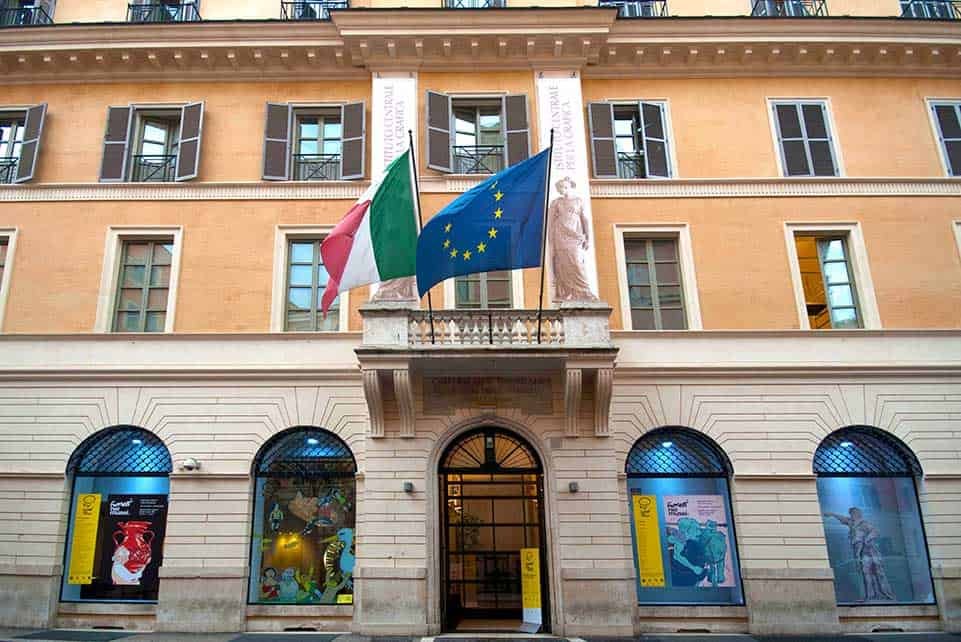
What the Istituto Centrale per la Grafica really is
The administrative definition is dry and has to be stated anyway, because it explains the powers and duties of this institution: the Istituto Centrale per la Grafica is an institute of the Ministry of Culture with special autonomy, with its own director, its own budget and its own board of directors. The current name has been in force since December 10, 2014, when the Ministry's organization regulation came into effect, introduced by the Prime Ministerial Decree of August 29, 2014, number 171, at article 30. The special autonomy, the kind that lets it plan exhibitions, acquisitions and restorations without going through a general directorate every time, came the following year.
Translated into words useful to the visitor: in here there is no museum in the sense that the Galleria Borghese is, with a fixed route and a masterpiece always hanging on the same nail. There is an organization that preserves extremely fragile materials, studies them, restores them, digitizes them and shows them on rotation. Graphic art is an art of paper and copper. Paper fears light with an almost animal intolerance: a drawing displayed too long permanently loses the brilliance of its iron-gall inks and the rendering of its whites. For this reason a cabinet of prints and drawings, all over the world, works through temporary exhibitions and consultation on request, never through permanent display. Whoever shows up on Via della Stamperia expecting a picture gallery will be disappointed. Whoever arrives knowing what to look for leaves with the feeling of having seen something that can't be seen elsewhere in Rome.
Our opinion: the Istituto Centrale per la Grafica is the most underrated place in the historic center, and it is so for an almost comic reason. It is invisible because it is too visible. Its palace is the backdrop of millions of photographs, and for exactly that reason nobody reads it as a building with an interior, a door and contents.
The Istituto Centrale per la Grafica and the monumental complex of the Trevi Fountain
The seat is not a single building. The Institute occupies two adjoining, connected buildings, which together form what the official documents call the monumental complex of the Trevi Fountain: Palazzo Poli, with its fronts on Piazza Poli, Via Poli and Piazza di Trevi, and the palazzo della Calcografia, which opens at number 6 on Via della Stamperia and was built in 1837 to a design by Giuseppe Valadier to house the Calcografia camerale.
The physical connection between the two buildings is not a land registry detail. It was the condition that allowed the collections, for decades divided between two seats and two traditions, to finally be reunited in 2008 under the same roof and in the same controlled climate conditions. A drawings collection that lives in two different storerooms is a halved collection: two card catalogs, two conservators, two study rooms, and nobody who can put on the table the preparatory drawing next to the print derived from it and the plate that impressed it. That triad, drawing, plate, print, is exactly what makes this institute different from any other European cabinet.
The palazzo della Calcografia on Via della Stamperia, seat of the Istituto Centrale per la Grafica
Valadier's palace is a sober, almost severe building, entirely without the late Baroque rhetoric that swells the square a few meters away. Valadier, who was the great architect of Napoleonic Rome and of the Restoration, designed it as a working machine: storerooms for the plates, rooms for the presses, offices for the papal chamber administration. His interest in the papal printing house was not passing, and the direction of the Calcografia kept him busy for years.
Passing along Via della Stamperia, look at the portal at number 6. The name of the street is not ornamental: it comes from the palace of the Stamperia camerale, at number 8, the building that Cardinal Luigi Cornaro had built in 1580 to a design by Jacopo Del Duca, a pupil of Michelangelo. Cornaro died four years later, and the palace changed hands several times, to the Bentivoglio, to the cardinals Valenti and Ceva, to Donna Olimpia Maidalchini Pamphilj, until it came into the possession of Pius VI in 1777. In those rooms, on July 13, 1636, Maria of Savoy, daughter of Charles Emmanuel I, died. During Fascism the building housed the Ministry of Corporations. Today it is home to offices of the Presidency of the Council of Ministers. One block, two palaces, four centuries of the history of the State and of printing: and over all this every day pass thousands of people who look only at their phones to find their way to the fountain.
Palazzo Poli, the part of the Istituto Centrale per la Grafica that nobody sees
Palazzo Poli is much bigger than the facade on the fountain lets you guess. The front on Piazza di Trevi is only the short side of an organism that stretches toward Piazza Poli and Via Poli, with courtyards, staircases, a piano nobile of large rooms and a hall that is among the largest in the historic center. Whoever wants to grasp the real size of the building has to do something very simple that almost no tourist does: turn the corner. From Piazza di Trevi you take Via delle Muratte, turn left and in two minutes you reach Piazza Poli, in front of a palace of late 16th-century appearance that seems to have no relationship with the fountain. It is the same building.
History of Palazzo Poli before the fountain
The oldest core of the building dates to the 16th century and bore another name: Palazzo d'Aragona, with its front on what is now Piazza Poli. In 1566 it was bought by Lelio Cesi, duke of Ceri, who entrusted the works to Martino Longhi the Elder, one of the most sought-after builders in the Rome of Pius V and Gregory XIII, and at a later stage to Ottaviano Mascherino, the Bolognese architect who would leave in Rome the spiral staircase of the Quirinale. These are first-rank names: whoever passes through Piazza Poli looks at architecture designed by the same men who drew half of Rome at the end of the 16th century.
After the Cesi came the Borromeo, who enlarged the building. In 1678 the palace passed to Lucrezia Colonna, who married Giuseppe Lotario Conti, duke of Poli. From that marriage comes the name the building still bears today, which in turn comes from Poli, the town in the Prenestini Mountains that gives the family its ducal title. The link between the palace and the Conti family is the key to understanding everything that happened in the following century, because the Conti were no ordinary house: they were the family of Innocent III and, in the 18th century, of Innocent XIII.
Palazzo Poli from the Conti dukes of Poli to the pontificate of Innocent XIII
In 1712 the duke obtained from Pope Clement XI permission to enlarge the building to make room for the apartment of Cardinal Michelangelo Conti, who 10 years later would ascend to the throne under the name Innocent XIII. In 1723 the family bought the adjacent buildings and the palace reached its definitive boundaries, as far as Piazza di Trevi and Via della Stamperia. In 11 years, in short, a house that had just produced a pope bought half a block and built itself an urban residence that looked onto the square of water.
In 1729 Duke Stefano Conti had the front on Piazza di Trevi made uniform. It is a decisive detail and escapes everyone: when Nicola Salvi began to work, the facade against which he would set the fountain had just been rebuilt. We are not talking about any wall readapted out of necessity. We are talking about a brand-new facade, which cost quite a lot, and which a papal decision turned within a few years into a support for someone else's work.
Why the dukes of Poli protested
The family opposed it, and had its reasons. The construction of the fountain would have cut the facade of their palace by two window bays, that is, it would have eaten a considerable portion of the front and subordinated it forever to an architecture that was not theirs. A Roman nobleman of the 18th century read his facade the way we read a business card: losing two bays meant losing rank.
The protest was no use. The project went ahead, and the result was the paradox that still defines the building today: Palazzo Poli is very famous and at the same time anonymous. Nobody knows what it's called, everybody has photographed it. If I had to point in all of Rome to a sharper case of architecture swallowed up by its own decoration, I wouldn't know which to cite.
The Trevi Fountain set against the Istituto Centrale per la Grafica
Many people know the story of the fountain, but almost always in pieces, and with the wrong dates. It's worth putting it back in order, because the Institute's building is an integral part of it.
In 1731 Pope Clement XII announced the competition for the new terminal fountain of the Acqua Vergine. The competition was won on paper by the Frenchman Lambert-Sigisbert Adam, but the commission passed to Nicola Salvi, and the most accredited reason is that the pontiff did not want to entrust to a foreigner a work destined to represent the magnificence of Rome. Work began in 1732 and ended on May 22, 1762. 30 years of construction site at the narrowest and busiest point of a working-class district: imagine what that meant for the people who lived there.
Three popes and two early inaugurations in front of Palazzo Poli
Clement XII, who had announced the competition, did not see the work finished: he had an early inauguration celebrated already in 1735. Benedict XIV wanted a second one in 1744. The work was completed only under Clement XIII. In the meantime Giuseppe Pannini, put in charge of finishing it, was removed for having changed the original project, and from 1759 Pietro Bracci took over, assisted by his son Virginio.
Who sculpted what
The Oceanus in the center, the colossal figure that everyone improperly calls Neptune, is by Pietro Bracci. The two side statues in the niches, Salubrity and Abundance, are by Filippo della Valle, one of the finest sculptors of the Roman 18th century and today unjustly forgotten. Agostino Corsini, Bernardino Ludovisi, Francesco Queirolo and Bartolomeo Pincellotti worked on the other figures. It is a collective construction site, like all the great Roman building sites of the century: the idea that a fountain like this is the work of a solitary genius is a narrative convenience that doesn't stand up to the payment records.
The Acqua Vergine that flows at the foot of Palazzo Poli
The water that fills the basin comes from the Acqua Vergine, the aqueduct of the Augustan age that is the only one among the ancient Roman aqueducts never to have stopped bringing water to the city. It runs almost entirely underground for about 20 kilometers, and that is the reason it survived the sieges and the cuts that put all the others out of use: nobody could interrupt it simply by knocking down an arch. When you look at the fountain you are also looking at the last stretch of an infrastructure that has worked since the time of Agrippa.
A sharp opinion, without beating around the bush: the Trevi Fountain is badly visited. Not because it isn't extraordinary, but because the crowd reduces it to a selfie backdrop and nobody lifts their eyes to the upper two thirds of the facade, which is the architecture of Palazzo Poli and not the sculpture of Salvi. The right way to see it is to get there at seven in the morning, look first at the palace and then at the water, and then go in through the door on Via Poli when the exhibition hall opens.

The Calcografia camerale of 1738, the first heart of the Istituto Centrale per la Grafica
While the foundations of the fountain were being dug a few meters away, something was happening in the same block that no guidebook tells and that has enormous consequences. On February 15, 1738 Clement XII founded the Calcografia camerale, that is, the public institution charged with preserving the engraved plates of the most notable works of the old masters, those copper plates which, as the founding document says, contributed greatly to promoting the magnificence and splendor of Rome among foreign nations.
You have to understand what an engraved plate was in the 18th century. It was, at once, a work of art and an industrial installation. From a copper plate hundreds of copies were pulled, and each copy carried around Europe the image of a Roman monument, a Vatican fresco, an ancient statue. Printing was the means by which Rome exported itself. An English gentleman who had never seen the Colosseum knew it through an etching bought from a London merchant, and that etching had been impressed from a copper engraved in Rome. Founding a public calcografia meant nationalizing that channel, removing it from the dispersal of private workshops and preventing the coppers from being melted down for the metal.
Why a state calcografia: the origins of the Istituto Centrale per la Grafica
The reason is brutally material. Copper is worth money. A worn plate, for an heir with little interest, was an ingot waiting for the crucible. Whole corpora of 16th-century engravings disappeared this way, not through fires or looting but through the price of metal. The Calcografia camerale was born also as a refuge against this banal and definitive form of destruction, and the plate collection the Institute holds today is the result of almost three centuries of that policy.
From that date on the collection grew through purchases, bequests and transfers of ownership, often taking over in a block the holdings of the great Roman publishing workshops when a dynasty of print merchants died out. The criterion was simple and far-sighted: buy the coppers whole, not the single pieces, because a dismembered holding loses its historical sense. It is the reason the plate collection of the Istituto Centrale per la Grafica is today the largest in the world.
Piranesi's plates at the Istituto Centrale per la Grafica
If in this palace there is a treasure in the proper sense of the word, it is the coppers of Giovanni Battista Piranesi. Not copies, not 19th-century print runs: the copper plates that the Venetian engraver who moved to Rome in 1740 worked with his own hands, and from which came the Views of Rome, the Roman Antiquities, the Imaginary Prisons. The Institute holds the entire holding, and there is no comparable collection in the world.
The numbers, checked against the Institute's catalog and the records of the restoration project, are these: the Calcografia Piranesi includes 1,191 plates engraved on copper, of which 964 are autograph plates of Giovanni Battista. The overall holding, counting also the plates of the other engravers who merged into the same collection, reaches 1,505 pieces. Around the father's coppers there are in fact those of his son Francesco, of his daughter Laura, who was a professional engraver and not an amateur, of the younger son Pietro, and of authors outside the workshop such as Nicolas Dorigny, Arnold van Westerhout and Francesco Bartolozzi, whose coppers the Piranesi firm had bought to widen its sales catalog. The cataloged plates cover a span from 1743 to 1806.
How Piranesi's coppers came to the Istituto Centrale per la Grafica
The story is a novel, and worth telling at length because it explains why those plates are in Rome and not in Paris.
At the death of Giovanni Battista, in 1778, the workshop passed to his children. Francesco Piranesi, a politically unscrupulous figure tied to Jacobin circles, in 1799 moved the whole calcografia to Paris, where the firm kept printing and selling the Roman views to a European clientele that bought them by the boxful. At the death of Francesco, in 1810, the calcografia was bought by the famous Parisian printing house Firmin Didot Frères, which continued the print runs until the end of 1838.
On December 19, 1838 the Firmin Didot signed the sale contract with the Calcografia camerale of Rome. The return took place under the pontificate of Gregory XVI and is one of the most significant acquisitions in the history of the institution. 40 years after leaving, Piranesi's coppers were coming back into the city they had made famous throughout Europe, and they came back as public property. From 1897 the holding was arranged in volumes and numbered as a single series, with a numbering organized by subject rather than by author, following the logic of 19th-century catalogs.
In our judgment that purchase of 1838 is one of the few acts of cultural policy of the late Papal State that stands comparison with any modern standard. Buying a whole holding, abroad, with public money, to bring it home and preserve it instead of reselling it, was a choice far from obvious in an era when Italian heritage was leaving the country by the truckload.
Why copper plates wear out
An intaglio plate is not eternal, and this is the point that people who don't work with prints find hard to grasp. Intaglio printing works by pressure: the inked plate passes under the cylinders of the press together with the damp sheet, and the paper is pushed into the grooves to pick up the ink. The pressure exerted by the cylinders is measured in quintals per square decimeter, between 5 and 10. Every pass imperceptibly crushes the edges of the grooves. After a few hundred print runs the image loses bite, the blacks turn gray, the shadows flatten.
To slow the wear, from 1859 and in the two following years people began to protect the plates with steel facing, that is, with a very thin galvanic deposit of iron on the copper surface. Later they moved on to chrome plating. When the image was by now tired, they resorted to restoring the incised work: an engraver went back over the worn grooves with a burin, mark by mark, re-entering the original hollows. It is work of superhuman patience and at the same time an enormous philological problem, because after a restoration the plate is no longer exactly the one the artist had engraved.
In the plate collection the Institute also holds a small group of four counterforms and 28 galvanic replicas acquired in the 19th century, among them 19 replicas taken from a plate by Marcucci and eight from plates by Calamatta. They are technical objects that tell of the moment when mechanical reproduction entered the world of art engraving and began to unhinge it.
The restoration of the Piranesi plates at the Istituto Centrale per la Grafica
In 2009 the Institute presented the Piranesi Project, curated by Ginevra Mariani, director of the Calcoteca sector. The goal was twofold: on one side the study, review and restoration of the plates with non-invasive diagnostic analyses, on the other the publication of a general catalog in six volumes that would allow scholars to work on the execution technique, the history of the collection and the workings of the workshop. The first three volumes came out between 2010 and 2017. To the restoration campaigns funded by the Ministry was added in 2019 a co-financing through the Art Bonus, the tax credit mechanism that lets individuals and companies support public heritage. The symbolic target was 2020, the third centenary of Piranesi's birth.
Whoever is lucky enough to see a restored plate displayed in an exhibition discovers something that prints don't say: the copper is beautiful. Under raking light, with shaped spotlights that graze its surface, the engraving becomes a relief, a writing in negative, and you read the artist's hand the way you read the handwriting of a letter. Piranesi engraved with rapid strokes, with second thoughts, overlaps, erasures. The print gives back the finished image. The plate gives back the thought.
The Gabinetto Nazionale delle Stampe, the other half of the Istituto Centrale per la Grafica
The Institute's second soul has a completely different history, and it begins with a princely library.
The Corsini princes had gathered in Rome, between the 18th and 19th centuries, a collection of prints and drawings that was already famous in Europe. The connoisseur Pietro Zani, at the beginning of the 19th century, called it the richest in Italy and put it on the same level as the great cabinets of Paris, Vienna and Dresden. It was not a courtesy compliment: it meant that in Rome there existed a collection capable of documenting the entire history of European engraving.
In 1883 the Corsini princes donated their library to the Reale Accademia dei Lincei. Drawings, prints and illustrated volumes that had always been part of the book collection went into the donation. 12 years later, in 1895, the Gabinetto Nazionale delle Stampe was born from that material extracted from the Corsiniana, while the illustrated volumes stayed with the library donated to the Lincei. It is a separation that still today obliges anyone studying a holding to work at two different sites, and it is the kind of detail that distinguishes research done well from research done in a hurry.
What the Gabinetto disegni e stampe of the Istituto Centrale per la Grafica means
The formula, to those who don't frequent paper museums, sounds bureaucratic. It indicates instead a precise institution, with its own rules, born in the Renaissance with the private collections of collectors and codified between the 18th and 19th centuries in the great European museums. A cabinet of drawings and prints does not display: it preserves in folders, in boxes, in cabinets with drawers, in rooms with controlled humidity and temperature. The public gains access on request, for study reasons, under supervision, with gloves or without depending on the support, with no ink pens on the table.
The Gabinetto disegni e stampe of the Istituto Centrale per la Grafica works exactly like this. It is not spite toward visitors: it is the only known way to guarantee that a 15th-century drawing reaches our grandchildren intact.
The 1975 merger and the birth of the Istituto Centrale per la Grafica
In 1975, with the creation of the Ministry for Cultural and Environmental Heritage, the Calcografia Nazionale of papal inheritance and the Gabinetto Nazionale delle Stampe were united in a single body, the Istituto Nazionale per la Grafica. Two different traditions, two different mentalities: on one side the conservators of the plates, people of copper, presses and inks, on the other the historians of drawing, people of paper, watermarks and attributions. Putting them together was an act of administrative intelligence that doesn't happen often in Italy.
But unification on paper is not enough if the collections remain in two palaces. For this reason in 1978 the Italian State exercised its right of preemption and bought Palazzo Poli, with the declared aim of unifying the two collections in physical space as well. The physical completion of the operation came in 2008, when the collections were actually reunited in the single seat formed by the two connected buildings.
In 2014 the Ministry's reorganization brought the current name, Istituto Centrale per la Grafica, and in 2015 the special autonomy. That is the arrangement in force today.
The dates that matter for Palazzo Poli, in order
For those who like fixed points: 1580, the palace of the Stamperia camerale to a design by Jacopo Del Duca. 1566, the purchase of the core of Palazzo Poli by Lelio Cesi. 1678, the passage to the Conti dukes of Poli. 1712 and 1723, the enlargements. 1729, the rebuilding of the front on Piazza di Trevi. 1732, the start of Salvi's fountain. February 15, 1738, the founding of the Calcografia camerale. 1762, the completion of the fountain. 1837, Valadier's palazzo della Calcografia. December 19, 1838, the contract for Piranesi's coppers. 1865 and 1866, the Galleria Dantesca in the Sala Dante. 1883, the Corsini donation to the Lincei. 1895, the birth of the Gabinetto Nazionale delle Stampe. 1975, the merger. 1978, the purchase of Palazzo Poli. 2008, the reunion of the collections. 2014, the current name. 2015, the special autonomy.
The collections of the Istituto Centrale per la Grafica
The Institute's digital catalog puts the holdings at more than 170,000 prints, 27,000 plates, 24,000 drawings and 17,000 photographs. These are figures in motion, because the digitization campaign funded by the National Recovery and Resilience Plan is still cataloging piece by piece, and as of February 2026 it was about 63 percent complete. In the meantime the Institute keeps buying contemporary works, so as not to be reduced to an archive of the past.
The drawings of the Istituto Centrale per la Grafica, from the 15th century to today
The drawings holding covers five and a half centuries of European art. There are sheets that any museum in the world would show as a star piece: a sheet by Andrea Mantegna with the battle of the sea gods, a study of an old man's head attributed to Leonardo, the Roman views engraved and drawn by Étienne Dupérac, the Frenchman who in the 16th century documented with topographical precision the Amphitheatrum Castrense and the ruins of the city. Pay attention to how these attributions are phrased: in the field of old drawing, the distance between an autograph sheet, a workshop sheet and a contemporary copy is a matter of permanent discussion, and the labels of print cabinets are updated with a frequency you don't see in picture galleries.
A tip for those who love drawing: when the Institute exhibits old sheets, go slowly and stop a hand's width from the display case. Drawing is the only genre in which you see thought before decision: the retraced line, the second thought erased with pumice, the crease of paper folded in four to fit in a pocket. In front of a drawing you are alone with the artist's hand, without the mediation of color and varnish.
The prints of the Istituto Centrale per la Grafica: the visual memory of Europe
The print collection is the largest of the four and the least spectacular in appearance, because it is made of sheets that are often small and monochrome. It is instead the material that best tells how images circulated before photography. Inside are the great historical holdings: the Corsini, the Barberini, the groups coming from the Louvre, the Piranesi holding and the specialist series. Whoever studies the fortunes of a work of art, the way a Roman altarpiece became famous in Antwerp or Nuremberg, works on this kind of material and not on the altarpieces.
The plates: the plate collection of the Istituto Centrale per la Grafica
The plate collection is the section that makes the Institute unique. 27,000 plates, engraved from the Renaissance onward, the largest collection in the world. In the Calcografia's historical inventory there was talk of about 23,000 plates, a figure that then grew with later acquisitions. They are coppers, but also zinc plates, steel plates, woodblocks for xylography and lithographic stones. In the storeroom, lined up on their edges on the shelves like volumes in a library, those plates weigh tons and are worth a fortune.
The photographic holdings of the Istituto Centrale per la Grafica
The photographic section gathers materials running from the mid-19th century to today. It includes author holdings, documentation campaigns, albums, negatives on glass and on film. Among the historical collections are more than 5,000 glass plates in different formats. It is a heritage that few associate with this address, and which makes the Institute one of the natural interlocutors for anyone studying Italian photography and its technical history.
Video art and the contemporary at the Istituto Centrale per la Grafica
Even less known is the fact that the Institute collects artists' video and contemporary works. It is a coherent choice: if the institution was born to preserve art that multiplies, the seriality of video and digital techniques belongs to the same conceptual family as printing. Anyone who expects an institute turned only to the old is badly mistaken.

The Sala Dante of Palazzo Poli
If I had to name the most important room in the building, I would have no doubt: the Sala Dante. It is the most significant place in the palace for three reasons that add up. The dimensions, exceptional for a private Roman hall. The view, which is the only interior view onto the Trevi Fountain that exists. And the sequence of uses assigned to it over almost three centuries, which is a novel of Rome's cultural history.
The Sala Dante as the library of the dukes of Poli
The hall was built in the 1720s by Stefano Conti, duke of Poli and nephew of Pope Innocent XIII, to house the precious family library. Then it also became a ballroom. An 18th-century noble library was a room for show at least as much as for study: carved shelving, globes, busts of philosophers, and the certainty that every guest admitted understood what social height he found himself at.
The studio of the painter Francesco Manno
In the early years of the 19th century the painter Francesco Manno, a Sicilian artist active in Rome in the Neoclassical season, had set up his own studio there. A hall of those proportions, with abundant light, was the ideal solution for someone who painted large-format canvases. It is not an isolated case: many decaying Roman palaces rented rooms to painters and sculptors for exactly this reason.
The Galleria Dantesca of 1865 at Palazzo Poli
The name of the hall comes from an enterprise both entrepreneurial and cultural. Between 1865 and 1866 the cavaliere Romualdo Gentilucci rented and renovated the room to house the 27 large canvases that made up the Galleria Dantesca, commissioned by him from famous painters of the time and taken from the drawings of Filippo Bigioli. The canvases were enormous: four meters by six. They were not shown all together, but alternately to the public, with special mechanisms and play of lights.
Let's stop for a moment on this fact, because it is extraordinary and nobody tells it. In 1865, in a palace behind the Trevi Fountain, there existed a paid visual spectacle with canvases of 24 square meters each, moved by devices and lit by lighting apparatus designed for the purpose. It is the 19th-century diorama in its most ambitious form, the direct ancestor of the movie theater, and Rome had a first-rate example of it. The recurrence of the date is no accident: 1865 was the sixth centenary of Dante's birth, celebrated throughout newly unified Italy as a rite of national identity.
The evening Liszt listened to his own Dante Symphony
For the inauguration of the hall, Franz Liszt's Dante Symphony was performed, for large orchestra and choirs. An erudite speech was declaimed along with new verses composed on the scenes of the Divine Comedy illustrated in the canvases. And this is where the story becomes memorable.
From 1864 the Roman symphonic concerts had moved to Palazzo Poli itself, near the Trevi Fountain, and the hall was later renamed Sala Dante. On February 26, 1866, at Liszt's express wish, the young Giovanni Sgambati, who had no conducting experience, conducted in this hall the first complete performance of the Dante-Symphonie, in the presence of the composer. Liszt in those years was living in Rome. It means that the most famous Hungarian composer in Europe sat in a hall of Palazzo Poli, a few meters from the water of Trevi, listening to his own music conducted by a 24-year-old Roman.
The same hall went on making music history. From May 18, 1866 Sgambati and the violinist Ettore Pinelli organized there a series of popular chamber concerts, and on December 6 of the same year Sgambati conducted there the first Roman performance of Beethoven's Third Symphony. Rome, capital of opera and province of instrumental music, began to make up for its lag exactly behind the Trevi Fountain.
Concerts, dances and bank meetings
The Galleria Dantesca enterprise, much appreciated by contemporaries, faded after a few years. Right after the unification of Italy the hall was already rented to the well-known musician Tullio Ramacciotti, who in turn sublet it to banking and commercial companies for meetings, to clubs for dances, to other musicians and very often to the Società Orchestrale Romana. In 1891 that Society signed the lease directly with the City of Rome, while continuing the subletting system. Until the end of the century the Sala Dante was one of the most celebrated places in the city for the performance of concerts, and it also hosted lectures and parties of illustrious people.
The registry offices and the neglect of the Sala Dante of Palazzo Poli
Then the downward arc, and it is the part nobody expects. In the first half of the 20th century the great room in which Liszt had listened to his own symphony was turned into the registry offices of the city. Birth certificates, changes of residence, lines at the counter. The hall of the dukes of Poli became a public office, with counters, stamps and paperwork.
The restoration and the return to culture
Since the palace became the seat of the Institute, and thanks to the functional restoration overseen by the architect Agostino Tropea, the Sala Dante has returned to being a cultural and exhibition center after many years of neglect. Today it hosts exhibitions, presentations and meetings. When it is open to the public for an exhibition, going into it is the real reason it's worth crossing the threshold on Via Poli.
The exhibitions of the Istituto Centrale per la Grafica
The normal way into Palazzo Poli is an exhibition. The Institute schedules several each year, drawing on its own collections or hosting projects devoted to contemporary graphics, photography and international engraving. Admission is free, which, within a radius of 300 meters from the Trevi Fountain, is an anomaly worth pointing out.
The exhibition rooms occupy spaces of Palazzo Poli, including the Sala Dante and some rooms on the ground floor. The installations are generally sober, with lighting calibrated for light-sensitive materials. Expect low light, and don't take it as carelessness. 50 lux on an old sheet is already a generous concession.
The 2020 Piranesi exhibition at Palazzo Poli
The most ambitious of the recent exhibitions was the one for the third centenary of Piranesi's birth, opened on October 15, 2020 at Palazzo Poli and curated by Maria Cristina Misiti and Giovanna Scaloni. The exhibition was laid out in three main rooms, with two sections on the ground floor devoted to the Imaginary Prisons and to contemporary visions inspired by the engraver. The installation, designed by the architect Paolo Martellotti, used shaped spotlights to bring out the incised line on the copper. Those who were there saw something almost nobody sees: plates and prints side by side, the negative and the positive of the same thought.
How to know what is open
The calendar changes. Between the closing of one exhibition and the opening of the next, weeks can pass in which the exhibition hall receives no public, and showing up on Via Poli without checking is the quickest way to end up on the sidewalk. The Institute's official website, on the cultura.gov.it domain, publishes the program. The switchboard, at 06 699801, answers during office hours.
The printing shop and presses of the Istituto Centrale per la Grafica
Inside the complex an art printing shop still works. It is not a museum piece put there for show: it is a workshop equipped with intaglio presses, where people print, experiment and teach. Intaglio is a technique transmitted by hand, not by manuals, and an institution that preserves 27,000 plates has the professional duty to keep alive the skill needed to understand them.
How an intaglio press works, the gesture that explains the Istituto Centrale per la Grafica
It's worth explaining, because it is the founding gesture of everything preserved in this palace. The engraved plate is inked with a dabber, working the ink into the grooves. Then the surface is wiped with gauze and with the palm of the hand, so that the ink stays only in the hollows. The plate is laid on the bed of the press, the dampened sheet is spread over it, and over that the felts. The star wheel of the press is turned and the cylinders pass the package through under pressure. The wet paper, pushed into the grooves, picks up the ink. The sheet is lifted and the image appears reversed relative to the plate.
Anyone who has watched this operation just once will never again look at an old print the way they did before. And they also understand why those plates wear out: every sheet costs the plate a little of its life.
The restoration lab of the Istituto Centrale per la Grafica
Next to the printing shop work the restoration labs specialized in paper and metals. Paper restoration is a highly refined discipline: controlled washing, deacidification, veiling with Japanese paper, filling of losses with fiber pulp. The restoration of plates is even more delicate, because it has to stop corrosion without erasing the traces of workmanship and without altering the line. A copper that was steel-faced in the 19th century and then chrome-plated in the 20th is a stratigraphy to be read before intervening.
The library and study room of the Istituto Centrale per la Grafica
The Institute has a specialist library on graphics, engraving, the history of collecting and conservation, with reference works and catalogues raisonnés that in Italy are found in very few other places. Next to the library runs the study room of the Gabinetto disegni e stampe, where the originals are consulted.
How to get access to consultation at the Istituto Centrale per la Grafica
Access is not free and it is not a whim. You need a reasoned request, addressed to the Institute, with the precise indication of the pieces or holdings you wish to consult, and you need an appointment. The reason is twofold: on one side every handling of an original is a risk, on the other the staff must physically take the pieces from the storerooms and prepare them on the consultation table. The rules of the room are those of every cabinet in the world: no pens, no bags, clean hands, one piece at a time, no forcing the sheets. To organize the request, write to ic-gr@cultura.gov.it or call the switchboard.
A recommendation from someone who has seen scholars go home empty-handed: before asking for an appointment, do a preliminary search on the digital catalog. Arriving with the inventory numbers already identified shortens the time and enormously increases the chances that the request will succeed.
The digital catalog of the collections of the Istituto Centrale per la Grafica
The Institute's online catalog is public and can be consulted at calcografica.it. It was built with the collaboration of the Real Academia de Bellas Artes de San Fernando in Madrid, which provided the software infrastructure, and it lets you browse the four great sections: prints, plates, drawings, photographs. Within the prints are the historical holdings, from the Corsini to the Barberini, from the groups coming from the Louvre to the Piranesi holding.
Said by someone who spends many hours on museums' digital catalogs: this is a serious tool. It lets you prepare a visit, check a state of a plate, compare print runs. Digitization is still under way, so the absence of a piece from the catalog doesn't mean the Institute doesn't own it.

How to visit the Istituto Centrale per la Grafica: what you see and what you don't
Let's line things up honestly, because it's the point on which people form the wrong expectations.
You can visit: the exhibition rooms of Palazzo Poli when an exhibition is on, with free admission. You can visit the Sala Dante when the installation includes it. You can access, by appointment and for study reasons, the consultation room of the Gabinetto disegni e stampe and the library.
You cannot visit freely: the storerooms, the plate collection, the restoration labs, the printing shop, the offices. They are workspaces, and in some cases climate-controlled rooms where the entry of people alters the parameters. Special openings of these spaces happen on dedicated days and outreach initiatives. They are rare, they sell out fast and you have to seize them on the fly.
There is not, at present, a visitable panoramic terrace above the Trevi Fountain. A project for a museum route through the rooms of the piano nobile, with a spiral staircase and a terrace overlooking the fountain, was publicly presented by the Institute's management, but it remains a project. Anyone who reads around that you can go up and look at the fountain from above is reading news reported as accomplished when it is not.
How long a visit to the Istituto Centrale per la Grafica takes
For a graphics exhibition of normal size, from 40 minutes to an hour and a half. The time depends on the kind of visitor far more than on the quantity of works: in front of 20 engraved sheets, someone without a trained eye passes in 10 minutes, someone who reads the marks takes an hour. If the Sala Dante is included in the route, add a quarter of an hour just for the room and the view.
The Istituto Centrale per la Grafica with children
With small children old graphics is a bet lost from the start: low lights, small sheets, nothing to touch. With kids aged 10 and up, on the other hand, it works very well on one condition, that someone explains to them the mechanism of printing. The concept of a reversed image, of a plate that generates identical copies, of a line that wears out, is fascinating at that age because it is concrete. If you happen to find a plate displayed next to the print derived from it, show them the comparison. It is the most effective lesson that exists on the history of images.
Accessibility of Palazzo Poli
Palazzo Poli is a historic building and like all the historic buildings of the center it has thresholds, level changes and stairs. Anyone who needs wheelchair access should make a call in advance to the switchboard to be told the entrance and the practicable route in relation to the current exhibition, because the answer changes depending on the rooms used. It is the advice that avoids nasty surprises on site.
Photos, backpacks, cloakroom
In graphics exhibitions flash photography is always forbidden, and in many cases photography is forbidden altogether for reasons of protection and of rights on the contemporary works on show. The instructions are at the entrance and must be respected without argument: here the rule is not a formality, it is conservation. Backpacks and umbrellas are left where the staff indicates. Don't expect the services of a big museum: this is a research institution that opens its rooms, not a machine for mass tourism.
When to go to the Istituto Centrale per la Grafica
The best time is early morning, right when it opens, for a reason that concerns the square more than the palace: between 10:00 and 19:00 Piazza di Trevi becomes a compact crush, and reaching the entrance on Via Poli by crossing that tide is tiring and unpleasant. At 10:00 sharp the square is already full but the flow still moves. Late winter afternoon, around 17:00, is the other good window: many visitors move toward the aperitivo areas and for half an hour you can breathe.
To avoid: holiday long weekends, December Saturdays and the middle hours of August. Not because the Institute is crowded, it almost never is, but because getting there becomes a contact sport.
What's around the Istituto Centrale per la Grafica
The Trevi district is one of the densest in Rome and within a 10-minute walk there is a concentration of things that elsewhere would be enough to fill a whole city.
Two minutes away
The Trevi Fountain, obviously, and the architecture of Palazzo Poli seen from Piazza Poli side. A little farther up, on Via Marco Minghetti, is the Galleria Sciarra, an Art Nouveau courtyard with mural decorations devoted to feminine virtue that is one of the most beautiful and least visited things in the center: free entry during office hours, five minutes' walk and no line.
Five minutes away
Going up Via del Tritone you reach Gian Lorenzo Bernini's Triton Fountain in Piazza Barberini, and from there Palazzo Barberini, home of the Galleria Nazionale d'Arte Antica. In the opposite direction, toward the Corso, are the Galleria Alberto Sordi and Piazza Colonna with the Column of Marcus Aurelius.
10 minutes away
The Pantheon, the church of Sant'Ignazio di Loyola with the vault painted by Andrea Pozzo, Palazzo Doria Pamphilj with its private gallery, and climbing the other way the Quirinal Palace with the Scuderie del Quirinale. For those who love the big exhibition cycles, the Palazzo delle Esposizioni is on Via Nazionale, a good quarter of an hour uphill.
A half-day itinerary around Palazzo Poli
9:30, standing coffee on Via delle Muratte. 10:00, entry to the Institute's exhibition on Via Poli. 11:00, exit and a walk around the block to see the palace from Piazza Poli side and grasp its real size. 11:30, Galleria Sciarra. Noon, Sant'Ignazio with the light coming in from the high windows. An hour later, lunch away from the square, toward the Pantheon or toward Via del Corso. It's a half day that costs almost nothing and gives back more than many paid tours.
A curiosity about the Istituto Centrale per la Grafica - Palazzo Poli
The curiosity I like best concerns an error of collective perception of planetary dimensions. The Trevi Fountain is, by number of shots, one of the most photographed subjects in the world. In every one of those photographs there appears a building that occupies more than half the frame: the giant order of Corinthian pilasters, the attic with the coat of arms of Clement XII held up by the Fames, the framed windows at the sides. Well, that architecture does not belong to the fountain. It is the facade of Palazzo Poli, a private noble residence rebuilt in 1729 by Duke Stefano Conti, and the fountain was simply set against it starting in 1732.
The sequel to the curiosity is even tastier. The dukes of Poli protested, because the new fountain would have cut the facade of their palace by two window bays. They had just rebuilt the front, and found themselves with someone else's monumental work imposed on top of their own investment. They lost, as you always lose against a pope who has decided. But their protest is documented and gives the affair a very human flavor: behind the most famous stage set in the city there is a condominium quarrel that ended badly for the owners.
Then there is the other side of the coin, and it concerns today. None of the millions of visitors who crowd the square knows that inside that building the Ministry of Culture keeps more than 170,000 prints, 24,000 drawings, 17,000 photographs and 27,000 engraved plates, including the entire holding of Piranesi's coppers. It is a disproportion with something comic about it: the most photographed wall in Europe hides one of the largest graphics cabinets in the world, and nobody turns the corner to go in. The door is at Via Poli 54, less than a minute's walk from the parapet where everyone throws the coin, and when there is an exhibition you go in for free.
I add a detail that completes the picture: from the rooms of the piano nobile there is an interior view onto the fountain. The Sala Dante has it, and it is the only private viewpoint on that water spectacle. It can't be visited at will and at the moment there is no panoramic route open to the public. But knowing that it exists, and that it sits behind those windows everyone photographs without looking at them, changes the way you stand in the square.
One thing nobody tells you about Istituto Centrale per la Grafica - Palazzo Poli
That in here you can study the original material for free, and that you don't need to be a university professor to ask for it.
The study room of the Gabinetto disegni e stampe is a public service. Anyone with a serious reason for research, an academy student, an engraver, a restorer, a collector who wants to compare a state of a plate, an enthusiast preparing a thesis or a documented piece of work, can send the Institute a reasoned request and get an appointment to consult the originals. Not the facsimiles. The originals. Sheets that in most museums in the world don't leave the storerooms even for in-house curators without three signatures.
Of course there are rules, and they are strict: written request with the precise list of what you want to see, agreed appointment, no pens, no bags, one piece at a time on the table, constant supervision. The staff physically take the pieces from the storerooms and bring them back, and every handling is a calculated risk that the institution accepts because research is part of its mission. But the door exists, and it is open to those who show up prepared.
The second thing nobody says concerns the digital catalog. The collections can be consulted from home, for free, with images and records. The digitization campaign funded by the National Recovery and Resilience Plan has passed 60 percent of the pieces. It means that a person in Buenos Aires or Osaka can today study Piranesi's coppers without taking a plane, and that a Roman student can arrive at the study room with the inventory numbers already ready instead of asking for help by groping. It is a silent revolution and no tourist guide tells it because it doesn't produce photographs.
Third thing, the most practical of all: admission to the exhibitions is free. Within a radius of 300 meters from here there is no other public exhibition venue where you go in without paying. The reason is that the Institute is not a ticketed museum but a protection body that opens its rooms. Those who know, go. Those who don't know, stay in the square waiting in line to photograph a wall.
The advice I give you for visiting Istituto Centrale per la Grafica - Palazzo Poli
The advice is only one and should be followed to the letter: call first, and go in the morning right when they open.
Calling first matters because this is not a continuously open venue. The exhibition rooms of Palazzo Poli receive the public when an exhibition is on, and between one installation and the next there are periods of closure that can last weeks. The calendar is published on the official website, on the cultura.gov.it domain, and the switchboard at 06 699801 answers during office hours. Five minutes on the phone are worth a wasted trip through the crowd of the square.
Going in the morning matters for a precise logistical reason. The entrance is at Via Poli 54, and Via Poli opens onto the square. From 11:00 on, the flow of people arriving toward the fountain from Via del Tritone and from Via delle Muratte becomes a river in which you move in fits and starts. At 10:00 you can still walk.
Second piece of advice, on method: first the palace, then the exhibition. Take 10 minutes and walk all the way around the block. Start from the square, look at the facade against which the fountain is set and try to read it as civil architecture, ignoring the water: you will see an 18th-century palace with a giant order, an attic, a coat of arms. Then take Via delle Muratte, turn onto Via Poli, reach Piazza Poli and look at the late 16th-century front. When you have understood that the two fronts belong to the same building, the visit inside will take on a completely different sense.
Third piece of advice, the one nobody will give you: in front of the works, look for the plates. If the installation shows even just a copper plate next to the print derived from it, stay there twice as long. Look at the copper at an angle, using the raking light, and try to read the line engraved in negative. It is the experience that separates a visit to graphics from a stroll down a corridor of little pictures.
Fourth and last: don't expect a museum. Expect an institute. If you go with the idea of finding the Sala Dante always open, the storerooms visitable and the terrace over the fountain, you will go home unhappy because of your own expectations. If you go knowing that you will enter a well-made exhibition inside a palace that almost nobody has ever seen from the inside, you will leave with the feeling of having stolen something from the city.
Another well-known fact, yet rarely cited
That the palazzo della Calcografia, at number 6 on Via della Stamperia, is the work of Giuseppe Valadier, and that it bears the date 1837.
Valadier is the name everyone associates with Piazza del Popolo, with the ramps of the Pincio and with the great urban interventions of early 19th-century Rome. Almost nobody attributes to him the building in which the most important plate collection in the world is kept today, and yet his signature is there, 50 meters from the fountain, on a building that goes unnoticed because it has nothing theatrical about it. It was a functional project: rooms for the presses, storerooms for the plates, offices for the Calcografia camerale. Valadier was also its director, and for decades.
The thing to understand is that this is not an urbanistic coincidence. Within a single block, between the 18th and 19th centuries, the Papal State concentrated the whole chain of the printed image: the Stamperia camerale in the palace at number 8, built in 1580 to a design by Jacopo Del Duca for Cardinal Luigi Cornaro. The Calcografia camerale founded by Clement XII on February 15, 1738. And finally, from 1837, Valadier's building built expressly to keep its plates. Via della Stamperia does not take its name from a vague memory: it was the district of Roman public publishing.
A second rarely cited fact, though well known to historians: the print runs. For two centuries the Calcografia officially printed from its own plates, selling copies to scholars, collectors and institutions. Those print runs exist, circulate on the antiques market and generate constant confusion, because a view by Piranesi printed in the 19th century by the Calcografia camerale is impressed from the original plate but is not an 18th-century print. Telling an artist's proof from a late print run is a connoisseur's trade, and is done by looking at the paper, the watermark, the rendering of the blacks and the traces of restoration of the incised work. It is exactly the kind of expertise this institute guards together with the plates.
Third fact: the steel facing. From 1859 onward the most heavily used plates were protected with a galvanic deposit that hardened their surface, and later with chrome plating. This is why certain coppers withstood thousands of passes under the press, and also why a restorer today has to read a stratigraphy of 19th- and 20th-century interventions before touching anything.
The right photo to take at Istituto Centrale per la Grafica - Palazzo Poli
The photo everyone takes is wrong, and I say it with the certainty of someone who has seen thousands of people take it. It is the fountain framed head-on from the central parapet, with the statue of Oceanus in the middle and someone else's head in the lower corner. It exists in hundreds of millions of copies and is, literally, the least original photograph on the planet.
The right photo is another one and requires three steps back. Go up the staircase to the right of the square, looking at the fountain, and turn the lens vertical. Frame only the upper part of the facade: the attic, the coat of arms of Clement XII with the two Fames, the balustrade crowning and the sky. No water, no Oceanus, no crowd. What you get is a portrait of Palazzo Poli, that is, of the building of the Istituto Centrale per la Grafica, and it is a photograph nobody around you is taking.
The second right photo is taken once you turn the corner, in Piazza Poli. The sober late 16th-century front, with the portal and the regular windows: it looks like another palace, and instead it is the same one. If you put the two images side by side you have told the whole paradox of this building, the famous face and the anonymous face, and you hold a diptych worth a hundred shots from the parapet.
Third possibility, for those with patience: the entrance at Via Poli 54 with the Institute's plaque, and in the background, at the end of the street, the mass of the fountain glimpsed between the buildings. It is the photograph that explains the geography of the place better than any caption.
The right time to photograph Palazzo Poli
The facade on Piazza di Trevi faces south and gets the sun in the middle hours, which is the worst light: flat, contrasty, without relief. The two good windows are first thing in the morning, when the raking light comes in from the left and draws the pilasters, and the half hour after sunset, when the floodlights ignite the stone and the sky is still blue. That half hour, in photography, is called the blue hour and is worth all the waiting it requires.
Photos inside the exhibition
Flat rule: no flash, ever, under any circumstances. In graphics exhibitions photography may be forbidden altogether, to protect the materials and for rights on the contemporary works. The instructions are at the entrance and are not to be argued with the gallery staff, who apply a rule and don't decide it. If photography is allowed, shoot without flash, resting your elbow against your body to hold the camera steady, and without approaching the display cases beyond the mark on the floor.

Some important events that happened here in history
This block has seen a quantity of things happen disproportionate to its size. Here they are in date order, because the sequence is worth more than any commentary.
July 13, 1636, a princely death
In the palace of the Stamperia, at number 8 of the street, Maria of Savoy, daughter of Charles Emmanuel I, died. A building that Cardinal Luigi Cornaro had built in 1580 to a design by Jacopo Del Duca, then passed to the Bentivoglio, to the cardinals Valenti and Ceva, to Donna Olimpia Maidalchini Pamphilj and finally to Pius VI in 1777. Whoever walks today on Via della Stamperia looking at their phone doesn't imagine that a Savoyard princess died behind those walls.
February 15, 1738, the founding of the Calcografia camerale
Clement XII established the Calcografia camerale with the declared aim of preserving the most notable works of the old masters engraved on copper, because they contributed greatly to promoting the magnificence and splendor of Rome among foreign nations. It is the document at the origin of everything now preserved in this complex, and it is an act of cultural policy with a lucidity that surprises: the Holy See understood that the printed image was the means by which the idea of Rome traveled across Europe, and decided to control its plates.
May 22, 1762, the end of the fountain's construction
After 30 years of work, the Trevi Fountain was given back to the public. In the meantime the pope who had wanted it, the architect who had designed it and a good part of the first sculptors had died. Two early inaugurations, in 1735 and 1744, had tried to give the Roman public the illusion that the work was finished. It was Pietro Bracci, who took over in 1759 with his son Virginio, who actually carried it through.
December 19, 1838, the return of Piranesi's coppers
The Parisian printing house Firmin Didot Frères signed the contract selling the Calcografia Piranesi to the Calcografia camerale of Rome. The plates, taken to Paris by Francesco Piranesi in 1799 and printed in France for 40 years, were coming back to the city they had told to the world. Under the pontificate of Gregory XVI, the Papal State bought a whole holding abroad to bring it back home: one of the few episodes in which Italian heritage made the trip in the right direction.
1865 and 1866, the Galleria Dantesca at Palazzo Poli
In the hall of the piano nobile the cavaliere Romualdo Gentilucci set up the Galleria Dantesca: 27 canvases of four meters by six, taken from the drawings of Filippo Bigioli and commissioned from celebrated painters, shown alternately to the public with mechanisms and play of lights. It was the sixth centenary of Dante's birth and newly united Italy was looking for its symbols. In technical terms it was a spectacular apparatus worthy of a theater, set up inside a private hall 50 meters from the fountain.
February 26, 1866, Liszt's Dante Symphony
The most extraordinary event of this hall. At the express wish of Franz Liszt, who in those years was living in Rome, the 24-year-old Giovanni Sgambati, with no conducting experience, conducted in this hall the first complete performance of the Dante-Symphonie, in the presence of the composer. For the occasion the room was officially renamed Sala Dante, and the name has remained to this day. Whoever enters that hall during an exhibition walks on the floor where one of the most ambitious symphonic scores of the 19th century was played in full for the first time, in front of the man who wrote it.
December 6, 1866, Beethoven in Rome
A few months later, in the same hall, Sgambati conducted the first Roman performance of Beethoven's Third Symphony. It seems incredible that a city like Rome had to wait until 1866 to hear the Eroica, and yet that is exactly how it is: the capital of melodrama was a province of instrumental music, and the recovery began in here. From May 18 of the same year Sgambati and the violinist Ettore Pinelli had started in this venue a series of popular chamber concerts, with the declared intention of widening the audience.
1891, the Società Orchestrale Romana
After the season of the Galleria Dantesca, the hall was rented to the musician Tullio Ramacciotti, who sublet it to banks and commercial companies for meetings, to clubs for dances, to musicians and very often to the Società Orchestrale Romana. In 1891 that Society signed the contract directly with the City of Rome, while keeping the subletting system. Until the end of the century the Sala Dante was one of the most celebrated places in the city for concerts.
The first half of the 20th century, the registry counters
The fall. The great room in which the Dante Symphony had been performed was turned into the registry offices of the City of Rome. Certificates, stamps, lines. There is no more effective way to tell how a city can forget its own places.
1975, 1978 and 2008, the building of the Institute
The merger of the Calcografia Nazionale with the Gabinetto Nazionale delle Stampe in 1975. The State's purchase of Palazzo Poli in 1978, exercising the right of preemption, to unify the two collections in physical space as well. The actual reunion of the collections in the single seat in 2008. Three administrative steps that don't make the news and that saved a heritage.
October 15, 2020, the third centenary of Piranesi
The opening of the exhibition devoted to Giambattista Piranesi for the 300 years since his birth, curated by Maria Cristina Misiti and Giovanna Scaloni, installed by Paolo Martellotti in three main rooms of Palazzo Poli with two sections on the ground floor devoted to the Prisons and to contemporary visions. An exhibition opened in an extremely difficult year for museums, which put the plates back at the center instead of the prints alone.
Who has passed through Istituto Centrale per la Grafica - Palazzo Poli
The list of people who have passed through these rooms is more impressive than that of many famous museums, and nobody tells it.
Franz Liszt
The first name is the most sensational. Liszt lived in Rome in the 1860s, and on February 26, 1866 he was present in this hall at the complete performance of his own Dante-Symphonie, which he had wanted to entrust to Sgambati. A composer who had filled the theaters of Europe, sitting in a private hall behind the Trevi Fountain listening to his own music in a city that was then still the capital of the Papal State.
Giovanni Sgambati
Roman pianist and composer, pupil and protégé of Liszt, he was the man who brought the German symphonic repertoire to Rome. He conducted here, very young and without experience, the Dante Symphony and then Beethoven's Eroica, and started with Ettore Pinelli the popular chamber concerts that opened instrumental music to a new audience. Without the Sala Dante, his career would have had a different start.
The Conti dukes of Poli and Pope Innocent XIII
The palace was the residence of the Conti, the house that had given the Church Innocent III in the 13th century and that in the 18th century produced Innocent XIII. In 1712 the duke obtained from Clement XI permission to enlarge the building to make room for the apartment of Cardinal Michelangelo Conti, who would become pope 10 years later. The future pontiff therefore lived here, in an apartment built to measure, a stone's throw from the spot where 20 years later the fountain would be born.
Stefano Conti, the duke who lost the facade
Nephew of Innocent XIII, he had the great hall of the family library built in the 1720s, the one that would become the Sala Dante, and in 1729 made the front on Piazza di Trevi uniform. Three years later he saw Nicola Salvi's construction site arrive on top of him. His is the most thankless position in the whole affair: he built a facade and lost its visual authorship forever.
Nicola Salvi and Pietro Bracci
Salvi, the architect who effectively won the 1731 competition and began the work in 1732, died without seeing the work completed. Bracci, who sculpted the Oceanus and took over the direction from 1759 with his son Virginio, carried it to completion in 1762. With them worked Filippo della Valle, author of Salubrity and Abundance, and then Agostino Corsini, Bernardino Ludovisi, Francesco Queirolo and Bartolomeo Pincellotti.
Giuseppe Valadier
The architect of Napoleonic Rome and of the Restoration built in 1837, at number 6 on Via della Stamperia, the palazzo della Calcografia, and was its director for decades. His building is today part of the Institute's seat: one of the few works by Valadier that nobody looks at.
Francesco Manno
The Sicilian painter set up his own studio in the early years of the 19th century in the hall of the piano nobile. Anyone who imagines the room as it was then, with the easels, the large canvases leaning against the walls and the light coming in from the high windows, has a fairly precise idea of how artistic life worked in Rome in a noble palace in search of income.
Romualdo Gentilucci and Filippo Bigioli
The cultural entrepreneur who rented and renovated the hall in 1865 and the painter from the Marche from whose drawings the 27 canvases of the Galleria Dantesca were taken. The first lost money, because the enterprise faded within a few years. The second left his name tied to one of the most ambitious visual apparatuses of papal Rome in its sunset.
Giovanni Battista Piranesi, in a certain sense
Piranesi never entered this palace: he died in 1778, 60 years before his coppers arrived here. And yet he is the strongest presence in the building. His 1,191 plates, 964 of them engraved by his own hand, are kept in these storerooms and make up the most important holding that exists in the world on him. Together with his own are the coppers of his son Francesco, of his daughter Laura, a professional engraver, and of his younger son Pietro. A whole family, a whole trade, inside a single Roman palace.
The scholars of the Istituto Centrale per la Grafica, every day
The list closes with the names that don't make the news. Every week, in the study room, sit restorers, engravers, doctoral students, foreign curators, connoisseurs who come to verify a state or a watermark. They are the real public of this institution, and the reason the holdings stay alive instead of sleeping in a storeroom. A collection nobody consults is a dead collection.
Quick questions about Istituto Centrale per la Grafica - Palazzo Poli
Where is the Istituto Centrale per la Grafica
At Via della Stamperia 6, 00187 Rome, Trevi district, inside the monumental complex of the Trevi Fountain formed by Palazzo Poli and the adjoining palazzo della Calcografia. The entrance for the exhibitions is at Via Poli 54.
Is it true that the Istituto Centrale per la Grafica is the building behind the Trevi Fountain
Yes. The facade against which the Trevi Fountain is set is that of Palazzo Poli, which since 1978 has been State property and houses the Institute. Whoever photographs the fountain photographs, for at least half of the frame, the seat of the Institute.
How much does the ticket cost
Admission to the exhibitions is free. There is no ticket office, because the Institute is not a paid museum but a body of the Ministry of Culture that opens its exhibition rooms.
What are the hours of the Istituto Centrale per la Grafica
Public opening is tied to the exhibition calendar. The hours given are Tuesday to Sunday, from 10:00 to 19:00, closed Monday. Since between one installation and the next the hall can stay closed for weeks, it's best to check the official website on the cultura.gov.it domain or call the switchboard before going.
Do you need to book to visit the Istituto Centrale per la Grafica
No, for the exhibitions no reservation is needed. An appointment, requested in writing, is needed instead for the study room of the Gabinetto disegni e stampe and for the library.
Can you go up to the terrace overlooking the Trevi Fountain
No. A project for a museum route in the rooms of the piano nobile with a spiral staircase and a panoramic terrace was publicly presented by the Institute's management, but it has not been built and there is no access open to visitors.
What do you see inside the Istituto Centrale per la Grafica
The temporary exhibitions installed in the rooms of Palazzo Poli, which in many cases include the Sala Dante. The storerooms, the plate collection, the restoration labs, the printing shop and the offices cannot be visited freely.
How long does the visit take
From 40 minutes to an hour and a half depending on the exhibition and the pace of the person looking. With the Sala Dante included in the route, add a quarter of an hour.
How many works does the Istituto Centrale per la Grafica hold
The Institute's digital catalog lists more than 170,000 prints, 27,000 plates, 24,000 drawings and 17,000 photographs. The digitization campaign is still under way and the numbers grow with cataloging.
How many Piranesi plates are there
The Calcografia Piranesi counts 1,191 plates engraved on copper, of which 964 are autograph plates of Giovanni Battista Piranesi. Counting also the coppers of other authors that merged into the same collection, the holding reaches 1,505 pieces. It is the most important Piranesi collection in the world.
Are Piranesi's plates on permanent display
No. They are kept in the plate collection and are exhibited on the occasion of exhibitions. Anyone who wants to see them must check the exhibition program.
Can you buy prints pulled from the original plates
The Calcografia has historically printed from its own plates and sold copies. The current conditions of sale, when there are any, should be asked of the Institute directly: it is a matter that changes over time and doesn't lend itself to generic answers.
How do you get access to the study room
With a reasoned request sent to the Institute, indicating precisely the pieces or holdings you wish to consult, and with an agreed appointment. Write to ic-gr@cultura.gov.it or phone the switchboard at 06 699801.
Who can ask to consult the originals
Anyone with a documentable reason for study: students, doctoral candidates, restorers, engravers, collectors, independent researchers. You don't need an academic degree, you need a serious and detailed request.
Is there an online catalog of the collections
Yes, and it is public and free: you consult it at calcografica.it, built with the collaboration of the Real Academia de Bellas Artes de San Fernando in Madrid. It includes the sections prints, plates, drawings and photographs.
Is there a library
Yes, a specialist library on graphics, engraving, collecting and conservation, accessible by appointment for study reasons.
Is the Istituto Centrale per la Grafica suitable for children
Not for the very small: low lights, fragile works, nothing to handle. From age 10 and up it works well if someone explains the mechanism of printing and, when possible, shows a plate next to the print derived from it.
Is it wheelchair accessible
Palazzo Poli is a historic building with thresholds and level changes, and the rooms used change from exhibition to exhibition. The thing to do is to make a call in advance to the switchboard to be told the entrance and the practicable route for the current exhibition.
Can you take photographs inside
Flash is always forbidden. Photography may be forbidden altogether depending on the materials on show and the rights on the contemporary works. The instructions are at the entrance of the exhibition.
Is there a cloakroom
Don't expect the services of a big museum. Backpacks and umbrellas are left where the gallery staff indicate, according to the rules in force for the current exhibition.
How to get to the Istituto Centrale per la Grafica by public transportation
The most convenient metro stop is Barberini, on Line A. From there you go down Via del Tritone in five minutes. The surface lines that run along Via del Tritone and Via del Corso drop you a few minutes' walk away. From Piazza Venezia it is a 10-minute walk by Via del Corso and Via delle Muratte.
Can you come by car
Absolutely not recommended. The Trevi district is inside the limited traffic zone of the historic center, parking is impossible and the streets are very narrow. Metro or bus, or on foot.
What is the difference between the Istituto Centrale per la Grafica and the Calcografia Nazionale
The Calcografia Nazionale, of papal inheritance, is one of the two historic institutions that merged in 1975 into the current Institute. The other is the Gabinetto Nazionale delle Stampe, born in 1895. Today the Calcografia is not an autonomous body but the section of the Institute that preserves the plates, and it gives its name to the palace on Via della Stamperia.
Why is it called Palazzo Poli
Because in 1678 the building passed to Lucrezia Colonna, wife of Giuseppe Lotario Conti, duke of Poli. The ducal title comes from the town of Poli, in the Prenestini Mountains.
What is the Sala Dante
The great hall of the piano nobile, built in the 1720s as the library of the dukes of Poli, then a ballroom, the studio of the painter Francesco Manno, the home of the Galleria Dantesca in 1865, a concert venue until the end of the 19th century, the city registry office in the first half of the 20th century and today the Institute's exhibition space after the functional restoration overseen by the architect Agostino Tropea.
What was the Galleria Dantesca
A spectacular apparatus set up between 1865 and 1866 by the cavaliere Romualdo Gentilucci: 27 canvases of four meters by six, taken from the drawings of Filippo Bigioli and commissioned from celebrated painters, shown alternately to the public with mechanisms and play of lights.
Is it true that Liszt listened to his own symphony in this palace
Yes. On February 26, 1866, at his express wish, Giovanni Sgambati conducted in this hall the first complete performance of the Dante-Symphonie in the presence of the composer, and from that occasion the hall took the name Sala Dante.
When was the Calcografia camerale founded
On February 15, 1738, by Pope Clement XII, with the aim of preserving the engraved plates of the most notable works of the old masters.
Who built the palazzo della Calcografia
Giuseppe Valadier, in 1837, at number 6 on Via della Stamperia. Valadier was also its director for decades.
What to see near the Istituto Centrale per la Grafica
Within a 10-minute walk: the Trevi Fountain, the Galleria Sciarra, Piazza Colonna, the Triton Fountain and Palazzo Barberini, the Pantheon, Sant'Ignazio di Loyola, Palazzo Doria Pamphilj, the Quirinale with the Scuderie.
What is the best time to go
The morning at opening, to cross the square before it becomes impassable, or late afternoon in the winter months. Avoid holiday long weekends, December Saturdays and the middle hours of August.
Is the Istituto Centrale per la Grafica worth visiting
Yes, on two conditions: that there is an exhibition on and that you arrive knowing what you are going to see. Those looking for masterpieces hanging on the walls will be disappointed. Those who want to understand how images are born and how they circulate, and who want to enter the one Roman building that everyone has photographed without knowing what it was, will find one of the most intelligent experiences in the historic center.
To conclude on the Istituto Centrale per la Grafica - Palazzo Poli
There is a useful rule every time you pass through Piazza di Trevi: lift your eyes above the level of the water and look at the windows. Behind those windows there are chests of drawers full of 15th-century drawings, shelves of engraved copper, consultation tables where someone, in silence, is turning the pages of a world nobody in the square imagines. It is the strongest contrast Rome offers between what you see and what is there.
If I had to give the reader a single piece of advice, it would be this: the next time you find yourself in front of the Trevi Fountain with your phone in hand, see if an exhibition is open and take 50 more steps to Via Poli 54. You will enter a palace of the Conti dukes for free, perhaps the hall where Liszt listened to his own Dante Symphony, and you will leave with a story to tell that none of the other 10,000 people who threw the coin that day has. Few things in this city offer such a ratio between effort required and reward.
Article written by the editorial team of TourLeaderPro, contact them for Private/Corporate/V.I.P. Tours and Experiences.
Planning a trip to Rome? The English guides for visiting the city are on ItalyPlanner.com.