Palazzo delle Esposizioni
In short. The Palazzo delle Esposizioni is at Via Nazionale 194, 00184 Rome, on the upper stretch of the street that climbs from Trajan's Forum toward Piazza della Repubblica, with secondary entrances at Via Milano 13, 15 and 19 and the one on…
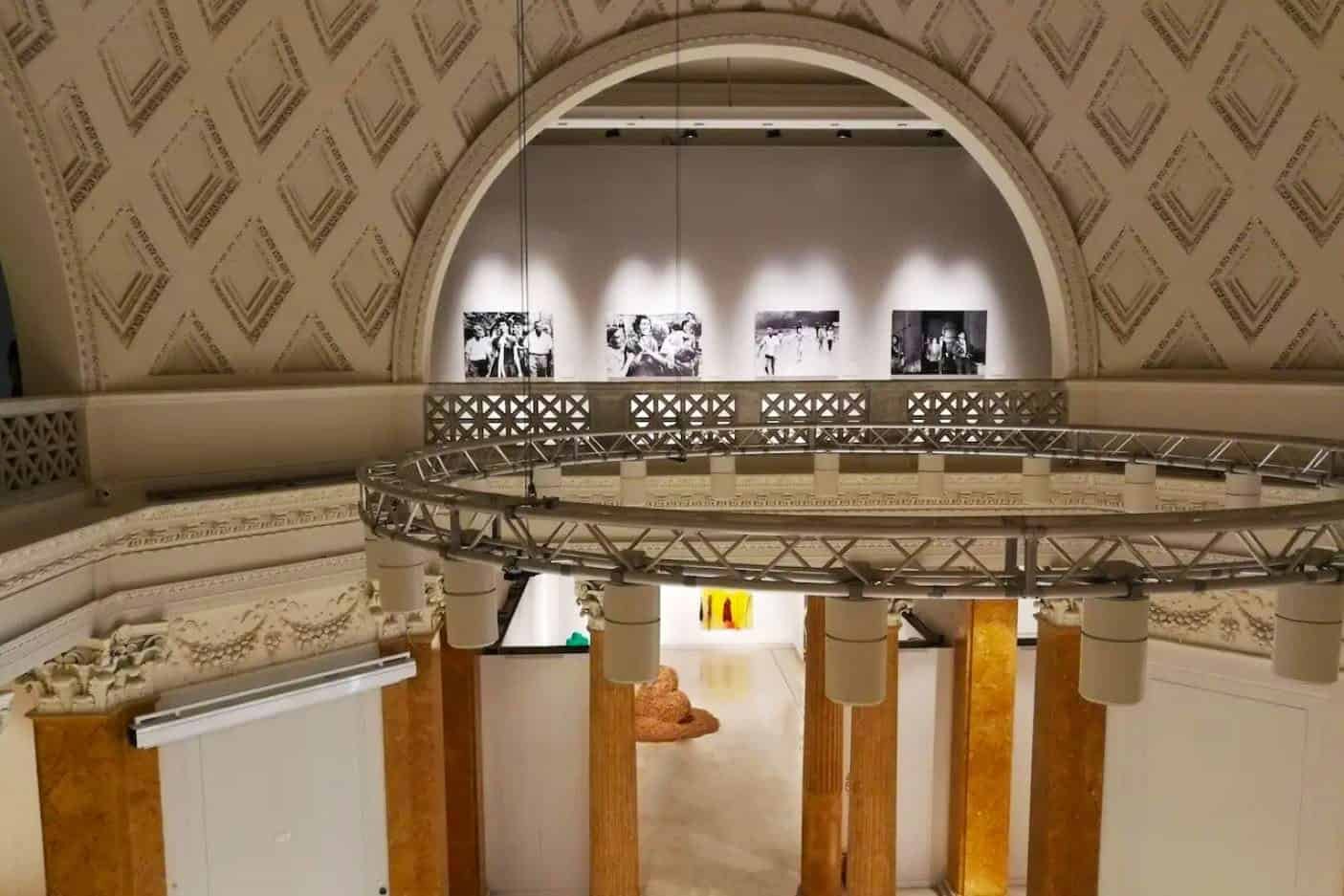
The Palazzo delle Esposizioni is at Via Nazionale 194, 00184 Rome, on the upper stretch of the street that climbs from Trajan's Forum toward Piazza della Repubblica, with secondary entrances at Via Milano 13, 15 and 19 and the one on Via Piacenza, which serves the cinema, the auditorium and the restaurant. You get there by Metro A, getting off at Repubblica, or by Metro B, stopping at Cavour: from both it's less than 10 minutes on foot. On the surface, lines 64, 70, 71, 117, 170 and H stop in front of the portico, at the Nazionale/Palazzo Esposizioni stop. If you arrive at Termini, take one of these buses from Piazza dei Cinquecento and get off after four stops in the direction of Piazza Venezia. The hours are Tuesday to Sunday from 10:00 to 20:00, with last entry at 19:00. Monday is the closing day, and in 2026 the summer closure covers August 13 to 28. The switchboard is 06 696271. The ticket isn't a single one: it changes from exhibition to exhibition, some shows are free admission and sales go through the CoopCulture circuit, so it's best to read the updated price on the ticket office of the official website before leaving home. The bookshop, the café and the crossing of the central axis, on the other hand, remain accessible without a ticket. It's an old choice of the house, and we'll come back to it.
This listing is part of the itinerary of the museums of Rome, where you'll also find the other exhibition venues of the city that revolve around the Quirinale and Via Nazionale.
What the Palazzo delle Esposizioni Really Is
It's best to clarify this right away, because it's the source of half the misunderstandings: the Palazzo delle Esposizioni is not a museum. It doesn't own a permanent collection, it doesn't have rooms with fixed works to see again every five years and find them unchanged. It's an exhibition machine, a Kunsthalle, a container designed in 1880 to fill up and empty out. What you see today won't be there in six months. Whoever walks in expecting the Galleria Borghese leaves disappointed. Whoever walks in knowing that inside there's a permanent cultural construction site leaves with the feeling of having seen the city at work.
The dimensions help to understand the scale of the thing: about 10,000 square meters in total, of which more than 3,000 are given over to exhibition rooms, spread across three levels connected by monumental stairs, side staircases and elevators. Inside there are a Sala Cinema, an Auditorium, the Forum, an art workshop for education, a reading space, a specialized bookshop, a café and a restaurant set under the glass vault of the Serra. It's the building that in Umbertine Rome invented the job of hosting contemporary art on a continuing basis, and it's still the one that does it with the widest programming: ancient painting and video installations, photojournalism and archaeology, science and cinema, often in the same quarter and under the same roof.
The official formula defines it as the largest interdisciplinary exhibition space in the center of Rome, and for once the official formula doesn't exaggerate. From 1883 on, Rothko and Kubrick have been through here, De Chirico and Calder, Mario Ceroli and Bill Viola, the American avant-garde and the painters of socialist realism, the National Geographic photographers and Robert Doisneau, Mimmo Jodice and Helmut Newton, the reportage that fixed the Mexican Revolution and the Prague Spring. No other Roman address has a list of visitors as disordered and as instructive.
How to Get to the Palazzo delle Esposizioni
By Metro and on Foot
The two useful stops are Repubblica on Line A and Cavour on Line B. From Repubblica you take Via Nazionale and walk down a slight descent for about 700 meters: the palace appears on the left, recognizable by the deep arch of the portico and the row of statues on the balustrade. From Cavour you climb Via Cavour up to Largo Visconti Venosta and cut across on Via Panisperna, a steeper but more beautiful route, which goes through the real Rione Monti, the one of workshops and crooked alleys. Unsolicited advice: if you have time, get off at Cavour even when it's less convenient, because arriving at the Palazzo from the bottom of Monti means seeing it emerge above the rooftops instead of finding it right on top of you.
By Bus and by Car
The de facto terminus is the Nazionale/Palazzo Esposizioni stop, served by lines 64, 70, 71, 117 and 170 and by the H. The 64 is the line that connects Termini to St. Peter's by way of Corso Vittorio: it's the most frequent and also the most crowded, so keep your backpack in front of you. The 117 is a small electric line that slips into the historic center and is the most civilized way to reach the palace from Via del Corso. By car, simply don't come: Via Nazionale is a through road with no possible parking, the Umberto I tunnel unloads traffic right under the staircase and the Tridente Limited Traffic Zone is a couple of steps away. If you absolutely must arrive by car, leave it in the surface parking lots of the Termini area and do the last few minutes on foot.
The Entrances of the Palazzo delle Esposizioni
The monumental entrance is the one at Via Nazionale 194, under the arch, at the top of the staircase. But the palace has other entrances worth knowing, because they're free of architectural barriers and often quicker: Via Milano 13 leads to the exhibitions, the events, the Laboratorio d'arte, the Forum, the Scaffale d'arte and the café. Via Milano 15 and 19 serve the bookshop and the café. Via Piacenza is the door to the cinema, the auditorium and the restaurant. Non-slip metal ramps connect the small differences in level at Via Milano entrances. A detail nobody ever mentions: the back on Via Milano is the operating facade of the building, the one through which the works, the catalogs and the staff come in, and walking around it before going in helps you understand the layout of the palace better than the front photograph does.
Hours, Tickets and Free Entrances at the Palazzo delle Esposizioni
Hours of the Palazzo delle Esposizioni
Tuesday to Sunday, from 10:00 to 20:00, with entry allowed until one hour before closing. On Monday the palace is closed, except for extraordinary openings on holidays or on the last days of an exhibition, which are announced case by case. In summer 2026 the break is from August 13 to 28. In practice, the evening schedule is the real gift: at 18:00 on a Tuesday in November the rooms of the monumental floor are almost empty, and the artificial light from the movable ceiling fixtures designed by Michele De Lucchi gives the works a rendering that you don't get at 11:00 in the morning, with full zenithal light.
How Much Does a Ticket to the Palazzo delle Esposizioni Cost
Here the honest answer is that it depends. The Palazzo delle Esposizioni doesn't have a fixed ticket like a civic museum: each exhibition has its own admission ticket, some photographic and documentary shows are free entry, other major exhibitions have a full and a reduced price, and it happens that two exhibitions running at the same time are bought with a combined ticket. Online sales go through the CoopCulture circuit and the updated price list is on the ticket office page of the official website, together with the discounts for young people, seniors, groups and schools. If you come to the house more than twice a year, do the math on the membership options, which exist in individual, double, junior and senior versions, and which pay for themselves quickly: the card also gives discounts at other institutions, from the MAXXI to the Fondazione Palazzo Strozzi in Florence, from the MART of Trento and Rovereto to Palazzo Grassi and Punta della Dogana, as well as discounts at a long list of Roman theaters and at the Casa del Cinema.
What You Can See Without a Ticket
This is the part almost nobody takes advantage of. The crossing of the central axis, from the monumental entrance to the rear wing, has been made accessible without paying since the years of the first autonomous management, and it's a choice that descends directly from Piacentini's idea of a building that could be looked at and looked through "from the street toward the inside and from the inside toward the street." It means you can walk in, climb the grand staircase, look out over the Rotonda, have a coffee, buy a catalog and leave without having spent a euro on a ticket. It's not a trick: it's the layout of the palace itself. If you have a free half hour in the center and want to understand how a nineteenth-century exhibition building is made, here is the cheapest lesson in Rome.

Rome as Capital, Via Nazionale and the Birth of the Palazzo delle Esposizioni
Why Via Nazionale
To understand where we are, we have to go back to 1874, when the new railway station was completed, designed by Salvatore Bianchi. Rome had been the capital for only four years and had a big logistical problem: whoever arrived by train got off in an outlying area compared to the historic city, and there was no axis to bring them in. Via Nazionale was born to solve that problem. Its route was laid out in relation to Piazza Esedra, then called Piazza delle Terme, which Gaetano Koch designed between 1886 and 1890, taking up the curve of the exedra of the Baths of Diocletian: a nod to the ancient that Michelangelo had already proposed three centuries earlier by building Santa Maria degli Angeli inside the frigidarium. From the great square, a monumental place of welcome for those stepping off the train, Via Nazionale led to Piazza Venezia and so into the historic city.
On this axis, and not elsewhere, the City decided to plant the building that was to represent the cultural vocation of the capital. The urban planning choices of those years, the placement of the representative buildings, the results of the competitions, provoked a heated debate: the task was to build a modern city inside a very complicated urban fabric, where every decision risked opening an irreparable rift. Mayor Luigi Pianciani put the question in writing in 1882 with a sentence that is still valid today: "Rome is the first museum in the world, but it is not a capital that satisfies the needs of the present. It is not a municipality to administer, it is the greatest of the ancient metropolises to respect, a modern metropolis to create."
The Two Competitions for the Palazzo delle Esposizioni
The first call came out in 1876 and was so vague that today it would make your arms drop: it didn't set the area, left to the free choice of the designers, and it didn't state the amount allocated. It said only, as to size, that "the building for the aforementioned national Exhibition shall occupy, on an area to be designated, the space of 4,000 square meters, shall have only two floors and shall possibly be surrounded by gardens." With those indications 40 designs arrived, exhibited at the Collegio Romano. Someone proposed building the palace at Piazza del Popolo.
A little more than a year later the City announced a second competition, this time indicating Via Nazionale area as the most suitable for the representative character of the building. The designs submitted were 74. After much controversy and quite a lot of indecision within the jury, Pio Piacentini won. He had submitted his entry under the motto "Sit quod vis simplex et unum", let what you want to make be simple and unified. The motto, taken from Horace, was a declaration of war on rampant eclecticism, and in fact it was precisely that choice that set off the fiercest press campaign.
Who Pio Piacentini Was
Piacentini was born in Rome in 1846 and trained at the Accademia di San Luca, of which he would later become president. From that school he had absorbed the purist tendency that had dominated the city under Pius IX: attention to drawing, measure, rejection of redundant decoration. Like many Roman architects of his generation, heirs to a solid academic culture, he took more care over the design than over the urban context the building would end up in. In the case of the Palazzo delle Esposizioni, though, the context was impossible to ignore: the space was tight, the margin of access from the street limited, the difference in level with Via Nazionale accentuated by the lowering of the roadway for the construction of the tunnel. Piacentini realized this and for years looked for solutions that were never approved. His is a name that many Romans today know only through his son, Marcello Piacentini, the architect of Via della Conciliazione and the Città Universitaria. The father deserves to be remembered in his own right, and this building is the reason.
Work began in 1880. The plaque on the front records the year 1882 with the formula "IN THE REIGN OF UMBERTO I THE CITY OF ROME BUILT FOR AN EXHIBITION OF FINE ARTS, WITH THE STATE AND PROVINCE CONTRIBUTING, IN THE YEAR MDCCCLXXXII." The opening to the public, however, took place on January 21, 1883, with a solemn ceremony in the presence of the king, and that is the date the palace celebrates as its own.
The Facade of the Palazzo delle Esposizioni
The Arch, the Portico and the Question of the Windows
Seen from Via Nazionale, the building presents itself as a compact mass pierced in the middle by a deep arched opening, a habitable triumphal arch. The monumental effect is all concentrated there: the upper floor sets back, the side elevations stay closed and rhythmed by pilasters, the solid surfaces far outweigh the voids. Compared with the other 73 designs submitted to the competition, Piacentini's was the least eclectic: the classicist tradition, that is the triumphal arch, the division of the outer walls into pilasters, the centrality and symmetry of the interior spaces, was cooled by the search for an international style rather than a national one.
That was precisely what set off the brawl. "A building without windows" became the slogan of the newspaper controversy, and the accusation of having given in to French influence instead of adhering to an Italian style split the jury itself. The problem of style was the sore spot of the architectural debate of the time: the search for a national style mostly coincided with the revival of historical styles, where classicism was no longer the exclusive reference. The criticisms, however, missed the technical point. The lack of windows was not a whim: it served to create inside continuous surfaces, walls to hang things on, that responded as fully as possible to the needs of exhibiting. The light came from above, through the iron and glass roofs, and zenithal light was exactly what in the nineteenth century was considered the most suitable for looking at paintings. Piacentini was right and the critics were wrong: it's rare to be able to say so with this much certainty 140 years later.
The Statues and the Staircase of the Palazzo delle Esposizioni
The statues that now distinguish the facade were placed in the late 1880s, so after the inauguration, but they answered a decorative intention that the architect had planned from the design stage. The authors are Roman academic sculptors, Cencetti, Biggi, Aureli, Trabacchi, Ferrari, Galletti and others, and the subjects are just as academic: at the top Art supported by Peace and Study, on the four pillars of the portico Architecture, Sculpture, Painting and Industrial Art, along the balustrades 12 artists of the past. It's worth stopping a minute on that fourth allegory of the portico: in 1883, putting Industrial Art next to the three major arts was a statement, the recognition that design applied to production had the same dignity as easel painting. It was the language of the great universal expositions, and it's the reason this building is called Palazzo delle Esposizioni and not Palazzo delle Belle Arti.
The staircase, on the other hand, is the remnant of a lost battle. Piacentini was obsessed with the problem of the connection between the building and the outside spaces: the available space was cramped and sacrificed the monumental character of the design. He tried three ways. The first was to take apart the church of San Vitale and rebuild it inside a garden, so as to free up an open space around the palace. The second was to realign the church with the street axis and bring it to the same level as the Palazzo. The third, the most beautiful, was to devise an access staircase with a double ramp that would embrace the base of the building with an almost Baroque movement, to remedy the isolation accentuated by the lowering of the street. None of the three passed. The architect was left to build two further levels of the outer staircase, and that is what we climb today. When you sit on the steps, as everyone does on mild afternoons, you're occupying the monument to a rejected project.
The Church of San Vitale Below Street Level
A few meters from the palace, on the opposite side and below, is the church that Piacentini wanted to take apart: San Vitale, of early Christian foundation, consecrated in 402 under Pope Innocent I. Today its churchyard sits several meters below street level, at the bottom of a narrow stair, because Via Nazionale was built at a much higher elevation than the ancient one. It's the quickest way to realize how much the nineteenth century raised this part of the city, and it explains better than any drawing why the Palazzo delle Esposizioni has that base and that staircase. Look at the two things together and you'll understand the whole urban planning problem that Piacentini carried with him for 20 years.
The Rotonda and the Interior Layout of the Palazzo delle Esposizioni
Six Rooms That Converge
The interior is the part that surprises first-time visitors. The monumental floor is organized on a simple and rigorous principle: six large rooms converge on the central Rotonda, and the two halves of the building are mirror images, so the route can be read continuously, both horizontally and vertically. The stately character is recognized above all in the decorative elements, the stuccoes, the coffered ceilings, the marmoridea that covers part of the colonnade. Marmoridea is a nineteenth-century faux stone, a polished mixture that imitates marble: look for it on the columns and run your hand over it, because it's a material that has almost been lost and that the restoration recovered with patience.
Costantino Dardi, the architect who a hundred years later brought the palace back as close as possible to the original design, described this interior space as a space "above all marked by the theme of visibility: looking and looking through appears as a constant objective of the design, from the street toward the inside and from the inside toward the street, from top to bottom and from bottom to top, from the stairs to the rooms and from the rooms to the stairs, first opening the gaze to long views and then screening these with frames, borders, panels, screens that in some areas turn the luminosity of the palace to semi-darkness." It's the most exact definition ever written about this building, and it's worth keeping in mind as you walk: almost every point in the palace is a point from which you see another point of the palace.
The Glass Serra and the View Toward the Quirinale
At the back, originally, the building was covered by a wide iron and glass vault. It was a transparent space that, in Piacentini's intentions, was meant to reconnect the interior with the outer gardens toward the Quirinale: a winter garden inside an exhibition palace, an idea entirely nineteenth-century and at the same time entirely modern. That vault was demolished in 1930, as we'll see, and rebuilt in a contemporary key in the construction site of the early 2000s. Today the Serra is a space of about 2,000 square meters in total, designed in a bioclimatic way with current technologies and materials, and it houses the palace's restaurant. Whoever goes up there on a winter evening, when the glass reflects the lights of Via Milano, understands what Piacentini had in mind 140 years ago.
The Palazzo delle Esposizioni Room by Room: The Visiting Route
Level 0: Spazio Fontana, the Bookshop, the Café, the Laboratorio d'arte
You enter from below more often than you'd think, because the entrances on Via Milano lead directly to the lower level, the one created in 1930 when the greenhouse was demolished and a floor slab was built. Here today are concentrated the welcome functions and the commercial and educational activities: the bookshop, which is a specialized art center with dedicated merchandising. The café. The Scaffale d'arte. The Forum, a multipurpose room that hosts meetings, presentations and screenings. The Laboratorio d'arte, the heart of the educational programs for families and schools. At the center is Spazio Fontana, the space that gives its name to that part of level 0, equipped with seating and used as a rest and orientation point: if you have an appointment inside the palace, set it there, because it's the only place everyone finds on the first try.
The rooms of this level have had an exhibition history of their own, and an important one, which we'll tell further on when talking about the Project Rooms. For now it's enough to say that these are the spaces where the palace has hosted its most experimental research, and that whoever goes straight up to the monumental floor without taking a look down here usually misses the liveliest part of the programming.
Level 1: The Monumental Floor and the Rotonda of the Palazzo delle Esposizioni
This is the floor of the big exhibitions, the one with the six rooms around the Rotonda, the stuccoes, the coffers and the skylights. Historically the most demanding exhibitions of ancient, modern and contemporary art have been staged here, often interdisciplinary, often with a variety of materials that runs from paintings to archive documents to films. The Rotonda is also the place where curators stake the opening of the exhibition: being the visual fulcrum of the entire building, the work placed inside it automatically becomes the cover of the show. Look at it from above, leaning out from the inner balconies, and then come back to look at it from the center: they're two different buildings.
One observation: the Rotonda has difficult acoustics and on crowded days it becomes a reverberation chamber. If you need to listen to an explanation, ask the guide to give it in one of the side rooms and to use the Rotonda only as a junction. The palace is designed to be walked through, not to be listened to standing in the center.
Level 2: The Large Rooms, the Small Rooms and the Annular Space
The upper floor is ideally divided into two zones. The larger rooms have housed the monographic exhibitions and those built around a precise thematic core, like "The Face of Christ," organized for the Jubilee of 2000. In the smaller rooms, which often extend into the annular space linking the two parts of the building, photography programming has been concentrated with exceptional continuity. That annular space is the best-kept secret of the building: it's a curved, narrow corridor, with a light different from everything else, and the photography exhibitions mounted there have a reading rhythm that no rectangular room allows. If the palace has a photography show on, start there and not in the large room.
At the foot of the grand staircases and in the small side rooms of this level, like in the Rotonda on the floor below and in Spazio Fontana downstairs, seating has been placed: the palace has worked a lot on rest points, and whoever visits with elderly people or small children would do well to mentally map these three stations before starting.
The Sala Cinema of the Palazzo delle Esposizioni
Among the three equipped rooms created in the construction site of the 2000s, the Cinema, the Auditorium and the Forum, the first is the one that changed the city's relationship with this address. The palace states a capacity of 139 seats for the Sala Cinema and 90 for the Auditorium. Both have two spaces reserved for wheelchair visitors in the front row, and are reached directly from Via Piacenza entrance. The programming is not that of a commercial theater: retrospectives, auteur series, screenings tied to the exhibitions on view, documentaries on art, film restorations, meetings with directors. It's the direct heir of that "multimedia room" and that "small, well-equipped theater space" that Costantino Dardi wanted in the 1980s in the line of a multidisciplinary activity, and it's the reason the Palazzo delle Esposizioni can stay open in the evening even when the exhibition rooms have closed.
A firm opinion: the Sala Cinema on Via Nazionale is the most underrated in Rome. It has a program that holds up against that of the Casa del Cinema in Villa Borghese and against the Palazzo's own series, low prices, comfortable seats and a location that lets you leave at 23:00 and find yourself in 10 minutes at Piazza Venezia. If you have to pick a single reason to sign up for the palace's membership, this is it.
The Scaffale d'arte, the Study Room and the Reading Room of the Palazzo delle Esposizioni
On level 0, next to the café, the palazzo keeps a function that few visitors know about: a reading and consultation point dedicated to art books, the Scaffale d'arte, and a study room equipped with 24 workstations. It's not a conservation library, with storage stacks and interlibrary lending. It's a consultation and working space, meant for people who want to read a catalog before or after the exhibition, for students preparing a contemporary art history exam, and for anyone who needs three hours of silence in the center. 24 workstations are not many, so during university exam periods they fill up early.
Anyone looking instead for a real library within a 10-minute radius will find it a little farther down, toward the center. And anyone who wants to see what a historic Roman reading room looks like should make a detour to the Biblioteca Angelica, which is another planet altogether and is worth the trip. But for the specific job of sitting down with a catalog you just bought, the space on level 0 of the Palazzo delle Esposizioni can't be beaten, because you bought the catalog 10 meters away.
The Bookstore and Restaurant of the Palazzo delle Esposizioni
The bookshop
The bookstore is a center specialized in art, with a stock that goes well beyond the catalogs of current exhibitions: architecture, photography, design, theory, catalogues raisonnés, international magazines, plus dedicated merchandising. You can enter without a ticket from the entrances at Via Milano 15 and 19. It's one of the few art bookstores in the Historic Center that still keep a serious selection instead of three shelves of gadgets, and it justifies a stop on its own. Practical tip: catalogs of past exhibitions stay on sale and often drop in price, so if you liked an exhibition and didn't buy the volume, come back six months later.
The restaurant under the Serra
The restaurant occupies the space of the rebuilt Serra, the glass volume designed by Paolo Desideri in the construction project of the early 2000s, and it is sized for a number of seats that the house's sources have given in ways that don't always agree, around 250 people. What matters for the visitor is that it's a space under a transparent roof, with a view over the city toward the Quirinal, reachable from the entrance on Via Piacenza even without having visited any exhibition. The café, more informal, is on level 0 and serves quick lunches. Survival rule: on the opening days of a big exhibition the café jams up between 13:00 and 14:30, so either you eat at 12:15 or you wait until 15:00.

The Amatori e Cultori, the Roman Secessions and the First Exhibition Seasons
From the year after the inauguration and for over three decades, the Palazzo delle Esposizioni was the permanent home of the exhibitions of the Società degli Amatori e Cultori di Belle Arti, an association founded in 1829 that brought together the artists considered most representative among those active in Rome, along with figures of power, nobles, patrons, intellectuals and academics. It was a society born in the climate of papal Rome, of conservative culture, aimed above all at the Roman art scene, even though it had been supported by figures of European stature such as Bertel Thorvaldsen and Horace Vernet, and had King Ludwig of Bavaria as honorary president.
The result was that the exhibitions on Via Nazionale reflected an extremely conservative vision, more conservative than that of other Italian venues, and that Rome lacked the international showcase function that the Venice Biennale, born in 1895, took on a few years later. It's the great missed opportunity of modern Roman art, and it's worth saying so plainly: the palazzo was there, the opportunity was there, the culture that governed it was not up to it.
An attempt at updating came with the four editions of the Esposizione Internazionale d'Arte della Secessione, held here from 1913 to 1916. The aim was to document, albeit belatedly, what was happening abroad and the work of the artists who in Italy drew on a diffuse modernism, from painting to sculpture to architecture to the applied arts. In Rome, in fact, there had been no sense of that phenomenon of deep renewal of taste and forms of expression that in France, Germany and Austria had gone under the name of Secession. The four Roman exhibitions remain the moment when the city tried to catch up, and the closing date, 1916, says by itself why the experiment stopped.
The Quadriennali at the Palazzo delle Esposizioni
The 1927 Resolution and the First Quadriennale of 1931
In 1927 the Governorate of Rome resolved to establish the National Art Quadrennial Exhibitions, based at the Palazzo delle Esposizioni. The first show was supposed to open on March 1, 1931. The same resolution, besides the members of the organizing committee chaired by the governor, with representatives of the Academy of Saint Luke, the Society of Amateurs and Connoisseurs, the International Artistic Association and artists appointed by different institutions, defined the funding: 250,000 lire per year, so a million for each edition. It also provided for the creation of prizes and a significant sum to be set aside for the purchase of works for the National Gallery.
The first Quadriennale, with Cipriano Efisio Oppo as secretary general, opened even early, on January 3, 1931. The works were selected by two juries of artists, one appointed by the organizing committee and the other by the exhibitors' representatives. The first prizes went to Arturo Tosi and Arturo Martini. The most important retrospectives were dedicated to Medardo Rosso, Armando Spadini and Antonio Mancini, who had died recently. The show, which Mussolini called historic, had over 200,000 visitors.
The 1930 Construction Site: The End of Piacentini's Greenhouse
To host the Quadriennale the palace had to be renovated, and the work began in 1930. The chronicles of the time and the commission's minutes say that it was necessary to increase the exhibition rooms, build the elevators, modify the skylights and install a heating system able to regulate an indoor climate that was too cold in winter and too hot in summer. It was then that it was decided to tear down the glass greenhouse, dismissed as an "ugly and expensive railway station canopy". Those in charge were Enrico Del Debbio and Pietro Aschieri: to the first are due the demolition of the greenhouse and the construction of a floor slab, which created on the floor below another six exhibition rooms around a central space, taking up on a smaller scale Piacentini's layout and restoring that symmetry that characterized the entire project.
Aschieri's installation canceled the monumental effect of the building, seeking a rational, sober and elegant balance in which the works would have precise visibility. The architect Luigi Piccinato commented on it in Domus in March 1931, writing that Aschieri and Del Debbio had "brought the great halls of Via Nazionale back to life. By proportioning the rooms, arranging partitions, softening the lights, attenuating the shadows, the great phalanx of paintings has come to be orderly and enhanced in a calm, simple, dignified and restful environment. In the representative spaces, that is in the Vestibule, the Winter Garden, the stairs, the corridors, where the neutral tone was no longer needed, they were able to freely do architecture". The judgment was so favorable that it confirmed the palace's definitive destination as the home of the Quadriennali.
The Exhibition of the Fascist Revolution of 1932
The most sensational episode of those years was the Exhibition of the Fascist Revolution, promoted by the National Fascist Party for the tenth anniversary of the March on Rome and opened on October 28, 1932. The preparatory work was submitted for Mussolini's approval, and he called it the sacred and solemn documentation of the genesis, developments and goals reached by Fascism. The purpose was exclusively propagandistic and celebratory. But it was also an extraordinary event of exhibition design, and this is the point that makes the story uncomfortable and instructive at once. The catalog reads that "to the monumental character of the exhibition a manner of architecture, let's say, scenographic, suited to evoking the atmosphere of the times, all fire and fever, tumultuous, lyrical, resplendent, could not but be fitting": words still crossed by the Futurist climate.
Top-level artists and architects worked on the layout: Marcello Nizzoli, Achille Funi, Mino Maccari and above all Mario Sironi on one side, Giuseppe Terragni, Adalberto Libera and Antonio Valente on the other. The outer facade, designed by Mario De Renzi and Adalberto Libera, completely erased Piacentini's front behind four metal lictor fasces 25 meters high. This is the reason why, in the photographs of the 1930s, the Palazzo delle Esposizioni looks like another building: the 19th-century facade was temporarily masked more than once, also for the Augustan Exhibition of Romanità, because Piacentini's style was considered out of step with the times. The exhibition was supposed to be moved permanently to the Palazzo del Littorio, which was never built, and so it stayed on here for about two years.
From the Second to the Fourth Quadriennale, 1935-1943
The second edition had to be organized in a very tight time frame and opened on February 5, 1935, with the installation by Pietro Aschieri and Eugenio Montuori. It was then that Piacentini's facade was brought back to light, and in the colonnaded atrium they limited themselves to a sober access portal. Inside, the covering of the central Rotunda, the canopies of the roofs and the three shades of gray of the exhibition walls created an almost metaphysical atmosphere, within which 1,800 works were placed, between painting, sculpture and black and white. Many were the solo shows, among them the one dedicated to Scipione, who had died two years earlier. The presence of the artists of the Roman School was decisive: Mario Mafai had a room with 29 works and was awarded a prize for Piano Lesson.
In 1937 a royal decree turned the National Quadrennial Exhibition of Art of Rome into an autonomous body with its own statute, signed by the minister of national education Giuseppe Bottai. The third edition, opened on February 5, 1939, was therefore run directly by the body, under the supervision of the Ministry of National Education and the Ministry of Corporations. Applying the racial laws issued the year before, the ministries imposed very strict oversight and documentation on the origins of every artist, with the compilation of personal files. It was a confused show, heavily compromised by political interference, which also reflected a real crisis in the artistic field. The installation was by Mario Paniconi and Giulio Pediconi, cared for in the details, with an increase in the number of rooms and great attention to the visibility of the works. The presence of Giorgio Morandi was important, as was the section dedicated to Futurist aeropainting and aerosculpture.
The fourth edition opened in May 1943, in the middle of the war, and was the last directed by Cipriano Efisio Oppo. It was a much reduced edition, with only a part of the rooms used, installed by the architect Ernesto Puppo and the engineer Alessandro Mangioni. The presence of the works of Enrico Prampolini and the Futurist painters was significant, while the major prizes went to Gianni Vagnetti and Giacomo Manzù. At the end of the war the palace was occupied by the food rationing offices and the Autonomous Quadriennale Body was placed under a commissioner. In a hungry city, the building of the Fine Arts became a warehouse of ration cards and rations: anyone who wants to understand Rome in the 20th century has in this sentence everything they need.
The Postwar Period and the Great Exhibitions of the 1950s and 1960s
The Reconstruction of the Building and the Sixth Quadriennale
The postwar years were a time of intense recovery for Roman culture: the shows of the Galleria Nazionale d'Arte Moderna, the initiatives of the private galleries, the formation of trend groups, the clashes between abstract and figurative artists made Rome, in the 1950s, an international city and a destination for foreign artists. The Palazzo delle Esposizioni, however, had been left out of the game: the most diverse occupations had made it practically unusable, so much so that the first postwar Quadriennale had to be organized at the National Gallery under the direction of the commissioner, the sculptor Francesco Coccia.
After the Reconstruction Exhibition promoted by the Ministry of Public Works in 1950 and the reconstitution of the Quadriennale body with the appointment of Fortunato Bellonzi as secretary general, work began on restoring the building. The restoration of the rooms and the installation of the show were entrusted to the engineer Giacomo Maccagno, an employee of the City of Rome, and to the architect Adolfo Bobbio, while Mario Bellina took care of the arrangement of the bar and the reception rooms. The stuccoes and plasters were redone, the floors restored, the central Rotunda freed, the systems overhauled, the skylights darkened with canopies and the exhibition surfaces increased with many movable partitions, which were later reused for other shows. The sixth Quadriennale opened on December 18, 1951, with many retrospectives, among them the one on Modigliani curated by Jean Cassou.
European 17th Century, the 18th Century in Rome, Mexican Art
In the 1950s the palace hosted two shows that today would simply be unrepeatable. The first was European 17th Century, promoted by the Council of Europe between November 1956 and February 1957: for size and for the importance of the loans from museums around the world, no institution in the world could put it back together today, with current insurance and conservation criteria. The second was The 18th Century in Rome, in 1959, which gathered 2,600 works, among them 600 paintings, besides sculptures, goldsmith work, furnishings and the most varied testimonies of the cultural life of the century.
In 1962 another exceptional event arrived: Mexican Art from Antiquity to Today, open between October 1962 and January 1963, a vast documentation of the pre-Columbian cultures and of Latin American Baroque, with the contemporary artists on the upper floor, from Diego Rivera to David Alfaro Siqueiros to José Clemente Orozco to Rufino Tamayo to Frida Kahlo, together with craft production. With that show an excellent cycle came to a close in terms of exhibitions, because in the 1960s the palace's activities, the Quadriennali aside, shrank to an accumulation of very modest initiatives.
Seventh, Eighth and Ninth Quadriennale
The seventh Quadriennale, in 1955, was played entirely on the controversy between abstractionists and realists, with sharply contrasting critical positions. At the center of the exhibition an important core of paintings and sculptures reconstructed the panorama of Italian art from 1910 to 1930. Among the many retrospectives were the one on Alberto Savinio curated by Giorgio de Chirico and the one on Atanasio Soldati curated by Nello Ponente. About 3,000 works between painting, sculpture and black and white: in the judgment of many, the best of all the postwar editions.
The eighth was held between December 1959 and April 1960, installed by the architects Melis and Clerici, and revolved around a show dedicated to young Roman painting from 1930 to 1945 curated by Giorgio Castelfranco and Emilio Lavagnino. The invitation committee was harshly challenged by a large group of artists tied to abstract and informal research, among them Emilio Vedova, Giulio Turcato, Leoncillo, Alberto Burri, Piero Dorazio, Afro and Umberto Mastroianni. To rebalance the heated climate contributed the retrospectives of Giacomo Balla curated by Enzo Francia, of Osvaldo Licini curated by Giuseppe Marchiori, of Enrico Prampolini curated by Vittorio Orazi and of Luigi Spazzapan curated by Fortunato Bellonzi and Renzo Romero.
The ninth opened in October 1965 with an installation by Mario Melis: retrospectives of Morandi, Mafai, Sironi, Casorati, Donghi, Fortunato Depero, Romagnoni and Tancredi, and at the same time the latest trends in research, from the new Roman situation of Franco Angeli, Tano Festa and Mario Ceroli to kinetic art. Among the prizewinners were Mirko, Alberto Viani, Turcato and Perilli.
The 1970s: Vitality of the Negative and the Season of Renato Nicolini
For over a decade the Palazzo delle Esposizioni became the home of some of the most important shows in Italy, with an exhibition project that aimed at continuity in the use of the spaces and at programming decided largely by the City of Rome. The first initiative, and the most memorable, was Vitality of the Negative in Italian Art 1960/70, curated by Achille Bonito Oliva with the International Art Encounters. It was not a sterile reconstruction of a decade: it told how, from the crisis of the historical languages and the variety of procedures, new poetics founded on the vitality of the creative act had been born. The phrase with which Bonito Oliva summed it up has endured: "Art stops being the zone where forms and the exemplarity of the artistic experience are hoarded, to become instead a dark zone without any certainty". Inside were Roman pop, conceptual art, happenings and body art, the materials of the minimalists, kinetic art and the recent experiences of arte povera.
The 10th Quadriennale began in November 1972 and developed in five sections spread out until July 1977: Aspects of Contemporary Figurative Art and New Image Research, The Situation of Non-Figurative Art, Aesthetic Research from 1960 to 1970, The New Generation, Foreign Artists Working in Italy. The first two sections were accompanied by historical reconstructions, The Line of Figurative Research in Italy from the Verismo of the Late 19th Century to 1935 and Lines of Non-Figurative Research in Italy from 1930 to 1965, the latter coordinated by Nello Ponente.
Alongside the shows of ancient art, among which Civilization of Early Latium from 1976 should be remembered, the City chose to devote attention to the most interesting aspects of 20th-century culture: the great retrospectives of Turcato in 1974, of Man Ray in 1975, of Savinio in 1978, and the investigation into the European avant-gardes with Mayakovsky Meyerhold Stanislavsky in 1975, installed by Maurizio Di Puolo according to a rereading of Constructivist modules that projected outside the palace, and with the show on the theater of the Weimar Republic in 1978. They were interdisciplinary shows, which made it possible to exploit all the potential of the spaces with performances, conferences, musical performances and screenings: during the show on the Polish avant-garde Tadeusz Kantor previewed here his production Où sont les neiges d'antan.
Renato Nicolini, then city councilor for culture and inventor of the Estate Romana, described the lines of those years this way: "At the center of the programs carried out then there had to be two big questions: the fate of the avant-garde and the intellectual function, in the twentieth century. Naturally the point was not to add ideology and interpretations to those that already existed, but to document what was known only partially". With the same aims came Linee della ricerca artistica in Italia 1960-1980, curated by Nello Ponente, holder of the chair of contemporary art at the University of Rome, who died during the preparation of the exhibition: a very broad documentation of the visual arts, photography, musical writing, visual poetry and artists' cinema.
The architecture exhibitions, finally, reflected the desire to deepen the analysis of the formation of the contemporary city, and managed to make spectacular a subject that the public usually avoids: Funzione e senso. Architettura-Casa-Città, Olanda 1870-1940 in 1979, Vienna Rossa. La politica residenziale nella Vienna socialista 1919-1933, curated by Manfredo Tafuri, and Architettura nel Paese dei Soviet in 1982.
Costantino Dardi's Restoration and the Reopening of 1990
The turning point came by way of an accident. During the exhibition Cinque miliardi di anni. Ipotesi per un Museo della Scienza, organized with the University of Rome and set up by Maurizio Sacripanti, fragments of stucco fell. More damage followed, and it became clear that a renovation of the whole building could no longer be put off. The commission went to Costantino Dardi, and the work took up the 1980s.
The key elements of the project were four: recovering the original qualities of the palazzo by freeing it of the improper additions accumulated over a century, restoring the relationship with natural light from above, re-proposing the vertical view by reconnecting the three levels of the building, with the reopening of the two interior stairs giving access from the level of Via Milano to the monumental floor and of the interior balconies that let you perceive the spaces from top to bottom and vice versa, and recomposing that uninterrupted directionality that links the entrance from Via Nazionale to the frontage on Via Piacenza. A critical restoration, then, which however had to transform a building constructed according to nineteenth-century canons into a structure able to meet modern exhibition needs.
The work dragged on for years because of bureaucratic and financial difficulties and did not complete everything the architect had conceived, starting with the most innovative elements. The transparent, airy roof system, which also included an open-air theater, was perhaps the most fascinating part of the project: it was rejected twice by the building commission. The large light machines placed in the place of the skylights, which were supposed to grade natural and artificial light through movable frames, were built without the automatic regulation mechanisms and turned out to be entirely ineffective. What remained were the geometric design of the travertine and peperino floors, the recovery of the marmoridea cladding and of the original decorative parts, and above all the creation of a multimedia room and a small, well-equipped theater space, in line with the multidisciplinary activity that was at the origin of the project: a Kunsthalle for Rome.
The Palazzo delle Esposizioni reopened in 1990 with three simultaneous exhibitions, one per level, which immediately declared the house's new philosophy: on the monumental floor La grande Roma dei Tarquini, curated by the municipal Soprintendenza, on the upper floor Peter Paul Rubens, on the lower floor an exhibition devoted to Mario Schifano. Ancient art, past art and contemporary art in the same building, on the same day. That same year a cycle of survey exhibitions on young artists also began, which would last until its fifth edition.

The 1990s and 2000s at the Palazzo delle Esposizioni
The Roman Thread
The theme of Rome, understood as analysis of the city's culture and history, was for an entire decade the most continuous thread. In the visual arts with Roma anni '60: al di là della pittura and with Tutte le strade portano a Roma, a tribute to the city through art, photography, cinema, graphics and poetry. In historical reconstruction with Roma sotto le stelle del '44, storia cronaca e cultura dalla guerra alla liberazione, devoted to a dramatic period and, in spite of everything, culturally very lively, examined 50 years later, and with Roma 1948-1959. Arte, cronaca e cultura dal Neorealismo alla Dolce Vita, held in 2002, which through works, objects of applied art, documents and a boundless mass of photographs and films reconstructed one of the most fervid periods in the city's history. On the archaeological side, Aurea Roma documented the late antique age from imperial Rome to the advent of Christianity with over 400 finds.
The Retrospectives of Italian 20th-Century Art
In those years the palace built a line of retrospectives on the Italian masters of the 20th century that no other Roman venue has matched: Giorgio de Chirico pictor optimus in 1992, Enrico Prampolini: From Futurism to Informal Art in the same 1992, Fortunato Depero: From Futurism to the Art House in 1994, Alberto Burri: Works from 1944 to 1955 in 1996. The two Futurist shows anticipated the great Futurism 1909-1944 held here in 2001 in collaboration with the Sprengel Museum in Hanover. In 1994 Richard Long created eight installations specifically for these spaces: one of the cases in which the artist worked on the building and not inside the building.
A complete list of the shows of that period is impossible to make. From archaeology, with Lysippus: Art and Fortune in 1995 and Ulysses, Myth and Memory in 1996, to the art of the past, with Titian. Sacred and Profane Love in 1995, El Greco. Identity and Transformation in 1999 and the show dedicated to Francesco Borromini also in 1999, up to The Idea of Beauty. A Journey Through 17th-Century Rome with Giovan Pietro Bellori, installed by the architect Lucio Turchetta and curated by the Ministry of Cultural Heritage, dedicated to the classicist strand of the 17th century and its relationship with the antique. Anyone who wants to continue that conversation today will find it at Palazzo Barberini, where 17th-century Rome is permanently at home.
Two shows of those years deserve a line of their own for how they worked on materials and communication: the one by Studio Azzurro in 1999, which filled the six main rooms with interactive multimedia installations, and Le Temps, conceived by the Centre Pompidou in Paris, also built on multimedia interventions alongside works by contemporary artists.
The Quadriennali of 1992 and 1999
With the 12th Quadriennale, in 1992, the body went back to working inside the palace, after the previous edition, which fell during the restorations, had been installed at the Palazzo dei Congressi in EUR. The edition, titled Profiles, was organized in several sections: the first dedicated to only 33 artists of different tendencies, the second opened in September 1996 in two venues, the Palazzo delle Esposizioni and the Mazzoniana Wing of Termini Station, with an installation by Massimiliano Fuksas, dedicated to the latest generations. In June 1999 the 13th edition, Projections 2000. The Space of the Visual Arts in Multimedia Civilization, installed by Enzo Serrani, attempted to record all the trends under way in a show set up like a Salon, according to the definition of the then president of the body Lorenza Trucchi.
The Palaexpo Special Agency and the System the Palazzo delle Esposizioni Belongs To
In 1998 the Palaexpo Special Agency was born, the first agency at the national level dedicated exclusively to culture, with a prevalence of the visual arts. The idea was simple and, at the time, bold: to give the palace a form of autonomy that would guarantee more agile administrative management and, above all, the development and implementation of cultural programs decided inside the structure instead of in the city offices. From that moment the Palazzo delle Esposizioni has taken on a leading role in the cultural activities promoted by the city.
The Agency's perimeter has changed over the years, and it is the point on which the most outdated information circulates. Today, besides the Palazzo delle Esposizioni, the Palaexpo Special Agency manages the Mattatoio di Testaccio, the MACRO on Via Nizza and the RIF Museo delle Periferie. The Mattatoio is the former 19th-century industrial complex in Piazza Orazio Giustiniani, a short walk from the Museo diffuso del Rione Testaccio, and it is the place where the Agency's most experimental programming finds the floor space that Via Nazionale doesn't have. The Scuderie del Quirinale, which were for a long time the second leg of the system, now have a different management. The Casa del Cinema in Villa Borghese is outside the Agency's perimeter and remains tied to the palace by an agreement that gives cardholders discounts on screenings. For visitors, the practical consequence is only one and should be kept in mind: when the Palazzo delle Esposizioni announces a show, always check the venue, because it can be on Via Nazionale or in Testaccio, and those are two different neighborhoods.
The Project Rooms and Photography
Between the 1990s and the early 2000s the Agency set up two lines of work that marked the palace. The first concerned the spaces of the lower level and was called Project Rooms: shows conceived as specific projects, created expressly for that space. The series opened with an important work by the American Sol LeWitt, who covered two rooms with large surfaces of color, and continued for two years with installations by established or emerging artists. What remain in memory are Luca Vitone's intervention dedicated to the city of Genoa, the large photographic installation by Botto and Bruno and the work of Ugo Rondinone, who covered the central fountain and a wall with fragments of mirrors.
The second line instead looked at how new technologies and mass media had changed the art world: the most significant exhibition was Gravità Zero. Arte, tecnologia e nuovi spazi dell'identità, with 13 international artists. Play. Il mondo dei videogiochi moved on the same ground, reconstructing the evolution of that technique, presenting its most famous characters and directly involving the public: it was the last exhibition before the closure for restoration, and bringing video games into an Umbertine palazzo in 2002 was a choice that now seems obvious and back then was not obvious at all.
The third ground, and perhaps the most lasting, has been photography. In the smaller rooms on the upper floor the palazzo built an exhibition continuity unmatched in Rome, at the exact moment when photography was regaining a leading role internationally: the first major Mario Giacomelli retrospective, shortly before the photographer's death, Parigi+Klein, Francesca Woodman. Providence, Roma, New York, Gianni Berengo Gardin. Copyright, Herb Ritts, the exhibition devoted to Alfred Stieglitz and the photographers of Camera Work, the great reportage of the Magnum agency, with Magnum, testimoni e visionari. 1989-1999 il mondo in dieci anni di fotografia. It's the reason why, still today, when a serious photography exhibition opens in Rome, the first thing people check is whether it's on Via Nazionale.
The 2003-2007 Construction Project and Paolo Desideri's Serra
The major construction project that gave the Palazzo delle Esposizioni its present form started in 2003 under the integrated contract formula and ended in 2007. It had two cornerstones: requalifying the spaces and adapting them functionally and technologically, holding together the monumental architecture of Piacentini's building with elements of contemporary innovation.
The definitive design was developed by the architect Firouz Galdo. The executive design was carried out by Paolo Desideri, who is also the designer of the Serra, and authorship of the work is also attributed to the studio ABDR, that is Maria Laura Arlotti, Michele Beccu, Paolo Desideri and Filippo Raimondo. Michele De Lucchi was the artistic director and signed the design of the lighting, furnishings and signage. The strengthening of the structures was entrusted to the architect Paolo Rocchi and involved a long and complex campaign of surveys and deep interventions. The total cost of the renovation and strengthening work was €28 million.
The least visible technical part is the one that changed the palazzo's life: the new air-conditioning system, which brought the building in line with the international standards required by the museums lending the works. Without that, today the Palazzo delle Esposizioni would not receive a single loan from a major foreign museum, and half of the programming of the last 20 years would not have existed. To this were added enhanced security for works and visitors, intrusion and fire systems, new elevators separate for the public, for staff and for works, with a freight elevator connected to storage, customs and offices that doesn't interfere with the rooms.
On the exhibition design side, Galdo and De Lucchi wondered at length about a difficult balance: how to prevent the strong sign of the palazzo's architecture from getting confused with the exhibition design and vice versa. The answer was a system of vertical exhibition walls that lines the walls of the rooms and creates a neutral, uniform background. With that gesture the exhibition area is defined, the monument is protected from the invasiveness of temporary installations, and the exhibition design is freed from the monument's decoration. Visual comfort is entrusted to the movable ceiling panels containing the lighting fixtures designed by De Lucchi, flexible, able to give unity to the spaces and to diffuse, when needed, the natural light from the skylights. The new functional layout has also significantly enlarged the commercial spaces and created the three equipped rooms: Cinema, Auditorium and Forum.
The 2026 Exhibitions at the Palazzo delle Esposizioni
The 2026 season was opened, in the end, by the tail end of the eighteenth Quadriennale of Art, titled Fantastica, which occupied the palazzo from October 11, 2025 to January 18, 2026 together with the historical exhibition that accompanied it, I giovani e i maestri: la Quadriennale del 1935, and together with Restituzioni 2025, open from October 28, 2025 to the same date of January 18. Seeing at the same time today's Quadriennale and the reconstruction of the 1935 Quadriennale, in the same rooms where the 1935 one had really been held, is the kind of short circuit that only this building can produce.
From March 17 to July 12, 2026 the rooms hosted Marco Tirelli. Anni Luce, the major solo show devoted to one of the protagonists of the so-called Nuova Scuola Romana, an artist who works on light and geometry and who found a natural sounding board in the rooms of the monumental floor. From May 1 to July 12, 2026 ROMASUONA was held, devoted to the relationship between the city and sound. From May 7 to June 29, 2026 the World Press Photo Exhibition 2026 returned, the annual appointment with the best photojournalism in the world, which in Rome is by now a springtime custom and which every year fills the small rooms of the upper level. From July 3 to August 2, 2026 it was the turn of Revelation, photographs by Lorenzo Meloni, with free admission.
After the summer break from August 13 to 28, 2026, the calendar resumes in September: among the first events scheduled are, on Saturday, September 19, 2026, the event Nei libri di David Wiesner at 10:30 and, in the afternoon at 16:00, Rospi volanti, rape giganti e pesci robot, both tied to the programming for young audiences and to the house's long educational tradition. The rest of the autumn schedule is announced progressively on the page of upcoming exhibitions on the official website, and that's where you should check before planning the visit: this palazzo's programming changes three or four times a year by definition.
How to Visit the Palazzo delle Esposizioni
How Much Time You Need
It depends on what's inside, but an order of magnitude can be given. A single photography exhibition on the upper level is well seen in 40 minutes. A big exhibition on the monumental floor, the kind with 200 pieces and apparatus, takes an hour and a half. If the palazzo has two or three exhibitions on at once, as often happens, count on a full two and a half hours, plus coffee time. Anyone who only wants to understand the architecture, without a ticket, gets by in 25 minutes: entrance from Via Nazionale, grand staircase, Rotunda, balconies, descent to level 0, bookstore, exit on Via Milano.
The Route I Recommend
Enter from Via Nazionale, under the arch, because the portico-atrium-Rotunda sequence is the only thing Piacentini was able to build in full, and it should be experienced in the right order. Go straight up to level 2 and start from the small rooms and the annular space, which are the first to fill up. Then go down to the monumental floor for the main exhibition. Finish at level 0, with Spazio Fontana and the bookstore. On the way out, take Via Milano instead of going back through Via Nazionale: by walking around the building you see the operational back, the volume of the Serra and the real relationship between the palazzo and the fabric of Monti.
Guided Tours, Groups and Schools
The palazzo works a lot with schools and groups, and for these categories there are dedicated entry slots and special rates, managed through the ticketing circuit. Anyone leading a group should always book: on high-traffic days the rooms of the monumental floor have capped admission, and showing up as a group of 20 without notice means waiting. For families the reference is the Laboratorio d'arte on level 0, which has its own program of activities, readings and workshops, often tied to the current exhibition.
The Palazzo delle Esposizioni with Children
It's one of the places in Rome where taking children really works, for three concrete reasons. The first is the Laboratorio d'arte, which isn't a place to park them but a real educational program, with activities calibrated by age group and fixed weekend appointments. The September 2026 calendar says it well, with readings and workshops devoted to picture books and fantastical inventions. The second is the scale of the building: the rooms are large, the routes linear, the rest points with seating are three and well distributed, and a six-year-old doesn't feel caged as in an enfilade museum. The third is that you enter level 0 without a ticket, so you can try it out: go in, get a juice at the café, make a loop through the bookstore, and if the mood holds, go up. If it doesn't, you've left without paying anything.
An honest warning: not all the exhibitions in this palazzo are for children. The photojournalism shows, World Press Photo first among them, contain images of war, violence and death, and are routes it's better to spare the youngest. Check the theme before buying tickets, and if in doubt ask the reception staff at the entrance, who are constantly on duty and know exactly what is in the rooms.
Accessibility of the Palazzo delle Esposizioni
On this front the palazzo is in good shape, better than the Roman average. There are three barrier-free entrances. Via Milano 13 is for the exhibitions, events, the Laboratorio d'arte, the Forum, the Scaffale d'arte and the café. Via Milano 15 and 19 are for the bookstore and the café. Via Piacenza is for the cinema, the auditorium and the restaurant. Non-slip metal ramps connect the small differences in level at the entrances on Via Milano. Elevators connect all three main levels, so all the exhibition areas, the services and the restaurant can be reached without stairs.
In the cinema and auditorium rooms, two front-row spots are reserved for visitors in wheelchairs. The entrance is constantly staffed by reception personnel, available for assistance and accompaniment, and the intercoms at the entrances allow you to ask for support at any hour. The rest points with seating are distributed at Spazio Fontana on level 0, at the Rotunda on level 1, at the base of the grand staircases and in the side rooms on level 2, as well as benches along the exhibition routes. On the exhibition design side, the house states it pays attention to the legibility of the captions and to the positioning of works, display cases and bases so that they are visible from different heights. Anyone who needs specific information before setting out should call the switchboard, 06 696271.
When to Go to the Palazzo delle Esposizioni
The worst day is Sunday afternoon, when Via Nazionale becomes a city promenade and the palazzo gathers all the traffic of people who had no plans. The best day is Tuesday or Wednesday, late afternoon, from 17:30 on: the closing time of 20:00 with last entry at 19:00 guarantees two hours of half-empty rooms. Saturday morning right at opening at 10:00 is the second good choice.
On seasons, the palazzo has an advantage few Roman places have: it's indoors, climate-controlled to museum standards, and so it works exactly when Rome doesn't. In the middle of summer, with 40°C on the Forums, two hours in here are worth more than any stroll. The only thing to remember is the Ferragosto break, which in 2026 runs from August 13 to 28. In winter, on rainy days, it's one of the few addresses in the center where you can spend half a day without going outdoors and without spending a fortune. The period of maximum programming density is between October and January, when three exhibitions usually coexist.
What to See Around the Palazzo delle Esposizioni
Via Nazionale and the Rione Monti
The palazzo is halfway along Via Nazionale, the street that the nineteenth century opened to stitch the station to the Historic Center. Going up toward Piazza della Repubblica you meet the sequence of Umbertine buildings, the Teatro Eliseo, the porticoes, and on the right the slope of the Rione Monti opens, which begins 100 meters from the portico and is an altogether different city: alleys, workshops, little squares. In 10 minutes on foot you go down to Trajan's Markets, which close the street at the bottom and which with their Museo dei Fori Imperiali offer the exact ancient counterpart to this modern building.
The Quirinal, the Galleria Sciarra, Trevi Fountain
Going up Via Milano and then along the ramps that lead to the hill, in eight minutes you reach the Quirinal Palace and its panoramic square, with the Dioscuri and the obelisk. On the opposite side of the square are the Scuderie del Quirinale, the other major exhibition venue on the hill. From there you go down toward the Trevi Fountain in about 10 minutes, passing through the Galleria Sciarra, which is perhaps the most beautiful Liberty courtyard in Rome and which almost nobody looks at: if you find yourself at the Palazzo delle Esposizioni and have 20 minutes, that detour is the best investment of time in the area.
The Baths of Diocletian and the Termini Museums
In the opposite direction, uphill, in a quarter of an hour you reach the area of Piazza della Repubblica with the Baths of Diocletian and, a little farther on, Palazzo Massimo, that is the seat of the National Roman Museum that holds the frescoes of the Villa of Livia and the Discobolus. A bit farther, beyond Termini and inside the Santa Croce in Gerusalemme complex, the National Museum of Musical Instruments is worth the detour, little visited and surprising. Anyone looking for contemporary art instead will find at a short distance Palazzo Merulana, with the Cerasi collection, and farther north the Chiostro del Bramante, which works with the same audience as the Palazzo delle Esposizioni with a different formula.
A Curiosity About the Palazzo delle Esposizioni
The curiosity lies in a Latin phrase written on a cartouche: "Sit quod vis simplex et unum". It was the motto with which Pio Piacentini presented his project at the second competition, the one in 1877, and with which he won over 73 competitors. The phrase comes from Horace's Ars poetica, where the poet recommends that the work be simple and unified, and in 1877 using it as a competition motto meant declaring which side you were on in the war of style that divided Italian architecture. It was a stand against eclecticism, against the pastiche of historical styles piled on the same facade, against the fashion of the moment. And it was precisely that sobriety that cost him the most violent press campaign of his career.
Because the paradox, and here the curiosity becomes an instructive fact, is that Piacentini was reproached for exactly the opposite of what he had done. They accused him of being too French, of having abandoned the national style, of having built a building without windows. But the building without windows wasn't an aesthetic whim: it was a functional choice, because blind walls give continuous surfaces on which to hang paintings and the light needed to look at painting comes from above, from the iron and glass skylights. Piacentini had designed a machine for exhibiting, and the critics judged it as if it were a ceremonial palace. 140 years later, all the exhibition halls in the world have blind walls and zenithal light, and the palazzo on Via Nazionale keeps working exactly as it was conceived. Who was right was decided by time, not by the commission.
There's a second layer of curiosity, smaller and more amusing. The surname Piacentini in Rome immediately recalls Marcello, the architect of Via della Conciliazione, EUR and the Città Universitaria, the man who left the heaviest imprint on twentieth-century Rome. Marcello was the son, born in 1881, that is while his father was putting up this building. The first construction site the future urbanist of the regime saw in his life, as a child, was that of the Palazzo delle Esposizioni. Not a small detail for understanding a dynasty.
Something Nobody Tells You About the Palazzo delle Esposizioni
That you can go in for free, every day it's open, without buying anything and without asking anyone's permission. I'm not talking about the free-admission exhibitions, which exist too and are frequent: I'm talking about walking through the building. The central axis, from the monumental entrance on Via Nazionale to the rear wing where the services are, is accessible without paying for a ticket. It's a decision made in the years of the first autonomous management, when they realized the palazzo had no real place of welcome for the public, and it descends in a direct line from Piacentini's idea of a building to be looked at and looked through, from the street inward and from the inside toward the street. In practice: you can climb the grand staircase, lean out over the Rotunda, look at the coffers and the marmoridea of the colonnade, go down to level 0, go into the bookstore, have a coffee and leave from Via Milano. Cost of the operation: zero.
The second thing nobody says concerns the hours. The palazzo closes at 20:00 with last entry at 19:00, and everybody knows that. What almost nobody takes advantage of is that from 18:00 on, on weekdays, the rooms of the monumental floor are practically empty even during the most crowded exhibitions. Rome is a city that at 18:00 goes home or goes to aperitivo, not to an exhibition. If you have to see a big show and want to see it properly, that is stopping in front of a painting for five minutes without someone at your back, that's the hour.
The third, for those who come with a group or a class: the Rotunda is an acoustic trap. It's the most beautiful space in the palazzo and the worst one to talk in, because the dome sends everything back and with 30 people it becomes unintelligible. The professionals who work here know it and use the Rotunda only as a point of passage and reorientation, moving the explanations into the side rooms, which have coffered ceilings and absorb better. If you end up with a guide who plants himself in the middle of the Rotunda and starts talking, you're looking at someone who has never worked in the palazzo.
The Advice I Give You for Visiting the Palazzo delle Esposizioni
My advice is to flip the order of visit everybody follows. The vast majority of visitors enter from Via Nazionale, climb the grand staircase, stop at the Rotunda, enter the first room of the monumental floor and continue clockwise until they run out of rooms. The result is that at 11:30 on Saturday the main exhibition on level 1 is clogged and the small rooms on level 2 are empty. Do the opposite: go straight up to the upper level, start from the annular space and the small rooms, then go down to the monumental floor when the first flow has moved on, and finish at level 0. You'll gain at least half an hour of free rooms and you'll see the photography exhibition with a fresh head instead of the fatigue of the last rooms.
Second piece of advice, on the ticket: before buying, check how many exhibitions are on. This palazzo often works with two or three simultaneous exhibitions and the access formulas change continually, with single tickets, combined tickets and free admissions alternating. Buying the wrong ticket means discovering in the room that the exhibition you cared about most wasn't included. The ticket office on the official site and the CoopCulture circuit show the combination valid at that moment: two minutes of reading before leaving home settle the matter.
Third, and for me the most important: give the palace the time it deserves as a building, not just as a container. Almost everyone looks at the works and not at the rooms. Stop for five minutes on the inner balcony and look down at the Rotonda from above, then go down and look at it again from the center. Run your hand over the marble-like finish of the colonnade. Raise your eyes to the skylights and try to imagine, in place of Michele De Lucchi's movable ceiling panels, the awnings and light machines that have followed one another here over a century and a half of attempts to regulate natural light. Then leave by Via Milano and walk around the block to see the glass volume of the Serra. It's a visit inside the visit, it takes 20 minutes, and it's worth the ticket on its own.
Another Well-Known Fact, Yet Rarely Cited
That this building has been, at least twice, literally hidden behind another facade. Architectural historians know it, you can read it in the textbooks, and yet there is almost no plaque on site that tells it to passersby. In 1932, for the Exhibition of the Fascist Revolution, Mario De Renzi and Adalberto Libera covered Piacentini's front with a metal set design dominated by four fasces 25 meters high: nothing could be seen anymore of the triumphal arch, the pilasters, the academic statues. The operation was repeated, with different solutions, for the Augustan Exhibition of Romanity, and the stated reason was always the same: Piacentini's style was considered out of step with the times.
The fact is well known, then, but the conclusion drawn from it is almost never the right one. It wasn't only propaganda. Those disguises were, for the history of exhibition design, first-rate experiments: the 1932 front is considered one of the most significant episodes of European exhibition graphics and architecture of those years, produced by a team that included Sironi, Nizzoli, Funi, Maccari, Terragni, Libera and Valente. A building from 1883, conceived as a neutral container, turned out to be so neutral that it could be completely rewritten on top. The flaw Piacentini was accused of became a quality.
Then there's the other side of the coin, and it's what makes the story bitter. In 1935, for the second Quadriennale, Piacentini's facade was brought back to light and in the colonnaded atrium they limited themselves to a sober entrance portal. The palace became itself again four years after being erased. The lesson, for anyone who works on exhibition design today, is all there: temporary architecture passes and the building remains, but for a few years the building can be forced to say things it doesn't mean. Go look for the 1932 photographs before climbing the staircase, and then look around you: the difference between what you see and what was there will tell you more about twentieth-century Italy than a whole textbook chapter.
The Right Photo to Take at the Palazzo delle Esposizioni
The obvious photograph is the frontal one from the opposite sidewalk of Via Nazionale, with the arch in the center and the statues on top. Go ahead and take it, it's for the archive, but it isn't the right photo. The problem is that the street is narrow compared to the mass of the building, traffic runs through the middle, and to fit the whole front the lens has to tilt upward: the vertical lines fall backward and the palace seems to topple over. It's the same problem Piacentini had foreseen and had tried to solve with the double-ramp staircase that was never built.
The right photo is from inside the portico, in the evening. Stand under the arch with your back to the entrance and frame Via Nazionale through the depth of the portico: the columns act as a frame, the statues on the pillars enter the shot at an angle, and the lit street becomes the subject. It's the photograph that conveys Dardi's idea, looking and looking through, from the inside toward the street. The second right photo is the Rotonda seen from the balcony of the upper level, vertical, with the frame centered on the floor: you get a concentric geometry that no frontal view of the palace can give. The third, for the patient, is the glass volume of the Serra from Via Milano at winter sunset, when the interior light makes the glass glow and the contrast with the nineteenth-century masonry becomes readable in a single shot.
Two practical warnings. Inside the exhibitions the photo rules change from show to show, because they depend on loan contracts and artists' rights: the ban, when there is one, covers the works on display and not the rooms, and the gallery staff will tell you right away. Flash is banned everywhere, always, and on paintings it's useless. For the interior architecture, which is the part I recommend you photograph, there are generally no problems: bring a moderate wide-angle lens and lean on the parapet instead of raising your arms, because with the filtered overhead light exposure times get longer.
Some Important Events That Happened Here in History
On January 21, 1883, the Palazzo delle Esposizioni opened to the public with a solemn ceremony in the presence of King Umberto I, three years after work began and with the plaque on the front recording the year 1882. The first exhibition was supposed to be reserved for Italian artists only, then was widened to a limited and modest presence of foreigners. It had an obvious political meaning and bore witness to a strongly academic cultural climate: the subjects came mostly from episodes of Roman history emphasized for their symbolic value, from recent Risorgimento battles, or from themes tied to the origins of Christianity, with a careful balance between secular and religious elements. The landscape paintings revealed an academicism very far from the search for truth that in France was already changing the rules of the game.
On January 3, 1931, the first National Art Quadriennale was inaugurated, ahead of the planned date, with Cipriano Efisio Oppo as secretary general, first prizes to Arturo Tosi and Arturo Martini, and over 200,000 visitors. On October 28, 1932, the Exhibition of the Fascist Revolution opened, which was supposed to be moved to the never-built Palazzo del Littorio and instead stayed here for about two years, forcing the second Quadriennale, inaugurated on February 5, 1935, to be organized in a very tight time frame. On February 5, 1939, the third edition opened under the direct control of the ministries, which in application of the racial laws of the previous year imposed personal forms and checks on the origins of every artist: it is the darkest page of this address and it must be told in full. In May 1943, in the middle of the war, the fourth Quadriennale opened in a reduced version, using only some of the rooms.
At the end of the war the palace was occupied by the food rationing offices and reduced to such a condition that the first postwar Quadriennale had to be hosted elsewhere. On December 18, 1951, after the restoration entrusted to engineer Giacomo Maccagno and architect Adolfo Bobbio, the sixth Quadriennale marked the reopening. Between November 1956 and February 1957 the European Seicento, promoted by the Council of Europe, brought here loans from museums all over the world in a concentration unthinkable today. Between October 1962 and January 1963 Mexican Art from Antiquity to Our Days did the same with Rivera, Siqueiros, Orozco, Tamayo and Frida Kahlo. In 1970 Vitality of the Negative in Italian Art 1960/70, curated by Achille Bonito Oliva, changed the way contemporary art was told in Italy. In 1990 the palace reopened after Costantino Dardi's restoration with three simultaneous exhibitions on three levels. In 2003 began the €28 million construction site that would close in 2007, giving back to the city the building we see today, with the Serra rebuilt, the Sala Cinema, the Auditorium and the Forum. Between October 11, 2025 and January 18, 2026 the rooms hosted the eighteenth Quadriennale d'arte, Fantastica, together with the historical reconstruction of the 1935 Quadriennale.
Who Has Passed Through the Palazzo delle Esposizioni
The first name is that of a king: Umberto I, present at the inaugural ceremony of January 21, 1883, and his name is still carved on the front of the building. The second is that of a mayor who is worth more than a king for understanding this place: Luigi Pianciani, who in 1882 wrote the sentence about the ancient metropolis to be respected and the modern metropolis to be created. The third is that of the architect, Pio Piacentini, a Roman born in 1846, president of the Accademia di San Luca, who made this building the work of his life and here saw three projects out of four rejected.
Then there are the artists, and it's a list that covers a century and a half of Italian art. At the first Quadriennale in 1931 Arturo Tosi and Arturo Martini were awarded prizes, and retrospectives were dedicated to Medardo Rosso, Armando Spadini and Antonio Mancini. In 1935 Mario Mafai had a whole room of his own with 29 works and won the prize for the Piano Lesson. In the same edition Scipione, who had died two years earlier, was remembered. In 1939 Giorgio Morandi exhibited. In 1943 Gianni Vagnetti and Giacomo Manzù were awarded prizes, with the significant presence of Enrico Prampolini. In 1955 Giorgio de Chirico personally curated the retrospective of his beloved brother Alberto Savinio. In 1959 Emilio Vedova, Giulio Turcato, Leoncillo, Alberto Burri, Piero Dorazio, Afro and Umberto Mastroianni protested against the invitation committee, while the retrospectives of Balla, Licini, Prampolini and Spazzapan were on show. In 1965 it was the turn of Morandi, Mafai, Sironi, Casorati, Depero, and of the new Rome of Franco Angeli, Tano Festa and Mario Ceroli.
On the side of exhibition design and architecture, those who passed through here include Enrico Del Debbio and Pietro Aschieri in 1930-31, Eugenio Montuori in 1935, Mario Paniconi and Giulio Pediconi in 1939, Giuseppe Terragni, Adalberto Libera, Mario De Renzi, Antonio Valente, Marcello Nizzoli, Achille Funi, Mino Maccari and Mario Sironi for the 1932 exhibition, Maurizio Sacripanti in the eighties, Costantino Dardi for the restoration, Massimiliano Fuksas in 1996, and finally Firouz Galdo, Paolo Desideri with the ABDR studio, Paolo Rocchi and Michele De Lucchi for the construction site of the early 2000s. Manfredo Tafuri curated the exhibition on Red Vienna here. Achille Bonito Oliva signed Vitality of the Negative. Nello Ponente worked on two editions until he died while preparing the last one. Renato Nicolini, the councilor who invented Estate Romana, dictated the programming lines of the seventies. The Polish director Tadeusz Kantor previewed his Où sont les neiges d'antan in these rooms. Sol LeWitt covered two rooms of the lower level in color, Ugo Rondinone covered the central fountain with mirrors, Richard Long created eight installations conceived to measure for these spaces in 1994. And then, as audience or as exhibited authors, Rothko and Kubrick, Calder and De Chirico, Doisneau, Mimmo Jodice, Helmut Newton, Mario Giacomelli, Francesca Woodman, Gianni Berengo Gardin, Herb Ritts and the photographers of the Magnum agency have passed through here. Few addresses in the world put together a list like this, and no other in Rome.
Quick Questions About the Palazzo delle Esposizioni
Where Is the Palazzo delle Esposizioni
At Via Nazionale 194, 00184 Rome, on the upper stretch of the street, between Piazza della Repubblica and Largo Magnanapoli. The secondary entrances, all barrier-free, are at Via Milano 13, 15 and 19 and at Via Piacenza, which serves the cinema, the auditorium and the restaurant.
What Are the Opening Hours of the Palazzo delle Esposizioni
Tuesday to Sunday from 10:00 to 20:00, with admission allowed until one hour before closing, so last entry at 19:00. It's closed on Monday, except for extraordinary openings announced case by case.
When Is the Palazzo delle Esposizioni Closed
Every Monday. In 2026 a summer closure is also planned from August 13 to 28. Any closures for installation between one exhibition and the next are announced on the official website.
How Much Is a Ticket to the Palazzo delle Esposizioni
There is no single price: the admission ticket changes depending on the current exhibition, some shows are free of charge, and in certain periods there are combined tickets for several exhibitions. The updated price list with full, reduced and free categories is published on the ticket office page of the official website, with online sales through the CoopCulture network.
Can You Enter the Palazzo delle Esposizioni for Free
Yes, for the non-exhibition part. Crossing the central axis, from the monumental entrance to the rear wing, is possible without a ticket: the grand staircase, the view over the Rotonda, the bookshop and the cafe can be reached freely. Some exhibitions, especially photographic and documentary ones, are themselves free admission.
Do You Need to Book to Visit the Palazzo delle Esposizioni
For the individual visitor usually not, but on weekends of the big exhibitions buying online with a time slot avoids the line. For groups and schools booking is required, because there are dedicated entry shifts.
How Long Does It Take to Visit the Palazzo delle Esposizioni
40 minutes for a single photography exhibition on the upper level, an hour and a half for a major exhibition on the monumental floor, two and a half hours if two or three exhibitions are on. For the architecture alone, without a ticket, 25 minutes is enough.
Is the Palazzo delle Esposizioni a Museum
No. It has no permanent collection: it is an exhibition space, a Kunsthalle, that programs temporary exhibitions of ancient, modern and contemporary art, photography, architecture and science. What you see today will no longer be there in six months.
How Do You Get to the Palazzo delle Esposizioni by Public Transport
Metro A, Repubblica stop, or metro B, Cavour stop, both less than 10 minutes on foot. On the surface, lines 64, 70, 71, 117, 170 and H stop in front of the entrance, Nazionale/Palazzo Esposizioni stop. From Termini you take one of these buses from Piazza dei Cinquecento in the direction of Piazza Venezia and get off after four stops.
Can You Take Photos at the Palazzo delle Esposizioni
In the architectural spaces generally yes. Inside the exhibitions the rules change from show to show, because they depend on loan contracts and artists' rights, and the gallery staff communicates them at the entrance. Flash is banned everywhere.
Is the Palazzo delle Esposizioni Wheelchair Accessible
Yes. There are three barrier-free entrances, at Via Milano 13, at Via Milano 15 and 19 and at Via Piacenza, with non-slip metal ramps over the small level changes. Elevators connect the three main levels and reach all the exhibition areas, the restrooms and the restaurant. In the cinema and auditorium halls two spots in the front row are reserved.
Is the Palazzo delle Esposizioni Suitable for Children
Very much so, thanks to the Laboratorio d'arte on level 0 and a dedicated program of readings, activities and workshops on weekends. Pay attention to the theme of the exhibition, though: photojournalism shows contain images of war and violence that are not well suited to the youngest.
Is There a Cinema Inside the Palazzo delle Esposizioni
Yes, a Sala Cinema with a stated capacity of 139 seats, alongside a 90-seat Auditorium and the Forum, a multipurpose room. You enter directly from Via Piacenza and the program includes retrospectives, director series, documentaries on art and series linked to the exhibitions.
Is There a Restaurant at the Palazzo delle Esposizioni
Yes, under the glass volume of the Serra rebuilt by Paolo Desideri, with a view toward the Quirinale hill and an entrance from Via Piacenza. On level 0 there is also the cafeteria, more informal, which can be reached without a ticket from Via Milano entrances.
Is There a Bookshop at the Palazzo delle Esposizioni
Yes, and it is a center specialized in art, with catalogs, architecture, photography, design, international magazines and dedicated merchandising. You enter without a ticket from Via Milano 15 and 19. The catalogs of past exhibitions remain on sale and often at a reduced price.
Can You Study at the Palazzo delle Esposizioni
On level 0 there are the Scaffale d'arte, dedicated to consulting art books, and a study room with 24 seats. It isn't a preservation library with lending, but a reading and working space: the seats are few and during exam periods they fill up early.
What Is the Rotonda of the Palazzo delle Esposizioni
It's the circular space at the center of the monumental floor, the hub toward which the six large rooms converge. It's the spot where curators place the opening work of every exhibition, and it should be looked at twice: from the center and from above, leaning out from the balconies of the upper level.
What Is the Serra of the Palazzo delle Esposizioni
It was the iron and glass vault that covered the rear part of the building in Piacentini's design, conceived as a link with the gardens toward the Quirinale. It was demolished in 1930 and dismissed as an ugly and expensive railway station shed. It was rebuilt in a bioclimatic key during the construction site of the early 2000s to a design by Paolo Desideri, over about 2,000 square meters in total, and today it houses the restaurant.
Why Does the Palazzo delle Esposizioni Have No Windows
For a functional reason: the blind walls offer continuous surfaces on which to display, and the light comes from above through the iron and glass roofs, which in the nineteenth century were considered the best source for looking at painting. At the time the choice set off a violent press controversy against Pio Piacentini.
Who Designed the Palazzo delle Esposizioni
Pio Piacentini, winner of the second competition with the motto "Sit quod vis simplex et unum". Work began in 1880, the plaque on the front bears the year 1882, and the opening to the public took place on January 21, 1883 in the presence of King Umberto I.
Who Restored the Palazzo delle Esposizioni
Two main interventions. The first, in the eighties, is by Costantino Dardi and led to the reopening of 1990. The second, between 2003 and 2007, saw the final design by Firouz Galdo, the executive design by Paolo Desideri with the ABDR studio, the artistic direction and the design of lighting, furnishings and signage by Michele De Lucchi, and the structural consolidation by Paolo Rocchi, for a total cost of €28 million.
What Is the Relationship Between the Palazzo delle Esposizioni and the Quadriennale
The National Art Quadriennale Exhibitions were established in 1927 with their seat right here, and the first was inaugurated on January 3, 1931. The palace hosted the offices and shows of the Ente for decades and remains the preferred venue of the Quadriennale d'arte exhibitions: the latest edition, the eighteenth, titled Fantastica, was open from October 11, 2025 to January 18, 2026.
What Is the Azienda Speciale Palaexpo
It's the company established in 1998 to manage the Palazzo delle Esposizioni autonomously, the first in Italy dedicated exclusively to culture. Besides the palace on Via Nazionale it now manages the Mattatoio di Testaccio, the MACRO and the RIF Museo delle Periferie.
What Is the Difference Between the Palazzo delle Esposizioni and the Scuderie del Quirinale
They are two distinct exhibition venues, eight minutes apart on foot, with separate management today. The Palazzo delle Esposizioni has much larger floor areas, three levels, an interdisciplinary program that includes cinema, photography, science and education. The Scuderie normally work on a single major exhibition at a time. Whoever has only one day and loves monographic exhibitions should go to the Scuderie. Whoever wants to see more things and a more interesting building should come to Via Nazionale.
What Is There to See Near the Palazzo delle Esposizioni
Eight minutes uphill, the Palazzo del Quirinale and the Scuderie. 10 minutes downhill, the Galleria Sciarra and the Trevi Fountain. 10 minutes toward the bottom, the Markets of Trajan. A quarter of an hour uphill, Piazza della Repubblica, the Baths of Diocletian and Palazzo Massimo. On the right side of the street begins the Rione Monti.
What Is the Best Time to Visit the Palazzo delle Esposizioni
Tuesday or Wednesday from 17:30 on: two hours of half-empty rooms until the last entry at 19:00. Avoid Sunday afternoon. In summer it's one of the best air-conditioned refuges in the center, except for the Ferragosto break.
In the end, my advice to anyone wondering whether it's worth climbing that staircase is to stop wondering in the abstract. This palace isn't judged the way a museum is judged, because it has no masterpieces waiting for you: it has a program, and the program can be magnificent or mediocre depending on the quarter. What is always there, instead, is the building: a very lucid container, built in 1880 by an architect who knew exactly what was needed to exhibit and who took 20 years of insults for doing it well. It's worth stopping by even without an exhibition to see: you go up the grand staircase, look at the Rotonda from above, buy a catalog and head off again. It costs nothing and is more satisfying than half the tickets you pay for in this city.
Article written by the editorial team of TourLeaderPro, contact them for Private/Corporate/V.I.P. Tours and Experiences.
Planning a trip to Rome? The English-language guides to visiting the city are on ItalyPlanner.com.