Chiostro del Bramante
In short. Chiostro del Bramante, Via Arco della Pace 5, rione Ponte, about 100 meters from the north side of Piazza Navona.
Chiostro del Bramante, Via Arco della Pace 5, rione Ponte, about 100 meters from the north side of Piazza Navona. You get there on foot from Corso Vittorio Emanuele II, where buses 40 and 64 stop at the Navona stop: from there it's five minutes of alleys, passing in front of the facade of Santa Maria della Pace. The metro doesn't reach this area. From the stops of line A you walk a good 20 minutes, and in the center walking is the better choice anyway. The cloister, the upper loggia, the café and the bookshop have free entry, regardless of the exhibitions: you enter through the main door on Via Arco della Pace and go up, with no ticket and no reservation. The ticket is needed only for the temporary exhibition in the exhibition spaces, and runs around €19 for the full price, with reduced prices between €15 and €17 for university students, over 65s, teachers and journalists, dedicated rates for children and teenagers and free admission under four. The price list changes with each exhibition and should be checked on the official website chiostrodelbramante.it before leaving. Indicative hours: Monday to Friday from 10:00 to 20:00, on weekends closing moves later, with the ticket office closing an hour before the rooms. The hours also follow the current exhibition, so the day's calendar should be checked on the official website. In summer 2026 the exhibition on view is Flowers. Meravigliosa Natura, open until September 6, 2026.
You can find the Chiostro del Bramante in the hub of the museums of Rome together with the city's other exhibition spaces.
What the Chiostro del Bramante is and why it matters
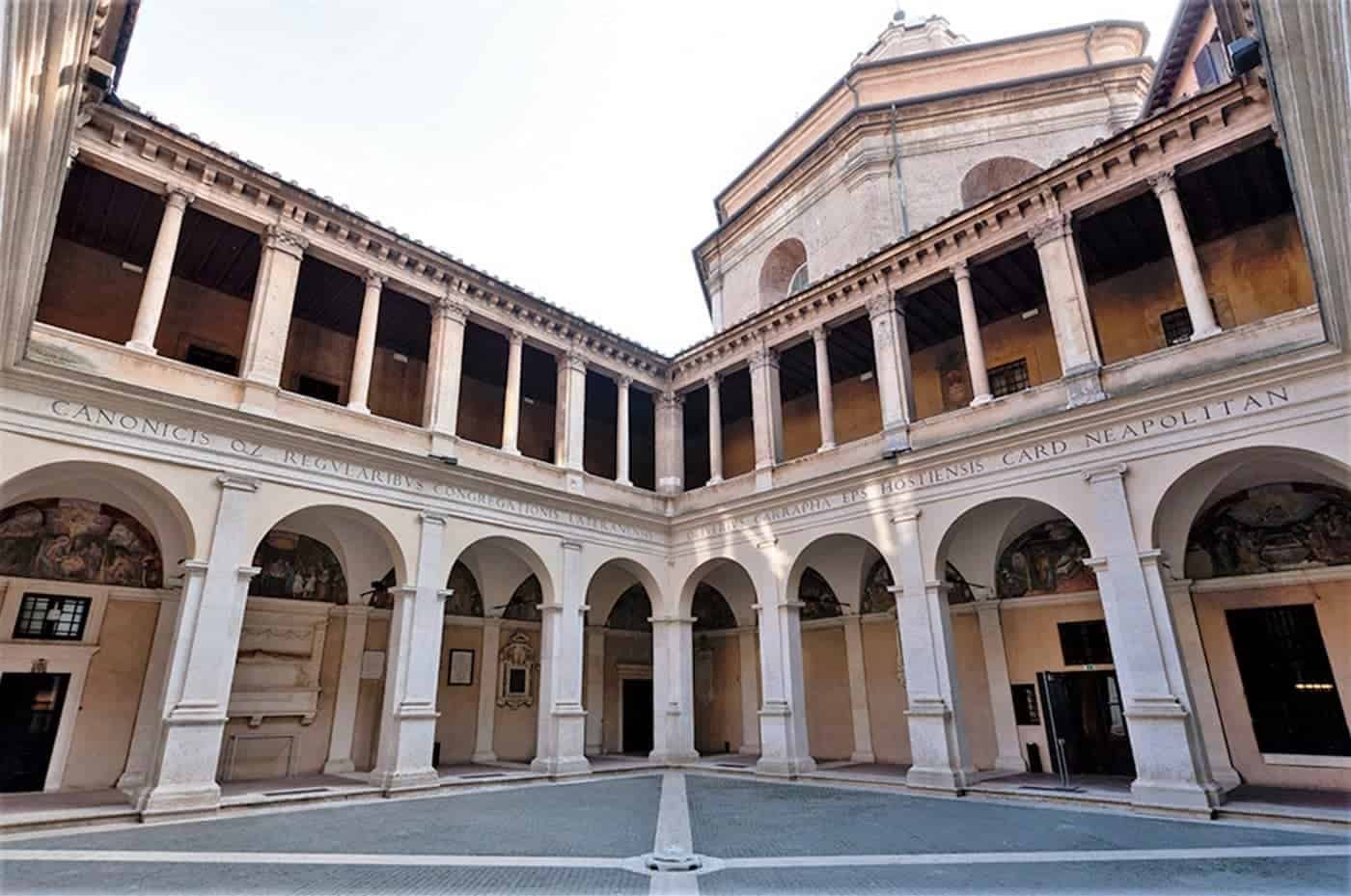
The Chiostro del Bramante is the arcaded courtyard of the convent attached to the church of Santa Maria della Pace, built between 1500 and 1504 on commission from the Neapolitan cardinal Oliviero Carafa. It's the first Roman work of Donato Bramante (1444-1515), and that alone would justify the visit. But there's more: it's the building where Italian architecture changes register. Before this courtyard, 15th-century Rome built pleasant cloisters, with slender columns and varied capitals, where taste counted for more than the rule. Here the rule becomes everything.
Bramante arrives in Rome shortly after 1499, with the fall of Ludovico il Moro and the end of his long Milanese period. He is more than 55 years old, with an important Lombard résumé and no position in the Rome of the popes. Within 15 years he will become the chief architect of Julius II, will design the Tempietto of San Pietro in Montorio, the Belvedere courtyard in the Vatican and the new basilica of St. Peter, and will be Michelangelo's great rival. The building site on Via Arco della Pace is the first step of that climb, and it has the air of an exam passed coolly.
The Chiostro del Bramante is the most underrated building in the historic center, and it is so because it makes no noise. It has no dome, no scenic facade, no famous statue to photograph. It has proportions. Anyone who doesn't know what to look at leaves saying it's pretty. Anyone who knows what to look at stays an hour.
How to get to the Chiostro del Bramante and how to visit
On foot from Piazza Navona
The natural way to get there is from Piazza Navona. Take the short northern side, the one with the Neptune fountain, leave the square and take Via di Santa Maria dell'Anima: in two minutes you are in front of the curved facade of Santa Maria della Pace, in a small scenic widening that seems built to be seen at an angle, because it is. The entrance to the cloister is not the church's: it's the main door at number 5 on Via Arco della Pace, on the left as you face the facade. It's an anonymous door, and that explains why so many walk past without going in.
By public transport
The useful buses are those on Corso Vittorio Emanuele II: lines 40 and 64 stop at Navona, and from that stop you walk five or six minutes north. Other lines on the Corso and those that pass along Corso del Rinascimento, the east side of Piazza Navona, drop you at a similar distance. The tram doesn't serve the area. Neither does the metro: the historic center inside the bend of the Tiber has no stations, and anyone arriving from line A must allow 20 minutes on foot. If you come from Termini station, the bus is faster than the metro ride with a change.
Hours, tickets and free entry to the Chiostro del Bramante
Here is the distinction worth keeping in mind, because it simplifies life. The monument is free, the exhibition is paid. The courtyard with its two orders, the upper loggia, the café and the bookshop are accessible without a ticket during opening hours. The exhibition rooms, which occupy about 1000 square meters spread over two floors, require the ticket for the current exhibition. The full price of the latest exhibitions has settled around €19, with a reduced band between €15 and €17 and discounted rates for minors. The precise figure, including the reductions for the weekday, is on the official website. The ticket office closes an hour before the rooms, so showing up at 19:30 for an exhibition that closes at 20:00 means staying outside.
Do you need to book?
For the cloister, never. For the exhibition, online booking is not mandatory but is advisable on weekends and long weekends, when entry is limited by time slots and the line forms on the narrow sidewalk of Via Arco della Pace. On weekday mornings you walk in without waiting. The advice: buy the ticket online for the first morning slot and arrive 10 minutes early, so you see the rooms while they are empty and keep the cloister for the moment when the light gets better.
Bramante in Rome: who the architect of the Chiostro del Bramante was
Donato di Pascuccio d'Antonio, whom we all call Bramante, was born in 1444 near Urbino, and Urbino in the second half of the 1400s is one of the most advanced laboratories in Europe: the palace of Federico da Montefeltro, Piero della Francesca, Luciano Laurana, a mathematical culture of space that very few Italian centers possess. Bramante begins as a perspective painter, and this origin explains many things about his way of building: he thinks of buildings as controlled images, with precise viewpoints.
The bulk of his career, though, takes place in Milan, where he works for the Sforza from about 1477. These are the years of Santa Maria presso San Satiro with the famous false perspective choir, of the tribune of Santa Maria delle Grazie, of the research drawings shared with Leonardo da Vinci, present at the Milanese court in the same years. His Lombard architecture is rich, sculptural, full of terracottas, cornices and ornaments: local taste demands it.
Then, in 1499, the French enter Milan and Ludovico il Moro falls. Bramante loses his patron and the city. He arrives in Rome as a mature man, in an environment where the big building sites are controlled by others, and does something architects rarely manage: he changes language. He measures the ancient ruins, studies the Colosseum, the theater of Marcellus, the baths, the basilica of Maxentius, and rebuilds his own vocabulary from scratch. The cloister of Santa Maria della Pace is the first result of that reconversion.
A remark worth making in front of these stones: Bramante in Rome doesn't copy the antique, he simplifies it. He removes instead of adding. It's a rare choice in an age that loved to fill, and proof that an artist's maturity is also measured by how much he is willing to give up.

Oliviero Carafa, the cardinal who commissioned the Chiostro del Bramante
The patron is not a footnote detail. Oliviero Carafa, Neapolitan, cardinal from 1467, was one of the most influential figures of the curia between Sixtus IV and Julius II: a man of great culture, protector of the Dominican order, a patron who in Naples had already had his own chapel in San Domenico Maggiore frescoed by Filippino Lippi. In Rome he held the title of Santa Maria della Pace, the church just rebuilt by Sixtus IV, and around 1500 he decided to give the attached convent a new cloister.
His name remains written in the building. The frieze of the entablature carries the dedicatory inscription that records the commission, and the cardinal's heraldic symbols appear in the upper part of the courtyard, on the supports of the loggia. It's the Renaissance way of signing an investment: not a sign, but a carved letter that lasts five centuries.
Carafa's choice deserves respect for a precise reason. In 1500 Bramante in Rome was, in effect, unknown: a good professional arrived from a fallen court. Entrusting him with a prestige building site in the most visible quarter of the city was a gamble. He won, but so did we.
The architecture of the Chiostro del Bramante, order by order
The square plan and the module that generates everything
The plan is square, and it is not square for decorative chance: it is square because it comes from the repetition of a single module, equal to the width of the portico. That module sizes the central void, which measures four modules by four, and extends also to the adjacent refectory room, which measures two by four. A single number governs the courtyard and the hall next to it.
It sounds like a textbook abstraction, and yet you feel it standing inside. When you walk under the portico, the distance between you and the far wall, the height of the arch above your head and the width of the courtyard before your eyes all belong to the same family of measures. The body registers it before the mind. That is why successful Renaissance spaces give a physical sensation of calm: they are not beautiful, they are coherent.
The 16 piers and the portico of the Chiostro del Bramante
The central space is surrounded by 16 piers, four per side, which carry a continuous portico covered by cross vaults. The number is not innocent: 16 is a perfect number in the Vitruvian tradition, one of those numbers the ancient treatise writers considered foundational to the proportions of the body and of the building. Bramante, who knew those texts well, uses them as one uses a grammar.
The cross vaults of the portico are smooth, without decorated ribs, without carved keystones. Light enters from the arcades and spreads evenly. Walking under the portico you lose the sense of the corner: the rhythm of the bays is so regular that you go around the courtyard without noticing you have turned. Try it, it's a small perceptual experiment that always works.
The first order: Ionic pilasters and arches on alette
On the ground floor the order is Ionic, applied in the form of pilasters, that is, piers barely projecting from the wall. The pilasters support an entablature with a continuous frieze, the kind proper to the Ionic order, and between one pilaster and the next runs a chain of round arches set on alette, that is, on short projections of wall that serve as a support for the arch. This combination, an arch set on a rectangular pier with an architectural order applied to the facade, is exactly the solution of ancient Roman architecture: you see it at the Colosseum, at the theater of Marcellus, in the monumental aqueducts.
The point is that in 1500 almost nobody used it this way. The 15th-century Roman cloisters preferred the arch on a column, lighter and more medieval in effect. Bramante chooses the heavy system of the ancients and gets a courtyard that looks like a fragment of a Roman public building instead of a convent garden. It's a declaration of belonging.
The second order and the column that falls in falso
Go up to the loggia and look up. The second order is built with pseudo-Corinthian pilasters that turn back on the sides in correspondence with the alette of the floor below, and between one pilaster and the next Bramante inserts a free-standing column, of the same order, which doubles the pace of the arcades below. The second order is also reduced in height by a quarter compared to the first, according to the Vitruvian rule that Leon Battista Alberti and Sebastiano Serlio would later codify in their treatises.
That column is the most discussed point of the building, and is worth the trip by itself. The column of the upper floor does not rest on a solid: it falls on the axis of the arcade below, that is, above the void. In the language of the treatise writers, the column is said to fall in falso. It is a breach of one of the most elementary rules of classical architecture, the one that wants supports aligned vertically, solid above solid. A schooled architect would never have done it, and in fact the solution was immediately recognized as an anomaly by those who read architecture for a living.
Why, then, does Bramante do it? Because he needs to double the rhythm. The first order has four arcades per side. The second, halving the interval, has eight. The result is that as your eye climbs the courtyard accelerates: below it breathes slowly, above it breathes quickly, and the wall seems to lighten toward the sky. It's an effect of rarefaction obtained by sacrificing apparent structural correctness. Bramante the perspective painter decides that the eye counts more than the manual.
Here lies the reason this courtyard is considered a manifesto of the mature Renaissance. The 15th century had learned the ancient rules. The 16th century begins when an architect breaks one on purpose, to obtain a desired effect, and manages to make it work. From this column on, reasoned transgression becomes a design tool, and the road that leads to Michelangelo and then to Mannerism is open. I'll add an opinion: it's the smartest detail in the historic center, and it has no plaque to explain it.
Why the Chiostro del Bramante has no decoration
Anyone arriving here after a week of Roman Baroque may find the courtyard bare. It is, deliberately. Bramante banishes all additional decoration and entrusts all the expression to the structural elements: pier, arch, entablature, cornice. There are no festoons, no putti, no scrolls. The travertine and the plastered brick do the work on their own.
This severity is the exact opposite of what Bramante himself had done in Milan, where Lombard architecture asked him for terracottas, molded cornices, animated surfaces, and he gave them in abundance. The passage from that language to this one, in very few years, is one of the sharpest stylistic leaps in the history of Italian art. Anyone who wants to see it at a glance can mentally compare the apses of Santa Maria delle Grazie and this courtyard: same author, two worlds.
The benches at the base of the supports
A detail almost nobody notices: at the base of the loggia supports run masonry benches. They are not modern furniture, they belong to the original layout and served the religious for reading and meditation, which in the rule of a cloistered community are activities with a dedicated space of their own. The cloister was not a courtyard of passage: it was a place of lingering, and its architecture is calibrated on a seated person looking horizontally, not on a tourist walking through.
The frescoed lunettes and the tombs of the portico
On the back wall of the portico, under the vaults, run frescoed lunettes with Stories of the Life of the Virgin, to which are added episodes linked to the church and its miraculous image. They are paintings of the late 15th and early 16th century, in uneven condition, which tell the reason the complex exists. Nobody looks at them because the courtyard monopolizes attention: force yourself and give them 10 minutes, because they are the narrative link between the cloister and the church next door.
Also in the portico are 15th-century funerary monuments, slabs and wall tombs from the convent complex. They are documents of a Rome that buried its notables inside the religious spaces it had financed, and each slab tells of a family, an office, a commission. Look at the inscriptions: the capital letters of these years are a masterpiece of graphic design in themselves, the result of the humanist study of ancient epigraphs.
An honest warning: during an exhibition some portions of the portico may be affected by the installations. The visibility of the lunettes varies from season to season.
The church of Santa Maria della Pace next to the Chiostro del Bramante
The miraculous image and the name of the Pace
The church existed earlier, under another name: Sant'Andrea de Acquarenariis, that is, of the acquarenari, the water sellers who had their shops around here. In 1480 a drunken soldier struck with a stone an image of the Virgin painted inside, and according to tradition the image bled. Sixtus IV visited the place and ordered the rebuilding of the church, completed in 1484 under Innocent VIII, with the design attributed to Baccio Pontelli. The new title, Santa Maria della Pace, recalls the peace of Bagnolo which in 1484 ended the war of Ferrara between Venice and its adversaries.
On the degree of certainty it's worth being clear: the episode of the struck and bleeding image is devotional tradition, not a documented fact. The rebuilding ordered by Sixtus IV and the date of 1484 are instead documented, as is the political reference contained in the title.
The facade by Pietro da Cortona
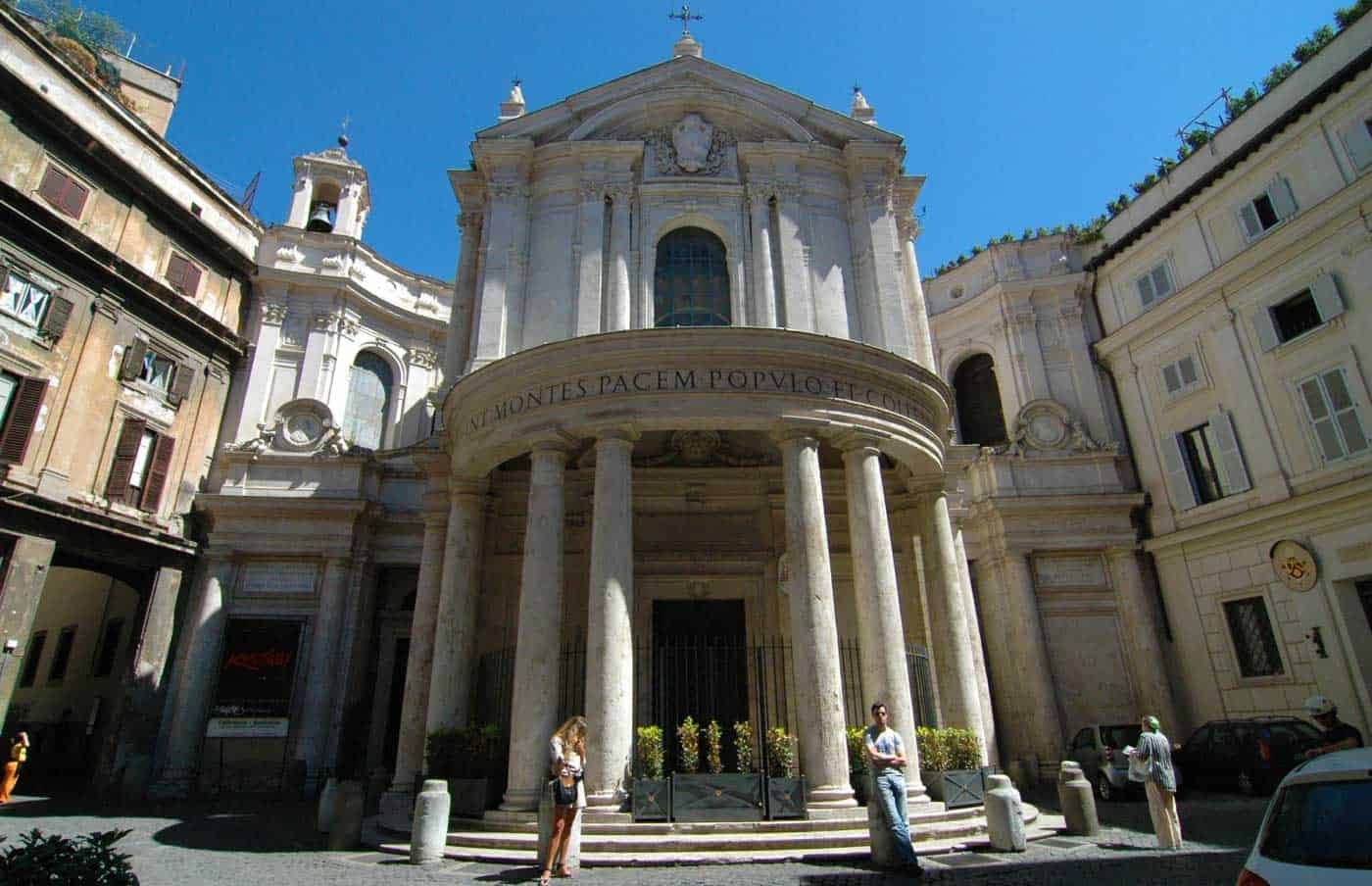
In 1656 Pope Alexander VII Chigi entrusted Pietro da Cortona with the arrangement of the church and its surroundings. Cortona built a convex facade with a semicircular portico of columns on the ground floor, and above all redesigned the urban space in front, widening the little square and unifying the fronts of the surrounding houses to create a small urban theater. It's one of the first Roman cases in which an architect designs at the same time the building and the void that precedes it.
The contrast with the cloister is the best reason to see the two things in the same half hour. Outside, the Baroque curve advancing toward the viewer, the columns casting deep shadows, the Chigi coat of arms with the mounts and the star. Inside, a few meters away, the Bramantesque courtyard that concedes nothing. 150 years of architectural history in 20 steps.
The Chigi Chapel and Raphael's Sibyls
The interior of the church is a single nave with chapels, and the first on the right is the Chigi Chapel, designed by Raphael for the Sienese banker Agostino Chigi, the richest man in Rome. Above the arch of the chapel Raphael frescoed in 1514 the Sibyls and Angels: four sibyls, the prophetesses of the pagan world, who receive divine messages from angels in flight. In the upper lunette are the Prophets, completed by Timoteo Viti.
The subject is theologically ambitious: it lines up the sibyls of antiquity and the prophets of Israel as two parallel channels of the same revelation, a theme dear to Roman humanist culture and to the very program of the Sistine Chapel. The composition is famous for the twisting of the figures and for the way the angels enter the viewer's space. Anyone who knows the vault of the Sistine, finished in 1512, will immediately recognize the debt and the answer at once: Raphael looks at Michelangelo and replies to him with elegance in place of force.
The Chigi family itself left Rome another Raphaelesque masterpiece, the funerary chapel in Santa Maria del Popolo. And Agostino Chigi also had Raphael fresco the villa on the Tiber that we now call Villa Farnesina. Keeping that in mind helps you understand that what you see here is not an isolated episode, but a piece of a program of self-representation that lasted 20 years.
Raphael's Sibyls seen from the café of the Chiostro del Bramante
Here is the detail that makes this place unique in Rome, and that very many visitors ignore.
The upper loggia of the Chiostro del Bramante borders the wall of the church. At that point, at the height of the first floor, a window opens that looks directly onto the interior of Santa Maria della Pace, and it looks exactly above the Chigi Chapel. Result: from the room that now houses the café, called for this reason the Sala delle Sibille, you look at Raphael's Sibyls almost at their own level, a few meters away. Not from below, with your neck bent and the light against you, as happens with almost all the frescoes above the arches of Roman churches. At the same height, face to face.
Anyone who has tried to look at a fresco seven meters high knows how much that changes things. From below you sense the masses, you lose the faces. From here you read the expressions, the way Raphael arranges the hands, the construction of the draperies. It's one of the few occasions in the city when a 16th-century masterpiece is observed from the position in which the author could see it from the scaffolding.
The window is part of the usual experience of the café, whose access is free. The practical conditions, however, change: they depend on the church's hours, on the lighting turned on inside, on the setup of the room and on how crowded the tables are. Take it as a possible gift and not as a contractual guarantee, and don't make the window the only reason for the trip.
The practical advice: go up to the café, order something, sit on the side of the church wall and give yourself time to look before taking out your phone. It's one of the three or four moments in the historic center when you have the clear sensation of having entered the history of art through a service door.
From convent to exhibition space: the lives of the building
The canons, the Irish Dominicans, the Roman priests
In 1487 Innocent VIII entrusted the complex to the Lateran canons regular, and it is for them that, 13 years later, Carafa has the new cloister built. The Lateran community remains until the Napoleonic suppressions and the reorganization of the orders that follows the Restoration.
In 1818 Pius VII assigned the convent to the Irish Dominicans, a presence linked to the network of national colleges that in Rome trained the clergy destined for mission countries or countries with a Catholic minority. A few years later, in 1825, Leo XII gave it to the Congregation of Roman Priests, for educational purposes.
The school, the university and the abandonment
From here on the history of the building is scholastic. In 1871, with Rome just made capital, a classical high school (ginnasio) was born inside the complex, conceived as an alternative to the Collegio Romano and the Visconti. In 1875 those institutions moved to Palazzo Ginnasi. In 1932 the Faculty of Philosophy and Theology of the Sapienza found temporary room in the same spaces.
This is the part of the story that explains the state in which the cloister reaches the late 20th century: a masterpiece of Renaissance architecture used as a container of classrooms, offices and storerooms, little visited and little visible. Rome is full of them, and it's one of its most disorienting characteristics for those arriving from outside: here the monuments are not under glass, they work.
The restoration and the birth of the exhibition space
The turning point comes in the mid-1990s. From 1996 the complex is recovered and transformed into an exhibition space and cultural hub on the initiative of Patrizia de Marco and the company DART, which takes over its management. The restoration brings the surfaces back into view and reopens the courtyard to the city. The rooms of the ground floor and first floor, about 1000 square meters in total, become a continuous exhibition route.
It's worth recording the basic choice, because it wasn't a given: instead of setting up the exhibitions in the courtyard, the management kept the cloister free and without charge, monetizing the rooms. That is why anyone today can enter to see Bramante without paying. In a Rome of tickets that go up every year, it's a decision worth mentioning.
The great exhibitions of the Chiostro del Bramante
The exhibition on in 2026
In summer 2026 the rooms host Flowers. Meravigliosa Natura, on the bill until September 6, 2026. It's the sequel to the project on the floral theme that the Chiostro del Bramante carried forward in the previous season with FLOWERS. Dal Rinascimento all'intelligenza artificiale, a show built on more than 90 works from 10 countries, with loans from major institutions, curated by Franziska Stohr with Roger Diederen. On estateromana.com you will find the dedicated page on Flowers. Meravigliosa Natura. The program of the following seasons is announced on the official website of the Chiostro.
20 years of exhibitions
The program of the Chiostro del Bramante is one of the most recognizable in Rome, built on names able to fill a room and on formats designed for a wide audience. Among the exhibitions hosted: Chagall. Love and Life in 2015, LOVE. L'arte contemporanea incontra l'amore between 2016 and 2017, Jean-Michel Basquiat in 2017, Turner. Opere della Tate in 2018, Bacon, Freud. La Scuola di Londra between 2019 and 2020, All about Banksy between 2021 and 2022, Emotion between 2023 and 2024. The catalog of seasons also includes Escher, the Macchiaioli with the collections unveiled and the immersive projects of the Enjoy series.
A professional judgment, and not a comfortable one. These exhibitions split into two very different families. On one side the shows with real loans, like Turner from the Tate or the London School, which bring works that would not otherwise be seen in Rome and that are worth every euro. On the other the immersive and thematic projects, built on staging, light and narrative more than on the rarity of the pieces: they work very well with kids and with people who go into a museum twice a year, and leave indifferent anyone looking for the masterpiece. Knowing which of the two families the current exhibition falls into is the best way not to be disappointed, and you can tell in two minutes by reading the list of lenders.
The model of the private museum in the center
The Chiostro del Bramante belongs to a rare and interesting species: the private exhibition space inside the historic center, with no permanent collection, living on temporary exhibitions and services. It doesn't have the parachute of public funding, so it has to fill the rooms. That explains the choice of popular titles, the displays designed for photography and the attention to the café and the bookshop, which are not accessories but part of the income statement.
The model has an obvious advantage for the visitor: hospitality. The labels are readable, the lighting is careful, staff are present, the hours are long and include weekend evenings, something Rome's state museums rarely offer. It also has a limit, and it's right to say so: the programming chases the public, and the scholarly rigor varies quite a lot from one exhibition to another. Anyone who visits the Chiostro knowing this goes in with the right expectations.
Anyone who wants to compare the two models in the same afternoon is lucky to have, 200 meters away, the Museo di Roma at Palazzo Braschi, a civic museum with a permanent collection, and, five minutes away, Palazzo Altemps, a state museum of ancient sculpture. Three different ways of being in the center, three different economies.
The café and the bookshop of the Chiostro del Bramante
The café on the loggia
The bistro café occupies the rooms of the upper floor that open onto the loggia, and it's one of the most civilized places in the historic center to stop. You enter without the exhibition ticket, during the opening hours of the complex. You have breakfast, you have lunch, you have tea in the afternoon, you work an hour on your computer without anyone giving you a dirty look, and in the meantime you have in front of your eyes a courtyard from 1504.
The value for money is not that of the neighborhood bar and doesn't claim to be: you pay for the room too. But within a radius of 300 meters, that is, in the triangle Piazza Navona, Pantheon, Via dei Coronari, where a coffee at the table can cost sums hard to justify on a plastic outdoor terrace, the café of the Chiostro del Bramante is one of the most sensible purchases. That is an opinion, and I defend it.
The best table, if you can get it, is the one on the side of the church wall, for the reason explained above. The second best is the one on the side of the loggia that looks onto the courtyard, with the slanting morning light.
The bookshop
The bookshop, also free to enter, is small but kept better than the average Roman museum bookshop. Catalogs of current and past exhibitions, art publishing, illustration, design objects. It's also one of the few places in the center to find a decent gift without ending up in a souvenir shop. If you're looking for the catalog of an exhibition that closed recently, ask: the leftovers often stay on sale.
When to go to the Chiostro del Bramante
Light rules everything in an arcaded courtyard. The best time is the morning of a weekday, between 10:00 and noon: the sun comes in at an angle, the portico fills with long shadows that draw the rhythm of the bays, and the upper loggia is lit while the ground floor stays in half-light. It's exactly the condition in which the architecture reads best, because the chiaroscuro makes the minimal projections of the pilasters evident.
Early summer afternoon is the worst time: the sun straight overhead flattens everything and the courtyard becomes a white rectangle. The weekend evening has a different charm, with the artificial lighting warming the travertine, and it's also the time when the place fills with Romans.
On times of the year: January and February are the months when the historic center is least crowded and an exhibition is really seen. August is less bad than people say, because the Romans are away and organized groups prefer the big monuments. The days to avoid without hesitation are the long weekends of spring and the Saturday afternoons of December.
The Chiostro del Bramante with children
It works better than you would expect, for three reasons. The first is that the courtyard is a closed and safe rectangle, without traffic, where a child can walk without being held by the hand every second. The second is that the immersive exhibitions that the Chiostro often programs are built precisely for a young audience, with dark rooms, projections and tactile installations. The third is that the café allows a stop, and the stop is the variable that decides the success of a day in the city with the little ones.
The game I recommend to parents: ask the children to count the piers of the ground floor and the columns of the floor above, then to explain why the numbers don't add up. They get there quickly, and without knowing it they have understood the most important thing about the building. The Chiostro del Bramante also organizes periodic activities for children and families tied to the exhibitions: the calendar is on the official website.
Stroller: the courtyard and the ground floor are easy to get around. For the loggia there is the historic staircase, and it's best to check on site whether the elevator is available.
Accessibility of the Chiostro del Bramante
The structure is indicated as accessible to people in wheelchairs, with a link between the two levels. The available information also reports a dog sitting service for those arriving with a dog, an uncommon detail among Roman exhibition spaces. Since it is an adapted building of the early 16th century, the practical advice remains the same I give for all the historic monuments of the center: a phone call in advance to the ticket office avoids surprises, especially during installations, when the internal routes may change.
The free or discounted conditions for people with disabilities and for their companions are provided in the exhibition price list. The exact amount of the reduction varies with the exhibition and is stated on the tickets page of the official website.
How long a visit to the Chiostro del Bramante takes
Count like this. For the cloister alone, with the two orders, the lunettes and a stop at the loggia: 40 minutes, and they are a full 40 minutes if you start looking at the proportions instead of crossing through. Add an hour, an hour and a quarter for a medium-sized exhibition in the rooms. Add another 20 minutes for the church of Santa Maria della Pace, when it's open, and 30 if you sit down in the café. The realistic total for a complete visit is two and a half hours.
If you have little time and have to choose, the hierarchy is clear: first the upper loggia, then the courtyard from below, then the exhibition. The opposite is the mistake I see made most often, and whoever makes it comes out of the rooms with a head full and crosses the masterpiece without seeing it.
What to see around the Chiostro del Bramante
Piazza Navona and the Stadium of Domitian
Two minutes away is Piazza Navona, which has the shape it has because it follows the arena of the stadium built by Domitian around AD 86. The foundations of that stadium can be visited below street level: the page on the underground of the Stadium of Domitian explains how to get in. Seeing the ruins first and then the square is the right way to understand why Rome has this plan.
Via dei Coronari
Leaving the cloister and heading north you reach Via dei Coronari, the straight street opened by Sixtus IV to connect the center to Ponte Sant'Angelo in view of the Jubilee of 1475. The name comes from the sellers of rosary beads who supplied the pilgrims headed to St. Peter's. For decades it was the street of the antique dealers. Today it is a mix of workshops, galleries and venues, and it is still one of the most beautiful walks in the rione Ponte, especially in the evening, when the low lamps light the 15th-century doorways.
The churches of the neighborhood
Five minutes away is the basilica of Sant'Agostino, with Caravaggio's Madonna of the Pilgrims, Raphael's prophet Isaiah painted on a pillar and the Madonna del Parto by Jacopo Sansovino, which Roman women expecting a child still visit. A little over five minutes away is San Luigi dei Francesi, with the Contarelli Chapel and the three large Caravaggio canvases dedicated to Saint Matthew. A little farther, toward Corso del Rinascimento, the church of Sant'Ivo alla Sapienza by Borromini with its spiral dome. Three masterpieces in 10 minutes on foot, all with free entry.
The nearby museums
Within 10 minutes you find Palazzo Altemps with the ancient sculptures of the Museo Nazionale Romano, the Napoleonic Museum overlooking the Tiber, the Museo di Roma at Palazzo Braschi and, on the other side of Corso Vittorio, Campo de' Fiori. To the east, just under 10 minutes, the Pantheon. Anyone who wants to close the circle on Bramante, though, has to cross the river and climb the Janiculum, where the Tempietto of San Pietro in Montorio stands: the cloister and the Tempietto are the two poles of his Roman research, and seen on the same day they tell everything.
A curiosity about the Chiostro del Bramante
The real curiosity of this building is arithmetic, and nobody tells it to you because it requires stopping to count.
The courtyard is generated by a single module: the width of the portico. That number, repeated, produces the central void, which measures four modules by four, and keeps working outside the courtyard too, because the adjacent refectory measures two by four. A whole building built on a single measure, like a musical composition on a single interval.
And then there are the 16 piers, four per side. As for 16, in the Vitruvian tradition that the Renaissance had rediscovered and learned by heart, it is a perfect number: it belongs to that chain of ratios that the ancient treatise writers considered foundational both of the proportions of the human body and of those of the building. Bramante does not use it out of superstition. He uses it because in 1500 building according to the numbers of the ancients meant affirming that one's architecture belonged to the same civilization as the ruins you could see from the window.
There is a simple way to verify that all this is not book theory. Stand in a corner of the portico and walk slowly along one side, counting the steps between one bay and the next. Then go up to the loggia and repeat the same route. Above, the supports are twice as many, so the rhythm of your steps is halved in relation to the supports. It's a physical experience: the upper floor makes you walk more tightly. Bramante designed this too, and he designed it 400 years before anyone invented the word design.
I'll add the detail I like best: the patron left his own name in the inscription of the frieze and his own cardinal's symbols in the upper part of the courtyard. Anyone who enters today reads a signature from five centuries ago without noticing.
One thing nobody tells you about the Chiostro del Bramante
That you get in for free. It's not a figure of speech and it's not a temporary promotion: the cloister, the upper loggia, the café and the bookshop have free entry regardless of the exhibitions. The ticket concerns only the exhibition rooms.
The practical consequences are considerable, and in Rome almost nobody uses them. It means that one of the founding works of the mature Italian Renaissance, the building with which Bramante introduces himself to the city of the popes, can be visited at no cost, with no line, no reservation and long hours that on weekends run late into the evening. It means that someone with 40 free minutes between appointments in the center can spend them here instead of in a bar. It means, for those who work in tourism, that the Chiostro del Bramante is the best solution I know for a group stuck by rain in the Navona area.
There is a second level to this information, even less known. Free entry also includes the upper loggia, that is, the floor from which you see Raphael's Sibyls through the window onto the church. Many visitors arrive in the courtyard, look up, take photos and leave without going up, convinced that the upper floor is part of the paid exhibition. Go up. The staircase is there and there is no checkpoint to get past.
One last note belonging to the same family of information. The cloister and the church have independent access and hours: the church of Santa Maria della Pace opens according to the liturgical calendar and the availability of the rector, with time slots that can be very limited. It can therefore happen that you see the cloister perfectly well and find the church closed. If your main goal is the Sibyls, the window of the loggia is the backup card that saves your day.
The advice I give you for visiting the Chiostro del Bramante
There is one piece of advice and it concerns the order of things, because here the order completely changes how the visit pays off.
Arrive early in the morning of a weekday, around 10. Don't go in right away. Stop for 30 seconds in the widening in front of the facade by Pietro da Cortona, look at the curve and the columns of the portico, then turn around and observe how the houses around were aligned to create that space. It's the right appetizer, because it puts the image of the Baroque in your head a moment before you enter a building that precedes the Baroque by 150 years.
Then enter from number 5 and go straight up to the loggia, without stopping in the courtyard. From the upper floor look down: from there you understand the plan, the module, the rhythm of the bays, and you see the column that falls on the axis of the arcade below, that is, the smartest detail of the building. Stay at least 10 minutes. Then go to the café and look for the window onto the Sibyls.
Only at that point go down into the courtyard and walk under the portico, looking at the frescoed lunettes and the 15th-century tombs. With what you have seen above, the ground floor reads completely differently. The exhibition, if you see one, should be kept for last: after an hour of staged rooms and theatrical lights, the eye is no longer able to appreciate a proportion.
Two final warnings, both practical. The first: the exhibition ticket office closes an hour before the rooms, so late afternoon is risky. The second: check the church's hours before planning the visit to the Chigi Chapel, because it is the only element of the complex you cannot count on for sure. If I had to name the ideal two-hour window, I would say 10:00 on a Tuesday in November.
Another well-known fact, yet rarely cited
Everyone knows that Bramante is the architect of the new basilica of St. Peter. It's the first line of any handbook: in 1506 Julius II lays the first stone on his design, the Greek-cross plan, the dome on the model of the Pantheon, the most expensive building site in Christendom. What is cited much less is how Bramante got there, and the answer begins in this courtyard.
In 1500 Bramante had no title in Rome. He was a successful Lombard professional left without a court, in a city where the papal building sites were contested by established families and clienteles. The cloister of Santa Maria della Pace is his first documented Roman commission: four years of work, an influential cardinal as guarantor, a building that anyone who counted in the curia could go and see on foot. Right after comes the Tempietto of San Pietro in Montorio, then the Belvedere court, then St. Peter's. The sequence is extremely quick, but it's not a stroke of luck: it's a career built by showing, in a convent courtyard, a mastery of the ancient language that nobody in Rome had yet shown in that form.
There is a second fact that everyone knows and almost no one connects: the rivalry with Michelangelo. The 16th-century sources tell it as bitter, and tradition has it that Bramante pushed Julius II to entrust Michelangelo with the vault of the Sistine, hoping to see him fail in a technique not his own. It must be said clearly that this anecdote belongs to the Michelangelo-partisan biographical tradition and not to a document: it's a story, not an established fact. What is established is that the two competed for the favor of the same pope in the same years, and that Roman architecture of the 16th century is born from that friction.
In our judgment the Rome we imagine when we think of the Renaissance is in very large part an idea of Bramante, carried out by others over the following 50 years. And the first place where that idea takes shape is a free courtyard behind Piazza Navona.

The right photo to take at the Chiostro del Bramante
The photograph everyone takes is the one from the center of the courtyard with the lens pointed up. It always comes out the same, always disappointing, and explains nothing about the building: the lines fall, the sky burns out, the two orders blur together.
The right photo is taken from the upper loggia, standing just inside a corner, framing diagonally across the courtyard. This way two adjacent sides enter the same image, and you see the relationship between the floor below and the floor above: four arcades below, eight intervals above, and the column of the second order that lines up with the keystone of the arch below. It's the only framing that makes Bramante's transgression visible, which is the real subject of this building.
The second photo to take home is a vertical detail: a column of the loggia shot up close, with the arcade below reading as blurred in the background. It serves to document the column that falls in falso, and in a travel album it's worth more than 10 panoramas.
On technique, four concrete tips. The best light is between 10:00 and noon, when the sun comes in at an angle and the chiaroscuro reveals the minimal projection of the pilasters. Hold the camera level horizontally, without tilting it, so the verticals don't fall: here geometry is the subject, and a crooked vertical ruins the shot more than a wrong exposure. If the sky burns out, expose for the shade of the portico and recover later. With a phone, avoid the extreme wide angle: it distorts exactly the proportions you came to photograph.
A recommendation of common sense: in the exhibition rooms the photography rules change from one exhibition to another, because of loans and rights. In the courtyard and the loggia, instead, you can photograph freely. Tripods and professional equipment are another matter and must be agreed with the management.
Some important events that happened here in history
1480. According to devotional tradition, a soldier strikes with a stone the image of the Virgin painted in the old church of Sant'Andrea de Acquarenariis, and the image bleeds. The episode is not documented, but its consequences all are: from that moment the place becomes a destination of devotion and attracts the attention of the pope.
1482-1484. Sixtus IV orders the rebuilding of the church, completed in 1484 under Innocent VIII, with a design attributed to Baccio Pontelli. The new title, Santa Maria della Pace, alludes to the peace of Bagnolo which in the same 1484 ends the war of Ferrara. A church named after a treaty: the Rome of the popes never separated devotion from politics.
1487. Innocent VIII entrusts the complex to the Lateran canons regular.
1500-1504. Cardinal Oliviero Carafa commissions the new cloister from Donato Bramante. Four years of construction for the first Roman work of the architect from Urbino.
1514. Raphael frescoes the Sibyls and Angels above the arch of the Chigi Chapel, in the church next door, for the banker Agostino Chigi. The Prophets of the upper lunette are completed by Timoteo Viti.
1656. Alexander VII Chigi commissions Pietro da Cortona for the new facade and the arrangement of the urban space in front. The semicircular portico and the little square created by widening the building fabric are one of the first Roman examples of a joint design of building and urban void.
1818. Pius VII assigns the convent to the Irish Dominicans.
1825. Leo XII gives it to the Congregation of Roman Priests for educational purposes.
1871. A classical high school (ginnasio) is established in the complex, conceived as an alternative to the Visconti in the Rome just become capital of the Kingdom.
1875. The school institutions move to Palazzo Ginnasi.
1932. The Faculty of Philosophy and Theology of the Sapienza finds temporary accommodation in the rooms of the former convent.
1996. The complex is restored and transformed into an exhibition space and cultural hub on the initiative of Patrizia de Marco and the company DART. The courtyard becomes accessible to the city again, and stays that way.
Who has passed through the Chiostro del Bramante
Donato Bramante worked here for four years, between 1500 and 1504, and this is his Roman calling card. He was over 55 and had recently arrived from Milan, where he had built for the Sforza in an entirely different language.
Oliviero Carafa, the Neapolitan cardinal who paid, was one of the most influential figures of the curia between Sixtus IV and Julius II, protector of the Dominicans and a patron used to choosing well: in Naples he had called in Filippino Lippi for his own chapel.
Raphael Sanzio worked a few meters from here, in the church next door, and his Sibyls are what you still look at today from the window of the loggia. Agostino Chigi, the Sienese banker who commissioned the chapel from him, was the richest man in Rome and the most unscrupulous collector of talents of his generation.
Sixtus IV ordered the rebuilding of the church. Innocent VIII saw it finished and entrusted the convent to the Lateran canons. Alexander VII Chigi sent Pietro da Cortona to redesign the facade and the square. Pius VII and Leo XII decided the 19th-century handovers. Five popes in this block, and each left a visible decision here.
Then there are the anonymous passages, which are the largest group: the Lateran canons who read seated on the benches of the loggia, the Irish Dominicans who arrived in 1818, the boys of the ginnasio of 1871 who crossed Bramante's courtyard to go to class without knowing what it was, the students of Philosophy and Theology of the 1930s.
From 1996 on the register of passages changes nature and becomes a list of works. Through these rooms have passed the canvases of William Turner lent by the Tate, the paintings of Francis Bacon and Lucian Freud with the London School, Marc Chagall, Jean-Michel Basquiat, the prints of Escher, the paintings of the Macchiaioli. A courtyard that in 1504 was meant for the meditation of a community of canons has become, five centuries later, one of the places where Romans see the art of the 20th century. It is not a decline: it is exactly the kind of reuse that keeps buildings alive.
Quick questions about the Chiostro del Bramante
How much does it cost to enter the Chiostro del Bramante?
The cloister itself, with the loggia, the café and the bookshop, is free. You pay only for the temporary exhibition in the exhibition rooms: the full ticket of the latest exhibitions has settled around €19. The updated price list is on the tickets page of the official website.
Is it true that you get in for free?
Yes, for the monumental part. Courtyard, portico, upper loggia, bistro café and bookshop have free entry during opening hours, regardless of the exhibitions on.
Where exactly is the Chiostro del Bramante?
At Via Arco della Pace 5, rione Ponte, just north of Piazza Navona. The entrance is not the same as that of the church of Santa Maria della Pace: it is the main door next to it.
What are the opening hours of the Chiostro del Bramante?
The reference hours are 10:00 to 20:00 on weekdays, with later closing on weekends. The ticket office closes an hour before the rooms. The hours follow the current exhibition and should be checked on the official website.
Do you need to book a visit to the Chiostro del Bramante?
For the cloister no. For the exhibition, online booking is not mandatory, but on weekends and long weekends it avoids the line and guarantees the time slot.
What exhibition is on now at the Chiostro del Bramante?
In summer 2026 Flowers. Meravigliosa Natura is on display, scheduled until September 6, 2026. The next program is published on the official website.
How long does the visit take?
40 minutes for the cloister alone, about an hour and a quarter for a medium-sized exhibition, 20 minutes for the church when it's open. With a stop in the café, two and a half hours.
Who built the Chiostro del Bramante and when?
Donato Bramante, between 1500 and 1504, on commission from Cardinal Oliviero Carafa. It is the architect's first Roman work.
Why is the Chiostro del Bramante important in the history of architecture?
Because it rigorously applies the ancient Roman building system, arch on pier with applied order, and because on the upper floor it introduces a column on the axis of the arcade below: a conscious transgression of the classical rule that opens the way to the mature 16th century.
What does it mean that the column falls in falso?
It means that a support of the upper floor does not rest on a solid of the lower floor but on a void, in this case the axis of the arch. The classical rule forbids it. Bramante does it on purpose to double the rhythm of the bays.
Can you really see Raphael's Sibyls from the café?
From the loggia floor a window looks onto the interior of the church at the height of the Chigi Chapel, and from there the fresco of the Sibyls is seen much closer than from the floor of the church. Visibility depends on the church being open, on the interior lighting and on the setup of the room.
Is the church of Santa Maria della Pace always open?
No. It has its own hours, independent of those of the cloister, and the opening slots can be restricted. It's best to check beforehand if the Chigi Chapel is the main goal of the day.
Can you take photographs at the Chiostro del Bramante?
In the courtyard and the loggia yes, freely. In the exhibition rooms the rules change from one exhibition to another for reasons of loans and rights. Tripods and professional filming must be agreed with the management.
Is the Chiostro del Bramante wheelchair accessible?
It is indicated as accessible, with a link between the two levels. Since it is an adapted building of the early 16th century, a phone call in advance to the ticket office is recommended, especially during installation periods.
Is it suitable for children?
Yes. The courtyard is closed and safe, many of the scheduled exhibitions have an immersive approach that works with kids, and the café allows a stop. The complex also offers periodic activities for children and families tied to the exhibitions.
Is there a bar inside the Chiostro del Bramante?
Yes, the bistro café on the loggia floor, with free access. You have breakfast, lunch and a coffee looking at the courtyard.
Is there a bookshop?
Yes, also with free access, with exhibition catalogs, art publishing and objects. It's one of the few places in the area to buy a sensible gift.
Can you go in with a dog?
The available information reports a dog sitting service at the facility. For the rules on access to the spaces with an animal in tow, it's best to ask the ticket office directly.
What is the best time to go to the Chiostro del Bramante?
The morning of a weekday, between 10:00 and noon: the light comes in at an angle and the architecture can be read. Early summer afternoon is the worst time, because it flattens everything.
How do you get to the Chiostro del Bramante by public transport?
With buses 40 and 64 to the Navona stop on Corso Vittorio Emanuele II, then five or six minutes on foot to the north. The metro doesn't serve this part of the historic center.
What is the difference between the Chiostro del Bramante and the Tempietto of San Pietro in Montorio?
They are the two Roman works with which Bramante defines his own language. The cloister dates from 1500-1504 and is a square-plan building on two orders. The Tempietto, slightly later, is a small circular building with columns on the Janiculum. Seen on the same day they tell the architect's whole research.
Does the Chiostro del Bramante have a permanent collection?
No. It is a private exhibition space with no collection of its own: the program consists of temporary exhibitions, which alternate in the rooms of the ground floor and first floor, about 1000 square meters in total.
Are the exhibitions at the Chiostro del Bramante worth the price?
It depends on the type. The shows with major loans from foreign museums bring works that would not be seen in Rome and are worth the ticket. The immersive projects rely on staging and narrative and work above all with kids and the occasional public. The list of lenders, on the exhibition page, immediately clarifies which category you are in.
What can I see around here in half an hour?
Piazza Navona with the underground of the Stadium of Domitian, Via dei Coronari, the basilica of Sant'Agostino with the Caravaggio and the Raphael, San Luigi dei Francesi with the Contarelli Chapel, Sant'Ivo alla Sapienza by Borromini, Palazzo Altemps and the Napoleonic Museum. All on foot, all within 10 minutes.
Are there restrooms and a coat check?
Restrooms are available inside the complex. For leaving backpacks and bulky bags, the conditions vary with the setup of the current exhibition and should be asked at the ticket office.
To finish, the most important thing about this whole block. In a city that has learned to put a turnstile in front of every stone, there is still a courtyard from 1504, designed by the man who would design St. Peter's, where you walk in through an open door, climb a staircase and sit down to look at the proportions for as long as you like, paying nothing. If you have only half an hour free in the center, the Chiostro del Bramante is the best way I know to spend it. And if you go back a second time, go straight up to the loggia: that is where the building says what it has to say.
Article written by the editorial team of TourLeaderPro, contact them for Private/Corporate/V.I.P. Tours and Experiences.
Planning a trip to Rome? The English guides to visiting the city are on ItalyPlanner.com.