Palazzo Altemps – National Roman Museum
In short. Palazzo Altemps has its entrance at Piazza di Sant'Apollinare 46, in Rione Ponte, less than 200 meters from the northern side of Piazza Navona.
Palazzo Altemps has its entrance at Piazza di Sant'Apollinare 46, in Rione Ponte, less than 200 meters from the northern side of Piazza Navona. The museum is open Tuesday to Sunday from 9:00 to 19:00, with last entry and ticket office closing at 18:00, and it's closed on Monday. The ticket is the single one of the National Roman Museum: €15 full and €2 reduced, valid for seven days from the first entry and usable at all the institute's sites, with a discounted rate of €10 for those covered by the Musei in rete agreement and a separate ticket of €5 for the Octagonal Hall alone. There is also the museum's annual pass, €30 full and €20 reduced, which allows unlimited entries for 12 months. On the first Sunday of every month admission is free, as at all state cultural sites. Tickets are bought on the official portal of Italian museums. Booking is not mandatory, and on ordinary days you get in without waiting. Phone 06 684851, email mn-rm@cultura.gov.it. There is no dedicated parking and the area is a limited traffic zone: you get there on foot from Corso del Rinascimento, where the surface lines serving Piazza Navona and Corso Vittorio Emanuele II stop, or from the Lungotevere.
This guide is part of the collection dedicated to the state museums of Rome, where you'll find the other sites of the institute and the State's museums in the city.
What Is Palazzo Altemps - National Roman Museum
Palazzo Altemps, formerly Palazzo Riario, is a historic building that takes up an entire block of Rione Ponte and that since 1997 has housed one of the sites of the National Roman Museum. The formula that applies to it is precise and worth fixing right away: what's on display here is not Roman archaeology as such, but the way the Romans of the Renaissance and the Baroque looked at, bought, restored, and staged Roman archaeology. It's a museum of antiquarian collecting, set up inside the palace of one of the collectors.
Where to buy tickets. Palazzo Altemps is paid for with the National Roman Museum ticket, on sale at museonazionaleromano.it: the combined ticket is the better choice, because it's also valid at the other sites. Entry reserved for Palazzo Altemps alone is on GetYourGuide. Verified on September 28, 2026.
The difference isn't academic. At a classic archaeological site the statue is a document: you read the type, the dating, the excavation provenance. At Palazzo Altemps the statue is also an object with a second biography, the one that begins the day a cardinal buys it, has it completed by a contemporary sculptor, and places it in a gallery to amaze his guests. The 17th-century additions in this museum are not hidden: they are shown and explained, because they are part of the work's history as much as the ancient marble.
The palace is one of the four sites across which the heritage of the National Roman Museum is distributed. The others are the Baths of Diocletian, the institute's historic seat, today with the epigraphic and protohistoric sections and with the Octagonal Hall, Palazzo Massimo alle Terme, which collects the statuary, the great cycles of wall painting, and the coin collection, and the Crypta Balbi, dedicated to the city between late antiquity and the early Middle Ages. Anyone visiting Rome for a few days should consider them a single itinerary, because there is only one ticket and it lasts a week.

Where Palazzo Altemps Ranks Among Italian Museums
One figure helps frame the scale: in 2013 Palazzo Altemps ranked as the 21st Italian state site by number of visitors, with 247,795 entries and a gross revenue of €909,016.50. These are numbers that describe a medium-sized museum, very well known to insiders and systematically ignored by the mass tourism that passes 50 meters away. Whoever comes in here on a May morning finds half-empty rooms two minutes from a square that at that moment doesn't allow walking in a straight line. This disproportion is the most absurd thing in Rome's historic center.
A Museum Inside a Palace: The Display Concept of Palazzo Altemps
The display comes from a clear-cut choice: not to build neutral rooms inside a historic building, but to use the historic building as part of the exhibition. The sculptures are placed in the courtyard portico, under the arches, in the frescoed rooms of the piano nobile, at the end of painted perspectives, in the service rooms. In many cases the position reproduces, or at least evokes, the one the work had in a cardinal's gallery. The result is that the visit is not a succession of display cases but a passage through rooms, and that a notable part of what you learn concerns architecture as much as sculpture.
There's a flip side, and it's good to know it: the natural light in the rooms of the piano nobile changes enormously over the course of the day and some works, at certain hours, are hard to read. The practical remedy is simple and you'll find it further on in the chapter on visiting tips.
The History of the Area Before Palazzo Altemps
The building you see today is the 16th-century end point of a sequence of constructions that has occupied this stretch of the Campus Martius without interruption since antiquity. Under the palace's cellars and in the surrounding streets the stratigraphy is continuous, and understanding what was here before changes how you read the neighborhood.
The Marble Port and the Statio Rationis Marmorum
From the age of Augustus the focus of activity in this area, about 160 meters upstream from the Aelian Bridge, was one of the two marble ports of Rome. The other was at the Marmorata, the area we now call Testaccio. Here was the seat of the Statio rationis marmorum, that is, the office that administered the imperial monopoly on the quarries: not just any warehouse, but a control body over one of the most strategic raw materials of the empire. The white marble of the Apuan Alps, the pavonazzetto of Phrygia, the giallo antico of Numidia, the red porphyry of Egypt arrived by water and were registered, taxed, and sorted from here.
The landing place was identified in 1891, summarily documented, and then destroyed during the work on the Tiber embankment walls. It is one of the heaviest losses of post-unification Roman archaeology, and it is rarely named because it left nothing to photograph. Whoever passes along the Lungotevere today has no clue: the river was enclosed between two walls and the ancient bank, with its quays and its winches, is under a roadway.
The Marble Workers' Shops Between Sant'Andrea della Valle Church and the River
It was here that the marbles destined for the architecture of the Campus Martius and those destined for statuary were unloaded and worked. Traces of the shops have been found throughout the strip between Sant'Andrea della Valle Church, Chiesa Nuova, and the Tiber: a specialized craft district, with workforces passing from generation to generation. In some cases roughed-out blocks never finished have come to light together with tools, attributable to the end of the age of Trajan, as if the workshops had been abandoned in a hurry. We don't know why: a flood, a change of imperial patronage, a relocation of the activity. The archaeological record registers the interruption, not the cause.
It's worth lingering on this point when you stand in front of the museum's statues. Many of the Roman copies on display at Palazzo Altemps were physically carved in workshops like those, a few hundred meters from where they stand today. The ancient sculpture we see did not come from Greece: it came from the neighborhood.
Sant'Apollinare Church, the Supposed Temple of Apollo, and the Medieval Campus Martius
Sant'Apollinare Church, which closes the square in front of the museum, has for centuries fueled the hypothesis that it stood on the ruins of a temple of Apollo. It was supported, among others, by Mariano Armellini, one of the scholars who in the 19th century surveyed the churches of Rome. It must be said clearly: it is an etymological conjecture, based on the assonance between Apollinare and Apollo, and it has received no confirmation from excavation. I report it because it is part of the historiography of the place, not because it is an established fact.
With the feudalization of the city and the occupation of the ancient ruins by the baronial families, Rome split into a Ghibelline sector to the east, controlled by the Colonna, and a Guelph sector controlled by the Orsini. The boundary ran through here. A patrol walkway ran along what is today Vicolo dei Soldati, the little street that flanks the palace on the eastern side: the name itself preserves the memory of a military function. Whoever walks it today is walking along a political fault line of the 13th and 14th centuries.
Once the need to fortify ended, and the economic depression that followed the Avignon captivity was overcome, the Campus Martius was urbanized intensively again. It's in that building revival that the palace's construction site belongs.
The Construction Phases of Palazzo Altemps
Girolamo Riario, Melozzo da Forlì, and the 15th-Century Construction Site
In the 15th century the palace we know begins to take shape, on top of pre-existing medieval structures. The patron is Girolamo Riario, nephew of Sixtus IV according to the official version, natural son according to a rumor that was already circulating at the time. Sixtus IV lavished on him all his nepotistic attention, and Girolamo entrusted the design to Melozzo da Forlì, the most gifted perspective painter of his generation, to whom he also commissioned other palaces in the territories of his lordship, at Imola and at Forlì.
The intention was to complete the building in time for the marriage to Caterina Sforza, celebrated in 1477. The works were not finished before 1480. Whoever knows the story of Caterina Sforza, who would become one of the toughest political figures of the Italian Renaissance, knows that her Roman story begins in this block. When the fortunes of the Riario fell with the death of Sixtus IV, the palace changed owner.
Cardinal Soderini, Sangallo the Elder, and Baldassarre Peruzzi
In 1511 the building was purchased, enlarged, and decorated by Cardinal Francesco Soderini, a Florentine, brother of the gonfalonier Piero Soderini. Soderini called on two first-rate architects: Antonio da Sangallo the Elder and Baldassarre Peruzzi. To Peruzzi is owed the work on the main courtyard, which is the most important piece of architecture in the palace and the reason why architectural historians come here even without looking at the statues.
Peruzzi was from Siena, came from the Farnesina construction site, and had a rare ability to make a heavy structure look light. The three-level courtyard you cross on entering is his idea of measure: arcades on the ground floor, superimposed order, proportions that keep the space intimate without crushing it.
Innocenzo Cybo and the Spanish Ambassadors at Palazzo Altemps
Between 1513 and 1518 the palace was the home of the Medici cardinal Innocenzo Cybo, who would later be bishop of Genoa, archbishop of Turin, and papal legate of the Provincia Romandiolae at Bologna. These were the years of the pontificate of Leo X and this block was at the center of the curial geography. After Cybo the palace served as the residence of the Spanish ambassadors, in a phase when the crown of Spain was the decisive power in Roman balances.
Marco Sitico Altemps and the Birth of a Roman Family
In 1568 the building was purchased by Cardinal Marco Sitico Altemps, son of a sister of Pius IV. His original name was Markus Sittikus von Hohenems, from the county of Hohenems in Vorarlberg: Italianized as Altemps, it became the name of a Roman family in every respect. The cardinal made the palace the family residence and began two undertakings that still matter today.
The first is the Biblioteca Altempsiana, a collection of manuscripts and printed books later merged into the Vatican Apostolic Library. The second is the first collection of ancient sculptures of the palace: the original nucleus of what would become, four centuries later, the museum. To complete the complex the cardinal called Martino Longhi the Elder, and after him his son Onorio Longhi, to whom are owed the final arrangement and the crowning of the building.
The Courtyard of Palazzo Altemps, the Portico, and the Altana
Peruzzi's Courtyard and the Statues Under the Arches
The courtyard is the first space of the visit and one of the most beautiful of the Roman Renaissance. It develops on three levels. On the northern side the arcades hold Roman statues, placed exactly where a 16th-century antiquarian would have wanted them. On the eastern side there are a fountain and a nymphaeum. Over the courtyard a movable roof has been installed that protects the sculptures from the weather and reflects the artificial light: a discreet technical solution, which whoever isn't looking for it doesn't notice.
The professional's advice is not to cross the courtyard on the way to the rooms. Stop for five minutes, walk around it along the portico and look at the statues from below, against the light, then up close. It's the only point in the museum where you physically understand what it meant for a Roman cardinal to own ancient marbles: not keeping them in a room, but putting them in the mandatory passage of anyone entering his house.

The Altana of Palazzo Altemps and the Coat of Arms That Tells a Tragedy
Above the palace rises a covered belvedere, the altana, designed by Martino Longhi the Elder and completed by his son Onorio. The crowning bears two emblems side by side: the Altemps ibex and the Orsini rose. They are there to commemorate the marriage between Roberto Altemps and Cornelia Orsini.
Keep these two symbols in mind, because in a few lines you'll understand how tragic they are. A marriage carved on the roof of the house and a man beheaded at 20 for having entered into it: Roman heraldry is rarely this explicit and this bitter at the same time. From the top of the rooftop belvedere, the view takes in the domes of the Campo Marzio. Access isn't always included in the regular route and should be checked on the museum's official website.
The painted loggia of the piano nobile
The piano nobile keeps its original 16th-century frescoes. A series of rooms decorated with grotesques leads to a frescoed loggia, conceived from the start as an antiquarian gallery: walls painted with vegetation, putti, a peacock, and at the far end a polychrome fountain. Along the way, images of the 12 Caesars line up, the obligatory repertoire of any collector who wanted to declare his classical culture.
The thing to understand is that this space wasn't decorated just to be beautiful. It was conceived as a container for the statues. The painting creates a green background and airy depth, and the white marble stands out against it. It's theater, in the best sense of the word, and it's exactly why the National Roman Museum chose this palazzo to tell the story of collecting.

Sant'Aniceto Church inside Palazzo Altemps
The remains of Pope Anicetus and the family chapel
Inside the palazzo there is a real church, not a devotional niche: Sant'Aniceto Church, built in the 17th century by Giovanni Angelo Altemps, second Duke of Gallese. In 1604 Pope Clement VIII Aldobrandini gave the family the remains of Pope Anicetus, a pontiff of the 2nd century, and the private chapel became a pope's reliquary. It was no small privilege: having the body of a pontiff of the early centuries at home gave a family a standing in Rome that was hard to match.
The room is lined with polychrome marbles and frescoed with stories of the saint. The quality of the whole is high and the scale is domestic: you walk in and you're inside a small, perfectly preserved 17th-century sacred theater. It's the most moving spot in the whole palazzo, and on average visitors spend 40 seconds here.
The beheading fresco: the dark story of the Altemps family
Roberto Altemps, natural son of Cardinal Marco Sitico, prefect of the papal arms in Avignon under Sixtus V Peretti and first Duke of Gallese, was accused of adultery and beheaded in 1586, at age 20. The sentence came from Sixtus V. The current reading of the affair, which goes back to the chronicles of the time, is that the accusation was a pretext and that the real political motive was Roberto's marriage to an Orsini, a family in open conflict with the pope. On this point historians are cautious: the trial exists, the execution is documented, the reconstruction of intentions remains interpretation.
What is not interpretation is the son's reaction. In 1617 Giovanni Angelo Altemps had a large fresco painted in the family chapel reproducing his father's beheading. Not a commemorative portrait, not a consoling allegory: the scene of the execution, inside the family's own church, before the eyes of anyone who came to Mass. It is a gesture of memory and accusation at once, and in a city that has always practiced the art of calculated forgetting, it is a notable exception. In the same chapel, 13 years after the gift of the papal relics, the family declared that it had not forgiven.
The Goldoni Theater of Palazzo Altemps
Giovanni Angelo Altemps is also responsible for the first theater built inside the palazzo, the one later named after Carlo Goldoni. The hall has been in use since the 16th century, was restored in the 19th century by Francesco Vespignani, the architect who worked for a long time for the Holy See, and in the 20th century met more prosaic fates: it was one of the city's first movie theaters and later a piano bar, before the restoration that returned it to its original function.
In 1690 the Academy of Arcadia was founded in this very palazzo, the literary institution born around the circle of Queen Christina of Sweden and destined to dominate Italian poetic taste for more than a century. Today Arcadia has its seat at the Bosco Parrasio, on the slopes of the Janiculum, but its birth certificate has this block of Rione Ponte as its address. The theater isn't always accessible: it opens for performances, lectures and temporary exhibitions, and it's worth checking the program on the museum's website.
Visiting Palazzo Altemps room by room: the ground floor
The portico, the courtyard and the first sculptures
The route starts from the portico around the courtyard, where statues and sarcophagi are lined up. It's the most scenic part and also the most misunderstood: many visitors walk through it as if it were an entrance hall. In fact it's already museum, and the works placed here were chosen to withstand natural light and to dialogue with the architecture. Look for the sarcophagi with hunting scenes and the male portraits of the imperial age: the quality of the faces, with beards worked with the drill, is remarkable.
The ground-floor rooms and the Athena Parthenos
Among the works that deserve a long stop is the Roman replica of the Athena Parthenos. It helps to know what you're looking at. The original was the colossal statue that Phidias made for the cella of the Parthenon in Athens around 438 BC: 12 meters tall, a wooden structure covered with gold plates for the drapery and ivory for the flesh, a decorated shield, a winged Nike on the right hand. That statue has been lost for centuries. Everything we know of its appearance comes from ancient descriptions, from coins and from a group of marble replicas of the Roman age, much smaller, made for collectors and for public settings.
Looking at one of these replicas means looking at the copy of something that doesn't exist. It's an exercise in controlled imagination: the iconographic type is faithful, the scale and the materials are not. Try multiplying the height of what you have in front of you by six and replacing the marble with gold and ivory under the light of oil lamps. At that point the Parthenon becomes understandable.
The Sala della Stufa and the systems of a Roman house
In the apartment attributed to Roberto Altemps you find the so-called Sala della Stufa, where elements of Roman-era plumbing and heating systems are visible. It's a room that almost no one looks at and that actually says a lot: lead pipes with the makers' stamps, heating systems, the everyday mechanics of an ancient house. Anyone with a technical curiosity finds more material here than they expect.
The piano nobile of Palazzo Altemps room by room
The Sala dei Bacchi
The piano nobile opens with a sequence of rooms in which 16th-century decoration and ancient sculpture live side by side. In the Sala dei Bacchi the piece that catches the eye is a pouring Dionysus, the god caught in the act of tipping wine from the pitcher: it's a Hellenistic statuary type replicated many times, and the version displayed here has a softness of drapery that rewards a stop. In the same room there is a statue attributed to the pharaoh Amenemhat III, and it's the first sign of a coexistence that isn't strange at all in Rome: Egypt and Greece inside the same collection, because both were antiquity, and both were prestige.
The Sala della Piattaia and the frescoes of the school of Melozzo
The Sala della Piattaia takes its name from the fresco that simulates a sideboard loaded with silverware: a 15th-century trompe l'oeil that feigns a service of plates and metal vessels displayed as they were at noble banquets. The restoration of the palazzo brought these paintings back to light, and they have been attributed to the school of Melozzo da Forli. A reasonable attribution, consistent with the patron, but it remains an attribution on stylistic grounds, not an archival fact.
The paradox of this room is that visitors remember it for the statue and not for the wall: the Ares Ludovisi is displayed here, which I talk about further on. My suggestion is to look at the fresco first and then at the marble. Otherwise you won't see the painted sideboard at all.
The Sala delle Prospettive Dipinte
The Sala delle Prospettive Dipinte is the most spectacular decorative space in the palazzo. The walls are opened by false windows and false columns beyond which landscapes, hunting scenes, archaeological ruins and putti stretch out. It's the repertoire of the suburban villa brought inside an urban palazzo, a way of telling guests that the house had windows even where the wall was blind. The quality of the perspective is high and it's best to stand in the center of the room, at the point where the illusion works best.
The Sala Mattei and the collection from the Celio
In the Sala Mattei are displayed sculptures from Villa Celimontana, the villa the Mattei family had on the Celio and which was one of the great antiquarian collections of Rome. The Mattei collection was formed between the 16th and 17th centuries, suffered later dispersals and a considerable part ended up abroad: what you see here is the core that remained in Italy. These are works of quality, often restored and supplemented according to the taste of the time, and in this room the theme of the museum becomes explicit: two different noble collections, displayed in the same palazzo, to show how Romans built their own collections.
The Loggia and the gallery of statues
The frescoed loggia mentioned earlier is also an exhibition room in every respect. The row of sculptures under the painted vegetation is the image almost everyone takes away from Palazzo Altemps, and it's also the most faithful to the original idea of the palazzo. If you have little time and have to choose a single space to look at calmly, choose this one.
The great works of Palazzo Altemps: the Ludovisi Throne
The Ludovisi Throne is the piece ancient-art historians board a plane for. It is a block of Thasian marble, 104 centimeters high and 144 wide, carved on three sides, dated between 460 and 450 BC, that is, at the moment of transition between the Severe style and mature classicism.
It was found in 1887 during the subdivision works of Villa Ludovisi, in the area of the ancient Horti Sallustiani, not far from where the temple of Venus Erycina stood. The subdivision of the villa, which devoured one of Rome's historic parks to make the Ludovisi district, is an urban wound that is little talked about today. It had the side effect, however, of returning some of the most important sculptures kept in the city.
The three faces of the Ludovisi Throne
On the main side a female figure emerges supported by two young women, commonly identified as Horai. A thin veil, rendered as if wet, covers and at the same time reveals the body. It is one of the highest passages of virtuosity in Greek sculpture of that moment: the drapery is not a covering, it is a narrative element.
On the left side a nude young woman, interpreted as a priestess or as a sacred hetaira, plays the diaulos, the double flute. On the right side a woman wrapped in a chiton and a raised mantle places incense in a censer. The juxtaposition of the nude figure and the veiled figure has been read as a contrast between two female conditions in worship.
What the Ludovisi Throne really is
The most accredited interpretation of the central scene is the birth of Aphrodite from the sea foam, set in Cyprus. An alternative reading sees in it the rising of Persephone from the underworld. Neither has been proven.
The question of function is even more open. The name throne is modern and describes nothing: the break on the upper side makes it impossible to establish how the block was completed. The proposals in play are at least three: a side ornament of a colossal seated statue, the parapet of a staircase or of a sacred enclosure, an architectural element of a temple. Anyone who tells you with certainty what it was is oversimplifying.
Finally there is the question of authenticity. Federico Zeri, together with other scholars, argued that it was a 19th-century forgery, suggesting the hand of the Genoese sculptor Santo Varni. The thesis was not accepted by the majority of archaeologists, but it produced a serious debate and has not been dismissed. There is also a second three-sided relief of similar design, the so-called Boston Throne, kept at the Museum of Fine Arts, which may come from the same context or the same workshop, and whose authenticity is itself debated. In front of this marble, in short, you are in front of an open problem of the discipline. It's worth the ticket on its own.

The Suicidal Gaul of Palazzo Altemps
The group that everyone in Rome calls the Suicidal Gaul shows a standing Celtic warrior plunging his sword above the collarbone while holding up with his left arm the body of an already dead woman, who according to the traditional reading is his wife. It is a scene of total defeat: the man has killed the woman to spare her captivity and is about to kill himself.
The marble is a Roman copy of a Pergamene bronze original attributed to the end of the 3rd century BC, commonly linked to the votive monument that Attalus I had erected in Pergamon to celebrate the victory over the Galatians, and to the circle of the sculptor Epigonus. The most famous pendant of this group is the Dying Gaul of the Capitoline Museums: the two works come from the same cycle and should be thought of together.
Why the victor makes the monument to the vanquished
The culturally interesting thing is the reversal of point of view. The patron is the victor, but the subject represented is the enemy, and the enemy is rendered with a dignity that no modern propaganda repertoire would grant. The Gaul is not ridiculed: he is a man who chooses death rather than suffer humiliation. The Hellenistic art of Pergamon builds the greatness of the victor through the valor of the defeated, and it is an extremely sophisticated rhetorical strategy.
Look at the torso: the musculature is strained to the point of spasm, the twist makes the viewer's gaze circle around the group. There is no privileged point of view, and this was an absolute novelty. If you have time, walk all the way around it twice, in opposite directions. The second time you'll see the fall of the woman, which gets lost the first time.
The Ares Ludovisi and the restoration attributed to Bernini
The Ares Ludovisi is a statue of the god of war seated, in a resting attitude, with a small Eros at his feet. It is a Roman copy of the imperial age that replicates a Greek original attributed to the 4th century BC and linked predominantly to the circle of Skopas. The idea is beautiful and hardly military: Ares isn't fighting, he's seated, almost bored, with his spear leaning and his helmet pushed back. The god of war at rest is a theme that late Greek art loved a lot, because it allowed showing a perfect body without the emphasis of action.
The 17th-century restoration of the statue is attributed by critics unanimously to Gian Lorenzo Bernini, who worked on it for Cardinal Ludovico Ludovisi in the years immediately after the purchase of the collection. Bernini filled in the missing parts and refined the surface, at a time when he was just over 20 and already the most sought-after sculptor in Rome.
How to recognize the modern hand on an ancient marble
In front of the Ares, try this exercise. Look for the differences in finish: the parts added in the 17th century have a more uniform polish and a sharper edge, while the ancient surface, even when well preserved, has a microscopically different texture. Then look for the joint lines, which in good restorations are hidden in anatomically plausible places, like a fold or a hollow. Finally look at the hands and feet: they are almost always the lost and remade parts, because they stick out and break first.
It isn't a specialists' game. Anyone, after 10 minutes of attention, starts to tell the difference. And it's the key that makes Palazzo Altemps different from any other archaeological museum in Rome.
The Hermes Logios of Palazzo Altemps
Hermes Logios means Hermes the orator, the god of speech. The statue type shows the god standing, with the chlamys thrown over one shoulder and the right arm raised in the gesture of speaking: it's the pose of the orator taking the stage, the same one that will pass into Roman portraiture and from there into European public statuary up to the 19th century. The model goes back to Greek sculpture of the 5th century BC and Roman replicas of it exist in several museums.
The museum's example is interesting also for its modern story: like almost all sculptures that entered cardinals' collections, it underwent additions that defined its current appearance. The statue you see is therefore a two-stage object, Greek in invention, Roman in execution, 17th-century in completion. It's exactly the kind of layering this museum exists to tell.
The Grand Ludovisi Sarcophagus
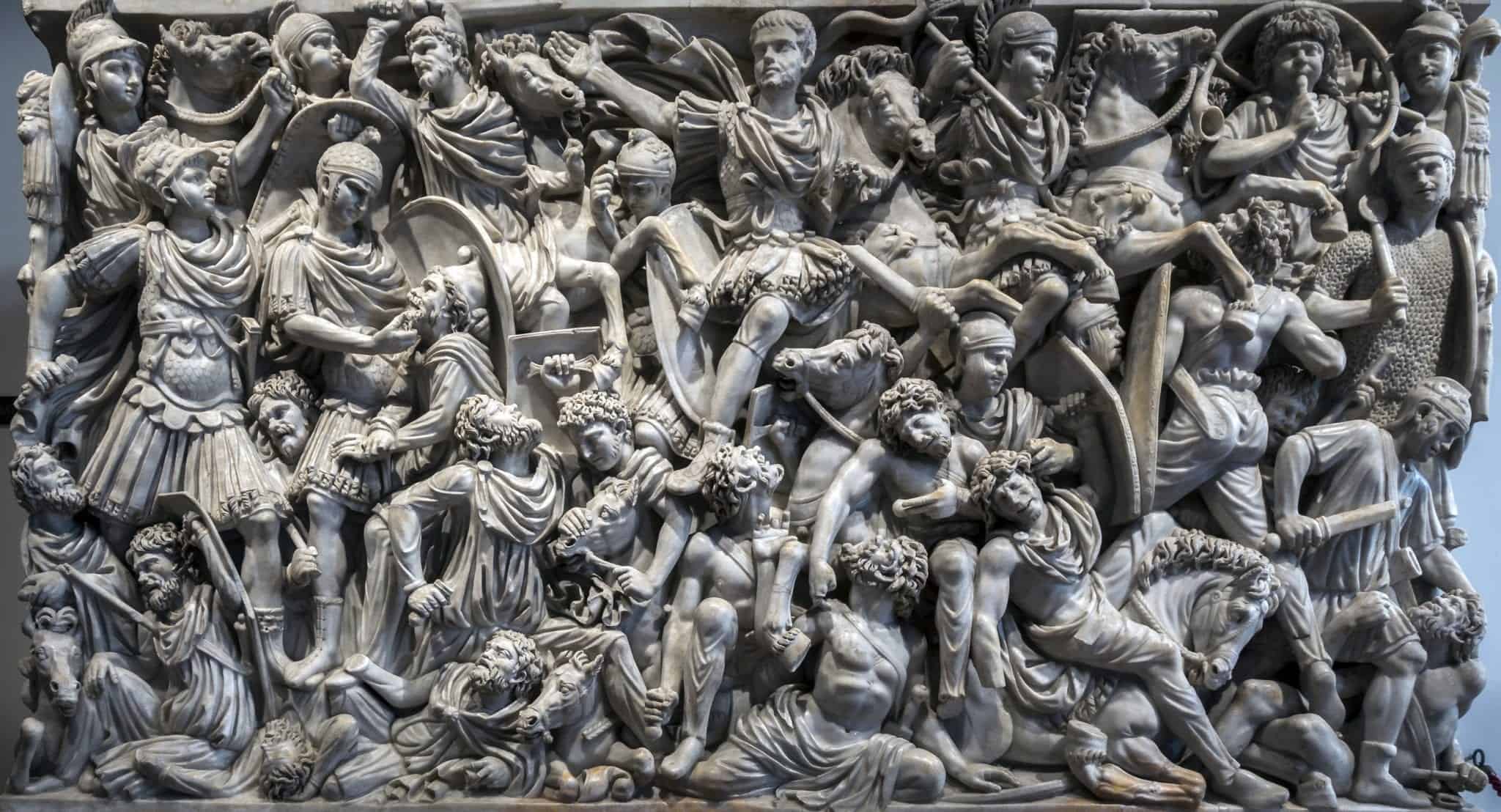
The Grand Ludovisi Sarcophagus is one of the most impressive reliefs you can see in Rome. The front is entirely taken up by a battle between Romans and barbarians, traditionally identified as Goths, carved in very high relief and with a crowding of bodies that almost cancels the background. The drill work digs under the figures and creates deep zones of shadow: it's a technique that reaches its peak in the second half of the 3rd century AD.
The piece was found in the 17th century in an area outside the city, near Porta Tiburtina, and quickly entered the Ludovisi collection. At the center of the composition, on horseback, stands a young Roman commander without a helmet, with his right arm raised in a sign of victory and a mark incised on his forehead that has been read as a Mithraic symbol. The identification of the figure is a matter of hypothesis: the most cited one recognizes him as a son of the emperor Trebonianus Gallus. It remains a hypothesis, not a fact.
What this sarcophagus really tells
The 3rd century AD is the century of crisis: emperors who last months, military pressure on the Danube borders, inflation, epidemics. A Roman aristocrat having himself buried inside a battle against the barbarians is saying something precise about his social role at a time when a military career had become the only road to power. The compositional chaos, with bodies piled up without spatial hierarchy, has been read as a mirror of that historical disorder.
Personally I distrust readings that match style to the mood of an era: they are fascinating and almost never provable. The certain fact is another, and it's enough to justify a long stop: here Roman sculpture abandons the classical principle of ordered space, and opens the way to late antique relief. It's a turning point in the history of Western art, visible to the naked eye, with admission included in the ticket.
The colossal head of Juno, or Hera Ludovisi
The great female head known as Hera Ludovisi or Juno Ludovisi is 116 centimeters high and carved in Parian marble. It was part of an acrolith, that is, a composite statue with head and extremities in marble and the rest of the body made of other materials: standing, the complete figure would have exceeded five and a half meters. It's a fact that should be told to visitors, because in front of the head alone nobody imagines the real scale of the original.
The current dating is to the 1st century AD. The identification, on the other hand, has been controversial for over a century: it has been proposed to see in it the goddess Hera, or a portrait of Antonia Minor, mother of Claudius and grandmother of Caligula, depicted with the attributes of Juno, or yet again a portrait of Livia, wife of Augustus, in the same scheme. Doubts about the divine identification began at the end of the 19th century and have never been resolved.
The 18th-century fortune of the Juno Ludovisi
The head was probably found in Rome and belonged to Cardinal Federico Cesi, who died in 1565. In 1622 it passed to the collection of Cardinal Ludovico Ludovisi. In the 18th century it became one of the most celebrated sculptures in Europe, considered the embodiment of ideal Greek beauty. Johann Joachim Winckelmann judged it the most beautiful head of Juno known. Goethe kept a plaster cast of it in his Roman home and compared it to a canto of Homer. Friedrich Schiller cited it as an example of ideal beauty, and Wilhelm von Humboldt admired it with the same intensity.
There is a detail that should make anyone concerned with taste think: the statue most loved by European Neoclassicism, the one that for two generations defined the canon of the beautiful, today we don't even know with certainty whom it represents. And it might not be Greek at all. The history of collecting is made of such reversals too, and it's the reason why it's worth visiting a museum built around collecting rather than around archaeology alone.
Restoring antiquity in the 17th century: what it really meant
This is the chapter that turns the visit to Palazzo Altemps from a walk among beautiful statues into an experience of understanding. It's best to take it slowly, because the modern idea of restoration is the exact opposite of the 17th-century one.
The horror of the fragment
For a Roman collector of the 17th century a mutilated statue was not a document: it was an incomplete object, therefore imperfect, therefore unsuitable for display in a gallery. A Venus without arms didn't communicate antiquity: it communicated ruin. The dominant aesthetic wanted the whole figure, legible, recognizable in its subject. As a result, restoration didn't consist in preserving what remained, but in giving back what was missing.
The sculptors called to do it were the best on the market. Gian Lorenzo Bernini, Alessandro Algardi, Ippolito Buzio and others worked on ancient marbles, adding heads, arms, legs, attributes. They didn't consider it a minor trade: it was a way of measuring themselves against the ancients on equal terms, and in some cases of correcting them.
Restoration as interpretation
The problem, from the historical point of view, is that every addition is also an interpretation. If the sculptor adds a bow to a torso without arms and attributes, that torso becomes Apollo or Diana. If he adds a thyrsus, it becomes Dionysus. The 17th-century restorer decided the identity of the work, and his decision conditioned all the later literature. Some sculptures have changed name two or three times over the centuries, following fashions and restorations.
Then there is the question of style. An arm carved by Bernini in 1622 is a Baroque arm: the twist, the muscular tension, the rendering of the skin belong to the 17th century, not to the 2nd century AD. When the addition is made by a great sculptor, the resulting work is a hybrid of the highest quality in which two eras live together in the same block of marble.
The 20th-century reversal and the choice of Palazzo Altemps
Between the 19th and 20th centuries the criterion is turned upside down. Archaeology becomes a science, the fragment gains documentary value, and many European museums proceed to dismantle the old additions to bring sculptures back to their state of discovery. It is the season of so-called de-restoration. The gain is evident in terms of philological truth. The loss, less discussed, concerns the history of taste, which those additions documented.
Palazzo Altemps chose the opposite road and, in our judgment, the most intelligent one: here the additions are kept and declared. The museum displays the statue for what it is today, that is, a layered object, and puts the visitor in a position to tell the layers apart. It isn't a compromise: it's a precise cultural position, which considers 17th-century Rome a chapter in the biography of those sculptures and not an accident to be erased.
If I had to name a single reason why this museum deserves more attention than it receives, I would name this one. Nowhere else in Rome is it so clear that the antiquity we see did not reach us intact, but passed through the hands of those who wanted it, bought it and remade it.
The Boncompagni Ludovisi collection at Palazzo Altemps
The most important core of the museum is the collection put together by Cardinal Ludovico Ludovisi, nephew of Pope Gregory XV, in the years immediately after 1621. It was a very rapid and financially enormous operation: the cardinal bought entire collections already formed, including pieces from the Cesi collection, and had systematic excavations carried out in the villa he was building on the Pincio, in the area of the ancient Horti Sallustiani. That land was the richest imperial garden in Rome and yielded sculptures in extraordinary quantity.
The collection then passed to the Boncompagni Ludovisi and remained with them for almost three centuries. At the beginning of the 20th century, after the subdivision of the villa, it was acquired by the Italian State and entered the holdings of the National Roman Museum. That's why we see it today in a palazzo that had nothing to do with the Ludovisi: Palazzo Altemps was chosen as a container because it's the kind of building those sculptures were conceived for.
The museum's other collections
Alongside the Ludovisi live the Altemps collection, that is, the core gathered by Cardinal Marco Sitico starting in 1568, and the Mattei collection from Villa Celimontana. There is also the collection of Evan Gorga, an extraordinary character: a tenor, he was the first performer of Rodolfo in Puccini's Boheme in 1896, then gave up singing and devoted himself to a compulsive collecting that led him to fill dozens of Roman apartments with objects of every era, to the point of financial ruin. Part of his archaeological material ended up here. The museum also holds frescoes from the Pallavicini Rospigliosi.
Four collections in a single building, formed in different centuries with different criteria: it is precisely this comparison that makes Palazzo Altemps a museum of ideas and not only of objects.
The Egyptian section of Palazzo Altemps and the Isiac cults in Rome
A part of the piano nobile is dedicated to Egypt and to the Egyptian cults practiced in Rome. It's a section that surprises those who don't expect it and that is in fact entirely consistent with the place: the Campo Marzio hosted the great sanctuary of Isis and Serapis, the Iseum Campense, one of the largest sacred complexes of the city, and from that area comes a notable quantity of Egyptian and Egyptianizing material, including the obelisks we see today in different squares of the center.
The museum's Egyptian rooms
The route crosses several rooms. In one of them stands the Hapi Bull, the sacred bull, together with a relief of the Navigium Isidis, the festival that every spring celebrated the resumption of navigation under the protection of the goddess. The Sala del Dio del Gianicolo holds an Osiris Chronocrator that still shows traces of ancient gilding: it's a detail to look for up close, because it reminds us that ancient sculpture was not white. In the Sala Isiaca are displayed statues of priests, with shaved skulls and the typical hieratic attitude. The Sala delle Grandi Dee and the Sala di Serapide follow, closing the section with pharaonic profiles.
Why Isis was worshipped in Rome
The cult of Isis arrives in Rome in the late Republican age through the ports and trade with Ptolemaic Egypt. The authorities looked at it with suspicion for a long time: there are decrees expelling the Isiac priests and demolitions of altars, because it was an initiatory cult, with a permanent clergy and its own rules, and therefore hard to control. Then the situation reverses. Caligula and above all the Flavians absorb it into public religion, and the Iseum Campense becomes a monumental sanctuary.
The reason for its success is understandable: traditional Roman religion was a system of civic rites that guaranteed peace with the gods for the community, but promised almost nothing to the individual after death. Isis promised personal salvation, rebirth, a direct relationship between the goddess and the believer. In a metropolis of a million inhabitants full of uprooted people, that promise worked. The Egyptian rooms of this museum tell this story much better than you would expect.

How to visit Palazzo Altemps: duration, route, accessibility
How long the visit to Palazzo Altemps takes
The museum can be visited well in an hour and a half. Anyone who wants to read the captions, stop at the Ludovisi Throne and the Grand Sarcophagus and look at the paintings of the piano nobile comfortably reaches two hours. In an hour you see everything superficially, and it's still an hour well spent. The palazzo isn't big: the effort here isn't physical, it's one of attention.
The visiting order I recommend at Palazzo Altemps
The recommended sequence is this: courtyard and portico at an easy pace, then straight to the piano nobile while you're fresh, and finally back to the ground floor for the rooms you skipped. The reason is that the most demanding works are on the upper floor and should be tackled with a clear head. The most common mistake is to use up 40 minutes on the ground floor and arrive tired in front of the Throne.
Accessibility of Palazzo Altemps
The palazzo is a historic building and has the typical limits of that category: differences in level, thresholds, ancient paving. The museum publishes on its website up-to-date information on services for visitors with disabilities and on accessible routes, and that's where you should look before leaving, or else call 06 684851 to check the situation of the day. Those who move in a wheelchair and those who accompany people with mobility difficulties should do this check in advance: it's the only way to organize the day well.
Services, photographs and luggage
Photographs without flash and without a tripod are generally allowed in state museums. Flash is forbidden everywhere because it damages painted surfaces. Bulky backpacks and umbrellas must be left at the cloakroom. The bookshop is small but has a serious scholarly catalog, which is not common. There's no café inside: you step out and in two minutes you're among the cafés of Rione Ponte.
When to go to Palazzo Altemps
The best hours
The first hour after opening, from 9:00 to 10:00, is the best time by far: the museum is almost empty and the morning light comes in well in the rooms facing the courtyard. The second good window is between 16:00 and 17:30, when the groups are elsewhere and the palazzo is quiet again. The time to avoid, if possible, is the middle of the day on spring weekends.
The first Sunday of the month
On the first Sunday of every month admission is free at state cultural sites, and this museum is no exception. A blunt and perhaps unpopular opinion: here free admission is worth less than elsewhere. Palazzo Altemps is a museum of details and captions, enjoyed in silence. On the free Sunday it fills up with visitors rushing through, and the ratio of quality of visit to savings, for me, doesn't hold. Better to pay €15 on a Tuesday morning.
Palazzo Altemps when it rains
In the rain this museum becomes an excellent choice. It's entirely indoors, the courtyard has a movable cover, and it's a couple of steps from other interiors you can visit. A day of bad weather in the center can become an itinerary of only beautiful things: first here, then San Luigi dei Francesi with the Contarelli Chapel, then the underground of the Stadium of Domitian.
Palazzo Altemps with children
It works better than you'd think, on two conditions. The first is duration: with children under 10 you stay inside 40 minutes, not two hours. The second is having a story to tell for every room, because a statue without a story is, for a child, a white object.
The stories are there, and they're strong. The Gaul who kills himself so as not to be captured. The Egyptian sacred bull. The general on horseback on the sarcophagus in the middle of a battle. The chapel with the beheading fresco, which has an enormous effect on kids of 11 or 12: judge your own child's sensitivity. The game that always works is the hunt for the remade parts: you show an added arm, explain how to recognize it, and from that moment the kids go around on their own looking for the modern pieces. They leave having understood a true thing about restoration, and without having been bored for a minute.
How much Palazzo Altemps costs and how to save
The full ticket is €15 and is valid for seven days at all sites of the National Roman Museum. It is probably the best ratio of price to content in the entire Roman museum offer: four sites, a week of time, €15. The reduced ticket is €2 for the categories provided by state regulations on cultural sites, which includes European Union citizens between 18 and 25. Minors under 18 enter free. The Musei in rete agreement provides a ticket at €10.
Anyone who lives in Rome or comes back often should look at the museum's annual card: €30 full, €20 reduced, unlimited entries for a year at all sites. Two complete visits are enough for it to pay off. I'll add a practical warning: the official website states that tickets bought through official channels are non-refundable, so buy when you're sure of the date.
Finally, pay attention to a point that changes planning: the Crypta Balbi appears to be temporarily closed to the public and at the Baths of Diocletian some spaces, including the Natatio, Aula VIII and the Museo della Protostoria, are not currently visitable. Before building an itinerary across the four sites, check the opening status on the museum's official website.
What to see around Palazzo Altemps
Two minutes on foot
Leaving the museum, you are a hundred or so steps from Piazza Navona, which preserves the shape of the Stadium of Domitian because it is literally built inside it. The underground of the stadium is visited from Via di Tor Sanguigna, at the northern corner of the piazza, and it is the physical explanation of that shape. On the western side of the piazza is the Napoleonic Museum, an intact 19th-century apartment that almost no one visits and that is worth half an hour.
Churches and palazzi within 10 minutes
Sant'Agostino Church, a little to the north, keeps Caravaggio's Madonna of the Pilgrims, Raphael's Prophet Isaiah and Jacopo Sansovino's Madonna del Parto: three masterpieces in a single nave, with no ticket. A little further on is San Luigi dei Francesi with the Caravaggio cycle in the Contarelli Chapel, which remains one of the most intense appointments Rome can offer. On the opposite side of Corso del Rinascimento is Palazzo Madama, seat of the Senate of the Republic, open to visitors on set days.
A half-day itinerary
If you have four hours and want to build a coherent route, this works: Palazzo Altemps early in the morning, Sant'Agostino, San Luigi dei Francesi, a quick lunch, then the Museo di Roma at Palazzo Braschi or a walk to Campo de' Fiori. Those who prefer to stay on the theme of collected archaeology can instead continue toward the Pantheon and then go back up toward Palazzo Massimo, using the same ticket.
Palazzo Altemps and Rome's other great collections
It's worth placing this museum on the map of Rome's noble collections. The Galleria Borghese was born in the same years as the Ludovisi collection and from an identical logic, with Cardinal Scipione Borghese raking in antiquities and commissioning from Bernini the groups everyone knows today. The difference lies in the outcome: the Borghese stayed in its villa, the Ludovisi lost theirs and found hospitality here.
Those who instead want to see how the State has organized archaeology in a scientific sense should go to Palazzo Massimo, where the criterion is chronological and thematic. The comparison between the two displays, five stops apart and with the same ticket, is the cheapest museology lesson you can take in Rome. And for those who want to close the circle on the defensive and residential architecture of Renaissance Rome there is Castel Sant'Angelo, on the other side of the river.
A curiosity about Palazzo Altemps - National Roman Museum
The curiosity that almost no one knows concerns the subsoil of this block and the way antiquity physically arrived in Rome. From the age of Augustus, about 160 meters upstream from the Aelian Bridge, one of the city's two marble ports was in operation. The other was at the Marmorata, below the Aventine, in the area we now call Testaccio. Here, in front of the palazzo we are visiting, the Tiber widened into quays where barges loaded with blocks from all over the Mediterranean docked.
It wasn't just a landing place. At this point was based the Statio rationis marmorum, the office that administered the imperial monopoly on the quarries. It means that marble was a State resource, accounted for like grain: every block carried incised stamps with the year, the name of the responsible official, the quarry of origin. Whoever studies these stamps reconstructs the economy of the empire better than by reading the ancient historians.
The landing was identified in 1891 during the excavations for the Tiber embankments. It was documented hastily and then destroyed. In the zone between Sant'Andrea della Valle, the Chiesa Nuova and the river, traces of many marble workers' shops have emerged, and in some of them roughly hewn blocks were found together with tools, datable to the end of the age of Trajan: workshops abandoned in haste, for reasons we don't know.
Put the two things together and the curiosity becomes something more. The sculptures admired today in the rooms of this palazzo were in good part carved by workers who labored a few hundred meters from here, with marble unloaded under these windows. Antiquity did not arrive in Rome from far away: it was produced here, in this neighborhood, as any manufactured good is produced in an industrial district. The museum is built on top of its own workshop.
Something nobody tells you about Palazzo Altemps - National Roman Museum
Look up at the crown of the palazzo, at the rooftop belvedere designed by Martino Longhi the Elder and completed by his son Onorio. The belvedere bears two side-by-side carved emblems: the ibex of the Altemps and the rose of the Orsini. They are there to commemorate the marriage between Roberto Altemps and Cornelia Orsini.
Now keep in mind the rest of the story. Roberto Altemps, natural son of Cardinal Marco Sitico, prefect of the papal arms in Avignon and first Duke of Gallese, was accused of adultery and beheaded in 1586, at age 20, by order of Sixtus V. The political tie with the Orsini, declared enemies of the pontiff, is considered by the current reading to be the real motive for the sentence, although on this point historians remain cautious: the execution is documented, the political calculation that motivates it remains interpretation.
That coat of arms, then, celebrates on the roof of the house exactly the union that in all likelihood cost the groom his head. And it stayed there. Nobody chiseled it off, nobody covered it, in four centuries. In the Rome of families that rewrote their past with every change of pontiff, the Altemps kept on their facade the monument to their own disgrace.
The same logic returns inside the palazzo, in the chapel. In 1604 Clement VIII gave the family the remains of Pope Anicetus. In 1617 Giovanni Angelo Altemps had a large fresco painted in the same sacred space showing the beheading of his father. A martyr pope of the early centuries and a duke executed by a pope, in the same room. I know of no other heraldic and figurative declaration in Rome as stubborn. And you can see it from outside, for free, simply by lifting your head in Piazza di Sant'Apollinare.
The advice I give you for visiting Palazzo Altemps - National Roman Museum
Tip number one is about timing and it's non-negotiable: come at opening, at 9:00 on a weekday. This museum behaves differently from others when it comes to crowds. The rooms are small, many works are viewed from a single useful point and reading the surfaces requires silence. With 10 people inside it's an experience. With 50 it's a corridor.
The second tip is about order. Don't spend your energy on the ground floor. The courtyard and portico deserve 10 minutes, not 40. Then go straight up to the piano nobile, where the Ludovisi Throne, the Ares, the Gaul, the Grand Sarcophagus and the painted rooms are. These are the works that demand concentration and should be tackled when your head is fresh. You return to the ground floor at the end, to finish.
The third tip is a method of looking, and it's the one that really changes the visit. In front of every sculpture, before reading the caption, look for the remade parts: differences in polish, edges that are too sharp, joints hidden in the folds, hands and feet. You'll soon notice that almost everything in front of you is a two-stage object, ancient at its core and 17th-century in its completion. From that moment the museum becomes legible.
The fourth is practical: use the ticket in full. It's valid for seven days and includes the other sites of the National Roman Museum. Anyone who pays €15 and visits only this palazzo is throwing away two thirds of what they bought. Check beforehand which spaces are open at the other sites, because not all of them can be visited at the moment.
One last thing, and on this I am categorical: the Sant'Aniceto chapel should be looked at slowly, seated if possible, for at least five minutes. It is the most intense space in the palazzo and the average visitor stays less than a minute. If you stop, you will have seen something almost nobody sees.
Another well-known fact, yet rarely mentioned
Everyone knows the National Roman Museum has several sites. Almost no one uses this information the right way, and the consequences are concrete.
The fact is simple: the €15 ticket is not the ticket for Palazzo Altemps. It is the ticket for the National Roman Museum, it's valid for seven days from first entry and opens the doors of all the institution's sites. Anyone who visits this palazzo and then pays again elsewhere the next day has paid twice for the same thing. It happens daily, because the information is there but isn't read.
The historical reason for this dispersal is just as rarely mentioned. The National Roman Museum was born in 1889 in the complex of the Baths of Diocletian, with the idea of concentrating in one place the archaeological materials that the building works of the new capital were turning up at an impressive pace. In a few decades the holdings exceeded every expectation: excavations for sewers, for the Tiber embankments, for the new neighborhoods delivered tens of thousands of finds. A single site became impossible and the institution spread across several buildings, each with a vocation: statuary and painting at Palazzo Massimo, epigraphy and protohistory at the Baths, the late antique and medieval city at the Crypta Balbi, collecting here.
A consequence follows that is worth spelling out: none of the four sites is self-sufficient and none is the main site in the sense in which that is usually understood. They are four chapters of the same discourse. Whoever visits only one has read a chapter and closed the book.
I'll add the practical fact, because it changes the planning of whoever is reading: at the moment the Crypta Balbi appears to be temporarily closed and at the Baths of Diocletian the Natatio, Aula VIII and the Museo della Protostoria are not visitable. The opening status should be checked on the official website before distributing the seven days of the ticket.
The right photo to take at Palazzo Altemps - National Roman Museum
The best photograph of this museum is not an isolated statue on a neutral background. It is the statue inside the architecture, because that is the point of the place.
Spot number one is the courtyard portico. Stand under an arch on the long side and frame a sculpture under the next arch, so that the curve of the arch frames the marble and the opposite side of the courtyard is visible in the background. The best light is the morning's, when the sun comes in at an angle and the movable cover diffuses it without flattening. Keep the horizon straight and the vertical lines parallel: in a Renaissance courtyard a crooked vertical is noticed immediately.
Spot number two is the frescoed loggia of the piano nobile. Here the framing that works is the long one, in depth: the row of white sculptures receding with the painted vegetation on the walls and the polychrome fountain at the end. It's the photograph that explains the idea of this palazzo better than any caption. You need a steady hand because the light is low. Lean against a door frame, since tripods aren't allowed.
Spot number three is not inside the museum. Step out into Piazza di Sant'Apollinare, cross it and look for the upward framing toward the rooftop belvedere, with the ibex and the rose. It's a difficult photograph because of the forced perspective, but it's the only image that contains the whole story of the family.
Two technical rules and one of manners. No flash: it's forbidden and it damages the pigments. No tripod in narrow spaces. And wait your turn in front of the Ludovisi Throne instead of sticking your phone in front of someone who is looking at it. It's a relief that deserves silence, not a queue of outstretched arms.
Some important events that happened here in history
The first event is a missed construction deadline. Girolamo Riario wanted the palazzo ready for his marriage to Caterina Sforza, celebrated in 1477. The works were not finished before 1480. It sounds like an administrative detail and instead tells the real pace of Sixtus IV's nepotism: they built fast, spent a lot, and when the pope died everything stopped. Once the Riario fortune fell, the palazzo passed to others.
The second event is the purchase of 1568 by Cardinal Marco Sitico Altemps, nephew of Pius IV on his mother's side. With him this building stops being a property and becomes the seat of a family: the Altempsiana Library is born, later merged into the Vatican Library, along with the palazzo's first collection of ancient sculptures. It is the remote founding act of the museum you visit today.
The third is the execution of Roberto Altemps in 1586, condemned at age 20 for adultery by Sixtus V, with the political reading already mentioned. The fourth is the donation of 1604: Clement VIII hands the family the remains of Pope Anicetus and the private chapel becomes the tomb of a pontiff. The fifth is 1617, the year in which Giovanni Angelo Altemps has the fresco of his father's beheading painted in the same chapel.
The sixth event is from 1690 and has enormous literary consequences: in this palazzo the Academy of Arcadia is founded, which for more than a century dictates Italian poetic taste and which today has its seat at the Bosco Parrasio, on the Janiculum. The seventh is from the 18th century: Cardinal Melchior de Polignac takes the palazzo on lease as French diplomatic seat and makes it a center of society and luxury.
The eighth belongs to the history of Roman education: passed to the Holy See in the 19th century, the building hosts from 1871 to 1903 the de Merode school, which then moves near Piazza di Spagna. The ninth is from 1982, when the palazzo enters State ownership through purchase by the Ministry for Cultural Heritage. A very careful architectural restoration follows, with important decorative recoveries, including the frescoes that reemerged in the Sala della Piattaia, attributed to the school of Melozzo da Forli.
The tenth and last event is the opening to the public as a site of the National Roman Museum: from that moment a family palazzo becomes the place where the Italian State tells how Romans collected their own antiquity. Five centuries of private ownership flow into a common good, which in Rome is not at all the most frequent ending.
Who has passed through Palazzo Altemps - National Roman Museum
We begin with a woman. Caterina Sforza, who was to begin her Roman life here in 1477, would become the lady of Imola and Forli and one of the most determined political figures of the Italian Renaissance, able to defend Ravaldino against Cesare Borgia. Her marriage to Girolamo Riario is the reason this building site was opened.
Then the cardinals. Francesco Soderini, a Florentine, who in 1511 called in Antonio da Sangallo the Elder and Baldassarre Peruzzi. Innocenzo Cybo, nephew of Innocent VIII and a man of the Medici circle, who lived here between 1513 and 1518 and was later bishop of Genoa, archbishop of Turin and papal legate of the Province of Romandiola at Bologna. Marco Sitico Altemps, who bought it in 1568 and turned it into the house of a family. Ludovico Ludovisi, nephew of Gregory XV, whose collection is today the heart of the museum even though it never belonged to this palazzo.
Then the architects and artists: Melozzo da Forli for the 15th-century design, Peruzzi for the courtyard, Martino Longhi the Elder and his son Onorio for the completion and for the rooftop belvedere, Francesco Vespignani for the 19th-century restoration of the theater. And, through sculpture, Gian Lorenzo Bernini, whose intervention on the Ares Ludovisi is unanimously attributed by critics to the restoration commissioned by Cardinal Ludovisi.
Then the popes, who here are not extras: Sixtus IV at the origin of the building site, Pius IV in the cardinal Altemps's kinship, Sixtus V who sends Roberto to his death, Clement VIII who donates the relics of Pope Anicetus, Gregory XV whose nephew builds the collection. Five pontificates intertwined with a single block.
In the 18th century the palazzo hosts the French social life of Cardinal Melchior de Polignac. Local tradition recalls that Pietro Metastasio performed here and that Wolfgang Amadeus Mozart played here during his Roman stay. These are stories handed down by the memory of the palazzo, which I report as such and not as verified archival fact. Metastasio, after all, was a child of the Arcadia founded right here, and the link has a coherence of its own.
Finally, indirectly, the whole European culture of the 18th and 19th centuries passed through here by way of a sculpture: the colossal head of Juno, admired by Winckelmann, cited by Schiller, admired by Wilhelm von Humboldt, kept as a cast by Goethe in his Roman home. They did not come to this palazzo, but their canon of the beautiful was formed in front of a marble that today you look at here, on the first floor, with a €15 ticket.
Quick questions about Palazzo Altemps - National Roman Museum
Where exactly is Palazzo Altemps
In Piazza di Sant'Apollinare 46, in Rione Ponte, less than 200 meters from the northern side of Piazza Navona. The entrance is on the piazza, in front of Sant'Apollinare Church.
How much is the ticket for Palazzo Altemps
The single ticket of the National Roman Museum costs €15 full and €2 reduced. There is a €10 rate for the Musei in rete agreement and a separate €5 ticket for the Octagonal Hall alone.
Is the Palazzo Altemps ticket valid for the other museums too
Yes. It's valid for seven days from first entry at all sites of the National Roman Museum: Palazzo Altemps, Palazzo Massimo alle Terme, Baths of Diocletian and Crypta Balbi. Before planning, check on the official website which spaces are open.
What are the opening hours of Palazzo Altemps
Tuesday through Sunday, from 9:00 to 19:00. Last entry and ticket office closing are at 18:00.
Is Palazzo Altemps closed on Monday
Yes, the museum is closed on Monday.
Is admission free at Palazzo Altemps on the first Sunday of the month
Yes. On the first Sunday of every month admission is free at all state cultural sites, including this museum. It's also the most crowded day.
Do you need to book to visit Palazzo Altemps
It's not required. Tickets are bought on the official portal of Italian museums or at the ticket office. On ordinary days you get in without a significant wait.
How long does the visit to Palazzo Altemps take
An hour and a half for a complete, relaxed visit, two hours for those who read the captions and stop at the main works, an hour for a quick pass.
What can you see at Palazzo Altemps
The Renaissance and Baroque collections of ancient sculpture: the Boncompagni Ludovisi collection with the Ludovisi Throne, the Ares, the Suicidal Gaul, the Grand Sarcophagus and the colossal head of Juno. The Altemps collection. The Mattei collection from Villa Celimontana. The Egyptian section. Part of the Gorga collection. Plus the palazzo itself, with Peruzzi's courtyard, the painted loggia, Sant'Aniceto Church and the theater.
What is the most important work at Palazzo Altemps
The Ludovisi Throne, a Greek relief of 460-450 BC found in 1887 in the area of the Horti Sallustiani. For visual impact, many point instead to the Grand Ludovisi Sarcophagus.
Is the Ludovisi Throne authentic
The great majority of archaeologists consider it authentic. Federico Zeri and other scholars argued the thesis of a 19th-century forgery, suggesting the hand of Santo Varni. The debate has remained open without overturning the prevailing opinion.
Why do many statues at Palazzo Altemps have remade parts
Because in the 17th century a mutilated sculpture was considered unsuitable for a gallery. Collectors had the missing parts added by the best sculptors of the time. The museum keeps and declares these additions instead of removing them.
Did Bernini work on a statue at Palazzo Altemps
The 17th-century restoration of the Ares Ludovisi is unanimously attributed by critics to Gian Lorenzo Bernini, who worked for Cardinal Ludovico Ludovisi.
Is Palazzo Altemps wheelchair accessible
It is a historic building with differences in level and thresholds. Information on routes and services for visitors with disabilities is published on the museum's official website. For a precise check, it's best to call 06 684851.
Can you take photographs at Palazzo Altemps
In state museums photographs without flash and without a tripod are generally allowed. Flash is always forbidden because it damages paintings and surfaces.
Is there a cloakroom at Palazzo Altemps
Yes, bulky backpacks and umbrellas must be left there. The museum also has a bookshop with a good scholarly catalog.
Is Palazzo Altemps suitable for children
Yes, provided you keep the visit within 40 minutes and tell the stories of the works. The Suicidal Gaul, the Egyptian sacred bull and the hunt for the remade parts work very well with kids.
What is the difference between Palazzo Altemps and Palazzo Massimo
Palazzo Massimo displays archaeology with a scientific, chronological and thematic criterion, and holds the great cycles of wall painting. Palazzo Altemps tells the story of antiquarian collecting and shows sculptures as a 17th-century cardinal saw them, inside his palazzo.
How many sites does the National Roman Museum have
Four: Palazzo Altemps, Palazzo Massimo alle Terme, Baths of Diocletian with the Octagonal Hall, and Crypta Balbi.
Is there a church inside Palazzo Altemps
Yes, Sant'Aniceto Church, built in the 17th century by Giovanni Angelo Altemps to house the remains of Pope Anicetus, donated to the family in 1604 by Clement VIII. In the same space is the 1617 fresco of the beheading of Roberto Altemps.
Can you visit the theater of Palazzo Altemps
The Goldoni Theater is not part of the regular route: it opens for performances, lectures and cultural events. The calendar is published on the museum's website.
Can you go up to the rooftop belvedere of Palazzo Altemps
Access to the rooftop belvedere is not always included in the regular route and depends on special openings. It should be checked on the museum's official website.
Who built Palazzo Altemps
The first building site is 15th-century, commissioned by Girolamo Riario to a design by Melozzo da Forli and finished no earlier than 1480. In 1511 Cardinal Francesco Soderini brought in Antonio da Sangallo the Elder and Baldassarre Peruzzi, author of the courtyard. After 1568 Cardinal Marco Sitico Altemps called in Martino Longhi the Elder and his son Onorio.
Why is it called Palazzo Altemps
From the name of Cardinal Marco Sitico Altemps, who bought it in 1568. Altemps is the Italianization of Hohenems, the Austrian family he came from. Before that it was called Palazzo Riario.
When did Palazzo Altemps become a museum
The State bought it in 1982 through the Ministry for Cultural Heritage. After a long restoration the palazzo was opened to the public as a site of the National Roman Museum.
How much time do you need to see all the sites of the National Roman Museum
With the seven-day ticket you can comfortably organize two half days. Palazzo Altemps takes an hour and a half, Palazzo Massimo at least two and a half hours, the Baths of Diocletian about an hour and a half.
What is there to see near Palazzo Altemps
Piazza Navona and the underground of the Stadium of Domitian, the Napoleonic Museum, Sant'Agostino Church with the Caravaggio and the Raphael, San Luigi dei Francesi with the Contarelli Chapel and Palazzo Madama, seat of the Senate. All within 10 minutes on foot.
Is it worth visiting Palazzo Altemps in the rain
Yes. The route is entirely indoors, including the courtyard, which has a movable cover, and the museum is a few steps from other interiors you can visit.
If I had to name a single Roman museum capable of changing the way you look at ancient statues for the rest of your life, I would name this one. Not for the quantity of works, which is limited, but because it's the only place in the city where the object and its fate are displayed together: the Greek marble, the Roman copy, the arm remade in the 17th century, a cardinal's gallery, the State that buys everything and opens the doors. I've been going for years, and I keep finding people who walk past without going in, with another museum's ticket in their pocket. Do yourself a favor: stay half a day, start at nine, and look at the statues' hands.
Article written by the editorial team of TourLeaderPro, contact them for Private/Corporate/V.I.P. Tours and Experiences.
Planning a trip to Rome? The English guides to visiting the city are on ItalyPlanner.com.