Palazzo Madama – Italian Senate
In short. Palazzo Madama occupies the block between corso del Rinascimento, via del Salvatore, via della Dogana Vecchia and piazza Madama, in the Sant'Eustachio rione.
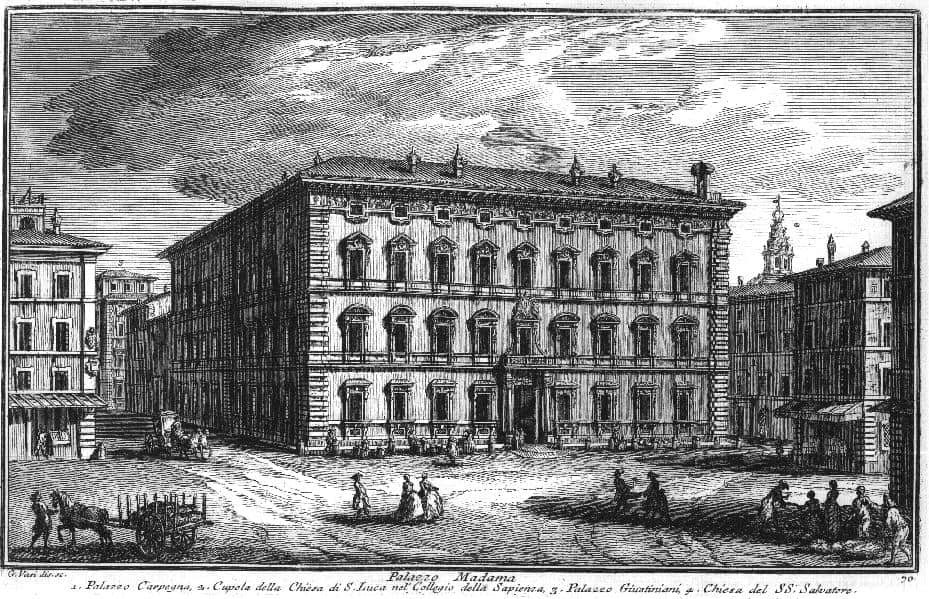
Palazzo Madama occupies the block between corso del Rinascimento, via del Salvatore, via della Dogana Vecchia and piazza Madama, in the Sant'Eustachio rione. The floor plan is not regular: it resembles a pentagon with sides of very different lengths. The formal entrance opens onto corso del Rinascimento, the secondary one on the side of San Luigi dei Francesi. No subway station serves the square. You get there on foot, in three or four minutes from the Pantheon and in two from piazza Navona, or by bus, on the lines that run along corso del Rinascimento and those that terminate at largo di Torre Argentina. Line numbers change often, so it's worth checking them on the transit company's app before you set out. The palace is not a museum: it is the seat of the Senate of the Republic, so it has no ticket office, no continuous opening hours, and it can't be visited freely. Guided tours do exist, and they are free, but they are reserved for organized groups, schools, bodies, associations and private individuals who apply. Procedures, schedule and forms are published by the Senate on its own official website, which remains the only source to check before planning anything. Anyone who can't get in still has access to the virtual tour the institution has put online, which lets you walk through the Aula and the reception halls from your screen.
One thing to make clear right away: in front of Palazzo Madama, most visitors stop for 30 seconds, photograph the façade and head on toward Navona. That's a waste. This is one of the few Baroque façades in Rome that reads like a text, and anyone who knows what to look for spends a quarter of an hour there. If you want to place the palace within the system of the city's great historic containers, start from the index of musei di Roma and the Tourist Attractions page.

What Palazzo Madama Is Today
Palazzo Madama takes its name from Margaret of the House of Habsburg, known as Madama d'Austria, who lived there after the death of her husband Alessandro de' Medici. Today the building is state property and is the seat of the Senate of the Republic. By metonymy, the expression Palazzo Madama has become, in journalistic language and in everyday speech, a synonym for the Italian Senate, just as Montecitorio stands for the Chamber and Palazzo Chigi for the government.
Inside the walls are housed the Aula, some parliamentary groups, the offices of the Presidency and the General Secretariat, and the services most directly tied to parliamentary activity. The number of elected senators fell to 200 after the 2020 constitutional reform: 196 elected in Italy and four in the Estero constituency. Adding the life senators appointed by the President, as of March 12, 2025 the assembly had 205 members. This figure matters for the visit more than it seems: the hemicycle you see from above was designed for a much larger assembly, and this explains why it looks wide today.
The Senate doesn't work alone in this block. A little farther on, on via della Dogana Vecchia, is Palazzo Giustiniani, which houses the residence of the President of the Senate and some offices. On the other side, toward corso del Rinascimento, the palazzo Baldinotti Carpegna, also owned by the Senate, is connected to Palazzo Madama by a twentieth-century building wing. The institution therefore occupies a small quarter, and anyone walking here in the evening can tell from the number of guarded entrances.
The Visit to Palazzo Madama, Room by Room
What follows is the route covered on the institutional tours, in the order you take it going up from the ground floor. Not all the rooms are always accessible: it depends on work in the Aula and on security needs.
The Cortile d'Onore of Palazzo Madama
The main entrance on corso del Rinascimento leads into the Cortile d'Onore, rectangular in shape, with a bronze statue by Emilio Greco at its center titled Grande figura accoccolata, from 1971. Greco, born in Catania in 1913 and died in Rome in 1995, had started at 13 as an apprentice in a workshop of stonecutters, and he ended his career with the doors of the Orvieto Cathedral and the monument to John XXIII in Saint Peter's. His is a smooth figuration with continuous line, which in a sixteenth-century courtyard works by contrast rather than by resemblance. Putting it there was a bold choice and, in our view, a successful one.
The current floor, in marble, replaced the original travertine one. The six columns of the portico, on the other hand, belong to the structure from the time of Leo X: they are the oldest piece the visitor encounters, and it's worth resting a hand on them. To the left of the portico rises the Scala d'onore.

The Second Staircase and the Medici Ceiling
The other staircase, which you reach from the entrance facing San Luigi dei Francesi, is covered by a gilded wooden ceiling from the 16th century with the Medici coat of arms and a depiction of sea deities. Pay attention to the detail that almost everyone misses: that ceiling didn't originate there. It was placed above the staircase in 1931, during the great renovation campaign of the 1900s, and it comes from another room in the palazzo. It's a clear example of how, in an institutional building, works move from one room to another depending on representation needs.
The First Floor of Palazzo Madama: The Rooms
On the first floor, in sequence, open the Buvette, the anteroom of the Balustrade, the Sala Cavour, the Sala Maccari, the Sala Italia, the Sala del Risorgimento, the Sala dello Struzzo, the Sala della Firma, the Sala Marconi, the Sala dei Postergali, the Sala Pannini and the Aula. There are 12 rooms, some of them just passageways, others that are worth the entry ticket on their own. I'll tell you about them one by one.
The Legislative Chamber of Palazzo Madama
The Aula is covered in red. It wasn't always: previously the dominant color was blue, for reasons all traceable to the colors of the Savoy family banner. It stands raised above the papal-era courtyard on which it was built, and the level was raised as a precaution after the 1870 flood of the Tiber, when the water invaded half of the historic center. It's a decision of hydraulic engineering that became parliamentary architecture, and you can still read it today in the difference in level you cross when you enter.
Behind the post of the President of the Senate, two inscriptions are read on rectangular plaques: one commemorates the proclamation of the Republic after the 1946 referendum, the other reports the words with which Vittorio Emanuele II marked the proclamation of the unity of Italy. The two plaques, placed side by side, sum up in a few centimeters the passage from monarchy to Republic: no museum says it with such economy.
The dome ceiling is covered with a cloth painted in gesso, according to the neo-Cinquecento grottesca technique. It's called the Velario and contains medallions with the effigies of four jurists, the four civic virtues and the four capitals of the pre-unification kingdoms. When television cameras frame the hemicycle from above, the Velario almost always stays out of shot: it's the most underrated decorative element of the entire palazzo.

The Sala Cavour of Palazzo Madama
At the center of the ceiling, designed after the ancient coffered type, an oval oculus was placed with the painting Bacchus and Ariadne by Giambattista Pittoni. Pittoni, a Venetian from 1687 to 1767, was among the leading figures of Venetian Rococo and co-founded the Academy of Fine Arts of Venice with Tiepolo, which he later presided over. His palette, recognizable for a cold blue and a glassy light, produces an almost disorienting effect in a Roman representation room.
The room is at the disposal of the members of the Government who attend the sittings, and sometimes hosts the Council of Ministers. Put another way: when the news announces a Council of Ministers convened at the Senate, this is the room, with an eighteenth-century Bacchus looking down from above on the negotiations. The short circuit is served.
The Sala Maccari, the Masterpiece of Palazzo Madama
The room, also called the yellow room for the color of its damask walls, takes its name from Cesare Maccari, who decorated it after winning a competition announced by the Ministry of Public Education in 1880. Maccari was born in Siena in 1840 and died in Rome in 1919. He trained with Luigi Mussini at the Sienese Academy after starting out as a sculptor, and had built his reputation with the decoration of the Royal Chapel of the Shroud. The Senate cycle kept him busy from 1881 to 1888. He closed his career with the dome of the shrine of Loreto, between 1895 and 1907, and in 1909 paralysis forced him to give up work 10 years before his death. If I had to name a single room worth insisting on until you get the visit permit, I'd name this one without hesitation.
The ceiling decorations show four allegorical figures surrounding the central motif, a personification of triumphant Italy. The four medallions represent commerce and agriculture, that is Industry, then Arms, the Sciences and the Arts. The allegories take the form of naked boys and girls. The frieze that joins the walls to the ceiling is run through by two phrases from Machiavelli and Guicciardini. The reference to the Florentine political tradition, in a palace that the Medici had made their own, is anything but accidental.
The Five Frescoes of the Ancient Senate in the Sala Maccari
On the walls are depicted five famous episodes from the Senate of ancient Rome. The first fresco on the right, right after the entrance, shows Appius Claudius brought into the Senate to urge the Romans not to accept the peace terms offered by Cineas, the ambassador of Pyrrhus. Maccari captures with evident involvement the expression of weight and of august, severe weariness of old Appius. The figure of the ambassador stands out for the rightness and nobility of his bearing.
The two smaller paintings, on the wall opposite the entrance and separated by a large window, depict, one, Senator Papirius Gallus impassive before the Celts invading Rome, the other, the Samnites' attempt to bribe Curius Dentatus so that he would persuade the Romans to make peace. These are the two pieces the public looks at least, and the ones that hold up best in narrative terms.
The third fresco shows the Senate of Rome at the moment when Cicero, indignant, arms stretched toward Catiline, bursts out with the famous Quousque tandem. Catiline, seated in his stall in the foreground, bows his head and convulsively grips his right leg with his hands, abandoned by everyone. It's the image every Italian has seen at least once in a school book without knowing where the original was. It's here, inside the Senate of the Republic.
The last fresco shows Atilius Regulus about to advise the Senate of Rome to resist Carthage, which had sent him, on a promise to return, to propose and support peace in his homeland. The Senate listens, the crowd admires, Regulus's family begs him to break his given word and not to go back to Carthage. The sky is a dazzling blue that curves toward sunset, against the backdrop of the buildings of Rome bathed in the dying light of the sun.


The Buvette of Palazzo Madama
The buvette is a large room with a vault decorated with friezes and small figures in light stucco from 1931. On one wall hangs a 16th-century Medici wall hanging from the Uffizi in Florence: a loan that tells, better than any plaque, the continuity between the Medici's Roman palace and their Tuscan capital. Opposite stretches the bar counter, which bears a small statue by Vincenzo Gemito that works as a little fountain.
The other two walls hold two still lifes by Luciano Ventrone, La Pausa and Il ritorno di Ulisse, both from 2002. Ventrone worked with a hyperrealism of photographic origin that, in the context of a 1931 room, clashes just enough to make you look. Blunt opinion: the buvette is the room where the Republic has collected best, because it bought contemporary when it was still contemporary.
The Sala Italia of Palazzo Madama
It's a large hall used for formal functions, created in the early 1930s by demolishing a dividing wall and fitted with a coffered ceiling in a modern style. In the part of the 17th-century frieze facing the buvette, figures of putti and lions predominate. In the other part, female figures appear. Six historical frescoes complete the decoration.
In August 2003 the wooden statue Italia by Giuliano Vangi, 2.35 meters tall, was placed in the hall: a female figure with braids and ivory eyes, later moved to Palazzo Giustiniani. The seascape by Piero Guccione titled Il nero e l'azzurro, placed on one of the short walls, dates from the same year. Guccione painted the sea of Sicily as a question of moral order before a chromatic one, and in a formal institutional hall that canvas works like an open window.
La Sala dello Struzzo of Palazzo Madama
It stands out from the others because it doesn't have the usual Medici frieze. In the gilded wooden coffered ceiling, an ostrich appears in its place. The animal, from the 16th century, is yoked with a ribbon tied around its neck to a shield of the Medici family, added in the 17th century. The most widely accepted explanation, and it remains a recurring hypothesis in the literature on the palace, is that the ostrich alludes to Margaret of Austria through the French wordplay between Autriche, Austria, and autruche, ostrich. It's not the only possible reading: some also see in it a heraldic symbol of speed and precedence, or of firmness and strength.
One thing, however, is certain: the ostrich was chosen by a person who held no religious office, as shown by the crown above the animal's head, which recalls imperial descent. On the walls hang two views of Rome by Mauro Reggio, one of the Theater of Marcellus and the other of the twin churches of Piazza del Popolo. The furnishings are completed by a 20th-century painting by Corrado Cagli with Etna erupting and a 17th-century wall hanging with a woman and a child.
The other rooms on the first floor of Palazzo Madama
The Balaustra antechamber is the room that regulates the flow toward the hemicycle. The Sala del Risorgimento and the Sala della Firma belong to the formal circuit. The Sala Marconi is linked to the memory of the scientist, who was a senator of the Kingdom. The Sala dei Postergali takes its name from the tall wooden backs that characterize its furnishings. The Sala Pannini owes its name to the painter from Piacenza Giovanni Paolo Pannini, master of 18th-century Roman view painting. These are rooms you pass through quickly on tours, and public documentation on them is sparser. For a precise description, it's best to refer to the material handed out by the Senate during the visit.

The history of Palazzo Madama, phase by phase
From the Benedictines of Farfa to the first owners
The story begins in the late 15th century, under the pontificate of Sixtus IV. The land on which the palace stands had belonged, together with the neighboring land of Piazza Navona, for almost five centuries to the Benedictine monks of the abbey of Farfa: hence the original name of Piazza Longobarda. In 1479 the Benedictines ceded it to the French monarch, who in turn gave to his treasurer and bishop of Chiusi, Sinulfo Ottieri di Castell'Ottieri, the portion between the Crescenzi tower and the Baths of Alexander. The original core of the building was founded on that lot.
In January 1503 the property was included in the bequest left in the will to Sinulfo's brother, Guidone, Count of Montorio, who first rented it out and then ceded it to Giovanni de' Medici, the future Pope Leo X. Keeping this chain in mind is useful: it explains why, for two centuries, the palace remains a piece of Florence planted in the middle of Rome.
Leo X's circle at Palazzo Madama
The palazzo truly came into the Medici's possession when Cardinal Giovanni de' Medici, son of Lorenzo the Magnificent, bought it in installments in 1505, after having rented it, and commissioned a major restoration from Giuliano da Sangallo. After the family was expelled from Florence, Giovanni, by then Leo X, made it the family's Roman seat. The Medici extended their presence to the whole neighborhood. The idea was to counterbalance Piazza del Popolo and its church of the Rovere with a Medici center just as important and glorious. With the transfer of what remained of the Florentine library, the palazzo also became a hub from which humanist culture spread.
The property history was eventful. Forced by debt, Leo X sold the building to his sister-in-law Alfonsina Orsini, and regained possession of it in 1519 upon her death, when she left it to him in her will. Upon the pope's death, in 1521, the palazzo was assigned to his cousin Giulio de' Medici, who had lived there as a teenager and who would become pope under the name Clement VII. Even then the building hosted a second exile of the Medici, who were expelled from Florence from 1527 to 1530.
Madama Margherita d'Austria and the name of Palazzo Madama
The name comes from Margherita of Austria, natural daughter of Charles V and wife of Duke Alessandro de' Medici. Widowed in 1537, she married Ottavio Farnese as her second husband and stayed for a long time in the building, which took from her the name it has kept to this day. The placing of the shield with the ostrich on the coffered ceiling of the hall of the same name is traced back to Margherita. It is a symbol of the palazzo's passage into the Spanish-Austrian sphere of influence. The usual Medici noble coat of arms would have been placed above it in the seventeenth century, with the addition of the ribbon that connects it to the animal's neck.
When Margherita left for the governorship of the United Provinces, the residence was rented to several cardinals. It then went back to the head of the family, Ferdinando I, who lived there for a few years as a cardinal. When he left to take up the grand duchy in Florence, he left it to his close associate, Cardinal Francesco Maria Bourbon del Monte Santa Maria, who was connected by family ties to the Bourbon-Navarre family and to the pro-French faction of papal diplomacy.
The Ownership Dispute with Caterina de' Medici
Queen Caterina de' Medici of France lived in the palazzo for only a few years, as a child. Since Leo X had left the inheritance to the only two surviving male heirs of Lorenzo the Magnificent's line, Caterina took note of this in 1533, signing a formal renunciation of her father's property in favor of her half-brother Alessandro. After his death, however, she retracted the renunciation. Only in 1560 did she sign a first agreement with Margherita of Austria: the queen of France was recognized as owner and granted the usufruct to the wife of Ottavio Farnese.
The dispute ended a year after Margherita's death, when her heir Alessandro Farnese, in 1587, gave up any claim to the Medici residence in Rome. The following year, in the marriage contract between Grand Duke Ferdinando I and Christina of Lorraine, Caterina's granddaughter, the grand duke obtained the transfer of the family property still owned by her, with particular reference to Palazzo Madama. That was in 1588. Among French travelers, the dispute long fueled the legend that the title Madama referred to Caterina and not to Margherita. It is a mistake that still appears in some foreign guidebooks.
The 1600s: the Baroque Facade and the Music Room of Cardinal Del Monte
The correspondence between Cardinal Del Monte and the grand duke shows that the palazzo was in poor state of repair. This did not stop him from setting up a music room there, in which, it is said, he wanted The Lute Player placed beside Caravaggio's Musicians. Keep in mind where you are: just a few steps away, in San Luigi dei Francesi, the Contarelli Chapel holds the cycle of Saint Matthew by the same painter, commissioned in the same years and within the same circle of patrons. For a short time, the neighborhood was the center of gravity of European Caravaggism.
In 1635 the Tuscan ambassador Niccolini persuaded Carlo di Ferdinando de' Medici not to sell the palazzo and to carry out new works instead. This produced a Baroque facade designed by Paolo Maruscelli and completed in 1642, which replaced the earlier asymmetrical pediment. On it, more than a hundred lion forms can be counted, including the skin of the Nemean lion carved over the entrance portal. It recalls the myth of Hercules and has its counterpart in the face of Omphale, whose braids frame a window. Omphale is the mythical ancestor of Tyrrhenus, from whom the Medici traced their genealogy. Inside, under the direction of the Tuscan Romano Monanni, decorated ceilings and friezes multiplied.
The 1700s: Academies, Violante Beatrice, the Lorena
After being the residence of Cardinal Giovan Carlo de' Medici, in the seventeenth century the building housed the Accademia Fiorentina nell'Urbe, founded in 1673 by Grand Duke Cosimo III. Led by Ciro Ferri and Ercole Ferrata, it trained, among others, Giovan Battista Foggini and Massimiliano Soldani Benzi, who brought Roman innovations into the Florentine language of the arts. Despite the expansion and embellishment, the Medici did not return to live there until 1725, when Violante Beatrice of Bavaria, sister-in-law of Grand Duke Gian Gastone, took up residence there until her death. It was a season of balls and parties, and the seat of the Accademia dei Quirini. In 1737, on the death of Gian Gastone, the Grand Duchy of Tuscany and with it Palazzo Madama passed from the Medici to the Lorraine.
The Papal Use and the Palazzo del Governo nuovo
In 1755 the palace was bought by Pope Benedict XIV, whose coat of arms still dominates the main entrance, and it became a public building of the Papal States. Important works followed: a second courtyard was opened and piazza Madama was laid out, by Luigi Hostini. The offices of the criminal court of the Governor of Rome and the police headquarters were installed there, so much so that during that period the building took the name Palazzo del Governo nuovo.
Perhaps it was this administrative calling, more than the place's still-persistent inclination toward France, that led Palazzo Madama to house the central office of the Roman Republic of 1798-1799. In 1849 Pius IX moved the Ministry of Finance and Public Debt and the Pontifical Post there, without excluding the management of the Lotto: the drawing of the numbers took place on the outside loggia starting January 26, 1850. In February 1853 the inauguration ceremony of the new offices was held, at the end of a restoration campaign.
The Senate of the Kingdom and the Vanished Church of San Salvatore in Thermis
The decision to assign the building to the Senate of the Kingdom of Italy was made in February 1871 and put into effect a little over a year after the breach of Porta Pia: the Senate of the Kingdom met for the first time on November 28, 1871, after extensive adaptation work that created the Aula in the space of the papal post office courtyard, to a design by the engineer Luigi Gabet. Among the works commissioned by Senator Giovanni Barracco stands out the Biblioteca del Senato, placed in 1890 in a small building designed by Gaetano Koch, the same architect as the Banca d'Italia palace in Rome.
There is an episode that deserves to be told in full. Between the nineteenth century and the first 20 years of the twentieth century, the small church of San Salvatore in Thermis, dating to the 6th century, which stood on the street to the left of the palace, was first closed, then expropriated, and finally razed to the ground for security reasons: the police believed someone could use it to attack the Senate. Some of the frescoes it contained were incorporated into the palace. An early medieval church demolished out of fear of an attack is a story that, when told to a group in front of via del Salvatore, always produces the same silence.
The Twentieth-Century Rebuilding and the Opening of Corso del Rinascimento
In the first 30 years of the twentieth century, Palazzo Madama and the adjacent buildings underwent further renovation and adaptation work. The transformation was radical: modernization of the hemicycle, complete rebuilding of the façades on via del Salvatore and via della Dogana Vecchia, and construction of a connecting body with the adjacent Palazzo Carpegna, which the Senate owned and which was entirely rebuilt in a position set forward from the original one.
That work should be read together with a larger urban planning operation. Corso del Rinascimento, the street we today consider the representative address of the Senate, was inaugurated on April 21, 1938, after the agreement signed on April 3, 1936 between the Governorate of Rome and the Istituto nazionale delle assicurazioni. Before that date, Maruscelli's façade looked onto a fabric of alleys, not a straight axis. Anyone who photographs the palace today from the opposite sidewalk sees it in a perspective that is less than 90 years old.

A Curiosity About Palazzo Madama - Italian Senate
The curiosity I like best concerns the wordplay hidden in the ceiling of the Sala dello Struzzo. In a building full of Medici coats of arms, one room gives up the family frieze and puts in its place a bird that doesn't fly. The most common reading links the animal to Margaret of Austria through the phonetic similarity between Autriche and autruche: a French pun carved into the gilded wood of a Roman palace inhabited by an Habsburg princess married to a Medici and then to a Farnese. Three dynasties and two languages in a single symbol.
Things get complicated when you look at the heraldic detail. The ostrich wears a crown on its head, and the crown points to imperial descent: it means whoever chose it was not a churchman, because a cardinal would have used other symbols. The ribbon tying the animal to the Medici shield, on the other hand, is a 17th-century addition: someone, a century later, decided to bring under family control an emblem that did not belong to the family. Art history calls these interventions additions, in reality they are political corrections made with a chisel.
It should be said that the pun remains a hypothesis, however solid and widely repeated: there are alternative readings that see in the ostrich a symbol of speed and precedence, or of firmness and strength, according to a heraldic tradition well documented in other contexts. No certain source states the intention of whoever commissioned the chest of drawers. It should be said openly: faced with a 16th-century symbol, the honest answer is often plural, and acknowledging the margin of uncertainty is worth more than an elegant but false explanation. Anyone who wants to explore the language of coats of arms will also find plenty to sink their teeth into at Palazzo Altemps, where the Ludovisi collections tell a different story of noble self-representation.
Something Nobody Tells You About Palazzo Madama - Italian Senate
No general guide will tell you that the square in front of the Senate lost a 6th-century church for reasons of public order. San Salvatore in Thermis stood on the street to the left of the palace, and its name preserved the memory of the baths of Alexander, the great Severan complex that occupied this part of the Campus Martius. Between the 19th and 20th centuries the church was closed, expropriated and demolished: the police believed a building leaning against the Senate, with its own entrances and rooms that could not be controlled, could be used to prepare an attack. Some frescoes were removed and incorporated into the palace.
The second thing nobody tells you concerns the elevation of the Chamber. The hemicycle was built higher than the papal courtyard on which it stands, and not for ceremonial reasons: the choice was made as a precaution after the Tiber flood of 1870, the flood that inundated the Historic Center in December of that year, a few months after the breach at Porta Pia. The young Italian state, even before setting up its own Senate, had to deal with a river that did not yet have embankment walls. The Senate chamber is, literally, a room built in defense against water.
The third concerns color. The chamber is red today, but for decades it was blue, in homage to the colors of casa Savoia. This change of color is one of those details nobody tells and yet says everything: once the form of the state changed, the upholstery was changed too. If you want to compare the Senate's choice with that of the other house of Parliament, you can look at the hemicycle of Montecitorio, where the decorative Liberty solution follows a completely different logic.
The Advice I Give for Visiting Palazzo Madama - Italian Senate
Tip number one is organizational and goes against the instinct of most travelers: don't try to enter as a solo tourist just passing through. Palazzo Madama is not a museum, has no ticket office and does not operate on free admission. Free visits are run by the Senate through separate channels, one for schools, one for organizations and associations, one for private individuals, and must be requested in advance through the forms published on the institution's official website. Anyone who shows up at the gate without authorization will not get in, and this also applies on special opening days, when the line forms early and closes sooner than you'd think.
Tip number two is about how to look. If you get a visit, give the Sala Maccari at least half of your available time: it is the only room where the 19th-century decoration reflects on the very meaning of the institution it houses, staging five episodes of the ancient Senate in front of the modern senators. Look at the two small paintings on the wall facing the entrance, the ones almost everyone skips. Then look up at the frieze with the quotations from Machiavelli and Guicciardini: that's where the cycle states its political thesis.
Tip number three is for those who don't get in, which is most people. Walk the full city block on foot, starting from Piazza Madama and finishing on Corso del Rinascimento: it's the only way to understand the pentagonal layout and to see how different the Baroque façade is from the facades rebuilt in the 20th century. If you are leading a group and want the experience to have a thread, it's best to go with those who work with licensed guides in Rome: TourLeaderPro organizes thematic routes in the Historic Center, and for small groups with special needs there is a dedicated line of personalized experiences in Rome.
Another Well-Known Fact, Yet Rarely Mentioned
Everyone knows that the Italian Constitution came into force on January 1, 1948. Almost no one remembers where it was signed: not in the Chamber of Palazzo Madama and not at Montecitorio either, but a few meters from here, in Palazzo Giustiniani, on Via della Dogana Vecchia. On December 27, 1947, the provisional Head of State Enrico De Nicola signed it in the room that has been called the Sala della Costituzione ever since. Palazzo Giustiniani now houses the residence of the President of the Senate and some offices of the institution, and its courtyard bears the signature of Francesco Borromini, who in 1650 designed the lowered arches that still characterize it.
The same building contains the Sala Zuccari, decorated by Federico Zuccari with five episodes from the life of King Solomon and with figures of virtues. It is the only room that has remained almost unaltered through the many renovations. I'll add a fact that always surprises people: from 1901 to 1985 Palazzo Giustiniani was the seat of the Grande Oriente d'Italia. In 1926 the regime took possession of it and allowed the Senate to use it. Full control by the parliamentary institution came only in 1985, when the Freemasons moved to Villa del Vascello.
Why does this matter for anyone visiting Palazzo Madama? Because it shows that the Senate is not one building but a system of buildings, grown through successive acquisitions inside a tiny rione. And because the statue Italia by Giuliano Vangi, placed in the Sala Italia in August 2003, ended up in Palazzo Giustiniani: works of art move between the Senate's palaces the way documents move between offices.
The Right Photo to Take at Palazzo Madama - Italian Senate
The wrong photo is the one everyone takes: head-on, from the opposite sidewalk of Corso del Rinascimento, at noon, with the palace flattened and the sky burned out. Maruscelli's facade faces in such a way that in the middle of the day it gets flat light, and the result is a yellow wall with no relief.
The right photo is taken in late afternoon, when the raking light comes in from the side and the more than 100 lion forms on the facade gain shadow. Stand on the diagonal, toward the corner with Piazza Madama, and use the oblique perspective: the Baroque front gains depth and the portal with the skin of the Nemean lion becomes legible. If you have a telephoto lens, isolate two details: the mask of Omphale with the braids that frame the window and the coat of arms of Benedict XIV over the main entrance. They are the two elements that tell the whole arc of the building, from the Medici to the Papal State, and no one photographs them.
Third option, the best one: in the evening, from the end of Via del Salvatore, with the street lamps lit and the palace closing off the street. At night the twentieth-century fronts become simpler and the whole recovers the look of a theatrical backdrop that it had before the corso was opened. A practical warning: in front of guarded entrances you don't stay long with your equipment set up, and common sense counts for more than any regulation. If you're looking for less familiar framings within the same 300 meters, the dome of Sant'Ivo alla Sapienza offers one of the most photogenic spirals in Rome.
Some Important Events That Happened Here in History
The first event is the founding itself: in 1479 the Benedictines of Farfa ceded to the King of France a piece of land that had belonged to the abbey for almost five centuries, and the core of the palace was born from that cession. The second is the purchase in installments in 1505 by Cardinal Giovanni de' Medici, with the restoration entrusted to Giuliano da Sangallo: from that moment the building becomes the Florentine bridgehead in Rome.
The third is the double Medici exile. Between 1527 and 1530 the family, driven out of Florence, found refuge here: a Roman palace hosting the government in exile of an overthrown Tuscan republic. The fourth is the long dispute over ownership between Catherine de' Medici and Margaret of Austria, closed only in 1587 with the renunciation of Alessandro Farnese and settled definitively in 1588 by the marriage contract between Ferdinand I and Christine of Lorraine.
The fifth is the papal era. In 1755 Benedict XIV buys the palace for the State of the Church. Shortly afterward the Governor's criminal court and the police move in. In 1798-1799 the building houses the central office of the Roman Republic. In 1849 Pius IX brings in the Ministry of Finance, the Papal Post Office and the management of the Lotto. From January 26, 1850, the drawing of the numbers is held on the outer loggia, under the eyes of the crowd. It's a scene worth imagining while you look at the facade.
The sixth is the turning point: the decision of February 1871 to assign the palace to the Senate of the Kingdom of Italy, and the first session on November 28, 1871, in the Hall just created by Luigi Gabet in the courtyard of the papal post office. The seventh is the demolition of San Salvatore in Thermis out of fear of attacks, between the 1800s and 1900s. The eighth is the campaign of rebuilding in the first 30 years of the 1900s, culminating in the opening of Corso del Rinascimento on April 21, 1938. The ninth is the 1946 referendum, commemorated by one of the two plaques behind the Presidency's bench. The tenth, finally, is the constitutional reform of 2020, which reduced the number of elected senators to 200. It is the first change in 80 years to alter the number of people that hemicycle has to hold.

Who Has Passed Through Palazzo Madama - Italian Senate
Two popes lived here before becoming popes. Giovanni de' Medici, who lived here as a cardinal and who ascended the papal throne as Leo X in 1513, and Giulio de' Medici, who spent his adolescence here and who became Clement VII in 1523. A third pope, Benedict XIV, did not live here but bought it in 1755 and left his own coat of arms over the main entrance.
Among the women, three names carry more weight than the others. Alfonsina Orsini, sister-in-law of Leo X, who owned it until 1519. Margaret of Austria, daughter of Charles V, widow of Alessandro de' Medici and then wife of Ottavio Farnese, who gave the palace its name and probably the ostrich. Catherine de' Medici, future queen of France, who spent a few years here as a child and who as an adult claimed ownership of it for a quarter century. I'll add Violante Beatrice of Bavaria, sister-in-law of Gian Gastone, who from 1725 until her death held a court of balls, parties and academies there.
In the artistic field, the most striking link is indirect. Cardinal Francesco Maria Del Monte, who received the palace from Ferdinando I, set up a music room here where he wanted to place The Lute Player next to Caravaggio's The Musicians: two canvases that today can be seen in museums that are very distant from each other. Del Monte was the patron who opened the doors of Roman commissions to Merisi, and the Contarelli Chapel in San Luigi dei Francesi was born in that context. Giuliano da Sangallo also passed through as restorer, Paolo Maruscelli as architect of the façade, Ciro Ferri and Ercole Ferrata as masters of the Accademia Fiorentina in the Urbe, with students of the caliber of Giovan Battista Foggini and Massimiliano Soldani Benzi. In the 1800s came engineer Luigi Gabet, who designed the Hall, Gaetano Koch, who in 1890 signed the small building of the Library commissioned by Senator Giovanni Barracco, and Cesare Maccari, who between 1881 and 1888 painted the room that bears his name.
In the 1900s and in our own century, the palace has kept calling on artists: Emilio Greco with the Grande figura accoccolata of 1971 in the Cortile d'Onore, Corrado Cagli with Etna, Mauro Reggio with the Roman views, Piero Guccione with Il nero e l'azzurro, Luciano Ventrone with the two still lifes in the buvette, Giuliano Vangi with the wooden Italia of 2003. And then, of course, every senator of the Republic from 1948 to today, and before them the senators of the Kingdom from November 28, 1871.
Palazzo Madama with Children and Schools
The school channel is the one that works best. The Senate reserves a dedicated route for schools, with a request to be submitted through the appropriate form published on the institution's official website. Classes enter as groups, accompanied, and the route is calibrated to civic education. For a child under 10, however, the visit is long and static: if you're traveling with family and don't have a school booking, it's better to aim for something else.
The tip for families is simple: use the palace as a 10-minute outdoor stop, tell the story of the ostrich and the demolished church, then take the children to see something you can touch. The Museo di Roma at Palazzo Braschi is five minutes away and has rooms that work well with kids, and the Pantheon, with its zenithal opening, remains the most effective plot twist in the Historic Center.
Accessibility, Safety and Entry Rules at Palazzo Madama
Since it is an institutional seat, stricter rules apply than at a museum. Entry is only allowed with an authorized visit, after a security check. The dress code is formal, large bags are subject to restrictions, and an identity document is mandatory. For the detailed rules, the conditions of accessibility for people with disabilities, and the possibility of watching the sessions from the galleries, the only reliable source is the official Senate website, which publishes the instructions for each visit channel. Be wary of what you find on third-party portals. It changes often, and nobody corrects it.
One last note: the security check times at the entrance to a parliamentary building cannot be compressed. If you have an appointment, allow at least 20 minutes more than you would for a civic museum, and tell the group that phones may have to stay off in some rooms.
What Is Around Palazzo Madama in 10 Minutes on Foot
This block is one of the densest in Rome. Just a few steps away, on the same insula, the church of San Luigi dei Francesi houses Caravaggio's cycle of Saint Matthew: three canvases that alone justify the trip. On the opposite side of Corso del Rinascimento, the Palazzo della Sapienza, historic seat of the university and today the State Archive, encloses the church of Sant'Ivo alla Sapienza, with Borromini's spiral lantern.
In 2 minutes you reach Piazza Navona, which follows the outline of Domitian's stadium, and in 4 minutes the Pantheon. Toward the river, Palazzo Altemps houses the Ludovisi collection of ancient sculptures. Toward the south, Campo de' Fiori offers its morning market and the monument to Giordano Bruno. Anyone who wants to complete the institutional circuit will find Montecitorio, seat of the Chamber of Deputies, seven or eight minutes away, and the Trevi Fountain a little under a quarter hour away. Higher up, the Quirinal Palace closes the triangle of the three powers, and from the Capitoline Hill you can measure the distance between ancient Rome and Republican Rome at a glance.
When to Go and When to Avoid Palazzo Madama
If the goal is the interior visit, the best period coincides with the suspensions of parliamentary business, when the chamber is free and the visiting calendar opens up. The worst months are those of intense sessions, especially the autumn of the budget law. Requests are accepted with more difficulty, and the reception rooms often turn out to be occupied.
If the goal is the façade, avoid 11 in the morning on a clear July day: overhead light, scorched marble, no relief. Go in October or February, around five in the afternoon. It's a preference, but it's a defensible one. Roman Baroque is read with low sun. Period.
What to Eat Around Palazzo Madama
The area between the Senate and Piazza Navona is tourist-trap territory, and there's no point pretending otherwise. The rules are three. Move at least two blocks away from the square, distrust the menus translated into six languages displayed on the sidewalk, and look at who is sitting at the tables at half past 12 on a Tuesday. If there are office workers and shop clerks from the neighborhood, the place holds up.
As for the dishes, the repertoire in this area is classic Roman: cacio e pepe, gricia, amatriciana, carbonara, coda alla vaccinara, carciofo alla romana in season between February and April, and pizza al taglio as a quick lunch between stops. I avoid naming places. They change management, they change chefs, and a guide who recommends an address without having tried it recently does harm. Ask locally, and trust the bars where a coffee costs what it costs in the outskirts.
Palazzo Madama in the System of Rome's Power Palaces
There's a smart way to use this stop: include it in an itinerary of institutional palaces. The triangle is tight and can be covered on foot in a good hour. Montecitorio is for the Chamber, with its Berninian façade and the obelisk in front. Palazzo Chigi is for the government, which can only be observed from outside. The Quirinal Palace is for the Presidency of the Republic, the only one of the four that is visited regularly. Palazzo Madama completes the picture with its pentagonal plan and its leonine façade.
For anyone planning a trip to Rome who reads English, the big picture of things to see in the city is in the ItalyPlanner guide to Rome, while the art and history angle, useful for understanding how palaces, churches and museums fit together, is in art and history in Italy. These are reads I recommend before you leave, not during. Standing in front of the facade, it helps to already have the layout in your head.
Quick Questions About Palazzo Madama, Italian Senate
Can you visit Palazzo Madama?
Yes, but not freely. Visits are free and must be requested in advance from the Senate through the channels for schools, organizations and associations, and private individuals. There is no ticket office, and you can't just walk in as a passing tourist.
How much does it cost to enter Palazzo Madama?
Visits organized by the Senate are free. There is no entry fee, either full or reduced, because the building is not a museum but an institutional seat.
Where is Palazzo Madama?
In the Sant'Eustachio rione, between Corso del Rinascimento, Via del Salvatore, Via della Dogana Vecchia and Piazza Madama, halfway between Piazza Navona and the Pantheon.
How do you get to Palazzo Madama?
On foot, in most cases: 2 minutes from Piazza Navona, 3 or 4 from the Pantheon, about 10 from Largo di Torre Argentina. No subway stop serves the area. Buses run along Corso del Rinascimento and connect to Largo di Torre Argentina, and it's worth checking the route numbers on the transit company's app, because they change often.
Why is it called Palazzo Madama?
After the nickname of Margaret of Austria, known as Madama d'Austria, natural daughter of Charles V and widow of Alessandro de' Medici, who stayed there for a long time in the sixteenth century.
Is Palazzo Madama the seat of the Senate or the Chamber?
Of the Senate of the Republic. The Chamber of Deputies is based at Montecitorio, 7 or 8 minutes on foot away.
How long does a visit to Palazzo Madama take?
Institutional tours usually last a little over an hour, not counting security checks. Allow at least 20 extra minutes beyond your scheduled time.
Can you take photos inside Palazzo Madama?
Filming rules depend on the type of visit and the rooms you pass through, and they are explained at the entrance. Outside, you can photograph freely, but avoid lingering in front of guarded entrances.
Is Palazzo Madama wheelchair accessible?
Accessibility conditions and alternative routes must be arranged when you submit the request. The Senate publishes the practical information on its official website.
Do you need to book to visit Palazzo Madama?
Always. The request must be submitted in advance through the channel that matches your category: schools, organizations and associations, or private individuals.
Can you attend Senate sessions?
Access to the public galleries is regulated by the Senate administration and requires authorization. The procedures and requirements are listed on the institution's official website.
Is there a virtual tour of Palazzo Madama?
Yes. The Senate has created a virtual tour that lets you walk through the Chamber and the reception halls online, and it is the best solution for those who can't get physical access.
What is the most beautiful room in Palazzo Madama?
The Sala Maccari, no question. Cesare Maccari's cycle with the five episodes of the ancient Senate, painted between 1881 and 1888, is one of the masterpieces of nineteenth-century Italian history painting.
What is the Sala dello Struzzo in Palazzo Madama?
A room on the first floor whose gilded coffered ceiling features an ostrich in place of the Medici frieze, most likely referring to the French wordplay between Autriche and autruche linked to Margaret of Austria.
How many senators are there in Italy?
After the 2020 constitutional reform, there are 200 elected senators: 196 elected in Italy and 4 in the Abroad constituency. Including life senators, as of March 12, 2025, the assembly had 205 members.
Where was the Italian Constitution signed?
At Palazzo Giustiniani, on Via della Dogana Vecchia, on December 27, 1947, by the provisional Head of State, Enrico De Nicola. Today the building houses the residence of the President of the Senate.
What is the difference between Palazzo Madama and Palazzo Giustiniani?
Palazzo Madama houses the Chamber and the main offices of the Senate. Palazzo Giustiniani, not far away, houses the residence of the President of the Senate, offices and the Sala Zuccari, with the courtyard designed by Borromini in 1650.
Is Palazzo Madama in Rome the same as Palazzo Madama in Turin?
No. They are two different buildings with the same name. The one in Turin, on Piazza Castello, is a civic museum of ancient art and has no institutional relationship with the Senate of the Republic.
What is there to see near Palazzo Madama?
San Luigi dei Francesi with the Caravaggio paintings, Sant'Ivo alla Sapienza, Piazza Navona, the Pantheon, Palazzo Altemps, the Museo di Roma at Palazzo Braschi and Campo de' Fiori: all within 10 minutes on foot.
Is Palazzo Madama free on the first Sunday of the month?
No. The initiative that opens state museums for free on the first Sunday of the month does not apply to the parliamentary seats. For the Senate's special openings, the calendar published by the institution is what counts.
Let's close with our opinion on this facade. Palazzo Madama is the most underrated Roman monument of all, and the fault isn't the tourists': it lies with the mistaken idea that a building still in use can't be visited. Yet this palace tells five centuries without interruption, from the Benedictines of Farfa to the 2020 reform, and it does so while continuing to work. If you have a school, an association, or even just a group of friends willing to fill out a form, insist: the Sala Maccari makes every bit of bureaucracy worth it. And if you don't manage it, walk around the block at sunset and look at the lions. There are more than 100 of them and nobody ever counts them.
Article written by the editorial team of TourLeaderPro, contact them for Tours and Private/Corporate/V.I.P. Experiences.
Are you planning a trip to Rome? English-language guides to visiting the city are on ItalyPlanner.com.