Contarelli Chapel
In short. Contarelli Chapel, inside the church of San Luigi dei Francesi, Piazza di San Luigi de' Francesi, rione Sant'Eustachio, 00186 Roma.
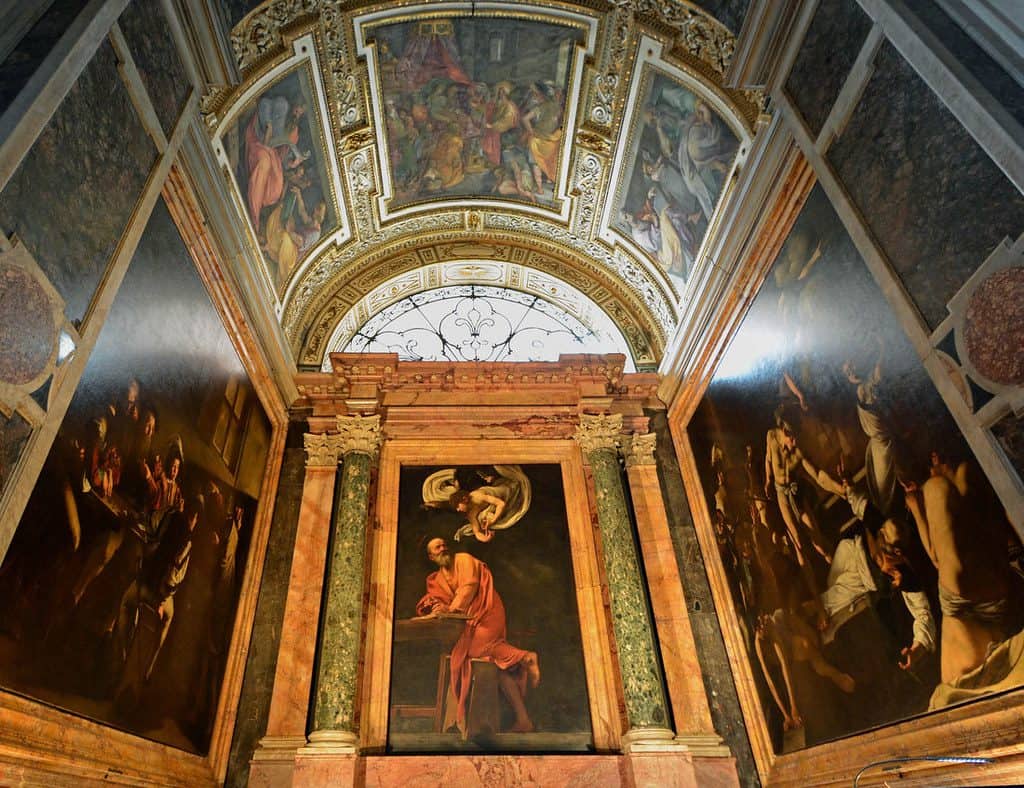
Contarelli Chapel, inside the church of San Luigi dei Francesi, Piazza di San Luigi de' Francesi, rione Sant'Eustachio, 00186 Roma. Free admission: the Contarelli Chapel is inside a church open for worship, so you pay nothing, there's no ticket office, and you don't need to book. The church's official site puts it plainly in English: "It's a church, so it's FREE. No ticket required". Visiting hours according to the official page: Monday to Friday, 9.30 to 12.45 and 14.30 to 18.15. Saturday, 9.30 to 12.00 and 14.30 to 18.30. Sunday, 12.00 to 12.45 and 14.30 to 18.30. Watch out for a closure that catches a lot of people off guard: on the first Wednesday of every month, the church stays closed in the morning. Phone (+39) 06 688271, email saintlouis.rome@gmail.com, official website saintlouis-rome.net. The same official page says you can request guided tours with the priests during opening hours, you can request private visits outside opening hours, and there is an audio guide in French, English and Italian that you activate with a QR code. The official site lists only "Piazza di S. Luigi dei Francesi 00186 Rome", without a street number. Inside the Contarelli Chapel there are three canvases by Caravaggio: The Calling of Saint Matthew on the left wall, The Martyrdom of Saint Matthew on the right wall, and Saint Matthew and the Angel above the altar.
The Contarelli Chapel is the last chapel in the left aisle, the one you find at the back as you walk toward the high altar. Everything else about the church, which is the French national church in Rome and has a long history of its own, is covered on the page for the church of San Luigi dei Francesi. This page is about the chapel and the three Caravaggios, which are the reason 95 percent of people enter this church.

Where the Contarelli Chapel is exactly and how to get there
The Contarelli Chapel doesn't have its own address. It's inside San Luigi dei Francesi, which faces the square of the same name, a narrow rectangle squeezed between Piazza Navona and the Pantheon, a short walk from Palazzo Madama, which is the Senate. If you're coming from Piazza Navona, leave from the east side, where the Fountain of the Moor is behind you, take the alley that leads toward Corso del Rinascimento, cross, and you've arrived. It's less than three minutes on foot. If you're coming from the Pantheon, it's even shorter, just under four minutes, passing Sant'Ivo alla Sapienza.
By public transport: the subway doesn't reach here. There's no station on Line A or Line B within a reasonable distance, and that's why the whole area between Corso del Rinascimento, the Pantheon and Largo Argentina is covered on foot. Surface lines run along Corso del Rinascimento and Corso Vittorio Emanuele II, and they do exist and pass through. Check the routes on the app or on atac.roma.it on the day you go. In the Historic Center, routes are constantly diverted for processions, roadworks and closures, and the stretch in front of the Senate is one of the most unpredictable in Rome.
My practical advice is simple: walk, and approach from Piazza Navona. Not because it's pretty, but because if you get off a bus on Corso Vittorio you still have to walk anyway, and this way the layout of this part of the city sticks in your head. The church doesn't have a facade that shouts for attention. It's tall, made of travertine, with statues in niches, and it sits on a square that people cross without looking at it. The sign that really points you the right way is the line of people at the entrance.
Opening Hours, Admission and Closures of the Contarelli Chapel
Admission to the Contarelli Chapel: free. Full stop. There's no ticket, no reduced rate, no online presale, and no priority line you can buy. Anyone who sells you a "ticket for the Caravaggios of San Luigi dei Francesi" is selling you a guide or a tour, not admission, because admission isn't sold. That's something that has to be said plainly in Rome every time.
The hours listed on the official visiting page of saintlouis-rome.net are: Monday to Friday 9.30-12.45 and 14.30-18.15, Saturday 9.30-12.00 and 14.30-18.30, Sunday 12.00-12.45 and 14.30-18.30. The same page warns that hours may change for special events, and it adds the one line to note: on the morning of the first Wednesday of every month, the church is closed. If your only day in Rome falls on the first Wednesday of the month, you'll only see the Contarelli Chapel in the afternoon.
Notice the break. From Monday to Friday there's a gap between 12.45 and 14.30, on Saturday it's even between noon and 14.30, and on Sunday morning the church opens to tourists only at 12.00. That gap is the number one reason people arrive at the door and find it closed: they come at one o'clock, thinking a church is always open, and it isn't. The Contarelli Chapel is not a museum, it's a chapel inside a parish that has its own liturgical schedule.
Another thing to know: during services the tour circuit stops or shrinks, and this applies to all the churches in Rome. If you go in during Mass, you can stay, but keep quiet and don't go plant yourselves in front of the Contarelli Chapel with your phone held up. Wait for it to end. In a French national church, where services are often in French, people sometimes don't realize a Mass is starting: watch whether someone turns on the lights in the sanctuary and you'll spare yourselves the embarrassment.
Natural light in the Contarelli Chapel: when it's really worth going
The Contarelli Chapel is a small side chapel with no museum-style lighting, and the three Caravaggio canvases are dark. Very dark. The amount of light that gets in changes with the hour, the season and the weather, and no official source publishes an optimal time: the guidance below is the editorial team's judgment, not certified data.
In our judgment, the best window for the Contarelli Chapel is late morning on weekdays, let's say between 10.30 and 12.30, and the first part of the afternoon, from 14.30 to around 16. In those hours the church still has real daylight coming in from above, and the paintings can be read without strain. In the last two hours before closing, especially from November to February, inside San Luigi dei Francesi it's almost dark and the Contarelli Chapel becomes a black smudge with three slightly lighter rectangles. Many people leave disappointed and think the Caravaggios are overrated: they aren't overrated, you went at five in the afternoon in December.
If you have to choose a single moment of the week for the Contarelli Chapel, the best choice is a Tuesday or Thursday morning around 11. It's the hour when natural light works best and when organized groups are still out and about between Palazzo Altemps and Piazza Navona. Avoid Sunday: it opens at 12, closes for the break 40 minutes later, and in those 40 minutes it's pandemonium inside.
The coin-operated light in the Contarelli Chapel
Anyone who has visited a Roman church with an important painting inside knows the small metal box with a coin slot: you insert a euro, a spotlight comes on for a couple of minutes, you look at the lit painting, then the light switches off with a click. It's an old system, it's noisy, and many churches in Rome still have it. The most frequent question is exactly this: does the Contarelli Chapel need coins?
The answer is not confirmed by official sources. Neither the homepage of the official website, nor the visiting hours page, nor the page dedicated to Caravaggio on the church's website mention paid lighting, the presence of a coin-operated device, or how much it would cost. The official page on Caravaggio describes the three paintings and refers to the French Opere Pie for reproduction requests, but doesn't say a word about lighting. So, no fee appears to be published.
So here's what to do in practice. Carry a few one-euro and 50-cent coins in your pocket before entering the Contarelli Chapel. If the device is there, use it. If it isn't, you've got two coins in your pocket and no harm done. What you shouldn't do is count on your phone to pay: these mechanisms, where they exist, take coins and nothing else, and in a church you won't find an ATM. And don't use your phone's flashlight to light the canvases: it's forbidden in every church that holds old paintings, and it gets you thrown out by the custodian within 10 seconds.
Last practical note: if you see a group in front of the Contarelli Chapel, wait. The guides turn on the light and let everyone look, and you step back and see for free what someone else paid for. It's not cleverness, it's common sense. Then, when the light switches off and the group leaves, you're left alone in front of three Caravaggios: that's the good moment.
Who was Matteo Contarelli and why the chapel bears his name
The name Contarelli Chapel comes from a Frenchman. Mathieu Cointerel, Italianized as Matteo Contarelli, bought the chapel in 1565 and died in 1585: these two dates, reported by the encyclopedia entry dedicated to the Contarelli Chapel, are the ones the whole story rests on. There were 20 years between the purchase and the death, and during those 20 years the chapel remains substantially undecorated.
Contarelli leaves a bequest, that is, earmarked money, with precise instructions on how to decorate his chapel: scenes from the life of Saint Matthew, his namesake saint. It's the classic mechanism of Roman patronage in the late 16th century. The prelate sets aside the money, specifies the subject, and delegates to an executor of the will the task of having the work carried out after his death. The executor, in this case, is Virgilio Crescenzi. In 1597, management of the operation is recorded as being in the hands of the Fabbrica di San Pietro.
Keep this sequence in mind, because it's the key to understanding why the Contarelli Chapel looks the way it does. A man who died in 1585 orders images. An executor takes years to decide whom to entrust them to. Meanwhile taste changes, the generation of painters changes, and when the right artist finally arrives, we're at the end of the century and the Holy Year of 1600 is about to arrive with the deadline stuck to it. The Contarelli Chapel is the result of a delay.
Before Caravaggio: the rejected statue and the frescoes of the Cavalier d'Arpino
This is the part that almost no one tells, and without this part the Contarelli Chapel just seems like the room where Caravaggio hung three paintings. It didn't happen that way.
First attempt: sculpture. The Flemish sculptor Jacques Cobaert is commissioned a marble statue of Matthew and the angel, meant for the altar. Cobaert works on it for years. When he finally delivers it, the churchmen reject it because it showed Matthew without the traditional angel beside him. The statue does not stay in the Contarelli Chapel: it is later bought by the Arciconfraternita della Santissima Trinità dei Pellegrini. All of these steps are recorded in the encyclopedia entry dedicated to the chapel.
Second attempt: the frescoes. Giuseppe Cesari, whom everyone in Rome calls the Cavalier d'Arpino, receives the contract to fresco the side walls and the vault. He finishes the vault by 1593. The walls, no. The contract called for a Matthew at the tax collector's table on the right wall and the martyrdom with the Mass on the left wall, but those walls remain empty. The Cavalier d'Arpino was the most sought-after painter in Rome in those years and had too many commissions: the Contarelli Chapel ends up at the bottom of the list.
So when you walk into the Contarelli Chapel and look up at the vault, what you see overhead is not Caravaggio: it's Giuseppe Cesari, finished by 1593. The walls are by Caravaggio. The vault is not. It's a distinction that guides mention in passing and half of visitors miss, yet it changes the whole sense of the chapel, because it puts the direct comparison between two opposite ways of painting in the same room right in front of you.
You often read that the Contarelli Chapel was "frescoed by Caravaggio." That's false: the three Caravaggio works in the Contarelli Chapel are oil on canvas paintings, not frescoes. Caravaggio never worked in fresco in the Contarelli Chapel, and the encyclopedia entry dedicated to the chapel explicitly lists the technique as oil on canvas for all three. The chapel's frescoes, the real ones, are on the vault and are by the Cavalier d'Arpino. Calling Caravaggio's Contarelli Chapel works "frescoes" is the mistake that circulates the most on the internet.
The July 23, 1599 contract: how Caravaggio enters the Contarelli Chapel
Cardinal Francesco Maria Del Monte suggests Caravaggio's name for the job. The contract is signed on July 23, 1599. Both pieces of information come from the entry dedicated to the Contarelli Chapel, and the date of the contract is one of the few solid documentary anchors of the whole story.
Stop for a moment and think about what this means. Michelangelo Merisi is 28 years old, has never had a public commission in his life, has until then painted cabinet paintings for private collectors, and they put in his hands the chapel that has been waiting for decoration for 14 years, in one of the most visited churches in Rome, with the Holy Year just around the corner. It's not a soft debut. It's a leap into the void, paid handsomely.
The two side canvases of the Contarelli Chapel, The Calling of Saint Matthew and The Martyrdom of Saint Matthew, are recorded as installed by July 1600, and the final payment for the commission is dated July 1600. It took 12 months from contract to delivery, for two canvases of that size, with 15 or 16 life-size figures inside. Anyone who tells you Caravaggio was a slow, tormented genius should look at this timeline.
You sometimes read that "the commission for the painting cycle went to Giuseppe Cesari through the intercession of Cardinal Del Monte." The correct fact is the opposite: the source says it was Cardinal Del Monte who suggested Caravaggio for the project. Del Monte is Caravaggio's man, not the Cavalier d'Arpino's. It's a detail that sounds like something for specialists, yet it flips the meaning of the story: without Del Monte, today the Contarelli Chapel would have three diligent frescoes by the most sought-after painter of the era, and none of us would be here standing in line.

The Calling of Saint Matthew, left wall of the Contarelli Chapel
It's the painting that draws people to the Contarelli Chapel, and it's the one on your left when you stand in front of the chapel. A bare room, a table, five men seated counting coins, and on the right two standing figures entering. A beam of light cuts across the scene and lights up the faces of the men at the table.
The point that makes the Calling of Saint Matthew different from any other altarpiece of the 1500s is that it doesn't look like a sacred scene. It looks like a gambling den. The figures are dressed like people of 1600, with feathered hats, swords, striped doublets: Caravaggio didn't put them in Roman togas, he dressed them in the clothes the Romans walking into the church that day were wearing. Anyone who entered the Contarelli Chapel in 1600 saw himself painted on the wall. It was a slap in the face, and it was perceived as such.
Then there's the question the scholars have been arguing over for decades. Most scholars identify Matthew as the bearded man who points to his chest, as if to say "Me?" in response to Christ's call. A more recent reading argues instead that the bearded man is pointing to the young man at the end of the table, the one with his head bent over the coins, and that the real Matthew is that boy, about to raise his head toward Christ. Some scholars describe the painting as deliberately ambiguous. Who is right is not decided here: go to the Contarelli Chapel, look at that hand, and decide for yourself. It's the most fun thing you can do in this church.
Many claims circulate about the painted light. It's often said that the beam of light in the Calling comes from the same direction as the chapel's real window, and that Caravaggio calculated the position of the actual light so it would continue inside the painting. It's an observation that gets repeated a lot, but it isn't confirmed by an official source: the reference source describes the beam of light on the faces but does not certify the match with the Contarelli Chapel's actual window. When you're inside, though, look at where the light comes in and form your own opinion: it's an exercise worth the visit.
The Martyrdom of Saint Matthew, right wall of the Contarelli Chapel
On the opposite wall is the painting that people look at last, and yet it's the one that tells the most about Caravaggio's struggle. The Martyrdom of Saint Matthew shows the saint's murder in front of the altar: the executioner at the center, half-naked, who has just knocked Matthew to the ground and raises his sword, around them, figures fleeing in every direction, high above, an angel coming down with the palm of martyrdom.
The composition is confused on purpose, and it is also confused in spite of itself. The Martyrdom is the canvas on which Caravaggio changed his mind several times, and those who have studied the surface have found traces of earlier layers beneath the final one. The detailed reconstruction of the underlying versions is not confirmed by a direct source. What you can see with your own eyes, though, is that this is a composition that struggles, with figures piling on top of each other and a space that doesn't add up, and that after the Calling, which is clear as a theorem, the effect is strange.
Then there's the face at the far left, behind the group, a bearded man who turns to look at the scene as he steps away. For centuries, critics have seen it as Caravaggio's self-portrait. It's a tradition that is repeated often, not an established fact: it is not confirmed by an official source. That said, when you're in the Contarelli Chapel, look at that face, because it's the only one in the whole painting that seems to know what is happening.
The Martyrdom of Saint Matthew, together with the Calling, is recorded as installed in the Contarelli Chapel by July 1600. The two side canvases are therefore contemporary, painted in the same year, by the same man, for the same facing wall. Looking at them one after the other and figuring out how different they are is the most instructive exercise there is on Caravaggio's painting.
Saint Matthew and the Angel, the altarpiece, and the first version that was lost
Above the altar of the Contarelli Chapel is Saint Matthew and the Angel, called in English and in much of the international literature the Inspiration of Saint Matthew: an old man with a beard, one knee bent on a stool, a book resting on it, and an angel coming down from above who dictates to him or counts out on his fingers what he needs to write. It's the last of the three to be painted, and it has a history that deserves to be told properly.
The available data are these: the work is from 1602, it is oil on canvas, it hangs on the altar of the Contarelli Chapel in San Luigi dei Francesi, the commission goes back to the bequest of Cardinal Cointerel, the deadline set was Pentecost of 1602, and payment is recorded as received in September 1602. So Caravaggio delivered late, after Pentecost, and was paid in September.
The important thing is that the one above the altar of the Contarelli Chapel is not the first version. There was another, titled Saint Matthew and the Angel, which was rejected. According to the source, the initial painting was rejected and was then accidentally destroyed during the Second World War. Who bought it after the rejection, which museum it ended up in, and the exact date it was destroyed are not confirmed by a direct source.
Why that first version was rejected, then, is the longest-running gossip in the history of Roman art. The story goes that the Matthew of the first version was too crude, with dirty feet in the foreground and the angel too close, almost leaning against the saint while guiding his hand over the page, and that to those who had to approve the work for the Contarelli Chapel it seemed indecorous for an altarpiece. It is a traditional story, not a documented fact: the source records the rejection but not the reasons.
The second version, the one you see now in the Contarelli Chapel, is more composed. The saint is balanced precariously on the stool, a brilliant detail and not decorous at all, but the angel floats in the air, separate, and does not touch his hand. Caravaggio gave in on everything except the stool. If you look closely, that stool is coming out of the painting toward you: it projects beyond the painted edge, as if it were about to fall into the chapel. It is Caravaggio's way of saying that he had understood the request and was going to do things his own way anyway.
How to look at the three Caravaggios in the Contarelli Chapel in 20 minutes
Here is a method, because most people enter the Contarelli Chapel, snap three crooked photos, stay four minutes, and leave. 20 minutes done well are worth 10 visits done badly.
First: don't look right away. Get to the Contarelli Chapel and stand still for 30 seconds while your eyes adjust to the dark. The canvases are dark, and your pupils are coming in from the light of Rome. If you look immediately, you won't see anything and you'll convince yourself they're black.
Second: start with the Calling, on the left. It is the most legible and it tunes your eye. Look for Christ's hand, then look for the hands of the men at the table, then decide for yourself who Matthew is.
Third: move on to the Martyrdom, on the right. Look for the executioner in the center, then follow the figures who are running away, then look for the bearded face in the background.
Fourth: stand facing the altar and look at Saint Matthew and the Angel. Look at the stool. Look at how far it projects.
Fifth, and almost nobody does this: raise your eyes to the vault of the Contarelli Chapel and look at the frescoes by the Cavalier d'Arpino, finished by 1593. They are six or seven years older than the canvases. They are in the same room. They seem to belong to another century. That comparison is the real content of the Contarelli Chapel, and no audio guide tells you about it.
Sixth: leave the chapel, walk 10 steps back into the nave, and look at it from a distance, all together. From there you understand that the three canvases work as a single scene: calling, death, inspiration. Contarelli asked for stories of Saint Matthew and got them, 160 years behind the taste of his era and 300 years ahead of everything else.
The church around the Contarelli Chapel, briefly
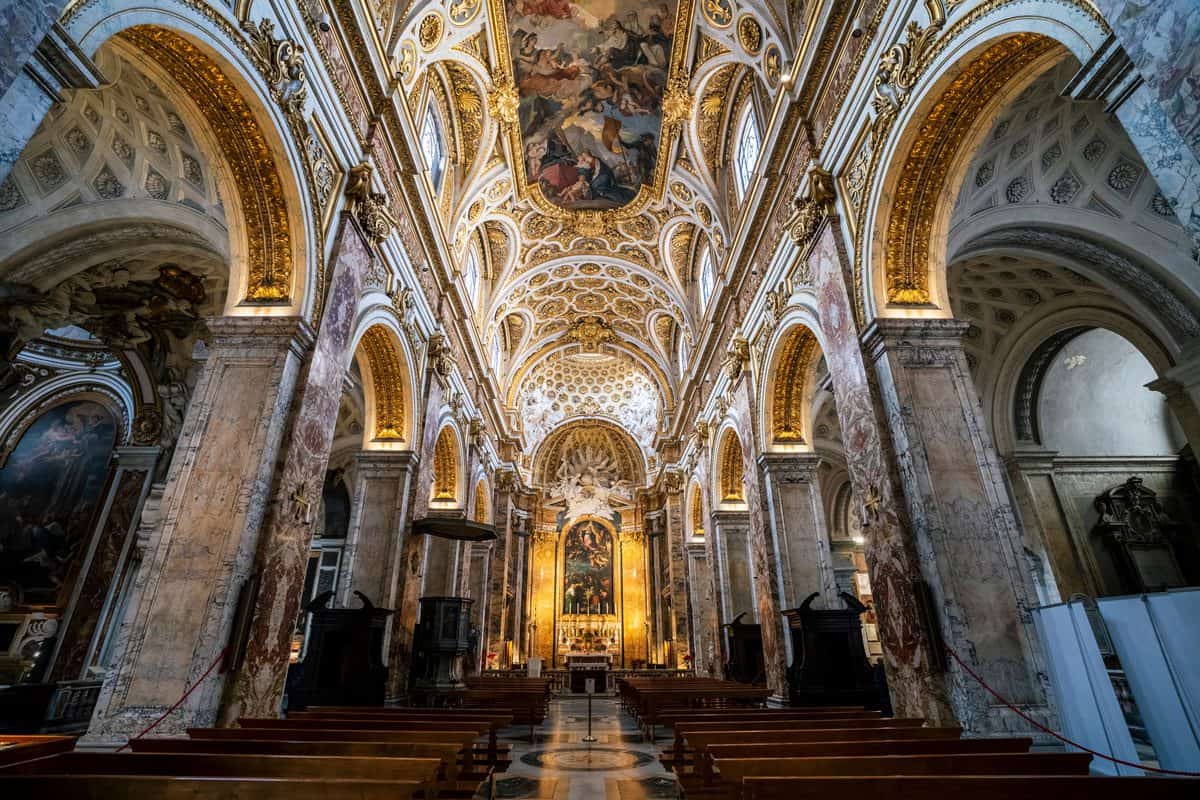
The Contarelli Chapel is not the only thing inside the Church of San Luigi dei Francesi, and it needs saying because many people enter, look at the Caravaggios, and leave without noticing the rest. The church is the national church of the French in Rome, it is an celebration of France through its saints and historical figures, the facade has statues of Charlemagne, Saint Louis, Saint Clotilde and Saint Joan of Valois, and inside there are frescoes with the apotheoses of Saint Louis and Saint Denis and the story of Clovis's life. In the second chapel of the right aisle there are frescoes with scenes from the life of Saint Cecilia by Domenichino and, on the altar, a copy by Guido Reni of Raphael's Saint Cecilia. There are the tombs, including that of Pauline de Beaumont commissioned by Chateaubriand, that of Cardinal de Bernis, that of Frederic Bastiat, the burial of Giuseppe Sisco, and that of Marin Tourlonias, founder of the Torlonia family. There is a pipe organ by the French organ builder Joseph Merklin.
These are traditional details, not confirmed one by one by an official source. To go deeper there is the entry for the chiesa di San Luigi dei Francesi, which covers the building as a whole.
About the construction dates of the church, an impossible sentence circulates: that the work was carried out by Domenico Fontana to designs by Giacomo Della Porta, thanks to the munificence of Catherine de' Medici, "from 1518 to 1589". That range of dates doesn't hold up: in 1518 neither Della Porta nor Fontana had been born or was active, so either the dates refer to the whole history of the construction site with different architects succeeding one another, or they are wrong. Certain dates are not confirmed by an official source: for the reconstruction of the construction site, the reference is the church's entry and the official site saintlouis-rome.net.
A curiosity about the Contarelli Chapel
The real curiosity about the Contarelli Chapel is that there was never supposed to be a painting. The original project called for a sculpture: a marble statue of Matthew with the angel, entrusted to the Flemish sculptor Jacques Cobaert to stand on the altar. If that statue had been accepted, the Contarelli Chapel today would be a chapel with a carved altarpiece, and Caravaggio would never have set foot here.
The statue was rejected because it showed Matthew without the traditional angel beside him, and it was later bought by the Arciconfraternita della Santissima Trinità dei Pellegrini. Both pieces of information come from the encyclopedia entry dedicated to the chapel. Think about it for a moment: the most famous spot in Roman Baroque painting exists because a sculptor delivered a work that nobody liked.
Our opinion, no beating around the bush: the Contarelli Chapel is proof that in art, the best things almost always come from someone else's failure. First Cobaert fails with the statue, then the Cavalier d'Arpino gets stuck on the frescoes for the side walls, and only at that point, 14 years late and with a Jubilee deadline bearing down, do they call in a 28-year-old who had never taken on a public commission. Nobody would have chosen him first.
One thing nobody tells you about the Contarelli Chapel
The vault is not by Caravaggio. It's worth repeating, because it's the piece of information that changes your visit and that almost nobody mentions.
In the Contarelli Chapel, the ceiling is frescoed by Giuseppe Cesari, known as the Cavalier d'Arpino, who had finished the vault by 1593. The side walls were his responsibility under contract, with Matthew at the customs table on the right and the martyrdom on the left, but he never painted them. They stayed empty until Caravaggio arrived in 1599.
The result is that the Contarelli Chapel is the only place in the world where you can see, in the same room, the best-paid painter in Rome at the end of the 16th century and the man who six years later upended his market. Above is the elegant, bright, colorful, proper painting that everyone wanted. Below are three black canvases with thieves, assassins, and an old man about to fall off a stool. The second one won, as we know, but in 1600 the one people agreed with was the first.
Second thing nobody says: the Contarelli Chapel is small. Very small. Anyone who arrives expecting a monumental nave is thrown off: it's a side niche at the end of a corridor, with a railing in front, and 10 people is already full. That's not a flaw, it's the reason the effect of the three canvases hits so hard.
My advice for visiting the Contarelli Chapel
Go twice. Seriously, it's the only advice that matters.
The first time, you go like everyone else: you enter, stand in front of the Contarelli Chapel, look at the three paintings, take your photos, and stay 10 minutes. Then you leave, go eat, wander for an hour between Piazza Navona and Campo de' Fiori, and come back in the afternoon. The second time, the chapel no longer has the element of surprise, and it opens up to you. You see things you didn't see the first time: the feet, the hands, the clothing, the floor, the angel, the palm, the stool.
Tip number two, less poetic and more useful: go on weekdays and late morning, and stay away on the first Wednesday of the month until 14.30, when the church is closed in the morning according to the official page.
Tip number three: bring coins for the lights, in case there are any, and get in line behind a guided group instead of in front of it. When the guide turns on the light, you stay behind and see everything without spending anything and without pushing anyone.
Tip number four, no sugarcoating: don't come to the Contarelli Chapel with 40 minutes to spare before another appointment. It doesn't work. Caravaggio in this chapel is awkward, dark, and demands time. If you're in a hurry, go to the Pantheon, which takes 10 minutes to see and is just as beautiful, and come back here another day.
Another well-known fact, yet rarely mentioned
The altarpiece you see is the second one. The first version of Saint Matthew and the Angel was rejected and no longer exists: according to the source, it was accidentally destroyed during World War II.
Plenty of people know this, it's said on every guided tour, and despite that, very few really think about it while they stand there in front of it. Above the altar of the Contarelli Chapel, you're looking at a remake, that is, a compromise between an artist who was 29 or 30 years old and clients who had rejected his first attempt. And the remake is a masterpiece. The first one, which none of us will ever see again, was probably even more brazen.
The second well-known but rarely cited fact concerns timing. Contract July 23, 1599, two side canvases installed by July 1600, final payment July 1600, altarpiece of 1602 with a deadline set for Pentecost of that year and payment received in September 1602. That means the entire Contarelli Chapel, from the first contract to the last payment, fits into a little more than three years. Three years to change European painting. In the meantime, the same chapel had been left without decoration for the previous 14 years.
Third fact: in 1597 the administration of the operation is recorded as being in the hands of the Fabbrica di San Pietro. That is, the administrative machine that built the Vatican basilica was also busy untangling the mess of a side chapel in a French church that had gotten bogged down. It says everything about how Rome worked back then and, to tell the whole truth, how it still works.

The Right Photo to Take at the Contarelli Chapel
First rule: no flash. Ever. In the Contarelli Chapel flash is forbidden, as in any place that keeps old paintings, and apart from the ban it's useless, because it gives you back a flat, washed-out canvas with a glare in the middle. If you see someone firing a flash at the Caravaggios, know that they're taking home a worse photo than yours.
Second rule: the right photo at the Contarelli Chapel is not the close-up of the painting. You'll find that close-up done better by anyone with serious equipment, and you'll find it for free. The photo that counts is the overall one: the whole chapel from the nave, with the arch that frames it, the railing, the Cavalier d'Arpino's vault above and the three canvases inside. That photo tells the story of the place, not of the work.
Third rule: if you want a photo with people, stand in the nave and wait for the little crowd to form in front of the Contarelli Chapel. Five or six people seen from behind, standing still, in silence, in front of three dark rectangles: that photo says what really happens in here. The human heads in front also give you the scale, and without scale you can't tell how small the chapel is.
Fourth rule, technical and concrete: brace yourself against something. In a church you don't use a tripod without permission, you're in the dark and shutter speeds get longer. Rest your elbows on a pew or your back against a column, hold your breath, shoot three times. Raise the ISO instead of pushing the shutter speed and accept a bit of noise: one dark, sharp photo is worth 10 bright, blurry ones.
Fifth rule, the most important: take one photo only and then put your phone away. In the Contarelli Chapel the memory that stays with you is the one you looked at with your own eyes, not the one you filed away.
Some Important Events That Happened Here Over the Centuries
Below, only the dated facts, separated into documented and traditional. A lot is told about the Contarelli Chapel and little is documented, and it's right that the difference is visible.
1565: Mathieu Cointerel, Italianized as Matteo Contarelli, buys the chapel that will take its name from him. Documented.
1585: Contarelli dies, leaving a fund and precise instructions for the decoration, with scenes from the life of Saint Matthew. From here on, decisions about the Contarelli Chapel pass to his executor Virgilio Crescenzi. Documented.
By 1593: Giuseppe Cesari, the Cavalier d'Arpino, completes the vault of the Contarelli Chapel. His contract also included the frescoes of the side walls, with Matthew at the tax table on the right wall and the martyrdom with the Mass on the left wall. The walls stay empty. Documented.
1597: the administration of the operation is recorded as being in the hands of the Fabbrica di San Pietro. Documented.
July 23, 1599: the contract is signed with Caravaggio, who came on the recommendation of Cardinal Francesco Maria Del Monte. It's the birth date of the Contarelli Chapel as we know it. Documented.
July 1600: the Calling of Saint Matthew and the Martyrdom of Saint Matthew are recorded as installed in the Contarelli Chapel, and the final payment for the commission is from the same month. Documented.
1602: Saint Matthew and the Angel, oil on canvas, is made for the altar of the Contarelli Chapel, with a deadline set for Pentecost of that year and payment received in September. It's the second version: the first was rejected. Documented.
World War II: the rejected first version of Saint Matthew and the Angel is accidentally destroyed. So the source reports. The precise place and the exact date of the destruction are not confirmed.
On the matter of Jacques Cobaert's statue, rejected because it showed Matthew without the traditional angel and then bought by the Arciconfraternita della Santissima Trinità dei Pellegrini, the source gives no specific dates.
Who Has Passed Through the Contarelli Chapel
The first name is the one who is no longer around: Mathieu Cointerel, the French prelate who bought this chapel in 1565 and died in 1585 without seeing it decorated. He never saw so much as a brushstroke of what he paid for. It is the very definition of Renaissance patronage.
Then Virgilio Crescenzi, the executor of his will, the man who held the decisions about the Contarelli Chapel in the years when nothing happened.
Then Jacques Cobaert, the Flemish sculptor who worked on it and had his work rejected.
Then Giuseppe Cesari, the Cavalier d'Arpino, the most sought-after painter in Rome, who left the vault finished by 1593 and the walls white. His signature above the head is still there, and almost no one looks at it.
Then Cardinal Francesco Maria Del Monte, who put forward Caravaggio's name. Without him, today's Contarelli Chapel would not exist.
Then Michelangelo Merisi da Caravaggio, who in 1599 was 28 years old with no public commission behind him, and who made his breakthrough in this chapel.
Since then, for four centuries, half the history of European painting has passed through here. Painters from every school and every country have come to look at the Contarelli Chapel, and it is documented in general terms that the three Matthews had an enormous influence on painters in seventeenth-century Rome and across Europe. Names and dates of individual visits circulate as anecdotes, not confirmed by a source.
A contemporary, verifiable name that passes through every day: the priests of Rome's French community. The official website says that during opening hours you can ask for guided tours with the church's priests. It's the best chance you have to hear about the Contarelli Chapel from someone who lives inside it, rather than from a recording.
The Contarelli Chapel with Kids
You can do it, and it works better than you'd think, on one condition: don't try to explain Caravaggio. Kids don't get there, and they'll be bored within 90 seconds.
What works in the Contarelli Chapel is turning it into a hunt. At the Calling: how many coins are on the table, who is looking at Christ and who is looking at the money, who has the hat with the feather. At the Martyrdom: how many people are running away, where the angel is, what he's holding. At the altarpiece: why the old man is balancing on a stool and what happens if the stool falls. These are questions an eight-year-old answers better than an adult, because they really look instead of trying to remember what they've read.
Realistic time with kids: 10 minutes in the Contarelli Chapel and not one more. Then leave. The church is cool in summer and that helps, but it's also dark and quiet, and mandatory silence weighs on little ones. Entry is free for them too, of course, because there's no ticket for anyone.
An honest warning: the Martyrdom of Saint Matthew is a painted murder, with a man on the ground and a raised sword. Kids usually love it, much more than the Calling, but if yours is especially impressionable, make the call yourself before putting it in front of them.
Strollers: the nave is flat and you can get through, but there's little space in front of the Contarelli Chapel, and with a stroller you'll get in other people's way. If you're two adults, one keeps the stroller in the nave and the other goes up to the chapel, then you switch.
Accessibility and Practical Rules for the Contarelli Chapel
First, the most important and most sensitive part. The official pages don't include an accessibility profile for the Church of San Luigi dei Francesi or the Contarelli Chapel: nothing on the entrance steps, nothing on ramps, nothing on accessible restrooms. Accessibility, therefore, is neither confirmed nor ruled out. If you need certainty, the number to call is (+39) 06 688271 and the email is saintlouis.rome@gmail.com, both listed on the official website.
A practical note, not certified: the nave of San Luigi dei Francesi is flat and wide, and anyone who gets inside can approach the Contarelli Chapel without significant changes in level inside. The critical point, as in almost all Roman churches, is the threshold from the square. If you're traveling by wheelchair, call ahead.
Rules of behavior, these apply always and everywhere in Rome: shoulders and knees covered, even in August, even if it's 38 degrees outside. No hats on your head. Silence, and not the fake museum kind, real silence: people pray here. No flash on the canvases in the Contarelli Chapel. No tripods without permission. No food and drink. No animals, except guide dogs.
There's no luggage deposit and no cloakroom for large backpacks: it's a church, not a museum. If you have a rolling suitcase, think carefully, because dragging a suitcase into San Luigi dei Francesi while someone is praying is the fastest way to get the whole nave giving you dirty looks.
How Much It Costs and How Much Time You Need for the Contarelli Chapel
Cost: zero. Free admission, no ticket, no reservation, as stated on the official page. The only possible expense is a coin for the lighting, for which there is no official confirmation, either of its presence or of its amount. Then there is the voluntary offering, which no one asks of you and which it's right to leave: a church that keeps three Caravaggios open for free 12 hours a day has costs.
Sensible minimum time in the Contarelli Chapel: 15 minutes. Recommended time: 25, using the method described above. Maximum time before your neck cramps and they throw you out: 40. If you add the tour of the rest of the church, plan on 45 minutes in total inside the Church of San Luigi dei Francesi.
Waiting in line: variable and unpredictable. There is no ticket office, so there's no organized line: there is a bottleneck in front of the Contarelli Chapel, which forms when two groups arrive together and clears up in 10 minutes. Official data on visitor flows does not appear to be published. Rule of thumb: if when you enter you already see 20 people crowded in front of the chapel, first walk around the rest of the church and come back after a quarter of an hour.
Guides and audio guides: the official website says that during opening hours you can request guided tours with the priests, that you can ask for private visits outside opening hours, and that there is an audio guide in French, English and Italian that can be activated by QR code. The conditions and any costs of these options are not detailed on the official page: ask the church directly.
What's around the Contarelli Chapel in a 10 minute walk
The location of the Contarelli Chapel is among the best in Rome for fitting in other things without taking transport. Here's what is really within walking distance.
Two minutes away: Palazzo Madama, home of the Senate, which overlooks the same street and which on certain days opens to the public. Three minutes away: Piazza Navona, with the Fountain of the Four Rivers, and under the square the underground areas of the Stadium of Domitian, which are the thing most tourists walk over without knowing they exist.
Four minutes away: the Pantheon, and along the way Sant'Ivo alla Sapienza with Borromini's spiral lantern, which can be seen from the courtyard even when the church is closed. Five minutes away: Palazzo Altemps, one of the four national museums of Rome, which is just past Piazza Navona and is empty even when everything else is full.
Seven to eight minutes away: the basilica of Santa Maria sopra Minerva behind the Pantheon, Largo Argentina with its sacred area and its cats, Campo de' Fiori with its market in the morning, and the basilica of Sant'Andrea della Valle on Corso Vittorio, which has the second-largest dome in Rome.
A half-day itinerary: Campo de' Fiori early in the morning for the market, then Sant'Andrea della Valle, then the Contarelli Chapel around 11, then Piazza Navona, then Sant'Ivo, then the Pantheon at noon when the shaft of light from the oculus is almost vertical. All on foot, all free except the coffee.
Caravaggio in Rome after the Contarelli Chapel: where to go next
If the Contarelli Chapel has hooked you, and it usually does, the next question is always the same: where are the other Caravaggios in Rome. Here are the places, with one warning: the collections move around for loans, exhibitions and restorations, so check the list of works on display at each venue on the museum's website before you set out.
The places are: Santa Maria del Popolo, at the other end of the city center, which like the Contarelli Chapel is a church with free admission and a Caravaggesque chapel, the Galleria Borghese, which can only be visited with a reservation for a time slot, Palazzo Barberini, home of the Galleria Nazionale d'Arte Antica, Palazzo Doria Pamphilj, the most beautiful private collection open to visitors in the city, and the Capitoline Museums on the Campidoglio.
The difference between the Contarelli Chapel and all these places is one, and it's worth saying. In the others, Caravaggio hangs on a museum wall, with the right light, the caption, the controlled temperature and a chair to sit on. Here, no. Here the three Matthews stay exactly where they were placed, above a real altar, inside a real chapel, in a church where Mass is still said, lit by the light coming in from the window. It's the only way to see Caravaggio as the person who had commissioned it saw it. If you have to pick just one Caravaggio in Rome, in our view the choice is the Contarelli Chapel, without a second thought.
When to avoid the Contarelli Chapel
There are times when coming here is wasted time, and it's better to know them in advance.
The morning of the first Wednesday of the month: closed, according to the official page. There's nothing to be done, it's the most basic and most frequent mistake.
Between 12.45 and 14.30 from Monday to Friday, and between 12.00 and 14.30 on Saturday: closed for the break. If you arrive at one o'clock in front of the door, you'll find it closed.
Sunday morning before 12: the church is not open to tourist visits. And the small window between 12.00 and 12.45 is the busiest slot of the entire week. If you can, skip Sunday.
The last hour before closing in winter: the Contarelli Chapel is dark to begin with, and with the dark outside it becomes unreadable. From November to February, after 16.30, it's not worth it.
During services: you can go in, but you can't set yourselves up in front of the chapel. If you see a service starting, sit at the back and wait, or come back later.
Ferragosto and long weekends: not because of the hours, which stay the same, but because of the crowds in the block between Piazza Navona and the Pantheon. On those days you don't stand in front of the Contarelli Chapel, you get pushed.
Quick Questions About the Contarelli Chapel
How much does it cost to enter the Contarelli Chapel?
Nothing. The official site states word for word that, since it is a church, admission is free and no ticket is needed. There is no full price, there is no reduced price.
Do I need to book to see the Caravaggios in the Contarelli Chapel?
No. There's no reservation and no ticket office. You just walk in, during opening hours.
What are the hours of the Contarelli Chapel?
The same as the church, according to the official page: Monday to Friday 9.30-12.45 and 14.30-18.15, Saturday 9.30-12.00 and 14.30-18.30, Sunday 12.00-12.45 and 14.30-18.30. They may change in case of special events.
Is it true that the first Wednesday of the month is closed?
In the morning, yes. The official page says the church is closed the morning of every first Wednesday of the month. In the afternoon, according to that same page, the normal hours remain.
How many Caravaggio paintings are there in the Contarelli Chapel?
Three. The Calling of Saint Matthew on the left wall, The Martyrdom of Saint Matthew on the right wall, Saint Matthew and the Angel above the altar.
Are the Caravaggios in the Contarelli Chapel frescoes?
No, and this is the most common misconception. They are oil paintings on canvas. The fresco in the Contarelli Chapel is the vault by Cavalier d'Arpino.
Where exactly is the Contarelli Chapel inside the church?
It's the last chapel in the left aisle, at the far end, going toward the high altar. Entering through the main door, you'll find it on your left, after all the others.
How long does it take to visit the Contarelli Chapel?
15 minutes at the very least, 25 to do it properly. If you add the rest of the church, allow three quarters of an hour.
Can you take photos in the Contarelli Chapel?
Photos without flash are the norm in Roman churches and people take them here. Flash, never, and not a tripod without permission either. If a guard tells you to stop, stop.
Is there a coin-operated machine to light the paintings?
It's not confirmed. The official pages, home, hours and the Caravaggio section, don't mention paid lighting or its price. Bring a few coins and decide on the spot.
What time is the best light in the Contarelli Chapel?
There is no official data. Roughly: late morning on weekdays, between 10.30 and 12.30, and early afternoon after reopening at 14.30. The last winter hours are the worst.
Is the Contarelli Chapel wheelchair accessible?
Not confirmed by an official source. The inside of the nave is flat, the critical point is the entrance from the square. Call (+39) 06 688271 before coming.
Is entry free on the first Sunday of the month?
The question doesn't apply: here you can enter free every day. The free first Sunday applies to state museums, not churches.
What's the difference between the Contarelli Chapel and the chapel of Santa Maria del Popolo?
They are the two Roman chapels with Caravaggio inside that are free to enter, at opposite ends of the center from one another. In the Contarelli Chapel there are three Caravaggios, and one sits above the altar, the other is a chapel in the transept of a different church, with different hours. If you like this one, go there too.
What is the altarpiece of the Contarelli Chapel really called?
In Italian it's San Matteo e l'angelo. In much of the international literature you'll find it as Inspiration of Saint Matthew. It dates from 1602 and is the second version.
What happened to the first version of San Matteo e l'angelo?
It was rejected and, according to the source, was accidentally destroyed during World War II. The museum that housed it and the exact date are not confirmed.
Who painted the vault of the Contarelli Chapel?
Giuseppe Cesari, known as Cavalier d'Arpino, who completed it by 1593. He also had the contract for the side walls but never painted them.
When was the contract with Caravaggio signed?
On July 23, 1599, according to the source. The two side canvases are recorded as installed by July 1600, the month in which the final payment also takes place.
Who was Matteo Contarelli?
Mathieu Cointerel, a French prelate, Italianized to Matteo Contarelli. He bought the chapel in 1565, died in 1585, and left a fund with instructions to decorate it with scenes from the life of Saint Matthew.
Why are the paintings dedicated to Saint Matthew?
Because he was the namesake saint of the patron. Contarelli's name was Matteo, and he wanted his saint on the walls of his own chapel. That's all there is to it, and it's a much more mundane reason than it seems.
Is there a bookshop or a cloakroom?
No. It's a church, not a museum. No luggage storage, no cloakroom, no café.
Is there an audio guide?
The official website lists an audio guide in French, English and Italian that you can activate via QR code. The conditions weren't detailed: bring your earphones and a connection.
Can you request guided tours?
Yes. The official page says that during opening hours you can request guided tours with the priests, and that private visits outside opening hours are possible on request.
How long is the wait in line at the Contarelli Chapel?
There's no formal line because there's no ticket office. A bottleneck forms in front of the chapel when groups arrive, and it clears in 10 or 15 minutes. Visit the rest of the church first and come back.
How should you dress to enter?
Shoulders and knees covered, all year round. It's not a formality, and in summer the checks at the entrance to Rome's churches are real.
Can you see the Contarelli Chapel well from a distance too?
Fairly well. From the nave you can take in the whole, but you only get the details of the canvases up close. The advice is to do both viewpoints, first up close and then from 10 steps away.
Is it worth going if I have only one day in Rome?
If your route includes Piazza Navona or the Pantheon, yes, no question: it's 20 minutes, it's free, and it's 200 meters away. If your only day is all at the Colosseum and the Vatican, skip it and save it for next time.
Are there other Caravaggios inside the church besides the ones in the Contarelli Chapel?
The Caravaggios in this church are the three in the Contarelli Chapel. The building's other important works, starting with the frescoes by Domenichino, are by other artists, and you'll find them covered in the church's entry.
In Front of the Contarelli Chapel
At the Contarelli Chapel the scene is always the same: you walk in, go all the way down the left aisle, stand in front of it, and for a minute nobody says a word. Then the same line always comes, which is "but how dark they are." Yes, they're dark. Then your eyes adjust, the hand of Christ emerges, the face of the old man emerges, and the line changes.
The last thing, which is also the real advice. In the Contarelli Chapel, don't look at the paintings one at a time as if you were in a museum. Stand in the middle, turn slowly from left to right and then toward the altar, and try to do it in the order of the story: first the calling, then the inspiration, then the death. They're three moments of a single life, painted by a man of 28 who had everything to lose, in a chapel that had waited 14 years to have something on its walls. Do it in silence. Then step out into that narrow square, and Rome will feel different to you for at least an hour.