Palazzo Merulana
In short. Palazzo Merulana occupies the corner between Via Merulana 121 and Viale Manzoni, in the Esquilino, a step from Piazza Vittorio Emanuele II.
Palazzo Merulana occupies the corner between Via Merulana 121 and Viale Manzoni, in the Esquilino, a step from Piazza Vittorio Emanuele II. The museum entrance is from the staircase on Via Merulana, in the district between Termini station and San Giovanni in Laterano. You get there on foot from Termini in about 10 minutes, or by metro A to Vittorio Emanuele and then a five-minute walk. By tram, lines 5 and 14 stop along Via Emanuele Filiberto, while buses 16, 714 and 105 serve the axis of Via Merulana and Piazza Vittorio. The museum is open Wednesday through Sunday. The permanent collection and the current exhibition can be visited on Wednesday, Thursday and Friday with entry slots every hour from 12:00 to 20:00 (last entry at 19:00), and on Saturday and Sunday from 10:00 to 20:00 (last entry at 19:00). Monday and Tuesday are closing days. The full ticket costs 13 euros, the reduced one 11, the rate for school groups 6 euros, with a presale fee of 2 euros on online purchases. The ground floor, with the Sala delle Sculture, the bookshop and the cafe, stays free to enter from Wednesday to Sunday from 9:00 to 20:00. Before leaving it's best to check hours and rates on the official site palazzomerulana.it and on the authorized ticketing channel the museum indicates on its own site, because the calendar changes for exhibitions, installations and private events.
Anyone planning a day in the Esquilino can save this address and the others in the area in Il mio viaggio and build a walking itinerary that holds together the museum, the basilica of Santa Maria Maggiore and the district's market.
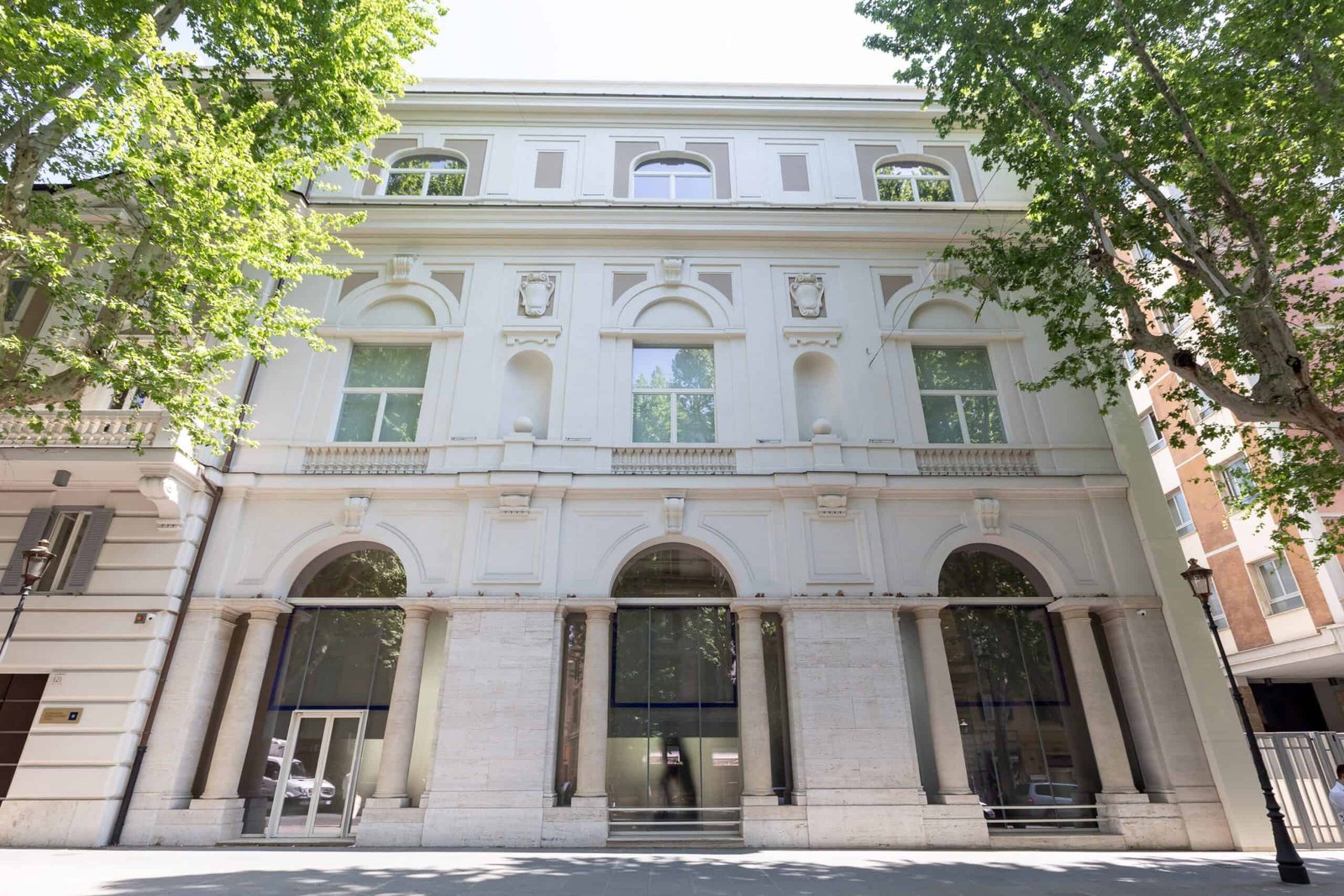
Palazzo Merulana at a Glance: Address, Hours and Tickets
Palazzo Merulana is a private museum open to the public, home of the Elena and Claudio Cerasi Collection. The building is at Via Merulana 121, postal code 00185, in the Esquilino district. The phone number is +39 06 3996 7800 and the web reference is palazzomerulana.it. The management of public services, ticketing and educational activities is entrusted to CoopCulture, the operator that runs many Roman cultural sites. This explains why tickets are bought through the circuit the museum authorizes and indicates on its own site, without going through third-party resellers.
How to Get to Palazzo Merulana
The Esquilino is one of the best-served districts of Rome, and Palazzo Merulana takes advantage of it. From Termini station it's a walk of about 10 minutes going down toward Piazza Vittorio. From the Vittorio Emanuele stop on metro line A it's five minutes going up Via Carlo Alberto and turning onto Via Merulana. Trams 5 and 14, which connect Termini with Prenestina and Togliatti, run along Via Emanuele Filiberto a few hundred meters away. The buses serving the stretch of Via Merulana and Piazza Vittorio include lines 16, 714 and 105. By car the area has regulated traffic and street parking is scarce: anyone without specific needs is quicker and better off leaving the car and getting around by public transport. The entrance staircase to the museum is on Via Merulana, right at the corner with Viale Manzoni.
Palazzo Merulana Hours
The museum observes a double schedule. The permanent collection together with the current temporary exhibition can be visited Wednesday through Friday with staggered entries every hour, from 12:00 to 20:00, with last entry at 19:00. On Saturday and Sunday the opening is continuous from 10:00 to 20:00, again with last entry at 19:00. The ground floor, which includes the Sala delle Sculture, the cafe and the bookshop, is free to enter and stays open Wednesday through Sunday from 9:00 to 20:00. The weekly closing days are Monday and Tuesday. At some times of the year, typically around Ferragosto, the museum observes extended closures: the precise calendar should be checked on the official site before showing up, because the dates vary from year to year.
Palazzo Merulana Tickets: How Much Does It Cost
The full ticket for the collection and the exhibition costs 13 euros, the reduced one 11 euros. School groups pay a dedicated rate of 6 euros, and a fee of 2 euros is added to advance online purchases. Reductions apply to young people under 26, to those over 65, to teachers in service and to holders of several cards and agreements. Free entry is provided for small children, for those accompanying groups and people with disabilities, for licensed tour guides and for other categories that the museum lists at the box office. Since the bands and agreements change over time, anyone in a discounted category does well to check their own status at the time of purchase. The ground floor, I repeat, is free to visit: it's the front door to the collection even for those with little time or little desire to spend.
A Curiosity About Palazzo Merulana
The curiosity that almost nobody knows concerns the very nature of the building: what is admired today as an elegant early twentieth-century palace is, in reality, a stump. Palazzo Merulana is the only surviving portion of a much larger complex, the former Hygiene and Health Office of the City of Rome, which occupied the entire block between Via Merulana and Viale Manzoni. In the 1950s and 1960s the City Council decided to raze the whole block to rebuild it: the demolition went on for years, until the Soprintendenza, in 1963, stopped the bulldozers. Only the wing on Via Merulana was saved, and it was saved by a whisker.
The result of that half rescue is visible to those who know how to look. For decades the facade on Via Merulana stayed cut off sharply on the side toward Viale Manzoni, as if a vertical slice had amputated it. The windows were walled up with brick screens, the travertine columns were taken down and carried away, and for almost half a century the palace stayed an open wound in one of the most central areas of the city. Anyone passing by in the 1980s and 1990s saw an urban ruin, not a museum. The real curiosity is that the Palazzo Merulana you visit today is not an intact historic building: it is a philological reconstruction, that is, a recomposition done with the same materials and the same techniques as the original, completed only in 2018. Few other Roman museum venues tell, in their own body of stone, a story of demolition and rebirth so stark.
The History of the Palazzo Merulana Building
To understand Palazzo Merulana you have to go back to the Esquilino of the late nineteenth century, when the hill, after Unification and the move of the capital to Rome, became an enormous construction site of urban expansion. The history of the building is the history of this district: a story of low-cost housing, public hygiene, disastrous demolitions and, in the end, a recovery with few equals in the city.
The Esquilino and the Low-Cost Housing of the Late Nineteenth Century
The lot on which Palazzo Merulana stands was part of the areas that the City of Rome ceded to Senator Alessandro Rossi in 1877 for the construction of low-cost housing, built along the axis of Via Galilei. Those were the years of the great post-Unification building speculation, when the Esquilino was filling up with income-producing apartment buildings and working-class neighborhoods. The destination of the lot, though, was soon to change. At the beginning of the twentieth century the City reacquired the area and rethought it as a health hub: starting in 1912 the new buildings of the Hygiene Office rose there, with outpatient clinics, a lazaretto, a quarantine house for isolation and an anti-tuberculosis pavilion. It was, in essence, the public hygiene outpost for a city that was growing too fast and needed to control epidemics and contagion.
The Hygiene Office and the Health Complex
The complex was built around 1929, in the Umbertine style then current: an eclectic and monumental architectural language, made of brick facings, travertine cornices, columns and vaults, which gave institutional dignity even to a service building like a health office. The halls, long and narrow, echoed the original function: transit spaces, examination corridors, rooms for medical and administrative staff. This elongated plan, inherited from hospital and administrative use, still shapes the museum route today, which unfolds in deep, narrow halls rather than large square rooms. Anyone visiting the museum walks, without knowing it, inside the distribution logic of an old hygiene office.
The Demolition and Abandonment of Palazzo Merulana
From 1957 the complex entered a long agony. The ASL and the city offices began to move elsewhere, and the City Council resolved the demolition of the whole block to make room for new construction. The bulldozers worked for years: the wing facing Viale Manzoni was knocked down, and the demolition would have wiped out everything if the Soprintendenza had not intervened in 1963, stopping work on the last remaining portion, the one on Via Merulana. From that moment the surviving building sank into decay. The openings were walled up with bricks, the travertine columns removed, and the facade stayed truncated on its side, displaying the cut section like a wound. For more than 40 years Palazzo Merulana was an empty shell, a wreck in the middle of a lively, crowded district, one of those places Romans walked past without seeing anymore.
The Philological Recovery of Palazzo Merulana (2004-2018)
The turning point came in 2004, when the SAC, Società Appalti e Costruzioni of the Cerasi family, won the City of Rome tender for the recovery of the palace using the project financing formula. The project provided for the reconstruction of part of the facade, without, however, restoring the right projecting block that had been lost. The work started late, because of the slowness with which the health offices left the spaces. The actual construction site opened in 2014 and ended in 2018. The reconstruction was carried out with a philological criterion, that is, faithful to the original: bricks, tuff blocks and travertine were used again, the vaults were redone entirely in brick, the exteriors were covered in stucco. The work, overseen by the architect Carlo Lococo in agreement with the Soprintendenza, cost about 5.5 million euros. It was, in fact, the first reconstructive philological restoration carried out in Rome since the postwar period, and the first case in which the architecture of the 1920s, so despised in the 1960s as to justify its demolition, was rehabilitated and rebuilt instead of demolished. There is something poetic in this reversal: the same architecture condemned to death by one generation is resurrected, stone by stone, by the next.
Something Nobody Tells You About Palazzo Merulana
The thing hurried guides don't say is simple and concrete: the ground floor of Palazzo Merulana can be visited for free, every day it's open, without a ticket. The Sala delle Sculture, with its large windows open onto the street, the bookshop and the internal cafe, is free to enter from Wednesday to Sunday from 9:00 to 20:00. That means anyone passing through the Esquilino can walk in, sit indoors or in the small urban garden at the back, have a coffee away from the traffic of Via Merulana and find themselves next to sculptures by Antonietta Raphaël, Pericle Fazzini, Ercole Drei and other masters of the twentieth century, without spending a euro. It's one of the few places in the center where you can shelter from the heat or the rain in a quality environment, with art within reach and without any museum purchase required.
The second little-known piece of information concerns the timed entries. From Wednesday to Friday the collection is visited in staggered slots every hour, not in free flow: anyone who arrives without thinking about it may have to wait until the next slot. On weekends access is more continuous, but on days of heavy attendance, for example when a much-advertised exhibition is on, the recommended slot is still the opening one. Knowing in advance that the mechanism is by time band avoids the pointless wait and lets you calibrate the visit: the free ground floor, besides, can always be seen while you wait for your turn to go up.
The Cerasi Collection: What You See at Palazzo Merulana
The heart of Palazzo Merulana is the Collection of Elena and Claudio Cerasi, a private collection of about 90 permanent works, spread over 1,800 square meters and arranged on four floors. The founding core is the Scuola Romana and, more generally, Italian twentieth-century art between the two wars, with some forays toward the contemporary. It's not an encyclopedic picture gallery: it's an author's collection, built with a precise taste and an idea of home, in which painting and sculpture talk to each other in rooms designed as a large lived-in living room. It's worth getting to know, one by one, the protagonists you meet on the way up.
The Scuola Romana at Palazzo Merulana
The Scuola Romana was not a movement organized around a manifesto, but a milieu of artists active in Rome between the 1920s and 1940s, united by a dense, textured painting, often streaked with melancholy and realism. It stood out for the variety of its voices and for a linguistic experimentation that made it one of the most solid and lively phenomena of Italian art between the wars. Elena and Claudio Cerasi made it the pivot of their collection, then enriching it with works by other protagonists of the national twentieth century, so as to compose a coherent whole. At Palazzo Merulana the Scuola Romana is not a textbook chapter: it's a living environment, in which you go from a portrait to a still life, from an urban landscape to a figure, catching the temperature of an artistic Rome looking for a modernity all its own.
The Return to Order and De Chirico's Metaphysics
A part of the collection tells of the climate of the so-called Return to Order, the season in which, after the avant-gardes, many European artists recovered the figure, classicism and craft. Giorgio De Chirico, the father of metaphysical painting, is present with works that document his passage from the famous deserted squares to a more constructed language. Among the themes of this phase are mythological figures and his enigmatic interiors. In front of a De Chirico it's worth stopping: his is a painting of silences, long shadows and perspectives that don't add up, and it should be looked at with the same slowness with which it was conceived. Metaphysical art, born in Ferrara in the years of the Great War, is one of the few truly Italian inventions of European twentieth-century art, and seeing an example in person, inside a domestic salon rather than in a large state museum, changes how you perceive it.
Antonietta Raphaël and Mario Mafai at Palazzo Merulana
The Mafai-Raphaël pairing is at the center of the Scuola Romana, and it is at the center of the collection. Mario Mafai, a Roman, and Antonietta Raphaël, born in Lithuania and arrived in Rome by way of London and Paris, were partners in life and in art, and together they created the so-called Scuola di via Cavour, the first core of Roman painting of the 1930s. Palazzo Merulana holds an important group of works by Antonietta Raphaël, a sculptor and painter with strong material and bright colors, and several canvases by Mario Mafai, author of urban landscapes, still lifes of flowers and the famous Demolizioni, cycles in which the Rome ripped open by the regime's pickax becomes a pictorial subject. There is a bitter and instructive coincidence in seeing Mafai's Demolizioni displayed inside a building that suffered demolitions on its own skin.
Giacomo Balla at Palazzo Merulana
Giacomo Balla, born in Turin but Roman by adoption, was among the signatories of Futurism and one of its most refined interpreters. At Palazzo Merulana you meet him in a mature phase, when the dynamic decomposition of light and movement in his most famous works softens into a more relaxed language. Balla is the artist who brought Futurism into daily life, from clothes to furnishings, and his presence in the collection recalls that Rome, often described as an ancient and motionless city, was also a laboratory of the avant-garde. In front of a Balla it's worth looking for the gesture, the trace of speed and vibration: even when he paints a still figure, his hand thinks in motion.
Mario Sironi and the Novecento at Palazzo Merulana
Mario Sironi is one of the strong presences in the collection. A painter of the Novecento Italiano, the group promoted in Milan in the 1920s, Sironi builds severe and monumental images: urban outskirts, bare architecture, massive figures that seem carved from matter. His is a dark and grave painting, often of earth tones and grays, which gives voice to a melancholy industrial modernity. In a collection dominated by the Scuola Romana, Sironi brings the Lombard counterpoint and the idea of a public, mural art, able to speak to crowds. In front of his canvases it's worth noticing the weight: everything, in Sironi, seems to bear downward, as if history itself weighed on the figures.
Antonio Donghi, Magic Realism
Antonio Donghi, a Roman, is perhaps the biggest surprise for those who don't know him. His painting belongs to the strand of magic realism: sharp figures, precise outlines, surfaces smooth as porcelain, scenes of daily life and popular entertainment, acrobats, outings, processions, rendered with a suspended calm that makes them almost unreal. Among the works linked to the collection is a Gita in barca, a clear example of this gaze that transfigures the ordinary into something still and eternal. Donghi is an artist to look at up close, to catch the smoothness of the brushstroke and the silence that wraps his characters, always present and at the same time distant. Anyone who loves well-made painting, with a sure craft, stops for a long time in front of Donghi.
Giuseppe Capogrossi Before the Signs
Giuseppe Capogrossi is famous worldwide for the abstract sign, that sort of fork or comb that he repeated obsessively from the 1950s on, becoming his signature. At Palazzo Merulana, though, you meet him in the earlier, figurative season, when he painted scenes of Roman life with a painting still anchored to the real. Seeing the early Capogrossi next to the fame of the abstract Capogrossi is instructive: it helps to understand that abstraction doesn't come from nothing, but from the conscious overcoming of a figuration already mastered. It's one of those cases in which the collection teaches something that popular catalogs tend to skip, focusing only on the mature artist.
Duilio Cambellotti and the Applied Arts
Duilio Cambellotti is the decorative and Symbolist soul of the collection. A total artist, he was a painter, sculptor, illustrator, set designer and master of the applied arts, tied to the world of the Roman countryside, the Agro and its figures. At Palazzo Merulana his presence is felt in sculptural works and in the proofs of that taste for line and myth that runs through all his output, from bronzes to stained glass. Cambellotti recalls that the Roman twentieth century was not only easel painting: it was also decoration, theater, art craft, an interweaving of disciplines that the collection documents with care. In front of his works it's worth looking for the graphic sign, sharp and sinuous, that holds them all together.
The Sculptures of Palazzo Merulana: Fazzini, Raphaël, Drei
Sculpture has a leading role, starting from the Sala delle Sculture on the ground floor. Pericle Fazzini, from the Marche, author of the great Resurrezione in the Paul VI Hall in the Vatican, is present with works that show his ability to give movement and wind to bronze. Antonietta Raphaël, already met as a painter, returns here as a sculptor of strong plasticity. Ercole Drei, from Emilia with a classical training, brings the more composed and monumental side. Alongside them are other authors of the twentieth century, in a whole that lets you read Italian sculpture of the last century in its different tensions, from the classical figure to expressionist research. Anyone entering from the free ground floor already has in front of their eyes a small museum of modern sculpture before even buying the ticket to go up.
The Contemporary Gaze: Jan Fabre at Palazzo Merulana
In the midst of the Italian twentieth century, at the center of the main hall, is a work by the Belgian Jan Fabre, one of the most discussed contemporary artists of the European scene, titled Il Direttore delle Stelle. The choice is deliberate: the Cerasi collection is not a mausoleum of the past, but an organism that keeps a window open on the present. The inclusion of a contemporary work among the historic ones creates a deliberate short circuit, which invites us to read the twentieth century not as a closed chapter but as a root of the contemporary. You may like Fabre or not, but his presence says something about the museum's ambition: not only to preserve, but to make different eras talk to each other.
The Floor-by-Floor Visit to Palazzo Merulana
Palazzo Merulana unfolds vertically, and the visit follows the floors. The route is clear, but it's good to know its logic before going up, so as not to treat as secondary the spaces that are not secondary.
Ground Floor: The Sala delle Sculture of Palazzo Merulana (Free Entry)
The ground floor is the democratic threshold of the museum. The Sala delle Sculture, with large windows open on Via Merulana, hosts the three-dimensional works of the collection together with the bookshop and the cafe. Access is free, without a ticket, from Wednesday to Sunday from 9:00 to 20:00. It's a space designed for pausing and unwinding, extended at the back by a small urban garden that offers a corner of quiet a few meters from the traffic. Here you meet the sculptures of Antonietta Raphaël, Pericle Fazzini, Ercole Drei and other masters of the twentieth century. I advise not treating this floor as a simple lobby: it's already collection, and it's the part everyone can see.
Second Floor: The Collection Hall of Palazzo Merulana
The second floor is the beating heart of the collection, the main core of the modern and contemporary art works of Elena and Claudio Cerasi, dedicated above all to the Scuola Romana and the Italian twentieth century. The space is conceived and furnished as a large comfortable living room, where you can stop, sit and look calmly at the works of Mafai, Donghi, De Chirico, Cambellotti, Capogrossi, Balla and the other protagonists. At the center of the hall stands Jan Fabre's Il Direttore delle Stelle, the contemporary pivot around which the historical reading turns. It's the floor where the collection shows its underlying idea: art as a domestic, inhabitable experience, not as a parade of masterpieces in cold display cases.
Third Floor: The Temporary Exhibitions Gallery of Palazzo Merulana
The third floor hosts the Gallery, a dynamic space reserved for temporary exhibitions, which change over the course of the year. Here the museum talks with the contemporary art scene and with exhibition projects that sit alongside the permanent collection. Since the program varies, the exhibition on at the time of the visit should be checked on the official site. This is nonetheless the floor that rewards anyone who comes back, because it offers something different each time. On the way up it's worth keeping your eyes open on the stair walls too, where transitional works have a place.
The Sala Attico of Palazzo Merulana
Going up further you reach the Sala Attico, a multipurpose and versatile space, used for cultural initiatives, meetings, food and wine events and private occasions. Its chameleon-like vocation makes it a space that changes face depending on use, and in some periods it also hosts temporary installations. It's not always accessible on the ordinary visit, because it's tied to the events calendar, but it's worth asking at the box office if it's open that day.
The Terrace on Via Merulana
On the top level opens the terrace, overlooking Via Merulana. Among the crowns of the tall plane trees of the avenue you glimpse the roofs and domes of the city, in a view that few expect from a museum in the district. The terrace is open to the public during events and cultural initiatives, and is available exclusively for private and corporate events. It's therefore not part of the daily route, but it's one of the reasons to keep an eye on the activities calendar, because going up there at sunset is an experience that repays the extra flight of stairs.
The Advice I Give You for Visiting Palazzo Merulana
The advice is to flip the mental order with which you approach this museum. Don't arrive thinking you have to rush up to the second floor to see the famous paintings: start from the free ground floor and take your time for the sculptures and the garden at the back. It serves two purposes. First, the plastic language of the twentieth century enters your eye, so that upstairs the painting reads with more depth. Second, if you come Wednesday through Friday, when entries to the collection are in hourly slots, the ground floor is the right place to wait for your slot without wasting time.
The clear judgment is this: Palazzo Merulana should be visited slowly, not in 20 minutes. The hall on the second floor is furnished like a home precisely to invite you to sit, and anyone who goes through it in a hurry misses the sense of the collection, which is not the quantity of the works but their coexistence. Allow a good hour and a half. If you can choose, go in the late afternoon on the weekend, when the opening is continuous from 10:00 to 20:00 and the light coming in from the ground floor windows is softer. Avoid instead the middle of Saturday when a much-advertised exhibition is on, because it's the moment of peak crowding. And, for once, skip the audioguide on the first round: look first, read after.
Another Well-Known Fact, Yet Rarely Cited
The fact, known to insiders but rarely told to visitors, is that Palazzo Merulana is considered the first reconstructive philological restoration carried out in Rome from the postwar period onward. The technical formula sounds abstract, but the meaning is powerful: instead of restoring what was left or building something new in style, the choice was made to rebuild the building of the 1920s as it was, using the same materials, bricks, tuff, travertine, and the same techniques, with the vaults redone entirely in brick. For the first time in Rome the architecture of the early twentieth century, the kind that in the 1960s had been judged ugly enough to deserve demolition, was recognized as heritage and brought back to life.
This fact says a lot about the change of sensibility in restoration culture. What one generation considered building waste, barely good for the bulldozer, a later generation protects and rebuilds. The operation, overseen in agreement with the Soprintendenza and costing about 5.5 million euros, also has the value of a precedent: it showed that project financing, that is, the involvement of a private party in the recovery of a public asset, could give the city back a building that would otherwise have been lost. That the private party, the Cerasi family, then placed its own art collection there, turning a former hygiene office into a museum, closes the circle in a way few other Roman palaces can claim.
The Right Photo to Take at Palazzo Merulana
The photo I recommend is not the one of the famous work, which you'll find already shot a thousand times, but the one that tells the double nature of the place. Step out onto the sidewalk of Via Merulana and frame the facade from the corner with Viale Manzoni: from there you read the character of the palace, the brick facing, the travertine cornices, and you sense the point where the building was cut off and then recomposed. It's a photograph that explains, without captions, what philological reconstruction means: you understand it by looking at the geometry of the facade.
Inside, the best photograph is of the ground floor windows, the Sala delle Sculture, backlit at the hours when the street sends in its light: the dark silhouettes of the sculptures against the brightness of the glass give a strong, clean image, and here you can shoot freely because the floor is free to enter. Anyone who wants an overview should instead aim at the hall on the second floor, furnished like a living room, where the presence of Jan Fabre's work in the center creates a natural focal point. On the use of tripods, flash and video recording it's best to ask at the box office, because the rules can vary depending on the room and the exhibitions on. In the collection, in general, respect for the works comes before the shot.
Some Important Events That Happened Here in History
The first event that marks the history of this place is its birth as a health outpost. Starting in 1912, on the area of the former Rossi lot, the City built the Hygiene Office complex, with outpatient clinics, lazaretto, quarantine house and anti-tuberculosis pavilion: for decades it was the nerve center of the fight against epidemics in a Rome in full demographic expansion. Behind the walls of this building thousands of citizens passed for checkups, vaccinations, health isolations. It's a story of public health that rarely makes it into the guides, but that explains the very shape of the rooms, long and narrow like hospital wards.
The second event, dramatic, is the demolition. From 1957 the dismantling of the block decided by the City Council began. The bulldozers worked for years and knocked down the wing on Viale Manzoni. In 1963 the Soprintendenza stopped the work, saving the last surviving portion. It's an exemplary episode of the tug of war, typical of twentieth-century Rome, between building frenzy and the protection of heritage. The very existence of the palace visited today depends on that halt.
The third event is the rebirth. In 2004 the city tender won by the SAC opened the way to the recovery. In 2014 the construction site opened and in 2018 the palace reopened as a museum, home of the Cerasi Collection. In its first years of activity Palazzo Merulana has become a reference point for the Esquilino, hosting temporary exhibitions, presentations, cultural initiatives and evenings: its terrace and its halls have entered the circuit of the district's cultural life. The complete arc, from hygiene office to ruin, from ruin to museum, is itself the most remarkable event of this address.
Who Has Passed Through Palazzo Merulana
Unlike an ancient monument, Palazzo Merulana has not crossed the centuries, and it should be told honestly: the figures who give it depth are not emperors or popes, but the artists whose works inhabit it and the people who wanted it. The true protagonists you meet here are the painters and sculptors of the Scuola Romana and the Italian twentieth century: Giacomo Balla, the Futurist from Turin who lived and worked in Rome for decades. Mario Sironi, the grave voice of the Milanese Novecento. Giorgio De Chirico, the inventor of Metaphysical art. Antonio Donghi, the Roman of magic realism. Mario Mafai and Antonietta Raphaël, the couple who created the Scuola di via Cavour. Giuseppe Capogrossi, first figurative and then master of the abstract sign. Duilio Cambellotti, total artist of Symbolist Rome. They are the ones who truly inhabited these walls, through their works.
Then there are those who made the museum possible. Elena and Claudio Cerasi, collectors and patrons, gathered the works over decades and chose to open them to the city, making the palace the public home of their collection. The architect Carlo Lococo signed the philological reconstruction, in agreement with the Soprintendenza. And, in a broader sense, the many residents of the Esquilino have passed through here who for a century watched the building change skin, from health office to ruin, from ruin to museum. Among the contemporary presences the Belgian Jan Fabre should be mentioned, whose work Il Direttore delle Stelle presides over the main hall: a living artist who has entered by right into the history of the place.
Palazzo Merulana with Kids
Palazzo Merulana is a museum that lends itself well to a visit with children, provided you calibrate it. The spaces are compact, the collection is not scattered, and the hall furnished like a living room reduces the awe typical of traditional museums. The free ground floor, with sculptures within eye reach and the cafe, is an excellent starting point for the little ones, who can walk around the three-dimensional works without the stiffness of rooms with paintings on the walls. The museum also organizes educational activities and workshops, whose calendar should be checked on the official site. Entry is free for small children. The practical advice is not to aim at seeing everything: choose four or five works, tell them like stories, and finish with a stop on the ground floor or in the urban garden at the back.
Accessibility at Palazzo Merulana
Being a building entirely rebuilt and reopened in 2018, Palazzo Merulana is equipped with vertical connections that make the floors reachable even for those with mobility difficulties. People with disabilities and their companions fall among the categories with reduced or free access. Since, however, the historic layout of the rooms and the needs of exhibitions can bring specific limitations, anyone visiting with a wheelchair or with specific needs does well to contact the museum in advance at the number given, so as to arrange the most convenient access. The ground floor, at street level and free to enter, is in any case the part most easily usable by everyone.
What's Around Palazzo Merulana
One of the strengths of Palazzo Merulana is its location: within a 10-minute walk is concentrated a surprising amount of Roman history, from the late empire to the Baroque. It's worth building an itinerary that holds together the museum and what surrounds it.
Going up Via Merulana toward the north you reach in a few minutes the basilica of Santa Maria Maggiore, one of the four papal basilicas, with its early Christian mosaics. Going down along the same axis toward the south you arrive at the basilica of St. John Lateran, the cathedral of Rome. A short walk away opens Piazza Vittorio Emanuele II, with its gardens and the mysterious Porta Alchemica, and the lively Nuovo Mercato Esquilino, the multiethnic heart of the district. A little farther, on the Colle Oppio, is Nero's Domus Aurea, while toward Termini you meet the Baths of Diocletian. Anyone who wants to stay on the theme of the twentieth century and modern art can continue the exploration with La Galleria Nazionale of modern and contemporary art, with the MACRO contemporary art museum, with the Centrale Montemartini where ancient statues dialogue with industrial machines, or with the big exhibitions of the Palazzo delle Esposizioni and the Capitoline Museums. In summer, in the evening, Piazza Vittorio hosts the series Notti di Cinema a Piazza Vittorio, the district's open-air arena.
When to Go to Palazzo Merulana
The best time to visit Palazzo Merulana is the weekend in the late afternoon, when the continuous schedule from 10:00 to 20:00 lets you manage the visit without the obligation of the hourly slots of weekdays. Anyone who prefers calm should choose the Saturday or Sunday morning opening, or the weekday evening band. From Wednesday to Friday entries to the collection are staggered every hour, so it's best to arrive a few minutes before the top of the hour. The ground floor, free to enter until 20:00, is a precious card in summer, when it offers a cool, shaded refuge a few steps from the heat of Via Merulana. Remember that on Monday and Tuesday the museum is closed and that, generally around Ferragosto, it observes an extended closure: the exact dates should be checked every year on the official site.
The Umbertine Style of Palazzo Merulana
It's worth spending a few words on the style of the building, because it's part of the story. The Umbertine style, named after King Umberto I, is the dominant architectural language in Rome between the end of the nineteenth century and the first decades of the twentieth: a monumental eclecticism that mixes Renaissance and Baroque references, exposed brick facings, travertine cornices and rustication, columns, pediments, vaults. It's the style with which the new capital wanted to give itself a solid and representative image, and it filled entire districts, the Esquilino above all, with imposing buildings. Palazzo Merulana, built around 1929, is an example of it applied to a service building: even a hygiene office, in that season, had to have the formal dignity of a civic palace. In the 1960s this language fell into disfavor, judged heavy and without value, and it is precisely this contempt that explains the ease with which its demolition was decreed. Looking today at the rebuilt facade also means looking at the rehabilitation of an entire chapter of Roman architecture.
How Much Time You Need and How to Organize the Visit to Palazzo Merulana
Anyone short on time can manage with 45 minutes concentrated on the second floor, the collection hall, adding a quick look at the temporary exhibition on the third. But the museum gives its best to those who aren't in a hurry: an hour and a half is the right measure to go through the floors calmly, sit in the hall, go up to the gallery and finish on the ground floor among the sculptures. If you're traveling with family or with people not used to museums, it's best to alternate the visit with breaks, making use of the ground floor cafe and the urban garden. An order that works well is this: ground floor and sculptures on entry, then up to the second floor for the core of the collection, third floor for the exhibition, and back down with a final stop at the cafe. This way the visit has a rhythm, begins and ends in the free space, and the paid floors stay in the middle, when attention is highest. Remember that on weekdays access to the collection is in hourly slots, so factor in the slot time when planning your arrival.
Private and Corporate Events at Palazzo Merulana
Besides being a museum, Palazzo Merulana is a venue for private and corporate events, a short walk from Piazza Vittorio. The spaces lend themselves to conventions, conferences, presentations and cultural initiatives. The Sala delle Sculture and the Giardino delle Sculture on the ground floor host business breakfasts and aperitifs for up to about 60 people, and catered closed-door receptions for up to about 100 guests buffet style or about 60 seated. The Spazio Incontri and the Terrace offer a conference room equipped for about 150 participants, with the possibility of a welcome coffee and brunch on the terrace. Every event can be enriched by exclusive guided visits to the hall and the gallery, discovering the masterpieces of the Scuola Romana and the Italian twentieth century. For information on setups and dedicated services, from reception to simultaneous translation, from catering to graphic materials, the reference is the museum's secretariat.
Quick Questions About Palazzo Merulana
Where Is Palazzo Merulana
At Via Merulana 121, 00185 Rome, at the corner with Viale Manzoni, in the Esquilino district, a short distance from Piazza Vittorio and Termini station.
What Are the Hours of Palazzo Merulana
The collection and the exhibition can be visited from Wednesday to Friday from 12:00 to 20:00 with hourly entry slots (last at 19:00) and on Saturday and Sunday from 10:00 to 20:00 (last entry at 19:00). The ground floor is open from Wednesday to Sunday from 9:00 to 20:00. Closed Monday and Tuesday.
How Much Does a Ticket to Palazzo Merulana Cost
The full ticket costs 13 euros, the reduced one 11, the rate for school groups 6 euros, with a 2 euro presale fee on online purchases. Rates should be confirmed at the time of purchase on the official site.
Is Entry to Palazzo Merulana Free
The ground floor, with the Sala delle Sculture, the bookshop and the cafe, is free to enter from Wednesday to Sunday from 9:00 to 20:00. For the collection on the upper floors a ticket is needed, with free entry provided for some categories.
How Long Does the Visit to Palazzo Merulana Take
To see the collection and the temporary exhibition calmly takes about an hour and a half. Anyone who wants to include the ground floor and the cafe can allow two hours.
How Do You Get to Palazzo Merulana
On foot from Termini in about 10 minutes, by metro A to Vittorio Emanuele and five minutes on foot, by trams 5 and 14 along Via Emanuele Filiberto or by the buses that serve Via Merulana and Piazza Vittorio.
Is Palazzo Merulana Wheelchair Accessible
The building, rebuilt and reopened in 2018, has vertical connections between floors. For specific needs it's best to contact the museum in advance. People with disabilities and their companions fall among the categories with reduced rates.
Do You Need to Book to Visit Palazzo Merulana
From Wednesday to Friday entries to the collection are in hourly slots, so booking or buying in advance helps you choose the slot. On the weekend access is more continuous. For heavily attended exhibitions it's still best to book.
Can You Take Photos at Palazzo Merulana
On the ground floor, free to enter, you can photograph without problems. For the collection rooms and for the use of tripods, flash or video it's best to ask at the box office, because the rules can vary by room and exhibition.
What Is There to See at Palazzo Merulana
The Cerasi Collection, about 90 works of the Scuola Romana and the Italian twentieth century, with paintings and sculptures by Balla, Sironi, De Chirico, Donghi, Mafai, Raphaël, Capogrossi, Cambellotti and others, plus a temporary exhibition on the third floor and a contemporary work by Jan Fabre in the hall.
Who Founded Palazzo Merulana
The museum was born from the wish of the collectors Elena and Claudio Cerasi, who recovered the building and placed their own art collection there, opened to the public in 2018.
Why Is Palazzo Merulana Important
Because it's the first reconstructive philological restoration carried out in Rome since the postwar period and because it hosts one of the most significant private collections dedicated to the Scuola Romana and the Italian twentieth century.
Is Palazzo Merulana Suitable for Kids
Yes. The compact spaces, the free ground floor with sculptures and the educational activities make it suitable for a family visit, best if focused on a few works. Entry is free for small children.
Is There a Cafe at Palazzo Merulana
Yes, on the ground floor, together with the bookshop, in a space free to enter with large windows and an urban garden at the back.
Can You Visit the Terrace of Palazzo Merulana
The terrace overlooking Via Merulana is open to the public during events and cultural initiatives, and available exclusively for private events. It's not part of the daily route.
What's the Difference Between Palazzo Merulana and a State Museum
Palazzo Merulana is a private museum that displays an author's collection in rooms designed as a large living room, while state museums host broader, more encyclopedic public collections. Here the approach is intimate and monographic on the twentieth century.
When Is Palazzo Merulana Closed
Monday and Tuesday. It generally also observes an extended closure around Ferragosto, with dates that change from year to year: they should be checked on the official site.
What to See Near Palazzo Merulana
Santa Maria Maggiore, San Giovanni in Laterano, Piazza Vittorio with the Porta Alchemica, the Nuovo Mercato Esquilino, the Domus Aurea on the Colle Oppio and the Baths of Diocletian, all reachable on foot.
Can You Organize Events at Palazzo Merulana
Yes. The museum makes available the Sala delle Sculture, the Spazio Incontri, the Sala Attico and the Terrace for conventions, conferences, receptions and corporate events, with dedicated services and exclusive guided visits.
If I had to sum up the meaning of this address in one sentence, I'd say that Palazzo Merulana is the museum that gives back dignity to two mistreated things: the architecture of the early twentieth century and the Scuola Romana. Go without rushing, start from the bottom, sit in the hall as you would in the home of someone with good taste, and leave having understood why it was worth saving, at the last minute, an old hygiene office headed for the bulldozers.
Article written by the editorial team of TourLeaderPro, contact them for Private/Corporate/V.I.P. Tours and Experiences.
Planning a trip to Rome? The English guides to visiting the city are on ItalyPlanner.com.