Nuovo Mercato Esquilino
In short. The Nuovo Mercato Esquilino is the covered market that occupies the block between Via Filippo Turati, Via Principe Amedeo, Via Lamarmora and Via Ricasoli, a couple of minutes on foot from Piazza Vittorio Emanuele II and a little over five from Termini station.
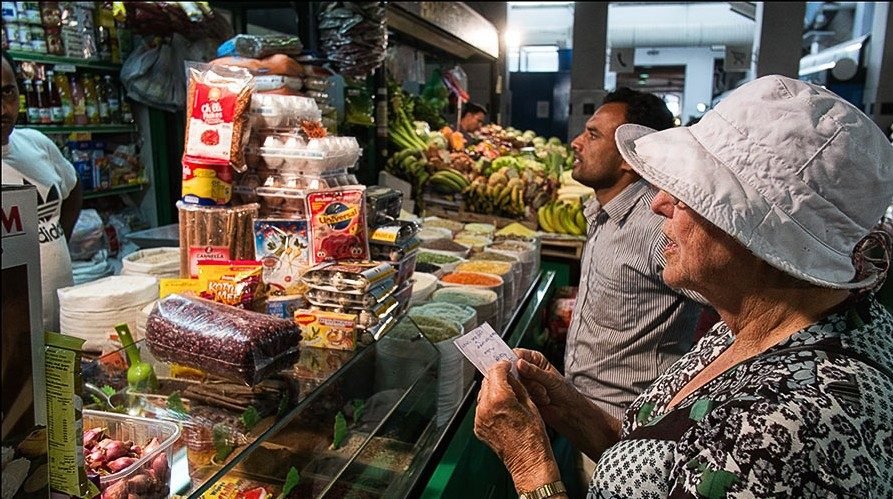
The Nuovo Mercato Esquilino is the covered market that occupies the block between Via Filippo Turati, Via Principe Amedeo, Via Lamarmora and Via Ricasoli, a couple of minutes on foot from Piazza Vittorio Emanuele II and a little over five from Termini station. It is the largest food market in the center of Rome, it is the most international in the city, and it is also the one that Romans name most casually and visit less often than its fame would suggest.
The history in two lines is this: for more than a century the Esquilino market was an open-air market, set up every morning under the plane trees and along the sides of the garden of Piazza Vittorio, with two-wheeled carts, collapsible stalls and the confusion everyone remembers. In October 2001 those stalls were cleared away and the vendors moved into a covered structure created a few steps away, in the spaces that until shortly before had been occupied by the Centrale del Latte di Roma and the Sani barracks, formerly the Pepe barracks. Since then the Esquilino market has had a roof, two pavilions, a washable floor and a precise address.
Carlo Emilio Gadda, who made this part of the city the setting of his most famous novel, called that old open-air market the "gran fiera magnara": a definition that anyone who writes about the Esquilino ends up quoting sooner or later, because it captures in three words the fact that people went there to eat, to buy food and to watch others buying food. The fiera magnara now has walls. It is still a fair, and it is still magnara.
The rest of these pages explains what this place really is, who works here, how to shop without looking like a lost tourist, what is within the 200 meters around it (and there is plenty: a Severan nymphaeum, a door covered in alchemical symbols, one of the four papal basilicas of Rome and a late-antique mausoleum wedged between the tracks), and why it is worth going in even if you have no intention of buying two kilos of onions.
Where the Nuovo Mercato Esquilino is and how to get there
The address and the shape of the block
The market occupies an entire block of the Esquilino district, bounded by four streets: Via Filippo Turati on the long side, Via Principe Amedeo on the opposite side, and the two cross streets Via Lamarmora and Via Alessandro Ricasoli. The entrances open onto more than one of these sides, and this is already the first practical fact to keep in mind, because those arriving from Piazza Vittorio enter from one side and those arriving from Termini enter from the other, and the two entry points lead into different product sectors.
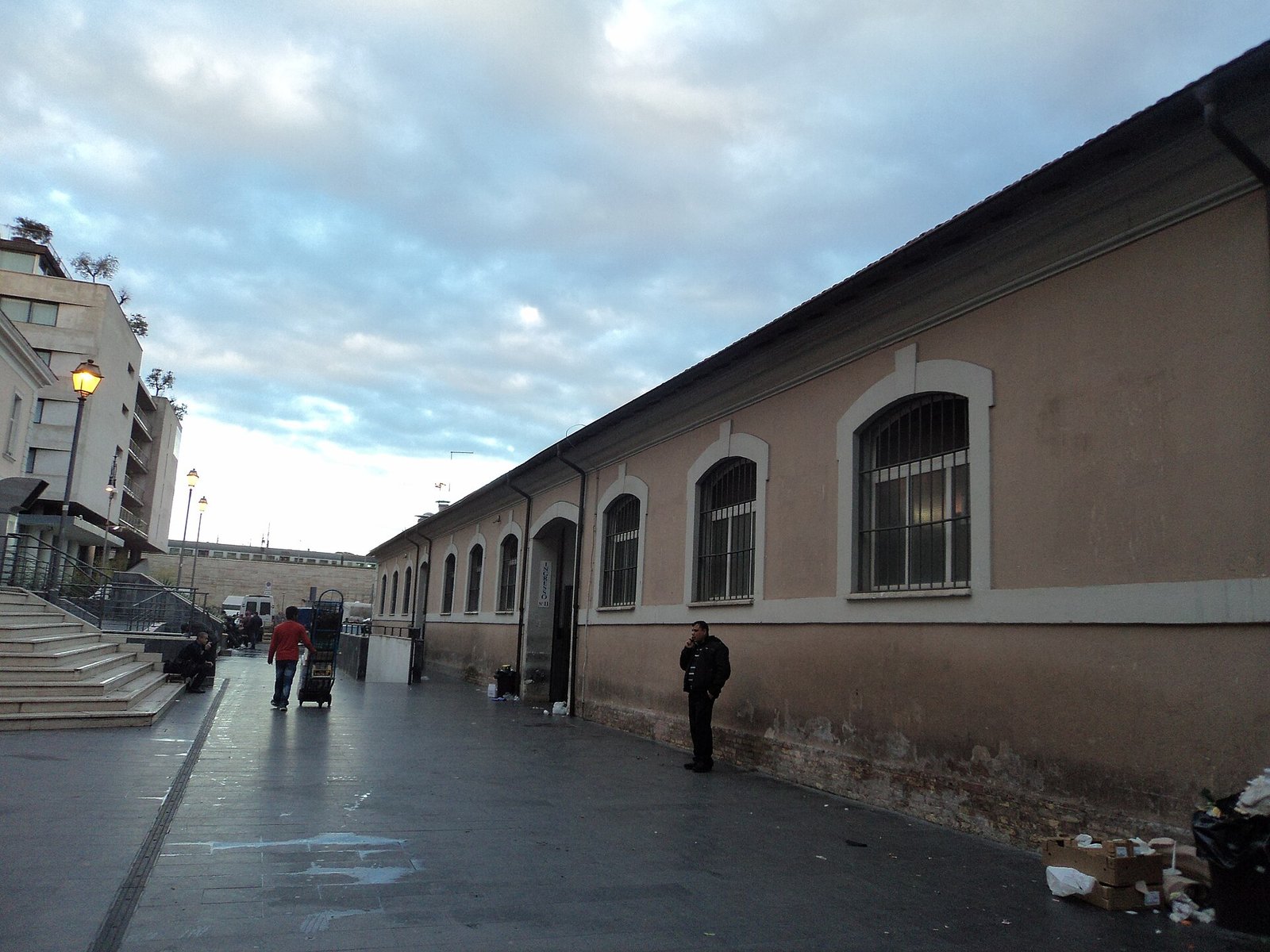
The market block, however, is not a residential block like the others. It is a lot that has always had service functions: first military, then industrial, then commercial. This is one of the reasons why, when a large covered space had to be found for a market of hundreds of stalls, people ended up looking right there. In the heart of a very dense district, a lot free of housing is a rarity worth gold.
How to get there by subway
The most convenient stop is Vittorio Emanuele, on subway line A. The exit opens on the side of the square and from there you walk a few minutes on the flat to the market, with no hills and no complicated crossings. It is the simplest choice for those coming from the center, from the Vatican or from Via del Corso area.
The second option is Termini, the terminus and interchange between lines A and B. From Termini the market can be reached on foot in a few minutes along Via Giolitti or Via Principe Amedeo, which is the street running directly along one side of the market. For those arriving by train from outside Rome, getting off the Leonardo Express or the airport connections, or coming from the long-distance buses of Piazza dei Cinquecento: for all of them the most logical solution is to leave the station and walk.
It is worth remembering that we are within a 20-minute walk of a disproportionate number of important things. From the market to the Colosseum you walk along Via Merulana and Via Labicana. To the Basilica of St. John Lateran you go down Via Emanuele Filiberto. To Santa Maria Maggiore it is barely five minutes. It is not the outskirts, however much common perception tends to describe it that way: it is the full historic center, inside the Aurelian Walls, a stone's throw from the Forum.
Buses, trams and trains
Surface transport serves this area well because Piazza Vittorio and the quadrilateral around Termini are crossed by a bundle of lines connecting the Esquilino to almost every quadrant of the city. The useful stops are spread along Via Merulana, Via Giolitti, Via Carlo Alberto and the sides of the square. Lines change over time, routes are diverted for roadworks and demonstrations, so the sensible thing is to check the route on the same day instead of trusting a number read somewhere.
On the rail front, Termini is within walking distance and this simplifies everything: if you arrive from Fiumicino, from Ciampino via Termini, from Lazio regional trains or from high-speed rail, the market is practically at the exit. It should be added that the railway line leaving Termini toward the east runs along Via Giolitti, and that from the window of those trains you can see one of the strangest monuments in Rome, the so-called temple of Minerva Medica, which I will discuss further on.
Getting there on foot, by bike, by car
On foot is the right way. From the historic center you get there without effort via Via Cavour or Via Merulana, and the route crosses the Monti district, which is a very different and much more written-about neighborhood but is literally attached to this one. By bicycle the area is convenient because it is almost entirely flat, except for the climb toward Santa Maria Maggiore, and because the streets of the Umbertine layout are wide.
By car it gets complicated. Part of the surrounding area is inside the Limited Traffic Zone of the historic center, street parking is contested and free spaces are very rare during the hours the market is open. Anyone who has to come by car does well to consider a park-and-ride and finish the trip by subway. Those who need to haul large quantities of groceries, instead, tend to organize with a cart or a trolley: it is what residents do, and it is also why in the streets around the market you constantly cross four-wheeled shopping carts pulled by people of every age.
What the Nuovo Mercato Esquilino concretely is
Two pavilions, two worlds
The structure is divided into two distinct bodies. One is devoted to groceries, the other to clothing and non-food products. They are two environments that work in completely different ways and that also have two different kinds of public, so much so that many regulars know one of the two pavilions very well and have almost never entered the other.
The food pavilion is the one that carries the market's fame. Inside there are fruits and vegetables, there are butchers, fishmongers, stalls of spices, dried legumes, rice, preserves, fresh products and imported products. The commercial geography is vast: next to the stalls selling vegetables from the Roman countryside there are stalls specialized in ingredients of Bangladeshi, Chinese, Indian, Egyptian, Peruvian, Nigerian, Sri Lankan, Filipino and Romanian cuisine. The layout does not follow an ethnographic logic: it follows the logic of whoever took that stall in that year, and so the neighbors in an aisle are often unexpected pairings.
The clothing pavilion is something else again. There you find fabrics, garments, accessories, household goods, suitcases, footwear. It is the sector that most resembles a large covered neighborhood market and that serves above all the demand of the neighborhood and of people who come to shop from the province.
Who works in the market
Something needs to be clarified here, because for years this market has been described as a sort of exotic attraction and it is not what it is. The Nuovo Mercato Esquilino is the workplace of several hundred people, in the vast majority of cases licensed merchants, with VAT numbers, suppliers, bookkeeping, hours and problems identical to those of any other Roman business operator. Many of them were born in Rome. Many others arrived 20 or 30 years ago and passed the business on to their children. Some took over stalls that belonged to Roman families who had sold because nobody wanted to continue.
The composition is international because the neighborhood is. The Esquilino, in proportion to its inhabitants, is the district with the highest foreign presence in the center of Rome, and it has been so for decades, not since yesterday. The market reflects this composition, and reflects it in the goods exactly as it does in the staff: if a substantial portion of residents cook with curry, tamarind paste, cassava or rice noodles, a well-functioning neighborhood market sells those things. It is not folklore, it is service.
Anyone entering for the first time will do well to remember that they are in a workplace and not in an exhibition hall. The merchants are people who have a day to bring home: they gladly answer those who ask, gladly explain an ingredient you don't know, but they do not appreciate, rightly, a camera being pointed at them without a word while they are serving a customer. It is a rule of good manners that applies everywhere and that here, for reasons easy to understand, gets noticed more.
How the shopping works
Shopping at the market has its own protocol that people who grew up in supermarkets no longer know. You look, you ask, you buy at the stall, you pay at the stall. Each stallholder is a business of their own: there is no single checkout at the exit. This means that a varied shop involves five or six separate transactions, and it is the reason it pays to have cash even if most operators accept cards.
The second rule is that at the stall you ask and do not serve yourself, unless indicated otherwise. It is a sharp difference from the produce section of the supermarket and it is the main source of small frictions between occasional visitors and vendors.
The third is that the quantities are designed for families who cook, not for singles buying the single portion. Many products, especially dried legumes, spices and rice, are sold in large packages or by weight with generous cuts. If you want to buy a hundred grams of something you can ask without any problem, but you will notice that the price per kilo rewards those who buy in quantity.
The fourth, and perhaps the most useful, is that it pays to make a full round before buying. The market is big, the stalls selling the same goods are many, and the difference in price and quality between one end and the other of the same pavilion can be noticeable. Residents do exactly this: they enter, walk around, then come back and buy.
A curiosity about Nuovo Mercato Esquilino
The curiosity is archaeological, and concerns what is just outside the walls of the market: on Via Filippo Turati, toward Piazza Guglielmo Pepe, some arches of an ancient Roman aqueduct are still visible. They are the remains of a branch that entered the city from Porta Tiburtina, today's Porta San Lorenzo, and continued toward the Esquilino to feed the great monumental nymphaeum that today is called the Trophies of Marius and that can be seen, reduced to a mass of brick masonry, at the northern corner of Piazza Vittorio.
Scholars have established that those arches, for reasons of elevation, can belong only to the Aqua Claudia or to the Anio Novus, the two channels that reached Rome from the Aniene valley at the highest elevations and that for a long stretch traveled on the same arches. Translated: the most multicultural market in Rome settled along the route of one of the most ambitious hydraulic works of the empire, at a point where water arrived in the city with enough pressure to make a monumental fountain about 20 meters high gush forth.
The funny thing, if you have a taste for coincidences, is that the function has not changed all that much. The aqueducts served to bring inside the walls a resource produced far away and to distribute it widely in a populated neighborhood. The market does the same job with goods: it gathers them from half the world, concentrates them in one point, redistributes them to a neighborhood that needs them. In the same block, 18 centuries apart.
Add to this that the lot hosted for decades the Centrale del Latte di Roma, that is a plant built precisely to collect, process and redistribute a food product to the whole city. Three eras, three infrastructures, a single vocation: bringing here what is not produced here. Few urban coincidences around Rome are as orderly.
From Piazza Vittorio market to the covered market
How the open-air market was born
Piazza Vittorio Emanuele II was built starting in 1880 and completed in the following years, according to the provisions of the 1873 master plan, that is in the full building fever that followed the transfer of the capital from Florence to Rome in 1871. It is the largest square in the city: 325 meters by 185, 60 thousand square meters counting the porticoes, almost 10 thousand square meters more than St. Peter's Square. The central garden was officially opened to the public on Sunday, July 10, 1889.
The market was not planned: it was born on its own. Already in the last years of the nineteenth century, while the big apartment buildings with porticoes filled with tenants, stalls began to be set up along the sides of the garden. At first a few, then many, then very many. It was above all a food market, but not only: in the porticoes surrounding the square, after the war, everything was sold. In Vittorio De Sica's famous film, Bicycle Thieves, one of the sequences shows precisely that trade in bicycle spare parts that was practiced there underneath, with wheels, frames and handlebars taken apart and resold piece by piece.
Among the food vendors there were the pollaroli, who offered chickens already ready for the kitchen but also, for wary customers who wanted certainty of freshness, live chickens to pluck at home and chicks to raise on their own. On Christmas Eve the square belonged to the fishmongers: salt cod, eels and enormous capitoni, for the meatless dinner that no Roman family skipped back then. The food stalls were daily, often dragged by hand on two-wheeled carts, and were set up from dawn to be taken down around two in the afternoon.
The market was famous all over Rome for the convenience of its prices and attracted customers even from distant neighborhoods. It also attracted the curious and tourists in search of color, and it did so thanks to a repertoire of characters who over the years became local legend: vendors who walked the whole length of the market announcing their goods with verbal formulas of their own invention, and a Capuchin friar with a long white beard whom Romans called zifrà, who collected alms for the poor and something for the convent's kitchen, a sort of Manzonian Fra Galdino transplanted to the Esquilino.
Gadda, the gran fiera magnara and the Pasticciaccio
Carlo Emilio Gadda arrived in Rome after the war and worked there as an editor at Rai. His best-known novel, Quer pasticciaccio brutto de via Merulana, came out in installments in the magazine Letteratura in 1946 and then, revised and expanded, as a book from Garzanti in 1957. It is set in March 1927, in the early years of Fascism, and revolves around a jewel theft and a murder inside a building on Via Merulana, at number 219, the one called the Palazzo degli Ori in the book.
Via Merulana is the street that connects Santa Maria Maggiore to St. John Lateran and passes a few hundred meters from the market. Inspector Francesco Ingravallo, called don Ciccio, from Molise, sharp and touchy, moves in that Rome: the Umbertine buildings, the doorman's lodges, the maids from the Castelli, the police station sergeants, the commendatori with their manias. And it is in this landscape that Gadda places his definition of Piazza Vittorio market as a "gran fiera magnara", an expression that stuck to the place and that continues to be quoted every time someone tries to describe it.
The point is not only lexical. The point is that Gadda frames the market as a matter of language even before commerce: a Babel in which Roman dialect mixes with Molise, Veneto and Neapolitan speech, the dialects of the Castelli, the approximate Italian of the clerks arrived from all over the Kingdom. The pasticciaccio of the title is not just the detective tangle, it is the linguistic mixture. And that is exactly why the comparison with today's market holds up very well: inside the food pavilion, on any afternoon, you hear at the same time Italian, Roman dialect, Bengali, Chinese, Arabic, Punjabi, Spanish, Romanian and working English. Gadda would have had material for a second volume, the one he never wrote and that left his mystery without a solution.
The clearing of October 2001
The open-air market remained in operation until the 1990s in its classic form, but the transformation had already begun. The daily stalls had become semi-permanent, that is they were no longer taken down every evening. The square had become a permanent construction site of setting up and taking down. The central garden, which in the meantime had accumulated decades of decay, struggled to coexist with hundreds of commercial pitches. Hygiene and safety issues had become pressing.
The project to redevelop the square and the surrounding spaces had started in the 1980s. The knot was finding an alternative arrangement for the merchants, who were many and had no intention of disappearing. The solution was to build a new covered market on the block of Via Turati and Via Principe Amedeo, where two large areas were freed up at the same time: that of the Centrale del Latte di Roma, moved to an industrial area outside the city, and that of the Sani barracks, formerly the Pepe barracks.
The clearing of Piazza Vittorio stalls took place in October 2001. It was a traumatic passage, like all market relocations: the logistics changed, the flow of customers changed, the visibility changed, the costs changed. Those who had a stall in a good position on the square found themselves in an ordinary position inside a shed. Those used to working outdoors had to learn the rules of an enclosed space. Casual foot traffic, that of the passerby who bought because they were passing by, dropped drastically.
At the same time, the move saved the market. Inside a covered structure you can work with refrigerated rooms, you can respect cold-chain rules, you can stay open even when it rains, you can serve fish and meat in conditions that would be unthinkable outdoors. The Esquilino market was able to become what it is today, that is a serious and specialized food market, precisely because it stopped being a market of carts.
The Sani barracks, the Centrale del Latte and the ghosts of the lot
The Sani barracks, earlier named after Pepe, belonged to that band of military installations that the new capital placed around Termini when the railway junction became strategic. It is a constant of post-unification Rome: where the railway passes, barracks, depots and warehouses arrive. Via Turati front, for this reason, has a different character from the residential front of Piazza Vittorio: lower buildings, blind walls, wide vehicle gates.
The Centrale del Latte di Roma is the other half of the story. It was the public plant that collected milk from the stables of the Roman countryside and of Lazio, pasteurized it and distributed it to the city, in an era when the food safety of milk was a leading public health question. When production was moved to an industrial site outside the center, the building stayed there like a shell, and within a few years that shell filled with vegetable stalls and fishmongers.
These are layers that happen constantly in Rome, but here the sequence is particularly readable: imperial aqueduct, gardens and aristocratic villas, dump and suburban necropolis in the Republican age, Umbertine residential neighborhood, barracks, dairy plant, covered market. Six functions on the same piece of land, each of which left a piece of wall or a street name.
Something nobody tells you about Nuovo Mercato Esquilino
What is almost never said is that the Nuovo Mercato Esquilino works, in large part, as a wholesale market disguised as a retail market. A substantial share of what leaves there does not end up in home kitchens: it ends up in restaurant kitchens. The restaurants of half of Rome that cook non-Italian food stock up here, because here they find ingredients that large-scale retail does not handle and that general wholesalers do not keep in their range.
This explains some things that look incomprehensible to an occasional visitor. It explains why certain stalls sell 25-kilo packages of basmati rice or sacks of chickpea flour that no family would use up in a year. It explains why at certain hours of the morning the market is full of people loading boxes onto professional carts instead of filling a bag. It explains why the variety of the same product is so wide: if the customer is a cook who knows exactly which type of dried chili he needs, the stall has to keep five types and not one.
The consequence, for those who come to do ordinary shopping, is entirely positive. It means prices feel the competition among suppliers and not only the tourist foot traffic. It means the turnover of fresh goods is fast, because a professional clientele does not forgive tired produce. It means that when you ask for advice you are talking to someone used to explaining an ingredient to the person who will actually cook it.
The second thing that is never said is that this market has a seasonality out of step with that of Roman neighborhood markets. In a classic neighborhood market the calendar follows the agricultural seasons of Lazio and the feasts of the Catholic calendar: artichokes in spring, mushrooms in autumn, salt cod in December. Here that calendar still exists, but on top of it there are others, overlapping, tied to the festivals of the communities that shop in this market. There are weeks when demand for certain products spikes for reasons that have nothing to do with the Italian calendar, and the stalls equip themselves accordingly.
The result is that if you enter the market four times a year at four different moments, you find four different markets. It is something regulars take for granted and nobody ever writes, because it requires going back more than once.
I add a third observation, one of those you understand only by going often. The clothing pavilion has a social function that goes beyond commerce: it is one of the few indoor places, free and not consumerist in the strict sense, where in central Rome you can spend time without having to consume anything. In winter this matters. On cold days the market is also a shelter, and it is not written anywhere but it is obvious to anyone who sets foot there in January.
My advice for visiting Nuovo Mercato Esquilino
Go with the intention of buying something
The main advice is simple and changes everything: go in with the idea of buying, not with the idea of looking. Not because looking is forbidden, but because the difference between a pleasant hour and an embarrassing hour, in here, lies entirely in the role you assign yourself. Whoever enters to buy talks to the vendors, asks questions, gets answers, tastes, makes mistakes, goes back. Whoever enters to look walks through other people's work with the face of someone visiting a museum, and the results are what you can imagine.
You don't need to buy much. A bag of spices, a package of legumes you don't know, a tropical fruit that at the supermarket would cost three times as much, a piece of fish. What matters is having a reason to stop at a stall and strike up a conversation. 90 percent of what there is to learn in this market is learned that way, by asking a stallholder how to cook something.
Choose the right time
The market's hours have changed several times over the years and can vary by sector and by individual business, so it pays to check them before leaving home instead of trusting what you find written around. What can be said with certainty, instead, is that the internal rhythms follow a constant pattern: early morning is the time of professionals and restocking, late morning is the time for residents' shopping, early afternoon is the time when the fresh goods are cleared out and when, if you are lucky and bold, you can haggle over the price of what is left.
The recommended time is late morning on a weekday, preferably midweek. On Saturday the market is packed and shopping becomes a matter of elbows. On Monday certain fish stalls work little for supply reasons, as all over Italy. A weekday late morning is the best compromise between a full range and room to move.
Bring cash, bags and patience
Cash: most stalls accept cards, but the transactions are many and small, and cash speeds things up. Bags: here you don't buy packaged, you buy by weight, and a sturdy bag or a cart solves it. Patience: the line at a stall doesn't work with a ticket number but with the collective memory of who arrived first, so it pays to keep an eye on who was there when you arrived and not try to cut ahead, because it is noticed immediately.
I add something about language. Many vendors speak perfect Italian, many others speak it in a functional, brisk way, and the conversation at the stall is almost always a practical conversation: how much, which one, what does it cost. If something isn't understood, pointing always works, and asking twice is not rude. What is perceived badly, instead, is talking about the vendor in the third person with your companion while he is standing right there. It happens more often than you would think, and it happens above all to visitors who have read somewhere that this market is a picturesque place.
Combine the visit with something else
The market alone takes an hour, an hour and a half if done at leisure. The best way to organize the morning is to combine it with what is around, which is a great deal: the garden of Piazza Vittorio with the Severan nymphaeum and the Alchemical Gate, Santa Maria Maggiore five minutes away, Palazzo Merulana with the Cerasi collection, the Auditorium of Maecenas on the Largo Leopardi side, the Domus Aurea on the Oppian Hill. With a slightly longer walk you reach the underground basilica of Porta Maggiore and San Lorenzo fuori le Mura.
Those who want to understand how Rome's covered markets work as a whole would do well to also plan on the Nuovo Mercato Testaccio, which is the other great market relocation of contemporary Rome and which solved the same problems in the opposite way, with a declared architectural project and with archaeological excavations in view under the floor. The comparison between the two says a lot about two different ideas of what a neighborhood market should be.
Another well-known fact, yet rarely mentioned
The well-known fact is that the Esquilino is the most international district of Rome. Everyone knows it, it is read everywhere, it is repeated in every article. What is almost never mentioned is the reason it happened right here, which is not random at all and has everything to do with geography and the real estate market.
The Esquilino is the district that surrounds Termini station. Anyone arriving in Rome without knowing it arrives at Termini, and looks for their first lodging within walking distance of the station. This holds for the migrants of the 1980s and 1990s exactly as it held for the people from Romagna, the Marche and Abruzzo who arrived in the capital in the 1950s. Proximity to the station is the first factor.
The second is the housing stock. The Umbertine buildings of the Esquilino were built in a hurry and with large apartments, intended for bourgeois families with domestic staff. In the second half of the twentieth century that bourgeoisie had moved to the new neighborhoods, Parioli, Balduina, EUR, and the apartments of the Esquilino were left behind: large, without an elevator in many cases, in buildings that needed maintenance, in a district considered run-down because of its closeness to the station. Large apartments in devalued buildings are exactly the kind of stock that gets divided up and rented to large households or shared among several people. It happened in the Esquilino as it happened in dozens of station neighborhoods across Europe.
The third factor is wholesale trade. When a few hundred people settle in a neighborhood, they begin to serve that neighborhood: first a grocery store, then a second, then a wholesaler supplying the first two, then a network that supplies other neighborhoods too. The streets between Piazza Vittorio and Termini have hosted for years one of the densest concentrations of wholesale trade in Italy, and the market became the node of that network.
The fourth, least cited of all, is school. The public school of the Esquilino has done for years what the central institutions have done much more slowly: it has held the district together. The data on the percentages of pupils with non-Italian citizenship in the district's schools has circulated for some time and is among the highest in Italy. These are generations born in Rome, who speak Roman dialect, who then took stalls at the market or opened businesses in the area. Today's market is not the market of immigrants who arrived yesterday: it is, in large part, the market of their children, who are Roman.
To say that the Esquilino is multicultural, in short, is true but it is not much. The interesting thing is that it has been multicultural long enough for the second and third generations to have become the norm, and this completely changes how it should be told.
What is around: Piazza Vittorio and the rest of the Esquilino
The garden of Piazza Vittorio
The central garden of the square is named in memory of Nicola Calipari, the intelligence official killed in Iraq in March 2005 after negotiating the release of the journalist Giuliana Sgrena. After 20 months of redevelopment work it reopened on October 31, 2020, with redone paths, new lighting and a landscaping arrangement that tried to restore order to a space that for decades had been used as the back of the market.
The Trophies of Marius, that is the Nymphaeum of Alexander Severus
The mass of brick masonry that occupies the northern corner of the square is what remains of the Nymphaeum of Alexander Severus, which ancient sources call Nymphaeum divi Alexandri and which from the Middle Ages onward everyone calls Trofei di Mario. It was a monumental fountain serving both as the terminal display of an aqueduct and as a water distribution tower: originally about 20 meters high, 25 wide at the base, with a volume of about 4,000 cubic meters, entirely faced in marble, as shown by the holes for the clamps that can still be seen over the whole elevation.
The traditional name comes from a misunderstanding. Two large marble trophies came from the fountain, and in 1590 Pope Sixtus V had them placed on the balustrade at the top of the Cordonata of the Capitoline Hill, where they can still be seen today. For centuries they were attributed to Gaius Marius and his victories over the Cimbri and the Teutons, but they are of the Domitianic era and were erected after the victorious campaigns against the Chatti and the Dacians of 89. The wrong name stayed attached to the building, as always happens in Rome.
A detail that makes the monument more important than its current condition suggests: the Nymphaeum of Alexander is the only survivor of the 15 display fountains of ancient Rome. 15 were the monumental terminal points of the urban aqueducts, and only one remains, reduced to a ruin, in the middle of a public garden visited every day by people who in the vast majority of cases don't know what it is. The building can be visited on request through the single number of the City of Rome.
The Alchemical Gate
On the other side of the garden is the Porta Alchemica, also called Porta Magica, Porta Ermetica or Porta dei Cieli. It was built between 1655 and 1681 by Massimiliano Savelli Palombara, Marquis of Pietraforte, who lived between 1614 and 1685, in his villa that occupied part of this piece of the Esquilino, more or less where the square opens today. It was one of the five gates of Villa Palombara and is the only one to survive: on the arch of the lost gate on the opposite side there was an inscription dating it to 1680.
The story behind the gate is one of the most beautiful Roman legends. The Marquis Palombara frequented from 1656 the court of Christina of Sweden at Palazzo Riario, today Palazzo Corsini, on the Janiculum. The queen, who had converted to Catholicism, had abdicated the throne of Sweden and lived in Rome from 1655 until her death in 1689, was passionate about alchemy and science, had been instructed by Descartes, and owned an advanced laboratory run by the alchemist Pietro Antonio Bandiera. Around that palace an academy formed, frequented by notable figures of the seventeenth century: the esoteric physician Giuseppe Francesco Borri, the astronomer Giovanni Cassini, the alchemist Francesco Maria Santinelli, the learned Jesuit Athanasius Kircher.
The legend, which reached us through the scholar Francesco Girolamo Cancellieri in 1802, tells that a pilgrim called stibeum, from the Latin name of antimony, was hosted for one night in the villa. He spent that night in the gardens looking for a mysterious herb able to produce gold. The next morning he was seen disappearing forever through the gate, leaving behind some flecks of gold, the fruit of a successful transmutation, and a paper full of riddles and symbols that was supposed to contain the secret of the philosopher's stone. The marquis tried in vain to decipher it, and in the end decided to make it public by having those symbols engraved on the five gates of the villa and on the walls of the small building, in the hope that sooner or later someone would understand them.
Behind the mysterious pilgrim scholars put the name of Giuseppe Francesco Borri, accused of heresy and poisoning by the Holy Inquisition in 1659, who fled, was arrested, locked up in Castel Sant'Angelo between 1671 and 1677 and then admitted to semi-liberty from 1678. In those years he resumed frequenting his old friend Palombara, who hosted him in the villa until his own death in 1685. The enigmatic inscriptions were made between 1678 and 1680, that is exactly in the period when the two were in contact again.
The gate today is set against one side of the garden, flanked by two statues of the Egyptian god Bes, and you can look at it up close for free at any time. You get there in two minutes from the market: whoever bought spices can go and read the alchemical formulas right afterward, and the sequence has its own coherence.
Santa Maria Maggiore and the ridge of the Cispius
Santa Maria Maggiore closes the district to the west and is one of the four papal basilicas of Rome, the only one of the great Marian basilicas to have kept the original early Christian structure. From the market you get there in five minutes going up Via Carlo Alberto, and the final climb, however short, makes you understand better than any map that the Esquilino is a hill and not a plain: you are climbing the Cispius, one of the three ridges that make up the Esquiline complex together with the Oppius and the Fagutal.
That difference in height is the reason the Aqua Claudia arrived so high and the reason the Nymphaeum of Alexander could work by gravity. And it is also the reason why, climbing onto the churchyard of the basilica and turning around, you see the square from above and understand its real size, which escapes you from street level.
The so-called temple of Minerva Medica
Walking from Piazza Vittorio toward Porta Maggiore along Via Giolitti you come upon, wedged between the railway tracks and the late-nineteenth-century buildings, an enormous domed building that everyone calls the temple of Minerva Medica and that was never a temple. It is a monumental hall from the early fourth century, 25 meters wide, 24 high today and originally 32, with a surface of about 400 70 square meters. It belonged to a luxurious suburban residence that occupied the area between Santa Bibiana and Porta Maggiore, and scholars debate whether it is the Horti Liciniani or the Horti Pallantiani.
The name comes from another of the misunderstandings that dot Roman topography. According to Rodolfo Lanciani the confusion goes back to the seventeenth century, when a statue of Minerva with a serpent at her feet, an animal sacred to Aesculapius, was attributed to these excavations, though it had actually been found in the Campus Martius and is today in the Vatican Museums. In truth the name was already circulating in the sixteenth century, used by Pirro Ligorio, who studied the building and drew its plan marking the points where statues and columns were found. Even earlier, until the mid-sixteenth century, the monument was attributed to the adopted sons of Augustus, Gaius and Lucius Caesar, or to Hercules Callaicus, and from those attributions derived the popular place name "Le Galluzze", which can be read in historical cartography.
The Esquilino before the Esquilino
It is worth spending a few words on what this piece of the city was before it became a neighborhood. The district is the fifteenth of Rome, established in 1874, and occupies barely a square kilometer and a half with more than 20 thousand inhabitants, which makes it one of the densest districts in the city.
The urban reform of Augustus buried the pestilential land under about 10 meters of fill, turned the embankment of the old walls into a public promenade and opened the way to the Gardens of Maecenas, the gardens that contained, among other things, the tall tower from which, according to Suetonius, Nero watched the fire of Rome. In 1874 the Auditorium of Maecenas was brought to light in that area, the surviving hall of a much larger complex, demolished entirely to make the land buildable: the new capital needed houses and its builders were not the type to be subtle.
The right photo to take at Nuovo Mercato Esquilino
Let's start with the wrong photo, because it is the one everybody takes. The wrong photo is the stolen close-up of the vendor behind the stall, taken from two meters without asking anything, possibly with the phone's wide-angle lens. It is wrong for two reasons: because it is rude, and because it turns out badly. That person is not looking at you, the neon light cuts across their face, and the result is a photograph that says only that whoever took it considered that man part of the furnishings.
The right photo is the goods. The spice and dried legume stalls of the food pavilion are, from a visual point of view, the most interesting thing within kilometers: open sacks, pyramids of yellow, red, ocher and green powders placed side by side with no aesthetic intention and for that reason perfect, hand-written labels in several alphabets, scales, scoops, jars. You shoot from above, vertically, holding the phone parallel to the surface of the stall, and you fill the whole frame with color. It is a photograph that always works, bothers nobody, and needs no filter.
The second framing I recommend is the architectural one: the long perspective of an aisle, taken from the end, with the stall signs lining up and the ceiling of the structure closing at the top. It is a photo that tells the size of the place, which gets completely lost in close-ups. It pays to lean on an upright to keep the camera steady, because the interior light is weaker than it seems and exposure times get longer.
The third is the outdoor counterpart, and for me it is the best: leave the market, walk to Via Filippo Turati toward Piazza Guglielmo Pepe and photograph the arches of the ancient aqueduct with the traffic and the Umbertine buildings around. It is the photograph that holds together the three Romes of this block, the imperial one, the post-unification one and the contemporary one, in a single frame. The best light is late afternoon, when the sun comes in low from the west and sets the brick off from the background.
The fourth, if you have 10 extra minutes, is inside the garden of Piazza Vittorio: the Alchemical Gate head-on, with the two statues of Bes on the sides, taken as straight as possible so the inscriptions can be read. It is a photo that requires patience because the gate has a fence in front, and it pays off because it is one of the least photographed and most photogenic monuments in the city.
A practical rule for all four: if the recognizable face of a person who is working enters the frame, you ask. A gesture and a word are enough. In most cases the answer is yes, and the photograph that comes out of it, with that person looking at the lens because they decided to look at it, is worth 10 times the stolen shot.
Some important events that happened here in history
Here are the steps that made this block what it is, widening the view to the piece of the Esquilino that surrounds it, because the history of the market cannot be understood without the history of the square.
Severan age. The great nymphaeum we now call the Trophies of Marius is built, fed by a branch of the Aqua Claudia or of the Anio Novus entering the city from Porta Tiburtina. Some arches of that branch survive on Via Turati, along the side of the future market.
Early fourth century. The great domed hall of the horti is built, which will later be mistakenly baptized the temple of Minerva Medica.
Between 1655 and 1681. Massimiliano Savelli Palombara builds in his villa on the Esquilino the five gates with alchemical inscriptions. Only one will survive.
1590. Pope Sixtus V has the two marble trophies moved from the Esquiline nymphaeum to the balustrade of the Cordonata of the Capitoline Hill, where they still are.
1871. Rome becomes the capital of the Kingdom of Italy. The building season begins that will change the look of the hill forever.
1873. The new master plan provides for the construction of a residential neighborhood on the Esquilino, with a large porticoed square at the center. The square takes the name of Vittorio Emanuele.
1874. The Esquilino district is established, fifteenth of Rome. In the same year the Auditorium of Maecenas re-emerges from the ground, to be saved while the rest of the complex is demolished.
July 10, 1889. The central garden of Piazza Vittorio is officially opened to the public. Around it, the market stalls are already beginning to multiply.
1911. Mario Rutelli creates for the square the fountain that Romans immediately christened "il fritto misto", for the crowd of figures that compose it. It will be restored in 2020.
1940s and 1950s. The market reaches its moment of greatest renown. Under the porticoes everything is sold, from loose tobacco made from cigarette butts to bicycle spare parts. Vittorio De Sica shoots some of the scenes of Bicycle Thieves here.
1946. Gadda's Pasticciaccio comes out in installments in the magazine Letteratura, set in 1927 in a building on Via Merulana. In 1957 it will come out as a book from Garzanti and become a literary event.
1980s. The project to redevelop Piazza Vittorio and the surrounding spaces begins. The search for an alternative location for the stalls starts.
1990s. The Centrale del Latte di Roma is moved to an industrial area outside the city and Via Turati lot is freed. Together with the area of the Sani barracks, formerly the Pepe barracks, it becomes the space available for the new covered market.
October 2001. Piazza Vittorio stalls, by now semi-permanent, are cleared. The Esquilino market enters the covered structure and takes the name Nuovo Mercato Esquilino.
2002. The Orchestra di Piazza Vittorio is born, a musical project that brings together musicians of different origins and takes its name precisely from this piece of the city.
March 2005. Nicola Calipari dies in Iraq. The central garden of the square will be named in his memory.
2012. The new building between Via Emanuele Filiberto and Via Conte Verde is inaugurated, rebuilt after the stability problems of the previous one. It houses the seat of the ENPAM foundation and loosely takes up the Umbertine style of the square, drawing quite a lot of criticism for breaking with the uniformity of the context.
2017. Abel Ferrara directs the documentary Piazza Vittorio, shot here, on the theme of coexistence among the district's different communities.
October 31, 2020. The garden of Piazza Vittorio reopens after 20 months of redevelopment work. In the same year the restoration of Rutelli's fountain is completed.
2021. An agreement between ENPAM and the Special Superintendency of Archaeology, Fine Arts and Landscape of Rome makes possible the museum display of the remains of the Horti Lamiani found during the works on the new building, bringing back to light one of the most luxurious imperial residences of the ancient Esquilino.
Who has passed through Nuovo Mercato Esquilino
The honest answer is that half of Rome passes through here, and that is why the list of famous names is less interesting than the list of categories. The cooks of the restaurants in the center pass through, arriving early in the morning with vans double-parked. The families of the district pass through, doing their weekly shopping here. The university students of La Sapienza pass through, which is 20 minutes' walk away. The retirees of Piazza Vittorio pass through, who have known the stalls one by one for 20 years. The curious pass through, arrived from other neighborhoods because someone told them you can find Vietnamese fish sauce here.
That said, a few names are worth mentioning, because they tie the market and the square to the cultural history of the city.
Carlo Emilio Gadda is the first, and not only for the "gran fiera magnara". The Pasticciaccio is the book that gave this piece of the Esquilino a literary dignity that tourist topography denied it, treating Via Merulana and its big buildings as a full narrative space, not as a backyard.
Vittorio De Sica shot parts of Bicycle Thieves here, and the market under the porticoes entered the imagination of neorealism together with Porta Portese and the borgata neighborhoods. Whoever knows those shots still recognizes, walking under the porticoes of the square, the exact geometry of certain scenes.
Abel Ferrara, who has lived in Rome for years and has a home in the district, directed the documentary Piazza Vittorio in 2017, built on the voices of the people who live around the square and on how they coexist. It is the most recent and most direct portrait of this piece of the city.
L'Orchestra di Piazza Vittorio, born in 2002, is the musical group that took its name from the square and drew its makeup from the neighborhood: musicians arrived from different countries who play a hybrid repertoire together. It is the best-known example of how this area has produced culture and not just news.
Pirro Ligorio, Giovanni Battista Piranesi and Rodolfo Lanciani passed through here in different eras for different reasons, all tied to archaeology: the first to study and draw the domed hall on Via Giolitti, the second to engrave it when it was still surrounded by countryside, the third to excavate and describe the Republican necropolises that resurfaced during the earthmoving for the new Termini station.
And then there are Massimiliano Savelli Palombara and Giuseppe Francesco Borri, the alchemist marquis and the esoteric physician, who between 1678 and 1680 spent their days in a villa that occupied these same streets, engraving formulas on the walls in the hope that someone would decipher them. Nobody has. The gate is still there, 200 meters from the spice stall.
Frequently asked questions about the market
Is it suitable for children?
Very much so. It is one of the places in Rome where a child sees more things they have never seen per square meter: unknown fruits, whole fish, sacks of spices, scales, different alphabets. The practical advice is to hold their hands in the narrow aisles, because carts pass continuously.
Can you eat inside the market?
The structure's vocation is selling groceries, not restaurant service. Those looking for a meal find in the surrounding streets, above all toward Via Principe Amedeo and Via Giolitti, one of the densest concentrations of international kitchens in Rome. No names, because they open and close constantly, but the criterion is simple: go in where the people who live in that neighborhood eat.
How much time do you need?
One hour for a full round with a few purchases. Two and a half hours to do the market, the garden of Piazza Vittorio, the Alchemical Gate and the Trophies of Marius. Half a day if you add Santa Maria Maggiore or Palazzo Merulana.
Is it safe?
Yes, in the terms in which any central station area of a large European city is: normal attention to your wallet in the crowd, nothing more. The reputation of the Esquilino is worse than its daily reality, and those who live there have been repeating it for 20 years.
Frequently asked questions about Nuovo Mercato Esquilino
Where is the Nuovo Mercato Esquilino?
The Nuovo Mercato Esquilino occupies an entire block of the Esquilino district in Rome, bounded by Via Filippo Turati, Via Principe Amedeo, Via Lamarmora and Via Alessandro Ricasoli, with entrances on more than one of these sides.
How is the Nuovo Mercato Esquilino organized?
The Nuovo Mercato Esquilino is divided into two distinct pavilions: one devoted to groceries and the other to clothing and non-food products, two environments that work differently and have partly different publics.
Is the Nuovo Mercato Esquilino suitable for children?
Yes, the Nuovo Mercato Esquilino is very suitable for children, who here see more unfamiliar things per square meter than elsewhere: fruits never seen before, whole fish, sacks of spices and scales. The practical advice is to hold their hands in the narrow aisles, where carts pass continuously.
Can you eat inside the Nuovo Mercato Esquilino?
The main vocation of the Nuovo Mercato Esquilino is selling groceries, not restaurant service: anyone looking for an actual meal should expect to leave the market to find it in the restaurants of the surrounding district.
Why do so many Rome restaurants stock up at the Nuovo Mercato Esquilino?
The Nuovo Mercato Esquilino works in large part as a wholesale market disguised as a retail market: a substantial share of what leaves there ends up in the kitchens of restaurants across half of Rome that cook non-Italian cuisine, because here they find ingredients that large-scale retail does not offer.
What is there to see near the Nuovo Mercato Esquilino?
Near the Nuovo Mercato Esquilino is Piazza Vittorio Emanuele II, with the garden named after Nicola Calipari, reopened on October 31, 2020 after 20 months of redevelopment work on the paths and the greenery.
Before you go
The Nuovo Mercato Esquilino is one of the few places in central Rome where the historic center keeps doing the job historic centers were born to do: selling food to the people who live around it. It is not a market rebuilt for visitors, it has no communication project, it has no logo. It has stalls, customers and scales, and that is exactly its quality.
If you go, go the way you go to do your shopping: with a bag, some cash and the willingness to have explained to you what the fruits you don't recognize are. You'll come out with something in your hand and with an idea of the Esquilino very different from the one that circulates.
To organize the rest of the day around this stop, or to understand how to fit the Esquilino into a wider Roman itinerary, you'll find useful material on italyplanner.com, which is the place where we put itineraries and travel guides to Italy. Those who instead work with groups, escort visitors for a living or organize tours and need professional tools, will find what they need on tourleaderpro.com. And if you are looking for other things to do in the area, in summer the garden of Piazza Vittorio hosts one of the city's historic open-air cinema arenas, the Notti di Cinema a Piazza Vittorio, which is the best way to come back here after sunset.
Contact Information
Via Principe Amedeo, 184
Roma Roma Città, Roma Città