Basilica of San Lorenzo Outside the Walls
In short. Piazzale del Verano 3, 00185 Rome, phone 06 491511: the Basilica of San Lorenzo Outside the Walls is a parish church and admission is free, but it must be said right away that the catacomb and the cloister can't be visited at will.
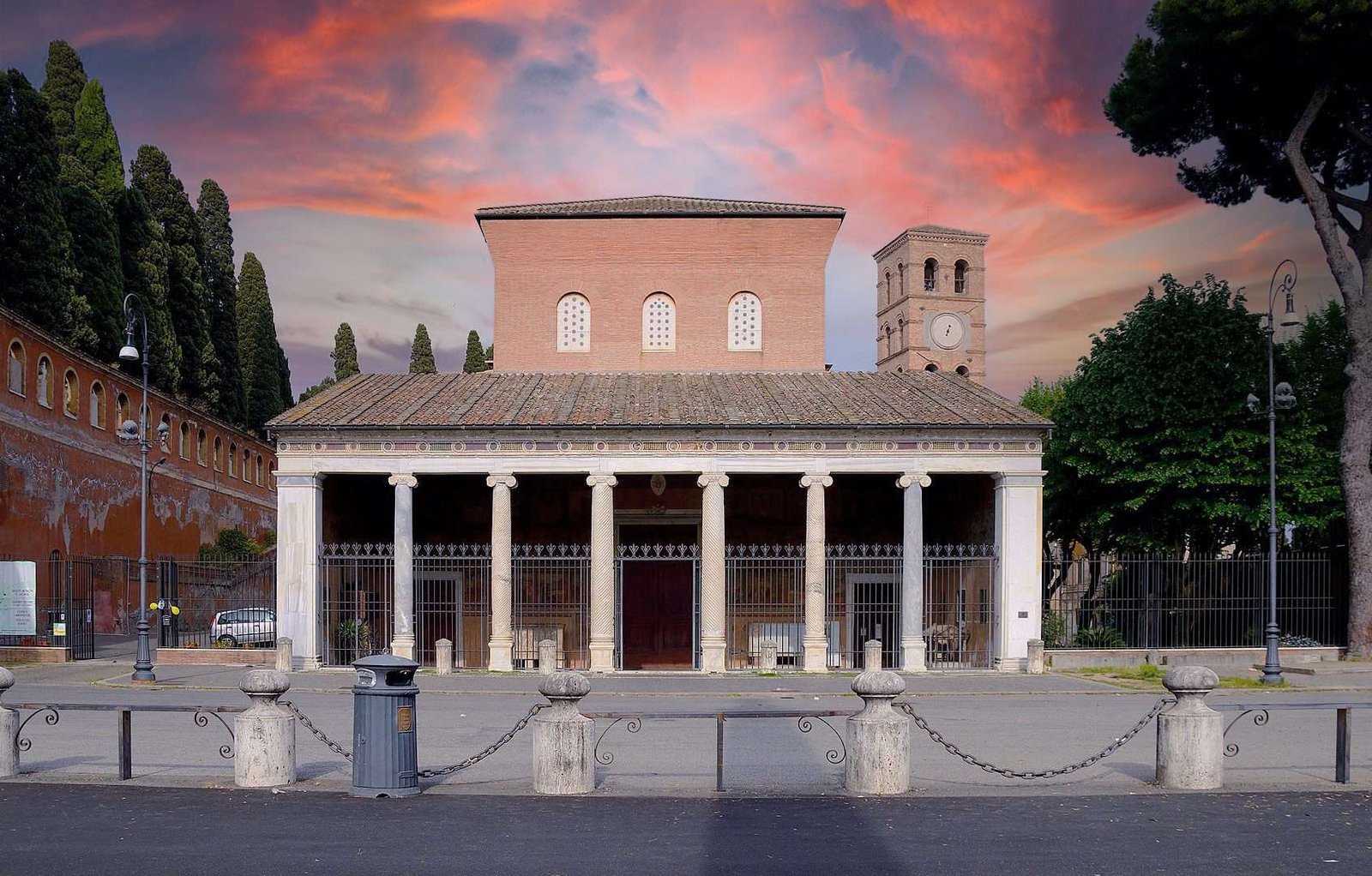
Piazzale del Verano 3, 00185 Rome, phone 06 491511: the Basilica of San Lorenzo Outside the Walls is a parish church and admission is free, but it must be said right away that the catacomb and the cloister can't be visited at will. They open only on request and by prior arrangement with the parish or with the Pontifical Commission for Sacred Archaeology, which gives for the catacomb the contacts 06 4465610 and 06 491511. Anyone who arrives at the Verano imagining going underground by buying a ticket at the door goes back disappointed.
Second practical warning, which applies in these weeks: the Roman tram network is replaced by buses from August 3 to September 7, 2026, with a gradual return of the lines by November 23. Tram 3 and tram 19, which normally serve the Verano stop in front of the basilica, therefore run as replacement rubber-tire lines along Viale dello Scalo San Lorenzo, with the same stops Verano, Verano/De Lollis and Scalo S. Lorenzo. Bus line 163 keeps its terminus right in Piazzale del Verano and connects the basilica with the Rebibbia station of metro line B.
Hours: the basilica opens very early in the morning and closes at 19:00, with the midday closing break that is the norm in Roman churches run by a religious community. The sources available give the morning opening until noon and the afternoon reopening from 16:00 to 19:00. Holy Masses are at 8:00 and 18:30 on weekdays, at 9:30, 11:00 and 18:30 on Sundays and holy days of obligation. The rosary is recited at 18:00. Anyone who arrives at 13:00 on a Tuesday in August finds the door closed: it is the number one trap of this visit.
The church is run by the Capuchin Friars Minor, to whom the parish passed in 1855. The parish itself is older, established on July 4, 1709 with the decree of Cardinal Vicar Gaspare Carpegna, and originally entrusted to the Canons Regular of the Lateran. There are no tickets, advance sales, turnstiles or audio guides for rent: you walk in, take off your hat, lower your voice. The contribution that makes sense to leave is an offering in the box, which here helps maintain an enormous and very fragile building.
Next to the basilica, and inseparably connected to it, is the Verano Monumental Cemetery, which has its own entrances and its own hours, normally from 7:30 until sunset with last entry one hour before closing and closing postponed to 19:00 in the summer period. Check its hours separately: the basilica and the cemetery are two different things, with two different managements, and anyone who confuses them risks finding one open and the other closed.
One last line of the file before I start telling the story. This is one of the seven pilgrimage churches of Rome, and it is the place where the tomb of Lawrence is venerated, the deacon martyred in 258. If you have planned the tour of the great Christian memories of Rome, the Verano is the stop that almost everyone skips and that almost everyone, afterward, regrets having skipped.
Where it is and how to get to the Basilica of San Lorenzo Outside the Walls
The basilica stands at the start of the extra-urban stretch of Via Tiburtina, just outside the Aurelian Walls, at the point where the ancient city ended and the countryside of the tombs began. Today that boundary is invisible to the naked eye, covered by the modern city, but the geography has not changed: the very name, outside the walls, tells a Roman funerary topography, because the dead were buried along the consular roads and outside the pomerium, and the great martyrial basilicas were all born beyond the circuit.
The exact address and the square of the Basilica of San Lorenzo Outside the Walls
The street address is Piazzale del Verano 3, postal code 00185, Tiburtino district. The semicircular square in front of the church is neither ancient nor medieval: in its present form it is 19th-century, wanted by Pius IX, and at the center it carries a column topped by the bronze statue of San Lorenzo, a work by the sculptor Stefano Galletti from 1865. The column is tall and imposing and serves as a natural meeting point: the associations that organize guided visits to the underground spaces set the meeting right there.
A useful clarification for those using the phone map. The Verano Cemetery has a different address, Via del Verano and Via dello Scalo San Lorenzo, and nine entrances distributed along its perimeter. If the navigator takes you to a cemetery gate, you are not in front of the basilica: the church facade faces the square, with the bell tower set back on the right.
Tram, bus and metro for the Basilica of San Lorenzo Outside the Walls
In ordinary conditions the basilica is served by two trams: the 3, which makes the long arc from Trastevere station to Valle Giulia passing through Viale dello Scalo San Lorenzo and Piazzale del Verano, and the 19, which connects Porta Maggiore to Valle Giulia and beyond. The relevant stops are Verano, Verano/De Lollis, Reti and Scalo S. Lorenzo. In this period, as said at the beginning, those runs are operated by replacement buses that travel the side lanes of Viale dello Scalo San Lorenzo and serve the same stops.
Bus line 163 has its terminus in Piazzale del Verano and goes up along Via Tiburtina to Piazzale della Stazione Rebibbia, where you take metro line B: it is the most direct connection with the metro network for those coming from the northeast. From the center, the simplest solution remains Termini and then the tram, today a bus, toward Verano: it is a few minutes and you arrive in front of the portico.
Those who prefer to walk can get off at the metro line B station Policlinico and cross the university district on foot: you pass along the Sapienza University City, cross Viale Regina Elena and find yourself at the Verano after a good quarter of an hour's walk, with the advantage of passing through one of the most coherent pieces of Roman rationalist architecture. It is the route I recommend to those who have time.
By car, by bicycle and on foot to the Basilica of San Lorenzo Outside the Walls
Arriving by car is possible but not very smart: the square is a traffic hub, parking is scarce and regulated, and on days of funerals the flow toward the cemetery saturates everything. By bicycle you arrive easily from Porta Maggiore and from San Lorenzo, taking care not to trust the tram tracks, which on this stretch are enemies of thin wheels. On foot, from the San Lorenzo neighborhood, you arrive in 10 minutes from Via dei Volsci and in a little more from Piazza dell'Immacolata.
On this point the advice is clear: come by public transport and plan to dedicate at least half a day to the area. There is no sense in touching and fleeing. The Verano is not a 15-minute stop between two monuments of the center, it is a piece of Rome that asks for slowness, and the basilica rewards those who sit at the back of the nave and let their eyes get used to the half-light.
Hours, Masses and visiting rules of the Basilica of San Lorenzo Outside the Walls
Here begins the part that almost no tourist guide explains with due clarity, and that is instead decisive in order not to ruin the visit for yourself and for others. The Basilica of San Lorenzo Outside the Walls is not a museum. It is a living church, seat of a parish since 1709, with a community of friars who celebrate there every day, with almost daily funerals because of the adjoining cemetery, with baptisms, weddings, catechism and adoration. The rules of behavior are not a clerical whim: they are the condition for the place to keep existing.
When is the Basilica of San Lorenzo Outside the Walls open
It is open daily, holidays included, following the traditional rhythm of Roman churches: morning from the first hours until noon, closing for lunch and the community's rest, reopening in the afternoon until 19:00. The sources available agree on an afternoon slot that begins at 16:00 and on an evening closing at 19:00, and on a morning opening around 7:00 or 7:30. The operational advice is trivial and infallible: call 06 491511 the day before, especially if you come from far away or if you are interested in a specific area.
On days of major funerals, and they happen often, some areas of the church may be temporarily inaccessible. It is not a closure, it is a celebration: you wait outside, under the portico, and look at the cycle of 13th-century frescoes while the service concludes. Anyone in a hurry should consider that the portico alone is worth the trip, and that the portico is always visible.
The Masses at the Basilica of San Lorenzo Outside the Walls and respect for the services
Holy Masses are celebrated at 8:00 and 18:30 on weekdays, and on holidays at 9:30, 11:00 and 18:30. The rosary precedes the evening Mass, at 18:00. On vigils and in the key weeks of the liturgical year the schedule may change, and it certainly changes around August 10, the solemnity of San Lorenzo, when the saint's titular basilica lives its most intense day of the year.
During celebrations you do not visit. You do not walk along the aisles with the camera around your neck, you do not go up to the presbytery, you do not go down to the crypt. If you enter after Mass has begun, stop at the back, sit down and stay. If you want to visit, come back later: it doesn't last long, and respect costs nothing. With groups the schedules are organized accordingly. Those who travel alone often don't think about it, and it is the most common and most unpleasant mistake you see at the Verano.
How to dress to enter the Basilica of San Lorenzo Outside the Walls
Shoulders covered, knees covered, heads uncovered for men. It is not a bizarre request and it doesn't concern only St. Peter's: it applies to every Roman church, and at the Verano, where the majority of those present on any given day are in mourning, it applies with particular force. In summer bring a light shawl or a shirt to slip on over the tank top: it is 30 grams in the backpack and solves the problem.
The phone must be silenced. Photos without flash are normally tolerated when no services are going on, but the criterion is not written in a posted regulation: it is common sense and the friars' guidance. If someone asks you to stop, you stop. You never photograph people at prayer and you never photograph a funeral.
Why the MIC card and the Roma Pass are not valid at the Basilica of San Lorenzo Outside the Walls
This is the most frequent question and the answer is blunt: they are not valid because there is nothing to pay. The MIC card is the card of the Musei in Comune of Roma Capitale and gives access to the civic museum system. The Roma Pass is a tourist package that combines transport and museum admissions. Neither has jurisdiction over a parish church, and in a parish church admission is normally free because it is a place of worship open to the faithful, not a cultural institute that charges.
The distinction must be made precisely, because not everything inside the perimeter of the basilica is equally free. The nave, the portico, the presbytery, the chapels and the confessio can be visited free of charge during opening hours. The Catacomb of Cyriaca and the cloister, instead, are not freely accessible: the Pontifical Commission for Sacred Archaeology indicates the catacomb as visitable on request, and the guided visits to the underground spaces are organized by cultural associations that apply their own participation fee. It is a difference worth keeping in mind before leaving, not in front of the closed gate.
Who Lawrence was: the deacon, the treasure and the grill
You understand nothing of the Basilica of San Lorenzo Outside the Walls if you don't understand who the man buried under the main altar was. And who he really was, beneath the crust of legend, is a question historians have asked for centuries with honesty and with some embarrassment, because the ancient sources are few, late and loaded with rhetorical intent.
The year 258 of Valerian and the persecution
In 257 and 258 the emperor Valerian issued two edicts against the Christians. The first struck the clergy and banned gatherings in the cemeteries. The second, harsher, provided the death penalty for bishops, presbyters and deacons. On August 6, 258 Pope Sixtus II was arrested and killed while celebrating in the cemetery of Callixtus, on Via Appia. Four days later, on August 10, it was Lawrence's turn, who was that pope's archdeacon. The date is fixed by the Depositio martyrum, the Roman calendar of 354 that records the memorials of the martyrs: it is one of the oldest and most solid documents we have on this story.
The role of archdeacon was not honorary. The deacon in the Church of Rome in the third century administered the community's goods and assisted the poor: he was, in modern terms, the person in charge of finances and assistance. This fact, which seems administrative, is the key to the whole later account.
The poor as the treasure of the Church
The tradition, set down in narrative form in the Golden Legend of Jacobus de Voragine in the 13th century but already present in Ambrose in the fourth century, tells that when the prefect of Rome ordered him to hand over the treasures of the Church, Lawrence asked for three days. At the end of the three days he appeared with the poor, the sick, the widows and the orphans of the Roman community, and said that these were the treasures of the Church, eternal treasures. The prefect, according to the story, did not appreciate the theological irony.
The number that circulates in medieval sources speaks of 1,500 poor and widows assisted by the Christian community of Rome. It is a figure to be taken for what it is, an order of magnitude handed down and not an archive datum, but it says something true about the size of the Christian charitable organization in the middle of the third century, and it explains why the imperial authority believed that this community really had a treasure.
The grill and the historians' doubt
The image everyone knows, the martyr roasted alive on a grill, comes mostly from Ambrose and Prudentius, who write more than a century after the events, and from Augustine, who preaches on Lawrence very frequently. It is in Prudentius that we find the savage quip attributed to the saint, the one about turning him over to the other side because this side is already cooked: a masterpiece of martyrial literature, not a record.
Modern historiography has pointed out that in 258 the penalty provided for clerics by Valerian's edict was beheading, and that an execution by fire would have been a legal anomaly. Some scholars therefore hypothesize that Lawrence was beheaded like Sixtus II and that the grill is a later elaboration, perhaps born from a transcription error in the records. Others defend the tradition by observing that exemplary executions outside the norm were not at all rare. Honesty requires saying that the point remains open: the grill is a very ancient and universally accepted tradition, not a fact documented with the same certainty as the date of August 10.
The relic of the grill, by the way, is not at the Verano. It is kept in an 18th-century urn in the Basilica of San Lorenzo in Lucina, in Campo Marzio, and the traditional place of the torment is indicated at San Lorenzo in Panisperna, on the Viminal. Rome spreads the memory of Lawrence over three different churches, and the Verano is the one of the burial.
Saint Cyriaca, the Verano field and the birth of the cemetery
The land in which Lawrence was buried was, according to tradition, the property of a Roman matron named Cyriaca, who is said to have granted her estate to give burial to the martyr. The catacomb takes its name from her, called interchangeably the Catacomb of Cyriaca or of San Lorenzo. The place name Verano comes instead from the ager Veranus, the field of a family of the Verani, and it has been preserved across 15 centuries until becoming the name of the modern cemetery.
Around that tomb a cemetery of enormous extent formed quickly, because Christians sought burial ad sanctos, near the relics of the martyr, in the belief that physical proximity to the saint would help on the day of the resurrection. It is the same mechanism that generated the great necropolises around St. Peter's, San Paolo fuori le mura and San Sebastiano fuori le mura. Today's Verano, with its 83 hectares of 19th- and 20th-century tombs, is the uninterrupted continuation of that gesture.
The two basilicas of the Basilica of San Lorenzo Outside the Walls
The present appearance of the complex is the result of a fusion: two churches built six and a half centuries apart, welded together into a single organism with a surgical operation of rare audacity. Anyone who enters and feels that something doesn't add up, that the axes don't coincide, that the floor changes level, is right: it really doesn't add up, and it is the sign of a building tradition that accumulated layers instead of erasing them.
Constantine's basilica maior
In the fourth century, around 330, the emperor Constantine had Lawrence's tomb arranged and monumentalized, isolating it from the surrounding burials and creating an entry and exit route for pilgrims, with one staircase to go down and one to go back up. Over the tomb a small oratory was built. Not far away a large cemetery basilica rose, the basilica maior, belonging to that family of buildings with an ambulatory and a horseshoe apse that archaeologists call circiform basilicas for their plan similar to a circus.
It was the same type as San Sebastiano on the Appia, Sant'Agnese on the Nomentana, the Santi Marcellino e Pietro near Torpignattara. They served as monumental coverings for burial areas: inside, daily Mass was not celebrated, people were buried and held banquets in memory of the dead. The floor was an unbroken carpet of tomb slabs.
Pope Damasus I, elected in 366, who had been a deacon at San Lorenzo, restored and embellished the shrine and placed there one of his famous inscriptions in verse, carved in the elegant Filocalian capital letters. Then, between the ninth and 12th centuries, the Constantinian basilica was abandoned and fell into ruin. For almost eight centuries nothing precise was known about it.
The Pelagian basilica of the sixth century
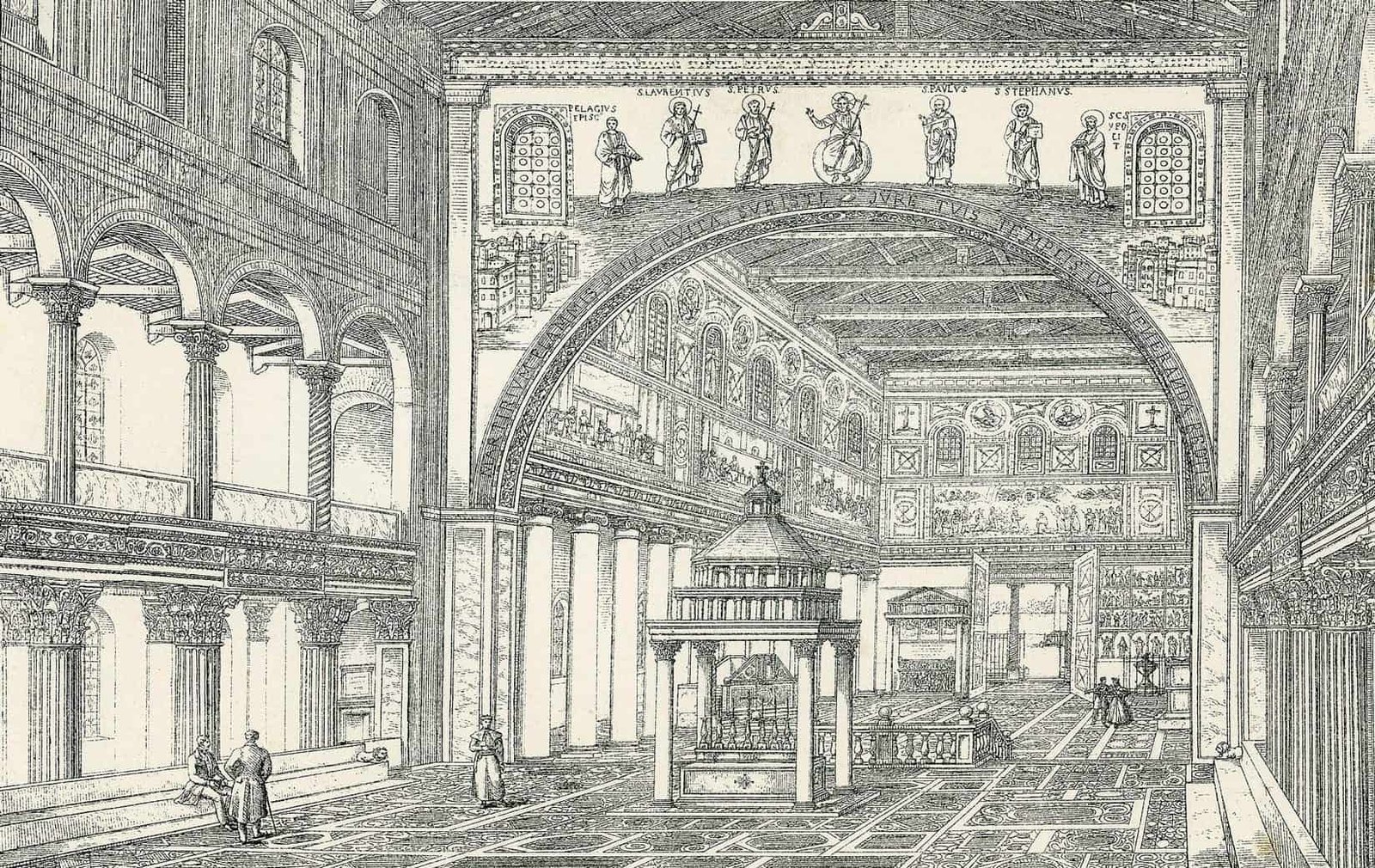
Between 579 and 590 Pope Pelagius II had a new church built directly over the tomb, a basilica ad corpus: to build it the side of the hill was cut, so that the building enclosed the tomb at floor level. It had three naves, with walkable galleries on the upper floor, the matronea, and with fluted pavonazzetto columns with Corinthian capitals. The entablatures are reused material from the second and third centuries, with friezes of vegetal scrollwork and trophies of arms of very high quality.
For a certain period the two churches coexisted: the Constantinian basilica maior, at an unspecified moment dedicated to the Madonna, and the Pelagian basilica minor, adjoining the tomb. It is in this phase that the mosaic of the triumphal arch was made, the oldest and most precious work preserved in the building.
Laurenziopoli, the fortified village around the Basilica of San Lorenzo Outside the Walls
Between the 11th and 13th centuries a walled village with towers formed around the basilica, which the sources call Laurentiopolis or Laurenziopoli. Pope Clement III, between 1084 and 1100, had the cloister built and began the fortification of the settlement. In an age when Rome was reduced to a few tens of thousands of inhabitants squeezed into the bend of the Tiber, the great extra-urban shrines defended themselves, with their own walls and a small settlement of clerics, peasants and craftsmen.
Of that fortified village what remains today is the bell tower, eight tiers of brick with two-light windows, about 31 meters tall, built at the end of the 12th century on tower foundations. Look at it carefully from the square: it is not just any bell tower, it is the last piece still standing of a vanished citadel.
The revolution of Honorius III
The decisive leap comes with Cencio Savelli, Pope Honorius III from 1216 to 1227, the pontiff who crowned Frederick II and approved the Franciscan rule. Around 1217 he had a new church built in front of the Pelagian one, toward the west, and carried out the operation that defines the building: he tore down the apse of the old basilica, reversed the orientation of the complex and turned Pelagius's church into the raised presbytery of the new one.
Some sources link the undertaking to the coronation of Peter II of Courtenay as Latin emperor of Constantinople, celebrated in Rome in 1217: the Basilica of San Lorenzo, outside the walls and therefore neutral with respect to imperial claims on the city, would have been chosen as the site of a politically very delicate ceremony. It is a reading by historians, plausible and well argued, not a fact certified by a direct document.
The result is the Honorian basilica that you walk through today on entering: three naves, 22 columns, 12 windows per side, a Cosmatesque floor, two ambones, a paschal candelabrum. And at the far end, raised by nine steps, the presbytery that is the body of the sixth-century church. Two adjoining and non-coaxial buildings: the axis of one and the axis of the other do not coincide, and this misalignment is visible to the naked eye from the door.
Innocent IV and the papal cathedra
Innocent IV, pope from 1243 to 1254, had the presbytery raised further and commissioned the papal cathedra that can still be seen at the far end, on the back wall of the presbytery, dated 1254. With him the great medieval season of the building site closes: what comes after is restorations, Baroque additions, 19th-century cleanings and 20th-century reconstructions.
It is worth stopping a moment on this sequence, because it is the real story of the building: Constantine monumentalizes a tomb, Pelagius builds a church over it, Honorius adds another and turns everything around, Innocent arranges the presbytery. Each pope leaves a signature, and none completely erases his predecessor. It is the exact opposite of how things are built today.
The square, the column and the bell tower of the Basilica of San Lorenzo Outside the Walls
Before going in, give five minutes to the exterior. The present square is 19th-century, but already in 1704 Cardinal Pietro Ottoboni had arranged in front of the church a semicircular square bounded by small columns, with the coat of arms of Pope Clement XI Albani at the center. The layout we see is the one redesigned under Pius IX, contemporary with the construction of the cemetery.
The column of San Lorenzo from 1865
The column that occupies the center of the square is about 24 meters tall and supports the bronze statue of the saint modeled by Stefano Galletti in 1865. In size it is second only to the Column of the Immaculate Conception in Piazza di Spagna among the commemorative monuments of the papal 19th century in Rome. It is an object that almost nobody looks at today, squashed as it is by traffic, and that nevertheless tells precisely the monumental ambition of the pontificate of Pius IX.
The Romanesque bell tower of the Basilica of San Lorenzo Outside the Walls
The bell tower rises set back, on the right of the facade. Brick, eight tiers, two-light windows, end of the 12th century: it belongs to the great family of Roman bell towers of that period, those of Santa Maria in Cosmedin, Santi Giovanni e Paolo, Santa Francesca Romana. The belfry and the crowning parts have undergone alterations, but the structure is authentic and rests, according to the current reading, on the foundations of a tower of the fortified village.
Next to the bell tower extends the monastery, today a Capuchin convent. From there, through the sacristy, you reach the cloister, and from the cloister you go down to the catacombs: a sequence of spaces that the ordinary visitor does not walk through and that constitutes, for those who manage to see it, the strongest experience of the whole complex.
The portico of the Vassalletto in front of the Basilica of San Lorenzo Outside the Walls
If I had to point to a single thing to look at at the Verano, I would point to the portico. Not the interior, not the mosaic, not the ciborium: the portico. It is the most intact, most refined and most story-rich space of the whole complex, and it is also the only one you can see when the church is closed.
The six reused columns and the polychrome frieze
The portico is attributed to the marble workers of the Vassalletto family and dated around 1220. Six reused, fluted columns with medieval Ionic capitals support an entablature with a rich polychrome frieze in Cosmatesque mosaic. The attribution to the Vassalletto is traditional and supported by style, not by a legible signature as is the case instead for the interior ciborium: it is an attribution by comparison, and it is good to say so.
In the frieze, within medallions, mosaic portraits appear. The technique of reuse here is carried to a level of very high awareness: the ancient columns are not simply reused because it cost less than carving new ones, they are chosen, matched, put in series. The Roman marble workers of the 13th century read the ancient as an available repertoire, and recomposed it with a grammar of their own.
The 13th-century frescoes of the portico
The walls of the portico preserve a cycle of frescoes from the end of the 13th century with Stories of Saints Lawrence and Stephen, and with the deeds of the emperor Henry. Critics have proposed for this cycle the names of the masters Paolo and Filippo, active in the last quarter of the 13th century. The frescoes have suffered a great deal, and they suffered in particular in 1943: they are legible in places, with wide gaps, and must be looked at with patience and in raking light.
The narrative structure is the typical one of great medieval decoration: superimposed registers, episodes separated by frames, painted captions. The two lives run in parallel, that of Lawrence and that of Stephen, because the two protomartyrs are buried together under the same altar and the church presents them as an inseparable pair: the first martyr of the Church of Jerusalem and the great martyr of the Church of Rome.
The story of the emperor Henry and the judgment of the soul
One of the most curious episodes of the cycle concerns the emperor Henry, identified by scholars with Henry II of Germany, who died in 1024 and was canonized in 1146. The medieval legend tells of a vision in which the emperor's soul is weighed on the scale of judgment: demons pile sins on one pan, and the scale tips the wrong way until Saint Lawrence places on the other pan a golden chalice that Henry had given to a church dedicated to him. The chalice tips the scale the right way, and the soul is saved.
It is a story of popular theology worth a whole treatise: concrete charity, the object given, weighs in the judgment. And it is perfectly consistent with the saint who had defined the poor as the treasure of the Church. That this episode appears right here, on the wall of the portico that pilgrims crossed to enter, is not a decorative detail: it is a message addressed to those who came in with the purse in their pocket.
The ancient sarcophagi and the two lions
Under the portico two sarcophagi of great interest are preserved. One, from the fourth century, is decorated with scenes from the Old and New Testaments. The other, of Attic manufacture, presents Bacchic motifs with grape-harvesting cupids, the theme of the grape harvest that early Christianity readily reread in a Eucharistic key. They are pieces of funerary reuse, reused in the Middle Ages for illustrious burials.
On the sides of the entrance portal two marble lions of the medieval period keep watch, coming from the ancient prothyrum. Column-bearing lions are a constant motif of Italian Romanesque architecture: guardians of the threshold, a distant memory of the lions of Solomon's throne. Walk past them slowly and look at the paws, worn down by 800 years of hands.
The tomb of Alcide De Gasperi sculpted by Giacomo Manzù
On the left wall of the portico is the funerary monument of Alcide De Gasperi, the statesman from Trentino who led Italy from 1945 to 1953 and who is considered one of the founding fathers of a united Europe. The sculpture is the work of Giacomo Manzù, one of the greatest Italian sculptors of the 20th century, the author of the Door of Death of St. Peter's.
The choice of the place is a political and spiritual statement at once. De Gasperi is not buried in the Pantheon among the kings, and he is not at the Verano among the monumental tombs of the Roman bourgeoisie: he is under the portico of a martyrial basilica, at the point of passage, like a pilgrim waiting to enter. Manzù represented him with that rough, sorrowful dryness that is his hallmark: no rhetoric, no triumphal allegory. It is among the most beautiful and least visited things of 20th-century Rome, and people walk past it without stopping because they are in a hurry to get into the church.
The plaque of Pius XII and July 19, 1943
Also in the portico a plaque recalls the visit of Pope Pius XII on July 19, 1943, the very day of the bombing of the San Lorenzo neighborhood. Of that visit, and its documented circumstances, I speak at length further on: here it is enough to say that the plaque is the point where the very ancient history of this church meets the 20th century in the most direct and most painful way.

Inside the Basilica of San Lorenzo Outside the Walls: the Honorian nave
You go in and the first impression is of bareness. No gilding, no polychrome marble on the walls, no Baroque altar machine. Light walls, a trussed ceiling, a row of columns on each side, light coming down from the high windows. This nudity is not medieval by chance: it is the result of the 19th-century restorations and above all of those that followed 1943, which pursued with determination the image of a medieval church cleaned of additions.
The 22 columns of the nave
The Honorian basilica has three naves separated by 22 columns of different size and material: cipollino, gray granite, red granite, white and black marbles, with Ionic capitals. The current hypothesis, and a widely shared one, is that they come from the abandoned Constantinian basilica, dismantled like a quarry of materials when it was by then in ruins. The capitals, on the other hand, seem to have been worked specifically for the new building site: the quality of execution is uniform, something reuse never guarantees.
Walk along the nave looking up at the columns one by one and you will notice that none is the same as another. It is the signature of medieval Roman building: 12 centuries of ancient Rome taken apart and put back together, one piece at a time, with a sense of measure that held together the incoherence of the materials.
The Cosmatesque floor of the Basilica of San Lorenzo Outside the Walls
The floor is Cosmatesque, the work of Roman marble workers, and dates to the works of Honorius III. The Cosmati, or rather the families of Roman marble workers of whom the Cosmati are the best known, cut discs of red porphyry and verde antico from Roman columns and composed them into guilloches, quincunxes and interlaced bands. The red porphyry came from Mons Porphyrites in Egypt and the quarry had been closed for centuries: every disc you see trodden underfoot is a piece of recycled imperial marble.
Look at the design standing still in one spot and then walking: the Cosmatesque floor is designed to be walked, and its large circles mark the liturgical stations along the nave. It is not a decorative carpet, it is a musical score.
The two ambones and the paschal candelabrum
Near the main altar two Cosmatesque ambones face each other. The one on the right, more elaborate, served for the proclamation of the Gospel. The one on the left for the Epistle. It is the classic liturgical arrangement of the medieval Roman basilica, before the single pulpit and the Tridentine choir changed everything.
Next to the right ambone rises the paschal candelabrum, supported by two lions and decorated in mosaic, a Cosmatesque work between the 12th and 13th centuries. It is the object on which the candle was placed on Easter night, the sign of the risen Christ: a twisted column of white marble and mosaic that climbs like a spiral. Stop and look at it against the light, when the late afternoon sun comes in through the high windows: it is one of the most beautiful objects in the church and nobody photographs it.
The monument of Cardinal Fieschi on the inner facade
Against the inner facade stands the funerary monument of Cardinal Guglielmo Fieschi, who died in 1256, nephew of Innocent IV. It is composed of a reused Roman sarcophagus, decorated with a wedding scene, surmounted by a Cosmatesque canopy. The sources oscillate between the second and third century for the dating of the sarcophagus: prudence suggests saying Roman sarcophagus of the imperial age, with a marriage scene.
It is a textbook case of the medieval relationship with the ancient: a 13th-century cardinal has himself buried inside the wedding sarcophagus of a pagan patrician, and puts over it a canopy of gilded mosaic. No embarrassment, no removal. The ancient was noble and available material, and its Christianization happened through use, not through iconoclasm.
The 19th-century frescoes of Cesare Fracassini
In the 19th century the central nave was entirely frescoed by Cesare Fracassini, a Roman painter of the Purist circle, as part of the great restoration wanted by Pius IX. Of that cycle the restorations after 1943 preserved only two portions: one on the inner facade and one on the triumphal arch facing the Honorian basilica.
The choice to sacrifice Fracassini in order to bring the medieval masonry back to light is a precise critical choice, the child of a season of restoration culture that considered 19th-century additions as superstructures to be removed. Today many art historians would judge it with more caution. I report it for what it is: a methodological decision taken at a specific historical moment, which gave the building the appearance it has.
The right nave and the medieval frescoes
In the right nave fragments of medieval frescoes survive with figures of Saints and a Madonna and Child. They are fragments, and you have to look for them: the light in that nave is scarce and the color is faded. But they are, together with the cycle of the portico, the surviving testimony of what must have been the normal condition of the medieval building, entirely painted from floor to ceiling.
The left nave, instead, has no painted works and leads to the access of the underground chapel of Santa Ciriaca. This asymmetry between the two side naves is one of the aspects that disorients the visitor on first entering and that becomes perfectly clear as soon as you understand the stratigraphy of the building.
The chapels of the Basilica of San Lorenzo Outside the Walls
There are two chapels, one per side nave, and they belong to two different worlds: one to the Purist 19th century of Vespignani, the other to the Roman 17th century of Pietro da Cortona. In a church that has pursued its medieval appearance with such stubbornness, they are the only two pockets in which the modern centuries have resisted.
The chapel of San Tarcisio
At the end of the right nave opens the chapel of San Tarcisio, built by Virginio Vespignani in the 19th-century restoration. Tarcisius is the young Roman acolyte killed, according to tradition, while carrying the Eucharist to the prisoners: a saint with a very ancient cult but an entirely legendary biography, made hugely popular in the 19th century by the novel Fabiola by Cardinal Wiseman and by the devotion of Catholic boys. That Pius IX dedicated a chapel to him here, next to the martyr par excellence, is consistent with the devotional climate of his pontificate.
From the chapel of San Tarcisio, and from the adjacent sacristy, you reach the cloister. It is the key passage of the complex, and the reason why it is worth finding out in advance about the possibility of a guided visit.
Serodine or Savonanzi: the knot of attribution
In the chapel of San Tarcisio a 17th-century canvas is preserved, and on this canvas the sources diverge sharply. Some indicate a Beheading of the Baptist by the Caravaggesque painter from Ticino Giovanni Serodine, dated 1619. Others indicate a Burial of San Lorenzo by Emilio Savonanzi, also dated 1619. The two attributions cannot be reconciled, because they concern not only the author but the very subject of the painting.
The prudent position, and the one I adopt, is to note that in the chapel there is a painting from the second decade of the 17th century in the Caravaggesque circle, and to invite whoever stands in front of the canvas to read the label on site. Serodine, if it is his, would be a very notable presence: dead at 34 in 1630, he is one of the most violent and most modern painters of the post-Caravaggesque generation, and his Roman works can be counted on the fingers of two hands. Savonanzi, from Bologna, belongs to a more classicist side. They are two very different critical roads, and anyone who tells you with certainty which one is right is simplifying your life.
The underground chapel of Santa Ciriaca and the monuments of Pietro da Cortona
At the end of the left nave, and below floor level, opens the chapel dedicated to Santa Ciriaca, Baroque in taste, decorated in the 17th century. It houses two funerary monuments made from designs by Pietro da Cortona, the great architect and painter who in Rome signed Santi Luca e Martina, Santa Maria della Pace and the ceiling of Palazzo Barberini.
The sources indicate that the two monuments are dedicated to Bernardino Guglielmi and Gerolamo Alendri, and that the sculpture of the Guglielmi monument would be the work of the Fleming Francesco Duquesnoy, the master of the Saint Susanna in Santa Maria di Loreto and the Saint Andrew in St. Peter's. Here too prudence is required: the attribution to Duquesnoy circulates in the local literature and must be confirmed on site.
On the altar of the chapel a 13th-century Cosmatesque aedicule is preserved that encloses a relief from around 1500 with the dead Christ supported by the Virgin and by Saint John, with coats of arms of the Farnese family. It is a small masterpiece of stratification: a 13th-century frame, a Renaissance relief, a coat of arms of 16th-century patronage, inside a Baroque chapel, under a 13th-century church built in front of one from 500 years before. The Rome of the churches works like this.
The presbytery: the Pelagian basilica inside the Basilica of San Lorenzo Outside the Walls
You go up to the presbytery by two flights of side stairs, and here happens the thing that makes this building unique in Rome. The presbytery is not a presbytery: it is the central nave of the sixth-century church, raised by nine steps and enclosed in the new body. Whoever climbs those stairs crosses 630 years of history in 12 steps.
The pavonazzetto columns and the reused entablature
The presbytery is framed by fluted pavonazzetto columns, 12 according to ancient descriptions, with Corinthian capitals of great finesse. Above runs an entablature with a frieze of trophies of arms and vegetal motifs, reused material of the imperial age, second or third century, of such high quality that archaeologists have long debated which building it comes from.
Look up and read that frieze up close: weapons, cuirasses, helmets, shields, in an interlacing of vine scrolls. It is Roman military decoration, survivor of an empire, reused by a sixth-century pope to frame the tomb of a martyr killed by the Roman state. I know of no more eloquent short circuit in Rome, and it is two meters above the head of whoever visits, in a church where at most a few dozen tourists pass each day.
The matroneum of the Basilica of San Lorenzo Outside the Walls
Above the side aisles of the presbytery runs the matroneum, the walkable gallery that was typical of the Pelagian basilica. 10 columns with Corinthian capitals and reused entablatures support it. Matronea in Roman basilicas of the sixth century are rare, and their function is debated: not necessarily reserved for women as the modern name suggests, perhaps service spaces, perhaps tribunes for the clergy, perhaps resting areas for pilgrims during the night vigils over the martyr's tomb.
The matroneum is not accessible to the public. Until the 1990s it housed the organ console, later placed back up there after a period in the presbytery: a detail that says how much that space has remained alive in the practice of the basilica.
The ciborium of 1148, the oldest signature of the Roman marble workers
At the center of the Cosmatesque floor of the presbytery rises the ciborium, and this is a capital object in the history of Italian medieval art. Four porphyry shafts support a pyramidal covering on small columns with entablature. Along the structure runs the inscription bearing the date 1148 and the names of the authors: the sons of Paolo, founder of the first great workshop of Roman marble workers, the same ones who worked at Santa Maria in Cosmedin, at Santa Croce in Gerusalemme and at San Clemente.
The point is this: it is the oldest signed work by Roman marble workers that survives. Before 1148 the makers of the Roman Middle Ages are anonymous. From here on they have a name, a workshop, a dynasty. It is the documentary birth certificate of the school we call Cosmatesque and that for two centuries would pave half of Italy. If I had to point to the single most important object contained in the Basilica of San Lorenzo Outside the Walls, I would point to this one, and not the mosaic that everyone photographs.
The episcopal cathedra of 1254
On the back wall of the presbytery is the episcopal cathedra, dated 1254 and commissioned by Innocent IV, decorated with mosaics and polychrome marbles. It is the seat from which the bishop presided over the assembly, placed according to the early Christian arrangement at the center of the apse, behind the altar, facing the faithful.
That position is not a detail of furnishing. It tells of a liturgy in which the celebrant looked at the people across the altar, an arrangement documented in Rome in the major basilicas and that the later Middle Ages would progressively abandon. In the cathedra of 1254, with its gilded mosaic and its carved arms, you read the awareness that the 13th-century popes had of their own continuity with the ancient Church.
The sixth-century mosaic on the triumphal arch
The oldest work in the building is the mosaic of the triumphal arch, commissioned by Pelagius II between 579 and 590. At the center Christ enthroned, blessing, seated on a globe. On the sides, three per side, Saints Paul, Stephen and Hippolytus, and Peter, Lawrence and Pope Pelagius II. Pelagius is portrayed with the model of his basilica in his hands, in the act of offering it to Christ, and with the square nimbus that in ancient iconography indicates the patron still living at the time of execution.
The theme is that of the Maiestas Domini, and the theological reading is precise: Peter introduces Lawrence into the presence of Christ, the master presents the disciple. The color register is the Byzantine-leaning one of the end of the sixth century, with the gold of the background, the elongated faces and large eyes, the rigid draperies. It is the last great season of Roman mosaic before iconoclasm and before the long early medieval interruption.
Know, however, that seeing it well is not easy: the mosaic is high up, the natural light is stingy, and the best position to observe it is at the foot of the presbytery staircase, looking up. Bring a light pair of binoculars if you are really interested: it completely changes the reading of the details, of the names written next to the figures, of the architectural model in the pope's hands.
Under the floor: crypt, confessio and catacombs of the Basilica of San Lorenzo Outside the Walls
The lower level is the reason why everything else exists. Without Lawrence's tomb there would be no basilica of Constantine, no basilica of Pelagius, no Honorius III, no Verano cemetery, no neighborhood. Everything you see on the surface is the consequence of a burial of the third century.
The confessio and the tombs of Lawrence and Stephen
Beneath the raised presbytery opens the confessio, the crypt that holds the relics. The tombs of Saint Lawrence and of Saint Stephen the protomartyr are venerated there, and according to the sources also that of Saint Justin, the Christian philosopher martyred in Rome between 163 and 167. The relics of Stephen were brought to Rome in the Pelagian age. The tradition of their translation from Jerusalem and from Constantinople is ancient and recurs in all the sources.
The relics were placed in the present confessio only during Vespignani's restoration under Pius IX, in the second half of the 19th century. Before then they were kept elsewhere in the building. It is a fact that surprises many visitors, convinced that in Roman churches nothing ever moved: on the contrary, relics have traveled a great deal, within the same building and between different buildings, for liturgical, devotional and security reasons.
The stained slab and the analysis ordered by Pius IX
In the crypt is preserved a marble slab with large dark stains, which tradition holds to have been soaked with the martyr's blood and collected at the place of torment. Pius IX, in the 19th century, had a chemical analysis carried out, and the report, according to the literature, recognized the presence of human blood and fat.
It must be said clearly what this means and what it does not mean. A 19th-century analysis could recognize organic material of animal or human origin. It could not date the stain, could not identify the individual, could not establish any connection with Lawrence. The slab is an object of devotion with a very interesting history, not a proof. Presenting it as proof would be wrong toward science and, in our judgment, also toward faith, which has never needed proofs of that kind.
The Catacomb of Cyriaca Beneath the Basilica of San Lorenzo fuori le mura
Beneath and around the basilica extends one of the largest Roman catacombs, called indifferently the catacomb of San Lorenzo or of Santa Ciriaca, and anciently the cemetery in agro Verano. It develops on several levels, beginning in the third century, and includes three distinct regions with arcosolia and paintings from the fourth century.
The heart of the complex is the area monumentalized around the special burial of the martyr: Constantine, between the first decades and the middle of the fourth century, had a masonry shaft built there to guarantee access to the tomb. The sources report that the burial was then enclosed behind a silver grating and surrounded by an apse faced in porphyry. Over that burial Pelagius II built his basilica in the sixth century, and over that basilica Honorius III built his in the 1200s. Three buildings stacked over a single tomb.
Pay attention to the practical point, which I repeat because it's the one most often ignored: the catacomb is not open to the public at fixed hours. The Pontifical Commission for Sacred Archaeology lists it as visitable on request and provides the telephone numbers 06 4465610 and 06 491511 and an institutional email address. Some Roman cultural associations organize guided visits to the underground areas for a participation fee, meeting at the column in the square. Anyone who wants to see these spaces has to organize well in advance. Anyone who shows up without having called doesn't get in.
The 1957 Excavations and the Discovery of the Constantinian Basilica
In 1957 test digs were carried out at the wall of the Verano cemetery, and those investigations finally made it possible to recognize the remains of Constantine's basilica maior: a large circus-type building, with three aisles separated by columns, of the type archaeologists had hypothesized by comparison with Sant'Agnese and San Sebastiano. It was an archaeological confirmation of primary importance, because until then the Constantinian basilica was a building known only from written sources.
Other excavations beneath the basilica have brought to light many rooms and crypts, and the picture is not closed: the stratigraphy of this site is among the most complex of Christian Rome, and the scholarly bibliography, from Richard Krautheimer's Corpus basilicarum christianarum Romae of 1962 to the studies on reuse of the 2000s, keeps updating it.
The Chapel of Pius IX in the Basilica of San Lorenzo fuori le mura
From the ends of the side aisles you go down to the funerary chapel of Pius IX, which was erected in the late 19th century reusing the narthex of the Pelagian basilica. The design is by Raffaele Cattaneo, and the mosaic decoration portrays moments in the life of the pontiff: it's a sumptuous space, of Neo-Byzantine taste, that has nothing to do with the medieval bareness of the nave above.
Giovanni Maria Mastai Ferretti, Pope Pius IX from 1846 to 1878, was the pontiff with the longest reign in history after Peter, according to tradition: 31 years and seven months. He is the pope of the Syllabus, of the First Vatican Council and of the dogma of infallibility, but also the pope who lost the Papal States in 1870 and declared himself a prisoner in the Vatican. He was beatified in 2000. His tomb here, in an extramural basilica and not in St. Peter's, was an express wish in his will.
The tone of the chapel is entirely 19th-century, and many visitors find it jarring. It is an extraordinary document: the last pope-king who chooses to be buried next to the deacon who had defined the poor as the treasure of the Church, in a basilica he himself had restored, just outside the walls of the city he had lost. There is no page of history that tells it better than this space.
The Cloister of the Basilica of San Lorenzo fuori le mura
The cloister dates to the end of the 12th century, begun under Clement III. It develops on two orders of superimposed loggias, and is reached from the chapel of San Tarcisio and from the sacristy. From the cloister you go down to the catacomb: it's the junction point between the church above and the city of the dead below.
The walls of the cloister house a collection of epigraphic and lapidary material from the catacomb and from demolitions: fragments of inscriptions, sepulchral slabs, engraved symbols. Anyone who reads Latin spends an afternoon there without noticing. Anyone who doesn't still finds, in the repeated formulas and the names, the voice of a community that in the fourth century buried its dead writing that they slept in peace.
The cloister is not freely accessible and has no published hours for free visits: it is seen as part of the guided visits to the underground spaces or on request to the parish. If you are lucky enough to get in on a sunny morning, sit on the edge and stay still for five minutes. It is one of the best silences in Rome, and above your head passes the noise of the Tiburtina.
The organ of the Basilica of San Lorenzo Outside the Walls
The present organ was built in 1958 by the Ruffatti brothers, and replaced the previous instrument by the Priori family, from 1860, destroyed in the bombing of 1943. It has two keyboards of 61 notes and a concave radiating pedalboard of 32 notes.
Its recent history is eventful. In 1981 the organ builder Alvaro Vercelli moved the console from the matroneum to the presbytery and modified some stops according to the neo-Baroque taste of those years. In 1992 the console was brought back to the matroneum. In 2019 the instrument was restored by the organ workshop Dell'Orto e Lanzini, with the addition of new pedal stops, a 32-foot acoustic bass and an 8-foot trumpet, and of new console controls including a sequencer and transposition.
It sounds like a note for specialists, and in part it is. But it says something important: this is not a museumified church, it is an organism that maintains itself, updates itself and is used. The organ of 2019 in a sixth-century basilica inside a 13th-century one is exactly the same gesture as Honorius III reusing the columns of Constantine.
July 19, 1943: the Basilica of San Lorenzo Outside the Walls under the bombs
This chapter must be approached with the facts in hand, the dates verified and the respect owed to those who died that day. The bombing of San Lorenzo is not a tour-guide anecdote: it is the trauma that defined this neighborhood, this basilica and Rome's relationship with the Second World War.
What happened in Rome that day
On July 19, 1943 Rome suffered the first Allied air bombing of the war. The attack took place in two waves: about 300 heavy bombers in the morning, another 200 medium bombers in the afternoon, for a total approaching 500 aircraft. About 4,000 bombs were dropped, for a tonnage estimated at around 1,600 tons according to some reconstructions and a little over 1,000 according to others.
The declared military targets were the rail yards and the airfields. The San Lorenzo freight yard was the hub through which German supplies headed to the southern front passed, and it was surrounded by a very dense working-class neighborhood. The hardest-hit neighborhoods were San Lorenzo, Tiburtino, Prenestino, Casilino, Labicano, Tuscolano and Nomentano.
The casualty figures vary according to sources and counting methodologies, as always happens with urban bombings. Overall estimates for the city speak of about 3,000 dead and 11,000 wounded. For the San Lorenzo neighborhood alone, about 1,500 dead and 4,000 wounded are indicated. These are orders of magnitude, not registry records, and historiography continues to discuss them.
The damage to the Basilica of San Lorenzo Outside the Walls
The basilica was severely hit. The facade, which was entirely covered in mosaics, was destroyed: of those mosaics only fragments remain today, among which the Christ as the Lamb and the presentation of Peter of Courtenay to Saint Lawrence can be recognized. The narthex was devastated. The 13th-century frescoes of the portico suffered very heavy damage. The Priori organ of 1860 was destroyed. The Verano cemetery was also hit: a stretch of the perimeter walls collapsed causing victims, and the monumental arcaded quadrangle, the military shrine, the municipal depot and several tombs were damaged, among them that of Ettore Petrolini and that of the Pacelli family.
The fact that needs underlining, because it is the one the visitor does not imagine, is that the facade we see today is an integral postwar reconstruction. It is not medieval: it is a 20th-century restitution, carried out with the original materials recovered among the rubble and with philological criteria. When you look at that brick wall with the three arched windows, you are looking at a restoration work, not a 13th-century artifact.
Pius XII among the rubble
In the afternoon of that same July 19, 1943 Pope Pius XII left the Vatican. According to L'Osservatore Romano the departure happened at 17:20, while the bombing was still going on. The pope was accompanied by Monsignor Giovanni Battista Montini, then Substitute of the Secretariat of State, the future Paul VI.
The chronicles report that the car slowly crossed the streets adjacent to the Verano, slowing down so that the pontiff could ask for news of the victims and the damage, and that Pius XII remained among the ruins in front of the basilica for over an hour and a half. Witnesses reported that on his return the white cassock was stained with blood. He spoke words of comfort, referring to the unspeakable anguish of so many families tragically deprived of their loved ones, and implored that the pain be turned into spiritual and moral strength, blessing those present, their families and the city.
The image of the pope with arms spread wide in the square of the Verano has become one of the best-known photographs of 20th-century Italy and has entered the collective memory of Rome. The plaque in the portico recalls that day.
The historiographical readings of the bombing
There are different historiographical readings of July 19, 1943, and they should be presented as readings, not as established truths. One part of historiography stresses the military legitimacy of the target, the rail yard, and the Allied intention to hit the German supply lines and to induce the collapse of the regime, recalling that the Grand Council of Fascism met just six days later and that Mussolini was removed on July 25. Another part insists on the disproportion between target and civilian slaughter, on the imprecision of the high-altitude bombing of the time and on the political responsibility of those who had declared Rome an open city without it truly being one.
The title of defender of the city attributed to Pius XII after the war belongs in turn to a debated historiographical story, within the wider debate on the pontificate of Pacelli during the conflict. It is not up to a guide to resolve it. It is up to a guide, however, to say that in the San Lorenzo neighborhood the memory of that day is alive, guarded, celebrated every year, and that before that memory the right register is silence.
The restoration until 1948
The reconstruction works ended in 1948. The management chose a precise criterion: to recompose the building with the original materials and to take the opportunity to eliminate a large part of Vespignani's 19th-century additions, giving the church back an appearance as medieval as possible. Fracassini's cycle was sacrificed almost entirely.
It is a restoration that fully belongs to the culture of its time, the one that after the war wanted to rebuild as it was and where it was, and that at the same time practiced a selection among the historical phases of the building. The basilica you visit today is both very ancient and recent: the columns are Roman, the ciborium is from 1148, the mosaic from the sixth century, but the volume that contains them is less than 80 years old in its present form. Keeping this in mind makes the visit much more interesting.
A curiosity about the Basilica of San Lorenzo Outside the Walls
The curiosity that almost nobody knows concerns a lost title. Until 1847 the Basilica of San Lorenzo Outside the Walls was one of the five patriarchal basilicas of Rome, and with each of the five was associated one of the patriarchates of Christendom: San Giovanni in Laterano to the pope, St. Peter's to Constantinople, San Paolo fuori le mura to Alexandria, Santa Maria Maggiore to Antioch, and San Lorenzo fuori le mura to Jerusalem.
It was not an abstract symbolic assignment. From 1374 to 1847 this basilica was effectively the Roman seat of the Latin patriarch of Jerusalem, that is, of the holder of an office born with the Crusades and remaining, after the fall of the Crusader states, as a title residing in the West. For almost 500 years, whoever held the title of patriarch of Jerusalem had his own church here, on Via Tiburtina.
In 1847 Pius IX reestablished the Latin patriarchal see in Jerusalem, with a patriarch residing in the Holy Land. From that moment the basilica of the Verano lost the patriarchal title and the Roman patriarchal basilicas went from five to four. In 2006, with the elimination of the title of Patriarch of the West from the Pontifical Yearbook, the terminology changed again and today people prefer to speak of papal basilicas.
There is therefore a question that people almost always answer wrong: how many papal basilicas are there in Rome? Four. And which is the one that was there and then was no longer? This one. It is the quickest way to explain to a group why such an important church is so little visited by mass tourism today: it lost its place on the list in the mid-19th century, and lists, when it comes to tourism, count enormously. The title of Abbot of San Lorenzo, by the way, still belongs today to the vicegerent of the vicar of the diocese of Rome: an institutional remnant of that season.
One thing nobody tells you about the Basilica of San Lorenzo Outside the Walls
Nobody tells you that this church is read backwards. All Roman basilicas are walked from the door to the altar following a single axis. Here the axis is double and broken, and the path you take on entering is the exact reverse of the original path.
The basilica of Pelagius II, in the sixth century, had its facade on the opposite side from the present one, with the apse where today the entrance to the presbytery is. When Honorius III built his church in the 13th century, he tore down the Pelagian apse and attached the new body there, reversing the orientation of the whole complex. The narthex of the Pelagian basilica, that is, the atrium that preceded the ancient entrance, ended up behind the altar of the new church: and that narthex is today the funerary chapel of Pius IX.
This is why, on entering, something doesn't add up. The two naves are not aligned, the floors have different levels, the columns have incompatible diameters and materials, and the passage between the two bodies is marked by a staircase that is not a simple presbytery rise but a hinge between two buildings. If you look from the entrance door toward the far end, and then move two meters to the right and to the left, you see the axis shift: it is the visual proof of the misalignment.
The second element that nobody tells is the practical consequence of this reversal on the lighting. The Honorian church takes light from 12 windows per side and from the facade. The Pelagian presbytery, set at the far end, has a much dimmer and more indirect light. The sixth-century mosaic, which is the most precious thing, is in the least lit zone of the building. It is not a defect: in the Pelagian logic that mosaic was on the apse arch and received light from a completely different direction. The new church took its light away. Whoever arrives in mid-afternoon on a sunny day has the best conditions. Whoever arrives at 18:00 in December will see almost nothing, and it is best that they be told beforehand.
The advice I give you for visiting the Basilica of San Lorenzo Outside the Walls
The main advice is only one and concerns timing: come early in the morning, between 8:00 and 11:00, or in the late afternoon between 16:30 and 18:00, and avoid like the plague the middle of the day, when the church is closed and you find yourself in front of a barred door with the square scorching behind you. It is the mistake I see most often from those who arrive here by inserting the basilica in an itinerary built on the hours of the state museums.
The second piece of advice is to call 06 491511 two or three days before if you are interested in the cloister and the catacombs. Do not take anything for granted: the parish manages those spaces according to its own availability, and the Pontifical Commission for Sacred Archaeology indicates the catacomb as visitable on request. A phone call solves it, improvisation does not.
Third: build the visit as a single block with the Verano cemetery. They are adjoining, they complete each other, and they tell the same story that is 17 centuries long. Allow a good 45 minutes for the basilica if you really look at it, another 90 minutes for the cemetery if you want to see its monumental zones. Half a day is the right measure.
Fourth, and more technical: bring a small flashlight or make do with the phone flashlight, and bring binoculars if you have a light pair. The sixth-century mosaic, the frescoes of the portico and the fragments of the right nave are all in difficult lighting conditions. The difference between seeing and guessing, here, is made by 10 euros of optics.
Fifth: enter the portico before entering the church, and give it at least a quarter of an hour. 95 percent of visitors cross it in 10 seconds looking at their phone. It is the richest space of the complex, it contains the tomb of De Gasperi, the ancient sarcophagi, the lions, the 13th-century cycle and the plaque of 1943, and it is the only one you can see even with the church closed.
Sixth, a clear opinion: do not come here if you have only one hour in Rome. It is not a church to tick off a list. It is a church to understand, and understanding it requires that you sit at the back of the nave for five minutes before starting to look at anything. Whoever arrives in a rush leaves in a rush and has seen nothing. Whoever arrives with time comes out with the feeling of having touched a point that has no equal in Rome.
Another well-known fact, yet rarely mentioned
That this basilica is one of the seven pilgrimage churches of Rome is said by every guide. What almost none explains is what that pilgrimage really was, how long it lasted, and why the Verano was such a tiring and necessary stop on it.
The itinerary of the seven churches has been documented in Rome for over 1,500 years and was reorganized in systematic form by Philip Neri in the 16th century, who made it the characteristic spiritual exercise of the Oratory. The seven are St. Peter's in the Vatican, San Paolo fuori le mura, San Sebastiano fuori le mura, San Giovanni in Laterano, Santa Croce in Gerusalemme, San Lorenzo fuori le mura and Santa Maria Maggiore. They were walked on foot, in a single day, for about 20 kilometers, with stops, prayers, songs and a shared snack along the way.
The Verano occupies in that circuit the most inconvenient position: it is the northeasternmost point, outside the walls, reachable only with a long detour from the Laterano-Santa Croce line. Those doing the seven churches arrived here tired, in the afternoon, and set off again toward Santa Maria Maggiore with the sun low. It is exactly for this reason that the basilica has preserved, over time, that secluded air: it was the stop of the pilgrimage, not the stop of tourism.
The second little-mentioned aspect concerns the stational function. The Basilica of San Lorenzo Outside the Walls is one of the stational churches of the Roman liturgical calendar, that Lenten and Easter route in which each day the papal liturgy touched a different church of the city. The station at San Lorenzo falls in Easter week, and still today the Roman stational walk arrives there every year.
Put them together, these two elements, and you will understand why a church outside the walls, in a working-class neighborhood, far from every circuit, was for centuries one of the most visited places in Rome. Not for tourism: for liturgy and pilgrimage. And you will also understand why today, with pilgrimage reduced to a niche phenomenon and tourism concentrated in two square kilometers of historic center, almost nobody comes here. The present emptiness is not the natural condition of this place. It is a recent anomaly.
The right photo to take at the Basilica of San Lorenzo Outside the Walls
The photo everyone takes is the facade from the square, with the column in the foreground. It is a correct and useless photograph: the facade is a postwar reconstruction, the square is full of cars, the light is almost always wrong because the church faces west and for half the day it is backlit.
The right photo is another one, and it is taken from inside the portico looking outward. Stand with your back to the entrance portal, step back to the rear wall of the portico, and frame the six columns that cut out the square. You will have in the foreground the Cosmatesque frieze, in the middle the colonnade in half-light and at the back the full light of the square with Galletti's column. It is a photograph built in layers, with a strong contrast ratio, and it conveys the idea of threshold that is the very meaning of the portico.
The best time is early morning, when the sun comes from behind the building and the square is still in shade: the contrast softens and the mosaics of the frieze catch reflected light. In the late afternoon, with the sun low in the west, the square burns and the portico becomes a black silhouette: it is another kind of image, very graphic, that works if you are after extreme contrast.
The second photograph I recommend is interior and harder: the staircase of the presbytery shot from the back of the central nave, with the pavonazzetto columns framing the ciborium and, above, the mosaic. You need a support, because the exposure times are long and tripods are not used in church: rest the camera on the back of a pew. Close down to a medium aperture, raise the sensor sensitivity as much as needed, and compose leaving room at the top for the triumphal arch. It is the only framing that conveys in a single frame the fact that there are two churches fitted together here.
The third, for those who love details, is the paschal candelabrum backlit. Get close, position yourself so that the high window of the nave stays behind the object, and expose for the mosaic. The result is a spiral of tesserae that lights up against a dark background.
Two warnings that are worth more than any technical advice. No flash, ever: it damages the pigments and disturbs those who pray. And no photographs during celebrations or during funerals, which are very frequent here: if you walk in and there is a coffin in the middle of the nave, put the camera away and leave. It is not a matter of regulation, it is a matter of decency.
Some important events that happened here in history
The first event is the burial itself, on August 10, 258 or in the days immediately after: Lawrence's body laid in the cemetery in agro Verano, according to tradition in the estate of the matron Cyriaca. From that gesture everything else descends, including the neighborhood that today bears his name.
The second is Constantine's intervention, in the years around 330: the monumentalization of the tomb, the construction of the basilica maior and the creation of an access route for pilgrims. It is the moment when Roman Christianity passes from funerary clandestinity to imperial architecture, and it does so here with the same grammar with which it does on the Appia and on the Nomentana.
The third is the Pelagian construction between 579 and 590, with the cutting of the hill and the mosaic of the triumphal arch. The fourth is the building site of Honorius III around 1217, with the reversal of the orientation. To that building site some reconstructions link the coronation of Peter II of Courtenay as Latin emperor of Constantinople, celebrated in Rome in 1217: a first-rank political ceremony, held outside the walls for reasons of institutional balance.
The fifth event is a precise and dramatic political date: the night between July 12 and 13, 1881, when the body of Pius IX was transferred from St. Peter's to the Basilica of San Lorenzo Outside the Walls to fulfill his testamentary wishes. The procession, six kilometers across Rome, took place at night to avoid disorder, and disorder happened anyway. A group of anticlerical demonstrators, which the sources quantify at around 300 organized people, attacked the procession with insults, stones and torches, and tried to storm the hearse shouting that they wanted to throw the coffin in the Tiber. The police intervened, and at Castel Sant'Angelo bayonets were drawn to separate the groups.
The estimates of the participants in the procession diverge wildly: contemporary Catholic sources speak of over 100,000 people, later analyses scale the figure down to a few thousand. The episode had international political consequences: Prime Minister Agostino Depretis had to issue statements of apology and Leo XIII threatened to leave Rome. From then on the Holy See organized transfers of papal remains in a private, nighttime form. It is a page of Italian history that played out in front of this portico and that almost nobody knows.
The sixth event is July 19, 1943, the bombing, with the destruction of the mosaic facade and of the narthex and the visit of Pius XII in the afternoon of the same day. The seventh is the conclusion of the restoration in 1948. The eighth, less known and of great scientific importance, is the campaign of test excavations of 1957 that archaeologically identified the remains of the Constantinian basilica along the cemetery wall: a building known for centuries only from written sources and finally recognized on the ground.
The ninth is from 1954: the burial of Alcide De Gasperi under the portico, with the monument by Giacomo Manzù. The tenth, if you want a living event and not an archived one, is the solemnity of San Lorenzo on August 10 of every year, when this church goes back to being what it has always been, the shrine of its martyr, with a liturgy and a participation that are not seen during the rest of the year.
Who has passed through the Basilica of San Lorenzo Outside the Walls
The list is long and spans 17 centuries. It begins with Constantine, who in the years around 330 had the martyr's tomb arranged and the basilica maior built: his presence here is that of the imperial patron, and his signature is in the very layout of the shrine.
Pope Damasus I passed through, elected in 366, who had been a deacon in this basilica before becoming pope and who returned here as pontiff to restore it and to compose one of his inscriptions in verse. Damasus is the great organizer of the memory of the Roman martyrs: it was he who transformed the catacombs from cemeteries into shrines, with stairs, light wells and monumental epigraphs carved in the Filocalian capital letters. Whoever walks today in the Catacombs of San Callisto or in the Catacombs of Priscilla walks inside a project of Damasus.
Pelagius II passed through, the sixth-century pope who had himself portrayed in the mosaic with the model of the church in his hand, and who had the relics of Saint Stephen brought here. Clement III passed through at the end of the 11th century, builder of the cloister. Honorius III passed through, that is Cencio Savelli, the pope who approved the Franciscan rule and crowned Frederick II, and who here carried out the most radical operation of architectural reorientation in medieval Rome. Innocent IV passed through, who commissioned the cathedra of 1254.
In 1217, if the historians' reconstruction is correct, Peter II of Courtenay passed through here to be crowned Latin emperor of Constantinople: a man who would see almost nothing of that empire, captured a few months later during the journey east. It is one of the most melancholy imperial coronations in European history, and it took place outside the walls of Rome.
In a less pleasant sense, Leo X passed through, who in the 16th century had marbles, capitals and columns removed from the complex, according to the sources in connection with the building site of Palazzo Farnese: one of the many episodes of Renaissance despoilment to the detriment of Roman medieval buildings. Cardinal Francesco Boncompagni passed through, who between 1624 and 1629 financed the restoration after a collapse of the roofs and had the crypt decorated. Cardinal Pietro Ottoboni passed through, who in 1704 had the square in front arranged.
In 1819 Joseph Mallord William Turner passed through, the greatest English landscape painter of the 19th century, during his first trip to Italy: at the Verano he made several sketches. Turner arrived here in the season when the basilica was still a semi-rural building surrounded by vineyards, before the cemetery and before the neighborhood, and his notebook is one of the visual testimonies of that lost condition.
Pius IX passed through, who made of this church his own obsession and his own tomb: restoration entrusted to Virginio Vespignani between 1855 and 1864, square redesigned, column erected in 1865 with the statue by Stefano Galletti, funerary chapel built at the end of the century on a design by Raffaele Cattaneo, and finally his own body brought here on the night of July 12, 1881. With him passed through all the protagonists of that building site: Vespignani, Galletti, Cattaneo, Cesare Fracassini who frescoed the nave.
On July 19, 1943 Pius XII passed through, accompanied by Giovanni Battista Montini, the future Paul VI: the pope who left the Vatican at 17:20 while the bombs were still falling, and remained over an hour and a half among the rubble of the square. In 1954 Alcide De Gasperi arrived here, dead on August 19 of that year, and in the portico Giacomo Manzù worked on his funerary monument.
Richard Krautheimer passed through, and worked here for years, the greatest historian of early Christian architecture of the 20th century, who dedicated to this basilica a volume of the Corpus basilicarum christianarum Romae published by the Pontifical Institute of Christian Archaeology in 1962. Together with him the line of scholars who have written on this building: Antonio Muñoz, author of a volume of 1944 written in the heat of the moment after the bombing, Guglielmo Matthiae in 1966, and more recently the specialists in architectural reuse.
And then the Romans have passed through, generation after generation, who have accompanied their dead here and continue to do so every day. In the cemetery next door are buried actors, writers, musicians, scientists, politicians. If you want a single name to understand how much this place belongs to popular Rome, take that of Ettore Petrolini, the greatest Roman comedian of the 20th century, whose tomb at the Verano was damaged by the bombs of 1943. You will find the full list on the page dedicated to the Verano cemetery.
The Verano cemetery next to the Basilica of San Lorenzo Outside the Walls
You cannot tell the story of the basilica without telling that of the cemetery, because the second was born from the first and changed its context forever. Until the early 19th century this was countryside with vineyards and farmhouses. Then a law arrived, and the countryside became the largest necropolis in Rome.
From the Edict of Saint-Cloud to Valadier
The Napoleonic Edict of Saint-Cloud of 1804 imposed that burials take place outside the city walls, in regulated, egalitarian cemeteries. In Rome, under French administration, the architects Giuseppe Camporese and Raffaele Stern identified two possible sites, the Pigneto Sacchetti and the Verano field on the Tiburtina. The second was chosen, and the final design passed to Giuseppe Valadier, the architect of the Pincio and of Piazza del Popolo.
Work began in 1811 and was interrupted in 1814 with the return of the papal administration. It resumed in the 1830s under Gregory XVI and received a decisive push in 1837, when a cholera epidemic caused over 13,000 deaths in Rome and made the cemetery question dramatically urgent. With Pius IX, elected in 1846, the building site was entrusted to Virginio Vespignani, the same architect who was restoring the basilica: from him come the cemetery church of Santa Maria della Misericordia, consecrated in 1860, and the great monumental arcaded quadrangle.
Numbers and geography of the Verano
The cemetery today occupies about 83 hectares divided into 21 zones, with nine entrances, and is managed by the municipal company. It is the second cemetery in the city by size after the Flaminio cemetery at Prima Porta, and it is among the largest in Europe. The two most notable monumental zones are the arcaded quadrangle, which houses illustrious burials under the colonnade, and the Pincetto, divided into the old Pincetto and the new Pincetto, on the western side toward the basilica: it is the oldest and most scenic part, with the tombs climbing along the slope.
The Military Shrine, built between 1922 and 1931 on a design by Raffaele De Vico, holds 4,978 soldiers, of whom 2,847 fell in the First World War and 2,131 in the Second. The arcaded quadrangle was also hit in 1943 and rebuilt in 1947.
Hours and access to the cemetery
The cemetery hours are independent from those of the basilica: opening is normally at 7:30, closing at 18:00 with postponement to 19:00 in the summer period, and last entry is allowed one hour before closing. Access by car is regulated: normally free on Saturday, reserved on other days for people with disabilities, pregnant women and those over 65, with a free shuttle that leaves from Piazzale del Verano every half hour. In the period of the commemoration of the dead, between the second half of October and the first days of November, the access rules change. Since these are hours subject to seasonal variation, it is best to check them before leaving.
The San Lorenzo neighborhood around the Basilica of San Lorenzo Outside the Walls
The neighborhood was born at the end of the 19th century, after 1870, as a working-class settlement tied to the rail yard and the industries of the Tiburtina. It is one of the few Roman neighborhoods built outside an organic master plan, with a dense grid of blocks and public housing, and with a very strong political and social identity from the beginning.
After 1943 San Lorenzo became the Roman symbol of the war on civilians, and after the 1960s, with the proximity of the Sapienza University City, it turned into the student neighborhood par excellence. Today a particular demographic stratification coexists: elderly people who remember the bombing, historic craftsmen, students, nightlife venues. The Verano is the northern vertex of this triangle, and the basilica is its founding monument.
Inside the university area, a few minutes' walk away, there are little-visited museums of great interest: the Sapienza Gipsoteca, the Giuseppe Sergi Anthropology Museum and the MLAC contemporary art laboratory. Anyone with a whole day can build an itinerary that starts from the basilica and ends among the plaster casts, with a leap of 20 centuries in 20 minutes of walking.
The tour of the seven churches and the Basilica of San Lorenzo Outside the Walls
Whoever wants to understand the place of this basilica in the sacred geography of Rome must think of it within the circuit of the seven churches, the itinerary that pilgrims walked in a single day and that Philip Neri reorganized in the 16th century as a spiritual exercise of the Oratory.
The classic route starts from St. Peter's in the Vatican, goes down to San Paolo fuori le mura, continues to San Sebastiano on the Appia, climbs back to the Lateran, touches Holy Cross in Jerusalem, pushes out to the Verano and closes at Santa Maria Maggiore. It is about 20 kilometers, and the Laurentian stop is the most exposed and the least comfortable: from Santa Croce you leave the city and walk along the railway.
If you want to redo that stretch today, the most beautiful route passes through Porta Maggiore, where below street level is the extraordinary Underground Basilica of Porta Maggiore, and then goes up Viale dello Scalo San Lorenzo to the square. It is 25 minutes on foot. Doing it at seven in the morning, with the city waking up and the tram tracks glittering, is one of the Roman walks I recommend most gladly.
Visiting the Basilica of San Lorenzo Outside the Walls with children
It works better than you would expect, on two conditions: that you tell a story and that you don't promise a museum. The story to tell is the one about the treasure, and it is boredom-proof. A man must hand over the gold of his community to the head of the police, asks for three days, and after three days shows up with the beggars, the sick and the widows saying that those are the treasures. Children like it, because it is a story of cunning and courage together.
Then you look for the grill. In Laurentian iconography the grill is the constant attribute: it appears in frescoes, in mosaics, on vestments, on coats of arms. Turning it into a visual treasure hunt keeps an eight-year-old busy for a good 20 minutes. The lions of the portal are the other winning element, and they can be looked at up close.
The Cosmatesque floor is the third tool: you ask the children to find the big circles, to count them, to understand that the red and green discs are pieces of Roman columns cut into slices. It is one of the few explanations of material reuse that you can make by touching the floor with the tip of your shoe.
Things to avoid: bringing small children at funeral time, promising the catacombs without having booked them, and staying more than 40 minutes. 40 minutes is the threshold beyond which, in a church without bright colors and without interactive panels, patience runs out. Leave before it runs out and the memory of the visit will stay good.
Accessibility of the Basilica of San Lorenzo Outside the Walls
The main nave can be reached from the square through the portico, with a small difference in level. The problem, for those who use a wheelchair or have mobility difficulties, is all inside: the presbytery is raised by nine steps and is reached only by two flights of stairs, and the crypt, the chapel of Santa Ciriaca and the chapel of Pius IX are at lower levels, also reached by stairs.
This means, in concrete terms, that a person in a wheelchair can visit the portico, the Honorian nave, the Fieschi monument, the Cosmatesque floor, the ambones and the candelabrum, but cannot access the Pelagian presbytery, the ciborium, the cathedra, the confessio and the underground chapels. That is about half of the route. The cloister and the catacombs are not accessible by wheelchair in any case, because of the very conformation of the underground spaces.
The operational advice is to phone the parish before coming and explain your needs: the community that serves the basilica knows its own building and can say what is possible. Don't expect elevators or lift platforms: in a building with this archaeological stratigraphy, interventions are extremely complex and restricted.
For those with hearing or visual difficulties there are no dedicated aids on site. Whoever needs a guided reading should turn to a licensed tour guide or to the associations that organize visits to the underground spaces.
How much it costs and when to go to the Basilica of San Lorenzo Outside the Walls
Admission cost: zero. There is no ticket office, no advance sales, no combined tickets. The only possible expense concerns the guided visits organized by cultural associations for the cloister and the catacombs, which apply a participation fee: the rates given by those who organize these visits are around 10 euros per person, with free admission for the youngest children, but conditions vary from organizer to organizer and must be confirmed at the time of booking.
The best time of year
Spring and autumn are the ideal seasons, for the light and for the temperature of the square, which in summer is a scorching slab without a thread of shade. On August 10, the solemnity of San Lorenzo, the basilica lives its most intense day: if you come for the liturgy it is the right day, if you come to look at the architecture it is the wrong day, because it will be full and in use. Easter week brings the Roman stational walk here, and it is a wonderful occasion for those who love the historic liturgy.
The period around November 2, the commemoration of the dead, transforms the whole area: the cemetery receives hundreds of thousands of visits, the square becomes a flower market, transport is increased and access rules change. It is a remarkable anthropological experience and a terrible idea for an art visit.
The best time of day
Mid-morning, between 9:30 and 11:30, after the 8:00 Mass and before the noon closing. The light enters from the high windows of the Honorian nave at a favorable angle, the church is almost empty and the portico is still in shade. The second choice is the late afternoon, from 16:30 to 18:00, before the rosary.
To avoid: early afternoon, because of the closing. Saturday mornings, because of the concentration of funerals and weddings. Sundays between 9:00 and 12:30, because of the succession of Masses. None of this prevents you from going in, but it prevents you from looking, which is a different thing.
What to see within a 10-minute walk of the Basilica of San Lorenzo Outside the Walls
The first step, obviously, is the monumental cemetery next door: arcaded quadrangle, Pincetto, military shrine, and a collection of 19th- and 20th-century funerary sculpture that has few comparisons in Italy. A 10-minute walk to the west leads to the Sapienza University City, the complex designed by Marcello Piacentini and inaugurated in 1935, with its university museums.
Toward the south, along Viale dello Scalo San Lorenzo, you reach in a quarter of an hour Porta Maggiore and its archaeological hub: the monumental Claudian gate, the tomb of the baker Eurysaces, and below street level the Neopythagorean underground basilica of the first century. Toward the center of the neighborhood are Via dei Volsci, Via degli Ausoni, Piazza dell'Immacolata: the popular Rome of the early 20th century, with its artisan workshops and its courtyards.
Whoever happens to be in the area at the end of summer will find the calendar of the neighborhood's events, which every year stages its own memory: the San Lorenzo film festival is born exactly from the memory of July 19, 1943 and makes it a community appointment.
Quick questions about the Basilica of San Lorenzo Outside the Walls
How much does it cost to enter the Basilica of San Lorenzo Outside the Walls?
Nothing. It is a parish church and a place of worship: admission is free during opening hours. There is no ticket office, online advance sale or combined ticket. The only sensible contribution is an offering in the box, which goes to the maintenance of an enormous and fragile building.
What are the hours of the Basilica of San Lorenzo Outside the Walls?
Daily opening with the traditional midday break: morning from the first hours until noon, afternoon reopening from 16:00 and closing at 19:00. The hours can vary according to the liturgical calendar and the needs of the community: a phone call to 06 491511 the day before removes any uncertainty.
What time are the Masses at the Basilica of San Lorenzo Outside the Walls?
On weekdays at 8:00 and 18:30. On holidays at 9:30, 11:00 and 18:30. The rosary is at 18:00. On solemnities, and in particular around August 10, the schedule changes: it is best to check directly with the parish.
Who serves the Basilica of San Lorenzo Outside the Walls?
The Capuchin Friars Minor, to whom the parish has been entrusted since 1855. The parish was established on July 4, 1709 by decree of Cardinal Vicar Gaspare Carpegna and was originally run by the Canons Regular of the Lateran. The title of Abbot of San Lorenzo belongs to the vicegerent of the vicar of the diocese of Rome.
Can you visit the catacombs of the Basilica of San Lorenzo Outside the Walls?
Not freely. The Pontifical Commission for Sacred Archaeology indicates the Catacomb of San Lorenzo, also called of Santa Ciriaca, as visitable on request, with the contacts 06 4465610 and 06 491511. Some Roman cultural associations organize guided visits to the underground spaces with a participation fee and mandatory booking. Showing up without having booked means not getting in.
Can you visit the cloister of the Basilica of San Lorenzo Outside the Walls?
The cloister from the end of the 12th century is reached from the chapel of San Tarcisio and from the sacristy, and has no published hours for free visits. It is seen on request to the parish or as part of the guided visits to the underground spaces, of which it is normally the first stop because from the cloister you go down to the catacomb.
Is the MIC card valid at the Basilica of San Lorenzo Outside the Walls?
No, and not because it is excluded: because it is not relevant. The MIC card is the card of the Musei in Comune system of Roma Capitale and applies to the civic museums. A parish church does not belong to that system and has no admission ticket to discount.
Is the Roma Pass valid at the Basilica of San Lorenzo Outside the Walls?
Not that either. The Roma Pass combines public transport and museum admissions: no admission is paid in the basilica, so the card has nothing to cover. It remains useful, if anything, for the transport you use to reach the Verano.
How much time do you need to visit the Basilica of San Lorenzo Outside the Walls?
45 minutes for a careful visit of the church, the portico and the presbytery. An hour and a quarter if you want to read the portico cycle at leisure and observe the mosaic with binoculars. If you add the Verano cemetery, allow half a day.
Can you take photographs in the Basilica of San Lorenzo Outside the Walls?
Normally yes, without flash and without a tripod, when no celebrations are going on. Never during Masses, never during funerals, never toward people at prayer. If a friar or a sacristan asks you to stop, you stop without arguing.
How do you dress to enter the Basilica of San Lorenzo Outside the Walls?
Shoulders and knees covered, heads uncovered for men. In a church where funerals are celebrated every day, clothing is not a formality: it is respect toward people in mourning. A light shawl or a shirt in the backpack solves the problem in summer.
Is the Basilica of San Lorenzo Outside the Walls wheelchair accessible?
Only in part. The portico and the Honorian nave can be reached. The presbytery, crypt, chapel of Santa Ciriaca and chapel of Pius IX are at different levels and are reached by stairs. The cloister and catacombs are not accessible by wheelchair. It is best to phone beforehand to make arrangements.
How do you get to the Basilica of San Lorenzo Outside the Walls by public transport?
In ordinary conditions with trams 3 and 19, Verano stop, along Viale dello Scalo San Lorenzo. In this period, because of the works on the tram network from August 3 to September 7, 2026, those runs are operated by replacement buses at the same stops. Bus line 163 has its terminus in Piazzale del Verano and connects to the Rebibbia station of metro line B.
What is the exact address of the Basilica of San Lorenzo Outside the Walls?
Piazzale del Verano 3, 00185 Rome, Tiburtino district. Phone 06 491511. Be careful not to confuse it with the cemetery entrances, which are on Via del Verano and on Via dello Scalo San Lorenzo.
Why is it called Outside the Walls?
Because it stands beyond the circuit of the Aurelian Walls, at the start of the extra-urban stretch of Via Tiburtina. In Rome the dead were buried outside the urban perimeter, along the consular roads: all the great martyrial basilicas, from San Paolo to San Sebastiano to Sant'Agnese, bear the same attribute for the same reason.
Who is buried in the Basilica of San Lorenzo Outside the Walls?
San Lorenzo, martyred in 258, and Saint Stephen the protomartyr, under the main altar. According to the sources also Saint Justin. Five popes: Saint Zosimus, Saint Sixtus III, Saint Hilarius, Damasus II and Blessed Pius IX. Cardinal Guglielmo Fieschi, who died in 1256, on the inner facade. And, under the portico, Alcide De Gasperi.
Where is the tomb of Alcide De Gasperi?
In the portico, on the left wall, with the funerary monument sculpted by Giacomo Manzù. De Gasperi died on August 19, 1954. The placement under the portico, and not inside the church, is a choice of great sobriety: the position of the pilgrim waiting on the threshold.
Was the Basilica of San Lorenzo Outside the Walls bombed?
Yes, on July 19, 1943, in the first Allied air bombing of Rome. The facade covered in mosaics was destroyed, the narthex was devastated, the 13th-century frescoes of the portico suffered very serious damage and the organ of 1860 was lost. The reconstruction, carried out with the original materials, ended in 1948.
Is the facade you see today the original one?
No. It is an integral postwar reconstruction, made with materials recovered among the rubble. Of the mosaics that covered it only fragments remain, among them the Christ as the Lamb and the presentation of Peter of Courtenay to Saint Lawrence. It is the fact that surprises first-time visitors the most.
What is the ciborium of the Basilica of San Lorenzo Outside the Walls?
The marble canopy that rises over the altar of the presbytery: four porphyry shafts with a pyramidal covering, dated 1148 by the inscription that bears the names of the sons of Paolo, Roman marble workers. It is the oldest surviving signed work of the school of Roman marble workers, and for the history of medieval art it is worth as much as the mosaic and more.
Why does the basilica seem made of two different churches?
Because it is. The raised presbytery is the central nave of the basilica built by Pelagius II between 579 and 590. The main body is the church added by Honorius III around 1217, who tore down the Pelagian apse and reversed the orientation of the whole complex. The two buildings are adjoining but not coaxial, and the misalignment can be seen from the door.
How many columns are there in the Basilica of San Lorenzo Outside the Walls?
There are 22 in the Honorian nave, of different size and material, with Ionic capitals, probably coming from the ruined Constantinian basilica. In the Pelagian presbytery there are fluted pavonazzetto columns with Corinthian capitals, and 10 others support the matroneum.
What is the mosaic of the triumphal arch?
A mosaic from the end of the sixth century, commissioned by Pelagius II: Christ enthroned at the center, with Saints Paul, Stephen and Hippolytus on one side, Peter, Lawrence and Pope Pelagius on the other. The pope is portrayed offering Christ the model of his own basilica, with the square nimbus that in ancient iconography indicates a living patron.
Is the Basilica of San Lorenzo Outside the Walls a papal basilica?
Not anymore. Until 1847 it was one of the five patriarchal basilicas of Rome, associated with the patriarchate of Jerusalem, and was its Roman seat from 1374. When Pius IX restored the patriarchal see in Jerusalem, the Roman patriarchal basilicas went from five to four. Since 2006 the definition of papal basilicas has been preferred anyway.
What is the relationship between the basilica and the Verano cemetery?
The cemetery was born next to the basilica precisely because here, from the third century, people were buried near the martyr's tomb. The modern layout goes back to the Edict of Saint-Cloud of 1804, with a design by Giuseppe Valadier and 19th-century construction under Gregory XVI and Pius IX. They are two distinct places with different hours and managements, but with a single history.
What are the hours of the Verano cemetery?
Normally opening at 7:30 and closing at 18:00, postponed to 19:00 in the summer period, with last entry one hour before. Access by car is regulated and on many days reserved for specific categories, with a free shuttle from the square. Since the hours are seasonal, check them before leaving.
Is the Basilica of San Lorenzo Outside the Walls one of the seven churches?
Yes, and it is the most off-center stop of the tour, the one that requires the longest detour. The pilgrimage of the seven churches has been documented in Rome for over 1,500 years and was reorganized by Philip Neri in the 16th century as a spiritual exercise of the Oratory.
Where is the grill of Saint Lawrence?
Not here. The relic of the grill is kept in an 18th-century urn in the Basilica of San Lorenzo in Lucina, in Campo Marzio, while the traditional place of the torment is indicated at San Lorenzo in Panisperna, on the Viminal. At the Verano the burial is venerated.
What is celebrated on August 10 at the Basilica of San Lorenzo Outside the Walls?
The solemnity of San Lorenzo, anniversary of the martyrdom of 258 according to the Depositio martyrum of 354. It is the most intense liturgical day of the year for the saint's titular basilica. The Night of San Lorenzo, with the shooting stars and the tears of the martyr, belongs to the same popular tradition.
Is it worth going all the way there?
If you are looking for a list of masterpieces to tick off in half a day, probably not. If you want to understand how a Roman shrine really works, how a church is built over a tomb and another church over that one, and how a community rebuilds its own monument after seeing it in rubble, then this is one of the three or four right places in all of Rome.
One last recommendation: go in without hurry and sit for five minutes before looking at anything. The Basilica of San Lorenzo Outside the Walls does not strike at first glance the way the great Baroque machines of the center do. It works slowly, by stratification, the way it was built. Whoever gives it those five minutes leaves with the feeling of having understood something about Rome that can't be learned elsewhere: that this city does not erase, it accumulates, and that even the bombs, in the end, have become one of the layers.
Article written by the editorial team of TourLeaderPro, contact them for Private/Corporate/V.I.P. Tours and Experiences.
Planning a trip to Rome? The English-language guides to visiting the city are on ItalyPlanner.com.