Basilica of San Sebastiano fuori le mura
In short. Via Appia Antica 136, Ardeatino neighborhood, third mile of the Regina Viarum: the Basilica of San Sebastiano fuori le mura can be visited for free, with no ticket and no reservation, while the catacombs that run beneath it can only be…
Via Appia Antica 136, Ardeatino neighborhood, third mile of the Regina Viarum: the Basilica of San Sebastiano fuori le mura can be visited for free, with no ticket and no reservation, while the catacombs that run beneath it can only be visited on the paid guided tour led by the internal staff. They are two different things, with two different entrances and two different ticket offices, and this confusion ruins more afternoons on this stretch of the Appia. The church costs nothing. The underground costs 10 euros for a full ticket and 7 euros for the reduced one, with 2 euros in extra booking fees if you buy online through the official circuit, and that price includes the guide: here there is no entry-only ticket.
Hours. The basilica opens at 8.15 and closes at 19 from April to September, at 18 from October to March. The catacombs follow their own schedule: the Pontifical Commission of Sacred Archaeology lists the hours as 9.30-17.00, with last entry at 16.45 and one weekly closing day, Monday, plus a maintenance closure in the first weeks of December. The two doors don't open together or close together: if you arrive at 16.50, you can still enter the church but no longer go underground. Checking catacombe.org before you leave saves a wasted trip, because extraordinary closures for ceremonies and works are frequent here.
A notice that concerns these very weeks and that's worth knowing before you hit the road: from August 14 to August 28, 2026, via Appia Antica is closed to traffic between via di Cecilia Metella and vicolo di Tor Carbone, for a tree inspection. The basilica remains reachable, because number 136 is uphill of that stretch, but anyone who was counting on continuing by car toward the Mausoleum of Cecilia Metella and the Villa dei Quintili needs to revise their plans.
How to get there. The buses that serve the square in front of the church are the 118, 218 and 660. The 118 is a circular line that departs from the Piramide and Circo Massimo area, climbs the Appia Antica and reaches Villa dei Quintili, the 218 comes down from San Giovanni and turns onto the Ardeatina, the 660 terminates at Arco di Travertino station on Metro line A and reaches the Mausoleum of Cecilia Metella. The useful stop is the one in front of the basilica, on the Appia Antica: there are 30 meters from the shelter to the portico.
Phone and contacts. The parish answers at 06 45430260 and at info@sansebastianofuorilemura.org. The catacombs' ticket office has its own number and email, 06 7850350 and info@catacombe.org. These are two separate switchboards, and asking the parish office about guided tour times is a waste of time.
Who runs it. The basilica has been a parish since April 18, 1714, established by a bull of Clement XI, and it is entrusted to the Franciscan Friars Minor, who have administered it since Leo XII handed it over with the apostolic letter Ex locis sacris of June 23, 1826. It is the first Franciscan parish in Rome. Masses: on Saturday at 18 in winter hours and at 18.30 in summer hours, on Sunday at 8.30, 10, 12.15, and in the evening at the same time as Saturday. In the hot months the schedule lightens: the 10 o'clock Mass is skipped in July and August, and the 12.15 Mass is skipped in August. The parish office receives on Tuesday and Thursday from 15.30 to 17.30 and on Wednesday and Saturday from 10 to 12, with reduced hours in July and closed in August.
Rules for the underground visit, because they change the day for anyone who doesn't know them. You go down only accompanied by the internal guides: no one visits on their own, no external guide can lead the group, and no one can translate the explanation aloud. The tour lasts about 40 minutes and includes 70 uneven steps. In the galleries the temperature stays around 17 degrees with very high humidity even at Ferragosto, so a long-sleeved top really is useful. Photos and videos are banned underground. The catacombs can't be visited by wheelchair, and the visit is not recommended for people who suffer from claustrophobia or have serious mobility problems. As a rule, groups don't exceed 45 people, and the tours are offered in five languages: Italian, English, French, Spanish, German.
Last line of the dossier. This place belongs to a larger system, and it's hard to understand on its own: the basilica is one of the nodes of the Appian Way Park and one of the seven underground cemeteries open to the public that tell the story of the catacombs of Rome. Anyone who arrives here without that context sees a pleasant baroque church and a dark corridor. Anyone who has it sees the exact spot where the word catacomb was born.

Free Entry to the Church, Ticket Only for the Underground: How the Basilica of San Sebastiano fuori le mura Works
I'm putting in writing the thing I repeat most often in front of this portico, because it's the only one that, if got wrong, ruins the visit. The Basilica of San Sebastiano fuori le mura is a parish church in full operation, not a museum. There's no turnstile, no box office at the entrance, no audio guide rental, no ticket. You go in, you uncover your head, you lower your voice, and you look as long as you like within the liturgical hours. The contribution worth leaving is an offering in the box, which helps maintain a large and fragile building.
The Catacombs are a different matter. They belong to the Holy See and are administered by the Pontifical Commission of Sacred Archaeology, which entrusts their daily management to the local religious community. They can only be visited with the in-house guides, in groups that leave at close intervals as they form, and the ticket and the guide are the same thing: there is no reduced entry because you give up the explanation. Anyone who shows up convinced they can wander the labyrinth alone is, rightly, stopped.
What You Pay For and What You Don't at the Basilica of San Sebastiano fuori le mura
Free: the nave, the presbytery, all the side chapels, the Chapel of the Relics with the stone of the footprints, the Chapel of San Sebastiano with the relics of the martyr, Bernini's Salvator Mundi in its niche. This list alone is worth the trip, and it doesn't cost €1. Paid: the descent into the catacomb, the saint's crypt underground, the small clearing with the three Roman mausoleums, the Triclia dei graffiti, the Platonia. In practice, you pay for everything under the floor and nothing above it.
My opinion, since you always ask: if you have two hours and a single ticket to spend on the Appia, spend it here and nowhere else. The Catacombs of San Callisto are larger and hold the Crypt of the Popes, one of the most solemn places in Christian Rome. But San Sebastiano has something no other underground Roman cemetery has: the surface and the subsoil explain each other within 30 meters, and the visitor sees with their own eyes how a pozzolana quarry becomes a pagan necropolis, then an apostolic shrine, then an imperial basilica, then a Baroque church. It's a lesson in stratigraphy that takes 40 minutes.
Rates, Discounts and Free Admission for the Catacombs Under the Basilica of San Sebastiano fuori le mura
The full ticket costs €10, the reduced one €7. On the official presale channel, a €2 booking fee is added, so €12 and €9. Entitled to the reduced rate are young people aged 7 to 16, school groups in the same age range, students of archaeology, architecture and art history up to age 25 with a university certificate, and priests, religious and seminarians carrying identification. Free admission is for children from zero to six, people with disabilities, students of the pontifical universities, licensed tour guides, one accompanying teacher for every 15 paying visitors, and researchers with authorization.
Two practical warnings that nobody reads in time. The first: tickets sold are non-refundable, so buying a time slot online and then arriving late means buying another one. The second: those who book and arrive on time get priority over those who show up without a reservation, and on spring weekends and long holiday weekends this makes the difference between getting in right away and waiting 40 minutes in a shadeless piazzale.
Why the MIC Card and Roma Pass Don't Work at the Basilica of San Sebastiano fuori le mura
This is the question I get most insistently, and the answer is blunt: they're not valid, and it isn't a mix-up. The MIC Card is the card for the civic museums of Roma Capitale, while the Roma Pass is a tourist product covering a closed list of state and municipal museums. A parish church belongs to neither system, and the Roman catacombs belong to the Holy See: they aren't Italian museums, they aren't part of the ministry's circuit, and they don't take part in the free Sundays. Anyone who arrives with the card in hand hoping to save €7 will be disappointed.
The reverse is also true, and that's the good news: the basilica above is free for everyone, always, with no cards and no special Sundays. There's nothing to book and nothing to download. The only restrictions are common sense in a place of worship: during Mass you don't walk around the chapels with a camera, and at the busiest celebrations, like the one on January 20, some areas are inaccessible.
Where It Is and How to Get to the Basilica of San Sebastiano fuori le mura
The address is Via Appia Antica 136, postal code 00179, in the Ardeatino neighborhood on the border with Appio Latino. The house number matters: the Appia Antica is long and the numbering proceeds in fits and starts, with gaps of hundreds of meters between one gate and the next. Number 136 corresponds to the tree-lined largo where the road widens in front of a white portico with three arches. Anyone looking for 134 finds the administrative entrance to the catacombs, which is the same property: no mistake, just two adjacent doors.
The geographic context can be explained in one sentence. Leaving Porta San Sebastiano, that is, the monumental gate of the Aurelian Walls that closes the city on the south side, the Appia runs down toward the junction with the Ardeatina, passes the little church of Domine Quo Vadis, goes past the entrance to San Callisto and reaches the basilica about two and a half kilometers later. From there, another 400 meters on, you reach the Circus of Maxentius and the Mausoleum of Romulus, and after another 300 meters, the Mausoleum of Cecilia Metella. It is the stretch with the most monuments along the entire road, and on foot it takes a little under half an hour.
By Bus to the Basilica of San Sebastiano fuori le mura
The 118 is the line anyone should know if they're heading for this stretch of the Appia. It's a loop route that serves the Piramide area, the Circus Maximus and the Baths of Caracalla, then turns onto via Appia Antica and climbs it as far as Villa dei Quintili, then returns via the Appia Nuova. It runs about every 20 minutes during the central hours, less often in the evening. The 218 leaves from Piazza San Giovanni in Laterano, goes down via delle Sette Chiese and continues on the Ardeatina: convenient if you're combining your visit with San Callisto and the Fosse Ardeatine. The 660 terminates at Arco di Travertino station on Line A and stops in front of the Mausoleum of Cecilia Metella: it's the right choice for anyone who wants to do the route in reverse, from the farthest monument toward the basilica.
Practical tip. If you're using the metro as your base, the fastest combination isn't the one the apps suggest: get off at Circo Massimo on Line B and catch the 118 from there, instead of getting off at Colli Albani or Arco di Travertino on Line A and waiting for the 660. The 118 passes by the gate and, along the way, shows you the Baths of Caracalla and the first mile of the Appia from the window, which is already half a lesson.
By Car, Bicycle and on Foot to the Basilica of San Sebastiano fuori le mura
You can drive there, but use your judgment. The Appia Antica is a road paved with basoli in places, narrow, without sidewalks for long stretches, and with a parking area in the forecourt in front of the basilica that fills up in an hour on weekends. On Sundays when the administration orders the monumental stretch closed to private traffic, access by car is impossible and it's better not to try: those are the best days to come on foot or by bicycle, because the road is left to pedestrians and cyclists, and the silence completely changes the experience.
Cycling is the option I recommend for anyone with a full day. There are rental shops along via Appia Antica near the visitor center of the regional park, and the elevation change is modest. The only warning concerns the basoli: the original Roman paving, where it resurfaces, is impassable with thin tires and should be tackled with a city or trekking bike. On foot, the route from Porta San Sebastiano to the basilica is beautiful, but keep in mind that the first kilometer has no sidewalk and cars pass close by.
The Summer Closure of the Southern Stretch and What It Means
From August 14 to August 28, 2026, traffic is banned on via Appia Antica between via di Cecilia Metella and vicolo di Tor Carbone, for a safety check on the trees. Translated into your itinerary: the basilica, the Circus of Maxentius and the Mausoleum of Cecilia Metella remain reachable from the north, while continuing toward Villa dei Quintili and the fifth mile requires a wide detour via via Appia Pignatelli or the Appia Nuova. Anyone who wants to walk past Cecilia Metella in those days should count the kilometers and the shade, because there's none on that stretch.
The History of the Basilica of San Sebastiano fuori le mura, Layer by Layer
The history of this place has to be told from the bottom up, because that's how it formed. No one designed a basilica on a virgin hill: the basilica came last, on top of something that had already been venerated for a century, and that something had in turn grown up over a quarry. If you keep this sequence in mind, everything else becomes readable.
First, a Quarry: the Origins of the Basilica of San Sebastiano fuori le mura
At the third mile of the Appia, the pozzolana bed surfaces close to the ground, and the Romans exploited it from the 1st century AD to extract the material that, mixed with lime, makes Roman concrete. The extraction galleries widened and intersected, following the best veins, with no overall plan. At the end of the 2nd century, the quarry was abandoned, and at that point the suburb's second economy came into play: the funerary one.
Roman law prohibited burials within the pomerium, and the great consular roads turned into linear cemeteries. Here, in the hollow left by the excavation, a pagan necropolis first took hold, with both cremations and inhumations, columbaria with double rows of niches in the northern sector, and small residential buildings decorated with mosaics. There was nothing Christian in this first settlement, and it's worth saying so clearly because it dismantles the most persistent cliché: the catacombs did not start out as a refuge for the persecuted, they started out as a cemetery, and what's more, they began as pagan.
The hollow that gives the name: why the Basilica of San Sebastiano fuori le mura is called ad catacumbas
The ancient place name of the site was ad catacumbas. The formula combines the Greek preposition katà, meaning near or down toward, and kymbe, hollow, and describes exactly what you can still see while traveling the Appian Way: the ground dips noticeably right here, because the emptied quarry has collapsed. In the Middle Ages the name of this particular cemetery was extended, by transfer, to all the other Christian underground cemeteries of Rome, and from there to the whole world. Every time someone says the word catacomb, in Paris, Odessa or Mexico City, they are using the nickname of a hole in the ground at the third mile of the Appian Way. I don't know many Roman place names with as brilliant a career.
258 and the memory of the apostles under the Basilica of San Sebastiano fuori le mura
Around the middle of the third century, the open area with the mausoleums was deliberately filled in, creating an embankment at a higher level, and on the new ground a complex of rooms intended for funerary worship arose. The tradition, recorded by the Depositio martyrum of the calendar of 354, places here, on June 29, 258, under the persecution of Valerian, the transfer of the bodies of Peter and Paul, taken away from the Vatican and from the Ostian Way to keep them from being confiscated. From that moment the place was called memoria apostolorum.
You have to be precise about the degree of certainty. That the joint veneration of the two apostles was practiced here intensely starting from the fifties of the third century is documented overwhelmingly by the hundreds of graffiti of the Triclia. That the bodies were physically moved and then brought back is instead an ancient tradition, debated among scholars for more than a century, with alternative hypotheses that speak of a simple devotional center born for topographical and liturgical reasons. An honest professional tells both things and makes the distinction: the cult is an archaeological fact, the transfer of the bones is a tradition.
Constantine's basilica above the Catacombs of San Sebastiano
In the first half of the fourth century, and more probably in the first quarter, Constantine had a large cemetery church built above the sanctuary, the Basilica Apostolorum. It belonged to an architectural type that archaeology calls circiform because its plan recalls that of a circus: three naves, an ambulatory that runs around the apse connecting the side naves, and a large square atrium in front. The same layout is found at Sant'Agnese sulla Nomentana, at San Lorenzo sulla Tiburtina, and at Santi Marcellino e Pietro sulla Labicana.
These basilicas were not parish churches in the modern sense: they were monumental covers for funeral banquets, spaces where Christian families buried their dead in contact with the tomb of a martyr and there consumed the refrigerium. The floor of the Basilica Apostolorum was literally paved with burials. Anyone who looks today at the walls preserved standing in the museum area sees the only Roman example in which this type of building can be read together with the cemetery that gave rise to it.
Damasus, Filocalus and the pilgrims: the Basilica of San Sebastiano fuori le mura in the fourth century
Between 366 and 384, Pope Damasus I transformed the suburban cemeteries of Rome into a system of organized shrines. He had access stairs dug out, rooms enlarged, and the crypts lit with skylights, and above all he had his poems in honor of the martyrs engraved on marble slabs, verses in hexameters that told the pilgrim who was buried there below. The lettering on those slabs is the work of a single man, the calligrapher Furius Dionysius Filocalus, who designed for the occasion a very elegant capital alphabet, with the stems ending in swallowtail serifs. Epigraphers still call it the Filocalian alphabet today, and it is one of the very rare cases in which an ancient typeface bears the name of its inventor.
Of that program, the poem dedicated to the martyr Eutychius survives at the Basilica of San Sebastiano fuori le mura. It was found by archaeologists at the beginning of the twentieth century and is today set into the wall at the entrance, on the lower left side. Anyone who enters and walks past it without stopping misses one of the most beautiful Christian inscriptions in Rome. I suggest looking at it against the light and noticing how Filocalus lets the letters breathe: the spacing is calculated, not improvised, and the slab works like a manifesto.
826, the Saracens and the rebuilding of the Basilica of San Sebastiano fuori le mura
In 826, Pope Eugene II had the remains of Sebastian moved inside the walls, to the Vatican basilica, fearing raids from the sea. The fear proved well founded: some 20 years later, Arab fleets sailed up the Tiber and ravaged the Roman suburbs, reducing the Basilica Apostolorum to ruins as well. The complex was rebuilt by Pope Nicholas I between 858 and 867, in forms much reduced compared with the Constantinian building.
The next phase was Cistercian. In 1167 Pope Paschal III entrusted the basilica to the monks of Cîteaux, who remained there, with an interval of Regular Canons of the Lateran starting in 1259, until the full sixteenth century. In 1218 Pope Honorius III brought the martyr's relics back to their original place, reconsecrated the altar and had the bell tower and the cloister built. In the thirteenth century the arches that connected the central nave with the side aisles were walled up. Those infills, still visible in the right aisle, are the most eloquent scar of the medieval downsizing.
Scipione Borghese and the Baroque Building Site of the Basilica of San Sebastiano fuori le mura
In 1584 the Cistercians left the complex, which passed in commendam to Cardinal Scipione Caffarelli Borghese, nephew of Paul V and one of the most formidable patrons Rome has ever known. Between 1608 and 1613 Scipione ordered a complete rebuilding, entrusting it to Flaminio Ponzio and, after his death in 1613, to Giovanni Vasanzio, the Flemish Jan van Santen, who had already worked with him on the casino of the Villa Borghese. Some sources attribute the artistic direction of the building site to the painter Guido Reni.
The design choice was radical and is worth understanding well, because it explains the building's strange current shape. Instead of rebuilding the basilica with three aisles, it was decided to occupy only the ancient central nave, enclosing it in a single-nave volume of manageable size, and to leave the rest outside. The result is a relatively small Baroque church set within the perimeter of an enormous early Christian basilica, like a box inside another box. It is not a flaw. It is the reason why both eras can be seen here at the same time.
The building site did not close in the seventeenth century. In 1672 Cardinal Francesco Barberini funded the chapel of San Sebastiano. Between 1706 and 1712 Pope Clement XI Albani had his own chapel built. In 1714 the same pontiff raised the church to a parish. In short, the Basilica of San Sebastiano fuori le mura took more than a century to take the form we see today, and every pope left his signature on it.
From the Cistercians to the Franciscans: the Basilica of San Sebastiano fuori le mura from 1826 to Today
On June 23, 1826, Pope Leo XII, with the apostolic letter Ex locis sacris, entrusted the basilica and the adjoining convent to the Order of Friars Minor. For 200 years it has been they who conduct the services here, accompany pilgrims and guard the entrances to the underground. It is the first Franciscan parish in the diocese of Rome, and this circumstance explains the tone of the church: sober, welcoming, not much inclined to theatricality despite the Baroque architecture.
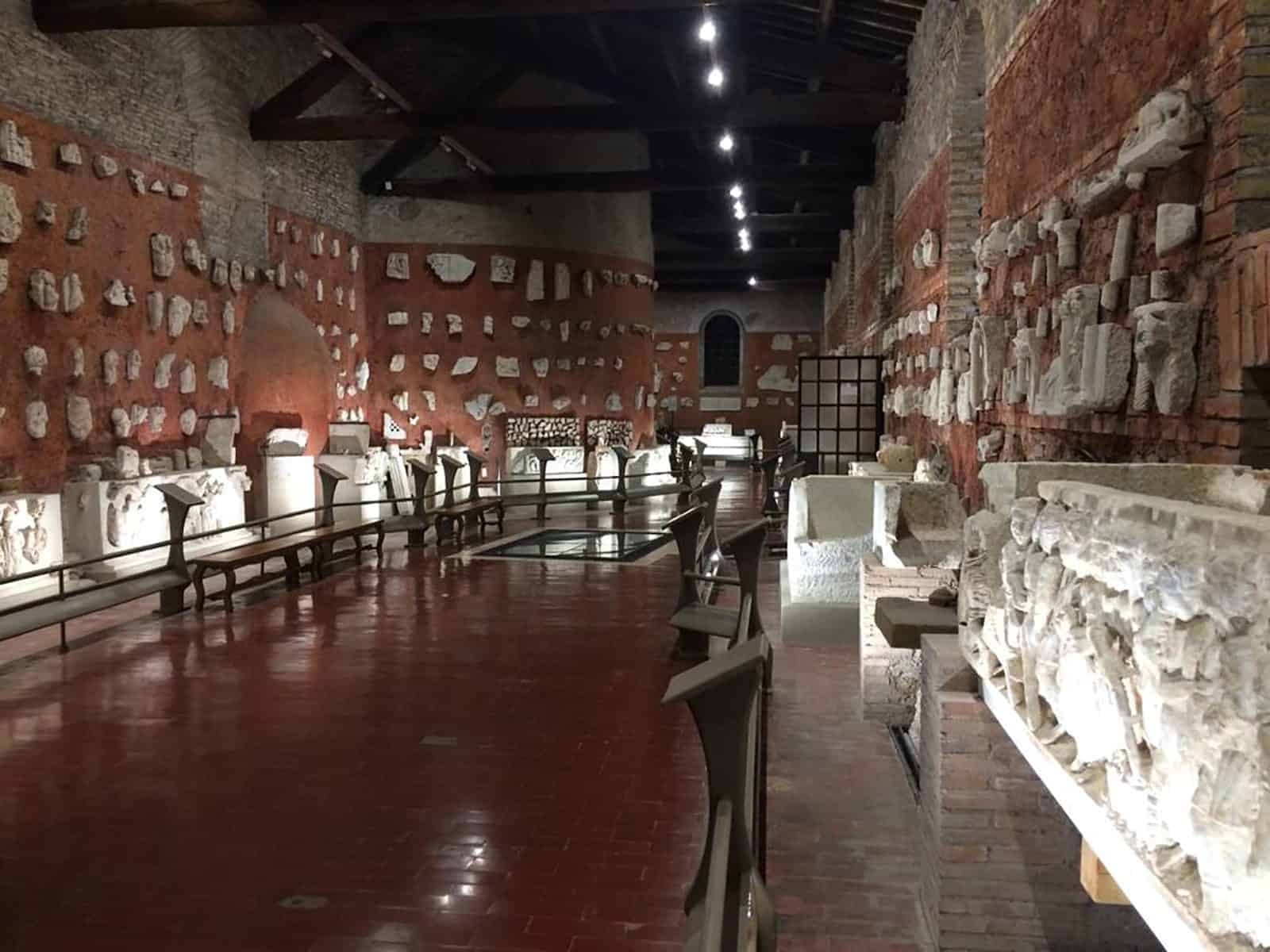
The twentieth century brought archaeology. The excavation campaigns of the first decades of the century brought to light the piazzola with the mausoleums, the Triclia with its graffiti, the Platonia, and recovered hundreds of sarcophagi and epigraphic fragments. In 1933 the side aisles were rebuilt using the layout of the Constantinian ambulatory. In the right aisle the sarcophagus museum was set up and the entrance to the hypogeal cemetery was placed. In the left one there was an exit from the catacomb and the epigraphic collection. Anyone walking through those spaces today follows the exact perimeter of Constantine's basilica.
The Cardinal Title and the Current Status of the Basilica of San Sebastiano fuori le mura
On December 30, 1960, Pope John XXIII established the cardinal title of San Sebastiano alle Catacombe, assigning it starting in 1962. It has been held by Ildebrando Antoniutti, Sebastiano Baggio, the great Dutch ecumenist Johannes Willebrands and, from 2007, Lluís Martínez Sistach, emeritus archbishop of Barcelona. The cardinal title is an ancient prerogative: it makes the holder the honorary pastor of that church as a member of the clergy of Rome, and it serves to remind us that cardinals are, legally, the presbyterate of the pope's diocese.
Until the Jubilee of 2000 the basilica was one of the seven churches of the Roman pilgrimage. From that year on, many Jubilee itineraries replace it with the Sanctuary of the Madonna del Divino Amore, but the historical route continues to be followed in its ancient form, and for very many pilgrims the stop here remains what gives meaning to the whole walk.
The Facade and Portico of the Basilica of San Sebastiano fuori le mura
The façade dates from the early 17th century, completed around 1612 or 1613 depending on the sources. It should be attributed to the workshop of Flaminio Ponzio, continued by Giovanni Vasanzio. The two names are so intertwined that historians waver over who designed the façade, one or the other. The scheme is of a disarming simplicity. At the bottom is a portico with three large arches. Above it are three large windows separated by pilasters, and a pediment as the crowning element. No giant columns, no superimposed theatrical orders, no concession to virtuosity.
The thing to look at is the columns of the portico. They are granite, and they come from the Constantinian basilica. It's pure reuse, as had been done in Rome for 1,500 years. Anyone who stops under the central arch and looks up sees a shaft cut in the 4th century supporting a 17th-century masonry wall, and this material continuity says more than any caption could. I'd also point out the inclination: the portico sits on a platform raised above the street, because the ground around it was dug and dug again for centuries.
A matter of personal taste, which not everyone shares. This façade is dismissed as plain, and in fact it doesn't hold up when compared with the grand urban showpieces of 17th-century Rome. But the comparison is wrong. A suburban cemetery church was not supposed to compete with anything. It had to welcome pilgrims worn out after three kilometers on a dusty road, and a shady portico with three arches is exactly what someone arriving on foot needs. Here, restraint serves a purpose.
Inside the Basilica of San Sebastiano fuori le mura: the nave and the ceiling
You walk in, and the first impression is of unexpected width. The hall is a single nave, punctuated on three sides by three arches framed by pairs of pilasters, with chapels opening off the sides and the presbytery at the far end under a dome. There is no colored marble in abundance, and no gilded stucco attacking the eye. The church is light, restrained, almost gray. Anyone arriving from the historic center with eyes saturated with Sant'Ignazio or the Gesù needs a minute to readjust.
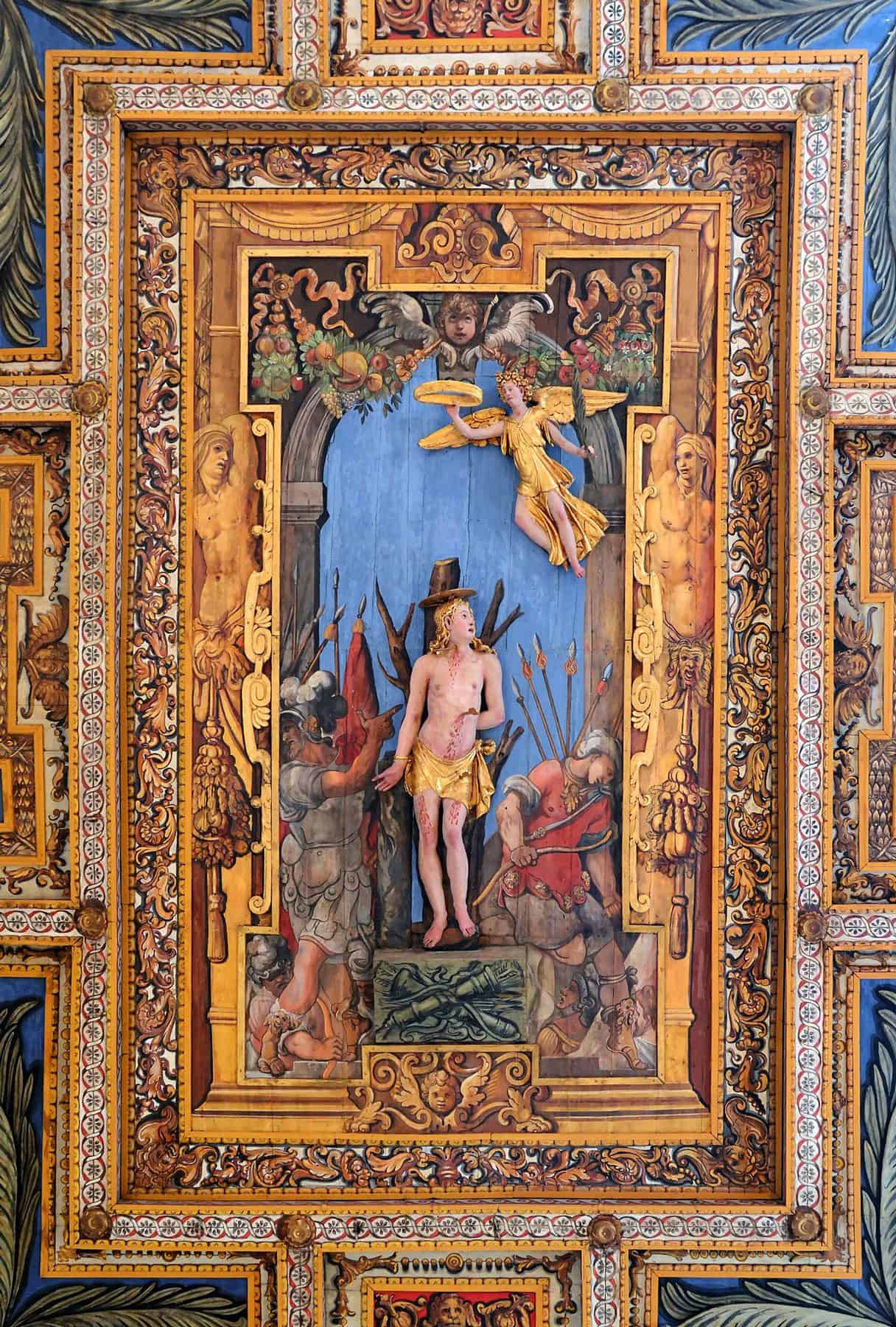
The highlight is overhead. The carved wooden ceiling was made in 1612 by Annibale Durante from a design by Giovanni Vasanzio. At its center is the Martyrdom of Saint Sebastian. On the sides stand the coats of arms of Cardinal Scipione Caffarelli Borghese and Pope Gregory XVI, the latter added during a 19th-century intervention. The coffered ceiling is gilded sparingly, and the woodwork is of excellent quality. You can see the joints and the structural logic, and this is rare in Baroque ceilings, which usually hide everything.
One detail to note. The eagle and the dragon that recur in the decoration are the heraldic arms of the Borghese, and anyone who has seen the Galleria Borghese or the façade of San Sebastiano al Palatino will recognize them right away. Scipione signed his projects the way a publisher signs his books: without excess, but leaving no doubt about who paid.
The left side of the Basilica of San Sebastiano fuori le mura, work by work
I suggest going around the church counterclockwise, starting from the left. It's the order in which it reads best, because you start with the oldest document and end with the most recent decoration.
The plaque of Pope Damasus at the entrance of the Basilica of San Sebastiano fuori le mura
Just to the left of the door, low down, is the slab with the poem that Damasus I dedicated to the martyr Eutychius in the second half of the 4th century. The text, in hexameters, tells of the martyr's sufferings and the discovery of his burial. It should be read knowing that it is propaganda in the noblest sense of the word: Damasus was building the Christian identity of the city, and these poems were his tool. The slab was found during the excavations of the early 20th century, in an unstable area of the catacomb.
Anyone with an eye for letters should stop for at least three minutes. The Filocalian capitals have thin strokes, swallowtail serifs, curved terminals on the S and the C, and an elegance that no later Christian epigraphy has matched. It is the only late-antique alphabet whose inventor we know by name.
The Tabernacle by Mino da Fiesole in the Basilica of San Sebastiano fuori le mura
Higher up, on the same wall, is a white marble tabernacle from the second half of the 15th century, attributed to Mino da Fiesole. It is the Renaissance piece of the church, and it is almost always overlooked because its placement, above eye level, makes it awkward to see. Mino worked in Rome for the great curial patrons between the 1460s and the 1480s. His manner is recognizable by the crispness of his profiles and by a certain restrained, Tuscan tone that always sounds a bit foreign in Rome.
The Chapel of San Sebastiano and the reclining statue
The first chapel on the left was built in 1672 at the wish of Cardinal Francesco Barberini and designed by Ciro Ferri, a pupil and follower of Pietro da Cortona. It was modeled on the Chapel of the Relics that corresponds to it on the opposite side. On the altar is kept the urn with the remains of Saint Sebastian. Beneath the altar table, inside a display case, is the reclining marble statue of the saint, carved between 1670 and 1672.
It's worth being precise about the author, because the confusion is old and recurring. The work is by Giuseppe Giorgetti, a sculptor documented between 1668 and 1682, who inherited the workshop of his older brother Antonio when Antonio died and worked for a long time for the Barberini. Sources disagree about the design: part of the tradition attributes it to Gian Lorenzo Bernini, of whom Giorgetti was a collaborator, while some more recent scholarship instead proposes Ciro Ferri, the author of the chapel. The statue is also sometimes attributed to Antonio Giorgetti, but Antonio had died at the end of 1669, before work on the site began.
In terms of imagery, Giorgetti's Sebastian is one of the most intelligent inventions of seventeenth-century Rome. The saint is not shown tied to the post, as in the dominant iconography from the Renaissance onward, but stretched out on the ground after the torture, his head limp, the arrows still stuck in him, his body twisted in a way that follows the line of the mensa. It is a martyrdom narrated in the recent past, not in the present. The raking light that comes in through the side window during the central hours of the day does the rest: the marble flesh seems to give way under its own weight.
The Chapel of the Most Holy Crucifix
A door from the Chapel of San Sebastiano leads to the Chapel of the Most Holy Crucifix, created in 1727 in the former sacristy. On the vault, a fresco with God the Father and saints, dated to 1618 and attributed to Pietro da Cortona, who in those years was a very young man who had just arrived in Rome from Tuscany: if the attribution holds, this is one of his early works, and it's worth looking at precisely for the enormous distance from the masterpieces of his maturity. On the wall, an oil on canvas with the Madonna and Child between San Sebastiano and Santa Lucina, dated 1627 and attributed to Marco Tullio Fontana.
Santa Lucina deserves a note, because her name comes up often on this road. Tradition gives her the role of a Roman matron who gathered and buried Sebastian's body in the catacomb: she is the figure who links the martyr to the site, and she is also the reason one of the oldest nuclei of the Catacombs of San Callisto is called the Crypts of Lucina.
The Altars of San Carlo Borromeo and San Francesco d'Assisi
The first altar on the left side holds an altarpiece with San Carlo Borromeo adoring the cross, oil on canvas from 1613 or 1614 attributed to Archita Ricci, a painter from the Marche active in Rome in the circle of the Borghese. The choice of subject is not accidental: Carlo Borromeo, canonized in 1610, was the reference saint of the Catholic Reformation, and including him in a basilica that had just been rebuilt meant declaring which side the patron stood on.
The second altar houses a San Francesco d'Assisi receiving the stigmata, oil on canvas from the second half of the sixteenth century attributed to Girolamo Muziano, the Brescian who in Rome was one of the protagonists of post-Tridentine painting and the founder of the Accademia di San Luca. The canvas is older than the Borghese rebuilding and most likely comes from the sixteenth-century furnishings of the church. The rocky landscape in the background is Muziano's signature, and he was also one of the first true landscape painters in Italian painting.
The Presbytery and High Altar of the Basilica of San Sebastiano fuori le mura
The nave ends with the triumphal arch that leads into the presbytery, which has a square plan and is covered by a dome. It is the most solemn space in the church, and also the least photographed, because the light coming down from the drum is difficult and visitors tend to stop before getting there. They are wrong: here is the most important archaeological piece in the whole above-ground part.
The Altar Frame of Flaminio Ponzio
The altar structure was carried out between 1610 and 1612 by Flaminio Ponzio and is an aedicule with four columns of verde antico, a green marble with dark spots that the Romans quarried in Thessaly and that in the seventeenth century was obtained almost exclusively from the spoliation of ancient buildings. Four shafts of that quality, all identical, were an enormous expense and a precise display: Scipione Borghese wanted the visitor to understand at a glance the rank of the patron.
The Altarpiece by Innocenzo Tacconi
Inside the aedicule is the altarpiece with Jesus Christ crucified between the Madonna and Saint John the Apostle, oil on canvas from 1614 by Innocenzo Tacconi, a Bolognese painter from the circle of Annibale Carracci. Tacconi is a name that says little even to many specialists, and his critical fortune is modest, but this Crucifixion is a solid work, classicist in its layout, with a use of nocturnal light that owes a great deal to the Roman stay of the Bolognese painters. I place it among the most underrated canvases in the Roman suburbs.
The Strigilated Sarcophagus of the Fifth Century Under the Mensa
This is the piece that is worth the trip. The altar table of the high altar is made of a fifth-century strigilated sarcophagus, that is, a sarcophagus whose body is decorated with the S-shaped grooves that archaeologists call strigillations, after the strigil with which the Romans scraped their skin in the baths. In the center and on the sides, three figured reliefs: the arrest of Saint Peter, Christ between Saints Peter and Paul, the resurrection of Lazarus.
Stop at this object and think it over. It is a reused early Christian funerary artifact, which 14 centuries later was repurposed as a eucharistic table in a Baroque church. It is not an isolated case in seventeenth-century Rome, but here the gesture carries an extra meaning, because the basilica exists only as a cemetery: placing a sarcophagus under the altar means declaring that the liturgy is literally celebrated above the dead. The ancient Christian theology of the altar-tomb, which produced the architecture of the martyr basilicas, is summed up in this block of marble.
The busts of Nicolas Cordier
On either side of the altar, the marble busts of Saints Peter and Paul, made in 1608 by Nicolas Cordier, a sculptor from Lorraine whom everyone in Rome called Franciosino. Cordier is a transitional figure. Trained on Northern naturalism, he worked extensively on the restoration and integration of ancient statues for major collectors, and this practice gave him a familiarity with Roman portraiture that shows in his busts. The two apostles have dry, nervous faces, free of emphasis. They are portraits, not icons.
The choir lofts and the organ of the Basilica of San Sebastiano fuori le mura
Two choir lofts open on either side of the presbytery. The one on the left holds the pipe organ, built in 1910 by Pacifico Inzoli, the famous organ builder from Crema, and modified and enlarged in 1964 by Libero Rino Pinchi, who assigned it opus number 192. It is an instrument of transition between the nineteenth-century Italian tradition and the Caecilian reform, and it is regularly used in liturgies. Anyone who happens to be here during a solemn Mass hears it working in an acoustic space that, for once, is not cavernous.

The right side of the Basilica of San Sebastiano fuori le mura, work by work
The right side is the one with the most famous and also the most debated pieces. You walk it on the way back toward the entrance.
The monument to Altobello da Montecorvino
Next to the door, a funerary monument in white and gray marble from the Roman milieu, dated 1515, dedicated to Altobello da Montecorvino. It is the sixteenth-century piece that almost no one looks at, and it is a good example of early sixteenth-century Roman funerary sculpture, still tied to the style of Andrea Bregno, which filled the churches of the city and which the seventeenth century largely wiped out. It survived here because it was already close to the door and nobody had any interest in moving it.
Bernini's Salvator Mundi in the Basilica of San Sebastiano fuori le mura
In a niche on the right side is the Bust of the Savior, the last sculpture by Gian Lorenzo Bernini. The marble, about 103 centimeters tall and so colossal in size compared with life-size, depicts Christ with his right hand raised in the gesture of blessing. Bernini carved it in Rome in 1679, at well past 80, the year before he died.
The story of this piece is a novel. Bernini left it in his will to Queen Christina of Sweden, who was both his friend and patron and who held the bust in very high regard. At the queen's death, in 1689, the work passed to Pope Innocent XI. In 1713 it is listed as inventoried at Palazzo Odescalchi, described as a marble bust of the Savior, sculpted by Bernini, on a pedestal of Sicilian jasper and a gilded wooden support with angels. From the late eighteenth century its traces are lost, and for over two centuries the masterpiece was considered lost.
The piece reappeared in 2001, in a way worth telling. The bust shows up in a photograph in the catalog of an exhibition on Pope Clement XI, cataloged as a work by Pietro Papaleo. The scholar Francesco Petrucci recognizes it from the reproduction, studies it on site in 2002 together with Maurizio Fagiolo dell'Arco, and proposes returning it to Bernini. In 2003 Irving Lavin, who in 1972 had identified a bust at the Chrysler Museum in Norfolk as the original, accepts the new attribution and revises his own hypothesis. The attribution has gathered very broad consensus, with the openly stated exception of Tomaso Montanari. This is a case where it is worth knowing the debate exists, because art history does not work through final verdicts.
How it got here is a plausible reconstruction and not a certainty: probably through Palazzo Albani, since an inventory from 1851 mentions a bust of the Savior with matching dimensions and material. Before 1960 the sculpture was in the sacristy of the Albani chapel of the basilica, that is, a few meters away from where it is displayed today. In 2023, between April 12 and August 31, it was lent to Fiumicino airport for a temporary exhibition.
The verdict on this piece is clear, and it is not the usual one. The Salvator Mundi is not a pleasant sculpture. The face is hollowed, the mouth barely open, and the gaze does not meet ours. It is the work of a man of 80 who is taking his leave, and Christ's flesh has the same waxy consistency as late portraits. Anyone who comes here expecting the theatrical ecstasy of Saint Teresa is left disoriented. Anyone who accepts the farewell for what it is leaves with the impression of having seen the last thing that giant wanted to say.

The Chapel of the Relics in the Basilica of San Sebastiano fuori le mura
Commissioned in 1625 by Duke Maximilian I of Bavaria, prince-elector and head of the Catholic League in the 30 Years' War, the Chapel of the Relics is the place that divides visitors into two categories. Those with an art historical sensibility pass through quickly. Those with a devotional sensibility stay for 20 minutes. Four objects are kept here.
The first is the stone with the footprints that tradition holds to be the feet of Jesus, linked to the episode of Domine quo vadis. The original is kept here by the basilica, and already in 1534 the veneration of pilgrims for this stone was documented. The slab you see in the small church of Domine Quo Vadis, at the fork between the Appia and the Ardeatina, is a copy. This is one of the few cases where the copy is more famous than the original, and the reason is banal: the little church at the crossroads is free, open, and on everyone's path, while here you have to enter the basilica and find the right chapel.
The second and third objects relate to the martyrdom of Sebastian: one of the arrows that, according to tradition, struck him, and a fragment of the column to which he would have been tied. The fourth is a lead chalice containing ashes and bones attributed to Pope Fabian, the pontiff martyred in 250 during the persecution of Decius and buried in the Crypt of the Popes at San Callisto.
How these things should be told to an adult audience. They are not passed off as facts: they are relics, that is, objects whose material authenticity cannot be verified and whose value is of a different order. But it would be just as foolish to dismiss them. The stone of the footprints is an extraordinary document of how Roman devotion worked in the sixteenth and seventeenth centuries, when jubilee indulgences were earned by touching objects and pilgrims crossed Europe to do so. The historical fact is not Christ's foot: it is the human flow that this stone has generated for five centuries.
The Altars of Saint Francesca Romana and Saint Jerome
The first altar on the right side holds a Vision of Saint Francesca Romana, oil on canvas from 1727 by Filippo Frigiotti. Francesca Bussa de' Ponziani, the Roman saint par excellence, founded the Oblates of Tor de' Specchi and died in 1440. Her cult in the city is widespread, so finding her here is not surprising. The second altar holds a Saint Jerome kneeling toward the angel, oil on canvas from 1613, again by Archita Ricci, the painter who had also signed the Saint Charles opposite.
Between the two chapels is the entrance to the catacomb, preceded by a vestibule with a fresco depicting God the Father and saints, datable to between 1610 and 1617 and attributed to Antonio Carracci, natural son of Agostino and nephew of Annibale, who died very young in 1618. It is worth looking at before going down, because it is the last painted thing you see before entering the dark.
The Albani Chapel in the Basilica of San Sebastiano fuori le mura
The chapel of Saint Fabian, which everyone calls the Albani Chapel, was built between 1706 and 1712 on commission from Pope Clement XI Albani. The design is by Carlo Fontana, with the collaboration of Alessandro Specchi and Filippo Barigioni, and the decorative direction entrusted to the painter Carlo Maratta: four names that in early eighteenth-century Rome meant the absolute top of the craft.
The sculptural group on the altar, Saint Fabian Pope and Angels, dates from 1712 and is the work of Pietro Francesco Papaleo, a sculptor from Palermo. On the left wall is an oil on canvas of the Election of Saint Fabian, from 1712, by Pier Leone Ghezzi, who everyone remembers as the first European caricaturist, and who was also a history painter more than decent. On the right wall, Saint Fabian consecrates Emperor Philip the Arab, from 1708, by Giuseppe Passeri, nephew of the artists' biographer Giovanni Battista Passeri.
The subject of Passeri's painting deserves an explanation, because it is one of the most curious in all of Rome. According to a late and historically untenable tradition, Emperor Philip the Arab, who reigned between 244 and 249, would have been the first Christian emperor, baptized or reconciled by Pope Fabian. No contemporary source confirms it, modern scholarship rejects the story, and yet in the eighteenth century the legend was still alive enough to merit a canvas in a papal chapel. Looking at this painting knowing that it depicts something that never happened is a healthy exercise: it reminds you that images in churches are not chronicles but programs.
An architectural note. The Albani Chapel reads like a small treatise on cultivated eclecticism: a central plan, measured polychrome marbles, reliefs that engage with the canvases, zenithal light. Compared with the sobriety of the nave, the effect is almost jarring, and in fact many visitors find it out of scale. In our view it is the most interesting room in the church after the presbytery, precisely because it shows how taste had changed in a century.
The Outer Aisle, the Sarcophagus Museum and the Basilica of Constantine
From a door along the side you enter the so-called outer aisle, that is, the ancient ambulatory that ran around the apse of the Constantinian basilica and that was recovered and covered over in 1933. Walking through it is the most instructive architectural experience of the visit: you follow the perimeter of a fourth-century building of which the Baroque volume occupies only the central part, and you can see at a glance how much larger the original was.
Arranged here is a collection of inscriptions and a scale model that reconstructs the mausoleums, the Triclia and the Basilica of Constantine. The model is old, dusty and unsurpassed as a teaching aid: in 30 seconds it clarifies a stratigraphy that would take 10 minutes to explain in words. In the right aisle is the sarcophagus museum, with finds recovered from under the church and the surrounding cemetery during the excavation campaigns of the early decades of the twentieth century: sarcophagi, whole and fragmentary, largely from the fourth century, with biblical scenes, portraits of the deceased in clipei, and strigils.
In that same aisle you can still see, on the wall facing the church, the communicating arches with the central nave walled up in the thirteenth century, and the exterior of the apse of the Chapel of the Relics. These are the points where the basilica tells its own narrowing without needing panels.

The Catacombs of San Sebastiano Under the Basilica: The Route of the Visit
You go down from the right aisle, by a staircase that leads about 10 meters below the current floor. From here on you are in the hands of the internal guide, you walk in single file, and photos are not allowed. The route takes about 40 minutes, includes 70 irregular steps and passes in sequence through the four things that make this cemetery different from all the others: the galleries, the martyr's crypt, the small open area with the Roman mausoleums, and the Triclia of the graffiti.
The Size of the Catacombs of San Sebastiano
The complex is laid out on three overlapping levels, with a total length of galleries that current estimates put at around 12 kilometers. Only a minimal fraction is open to the public, and the visitable part was chosen because it tells the chronological sequence well, not because it is the most spectacular. By comparison, the Catacombs of San Callisto, a few hundred meters farther up along the same road, exceed 20 kilometers of galleries spread over about 30 hectares, and they are the most extensive in Rome. San Sebastiano does not compete on size: it competes on density of meaning.
The Galleries and the Cubiculum of Jonah
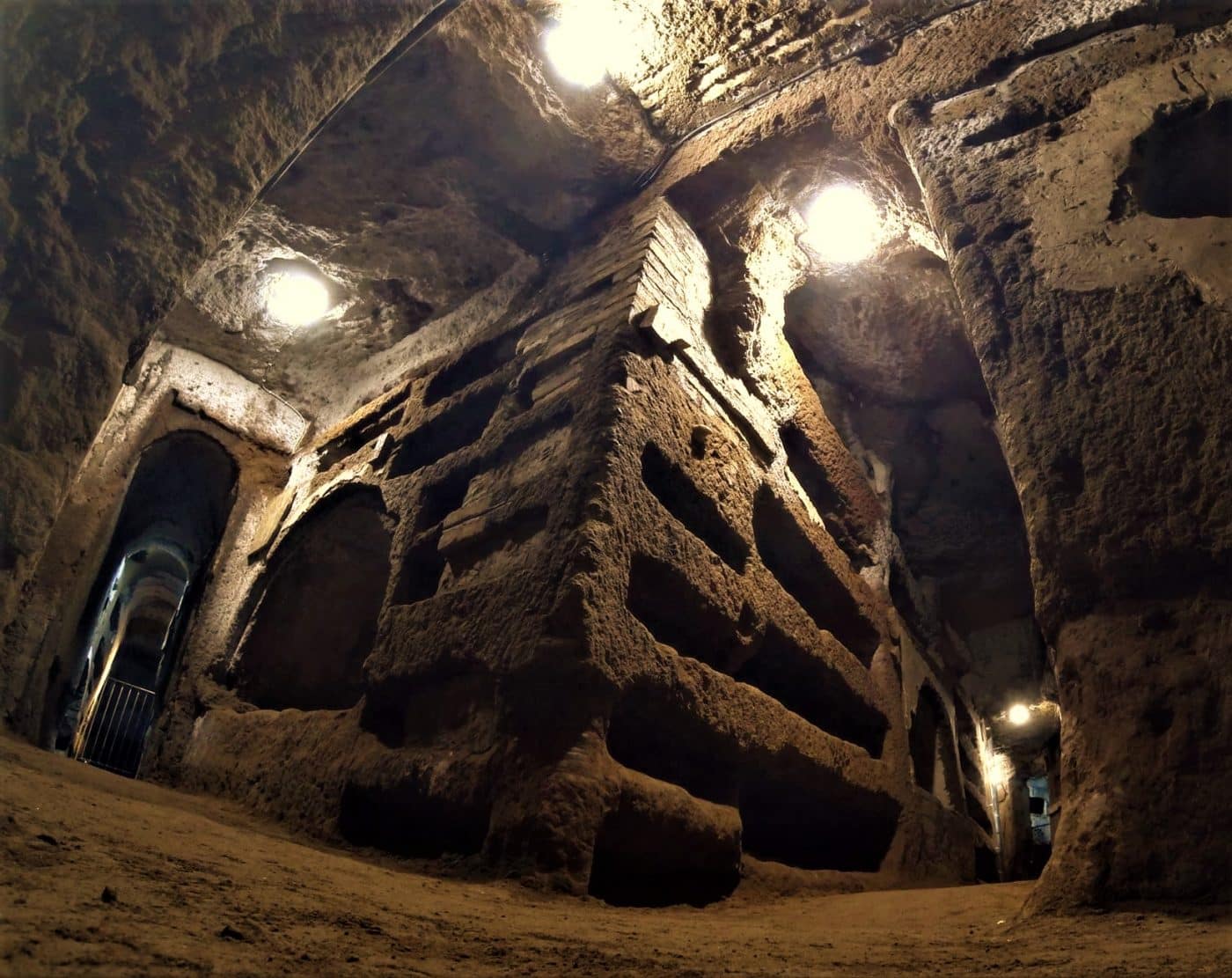
The galleries have the classic appearance of Roman underground cemeteries: narrow corridors dug into tufa and pozzolana, walls pierced by loculi stacked in several tiers, square rooms, the cubicula, opened at intervals to hold the burials of a family. The loculi were closed with marble slabs or with tiles sealed with lime, and on the closures the name of the deceased, the age and often a formula of peace were carved.
The most notable cubiculum on the route is the one known as Jonah's, decorated with paintings from the late fourth century showing the prophet's cycle in four scenes: Jonah thrown into the sea, swallowed by the sea monster, cast up on the shore, and lying under the castor-oil plant. The cycle of Jonah is the most frequent subject in early Christian funerary painting, and the reason is theological: three days in the belly of the fish and then the return to light foreshadow the resurrection. Anyone looking for crosses and crucifixes in the catacombs comes away empty-handed, because in the early centuries the sign of faith was this, not the instrument of torture.
The Crypt of San Sebastiano
A stretch of gallery leads to the restored crypt of the martyr. At the center is an altar table placed where the ancient one stood, of which some traces of the base remain. In a niche is the bust of Saint Sebastian attributed to Gian Lorenzo Bernini or to his workshop. All around is emptiness. The original tomb was emptied when the relics were moved up into the basilica, and what you see is the devotional frame built over the centuries around an absence.
This is the moment when most groups fall silent on their own, and not because of the solemnity of the place, which is modest. They fall silent because the guide explains that above our heads, 10 meters up, is the chapel with the urn. The saint was moved vertically, and the entire basilica is a machine built to mark a point in the ground.
The Piazzola and the three Roman mausoleums
The most extraordinary stretch comes when the gallery opens onto an open space: the piazzola, that is, the floor of the abandoned pozzolana quarry, with walls in which three brick mausoleums from the second half of the 2nd century were carved. They are not Christian. They are tombs of wealthy Roman families, with painted plaster and stucco, and their preservation is due to the fact that in the mid-3rd century the entire area was deliberately buried, sealing them under an earthen embankment.
The first on the right preserves painted funeral banquets and the miracle of the possessed man of Gerasa on its exterior, along with the inscription bearing the owner's name, Marcus Clodius Hermes. The interior, with inhumation burials and paintings, has a Gorgon's head on the vault. The structure was laid out on two superimposed chambers with an external solarium, where the family gathered on the anniversary of the death for the refrigerium. The figurative repertoire is a fascinating puzzle: some scenes lend themselves to a Christian reading, others to a pagan one, and historians have been debating for a century whether the owner was a cautious Christian or a cultured pagan.
The second, called the Innocentiores after the funerary collegium that owned it, has a descenso with a vault decorated in stucco of very high quality. In some rooms you can read inscriptions written in Latin but with Greek letters, and a graffito with the initials of the Greek words meaning Jesus Christ, Son of God, Savior. Those five letters form the word fish, and that is why the fish became the Christian symbol par excellence. Seeing that acronym scratched into plaster from the 2nd or 3rd century is worth the ticket price on its own.
The third, on the left, is the Mausoleum of the Axe, named after the tool carved on its exterior pediment. The decoration consists of grapevine tendrils growing from kantharoi, the two-handled vessels of the symposium, set on painted false pilasters. The axe on the tympanum is a widespread Roman funerary symbol whose meaning is still debated: perhaps a reference to the legal formula that protected the tomb from tampering.
The Triclia and the graffiti to Peter and Paul
From the piazzola you climb to a room located roughly halfway up the basilica above and cut into the top by its construction: the Triclia. It was a trapezoidal courtyard of about 23 by 18 meters, with a brick floor and a portico covered by a roof, and it served funeral banquets in honor of the apostles. Masonry benches lined the back wall, and next to it a room with a well supplied the water.
The plastered walls preserve hundreds of graffiti carved by the faithful, in a chronological range running from the second half of the 3rd century to the first decades of the 4th. Estimates vary. Studies count around 500, and some reconstructions go over 600. They are very short, repetitive formulas: Peter and Paul, intercede for Victor, remember me, pray for so-and-so, protect so-and-so. There is even one that asks the apostles for a good voyage.
The historical implications are enormous, and it's worth explaining them standing in front of that wall. The apostles are called by name, almost never with the titles saint, martyr, or blessed. We are before the official codification of the cult of the saints. The people who wrote these are ordinary folk, with basic literacy, often in family groups, coming from the city or from the nearby regions. The refrigerium they shared was both a ritual meal in honor of the two apostles and, metaphorically, the eternal refreshment requested for one's own dead. It is a devotional practice that arose from below, managed by the faithful, and only with Constantine and then with Damasus was it channeled and legitimized by the institution. In short: here you can see Christianity before it became official.
One more observation. Those graffiti are the most moving thing on the Appia Antica, and they are also the easiest to walk past without noticing, because to the naked eye they look like scribbles on dirty plaster. Ask your guide to point out three or four that are legible and take the time to decipher them. The name of Victor, carved by someone who prayed for him 1,750 years ago, lingers longer than any marble.
The Platonia, the Mausoleum of Quirinus and the Chapel of Honorius III
From the Triclia, a small service passage leads into the ancient ambulatory that wraps around the apse, and from there you go down into the Platonia, a structure built after the Constantinian basilica. The name comes from the marble slabs, platoniae, that Pope Damasus used to clad the room. For centuries it was believed to be the place where the two apostles were temporarily buried. The excavations of 1892 instead showed that it was the mausoleum of Quirinus, bishop of Siscia in Pannonia, whose remains were brought to Rome by pilgrims from his region between the 4th and 5th centuries.
To the right of the Platonia is the chapel of Honorius III, built into the vestibule of the mausoleum and decorated with 13th-century paintings of considerable interest: Peter and Paul, the Crucifixion, figures of saints, the Massacre of the Innocents, the Madonna and Child. They date from the period when the basilica was becoming a pilgrimage center again under papal protection, and their quality is higher than you would expect in an underground space.
To the left is an apsed mausoleum with an altar walled up against the apse. On the left wall is a graffito with the words domus Petri, which part of the scholarship considers a reference to a burial house of the apostle. Here too: this is an interpretive hypothesis, not an established fact, and anyone who tells it to you as a certainty is selling you something.

The martyrs buried in the Catacombs of San Sebastiano
Ancient sources document the presence of three martyrs in the cemetery on the Appian Way: Sebastian, Quirinus and Eutychius. Their names appear together in a 7th-century catalog, the Notula oleorum, that is, the list of oils that pilgrims collected from the lamps burning over the venerated tombs and took home as contact relics. The itineraries for pilgrims from the early Middle Ages, however, say nothing about Eutychius. His burial was in a spot that was hard to reach, and in devotional practice he disappeared.
Sebastian
Very little is known about Sebastian's biography, and it's best to say so openly. The Depositio martyrum, the Roman calendar compiled in 354, records his death and burial on January 20, in catacumbas. This is the oldest and most solid piece of information, and it confirms that by the mid-4th century the cult was already established here. Saint Ambrose, at the end of the 4th century, states that he came from Milan and suffered martyrdom in Rome during the persecution of Diocletian. The passio written in the 5th century, much richer in detail and much less reliable, makes him a soldier born in Narbonne in Gaul to a family from Milan, an officer of the imperial guard, who died in Rome under Diocletian.
The story everyone knows, with the arrows and the rescue by Irene and the second execution by clubbing, belongs to the later passio. It is hagiographic literature, not chronicle. This doesn't diminish the value of the cult, and in fact it explains the enormous iconographic success of the saint: from the Quattrocento onward, the young body pierced by arrows has been the pretext for painting the male nude in church, and half of Italian art history passes through there.
The relics remained in the catacomb until the 9th century, moved to the Vatican in 826, returned to the Appian Way with Honorius III in 1218, and today are kept in the chapel dedicated to the saint, in the basilica above. On January 20, the parish celebrates the feast, and it's the day when this church stops being a tourist stop and becomes again what it has always been.
Quirinus of Siscia
Quirinus was bishop of Siscia, today's Sisak in Croatia, in the Roman province of Pannonia, and he was martyred at the beginning of the 4th century. His remains were brought to Rome between the 4th and 5th centuries by pilgrims from his region, either fleeing or traveling for devotion, and placed in the structure we today call the Platonia. His presence here is the material proof of something that's easy to forget: Rome didn't only export cults, it imported them, and the suburban cemeteries welcomed martyrs from all over the empire.
Eutychius
We know nothing about Eutychius, except that his tomb really existed. It was identified during the archaeological excavations of the last century in a landslide-prone area of the catacomb. What remains of him is the poem that Pope Damasus dedicated to him, now displayed at the entrance to the basilica. It's the borderline case of this site: a name, a slab, a hole in the ground. Yet that name has reached us across 1600 years, and the reason is a pope who decided in the 4th century that martyrs should have a written voice.
The Seven Churches Route and the Basilica of San Sebastiano fuori le mura
In 1552, on February 25, Philip Neri led the first official pilgrimage to the seven Roman churches, a practice he had already followed informally since the previous year. The route, 16 Roman miles long, that is, about 20 kilometers, started on Wednesday evening from the church of San Girolamo della Carità and was split over two days. The order was St. Peter's, San Paolo, San Sebastiano, then the Caelian, San Giovanni in Laterano, Santa Croce, San Lorenzo, and finally Santa Maria Maggiore.
At San Sebastiano they attended mass. It was not just any stop: it was the central point of the pilgrimage, the one where the group stopped for a long time, went down into the catacombs and ate. The first stops took place at the Vigna Savelli, near the Caffarella. Later the stop in the Mattei garden, today's Villa Celimontana, became customary, where Philip had a snack served and music played. Whoever imagines 16th-century pilgrimages as gloomy exercises has the wrong target: Philip Neri had understood that fatigue is bearable if the day is cheerful, and his pastoral invention worked precisely for this reason.
The full route still touches today San Paolo fuori le mura, San Giovanni in Laterano, Santa Croce in Gerusalemme and Santa Maria Maggiore, besides San Lorenzo and St. Peter's. Since the Jubilee of 2000 many itineraries replace San Sebastiano with the Sanctuary of Divino Amore, but whoever wants to walk in the footsteps of Philip Neri does well to respect the original list: without the stop on the Appia the pilgrimage loses its underground chapter, which was exactly the point.
For the Jubilee of 2025 the Pontifical Commission for Sacred Archaeology proposed the Path of the Martyrs, an itinerary with a pilgrim's passport that includes six Roman catacombs, jubilee crosses placed in the crypts, stamps at every stop and a final testimonium once the route is completed. San Sebastiano is one of its key stops.
A Curiosity About the Basilica of San Sebastiano fuori le mura
The curiosity I'm handing over is linguistic, and concerns a word we all use without knowing where it comes from. The word catacomb did not exist in classical Latin and does not mean underground cemetery. It was born as a place name, and it was born here: the stretch of the Appia at the third mile was called ad catacumbas, a formula built on the Greek katà, near or down toward, and kymbe, cavity or hollow. It described something very concrete, namely the dip in the ground produced by the emptying of the pozzolana quarry, which anyone walking this stretch of road today can still see with their own eyes: the roadway lowers noticeably right in front of the basilica.
For centuries that formula indicated only this place. The underground cemetery located there was the coemeterium ad catacumbas, while the other Roman cemeteries had proper names, that of Callixtus, that of Priscilla, that of Domitilla. Then, over the early Middle Ages, when topographical knowledge of underground Rome fell apart and pilgrims stopped distinguishing one hypogeum from another, the nickname of the most frequented cemetery came to designate the whole category.
The result is that a word born to describe a hole in the ground of the Appia today indicates the underground Christian cemeteries of Naples, Syracuse, Malta, and by extension the ossuaries of Paris, the tunnels of Odessa, the underground spaces of half the world. No other place in Rome has exported a common noun with this effectiveness. Knowing this, you look at the road, notice the dip you crossed without noticing it and understand that toponymy, once in a while, is an exact science.
A Thing Nobody Tells You About the Basilica of San Sebastiano fuori le mura
Nobody tells you that under the Christian catacombs, before the Christian catacombs, there was a neighborhood. Not poor tombs dug as best they could by a persecuted minority: three brick mausolea of well-off families, with plaster painted in solid colors, quality stuccoes, superimposed chambers, open-air terraces for anniversary banquets, a small residential building with black-and-white mosaic floors and a portico on pillars. This was, at the end of the 2nd century, an elegant funerary area of pagan people with money.
The reason we can see it is even more surprising. Around 250 the whole small plaza was deliberately filled in: the hollow was filled with earth until it covered the mausolea almost entirely, creating a raised level on which the Christian devotional complex rose. It was not an act of destruction, it was an act of construction: they wanted a higher and more regular walking surface. The burial sealed the pagan buildings and handed them over intact to 20th-century archaeology, with the paintings still attached to the walls.
This leads to a correction that applies to all the Roman catacombs and that you can see firsthand here. Christians did not hide underground from the guards of Rome. They dug where the soil was soft and where Roman funerary law allowed burial, that is, outside the walls, and they did so alongside pagans, often in the same complexes. The catacombs were not refuges, they were cemeteries, and for a long time they were mixed cemeteries. The legend of hunted Christians celebrating Mass in the galleries originates in the Romantic nineteenth century, not in ancient sources. Anyone who leaves this tour having understood this has already paid for the ticket.
The advice I give you for visiting the Basilica of San Sebastiano fuori le mura
There is only one piece of advice, and it concerns the order of things. Don't go down right away. The temptation, as soon as you arrive, is to buy the ticket and join the line for the guided tour, dismissing the church as an appetizer to do later, if there's time left. It's the wrong order, and it produces 40 minutes of incomprehensible underground followed by 10 rushed minutes in the basilica.
Do the opposite. Enter the church, which is free, and give yourselves 20 real minutes: the plaque of Damasus at the entrance, the wooden ceiling, the early Christian sarcophagus that serves as the table of the main altar, the reclining statue of Giorgetti, the Salvator Mundi. Then, and only then, go to the outer nave to look at the model of the Constantinian basilica. 30 seconds in front of that little model are enough to understand where you're about to go down and why everything above exists. At that point, buy the ticket and go down. The underground route lights up on its own, and the graffiti of the Triclia stop being scribbles.
The second part of the advice is less refined but just as useful. Bring long sleeves even on August 12. Underground it's 17 degrees with humidity close to saturation, and the temperature jump from the 35 degrees on the Appia is brutal. Wear closed shoes with a non-smooth sole, because the 70 steps are uneven and in some places damp. Leave large backpacks and tripods in the car or at the entrance, because bulky objects don't fit into the gallery. And resign yourselves to not taking photos: it's forbidden underground, and insisting means being escorted out.
Another well-known fact, yet rarely mentioned
Everyone knows that the stone with the footprints of Christ belongs to the legend of Domine quo vadis, the episode in which Peter, fleeing Rome along the Appia, meets the Lord walking in the opposite direction and asks him where he is going. Almost no one knows that the real stone, the one venerated by pilgrims since at least 1534, is kept here, in the basilica's Chapel of Relics, and that the slab displayed in the small church at the crossroads of the Appia and Ardeatina is a copy.
The fact deserves to be told in full, because it explains something about how Roman devotion worked. The episode does not appear in the Gospels: it comes from the apocrypha, in particular the Acts of Peter, and an ancient echo of it is found in Saint Ambrose. In the sixteenth and seventeenth centuries the stone was kept on an altar in the center of the basilica, which no longer exists today, and it was one of the most sought-after stops on the entire Roman pilgrimage: visitors touched it, placed objects and handkerchiefs on it, and made contact relics from it.
The church at the crossroads, much smaller and much more exposed to passing traffic, received the copy precisely because the flow of pilgrims stopped there first. Over the centuries the copy has inherited the fame of the original, and today thousands of people photograph a cast every year, convinced they're looking at the relic. There is no deception in this: it is simply the way memory moves and multiplies along a road that has been traveled for 2,000 years. But if one of the two is worth seeing knowing what it is, it's the one kept in the Basilica of San Sebastiano fuori le mura.
The right photo to take at the Basilica of San Sebastiano fuori le mura
The first point is the ban, because it's the premise for everything: in the catacombs photos and video recordings are prohibited, without exceptions, and the guide has the authority to have anyone who insists sent out. So the right photo is taken above ground, and there's no shortage of opportunities.
The first is the three-arched portico seen from the opposite sidewalk, from a three-quarter angle, in late morning. Southeast sun lights the façade and the arches become three panels of deep shadow: the façade, which looks flat from the front, takes on the depth it really has. If you wait for a group to enter or exit, you also get the human scale, which is needed here, because the portico is bigger than it looks in photographs.
The second, and for me the best, is the carved wooden ceiling shot from below, standing in the center of the nave, with the lens pointed upward and the Martyrdom of Saint Sebastian at the center of the frame. Natural light coming down from the large windows is almost always enough: rest your elbows against your chest, lower yourself at a slow tempo, and take three shots. The Borghese coats of arms on the sides complete the composition.
The third is the reclining statue in the chapel of San Sebastiano, to be shot without flash and slightly from the side, not head-on: the twist of the body only reads from one angle. During the middle hours of the day, the raking light from the side window does work that no lighting unit could imitate.
One last shot that almost nobody takes: the outer aisle, that is, the ancient Constantinian ambulatory, with the run of ancient masonry and the aligned inscriptions. It's the image that best explains, better than any other, how the Baroque sits inside the early Christian, and usually there's no one to disturb you.
Some important events that happened here in history
The first event is from 258, and it's the one everything else follows from: under the persecution of Valerian, according to the tradition recorded in the calendar of 354, the bodies of Peter and Paul would have been moved here from the Vatican and from the Ostiense and would have remained for about half a century. That the bones were actually moved remains a matter of debate among scholars. That from the 250s on this site became the center of a joint cult of the two apostles is instead certified by the hundreds of graffiti in the Triclia, and no one doubts it.
The second is the great filling-in of the mid-third century, when the piazzola with the mausoleums was filled with earth to create the raised level of the devotional complex. It's a building event, not dramatic, but it has enormous consequences: by sealing the pagan tombs it preserved them, and it gave modern archaeology a piece of second-century Rome that has been lost elsewhere.
The third is the construction of the Basilica Apostolorum commissioned by Constantine in the first quarter of the fourth century, the moment when a popular, spontaneous cult becomes imperial architecture. The fourth is Damasus's intervention between 366 and 384, with the stairs, the skylights and the verses incised by Filocalus: the birth of Christian Rome as an organized system of shrines.
The fifth is 826, when Eugene II has the relics of Sebastian brought inside the walls for fear of Saracen raids, and the roughly 20 years that followed, when Arab fleets sail up the Tiber and devastate the suburbs, reducing this basilica to ruins too. The sixth is Nicholas I's reconstruction between 858 and 867. The seventh is 1218, when Honorius III brings the martyr's remains back to his church, reconsecrates the altar and has a bell tower and cloister built.
The eighth is February 25, 1552, when Philip Neri leads the first official pilgrimage of the Seven Churches here, making it one of the seven mandatory stops of Roman devotion for four and a half centuries. The ninth is the building site of Scipione Borghese between 1608 and 1613, which gives the church its current form. The tenth is the excavations of 1892, which dismantle the identification of the Platonia with the apostolic burial and recognize there the mausoleum of Quirinus, and the campaigns of the first decades of the twentieth century that bring the piazzola, mausoleums and Triclia back to light. The eleventh is 1933, with the rebuilding of the naves on the layout of the Constantinian ambulatory. The twelfth, and the most recent, is 2001, with the recognition of the Bust of the Savior as Bernini's last work after two centuries in which it was considered lost.
Who Has Passed Through the Basilica of San Sebastiano fuori le mura
The list is long and starts with those who didn't leave their name: the hundreds of ordinary men and women who between 250 and 320 carved on the walls of the Triclia their invocations to Peter and Paul. They were travelers with basic literacy, often in family groups, coming from the city and the nearby regions, and their graffiti remain the most direct evidence we have of Roman Christianity before Constantine.
Then come the names. Constantine, who had the circiform basilica built there. Pope Damasus I, who between 366 and 384 reorganized the shrine and left there the verse for Eutychius, inscribed by the calligrapher Furius Dionysius Filocalus. Pope Eugene II, who in 826 ordered the transfer of the relics. Pope Nicholas I, who rebuilt the complex after the Saracen devastation. Pope Paschal III, who in 1167 entrusted it to the Cistercians. Pope Honorius III, who in 1218 brought the body of Sebastian back here and built the bell tower and cloister. The underground chapel that bears his name keeps the thirteenth-century paintings from that period.
Philip Neri arrived on foot on February 25, 1552 at the head of the first pilgrimage of the Seven Churches and returned here countless times during the sixteenth century, making this basilica the stop where the group heard Mass. Cardinal Scipione Caffarelli Borghese made it his building site between 1608 and 1613, calling in Flaminio Ponzio, Giovanni Vasanzio, Nicolas Cordier, Innocenzo Tacconi, Archita Ricci and, according to part of the sources, Guido Reni as artistic director. A very young Pietro da Cortona frescoed the vault there in 1618, in what would become the Chapel of the Crucifix.
Maximilian I of Bavaria, prince-elector and head of the Catholic League, financed the Chapel of the Relics in 1625. Cardinal Francesco Barberini paid for the Chapel of San Sebastiano in 1672, designed by Ciro Ferri and carved by Giuseppe Giorgetti. Pope Clement XI Albani built his own chapel here between 1706 and 1712, calling in Carlo Fontana, Carlo Maratta, Alessandro Specchi, Filippo Barigioni, Pietro Francesco Papaleo, Pier Leone Ghezzi and Giuseppe Passeri. In 1714 he made it a parish. Pope Leo XII handed it over to the Franciscans in 1826.
And there is an indirect link that is worth as much as the others. Gian Lorenzo Bernini is not recorded as having worked in this church, but his last sculpture, the Bust of the Savior from 1679, ended up here after passing through the hands of Queen Christina of Sweden, Pope Innocent XI and the Odescalchi family. It stayed in the sacristy for two centuries without anyone knowing what it was. Pope John XXIII established the cardinal title here in 1960, and since then it has been held by Ildebrando Antoniutti, Sebastiano Baggio, Johannes Willebrands and Lluís Martínez Sistach.
How to Really Visit the Basilica of San Sebastiano fuori le mura
This is the part no printed guide describes precisely, yet it decides whether the day goes well.
How Much Time the Basilica of San Sebastiano fuori le mura Takes
Plan on an hour and a half in total. 40 minutes is the guided underground visit, 20 the church taken at a leisurely pace, 15 the outer nave with the model and the sarcophagus museum, and the rest is waiting. Waiting is the variable: on weekdays in November you go down almost right away, but on Saturdays in April and on bridge holiday weekends you can wait 40 minutes because groups leave in rotation and people with reservations go first. If you have a full afternoon and want to add the Circus of Maxentius and the Mausoleum of Cecilia Metella, plan on four hours in total, including the walking between sites.
The Basilica of San Sebastiano fuori le mura with Children
It works, but with two caveats. The first is practical: the 70 uneven steps and the 40 minutes single file are demanding for children under six, and strollers don't fit in the tunnel. The second is about storytelling: if you tell the child they'll go down to a place full of skeletons, they'll be disappointed, because the niches have been empty for centuries and there is nothing macabre to see. But if you tell them they're about to enter a Roman sand quarry turned into a city of the dead, with drawings of the prophet swallowed by the whale on the walls and signatures left by pilgrims 1,700 years ago, the interest holds up very well. Children up to six enter free, and those from seven to 16 pay the reduced fee.
Extra tip for families: the basilica above is free, so you can split the group. One adult goes down with the older kids while the other stays in the church with the little ones, and the 40 minutes pass looking at the painted ceiling and searching the coffered ceiling for the Borghese eagle and dragon. It's a game that always works.
Accessibility of the Basilica of San Sebastiano fuori le mura
The church is accessible: the portico has a modest change in level and the nave is flat. The catacombs are not, and the rules say so plainly: they cannot be visited in a wheelchair because of insurmountable architectural barriers, and the visit is not recommended for people with serious mobility problems, since the route includes 70 uneven steps, or for people who suffer from claustrophobia. People with disabilities are entitled to free admission, which makes the most sense for those who accompany them. There are no elevators or alternative routes: the tunnel is the one dug in the 3rd century, and it can't be tamed.
When to Go and When to Avoid the Basilica of San Sebastiano fuori le mura
The best months are April, May, October and November, when the Appia is green and the outside temperature doesn't turn leaving the catacomb into a thermal slap. The best hours are the first of the morning, right after opening, and the last two of the afternoon. Avoid the Easter weekend and the days around January 20, the saint's feast day, if you're looking for quiet: that day is beautiful, but the church belongs to parishioners and pilgrims, not visitors.
Also avoid the middle of August afternoons, not because of the catacomb, which is cool, but because of the stretch of road with no shade between the stop and the other sights on the Appia. And remember that the underground is closed on Mondays: anyone who arrives that day visits a beautiful Baroque church for free and goes home without having seen the reason they came.
One last recommendation, the kind you learn by making mistakes. Sunday mornings have Masses one after another from 8.30 to 12.15: these are the hours when the basilica is most alive and least open to visitors. If you want to look at the chapels at your leisure, come on Sunday afternoon or on a weekday.
Things to See Around the Basilica of San Sebastiano fuori le mura
Within a 10-minute walk there is one of the densest concentrations of monuments in Europe, and since 2024 Via Appia has been a World Heritage Site under the name Via Appia. Regina viarum, the sixtieth Italian site on the list.
Just to the south, 400 meters away, is the complex of the Villa of Maxentius with the circus, the palace and the Mausoleum of Romulus. The Circus of Maxentius is the only Roman circus whose plan can be read in full, including the carceres, and it's worth seeing even just from the outside. A little further on, there is the Tomb of Caecilia Metella with the Caetani castle. Farther south still, at the fifth mile, is the Villa of the Quintilii, the largest suburban residence in Rome.
To the north, one kilometer away, is the entrance to the Catacombs of San Callisto with the Crypt of the Popes, and at the junction with the Ardeatina is the small church of Domine Quo Vadis. A short distance away opens the valley of the Caffarella, which is the best-preserved piece of Roman countryside inside the Grande Raccordo Anulare and the best way to understand what the outskirts looked like before construction. Heading back toward the city, you come to Porta San Sebastiano, the most monumental gate of the Aurelian Walls, which houses the Museum of the Walls and lets you walk along a stretch of the patrol walkway.
Anyone who wants to broaden the topic of the catacombs has other sites elsewhere in the city: the Catacombs of Priscilla on the Salaria, with the Greek chapel and the oldest known image of the Virgin Mary, the Catacombs of Santa Tecla, those of Commodilla, and the museum of the Catacombs of Generosa, which are largely visitable on request.

The neighborhood, the road and the landscape of the Basilica of San Sebastiano fuori le mura
The basilica administratively belongs to the Ardeatino neighborhood, bordering the Appio Latino, but its true geography is that of the road. The Appia Antica was opened in 312 BC by the censor Appius Claudius Caecus to connect Rome to Capua, and was later extended as far as Brindisi. It was the military and trade route to the East, and Statius called it regina viarum, the queen of roads. The first stretch outside the city became a continuous funerary gallery, because burying someone along a consular road meant exposing their name to anyone who passed by.
This explains the landscape. The stone pines, the tufa walls, the ruined tombs that rise among the fields, and the original basoli that resurface in places: none of this is decoration. It is the consequence of a Roman law on burials. It also explains why the Christian catacombs are all found in this belt: outside the walls, along the consular roads, where the tufa ground is easy to dig and where the law allowed burial.
The Parco Archeologico dell'Appia Antica and the Parco Regionale now manage this territory, which is the largest urban park in Europe. Anyone with a full day should walk or bike it from Porta San Sebastiano to the Villa of the Quintilii, with the basilica as the central stop. Anyone with two hours should just do the stretch between San Callisto and Cecilia Metella. It is one and a half kilometers long and contains half of Rome's history.
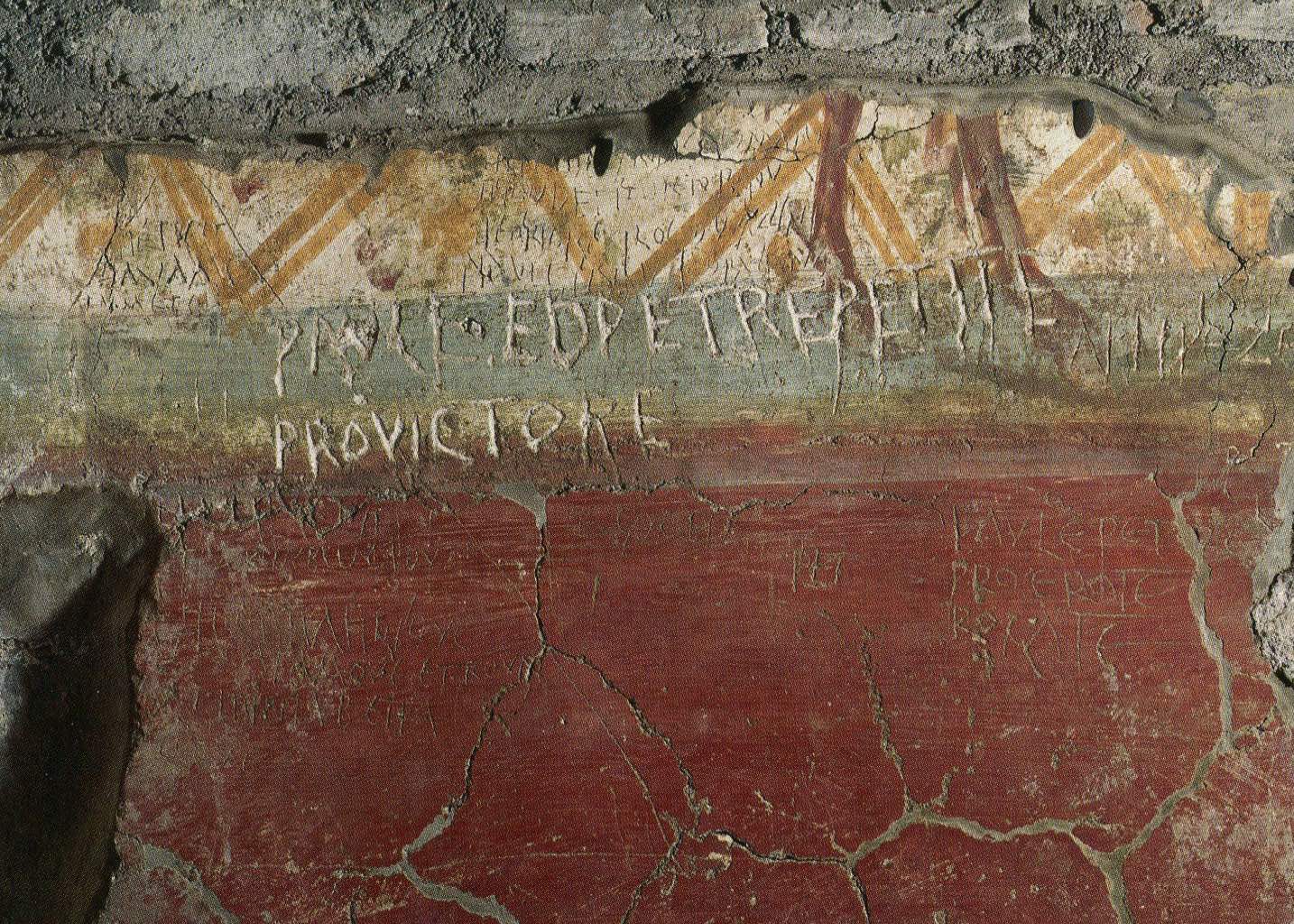
Quick questions about the Basilica of San Sebastiano fuori le mura
How much does it cost to enter the Basilica of San Sebastiano fuori le mura?
Nothing. The basilica is a parish church with free admission, with no ticket, no reservation and no turnstiles. You only pay for the guided tour of the catacombs below, which is a separate thing.
How much does the visit to the Catacombs of San Sebastiano cost?
The full ticket costs €10 and the reduced ticket €7. Buying it online through the official channel adds €2 in booking fees, for a total of €12 and €9. The price includes the guided tour: there is no entry-only ticket.
Can you visit the Catacombs of San Sebastiano on your own?
No. The rules are explicit: no one may visit the catacombs on their own or with private guides, leave the group, or follow routes that are not open to the public. You only go down with the internal guide staff.
How long does the guided tour of the Catacombs of San Sebastiano last?
About 40 minutes. The route has 70 uneven steps and runs about 10 meters below the level of the basilica.
What are the opening hours of the Basilica of San Sebastiano fuori le mura?
The basilica opens at 8.15 and closes at 19 from April to September, and at 18 from October to March.
What are the opening hours of the Catacombs of San Sebastiano?
The website of the Pontifical Commission of Sacred Archaeology gives the hours as 9.30-17.00, with last entry at 16.45 and one weekly closing day, Monday, plus a maintenance closure in the first weeks of December. It's worth checking catacombe.org before you go.
Do I need a reservation to visit the Catacombs of San Sebastiano?
It isn't mandatory, but it's a good idea on weekends and at peak times, because those who have booked and arrive on time get priority over those who show up without a booking. Tickets that have been sold are not refundable.
Can I take photos in the Basilica of San Sebastiano fuori le mura?
Inside the church, yes, with the common sense expected in a place of worship and without disturbing any services. In the Catacombs, no: photos and video recordings are forbidden, and the guide may ask anyone who doesn't respect the ban to leave.
Are the MIC Card or the Roma Pass valid at the Basilica of San Sebastiano fuori le mura?
No. The basilica is a parish church, not a museum, and the Catacombs belong to the Holy See: they remain outside the circuit of the civic and state museums. Free Sundays don't apply either.
Are the Catacombs of San Sebastiano wheelchair accessible?
No. The regulations list architectural barriers that cannot be overcome and advise against the visit even for people with serious mobility problems. The basilica above, on the other hand, is accessible.
What is the temperature in the Catacombs of San Sebastiano?
About 17 degrees all year round, with very high humidity. Even in August you'll need long sleeves.
How do I get to the Basilica of San Sebastiano fuori le mura by public transport?
By bus 118, 218 and 660. The 118 is a circular route that stops at Piramide, Circo Massimo and Terme di Caracalla, then climbs the Appia Antica as far as Villa dei Quintili. The 218 departs from San Giovanni. The 660 terminates at the Arco di Travertino station on Metro Line A.
What is the exact address of the Basilica of San Sebastiano fuori le mura?
Via Appia Antica 136, 00179 Rome, Ardeatino neighborhood. The administrative entrance to the Catacombs is at number 134.
What is the phone number of the Basilica of San Sebastiano fuori le mura?
The parish answers at 06 45430260, email info@sansebastianofuorilemura.org. For the Catacombs, the number is 06 7850350 and the email is info@catacombe.org.
Who runs the Basilica of San Sebastiano fuori le mura?
The Franciscan Friars Minor, to whom Pope Leo XII entrusted the complex on June 23, 1826. It is the first Franciscan parish in Rome, established in 1714 by Clement XI.
What are the Mass times at the Basilica of San Sebastiano fuori le mura?
Saturday at 18 in winter time and at 18.30 in summer time. Sunday at 8.30, at 10, at 12.15 and in the evening at the same time as Saturday. In July and August the 10 o'clock Mass is cancelled, and in August the 12.15 Mass is cancelled too.
What is the difference between the Catacombs of San Sebastiano and those of San Callisto?
San Callisto is larger, with over 20 kilometers of galleries across about 30 hectares, and it houses the Crypt of the Popes, with the tombs of nine popes from the 3rd century. San Sebastiano is smaller, about 12 kilometers over three levels, but it is the only one where you can see together the pagan necropolis with the three mausoleums, the Triclia of the Apostolic Graffiti, and the basilica built above it. The two complement each other. If you have time for only one, choose based on what interests you most.
Why are they called Catacombs?
Because this stretch of the Appia was called ad catacumbas, from the Greek katà kymbe, meaning "by the hollow," for the depression left by a pozzolana quarry. The nickname of this cemetery later came to refer to all underground Christian cemeteries, and from there to the whole world.
Were the Catacombs a hiding place for persecuted Christians?
No. They were cemeteries, dug outside the city walls as Roman law required, and in the earliest phase they were also used by pagans. The legend of Christians hiding in the galleries belongs to nineteenth-century imagination.
Where is the stone with the footprints of Christ?
The original, venerated by pilgrims since at least 1534, is kept in the Chapel of the Relics in the basilica. In the small church of Domine Quo Vadis, at the fork between the Appia and the Ardeatina, there is a copy.
Where is Bernini's Salvator Mundi?
In a niche on the right side of the nave, and you can see it for free. It is the Bust of the Savior, the last sculpture by Gian Lorenzo Bernini, made in 1679 and recognized as his in 2001 after two centuries during which it was considered lost.
Are the relics of Saint Sebastian still in the basilica?
Yes. They are in the urn on the altar of the Chapel of Saint Sebastian, the first on the left as you enter. They went to the Vatican in 826 and came back here with Honorius III in 1218.
Is the Basilica of San Sebastiano fuori le mura part of the Seven Churches?
Historically, yes, and it is the stop where Filippo Neri had pilgrims hear Mass starting in 1552. Since the Jubilee of 2000, many itineraries replace it with the Santuario del Divino Amore, but the original route is still followed.
Is a visit to the Catacombs of San Sebastiano suitable for children?
From six or seven years old on, it works well. Under that age, the 70 steps and the 40 minutes in line are demanding, and strollers don't fit. Children up to six enter for free, and children aged seven to 16 pay the reduced fare.
In which languages are the guided tours of the Catacombs of San Sebastiano given?
Italian, English, French, Spanish, and German. Groups speaking other languages can bring their own outside guide, but during the visit no one is authorized to translate the inside guide's commentary out loud.
How large are the groups?
As a rule they don't exceed 45 people, in proportion to the capacity of the underground spaces.
Can you visit the Basilica of San Sebastiano fuori le mura during Mass?
You can go in and take part, but it makes no sense to wander among the chapels with a camera while Mass is being celebrated. On Sunday mornings, with Masses following one after another from 8.30 to 12.15, it's better to postpone the visit to the afternoon.
Is there parking at the Basilica of San Sebastiano fuori le mura?
There is an open area in front of the church, which fills up quickly on weekends. On days when the monumental stretch of the Appia is closed to private traffic, access by car is impossible: those are the best days to come on foot or by bike.
What is the Triclia?
A trapezoidal courtyard of about 23 by 18 meters, with a covered portico, set up in the mid-third century for funerary banquets in honor of Peter and Paul. Its walls preserve hundreds of graffiti left by devotees, carved between the second half of the third century and the early decades of the fourth.
What is the Platonia?
A structure built after the Constantinian basilica, clad in marble slabs by Pope Damasus, long thought to be the place of the apostles' temporary burial. Excavations in 1892 showed that it is the mausoleum of Quirinus, bishop of Siscia in Pannonia.
How long are the galleries of the Catacombs of San Sebastiano?
The Catacombs of San Sebastiano extend for about 12 kilometers across three levels stacked on top of each other. The part open to the public is a tiny fraction of the total.
Can you bring a dog into the Catacombs of San Sebastiano?
No, the rules ban bringing animals in. They also ban smoking, eating and drinking, touching the finds, and using earphones and private radios.
Is it worth buying Online Tickets for the Catacombs of San Sebastiano?
It's worth it in busy periods, since it guarantees priority entry, but it costs €2 more per person and is non-refundable. On weekdays in the low season, you can easily buy tickets at the ticket office.
What can you see for free at the Basilica of San Sebastiano fuori le mura?
The nave with the wooden ceiling from 1612, the slab of Pope Damasus, the tabernacle attributed to Mino da Fiesole, the chapel of San Sebastiano with the recumbent statue and relics, the chapel of the Crucifix, the side altars, the presbytery with the early Christian sarcophagus and the busts of Cordier, the Salvator Mundi by Bernini, the chapel of the Relics, and the Albani chapel.
What is the best time to visit the Basilica of San Sebastiano fuori le mura?
April, May, October, and November, in the early morning or late afternoon. On January 20, the feast of the saint, the church is splendid but crowded with the faithful and poorly suited to a tourist visit.
Our verdict on the Basilica of San Sebastiano fuori le mura
Here are the facts in order, for anyone with a free afternoon who wonders whether it's worth making the trip out here. Yes, it's worth it, but not for the reasons you usually read about. The baroque church is pleasant and well proportioned, and it holds three works of the first rank: Bernini's Salvator Mundi, Giuseppe Giorgetti's recumbent Sebastian, and the early Christian sarcophagus under the high altar. Compared with the great machines of the historic center, though, that is not the reason to make the trip.
The real reason to come is that here you can see something that elsewhere can only be imagined: how a sanctuary comes into being. A disused quarry, a cemetery for wealthy pagan families, a backfilling done for practical reasons, a courtyard with benches where ordinary people ate and wrote on the wall the names of their dead, asking two apostles for help, an emperor who puts a basilica on top, a pope who carves the verses, another pope who carries off the bones, the Saracens, the Cistercians, a seventeenth-century cardinal with too much money, a very old Bernini who sculpts his own farewell, and finally a Franciscan parish that says Mass every Sunday above all of this. 1,700 years without interruption, within 30 vertical meters.
My clear opinion, and not everyone will agree. If you have to choose just one Roman catacomb and you want to be moved, go to San Callisto: the Crypt of the Popes is more solemn and the route is more grand. If you want to understand, come here. San Sebastiano is the catacomb for adults, the one that takes apart the myth of Christians hiding in the galleries and replaces it with something far more interesting, namely the true story of how a community builds its own memory.
To wrap up, just one recommendation. When you're in the Triclia, in front of that wall of graffiti, don't listen to the guide for a minute. Look for a readable inscription, decipher it letter by letter, and think about someone who carved it with a nail while eating, for a dead person they missed. Then head back up. The basilica above, with its gilded ceiling and its Bernini, you'll see differently after that minute: not as a beautiful church, but as the roof Rome built over a graffito.

Article written by the editorial team of TourLeaderPro, contact them for Private/Corporate/V.I.P. Tours and Experiences.
Are you planning a trip to Rome? The English guides to visiting the city are on ItalyPlanner.com.