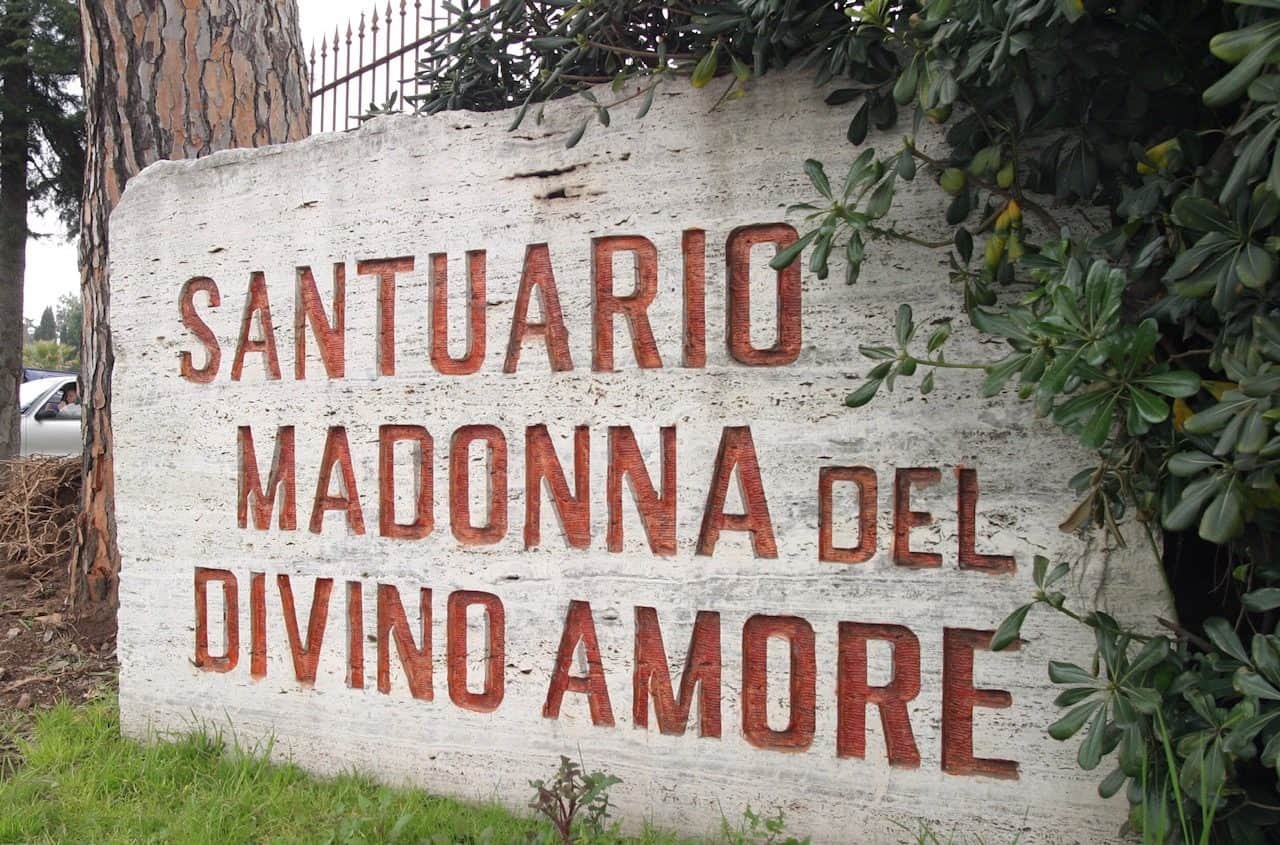
Sanctuary of the Madonna del Divino Amore
In short. There's a point on Via Ardeatina where Rome stops being Rome without anyone warning you.
There's a point on Via Ardeatina where Rome stops being Rome without anyone warning you. The Grande Raccordo Anulare is a few minutes behind you, the buildings thin out, dry-stone walls appear, bramble hedges, horses grazing behind rusty fences, and then, on a small hill to the left, a tower. A real tower, medieval, cut off at the top, with the look of something that has stayed standing by distraction. At its feet is an ocher-colored 18th-century church and, about 100 meters lower down, a white curved building that looks as if it landed there from the end of the 20th century. Together they make up the Sanctuary of the Madonna del Divino Amore: barely 12 kilometers from the Circus Maximus, and another planet.
It's a different kind of visit from the others, and it's best to know that right away. You don't come to the Sanctuary of the Madonna del Divino Amore for art history. There are worthy works, an important medieval fresco, a first-rate contemporary architecture that few know and many underrate. But that is not the reason why, every Saturday night from Easter to the end of October, a few hundred Romans set out at midnight from Piazza di Porta Capena and arrive up here at dawn with their feet in pieces. This is the place where Rome keeps its most concrete devotion, the kind that doesn't go through museums and doesn't end up in guidebooks. And it is, for anyone who wants to understand the city and not only photograph it, one of the most instructive experiences you can have within 20 kilometers of the Colosseum.
It's all here: the hill and the castle that were there before, the icon and the story of the pilgrim attacked by dogs in the spring of 1740, the church of 1745 and its century of splendor and decline, the madonnare with the porchetta, the rector who put everything back on its feet after surviving a road accident right here out front, the vow of the Romans of June 4, 1944, and what happened that evening, the new church dedicated by John Paul II in 1999, the night pilgrimage told as it really is, the open-air sanctuary dedicated to the first Roma blessed, the shrines scattered around the city and the walls papered with little plaques "per grazia ricevuta". And then the practical side: how to get there, what to expect, how to behave in a living and heavily visited place of worship, when to come and when it's better to avoid.
Where the Sanctuary of the Madonna del Divino Amore Is
The Sanctuary of the Madonna del Divino Amore stands on Via del Santuario, at Castel di Leva, in the southern quadrant of Rome, a little over a kilometer from Via Ardeatina and about 12 kilometers as the crow flies from the historic center. Administratively we are in the 23rd zone of the Municipality of Rome, Z. XXIII Castel di Leva: 81.5 square kilometers of territory, the second largest toponymic district of the city, which also includes the urban areas of Appia Antica Sud, Vallerano-Castel di Leva, Porta Medaglia and Santa Palomba. Put less bureaucratically: we are in the countryside, and the countryside here is not a leftover decoration but the ordinary condition of the landscape.
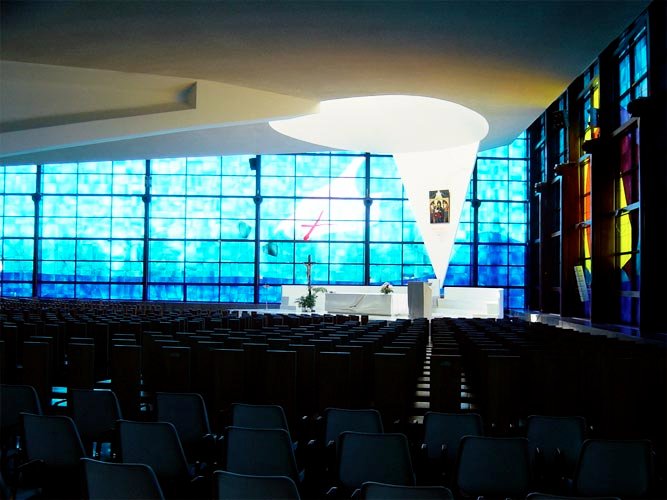
The first thing to make clear is that the sanctuary is not one church, but two. On top of the small hill, inside the enclosure of the old complex, is the 18th-century sanctuary, the one of 1745, with the icon on the high altar. At the foot of the hill, outside the old walls, is the new sanctuary, completed for the Great Jubilee of 2000 and able to hold over 1,500 pilgrims. The two churches are a handful of meters and about 250 years apart. Between them run an avenue, a square, a garden, and a difference in spiritual temperature that is worth the trip on its own: from the golden half-light of the 18th century to the light filtered through the big polychrome windows of the late 20th.
The Context: the Real Roman Countryside
Around the Sanctuary of the Madonna del Divino Amore stretches a district of meadows, rows, a sparse wood, a disused quarry, cultivated fields and the low hills typical of the southern Agro Romano. It is not an urban park or a garden: it is land that works. Whoever arrives in summer at sunset finds the swallows, the slanting light on the tuff and, with luck, that humming silence that in Rome you now hear only on the Appia Antica after seven in the evening. It is a context that has shaped the history of this place in every phase: the solitude that made it dangerous in the 18th century, the distance that made it forgotten in the 19th, and finally, in the 20th, that same distance turned into an asset, because a church in the middle of the fields is exactly what is needed by someone who walks all night to reach it.
Note the coordinates of the complex, because they say something precise: the old church stands at 41.7782 north latitude and 12.5425 east longitude, the new one at 41.7793 and 12.5424. A little more than 100 meters apart as the crow flies. In that minimal gap sits the whole story I am about to tell you: a vow made in 1944 and fulfilled 55 years later, a stone's throw from the place where everything had begun two centuries earlier.
Castel di Leva, the hill beneath the Sanctuary of the Madonna del Divino Amore
Before the sanctuary there was the castle, and before the castle there was a monastic estate. The area originally belonged to the abbey of San Paolo fuori le Mura, which held vast lands in the Agro Romano: a landholding geography that explains why so many place names in this quadrant sound like names of estates rather than of towns. On the hill, in the 13th century, there was a castrum documented under the name Castrum Leonis, the castle of the lion, from which Castel di Leva derives through Roman phonetic wear. Anyone expecting a fairy-tale manor will be disappointed and anyone expecting some ordinary ruin will be surprised: the structure was a crenellated fortress enclosing in turn a crenellated tower, surrounded by a small settlement protected by walls and defensive turrets. A fortified village in miniature, in short, like dozens around Rome.
In the 16th century the fief belonged to the Capizucchi family, a baronial Roman house with no small political weight in the city of the popes. Before and after them the property passed through the hands of more than one noble family, following the logic of the Lazio latifundium, which over the centuries has treated estates the way blocks of shares are treated today. In the 18th century, in the shadow of the by then crumbling tower, an adjacent chapel was built. And it is at that point that the story of the castle stops being a story of property and becomes a story of devotion.
The tower, the oldest piece of the Sanctuary of the Madonna del Divino Amore
The tower of Castel di Leva is still standing, inside the enclosure of the complex, and you see it as soon as you turn into the avenue. It is not restored like a monument. It is consolidated like an emotional relic. On one of its walls, in the 14th century, an anonymous painter frescoed an image of the Virgin with the Child. It was not an exceptional gesture: the towers, the bridges, the gates of the farmhouses of the Agro Romano were studded with sacred images exposed to the weather, wall protections against evil, bad weather and brigands. Of those hundreds of images, today, we know very few. One was saved, and that is why it is talked about today.
Up here the stop in front of the tower is the most important. Because it is easy to look at the new sanctuary, which is big and white and makes an impression, and forget that all this exists because of a tuff wall on which someone, 700 years ago, laid a brush. The tower is the only material witness of the phase before the cult, and it has the rare privilege of being at the same time the oldest monument and the reason for the existence of everything else.
Via Ardeatina, the road that leads to the Sanctuary of the Madonna del Divino Amore
The road that will bring you up here is 2,600 years old. Via Ardeatina, today classified as provincial road 3/e, is one of the ancient consular roads: it branched off Via Appia a short distance from the city and ran toward Ardea, which between the 8th and 6th centuries BC was one of the most important centers of southern Lazio, rich thanks to trade with the Latins, the Volsci and the Etruscans and thanks to the canal port at the mouth of the Incastro river, the Castrum Inui of the ancients. The route is recorded in the Curiosum Urbis among the roads that started from the gates of Rome, and it is cited by Rufius Festus. On its length the ancient authors happily quarrel: Strabo gives it as 160 stadia, that is 20 Roman miles, Eutropius counts 18, and the modern calculation establishes that from Rome to Ardea, by that road, there are almost 39 kilometers.
The ancient itinerary passed through the places we now call Tor Marancia and Cecchignola, reached the Solfarata, at the time a pool of cold sulfurous waters 15 miles from the city, and anyone who has passed there in summer knows the smell hasn't changed, and continued toward Ardea along a route almost identical to the modern one, crossing, four and a half miles from the end, the Numicius, which in all likelihood is the present Rio Torto. In the medieval period the road stayed in use while the places it led to were being depopulated: at the foot of the fortress of Ardea a lazaretto even arose for the lepers expelled from Rome. It is not a marginal detail. This has always been a road of the margins, of people leaving the city more than of people entering it.
Why the road matters in the history of the Sanctuary of the Madonna del Divino Amore
In the 18th century, when the devotion exploded, Via Ardeatina was in such condition that it was a serious obstacle. It took the celebrations of the centenary, in 1840, for it to be fixed up in view of the influx of pilgrims: a textbook case of infrastructure built by faith more than by administration. And even today, despite the asphalt and the Raccordo, the Ardeatina remains a narrow, winding road, with few lanes and a lot of local traffic: a practical element that will come in handy later, when we talk about how to get there.
Whoever walks on Saturday night doesn't follow exactly the ancient route, but follows its spirit: you leave the city on the side where the Appia and the Ardeatina separate, you cross the southern quadrant, and at a certain point the city ends. It's a movement Romans have been making for at least two and a half millennia, first to trade, then to bury, then to pray, today to walk. The Sanctuary of the Madonna del Divino Amore is the latest chapter, for now, of this very long habit.
The Icon of the Sanctuary of the Madonna del Divino Amore: What You're Really Looking At
Go up to the old sanctuary, go in, and raise your eyes to the high altar. The image you see is a 14th-century fresco, the work of an unknown artist, originally painted on the wall of the tower of Castel di Leva and later transferred onto a wooden support so that it could be detached and moved. From the art-historical point of view it is a Lazio icon of Byzantine descent, that is, of that strand of medieval Marian painting that in Rome and Lazio produced works of enormous iconic force and very little fame. It shows the Virgin seated on a throne with the Child: a frontal, hierarchical composition, built to be looked at from far away and from below, the way you look at an image above a door or on a tower.
The detail that gives its name to everything, the dove of the Holy Spirit above the Madonna's head, deserves a clarification that almost nobody will give you. The dove does not belong to the original fresco: it is a later addition, datable around the middle of the 18th century, that is, to the years when the cult was taking shape and a visual sign was needed to explain the title of Divino Amore. The Holy Spirit, in theology, is the Love of the Father and the Son: the dove above the Virgin declares the bond between Mary and the Spirit, and it is exactly on this bond that Benedict XVI built his speech when he came up here in 2006. It is an addition, then, but not an embellishment: it is a painted theological gloss.
The Three Stars and the Other Signs
On the image appear three stars, according to the grammar of Byzantine iconography: one on the forehead and one on each shoulder of the Virgin, though not always all visible depending on the state of conservation and the coverings. They signify Mary's virginity before, during and after the birth: a dogma condensed into three points of light, which is the way medieval art did theology without writing a line. For those unfamiliar with Eastern iconography, this is the moment when a light bulb usually goes on: an icon is not a painting, but a text.
The image, like all venerated images, has undergone additions, coverings, crowns, drapes and restorations over the centuries. It's the normal fate of objects of active worship, which do not live in a temperature-controlled case but inside a relationship: they are kissed, looked at, carried in procession, adorned, crowned. An art historian would call it a conservation problem. It is the proof that the object is still alive. At the Sanctuary of the Madonna del Divino Amore the icon is not a collection piece: it is the reason for the building, and you can see it.
The Spring of 1740: the Pilgrim, the Dogs and the Birth of the Sanctuary of the Madonna del Divino Amore
Here is the story from which everything comes, told for what it is: a tradition, handed down orally and put in writing later, of which we don't even know the protagonist's name. That is not a flaw. It is the typical structure of founding legends, and the fact that the protagonist stays anonymous is, if you think about it, the reason the story worked: anyone can put themselves in his shoes.
In the spring of 1740 a pilgrim heading for the basilica of Saint Peter got lost in the inhospitable and unhealthy countryside near Castel di Leva, about 12 kilometers south of Rome. Keep in mind what the word countryside meant then, around here: endemic malaria, isolated farmhouses, brigands, no signposts, no light after sunset. The traveler spotted some farmhouses and a ruined castle on top of a hill and headed toward it hoping to find someone to point him to the right road. Instead he found a pack of rabid dogs that surrounded him.
Looking up, with the instinctive reflex of someone looking for an escape route upward, the man noticed that on the tower of the castle there was an icon of the Virgin with Child surmounted by the dove of the Holy Spirit. He called on the Madonna to save him from that danger. And the beasts on top of him, suddenly, stopped and vanished. The shepherds of the area, drawn by the screams, ran up, listened to his account and put him back on the road to Rome. The pilgrim's name is unknown. The news of what had happened, on the other hand, reached the city in very little time, and in very little time the icon of the Madonna at Castel di Leva became a pilgrimage destination.
Why This Story Took Root
A possible reading, which takes nothing away from the tale and in fact makes it more interesting. The strength of this episode lies in its complete ordinariness: there is no vision, no message, no visionary. There is a man lost in the middle of nowhere who risks being torn apart and who, raising his eyes, sees an image on a wall. No extraordinary element except the outcome. It is a story that spoke directly to those who, in the Rome of the 18th century, crossed the Agro out of necessity: shepherds, carters, seasonal reapers, merchants, poor pilgrims. People who knew stray dogs and the risk of getting lost very well.
The second reason is chronological. 1740 is the year Benedict XIV, Prospero Lambertini, rises to the papal throne, one of the most intelligent and most rigorous popes of the century in matters of cults and miracles: it was he, as archbishop and then as pontiff, who codified the procedures by which the Church evaluates canonizations and prodigies. That a cult born in those years not only survives but receives papal concessions is a fact worth keeping in mind. The Sanctuary of the Madonna del Divino Amore was born in the middle of the most skeptical century modern Catholicism had known up to then, and passes the exam.
From Santa Maria ad Magos to the First Church of the Sanctuary of the Madonna del Divino Amore
Between the miracle and the sanctuary pass five years, and they are eventful years. On September 5, 1740, just a few months after the episode, the icon was detached from the tower and taken to the nearby estate called "La Falconara", where the little church of Santa Maria ad Magos stood. The reason is the most prosaic in the world: a fresco exposed to the elements on a ruined tower, with a growing flow of people climbing up to pray in front of it, is at once fragile and unmanageable. A roof was needed.
Santa Maria ad Magos was therefore the first sanctuary of the Divino Amore, a function that very few remember and that deserves a paragraph. The church stood inside an enormous estate that, already in the 15th century, included farmhouses and rural properties belonging to several noble Roman families. Today it is in the Falcognana area, and it is in such condition that whoever looks at it from far away mistakes it for any agricultural ruin. Inside you can still make out the altar at the back, while of the original decoration almost nothing remains. In recent decades the abandoned church has become a field of intervention for Roman street art: above the altar stands a large mural, and in the side niches representations of the deadly sins have appeared. It is a curious and in some ways moving fate, which says a lot about how Rome treats its disused buildings: never demolished, never restored, simply reinhabited by someone else.
April 19, 1745: the Icon Comes Home
On April 19, 1745, Easter Monday, the icon was transferred to a place near the tower, where in the meantime a new church had been built. The fresco was enthroned on the high altar, where it still is today. The choice of date was no accident: Easter Monday, in Rome, had for centuries been the day of the outing beyond the walls, the day the city emptied out toward the Agro. Whoever organized the transfer knew perfectly well what he was doing.
Participation was such, people who came from Rome and from the nearby Castelli Romani, that Pope Benedict XIV decided to grant the plenary indulgence not only for the day of the transfer, but also for the seven following days. Whoever is not familiar with ecclesiastical language risks missing the weight of the thing: a plenary indulgence extended to a whole octave is a heavy recognition, which in effect certifies the new sanctuary as a legitimate destination and places it in the devotional calendar of the city. Within five years, the Sanctuary of the Madonna del Divino Amore goes from an image on a tower to an institution.
The 18th-Century Sanctuary of the Sanctuary of the Madonna del Divino Amore
The old church was built around 1744-1745 on the ruins of the castle, in a dominant position on the hill. The name of the architect is not documented with certainty: local tradition and part of the literature have put forward the name of Filippo Raguzzini, the Beneventan who became a Roman by adoption and who in Rome signed Piazza Sant'Ignazio and the hospital of San Gallicano, that is, one of the most elegant and least pompous interpreters of the city's late Baroque. The attribution should be taken for what it is, a hypothesis, but it is not far-fetched: the taste for sober solutions, the contained scale and the scenic handling of the relationship with the landscape are consistent with that language.
What you see today is a church of modest size, with a simple facade, an interior with a single nave, a high altar that frames the icon and side altars added over the course of the 19th century. It is a country Baroque, without princely marbles and without pretensions: stucco, gilding, wood, and that lukewarm half-light that in small churches creates itself. Whoever arrives here after three days among Saint Peter's, Sant'Ignazio and the Gesù feels a clear change of register, and almost always finds it a relief.
The Relationship Between the Church and the Tower
The smartest thing about the old sanctuary is its position. It wasn't built on the tower or in place of the tower, but next to it: the image was carried down a few meters, into a new building, leaving the witness standing. In sacred urban planning this is a rare gesture. Usually the sanctuary cannibalizes the place of the event. Here instead the two elements coexist, and the visitor can still walk from the church to the tower in 30 seconds, reconstructing the sequence of events with their feet. It is a quality that was kept in the 20th-century phase too, as we'll see: the new sanctuary also was built next to and not on top.
It's also worth noting the relationship with the landscape. From the churchyard of the old sanctuary the gaze runs over the countryside, the fields, the hills toward the Castelli. On clear days you can make out the outlines of the Colli Albani. Whoever has arrived on foot after a night of walking, and turns around at dawn, has exactly this in front of them: the light rising from the side of the Castelli and Rome left behind, invisible. I don't believe they designed it that way in 1745. But it works.
Brigands, Hermits and Pentecost: the Difficult First Decades of the Sanctuary of the Madonna del Divino Amore
Building a church is one thing. Keeping it open in the middle of nowhere is another. The custody of the new sanctuary proved problematic at once, given the isolated position, easy prey for bandits and brigands. Dozens of religious orders were approached, and none felt up to accepting the job. I invite you to dwell on this detail, because it is less of a postcard than it seems: it means that in the second half of the 18th century, 12 kilometers from Saint Peter's Basilica, there was a territory that the Roman religious orders considered too risky for a stable community. The Agro Romano was not the gentle countryside of the prints: it was a malarial, depopulated land, with no effective authority after sunset.
The solution was the minimal one: first a hermit custodian, then, from 1805, priests who lived there only in the period of Pentecost, that is, when the pilgrimages were at their largest. An intermittent sanctuary, in short, open when needed and left to itself for the rest of the year. It is a management model that seems absurd to us today and that then was simply realistic.
Why Pentecost in Particular
The concentration of pilgrimages around Pentecost is not accidental and remains, still today, the key to the calendar of the Sanctuary of the Madonna del Divino Amore. The feast falls between May and June, 50 days after Easter: a season when the Roman countryside is at its best, the days are long, malaria has not yet done its worst of the summer and farm work grants a truce. But above all Pentecost is the feast of the Holy Spirit, and it is impossible not to link it to the title of this sanctuary and to the dove painted above the icon. The bond between Mary and the Spirit is the theological key of the whole place, and Pentecost is its liturgical translation.
Still today, if you come in that period, you find the sanctuary at its moment of maximum intensity, with the largest influx of the year. Whoever is looking for recollection would do well to choose another weekend. Whoever instead wants to understand what Roman popular devotion is has to come exactly then.
1840: the Centenary, the King in Exile and the Madonnare
In 1840, the year of the first centenary of the miracle, the sanctuary received the full treatment. The church and the altar were restored, the stuccoes regilded, two more altars and many confessionals were installed. Drapes, damasks and other sacred furnishings were brought from Rome. Via Ardeatina too, reduced to terrible condition, was fixed up for the occasion. The celebrations began on June 7, 1840, Pentecost Sunday, and continued for seven days.
Don Miguel, King of Portugal, also took part in the feast, living at that time in exile after losing the Portuguese civil war: a detail that says how far the sanctuary, at that moment, had entered the circuit of international legitimist and aristocratic devotion. It is one of the rare moments when this country church appears in a court chronicle.
Porchetta, Pecorino, Fava Beans and Wine
Right after the centenary, however, a different season opens. Around the sanctuary, especially in the days near Pentecost, stalls of porchetta, pecorino, fava beans and wine began to be set up. With the stalls came the phenomenon of the madonnare: Roman women of the people, mostly vegetable sellers and washerwomen, who celebrated their own special annual feast precisely on Pentecost Monday, going up to the Divino Amore in a group, with carts, singing.
Better not to dismiss this story as folklore. The madonnare were women who worked 12 hours a day with their hands in cold water or behind a vegetable stand, and who once a year took a whole day for themselves: dressed well, in a group, outside the city, with wine and porchetta, in front of a sacred image they considered theirs. It is one of the few forms of organized leisure that pre-industrial Rome granted its working women, and the fact that it went through religion does not make it less significant from the social point of view. The Sanctuary of the Madonna del Divino Amore was, for a good century, also this: the place where the women of the Roman people had a right to a feast.
The Decline and Rebirth of the Sanctuary of the Madonna del Divino Amore
The mixing of sacred and profane had a price, though. In the early decades of the 20th century the pilgrimage to the Divino Amore had by then become a synonym for an outing beyond the city gates, and the sanctuary slid into a progressive decline until it almost fell into oblivion. It is a passage that repeats often in the history of popular places of worship: when the feast eats the devotion, the ecclesiastical institution moves away, and when the institution moves away the building decays.
The turning point comes in 1930, when the sanctuary passes under the dependence of the Vicariate of Rome and a rector is sent to the site, with the obligation to reside. Two years later, on December 1, 1932, Cardinal Vicar Francesco Marchetti Selvaggiani establishes here the parish of Santa Maria del Divino Amore at Castel di Leva with the decree Cum Summus Pontifex, by virtue of the apostolic letter of Pope Pius X Quamdiu per agri romani of May 24, 1912, the measure with which the Holy See had begun the ecclesiastical organization of the Agro Romano. The rector becomes also pastor: the sanctuary stops being a seasonal destination and becomes a community.
Don Umberto Terenzi, the Man Who Put Everything Back on Its Feet
The first rector was a young priest, don Umberto Terenzi, born in 1900 and dead in 1974, who had survived a road accident right near the sanctuary. The biography says it in a line, but it's worth stopping on it: the man who rebuilt the Sanctuary of the Madonna del Divino Amore came here for the first time because he had almost died here. From that episode came a personal bond that turned into a life program of 40 years.
Terenzi found himself facing a half-abandoned church in a poor rural territory, with rural schools without catechists, without stable clergy, without works. Within 40 years he made it a center with two religious congregations, a seminary, educational and welfare works and a steady flow of pilgrims. His canonization process is now under way. When John Paul II, in 1999, dedicated the new church, he expressly remembered him as the one who "with tenacity wanted a new home here for the Blessed Virgin": the home that Terenzi never managed to build, and which was built 25 years after his death.
The Oblates and the Daughters of the Madonna del Divino Amore
The Sanctuary of the Madonna del Divino Amore is kept and animated by two religious families, both born here, and it's worth knowing who the people you will meet are.
The Daughters of the Madonna del Divino Amore, who add the initials F.M.D.A. after their names, were founded by don Umberto Terenzi for a very concrete reason: he couldn't find catechism teachers for the six rural schools of the area. He then turned to five young women he had met when he was assistant pastor of Sant'Eusebio at Piazza Vittorio, activists in Catholic Action: Antonietta Fabbri, Maria Fasuli, Adelaide Guidotti, Elena Pieri and Franca Salfa. In May 1934 the community settled in a farmhouse near the sanctuary and, with the approval of Cardinal Marchetti Selvaggiani, gave rise to the congregation.
From Five Catechists to an International Congregation
The institutional path is the classic and fairly quick one: recognition as a pious association by decree of March 25, 1942, the day on which the first 10 Daughters of the Madonna del Divino Amore were admitted to the profession of religious vows. Erection as a religious institute of diocesan right on August 5, 1959. Elevation to an institute of pontifical right by decree of August 5, 1961. Today the sisters devote themselves to caring for the sick in hospitals, to education in nursery schools, to catechesis in parishes, to youth ministry and to hospitality in houses of spirituality, and they are present not only in Italy but also in Brazil, Colombia, the Philippines, India and Peru. At the end of 2008 the congregation counted 205 sisters in 38 houses, and the general headquarters is on Via Ardeatina.
Alongside them work the Oblate Sons of the Madonna del Divino Amore, the male branch, born after the war with the seminary that Terenzi wanted here and which since then has kept and animated the sanctuary. They are the priests who hear confessions, celebrate, welcome the night pilgrims at dawn and keep running a machine that, on the weekends of May, moves numbers of a major event. If you get the impression that the place works with a precision unusual for Italy, it is no accident: these are people who have done this job for almost a century.
January 1944: the Icon of the Sanctuary of the Madonna del Divino Amore Enters the City
We come to the chapter that explains why this country sanctuary occupies, in the memory of Romans, a place that no tourist guide grants it. The events of the Second World War involved the Madonna del Divino Amore too, and directly.
In the aftermath of September 8, 1943, the area of the sanctuary was bombed. We are in the southern quadrant, on the route to Anzio and the front, in an area crossed by troop movements and dotted with military targets: the countryside that had protected the sanctuary for two centuries suddenly put it on the front line. On January 24, 1944, two days after the Allied landing at Anzio, the icon was taken to Rome to keep it safe.
From Vicolo del Divino Amore to Sant'Ignazio
The image was welcomed triumphantly in the city by the people and placed first in the little church of the Madonna del Divino Amore, which stands near Piazza Fontanella Borghese, on Vicolo del Divino Amore: a small street that you cross absentmindedly today on the way to the Pantheon or Via del Corso, and which bears this name for exactly that reason. It is one of those Roman place names that seem poetic and are instead administrative.
Soon the space was no longer enough. In May, given the enormous influx of faithful, the icon was moved to the larger basilica of San Lorenzo in Lucina. Pope Pius XII, seeing the imminence of the battle for Rome between the Germans and the Allies, solemnly invited the Romans to pray for the salvation of the city during the octave of Pentecost and the novena of the Madonna del Divino Amore, begun that year on May 28, 1944. The attendance at San Lorenzo in Lucina grew to such a point that they were forced to move the image again, this time to the great church of Sant'Ignazio di Loyola at Campo Marzio. To give an idea of the proportions: La Civiltà Cattolica reports 15,000 communions distributed daily. 15,000 a day, in a hungry, occupied city under curfew.
June 4, 1944: the Vow of the Romans to the Madonna del Divino Amore
On June 4, 1944, the day the octave ended, the fate of Rome is decided. At 18:00, in the packed church of Sant'Ignazio, the text of the vow of the Romans to the Madonna del Divino Amore is read, so that the city may be spared the destruction of war. The faithful promise three things: to correct their moral conduct, to build a new sanctuary and to carry out a work of charity at Castel di Leva.
There are two details in this scene that tell the era better than any commentary. The first is that the vow is expressed in great haste, because at 19:00 the curfew would begin: a solemn promise delivered with watch in hand. The second is that the one who reads the text, in place of the Pope, who could not leave the Vatican because of the danger of deportation, is the camerlengo of the parish priests of Rome, father Gremigni. The pontiff couldn't leave his house. The city entrusted itself to a parish priest.
That same evening the Germans left Rome. The Allied troops entered the city from Porta San Giovanni and Porta Maggiore, welcomed by demonstrations of joy. In the speech he gave up here in 1999, John Paul II recalled that the German army abandoned Rome without putting up resistance "a little more than an hour after the reading of the vow".
How to Treat This Episode
Here we need to explain without simplifying. The German retreat from Rome on June 4, 1944, is a historical fact documented in every detail, and its military and diplomatic causes have been reconstructed by historians: the decision not to defend the city, the declaration of an open city, the pressure of the Holy See and the Allies, the situation of the front after the breakthrough of the Gustav line and the conquest of Cassino. No serious historian explains the retreat with the vow read at Sant'Ignazio.
But that is not the question. The question is that that evening, in a city exhausted by nine months of occupation, a vast number of Romans were convinced they had obtained something, and that conviction produced verifiable material consequences: two congregations, a church with 1,500 seats, a home for the elderly, a weekly pilgrimage that has lasted for generations and a devotion that in Rome has no equal in popular continuity. The vow of June 4, 1944, is the founding document of the contemporary Sanctuary of the Madonna del Divino Amore. Its theology can be debated. Its historical effect cannot be ignored.
Savior of the City: June 11, 1944, and the Title of the Madonna del Divino Amore
On June 11, 1944, a week later, Pope Pius XII was finally able to leave the Vatican and go to the church of Sant'Ignazio, as a great many Romans had done for over four months, to celebrate a Mass of thanksgiving to the Madonna del Divino Amore. On that occasion the image was given the title of Salvatrice dell'Urbe.
In the homily the pontiff spoke words worth quoting, because they are the most authoritative text that exists on this affair: "Today we are here not only to ask Her for her heavenly favors, but first of all to thank Her for what has happened, against human predictions, in the supreme interest of the Eternal City and its inhabitants. Our Immaculate Mother has once again saved Rome from gravest imminent dangers. She has inspired, in those who held its fate in their hands, particular feelings of reverence and moderation, so that, in the changing of events, and even in the midst of the immense conflict, we have been witnesses of a safety that must fill our soul with tender gratitude toward God and his most pure Mother."
A Title That Carries Weight
Notice the wording: "has inspired, in those who held its fate in their hands, particular feelings of reverence and moderation". It is a highly refined diplomatic language, which implicitly acknowledges the role of human decisions and places them inside a providential frame. Pius XII does not say that the vow moved the troops. He says that Marian protection acted through the choices of those in command. It is a precise theological distinction, and the Romans, with the pragmatism that marks them, translated it into a much simpler formula: the Madonna del Divino Amore saved Rome.
The title of Savior of the City places this image in illustrious company, next to the Salus Populi Romani of Santa Maria Maggiore and the Crucifix of San Marcello al Corso, that is, the other two icons to which the city turned in moments of extreme danger. But with a substantial difference: the other two stand in the heart of the historic center, this one stands 12 kilometers away, in the middle of the fields. And every Saturday night, to get there, people walk.
The Fulfillment of the Vow: Why the Sanctuary of the Madonna del Divino Amore Has Two Churches
Once the war was over, under the impulse of don Umberto Terenzi, the sanctuary is reborn: the seminary of the Oblates of the Divino Amore is born, the congregation of the Daughters is consolidated, the works of charity around the sanctuary take shape, the nursery school, the hospitality and care of girls in difficulty. Two of the three commitments of the vow, the work of charity and, as far as possible, the conversion of customs, are started right away.
The third, the construction of the new sanctuary, proves the hardest. Terenzi tried for his whole life, and didn't succeed: bureaucratic and logistical difficulties always prevented him. He died in 1974 leaving the vow unfulfilled. Consider it for a moment from his point of view: 40 years of work, two congregations founded, a sanctuary raised from oblivion, and the one thing the city had publicly promised the Madonna remains a project in a drawer.
1996: the First Stone
We have to wait until January 8, 1996, for Cardinal Vicar Camillo Ruini to lay the first stone of what, in view of the Jubilee of 2000, would become the new sanctuary. 52 years after the vow. 22 years after Terenzi's death. It is not just any delay: it is the measure of how hard it is, in a city like Rome, to go from a collective promise to a building site.
The basic design choice was made well, and should be acknowledged. The new structure was built at the foot of the hill, outside the old walls, so as not to violate either the landscape of the Roman countryside or the 18th-century monumental complex. No demolition, no raising, no invasive enlargement of the old church. The two eras coexist at a safe distance, and whoever visits the Sanctuary of the Madonna del Divino Amore can read them side by side like two chapters of the same book.
The New Sanctuary: Costantino Ruggeri and Luigi Leoni
The project was entrusted to a pair of authors who deserve to be known far more than they are. Father Costantino Ruggeri, born at Adro in the province of Brescia in 1925 and dead in 2007, was a Franciscan friar and priest, but also a painter, sculptor and above all stained-glass maker: one of those religious artists who in 20th-century Italy kept the thread between the Church and contemporary art together, almost alone. Having entered the seraphic seminary in 1938, he was ordained in 1951 by Cardinal Ildefonso Schuster. He studied sculpture at the Accademia di Brera in Milan, graduating in 1962 under the guidance of Luciano Minguzzi.
His training was not at all provincial. Ruggeri frequented and knew figures like Mario Sironi and Lucio Fontana, worked as a liturgical consultant with the architect Luigi Figini on the church of the Madonna dei Poveri, and in 1960 met Le Corbusier through the Ufficio Nuove Chiese of Bologna. Whoever looks at the Divino Amore sanctuary thinking of a generic devotional building would do well to know it: behind those curves is an architectural culture that comes from the heart of European modernism.
The Partnership With Luigi Leoni
The decisive relationship of Ruggeri's professional life was the one with the architect Luigi Leoni, begun when the friar moved to the convent of Pavia in 1959. Together they designed over 30 churches in Italy and abroad, with a recognizable signature: sculptural volumes, white surfaces, and big stained-glass windows that turn natural light into the main building material. Among their works are Santa Maria della Gioia in Varese, from 1977, and Santo Spirito in Pavia, from 1982. The Sanctuary of the Madonna del Divino Amore, from 1999, is the last great episode of that collaboration and the most visited of all.
In 1995 Ruggeri founded the Fondazione Frate Sole, meant to promote excellence in sacred architecture through an international prize awarded every four years starting in 2006. It is a coherent legacy: an artist who spends his life building churches and who in the end establishes a prize to convince others to build them better.
July 4, 1999: the Dedication of the New Sanctuary of the Madonna del Divino Amore
The new sanctuary was completed in the summer of 1999 and dedicated to worship on Sunday, July 4, 1999, by Pope John Paul II, with a solemn Eucharistic concelebration. It is a fact worth fixing precisely, because it is the moment when the vow of 1944 is formally fulfilled in its most visible part.
In the homily the Pope was explicit: "With the dedication of this new Sanctuary a vow is today partially fulfilled that the Romans, invited by Pope Pius XII, made to the Madonna del Divino Amore in 1944, when the Allied troops were about to launch the decisive attack on Rome occupied by the Germans". And he recalled that the work of charity was about to be completed: a home for the elderly not far from the sanctuary. But he immediately added that the vow included a promise that does not end and that is much harder to fulfill, namely the correction of moral conduct, "the constant commitment to renew life and make it ever more conformed to that of Christ".
Who Was There That Day
The Pope greeted Cardinal Vicar Camillo Ruini, the cardinals, the bishops, the priests and the rectors of other Marian sanctuaries present. The rector-pastor of the sanctuary, don Pasquale Silla, "who did so much to reach this day". The sons and daughters of the Madonna del Divino Amore who keep these places, continuing the work of their founder don Umberto Terenzi. And finally he greeted, with an explicit mention, "the designers and builders of this work: Father Costantino Ruggeri and the architect Luigi Leoni, together with all the benefactors, the companies and the workers".
In the same homily John Paul II spoke of the building as a sign: "These walls that circumscribe the sacred space in which we are gathered and, even more, the altar, the great polychrome windows and the other religious symbols stand as signs of the presence of God in the midst of his people". The great polychrome windows cited by the Pope are Ruggeri's signature, and they are the reason I advise you to enter the new church on a sunny day and not on a rainy one.
How to Read the Architecture of the New Sanctuary of the Madonna del Divino Amore
Here are a few keys, because the new church is one of those buildings that defend themselves poorly on their own. Whoever arrives with the idea of a church as nave, columns and apse in their head finds it alienating. Whoever looks at it for what it is, that is, a late 20th-century architecture conceived by a sculptor, finds it extraordinary.
The first thing to observe is the relationship with the hill. The building leans against the foot of the slope, in a deliberately subordinate position: it does not compete with the old sanctuary above, does not steal its scene, does not try to dominate the landscape. In an age when new sanctuaries tend toward gigantism, this is a choice of design modesty that should be acknowledged. The volume develops horizontally and in a curve, with white, light surfaces that reflect the light of the countryside.
Light as a Material
Costantino Ruggeri was a stained-glass maker even before being an architect, and in his work light is not an effect but a load-bearing structure. The great polychrome windows that John Paul II cited in the homily of the dedication are not decorated windows: they are the devices that determine the character of the interior space at every hour of the day. If you go in at mid-morning, with the sun still low in the east, you will have a completely different church from the one you would find in the early afternoon. It is an architecture that changes, and that has to be seen at least twice to be understood.
The second key is the capacity. 1,500 pilgrims and more is not a decorative number: it is the requirement the project started from. The Sanctuary of the Madonna del Divino Amore has to be able to welcome, on peak days, enormous crowds, and has to do so while keeping recollection. The solution adopted is a wide, unified space, without columns that obstruct the view, with the assembly arranged so as always to have the altar before its eyes. It is the architectural translation of the liturgical reform of Vatican II, applied with intelligence and without coldness.
What to Look For When You Go In
Look at the altar and its relationship with the light that comes down from above. Look at the way the floor guides toward the presbytery. Look at the materials: few, light, not precious. And then go out and walk around the building on the outside, because the sculptural form is understood only by walking around it: it is a sculpted volume, not one drawn in plan. Whoever limits themselves to going in, sitting and leaving takes away half the project.
One last observation. The contrast between the two churches is not an accident: it is a value. Above, the golden 18th century, small, warm, with the icon set like a gem. Below, the white 20th century, wide, luminous, welcoming the crowds. The two architectures answer two different needs and coexist without canceling each other. It is exactly what a sanctuary should do, and rarely manages.
The Night Pilgrimage on Foot to the Sanctuary of the Madonna del Divino Amore
If I had to choose a single thing to tell about this place, I would choose this one. Every Saturday, from the first after Easter to the last in October, a night pilgrimage on foot is held, leaving at midnight from Piazza di Porta Capena, near the Circus Maximus. You walk 14 kilometers through the southern periphery and then the countryside, and you arrive at the sanctuary at dawn, where the pilgrim's Mass is celebrated.
Stop a second on these facts. Every Saturday. For six months a year. On foot. At night. For decades. It is not a historical reenactment organized by a cultural association, it is not an event with a ticket and a T-shirt, it is not a sports walk. It is an uninterrupted devotional practice that a part of the city carries on with a constancy that has no equivalent in any other major Western European capital.
Who Really Walks
The makeup of the group changes from week to week and is more varied than you would imagine. There are whole parishes with their own pastor, there are youth groups, there are families, there are elderly people who have done it for 40 years, there are people who walk alone in silence for reasons they tell no one, there are communities of Catholic immigrants, Filipino, Latin American, African, Eastern European, who have adopted this Roman tradition and are today an essential component of it. The night pilgrimage to the Sanctuary of the Madonna del Divino Amore is one of the very few places in Rome where the real city and the devout city coincide without mediation.
The phenomenon has also drawn the attention of scholars. The sociologist Carmelina Chiara Canta devoted a whole volume to it, Sfondare la notte. Religiosità, modernità e cultura nel pellegrinaggio notturno alla Madonna del Divino Amore, published by Franco Angeli in 2004: if the subject really interests you, it's the reading to start from. The title, incidentally, is one of the best summaries of what it means to walk those hours.
What It Feels Like, Honestly
The first two hours are the strangest, because you cross a city that doesn't entirely sleep: bars closing, people coming home, flashing traffic lights, someone who looks at you badly because you are a noisy group in the middle of the night. Then the city thins out, the lights grow sparse, and toward 3:00 you enter a different dimension: you walk in the dark, often in single file at the edge of the road, with flashlights and reflective vests. It is the hard part, the one where the feet begin to protest and conversation dies down.
The last stretch is the one nobody forgets. The sky begins to lighten behind the Castelli, the countryside becomes visible, the air turns cold and damp, and at a certain point, behind a bend, the silhouette of the sanctuary appears. Whoever arrives up there, believer or not, Roman or not, almost always has a particular expression on their face. The dawn Mass, after 14 kilometers of darkness, has a weight that no Sunday liturgy can have. Then there is coffee, and your feet hurt for two days.
Practical Tips for the Night Pilgrimage to the Sanctuary of the Madonna del Divino Amore
If you decide to walk, here is what I would tell a friend, and what nobody tells you before the first time.
Shoes are everything. 14 kilometers on asphalt, at night, with cold legs, are harder than 20 kilometers of mountain trail at 9:00 in the morning. Use shoes already broken in, never new ones, and socks that don't wrinkle. Bring a second pair of socks in your backpack: changing them halfway is one of the few luxuries available. A preventive bandage on your heels before leaving will spare you many regrets.
Clothing and Gear
Even in June, the Roman countryside at 4:00 in the morning is cold and damp. Dress in layers: you start out hot and arrive chilled. A light windproof shell, always. A headlamp or a small flashlight, because stretches of the route are not lit and the phone runs down. Something reflective on you, not out of scruple but because you walk on roads open to traffic, and Saturday night traffic is not the most prudent in Rome. Enough water and something sugary: the drinking fountains along the route are not guaranteed.
The backpack should be light. Every kilo you load you'll pay for in the last three kilometers, with interest. Bring an ID, a charged phone, a small power bank, and money for a coffee and for the way back.
The Return, the Real Problem
This is the part almost everyone underestimates. You arrive at dawn, attend Mass, and then you have to get back to Rome with wrecked legs. The Sanctuary of the Madonna del Divino Amore is not served by convenient public transport, and early Sunday morning the situation is even thinner. Organize beforehand: many parish groups arrange a bus for the return, others coordinate with cars left at the sanctuary the evening before and drivers who go down to the city by car. If you go alone, count on a taxi or a ride, and check in advance the coverage of the service at that hour and in that area. Walking 14 kilometers and then being stuck for two hours on a square is the worst possible end to a good night.
Last piece of advice, the most important: don't treat it as a performance. It is not a race, it is not a trek, it is not content. It is a gesture that a great many people perform for serious reasons, often painful ones. If you come out of curiosity, and it is a legitimate curiosity, of course, walk in silence, keep your phone in your pocket and let the group set its own rhythm. You will come away with much more than what you came looking for.
The Sacred Representation of Via Crucis at the Sanctuary of the Madonna del Divino Amore
There is a second appointment that fills these hills, and it belongs to Holy Week. Every year, on Palm Sunday and Good Friday, the Sanctuary of the Madonna del Divino Amore stages a spectacular open-air theatrical performance, known as the Sacra Rappresentazione della Via Crucis del Divino Amore. It is held at night, on the hills surrounding the sanctuary, and more than 200 people perform in it, unpaid.
The script retraces the last events of the life of Jesus: the triumphal entry into Jerusalem, the Last Supper, Judas's betrayal and the arrest, the trial before the Sanhedrin, the questioning by Pontius Pilate, the flagellation and the crowning with thorns, the presentation of the Ecce Homo before the crowd and the choice of Barabbas, the climb to Calvary under the weight of the cross, the meetings with the Madonna, the pious women and Veronica, and finally the crucifixion between the two thieves, the death, the resurrection and the ascension.
Why It Works
The scene is made particularly effective by the presence of Roman soldiers on horseback, by the fires that light the night, by the full moon, which in Holy Week exists by definition, Easter being fixed on the full moon following the spring equinox, by the many special effects and by the actors' costumes. Whoever is used to village sacred plays expects a living nativity scene and finds instead a production of considerable scale, with a serious technical setup and scores of extras.
A note that concerns anthropology more than liturgy. 200 people who every year, for free, learn a part, sew a costume, train a horse and perform in the cold at night in front of a great many spectators, are a community telling itself its own founding story. It is the same mechanism that made the confraternities work in Rome, and which today survives in very few places. Here it is alive, and doesn't need anyone to come and explain it to them.
The Romani Sanctuary, the Lesser-Known Place of the Sanctuary of the Madonna del Divino Amore
In the vast district of the Divino Amore, on a small hill outside the enclosure of the sanctuary, there has been since 2004 an utterly singular open-air place of worship, called the Romani sanctuary. It is dedicated to Blessed Zeffirino Giménez Malla, a Catholic Gitano shot in 1936 during the Spanish Civil War and beatified in 1997: the first Roma in history raised to the altars.
The space is essential and beautiful in its bareness. It is a circular area bounded by a few tuff walls that define the minimal elements of worship: two jambs that mark the entrance, two hemicycles with double steps for the faithful, a central altar, an ambo and a cross in rough wood. At the back, at the apsidal point, a bronze sculpture depicts the titular blessed. The decorative elements are very few: besides the bronze, some ceramic panels with the symbols of the evangelists on the ambo and a majolica in memory of the 500,000 Roma exterminated by Nazism.
May 4 and the Long Roma Presence
On May 4 a pilgrimage of Catholic Roma and Sinti is held there every year. It is not an initiative handed down from above: nomadic communities already frequented the old sanctuary, and the construction of this space in 2004 gave stable form to a presence that had been there a long time. Whoever knows the history of relations between Rome and the Roma communities knows how rare it is to find a public place where that presence is recognized, named and honored instead of tolerated.
It's always worth going up here, and almost always there is nobody. It is a piece of the Sanctuary of the Madonna del Divino Amore that no guide points out, that no bus reaches and that is worth the quarter hour of uphill walking it requires. The majolica with the memory of the Roma victims of Nazism is, in its kind, one of the driest and most effective monuments in Rome.
The Shrines and the Ex-Votos: the Sanctuary of the Madonna del Divino Amore Inside the City
This sanctuary does not end at Castel di Leva. The devotion of the Roman people to the Madonna del Divino Amore also shows itself through many shrines scattered all over the city, and whoever learns to recognize them never stops seeing them. A sacred shrine is that wall tabernacle, often on a street corner, which in Rome is a very widespread element of urban furnishing and completely ignored by tourists: there are a great many of them, of every era, from the 16th century to yesterday.
Some shrines of the Divino Amore have a particular feature: around them popular piety has papered the walls, over the years, with dense tiny plaques with the formula "per grazia ricevuta". They are marble slabs of a few centimeters, with initials, dates, sometimes a single word. Seen up close they are moving. Seen from afar they are a covering, a kind of armor of gratitude.
The Policlinico Wall
The most impressive case was the Aurelian walls near the Policlinico Umberto I. There, around a shrine of the Madonna del Divino Amore, an enormous quantity of ex-votos had accumulated over the years: it was the wall in front of which the relatives of the hospitalized passed, and the logic of the thing speaks for itself. After the 1970s those plaques were dismantled, transferred and partly reassembled on the outer wall of the sanctuary, where you can still see them today.
I recommend you spend a few minutes on them. It is an archive of the suffering and hope of Rome, written by people who left no other documentary traces: names, initials, dates covering decades. There is no book of the city's social history worth as much as 10 minutes spent reading those plaques. And there is a symmetry I find perfect: the ex-votos born in front of a hospital in the center ended up on the wall of a country sanctuary, brought here the way you bring home something that belonged to a loved one.
The Crypt of the Sanctuary of the Madonna del Divino Amore and the Blessed Beltrame Quattrocchi
In the crypt of the sanctuary rest two Roman spouses, Luigi Beltrame Quattrocchi and Maria Corsini, and their presence here is neither accidental nor decorative: it is one of the reasons this place has a particular meaning for families.
Luigi was born in Catania on January 12, 1880, and lived in Rome, in the Esquilino area, for almost his whole life. He graduated in law in 1902 with a thesis in criminal law supervised by Enrico Ferri, one of the major names of Italian criminology. He was a State attorney, a scout leader (from 1916 he committed to Catholic scouting, became president of the Rome V troop in 1917 and in 1918 a member of the Central Commissariat of the ASCI, and in 1919 he founded with his friend Gaetano Pulvirenti a festive oratory in the basilica of Santa Pudenziana) and a man of Catholic associationism, a friend of don Luigi Sturzo and Alcide De Gasperi. Maria Corsini was a cultured woman, a writer of educational books, a Red Cross nurse during the war, a catechist, and she organized courses for engaged couples when they were an absolute novelty. They married on November 25, 1905, in the Cesi chapel in Santa Maria Maggiore.
August 13 and the Link With This Sanctuary
They had four children: Filippo, Stefania, Cesare and Enrichetta. The first three embraced the consecrated life. The birth of the youngest was preceded by a dramatic pregnancy: a total placenta previa led the doctors to propose abortion to save the mother, and the spouses firmly refused. On the Monday of Holy Week of 1914 Maria gave birth to Enrichetta, and the doctors noted with amazement the good condition of both.
The link with the Sanctuary of the Madonna del Divino Amore begins on August 13, 1940, when Maria entrusted her children here to the protection of the Virgin. The family later told of a series of coincidences tied to that date: on August 13, 1942, Filippo, who had become don Tarcisio, escaped the torpedoing of the ship he was aboard. On August 13 of the following year Cesare, a military chaplain under the name of father Paolino, escaped the shots of a sniper while collecting the remains of a fallen soldier. And on the same day Stefania, who had become mother Cecilia, left the Benedictine monastery of Milan shortly before it was hit by a bombing.
The First Couple Beatified Together
Luigi died in Rome on November 9, 1951. Maria survived him by 14 years and died on August 26, 1965, shortly after reciting the Angelus with her children in the house at Serravalle, in the province of Arezzo. The cause for beatification was opened on November 25, 1994, and on October 21, 2001, John Paul II raised them to the honors of the altar: it is the first time in history that a married couple has been beatified together, as a couple, and not individually. On October 28, 2001, their bodies were transferred to the crypt of the sanctuary, where they are today.
The tomb is simple and is visited in a few minutes. But if you have a moment, stop: what you are looking at is the explicit attempt of the Catholic Church to say that holiness does not require the cloister. That they placed it precisely here, in a country sanctuary where families arrive on foot every Saturday night, has its own precise coherence.
The Popes and the Sanctuary of the Madonna del Divino Amore
The relationship between the pontiffs and this sanctuary is documented and continuous, and it's worth lining it up because it is denser than you would believe for a peripheral church.
The first is Benedict XIV, who in 1745 granted the plenary indulgence for the day of the transfer of the icon and for the seven following days, in effect authorizing the cult. The second, and the most important, is Pius XII: it was he who invited the Romans to pray to the Madonna del Divino Amore during the octave of Pentecost of 1944, it was his camerlengo of the parish priests who read the vow on June 4, and it was he who went to Sant'Ignazio on June 11 for the Mass of thanksgiving in which the image received the title of Savior of the City.
John Paul II, May 1, 1979
John Paul II made his first visit as pontiff to the Sanctuary of the Madonna del Divino Amore on May 1, 1979, in the first months of the pontificate. It is not an irrelevant detail: a newly elected Polish pope, raised in the Marian devotion of Częstochowa, chooses very early to go and pay homage to the Marian image most loved by Romans, and does it on the first day of May, the Marian month par excellence. It is a gesture of taking up residence in the diocese of Rome, as well as an act of personal devotion.
20 years later, on Sunday, July 4, 1999, the same pontiff returned here to dedicate the new church, fulfilling the material part of the vow of 1944. And on October 21, 2001, he beatified Luigi and Maria Beltrame Quattrocchi, whose bodies were moved to the crypt of the sanctuary a week later. Three passages in 22 years: few peripheral places in Rome can claim as much.
Benedict XVI, May 1, 2006
Benedict XVI came to the sanctuary on Monday, May 1, 2006, to recite the Holy Rosary, deliberately choosing the same date as his predecessor. He said so himself at the start of the speech: "A particular joy arises from the thought of thus renewing the experience of my beloved Predecessor John Paul II, who, exactly 27 years ago, on the first day of the month of May 1979, made his first visit as Pontiff to this Sanctuary".
That evening the five joyful mysteries were recited, and the Pope built his remarks exactly on the theological key of the place: "in this Sanctuary we venerate the Most Holy Mary with the title of Madonna del Divino Amore. The bond that unites Mary to the Holy Spirit is thus placed in full light". Then he returned to the vow: "We await especially the inner energy to fulfill the vow made by the Romans on June 4, 1944, when they solemnly asked the Madonna del Divino Amore that this City be preserved from the horrors of war and they were heard: the vow and the promise, that is, to correct and improve one's moral conduct". It is the most mature reading of this whole story: the sanctuary is built, the work of charity is done, and the hard part of the vow remains open.
The Works of Charity of the Sanctuary of the Madonna del Divino Amore
The third commitment of the vow of 1944 was "to carry out a work of charity at Castel di Leva". The formula is vague as it reads today, and needs to be translated.
In the postwar period, under don Terenzi, a nursery school and facilities for the hospitality and care of girls in difficulty arose around the sanctuary: in a poor rural area, with large families and scarce education, the work of charity meant first of all children fed and schooled. The Daughters of the Madonna del Divino Amore were for decades the operating structure of this work, and they continue to take care of nursery schools, care for the sick in hospitals, catechesis and hospitality.
The Home for the Elderly
In the homily of July 4, 1999, John Paul II announced that the work of charity provided for by the vow was about to be completed: "a home for the elderly not far from here". 55 years after the promise, then, the circle closed on both material fronts: the church and the home. It is a detail that usually escapes notice, and which is instead the most concrete part of the whole affair. The Romans of 1944 did not promise only a building for worship: they also promised to take care of someone.
Whoever visits the Sanctuary of the Madonna del Divino Amore will see, besides the two churches, a complex of buildings that includes the clergy house, the seminary rooms, the hospitality facilities, spaces for groups and pilgrims, rest areas and services. It is not architecture to photograph, but it is the reason the place works even when 3,000 people arrive in a morning.
How to Get to the Sanctuary of the Madonna del Divino Amore
Here I have to be honest, because it is the point where many descriptions gloss over: getting up here is not convenient, and it's best to know it beforehand.
By Car
It's the most practical means. You take Via Ardeatina out of Rome, pass the Grande Raccordo Anulare at the corresponding junction, and continue for a few kilometers until the signs point to the sanctuary on the left. From there a secondary road leads to the complex, where there are wide parking lots. Consider that the Ardeatina is narrow, winding and busy at rush hour, and that on days of heavy attendance (Pentecost, the month of May, Holy Week, spring Sundays) traffic on the last stretch slows a lot and the parking lots fill up. Leave half an hour earlier than what the navigator tells you.
By Public Transport
The public transport link exists but is basic: the sanctuary is served by peripheral bus lines with sparse frequencies, which have to be checked each time on the Roman transport company's website, especially on holidays and in the early morning hours. There are no metro stations nearby. The typical combination is metro or train to a terminus in the southern quadrant and then bus, with total times that can exceed an hour. If you have little time and no experience of peripheral Roman transport, seriously consider a taxi or a car with driver for the final stretch.
On Foot, That Is, How You Really Get There
The third option is the historic one: walking. 14 kilometers from Piazza di Porta Capena, at night, on Saturday, from after Easter to the end of October. It is not a way of reaching the sanctuary: it is the way. Whoever does it is not solving a transport problem, they are performing a gesture. If you have the chance and the health, try it at least once: you will understand the Sanctuary of the Madonna del Divino Amore far better than anyone who got there by car.
What to Expect and How to Behave at the Sanctuary of the Madonna del Divino Amore
This is an active, heavily visited place of worship, and not a museum. The difference is substantial and concerns your behavior.
On normal days you will find a quiet sanctuary, with a few groups, people praying, priests available for confession, a discreet coming and going. On peak days (May, Pentecost, Holy Week, Ferragosto, the big pilgrimages) you will find real crowds, with continuous celebrations, organized groups, buses, lines. In both cases there will be people praying next to you, and some of them are here for reasons I wouldn't wish on anyone: illness, bereavement, difficult family situations. The sanctuary is one of the typical destinations of those who have received a diagnosis.
Unwritten Rules, but Serious Ones
Covered clothing: shoulders and knees, as in all Roman churches, and here more than elsewhere because the public is local and devout. Silence inside the churches, phone on silent. Photographs: be extremely careful. Photographing the architecture is one thing, photographing people at prayer is another, and there may be specific limitations on the icon indicated on site: respect them without arguing. Don't enter ongoing celebrations moving along the nave. If you arrive during a Mass, stay at the back and wait.
One last recommendation that works as a general principle. At the Sanctuary of the Madonna del Divino Amore you will see things that to an outside eye can seem excessive: people touching the glass of the icon, crying, leaving notes, dragging themselves on their knees, arriving barefoot after 14 kilometers. It is not folklore to look at from above: it is the way a considerable part of this city works through its own life. Whoever comes here to collect oddities misses everything. Whoever comes to look, understand and keep quiet takes home one of the deepest lessons Rome knows how to give.
When to Go to the Sanctuary of the Madonna del Divino Amore
The calendar of this place is marked by some moments worth knowing, because they make the difference between two completely different visits.
The period of greatest intensity runs from Easter to the end of October, when the Saturday night pilgrimage is running, and in particular the month of May and Pentecost, which historically remain the devotional heart of the year. Whoever wants to see the sanctuary in its full popular dimension has to come then, accepting the crowd. Holy Week concentrates the other big appointment, with the Sacra Rappresentazione della Via Crucis of Palm Sunday and Good Friday.
For Those Looking for Silence
If instead you're looking for recollection, architecture and landscape, come on a weekday in fall or winter, preferably at mid-morning. You will find the two churches almost empty, the low light coming in through the windows, the bare countryside and the tower standing out against the sky. It's a version of the Sanctuary of the Madonna del Divino Amore that few people know and that, from the purely aesthetic point of view, is the best.
A tip on timing: avoid early summer afternoons, when the square is an oven and the light flattens everything. The late spring afternoon, instead, with the sun going down toward the west and lighting the old sanctuary from the side, is the most beautiful moment of the day. Always check in advance the opening hours, the celebrations and any closures for events: being a sanctuary-parish with a dense liturgical calendar, the schedule changes, and the big celebrations can limit access to some parts of the complex.
What to See Around the Sanctuary of the Madonna del Divino Amore
The southern quadrant of Rome is, from the point of view of someone who loves history, one of the richest in the city, and a visit to the sanctuary combines well with other stops.
The most obvious is the Appia Antica, which runs parallel to the Ardeatina a little farther east: the archaeological park, the catacombs of San Callisto and San Sebastiano, the mausoleum of Cecilia Metella, the villa of the Quintili. On Via Ardeatina itself, halfway between the center and the sanctuary, are the Fosse Ardeatine, the mausoleum dedicated to the victims of the massacre of March 24, 1944. If you are doing a route on the Rome of the Second World War, the sequence Fosse Ardeatine and Divino Amore, on the same day and on the same road, is one of the most intense you can build in this city. The vow read at Sant'Ignazio on June 4 and the pozzolana quarry where 335 people were killed 10 weeks earlier belong to the same spring.
Toward the Castelli
Continuing on, you quickly reach the area of the Castelli Romani, with Marino, Castel Gandolfo, Albano, Ariccia and Genzano: volcanic hills, lakes, papal villas and a food tradition that makes up for any effort. The combination of sanctuary plus Castelli is the classic Roman Sunday program, and it didn't become a classic by chance.
If instead you want to stay on the devotional theme, the historic reference is the Giro delle Sette Chiese, the urban pilgrimage route codified by Saint Philip Neri in the 16th century that links the great Roman basilicas. The night pilgrimage to the Sanctuary of the Madonna del Divino Amore is, in a certain sense, its popular heir: the same principle (you walk, you pray, you arrive) applied to a single destination, outside the walls, and at an hour when the city isn't looking.
The Sanctuary of the Madonna del Divino Amore in Cinema and in the Language of Rome
There is an infallible test for telling if a place truly belongs to a city: check if it appears in its films without needing an explanation. The Divino Amore passes with flying colors. The sanctuary, as an exemplary place of the Marian devotion of Romans, is mentioned in Il marchese del Grillo with Alberto Sordi, in I soliti ignoti by Mario Monicelli and in the film Trastevere directed by Fausto Tozzi.
The point is not the length of the mentions, which is minimal, but their function. In an Italian comedy of the 1950s or 1960s, naming the Divino Amore served to place a character immediately: the devout woman, the woman of the people, the promise made and not kept, the vow whispered in a moment of trouble. The audience understood at once, because everyone knew what it was and where it stood. It's the same mechanism by which, in an American film, naming a city is enough to define a character.
Roman Expressions
In spoken language, "annà ar Divino Amore" has meant two things at once for generations, and this double meaning is the heart of the matter: it meant making a pilgrimage and it meant making an outing. The two senses have coexisted for at least two centuries, since the days of the madonnare and the porchetta stalls, and the second for a certain period almost smothered the first, causing the 19th-century decline of the sanctuary. Then don Terenzi put things back in balance, and today the night pilgrimage holds the two souls together better than any reform: you walk for real, you pray for real, and at 7:00 in the morning you have coffee laughing.
The title "Salvatrice dell'Urbe" too, which to a modern ear sounds solemn and a little archaic, in the mouths of elderly Romans becomes a practical observation, almost an accounting one: the Madonna has done her part, now it's our turn. The Sanctuary of the Madonna del Divino Amore is, from the linguistic point of view, one of the few Roman sacred places that has never needed to be explained to Romans.
Frequently Asked Questions About the Sanctuary of the Madonna del Divino Amore
How Many Churches Are There and Which One Should I Visit?
Two, and both should be seen. The old sanctuary of 1745, on top of the hill, keeps the icon on the high altar and is the devotional heart of the place. The new sanctuary, at the foot of the hill, dedicated in 1999, is the large contemporary liturgical hall with over 1,500 seats where the most crowded celebrations take place. They are a few minutes apart on foot. Whoever visits only one has seen half of the story.
How Much Time Does the Visit Take?
Barely an hour is enough for the two churches. An hour and a half or two lets you add the tower, the crypt with the tombs of the Blessed Beltrame Quattrocchi, the wall of ex-votos and a walk around the district up to the Romani sanctuary. If you come from far away and have spent an hour on the road, don't be in a hurry: half the value of this place lies in slowness.
Do You Pay for a Ticket?
No: it is a sanctuary and a parish church, not a museum, and access to places of worship follows the ordinary logic of Roman churches. As always, opening hours and arrangements should be checked in advance, especially on the occasion of big celebrations or events.
Is It Suitable for Children?
Very. The outdoor spaces are wide, the complex has green areas, and the story of the pilgrim and the dogs can be told in two minutes and is never forgotten. The night pilgrimage, on the other hand, with small children is an undertaking to be weighed honestly: 14 kilometers at night is no joke, and it's best to wait until they have the legs and sleep to match.
What Is the Link With June 4, 1944?
It is the decisive link. That day, at 18:00, in Sant'Ignazio, the Romans made a vow to the Madonna del Divino Amore promising to correct their moral conduct, to build a new sanctuary and to carry out a work of charity at Castel di Leva, asking that Rome be spared. That evening the Germans left the city. The new sanctuary, dedicated in 1999, and the home for the elderly are the material fulfillment of that promise.
Can I Take Part in the Night Pilgrimage Even if I'm Not a Believer?
Yes, and you wouldn't be the first. There is no check at the entrance and nobody will ask you questions. The only thing asked of you, implicitly, is respect: walk in silence when the group is quiet, don't turn the route into a photo shoot and don't comment out loud on what you see. The Sanctuary of the Madonna del Divino Amore will welcome you all the same, and in all likelihood will leave you thinking for a few days.
A Curiosity About the Sanctuary of the Madonna del Divino Amore
The most beautiful curiosity concerns the dove. The title of this sanctuary, "del Divino Amore", does not derive from an apparition, a revelation or a pre-existing devotion: it derives from a painted bird. Above the 14th-century icon of the Virgin with Child, at a certain point, someone added the dove of the Holy Spirit. And since the Holy Spirit, in Trinitarian theology, is the Love that unites the Father and the Son, that Marian image topped by the dove became, for the Romans, the Madonna del Divino Amore. The name was born from a correct popular reading of an iconographic detail.
The curious thing is that the dove was not there originally. The medieval fresco showed the Virgin enthroned with the Child, according to the usual Byzantine scheme. The dove is a later addition, datable to around the middle of the 18th century, that is, in the years immediately after the birth of the cult. Put differently: the sanctuary took its name from an element that was added after the sanctuary existed. The people called the image a certain way, and the image adjusted.
There is then a second level of curiosity, for lovers of art history. The title "Madonna del Divino Amore" also designates a famous painting by Raphael and assistants kept at Capodimonte, in Naples. But that name was attributed to it only in 1824, derived from the title of a lithograph by Friedrich Rehberg, and it has nothing to do with the Roman sanctuary or its iconographic model. It is one of those namesakes that confuse search engines and that is worth knowing so as not to make a mistake: the Madonna del Divino Amore of the Romans is an anonymous fresco of the 14th century on a country tower, not a Raphaelesque panel in a Neapolitan museum. Which, in our judgment, makes the first much more interesting than the second.
One Thing Nobody Tells You About the Sanctuary of the Madonna del Divino Amore
Nobody will tell you that the first sanctuary of the Divino Amore is not the one you are visiting, and that it is still standing a few kilometers from here, abandoned, with the deadly sins painted on its walls.
When the icon was detached from the tower, on September 5, 1740, it was not taken to a new church: it was taken to the nearby estate of Falconara, where the little church of Santa Maria ad Magos already existed. There it stayed for almost five years, until the definitive transfer of April 19, 1745. For five years, then, the sanctuary of the Madonna del Divino Amore was that rural little church, and the first Roman pilgrims who climbed up to pray before the miraculous image went there and not here. Then the icon left, and Santa Maria ad Magos was left alone.
Today you find it in the Falcognana area, and whoever looks at it from far away mistakes it for a farmhouse in ruins. Inside, the altar remains against the back wall, while of the original decoration almost nothing has survived. In recent decades the abandoned church has been adopted by Roman graffiti writers: above the altar stands a large mural, and in the six side niches representations of the deadly sins have appeared: avarice, lust, envy, gluttony, wrath, sloth. Pride is missing, and some have observed with a certain irony that the church itself embodies it, left there to decay after having been, for five years, the heart of Roman devotion.
I don't recommend going without finding out first: it is a property in a state of abandonment, it is not a site open to visitors and it has no form of custody. But knowing it exists changes the perception of everything else. The Sanctuary of the Madonna del Divino Amore we see today, with its two churches, the seminary, the congregations and the 1,500 seats, had a poor ancestor that nobody remembers, and it stayed standing long enough to be frescoed twice almost 700 years apart: first by the anonymous painters of the 18th century, then by kids with spray cans.
My Advice for Visiting the Sanctuary of the Madonna del Divino Amore
The advice is to reverse the order that will come naturally to you. Almost everyone arrives by car, parks at the foot of the hill, goes into the new church because it's the first one you meet and it's big and white and attracts, then goes up to the old sanctuary and finally leaves. It's the most convenient itinerary and it's the one that gives the least.
Do the opposite. As soon as you arrive, go straight up to the top of the hill and go first of all to the tower. Stay there two minutes in silence, looking at the tuff wall and the countryside around. You are looking at the exact point where, in the spring of 1740, a man whose name we don't know believed he was about to die. From there enter the old sanctuary, where the icon that was on that tower is now set on the high altar: the path is a few meters, and you make it in the same order in which the image made it. Then go down to the new church, and at that point it will be clear to you why it was built: it is not an enlargement, it is the fulfillment of a promise made 200 years later.
The second piece of advice concerns the hour. Come late in the afternoon, an hour before sunset, on a weekday. The raking light lights up the ocher of the old sanctuary, the countryside turns golden, the windows of the new church work at their best and the crowd has already thinned out. Take the time to walk along the outer wall with the ex-votos and, if you have the legs for it, climb to the small hill of the Romani sanctuary, which at that hour is almost always deserted and has a view over the whole district.
Third and last. If you can organize it, come back a second time on a Saturday night between Easter and October, and this time get there on foot from Piazza di Porta Capena. I'm not proposing an experience: I'm saying that the Sanctuary of the Madonna del Divino Amore was built to be reached that way, and that every other way of arriving is a legitimate but partial convenience. 14 kilometers, six hours, a Mass at dawn and two days of aching feet. It is the best investment of effort this city can give you back.
Another Well-Known Fact, Yet Rarely Cited
Everyone knows this is a Marian sanctuary. Very few dwell on the fact that it is also a parish, and has been since 1932. The distinction seems bureaucratic and instead explains almost everything you see.
The parish of Santa Maria del Divino Amore at Castel di Leva was established with the decree Cum Summus Pontifex of Cardinal Vicar Francesco Marchetti Selvaggiani, dated December 1, 1932, by virtue of the apostolic letter of Pope Pius X Quamdiu per agri romani of May 24, 1912: the measure with which the Holy See had begun the ecclesiastical arrangement of the Agro Romano, that is, of that vast, poor and half-abandoned territory that surrounded the capital and that had remained for centuries without stable clergy. Two years earlier, in 1930, the sanctuary had passed under the dependence of the Vicariate of Rome and a rector with an obligation to reside had been sent there. Rector and pastor became the same person.
The result is a rare hybrid structure: a place that welcomes every year an enormous number of pilgrims from all over the city and, at the same time, a place where local people baptize their children, get married, hold funerals and send their kids to catechism. The two functions interweave continuously, and whoever visits the complex on a spring Saturday afternoon may find themselves in front of a local wedding while 50 meters away a diocesan pilgrimage files past. It isn't disorder: it is the normal condition of a sanctuary that is also a neighborhood church.
The most important consequence is of a human nature. The Sanctuary of the Madonna del Divino Amore has never been handed over to pure devotional tourism, the kind in which visitors arrive, consume the place and leave without crossing anyone who lives there. Here there is a resident community that considers these two churches its own home, and that has remarkable patience with all of us who come from outside. It's worth remembering, and behaving accordingly. I add a fact that completes the institutional picture: since November 28, 2020, the church has also carried a cardinal deaconry named Santa Maria del Divino Amore at Castel di Leva, which means that this country sanctuary is today the title of a cardinal of the Roman Church. Not bad, for a ruined tower in the middle of the fields.
The Right Photo to Take at the Sanctuary of the Madonna del Divino Amore
If you have to take away a single image, it isn't the icon and it isn't the facade. It's the framing that holds the two churches and the tower together in a single frame, and it is obtained from a precise spot: go back up the avenue toward the old sanctuary, stop halfway up the slope and turn around, staying slightly to the right. From there, with a moderately wide-angle lens, the white curved mass of the new church below, the ocher flank of the 18th-century sanctuary in front of you and the medieval tower poking out above the roofs all enter the field. Three centuries of architecture (14th, 18th, 20th) in a single photo. It's the image that explains the place better than any caption.
The hour matters more than the equipment. The late afternoon, with the low sun from the west, lights up the plaster of the old sanctuary and sets the white of the new church off from the green of the hill. Midday light, on the contrary, flattens everything and turns the scene into an anonymous postcard. In winter the good moment comes early, toward 16:00. In summer you have to wait until past 19:00, and it's worth it, because the Roman countryside at that hour has a color you don't find elsewhere within 30 kilometers.
The second photo I recommend is the interior of the new church with the light of the windows. Don't look for the frontal shot of the altar, which is the one everyone takes: stand to the side, at the back of the hall, and photograph the beam of colored light crossing the space. It is exactly how Costantino Ruggeri understood this building, and a photo built this way gives back the architecture instead of just documenting it. Go on a sunny day: with an overcast sky the windows don't work and the hall becomes any ordinary room.
A serious warning, though, and please take it literally. This is an active place of worship, often full of people praying who are going through difficult moments. Don't photograph faces, don't photograph those who pray before the icon, don't photograph during celebrations and don't use flash. Check on site the indications regarding the image and the liturgical spaces and respect them without arguing. The right photo at the Sanctuary of the Madonna del Divino Amore is the one you could show to anyone appearing in the frame without having to apologize.
Some Important Events That Happened Here in History
It's worth lining the dates up again, because they are few, all weighty, and spread over almost three centuries.
Spring 1740: a pilgrim heading for Saint Peter's gets lost near Castel di Leva, is attacked by a pack of dogs, calls on the image of the Virgin painted on the tower of the ruined castle and is saved. It is the birth certificate of the cult. On September 5 of the same year the icon is removed from the tower and transferred to the Falconara estate, near the little church of Santa Maria ad Magos. On April 19, 1745, Easter Monday, the image returns near the tower and is enthroned on the high altar of the newly built church: the attendance is such that Benedict XIV grants the plenary indulgence for the day of the transfer and for the seven following.
In 1805 the sanctuary, after years of precarious custody entrusted to a hermit, is assigned to priests who reside there only during Pentecost. On June 7, 1840, Pentecost Sunday, the celebrations of the first centenary open, lasting seven days, for which the church is restored, the stuccoes regilded, two altars and many confessionals added, and even Via Ardeatina put back in shape. Don Miguel, King of Portugal in exile, also takes part in the feast. In 1930 the sanctuary passes to the Vicariate of Rome with a resident rector. On December 1, 1932, the parish is established. In May 1934, in a farmhouse next to the sanctuary, the congregation of the Daughters of the Madonna del Divino Amore is born.
Then comes the war. After September 8, 1943, the area is bombed. On January 24, 1944, the icon is taken to Rome and welcomed triumphantly. In May it passes from Vicolo del Divino Amore to San Lorenzo in Lucina and finally to Sant'Ignazio, where La Civiltà Cattolica records 15,000 communions a day. On June 4, 1944, at 18:00, the vow of the Romans is read. That evening the Germans leave the city and the Allies enter from Porta San Giovanni and Porta Maggiore. On June 11 Pius XII celebrates the Mass of thanksgiving at Sant'Ignazio and the image is given the title of Savior of the City.
The rest is recent history: May 1, 1979, first visit of John Paul II as pontiff. January 8, 1996, first stone of the new sanctuary laid by Cardinal Vicar Camillo Ruini. Sunday, July 4, 1999, dedication of the new church by John Paul II, with the fulfillment of the material part of the vow. October 21, 2001, beatification of the spouses Luigi Beltrame Quattrocchi and Maria Corsini, whose bodies are transferred to the crypt on the following October 28. 2004, creation of the Romani sanctuary dedicated to Blessed Zeffirino Giménez Malla. May 1, 2006, visit of Benedict XVI for the recitation of the rosary. November 28, 2020, establishment of the cardinal deaconry. Almost three centuries in about 20 lines, and the Sanctuary of the Madonna del Divino Amore is still, every Saturday night, the arrival point of people walking in the dark.
Who Has Passed Through the Sanctuary of the Madonna del Divino Amore
The first name on the list isn't there. It's that of the pilgrim of the spring of 1740, whom the sources did not record: we know he was heading for Saint Peter's, that he had got lost and that he was afraid, and we know nothing else. I find it the best possible opening for a list of illustrious passages, because it reminds us that this sanctuary was born from a stranger and continues to be frequented mostly by strangers.
Among the documented names, the first is don Miguel, King of Portugal, who took part in the centenary celebrations in June 1840 when he was living in exile: a deposed sovereign among Roman vegetable sellers, in one of the most unintentionally democratic scenes of the century. Then there is don Umberto Terenzi, the rector who from 1930 to 1974 pulled the sanctuary out of oblivion, founded two religious congregations and spent his life trying to build the new church without succeeding. His canonization process is now under way, and John Paul II remembered him by name from the altar of the church that Terenzi never saw. Beside him must be remembered the five young women of Catholic Action who in May 1934 moved to a farmhouse up here to teach catechism in the rural schools: Antonietta Fabbri, Maria Fasuli, Adelaide Guidotti, Elena Pieri and Franca Salfa. From them descends a congregation now present in Brazil, Colombia, the Philippines, India and Peru.
Then there are the pontiffs. Pius XII, who in 1944 tied the fate of the city to this image and conferred on it the title of Savior of the City. John Paul II, who came up here the first time on May 1, 1979, returned to dedicate the new church on July 4, 1999, and in 2001 beatified the spouses whose remains rest in the crypt. Benedict XVI, who on May 1, 2006, recited the rosary here, knowingly choosing the date of his predecessor, greeted the rector monsignor Pasquale Silla, Cardinal Vicar Camillo Ruini and the auxiliary bishop of the southern sector monsignor Paolo Schiavon, and recalled that the vow of 1944 has a part still to be fulfilled.
And then there are those who rest here. Luigi Beltrame Quattrocchi and Maria Corsini, husband and wife, a State attorney he and a writer she, married in 1905 in Santa Maria Maggiore, beatified together as a couple in 2001 (the first time in the history of the Church) and buried in the crypt since October 28 of that year. And Blessed Zeffirino Giménez Malla, a Catholic Gitano shot in 1936 during the Spanish Civil War and beatified in 1997, to whom the open-air sanctuary on the small hill is dedicated. A lawyer and a writer of the Roman bourgeoisie and an Aragonese Roma killed by a firing squad: if you were looking for proof that the Sanctuary of the Madonna del Divino Amore makes no distinctions, it is all here, in two tombs 300 meters apart.
Finally, the builders. Father Costantino Ruggeri, Franciscan, painter and stained-glass maker, and the architect Luigi Leoni, who together signed over 30 churches and who here made their most visited work. Cardinal Camillo Ruini, who laid the first stone in 1996. Monsignor Pasquale Silla, the rector-pastor who brought the building site to completion. And the companies, the workers and the benefactors whom John Paul II wanted to cite expressly from the altar on the day of the dedication. Among all these names, though, the one that continues to determine the existence of the place remains the first: a man without a name, a tower, a pack of dogs and an image painted on a wall.
The last image is that of the square, at the hour when the light goes away. The Sanctuary of the Madonna del Divino Amore is the place where Rome keeps the part of itself that isn't sold to visitors: a promise made in a hurry before the curfew, a church built 55 years later to keep it, a home for the elderly, an anonymous fresco of the 14th century and a great many people who every Saturday night leave the city on foot and come back in on Sunday afternoon limping. Come late in the afternoon, on any day, and stay 10 minutes in silence between the tower and the new church. On one side you have the 14th century, on the other the Year 2000, and in between, if you listen carefully, there is the sound of a city that keeps walking.
Article written by the editorial team of TourLeaderPro, contact them for Private/Corporate/V.I.P. Tours and Experiences.
Planning a trip to Rome? The English guides to visiting the city are on ItalyPlanner.com.