Aurelian Walls
In short. The Aurelian Walls can be visited at the point where they are best preserved, namely at the Museo delle Mura, inside the monumental gate of Porta San Sebastiano, at via di Porta San Sebastiano 18, 00179 Rome.

The Aurelian Walls can be visited at the point where they are best preserved, namely at the Museo delle Mura, inside the monumental gate of Porta San Sebastiano, at via di Porta San Sebastiano 18, 00179 Rome. Entry to the museum and to the walk along the walkway is free. Opening hours are Tuesday to Sunday, from 10.00 to 16.00, with last entry one hour before closing. Closed on Mondays, May 1, and December 25. For information, reservations for visits to the walkway, and for those entitled to free admission with the MIC card, the single number for the Civic Museums is 060608, active every day from 9.00 to 19.00. The museum admits a limited number of visitors at a time and the stay is limited, so it's best to arrive early. You can get there on foot from the Circo Massimo or the Terme di Caracalla in a little under 15 minutes, or by bus along viale delle Terme di Caracalla and viale Guido Baccelli. The reference metro station is Circo Massimo, line B. If you'd rather frame the topic in a wider context first, the page on Porta San Sebastiano is a good starting point, the most imposing gate of the entire wall circuit.
That's the practical part. The rest of the page explains what the Aurelian Walls really were: the wall that Rome built in a hurry under the threat of the barbarians, the longest urban wall of the ancient world, 19 kilometers of brick that separated inside from outside for almost 16 centuries, until the cannon shot that on September 20, 1870 brought an end to the Papal States.
Where the Aurelian Walls are and how to get there
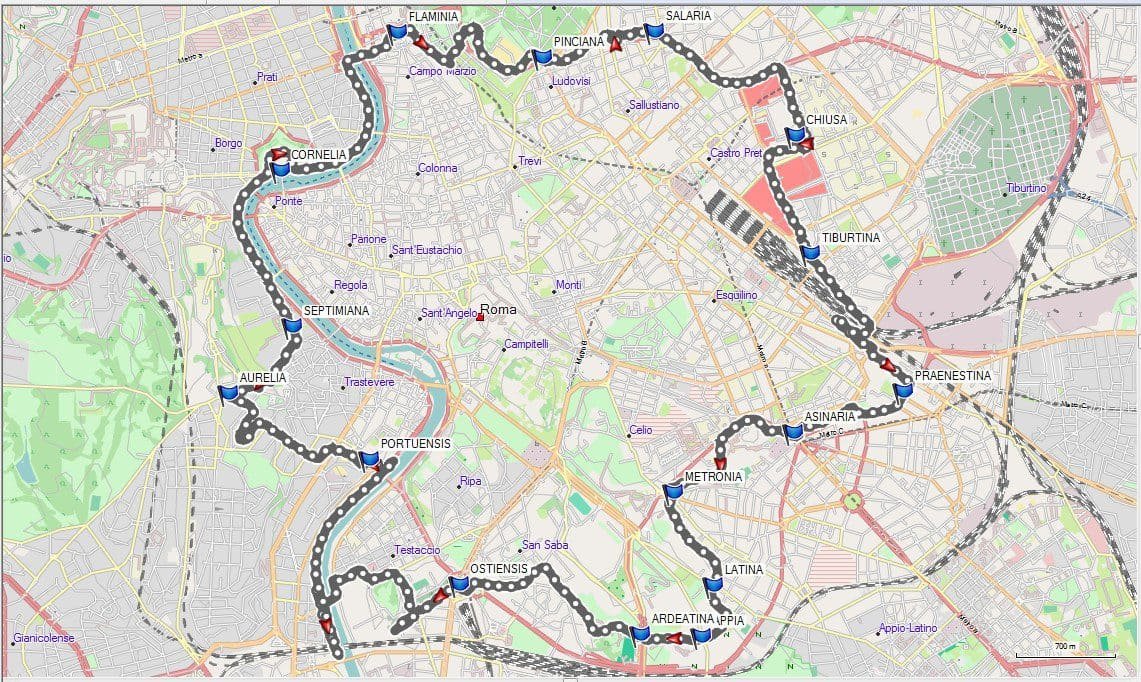
The question doesn't have a single answer, because the Aurelian Walls aren't a single monument but a ring as long as a half-day walk. They run around the historic center in an irregular shape that starts at the Muro Torto above Villa Borghese, descends toward Porta Pia and Porta Maggiore, cuts through the Esquilino, the Celio and the Aventine, reaches the Piramide and Porta San Paolo, crosses the Tiber and embraces Trastevere and the Janiculum, then closes again heading back up toward the Pincio. If you want to see them, you don't need to look for an entrance: just pick a stretch and walk alongside it.
How to get to the Aurelian Walls
The most visitable section, the one at Porta San Sebastiano with its museum, is reached by metro line B to Circo Massimo and then on foot along via di Porta San Sebastiano, a tree-lined uphill stretch of about one kilometer that runs alongside the Terme di Caracalla. The buses that serve the area pass along viale delle Terme di Caracalla. If you're heading instead for the eastern section, the one at Porta Maggiore and the Castrense Amphitheater next to Holy Cross in Jerusalem, get off at Termini station or take the trams that converge on Porta Maggiore. The western front, on the Janiculum and in Trastevere, is explored from the side of Porta San Pancrazio and Porta Portese. In every case, it's best to bring comfortable shoes: the walls are seen by walking, not standing still.
Hours and tickets for the Aurelian Walls at Porta San Sebastiano
The Museo delle Mura, housed inside the gate, is open Tuesday to Sunday from 10.00 to 16.00 and admission is free, including the walkway. Monday is a closing day, along with May 1 and December 25. The visit to the stretch of walkway that runs from the gate toward via Cristoforo Colombo takes place in limited groups, so it's best to check availability and book at 060608. Don't expect ticket offices, turnstiles or lines: here you just go in, climb the internal stairway of the tower and end up on the patrol walk, suspended between the rooftops of the neighborhood and the Appian countryside.
What the Aurelian Walls are
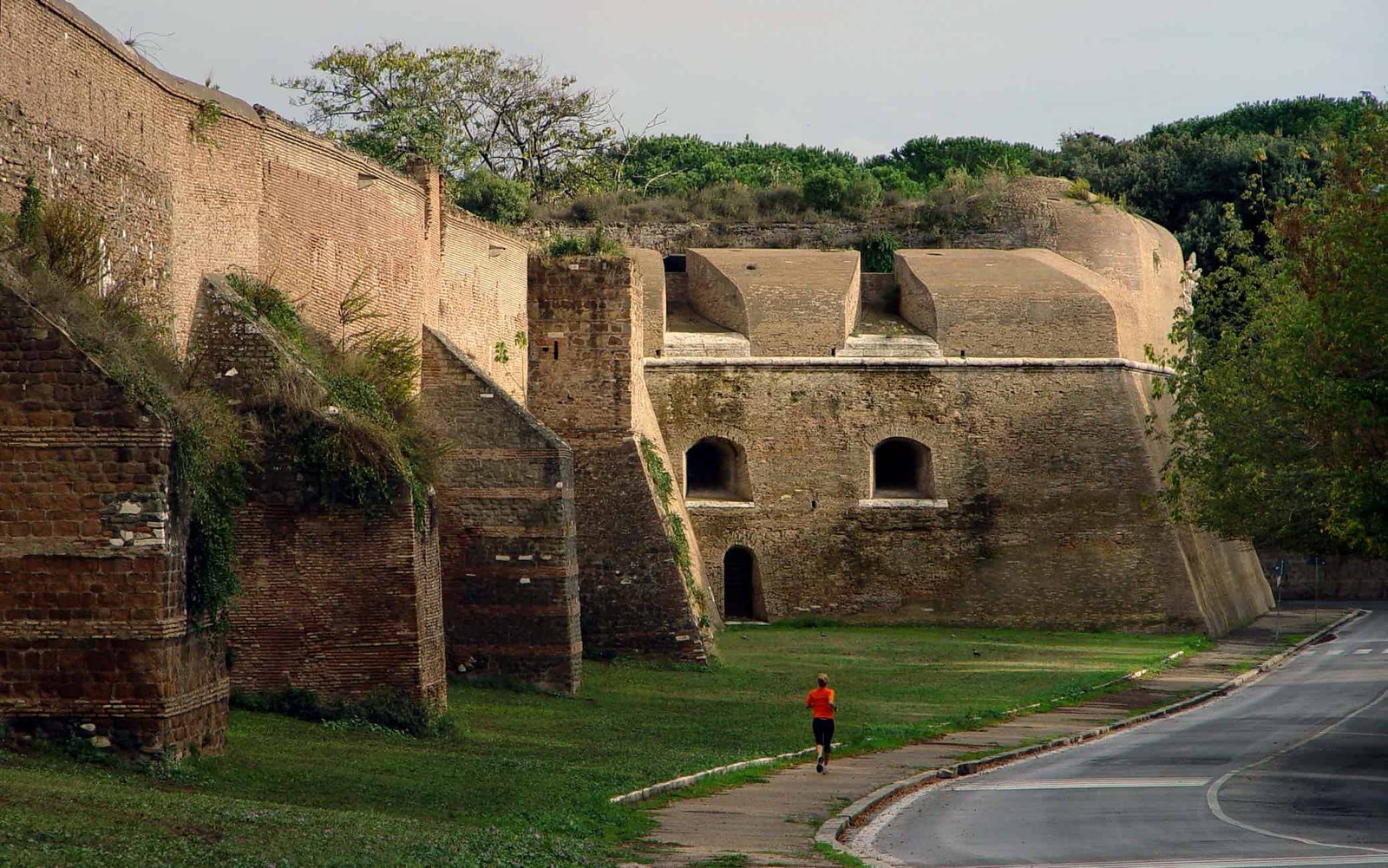
The Aurelian Walls are the defensive wall that Emperor Aurelian had built around Rome between 270 and 275 AD. In antiquity they measured about 19 kilometers and enclosed an area of over 1,200 hectares: the longest city wall of the ancient world, and still today one of the best preserved. The original route enclosed not only the seven hills but the whole city that had grown over the centuries of expansion, including the areas across the river. Today about 12.5 kilometers of them still stand, with some sections in excellent condition and others reduced to ruins or built into buildings.
To understand how new this work was, you have to remember that for almost half a millennium Rome had lived without real walls. The old Servian Walls, built in the 6th century BC and reinforced after the sack by the Gauls, defended only the core of the hills and had long since been swallowed up by the growing city. Imperial Rome, the capital of a world that stretched from Britain to the Euphrates, had no need for bastions: its defense was the legions stationed on the frontiers, very far away. That the capital should once again wrap itself in walls, after so many centuries, was the clearest and most dramatic sign of an empire that had stopped feeling safe.
Why Aurelian built the Aurelian Walls
The 3rd century was a period of deep crisis for Rome: emperors who followed one another within months, devalued currency, epidemics and growing pressure on the borders. In 271 the Germanic tribes of the Alemanni and the Iutungi broke through the northern defenses and descended into Italy. Aurelian, who had been ruling for barely a year, was first defeated near Piacenza, in a clash that spread panic all the way to Rome. Then he regained the initiative and defeated them in two decisive battles, near Fano and Pavia, driving them back beyond the Alps. The threat had been repelled, but the lesson was clear: an enemy had reached within a few days' march of the Urbs, and the capital was defenseless.
From that fear comes the decision to surround Rome with walls. The project was shaped by maximum speed and maximum economy: not a showpiece, but a defensive tool to be built before the danger returned. The speed with which the circuit was completed, and certain very practical technical solutions, suggest that military engineers rather than court architects worked on the design. On the other hand, against enemies capable at most of a raid, a tall wall with sturdy gates and a good walkway was sufficient and more. And in fact, for more than a century, no enemy really dared to besiege Rome. The first real siege came only in 408, with Alaric.
Aurelian, the Emperor Who Ordered the Aurelian Walls
It's worth spending a few lines on the man who gave these walls their name, because he was one of the most extraordinary figures of late antiquity. Lucius Domitius Aurelianus was born around 214 in Illyria, possibly at Sirmium, to a humble family. He made a career in the army and reached the throne in 270, at one of the darkest moments in Roman history. In a little less than five years of rule he accomplished the seemingly impossible: he brought the rebellious East back under Rome, defeating Queen Zenobia and dismantling the kingdom of Palmyra in 272, and he reconquered the separatist West, the Gallic Empire of Tetricus, in 274. For this the Senate granted him the title Restitutor Orbis, restorer of the world. In 274 he also imposed the cult of Sol Invictus as the state religion, an attempt to give the empire a unique spiritual glue.
The Rome walls are just one of his achievements, and perhaps the most lasting: when almost all the rest of his work has dissolved, his bastions are still standing. Aurelian did not live to see them fully completed. In 275, while marching east on a campaign against the Persians, he was killed in a conspiracy of officers from his own staff, near Caenophrurium in Thrace, deceived by a secretary who had forged a proscription list. The Senate deified him. The final touches on the circuit fell to his successor Probus, around 279.
How the Aurelian Walls Were Built
The rush with which the work was carried out explains many things you can still see today while walking along the circuit. To save time and money, the builders incorporated into the line everything already standing that could serve as a wall: buildings, tombs, aqueducts, an amphitheater, a pyramid. About one-sixth of the entire route, according to scholars, is made of existing structures reused. It is an almost unique case of a wall that devours the city it is meant to protect, which is why the Aurelian Walls are also an extraordinary catalog of reused Roman architecture.
The Numbers of the Aurelian Walls
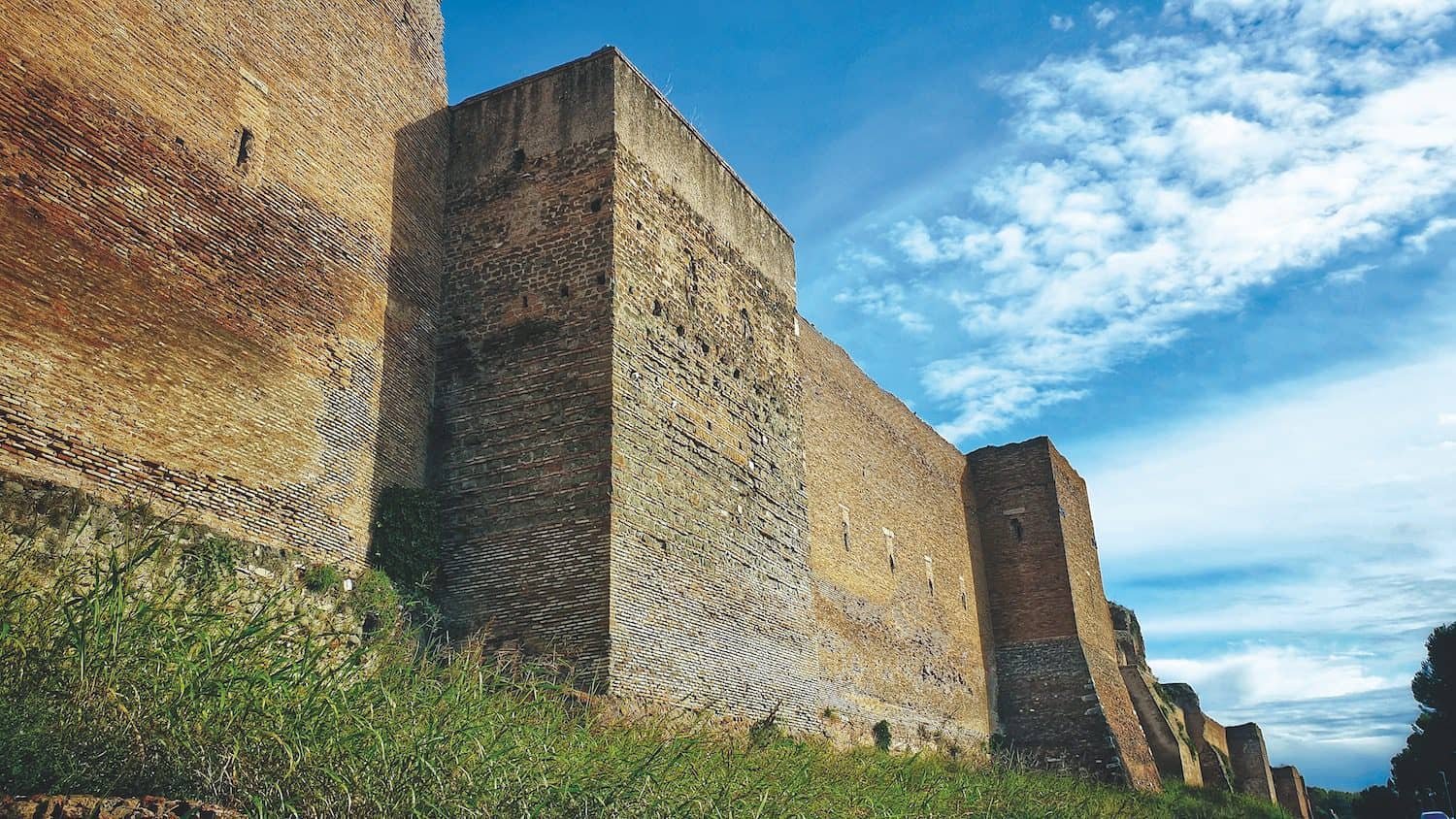
In their original form, the walls were about 6.5 meters high and 3.5 meters thick, crowned with merlons about 60 centimeters tall, spaced every three meters. The brick curtain wall ran straight, interrupted at regular intervals by towers. Ancient sources and surveys describe a structure of 378 stretches of crenellated wall, punctuated every 30 meters by 381 square-plan towers, with 14 main gates as well as many secondary gates and passages, and even 116 service latrines for the soldiers on watch. Only at the sides of the gates were cylindrical towers built, although it is unclear if this form is original or the result of Honorius's restorations.
Each tower was a small, self-contained fortress, with side windows that allowed it to fire along the whole stretch of wall as far as the next tower, on both sides, so as to eliminate blind spots. Ballistae, launching machines, were mounted on the towers, perhaps up to 800 in all, concentrated at the most exposed points. In later periods many ballista windows were walled up and replaced with simple loopholes, a sign that the defensive strategy changed as the threats changed.
The Monuments Built Into the Aurelian Walls
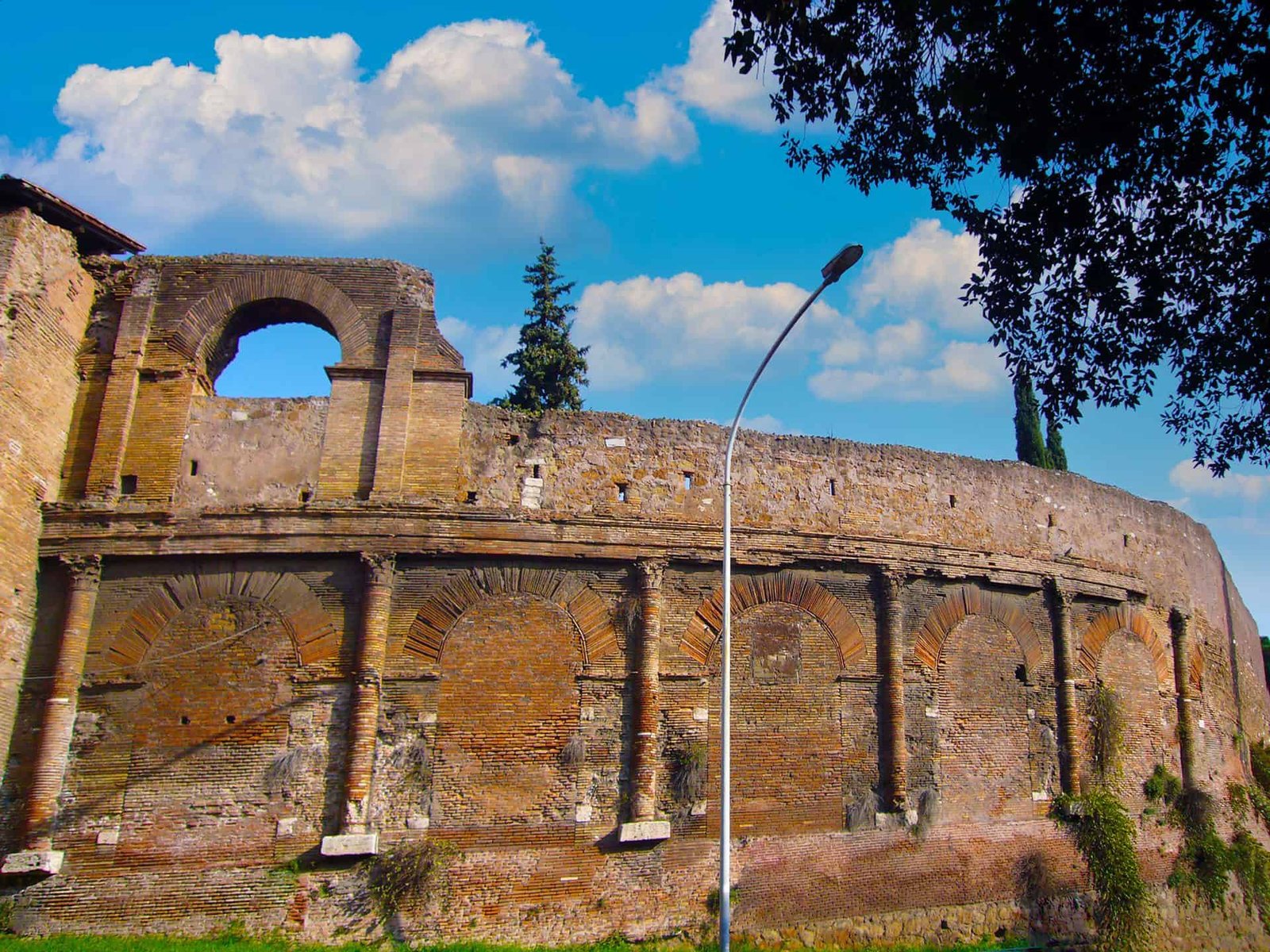
Walking along the walls, you come across pieces of ancient Rome walled into the defenses. The most striking case is the Castrense Amphitheater, the small amphitheater from the Severan period that now projects from the side of the walls at the height of Santa Croce in Gerusalemme: it was cut and closed off to make a bastion, and its brick arches still form an elegant curve in the wall. There is also the Pyramid of Gaius Cestius, the pyramid-shaped tomb of a magistrate from the 1st century BC, set into the wall beside Porta San Paolo and preserved precisely because it became part of the wall. And there are the large aqueducts, such as the one at Porta Maggiore that was monumentalized as a double gate in travertine. In short, the walls saved from destruction monuments that would otherwise have disappeared.
The Phases of the Aurelian Walls Over Time
The wall we see today is not the one from 275: it is the result of almost 1,600 years of rebuilding, raising, collapses and restorations. Going through its phases one by one is the best way to read the wall the way you read a book.
Maxentius and the First Reinforcement
At the beginning of the 4th century, under Maxentius, the walls received their first reorganization and reinforcement work. He is responsible for setting up a ditch in front of the walls, in an anti-Constantinian function, a work that was perhaps later completed by his rival and victor, Constantine, after the Battle of Ponte Milvio in 312. It is the first sign that the Aurelian Walls were no longer enough as they were.
Honorius's Great Rebuilding
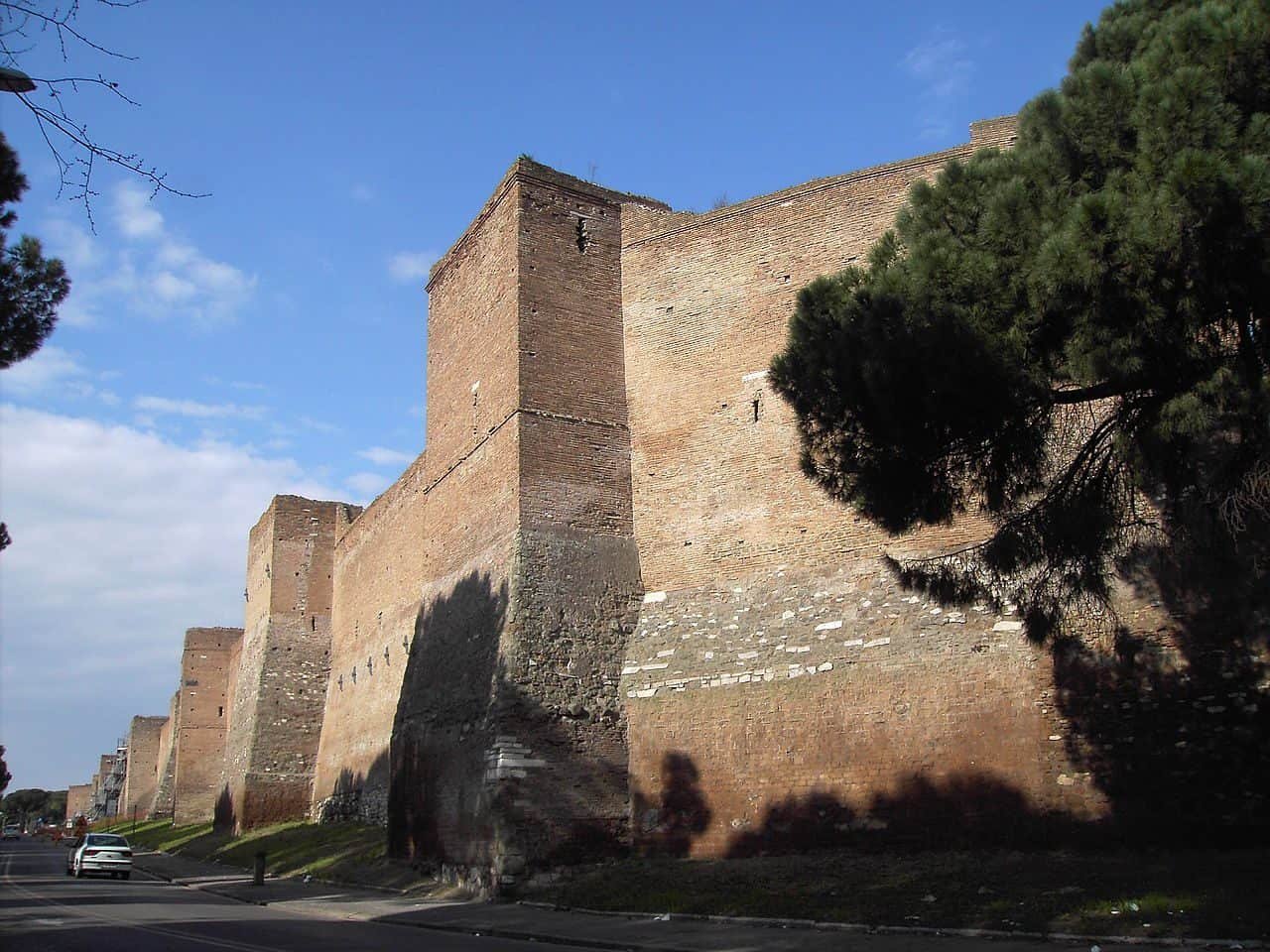
The most radical intervention came at the beginning of the 5th century. Between about 401 and 403, under Emperor Honorius and through the work of the general Stilicho, the walls were nearly doubled in height: from the original six to eight meters, they were raised to 10 and a half meters or more, and in some places up to about 15 meters. The old open walkway was turned into a covered gallery, equipped with arrow slits for archers, and above it a new outdoor walkway was built, protected by merlons. The towers were raised by one floor. It is this doubling that gives the walls the imposing look they still have today: when you see them as tall as a four-story house, you are looking at the work of Honorius, not that of Aurelian.
The proof that the reinforcement worked came a few years later. In 408 and again in 410, Alaric and his Visigoths besieged Rome. The city capitulated because of hunger and treachery, not because the walls had been breached. And a century and a half later, during the Gothic War, between 537 and 538, the Byzantine general Belisarius defended Rome on behalf of Emperor Justinian against the repeated assaults of Vitiges, king of the Ostrogoths: the walls of Honorius held, and the defense entered legend.
The Popes, the Sangallo Bastions and Urban VIII
Throughout the Middle Ages and the early modern period, the walls remained Rome's defense, and the popes kept them in working order. The most important intervention was in the early 16th century, when Antonio da Sangallo the Younger designed the Sangallo Bastions in the southern stretch, not far from Porta San Sebastiano: low, massive structures with orecchioni and gun platforms, meant to withstand the impact of cannon fire and to house artillery, following a completely different logic from the tall ancient walls. They were left unfinished, but the surviving section is one of the most interesting pieces of Renaissance military architecture in the city. Around the middle of the 17th century, Pope Urban VIII instead had the old circuit surrounding the Janiculum demolished to replace it with a new, wider wall, the one that still bears his name today. In short, the walls never stopped changing.
A Tour of the Gates of the Aurelian Walls
The gates are the best way to get your bearings along the walls: each one was named after the consular road that left from it, and many changed their name in the Middle Ages, taking that of a church or a saint. Going through them clockwise, starting from the north, is like making a full circuit of walled Rome.
From Porta del Popolo to Porta Pia
On the northern side is the Porta Flaminia, today Porta del Popolo, from which Via Flaminia led north: it was the gate through which Grand Tour travelers entered the city, and their first image of Rome. Next is the Porta Pinciana, at the top of Via Veneto, with its two well-preserved cylindrical towers. Then comes the Porta Salaria, demolished in the 19th century. Then the Porta Nomentana, replaced in modern times by the nearby Porta Pia, designed by Michelangelo as his last architectural work and destined to go down in history for a very different reason.
From Porta Tiburtina to Porta Maggiore
Continuing east you reach the Porta Tiburtina, opened beneath an arch of the Augustan aqueducts, and above all the Porta Prenestina-Labicana, which everyone knows as Porta Maggiore. Here the wall incorporates the majestic double travertine arch that Claudius built to carry two aqueducts over the roads, one of the most spectacular stretches of the entire wall. Nearby, walled into the railway tracks, is the curious tomb of the baker Eurysaces.
From Porta San Giovanni to Porta Metronia
On the southern side of the Esquilino and the Celio stood the Porta Asinaria, the small ancient gate flanked by two round towers, through which Belisarius's troops entered Rome in 536. There is also the later Porta San Giovanni, opened in the sixteenth century for modern traffic beside San Giovanni in Laterano. A little further on is the Porta Metronia, now closed, and the small, refined Porta Latina, one of the best preserved, from which Via Latina ran out.
Porta San Sebastiano, the most monumental
On the Appian side is the largest and most scenic gate of the entire wall: the Porta Appia, which in the Middle Ages became Porta San Sebastiano, named after the martyr buried just outside. From it ran the queen of roads, Via Appia, heading south. This is the gate that houses the Museo delle Mura, and it deserves a chapter of its own.
From Porta Ardeatina to Porta San Paolo
Toward the Tiber were the Porta Ardeatina, now gone and replaced by the modern gap in the Sangallo bastions, and the Porta Ostiense, that is Porta San Paolo, the well-preserved double gate beside the Pyramid of Cestius, on the road that led to Ostia and the basilica of San Paolo.
The gates across the river
Once across the Tiber, the wall enclosed Trastevere and the Janiculum with the Porta Portuensis, on the road to Porto, later demolished and replaced by the seventeenth-century Porta Portese, and with the Porta Aurelia, today Porta San Pancrazio, at the top of the Janiculum, site in 1849 of the bloodiest fighting of the Roman Republic. Further down, the small Porta Settimiana marked the entrance to the heart of Trastevere. It was precisely to guarantee water to the besieged city, as well as to defend a populous area, that Aurelian chose to run the walls onto the right bank too, enclosing Trastevere and the hill of the Janiculum.
Porta San Sebastiano and the Museo delle Mura
If you only see one section of the Aurelian Walls, choose this one. Porta San Sebastiano is the largest and tallest gate in the wall, and by a happy stroke of luck it houses the museum dedicated to the walls of Rome. You enter through the gate, climb up, and end up walking along the wall.
The largest gate of the Aurelian Walls
Today the gate presents a single large archway, a travertine-clad facade, and two semicircular towers on either side, set on a high base of reused marble blocks. It is the result of several phases. The gate of Aurelian, with its double arch, was raised and reinforced many times, notably under Honorius and then in the sixth century under Belisarius and Narses, until it took on the massive, towered appearance it has now. In front of the gate, like a monumental antechamber, survives the Arch of Drusus: not a triumphal arch, as popular tradition has it, but an archway that supported the branch of the Antonine aqueduct leading to the Baths of Caracalla.
The graffito of the archangel Michael
There is a detail almost no one notices, and it alone is worth the climb. On the inner jamb of the gate, carved into the marble, is a graffito showing the archangel Michael piercing the dragon, accompanied by a Latin inscription. The text records that in September 1327, in the eleventh indiction, on the penultimate day of the month, the feast of Saint Michael, foreign people entered the city and were defeated by the Roman people, with Jacopo de' Ponziani as head of the rione. Behind those lines lies a real clash: Roman militias repelled an attempt at occupation tied to the designs of Robert of Anjou, king of Naples, on the city. A citizen carved the archangel to commemorate the victory, and for 700 years that graffito has been there, within reach of anyone who enters the museum.
The gate inhabited by Ettore Muti
The recent history of the gate is less noble but just as curious. Between 1940 and 1943 Porta San Sebastiano was renovated to a design by the architect Luigi Moretti and turned into a private studio-residence for the Fascist leader Ettore Muti, party secretary. The interior rooms, the floors, certain finishes that today's visitor walks through without knowing it are the remnant of that singular residence inside an ancient monument. With the fall of the regime the gate returned to the State, and in 1990 the Museo delle Mura was set up there.
What you see in the Museo delle Mura
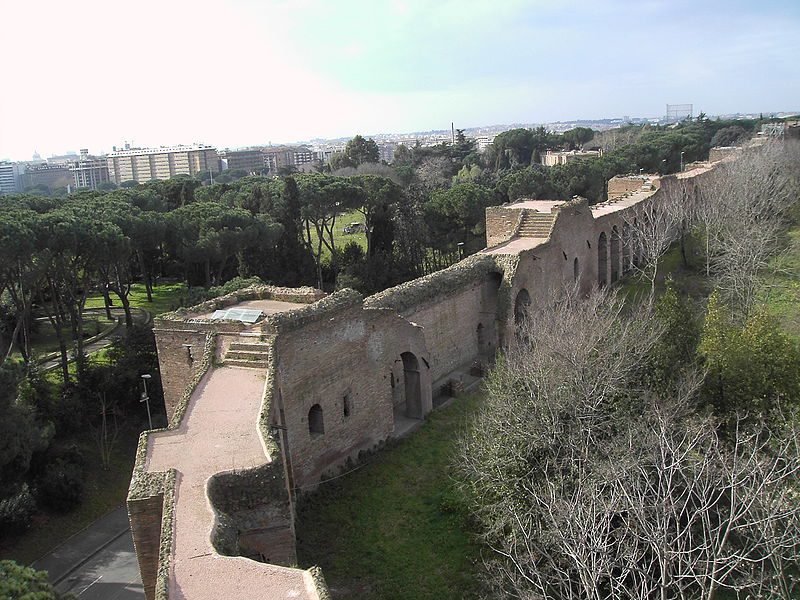
The Museum of the Walls is small and should be taken for what it is: not a collection of masterpieces, but a route that explains the walls while you are inside them. Through models, casts, panels and drawings it reconstructs the building phases of the circuit, from the Servian walls to Aurelian, from Honorius to the modern bastions. The real highlight, however, is not in a display case: it's the chance to climb onto the walkway and walk a stretch of the walls from the inside, seeing the covered gallery of Honorius, the arrow slits, the towers, and looking out on one side over the city and on the other over the countryside of the Appia.
The walkway and the 2001 collapse
The stretch of walkway that goes from the museum to the arches of Via Cristoforo Colombo, about 400 meters, has an eventful recent history. On the evening of April 15, 2001 a considerable portion of the walls, 12 meters between towers 7 and 8, collapsed in precisely this stretch. What gave way was above all the brick facing added by Innocent X between 1644 and 1655, never well bonded to the ancient core of Aurelian and Honorius and undermined by water infiltration. The coat of arms and the inscription that recalled that seventeenth-century restoration, after the collapse, were taken into the museum. The city administration rebuilt the collapsed stretch between 2004 and 2006 and reopened the whole walk on the walls to the public in July 2006. Today that route is again usable and remains the only way to walk at length inside the walls of Aurelian.
The stretches of the Aurelian Walls that can be walked today
Besides the covered walkway of Porta San Sebastiano, which is the only one walked from the inside, the circuit can be followed at length from the outside at several points, and each has a character of its own.
From Porta San Sebastiano to Porta Ardeatina
The most beautiful and most intact stretch is the southern one, between Porta San Sebastiano and the bastions of Sangallo. Here the wall is high, almost uninterrupted, immersed in greenery, with the regular towers following one another and the great Renaissance bastions appearing suddenly. You walk along Viale di Porta Ardeatina in a silence rare for Rome, with the Baths of Caracalla not far away.
The stretch of the Amphitheatrum Castrense
At the eastern end, behind Holy Cross in Jerusalem, the walls absorb the Amphitheatrum Castrense and bend at an angle forming one of the most photographed views: the brick arches of the amphitheater sticking out of the wall, the Romanesque bell tower of the basilica in the background, the gardens that now occupy the area. It's a piece of Rome off the circuits, where there is almost never anyone.
The Muro Torto and the Pincio front
On the northern front, the stretch called Muro Torto, under the slopes of the Pincio and Villa Borghese, is famous for having always been unstable and never collapsed: tradition held that Saint Peter himself defended it, and for centuries at its foot were buried the outcasts who had no right to consecrated burial. Today the wall runs sheer above the traffic of Viale del Muro Torto, and you see it very well from below.
A curiosity about the Aurelian Walls
The most beautiful curiosity concerns what the walls ate in order to build themselves. About a sixth of the whole circuit, that is over three kilometers, is not new wall but pre-existing buildings readapted: houses, tombs, warehouses, stretches of aqueduct, an entire amphitheater and a pyramid. Aurelian was in a hurry, and the hurry turned into a gigantic urban recycling. The result is that, walking along the circuit, you read the layers of the city as in a geological section: a piece of tomb here, an aqueduct arch there, the curve of an amphitheater a little farther on. The Pyramid of Caius Cestius, to name one, has come down to us intact precisely because the builders found it convenient as a bastion and walled it into the defense. Without the walls, today we would not have a Roman pyramid in the middle of Rome. There is a small irony in all this: the rampart that was meant to defend the city from the barbarians became, unintentionally, the largest operation of conservation of antiquity ever carried out in Rome. Many monuments survive only because a third-century engineer decided they saved bricks.
Something nobody tells you about the Aurelian Walls
What almost nobody explains is that the tall, imposing walls we admire today are not the work of Aurelian. Aurelian built a sturdy but relatively low wall, around six and a half meters high, designed against raids. The fortress look, with the double height, the covered gallery of archers and the raised walkway, is entirely thanks to the rebuilding by Honorius, more than 120 years later, at the beginning of the V century. In practice, when we say Aurelian Walls, we are mostly looking at Honorian walls. Aurelian's wall is the part underneath, the first few meters. Everything you see above it, the gallery with the loopholes and the battlements, was added to face a far greater danger than the one of the III century, the arrival of the Goths. And there's more: many stretches that look ancient are actually papal restorations from the 17th-century or 19th-century, recognizable by the different color and texture of the bricks. Learning to tell ancient brick from modern brick while you walk is one of the subtle pleasures of anyone who spends time on these walls. The wall is a palimpsest, and every era has written its line on top.
The advice I give you for visiting the Aurelian Walls
The advice is clear: don't treat the Aurelian Walls as a monument to tick off in half an hour, but as a walk. Go up to the Museo delle Mura di Porta San Sebastiano early in the morning, when it opens at 10, because it lets in only a few visitors at a time and the light on the travertine is better. Do the walkway at a leisurely pace. Then, instead of turning back, go down and continue on foot along the southern stretch toward the Sangallo bastions and Viale di Porta Ardeatina. It's one kilometer of nearly unbroken walls in the greenery, with no traffic, and the Baths of Caracalla are a short walk away. In an hour and a half you'll have seen the best of the circuit and understood how it worked. A practical warning: the walls are not a good visit in heat or rain, because most of the route is outdoors and uncovered. Spring and autumn are the right seasons. And wear sturdy shoes: the walkway is ancient, the steps are uneven and there are no amenities. If you have little time and still want a taste, you can limit yourself to the gate and the Arch of Drusus in front of it, which you can see from outside for free at any time.
Another well-known fact, yet rarely mentioned
Everyone knows that on September 20, 1870, the Bersaglieri entered Rome by opening a breach in the walls near Porta Pia, and that this act ended the temporal power of the popes and made Rome the capital of Italy. What is rarely mentioned is that the breach was opened right in the Aurelian Walls, and that those walls, at that moment, were over 1,600 years old. The circuit built by Aurelian against the Alemanni defended Rome without interruption from the III century until that September morning. No other urban fortification in the world has had such a long military life. The wall the Piedmontese cannons fired on was the same one, enlarged and restored, that had pushed back Vitiges and his Goths 13 centuries earlier. There is an almost moving detail: the 19th-century artillery took hours to open that gap, only a few meters wide, in an ancient structure by then reduced to scenery. The point of the breach, just to the right of Porta Pia along the present-day Corso d'Italia, is still marked by a column and a plaque, and the date, XX Settembre, has become the name of streets and squares throughout Italy. The walls' very long defensive life ended there, with a single cannon shot, after 16 centuries of service.
The right photo to take at the Aurelian Walls
The photo everyone tries is the façade of Porta San Sebastiano with the Arch of Drusus in the foreground. You take it from the inside, that is, from the city side, standing a few meters inside the arch and framing the two semicircular towers that frame the sky. In morning light the travertine turns golden, and the contrast with the dark brick of the towers is perfect. But the photo you'll bring home that nobody else has, you'll find elsewhere: at the eastern end, behind Santa Croce in Gerusalemme, where the walls enclose the Anfiteatro Castrense. There, the curved arches of the amphitheater jut out from the straight wall, the basilica's medieval bell tower rises behind, and on clear days the composition, with the green of the gardens below, has no equal in the city. A subtler alternative is from inside Honorius's covered walkway. Stand at the far end of the gallery and photograph the row of loopholes getting smaller, with light coming in in slats. Avoid midday, which flattens everything. Look for early morning or the hour before sunset, when low sun reveals the texture of the bricks and the walls stop being a backdrop and become a living surface.
Some important events that happened here in history
Few stones in Rome have witnessed as many decisive events as the Aurelian Walls. I'll pick some of them, in chronological order, because they are the backbone of the city's history.
The Gothic sieges
In 408 and 410, Alaric and the Visigoths besieged Rome in front of these walls. The city fell through hunger and the betrayal of its gates, not through a breach. The siege of 537-538, during the Gothic War, was even more dramatic: the Byzantine general Belisarius, with a reduced garrison, defended the entire circuit against the repeated attacks of Vitiges and the Ostrogoths, who tried to scale the walls with mobile towers and to enter through the aqueducts. The walls of Honorius held, and Rome remained Byzantine.
The battle of 1327 at Porta San Sebastiano
In September 1327, the city militias repelled an attempt at occupation at Porta San Sebastiano, linked to the Angevin designs on Rome. The victory of the Roman people was carved into the marble of the jamb, with the image of the archangel Michael and the date, and it can still be read today by anyone who enters the museum.
The defense of the Roman Republic in 1849
In the spring of 1849, the walls once again became a battlefront. The defenders of the Roman Republic, led by Garibaldi, opposed the French army sent to restore the pope, right on the line of the Janiculum walls, around Porta San Pancrazio. The fighting was extremely fierce and left marks that can still be seen on the wall full of holes in that area.
The breach of Porta Pia
The best-known event is the last one in their military life: on September 20, 1870, Italian artillery opened a breach near Porta Pia, the Bersaglieri entered, and the temporal power of the popes came to an end. After 16 centuries, the Aurelian Walls had stopped defending Rome.
Who has passed through the Aurelian Walls
Literally all of Rome's history has passed through the gates of this circuit. From Porta Flaminia, today Porta del Popolo, medieval pilgrims entered the city and, centuries later, the great travelers of the Grand Tour did too: Goethe describes his entrance into Rome through that gate in 1786 as one of the moments of his life. From Porta Appia, today San Sebastiano, the trade of the South went out and came in for centuries along the Queen of Roads. From the walls, as defenders or as attackers, some of the protagonists of European history have passed: the emperor Aurelian, who commissioned them, the general Stilicho and the emperor Honorius, who doubled them, the Gothic king Alaric, who besieged the city, the Byzantine Belisarius, who defended it for Justinian, and the Ostrogothic king Vitiges, who tried in vain to scale them. In the modern age, Giuseppe Garibaldi fought on the walls of the Janiculum in 1849, and in 1870 the army of the new Kingdom of Italy crossed them through the breach. Even Fascism left its mark, with the party official Ettore Muti, who made Porta San Sebastiano his home. Few places in the world have seen such a procession of emperors, kings, generals, popes, pilgrims and artists parade in front of and through their stones.
The Aurelian Walls with children
Bringing children to the Aurelian Walls works better than you might think, as long as you present them as a real castle and not as a lesson. The covered walkway at Porta San Sebastiano has everything needed to impress a child: the spiral staircase inside the tower, the arrow slits to peek through, the wall walk up top, and the idea that archers were stationed right there. The museum is small and can be visited in a short time, the scale models help explain how the defense worked, and free admission means no anxiety about a wasted ticket if the visit turns out to be short. Be careful, though: the walkway is ancient, the steps are steep and uneven, and the protections are those of a monument, not a playground, so the little ones should be held by the hand. Outside, the southern stretch in the greenery is perfect for a walk with room to run, and the Baths of Caracalla, just a short walk away, complete the morning. The game that always works is the hunt for the hidden monument: look for the pyramid, the arches of the amphitheater, and the arches of the aqueducts built into the wall. Children love discovering that the wall has swallowed half the city.
What's around the Aurelian Walls
The stretch around Porta San Sebastiano is the ideal starting point for a day in southern Rome, the most monumental and the least crowded part of the city. A few minutes on foot takes you to the Baths of Caracalla, the best-preserved imperial baths in the city, and to the start of the Appian Way Park, with the original paving stones, the tombs and the aqueducts. On the other side, toward Porta San Paolo, you reach the Pyramid of Caius Cestius and the Non-Catholic Cemetery, where Keats and Shelley are buried, opened right against the walls in 1821. A little further on is the Testaccio neighborhood, with its museo diffuso and the working-class life that still survives. If you have the legs and the willingness, climb to the Aventine, with the Basilica of Santa Sabina and the famous orange garden. Along the Appian Way, just outside, the basilica of San Sebastiano fuori le mura gives the gate its modern name. All of this fits into a single day, with the walls as the common thread.
When to Visit the Aurelian Walls
The season makes a huge difference, because much of the visit is outdoors. Spring, from April to mid-June, and autumn, from mid-September to November, are the best periods: the light is soft, the greenery around the southern stretch is at its best, and the heat doesn't torment anyone walking the open walkway. The Roman summer is harsh around here, with no shade and no relief. If you come in July or August, go right at opening, at 10:00, and finish by noon. Winter has the advantage of solitude and some clear days that are wonderful for photography, but the days are short and the museum closes early, at 16:00. In summer, moreover, a series of free cinema under the walls has been held for years at the foot of the walls of Porta San Sebastiano. It may be the most scenic way, and at the same time the most Roman way, to see these ramparts: lit up in the evening, with the screen glowing at their base.
The Legends of the Aurelian Walls
A wall 16 centuries old was bound to gather legends, and the Aurelian Walls have some wonderful ones. The best known concerns the Muro Torto, the leaning stretch below the Pincio. Tradition says that during the Gothic siege, when the defenders wanted to reinforce it because it seemed about to collapse, Saint Peter himself appeared to promise that he would defend it, and since then that crooked, overhanging wall has never fallen. At its foot, for centuries, suicides, executed criminals and those who died without the sacraments were buried, at the margins of the city of the living as well as the city of the dead. Another tenacious tradition holds that the Arch of Drusus in front of Porta San Sebastiano was a triumphal arch raised for the German victories of Livia's son. Scholars have clarified that it is instead an arch of the aqueduct, but the popular name has remained and survives. And then there is the graffito of the Archangel Michael in the gate, which for centuries Romans read as a sign of heavenly protection over the city. These are stories that tell a deeper truth than the facts: for those who lived beside them, the walls were not just stone and lime, but a sacred boundary, the limit separating Christian Rome from the world outside.
Why the Aurelian Walls Are a Record
It's worth pausing for a moment on the scale of the undertaking, because the numbers alone don't convey the idea. 19 kilometers of wall, originally 6.5 meters high and later raised, often 3.5 meters thick, with almost 400 towers and 14 monumental gates, built in barely five years by a city in the middle of an economic and political crisis. It's an effort that leaves you stunned. No other ancient capital built a circuit so long, and none kept it in use for so long. The walls of Constantinople, though extraordinary, are shorter. Those of the provincial Roman cities don't stand up to comparison. The Aurelian circuit defended Rome from the 3rd to the 19th century. It saw the empire, the Goths, the Byzantines, the popes, the French and the Piedmontese pass by, and it still stands for most of its route. Walking alongside it means touching the largest and oldest thing Rome has preserved almost whole: not a temple, not an arch, but a wall as long as a walk, which enclosed and protected everything else.
What the Aurelian Walls Are Made Of
Looking at the wall up close, instead of from far away, changes the way you understand it. The construction technique of the Aurelian Walls is the one typical of Roman building in the period: an inner core of concrete, made of stone chips and mortar, faced on both sides with a curtain of brick, the so-called opus latericium. The ancient bricks are thin, wide and a warm red, laid in regular courses with generous mortar joints. Many still bear the factory stamps, the mark showing the kiln and the year, and for scholars they are like the dated pages of a register. In later repairs the texture changes: medieval and papal brick is thicker and more irregular, while the brick of the 19th- and 20th-century restorations is a flat, uniform red, recognizable at a glance. Learning to read these differences is what separates those who walk past the wall from those who understand it. Where Aurelian reused existing buildings, the curtain changes completely: tuff blocks, spolia marble, travertine arches and whole fragments of monuments built into the defense all appear. The wall, in short, is never the same as itself for two stretches in a row, and this variety is exactly what makes it fascinating to walk along.
The Aurelian Walls today: conservation and condition of the stretches
About 12.5 kilometers of the ancient walls remain today, but their condition varies enormously. Some stretches, such as the southern one at Porta San Sebastiano or the eastern one at the Anfiteatro Castrense, are in good condition and benefit from maintenance and surveillance. Others are fragile: the circuit often runs up against busy roads, private property and gardens, and in many places it is threatened by water seepage, invasive vegetation and pollution. The collapse in 2001 at Porta San Sebastiano reminded everyone that this is an ancient and vulnerable structure, not an indestructible stage set. In recent years the Sovrintendenza Capitolina has promoted a project to study and enhance the entire circuit, with the idea of making it a continuous, readable route: a green and archaeological ring that takes those who walk along the entire wall. It's a long project, moving forward in stages, but the direction is the right one. Those who visit the walls today, in short, see a living monument, subject to care and risks, not a frozen relic. And perhaps this is their strength: they keep telling the story of Rome precisely because they keep aging along with it.
Quick questions about the Aurelian Walls
How long were the Aurelian Walls?
In antiquity they measured about 19 kilometers, the longest city wall of the ancient world. Today about 12.5 kilometers survive, some sections intact and others reduced to ruins or built into buildings.
When were the Aurelian Walls built?
Between AD 270 and 275, by order of Emperor Aurelian, with the finishing work completed under Probus around 279. They were then almost doubled in height under Honorius, at the start of the 5th century.
Why are they called Aurelian?
They are named after Emperor Aurelian, who ordered their construction after the invasion of the Alemanni in 271 had shown how defenseless Rome was.
Can you visit the Aurelian Walls?
Yes. The best spot is the Museo delle Mura, inside Porta San Sebastiano, where you go up onto the walkway and walk a stretch of the wall. Many other sections can be walked alongside freely from the outside.
How much does it cost to enter the Museo delle Mura?
Admission is free, walkway included. For the guided visit to the section toward via Cristoforo Colombo, it's worth checking availability and booking at 060608.
What are the opening hours of the Museo delle Mura?
Tuesday to Sunday, 10.00 to 16.00, with last entry one hour before closing. Closed on Mondays, May 1 and December 25.
How do you get to Porta San Sebastiano?
By Metro B to Circo Massimo, then on foot along via di Porta San Sebastiano, about one kilometer uphill next to the Terme di Caracalla, or by the buses on viale delle Terme di Caracalla.
Do you need a reservation to visit the Aurelian Walls?
For the museum and the basic walkway it's usually not needed, but spots are limited. For guided visits to the long section of the walkway, booking at 060608 is recommended.
How long does a visit to the Aurelian Walls take?
The museum and walkway can be seen in about an hour. Adding a stroll along the southern stretch through the greenery brings you comfortably to an hour and a half or two.
Are the Aurelian Walls accessible by wheelchair?
The walkway and towers have steep ancient stairs and are not suitable for people with mobility difficulties. The ground floor of the gate and the exterior view of the walls remain accessible. For accessibility information, it's best to call 060608.
How many gates did the Aurelian Walls have?
14 main gates, plus many secondary gates and passages. Many still exist, often with names changed in the Middle Ages, such as Porta del Popolo, Porta Maggiore, Porta San Sebastiano and Porta San Paolo.
Why are the Aurelian Walls so tall?
The current height, more than 10 meters in many stretches, is not the original one from Aurelian but the result of the doubling wanted by Honorius at the beginning of the 5th century, with a covered gallery for archers and a raised walkway.
What is the Arch of Drusus in front of Porta San Sebastiano?
It is not a triumphal arch, as is commonly believed, but a fornix that supported the branch of the Antoniniano aqueduct leading to the Baths of Caracalla. It serves as a monumental antechamber to the gate.
Where was the breach of 1870 made?
In the Aurelian Walls, a little to the right of Porta Pia, along today's Corso d'Italia. The spot is marked by a commemorative column and is remembered every September 20.
What are the Sangallo bastions?
They are low, massive fortifications designed by Antonio da Sangallo the Younger in the early sixteenth century, in the southern stretch near Porta San Sebastiano, to adapt the walls to the use of cannons. They were never completed.
Are the Aurelian Walls suitable for children?
Yes, if they are presented as a castle. The arrow slits, the stairway in the tower and the walkway catch the attention of the little ones, and free admission removes all pressure. The ancient steps should be tackled with caution, however.
What is the difference between the Aurelian Walls and the Servian Walls?
The Servian Walls are much older, dating from the 6th century BC, and enclosed only the seven hills. A few stretches remain, for example near Termini. The Aurelian Walls, from the 3rd century AD, are immensely longer and enclosed the entire city that had grown over the centuries.
Can you walk on all of the walls?
No. From the inside, you can only walk the stretch of the walkway at Porta San Sebastiano. The rest of the circuit is followed on foot from the outside, along the streets that run beside it, as in the lovely stretch between Porta San Sebastiano and Porta Ardeatina.
What is the most beautiful stretch of the Aurelian Walls?
For condition and atmosphere, the southern stretch between Porta San Sebastiano and the Sangallo bastions, surrounded by greenery and free of traffic. For a unique view, the eastern stretch where the walls enclose the Anfiteatro Castrense behind Santa Croce in Gerusalemme.
How long did the Aurelian Walls defend Rome?
Until September 20, 1870: for more than 16 centuries, from the time of Aurelian to the breach of Porta Pia, they were the city's defense, a record with no equal among urban fortifications.
If I could leave you with just one thought, it is this: the Aurelian Walls are not a backdrop, they are the master ledger of Rome. Aurelian and Honorius have written on them, as have the popes and the Sangallos, Garibaldi and the Bersaglieri, and even a fascist bigwig who set up house there. Go with time to read them, and you'll notice that 16 centuries of history are condensed into a few meters of brick. Start at Porta San Sebastiano, climb onto the walkway, and then walk: that is the right way to spend time with a wall that has seen everything.
Article written by the editorial team of TourLeaderPro, contact them for Tours and Private/Corporate/V.I.P. Experiences.
Are you planning a trip to Rome? English-language guides for visiting the city are available on ItalyPlanner.com.