Catacombs of San Callisto
In short. There are monuments you visit and monuments you walk through.

There are monuments you visit and monuments you walk through. The Catacombs of San Callisto belong to the second group: they are not a facade to look at or a hall to walk around in a circle, but an upside-down city dug into the tuff beneath the via Appia Antica, almost 20 kilometers of galleries spread across several stacked levels, inside an area of about 30 hectares that runs from the Appia to the via Ardeatina and the via delle Sette Chiese. Under the pines and cypresses you see from the road, the ground is pierced like a sponge. The most common line, halfway down the staircase, is always the same: "I didn't expect it to be so big." And that is only the excerpt: the route open to the public is a small fraction of the complex.
However, the Catacombs of San Callisto are not only the largest of those open to visitors in Rome. They were the first to be owned by the community, that is, the exact moment when the Church of Rome stops being a collection of families burying their dead in private hypogea and becomes an institution with assets, an administrator and a land registry. Nine 3rd-century popes rested here in the Crypt of the Popes alone, and 16 according to the sanctuary's tradition across the whole complex. Here, on the walls of a cubiculum, the word papa appears for the first time referring to the bishop of Rome. Here, on the ceiling of a little room cut into the tuff, an anonymous painter invented the visual grammar that Christianity would use for the next 18 centuries. This is why Giovanni Battista de Rossi, the father of Christian Archaeology, called the Crypt of the Popes "the little Vatican, the central monument of all Christian necropolises." For once, the superlative is not rhetoric: it is a technical fact sheet.
Everything is here, inside and out: the history, the topography, the individual crypts, the popes one by one, the painting, the inscriptions, the 19th-century rediscovery, today's custodians, and then all the practical information, that is, how to get there, what to wear, how long it lasts, and what to see around the Appia nearby. If you have a 40-minute guided tour ahead of you, this is the reading that will make it count double.
Why They Are Called Catacombs of San Callisto
The name comes from an administrator promoted on the job, and it is one of the most beautiful stories of social mobility that antiquity has left us. Between 198 and 217, Pope Zephyrinus entrusted the deacon Callixtus with the administration of the communal cemetery on the via Appia: the first cemetery directly dependent on the Roman church, born around the end of the 2nd century by joining some private Christian hypogea to an ecclesiastical burial area. Callixtus was not an aristocrat or an intellectual: he had been a slave, then a freedman, then a bankrupt banker, then a convict sentenced to forced labor in the mines of Sardinia. The fact that a man with that résumé became the manager of the community's funerary property, and then its bishop, tells you more about the Church of the 3rd century than any treatise.
Where to buy tickets. The Catacombs of San Callisto have their own ticket office and a mandatory guided tour: hours and closures are on the official site catacombesancallisto.it. They are large and cool, so bring a sweatshirt even in August. The guided tour is on GetYourGuide. Verified on September 28, 2026.
Having become pope in his turn as Callixtus I, he expanded the funerary complex, which quickly became the official cemetery of the Church of Rome. The custodian gave his name to the house, and what a house it was. The paradox, which amuses me every time, is that Callixtus is not buried here: he died in 222, according to tradition lynched during a popular riot in Trastevere, and was interred in the Callepodius cemetery on the via Aurelia, on the other side of the city. The man who gave his name to the most famous catacombs in the world rests elsewhere. Fate loves these little jokes.
The word "catacomba" and the word "cemetery"
It's worth pausing for a moment on the words, because here they were all born together with the place. "Catacomb" is not an ancient technical term. It comes from the Greek katà kýmbas, "near the hollows", and it was the place name of a depression in the ground, an abandoned pozzolana quarry, that was at the third mile of the Appian Way, right where the Basilica of San Sebastiano stands today. For centuries "ad catacumbas" meant that place and only that place. Then, in the Middle Ages, when the only underground cemetery still accessible to pilgrims was precisely that one, the proper name became a common noun and extended to all the others. In practice, all the catacombs in the world are called that because of a hole in the ground 500 meters from here.
"Cemetery," instead, is a fully Christian word. It comes from the Greek koimáo, to sleep: koimetérion is the dormitory. The pagan Romans had the necropolis, the city of the dead, or the sepulcrum. The Christians, who believe in the resurrection of the flesh, call their burial place a dormitory, because for them those bodies are not finished, they are waiting. Changing the word is changing the world. When the guide points out that the burial niches are oriented and aligned like beds in a barracks, remember that it's not a modern metaphor. It is literally the plan.
The Original Core and the Family of the Caecilii
Before the Christians, there were pagan burials on the plateau. The excavations have yielded many fragments of sarcophagi with the name of the gens Caecilia repeated several times, and this has fed one of the most evocative hypotheses of Christian archaeology: that the land came to the community by donation from a converted aristocratic family, and that the link between the Caecilii and the nearby crypt of Saint Cecilia is not an onomastic coincidence but a trace of ownership. It's a hypothesis, and as such it should be taken. Here the written documents are few and caution is required. But the idea that beneath the Catacombs of San Callisto there is the testamentary bequest of a Roman lady has a narrative elegance that's hard to resist.
Where the Catacombs of San Callisto Are and How to Get There
The address is Via Appia Antica 110, but the address doesn't give the idea. The entrance is a gate on the right going up from Porta San Sebastiano, shortly after the little church of Domine Quo Vadis, and from there a straight avenue lined with cypresses climbs for a few hundred meters up to the square of the complex. That avenue is already half the visit: whoever arrives by tour bus covers it in 30 seconds looking at their phone, whoever arrives on foot understands they have entered another piece of Rome. There is a second access on Via delle Sette Chiese side, which serves mostly groups and the Salesian area.
By Public Transit to the Catacombs of San Callisto
The classic way is bus 118, which starts from the Circus Maximus and Baths of Caracalla area, passes by Porta San Sebastiano and continues along the Appian Way with a stop practically in front of the entrance avenue. The alternative is the 218, which starts from St. John Lateran and goes down onto Via Ardeatina. It's convenient if you're coming from the east side of the center, and useful if you want to combine the Ardeatine Caves. From the San Giovanni metro station or from Circo Massimo, in a little under half an hour you are at the gate. I recommend checking the routes on the same day, because on this route the lines are rerouted fairly often for works or events.
On Foot, by Bike, by Car
On foot from Porta San Sebastiano it's about two and a half kilometers of Appian Way, and they are beautiful but need to be approached knowingly. The first stretch has narrow or absent sidewalks and the cars pass close. The advice is to do the walk on the way back and in the opposite direction, or to take advantage of Sunday, when Via Appia Antica is closed to private traffic and becomes the most beautiful pedestrian and bike corridor in Europe. By bicycle it's one of the Roman experiences I recommend without reservation: you rent at the points of the Appia Antica Park and arrive at the gate of San Callisto relaxed.
By car there is parking inside the compound, and this is one of the rare times in Rome when the car is not madness: we are outside the central ZTL and the space, on weekdays, is usually there. Watch out for Sundays and the days the Appian Way is closed, though. Find out beforehand, because ending up making a U-turn on a paved road four meters wide with a tour bus behind you is not the best way to begin a meditative visit.
The Appian Subsoil: Why the Catacombs Were Born Right Here
The Catacombs of San Callisto weren't dug where they are by chance, and the reason is geological before it's religious. The plateau between the Appia and Ardeatina roads is made of tufo granulare and pozzolana, materials of volcanic origin that have a very valuable property: they're soft enough to be dug with hand tools, and firm enough to hold up a vault without props or linings. If you try to dig galleries like that in clay or sand, they collapse on you. If you dig them in travertine, it would take you three lifetimes. The tuff from the Alban Hills is the perfect middle ground, and it's the real reason Rome has catacombs and other ancient cities have far fewer.
The second reason is legal. Roman law forbade burials inside the pomerium, the sacred boundary of the city. The dead stayed outside the walls, along the consular roads. That's why the Appia, the regina viarum, had already been a corridor of monumental pagan tombs for centuries, including the Scipios, Cecilia Metella, and the Horatii and Curiatii of legend, before Christians dug beneath it. Christianity didn't invent Roman funerary geography. It inherited it and turned it vertical. Where the wealthy pagan built a mausoleum above ground, visible from the road, the Christian community dug down into an invisible dormitory, and put rich and poor inside it, each with the same rectangular niche.
The tuff, the pozzolana and the quarries
There's a detail people always overlook: many galleries didn't start from nothing. They connected to existing cavities, that is, to abandoned pozzolana quarries, the arenaria. Pozzolana was the secret of Roman concrete, and the Romans extracted it wherever they could find it. When a quarry was exhausted, it left a labyrinth of galleries just a few meters below ground level, already prepared. In several places in the suburbs, the first funerary hypogea were linked directly to these industrial voids. It's a kind of urban redevelopment ante litteram, and it gives a far less romantic and far more concrete picture of underground Rome: not a secret hideout dug at night by fugitives, but a cemetery area managed with rules, permits and skilled labor.
Why they weren't hiding places
Let's debunk it right away, because it's the most stubborn legend of all, and you'll hear half a school class on a field trip repeating it: the catacombs were not hiding places for persecuted Christians. They were cemeteries, official, known, registered, often with a monumental entrance and recognized ownership. An emperor who wanted to arrest Christians knew perfectly well where they gathered. In 258, Sixtus II was captured and killed while celebrating in an underground cemetery, and it wasn't a lucky break for the soldiers. The catacombs were the easiest place in the world to police: a narrow gallery, a single entrance, no escape route. As a hiding place, it would have been the worst idea possible.
People did gather there, yes, but for funeral worship: the anniversaries of the martyrs, the refrigeria, commemorative banquets at the tomb. For the rest of the time, down there, there were only the gravediggers at work and silence. The adventure version was born in the 1800s, with novels and lithographs, and it took hold so well that even today you have to take it apart at the start of every visit. It's a shame, because the truth, a poor community organizing to guarantee everyone a dignified and equal burial, is far more interesting than the swashbuckling escape.
The fossores: who really dug the Catacombs of San Callisto
20 kilometers of galleries don't dig themselves, and devotion didn't dig them either. A professional trade did. The fossores, the gravediggers, were the skilled workers of the Christian underground, and within the community's hierarchy they held a position that was far from marginal: in some sources they appear among the minor orders of the clergy, together with doorkeepers and readers. They did a brutally hard and extremely delicate job, because a badly calculated gallery collapses, and a level dug too close to the one above makes both give way. In the paintings of the Roman catacombs, we see them shown with the tools of their trade: the double-pointed pick, the oil lamp hung or set into a niche cut specifically into the wall, the short tunic cinched at the waist.
Their work followed a surprisingly industrial logic. You started with a main gallery, generally perpendicular to the road. You dug at head height, 60 or 70 centimeters wide, and as you advanced you cut the loculi into the walls, one above the other, three to five per row. The excavated material was carried to the surface or used to fill in disused galleries. When a gallery was full, you went down a level: you cut a stairway and started again 10 meters lower. There is nothing accidental about this architecture. It's an optimized storage system, designed by people who knew exactly how much tuff they could remove before the vault started to speak.
The Cost of a Tomb in the Catacombs of San Callisto
The gravediggers sold graves, and the inscriptions tell us so without any embarrassment: in some Roman catacombs, stone slabs have survived that record the purchase of a loculus from a gravedigger, complete with name and price. It was a regulated market, with better and worse positions: the loculus at eye level cost more than the one at floor level or under the vault, the arched niche, the arcosolium, cost far more than a simple loculus, and the family cubicle, that is, a small private room opening onto the gallery, was the most a well-off family could afford. Those who could afford nothing were buried all the same, often in a forma, a grave dug directly into the floor of the gallery.
This price scale is, for me, one of the most telling pieces of evidence from the Catacombs of San Callisto. It describes a community that preaches equality before death and at the same time reproduces, on a smaller scale, the social differences of the world above. It isn't hypocrisy: it's reality. But the fact that the poor and the rich ended up in the same gallery, one meter apart, with the same rectangular shape cut into the same wall, remains a glaring anomaly compared with the pagan necropolis, where the freedman who had grown rich built his mausoleum and the slave ended up in a common grave outside the Porta Esquilina.
How a Loculus Was Closed
The loculus was sealed with reused marble slabs or with rows of roof tiles fixed in mortar. On that closure people would write, when they could afford to write: the name, the age, sometimes the phrase in pace, the monogram of Christ, an anchor, a dove, a fish. Those who couldn't write or didn't have the means to pay a stonecutter left a sign of recognition: a small coin pressed into the still fresh mortar, a seashell, a piece of glass, a small toy if it was a child. These are the most moving finds, because they were the only way an illiterate family had to find their dead in a corridor identical to a thousand others.
The Topography of the Catacombs of San Callisto: 20 Kilometers Beneath Your Feet
Let's run some numbers, because they help give a sense of the scale. The cemetery complex proper covers an area of about 15 hectares, and the galleries that run through it add up to a total length of nearly 20 kilometers, spread over several stacked levels, commonly people speak of four levels, and in some places a fifth is counted, with depths that exceed 20 meters below the surface of the countryside. The surface property, the area that runs between via Appia Antica, via Ardeatina and via delle Sette Chiese, comes to about 30 hectares. Traditional estimates speak of half a million burials, including those of more than 50 martyrs and 16 popes.
The guided route takes roughly 40 minutes and covers the second level, that of the region of the Popes. It is, quite literally, a walk through one neighborhood of a metropolis: nobody expects to know Rome after walking for 40 minutes through one district, and the same goes down here. The Catacombs of San Callisto you visit are an anthology, not the complete works.
The Regions of the Catacombs of San Callisto
Archaeologists have divided the complex into regioni, which correspond to distinct excavation nuclei, grown in different periods and later linked together. The oldest nuclei are the crypts of Lucina, toward the Appia, and the region of the Popes and Saint Cecilia, which contains the most sacred memorials of the site. Following, in approximate chronological order, come the region of San Milziade, that of the Saints Gaius and Eusebius (end of the 3rd century), the Western region (first half of the 4th century) and the Liberiana region (second half of the 4th century), the latter with underground architecture of truly monumental scale, wide galleries and imposing connecting stairs. There are also the areas linked to Santa Sotere and to the small Damasan basilica on the Ardeatina.
This growth, spreading like an oil stain, explains why the complex, seen in plan, looks more like an organism than a project: oval nuclei that expand, touch and merge. It is exactly how a city grows, and that's why the urban metaphor is not a rhetorical figure but a description. Between the 2nd and 4th centuries an underground neighborhood took shape here, with main streets, alleys, squares, that is the cubicles, and public monuments, that is the crypts of the martyrs.
Loculi, Arcosolia, Cubicles: The Vocabulary to Take Along
Three words will help you understand everything you see. The loculus is the rectangular niche cut horizontally into the gallery wall, the basic form, the one repeated thousands of times and that gives the walls the look of a shelf. The arcosolium is the niche tomb topped by an arch, carved into a worked wall: above the sarcophagus or grave there is a lunette, which is often the painted surface. The cubicle is the small square room opening onto the gallery, a family tomb, with several loculi and arcosolia on its walls, a vaulted ceiling and sometimes a small skylight.
Then there are the formae, the burials in the floor, and the skylight shafts, vertical wells that bring light and air from the surface to the galleries below. When you walk in the park above the Catacombs of San Callisto and see a square masonry structure emerging in the lawn, it isn't a water well. It's the window of a gallery you have just walked through. Looking into it from above, after coming back up, is one of the small pleasures of this visit.
The crypts of Lucina: where it all began
The oldest core of the whole complex is not the Crypt of the Popes but a group of rooms called the crypts of Lucina, located toward the Appia, not far from the current entrance. Lucina is a name that recurs often in the funerary traditions of Christian Rome, associated with matrons who put their own land at the community's disposal. Scholars have been arguing for a century and a half about her: a historical figure, a composite figure or a legendary one. What matters is that this sector, born as a private hypogeum toward the end of the 2nd century, contains some of the oldest paintings that Christian archaeology knows.
In a double cubiculum near the crypt of Pope Cornelius, frescoes datable between the end of the 2nd and the beginning of the 3rd century survive: on the ceiling a Good Shepherd surrounded by praying figures, and on the back wall two fish carrying on their backs a basket of loaves, with something red inside that has been interpreted as the Eucharistic wine. That motif, the fish and the bread, is the concentrate of all the Eucharistic theology of the origins in a single image, and it is born here, on this tufa, in a cubiculum that today is not open to the public but that generated half of the later Christian iconography.
Why the fish
The reason is a play on words, and for once the play on words made history. In Greek the fish is called ichthys, and the five letters of the word were read as the initials of Iesùs Christòs Theoù Yiòs Sotér: Jesus Christ, Son of God, Savior. An acrostic, that is the kind of puzzle-making that enjoyed enormous prestige in the ancient world. Add that the fish appears in a bunch of Gospel episodes, from the miraculous catch to the multiplication of the loaves, and you'll understand why it became the most widespread sign of recognition of the first Christians, long before the cross.
Here is a fact that always surprises anyone coming down here for the first time: in the oldest catacombs the cross is almost absent. Crucifixion was a shameful punishment, reserved for slaves and rebels, and depicting your own God nailed to a gibbet would have been for a Roman of the 3rd century like drawing an electric chair on the family tombstone today. It will take centuries for the cross to become a symbol that can be displayed. In the meantime the community uses the fish, the anchor, the dove, the monogram, the Good Shepherd: an oblique, allusive vocabulary, understandable to its own and harmless to the others.
The Crypt of the Popes, the heart of the Catacombs of San Callisto
A modern staircase, built roughly where the ancient one wanted by Pope Damasus I ran, descends to the region of the Popes. At the end opens the room that de Rossi called «the little Vatican, the central monument of all the Christian necropolises»: the Crypt of the Popes. It is a relatively small rectangular chamber, which originally, toward the end of the 2nd century, was a private cubiculum like many others, and which after the donation to the Church of Rome was turned into the burial place of the city's bishops. Its original structure included four niches meant for sarcophagi and 12 loculi, six per side: 16 burials in all, plus the monumental tomb at the back.
Here were laid nine pontiffs of the 3rd century and, according to the traditional reading, some other members of the church hierarchy. On the walls you can still read the original Greek inscriptions of five of them: Pontian, Anterus, Fabian, Lucius I and Eutychian. Some bear, next to the name, the abbreviation MTR for martyr or the title epì(scopos), bishop. They are modest slabs, engraved without luxury, in a language that is not that of the empire but of the community. Anyone who has in mind the magnificence of the papal tombs of Saint Peter's will do well to prepare for a violent contrast: here the longest-lived spiritual power in Western history begins with five names scratched on marble in Greek letters, inside a room measuring four meters by three.
Who rested in the Crypt of the Popes, one by one
Saint Pontian (230-235) is the first in line and has a biography like a political novel: during the persecution of Maximinus Thrax he was deported to Sardinia, to the metalla, the mines from which no one returned, and there he abdicated, the first pope in history to do so, to allow the community to elect a successor who could govern. He died in exile. His remains were brought back to Rome and laid here, and the Greek tombstone with his name carries the later addition of the title of martyr.
Saint Anterus (235-236) remains in office for 43 days, a large part of which were probably spent in prison: a papacy measured in weeks, ending in this room. Saint Fabian (236-250) is instead one of the great organizers. He is credited with dividing the church of Rome into seven ecclesiastical regions entrusted to seven deacons, that is, the first territorial administrative structure of urban Christianity. He died at the start of the persecution of Decius. His Greek epitaph bears letters carved at a later time, which qualify him as martyr and bishop.
Saint Lucius I (253-254) governs for eight months. Stephen I (254-257) and Saint Dionysius (259-268) are recorded by the sources as buried here, but their epitaphs have not been found. The same goes for Saint Felix I (269-274). Saint Eutychian (275-283) closes the series and is the last pope deposed in the crypt. In the middle, on the back wall, stands the name that made this room a sanctuary: Sixtus II.
Sixtus II, the Year 258 and the Day That Changed the Catacombs of San Callisto
In the summer of 258, Emperor Valerian issued a rescript of unprecedented harshness: bishops, presbyters and deacons were to be executed immediately, without trial. Christians were forbidden access to their own cemeteries. On August 6 of that year, Pope Sixtus II was celebrating the liturgy in an underground cemetery on the Appian Way when soldiers surprised him. He was killed on the spot, together with several of his deacons. His body was laid in the Crypt of the Popes, in the place of honor, and from that moment the crypt stopped being a burial site and became a place of pilgrimage.
That imperial ban, forbidding access to the cemeteries, is the best proof that the catacombs were anything but secret. You don't forbid entry to a hiding place. You forbid entry to a known, registered place, whose address and owner the authorities know. And the choice to strike the cemeteries before even the people shows that the imperial administration had understood very well where the glue of that community lay: in the shared memory of the dead.
Deacon Lawrence, Four Days Later
The story of Sixtus II has an appendix that everyone knows without knowing it begins here. Among the deacons was Lawrence, the administrator of the property of the Roman church. According to tradition, he was executed four days after his bishop, on August 10, after having squandered the church treasure by distributing it to the poor. He had also presented to the prefect, who was demanding an account of it, a crowd of beggars, with the phrase that became famous: these are the treasures of the church. The gridiron on which he supposedly died is almost certainly a late hagiographic addition, but the link between August 6 and August 10 is very ancient, and the liturgical calendar preserves it intact. When on the night of San Lorenzo everyone looks at the shooting stars, they are commemorating, without knowing it, the epilogue of what began in this crypt.
Damasus I, the Poet Pope, and the Calligrapher Filocalus
If today the Crypt of the Popes can still be read as a monument and not as a ruin, the credit goes to a pope of the 4th century who turned the cult of the martyrs into a political and cultural program: Damasus I (366-384). Damasus came after the Constantinian turn, in a Rome where Christianity was now legal and on the rise, and he understood before anyone else that a community needs an organized memory. He had access stairs excavated, rooms enlarged, skylights opened to bring in light, and floors restored. Above all, he had carved, in front of dozens of martyrs' tombs scattered through all the Roman catacombs, poems in Latin hexameters of his own composition.
In front of the tomb of Sixtus II, in the Crypt of the Popes, stands one of these Damasan metrical inscriptions. It celebrates the martyrs, recalls Sixtus's companions and the host of the blessed buried in the complex, and at the end the author signs with the proud humility that was characteristic of him. They are rhetorical texts, resonant and at times frankly pompous. But they are also the first institutional communication operation of the church of Rome, and they worked so well that even today we read the history of the Roman martyrs through the words Damasus chose.
The Filocalian Script
Damasus did not limit himself to the verses: he got himself an art director. The calligrapher Furius Dionysius Filocalus designed for him an original epigraphic typeface, very elegant, with thin stems, curved serifs and elongated proportions, which scholars call precisely Filocalian script. It is one of the rare cases from antiquity in which we can attribute a font to a proper name, and anyone working in typography should make a point of seeing it. In the Catacombs of San Callisto, 15 meters below the level of the Appian Way, one of the most refined and most self-aware graphic projects of the late ancient world can be seen at work.
The contrast with the Greek inscribed slabs of the 3rd-century popes, carved 50 years or a century earlier in the same room, is illustrative: on one side the simplicity of an immigrant community writing its bishop's name in functional letters, on the other the calligraphic grandeur of a Church that is becoming the dominant institution in Rome. Two eras, two languages, two typefaces, six square meters.
Where Damasus Is Buried
It's a precision worth making, because it constantly causes confusion. Damasus is counted among the popes buried in the Callistian complex, but he did not rest in the crypts he had monumentalized. He had himself buried in the small family basilica on Via Ardeatina, within the perimeter of the complex, next to his mother and sister. He stated this in writing, with a beautiful formula: he did not dare occupy a space among the martyrs. The pope who wrote the epitaphs of half of underground Rome, the man who built the cult of the saints as we know it, chose for himself the modesty of a family tomb a few hundred meters away. It's the kind of detail that suddenly makes a historical figure human.
The Crypt of Saint Cecilia in the Catacombs of San Callisto
Adjacent to the Crypt of the Popes, and connected to it, is the room that almost all visitors remember longest: the crypt of Saint Cecilia. It is a spacious chamber, with an arcosolium on the wall and a niche that now holds a marble copy of the famous statue by Stefano Maderno, sculpted in the years straddling 1599 and 1600 and kept in the original in the basilica of Santa Cecilia in Trastevere. The statue does not show the saint in glory or in prayer. It shows her lying on her side, her body curled up, her face turned downward and hidden, and the fingers of one hand extended in a gesture that has been read as a profession of faith in the Trinity and the unity of God.
The reason for that pose is that Maderno stated he had portrayed the body just as it had been found, when in 1599 the tomb was opened in Trastevere during works promoted by Cardinal Sfondrati. That the artist really saw what he says, or that he built a masterpiece of Counter-Reformation communication on a mere suggestion, remains a matter of debate among historians. The result is nonetheless one of the most intense sculptures of seventeenth-century Rome. Down here, in a copy, inside the half-light of the crypt, it produces an effect no photograph conveys: it seems the saint is truly sleeping, in a dormitory full of sleepers.
Frescoes of the Crypt and the Translation of 821
Cecilia has not been here for 1,002 years. In 821, Pope Paschal I had her relics moved inside the walls, to the basilica in Trastevere that bears her name, the house where, according to tradition, the saint had lived and suffered martyrdom. It was not an isolated move. In the ninth century, with the suburbs exposed to raids and the underground cemeteries now outside the defensible perimeter, the popes organized a systematic transfer of martyrs' relics into the urban churches. This is the moment when the Roman catacombs are emptied.
On the walls of the crypt, however, the frescoes from the early ninth century remain, from the same period as Paschal I: a praying Saint Cecilia, richly dressed, with the jewels and veil of a Byzantine noblewoman, the bust of the Redeemer with a cruciform halo, the figure of Pope Urban I, linked to the saint's story in hagiographic tradition. These paintings are hard to read, because time and humidity have worked on them for 12 centuries. That is exactly why the restoration work carried out in recent years by specialists from the Pontifical Commission has been so important: beneath layers of deposits and repaintings, a decorative palimpsest more complex than expected has emerged, with overlapping phases that tell of centuries of layered devotion on a single wall.
Why Cecilia Is the Patron Saint of Music
It's worth telling because it is one of the funniest stories in hagiography, and because it comes from a misunderstanding. In the acts of her martyrdom, it is written that during the banquet of her wedding, while the instruments played, cantantibus organis, Cecilia sang in her heart only to God. The phrase, read in passing in the following centuries, turned into the image of a Cecilia who plays the organ, and from there into the patron of musicians, orchestras and conservatories across half the world. An Italian national academy bears her name, and Raphael, Rubens and Domenichino all painted her surrounded by instruments. All of this because someone, one day, misread an ablative absolute.
The substance of the hagiographic account is in any case tragic and rich in detail: a Roman noblewoman, a virgin bride, who converted her husband Valerian and her brother-in-law Tiburtius, was condemned to suffocation in the caldarium of her own house's baths and survived. Then she was struck three times on the neck by the executioner, who according to law could not strike a fourth time, and she lingered in agony for three days before dying. The statue by Maderno, with that visible cut on the neck and the face turned away, is the exact marble translation of this account. In the crypt, in front of the copy, the story suddenly becomes concrete.
The cubicles of the sacraments: the first visual alphabet of Christians
Not far from the Region of the Popes, along a gallery that dates to the end of the second century, five small rooms open up that are worth the trip on their own: the cubicles of the sacraments. They are family tombs, modest in size, but their walls and vaults preserve a cycle of frescoes from the first half of the third century that constitutes one of the oldest and most complete documents of Christian painting. Art historians make a pilgrimage here, and with good reason: what you see on these vaults is not an illustration of the Christian faith. It is the moment when the Christian faith invents an image.
The figurative program revolves around the two sacraments of initiation: baptism and the Eucharist. Not, however, as the Renaissance will paint them, with explicit narrative scenes. Here everything works through allusion, prefiguration, typology. An episode from the Old Testament is placed alongside an episode from the Gospels because the first announces the second. It is a way of thinking in images that today feels laborious to us and that at the time was the daily bread of those who listened to the homilies.
Baptism painted on the walls of the Catacombs of San Callisto
On the baptismal theme one recognizes the scene of Jesus baptized by John in the Jordan, with the dove of the Spirit. There is the miracle of Moses striking the rock and making water gush forth. There is the Samaritan woman at the well, that is, the living water of the Johannine dialogue. And above all, in one of the cubicles, is what is considered the oldest known depiction of the baptism of a catechumen: a standing figure with its feet in the water, and beside it a minister who places his right hand on its head. It seems little. Yet it is the only figurative evidence we have of how the rite was concretely celebrated in third-century Rome, and it is worth as much as a liturgical treatise.
The Eucharist, the loaves and the fish
On the Eucharistic side, the recurring image is the miracle of the multiplication of the loaves and fish, with the baskets lined up, and the scene of seven figures seated around a semicircular table. Seven diners, the perfect number. A table that is both the Roman funerary banquet, the refrigerium, and the anticipation of the heavenly banquet. This double reading is the key to all catacomb painting. The images work on two levels, one familiar and domestic, the other theological, and those who looked at them knew how to read both.
There is also a figure that appears in every cubicle and that is the true protagonist of early painting: Jonah. Jonah thrown into the sea, Jonah swallowed by the sea monster, Jonah spat out onto the beach, Jonah resting under the pergola of gourds, naked, stretched out, in an abandon that painters borrow from a pagan iconographic type, the sleeping Endymion. Why such insistence on a minor prophet? Because three days in the belly of the fish and then the return to light are the most immediate prefiguration of the resurrection, and because the story of Jonah is also the account of a salvation offered to everyone, even to the Ninevites, even to strangers. In a cemetery, there is no more consoling image.
The Good Shepherd and the orants
The other two ubiquitous figures are the Good Shepherd, the beardless young man with the sheep on his shoulders, and the orant, the standing figure with raised arms and open palms. Both have a direct precedent in pagan art. The criophoros shepherd is a Hellenistic type that signified philanthropy, and the orant was the allegory of pietas. Christians did not invent them. They filled them with new content. It is a spectacular cultural operation, and for me it is the real reason why the Catacombs of San Callisto should be told as an artistic fact as well as a religious one. Here you can see, firsthand, a visual language that changes meaning without changing form.
The Stairway of the Martyrs
Near the cubicles of the sacraments is an element that usually goes unnoticed and that is instead among the oldest structures in the complex: a second-century staircase, tufa steps worn down in the center by centuries of feet. They are called the Scala dei Martiri. If your guide leads you to it, stop for a moment and look at the hollows of the steps. It is the collective signature of everyone who has passed through, the kind of trace that no inscription can falsify.
Inscriptions of the Catacombs of San Callisto: Greek, Latin, abbreviations
The Roman catacombs have yielded tens of thousands of inscriptions, and the Callistian complex is one of the richest deposits. They are very short texts, often just a few words, badly carved and full of spelling errors. That is exactly why they are so valuable, because they preserve the language spoken by ordinary people, not the literary Latin of the classics. The Christian epitaphs show the vulgar Latin that would become Italian, with its vowel variations, its simplifications, and its repeated formulas.
The most common formulas have a disarming sobriety: the name of the deceased, the formula in pace, the age expressed in years, months and days with a precision that is striking, vixit annis III mensibus V diebus XII, and the date of burial. What is almost always missing is what pagan epitaphs overflow with: career, offices, titles, wealth. There is no cursus honorum and no list of magistracies. There is the name and there is the peace. In a society obsessed with status like Rome's, the silence about titles is a striking ideological statement.
Why the third-century popes wrote in Greek
Everyone knows that popes rested here. Almost no one notices in what language the slabs say so. The original inscriptions of Pontian, Anterus, Fabian, Lucius and Eutychian are in Greek, and the reason is not liturgical but sociological: the Christian community of Rome in the second and third centuries was largely made up of immigrants, merchants, freedmen and slaves from the Eastern Mediterranean, and its everyday language was Greek. Preaching was in Greek, letters were written in Greek, and worship was conducted in Greek. The shift to Latin in the Roman liturgy came only later, and Damasus in the fourth century already belongs to another era.
This is a detail that overturns the postcard image of early Roman Christianity. The church that buried its bishops along the Appian Way was not a Latin institution speaking to the Senate. It was a Greek-speaking community rooted in the port and craft neighborhoods, with networks of relationships reaching Antioch, Ephesus and Alexandria. When your guide shows you the slabs in the Crypt of the Popes, look at the letters before the names: those epsilons and omegas tell the story of a spiritual border city better than any textbook.
The symbols and signs carved in the stone
Alongside the names appear signs worth learning to recognize. The Constantinian monogram, formed by the Greek letters chi and rho intertwined, the initials of Christòs. The anchor, which alludes to hope and in certain forms conceals a cross without saying so. The dove with an olive branch, a sign of peace and of the soul that has reached harbor. The fish, which we have already discussed. The palm, a sign of victory, which in the nineteenth-century imagination was read as an infallible mark of the martyr, an interpretation that scholars today have scaled back, urging much more caution. And the abbreviation MTR or MAR, added later on some papal slabs to certify martyrdom.
The Region of San Miltiades and the Child's Sarcophagus
Adjacent to the region of the Popes is the one named after Pope Miltiades, the pontiff of the transition: under him, in 313, the Edict of Milan made Christian worship lawful, and Constantine entrusted the Lateran to him. In this area is preserved a piece that always stops visitors: the child's sarcophagus, with its front carved in low relief with biblical episodes, following the formula of the fourth-century Christian sarcophagus that lines up scenes like panels in a comic strip.
Looking at a sarcophagus like this is an exercise in visual literacy: the scenes do not follow a linear narrative but a thematic one. Healing miracles sit beside episodes from the Old Testament, all compressed into a band 50 centimeters high, with the figures squeezed together like passengers in a subway car. The fact that it was carved for a child adds a weight that needs no comment: a Roman family in the fourth century spending a considerable sum to give their dead child a tomb carved with scenes of salvation.
The Region of Saints Gaius and Eusebius
In the region excavated toward the end of the third century, two crypts face each other, telling the stories of two very different pontificates. On one side is the tomb of Pope Gaius (283-296), with its inscription. On the other, that of Pope Eusebius (309 or 310), whose pontificate was very short and whose end was bitter. He died in Sicily, where Emperor Maxentius had exiled him, and his body was brought back to Rome under his successor Miltiades and buried here.
On the crypt wall is an inscription, in a marble copy made at the end of the fourth century, with the original fragments kept on the opposite side. It is one of the most interesting Damasan inscriptions from a historical point of view, because it doesn't just celebrate: it recounts a conflict. It recalls the Schism of Heraclius, the split that tore the Roman community apart over the question of the lapsi, that is, Christians who had given in during the persecutions by sacrificing to the gods or handing over the sacred books.
The question of the lapsi, explained clearly
It is a debate that sounds technical but is actually the great moral problem of the third century. After each wave of persecution, thousands of baptized Christians remained who had renounced their faith out of fear, under torture, or simply by buying a certificate of sacrifice from an accommodating official. Should they be readmitted? On what conditions? Those who had resisted, and perhaps bore the marks of torture on their bodies, demanded absolute strictness. Those who looked to the survival of the community pushed for mercy. Around this question, schisms, disputed elections, and exiles followed. Eusebius paid for his line with deportation, considered too lenient by one side, and Damasus, decades later, put the matter in writing on this wall.
I find this to be one of the most underrated aspects of the Catacombs of San Callisto: here there isn't only piety, there is politics. The walls record the internal conflicts of a community that is learning to govern itself, with its factions, its processes, and its compromises. The history of the church begins underground with a fight over mercy.
Calocerus, Partenius and the other martyrs
Along the same gallery you come to the crypt of the martyrs Calocerus and Partenius, remembered by the medieval pilgrim itineraries and honored for centuries in this sector. The Callistian complex holds, according to the traditional count, more than 50 martyrs: names that today mean nothing to almost anyone and that for a millennium moved thousands of people on foot from half of Europe to this plateau.
The cubiculum of Severus and the birth of the word "papa"
The complex preserves a double cubiculum dug for a deacon named Severus, with a rhythmic inscription dated no later than 304, in which appears, referring to the bishop of Rome Marcellinus, a title that is not attested for a Roman bishop before then: papa. The text says, in essence, that Severus obtained permission to build his cubiculum from his papa Marcellinus. Nothing more: not a solemn document, not a conciliar act, not a bull. A family epitaph in verse, carved into a small room of tuff, in a cemetery outside the city gate.
The word originally had nothing exclusive about it: pappas in Greek is a diminutive for father, and in the Christian East it was used for bishops and priests of every rank (in Alexandria it was the title of the patriarch, and in some Eastern churches it is still used for priests). But the fact that its first Roman epigraphic appearance is here, in a private tomb, is one of those details that tells the whole story: the vocabulary of ecclesiastical power was not invented at a desk, it arose from affection and use.
It's worth adding a melancholy note about Marcellinus, who was the first known recipient of that title: his pontificate fell in the midst of the persecution of Diocletian, and some ancient sources, hostile to him, accuse him of having given in by handing over the sacred books. The question is controversial, and scholars have debated it for centuries. But it is dizzying to think that the most frequently spoken word in the Catholic world appears for the first time next to the name of a bishop whose conduct was, even in antiquity, the subject of doubt.
The crypt of Pope Cornelius and the Byzantine paintings
In a more secluded sector of the complex, toward the area of the Lucina crypts, lies the burial of Pope Cornelius (251-253), and here there is an anomaly that specialists notice right away: his inscription is in Latin, not Greek, and reads Cornelius martyr, with the title carved from the start. Cornelius belonged to a Roman patrician family, the gens Cornelia, and was buried in a different sector from that of his predecessors: two clues that, taken together, tell of a church in which the great families of the city are beginning to enter.
The pontificate of Cornelius was marked by conflict with Novatian, the rigorist antipope, and is documented by an extraordinary correspondence with Cyprian, bishop of Carthage: one of the most valuable exchanges of ancient Christianity, which shows us how two churches on two continents discussed matters and coordinated with each other. Cornelius died in exile at Civitavecchia, the ancient Centumcellae, and his body was brought back here.
On either side of the tomb are paintings in Byzantine style from the 7th-8th century of remarkable quality: on one side the popes Sixtus II and Cornelius, on the other the African bishops Cyprian and Optatus. Seeing them side by side, the Roman and the Carthaginian, on the wall of a Roman crypt four centuries after their deaths, is visual proof of how much that correspondence had mattered: the memory of an intellectual friendship that outlived the empire that had seen it born.
The Liberian Region and the Western Region
The two latest regions of the complex, the Western region from the first half of the 4th century, and the Liberian region from the second half, are the ones visitors don't see but that would change their idea of the catacombs. Here the scale of the underground architecture becomes monumental: wide galleries, imposing connecting stairs, elaborate rooms, with a building ambition far removed from the cramped corridors of the early days. This is the underground of a Church that is no longer secret or poor, and that designs its burial spaces with the same mindset it uses above ground to build its basilicas.
The name of the Liberian region comes from Pope Liberius (352-366), predecessor of Damasus, and it reminds us that the complex kept growing well after the persecutions ended. This point debunks another common belief: burial in the catacombs did not end with Constantine. It continued throughout the 4th century and gradually faded in the 5th, when the center of burial shifted toward the cemetery basilicas above ground and toward ad sanctos burial, as close as possible to the tomb of a martyr.
The 16 Popes Buried in the Catacombs of San Callisto
Tradition counts 16 popes buried in the Callistian complex, and this primacy made the site the papal necropolis par excellence before the Vatican took on that role. The list, in chronological order of their pontificates: Zephyrinus, for whom the exact burial site is not certain and the sources contradict each other, Urban I, Pontian, Anterus, Fabian, Cornelius, Lucius I, Stephen I, Sixtus II, Dionysius, Felix I, Eutychian, Gaius, Eusebius, Miltiades and Damasus I.
Nine of them rested in the Crypt of the Popes alone. The others are spread across the different regions of the complex, with Cornelius in his secluded sector, Eusebius and Gaius in their facing crypts, and Damasus in the small family basilica on the Ardeatina. The period covered runs, roughly, from the early 3rd century to the end of the 4th: barely two centuries during which the office of the bishop of Rome changed from the role of leading a small, watched minority community to being one of the most influential moral authorities in the empire. The path of this transformation can be read, quite literally, by walking from one crypt to the next.
How Long a Pontificate Lasted in the 3rd Century
An instructive exercise: add up the years. Anterus, 43 days. Lucius I, eight months. Sixtus II, less than a year. Eusebius, a few months and then exile. Marcellinus, a troubled pontificate in the middle of the persecution. Between 235 and 314 the see of Rome stayed vacant several times, and for long periods: after Fabian it stays empty for over a year, because electing a bishop at that time meant condemning him to death, and the Romans knew this very well.
Keep this fact in mind when you stand in front of the row of plaques. You are not looking at an orderly succession of prelates. You are looking at a list of people who accepted a post knowing, with reasonable certainty, how it would end. This is something that guidebook photos don't convey, and that you can feel very well by spending two minutes in silence in that room.
Where the Bodies Went: The Translations and the Empty Loculi
The question always comes up, halfway through the visit, with a mix of curiosity and unease: and the bodies? The honest answer is that in the visitable routes of the Catacombs of San Callisto, the loculi are empty. There is nothing to see inside the niches, and it's not for museum decorum: it's for precise historical reasons, which began more than a millennium ago.
The great translations began in the 8th and 9th century. The Roman suburbs had become unsafe, the cemeteries outside the walls were exposed to raids, first by the Lombards and then by the Saracens on the Appian Way and at the mouth of the Tiber, and the tombs of the martyrs were too precious a heritage, spiritually and politically, to be left undefended. Popes such as Paul I and especially Paschal I, the one who translated Cecilia in 821, organized the systematic transfer of relics to the urban basilicas: Santa Prassede, Santa Maria in Trastevere, Santi Quattro Coronati, and dozens of others. Processions of carts climbed the Appian Way carrying chests of bones, and lists of names were carved on the walls of the churches where they arrived to certify the operation.
What lay underground was gradually forgotten, and then, in modern times, plundered: between the 16th and 18th centuries, the hunt for relics caused enormous damage and produced a number of fanciful attributions. Today the surviving burials in the areas not open to the public are protected precisely so that they are left in peace, and this explains why the tourist route only touches areas where there are no remains. It's not a staging: it's a choice of respect, and it needs to be said clearly so that anyone who goes down hoping for a macabre thrill makes peace with the idea in advance.
The Link with Santa Prassede and Santa Cecilia in Trastevere
If you want to complete the story, the continuation of this visit isn't on the Appian Way but inside the walls. In the basilica of Santa Prassede, on the Esquiline, a marble slab commemorates the transfer, ordered by Paschal I, of thousands of martyrs' bodies from the suburban cemeteries, and the Chapel of San Zenone preserves mosaics from the same papacy that are the closest thing to Byzantium you can see in Rome. At Santa Cecilia in Trastevere, by contrast, you'll find the original of the statue by Maderno and, in the 19th-century crypt, the monumental arrangement of the saint's tomb. Making the three stops, San Callisto, Santa Prassede, Santa Cecilia, means following a body and a memory across 1,200 years of city. It's one of the most beautiful itineraries in Rome, and almost no one does it.
The Middle Ages, Oblivion, and Pilgrim Graffiti
Between the 5th and 9th centuries the catacombs stop being cemeteries and become shrines: no one is buried there anymore, people go on pilgrimage. Above the most revered crypts, semi-subterranean basilicas are built, skylights are opened, and stairways are widened to manage the flow of people. There exist early medieval itineraries, actual pamphlets for pilgrims written between the 7th and 8th centuries, that list the Appian cemeteries with the names of the martyrs to visit in each, in the order you encounter them leaving through the city gate. They are the first tourist guides to Rome, and the Callistian complex appears in a place of honor.
Then, once the transfers were complete, the reason to go down disappears. The stairs collapse, the skylights clog up, vegetation covers the entrances, and for centuries the plateau between the Appian and Ardeatina roads goes back to what it was: countryside, with vineyards, farmhouses and flocks. Between the 10th and 16th centuries the Roman catacombs drop out of the city's mental map. Anyone who mentions them does so from hearsay.
Bosio, the Antiquus, and the 17th-Century Rediscovery
The reopening of the chapter is owed to a Maltese man transplanted to Rome, Antonio Bosio, who from 1593 for 35 years systematically lowered himself into every cavity in the suburbs, with ropes, torches and notebooks, eventually exploring some 30 underground cemeteries. His work, the Underground Rome published posthumously in 1632, earned him the title of the Columbus of the catacombs. Bosio identified and described sectors of the Callistian complex, but the exact topography and the identification of the main crypts escaped him: the methodological tools were missing, and above all the idea was missing that fragmentary inscriptions could be reassembled like the pieces of a puzzle.
In the following two centuries the Christian underground became mostly a mine: it was dug for relics and objects, often destroying the contexts. One has to get to the mid-19th century, and to a young Roman with an unusual passion for broken slabs, for the Catacombs of San Callisto to come back to light in the full sense of the term.
Giovanni Battista de Rossi and the Rediscovery of the Catacombs of San Callisto
The story is that of a philological intuition that became a dig. Giovanni Battista de Rossi (1822-1894), an archaeologist and epigraphist trained on the Vatican manuscripts, had a simple and revolutionary idea: that the medieval pilgrim itineraries were reliable documents, and that by comparing them with the surviving inscriptions one could reconstruct the lost topography of the cemeteries. He applied the method to the vineyard that covered the Appian plateau, and it worked.
The decisive moment is famous: in 1849 de Rossi spots in a vineyard a fragment of a marble slab with the letters NELIUS MARTYR. Anyone else would have seen a broken piece of marble, he saw the second half of the name CORNELIUS, that is, the slab of a pope he knew was buried in the Callistian complex, and understood that the ground to buy and dig was that one. He convinced Pius IX to buy the vineyard, and in the following years he ran the excavation campaign that led to the identification of the crypt of Cornelius and, in 1854, to the recognition of the Crypt of the Popes, with the Greek inscriptions still in place or able to be reassembled from fragments.
The Scene with Pius IX
The account of the pope's visit to the newly identified crypt has entered the mythology of Christian archaeology: the pope goes down, sees the names of his third-century predecessors lined up, and is moved by the material continuity of the office he holds. Beyond the 19th-century picture, the historical fact is that this discovery carried enormous political weight in a decade when the papacy was losing its temporal power. Proving that the Church of Rome had verifiable, documented, archaeological roots in the third century was an argument of formidable effectiveness.
De Rossi published his results in the three volumes of La Roma sotterranea cristiana, which came out between 1864 and 1877 and remain the foundation stone of the discipline. He also founded the Bullettino di archeologia cristiana and began the immense collection of the city's Christian inscriptions. It was he who coined, for the Callistian complex, the definition that is still repeated: "the catacombs par excellence, the first official cemetery of the Roman community, the glorious burial ground of the popes of the third century".
The method that changed everything
What makes de Rossi important is not the fortune of the find but the method. Before him, people dug to find objects. After him, people dig to reconstruct contexts. Before him, an inscription was a collector's piece. After him, it is a document to be placed in space. Before him, the hagiographic story was taken literally. After him, it is compared with stratigraphy. This is the entry of Christian archaeology into modern science, and it happened here, in a vineyard above the Appia, with a broken piece of marble in hand.
The Salesians, custodians of the Catacombs of San Callisto
The person who will welcome you at the ticket desk, and the person who will take you underground, almost certainly belongs to the Salesian family or works with it. Welcoming pilgrims and guided tours of the Catacombs of San Callisto have been entrusted to the Salesians of Don Bosco since 1930, and the community that runs the site has its institute here. It is an almost century-old presence, and it has a logic that I really like: the congregation founded by a Turin priest to educate boys from the industrial outskirts ends up looking after the cemetery of the third-century popes, that is, the memory of a Church made of slaves, freedmen and immigrants. The two things speak the same language.
The structure of responsibility has three levels, and it is worth understanding, because it explains why certain things work one way here and not another. Ownership rests with the property administration of the Holy See. Archaeological and scientific protection falls to the Pontifical Commission for Sacred Archaeology. Reception and visits are in the hands of the Salesians. Three parties, three areas of responsibility, one site.
Multilingual guides
One thing that always surprises people is the number of languages you can be guided in. The complex has guides covering a very wide range of languages, and groups leave on a rotating basis by language, at close intervals. If you hear Polish, Korean, Portuguese and German in the same corridor within 10 minutes, that's normal. This is also why the visit is organized the way it is: frequent group departures, a fixed route, controlled timing. This is not a museum where you wander. It is a flow that has to be managed.
The Pontifical Commission for Sacred Archaeology and protection
The Pontifical Commission for Sacred Archaeology was founded in the mid-19th century, in the very climate created by de Rossi's discoveries, and after the Lateran Pacts of 1929 its authority over the Christian catacombs in Italian territory is recognized. It is the body that authorizes excavations, coordinates restorations, manages the archives, and decides what can be opened to the public and what cannot. The decisions that visitors experience as restrictions, like the ban on photography, visits only with a guide, and closed sections, all stem from there, and all have a conservation rationale.
The main problem in a hypogeum is the microclimate. Temperature, relative humidity and carbon dioxide must stay within narrow limits, because the paintings on thin plaster, applied directly onto tufa, are extremely sensitive: repeated thermal shock produces condensation, condensation produces salts and mold, and in a few years a fresco that has survived 18 centuries can deteriorate irreparably. Every human body that goes down is a source of heat and water vapor. The number of people per group, the length of the route and the distance between departures are not organizational whims. They are conservation parameters.
Restoration and technology
In recent decades, work in the Roman catacombs has changed face thanks to non-invasive techniques: laser scanner surveys that produce three-dimensional models of the galleries, photogrammetry, low-heat-emission LED lighting with a controlled spectrum that replaced the old lamps, chemical analysis of pigments, and continuous monitoring systems for environmental parameters. In the crypt of Santa Cecilia in particular, cleaning the overlapping layers has restored legibility to a decorative palimpsest that had become almost illegible.
I tell you these things because I believe they change the way you look at a catacomb fresco. What you see didn't survive by chance. It survived because someone, every year, measures the humidity in that room. Conservation is a job, not a miracle.
How the Visit to the Catacombs of San Callisto Works
The format is simple and allows no variations: you go down only with a guide, in a group, with a guide from the site, and the guide is included in the ticket. There is no free visit, no audio guide in place of a person, and you can't fall behind to take photos or meditate: you walk together and you leave together. The visit lasts about 40 minutes, departures follow one another at close intervals during the opening hours, and groups are formed by language as visitors accumulate at the ticket office.
The route descends on a single level, passes through the region of the Popes with the Crypt of the Popes and the crypt of Santa Cecilia, continues toward the cubicles of the sacraments, and gives a taste of the galleries with their multi-tier loculi. There are stairs going down and up, narrow corridors in some sections, and uneven floors. The lighting is artificial and constant. At the exit you come back out into the complex, and this passage from darkness to greenery is one of the most beautiful and most underrated moments of the day.
Tickets, Booking and How Not to Get Ripped Off
The ticket for the Catacombs of San Callisto is inexpensive. The full price is around 10 euros, with a reduced fare just over half that price for boys and girls, school groups and students of archaeology and architecture within the age limits set, and free admission for young children and people with disabilities. However, fares and conditions should always be checked on the official channels before you go, because they can change. The guided visit is included and mandatory: there is no ticket without a guide.
For individual visitors, booking is generally not mandatory. For groups, it is. The practical advice is to handle any booking through the official channels of the site and of the body in charge of pilgrimages, and to be wary of third-party offers that promise priority access. Down here there is no line to skip in the true sense. There are group departures, and paying a surcharge for something you can arrange yourself in three minutes makes no sense. If instead you want an in-depth themed visit with your own guide, that's a different matter and has its own value, but it is an additional service, not a privileged entrance.
Opening Hours and Closures: How to Plan
Without chasing numbers that change, the structure is this, and it has remained stable for many years: opening in two sessions, one in the morning and one in the afternoon, separated by a midday break. A weekly closing day, which traditionally falls midweek. A closure of several weeks in winter. And closure on the main religious holidays. Always check before you set out, because the midweek closing day is the classic trap for anyone who plans an itinerary at a desk, looking only at the map.
The recommendation is to arrive early, as soon as it opens. The first morning departures are the least crowded, and in summer the outside temperature is still reasonable. Mid-morning, the coaches and organized groups arrive, and you can feel the difference. In the afternoon things improve again toward the end of the session, but with the risk of finding the last departures already full.
What to Bring and How to Dress
Underground, the temperature stays around 15 or 16 degrees all year, with high humidity. In August it's a blessing. In January, if you arrive chilled from outside, it's less of one. Still, bring a light jacket or a sweatshirt. 40 minutes standing still and listening in a damp place at 16 degrees makes itself felt, especially with children. Wear closed shoes with non-slip soles: the tufa steps and the packed-earth floors are regular, but they are not a museum floor. No heels, for obvious reasons.
The access rules are those of sacred places: decent clothing, shoulders and knees covered, and a low speaking voice. This isn't formalism. It is a cemetery, and for the Catholic community it is a sanctuary. Large backpacks and suitcases are not permitted on the route. Keep your phone in your pocket, for a reason we'll get to shortly.
Accessibility, Children, Claustrophobia
The route involves stairs going down and up and is not suitable for people with significant mobility difficulties: there are no elevators and no alternative routes, and this is a structural limitation of a hypogeum dug in the second century. Those with walking difficulties or who use a wheelchair will still find the surface area a beautiful visit, but the underground part remains off-limits. It's worth checking in advance what options are available, as conditions can change.
When it comes to children, I'm optimistic: from around seven or eight years old and up, the Catacombs of San Callisto work really well, because the story is concrete. There's the darkness, there's the tufa, there are the painted fish, there's the story of the popes. 40 minutes is a sustainable length of time. Under five years old, the risk of boredom and fright is high, and a stroller is unmanageable. As for claustrophobia, the truth is somewhere in the middle. The galleries on the tourist route are lit and ventilated, with ceilings often more than two meters high and some sections that are wide. But they are still narrow corridors more than 15 meters underground, with no views and no shortcuts. Anyone who has serious attacks should factor that in and assess it honestly. It's not a stroll under a portico.
The Surface Area of the Catacombs of San Callisto
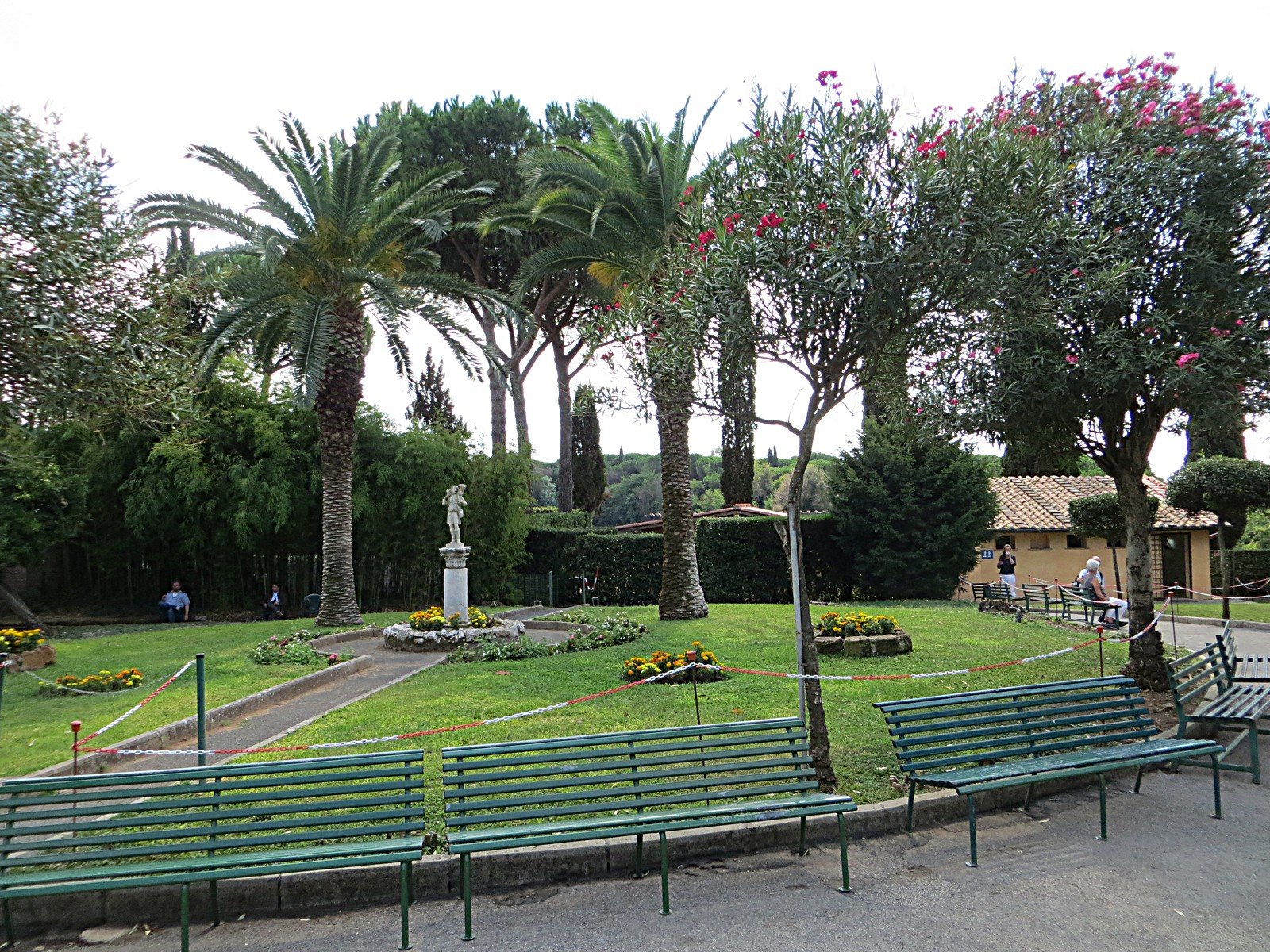
Here's the part almost nobody takes advantage of. Above the galleries stretches a park of about 30 hectares that is, without exaggerating, one of the most peaceful patches of green in the city: stone pines, cypresses lined up along the avenue, meadows, low walls, farmhouses, and a quiet that, two kilometers from the Baths of Caracalla, seems like a geographical mistake. Coaches drop people off, the group goes down, comes back up, and sets off again. The surface remains with those who know it.
Within the grounds, besides the Salesian buildings, you'll find traces of ancient structures on the surface and the lucernari that emerge from the grass like periscopes, each connected to a gallery below. Walking across those meadows knowing you have 20 kilometers of corridors beneath your soles is a perceptual experience that's hard to explain to someone who hasn't felt it. The ground suddenly seems thin.
The Cypress Avenue
The entrance avenue deserves a paragraph of its own. It's a tree-lined straight road that climbs from the Appia to the forecourt, with the cypresses arranged in a perspective so regular it looks like it was drawn by a 17th-century painter. And it is, in fact, the quintessence of the Roman countryside landscape as Claude Lorrain, Poussin, and then the vedutisti of the Grand Tour codified it. Walking it, slowly, changes the day. Riding it by coach, looking at your phone, is a waste of one of Rome's lovely views.
The Catacombs of San Callisto and Rome's Other Catacombs
In Rome, more than 60 early Christian underground cemeteries have been catalogued, but only a few are regularly open to the public, and each has its own personality. If you have time for just one visit, the choice depends on what you're looking for. If you have time for two, there are pairings that work better than others. Here's a mental map, with an honest caveat up front: always recommending only the place you're writing about isn't being a guide, it's being a salesperson.
San Sebastiano, 10 minutes on foot
The Catacombs of San Sebastiano are on the same Appia, a little further on, and they're the natural pairing. They have three features that San Callisto doesn't: the basilica above, with its beautiful wooden ceiling and the statue of the saint attributed to Bernini's circle, the pagan mausoleums, perfectly preserved and visible in an open-air setting, with stucco and paintings, which is something very rare, and the Triclia, the portico courtyard covered in graffiti left in the third century by the faithful who invoked Peter and Paul, the oldest evidence of an apostolic cult in this place. If San Callisto is the institutional cemetery, San Sebastiano is the place where you can see the point where the pagan and Christian worlds meet.
Domitilla, the largest
The Catacombs of Domitilla, on the via delle Sette Chiese, are the largest of all and have an ace up their sleeve: the semi-subterranean basilica of Saints Nereus and Achilleus, a three-aisled church dug underground, with its columns and apses. Going inside gives a completely different feeling from the corridors: here the underground becomes monumental architecture. The fresco of the Good Shepherd in the so-called cubicle of the same name is also worth the detour. They're just under one kilometer from San Callisto, in the same quadrant.
Priscilla, for the painting
If you're looking for the most beautiful paintings of all, the best choice is still Priscilla, on via Salaria, on the other side of the city. There you'll find the so-called Greek Chapel, and above all what many consider the oldest known depiction of Mary: a Madonna and Child and a prophet figure pointing to a star, datable to around the first half of the third century. Priscilla is less spectacular in scale and less famous by name, but for those who love painting it's the right place. San Callisto has the story of the popes. Priscilla has the images.
Pretestato, Sant'Agnese, and the Jewish catacombs
On the other side of the Appia, almost opposite, are the Catacombs of Pretestato, with their 4th-century painting and a history linked to the martyr Januarius. Access is more limited and must be arranged in advance. To the north, on the Nomentana, Sant'Agnese can be paired with the Constantinian basilica and the mausoleum of Santa Costanza, which has the most beautiful grape harvest mosaics in Rome. And along the Appia itself are the Jewish catacombs of Vigna Randanini, an essential reminder: underground burial in Rome was not a Christian invention, and the city's Jewish community used similar solutions in the same centuries and on the same land.
Via Appia Antica Around the Catacombs of San Callisto
No one should come all this way and leave right away. The Catacombs of San Callisto are at the heart of one of the most extraordinary archaeological landscapes in Europe, and the rest of the day builds itself as you walk. Via Appia was opened in 312 BC by the censor Appius Claudius Caecus to connect Rome with Capua, and later extended to Brindisi: the regina viarum, the road on which half the history of the ancient Mediterranean passed.
Domine Quo Vadis
Heading down toward the city, a few hundred meters from the entrance, is the small church of Santa Maria in Palmis, which everyone calls Domine Quo Vadis. The tradition, told in the apocryphal Acts of Peter, holds that here the apostle, fleeing Rome, met Christ walking in the opposite direction and asked him: Lord, where are you going? The answer was: I'm going to Rome to be crucified again. This convinced Peter to turn back and face martyrdom. Inside is a slab with two footprints, a copy of the one kept at San Sebastiano. It is a legend, and no one claims otherwise, but it is a legend that has inspired paintings, novels and films, and the little church, with its low facade among the cypresses, is worth a stop.
Cecilia Metella, the Circus of Maxentius, the Quintili
Going south instead, after San Sebastiano, you pass in sequence the Circus of Maxentius, the best-preserved Roman circus of all, with its starting gates still legible and its perimeter intact, and the Mausoleum of Cecilia Metella, the cylindrical drum faced with travertine that the Caetani family turned into a castle tower in the 14th century. From there the Appia's most photogenic stretch begins: the original paving stones, the umbrella pines, the fragments of funerary sculptures set back upright in the 19th century, and a few kilometers on, the Villa of the Quintilii, the largest suburban residence in the Roman countryside, with its monumental baths.
On the other side, toward the interior, opens the Caffarella Park, an agricultural valley that survived inside the city, with flocks, nymphaea and the farmhouse of the former mill. It is where Romans go to walk on Sunday mornings, and rightly so.
Fosse Ardeatine
Not far away, on Via Ardeatina, within the same geographic area as the San Callisto complex, is the Ardeatine Caves Mausoleum, where on March 24, 1944, 335 men were killed in reprisal. Those were pozzolana quarries too, the same tuff, the same subsoil. Anyone who visits the catacombs in the morning and the Fosse Ardeatine in the afternoon takes on a very grueling but necessary route, and understands something about this hill that no guide can explain in words: that for 18 centuries the underground has received people killed for their faith or for their name, with a continuity that sends shivers down the spine.
The Seven Churches of Saint Philip Neri
The road that runs alongside the San Callisto complex is called via delle Sette Chiese for a precise reason: in the 16th century Philip Neri revived the pilgrimage to Rome's seven basilicas, a walking route of roughly 20 kilometers that linked San Pietro, San Paolo, San Sebastiano, San Giovanni, Santa Croce, San Lorenzo and Santa Maria Maggiore. The stretch between San Paolo and San Sebastiano passes right through here, and Philip walked it with hundreds of people, with stops, songs and picnics, turning a penitential exercise into a popular festival. If you walk the piece of road that separates San Callisto from San Sebastiano, you are standing on that route.
What You Won't Find in the Catacombs of San Callisto: Myths to Debunk
Every very famous place accumulates legends, and this one has collected several. It is worth tackling them head-on, because arriving prepared makes the visit better, and because reality, as almost always, is more interesting than fiction.
They Were Not Secret Hideouts
We've already said it, but it bears repeating, because it is the number one misunderstanding: the catacombs were legal, known cemeteries, not hiding places. Roman law protected burial places, and funerary associations were recognized, the Christian community operated for a long time within that legal framework. When the authorities wanted to strike, they had no trouble finding the address: in 258 they expressly forbade Christians from entering the cemeteries, which presupposes that they knew exactly where they were.
Nobody Lived There
No one lived in the catacombs. No one hid there for months. The air is breathable but thin, the humidity is constant, lighting required oil lamps that consume oxygen, and in a gallery without air exchange the atmosphere quickly becomes unbearable. Liturgical gatherings down there were brief and tied to anniversaries. The community's life took place in homes, in the domus ecclesiae, on the surface.
Palm branches and ampoules do not prove martyrdom
In the 17th and 18th centuries the belief spread that a palm carved on a tombstone, or a glass ampoule with reddish residue beside the loculus, were automatic certificates of martyrdom. Thousands of supposed holy bodies were thus extracted from several cemeteries and distributed to churches across half of Europe. Later historical criticism drastically scaled back that criterion. The palm was a widely used symbol of victory, and the ampoules almost always held ointments or funerary perfumes, not blood. A textbook case of how a wrong hypothesis, repeated for two centuries, can produce enormous material consequences.
Not all the buried were martyrs or poor
People of every social condition were buried in the Roman catacombs: martyrs, yes, but in very limited numbers compared to the mass. Also children, artisans, merchants, officials, matrons and slaves. Traditional estimates for the Callistian complex put the order of magnitude at half a million burials over its active life. Of that total, the recorded martyrs number a few dozen. The catacombs are not a monument to an elite of heroes. They are the municipal cemetery of an enormous community.
A one-day itinerary with the Catacombs of San Callisto
Here's a tested program that works in every season, with some adjustments to the times.
Morning
Leave early from the center on the 118 from Circus Maximus, or walk from Porta San Sebastiano if you have the legs and the inclination. First visit of the day to the Catacombs of San Callisto, just as they open: the group is smaller, the guide has more time to answer questions, and the outside temperature hasn't yet decided to ruin your morning. Spend 40 minutes underground, then half an hour in the surface grounds, unhurried, up to the cypress avenue.
From there, on foot, toward San Sebastiano: a good 10 minutes, then a visit to the basilica and its catacombs, with the mausoleums and the Triclia. By then you'll have seen the two faces of the Christian underground along the Appian Way, and the difference between the two will stick with you.
Lunch and afternoon
Trattorias and eateries along the Appian Way in this stretch are the natural solution. Alternatively, a sandwich on the park lawn works perfectly well and costs a tenth as much. In the afternoon, the real Appian Way: the Circus of Maxentius, the Tomb of Caecilia Metella, and then the basalt paving heading south, on foot or by bike, as far as you feel like going. Those with energy can reach the Villa of the Quintilii. Those with less can stop earlier and turn back at an easy pace, which is an equally respectable choice.
Variations
The spiritual variation: San Callisto in the morning, the Fosse Ardeatine in early afternoon, and a quiet return to the city. The art variation: San Callisto in the morning, and in the afternoon inside the walls, Santa Cecilia in Trastevere for Maderno's original and Santa Prassede for the mosaics of Paschal I, which is the exact continuation of the story you heard down there. The Sunday variation: the Appian Way closed to traffic, bikes, the catacombs in mid-morning and a picnic at the Caffarella Park.
When to visit the Catacombs of San Callisto
The seasons matter less here than elsewhere, because underground the climate never changes. But they matter a great deal for everything around it. Spring is ideal above all: the Roman countryside between April and May is green, the grounds of the complex are in bloom, and the walk along the Appian Way is perfect. Autumn, from late September through November, is the best season for light: the pines against the low October sky create an effect no postcard can capture.
Summer has a not-insignificant advantage: 40 minutes at 16 degrees Celsius while it's 38 degrees Celsius outside is a kind of therapy. But the stretch of the Appian Way under the July sun at noon isn't advisable for anyone. Go early in the morning or late in the afternoon, and bring a hat. Winter is the season of few visitors and long light, but it's also when the site takes a break of a few weeks. Check first, always.
Jubilees, holidays and big crowds
During periods of heavy pilgrim traffic in Rome, the Callistian complex is a fixed stop on organized itineraries, and the numbers rise noticeably. If you're in the city during one of these periods and want to avoid the rush, the rule still holds: first departure in the morning, weekdays, and patience if you have to get up early. Sundays and Saturdays are the busiest days. Mondays and Thursdays, usually, are the quietest.
What the Catacombs of San Callisto mean today
At the end of the historical section, here is a reflection that justifies the two hours to spend at this place. The Catacombs of San Callisto are the place where a religious community learned to be an institution. Before this, there were families burying their dead wherever they could. From here on, there is an organization with real estate holdings, an appointed administrator, a burial register, a criterion for assigning spaces, a pricing policy and a hierarchy of roles. It's a less poetic step than the martyrdoms but infinitely more decisive: institutions last, enthusiasms don't.
And at the same time, in those same corridors, that same community was creating its most tender images: the young shepherd with the sheep on his shoulders, the fish with the basket of loaves, the prophet sleeping under the pergola, the figures with their arms open. No written theology, no formulated dogma. Only figures painted in haste by anonymous artisans on thin plaster, with four colors at their disposal. That those figures have survived 18 centuries and are still legible on the vault of a small tufa room is, if you think about it, the most improbable thing in this whole story.
Quick Questions About the Catacombs of San Callisto
How much does a visit to the Catacombs of San Callisto cost?
The full ticket costs around 10 euros, with a reduced rate just over half that is reserved for young people, school groups and students of archaeology and architecture within the age limits set. Free admission is provided for young children and for people with disabilities. The guided tour is included in the price and mandatory: there is no entry without a guide. Always check current prices on the official site channels before you go, as they may be revised.
What are the opening hours and closing day?
Opening is organized in two time slots, one in the morning and one in the afternoon, separated by a midday break, with group departures at close intervals. There is a weekly closing day, which traditionally falls midweek, a break of a few weeks in winter, and closure on the main religious holidays. This information changes: check the official channels the day before, and plan around the last useful departure of each time slot, which comes well ahead of the gate closing time.
Do you need to book the Catacombs of San Callisto?
Individual visitors usually don't need a reservation and can simply show up at the ticket office. For groups, booking is the norm and strongly recommended. If you want to stay clear of peak crowds, use the official channels of the site and of the body in charge of organizing pilgrimages. Be wary of third-party offers that promise priority access: here you don't skip a line, you wait for your group's departure in your own language, and no one can shorten that wait.
How long does the visit last and what do you see?
About 40 minutes accompanied by the guide. You see the Crypt of the Popes with its original Greek inscriptions, the crypt of Saint Cecilia with the frescoes from the IX century and the copy of the statue by Maderno, the cubicles of the Sacraments with paintings from the first half of the III century, and a significant stretch of the galleries with loculi in multiple rows. This is an excerpt of a complex of nearly 20 kilometers: the open route is a very small fraction of the total, and your guide will tell you so.
How many popes are buried in the Catacombs of San Callisto?
The sanctuary's tradition counts 16 in the entire complex, 9 of whom are in the Crypt of the Popes alone. As for Zephyrinus, the exact burial place is not certain, and Damasus I rested in the small family basilica on via Ardeatina, within the Callistian grounds but outside the crypts he himself had monumentalized. Today the loculi you see during the visit are empty: the relics were moved to churches inside the walls starting in the VIII and IX centuries.
Can you take photos in the Catacombs of San Callisto?
No. Inside, photography and filming are prohibited, as in the other catacombs run by the Pontifical Commission of Sacred Archaeology. There are two reasons, both serious: the preservation of the paintings, which suffer from lights and flash, and the respect owed to a burial place. Outside, in the grounds and along the Appia, you can photograph freely, and as you'll see, there is no shortage of subjects.
Is it cold in the catacombs?
The temperature stays around 15 or 16 degrees all year, with high humidity. In summer it's a relief, but standing still to listen for 40 minutes in a humid environment chills you more than you'd expect: bring a light jacket, especially for children and elderly people.
Are the Catacombs of San Callisto accessible by wheelchair or stroller?
The underground route involves stairs going down and up and offers no alternatives: it is therefore not feasible with a wheelchair or a stroller. The surface grounds, with their paths and lawns, can be navigated without difficulty. If you have special needs, contact the site in advance to find out what solutions may be possible.
How do you get to the Catacombs of San Callisto by public transport?
The address is via Appia Antica 110. The reference bus lines are the 118, which leaves from the Circo Massimo and Terme di Caracalla area and runs along the Appia with a stop very close to the entrance drive, and the 218, which leaves from San Giovanni and comes down to the Ardeatina. On Sundays, with the Appia Antica closed to private traffic, walking or cycling from the Parco dell'Appia Antica is half the pleasure of the day.
Is San Callisto or San Sebastiano better?
It depends on what you're looking for, and if you have time the right answer is both, in the same morning, because they are 10 minutes' walk apart. San Callisto has the complex's staircase, the Crypt of the Popes and the paintings in the cubicles of the sacraments. San Sebastiano has the basilica above ground, the preserved pagan mausoleums and the Triclia with the graffiti left by the faithful. They are complementary, not alternatives.
Is a visit to the Catacombs of San Callisto suitable for children?
From seven or eight years old it works well: the storytelling is concrete, the duration is contained, and the fascination of the underground does the rest. Under five, I advise against it, both because of how difficult the route is and because the darkness and narrow spaces can frighten them. The guides are used to school groups and know how to adjust the story to the age.
What to see along with the Catacombs of San Callisto?
In order of proximity: the Catacombs of San Sebastiano with the basilica, the little church of Domine Quo Vadis, the Catacombs of Domitilla on the via delle Sette Chiese, the Circus of Maxentius and the Mausoleum of Cecilia Metella along the Appia, the Parco della Caffarella and, for those with a full day, the Villa dei Quintili. On the side of contemporary memory, the Mausoleo delle Fosse Ardeatine on the via Ardeatina.
A curiosity about the Catacombs of San Callisto
The most spoken word in the Catholic world made its debut down here, and not in a solemn document but in a family funerary poem. In the double cubicle of Severo, a rhythmic inscription carved no later than 304 calls the bishop of Rome Marcellino by a title never before attested for a Roman bishop: papa. The deacon Severo recalls there that he obtained from his papa Marcellino permission to build his cubicle, and he writes it in verse, as was the custom for epitaphs of a certain tone.
There is no council, no bull, no official decision: there is a man speaking of his bishop with the affection one has for a father, and using a Greek word, pappas, papà, that in the Christian East was applied to priests and bishops of every rank. From that domestic familiarity, carved about 10 meters under the Roman countryside, came the most famous title in the world. Every time a newscast says "the Pope," it unknowingly cites the epitaph of a cemetery on the Appia.
This is the kind of primacy that makes this place unique. In the Catacombs of San Callisto you don't visit a monument: you visit the birth certificate of a vocabulary. The fish that stands for Christ, the shepherd that stands for salvation, the dormitory that stands for the cemetery, the pope that stands for the bishop of Rome. Words and images the world still uses every day, almost always without knowing where they come from. They come from here, from a plateau of tuff between two consular roads, where a community of Greek-speaking immigrants was inventing a way of saying things.
Something nobody tells you about the Catacombs of San Callisto
Above the catacombs there is a park that charges no ticket, and it is one of Rome's green secrets. The roughly 30 hectares of the San Callisto complex above ground are a plateau of stone pines, cypresses and meadows between the Appia and the Ardeatina, crossed by the entrance drive and by paths almost no one walks. The mechanism is always the same: the coaches unload at the forecourt, the group goes underground, comes back up, and leaves. Nobody looks around. The surface stays with those who know it, and it is a place where at 11 on a Tuesday in October you can hear birds singing 2 kilometers from the Baths of Caracalla.
The second thing nobody tells you concerns the lucernari. Walking through the meadows you occasionally come across square masonry structures emerging from the grass: they are the ventilation and lighting shafts of the galleries below, opened in antiquity to bring air and light to where the fossors worked and where pilgrims prayed. Looking down and seeing the darkness drop vertically, right after coming back up from that darkness, produces a perceptual short circuit that is worth the walk on its own. The ground you are walking on is full of voids, and suddenly you realize it with your body and not with your head.
The third element is time. The ticket to the Catacombs of San Callisto buys you 40 minutes, the peace above ground has no set duration, for as long as the gates are open. Take the rest of the morning with you, sit on a low wall, take a long loop before leaving. And then head on foot toward San Sebastiano, along the via delle Sette Chiese or the Appia: you are literally walking over 20 kilometers of galleries. The real visit begins once the guide has said goodbye.
The advice I give you for visiting the Catacombs of San Callisto
Take the first departure of the morning, right when it opens, and if possible not on a Saturday or Sunday. San Callisto is the catacomb for organized groups, and by mid-morning the departures close together are already full. The difference between going down with 12 and going down with 40 is huge, because in the first case the guide answers questions, and in the second the guide recites the text. At first light the outside temperature is still mild, the Appia is empty for the walk that follows, and the day opens up in front of you instead of closing in.
The three practical things not to forget, in order of how often I see people getting them wrong: the jacket, because underground it's 16 degrees and 40 minutes standing still makes you feel it, the midweek closing day, the classic trap for anyone who plans on the map without checking the calendar, and closed shoes, because the tuff steps are regular but they aren't a museum floor. I'll add a fourth, less obvious one: eat something first. Going down on an empty stomach into a damp environment after an early start is the most effective way to feel sick halfway through the galleries, and it happens more often than you'd imagine.
The combination I've been recommending for years is this: the Catacombs of San Callisto on the first departure, half an hour in the surface complex, a walk to San Sebastiano with the basilica and its catacombs, lunch along the Appia, and an afternoon among the Circus of Maxentius, Cecilia Metella and the basolato, by bicycle if you feel like it. If instead you're looking for the catacombs with the most beautiful painting of all, I have to be honest: here the strength is the history of the popes and the institutions. For images, the better choice is still Priscilla, on the Salaria. After all, a guide who always and only recommends the place they're talking about isn't really doing their job as a guide.
Another well-known fact, yet rarely mentioned
Everyone knows that the popes of the 3rd century rested here. Almost nobody notices what language their epitaphs are written in. Ponziano, Antero, Fabiano, Lucio, Eutichiano: the original inscriptions in the Crypt of the Popes are in Greek, not Latin. It's not an erudite whim or an accident. Greek was the everyday language of the Christian community of Rome, made up to a large extent of immigrants, merchants, freedmen and slaves from the eastern Mediterranean. People preached in Greek, wrote in Greek, and celebrated in Greek. Latin in the Roman liturgy came later, and by the 4th century of Damasus it's already a different world.
It's a detail that overturns the postcard image of early Roman Christianity. When we imagine the Church of its origins, we picture a Latin institution dealing with the Senate and the emperor. The reality is that its bishops were buried with their names carved in the alphabet of the ports, in a community whose networks reached Antioch, Ephesus and Alexandria long before they reached Milan. Christian Rome was born peripheral to power and central to the Mediterranean. These are two things we tend to confuse.
There is a second well-known fact, just as rarely cited, and it concerns an absence. In the oldest paintings of the Catacombs of San Callisto, the cross isn't there. Crucifixion was a degrading punishment reserved for slaves and rebels, and no Roman family of the 3rd century, however devout, would have carved the instrument of that death on the tomb of its dead. It would take centuries, and the legal end of the penalty, before the sign could be displayed. In the meantime, the community speaks in oblique figures: the fish, the anchor, the dove, the shepherd, the sleeping prophet. When the guide shows you the vault of a cubiculum, count how many crosses you see. It's instructive.
The right photo to take at the Catacombs of San Callisto
Let's start with honesty: you can't photograph underground. The ban applies to all the catacombs run by the Pontifical Commission, covers photos and video, with or without flash, and it isn't negotiable. The reasons are excellent, since paintings on thin plaster are sensitive to light and heat, and a cemetery isn't a film set. But I know that for many people the instinctive reaction is frustration. Turn it around: take the rare luxury of looking at something without having to capture it. 40 minutes with your phone staying in your pocket is almost an exotic experience these days. You'll leave remembering more, not less.
The right photo, then, is taken on the surface, and it's a real standout: the entrance avenue lined with cypresses, the straight stretch that climbs from the Appia to the complex. Take it early in the morning, with the low light cutting obliquely between the trunks and stretching the shadows across the asphalt, or in the late afternoon when the pines turn orange. Stand in the middle of the avenue, lower yourself half a meter below eye level to enhance the perspective, and wait for no one to pass by. It's one of the most photographed views of the Roman countryside, and it's almost always shot in a hurry, from the window of a bus. Do it on foot, calmly, and you'll get an image unlike any of the others.
The variant that tells a story is the skylight in the lawn: that square masonry shaft that sinks into the greenery. Frame it from above, with the darkness inside and the grass all around, maybe with a cypress in the background to give scale. It's the only image of the interior you can take home without breaking any rules, and paradoxically it says more than any stolen shot taken in the galleries: it shows exactly what lies beneath your feet. On your way out, add the paving stones of the Appia with the umbrella pines, the low facade of Domine Quo Vadis, and the drum of Cecilia Metella against the sky. Down below, memory keeps the fish and the basket of bread. It's an archive that nobody can erase from you.
Some important events that happened here in history
End of the 2nd century: on the plateau between the Appia and the Ardeatina, the communal cemetery takes shape as the first direct burial property of the church of Rome. It forms from the joining of private Christian hypogea, the crypts of Lucina and the core of the Region of the Popes, to an area managed by the community. Between 198 and 217: Pope Zephyrinus entrusts management of the cemetery to the deacon Callistus, who, once he became pope, will make it the official cemetery of the Church. First half of the 3rd century: frescoes of baptism and the Eucharist are painted in the Sacraments cubicles, the first Christian visual alphabet.
3rd century: the Crypt of the Popes holds nine popes, with the Greek plaques of Pontian, Anterus, Fabian, Lucius and Eutychian. 251-253: Pope Cornelius, of the gens Cornelia, is buried in a secluded area, with the Latin inscription bearing the title martyr. August 6, 258: Pope Sixtus II is caught by surprise and killed by soldiers while celebrating in a cemetery on the Appia during the persecution of Valerian, who had forbidden Christians access to their own cemeteries. His body is laid in the place of honor in the crypt. No later than 304: in the Severus cubicle, Marcellinus, bishop of Rome, is called "pope" for the first time.
309-310: Pope Eusebius, exiled to Sicily by Maxentius, dies in exile and is moved here, under Miltiades. On that wall, Damasus will have the memory of the schism of Heraclius over the question of the lapsi inscribed. 366-384: Damasus I monumentalizes the crypts, opens stairways and skylights, and has his poems in hexameters inscribed in the script designed by the calligrapher Furius Dionysius Filocalus. He is later buried in his little family basilica on Via Ardeatina. Late 4th century: the Western and Liberian regions develop, with monumental underground architecture.
5th century: burials gradually cease. The complex remains a pilgrimage destination, and in early medieval itineraries it appears in a place of honor among the cemeteries of the Appia. 821: Pope Paschal I transfers the relics of Saint Cecilia to the basilica in Trastevere. Over the 8th and 9th centuries, systematic transfers empty the crypts to protect them from raids. Middle Ages: oblivion, collapsed entrances, and the plateau returns to being vineyard and pasture.
1593-1632: Antonio Bosio systematically explores the Christian underground of Rome and posthumously publishes the Underground Rome. 1849: Giovanni Battista de Rossi recognizes, in a vineyard, the fragment of slab with the letters NELIUS MARTYR, and identifies the ground to be excavated. 1852: the crypt of Pope Cornelius is identified. 1854: de Rossi recognizes the Crypt of the Popes, the birth certificate of modern Christian archaeology. The announcement has an enormous echo, and Pius IX visits the crypt. 1864-1877: the volumes of La Roma sotterranea cristiana come out.
1929: with the Lateran Pacts, oversight of the Christian catacombs is recognized as belonging to the Pontifical Commission of Sacred Archaeology. 1930: the welcoming of pilgrims and guided tours are entrusted to the Salesians of Don Bosco, who have looked after the site since then. Recent decades: restoration campaigns using non-invasive technologies, low thermal impact lighting, microclimate monitoring, and the rediscovery of decorative layers in the crypt of Saint Cecilia. Today: guided tours with closely spaced departures in dozens of languages, in the most studied ancient cemetery in the world.
Who has passed through the Catacombs of San Callisto
The first name is the one the site is named after, and his is a story of an unlikely promotion: Callistus, slave, then freedman, then bankrupt banker, then sentenced to the mines in Sardinia, then administrator of the community's cemetery, and finally bishop of Rome. He gave this place its name without being buried here. He rests in the cemetery of Calepodius on Via Aurelia, and the paradox suits him. After him come the nine popes of the crypt and the 16 of the complex: Zephyrinus, Urban I, Pontian, Anterus, Fabian, Cornelius, Lucius I, Stephen I, Sixtus II, Dionysius, Felix I, Eutychian, Gaius, Eusebius, Miltiades, Damasus I. A list that spans two centuries and includes exiles, those who abdicated, martyrs and organizers.
Then there's Damasus, the poet pope who turned the tombs down here into a shrine, and his calligrapher Furius Dionysius Filocalus, who designed for him the most elegant epigraphic lettering of late antiquity: one of the very few designers from antiquity whose name we know. There's Saint Cecilia, here until 821, and with her the faithful who for centuries came to pray in front of her arcosolium. There's the deacon Severus, who in his epitaph handed down the word "papa" without suspecting he was doing anything memorable. And there are the fossores, the real makers of this place: thousands of working days with the double-pointed pick and the oil lamp, for 20 kilometers of galleries and half a million burials.
In the 1600s Antonio Bosio came through, the Columbus of the catacombs, with his ropes and his notebooks. In the 1800s came Giovanni Battista de Rossi, who with a broken fragment of marble in his hand refounded a discipline and reassembled, name by name, the burial place of the third-century popes, showing it to Pius IX in a scene that historians still tell. In the 1900s came the Salesians of Don Bosco, who have welcomed and guided visitors since 1930, and the archaeologists of the Pontifical Commission for Sacred Archaeology, who measure the humidity of the painted rooms so that they reach the next century.
And then there are the pilgrims: the early medieval ones with their itineraries in hand, those of Saint Philip Neri who in the 1500s walked up Via delle Sette Chiese singing, and those of today, who go down in groups of 20 or 30, 40 minutes each, from every continent and in dozens of languages. A chain of custodians and visitors 18 centuries long, begun with a deacon named Callixtus and continued without interruption until your nine o'clock departure. Join them with a low voice: the line here has been in good company since the third century.
To close, from the avenue of cypresses. The Catacombs of San Callisto are the place where the Church learned to be an institution, with a land registry, an administrator, an official cemetery and even a price list, and at the same time the place where it invented its most tender images: the fish with the basket of loaves, the young shepherd with the sheep on his shoulders, the sleepers waiting. Go down on the first departure, listen to the guide without looking at your watch, come back up into the grounds and stay 10 minutes in silence under the pines. Down there you have just crossed 18 centuries. Up here, in the meantime, not even a storm has passed.
Article written by the editorial staff of TourLeaderPro, contact them for Private/Corporate/V.I.P. Tours and Experiences.
Planning a trip to Rome? The English-language guides to visiting the city are on ItalyPlanner.com.