Museum of Anthropology “G. Sergi”
In short. The Museum of Anthropology "G. Sergi" of Sapienza is at Piazzale Aldo Moro 5, inside the University City, on the second floor of the Anthropology building, the one that carries the code CU011 on the university's maps.
The Museum of Anthropology "G. Sergi" of Sapienza is at Piazzale Aldo Moro 5, inside the University City, on the second floor of the Anthropology building, the one that carries the code CU011 on the university's maps. Admission is free. The hours given by Polo Museale Sapienza are these: Monday, Thursday and Friday from 9:30 to 13:30. Tuesday from 9:30 to 13:30 and from 14:30 to 18:30. Wednesday from 9:30 to 13:30 and from 14:30 to 15:30. Individual visitors don't need to book: you go up and walk in. For groups and school classes the guided visit is arranged beforehand, by writing to museo-antropologia@uniroma1.it or calling 06 4991 2495. The museum is directed by Professor Fabio Di Vincenzo, and the area curator is Dr. Alessandro Aruta. By public transport: metro line B, Policlinico stop, then five minutes on foot. Trams 3 and 19, which run along Viale Regina Elena and Viale delle Province. Buses 310 and 492. Before setting out it's worth rechecking the hours and any closures on the museum's official page, because the calendar of a university museum also follows the academic one: polomuseale.web.uniroma1.it.
If you're building a Roman itinerary off the usual circuits, the tourist attractions page of this site gathers the other possible stops, and the University City offers quite a few within 200 meters.

What the Museum of Anthropology "G. Sergi" really is
Let's say it right away, because it helps set expectations: it's not an ethnographic museum and it's not a natural history museum with dinosaurs. It's a museum of physical anthropology, that is, the discipline that studies the human body as a biological object, its variability and its evolutionary history. The material on display is made largely of human bones, skulls, plaster casts, 19th-century measuring instruments. Anyone who arrives thinking of African masks and Amazonian textiles is thrown off. Anyone who arrives knowing what they'll see comes out with a head full of ideas.
The second thing to understand is that the Museum of Anthropology "G. Sergi" is two museums overlapping in the same room. One tells human evolution: 6 million years of natural history, the place of our species among the primates, the fossil forms that preceded us. The other, almost without meaning to, tells the history of Italian anthropology between the 19th and 20th centuries, with its instruments, its ambitions, its glaring mistakes. The first museum everyone understands. The second is the one worth the trip, and it's also the one nobody explains to you unless you ask.
This is one of the three or four Roman museums where a one-hour visit changes the way you look at people on the metro. Not because of the pathos of the bones, which stops impressing after 10 minutes, but because of the lesson in method behind the display cases. A museum that keeps the instruments with which people got it wrong is more honest than 90 museums that display only the right results.
Where the Museum of Anthropology "G. Sergi" is and how to get there
The exact address and the CU011 building
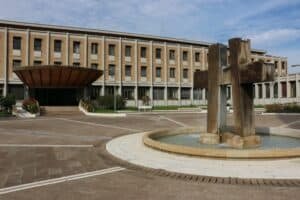
The postal address is Piazzale Aldo Moro 5, 00185 Rome, but that address is valid for the whole University City, which is a neighborhood within the neighborhood. The useful reference is another: Anthropology building, code CU011, second floor. Once past the monumental entrance on Piazzale Aldo Moro you enter Piazzale della Minerva, the one with the statue and the pool. The buildings of the scientific institutes are on the right, toward Viale dell'Università and Viale Regina Elena. The university's maps, posted at the gates and available on the site, give the CU codes followed by the number: the one you need is CU011, where the museum shares the building with psychology. The museum belongs to the Department of Environmental Biology.
Anyone arriving for the first time loses on average 10 minutes looking for the right stairs. The practical advice is trivial and works: at the building's front desk, ask for the museum, not the department. The staff can point it out, and at a university with over 100,000 enrolled students, knowing the right name of the thing you're looking for saves a quarter of an hour.
Metro, tram and bus for the Museum of Anthropology "G. Sergi"
The most convenient stop is Policlinico, on metro line B. Leaving the station, take Viale Regina Elena westward and in five or six minutes on foot you are at the gate of the University City. Line B, for those arriving from elsewhere, is the same one that serves the Colosseum and Termini station, so the museum can be reached without changes from half the city. The second useful stop, for those coming from the north, is Castro Pretorio, still on B: from there you walk a bit more and run alongside the barracks wall.
On the surface, the official tourist portal of Roma Capitale lists for this museum trams 3 and 19 and buses 310 and 492. The 3 and the 19 are the two trams that cut across the city from Trastevere and from Piazza Risorgimento toward San Lorenzo and the Verano, and they stop right by the Policlinico and the university. For those coming from Trastevere or the Vatican they are the most convenient solution, though not the fastest. The 492 links Tiburtina station to the center via the University City, and the 310 comes from Montesacro and the northeast quadrant.
A piece of advice: from Termini take nothing. It's a 20-minute walk along Via Marsala and Via dei Mille, you cross the Castro Pretorio rione and arrive at the square without waiting for anything. In a city where tram 19 can vanish for 20 minutes, walking is often the rational choice.
By car, by bicycle, by train
By car you arrive badly and park worse. The University City is surrounded by blue parking lines and by traffic that is ferocious during class hours. Vehicle access inside the campus is regulated and not designed for visitors. Anyone who really has to come by car had better leave the vehicle near the Verano or on Viale delle Province and walk the last stretch.
By bicycle, instead, it works: the area between San Lorenzo, the Policlinico and Nomentano is flat, and inside the campus you ride easily. By train, Tiburtina station is two metro B stops away, Termini station three. Anyone arriving in Rome for the day and wanting to see this museum can do it comfortably in a morning, and stay in the same area for lunch too.
Hours, ticket and booking at the Museum of Anthropology "G. Sergi"
Opening hours
The hours published by Polo Museale Sapienza are generous for a university museum and tight for a civic museum: Monday, Thursday and Friday only in the morning, from 9:30 to 13:30. Tuesday morning and afternoon, from 9:30 to 13:30 and from 14:30 to 18:30. Wednesday morning and early afternoon, from 9:30 to 13:30 and from 14:30 to 15:30. On Saturday and Sunday the museum is closed, barring special openings tied to university events. There are closing periods between December and January, coinciding with the suspension of academic activities, and they should be checked on the official page.
Tuesday afternoon is the only long window of the week, and anyone who works mornings has no alternative. Make a note of it: Tuesday until 18:30. It's also the moment when the museum is least frequented by students, who are elsewhere at that hour.
How much it costs to enter the Museum of Anthropology "G. Sergi"
It costs nothing. Admission is free, as for most museums in the Sapienza museum system. There are no ticket offices, no lines, no reductions to ask for because there's no full price to reduce. This is one of the pieces of information the Roman public ignores most consistently: inside the University City there are 20 museums open to the public and almost all are free.
It's worth saying clearly: being free isn't a sign of little value. It's the consequence of the fact that these are university collections, born for teaching and research, whose primary audience is students. The outside visitor is a guest in a workplace. Behaving accordingly, that is, with discretion, is the minimum.
Do you need to book a visit to the Museum of Anthropology "G. Sergi"?
For the individual visitor, no: during opening hours you walk in freely. For groups and classes, yes, and the booking must be arranged with the museum: the email address is museo-antropologia@uniroma1.it, the phone 06 4991 2495. Guided visits for school groups are guaranteed on request, and they are the way the museum works most often.
The professional's advice: even if there are only two or three of you, an email a couple of days beforehand costs nothing and changes the visit. A museum of this kind, when it knows you're coming, often puts someone next to you who knows. In a civic museum this never happens. In a university museum it often does, because whoever runs it has a professional interest in explaining.
A curiosity about the Museum of Anthropology "G. Sergi"
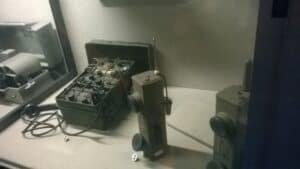
In the display cases of this museum, together with the skulls and skeletons, are kept the instruments of the first psycho-physiology laboratory set up in Italy by Giuseppe Sergi starting in 1885. They are objects that seem to have come out of a physics cabinet: chronoscopes, dynamometers, devices for measuring reaction times, esthesiometers for testing the sensitivity of the skin. They served to measure the mind through the body, according to the program of late-19th-century experimental psychology, which wanted to wrest the study of the soul from philosophy and hand it over to the laboratory.
The real curiosity is another, and it's one of those that, told on a visit, make everyone look up. In that laboratory, in the 1890s, a medical student named Maria Montessori trained. Sergi was her teacher, and his lessons in anthropology and experimental psychology entered the method that would make that student famous around the world. Montessori then herself taught pedagogical anthropology in Rome. The idea of observing the child rather than just instructing him, of measuring his growth, of building environments suited to his height and his hand, was born also within that tradition: anthropology applied to school.
The paradox is that the same anthropology, applied to politics, would produce disasters. The same toolbox that produces the Montessori teaching materials produces, 40 years later, the anthropometric tables for the certification of race. It's no small detail: it's the central lesson of the Museum of Anthropology "G. Sergi", and whoever grasps it has understood why this museum exists.
If I had to point to a single object to look at for a long time, I would point to one of those devices. They're made of brass and wood, they have the beauty of 19th-century scientific instruments, and they are profoundly useless with respect to the purpose for which they were built. They measured very well things that didn't explain what they wanted to explain. It's the definition of a scientific dead end, on display in a case.
Giuseppe Sergi, the man the museum is named for
From Messina to Rome
Giuseppe Sergi was born in Messina on March 20, 1841 and died in Rome on October 17, 1936, at the age of 95. In between is a career that crosses almost the whole history of unified Italy. A self-taught man of irregular training, a Garibaldian as a youth, he reached the university by side roads: in 1878 he obtained authorization to teach psychology in Messina, in 1879 he was at Accademia Scientifico-Letteraria in Milan with theoretical philosophy, in 1880 he held the chair of anthropology at Bologna, in 1883 he moved to Rome.
The year that matters for us is 1884: that's when the teaching of Anthropology was established at Sapienza, entrusted to Sergi. From that teaching were born, in order, an institute, a laboratory, a scientific society and a collection. The collection is the museum visited today. Defining Sergi in one line is impossible: philosopher, psychologist, anthropologist, pedagogue, tireless polemicist, a man of vast curiosity and uneven rigor.
The laboratory, the institute, the society
From 1885 Sergi set up the psycho-physiology laboratory, the first of its kind in Italy, whose instruments are on display today. In 1893 he founded in Rome the Institute of Anthropology and the Roman Society of Anthropology, which still exists and today is called the Italian Institute of Anthropology. In 1887 the Institute found its first home in the old palace of the Collegio Romano, right in the center, a stone's throw from the Pantheon.
It's worth picturing it, that first museum: a long corridor, furniture and shelves lined up along both walls, skulls arranged by series, students passing among the display cases on their way to class. There was no museographic plan, there was a working collection that kept growing. That corridor structure, in the end, the present museum still carries on its back: it's a single large room, ordered by series, dense.
What Sergi left and what he didn't
Very little of Sergi's scientific output survives scrutiny. What survives is the institution, the school, the museum, and an idea of method: that man must be studied as any other animal is studied, with observation and measurement, without metaphysical shortcuts. Almost nothing of his classifications survives. The human taxonomy he built, with its species and varieties, is today a chapter in the history of science, not of biology.
The blunt opinion, the one that saves you half an hour of reading: Sergi should be read the way you read a great engineer who built a bridge that collapsed. The bridge is gone, but the quarry from which he took the stones and the workers he trained built everything else. Italian paleoanthropology of the 20th century, the one that produced real results, comes from there.
The Mediterranean stock theory
What Sergi claimed
The thesis that made Sergi famous in Europe is that of the Mediterranean stock. In the briefest summary: European civilization wasn't born from migrations of Aryan peoples coming from the north or from Asia, but from populations originating in East Africa, and in particular the Ethiopian plateau, who moved up along the Mediterranean and divided into three branches. From that stock, according to Sergi, descend the Egyptians, the Cretans, the Etruscans, the Latins, the Iberians, the Berbers. The great ancient civilization would thus be African and Mediterranean in origin, and the peoples of northern Europe would have arrived later, as recipients, not as bearers.
Sergi developed this model in a series of books between the end of the 19th century and the beginning of the 20th, the best known of which also circulated in English with the title The Mediterranean Race in 1901. On the level of method, he rejected the cephalic index, that is, the numerical ratio between the width and length of the skull with which the anthropologists of the day divided humanity into dolichocephalic and brachycephalic. He held that the overall shape of the skull said much more than a single number, and he built a morphological classification based on described and named types.
Why it was an anti-Aryan thesis
Here is the knot that makes Sergi an uncomfortable figure for everyone. His theory was, in late-19th-century Europe, a bomb against Nordicism. While in Germany and France the myth of Aryan and Nordic superiority was being built, an Italian professor was writing that European civilization had come from Africa and that the blonds of the north were last in line. It was a thesis that also served to found the national pride of a recently unified and insecure Italy: if the Mediterranean stock had built Crete, Egypt and Rome, then Italians weren't the poor cousins of Europe.
The point has to be made without sugarcoating: it was a racial theory all the same. It built stocks, classified them, attributed capacities and destinies to them. That it overturned the hierarchy instead of confirming it doesn't make it any less a hierarchy. It is an anti-racism that doesn't exist: it is a racism with the seating order changed. On this we have to be clear, because in recent years Sergi is sometimes claimed as a precursor of the idea that we all come from Africa, and the resemblance is only apparent. The African origin of Homo sapiens is a fact established by genetics and fossils in the second half of the 20th century. Sergi's Mediterranean stock is a 19th-century typological construct that has no kinship with that discovery.
Sergi against Latinism
One last element, little cited and useful for understanding the man. In 1900 Sergi published La decadenza delle nazioni latine, a very harsh book against contemporary Italy, in which he branded Latinism as a social disease. He was no parade-ground nationalist: he was a pessimistic positivist, convinced that the country was sick and that science should say so. 40 years later, when Fascism looked for noble fathers for its own anthropology, this book would be the argument with which its internal opponents declared him unusable.
One thing nobody tells you about the Museum of Anthropology "G. Sergi"
The Manifesto of the Racist Scientists, the document that in July 1938 opened the way to the Italian racial laws, was drafted by a man who worked here. His name was Guido Landra, a young assistant to the chair of anthropology of Sergio Sergi at the University of Rome, and he drafted the text following directives that came from Mussolini. The document came out on July 15, 1938 on the front page of the Giornale d'Italia with the title Fascism and the Problems of Race. The names of the 10 signatories, university professors and assistants, were made public on July 25.
This is no erudite detail. It's the point where the history of this museum touches the worst history of the country. The anthropology institute of Sapienza, with its display cases of skulls and its measuring instruments, is also the workplace of the man who wrote the text with which the Italian State declared the existence of an Italian race and the need to defend it. From that document descended the measures of the autumn of 1938: the expulsion of Jewish students and professors from the universities, the cancellation of careers, the beginning of a persecution that would end in the sealed railcars.
There is a further twist, and it should be told because it's instructive. Landra had been a convinced Mediterraneanist: in the obituary he wrote for Giuseppe Sergi in 1937 he still extolled the glorious Mediterranean stock. Then, after contacts with German anthropologists, he completely changed position. Point eight of the 1938 Manifesto explicitly declares the theory of the Mediterranean race dangerous, because that theory includes in the race also the Semites and the Hamites. So the founding document of Italian state racism was written by a pupil of Sergi's school, and one of its points served to demolish the theory of the founder of the school. Political loyalty counted for more than scientific loyalty.
Between 1940 and 1942, inside Fascism, there was open quarrel over Sergi's legacy. There were those who claimed him as a true and very great racist, as Giuseppe Genna did. And there were those who rejected him, like Giovanni Marro, recalling that in 1900 that gentleman had written a book in which Italy was described as a nation in decline. Sergi had died in 1936 and could not have his say. The dispute is one of the most revealing pages in the history of Italian science: it shows that state racism didn't need a coherent theory, a useful one was enough.
This, in the museum, is not written on the panels in block letters. It has to be looked for, and it has to be asked of whoever accompanies you. In our judgment it is the main reason an adult should come here: because a museum that displays the instruments of a science that got it wrong, and that doesn't hide where that error led, teaches more than any celebratory exhibition.
19th-century physical anthropology and its instruments
How a skull was measured
To understand the display cases you need to understand the gesture that filled them. 19th-century physical anthropology was born from a simple and mistaken conviction: that the visible differences among human beings can be traced back to stable types, and that those types can be grasped by measuring bones, the skull above all. The skull was considered the part of the body least subject to individual variation and most faithful to heredity: measuring it meant, it was thought, reading the history of a people.
The instruments you see in the cases serve this. The curved-arm caliper for transverse diameters, the sliding caliper for distances between defined anatomical points, the craniostat for locking the skull in a conventional, repeatable position, the goniometer for facial angles, the tape measure for circumferences. Every measurement had a name, a starting point and an end point set by international convention, and ended up in a table. Thousands of tables. 19th-century craniometry produced a mountain of exact numbers on a badly posed question.
Sergio Sergi's instruments in the display cases of the Museum of Anthropology "G. Sergi"
The museum keeps the anthropological instruments of the 19th and 20th centuries, and among the pieces are originals devised and built by Sergio Sergi, son of Giuseppe and his successor in the Roman chair from 1916. Sergio Sergi was a refined technician: he worked on craniography, that is, the graphic rendering of the shape of the skull, and designed devices to obtain drawings and projections strictly comparable with one another. It's work that a three-dimensional scanner would do today in 10 minutes, and that then took an hour of work per skull and a steady hand.
Seen with contemporary eyes, these devices have an appeal that scientific objects rarely have: they are honest. They do exactly what they declare, and they do it well. The problem was upstream, in the question. No caliper, however precise, can say which people a skull belongs to, because peoples are not biological entities.
Craniology and its limits
Craniology went into crisis for reasons internal to science, even before moral ones. The first problem was overlap: by measuring enough skulls, people realized that the variability within each group was enormous and that the ranges of the different groups overlapped almost completely. Two individuals from the same city could differ more than two individuals from different continents. The second problem was plasticity: it was shown that traits considered stable changed within a generation as diet and living conditions changed. The third problem, decisive, came with population genetics in the second half of the 20th century: human genetic variation is overwhelmingly within populations, not between populations, and is not organized into races.
Sergi, in his own way, had sensed the first problem when he rejected the cephalic index: he had understood that a single number isn't enough. His solution, however, was to replace a number with a typological description, and the types were no less arbitrary than the index. The instrument changed, the error remained.
An opinion, valid for all historical scientific museums: in front of these instruments there's no point in being indignant. What's needed is to ask which of our present-day instruments will be looked at 100 years from now with the same embarrassment. It's a question that makes the visit much more interesting than a condemnation.
What survives of craniology
It would be wrong to dismiss everything. From craniometry descend, by direct filiation, disciplines that work very well today. Forensic anthropology uses the skull and pelvis to estimate sex, age at death and stature of an unknown individual: it's the science that identifies remains in mass graves and in catastrophes. Bioarchaeology reads on bones the diseases, dietary deficiencies, traumas, repeated labor: from a skeletal series of a medieval cemetery you reconstruct the diet of a village and the average age at which people died. Paleoanthropology compares fossil morphologies to establish relationships between species.
The difference between these disciplines and racial craniology lies entirely in the question they ask. Asking a skull how old its owner was is a question the bone can answer. Asking it which race it belonged to is a question the bone cannot answer, because the category doesn't exist in nature. A good anthropology museum also serves to teach the difference between these two questions.
1938, the racial laws and the Roman school of anthropology
What happened at Sapienza
In the autumn of 1938 the measures for the defense of the race hit the Italian university directly and immediately: faculty, assistants, students and staff of Jewish origin were expelled. At the University of Rome this meant emptied chairs, interrupted careers, theses never defended, and colleagues who from one day to the next could no longer pass through the gates of the University City, inaugurated a few years earlier. The Sapienza Historical Archive has for some time had a project devoted to surveying and making consultable the documentation on the anti-Semitic policy and the expulsion of Jews from the University of Rome: it can be consulted at 1938-sapienza-leggirazziali.it.
In 2018, on the occasion of the 80th anniversary, the rectors of Italian universities publicly pronounced formal apologies for the complicity of the academy. It's a belated gesture, and like all belated gestures it risks seeming ritual. It isn't, if next to it you put the archival work, the names, the papers, the reconstructed biographies. The difference between memory and rhetoric runs through there.
The role of a scientific institute
The responsibility of Italian anthropology in this affair has to be measured precisely, without inflating it and without discounting it. Not all Italian anthropologists signed the Manifesto: the signatories were 10, and Sergio Sergi was not among them. But the text was born inside an academic environment, with the signatures of professors and assistants, and was presented as a scientific document. It was precisely that garb, the lab coat, the chair, the laboratory, that gave it the authority that propaganda alone would not have had. Science in that case was not used against its will: a part of it offered itself.
Sergio Sergi for his part continued to work on the Mediterranean stock, proposing reconstructions of the prehistoric settlement of Europe founded on that idea. It's not a neutral position, but it's not the position of the Manifesto, which declared that theory dangerous. Real history is made of these asymmetries, and telling it as a row of good guys and bad guys makes it useless.
How it's told today
A museum can do two things with a past like this. It can keep silent and limit itself to the display case of fossils, or it can take on the history of its own discipline as a museum object. The second road is the one the Museum of Anthropology "G. Sergi" has taken, declaring explicitly, among its aims, to be immersed in the history of physical anthropology between the 19th and 20th centuries. It's a demanding declaration: it means that the instruments and the casts are not relics, they are documents.
There is also an institutional continuity worth mentioning. The scientific society founded by Sergi in 1893 still exists under the name Italian Institute of Anthropology, and in recent years it has promoted a manifesto on human diversity and unity, a text that reaffirms the principle of equality among human beings. That the one writing it is the direct descendant of the society that hosted racial craniology isn't an irony: it's the way a discipline comes to terms with itself.
The advice I give you for visiting the Museum of Anthropology "G. Sergi"
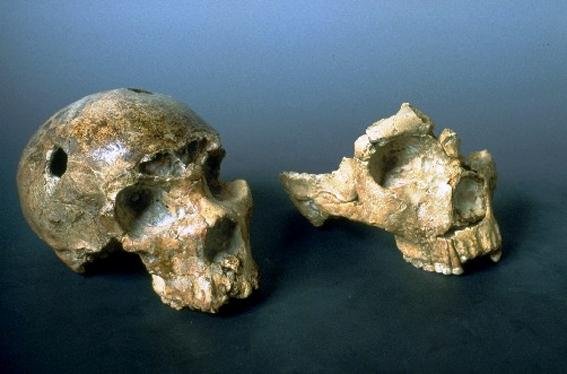
The main advice is to reverse the direction of travel. The natural temptation, on entering, is to go straight to the Saccopastore skulls, because they are the famous pieces and because the word Neanderthal draws. Do the opposite: begin with the instruments and the casts, that is, the part that tells how knowledge was built, and get to the fossils at the end. It changes everything. If you look at the two skulls knowing with which calipers they were measured and inside which idea of humanity they were interpreted, those two skulls stop being finds and become protagonists of an intellectual story. If you look at them first, they remain two bony skullcaps in a case.
Second piece of advice, practical: devote an hour and a half to the visit, not 40 minutes. The museum is a single large room and from a distance it seems something you can dispatch in a quarter of an hour. It's an optical illusion. The density of information per square meter here is very high, and the captions are dry, scientific-museum style. If you read everything that's written there, you need 90 minutes, and it's worth it.
Third piece of advice, and this one is for whoever is accompanying someone else. Prepare a single question, and put it to the staff: ask which of the exhibits on display are originals and which are casts. It's the right question for two reasons. First, because the answer is interesting in itself and changes the perception of what you are looking at. Second, because it opens the conversation with whoever looks after the museum, and in a university museum that conversation is worth double the panel.
Fourth, the right moment. Tuesday afternoon, between 15 and 18, is the best window: the museum is open, the building is half empty, and you have space in front of the cases. Monday and Friday morning, by contrast, the University City is in full activity and the building is crossed by students going to class. It's not a problem of noise inside the museum, it's a problem of corridors and elevators.
Fifth: don't bring a group of very small children without preparation. Not for a matter of abstract sensitivity, but because a single room full of human remains requires a narrative frame, otherwise it turns into a contest over who gets more scared. With 10 minutes of preparation, on the other hand, it works very well even with primary schools.

The collections of the Museum of Anthropology "G. Sergi", display case by display case
The museum states that it keeps thousands of finds relating to present-day human variability and to the natural history of man and the other primates. The official tourist portal of Roma Capitale speaks of materials attributable to more than 6,000 individuals. It's a figure to be read carefully: 6,000 individuals doesn't mean 6,000 complete skeletons, it means 6,000 people documented by something, often by a single skull or a few bones. But it remains a first-rate heritage on a European scale, and it's worth going through by groups.
The skull collection of the Museum of Anthropology "G. Sergi"
The skull collection is the quantitative heart of the collection: a collection of skulls with finds from all over the world, ordered and cataloged according to criteria going back to the founding of the institute. It's also the most delicate part to look at and to talk about. Every skull was a person. Many arrived in Rome by the routes by which anthropological materials arrived between the 19th and early 20th century, that is, through the network of scientific missions, hospitals, colonial expeditions, exchanges between institutes. No European museum of this kind has a fully clean provenance, and pretending otherwise would be ridiculous.
The current scientific value of a skull collection, however, is considerable, and opposite to the reason for which it was formed. Large, documented series of human skulls today make it possible to study morphological variability statistically, to calibrate the methods of age and sex estimation used in forensic anthropology, to measure how much skull shape depends on environment and how much on heredity. The collection born to demonstrate the existence of races is today one of the tools with which it is shown that races do not exist. Few historical revenges are as clean.
Prehistoric and historical skeletal series
Beside the skulls the museum keeps skeletal series from different prehistoric and historical periods. A skeletal series is the set of individuals from a single context, usually a necropolis. It is the basic unit of bioarchaeology: on a series you can count ages at death, calculate infant mortality, identify recurring pathologies, read dietary deficiencies in the growth-arrest lines of teeth, recognize healed fractures and those that did not heal.
Rome and Lazio have supplied and still supply material in quantity: every urban excavation turns up burials, and for a century and a half the Roman anthropology institute has been one of the places where that material is studied. The cases show a selected part of it for teaching purposes, with the most instructive cases: evident pathologies, traumas, deformations. The rest is in storage, and it's the portion that is actually worked on.
Facial masks and plaster busts
The collection of facial masks and plaster busts is the section that strikes visitors most, and the one that calls for the most careful commentary. They are casts taken on living persons or on the dead, produced by anthropometric practice between the 19th and 20th centuries: plaster was spread on the face, a negative was obtained, a positive was made that was kept as a document of the shape of the face of an individual or, in intention, of a type.
Looking at them is a strange experience. They are closed faces, with shut eyes, often with no name on the label. The distance between that plaster and the person who was underneath is the real subject of the room. If it's told well, this is the section where a group fully grasps what it means to treat a human being as a specimen. If it isn't told, it's just a row of white faces.
A clarification that avoids misunderstandings: this is not an ethnographic museum, and the casts are not here as documents of cultures, they are here as documents of a technique of measurement. The great Roman ethnographic collections, those born from the 19th-century collections and from colonial events, are elsewhere, at the Museum of Civilizations in EUR, where the collections of the Pigorini Prehistoric and Ethnographic Museum and those of the Museum of Folk Arts and Traditions also converge.
Skeletons of non-human primates
A substantial section of the collection is made up of skeletons, in varying degrees of completeness, of non-human primates: apes, guenons, lemurs. It's not a zoological whim, it's the foundation of the argument. Physical anthropology compares: to say what is peculiar to the human body you must have the body of its closest relatives in front of you. The pelvis, the femur, the curve of the spine, the position of the foramen magnum, the structure of the hand and foot: it's by looking at the skeleton of a chimpanzee next to that of a human being that you understand what standing upright entails.
Two details deserve attention. The first is the foramen magnum, the opening at the base of the skull through which the spinal cord passes: in quadrupeds it's shifted backward, in human beings it's central, because the head has to balance on top of the spine. The second is the big toe: in arboreal primates it's opposable and serves for grasping, in us it's aligned with the others and serves for pushing. Two details, and bipedalism stops being an abstract word.
The first psycho-physiology laboratory
The instruments of the laboratory set up by Giuseppe Sergi from 1885 make up a section of their own. They are devices of experimental psychology from the late 19th century, and they should be read in relation to what was happening in the same years in Leipzig with Wilhelm Wundt and in Paris with the French school: psychology was trying to become a laboratory science, and to do so it measured what let itself be measured, that is, reaction times, sensory thresholds, fatigue.
This section is the most neglected by visitors and one of the most precious. In Italy there are few places where you can see the material of a 19th-century psychological laboratory in the place where it was used. Those who work on the history of psychology come here on purpose.
The mummy and the other materials
Among the materials kept by the museum is also an Egyptian mummy, flagged by the Roma Capitale tourist portal among the pieces of note of the collection. Mummies in Italian anthropological collections almost always arrived in the 19th century through diplomatic or commercial channels, and are now at the center of the museological debate on human remains. Anyone arriving hoping for an Egyptian section should stay realistic: here the context is anthropological, not Egyptological.
The audiovisual room and the educational routes
The museum has an audiovisual room and two educational routes open to the public. It's the infrastructure with which it works with schools, and it serves to give the visitor the time frame that the cases alone don't give: 6 million years of human evolution don't fit in a display case, they fit in a timeline and in a film. Multimedia content is also entrusted with presenting finds that the museum does not own in original, first of all the Ceprano skull.
The Saccopastore skulls, the Roman Neanderthals
1929: the first skull
Saccopastore is a stretch of the Aniene valley between Montesacro and Nomentano, today covered with buildings, then occupied by gravel quarries. In 1929, in one of those quarries, some workers employed by Duke Mario Grazioli recovered a human skull that had an unusual look. The find ended up in the hands of Giuseppe Sergi, who was then 88 years old. It was a Neanderthal skull, the first found in Italy in a documentable stratigraphic context, and the first ever found within the territory of a major European city.
The skull, which specialists call Saccopastore I, lacks the lower part of the face. In 1941 it was attributed to a young woman. It has the heavy brow ridges typical of Neanderthals, but retains a canine fossa on the maxillae, though attenuated: a trait that disappears in classic Neanderthals, and that places these individuals in an early phase of the Neanderthal line, when the characteristics of the group had not yet become accentuated.
1935: Blanc, Breuil and the second skull
Six years later, in 1935, in the same locality, two of the greatest prehistorians of the time came back to dig: the Italian Alberto Carlo Blanc and the Frenchman Henri Breuil, the abbé Breuil, the man who had copied with his own hands the paintings of the Franco-Cantabrian caves. At a depth of only three meters they recovered a second skull, Saccopastore II, belonging to an adult male individual. That two scholars of that caliber were personally on the spot says how much weight the deposit had assumed in European prehistory.
Both skulls entered the collections of the Roman institute between 1929 and 1935, and since then they have been the most important finds of the Museum of Anthropology "G. Sergi". Sergio Sergi made them the subject of a monumental study of craniography and craniometry, published in Ricerche di Morfologia in 1943, in the middle of the war: one of those scientific works produced while the city around is being bombed.
How old the Saccopastore skulls really are
For almost a century the two skulls were attributed to the last interglacial, the Riss-Würm, that is, to about 125,000 or 130,000 years ago, on the basis of the associated fauna and the Mousterian lithic industry found in the deposit. In 2015 a study coordinated by the National Institute of Geophysics and Volcanology, with Sapienza and the University of Wisconsin-Madison, put that chronology back into question. The group led by Fabrizio Marra reconstructed the sequence of the Roman river deposits by crossing the oscillations of sea level during the glacial phases with the radiometric dating of the volcanic layers interspersed with the sediments, and placed the Saccopastore skulls at around 250,000 years ago. The work came out in Quaternary Science Reviews.
If the dating holds up, it's big news: it means that the oldest Neanderthals in Europe are Roman, that they lived along the Aniene 250,000 years ago, and that the evolution of the Neanderthal line was already under way much earlier than was thought. The municipal tourist portal continues to report the traditional dating at around 120,000 years, and it's worth keeping in mind on the page that both figures circulate: the traditional one, derived from the faunal context, and the one proposed by the 2015 study. In the scientific community the debate is open, as always happens when a consolidated chronology is doubled.
What you see today
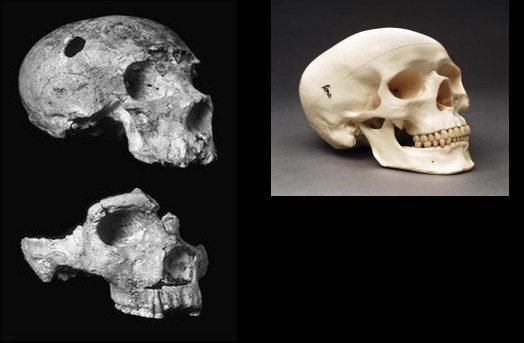
In the museum the two skulls are displayed in a dedicated case, with the apparatus you'd expect of a scientific museum: minimal. It's worth looking at them in profile, not head-on. Head-on, the brow ridge impresses. In profile you read the real difference, that is, the elongated, low shape of the braincase compared to ours, which is high and globular. The brain capacity of Neanderthals was equal to ours or greater: the difference is not in volume, it's in architecture.
One last note. The neighborhood that today occupies that bend of the Aniene has streets with ordinary names, apartment blocks from the 1960s, normal traffic. Under those buildings, 250,000 years ago, there was a river, and on its banks lived a human population different from ours. The same valley, a little farther upstream, yielded the Pleistocene deposit of Casal de Pazzi, now turned into a museum in situ. The Aniene is the most prehistoric river in Italy and almost nobody knows it.
Another well-known fact, yet rarely mentioned
That a world-famous Neanderthal skull exists in Rome is known to many: it's the Circeo skull, the one found in 1939 in the Guattari cave, at the foot of the promontory, an almost intact skull in excellent condition, originally surrounded by a ring of stones that for decades fed the hypothesis of a funeral rite or even of an act of ritual cannibalism. It's one of the most famous finds of European paleoanthropology, and it was studied precisely by Sergio Sergi, the director of this institute.
The little-cited fact is that this skull is not kept here. The Circeo Neanderthal, which specialists call Guattari 1, is at Museo delle Civiltà in Rome, at EUR. Many visitors arrive at the Museum of Anthropology "G. Sergi" convinced they'll find it there, and are disappointed. The Neanderthals of Sapienza are those of Saccopastore, which are older, less spectacular and scientifically just as important.
The confusion has a precise and understandable historical root. The Circeo skull was studied, measured and published by the Roman anthropology of Sapienza, and for years its scientific story passed through these rooms and these hands. Its museum home, however, is another. It's a classic case of the difference between who studies a find and who keeps it, and it's worth keeping in mind every time you read the name of an institute next to that of a fossil.
What remains is the most instructive detail of the whole affair. The ring of stones and the lesions on the skull, for decades interpreted as proof of an anthropophagic ritual, have been reread over the last 30 years in a much more prosaic way: modifications produced by carnivores, hyenas in particular, which had their den in the cave. The Guattari cave has returned to the center of research in very recent years, with new Neanderthal finds. A find that everyone thought exhausted started speaking again after 80 years: it happens more often than you'd think, and it's the reason museums keep even what seems already explained.
Casts: why they matter as much as originals
In the display cases of this museum, as in every paleoanthropology museum in the world, a part of the exhibits are casts. The public tends to consider them a disappointment, almost a swindle. It's a prejudice to be dismantled, and I always dismantle it on visits.
Human fossils are very few, very fragile and scattered across dozens of institutions between Europe, Africa and Asia. No scholar can travel to every dig to compare two jawbones. The scientific community solved the problem by producing casts of very high precision and exchanging them: a good cast reproduces the surface of the bone with a deviation of fractions of a millimeter, and for most morphological measurements it is equivalent to the original. The history of the study of human evolution is also a history of casts traveling by mail.
Then there's the fact that the cast preserves. Many originals have been damaged, some destroyed: of the Homo erectus fossils from Zhoukoudian, in China, which vanished during the Second World War, today the casts remain, and science studies them because there's nothing else. A well-made cast is an insurance policy on knowledge.
A blunt criterion: the right question in front of a paleoanthropology display case is not if the piece is original, but if it's a good cast and which original it derives from. The museum that states clearly what is original and what is reproduction is a serious museum. The one that leaves the visitor in ambiguity to make him believe he's getting more is not.
The pre-Neolithic man of Maiella and other Italian fossils
Among the museum's main finds is the skull with part of the postcranial skeleton of the so-called pre-Neolithic man of Maiella. The name is of its time and must be taken for what it is: a 19th- or early-20th-century label that indicates an individual attributed to the phases preceding the introduction of agriculture, thus to the world of hunter-gatherers of the central Apennines. The adjective pre-Neolithic would be used with greater caution today, because chronology is established with radiometric dating, not with typology.
Italy is a country very rich in human fossils, and it's a richness that the general public almost completely ignores. Among the Neanderthals, besides Saccopastore and Circeo, there are the remains of Grotta Breuil and Grotta dei Moscerini, again on the Pontine coast, those of Altamura in Puglia, extraordinary for its state of preservation, those of Grotta Guattari. Among the oldest forms is the Ceprano skull, in Ciociaria. Among the hunters of the Upper Paleolithic are the burials of Arene Candide in Liguria and of Circeo, with grave goods and red ocher.
The Sapienza museum is one of the places where this story can be told in full, because it keeps materials from several periods and because it's a research museum. If you go with a class, it's the theme to insist on: Italian prehistory isn't an exotic chapter, it happened under the houses we live in.
The Ceprano skull
The Ceprano skull deserves a paragraph of its own, because it's the oldest human fossil found in Italy and because the museum gives it space in its multimedia content. It was spotted on March 13, 1994 by the archaeologist Italo Biddittu during surveys along the route of a road under construction in the locality of Campogrande, in the lower Sacco valley. The find had been fragmented by machinery and was patiently reassembled.
Its age is debated: the traditional chronology places it between 900,000 and 800,000 years ago, while later magnetostratigraphic studies propose instead an interval between 500,000 and 350,000 years. The taxonomic attribution is also disputed: some consider it an independent species, some bring it back to late forms of Homo erectus, some bring it closer to the Atapuerca populations in Spain. It's the kind of find that reopens its own place every 10 years.
An honest clarification, to spare the reader a wasted trip: the original is not displayed here. The fossil is kept at the anthropology service of the archaeological superintendency responsible for Lazio. At the Museum of Anthropology "G. Sergi" its story is told through the multimedia supports of the human evolution route.
The right photo to take at the Museum of Anthropology "G. Sergi"
The rule first, because it comes before aesthetics: in museums that keep human remains, photography is never an acquired right. Before pulling out your phone you ask, and abide by the answer. In many European scientific institutions photographing identifiable human remains is forbidden or subject to authorization, and the reason is not copyright protection, it's the dignity of the people to whom those bones belonged. If permission is given, you shoot without flash. If it isn't, you don't insist.
That said, the right photograph in this museum is not the Neanderthal skull. It's the display case of instruments. Brass, wood, micrometer screws, graduated scales, all lined up on a shelf with the maniacal order of the 19th-century scientific cabinets. Shoot it edge-on, with the camera resting on the glass to avoid reflections, using the natural light that enters from the building's windows. You get a photograph that looks as if it was taken in 1900 and that tells the whole museum better than any panorama.
The second framing I recommend is a detail, not a whole: the profile of a skull against the light background of the case, cropped so that the line of the forehead can be read. If you also have a recent sapiens skull next to it, the difference in curvature emerges by itself and the photograph becomes a lesson. The photos that work in scientific museums are almost always comparative: two objects in the same frame that explain each other.
The third, the most difficult and the most beautiful, is the row of plaster facial masks. White on white, side light, no strong contrast. It's an image that has to be handled with respect: they are the faces of real people. It can be done, but never for the benefit of a pose: no selfies in front of the casts. It's the only rule of museum etiquette on which I don't compromise, and it's worth more than any sign.
One last technical tip. The space is a single large room with wall display cases and mixed light, natural and artificial: it's a difficult condition, with different color casts in different parts of the room. If you shoot with a phone, lock the white balance on a neutral surface before starting, otherwise you'll go home with yellow skulls and blue display cases.
A few important events that happened here in history
The first event is the founding itself. In 1884 the teaching of Anthropology was established at Sapienza and entrusted to Giuseppe Sergi. In a pontifical university only recently become Italian, in a Rome that was building the ministries and the Umbertine districts, the entry of a discipline that claimed to study man with the methods of the natural sciences was a political fact as well as an academic one. From that chair were born the institute, the laboratory and the collection that is visited today.
The second is the 1887 move to the Collegio Romano palace, the old Jesuit college in the center of Rome, where the institute obtained its first space and where the collection took the form of a long corridor lined with shelves. For half a century Roman anthropology worked there, 200 meters from the Pantheon, in a building that also housed the prehistoric and ethnographic museum and the observatory.
The third is 1929, the year of the first Saccopastore skull. The find reached the hands of a Sergi well over 80 and transformed the Roman collection into a collection of international standing. Until then the institute had osteological series and instruments. From then on it has a human fossil of the first rank found inside Rome.
The fourth is 1935, with the second skull recovered by Alberto Carlo Blanc and Henri Breuil. In the same year, a few hundred meters away, the University City wanted by the regime and designed under the direction of Marcello Piacentini was being completed. The two facts meet three years later.
The fifth is 1938, and it has two faces. On one side the anthropology institute moves into the new University City, under the direction of Sergio Sergi, and the museum finds the home it still occupies today. On the other, in the same year, the Manifesto of the Racist Scientists written by an assistant of that chair comes out, and in the autumn the racial laws empty the Italian university of its Jewish professors and students. No other year in the history of this museum weighs as much.
The sixth is 1943, when in the middle of the war Sergio Sergi publishes the craniography and craniometry of the first paleanthrope of Saccopastore, the work that fixes the descriptive standard of those finds. The seventh is 1982, the year in which the permanent exhibition wing was set up, that is, the moment in which the working collection becomes a museum open to the public. The eighth is 1984: exactly 100 years after the establishment of the teaching, the museum is named after Giuseppe Sergi.
The ninth event is recent and has no single date: it's the redefinition of the museum as a place for popularizing human evolution, with the educational routes, the audiovisual room and the inclusion in the Polo Museale of Sapienza. The tenth is 2015, the year in which the dating of the Saccopastore skulls was doubled by the study coordinated by the National Institute of Geophysics and Volcanology: a find kept for 80 years changes age and with it changes the place of the Italian Neanderthals in European prehistory. The collections are not still: that's the point.
Who has passed through the Museum of Anthropology "G. Sergi"
Giuseppe Sergi, before anyone. From Messina, a Garibaldian in his youth, arrived at the Roman chair in 1884, he is the man who built the collection, the laboratory, the institute and the scientific society. He worked there until extreme old age: he was 88 when they brought him the first Saccopastore skull, and he was 95 when he died, in 1936. Anyone who enters the museum enters his idea of anthropology, with everything that idea produced of good and of wrong.
Maria Montessori. Her Roman training passes through Sergi's laboratory and through anthropology: she was Sergi's student and in turn taught pedagogical anthropology at the Roman university before the method that bears her name went around the world. It's the most unexpected link in this museum and the one visitors remember longest: the same school produces the best-loved teaching material of the 20th century and the anthropometric tables of state racism.
Sergio Sergi, son of Giuseppe, in the Roman chair from 1916, director of the institute at the time of the move to the University City, national member of the Lincei, died in Rome in 1972 after a very long career. He is the man of the hand-built instruments, of craniography, of the studies on Saccopastore and on the Circeo skull. He brought Italian anthropology to a very high technical level while staying within a theoretical frame that the rest of the world was abandoning.
Guido Landra, who was a young assistant of that chair and who in 1938 drafted the Manifesto of the Racist Scientists on Mussolini's directives. There's no way to tell the story of this museum without his name, and no reason to keep silent about it. He passed through here, used these instruments, and wrote the text that gave a scientific garb to persecution.
Alberto Carlo Blanc and Henri Breuil, the two prehistorians who in 1935 excavated the second Saccopastore skull. Blanc, an Italian of international training, is also the man tied to the story of the Circeo skull of 1939. Breuil, a French priest and prehistorian, was for half a century the supreme authority on European Paleolithic art. That both worked on a gravel deposit on the outskirts of Rome says how much that site counted.
Giorgio Manzi, paleoanthropologist, professor at Sapienza since 2001 and full professor of anthropology, director of the Museum of Anthropology "G. Sergi" from 2004 to 2021, author of popular books including Il grande racconto dell'evoluzione umana and Ultime notizie sull'evoluzione umana. He is the scholar who brought the museum into public debate and who worked at length on the Ceprano skull. Today the direction is Professor Fabio Di Vincenzo's, with Dr. Alessandro Aruta as area curator.
And then thousands of nameless people have passed through here too, and it's right to say so at the end. The people whose skulls, skeletons and face casts the museum keeps. Almost none of them consented to be in a display case. How a museum handles this asymmetry is the true indicator of its scientific maturity.
Scientific museology: how a museum like this is exhibited
The problem of human remains
A museum of physical anthropology exhibits dead people. Put like that it sounds brutal, but it's exactly the problem international museology has been grappling with for 30 years. There are three issues, and they are distinct. The first is acquisition: how these materials arrived, with what consent, within what power relations. The second is conservation: what conditions are owed to human remains, which are not objects like others. The third is exhibition: what is shown, how, with what captions, and if it should be shown at all.
On these points international reflection has produced ethical codes and guidelines that museums apply with different degrees of conviction. In Italy there is a peculiar legal obstacle, and it's worth knowing because it explains many things: the principle of inalienability of public cultural property, enshrined in the Italian code, has in recent years prevented the return of some human remains to Australian Aboriginal communities who had made a formal request. A skull that entered an Italian public collection is legally property of the State, and getting it out is extremely complicated, even when the request is well founded.
An opinion, a non-legal one: documented requests for return should be honored, and inalienability devised for paintings should not apply mechanically to people's bodies. Which doesn't mean emptying the collections: the vast majority of materials are the object of no claim, and research on them produces knowledge that serves everyone, starting with forensic anthropology.
University museums and civic museums, two different trades
The Museum of Anthropology "G. Sergi" is a university museum, and this explains almost everything the visitor notices. It explains the hours, calibrated on teaching activity and not on tourism. It explains the free admission. It explains the sober layout, with display cases that are also working tools. It explains the technical captions. It explains why there is no bookshop, no cafeteria, no audio guides in eight languages.
A civic museum exists for the public. A university museum exists for teaching and research, and welcomes the public. The difference is not one of quality: it's one of function. The visitor who realizes this stops expecting the museum it isn't and starts enjoying the museum it is, that is, a place where you see science while it's being done rather than packaged.
How to tell the story of a discipline that got it wrong
There's no recipe and there are two symmetrical errors. The first is implicit absolution: exhibiting the instruments as curious antiques, without saying what they were for and what they produced. The second is the summary trial: dismissing 19th-century anthropology as a racist pseudoscience, which is convenient and false, because contemporary paleoanthropology and bioarchaeology descend from that very discipline.
The narrow way, which this museum declares it wants to follow when it defines itself as immersed in the history of physical anthropology between the 19th and 20th centuries, is to exhibit together the method, the results and the consequences. A caliper next to a skull next to a document of 1938. Let the visitor see the whole chain and draw his conclusions. It's much harder than writing an indignant panel, and it teaches infinitely more.
The Museum of Anthropology "G. Sergi" and the Polo Museale Sapienza
What the Polo Museale is
Sapienza owns one of the largest university museum collections in Europe, brought together and coordinated in the Polo Museale Sapienza. The museums number about 20 and are arranged by thematic areas: archaeology and classical and contemporary art, anthropology and medicine and comparative anatomy, earth sciences, biological sciences, science and technology. The Museum of Anthropology "G. Sergi" belongs to the second area, together with the museum of comparative anatomy, that of pathological anatomy and the museum of the history of medicine.
Almost all these museums are inside the University City or in the immediate vicinity, almost all are free, almost none is known to Romans. It's the most glaring tourist anomaly of the city: 20 museums in one square kilometer, with no lines and no ticket, in a city where people queue two hours to get into a church.
What to visit on the same day
If you have a morning, this museum combines very well with two others in the same quadrant. The Museum of Comparative Anatomy Battista Grassi is the natural complement: vertebrate skeletons mounted in series, with the same comparative logic applied here to primates. The Museum of the History of Medicine tells the instruments and health practices from the ancient world to the 20th century, and closes the circle on the theme of the body measured and treated. The Museum of Pathological Anatomy, which is visited by appointment, is for strong stomachs and specific interests.
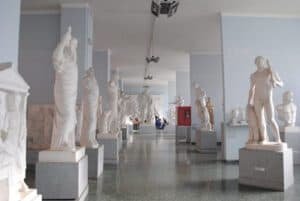
Anyone who prefers to change register finds, still inside the campus, the plaster cast gallery of classical art, with the casts of the great Greek and Roman statues: it's interesting to line it up with the room of facial masks, because it's the same technical gesture, the plaster cast, applied to two opposite purposes, art and anthropometric measurement. Then there are the Museum of Etruscan and Italic Antiquities and the University Museum of Earth Sciences, and also the Museum of the Near East, the Museum of Physics, the Primo Levi Museum of Chemistry, the Herbarium Museum and the Contemporary Art Laboratory Museum: all inside the campus, all free, all half empty.
The Museum of Anthropology "G. Sergi" with children and with schools
It works, on two conditions. The first is age: from nine up the visit is fully sustainable and engaging, under seven it's tiring and risks being reduced to counting skeletons. The second is preparation: 10 minutes before entering, well explained, change the whole visit. The concept to hand over is simple and children grasp it right away: in here are the remains of people who lived a long time ago, and they serve to understand how we're made. Put like that, the fear vanishes and curiosity remains.
Guided visits for school groups are the way the museum normally works, and they are booked by writing or phoning. The advantage of the internal guide is obvious: whoever works on the finds knows which questions the kids always ask and has the answers ready. The recurring question, in every class in Italy, is if Neanderthals were dumber than us. The correct answer, which the museum lets you give with the finds before your eyes, is that they had a brain as large as ours and sometimes larger, that they buried the dead, that they cared for the wounded, and that their fate isn't a matter of intelligence.
The advice I give teachers: prepare three questions and assign them beforehand, one per small group. What is the difference between a chimpanzee's skull and ours? What was a craniometry caliper for? Why does a museum exhibit the instruments of a mistaken science? With these three questions in their pocket, an hour in here is worth a term of science class.
Accessibility, services and practical rules
The museum occupies the second floor of building CU011. Anyone with mobility problems or traveling with a wheelchair should make a phone call beforehand to 06 4991 2495 or write to museo-antropologia@uniroma1.it to be told the accessible route inside the building: in the historic buildings of the University City elevators exist but aren't always immediate to find, and an indication given beforehand saves an hour.
There is no cloakroom or luggage storage: anyone arriving with a suitcase from Termini station has to make other arrangements. There's no bookshop. There's no cafeteria, but inside the campus there are university bars and canteens, and just outside, toward San Lorenzo and Viale Regina Elena, the offer is wide and at university-neighborhood prices, that is, honest. The restrooms are those of the building.
On photography what was said above holds: you ask first. Backpacks on shoulders in front of narrow display cases are a risk to the finds and to you: carry them in your hand. And silence, in a museum where people work, is not a formal rule, it's a courtesy toward whoever, behind the next door, is working in the laboratory.
How long the visit takes and when to go
An hour is the sensible minimum, an hour and a half is the right duration, two hours are for those who read everything and ask questions. It's a museum of a single large room, so you don't walk: you stand still, which tires more. Anyone with back problems should plan on breaks.
The best period of the year is when the university is working but not in exam session: October and November, March and April. In session, January and February or June and July, the campus is full of students under tension and the common spaces are crowded. In August the University City is half deserted and many services are reduced: always check the openings before setting out. Between December and January closures are planned, tied to the suspension of academic activities.
The best hour of the day, if you can choose, is early Tuesday afternoon: the museum is open until 18:30 and between 14:30 and 16 there is almost no one. The worst is the window between 9:30 and 11 on class days, when the building is crossed by hundreds of students.
What's around the Museum of Anthropology "G. Sergi"
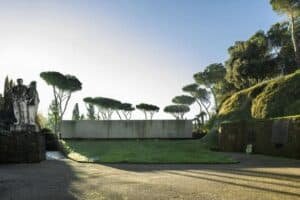
The University City is a piece of 1930s architecture that deserves a walk of its own: Piazzale della Minerva, the white, squared-off volumes of the institutes, the rigorous scansion of the axes, the statue in the center. It's the regime's urban planning, and it's instructive for that reason too. At the back of the complex is the church of the Divina Sapienza, designed by Marcello Piacentini and built in the postwar period.
Going out the gate, to the east, San Lorenzo begins: a working-class neighborhood of the late 19th century turned university neighborhood, with its historic osterie, its murals, its nightlife and the memory of the bombing of July 19, 1943, which hit the neighborhood and the nearby cemetery. The monumental cemetery of the Verano is a five-minute walk and is one of the great monumental graveyards of Europe, with funerary sculpture of the 19th century of very high level: for someone who has just spent an hour among the human remains of a museum, the comparison with the way the Roman bourgeoisie staged its dead is a remarkable intellectual exercise.
To the west you descend toward the Policlinico Umberto I and the Nomentano district, with the Liberty-style villas of Via Nomentana. Further on you reach Villa Torlonia, with the Casino Nobile and the Casina delle Civette. In the opposite direction, toward the center, in a quarter of an hour you're at Termini and at the civic museums of the center. Anyone who wants to stay on theme can push on to EUR, where the Museum of Civilizations keeps the Circeo skull and the national prehistoric and ethnographic collections.
For eating: San Lorenzo, no hesitation. University-neighborhood prices, real Roman cooking in the historic trattorias of Via dei Volsci and around, and the chance to sit down without booking at noon on a Tuesday. Avoid the bars in front of the Policlinico: they serve people in a hurry, and it shows.
Quick questions about the Museum of Anthropology "G. Sergi"
How much is a ticket to the Museum of Anthropology "G. Sergi"?
Nothing: admission is free, as for most museums of the Polo Museale Sapienza. There is no ticket office and no reductions are needed.
Where exactly is the Museum of Anthropology "G. Sergi"?
At Piazzale Aldo Moro 5, inside the Sapienza University City, on the second floor of the Anthropology building, code CU011. The museum belongs to the Department of Environmental Biology.
What are the hours?
Monday, Thursday and Friday from 9:30 to 13:30. Tuesday from 9:30 to 13:30 and from 14:30 to 18:30. Wednesday from 9:30 to 13:30 and from 14:30 to 15:30. Closures are planned between December and January: it's best to check the official page of the Polo Museale before setting out.
Do you need to book to visit the Museum of Anthropology "G. Sergi"?
For the individual visitor no, you walk in freely during opening hours. For groups and schools yes, and the guided visit is arranged by writing to museo-antropologia@uniroma1.it or phoning 06 4991 2495.
How do you get there by public transport?
Metro line B, Policlinico stop, then five minutes on foot. On the surface, trams 3 and 19 and buses 310 and 492. From Termini it's a 20-minute walk along Via Marsala and Via dei Mille.
How long does the visit take?
An hour at minimum, an hour and a half the right duration, two hours for those who read all the captions and ask questions. It's a single large room, so you stand still on your feet a lot.
Is the Museum of Anthropology "G. Sergi" suitable for children?
From age nine up it works very well, especially with 10 minutes of preparation before entering. Under seven the visit is tiring. School groups are the audience the museum works with most often.
Can you take photographs?
You always ask staff first, because in museums that keep human remains photography may be restricted. If allowed, you shoot without flash and without posing anyone in front of the human remains.
Are there really Neanderthals at the Museum of Anthropology "G. Sergi"?
Yes: the two Saccopastore skulls, found in 1929 and 1935 along the Aniene, within the territory of Rome. They are the most important finds in the collection.
How old are the Saccopastore skulls?
The traditional chronology places them at around 125,000 or 130,000 years ago. A 2015 study coordinated by the National Institute of Geophysics and Volcanology, published in Quaternary Science Reviews, relocated them to around 250,000 years. Both figures still circulate.
Is the Circeo skull kept here?
No. The Neanderthal from the Guattari cave, found in 1939 at Circeo, is kept at Museo delle Civiltà in Rome, at EUR. It was however studied by Sergio Sergi, director of the Roman anthropology institute.
And the Ceprano skull?
The original, spotted in 1994 by Italo Biddittu, is kept at the anthropology service of the archaeological superintendency responsible for Lazio. At the museum its story is told with the multimedia supports of the human evolution route.
Who was Giuseppe Sergi?
The anthropologist from Messina, born in 1841 and died in Rome in 1936, who in 1884 was entrusted with the teaching of Anthropology at Sapienza. He founded the institute, the psycho-physiology laboratory and the scientific society from which the present Italian Institute of Anthropology descends. The museum has carried his name since 1984.
What is the Mediterranean stock theory?
The thesis with which Sergi maintained that European civilization derived from populations originating in East Africa that moved up along the Mediterranean, in opposition to the Aryan and Nordic myth. It remains all the same a 19th-century racial theory, with all the limits that implies, and shouldn't be confused with the African origin of Homo sapiens demonstrated by genetics in the 20th century.
What is this museum's relationship to the 1938 racial laws?
A direct and documented one: Guido Landra, who drafted the Manifesto of the Racist Scientists published on July 15, 1938, was an assistant to the chair of anthropology of Sergio Sergi at the University of Rome. Point eight of that text declared dangerous precisely the Mediterranean race theory of the founder of the school.
Is the museum wheelchair accessible?
The museum is on the second floor of a historic campus building. It's best to phone beforehand at 06 4991 2495 or write to museo-antropologia@uniroma1.it to be shown the accessible route.
Is there a cloakroom or luggage storage?
No, and there's no bookshop. Anyone arriving from the station with luggage has to make other arrangements.
Do you wait in line?
Practically never. It's one of the few Roman museums where the word line has no meaning.
Is the Museum of Anthropology "G. Sergi" open on Saturday and Sunday?
No, the museum keeps a weekday calendar tied to academic activity. Saturday or Sunday openings are tied to special university initiatives and have to be checked case by case.
What is the difference between this museum and Museo delle Civiltà?
This is a museum of physical anthropology: bones, casts, measuring instruments, human evolution. Museo delle Civiltà at EUR brings together the great national prehistoric and ethnographic collections and keeps the Circeo skull. They are complementary, not alternatives.
What is the difference from the Museum of Comparative Anatomy?
The comparative anatomy museum lines up vertebrate skeletons in series to compare their structures. Here the comparison is focused on man and the primates, and is accompanied by the history of the discipline. They are a few steps apart and can be visited in the same morning.
Are there guided visits for the general public?
Guided visits are organized mainly for groups and school classes by reservation. Even a small group can ask for an accompanied visit by writing to the museum a few days ahead.
How many finds does the Museum of Anthropology "G. Sergi" keep?
The museum speaks of thousands of finds relating to human variability and to the natural history of man and the other primates. The Roma Capitale tourist portal indicates materials attributable to more than 6,000 individuals. Only a part is on display, the rest is in storage and under study.
Is it a museum for strong stomachs?
No. The remains are presented in a scientific and dry way, without relish. Anyone who has a difficult relationship with human bones will find the skull collection and the room of facial masks demanding all the same.
Is it worth coming from afar just for this museum?
From afar, no: it's a small museum. As part of a morning devoted to Sapienza's museums, yes. In that format it is one of the densest and least known cultural experiences Rome offers for free.
One last thing
Of all the Roman museums I take people to, this is the one that divides the public the most. There are those who leave after 20 minutes saying it's four cases of bones, and there are those who stay an hour and a half and the week after look for a book on human evolution. The difference isn't made by the visitor's sensitivity: it's made by the way what they're looking at was presented to them.
For this reason the final advice is to go in with a question instead of an expectation. The question that works best is this: how did a serious science, practiced by intelligent men in good faith, get it so glaringly wrong, and how do we know we aren't getting it wrong in the same way. The Museum of Anthropology "G. Sergi" gives no answer and isn't tasked with giving one. It shows the instruments, it shows the results, it shows the consequences, and it leaves the visitor in front of a display case with something to think about. In a city that sells wonder by the kilometer, a museum that sells doubt is a rarity worth the metro ride.
Article written by the editorial team of TourLeaderPro, contact them for Private/Corporate/V.I.P. Tours and Experiences.
Planning a trip to Rome? The English-language guides to visiting the city are on ItalyPlanner.com.
Contact Information
Nearby
 Museo Laboratorio d’Arte Contemporanea, MLAC100 m
- Museo del Vicino Oriente, Egitto e Mediterraneo100 m
- Sapienza University City200 m
- Aula Magna of Sapienza University200 m
- Herbarium Museum of Rome200 m
- Gipsoteca – Museum of Classical Art200 m


Upcoming events nearby
- IUC Concert Season 2026-2027 at Aula Magna della Sapienza, October 17, 2026 to May 8, 2027200 m
- Mario Brunello at the Aula Magna of the Sapienza, January 19, 2027200 m
- Marc-André Hamelin at the Aula Magna of the Sapienza, January 23, 2027200 m
- Janoska Ensemble at Aula Magna, Sapienza University, January 26, 2027200 m