Alberto Moravia House Museum
In short. The Alberto Moravia House Museum occupies the penthouse at Lungotevere della Vittoria 1, at the corner of Piazzale Maresciallo Giardino, postal code 00195, Della Vittoria neighborhood: the top floor of a building with sober lines and…
The Alberto Moravia House Museum occupies the penthouse at Lungotevere della Vittoria 1, at the corner of Piazzale Maresciallo Giardino, postal code 00195, Della Vittoria neighborhood: the top floor of a building with sober lines and large balconies overlooking the river. You enter only with the guided tour and only by reservation, and admission is free, tour included. The regular calendar provides for opening on the second Saturday of every month, with two time slots at 10:00 and 11:00, groups of at most 15 people. Reservations open roughly 30 days ahead and are made at the number 060608, active every day from 9:00 to 19:00. Groups that arrive with their own guide have a dedicated slot the same Saturday at 12:00, lasting about an hour, reservation by email at didattica@zetema.it. School groups instead enter on Wednesday at 10:00 and 11:30, at most 25 students, with one free chaperone for every 10 kids. The museum is not accessible to people with mobility disabilities: the official site states it, and it is a consequence of the structure of the building. The writer's library and archive can be consulted by appointment, Monday to Friday between 10:00 and 14:00, by writing to info@fondoalbertomoravia.it or phoning 06 3203698. You get there by bus 280 (De Bosis/Stadio Tennis - Partigiani), which stops right at Lungotevere Vittoria/Maresciallo Giardino, or by the 32 (Stazione Grottarossa - Giulio Cesare/Ottaviano) and the 69 (Largo Pugliese - Clodio), which stop at Maresciallo Giardino on Viale Angelico side. The metro doesn't reach the Lungotevere: the useful stop is Lepanto, line A, and from there it is a good 20-minute walk. Dates, hours and availability of the slots must be confirmed on the museum's official website or by phone before setting out, because the calendar fills up fast.
Anyone who wants to build a Roman itinerary dedicated to the homes of writers and artists finds a small coherent circuit in the city: the house of Luigi Pirandello on Via Bosio, the Mario Praz museum at Palazzo Primoli and the Hendrik Christian Andersen museum a stone's throw from Piazza del Popolo. They are four very different homes, and lined up they tell a century of Rome better than many exhibitions.
Where the Alberto Moravia House Museum is and how to really get there
Lungotevere della Vittoria is a short stretch, a little under 600 meters, between Piazzale Maresciallo Giardino and Piazza del Fante. Number 1 is at the southern end, the one at the piazzale, and this is the first practical fact worth fixing in your mind: if you get off at Piazza del Fante you find yourself at the other end of the street and have to backtrack. The place name recalls the Italian victory in the First World War and was given to the whole neighborhood. The street was originally called Lungotevere Milvio. A resolution of the Governor of June 12, 1939 renamed it Lungotevere della Vittoria, the following year the name changed again to Lungotevere Guglielmo Oberdan, and only with the City Council resolution of February 25, 1948 did the stretch between Piazza del Fante and Piazzale Maresciallo Giardino go back to being called what we know today. Three names in nine years: Rome's 20th-century street naming had the same instability as the politics that produced it.
Bus and metro for the Alberto Moravia House Museum
The most convenient line is the 280, which runs along the right-bank lungoteveri and has a stop named precisely Lungotevere Vittoria/Maresciallo Giardino: you get off and you are in front of the main door. The other two useful lines, the 32 and the 69, serve the piazzale from the inner side, Viale Angelico side, and mean about a hundred more meters on foot. The 32 connects Stazione Grottarossa to Giulio Cesare/Ottaviano and is the one visitors arriving from the Vatican area generally take. The 69 comes from Largo Pugliese and ends at Clodio. Anyone traveling by metro has to count on a walk: line A has the Lepanto stop in Prati, and from there you go up Via Marcantonio Colonna or Viale Angelico to the piazzale. 20 minutes at a normal pace, more if you stop to look at shop windows.
A tip: if you booked the 10:00 slot, be in the area by 9:30. The piazzale has parallel parking that is always full, the Lungotevere traffic at rush hour is unpredictable and the group leaves on time. Anyone who arrives at 10:05 finds the main door closed and has lost their place, which is free but limited to 15 people: you don't get it back the same day.
The Della Vittoria neighborhood around the Alberto Moravia House Museum
The Della Vittoria neighborhood is one of the few pieces of Rome that tourism hasn't consumed yet. It was born between the two wars as a middle-class expansion beyond Prati, with a regular layout of tree-lined avenues, apartment buildings of six or seven floors, inner courtyards and neighborhood shops. It has no ruins, no famous basilicas, no lines. It has instead an unusual density of institutions: on the Lungotevere stands the Historical and Cultural Institute of the Engineers Corps, built in 1940, and a few hundred meters away begins the sports complex that leads to the Foro Italico and the Olympic Stadium. To the north the road leads to Milvian Bridge, the oldest bridge in Rome still in use, and to the slopes of the Monte Mario Nature Reserve.
That Moravia chose this address, and not the historic center where he had lived until then, says something precise about him. In 1963 he was 55, he was the most translated Italian writer in the world and he could have afforded any piano nobile between the Corso and the Tiber. He took instead a penthouse in a middle-class building from the 1950s, on a street with no monuments, where nobody stopped him in the street. The house didn't have to impress: it had to work as a study, as a library and as a vantage point over the river. Whoever visits it understands at once that it was thought out by someone who spent 10 hours a day in it.
How to visit the Alberto Moravia House Museum
The formula is rigid and it is worth knowing before you phone, because it saves half an hour of misunderstandings. You don't enter the Alberto Moravia House Museum the way you enter any ordinary civic museum, by showing up at the ticket office and buying a ticket. The apartment is a real apartment, with narrow corridors, rooms of domestic size and fragile objects set down where the master of the house left them. A free flow of people would destroy it in a month. That is why access happens only in accompanied groups, with quotas and reservations.
Booking the Alberto Moravia House Museum, step by step
The number is 060608, the cultural call center of Roma Capitale, active every day from 9:00 to 19:00. Reservations for the public open roughly 30 days before the date of the visit. This means that if you are aiming for the second Saturday of October, you have to call in the first days of September and not the Thursday before. The 10:00 slot sells out before the 11:00 one: if you have to choose, ask for the 11:00 slot, which usually stays available a few days longer and has a practical advantage on top, because at that hour the light enters from the skylights of the living room at a better angle.
Whoever arrives with an organized group and their own guide doesn't use the public slot: on the Saturday of opening there is a reserved slot at 12:00, with reservation by email at didattica@zetema.it and lasting about an hour. The cap remains 15 people per group. Middle and high schools instead have the Wednesday morning channel, at 10:00 and 11:30, with classes divided into subgroups and a maximum of 25 students. For every 10 kids one chaperone enters free.
How long does the visit to the Alberto Moravia House Museum last
The accompanied public visit is used up in a short window, and for the apartment itself a good half hour is realistic: the rooms are four or five, connected by two corridors, and there is no exhibition route to read. Groups with their own guide have about an hour, which is the right length if you also want to tell the literary context and not just list the objects. The suggestion to whoever organizes a group: don't fill the hour with the biography. That is told beforehand, on the street, on the Lungotevere. Inside the house you look, you read a few book spines, you stay quiet for a minute on the terrace. It is the only way to take something away.
Tickets, MIC Card and free admission at the Alberto Moravia House Museum
The museum's official site indicates free admission, and the guided tour that is the condition of access is free too. Some tourist portals report a five-euro ticket: it is a claim that finds no confirmation on the museum's tickets page, so the prudent advice is to stick to what the official site states and to ask for confirmation at the time of the phone reservation. The MIC Card, the annual pass to the civic museums reserved for residents and for people domiciled for study or work in the Metropolitan City, remains the document worth having in your pocket in Rome anyway: here it isn't needed, but it is needed at the Carlo Bilotti Museum, at the Centrale Montemartini and across the whole network of the Musei in Comune.
Accessibility of the Alberto Moravia House Museum
The official site is clear: the museum is not accessible. It is the top floor of a residential building, with thresholds, internal level changes and reduced room to maneuver. The condominium elevator does not solve the problem at the root. Anyone with mobility difficulties has, however, a serious alternative and not a consolation prize: the house has been digitized on Google Arts and Culture, with about 44 works cataloged and room-by-room routes. It's not the same thing, but for once the digital substitute gives back quite a lot, because here the experience is made of close-up details and not of volumes.
The building and the penthouse on Lungotevere della Vittoria
The building is a residential block of simple lines, with large continuous balconies looking onto the river. Moravia's apartment is on the top floor, the sixth, and has the typical layout of the postwar Roman penthouse: a series of rooms connected by two central corridors, with the main rooms facing the Tiber and the service rooms toward the inside. There is nothing monumental. No frescoed ceiling, no grand staircase, no courtyard for show. It is a middle-class apartment, spacious but not huge, which is valuable for what it contains and for what you see from its windows.
The thing that strikes whoever enters for the first time is the light. The Lungotevere at that point is wide, the opposite bank is low and tree-lined, and nothing obstructs the horizon: the house receives light from morning to evening, and the living room also has skylights that make it fall from above. For a writer who spent five years of his childhood pinned to a bed in closed rooms, the choice of a glazed top floor is not a detail of furnishing. It is a biography translated into square meters.
Why the Alberto Moravia House Museum has remained as it was
The credit goes to a decision made early. Moravia died on September 26, 1990. Already in 1991 his sisters, his heirs and a group of friends established the Associazione Fondo Alberto Moravia, with the declared aim of creating a study center on the writer's work and, at the same time, of turning the home into a house museum leaving furniture and objects in their place. In 1993 the Archive was established. In 2009 the heirs donated the property to the City of Rome. On November 29, 2010 the house officially opened to the public and entered the Civic Museums System of Roma Capitale.
19 years between the death and the opening is a lot on paper, very little in Italian practice with writers' homes, where most of the time the apartment is emptied, the furnishings scattered among the heirs and the library sold off in lots. Here it didn't happen. The result is that the Alberto Moravia House Museum is not a philological reconstruction: it is the house, with the dust removed and the books standing where they stood. The difference can be felt within the first two minutes.
The Alberto Moravia House Museum room by room
What follows is the route in the order in which it is made, with what is worth looking at in each room. Whoever visits with a public group will have tight timing: better to know in advance where to rest your eyes.
The entrance and the two corridors
You enter and the first thing you meet is not a room: it is books. The two central corridors that distribute the apartment are lined with tall bookcases on both sides, and between one shelf and the next hang paintings and works on paper. It is a domestic choice that amounts to a statement of poetics: in this house the corridor is not a space of passage, it is a working space. Moravia walked back and forth while he thought, and what he had before his eyes while he walked were the spines of his books.
Look at the bindings. Cheap editions falling apart from use live side by side with large-format art volumes, Italian and French and English, fiction and political essays and psychoanalysis and anthropology. It is not a library built for show: it is a library worn out with use.
The study of the Alberto Moravia House Museum
It is the room worth the trip. In the center, a massive wooden desk, oak and walnut, facing the windows and therefore the river. He didn't buy it in a shop: it was built for him by the German artist Sebastian Schadhauser, who left a beautiful memory of those hours spent together, the portrait of a man able to sit for hours without saying a word, taking all the time he needed to think. On the top is the Olivetti 82, the typewriter on which Moravia typed the pages of his last 27 years.
The Olivetti 82 is the most photographed object in the house and also the one that says the least. The thing to look at, in the study, is the orientation of the desk: it has its back to the room and its face to the windows. A writer who sets himself up like this has decided that the landscape doesn't distract him, it feeds him. The Tiber, the plane trees of the opposite bank, the sky above Monte Mario: that was his screen. Whoever knows Moravia's prose, dry, referential, without ornament, understands that that window was not there to inspire. It was there to keep the world in sight while he took it apart sentence by sentence.
The living room and the terrace over the Tiber
The living room is the largest and brightest room, lit also by the skylights. There are green velvet sofas and a grand piano, and on the walls the densest part of the painting collection. From here you step out onto the wide terrace overlooking the Tiber, which is both the showpiece of the house and its key to interpretation.
Standing on that terrace you understand something that no biography explains well. Moravia wrote the Racconti romani looking at a Rome that, from up there, can't be seen: the Rome of the borgata dwellers, the drivers, the housemaids, the ragazzi di vita. The city he had before his eyes was instead this one, orderly, middle-class, tree-lined, with the river channeled between the embankment walls and the green hill in the background. The gap between the view and the material narrated is all Moravia: a writer who for 60 years told of a world he observed from the outside, with the honesty of never pretending to belong to it.
The 1970s kitchen
The kitchen has remained as it was set up, in full 1970s style, and it is one of the rooms that visitors look at with the most tenderness. There is nothing precious in it. It has, however, the documentary value that common things that have survived have: wall cabinets, surfaces, appliances, colors of a precise decade. In Italian house museums the kitchen is almost always the first room to be sacrificed, readapted as a storeroom or a ticket office. Here it is still there, and it is a small historiographical stroke of luck.
The bedroom
A sober room, almost bare compared with the rest. Here too books, here too works on the walls. It serves to remind us that this was not a showpiece home with a few private rooms attached: it was a private home into which, at fixed hours, half of Italian culture walked. The bedroom is the point where the attentive visitor stops feeling in a museum and starts feeling, rightly, a little indiscreet.

The library of the Alberto Moravia House Museum
The personal library is the element that dominates the apartment: not a room, but a diffuse presence that occupies corridors, living room, study, bedroom. The museum describes it as the writer's private collection, with Italian and foreign literature, art catalogs, political essays, psychoanalysis and non-European cultures. On the number of volumes the sources differ: the estimates in circulation range from a few thousand to over 10,000, and the precise figure is best asked directly of the Associazione Fondo Alberto Moravia, which is the scholarly custodian of the collection. What can be said without margin of error is that it is a working library, with annotations, marks, worn spines, and not a collection for display.
What Moravia read, and how you can tell from the shelves
The four large areas of the collection correspond precisely to the four intellectual lives of the man. Literature, obviously, Italian and above all foreign: Moravia read in French and in English, and his youthful formation passed through Dostoevsky, through Joyce, through the 19th-century French novel more than through the Italian tradition. Psychoanalysis, which enters his novels as a tool for digging and not as a learned quotation. Politics, with the essays of the European 20th century and the magazines. And anthropology together with non-European cultures, which is the least known side and the most revealing.
Whoever visits should linger over the art catalogs. There are very many, and it is not an isolated case in a writer's house: here they have a precise family reason. Moravia's father, Carlo Pincherle, was an architect and painter. His sister Adriana Pincherle (1905-1996) was a painter of merit. Moravia grew up in a house where people painted, and from the 1930s he paired his fiction with an activity as an art critic in magazines and catalogs that Italian art historians still take seriously. The library documents it better than any bibliography.
How to consult the library of the Alberto Moravia House Museum
Consultation is reserved for scholars, researchers and students, and happens by appointment only, Monday to Friday between 10:00 and 14:00. You write to info@fondoalbertomoravia.it or phone 06 3203698. It is not an open-shelf library and there is no lending service: you agree in advance on what you need, and the material is prepared. For someone working on Moravia, on the Italian 20th century or on the history of film criticism, it is a mine. For the occasional visitor, it is not the way into the house.
The Archive and the Fondo Alberto Moravia
The Archive was established in 1993 and the Soprintendenza Archivistica per il Lazio has declared it of notable historical interest. It holds about 15,000 archival units: books, magazines, articles, correspondence, manuscripts, typescripts. It is the complete documentation of a career that begins at the end of the 1920s and closes in 1990, and includes the material of his journalistic work, which in Moravia's case means thousands of articles.
The fact that surprises anyone who doesn't know Italian publishing history is the bulk of the newspaper clippings. Moravia was as much a daily-newspaper professional as a novelist: a contributor to La Stampa already in 1930, then for decades a byline of the Corriere della Sera until his death, and from 1955 the holder at L'Espresso of the film criticism column that shaped the taste of two generations of Italian viewers. An archive that holds together the manuscript of a novel and the review of a film that came out the previous Thursday gives back an intellectual trade that today almost no longer exists.
The Associazione Fondo Alberto Moravia
The Association was born in 1991, a year after the writer's death, on the initiative of his sisters, his heirs and his closest friends. It has two declared purposes: to create a study center for research on Moravia's work, and to turn the home into a house museum keeping furnishings and objects in their original arrangement. It promotes exhibitions, international conferences, debates, publishing and film projects. It is based in the house itself, which means that whoever manages the archive works inside the rooms that the archive documents: a rare circumstance and, for whoever goes there to study, extraordinarily productive.
The paintings of the Alberto Moravia House Museum
On the walls and in the corridors hang paintings and works on paper donated over the years to the writer by his artist friends. It is not a bought collection: it is a received collection, and that changes everything. Each piece is the material trace of a personal relationship. The museum lists about 40 works on the digital platform.
The portraits of Moravia
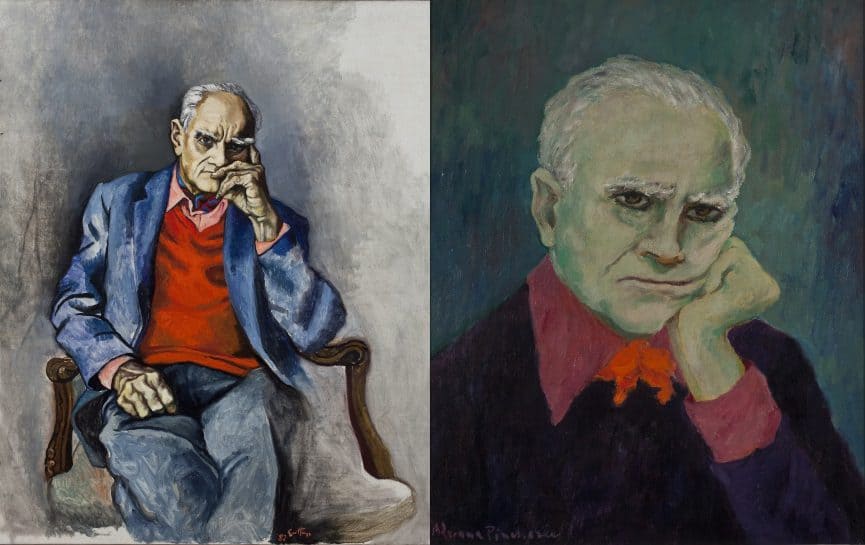
The recurring theme is the writer's face. He was portrayed by Renato Guttuso (1912-1987), Mario Schifano (1934-1998) with more than one version, Sergio Vacchi (1925-2016). They are three generations and three incompatible poetics: Guttuso's militant realism, Schifano's pop and media painting, Vacchi's dense dreamlike quality. That all three wanted to fix that face says how much Moravia was, for Italian artists, a reference figure as well as a friend.
Among the portraits shown on the museum's digital platform there is one that has become a small icon, the Portrait of Alberto Moravia with a Red Sweater. It's worth looking at before the visit and then looking for it in person: the comparison between reproduction and original, in painting, is always instructive, and in a domestic room with natural light it is doubly so.
The other artists in the house
The roster of names is wide and runs across half a century of Italian art. Besides the three main portraitists, the house has works by Adriana Pincherle, the painter sister, of whom the museum catalogs, among others, Bocca di Magra and Sahara. By Carlo Levi, writer and painter, the author of Christ Stopped at Eboli. By Tano Festa and Franco Angeli, both of the so-called Piazza del Popolo school. By Titina Maselli. By Giulio Turcato, Corrado Cagli, Lorenzo Tornabuoni and Leonardo Cremonini. There are also non-figurative works, urban compositions and abstract still lifes.
An observation from a professional. This is not a coherent collection and it doesn't pretend to be: it is a diary of friendships hung on the wall. Anyone who looks at it searching for a critical line wastes their time. Anyone who looks at it trying to reconstruct who frequented those rooms between 1963 and 1990 holds in their hands the notarial deed of Roman culture in the second half of the 20th century. Piazza del Popolo school and Guttuso's realism, in those years, cordially detested each other. In the Moravia home they lived side by side on the same wall.
Why so many painters in a writer's house
The short answer is that Moravia wrote about art. The long answer is that he belonged to a generation in which the separation between the arts did not exist: you moved from the editorial office of a magazine to the gallery, from the film set to the café, and the same 10 or 15 people met again everywhere. The house on Lungotevere della Vittoria was for almost 30 years one of the nodes of that network. The walls keep the proof.
The African masks and the travel objects
Among the books and the paintings, the house holds the perhaps most unexpected part: masks and objects collected by Moravia himself during his travels in Africa, in the East and in South America. There are traditional African masks, Japanese makemono, theatrical masks from Japan, a ritual leopard mask, as well as design objects, pop lamps from the 1960s and records.
Moravia's Africa is not a souvenir
Careful not to dismiss these objects as drawing-room exoticism. Africa is one of the intellectual obsessions of the late Moravia, and it produced real books: A quale tribù appartieni?, Lettere dal Sahara, Passeggiate africane. He traveled for years on the continent, often in the company of Pier Paolo Pasolini, and drew from it a reflection on the relationship between industrial and preindustrial civilization that is political before it is literary. The masks hung in the house are the material archive of that thought.
In front of this section it is worth asking the guide to say where each object was acquired, if the information is available. The difference between a piece bought in a Nairobi market in the 1970s and a piece bought from a Roman antiques dealer is enormous, in documentary terms. When the information is there, the mask stops being decoration and becomes a date on an itinerary.
The domestic design of the 1960s and 1970s
The pop lamps, the modern furnishings without ostentation, the records: the house preserves a sample of the cultured Italian middle-class taste of those years that today has an independent historical value. The official description of the collection insists on one point, and it's the right one: the simplicity of the furnishings, modern but without ostentation. There is nothing expensive on display, nothing designed to impress the guest. It is exactly the opposite of the homes of men of letters that one usually visits, where ostentation is the rule.
Who Alberto Moravia was
To understand the house you have to know the man, and Moravia's biography is more dramatic than his reputation as a middle-class writer suggests. Summing it up in two lines is impossible: let's go through it stage by stage, because each stage left a mark in those rooms.
Alberto Pincherle, and his grandmother's name
He was born in Rome on November 28, 1907 as Alberto Pincherle. Moravia is the surname of his paternal grandmother, adopted as a literary pseudonym. His father, Carlo Pincherle, a Venetian from a Jewish family, was an architect and painter. His mother, Teresa Iginia de Marsanich, was of Anconetan origin. A middle-class family, well-off, cultured: exactly the environment that Moravia would spend his life dissecting.
The illness: five years in bed
At nine, in 1916, he contracted a serious bone tuberculosis. A five-year immobility followed: three at home, two at the Codivilla sanatorium in Cortina d'Ampezzo. He did not attend regular schools, did not earn a diploma, and educated himself by reading everything that came to hand, in Italian, French and English.
This is the capital fact of his formation, and it is worth saying without rhetoric: the greatest Italian novelist of the 20th century is a self-taught man created by an illness. His bare prose, the refusal of ornament, the obsession with the clinical observation of human relationships come from there, from a boy who for five years could do nothing but look and read. When you enter the house on Lungotevere della Vittoria and see the bookcases that cover even the corridors, keep it in mind.
Gli indifferenti, at 21
In 1929 Gli indifferenti came out, published by Alpes of Milan at the author's expense, 5,000 lire. Moravia is 21 and will turn 22 in November. The book tells of the moral disintegration of a Roman middle-class family with a coldness that had never been read in Italy, and it immediately becomes a case. It is one of those very rare debuts that shift the history of a literature: critics still consider it today a capital novel of the Italian 20th century.
A detail I would put back in the center. The book was printed at the author's expense because no publisher wanted it. The history of Italian literature is full of rejected masterpieces, but few produced such an immediate effect. At 21 Moravia was already Moravia, and for the next 61 years he did nothing but test that initial intuition on ever new materials.
Fascism, censorship and the racial laws
The regime understood early that Gli indifferenti was not a friendly book. The ban on reviews, the seizures, the pressure on publishers arrived. With the racial laws of 1938 the position of Moravia, son of a Jewish father, became untenable: he kept working for the cinema as a screenwriter, but without being able to appear in the credits. He published under a pseudonym. It is a condition that lasts years and that can be read in watermark across all the output of the period, from the Mascherata of 1941 onward.
The flight to Fondi, and the birth of La ciociara
After September 8, 1943, with the Germans in Rome, Moravia and Elsa Morante, whom he had married in 1941, fled south. They took refuge at Sant'Agata, in the territory of Fondi, guests of the Marrocco-Mirabella family, in very harsh living conditions, among the peasants of Ciociaria, waiting for the arrival of the Allies. From those months, 14 years later, came La ciociara.
It is worth pausing a moment on this passage, because it is the key to the best Moravia. The writer who had anatomized the Roman bourgeoisie from the inside finds himself, for the first time at 36, really living as a poor man among the poor. What he sees in those months supplies him with the material for the next 20 years: La ciociara, the Racconti romani, the stubborn attention to subaltern lives that runs through all his middle work. The war turned a middle-class novelist into a civic writer.
The postwar period, the Strega Prize, the great novels
From 1945 on Moravia became the most read and most translated Italian novelist. Agostino in 1945, La romana in 1947, La disubbidienza in 1948, L'amore coniugale in 1949, Il conformista in 1951, Il disprezzo and the Racconti romani in 1954, La ciociara in 1957, La noia in 1960. In 1952 he won the Strega Prize with I racconti 1927-1951. In 1954 the Marzotto Prize with the Racconti romani. In 1960 the Viareggio Prize with La noia. The Mondello Prize in 1982 and the Pisa National Literary Prize in 1986 would follow.
In 1953 he founded with Alberto Carocci the magazine Nuovi Argomenti, which would become for decades one of the central laboratories of Italian culture and of which Pier Paolo Pasolini would be, among others, an editor and contributor.
The cinema, and Moravia the critic
No Italian writer of the 20th century was plundered by the cinema as much as Moravia. From his books came films that made history: La ciociara by Vittorio De Sica in 1960, which won Sophia Loren the Oscar for best actress. Il disprezzo by Jean-Luc Godard in 1963, shot partly in Capri, with Brigitte Bardot and Michel Piccoli. Il conformista by Bernardo Bertolucci in 1970. And before that Gli indifferenti, La noia, Agostino, La romana.
But Moravia also judged the cinema, every week, for decades. The column in L'Espresso, started in 1955, is one of the largest bodies of film criticism ever produced by a writer in Europe. He wrote the reviews with the same referential prose as the novels: no ecstasy, no superfluous adjective, the plot, the theme, the judgment. Many directors feared him and almost all read him.
In our judgment Moravia's reviews age better than quite a few of his late novels. They are the place where his anthropological gaze on Italian society works in the heat of the moment, on the material of the month, without the mediation of fiction. Whoever visits the house and sees the archive of clippings has before them the raw material of that work.
The European Parliament and the last decade
In 1984 Moravia was elected to the European Parliament as an independent on the lists of the Italian Communist Party, and stayed there until 1989. He was 77 when the term began. It is not a political career: it is the final consistency of an intellectual who had made public stands a part of the trade, and who in the 1980s focused on the theme of nuclear disarmament. From that reflection came L'inverno nucleare, from 1986.
These are also the years of the great late output written in this house: 1934 in 1982, La cosa e altri racconti in 1983, L'uomo che guarda in 1985, Passeggiate africane in 1987, Il viaggio a Roma in 1988, La villa del venerdì in 1990. He died with a book in progress and two others would come out posthumously, La donna leopardo in 1991 and the Diario europeo.
His death, on September 26, 1990
On the morning of September 26, 1990 Alberto Moravia was found lifeless in the bathroom of this house. He was 82. The lying in state was set up in the Sala della Protomoteca on the Campidoglio and the funeral was held in Piazza del Campidoglio, with a turnout that the Italian 20th century had reserved for very few writers.
Whoever visits the house should know this before entering, because it changes the way you move through the rooms. It is not a house museum built in memory of someone who died elsewhere: it is the exact place where that life ended, with the desk still laid with papers and the typewriter in its place. The house doesn't declare it and is right not to. But the visitor who knows it walks differently.

The women and the partnerships of the Alberto Moravia House Museum
This house had three romantic seasons, and each left its mark. Telling them is indispensable, because Moravia's private story is not literary gossip: it is part of the history of Italian literature, since the people he lived with were leading women writers.
Elsa Morante, before Lungotevere della Vittoria
Moravia and Elsa Morante met in Rome in November 1936, and married in 1941 in a religious ceremony, celebrated by the Jesuit Father Pietro Tacchi Venturi. Together they fled Rome after September 8, 1943 and lived the months at Sant'Agata di Fondi. In the postwar period they lived in the apartment on Via dell'Oca, a few steps from Piazza del Popolo, which became one of the most frequented literary salons in Italy. The separation came in 1962.
Morante therefore never lived in this house: when Moravia moved to the Lungotevere, in 1963, the marriage was already over. And yet her presence is felt, because the relationship between the two never really broke off and because the library preserves the signs of those shared years. Elsa Morante would die in 1985, five years before him.
A personal judgment that not everyone shares: Morante is the greater writer of the two. Moravia had more readers, more translations, more films. La Storia and L'isola di Arturo have a temperature that Moravia never sought. That said, they are two opposite and complementary ways of looking at the same country in the same years, and whoever reads only one misses half the picture.
Dacia Maraini, and the new house
The move to Lungotevere della Vittoria in 1963 coincides with the beginning of the long cohabitation with Dacia Maraini, which lasted until the early 1980s. Maraini is 27 years younger than he, comes from an extraordinary family, lived as a child through internment in a Japanese concentration camp together with her parents, and would become one of the most important voices of contemporary Italian literature.
These are the most intense years of the house. In these rooms people discuss theater, feminism, cinema, politics. Magazines are prepared. Trips are organized. Maraini and Moravia founded theater ventures together, traveled in Africa with Pasolini, went through the years of the protests and of terrorism. Whoever enters the living room with the green sofas and the piano today must imagine it full of people and smoke.
Carmen Llera
In 1986 Moravia married at the Campidoglio Carmen Llera, a Spanish writer 45 years younger. The marriage aroused the predictable gossip, which interested Moravia very little. These are the last four years of his life, those of the African trips, of the European Parliament, of the books on disarmament. Llera is among the figures who contributed to the preservation of the house after the writer's death.
Pier Paolo Pasolini in the Moravia home
The partnership with Pier Paolo Pasolini is perhaps the most important of all those that passed through these rooms. Pasolini was an editor and contributor of Nuovi Argomenti, the magazine founded by Moravia in 1953. The two traveled together in Africa for years. They discussed, quarreled, defended each other in trials and in the newspapers. They were very different: Moravia a rationalist, secular, middle-class to the marrow. Pasolini a visionary, religious in his own way, obsessed with the sacred and the body.
When Pasolini was killed at the Idroscalo of Ostia, in the night between November 1 and 2, 1975, it was Moravia who spoke in public the words that remained most famous about his death, with a harshness that nobody expected from him. Whoever visits the house and looks at the walls covered with works by artist friends should remember that that network of friendships paid very high prices. The cultural Rome of the 1970s gathered in salons like this one and ended up, sometimes, on the crime pages.
The other regular guests
For almost 30 years the house was a meeting place for artists, directors, poets and intellectuals. The names that appear on the walls are already a list of regulars: Guttuso, Schifano, Vacchi, Carlo Levi, Tano Festa, Franco Angeli, Titina Maselli, Giulio Turcato, Corrado Cagli, Leonardo Cremonini, Lorenzo Tornabuoni. None of those paintings was bought. They all arrived as gifts. A list of gifts is the most reliable of attendance registers.
The books written in the Alberto Moravia House Museum
27 years of work in a single room produce an impressive bibliography. On the oak and walnut desk, in front of the window on the Tiber, the pages of these were typed on the Olivetti 82: L'attenzione, La rivoluzione culturale in Cina, Il paradiso, Io e lui, A quale tribù appartieni?, Boh, La vita interiore, Lettere dal Sahara, 1934, Storie della preistoria, La cosa e altri racconti, L'uomo che guarda, L'inverno nucleare, Passeggiate africane, Il viaggio a Roma, La villa del venerdì, La donna leopardo, Diario europeo, Romildo.
Moravia in the 1960s
L'attenzione, from 1965, is the first novel entirely conceived here. It is also one of his most experimental books: a novel that tells the writing of a novel, built on a diary that contradicts itself. Whoever reads it today finds a restless Moravia who, after La noia, looks for a way out of the psychological realism that had made him famous. These are the years in which Gruppo 63 attacks head-on the novelists of his generation, and L'attenzione is also a reply to that attack.
La rivoluzione culturale in Cina, from 1968, was born from a trip and belongs to the reportage side. It is a book to be read knowing when it was written: it records an enthusiasm that the following years would harshly correct. Moravia was never a naive chronicler, but not a prophet either.
Moravia in the 1970s
Io e lui, from 1971, is the book that brought him the most scandal and the most copies sold. A comic and obscene novel on the conflict between a man and his own sex, treated as an autonomous character that speaks. It was received with embarrassment by serious critics and with enthusiasm by readers. Rereading it today you see what back then was seen little: it is a ferocious satire of the Italian left-wing intellectual, of whom Moravia himself was the most exposed representative.
La vita interiore, from 1978, is the great novel of the years of lead: the story of a middle-class girl who slides into terrorism, built entirely as an interview. It came out while Italy was living through the Moro case. It is the book in which the Moravia method, clinical observation applied to the Roman bourgeoisie, touches the most incandescent material of republican history.
A quale tribù appartieni?, from 1972, instead opens the African season. These are travel reports in which anthropology prevails over narration, and in which Moravia questions his own belonging to a civilization he considers exhausted.
Moravia in the 1980s
1934, from 1982, set in Capri in the year of the title, is considered by many the author's last great novel: the story of a despair that tries to stabilize itself, told with a formal control that the immediately preceding books had loosened. L'uomo che guarda, from 1985, returns to the theme of voyeurism and the father-son relationship. Il viaggio a Roma, from 1988, closes the circle by bringing the protagonist back to the city where everything had begun.
Passeggiate africane, from 1987, and L'inverno nucleare, from 1986, bear witness to the two commitments of the last Moravia: the African continent and the atomic threat. They are the books of an 80-year-old man who keeps reading the present instead of taking refuge in memory. It is not a common thing among older writers.
Postwar Rome seen from this house
Between 1963 and 1990 Rome changes more than in the previous 300 years. Moravia looks at it from a penthouse on the Tiber and tells it live, in the newspapers before the novels. It is worth reconstructing that landscape, because it is the true context of the visit.
The 1960s: the boom and the periphery
When Moravia moves in, Rome has passed 2 million inhabitants and is growing at rates that no master plan manages to govern. The borgate he had told of in the Racconti romani and that Pasolini told of in his novels are turning into neighborhoods. The historic center begins to empty of residents. The automobile takes possession of the squares. The Della Vittoria neighborhood, already built and already middle-class, remains on the margins of this upheaval: it is one of the reasons the house has been able to be preserved.
The 1970s: politics inside the home
The following decade brings the temperature of the country into these rooms. The protests, feminism, divorce, abortion, terrorism. Moravia takes a stand on everything, in the Corriere and in the Espresso, and pays the price of exposure: attacks from the right and from the left, weekly polemics, obscenity trials dragging on for years. The house becomes a place where people discuss things that concern the life and death of people, not just literature.
An observation that directly concerns the visit: when the guide shows you the walls with the friends' paintings, try to date them mentally. Many of those works come from years in which Italian artists were divided by very deep political fractures. That they all ended up on the same walls means that the master of the house had a capacity to keep people together that was, in itself, a political position.
The 1980s: Europe and disarmament
The last decade is that of the European Parliament, of the trips to Africa and of the battle against the nuclear arms race. Rome in the meantime becomes the city of the retreat from politics, of the Milano da bere seen from afar, of the first great restorations and the first great speculations on heritage. Moravia, who is by now over 70, keeps writing every day at the same desk, at the same hour, with the same machine.
A curiosity about the Alberto Moravia House Museum
The finest curiosity of this house is not an object: it is a piece of furniture, and the furniture has an author who is not a carpenter. The desk in the study, the piece on which Moravia worked for 27 years, was built expressly for him by the German artist Sebastian Schadhauser, in oak and walnut. It is not a table bought in a furniture store nor an antique piece: it is a work commissioned from a sculptor, designed to the measurements and habits of the person who had to write on it.
Schadhauser left a description of the hours spent with the writer that is worth, by itself, the price of many critical essays: he recalls a man who thought slowly, taking all the time necessary, and with whom you could sit for hours without exchanging a word. Whoever knows Moravia's prose, cut to the minimum, free of digressions, built by subtraction, recognizes in that description the same method applied to conversation.
There is more, and it concerns the way the desk is placed. It faces the windows, that is, the river, and turns its back to the room. A custom-made piece of furniture could be put in any position: that choice means the author wanted to have the landscape before his eyes and behind his back the house, the guests, the paintings, the social life. Whoever writes knows how important it is to decide what you look at while you look for a sentence. Moravia looked at the Tiber and Monte Mario.
I add a detail that visitors rarely notice and which is instead the signature of the house: the bookcases are not concentrated in a library room, as happens in 99 percent of writers' homes. They are distributed everywhere, including the two central corridors, which are lined with shelves along their whole length. The apartment was designed around the books, not the books arranged around the apartment. Try looking at how much space is left to pass through in those corridors: very little. He was a man willing to sacrifice the width of the corridors to the number of volumes.
Something nobody tells you about the Alberto Moravia House Museum
The thing nobody tells you concerns the booking mechanism, and it will save you two months of waiting if you know it. Reservations for public visits open roughly 30 days before the date. There is no perpetual waiting list to sign up for: if you call 060608 40 days ahead they will tell you it is not yet possible to book, if you call five days ahead you will almost always find it sold out. The useful window is narrow, and has to be hit in the first days when it opens.
The second little-known element is that there are three different entrance doors to this house, and not everybody knows they can use them. The first is the public visit on the second Saturday, at 10:00 and 11:00, groups of 15. The second is the 12:00 slot of the same Saturday, reserved for groups that bring their own guide, with reservation by email at didattica@zetema.it and lasting about an hour: if you are 15 friends or a cultural association, this is the best route, because you have double the time. The third is the school channel on Wednesday morning, at 10:00 and 11:30, for middle and high schools.
The third element, the one that almost nobody really takes advantage of, is scholar access. The library and archive of the Fondo Alberto Moravia can be consulted by appointment, Monday to Friday from 10:00 to 14:00, by writing to info@fondoalbertomoravia.it or phoning 06 3203698. Whoever is preparing a thesis, a piece of research, an article on Moravia, on the Italian 20th century or on film criticism has the standing to ask. It is not a tourist shortcut and should not be used as one: it is a scholarly service, and must be requested with a serious and reasoned request. But it exists, it works, and in those hours the house is empty.
One last piece of information that circulates little: the house has been digitized on Google Arts and Culture, with about 40 works cataloged and routes that follow the rooms. For those who can't climb up, for those with mobility problems, for those who want to prepare the visit knowing in advance where to look, it is a concrete and free resource. It is best used before the visit: half an hour in front of the screen the evening before, and the time inside the house gives you triple.
The advice I give you for visiting the Alberto Moravia House Museum
The main advice is to read a book before going up, and not just any book. Not Gli indifferenti, which is from 1929 and belongs to another house and another man. Read Il viaggio a Roma, from 1988, or a handful of Racconti romani. They will help you understand the gap between what you see from the terrace and what that gaze produced on the page.
The second advice concerns the rhythm. The public visit is short and the instinct is to photograph everything and understand later. Do the opposite. Choose three things to really look at and neglect the rest: the desk with its orientation, a stretch of bookcase read spine by spine, and the terrace. Three things observed well are worth more than 40 photographs you will never look at again.
Third: ask the guide questions, and make them specific. Generic questions produce generic answers. Ask where a certain mask comes from, who gave a certain painting and in what year, what was on the desk on the day the house was turned into a museum. The staff who accompany visits in this house know the material and are glad when someone asks something precise, because it rarely happens.
Fourth, and it concerns logistics: combine the visit with a walk, otherwise you have done half an hour of museum after half an hour of bus. Coming out of the main door, with the river on your right, in 20 minutes on foot to the north you reach Ponte Milvio and the Foro Italico. In the opposite direction, crossing the bridge, you are in Flaminio and in a quarter of an hour at the MAXXI or the Auditorium Parco della Musica. A morning built like this makes sense. The isolated visit doesn't.
Fifth and last, an honest warning: if you are looking for a spectacular museum, this is not one. It is an apartment of normal size with inside it the furniture of a gentleman who died in 1990. Whoever arrives without knowing who Moravia was leaves disappointed, and is right. Whoever arrives having read two of his books leaves with the feeling of having met a person. You make the difference before going up, not the museum.
Another well-known fact, yet rarely cited
That Alberto Moravia is the pseudonym of Alberto Pincherle almost everyone knows, and it is written in every school anthology. What is cited far less is the reason that surname was chosen: Moravia was his paternal grandmother's surname. Not an invented name, not a literary homage, not an anagram: a piece of his own family, taken from the father's maternal branch.
The fact takes on another weight if you put it next to a second piece of data equally well known and equally little pondered: the father, Carlo Pincherle, was a Venetian of a Jewish family, architect and painter. In 1929, when Gli indifferenti came out, that surname was not yet a problem. In 1938, with the racial laws, it certainly became one. Moravia found himself working as a screenwriter without being able to appear in the film credits, publishing under another name, seeing his own books seized and the reviews banned. A pseudonym chosen at 20 for purely literary reasons proved, 10 years later, also to be a protection.
There is a third well-known element that almost nobody connects to the other two. The artistic branch of the family does not stop at the father: the sister Adriana Pincherle, born in 1905 and died in 1996, was a painter of standing, present with her works on the walls of this house. The Pincherle family produced in the same decade a capital novelist and a recognized woman painter, and the house on Lungotevere della Vittoria preserves both vocations under the same roof: his books on the walls of the corridors, her paintings hung between one shelf and the next.
Our view: the school vulgate presents Moravia as the cold narrator of the bourgeoisie. It is an accurate description and an insufficient one. That clinical detachment is not a stylistic whim, it is the result of a biography that includes five years of immobility as a child, a law of the State that took his name off the end credits and nine months spent hiding in a hut in Ciociaria. Whoever has seen things from those positions hardly writes with enthusiasm.
The right photo to take at the Alberto Moravia House Museum
A necessary premise: photography in the rooms of Rome's civic museums follows rules that can change, and in a house museum with private objects and artworks owned by others the first thing to do is ask the staff who accompany the group what is allowed. Flash and tripods are always to be ruled out on your own, even if nobody tells you: in small rooms with paintings and papers, flash is a technical discourtesy before it is a violation.
That said, the photograph that gives an account of this house is just one, and it is not the typewriter. It is the shot from the study toward the window, with the desk in the foreground and the Tiber in the background. It serves to explain in one frame what 20 minutes of storytelling struggle to say: that this was a workplace overlooking the city, and that the landscape was part of the instrument. Technically it is best to stand slightly to the side of the axis of the desk, so as not to have the window completely blown out by the light. If you have a camera that allows underexposing by one stop, do it and recover the shadows afterward.
The second framing to keep in mind is vertical: a stretch of corridor with the bookcases rising to the ceiling and the paintings hung in the gaps. With the smartphone held vertically, leaning your back against the opposite wall, you get a compressed perspective that renders exactly the physical sensation of those passages. It is the image that best describes the house to someone who has never been there: not the rooms, but the fact that the books occupy even the passageway.
The third is the terrace. Here the common mistake is to aim the lens at the panorama and forget the foreground. The panorama of the Tiber at that point, by itself, is an ordinary panorama: channeled river, plane trees, buildings. What makes the photograph is including an element of the house in the frame, the jamb of the French window, the railing, a corner of the living room behind you. The photo must tell a point of view, not a view.
On the light: the 10:00 slot and the 11:00 one give different results. At 10:00 the light on the Lungotevere still comes in low and raking from the east, and the living room with the skylights is more contrasted. At 11:00 the light is higher and more diffuse, and the inner rooms gain. If you photograph, take the 11:00. If you want the terrace with the river backlit in gold, that is a late-afternoon affair and in this house it can't be done, because at that hour it is closed. Better to know it beforehand than to be disappointed.
One last recommendation: the best photograph you can take away from here doesn't end up on your phone. Look for 30 seconds at the spines of the books at eye level, at any point in the corridor, and read the titles. No image gives back the vertigo of a real library better than that gesture.
Some important events that happened here in history
This house hosted no battles and no conclaves. It did host, however, a series of facts that weigh on Italian cultural history, and it is worth listing them in order.
1963: the arrival. Moravia leaves the historic center and takes the penthouse at Lungotevere della Vittoria 1. He is 55, has just come out of the season of the great realist novels and begins a new phase both literary and private, together with Dacia Maraini. The move coincides with a stylistic turn: L'attenzione, the first book conceived here, will be an experimental novel, very far from Il disprezzo and La ciociara.
From 1963 to 1990: 27 years of daily work. It is not a single event, but it is the most important thing that happened in this apartment. 18 or 20 volumes among novels, stories, reportage and essays were written at the same desk. Few places in Italy can document a literary productivity so concentrated in so small a space.
The 1960s and 1970s: the house as a meeting place. Artists, directors, poets and intellectuals met regularly in these rooms. Among them Pier Paolo Pasolini, who was Moravia's friend, partner, travel companion in Africa and contributor to the magazine Nuovi Argomenti. People discussed literature, art and politics in a city that in those years was living through its deepest fractures.
1975: the death of Pasolini. The murder at the Idroscalo of Ostia, in the night between November 1 and 2, strikes this living room like a family bereavement. Moravia speaks publicly in words of a harshness unusual for him. It is the moment when the group of friends who met in this house realizes it is inside history and not beside history.
1984: the election to the European Parliament. At 77 Moravia is elected as an independent on the lists of the Italian Communist Party and stays in office until 1989. From this house he leaves for Strasbourg and to this house he returns to write. The European season produces the commitment on nuclear disarmament and the book that is its synthesis, L'inverno nucleare, from 1986.
1986: the marriage to Carmen Llera, celebrated at the Campidoglio. The house enters its last domestic configuration.
September 26, 1990: the death. Alberto Moravia is found lifeless in the bathroom of the apartment. He was 82 and was working. The lying in state is set up in the Sala della Protomoteca at the Campidoglio, the funeral takes place in Piazza del Campidoglio. Rome says farewell to its writer in the symbolic place of the city, four kilometers from the house where he had written for 27 years.
1991: the Associazione Fondo Alberto Moravia is born. Sisters, heirs and friends form an association with two goals: a study center on the writer's work and the transformation of the apartment into a house museum, leaving furniture and objects where they were. It is the decision that made everything else possible.
1993: the establishment of the Archive, which gathers about 15,000 archival units and will be recognized by the Soprintendenza Archivistica per il Lazio as of notable historical interest.
2009: the donation to the City of Rome. The heirs hand over the property to the city. A choice that was anything but a given, considering the real-estate value of a penthouse on the Tiber.
November 29, 2010: opening to the public. The house officially enters the Civic Museums System of Roma Capitale and begins to receive visitors. Since then the opening calendar has changed several times, but the principle has remained: you enter a few at a time, accompanied, by reservation.
Who has passed through the Alberto Moravia House Museum
The list of people who climbed those stairs between 1963 and 1990 is, in practice, an index of Italian culture in the second half of the 20th century. Not all the visits are documented with date and time, and it is worth distinguishing between those who frequented it steadily and those who passed through.
Dacia Maraini
Not a guest: the co-resident. She lived with Moravia in this house from the move in 1963 until the early 1980s. In that period Maraini wrote some of her fundamental books, founded theater ventures, took part in the battles of the Italian feminist movement. Many of the discussions that produced Italian literary feminism passed through these rooms.
Pier Paolo Pasolini
The most assiduous and the most famous regular. Editor and contributor of Nuovi Argomenti, the magazine founded by Moravia with Alberto Carocci in 1953, Pasolini was also a companion on the African trips, repeated for years. The relationship between the two was made of affection and permanent disagreement: neither ever convinced the other of anything, and that is exactly why they kept talking to each other. When Pasolini was killed, in November 1975, Moravia lost at once a friend and an interlocutor he never replaced.
The painters
The walls are the attendance register. Renato Guttuso, who made a portrait of Moravia, was in those same years the most politically exposed painter in Italy. Mario Schifano, of a younger generation, portrayed him more than once and belonged to that Piazza del Popolo school that had nothing in common with Guttuso's realism. Sergio Vacchi, the third portraitist, came from yet another road. And then Carlo Levi, doctor, painter and writer, author of Christ Stopped at Eboli. Tano Festa and Franco Angeli. Titina Maselli. Giulio Turcato, Corrado Cagli, Lorenzo Tornabuoni, Leonardo Cremonini. And of course Adriana Pincherle, the sister.
Elsa Morante
With a necessary clarification: she did not live in this house. The marriage to Moravia, celebrated in 1941, had ended in 1962, the year before the move to the Lungotevere. The years of their life together belong to other Roman addresses, in particular to Via dell'Oca, near Piazza del Popolo, where their apartment was for a decade one of the gathering places of Italian literature. The bond, however, never fully died out, and the library on Lungotevere della Vittoria preserves the memory of that shared season. Morante died in 1985.
Carmen Llera
A Spanish writer, married by Moravia at the Campidoglio in 1986. She shared with the writer the last four years of his life in this house and was among the figures who made its preservation possible.
Directors, journalists, publishers
Italian cinema passed through this living room as much as literature did. From Moravia's novels came films by Vittorio De Sica, Bernardo Bertolucci, Jean-Luc Godard, and the film criticism column in the Espresso, kept from 1955 for decades, made this house an address that directors knew well. Add the editors of the Corriere della Sera, the publishers, the foreign translators, the journalists in search of a statement on every Italian event of those 30 years, and you will have the measure of the traffic this landing endured.
Whoever visits today, on the second Saturday of the month, in a group of 15 people, is repeating a gesture that thousands of people made when someone lived here. The difference is that back then you rang the doorbell and now you book at 060608.
What to see around the Alberto Moravia House Museum
Half an hour of visit does not justify a crossing of the city. Here is what you can put together, on foot or with two bus stops, to build a morning or a whole day.
North, along the river
With the Tiber on your right and walking upstream you reach in about 20 minutes the Foro Italico, the 1930s sports complex with the Stadio dei Marmi and the mosaics of the piazzale, one of the most embarrassing and most intact documents of regime architecture. Next to it stands the Olympic Stadium. A little further on you meet Ponte Milvio, the oldest bridge in Rome still in service, the one of the battle of 312 between Constantine and Maxentius.
Whoever has legs and half a day can climb the slopes of the Monte Mario Nature Reserve, the rise you see from the terrace of Casa Moravia, where the astronomical observatory also stands. From above, the point of view is reversed: you look down toward the Lungotevere and pick out the building.
Over the bridge, toward Flaminio
Crossing the river you find yourself in the Flaminio neighborhood, which since the 2000s has become the city's contemporary cultural hub. In a quarter of an hour you reach the MAXXI, the national museum of 21st-century arts designed by Zaha Hadid, and the Auditorium Parco della Musica by Renzo Piano. In the same area is the Teatro Olimpico.
The pairing that works best is precisely this: Casa Moravia in the morning, a quick lunch, the MAXXI in the afternoon. A private 20th-century home and a public 21st-century museum, a kilometer and a half apart. The contrast makes you understand more than two similar museums would.
The other house museums of Rome
If the formula of the writer's house interests you, Rome offers a small circuit: the house of Luigi Pirandello on Via Antonio Bosio, where the Nobel laureate lived until 1936. The Mario Praz museum at Palazzo Primoli, which is the exact opposite of Casa Moravia, a neoclassical interior built as a total work of art by a maniacal collector. The Hendrik Christian Andersen museum, home and studio of the Norwegian-American sculptor. The Pietro Canonica Museum at the Fortezzuola of Villa Borghese.
To these is added, for those looking for the places of literature, the Non-Catholic Cemetery in Testaccio, where Keats, Shelley, Gramsci and Carlo Emilio Gadda are buried.
Museums of 20th-century art
Whoever leaves Casa Moravia with curiosity lit for the painters seen on the walls finds the natural follow-up at the Galleria Nazionale d'Arte Moderna on Viale delle Belle Arti, which holds works by Guttuso, Turcato, Cagli and almost all the artists of the house. At the Galleria d'Arte Moderna on Via Francesco Crispi. At the MACRO on Via Nizza. And at the Carlo Bilotti Museum at the Aranciera of Villa Borghese.
When to go to the Alberto Moravia House Museum
The question has a mandatory answer and a discretionary one. The mandatory one: you go on the second Saturday of the month, because there are no alternatives in the regular calendar. The discretionary one concerns the season.
The best season
April, May, October. Not for the climate itself, but for the terrace: in the in-between months you can stay outside a few minutes without suffering, and the view of the river with the plane trees in leaf or in color is worth half the visit. In July and August the top-floor penthouse is hot, the Lungotevere is scorching and the surrounding walk becomes tiring. In the dead of winter, instead, the morning light on the river is low and crisp, and the inner rooms gain a tone they don't have in August.
Which slot to choose
Between 10:00 and 11:00, better 11:00, for two practical reasons. The first is the light, higher and more diffuse, which renders better in the interior rooms and under the skylights of the living room. The second is that the 10:00 slot fills up first in the reservations, and whoever calls a few days after the window opens finds it easier to get a place at 11:00.
The Alberto Moravia House Museum with children
I'll be frank: under 11 or 12 years old this is not a suitable visit. There are no interactive stations, no spectacular rooms, and the value of everything you see depends on who the person was who lived there. Middle and high school kids, on the other hand, have a dedicated channel on Wednesday morning, with educational routes designed for the purpose, and for a class studying the Italian 20th century it is an hour very well spent: seeing the desk on which a book they read in class was written produces an effect no lesson reproduces.
For families with small children on a day in north Rome, better to divert to Villa Borghese, the Foro Italico or the Casa del Cinema.
How much time you need in all
Counting arrival with a 20-minute margin, the visit and the return to the street, allow an hour and a half for the public slot and two hours for the group with its own guide. If you combine it with a walk to Ponte Milvio or a crossing to the MAXXI, the half day fills up effortlessly.
Quick questions about the Alberto Moravia House Museum
How much does a ticket to the Alberto Moravia House Museum cost?
The museum's official site indicates free admission, and the guided tour, which is the only way in, is free too. Some tourist portals report five euros: the claim finds no confirmation on the museum's tickets page, so it is best to ask for confirmation at the time of the phone reservation.
Do I need to book to visit the Alberto Moravia House Museum?
Yes, booking is mandatory and there is no free entry. You book at the number 060608, active every day from 9:00 to 19:00. Reservations for the public open roughly 30 days before the date of the visit.
When is the Alberto Moravia House Museum open?
The regular calendar provides for opening on the second Saturday of every month, with two slots at 10:00 and 11:00. Groups with their own guide have a dedicated slot at 12:00 on the same Saturday. Dates should always be checked on the official site, because the calendar can change.
How many people can enter at a time?
Groups are at most 15 people. For school groups the limit is 25 students, divided into subgroups during the visit.
How long does the visit to the Alberto Moravia House Museum last?
The accompanied public visit is short, on the order of a good half hour. Groups that arrive with their own guide have about an hour.
Where exactly is the Alberto Moravia House Museum?
Lungotevere della Vittoria 1, 00195 Rome, at the corner with Piazzale Maresciallo Giardino, in the Della Vittoria neighborhood. The apartment is on the top floor of the building.
How do I get to the Alberto Moravia House Museum by public transport?
By bus 280, which has the stop Lungotevere Vittoria/Maresciallo Giardino in front of the building, or by lines 32 and 69, which stop at Maresciallo Giardino on Viale Angelico side. The nearest metro stop is Lepanto on line A, about a 20-minute walk.
Is the Alberto Moravia House Museum wheelchair accessible?
No. The official site states that the museum is not accessible. Those with mobility difficulties can consult the digitization of the house on Google Arts and Culture, which includes about 40 works and room-by-room routes.
Can you take photographs inside the Alberto Moravia House Museum?
The rules on photography in the rooms of civic museums can vary: the correct thing is to ask the staff who accompany the group before shooting. In any case flash and tripods are to be avoided, for the conservation of the works and out of respect for the other visitors.
How many years did Moravia live in this house?
27. He moved in in 1963 and died there on September 26, 1990.
What books did Moravia write in the Alberto Moravia House Museum?
Among others Attention, The Cultural Revolution in China, Paradise, Me and Him, Which Tribe Do You Belong To?, Boh, Inner Life, Letters from the Sahara, 1934, Stories of Prehistory, The Thing and Other Stories, The Man Who Watches, Nuclear Winter, African Walks, The Journey to Rome, The Friday Villa, The Leopard Woman, European Diary, Romildo.
What typewriter did Moravia use?
An Olivetti 82, which is still on the desk in the study.
Who built Moravia's desk?
The German artist Sebastian Schadhauser, in oak and walnut. It is a custom-made piece of furniture, not a bought item of furnishing.
Which artists are present in the Alberto Moravia House Museum?
Renato Guttuso, Mario Schifano, Sergio Vacchi, Adriana Pincherle, Carlo Levi, Tano Festa, Franco Angeli, Titina Maselli, Giulio Turcato, Corrado Cagli, Lorenzo Tornabuoni, Leonardo Cremonini. The works are largely gifts from the artists to the writer.
How many volumes are in Moravia's library?
The estimates in circulation vary considerably and the museum does not publish a single figure on the collection page. The certified figure concerns instead the archive: about 15,000 archival units, recognized as of notable historical interest by the Soprintendenza Archivistica per il Lazio. For the exact count of volumes it is best to contact the Associazione Fondo Alberto Moravia.
Can you consult Alberto Moravia's archive?
Yes, by appointment, Monday to Friday from 10:00 to 14:00, by writing to info@fondoalbertomoravia.it or phoning 06 3203698. The service is aimed at scholars, researchers and students.
Can schools visit the Alberto Moravia House Museum?
Yes. Middle and high schools have a dedicated channel on Wednesday, at 10:00 and 11:30, with reservation at didattica@zetema.it. Maximum 25 students, with one free chaperone for every 10 kids.
Did Elsa Morante live in the Alberto Moravia House Museum?
No. The marriage to Moravia had ended in 1962, the year before the move to the Lungotevere. The years of their life together belong to other Roman addresses, in particular Via dell'Oca, near Piazza del Popolo.
Who lived in this house with Moravia?
Dacia Maraini, from the move in 1963 until the early 1980s, and then Carmen Llera, whom Moravia married at the Campidoglio in 1986.
Did Pasolini frequent this house?
Yes. Pier Paolo Pasolini was an editor and contributor of the magazine Nuovi Argomenti, founded by Moravia with Alberto Carocci in 1953, and Moravia's companion on the African trips. For years the house was a meeting point for artists, directors and poets, Pasolini included.
Why did Alberto Pincherle sign himself Moravia?
Moravia was his paternal grandmother's surname. He adopted it as a literary pseudonym from his debut.
When was the house museum born?
The Associazione Fondo Alberto Moravia was formed in 1991, the Archive in 1993. In 2009 the heirs donated the property to the City of Rome and on November 29, 2010 the house officially opened to the public, entering the Civic Museums System of Roma Capitale.
Is the MIC Card valid for the Alberto Moravia House Museum?
Admission here appears to be free for everyone, so the question doesn't arise. The MIC Card remains, however, the pass worth having for the whole network of Rome's civic museums, from the Centrale Montemartini to the Carlo Bilotti Museum.
Is there a coat check or luggage storage?
No. It is a private apartment turned into a museum, with no reception services. Showing up with suitcases or bulky backpacks is not a good idea, considering the width of the corridors.
Is the Alberto Moravia House Museum worth visiting if you haven't read Moravia?
Less so. This is a house that speaks through an accumulation of biographical clues: without knowing who the person was, the clues remain objects. A novel and half an hour of preparation are enough, however, to change the experience completely.
What is the difference between the Alberto Moravia House Museum and the Mario Praz museum?
They are the two extremes of the Roman writer's house. Praz built his apartment at Palazzo Primoli as a total work of art, with neoclassical furniture chosen one piece at a time and a calculated visual direction. Moravia lived in a modern, unadorned house, where the only excess is the books. Visiting them a few days apart is an instructive exercise on the relationship between writers and objects.
Are there exhibitions or events at the Alberto Moravia House Museum?
The Associazione Fondo Alberto Moravia promotes exhibitions, international conferences, debates and publishing and film projects. The calendar can be consulted on the museum's official site, in the sections dedicated to exhibitions and events.
Our verdict on the Alberto Moravia House Museum
It's wise to be wary of house museums: almost always they are reconstructions, with furniture bought afterward and rooms furnished from memory. This one is not. This is the real house, with the desk where it stood, the books where they stood, the bathroom in which the man died one morning in September 1990. It has the flaw of being small, of opening once a month and of not explaining itself. It has, however, a quality that counts for a great deal in Rome: it pretends nothing.
If I had to tell a friend whether to go up or not, I would ask them one thing only: have you read anything of his? If the answer is no, I would tell them to read Il viaggio a Roma or 10 Racconti romani first, and then to phone 060608 the following month. If the answer is yes, I would tell them to call right away, to take the 11:00 slot, and to spend the last five minutes on the terrace without taking out their phone. The river you see from up there is the same one that was looked at by one of the men who taught Italy to talk about itself without consoling itself. It is worth the half hour.
Article written by the editorial team of TourLeaderPro, contact them for Private/Corporate/V.I.P. Tours and Experiences.
Planning a trip to Rome? The English-language guides to visiting the city are on ItalyPlanner.com.