Mario Praz Museum
In short. The Mario Praz Museum occupies the third floor of Palazzo Primoli, at Via Giuseppe Zanardelli 1, a short walk from Ponte Umberto I and the northern flank of Piazza Navona.
The Mario Praz Museum occupies the third floor of Palazzo Primoli, at Via Giuseppe Zanardelli 1, a short walk from Ponte Umberto I and the northern flank of Piazza Navona. You can visit only by reservation and in fixed shifts: groups of 12 people at most, visits of about 45 minutes, entries every hour starting at 9:00 and the last shift at 18:00. It is open daily from 9:00 to 19:00, closed on Tuesdays, plus December 25 and January 1. The full ticket costs 6 euros, the reduced ticket 2 euros for European Union citizens between 18 and 25 years old, and admission is free for under-18s, on the first Sunday of the month and in the other cases provided by law. You book on the Ministry of Culture's portal or with the Musei Italiani app, and on site there is a kiosk for buying the ticket. The phone number is 06 6861089, the email dms-rm.museopraz@cultura.gov.it. By public transport you get off right at the door: lines 30, 70 and 87 run along Via Zanardelli between Piazza di Tor Sanguigna and Piazza di Ponte Umberto I. From the tram terminus at Largo di Torre Argentina it is a nine-minute walk along Corso del Rinascimento.
If you are putting together a tour of Rome's museums, the page on Rome's museums gathers the other venues you can visit in the city and helps you fit the hours together.
What the Mario Praz Museum really is
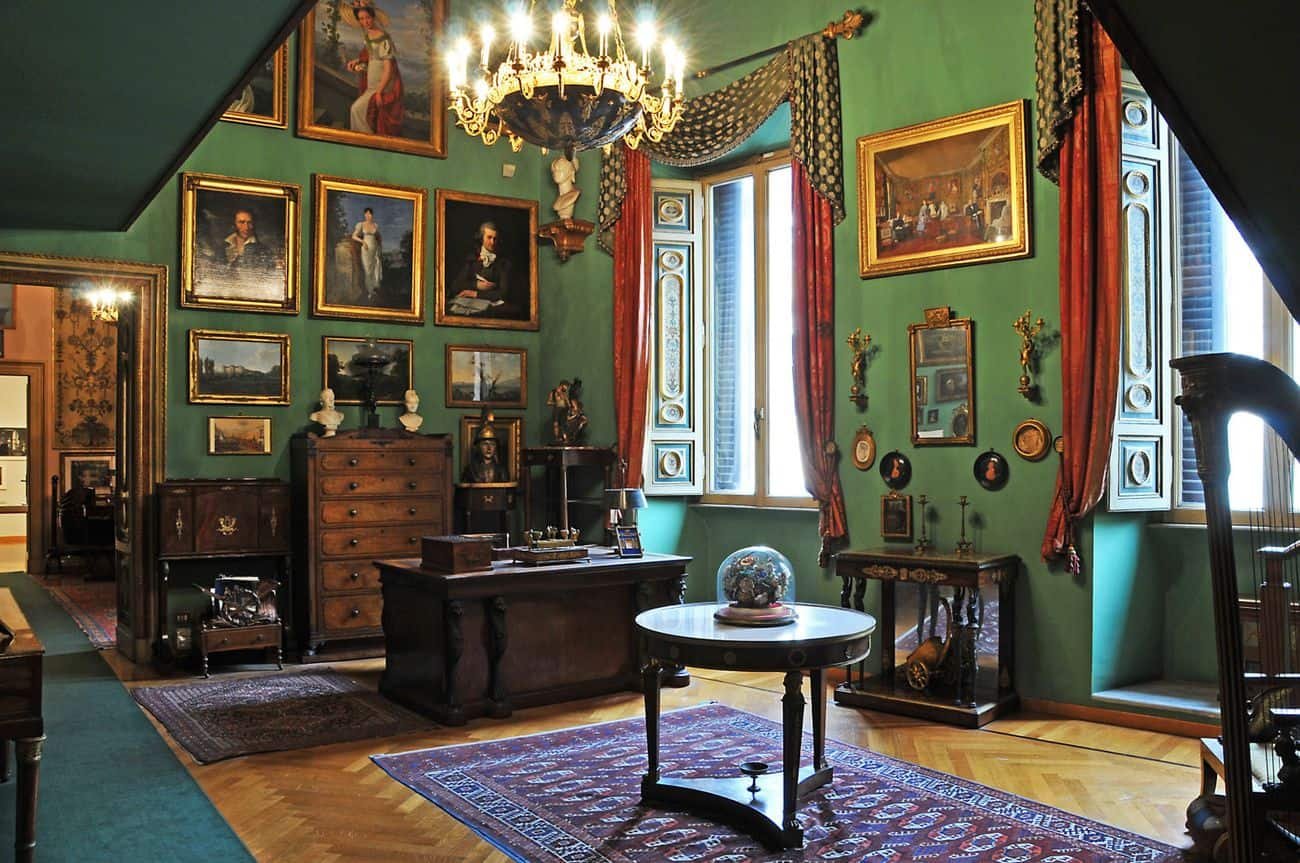
It is not a gallery and not a picture collection. It is the apartment where Mario Praz, an Anglicist and one of the most authoritative art critics of 20th-century Europe, lived from 1969 until his death in 1982, left exactly as it was: more than 1,200 pieces among furniture, paintings, sculptures, rugs, drapes, chandeliers, bronzes, crystal, porcelain, miniatures, silver and marbles, arranged according to the order the owner had established over 60 years of purchases. The difference is substantial. In a normal museum the objects have been detached from their context and rearranged by school or by century. Here the context is the main object, and the individual pieces matter above all for the place they occupy in relation to the others.
The house states a thesis. Praz was convinced that furnishing was a form of autobiography and that you could read a person's character from the room they had chosen to grow old in. He wrote this in La filosofia dell'arredamento, published in 1945, and told it as a novel of formation in La casa della vita, from 1958, where each chapter corresponds to a room and each room to a season of his life. Walking through the museum means stepping into that book. Anyone who arrives expecting recognizable masterpieces is left disoriented. Anyone who arrives knowing that the masterpiece is the whole leaves with the impression of having seen one of the few Italian house museums that really work.
A professional warning: this is a visit that rewards those who bring the mental captions with them from home. 20 minutes of preparation on Praz's biography doubles the value of the 45 minutes of the visit. Without that preparation the risk is to leave saying it was a nice house full of antique furniture, which is the most efficient way to waste the cheapest ticket in the historic center.
Where the Mario Praz Museum is and how to get there
The official address is Via Giuseppe Zanardelli 1, 00186 Rome. It is the same door as the Fondazione Primoli. The palace occupies the block between Via Zanardelli, Piazza di Ponte Umberto I and Via di Monte Brianzo, and the facade you see as you arrive from the bridge is the 20th-century reconstruction discussed further on. The museum is on the third floor. The entrance to the Napoleonic Museum, which occupies the ground floor of the same building, has its own access on Piazza di Ponte Umberto I.
By bus to the Mario Praz Museum
Lines 30, 70 and 87 all three pass along Via Giuseppe Zanardelli, in the stretch between Piazza delle Cinque Lune, Piazza di Tor Sanguigna and Piazza di Ponte Umberto I. They are the routes that connect the palace respectively with Laurentina and Piazzale Clodio, with Piazzale Clodio and Termini station on the Giolitti side, and with the Tuscolano and the Prati district. In practice, if you are coming from the Termini area, Santa Maria Maggiore or Via Nazionale, the 70 drops you 50 meters from the door. If you are coming from Prati or Lepanto, the 87 and the 70 provide the same service in the opposite direction.
By metro and on foot to the Mario Praz Museum
The metro in Rome doesn't do much for this part of Campo Marzio: none of the three lines reaches the historic center. The useful stop on line A is Spagna, and from there it is a good 20 minutes on foot via Via dei Condotti, Via Tomacelli and Via di Monte Brianzo. From Flaminio you walk down Via di Ripetta and it takes more or less the same time. The solution I recommend almost every time is a different one: get to Largo di Torre Argentina by tram 8 or by the buses that converge there, and walk up Corso del Rinascimento. Nine minutes, one sidewalk only, and you pass the flank of Sant'Ivo alla Sapienza.
By car, taxi and bicycle
Via Zanardelli is inside the limited traffic zone of the historic center and there is no usable street parking. If you arrive by car, leave it far away, on the opposite bank of the Tiber or in the park-and-ride lots, and finish the trip by public transport. By taxi you can reach Piazza di Ponte Umberto I without problems. By bicycle, the Lungotevere Tor di Nona has a comfortable lane all the way to Ponte Umberto, and the racks in the area are always crowded but not impossible.
Hours, tickets and booking for the Mario Praz Museum
The museum is open on Mondays and from Wednesday to Sunday, from 9:00 to 19:00. Tuesday is the weekly closing day. The fixed closures of the year are December 25 and January 1. In the summer months the museum has added, in some weeks, extraordinary openings on Tuesday afternoons too. It is a window announced season by season on the official website and should be checked before you count on it.
How much a ticket to the Mario Praz Museum costs
Six euros for the full price. Two euros for the reduced ticket, reserved for citizens of the European Union between 18 and 25 years old. Free under 18, free on the first Sunday of the month and free in the other cases provided by national regulations on state museums. Compared with what you see, it is one of the best-value tickets in Rome's historic center: six euros for 45 minutes in a private 19th-century apartment rebuilt piece by piece by the person who lived in it.
How to book a visit to the Mario Praz Museum
Booking is mandatory and it is not a bureaucratic detail: without a reservation you don't get in, because each shift has 12 places and that's it. You book on the Ministry of Culture's Italian museums portal or through the official Musei Italiani app. Alternatively you buy on site at the kiosk, but only if places remain free in the next shift, which almost never happens on weekends. The museum also answers by phone, 06 6861089, and by email at dms-rm.museopraz@cultura.gov.it, and that is the right channel for school groups and for anyone with special needs.
When to book the visit
The booking calendar is opened in windows, not over an unlimited horizon. It happens that you can book only up to a certain date, beyond which the system doesn't accept requests. The practical rule is simple: as soon as you decide your travel dates, check the portal. If the shift you need is not yet bookable, come back a week later. The early-morning shifts, the 9:00 one in particular, open up later than the others and are the best for the light.
Who Mario Praz was
Mario Praz was born in Rome on September 6, 1896 and died in Rome on March 23, 1982. His father, Luciano Praz, was a bank clerk from a family of Swiss origin. His mother, Giulia Testa di Marsciano, descended from the counts of Marsciano. The boy grew up between Rome and Florence, attended the Galileo liceo-ginnasio, earned a law degree in Bologna in 1914 with a thesis that in 1918 touched on the topic of the League of Nations in international law, and then earned a second degree, in literature, in Florence in 1920, with a thesis on D'Annunzio's language defended before a panel that included Giorgio Pasquali and Ernesto Giacomo Parodi. Two degrees, two worlds: the jurist never really disappeared behind the man of letters, and you can feel it in the almost notarial precision with which, decades later, he cataloged his own objects.
The English years and the chair at the Sapienza
From 1923 to 1931 Praz was a lecturer in Italian at the University of Liverpool. In 1932 he obtained the chair of Italian at Manchester and, within the same few months, the first Italian chair of English literature, at the Sapienza in Rome, where he would be full professor of English language and literature from 1934 to 1966. Anyone who studied English literature in Italy necessarily met him: from those classrooms came Vittorio Gabrieli, Agostino Lombardo, Giorgio Melchiori, Gabriele Baldini and Masolino d'Amico. It is a fact that explains why the museum has, for those who come from the university world, an almost moving value: those bookshelves are the working library of a man who founded a discipline in a country that did not have it.
The books by Mario Praz that explain the house
Secentismo e marinismo in Inghilterra is from 1925. La carne, la morte e il diavolo nella letteratura romantica, the book that made him famous in Europe, came out in 1930 and in English in 1933. Then came Studi sul concettismo in 1934, the Storia della letteratura inglese in 1936 with new editions in 1960 and 1979, Gusto neoclassico in 1940, La filosofia dell'arredamento in 1945, La crisi dell'eroe nel romanzo vittoriano in 1952, La casa della vita in 1958, Mnemosine in 1971, Il patto col serpente in 1972 and Perseo e la Medusa in 1979. The overall count of his publications exceeds 2,600 entries. If you have to read just one before going up to the third floor, read La casa della vita: it is the museum's instruction booklet, written 20 years before the museum existed.
Recognitions, honors and a life as a European
In 1935 the British Academy awarded him its gold medal for his studies on the literary relations between Italy and England. In 1952 he won the Premio Viareggio for nonfiction, which he would win again in 1973 with Il patto col serpente. In 1957 he received an honorary degree from Cambridge, in 1960 the Premio Feltrinelli of the Accademia Nazionale dei Lincei, in 1962 the title of Knight Commander of the Order of the British Empire from the hands of Queen Elizabeth II, in 1964 an honorary degree from Aix-Marseille, and in 1967 one from the Sorbonne. Between 1962 and 1965 he chaired the international association of university teachers of English. In 1949 he had founded, with the support of the British Council, the journal English Miscellany. In 1952 he made his first lecture tour of the United States. This is the résumé of the man who bought vase-holding sphinxes and wax saints at flea markets across Europe.
The legend of the unnameable
It has to be told, because in Rome everyone knows it and nobody explains it well. Praz had a congenital malformation of the right foot, surgically corrected at the Rizzoli Orthopedic Institute in Bologna, and a sharp character. That was enough for a reputation to take hold in certain provincial Italian circles that he brought bad luck, to the point that some avoided pronouncing his name. The international scholarly community ignored the superstition, and he himself treated it with ironic detachment. My opinion is clear: the legend did more damage to the fortunes of his books than his prose did, which is difficult but not hostile. Visiting the house is, among other things, an elegant way of making it up to him.

Palazzo Primoli, the building that houses the Mario Praz Museum
The palace dates to the 16th century and changed hands several times: around 1500 it belonged to the Gottifredi, then to the Filonardi. In 1820 Count Luigi Primoli bought the first floor and the family began to take over the whole building progressively, an operation that ended in 1901, when Giuseppe Primoli became its sole owner. Between 1904 and 1911 the Roman architect Raffaello Ojetti, father of the critic Ugo Ojetti, directed the renovation that modernized the building and gave it a new facade facing the street that had just been opened: Via Zanardelli, laid out together with Ponte Umberto I in the plan for the Tiber embankments. That is why the palace has two faces: the old one toward Via di Monte Brianzo and the early-20th-century one toward the river.
Giuseppe Primoli, the photographer count
Giuseppe Napoleone Primoli was born in Rome on May 2, 1851 and died in Rome on June 13, 1927. His mother was Carlotta Bonaparte, daughter of Carlo Luciano Bonaparte and Zenaide Bonaparte, themselves children of two brothers of Napoleon: Lucien and Joseph. The count was therefore a Bonaparte on his mother's side twice over, and the Napoleonic museum on the ground floor comes from there. In the last decades of the 19th century he developed a passion for photography with his brother Luigi and his cousin Placido Gabrielli, producing more than 15,000 plates and prints. In Paris he mixed with Guy de Maupassant, Alexandre Dumas the younger, Sarah Bernhardt and Théophile Gautier. In Italy he made friends with Arrigo Boito, Giuseppe Giacosa, Matilde Serao, Gabriele D'Annunzio and Enrico Nencioni. In his will he established the Fondazione Primoli, which manages the library, the archive and the photographic cabinet, and he donated to the City of Rome the collection of Napoleonic objects and documents that would become the Napoleonic Museum.
What is inside Palazzo Primoli today
The ground floor is occupied by the Napoleonic Museum, which belongs to Roma Capitale and follows a different calendar: open Tuesday to Sunday from 10:00 to 18:00, closed Monday. The third floor is the Mario Praz Museum, which is a state museum, closed on Tuesday. On the intermediate floors are the Fondazione Primoli, with its study library, the historical archive and the photographic cabinet, open to scholars by appointment during office hours. One building, three different institutions, three calendars that don't coincide: that is the reason so many badly planned visits end up in front of the right door and the wrong entrance.
From Palazzo Ricci to Via Zanardelli: how the Mario Praz Museum came to be
In 1934, returning to Italy for the Roman chair, Praz took an apartment at Palazzo Ricci, on Via Giulia. He stayed there 35 years and built most of the collection there, buying on the European antiques market during his academic trips: furniture in England, bronzes in France, malachites in Russia, crystal in Bohemia, porcelain in Germany, views of Italian and European cities, portraits of the reigning families from the Bourbons to the Bonapartes, and portraits of countless unknown 19th-century sitters bought because they had an interesting face. It is a collection made with the eye of a critic and the wallet of a university professor: no dizzying pieces, a great many right ones.
In 1969 came the move to Palazzo Primoli. Praz settled there as a tenant of the Fondazione Primoli and reorganized, room by room on Via Zanardelli, the house he had built on Via Giulia: not a copy, but a second draft of the same text. He would remain there until March 23, 1982.
In 1986 the Italian state bought the entire collection from the heirs, for a sum that sources give as 2 billion 100 million lire, and entrusted its cataloging and restoration to the Galleria Nazionale d'Arte Moderna. The collection was put back in the same rooms and in the same arrangement the collector wanted. The museum opened to the public in June 1995. In 2020 it closed for a cycle of restorations of both the structure and the works, and reopened on March 1, 2024, under the direction of Francesca Condò, with the collaboration of the restorer Silvana Costa and the coordination of the Directorate General for Museums of the Ministry of Culture.
Who runs the Mario Praz Museum today
The museum belongs to the State and is now assigned to the autonomous institute Pantheon e Castel Sant'Angelo, Direzione Musei nazionali della città di Roma, established by decree of March 15, 2024 and operational from May 18 of the same year. The same institute administers the Pantheon, Castel Sant'Angelo, the Museo Boncompagni Ludovisi, the Hendrik Christian Andersen Museum, the Museo della Liberazione, the Museo degli strumenti musicali, the Museo Giacomo Manzù and Casa Pasolini. Before this arrangement the house had passed from the Galleria Nazionale d'Arte Moderna to the Polo Museale del Lazio and then to the Direzione regionale Musei del Lazio: a succession of acronyms that explains why you find contradictory indications around about the owning body.
Visiting the Mario Praz Museum, room by room
The rooms open to the public number about 10 and you go through them in a line, with no comfortable way to turn back. The outline below is meant to tell you in advance where to look, because 45 minutes pass sooner than it seems. Each room has a dominant color and a logic of its own, and Praz had conceived them as chapters.
The entrance of the Mario Praz Museum
It is the only room where works by contemporary artists of the master of the house appear, all friends of his: Leonor Fini, Fabrizio Clerici, Stanislao Lepri, Colette Rosselli. Above, a portrait of the young Praz painted by Leonetta Cecchi Pieraccini, wife of Emilio Cecchi, the critic with whom Praz had an intellectual friendship that lasted more than 40 years. In the same room is a bookcase that had belonged to Gabriele D'Annunzio and comes from the Capponcina, the villa in Settignano. The message is clear from the threshold: here the 20th century enters only as a circle of affections, and the rest of the house belongs to another century.
The salon-gallery, the center of the Mario Praz Museum
The most theatrical room in the house plays on the white and gold of the neoclassical scheme, with a coffered ceiling and two symmetrical fireplaces placed on either side of a bookcase-alcove. On the wall is a painting worth the climb by itself: Maria Isabella di Napoli nel suo appartamento by Vincenzo Abbati, dated 1836, exactly the kind of picture Praz studied, an interior painted inside a real interior. A sculpture of Amore in caccia, attributed to Adamo Tadolini, a pupil of Canova, guards the space. A sofa embroidered by Praz himself reminds you that the man was also a patient craftsman. Among the female busts you can recognize the Marchesa d'Elci, an Elisa Bonaparte from the circle of Bartolini and a terracotta by Chinard depicting Madame de l'Horme. On a small table is the photographic portrait of his mother made by Mario Nunes Vais, one of the great Italian photographers of the early 20th century.
The study, the real brain of the house
Green walls, red curtains, and a long mezzanine gallery running high up to hold the library, built to a design by the architect Lizzani. Anyone who has seen professors' studies knows this is the room where real work was done. The small staircase up to the gallery is decorated with military subjects and dragon heads. On the wall is a Gran Salone di Palazzo Ricci painted by Sergio De Francisco in 1965, that is, the portrait of the previous house made when that house still existed: a piece of autobiography hanging on the wall. By the same painter is a portrait of the mature Praz. Personal opinion: if you have only five minutes of attention left, spend them here and not in the salon.
The wax collection of the Mario Praz Museum
The study holds the most singular collection in the house: more than 70 wax pieces, among martyrs, saints, portraits of nobles and anonymous heads, datable between the 16th and 19th centuries. Wax modeling is a technique that contemporary taste tends to consider macabre, and Praz loved it for the opposite reasons: wax renders flesh tones better than marble, and in the 17th and 18th centuries it was the material of home devotion and of the miniature portrait. It is a collection that no general guide describes and that alone would justify the museum's existence. Look at them calmly even if the shift is pressing.
The picture wall of the study
Above the study's bookcases runs a picture wall of nine paintings that is a small essay in the history of taste: Italian landscapes, a portrait of Ugo Foscolo attributed to François-Xavier Fabre, a portrait of Teresa Pikler linked to Achille Labruzzi, a portrait of Ferrandy also attributed to Fabre, Biedermeier-style interior scenes and a view of an interior of the Winter Palace in Saint Petersburg. The attributions on this wall should be taken for what they are: references established in the literature on the collection, not notarized certificates. The value of the group is its coherence, not any single name.
The library room of the Mario Praz Museum
Two large bookcases face each other: an Italian one from the first half of the 19th century, recognizable by its carved eagles and swans, and an English one in rosewood. In the center is a semicircular desk from Livorno with a pull-out top and an interior lined with mirrors, the kind of furniture that in the 19th century was used to write letters nobody was supposed to read. A bust of Giuseppina Grassini, the contralto from Piacenza who was Napoleon's favorite singer, and a Ritratto della principessa Vittorina Spinola presso il busto di Augusto d'Arenberg by Jacques Sablet, dated 1792, complete the room. Sablet is a Swiss painter who was active in Rome in the decade before the revolution: the painting is one of the highest-quality pieces in the whole collection.
The passage
The passage connecting the rooms is not a leftover space. It holds a small table with a polychrome marble top, two 18th-century vase-holding sphinxes, a Veduta di Cava vicino Salerno by Anton Sminck Pitloo, the Dutchman who in effect founded the Posillipo school in Naples, four Venetian wooden figurines with the allegories of the seasons and a case with an Annunciation in polychrome wax. Praz hated empty corridors. Anyone who has furnished a house knows why.
Mario Praz's bedroom
It is dominated by a canopy bed stamped Jacob, one of the most celebrated dynasties of French cabinetmakers of the early 19th century, dated 1806. Beside it is a Neapolitan mahogany psyche, that is, the full-length swivel mirror that in the Empire period was the showpiece furniture of the bedroom. On the walls are French decorative panels in papier peint with grotesque motifs and tempera pieces derived from the Storie di Psiche at the Farnesina: a learned reference to Raphael's loggia, which is a kilometer away, in Trastevere, at Villa Farnesina. In the semicircular frames is a collection of fans. In a small case are 325 marble samples from the quarries of the Russian Empire: the closest thing to a geological catalog that a man of letters ever kept on his dresser.
The daughter's room
Lucia, the daughter born in 1938 from the marriage to Vivyan Eyles, has her own room, with a canopy bed and an Empire cradle. The paintings here change register and become lighter: a young girl with canaries attributed to Élisabeth Chaudet, a French painter specializing in scenes of childhood and animals, and a Figura femminile in piedi accanto alla finestra by Jules-Émile Saintin dated 1870. On an Empire dressing table is a reduced-size copy of James Pradier's Odalisque. It is the room where you get a sense of the most private part of the family story, which ended with the couple's separation at the end of the war.
The dining room of the Mario Praz Museum
Pompeian red walls and English furniture: a central table, a Regency serving table, a wine cooler in the shape of a sarcophagus, which is exactly the kind of learned joke Praz appreciated. Over the table hangs a hot-air-balloon-shaped chandelier with rock crystal pendants, bearing the signature of Thomire, Napoleon's bronze-worker. On the sideboard are two figurines built with a double profile, the skeleton on one side and the living figure on the other: memento mori for the table, another genre the owner collected with amusement. On the walls are a copy of La Giustizia e la Vendetta divina che perseguitano il Delitto by Pierre-Paul Prud'hon and a painting attributed to Marguerite Gérard, Fragonard's sister-in-law. If someone asks you which is the most beautiful room in the house, this is the answer almost the whole public gives.
The service entrance and the busts of the tsars
The service room keeps, on a neo-Gothic bookcase, the busts of Nicholas I, Alexander I and Catherine the Great, which is the most elegant way of recalling how much Russia counted in European neoclassical taste. On the wall is a Mario Praz come poeta laureato by Bruno Caruso, with the inscription Et in arcadia ego, a self-portrait by proxy that says a lot about the character's irony. There is a sculpture of Amore che spezza l'arco by Tito Angelini, dated 1844, and two musical instruments: a Neapolitan lyre-guitar and an Austrian upright fortepiano of the type called en giraffe, for the shape of the case that rises vertically. Here too, no wasted space.
What to really look at: neoclassical, Empire, Biedermeier
The collection covers a precise arc, from the end of the 18th century to the first half of the 19th, and passes through three seasons of taste that the public tends to confuse. The neoclassical of the late 18th century is archaeological and severe: straight lines, references to Rome and Athens, furniture that imitates the ancient repertoire. The Empire style, from 1804 on, takes that grammar and loads it with political symbols: bees, eagles, winged victories, gilded bronzes on dark mahogany. Biedermeier, which was born in the German-speaking area after 1815, brings everything back inside the home: light woods, soft forms, bourgeois comfort in place of imperial rhetoric. Praz owned pieces from all three phases and mixed them on purpose, to show how European taste moved from the courtroom to the living room within two generations.
Conversation pieces, the key to the Mario Praz Museum
Praz devoted an entire book, Scene di conversazione, published in 1971, to an 18th-century English pictorial genre: the group portrait set in a domestic interior, where the room counts as much as the people. It is the key that opens the whole museum. The house on Via Zanardelli is a three-dimensional conversation piece, staged by a man who had spent his life studying that genre and then decided to live inside it. When you look at a room, try to imagine it as a painting with seated figures: you will understand why that sofa is there and not two meters further on.
A curiosity about the Mario Praz Museum
The museum's logo, adopted with the reopening of March 1, 2024, is a small treatise in graphic autobiography. It contains a profile of Praz treated like a neoclassical cameo, books that allude to his work as a scholar, and a Latin inscription: Sapientia aedificavit domum sibi, wisdom has built herself a house. It is a verse from Proverbs, chapter nine, and it is the perfect phrase for a place where a professor of English literature literally built a house around his own knowledge. Whoever chose that formula understood the character better than many of his commentators: Praz didn't collect in order to possess, he collected in order to build an environment in which thought could function.
The curiosity within the curiosity is that this phrase overturns the commonplace about collecting. Current rhetoric describes the collector as a hoarder, someone who adds until there is no more room. Praz did the opposite: he took away. In the Filosofia dell'arredamento he insists that a successful room is one in which every object is in relation to the others, and that a very beautiful piece put in the wrong place ruins the whole. When the State bought the collection in 1986 and put it back in the same rooms, the choice not to rearrange anything was not museographic laziness. It was the recognition that the arrangement was itself the work, and that taking it apart would have meant destroying the main piece.
I'll add a detail that always amuses groups. In the salon there is a sofa embroidered by hand by Praz himself. A full professor at the Sapienza, a British Academy medalist, a knight of the British Empire, spent his evenings embroidering the upholstery of his own sofa. The house of life was not a literary metaphor: it was a permanent domestic building site, and he worked on it with his hands.
Something nobody tells you about the Mario Praz Museum
The Mario Praz Museum is closed on Tuesday. The Napoleonic Museum, which is in the same building, is closed on Monday. It sounds like a bureaucrat's detail, and yet it is the most useful piece of information on this whole page, because 90 percent of visitors arrive at Palazzo Primoli convinced they can do the two visits back to back. If you come on a Monday, go up to the third floor and give up the ground floor. If you come on a Tuesday, do the opposite. If you want both in the same afternoon, choose a day between Wednesday and Sunday and book the Praz shift first, because that is the one with limited numbers: the Napoleonic can be visited freely and absorbs any hour.
The second thing nobody will tell you concerns the numbers. 12 people per shift, one shift an hour, eight entries a day from 9:00 to 18:00: that makes fewer than 100 visitors a day at best. It is a tiny capacity for a museum that is 200 meters from Piazza Navona, where tens of thousands of people pass in the same span of time. The practical result is that on high-season weekends and on the first Sundays of the month the places run out weeks ahead, while on a Tuesday in November you find a free shift the same day. The right strategy is not to book early in absolute terms: it is to choose the right day and then book early.
Third thing, and it concerns the body. The museum is on the third floor of a historic building and the visit is entirely on foot, in rooms of domestic size, with original floors and narrow passages. There are no seats along the route and no way to slow down without also slowing the group. If you have walking difficulties, if you are visiting with a stroller or if you have specific accessibility needs, call the museum before booking, at 06 6861089, or write to dms-rm.museopraz@cultura.gov.it: it is the only way to know for sure what to expect on the day of the visit.
The advice I give you for visiting the Mario Praz Museum
Book the first shift, the 9:00 one, and do it on a weekday between October and March. The reasons are three and all practical. The first is the light: the windows on the third floor look toward the Tiber and in the morning the red dining room and the white and gold salon get a raking light that isn't there in the afternoon. The second is noise: at nine Via Zanardelli is still almost silent, while after 11 the bus traffic and the flow from Piazza Navona reach right into the rooms. The third is that the first shift of the day is the one when the staff have the most time to answer questions, and in a museum like this the questions are half the value of the ticket.
Second piece of advice, and it counts double: read something first. You don't need a course in the history of furnishing. The first 30 pages of La casa della vita are enough, where Praz describes the house on Via Giulia in obsessive detail, to understand what game you are taking part in. Whoever walks in without that base looks at furniture. Whoever walks in with that base looks at an autobiography. It is not a scholar's detail: it changes the experience itself.
Third piece of advice. Don't try to see everything. In 45 minutes, with 12 people inside apartment-sized rooms, the only way to enjoy the visit is to choose three things in advance and stand by them: the wax pieces in the study, Vincenzo Abbati's painting in the salon, the hot-air-balloon chandelier in the dining room. Skim your eyes over everything else, and that's fine. The worst regret in this museum is that of the people who ran from one object to the next without really stopping in front of any of them.
Fourth and last: when you leave, don't head straight for Piazza Navona. Turn right toward the bridge, stop at the parapet of Ponte Umberto I and look back at the facade of the building. From there you understand the entire urban story, and the house you have just visited stops being an apartment and becomes a piece of the city.
Another well-known fact, yet rarely cited
Many people know that Gruppo di famiglia in un interno, Luchino Visconti's 1974 film, was inspired by Mario Praz. What is rarely mentioned is how precise and reciprocal the matter was. The screenplay is by Suso Cecchi d'Amico, Enrico Medioli and Visconti himself. Suso Cecchi d'Amico was the daughter of Emilio Cecchi, Praz's friend of 40 years, and the mother of Masolino d'Amico, who had been Praz's student. The film's international title, Conversation Piece, quotes literally the Scene di conversazione published by Praz in 1971. The protagonist, played by Burt Lancaster, is an old professor who lives surrounded by his paintings and looked after by an elderly maid, and who finds himself having to deal with the irruption of a group of young people into the upper floor of his building.
The part that is almost always missing from the accounts is the reaction of the person directly concerned. Praz openly acknowledged that Visconti had started out from his Scene di conversazione. He observed, with a certain amused bitterness, that reality had then imitated the film, when a group of dissolute young people came to live in his own building too, and he concluded that the film was respectful toward its own double. It is not the reaction of an offended man: it is that of a critic who evaluates a work about himself and gives it a grade.
Why this matters during the visit. Because the film created a public image of the character, the old scholar barricaded among his objects, that the real house partly contradicts. The rooms on Via Zanardelli are not the lair of a misanthrope: they are spaces designed for receiving guests, with an adequate number of seats, a salon laid out for conversation and a dining room that is anything but monastic. The solitude of his last years was a biographical circumstance, not an architectural plan. If you look at the house through the eyes of the film, you miss half of its meaning.

The right photo to take at the Mario Praz Museum
Inside the rooms, photography always has to be agreed with the staff. In a house museum with 12 people per shift, with original fabrics and furniture within elbow's reach, the rules can change from season to season and common sense counts for more than the regulations. Ask before raising your phone, and in any case keep the flash off: the drapes, the tempera pieces and the papier peint in the bedroom are the most fragile materials in the house.
The photo I really recommend, though, is a different one and is taken outside. Go out the door, turn toward the river and climb onto Ponte Umberto I to the middle of the span, on the upstream side. From there frame Palazzo Primoli with the Lungotevere in the foreground and, behind it, the silhouette of the houses of Campo Marzio. In the same image you get the family palace of the Roman Bonapartes, the facade by Raffaello Ojetti built between 1904 and 1911, and the third-floor windows from which Praz looked at the Tiber. It is a photograph that tells a story, not a souvenir.
You find the second shot at the mouth of Via Zanardelli on Piazza di Tor Sanguigna side. Stand with your back to the square and photograph the street in perspective, with the building on the right and Ponte Umberto I closing off the far end. It is the viewpoint that best conveys the early 20th-century urban operation, when the street was forced open through the medieval fabric to connect the new bridge to Corso del Rinascimento.
Third option, for those with patience: come back at winter sunset, when the lights on the third floor are on and the windows light up one by one. From Ponte Umberto I you see the apartment lit up like a lantern. It is the photograph nobody takes, because at that hour the museum is already closed and everyone has gone.
Some important events that happened here in history
The first event is the transformation of the building itself. Between 1904 and 1911, while Rome as capital was redesigning its embankment and opening Ponte Umberto I, Giuseppe Primoli entrusted Raffaello Ojetti with the renovation of the family building. The 16th-century palace that faced Via di Monte Brianzo turned toward the river and built itself a new facade on the newly laid-out street. That is the moment the address becomes Via Zanardelli, and without that construction site the third floor that now houses the museum would not exist in the form in which we see it.
The second is the death of Giuseppe Primoli, on June 13, 1927, and the opening of his will. The count left the Napoleonic collection to the City of Rome, which made it the Napoleonic Museum on the ground floor, and established the Fondazione Primoli for the library, the archive and the photographic cabinet. From that document comes the entire current arrangement of the building, including the circumstance that, 42 years later, a university professor could rent an apartment on the third floor from a cultural foundation.
The third is the move of 1969. Praz left Palazzo Ricci on Via Giulia after 35 years and brought the entire house to Via Zanardelli, rebuilding it room by room. Moving 1,200 fragile objects across Campo Marzio is an event in itself. The fact that the final result was a coherent new edition of the previous house, and not a provisional accumulation, shows how much that man had a project in his head and not a habit.
The fourth is the death of Praz, on March 23, 1982, in these rooms, and the negotiation that followed. In 1986 the State bought the entire collection from the heirs, which sources put at 2 billion 100 million lire, entrusting its cataloging and restoration to the Galleria Nazionale d'Arte Moderna. It is one of the few Italian cases in which a private collection of this nature was not dispersed at auction. Anyone who knows how rarely it ends up this way knows that the real historical event of this house is right here.
The fifth is the opening to the public, in June 1995. The sixth is the closure of 2020 for a cycle of restorations that covered both the structure and the works, and the reopening of March 1, 2024 under the direction of Francesca Condò, with the restorer Silvana Costa and the coordination of the Directorate General for Museums of the Ministry of Culture. The seventh, less spectacular but decisive, is the decree of March 15, 2024, in force from May 18, which brought the house into the autonomous institute Pantheon e Castel Sant'Angelo: it means resources, staff and visibility shared with two of the most visited places in Italy.
Who has passed through the Mario Praz Museum
The building has two layers of famous visitors, and it helps to keep them distinct. The first is that of Giuseppe Primoli, who between Paris and Rome gathered around himself one of the most remarkable networks of friendships of his era: Guy de Maupassant, Alexandre Dumas the younger, Sarah Bernhardt and Théophile Gautier in Paris, and Arrigo Boito, Giuseppe Giacosa, Matilde Serao, Gabriele D'Annunzio and Enrico Nencioni in Italy. Primoli was a photographer even before being a collector, and the more than 15,000 images he produced with his brother Luigi and his cousin Placido Gabrielli make up one of the most valuable archives for understanding Italian and French society between the 19th and 20th centuries. Those people came in through this door.
The second layer is that of Praz. His Roman circle included Emilio Cecchi, whose intellectual friendship lasted more than 40 years, and Cecchi's wife, the painter Leonetta Cecchi Pieraccini, whose portrait of the young Praz you see as soon as you come in. There were the artist friends of the entrance walls: Leonor Fini, Fabrizio Clerici, Stanislao Lepri, Colette Rosselli. There was the generation of students who in turn became teachers, Vittorio Gabrieli, Agostino Lombardo, Giorgio Melchiori, Gabriele Baldini and Masolino d'Amico, who came into these rooms as students and then as colleagues. With Eugenio Montale the relationship had been very intense in the Florence years between 1927 and 1934, so much so that Praz remembered how during his stays in Florence hardly a day went by without meeting him. With T.S. Eliot and with Vernon Lee there was correspondence and an ongoing acquaintance.
Then there is the D'Annunzio chapter, which runs through the house obliquely: the bookcase in the entrance comes from the Capponcina, the villa in Settignano where the poet lived before his flight to France. Praz had graduated in literature in 1920 with a thesis on D'Annunzio's language, and ended up owning a piece of his furniture. It is the kind of coincidence he would have liked very much.
Finally the cinema chapter. Luchino Visconti never lived here, but in 1974 he sent into this house, by fictional proxy, Burt Lancaster, Helmut Berger and Silvana Mangano. Gruppo di famiglia in un interno is set in a Roman palace that is not Palazzo Primoli, and yet the professor protagonist is declaredly Praz, and the rooms you see on the set derive from the idea of a house that you can touch on the third floor of Via Zanardelli. Since then every film buff who climbs these stairs is, to some extent, walking into a film he has already seen.
The Mario Praz Museum with children
I'll be frank: it is not a museum for small children. 45 minutes on your feet, tight rooms, fragile objects half a meter away, no interactive stations and a narrative that lives on literary references. With a child under six, the visit becomes an exercise in vigilance for the adult and boredom for the little one. With a stroller, then, you create a maneuvering problem inside rooms that used to be bedrooms.
Above age 10 the picture changes, and for the better, on one condition: turn the visit into a hunt. The wax pieces in the study, the two figurines with the skeleton in the dining room, the small case with the 325 samples of Russian marble, the vase-holding sphinxes in the passage, the giraffe fortepiano, the hot-air-balloon chandelier. These are six bizarre and memorable objects, and a kid who looks for them one by one leaves the house having understood something serious about collecting without being bored for a minute. For families with small children, the rooms of the Museo di Roma at Palazzo Braschi, a five-minute walk away, are much better suited, with large spaces and a free route.
Accessibility and services at the Mario Praz Museum
The museum occupies an apartment on the third floor of a historic building and the route is entirely on foot, with no seats along the rooms. For any accessibility need, from the presence of an elevator to the width of the passages, the right channel is direct contact with the museum before booking: phone 06 6861089, email dms-rm.museopraz@cultura.gov.it. A house museum is not a building designed to be a museum, and the generic information you find around is not enough to organize a calm visit.
The same caution applies to services. The museum's official pages mention the automatic ticket machine on site and online booking, while they don't list a coat check, luggage storage, audio guides or a bookshop. If you arrive with bulky backpacks or suitcases, assume you can't leave them anywhere and organize your day accordingly. If you plan to visit the house between one train and another, you will have to look for luggage storage elsewhere.
How long a visit to the Mario Praz Museum lasts and how to organize your day
The visit lasts 45 minutes, not one more: that is the length of the shift. Count, though, at least an hour and a quarter overall for arriving early, the booking check, the climb and the exit. If you want to build half a day around it, there are two schedules that work well.
Half a day starting from the Mario Praz Museum
The 9:00 shift at the Praz, then down to the Napoleonic Museum on the ground floor, which opens at 10:00 and can be visited at leisure in 40 minutes. From there cross Piazza di Tor Sanguigna, go into the underground of the Stadium of Domitian to understand what Piazza Navona rests on, come out into the square and finish in front of Bernini's Fountain of the Four Rivers. That is four stops within a 400-meter radius and a late lunch around 14:00.
A long day on the theme of houses and collections
If the theme that interests you is private collecting turned into a museum, the morning at the Praz pairs very well with Palazzo Altemps, a three-minute walk away, which is the Ludovisi collection of ancient sculpture inside a Renaissance palace, and with the Museo Barracco on Corso Vittorio Emanuele II, another 19th-century private collection preserved as such. If you want to go further, you find the same logic at the Galleria Spada and at Palazzo Corsini, where the picture galleries are still hung in the 18th-century order. It is an itinerary nobody proposes and it explains Rome better than many classic tours.
What to see around the Mario Praz Museum within a 10-minute walk
The location is privileged and lets you build the rest of the day without ever taking transport. About a hundred meters away, past Piazza di Tor Sanguigna, opens Piazza Navona, which preserves the shape of the Stadium of Domitian it is built on. On the west side of the square the Museo di Roma at Palazzo Braschi tells five centuries of the city with its civic collections. Three minutes in the opposite direction, toward Via di Sant'Apollinare, Palazzo Altemps houses the ancient sculptures of the Ludovisi and Mattei collections.
Toward Corso del Rinascimento, in five minutes you reach the church of San Luigi dei Francesi, where the Contarelli chapel holds the three large canvases by Caravaggio on the life of Saint Matthew. If you already have the Praz ticket for the morning, put Caravaggio in the early afternoon, when the chapel empties out. Going on for 10 minutes brings you to the Pantheon. In the direction of the river, after crossing Ponte Umberto I and going up the Lungotevere, in a quarter of an hour you reach Castel Sant'Angelo, which today belongs to the same autonomous institute as the Praz museum.
When to go to the Mario Praz Museum and when to avoid it
The best period is the cold season, from November to March, excluding holiday long weekends. The rooms are small and with 12 people inside, in July, you feel the heat quite a lot: the apartment doesn't have the ventilation of a modern gallery. In winter, instead, the house is at its best, because the low light coming in from the windows toward the Tiber is exactly the light those rooms were designed for.
To avoid, if you can: the first Sunday of the month, when free admission fills the shifts in a few hours and the visit becomes more hectic. Spring Saturday afternoons, when the historic center is impassable and arriving on time becomes an undertaking. And obviously Tuesday, which is the closing day. If instead your goal is absolute silence, the 9:00 shift on a February Wednesday is the closest thing to a private visit you can get in a state museum in the center of Rome.
Quick questions about the Mario Praz Museum
Where exactly is the Mario Praz Museum
At Via Giuseppe Zanardelli 1, 00186 Rome, on the third floor of Palazzo Primoli, between Piazza di Ponte Umberto I and Piazza di Tor Sanguigna, about a hundred meters from the north side of Piazza Navona.
How much does a ticket to the Mario Praz Museum cost
Six euros for the full price and two euros for the reduced ticket for citizens of the European Union between 18 and 25 years old. It is free for under-18s, on the first Sunday of the month and in the other cases of free admission provided by law.
Do you need to book to visit the Mario Praz Museum
Yes, booking is mandatory. Each shift admits 12 people at most and without a reservation you don't get in, unless places remain free in the shift immediately after.
How do you book a visit to the Mario Praz Museum
On the Ministry of Culture's Italian museums portal or with the official Musei Italiani app. On site there is a kiosk for buying tickets. For groups and schools it is best to write to dms-rm.museopraz@cultura.gov.it or call 06 6861089.
What are the opening hours of the Mario Praz Museum
Open from 9:00 to 19:00 on Monday and from Wednesday to Sunday. Closed on Tuesday, December 25 and January 1. Entries start at 9:00 and the last shift is at 18:00.
How long does a visit to the Mario Praz Museum last
About 45 minutes, which is the fixed length of the shift. Allow an hour and a quarter overall, counting arrival, the climb and the exit.
How many people enter per shift at the Mario Praz Museum
12 at most. That is why places sell out quickly on weekends and on the first Sundays of the month.
Is the Mario Praz Museum free on the first Sunday of the month
Yes, it is among the state museums that apply free admission on the first Sunday of the month. Booking is still necessary and places run out early.
How many rooms does the Mario Praz Museum have
The rooms open to the public number about 10, corresponding to the rooms of the apartment where Praz lived: entrance, salon-gallery, study, library room, passage, bedroom, daughter's room, dining room and service entrance.
How many objects does the Mario Praz Museum hold
More than 1,200 pieces among furniture, paintings, sculptures, rugs, drapes, chandeliers, bronzes, crystal, porcelain, miniatures, silver and marbles, dating mostly from the end of the 18th century to the first half of the 19th.
Can you take photographs inside the Mario Praz Museum
Ask the staff before shooting: in a house museum with original fabrics and wallpapers the rules can vary. The flash should always be avoided in any case.
Is the Mario Praz Museum wheelchair accessible
The museum occupies the third floor of a historic building and the route is entirely on foot in domestic rooms. For a definite answer on access conditions it is best to call 06 6861089 or write to dms-rm.museopraz@cultura.gov.it before booking.
Is the Mario Praz Museum suitable for children
Above age 10 it works very well if the visit is turned into a hunt for bizarre objects. Under six it is a tiring visit, for the adults more than for the little ones.
What is the difference between the Mario Praz Museum and the Napoleonic Museum
They are two different museums in the same building. The Napoleonic is on the ground floor, belongs to Roma Capitale, collects relics and portraits of the Bonaparte family and can be visited freely. The Praz is on the third floor, is a state museum, is the house of a collector left as it was and can be visited only by reservation in shifts.
Can you visit the Mario Praz Museum and the Napoleonic Museum on the same day
Yes, but not on Monday and not on Tuesday: the Napoleonic is closed on Monday and the Praz is closed on Tuesday. Choose a day between Wednesday and Sunday and book the Praz shift first.
Who was Mario Praz
An Anglicist, essayist and art critic, born in Rome in 1896 and died in Rome in 1982. He was the first holder in Italy of a chair of English literature, at the Sapienza, and one of the leading European scholars of taste between the 18th and 19th centuries.
Why did Mario Praz's house become a museum
Because in 1986 the Italian state bought the entire collection from the heirs and decided to keep it in the same rooms and in the arrangement the collector wanted. The museum opened to the public in June 1995.
When did the Mario Praz Museum reopen after the restorations
On March 1, 2024, after the closure that began in 2020 for the restoration of the structure and the works.
Who runs the Mario Praz Museum today
The autonomous institute Pantheon e Castel Sant'Angelo, Direzione Musei nazionali della città di Roma, of the Ministry of Culture, established by decree of March 15, 2024 and operational from May 18, 2024.
How do you get to the Mario Praz Museum by public transport
With lines 30, 70 and 87, which run along Via Giuseppe Zanardelli. Alternatively, get off at Largo di Torre Argentina and walk up Corso del Rinascimento in nine minutes. The metro doesn't serve the area: from Spagna or from Flaminio it is about 20 minutes on foot.
Is there a coat check or luggage storage at the Mario Praz Museum
The museum's official information doesn't mention a coat check or luggage storage. If you are traveling with suitcases or large backpacks, sort that out elsewhere before going up.
Can you visit the Mario Praz Museum with a guide
The shift provides for limited entry at a fixed time. For visits led by a licensed guide or for organized groups, the museum must be contacted in advance at 06 6861089 or by email.
What is the best time to visit the Mario Praz Museum
The first shift of the morning, at 9:00, on a weekday in the cold season. Better light, less noise from the street and more time to ask questions.
How far in advance should you book the Mario Praz Museum
On high-season weekends and on the first Sundays of the month, even several weeks. On a winter weekday a few days is often enough. The booking calendar is opened in windows, so it is best to check the portal as soon as you set your travel dates.
Does the Mario Praz Museum have temporary exhibitions
Over the years the house has hosted temporary art and design projects conceived in dialogue with the collection. The updated calendar is on the museum's pages on the official website of the Direzione Musei nazionali della città di Roma.
What other house museums can you visit in Rome
In the same state circuit there are the Hendrik Christian Andersen Museum and the Museo Boncompagni Ludovisi. Among the others are the Luigi Pirandello house museum, the Museo Pietro Canonica at Villa Borghese and the Casina delle Civette at Villa Torlonia.
Are there free museums near the Mario Praz Museum
Yes, and the dedicated page on free museums in Rome collects those you can visit without a ticket or on free-admission days.
Is the Mario Praz Museum worth visiting if you don't know Mario Praz
Yes, but read a few pages about him first. Without context the house looks like a nice old apartment. With context it becomes the most precise document that exists on European taste between the 18th and 19th centuries, told by the person who studied it.
My verdict on the Mario Praz Museum
It pays to distrust places that describe themselves as intimate: it almost always means small and poorly kept. Here it is the opposite. Six euros, 45 minutes, 12 people: it is the visit with the best ratio between what you spend and what you take home in the whole historic center, provided you arrive prepared and don't expect to see everything. Book the first shift, take three objects in your head to really look at and let the rest go. And if you happen to leave with the feeling of having visited someone's home rather than a museum, it means you have understood perfectly what this is about.
Article written by the editorial team of TourLeaderPro, contact them for Private/Corporate/V.I.P. Tours and Experiences.
Planning a trip to Rome? The English guides to visiting the city are on ItalyPlanner.com.