National Gallery of Modern and Contemporary Art
In short. The National Gallery of Modern and Contemporary Art occupies the Palazzo delle Belle Arti at Viale delle Belle Arti 131, in Valle Giulia, on the northern edge of Villa Borghese and a few steps from the National Etruscan Museum of Villa Giulia.

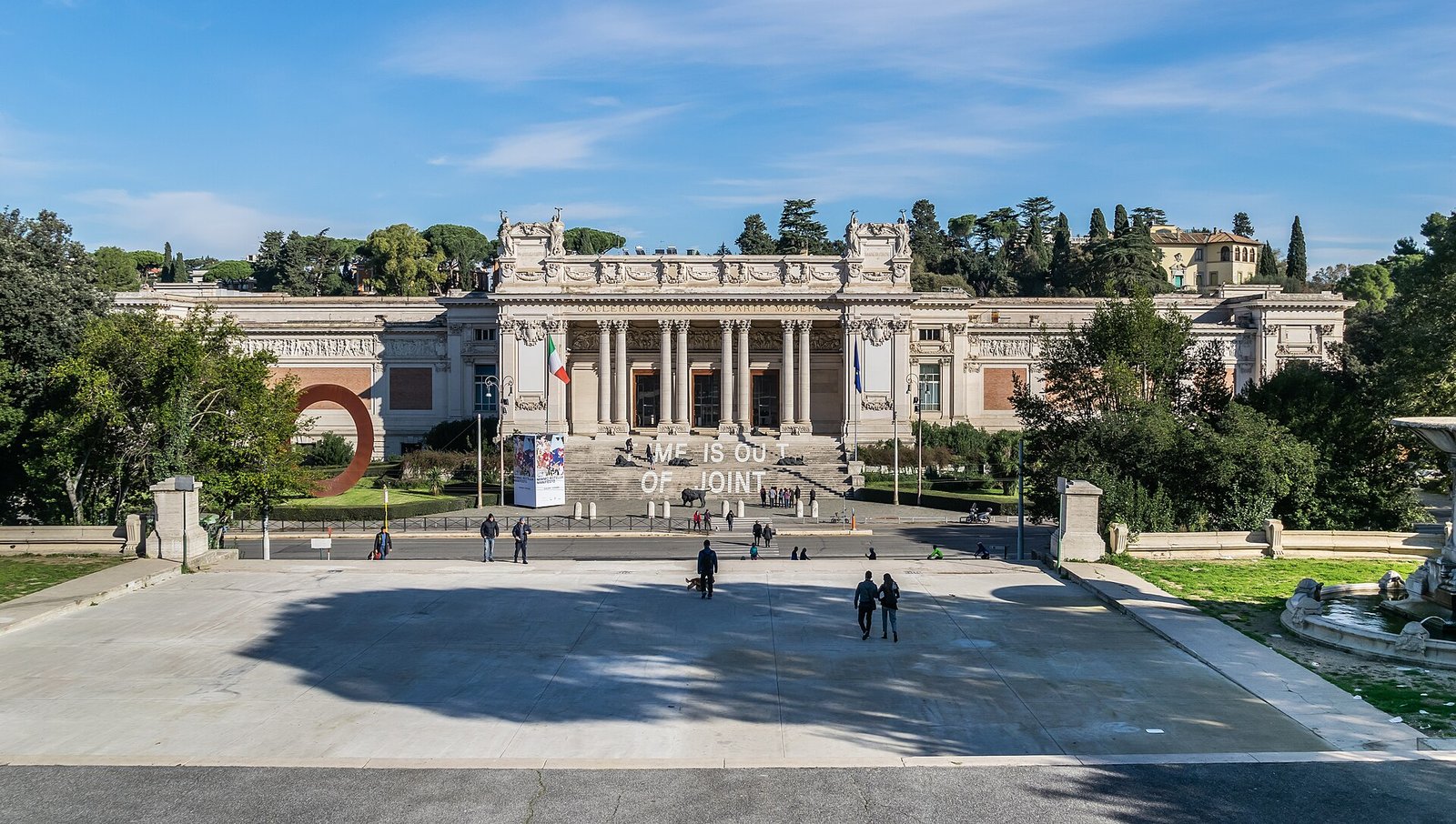
The National Gallery of Modern and Contemporary Art occupies the Palazzo delle Belle Arti at Viale delle Belle Arti 131, in Valle Giulia, on the northern edge of Villa Borghese and a few steps from the National Etruscan Museum of Villa Giulia. It's the largest Italian museum devoted entirely to 19th- and 20th-century art: about 20,000 works among paintings, sculptures, drawings, photographs, installations and videos, covering two centuries of Italian and European art history, from the neoclassicism of Antonio Canova to the most recent research. The building that houses them is not a historic palace adapted for the purpose, but a container built for it: Cesare Bazzani designed it for the 1911 International Exposition, the one organized for the 50th anniversary of Italian Unification, and its white mass with the monumental portico and the staircase remains one of the most recognizable examples of celebratory architecture of early 20th-century Rome. Whoever arrives here after visiting the Galleria Borghese or the city's archaeological museums finds something completely different: very tall, bright rooms, a display that in the last decade has been questioned several times, a garden with outdoor sculptures and a café overlooking the greenery. The lines that follow tell what's inside, how it got there, what to look for room by room and how to organize the visit without wasting time.
Where the National Gallery is and how to get there
The National Gallery of Modern and Contemporary Art is at Viale delle Belle Arti 131, in the Pinciano district, in that green hollow north of Villa Borghese that Romans call Valle Giulia. It's a location that explains a lot about the museum: Valle Giulia isn't an area of the historic center, it's a piece of city built between the 19th and 20th centuries as a district of culture and international representation, with the foreign academies, the Faculty of Architecture, the surviving pavilions of the 1911 Exposition and two large national museums facing the same street. The main entrance opens onto the monumental staircase that faces the avenue. The barrier-free access is instead on the opposite side of the building, at Via Antonio Gramsci 71, where the change in ground level allows you to enter at the level of the rooms.
On foot from Villa Borghese and the center
If you're already inside Villa Borghese you can reach the museum on foot in a pleasant, mostly tree-lined walk. From the Pincio and the terrace overlooking Piazza del Popolo, you cross the park heading northeast, skirt the little lake with the Temple of Aesculapius and exit on Viale delle Belle Arti side: it's just under 20 minutes of walking, with no demanding climbs. From the Galleria Borghese the route is similar in duration but crosses the eastern part of the park, passing near the Bioparco. If you start from Piazza di Spagna or Via Veneto, count on a good half hour, because the real distance is greater than the map suggests: Villa Borghese is vast and the paths never cut in a straight line.
By tram, bus and metro
The most convenient way to reach the National Gallery is the tram. The tram lines that run along Viale delle Belle Arti have a stop right in front of the museum, a few meters from the staircase, and connect the area with the Flaminio district on one side and with the center on the other. If you arrive by metro, you can get off at Flaminio station on line A, exit onto Piazzale Flaminio and continue with the tram that goes up Via Flaminia to the Belle Arti stop, from which the museum is a few minutes' walk on a gentle uphill. Alternatively there are bus lines that serve the Pinciano district and Viale Bruno Buozzi, with stops within walking distance. Since the routes and terminals of surface lines in Rome change with some frequency, particularly when work is under way on the tracks, it's best to check the updated route on the transport company's app or website on the day of the visit, instead of relying on directions read months earlier.
Cesare Bazzani's Palazzo delle Belle Arti
The building that houses the National Gallery is the Palazzo delle Belle Arti, designed by Cesare Bazzani and built for the 1911 International Art Exposition, the event with which Rome celebrated the 50th anniversary of Italian Unification. It's a fact worth keeping in mind to understand the architecture: the palace wasn't born as a museum in the strict sense, but as an exhibition pavilion representing the nation, and from this origin comes everything that surprises visitors today, from the exceptional height of the rooms to the width of the circulation axes, to the amount of zenithal light that pours down from the skylights.
The 1911 Exposition and the birth of Valle Giulia
The 1911 International Exposition was an event spread across several city venues, with an archaeological and ethnographic hub at the Baths of Diocletian and Castel Sant'Angelo, an industrial and agricultural hub in other parts of the city and, for the fine arts section, an entire district built from scratch in the valley between the Parioli and Villa Borghese. Many foreign nations built their own pavilions for the occasion along what would become Viale delle Belle Arti: some were dismantled at the close of the show, others stayed and became the permanent seats of the academies and cultural institutes that still characterize the area today. Valle Giulia, before 1911 a peripheral area of vegetable gardens and vineyards just outside the walls, was transformed within a few years into one of the densest cultural districts of the capital, and the Palazzo delle Belle Arti became its architectural fulcrum.
The 1933 expansion
In 1933 Cesare Bazzani himself signed an expansion that doubled the palace's exhibition area, adding new building wings and new rooms. There is, however, a detail that is rarely told to visitors: those new rooms, just finished, were not immediately assigned to the Gallery's collections, because they were occupied by the Exhibition of the Fascist Revolution, the regime's great propaganda show that in those years toured the country's most prestigious exhibition venues. It's one of those cases where the history of the building and Italian political history intertwine directly, and knowing the episode helps you read the museum for what it truly is: not a neutral container, but a State building that went through all the regimes and all the cultural seasons of 20th-century Italy.
The works of the second half of the 20th century
A third phase of works began in the early 1970s, when funding was allocated for a further intervention designed by the architect Luigi Cosenza, one of the leading figures of modern Neapolitan architecture. The construction site dragged on and completion came only toward the end of the 1980s, with the aim of equipping the museum with technical spaces, storage and routes suited to the museographic standards of the second half of the 20th century. The overall result, today, is a building layered in at least three distinct moments, recognizable to anyone who observes the construction details and the junctions between the building wings with attention: the 1911 exhibition pavilion, the monumental expansion of the 1930s and the functional interventions of the postwar period.
The history of the institution, from 1883 to today
The National Gallery of Modern and Contemporary Art was established in 1883, a little more than 20 years after the proclamation of the Kingdom of Italy and only 13 years after the annexation of Rome. It was born with a precise mission, and one that was far from obvious at the time: to collect and preserve the art of the living, that is, the contemporary artistic production of the newly unified State, in a country that was extremely rich in museums of antiquities and had practically none of contemporary art.
The first seat at the Palazzo delle Esposizioni
The original seat was not Valle Giulia but the Palazzo delle Esposizioni on Via Nazionale, the building inaugurated a few years earlier in the center of the Umbertine Rome under construction. It was a logical location, because the palace on Via Nazionale was the place where the great national art shows were held and where, therefore, the works destined to form the core of the state collection arrived, by public purchase or by donation. The problem was that this seat quickly became insufficient: the collection grew with every exhibition, the space did not, and already at the start of the 20th century it was clear that a dedicated building was needed.
Palma Bucarelli and the longest directorship
In the museum's history there's one figure who dominates all the others: Palma Bucarelli, who directed the National Gallery from 1941 to 1975, one of the longest and most influential directorships in Italian museum history. Bucarelli came to the directorship at a dramatic moment, when the war required the works to be put to safety: during the conflict she had a substantial part of the collection secretly moved to places considered safer, including Palazzo Farnese and Castel Sant'Angelo, thus saving a heritage that would have been exposed to bombing and requisitions.
After the war, Bucarelli transformed the museum from a repository of works into an active cultural institution: she introduced educational services, strengthened the specialized library, wanted a café inside the museum when in Italy the idea was still considered eccentric, and above all opened the Gallery to international contemporary art with a decision that cost her fierce controversy. The exhibitions and acquisitions she promoted, particularly those tied to Informal art and the postwar avant-gardes, were attacked in the press and even in Parliament, in an Italy where abstract painting was still considered by a large part of public opinion an incomprehensible provocation. The fact that today the National Gallery's collection contains fundamental works of Italian and European 20th-century art is due in a decisive measure to those choices against the grain.
From the postwar period to special autonomy
During the second half of the 20th century the museum changed its administrative setup several times. In 1975, with the birth of the Ministry for Cultural Heritage, the Gallery obtained the rank of special superintendency, a recognition that sanctioned its scientific autonomy with respect to the territorial superintendencies. Among the postwar directors, Giorgio de Marchis is remembered, at the helm of the museum between the late 1970s and the early 1980s, who took up and developed the experimental orientation of the previous period. From 2004 the directorship passed to Maria Vittoria Marini Clarelli, who led the institution for over a decade. In 2014, with the reform that granted managerial autonomy to Italy's main state museums, the National Gallery entered the group of museums with special autonomy, with its own budget and its own director selected through an international competition.
The most recent directorships
From 2015 the directorship was entrusted to Cristiana Collu, who launched the most radical transformation in the museum's recent history, culminating in the 2016 rehang discussed further on. In recent years the leadership of the institution has passed to Renata Cristina Mazzantini, an architect with long experience in designing museum displays and exhibitions. Every directorship, in a modern and contemporary art museum, leaves a far more visible mark than in an archaeological museum or an old-master picture gallery, because here the way of ordering the works is not dictated by an indisputable chronology but by an interpretive choice: changing director almost always means, sooner or later, changing the story that the rooms offer the visitor.
What you see: the cores of the collection
The National Gallery's collection numbers about 20,000 works among paintings, sculptures, drawings, engravings, photographs, videos and installations, and covers continuously the arc from the early 19th century to the present day. It's a figure that needs to be read correctly: only a small fraction is on view at any time, because no museum displays its entire holdings and because works on paper and photographs, for conservation reasons, can be exhibited only for limited periods. What stays constant is the structure of the collection, organized around a few large cores that are worth knowing before you go in.
Canova and the neoclassical 19th century
The piece that ideally opens the route is Antonio Canova's sculptural group dedicated to Hercules and Lichas, made in 1815. It's an enormous work, dramatic and not at all reassuring: it depicts the instant in which the hero, driven mad by the pain of the poisoned tunic, hurls far away the young messenger who brought it to him. Those who know Canova only through the Graces or Paolina Borghese are often surprised by the violence of the composition, which belongs to a register of neoclassicism much less tamed than the one that circulates in the common imagination. The size of the group and its placement in a tall room add to the effect: it's one of the few works in the museum that bear the monumental scale of Bazzani's architecture without difficulty.
Around Canova the 19th-century collection documents the major strands of Italian painting before and after unification, from historical romanticism to landscape painting, from official portraits to the large canvases on civic and patriotic subjects that accompanied the construction of the national identity. It's a section that foreign visitors tend to cross quickly and that nevertheless tells, better than many books, how newly united Italy imagined itself.
The Macchiaioli
One of the largest groups concerns the Macchiaioli, the group of Tuscan painters who, starting from the mid-nineteenth century, built a painting based on the macchia of color, that is, on the direct juxtaposition of contrasting masses of color in place of academic drawing and studio shading. The collection represents the main names of the movement, among them Giovanni Fattori, Telemaco Signorini and Silvestro Lega. They are often small-format paintings, sometimes painted on panels, and they ask the visitor to step closer: seen from afar, many of these works look like simple country or barracks scenes, while up close they reveal a construction by blocks of light that anticipates pictorial questions tackled elsewhere in Europe almost in the same years.
Divisionism
The next step, chronologically and conceptually, is Divisionism, the current that at the end of the nineteenth century brought to Italy the breaking down of color into touches and filaments set side by side, with results that were both scientific and Symbolist. The Galleria Nazionale holds some of the best-known works of the current, among them a painting by Giovanni Segantini dated 1886 and dedicated to the theme of cattle at the tethering pole, Gaetano Previati's large composition on the fall of the angels from 1913, and a work by Giuseppe Pellizza da Volpedo from 1904 dedicated to the sun. Seeing these three paintings in the same visit lets you grasp how Italian Divisionism was a single thing only in appearance: Segantini uses it for Alpine light, Previati for a mystical and theatrical vision, Pellizza for a search for luminous intensity that borders on abstraction.
Klimt, Van Gogh, Cézanne, Monet: The International Core
The Galleria Nazionale is the only Italian museum where you can see, in the same route, works by Gustav Klimt, Vincent van Gogh, Paul Cézanne and Claude Monet acquired directly by the Italian State between the end of the nineteenth century and the first decades of the twentieth, largely through the Venice Biennales. By Klimt the museum holds the three ages of woman, a painting from 1905 that is probably the most photographed work of the entire collection: a composition in which luminous motherhood and stripped-down old age coexist in the same field decorated with gold and pattern, with a rawness that contrasts with the widespread idea of a purely ornamental Klimt.
By Vincent van Gogh the museum owns the gardener, from 1889, and an Arlésienne from 1890, two portraits from the artist's final period. By Paul Cézanne it holds a view of the farmhouses of Jourdan from 1906, a work from the painter's last year of life, and by Claude Monet a painting of water lilies from 1898. It is a small group, not an Impressionist collection comparable to those of the great French or American museums, but it has a particular historical value: it documents the moment when official Italy, through public purchases at international exhibitions, decided to recognize avant-garde European painting instead of limiting itself to the national kind.
Modigliani and the School of Paris
Among the works most sought by visitors is the reclining nude by Amedeo Modigliani, painted between 1918 and 1919, in the last years of the short life of the artist from Livorno who had moved to Paris. Modigliani's nudes are among the most immediately recognizable paintings of the twentieth century, and knowing the context helps you look at them better: they belong to a series that caused a public scandal at its first Paris exhibition, and that is read today as one of the moments in which the tradition of the classical Italian nude meets the lesson of African sculpture and the Paris avant-gardes.
The Futurists
Futurism is one of the chapters in which the Galleria Nazionale is strongest, as is natural for the Italian national museum of modern art. The collection includes key works by Umberto Boccioni, among them a composition from 1913 and 1914 that breaks down horse, rider and buildings into a single dynamic field, and by Giacomo Balla, with a painting from 1913 dedicated to the theme of dynamic expansion and speed. These are works to be looked at remembering what it meant, in the decade before the Great War, to try to paint not a still object but movement itself, the simultaneity of perceptions, the noise and energy of the industrial city. Futurism was born in Milan but found in Rome, with Balla, one of its most refined versions, and seeing a Boccioni and a Balla together in this museum means seeing the two souls of the movement side by side.
De Chirico and Metaphysical Art
Giorgio de Chirico is present in the collection with several works, which document different seasons of a long and deliberately contradictory career. Metaphysical painting, with its deserted piazzas, long shadows, mannequins and objects suspended in a motionless light, is the phase that influenced twentieth-century European art most deeply, from French Surrealism onward. It is worth observing that de Chirico, after inventing that language, abandoned it to return to a declaredly anti-modern painting inspired by the old masters, a choice that cost him decades of critical hostility and that is now reread as one of the most interesting episodes of Italian modernity.
Roman School, Neorealism and the Postwar Period
The museum holds an important core of Roman painting of the 1920s and 1930s and of postwar Italian art, with works tied to the debate between realism and abstraction that ran through the country in the years of reconstruction. Among the best-known paintings of the section is a large canvas by Renato Guttuso from 1952 dedicated to the Garibaldian battle of Ponte dell'Ammiraglio, an example of militant history painting that fully belongs to the cultural climate of the Italy of the early 1950s under the Republic. It's a section that reads well in parallel with that of the Galleria d'Arte Moderna di Roma, the civic museum on Via Francesco Crispi, which for the same period holds a complementary heritage of municipal origin.
Burri, Fontana and Informal art
The leap toward the contemporary passes through two names that have a particular weight in the National Gallery's history: Alberto Burri and Lucio Fontana. Burri, an Umbrian doctor who became an artist during imprisonment in an American camp, brought into painting materials foreign to the tradition, sewn jute sacks, burned plastics, welded iron, charred wood, forcing the picture to become a wounded surface instead of a window onto an image. Fontana, with the cuts and holes in the monochrome canvas, performed a parallel and equally radical gesture, physically breaking the plane of the painting to declare that the space of the work doesn't end at the surface. It was precisely works of this kind, acquired during Palma Bucarelli's directorship, that set off the most violent public controversies in the museum's history.
Arte Povera and contemporary research
The chapter of Arte Povera, the Italian movement that from the late 1960s replaced easel painting with elementary materials and natural processes, is represented in the collection and is one of the obligatory stops for understanding why Italian art of the second half of the 20th century was influential internationally. Alongside Arte Povera the museum documents later research, from conceptual practices to environmental installation, from artists' photography to video, with an acquisitions program that keeps being updated. Those who are specifically interested in the art of recent decades will find a complementary route at MAXXI, the national museum of 21st-century arts, and at MACRO, the contemporary art museum of the City of Rome.
The “Time is Out of Joint” rehang and what became of it
In October 2016 the National Gallery inaugurated the most debated rehang of its recent history, titled with a line from Shakespeare's Hamlet, “Time is Out of Joint,” time is off its hinges. The project, driven by Cristiana Collu's directorship, overturned the principle on which almost every modern art museum stands: in place of the chronological sequence by movements and decades, the rooms offered thematic and associative pairings, with works from very distant eras set one next to the other because they were linked by a theme, a form, a visual suggestion.
What changed in 2016
The rehang involved three precise choices. The first was the reduction in the number of works on display, with a drastic lightening of the walls compared with the density of paintings in the previous display. The second was the abandonment of chronology as the ordering criterion, replaced by a reading by thematic cores. The third, more symbolic but no less significant, was the abandonment of the acronym GNAM, by which the museum had been known for decades, in favor of the simplified name La Galleria Nazionale. At the same time the reception areas, the bookstore and the Sala delle Colonne were redesigned, with the idea of making the building more permeable and less intimidating.
Why it caused debate
The debate that followed was lively and crossed both specialist criticism and the general public. Those who appreciated the project argued that freeing the walls and breaking the chronology gave the works room to breathe and forced the visitor to look instead of reading the labels in sequence. Those who criticized it objected that a national museum also has a didactic and documentary function, that a non-specialist visitor needs a timeline to get oriented, and that reducing the number of works on display in a museum that owns 20,000 of them means withholding from the public a part of public heritage. Both positions are defensible, and the discussion that pitted them against each other remains one of the most cited cases of Italian museology of recent years.
What you find in the rooms today
With the change of director, the Galleria Nazionale has started a revision of its permanent display, and the story told by the rooms no longer necessarily matches the one launched in 2016. A clarification is needed here, though, because it concerns the very information that matters most to anyone planning a visit: the exact state of the current display, with the title now in use and the layout of the rooms, is not confirmed by an up-to-date official source. The most sensible thing, before you go, is to check the collection section of the museum's official website, where the current display is described and updated, and to keep in mind that in a contemporary art museum the rooms can change even during the year to make space for temporary exhibitions.
A Curiosity About the Galleria Nazionale d'Arte Moderna e Contemporanea
The tastiest curiosity is about the name, or rather its disappearance. For almost the whole twentieth century the museum was known in Italy by the acronym GNAM, which simply stands for Galleria Nazionale d'Arte Moderna: an abbreviation that generations of students, guides and Romans have used without thinking, and that has the flaw and the merit of sounding like a comic-strip sound effect. In 2016, with the new display, the management decided to drop that acronym and present the institution simply as La Galleria Nazionale, with the article in front.
The choice was not a graphic whim. Behind it was the idea that a bureaucratic acronym created a distance between the museum and its public, and that calling itself by its full name, with the definite article, gave the institution back a spoken identity instead of an administrative one. The operation was only partly successful: in official communication and in the museum's materials the new name has taken hold, while in the everyday speech of Romans the old acronym never really died, and even today you regularly hear the building in Valle Giulia referred to by those four letters. It's a small case study in how hard it is to change the name of a public place when that name has entered a city's spoken language.
There's also a lesser-known detail about the full official name: the museum is not called only of modern art, but of modern and contemporary art, and the addition is not decorative. It signals a precise choice, namely that the institution, founded in 1883 to collect the art of living artists, still considers itself responsible for the art of today too, and not only the custodian of a century that is now over. That's the reason the museum keeps acquiring works by artists who are still active, instead of limiting itself to preserving what it has.
Something Nobody Tells You About the Galleria Nazionale d'Arte Moderna e Contemporanea
What almost no guide says is that the Galleria Nazionale is, in all likelihood, the least crowded major museum in Rome in relation to the quality of what it holds. In a city where getting into the Galleria Borghese means booking weeks ahead and where lines at the Vatican Museums wrap around the block, here you regularly walk through huge rooms with a handful of other people, even in high season, even on weekends.
Why It Stays Out of the Mass Circuits
The reasons are mostly geographic and a matter of perception. Valle Giulia is outside the area that most passing visitors consider the center of Rome: you don't walk past the Galleria Nazionale by chance on the way from Piazza Navona to the Trevi Fountain, you have to decide to go. On top of that, modern and contemporary art is almost never the reason someone comes to Rome the first time: if you have three days, you give them to antiquity and the Baroque, and the twentieth century remains a chapter for those who come back. The result is that one of the most important museums in Italy remains largely a matter for Romans, students, enthusiasts and repeat visitors.
What This Means in Practice for Visitors
The practical consequence is remarkable and you should take advantage of it. In the rooms of the Galleria Nazionale you can do what has become impossible in other Roman museums: stand in front of a painting for 10 minutes without being pushed, sit down, go back to see a room again, look at a work from far away and then up close, changing your distance three or four times. For anyone with a real interest in painting, this way of visiting is worth the trip to Valle Giulia on its own, and it changes the quality of the experience radically compared with a visit squeezed into a crowd.
My Advice for Visiting the Galleria Nazionale d'Arte Moderna e Contemporanea
The most useful advice is to combine the Galleria Nazionale with the Museo Nazionale Etrusco di Villa Giulia in the same morning or the same afternoon: the two museums are a few dozen meters apart, both are state museums, and put one after the other they create a contrast that no guide can put into words. On one side, Etruscan civilization of the seventh and sixth centuries BC, with the Sarcophagus of the Spouses and the terracottas of Veii. On the other, Klimt, Van Gogh, Burri and Fontana. 2,500 years apart and a five-minute walk.
How Much Time You Really Need
For an honest visit to the Galleria Nazionale alone, plan for at least two hours, which become three if you stop to read the wall texts and also see the temporary exhibition currently on. Keep in mind a practical limit stated by the museum itself: the entry ticket is valid for three hours, a limit introduced to control access and crowding. If you only have an hour, you're better off choosing two or three sections in advance to see calmly, for example Canova, the Divisionists and the international twentieth century, instead of rushing through everything.
The Best Time of Day and of the Week
The first hours of the morning, right after opening, are when the big rooms get the best light from the skylights and when the museum is quietest. Monday is a closing day, so rule it out when planning. The first Sundays of the month, when entry to state museums is free, bring far more people here than usual and require a reservation: it's a great opportunity if you want to save money, but it's exactly the wrong day if you're looking for this museum's main advantage, which is calm.
Another Well-Known Fact, Yet Rarely Mentioned
In May 1998 the Galleria Nazionale was at the center of one of the most sensational art thefts in recent Italian history: three paintings disappeared from the museum's rooms, two by Vincent van Gogh, The Gardener and The Woman of Arles, and one by Paul Cézanne, the view of the farmhouses at Jourdan. The theft took place in the evening and caused a scandal not only because of the value of the paintings, but because it put the entire security system of Italian state museums under accusation at a time when the subject was still largely underestimated.
The Recovery and the Return to the Gallery
The story had a fortunate outcome: the works were recovered and returned to the museum, and today they are once again part of the Galleria Nazionale's holdings. On the details of the operation that led to the recovery, press reconstructions are in circulation that don't entirely agree, and for this reason here we limit ourselves to the certain fact, namely that the three paintings were found and given back to the institution they had been taken from. Anyone who stands in front of Van Gogh's gardener today is looking at a painting that for a certain period was considered lost.
The Right Photo to Take at the Galleria Nazionale d'Arte Moderna e Contemporanea
The photo that best tells the story of this museum is not the close-up of a masterpiece, but the shot that puts together the scale of the architecture and the smallness of the people: a room several meters high, the light coming down from the skylight, a figure standing in front of a work. It's the image that captures the real feeling of the visit, that of moving inside a building designed to impress and filled with works that instead ask for close attention.
The Facade From Outside
On the exterior, the best shot is from the opposite sidewalk of the avenue, where you can include the full width of the portico with the staircase in the foreground. The morning light hits the facade from the side and brings out the reliefs, while in the middle of the day the white tends to burn out. A second interesting viewpoint is found by moving back along the sidewalk toward Villa Giulia, from where you can frame the building diagonally with the trees of Villa Borghese framing the scene.
The Outdoor Sculptures and the Greenery
The outdoor spaces and the garden offer the most unusual shots, because they let you put in the same frame a contemporary sculpture, the monumental architecture of 1911 and the vegetation of the park. It's the kind of image that conveys well the anomaly of this museum, a container nineteenth-century in spirit that has housed for a century the art that this spirit put into crisis.
Some Important Events That Happened Here in History
The first great event this building hosted is the one it was built for: the International Exposition of 1911, the showcase with which the Kingdom of Italy celebrated 50 years of Unification and with which Rome presented itself to the world as a modern capital. The Palazzo delle Belle Arti was the main pavilion of the art section, and from that event the whole Valle Giulia district was born as we know it today, with the foreign academies built along the same avenue.
The Exhibitions That Caused a Scandal After the War
In the 1950s and 1960s the Galleria Nazionale was the ground on which one of the bitterest cultural battles of republican Italy was fought, the one over abstract and informal art. The exhibitions and purchases promoted by Bucarelli's directorship were attacked by the press, publicly contested and even debated in political venues, in tones that seem incredible today but that tell of a country in which the value of contemporary art was still entirely up for negotiation. It's a story worth keeping in mind as you walk through the rooms dedicated to Burri and Fontana: those works are there because someone bought them at a high political cost.
The 2016 Rehang and the Museological Debate
Closer to our time, the opening of "Time is Out of Joint" in October 2016 made the Galleria Nazionale the center of a national debate on how to display modern art museums, on the role of chronology and on the relationship between spectacle and education. Few other Italian museum events of recent decades have generated as many public stances, and the fact that the debate continued in the following years shows that the issue raised then was not a matter of taste but a real problem of how art is told to a non-specialist public.
Who Has Passed Through the Galleria Nazionale d'Arte Moderna e Contemporanea
The figure who spent the longest time at this museum is Palma Bucarelli, director from 1941 to 1975, a public personality as well as an art historian, able to move between the academic world, cultural politics and the Roman intellectual jet set of the postwar period. Her presence is so tied to the identity of the Galleria Nazionale that even today, decades later, the museum's history is implicitly divided into a before and an after her.
The Artists
Through the rooms of Valle Giulia have passed, alive and as protagonists, practically all the great names of twentieth-century Italian art: Giacomo Balla, who had a studio in Rome and was the master of Roman Futurism, Giorgio de Chirico, a constant and controversial presence in the capital's artistic life, Alberto Burri and Lucio Fontana, whose works were acquired when they were still divisive artists and not recognized classics, Renato Guttuso, a central figure of Italian realism and of Roman cultural life. In recent decades they have been joined by contemporary artists invited to create specific projects for the museum's spaces, a practice that continues to bring active Italian and international artists here.
The Cafe, the Garden and the Museum's Services
The Galleria Nazionale is one of the few Roman museums where a stop at the cafe is part of the experience and not a fallback. The venue facing Via Gramsci side, historically known as Caffè delle Arti, occupies an elegant space with outdoor seating among the greenery and is also frequented by people who don't enter the museum. Since the management of food services in state museums is assigned through contracts that change over time, the venue's hours and format should be checked on the spot and can't be taken for granted.
The Garden and the Outdoor Spaces
Around the building there are flower beds, terraces and green spaces that form a natural link with Villa Borghese and that over time host large-format sculptures and installations. It's one of the reasons it's worth arriving a few minutes before your scheduled entry time: the walk around the outside of the building, with the view of the park's greenery and of the facades of the nearby academies, is a part of the visit that costs nothing and that a great many visitors skip.
Accessibility
The accessible entrance of the Galleria Nazionale is at Via Antonio Gramsci 71, on the opposite side from the monumental staircase on Viale delle Belle Arti, and lets you enter avoiding the steps. Entry is free for people with disabilities and for their companion. The interior rooms, being large and mostly on the same level, are well suited to a visit in a wheelchair, but for details on vertical connections and dedicated services it's best to contact the museum before your visit.
Hours, Tickets and Practical Information
The Galleria Nazionale d'Arte Moderna e Contemporanea is open Tuesday through Sunday from 9:00 to 19:00, with last entry 45 minutes before closing, and is closed on Monday. The full ticket costs €15, the reduced ticket for European Union citizens aged 18 to 25 costs €2, and entry is free for those under 18. The entry ticket is valid for three hours. This information is taken from what the museum publishes on its official website and may change: since it's a state museum with a program of temporary exhibitions, it's always worth rechecking before you go.
Discounts and Free Entry
Besides the reduced ticket for the 18 to 25 age group, the museum offers discounted rates tied to certain agreements, including a reduced ticket for holders of an entry ticket to the Galleria Borghese and a discount tied to the card of the Accademia Nazionale di Santa Cecilia, which is based at the Auditorium Parco della Musica not far away. Entry is free, among others, for people with disabilities and their companion, for ICOM members, for licensed tour guides and for employees of the Ministry of Culture. Free entry also applies on the first Sundays of the month, for which a reservation is required, and on some commemorative days of the year.
Frequently Asked Questions About the Galleria Nazionale d'Arte Moderna e Contemporanea
How much does a ticket to the Galleria Nazionale d'Arte Moderna e Contemporanea cost?
The full ticket to the Galleria Nazionale d'Arte Moderna e Contemporanea in Rome costs €15, according to the information the museum publishes on its official website. There is a reduced ticket of €2 for European Union citizens aged 18 to 25, and free entry for those under 18, for people with disabilities with a companion, and on the first Sundays of the month, for which you need to reserve. Rates may vary during temporary exhibitions.
What are the hours of the Galleria Nazionale d'Arte Moderna e Contemporanea?
The Galleria Nazionale d'Arte Moderna e Contemporanea is open Tuesday through Sunday from 9:00 to 19:00, with last entry 45 minutes before closing. The weekly closing day is Monday. Since the hours of state museums can change for holidays, exhibitions or service needs, it's best to recheck the museum's official website the day before your visit.
How do you get to the Galleria Nazionale d'Arte Moderna e Contemporanea by public transportation?
The Galleria Nazionale d'Arte Moderna e Contemporanea is at Viale delle Belle Arti 131, served by the tram that stops right in front of the museum. From the Flaminio station on Metro Line A you can continue by the tram that goes up Via Flaminia to the Belle Arti stop, a few minutes' walk away. If you're already inside Villa Borghese, you can reach the museum on foot in about 20 minutes by crossing the park.
How much time do you need to visit the Galleria Nazionale d'Arte Moderna e Contemporanea?
To visit the Galleria Nazionale d'Arte Moderna e Contemporanea you need at least two hours, which become three if you include the temporary exhibition currently on and a stop at the cafe. The museum states that the entry ticket is valid for three hours. If you have less time, it's best to choose two or three sections of the collection in advance, for example Canova, the Divisionists and the international twentieth century.
What famous works are at the Galleria Nazionale d'Arte Moderna e Contemporanea?
At the Galleria Nazionale d'Arte Moderna e Contemporanea you'll find Antonio Canova's sculptural group of Hercules and Lichas from 1815, Gustav Klimt's The Three Ages of Woman from 1905, two portraits by Vincent van Gogh, a late landscape by Paul Cézanne, a water lilies painting by Claude Monet, a nude by Amedeo Modigliani, and works by Boccioni, Balla, de Chirico, Burri and Fontana. Rotations and loans can mean a single work is temporarily not on display.
Is the Galleria Nazionale d'Arte Moderna e Contemporanea suitable for children?
The Galleria Nazionale d'Arte Moderna e Contemporanea works well with children because the rooms are spacious, the works often large and immediately surprising, and entry is free for those under 18. The museum is also on the edge of Villa Borghese, where after the visit you can reach the Bioparco, the Casina di Raffaello and large green spaces in a few minutes.
Can you take photographs inside the Galleria Nazionale d'Arte Moderna e Contemporanea?
At the Galleria Nazionale d'Arte Moderna e Contemporanea, photographs for personal use are generally allowed in the collection rooms, without flash and without a tripod. There may, however, be limitations for temporary exhibitions and for works on loan, whose rights belong to others: the rule that applies is always the one shown on the signs at the entrance of each room and given by the security staff.
Is the Galleria Nazionale d'Arte Moderna e Contemporanea accessible to people with disabilities?
The Galleria Nazionale d'Arte Moderna e Contemporanea has an accessible entrance at Via Antonio Gramsci 71, which avoids the monumental staircase at the main front, and offers free entry for people with disabilities and their companion. The rooms are spacious and mostly on the same level: for specific information on routes and dedicated services, it's best to contact the museum before your visit.
What is there to see near the Galleria Nazionale d'Arte Moderna e Contemporanea?
Near the Galleria Nazionale d'Arte Moderna e Contemporanea are the National Etruscan Museum of Villa Giulia, a few dozen meters away on the same avenue, Villa Medici and the foreign academies of Valle Giulia, the Museo Carlo Bilotti and the Museo Pietro Canonica inside Villa Borghese, and the Hendrik Christian Andersen Museum a little farther on, toward the Tiber.
One Last Piece of Advice for Planning Your Itinerary
The Galleria Nazionale works better as the destination of a half day devoted to Valle Giulia than as a stop squeezed between two monuments in the center. If you've already seen ancient and Baroque Rome and are coming back to the city for the second or third time, here, together with the Etruscan Museum and the academies along the avenue, you'll find one of the most interesting and least trodden districts of the capital, with the not negligible advantage of being able to end the day with a walk through Villa Borghese up to the terrace of the Pincio.
If you're building a broader itinerary in central Rome, combining this stop with the Villa Borghese museums and the Flaminio district, you can find useful planning tools on Tour Leader Pro, while for a wider picture of transportation and destinations in Lazio, Italy Planner is a helpful resource.