Temple of Aesculapius at Villa Borghese
In short. The Temple of Aesculapius at Villa Borghese is that little white temple with four columns that seems to float in the middle of the small lake of the Giardino del Lago, in the heart of Rome's best-loved park.
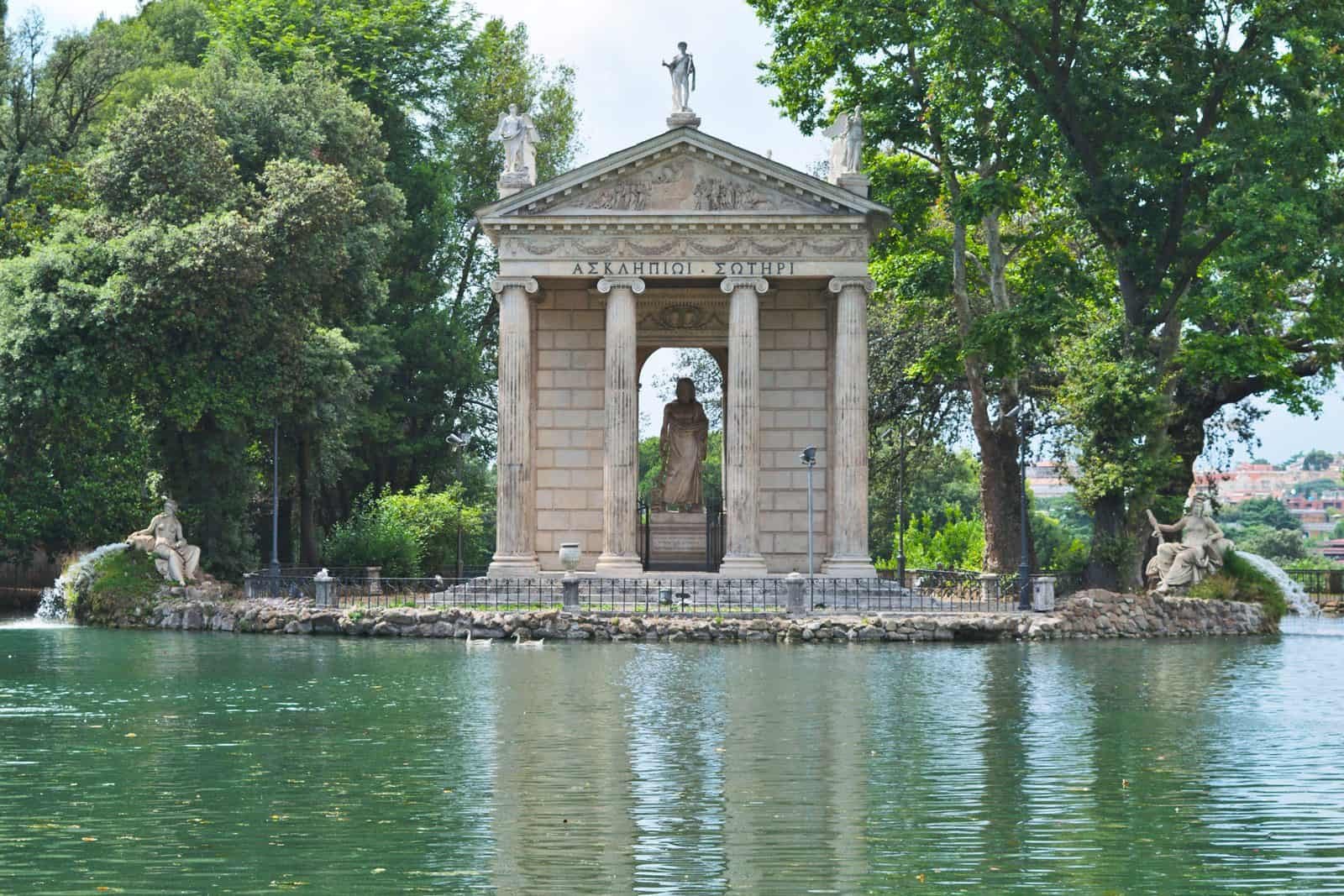
The Temple of Aesculapius at Villa Borghese is that little white temple with four columns that seems to float in the middle of the small lake of the Giardino del Lago, in the heart of Rome's best-loved park. It's not an ancient monument, and that's the first thing to make clear: it was built between 1785 and 1792 at the wish of Prince Marcantonio IV Borghese, to a design by Antonio Asprucci with his son Mario Asprucci and with the contribution of the painter Cristoforo Unterperger. It's a prostyle temple with four fluted columns and Ionic capitals, it stands on an artificial islet connected to the shore by a wooden pier, and it keeps in its aedicule a statue of Aesculapius of the Roman era, found according to tradition near the Mausoleum of Augustus. On the architrave runs in Greek letters the dedication ΑΣΚΛΗΠΙΩΙ ΣΩΤΗΡΙ, "to Asclepius the Savior", while the pediment holds a stucco bas-relief that tells of the god's arrival in Rome. The islet is closed by a gate and can't be visited: you look at it from the shore, or from the water, getting into one of the rowboats that can be rented at the small lake. Entry to the park is free and the Giardino del Lago can be reached on foot from Viale dell'Uccelliera, from Via Pietro Canonica, from the Arch of Septimius Severus on Viale Madama Letizia or going down from Largo Pablo Picasso. The most convenient metro stops are Flaminio and Spagna on line A.
This story needs to be taken slowly, because it's more tangled than it looks: there's a Roman prince who wanted to redo his garden in the European fashion, there's an architect who invented a piece of antiquity out of nothing, there's a real statue inside a fake building, and in the background there's an authentic cult, which arrived in Rome in 293 BC in the form of a snake, and which left the Tiber Island a hospital still in operation. The Temple of Aesculapius at Villa Borghese is one of the few Roman buildings that are better understood if you accept that they are lying. Or rather: that they are acting.
What the Temple of Aesculapius at Villa Borghese Really Is
Let's start with the most widespread misunderstanding, the one you hear repeated most often along the shore of the small lake. Almost everyone, the first time, takes for granted that the Temple of Aesculapius at Villa Borghese is an ancient building: the pale stone, the Ionic columns, the inscription in Greek, the togate statue inside the niche. Everything seems to say "2nd century AD". And instead we are looking at a work of full Roman Neoclassicism, designed and built in the last 15 years of the 1700s, at a moment when Rome looked at the ancient with a new archaeological passion and an impressive technical ability to imitate.
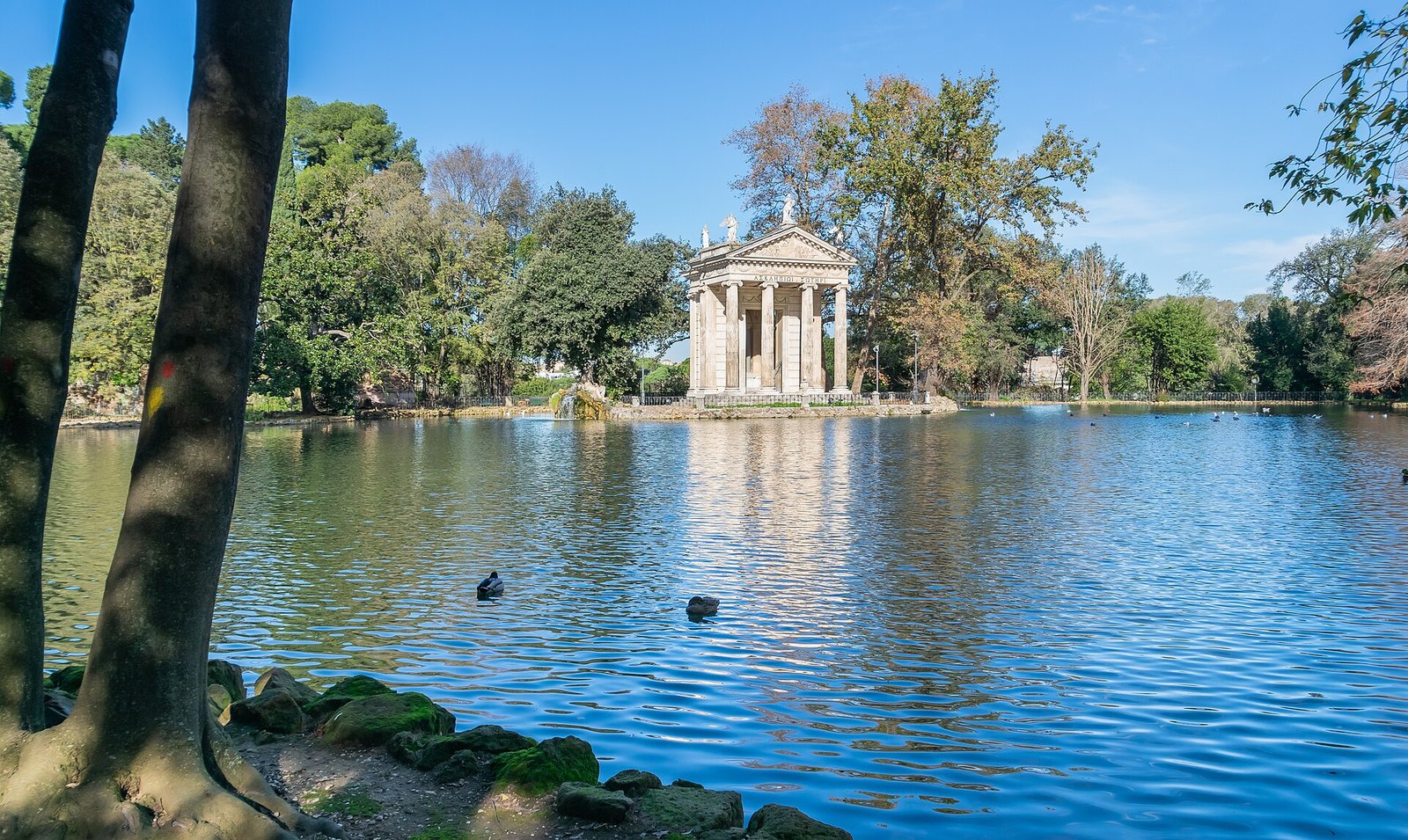
Don't call it a fake, though. The right term, the one they used back then, is another one: it is a fabbrica di ornamento, that is, a building designed to complete a landscape, to give the gaze a focal point, to supply the garden with a story. In the vocabulary of 18th-century European parks these constructions were called follies in England, fabriques in France. They were fake ruins, pagodas, hermitages, small temples, Gothic towers, artificial grottoes. The taste was everywhere, from Stowe to Ermenonville, from Parc Monceau to German Wörlitz. The difference, in Rome, is that a newly built Neoclassical small temple could contain an authentic ancient sculpture, because ancient sculptures in Rome could still be found by digging in the ground at home. The Temple of Aesculapius at Villa Borghese is exactly this short circuit: an invented container for a real content.
A Prostyle Temple, Not a Round Temple
In terms of type the building is a tetrastyle prostyle temple: this means the colonnade stands only on the front, before the cella, and that the columns are four. It's the most economical and most legible formula of the classical repertoire, the one that with the minimum of elements produces the maximum of recognizability. If you look at the small temple from the opposite shore, you understand right away: you see a facade, and behind the facade a closed, simple volume, almost a box. There is no peristasis, no colonnade running around, none of the complication of a peripteral temple. The effect is that of a frontispiece, a cover.
The columns are fluted, with Ionic capitals with volutes. The Ionic order is not chosen at random: it is the order that the treatises considered the most suitable for sacred contexts of a mild, delicate, feminine or medical character, as opposed to Doric severity and Corinthian exuberance. For a god of healing, in a garden of delights, Ionic was the right register. Above the entablature rises the triangular pediment, and higher still, on the ridge line and the corners, are placed statues of Hellenistic taste that work as acroteria, breaking the profile of the roof against the green of the trees.
Why "of Aesculapius" and Not Another God
The dedication is not a whim. The Temple of Aesculapius at Villa Borghese bears the name of the god of medicine because it is born, literally, around a statue of that god. The sources agree on one point: in the Borghese collection there was an ancient sculpture depicting Aesculapius, and the garden project was looking for a worthy placement for it. At first a more modest solution was considered, an architectural backdrop, a scenic facade to serve as a backdrop for the statue. Then, as happens when the patron has money and ambition, the idea grew until it became an autonomous temple, isolated in the middle of the water, visible from every point of the shore.
And here the finesse of the designers shows. A god of health, in a garden, on an island: the combination is not arbitrary. The real Roman sanctuary of Aesculapius, the one the people truly attended, stood on an island in the middle of the Tiber. Rebuilding an artificial island inside Villa Borghese and putting Aesculapius on it meant quoting the Tiber Island with elegance, without explaining it, counting on the fact that every cultured visitor of the time would catch the allusion. We'll come back to this, because it's the intellectual heart of the whole operation.
Where the Temple of Aesculapius at Villa Borghese Is and How to Get There
The Temple of Aesculapius at Villa Borghese is in the northern portion of the park, in the sector called the Giardino del Lago, in a natural hollow lower than the main avenues. This topographic detail matters more than it seems: the small lake lies in a depression, and whoever arrives from the high avenues discovers it suddenly, going down. It's an intended effect, one of the many coups de théâtre the 18th-century project scattered through the park.
The Entrances to the Giardino del Lago
The most natural access routes are four. The first is Viale dell'Uccelliera, which comes down from the area of the Casino Nobile and the secret gardens: it's the route I recommend to those arriving from the Galleria Borghese, because it keeps the historical thread of the visit. The second is Via Pietro Canonica, which passes beside the Fortezzuola and leads directly to the shore. The third is Viale Madama Letizia, where the Arch of Septimius Severus built by Luigi Canina around 1830 is located: going under that arch and finding the lake in front of you is perhaps the most beautiful entrance. The fourth is the small flight of steps that comes down from Largo Pablo Picasso, convenient for those arriving from the Pincio and from the terrace above Piazza del Popolo.
Metro, Tram and Bus
With the metro line A the two useful stops are Flaminio, from which you climb to the Pincio crossing Piazza del Popolo and the climb of Viale, and Spagna, which has an exit directly inside Villa Borghese in the area of Viale del Museo Borghese. From Flaminio the walk is longer but more scenic. From Spagna you are inside the park in a few minutes, and then you go down toward the lake. On the surface tram 19 serves the side of Viale delle Belle Arti and Viale Bruno Buozzi, convenient for those arriving from the Flaminio neighborhood or the area of Piazza Thorvaldsen. Several bus lines run along Via Pinciana and Viale del Muro Torto. It's always best to check the updated routes on the Rome public transport platforms before leaving, because in Rome detours are a national sport.
On Foot, Which Is the Right Way
The advice is to arrive at the Temple of Aesculapius at Villa Borghese on foot, and possibly from far away. From the Pincio you enter the park with your gaze already full of domes. From Piazzale Flaminio you climb gently. From Via Veneto and Porta Pinciana you enter the most monumental sector. In every case the small temple comes at the end of a path, and this is the way the 18th-century project wanted it to be met. Villa Borghese measures about 80 hectares: it's not a garden to cross in a hurry, and the small lake rewards those who arrive calmly.
The Giardino del Lago, the Setting of the Temple of Aesculapius at Villa Borghese
You can't understand the Temple of Aesculapius at Villa Borghese by isolating it from its context, because the small temple is the tip of a much bigger project: the 18th-century transformation of the so-called third enclosure of the villa into an English garden. Until then that sector had been a hunting and leisure park, with a regularly shaped lake, aviaries, rustic fountains and groves. At the end of the 1700s it becomes a "natural" landscape built with maximum artificiality: artificial hills, a lake with an irregular outline, a stream, clearings, winding paths, and monuments that pop up among the trees.
The chronologies you read in the different sources vary: some place the start of the works around the middle of the 1770s, others around 1786, still others extend the building site to the early 1790s. On this subject it's best to be cautious and say what is certain: the Giardino del Lago is born within the renewal desired by Marcantonio IV Borghese, takes shape in the last quarter of the 1700s and finds its visual completion precisely with the small temple, whose construction the sources place in agreement between 1785 and 1792.
A Lake That Isn't a Lake
The body of water of the Giardino del Lago is entirely artificial. It has an elongated, irregular shape, with inlets and promontories that serve a precise optical purpose: to prevent the gaze from taking in the whole perimeter at once. A round lake reads immediately and bores. A lake with a jagged outline always promises something behind the curve. It's the grammar of the landscape garden, imported from England, where the great parks of Capability Brown had codified the art of fabricating sheets of water that looked like the work of nature.
In the center, or rather in a deliberately off-center position, stands the islet with the temple. Here too the choice is a matter of design: if the island were exactly in the center, the temple would become a symmetrical, static, predictable object. By shifting it, the designers made sure that from every point of the shore the small temple presents itself in a different perspective, now three-quarter, now almost frontal, now foreshortened between the branches. It's a monument that changes depending on where you stand, and this is precisely what was asked of a garden fabbrica.
The Stream, the Little Hills, the Clearings
Around the basin the ground was modeled with artificial little hills that serve as backdrop and screen: they hide what lies beyond, create green wings, multiply the planes of depth. A stream feeds and connects the sheets of water. The paths don't cut in a straight line but turn, forcing the step to slow down. Whoever designed this piece of park worked like a landscape painter: he built views, not routes.
The tree species complete the design. Around the lake there are plane trees, holm oaks, cedars, magnolias, willows that mirror themselves in the water, and of course the stone pines that are the signature of every Roman landscape. The contrast between the dark crowns and the evergreens on one side and the white of the marble and stucco on the other is the visual mechanism on which the whole Giardino del Lago is built: without that green, the Temple of Aesculapius at Villa Borghese would lose half of its effect.
Marcantonio IV Borghese, the Prince Who Wanted the Temple of Aesculapius at Villa Borghese
Behind every great garden there is a patron with a fixed idea. In our case it is Marcantonio IV Borghese (1730-1800), Prince of Sulmona, heir of one of the most powerful families of Rome, descendant of the branch that had given the Church Pope Paul V and art history Cardinal Scipione Borghese. Marcantonio IV belongs to a generation of Roman aristocrats living through a delicate moment: dynastic prestige is intact, the collections are legendary, but the cultural world is changing and Rome risks looking like a capital of the past. Marcantonio's response is ambitious and in a certain sense modern: to completely renew the family villa, inside and out.
The Renovation of the Casino Nobile
The building site that leads to the Temple of Aesculapius at Villa Borghese starts from the inside of the palace. From the 1770s, Marcantonio IV entrusts Antonio Asprucci with the renovation of the rooms of the Casino Nobile, the one that today houses the Galleria Borghese. Every room is rethought as a unified thematic environment, where floors, stuccoes, frescoes, ancient marbles and sculptures converse around a subject: the entrance Salone, the Room of Paolina, the Room of Apollo and Daphne, the Room of the Hermaphrodite. It's a way of staging that anticipates the modern museum and at the same time sinks its roots in the tradition of the noble "gallery".
That method, one theme, one room, one direction, then leaves the palace and is applied to the park. The garden becomes a succession of open-air rooms, each with its subject: here the lake and medicine, there Diana and the hunt, elsewhere Egypt, elsewhere still ancient Rome. The Temple of Aesculapius at Villa Borghese is the most successful room of this museum without walls.
Why the Park Had to Change
At the end of the 1700s the formal Italian-style garden, with its rigid axes and geometries, looked outdated in the eyes of European travelers. The fashion was the landscape garden, the "natural" park in the English manner, theorized in England and spread across Europe. Rome was full of cultured foreigners, English, German, French, Russian, and the villa of a great Roman family was also a diplomatic and social instrument. Renewing the park meant saying: we are up to date, we know what's done in London and Paris, and we know how to do it better because we have the real statues.
There is also an aspect I always find fascinating. Villa Borghese, already in the 1700s, was not entirely private: the family allowed access on certain days, and the villa was part of the obligatory route of the Grand Tour. Investing in the park meant investing in the international reputation of the house. The small temple on the lake was not built to be enjoyed in solitude: it was built to be seen, described, drawn, told around Europe. And that's exactly what happened.
Antonio and Mario Asprucci, the Architects of the Temple of Aesculapius at Villa Borghese
Antonio Asprucci (1723-1808) is one of those Roman professionals who changed the face of a city without becoming as famous as they deserve. The Borghese family's trusted architect, a man of the building site and of the court, he directed the transformation of the villa for decades. His talent was not spectacular invention, but direction: he knew how to bring together architects, sculptors, painters, stucco workers, gardeners and antiquarians, making everyone play the same music. In a project like the Giardino del Lago this ability is worth more than any isolated stroke of genius.
Beside him works his son Mario Asprucci (1764-1804), an architect with a more up-to-date training, attentive to international Neoclassical currents, author among other things of the Tempietto di Diana that stands in another sector of the park and that the sources date to 1789. The relationship between father and son on the Villa Borghese building site is documented but not always easy to untangle in the details: we know both worked there, and for the Temple of Aesculapius at Villa Borghese the sources cite one, the other or both depending on the aspect considered.
Attributions: Where the Sources Diverge
On this point I want to be honest, because the literature is not unanimous. Some institutional pages attribute the small temple to Antonio Asprucci as the main designer. Others speak of a joint work of Antonio and Mario Asprucci. Still others add the name of Cristoforo Unterperger among the designers, not as material executor but as author of drawings and decorative solutions. It's not a contradiction: on 18th-century building sites the boundary between "project", "drawing" and "invention" was fluid, and more than one hand could intervene on the same building in different phases.
The most cautious formula is the following: the Temple of Aesculapius at Villa Borghese was built between 1785 and 1792 under the direction of works of Antonio Asprucci, with the documented participation of Mario Asprucci and with the conceptual contribution of Cristoforo Unterperger. Whoever tells you with absolute certainty that the author is only one is simplifying.
From the Facade Project to the Isolated Temple
There is a design detail that the sources report with a certain constancy and that is worth telling, because it explains the very form of the building. Originally the idea was not to build a complete temple: an architectural facade was planned, that is, a scenic backdrop meant to receive the ancient statue, leaning against a backdrop or a bank. Then the decision changed and they opted for an isolated building, autonomous, surrounded by water.
This step explains many things. It explains why the temple is prostyle and not peripteral, that is, why the columns stand only in front: the core of the project remained the front, the facade conceived as a picture. It explains why the back and the sides are treated with extreme sobriety. And it explains why the overall effect, from the shore, is so pictorial: you're looking at a stage set that at a certain point in its history decided to become a building.
Cristoforo Unterperger and the Decorative Hand of the Temple of Aesculapius at Villa Borghese
Cristoforo Unterperger (1732-1798) is a figure who deserves more space than he is usually granted. Born in Cavalese, in Val di Fiemme, into a family of painters, he came to Rome young and built a very solid career there at the moment when the city was the laboratory of European Neoclassicism. He worked in the Vatican, took part in the decoration of prestigious rooms, specialized in the "grotesque" repertoire and in the philological reconstruction of ancient ornament. He's the kind of artist we'd today call a high-profile consultant: whoever called him wanted the ancient to come out well.
In the renewed Villa Borghese his name recurs several times. The institutional sources attribute to him the conception of the Fontana dei Cavalli Marini, made at the end of the 1700s, and the design of the Temple of Antoninus and Faustina, dated to 1792 and built by assembling fragments of ancient architecture from the Roman Forum. In the case of the Temple of Aesculapius at Villa Borghese his contribution is remembered alongside that of the Aspruccis, which is entirely consistent with the way they worked: the architect gave the structure, the painter-inventor gave the skin, that is, the reliefs, the proportions of the ornament, the color.
Why You Needed a Painter to Build a Temple
The question is legitimate. The answer lies in the very nature of these buildings. A garden temple doesn't have to function: it doesn't host rites, doesn't welcome crowds, has no serious structural problems. It has to appear. Its patron judges it by the effect it makes from 200 meters away, on the water, at five in the afternoon in October. A landscape and ornament painter, used to composing views, knows exactly how tall the pediment must be for the silhouette to stand out against the trees, how far apart the columns must be for the inner shadow to be deep, how much white is needed for the building to reflect well in the water.
Then there's the question of the bas-relief of the pediment, which is an exquisitely pictorial problem: you have to tell a complicated story, the arrival of a god in Rome in the form of a snake, with a ship, a river, figures, inside a long, low triangle. Composing in a pediment is an exercise the ancients had brought to perfection and that the 1700s studied with admiration. It takes a painter's eye.
The Architecture of the Temple of Aesculapius at Villa Borghese, Element by Element
Now let's stand on the shore and read the building from bottom to top, the way you read an architectural order. It's an exercise worth doing: five minutes of guided observation are worth more than an hour of chatter.
The Base and the Crepidoma
The temple rests on a base that lifts it above the level of the islet and so above the water line. This raising has an evident practical function, keeping away the damp and preventing the seasonal swells of the basin from lapping at the cella, but above all a visual function: it separates the sacred from the profane, the temple from the earth. In the ancient temple this separation is achieved with the podium and the front staircase. Here the principle is taken up on a reduced scale, adapted to a garden context where no one will ever climb those steps in procession.
The Four Ionic Columns
The columns are the heart of the building. There are four, lined up on the front, with a fluted shaft and an Ionic capital with volutes. The fluting is not gratuitous decoration: it serves to multiply the vertical lines and to catch raking light, giving the shaft a quiver that a smooth surface wouldn't have. Look at them early in the morning, when the low sun arrives from the side: the flutes light up in stripes and the colonnade seems to vibrate on the water.
The Ionic order has, in classical architectural culture, a precise meaning. Vitruvius associates it with a character halfway between the severity of the Doric and the grace of the Corinthian, and recommends it for gods of mild temperament. A healing god, a god who in the ancient imagination listens, consoles and appears in dreams, is at home in the Ionic. The 1700s, which read Vitruvius with almost religious attention, knew this correspondence very well.
The Entablature and the Greek Inscription
Above the capitals runs the entablature, and on the band of the architrave is the most telling element of the whole monument: the inscription in Greek characters ΑΣΚΛΗΠΙΩΙ ΣΩΤΗΡΙ, that is, "to Asclepius the Savior" or "to Asclepius Soter". The formula takes up an epigraphic usage that was really widespread in the Greek world, where Soter, "savior", was one of the canonical epithets of the god of medicine. It's not invented Greek: it's correct Greek, chosen knowingly by someone who knew what he was doing.
I find the decision to use Greek rather than Latin remarkable. A small temple in a Roman garden could easily have carried a Latin dedication, more legible for the public and more consistent with the urban context. The choice of Greek is a cultural statement: it says the god came from outside, that his homeland is Epidaurus, that the cult is imported. It's a note of refined erudition, almost a wink at the antiquarians.
The Pediment and the Bas-Relief of the God's Arrival
The triangular pediment holds a stucco bas-relief that represents the arrival of Aesculapius in Rome. It's the narrative part of the building, the point where the small temple stops being merely beautiful and begins to tell. The scene refers to the episode of 293 BC, when according to tradition the god reached Rome by sea in the form of a snake, and it chooses to represent not a rite, not a sacrifice, but a journey. A god who moves, who chooses a city, who agrees to settle.
Stucco, as a material, is not a fallback choice. In 18th-century Rome stucco reaches extraordinary technical levels and is used in very prestigious contexts, because it allows quick modeling, corrections on site, and a surface that from a distance looks a great deal like the white of marble. On a building meant to be seen from afar, across the water, stucco does exactly the job that's needed.
The Statues on the Roof
Above the pediment and at the corners of the roof are placed statues of Hellenistic taste, which work as acroteria. Their task is to break the horizontal line of the ridge and to connect the building to the trees behind it. Without those figures the small temple would have a silhouette too sharp, too geometric, and would seem pasted onto the landscape instead of immersed in it. It's a detail that almost nobody notices consciously and that everyone perceives.
The Cella and the Aedicule of the Statue
Behind the colonnade opens the cella, and inside, in a small aedicule, stands the statue of Aesculapius. It's a typically museum solution: the sculpture isn't placed at random but framed by an architectural frame that isolates it, protects it and shows it off. Here too you feel the method of Antonio Asprucci, the same one who inside the Casino Nobile had built a made-to-measure environment around each masterpiece.
The Ancient Statue Inside the Temple of Aesculapius at Villa Borghese
We come to the authentic piece. Inside the Neoclassical small temple is a sculpture of the Roman era depicting Aesculapius, and scholarly tradition ties it to the discovery near the Mausoleum of Augustus, the great dynastic tumulus in what is today Piazza Augusto Imperatore. The Mausoleum, built around 28 BC, has had an eventful post-ancient history: medieval fortress of the Colonna, garden, amphitheater, bullfighting arena, theater, concert hall. In all these transformations ancient materials emerged, later dispersed into Roman collecting.
Careful, though: when talking about the provenance of ancient sculptures in Rome you must always tread lightly. Reports of discovery circulated among antiquarians, dealers and restorers, and were not infrequently embellished to raise the prestige of the piece. That the statue is ancient is not in question. That it comes from the area of the Mausoleum of Augustus is what tradition reports, and it's correct to present it as such, not as a documented excavation datum.
How to Recognize Aesculapius
The iconography of the god of medicine is among the most stable of antiquity, and learning to recognize it is useful in every museum in the world. Aesculapius appears as a mature, bearded man, wrapped in a wide mantle that leaves his chest or one shoulder bare. His attribute par excellence is the knotty staff with a snake coiled around it, the one that still stands today on pharmacy signs and in the symbols of the health professions of half the planet. Sometimes his daughter Hygieia appears beside him, personification of health, with the cup and the snake. Sometimes the little Telesphorus, hooded, genius of convalescence.
The single staff with a single snake is the authentic symbol of medicine. The caduceus with two snakes and wings belongs instead to Mercury and is the emblem of commerce and heralds: the confusion between the two, very widespread especially in the Anglo-Saxon world, is one of the most tenacious iconographic errors in history. If someone brings you before the Temple of Aesculapius at Villa Borghese and talks about the caduceus, you have permission to correct them gently.
The 18th-Century Restoration of Ancient Statues
There's an aspect that concerns almost all the ancient sculptures displayed in Roman villas and is worth explaining. In the 1700s a fragmentary ancient statue was never displayed as it was: it was completed. Arms, legs, heads, missing attributes were remade in new marble by professional restorer-sculptors, often very skilled, who had to guess or invent the lost part. The result was a hybrid object, in which ancient and modern lived together without the visitor being given any way to tell them apart.
Rome, at the end of the 1700s, was the world capital of this trade. Workshops like those of Bartolomeo Cavaceppi and the restorer-sculptors active for the great families supplied the international Grand Tour market. Among the names that recur on the Borghese building sites of those years is that of Vincenzo Pacetti, sculptor and restorer among the most sought after in Neoclassical Rome, author among other things of the sculptures of the Fontana dei Cavalli Marini. Knowing that an "ancient" statue of that period may contain substantial 18th-century parts takes nothing away from the charm of the piece: it adds a level of reading.
The Artificial Islet of the Temple of Aesculapius at Villa Borghese
The island is perhaps the most intelligent invention of the whole project. A Neoclassical small temple built in a clearing would have been a building like many others. Built on an island it becomes an image. The water does three things at once: it isolates the monument, making it inaccessible and therefore desirable, it doubles it through the reflection, and it distances it, creating an unbridgeable gap between the one who looks and the thing looked at.
This distance is the real poetic content of the place. The Temple of Aesculapius at Villa Borghese is a monument you cannot touch. The islet is connected to the shore by a wooden pier with metal railings, but the passage is closed by a gate and not open to the public. Anyone who has visited the Giardino del Lago has found themselves sooner or later in front of that gate with the urge to climb over it, and understood in that moment that the project was working exactly as planned 230 years ago.
Garden Islands: A European Fashion
The island with a monument is a recurring theme in the landscape parks of the second half of the 1700s. The most famous case in Europe is the Île des Peupliers at Ermenonville, in France, where in 1778 Jean-Jacques Rousseau was buried in a sarcophagus surrounded by poplars in the middle of a small lake. That image, reproduced in thousands of prints, engravings, porcelains and wallpapers, defined for an entire generation the very idea of sublime melancholy. Similar islands appear at Wörlitz in Germany, in English parks, in Russian gardens.
The Giardino del Lago of Villa Borghese fits into this current, but with an entirely Roman variant: while in France the island commemorates a philosopher and in England it often hosts a fictitious ruin, in Rome the island becomes a sanctuary, and the sanctuary alludes to a real sanctuary located a few hundred meters away as the crow flies, in the middle of the Tiber. It's the competitive advantage of the Eternal City: here imagination always has an original to lean on.
Why You Can't Go Up There
The closing of the islet is not a bureaucratic spite. It has solid conservation reasons: the structure is delicate, access is possible only via a narrow walkway, the island has no escape routes, the statue inside the small temple is an exposed archaeological asset. Opening the island to free passage would mean accepting wear that the building cannot sustain and a risk of damage that no protection body would take on.
There is also an aesthetic reason that is rarely said out loud, and it is just as serious: if you could get all the way to the temple, the temple would stop being an apparition. Up close you would see the stuccoes, the patching, the marks of time, the modesty of the materials. From afar you see an idea. The Temple of Aesculapius at Villa Borghese works at a distance, and at a distance it should be left.
The Real Cult of Aesculapius in Rome: 293 BC and the Plague
Now let's leave the 1700s for a moment and go back 2,000 years, because without this story the Temple of Aesculapius at Villa Borghese remains a beautiful object without roots.
In 293 BC, according to Roman tradition, the city was struck by a devastating plague. Rome was then a rising power in central Italy, engaged in the Samnite wars, and the disease hit the city and the countryside with a violence that no remedy could stop. When human means failed, Roman public religion had a procedure: to consult the Sibylline Books, the collection of oracles in Greek kept on the Capitoline and interpreted by a college of priests.
The response of the Books was clear and unusual: to save Rome you had to go and fetch the god in person. Not a rite, not a sacrifice, not a temple: the god, physically. And the god was Asclepius, whom the Romans called Aesculapius, whose oldest and most prestigious sanctuary was at Epidaurus, in the Peloponnese, active since at least the 6th century BC and famous throughout the Mediterranean as a place of healing.
The Embassy to Epidaurus
The Senate then sent an official embassy. The ancient sources remember at the head of the delegation Quintus Ogulnius Gallus, a politically notable figure: he belonged to a leading plebeian family, and with his brother Gnaeus had been the protagonist of important symbolic initiatives for the Rome of the time. Sending a man of that rank was not a formality: it meant that the operation was a matter of State.
The most famous account of what happened at Epidaurus has reached us through Ovid, who devotes to it the final pages of the Metamorphoses, in book XV. It's literature, not chronicle, and should be read for what it is, but it is a literature that reflects the way the Romans told themselves this episode. The god, according to the narration, appeared in a dream to the ambassadors and announced that he would follow them, but in another form. The next day a snake came out of the sanctuary, crossed the city among the crowd and climbed spontaneously onto the Roman ship.
The Voyage and the Landing
The return voyage, in Ovid's account, touches several stops of the Mediterranean, with the snake-god accompanying the envoys. Once up the Tiber, at the Tiber Island the snake left the ship, reached the island and settled there. The gesture was interpreted as an explicit choice of the god: that would be his place. The plague, says tradition, ceased.
The sanctuary was built within a few years. On the exact date of the dedication the modern sources are not unanimous: the indications you read vary between 291 and 289 BC, depending on the chronological reconstruction adopted. What there is agreement on is the day: the dies natalis of the temple fell on January 1. The temple remained in operation throughout the imperial age and survived until late antiquity.
The Tiber Island, the Original Alluded to by the Temple of Aesculapius at Villa Borghese
If you really want to understand the small temple of Villa Borghese, you have to take a 20-minute walk on the Tiber Island. It's the only island of the Tiber inside the city, a bank of sediments stabilized in the middle of the current, connected to the two shores by the Ponte Fabricio, from 62 BC, which is the best-preserved Roman bridge in the city and still carries foot traffic after more than 2,000 years, and by the Ponte Cestio toward Trastevere.
The Stone Ship
The most extraordinary thing about the island is that the ancients turned it into a ship. They clad the banks with travertine blocks shaped to reproduce the hull, with stern and prow, and at the center of the island they erected an obelisk that served as the mainmast. The idea was to monumentalize the arrival of the god: the island itself became the ship that had carried him.
Of that cladding there remains today a visible fragment near the downstream tip, and it is one of the most moving fragments of ancient Rome: you can still recognize, carved in the travertine, the profile of the prow, the head of a deity and a snake coiling around a staff. It is the attribute of Aesculapius, carved in stone 2,300 years ago, a few centimeters from the water. Whoever designed the Temple of Aesculapius at Villa Borghese knew that fragment perfectly.
Incubatio: How Healing Happened in the Sanctuary
The therapeutic method of the sanctuaries of Asclepius was called incubatio. The sick person, after purifications and offerings, slept inside the sacred enclosure, in a dedicated room, waiting for the god to appear in a dream. The dream could contain a direct healing or a prescription, which the priests then interpreted and applied. Collections of testimonies of healing carved on stone slabs have come down to us, especially from Epidaurus, true registers of sacred clinical cases.
Seen with modern eyes, this system is not absurd at all. It combined rest, diet, isolation from daily life, baths, exercise, suggestion, positive expectation and a reassuring environment: many of these elements have real, measurable effects, and the role of sleep and the mind in healing is today a subject of study. The sanctuary of Aesculapius was, by ancient standards, a serious place of care.
The Anatomical Ex-Votos
Those who were healed gave thanks. The most common way was to offer the god a terracotta reproduction of the healed body part: feet, hands, ears, eyes, legs, heads, internal organs, wombs. They have been found in huge quantities in the votive deposits of Italic and Roman sanctuaries, and in archaeological museums they fill entire display cases that strike anyone who sees them. They are the most direct documents we have on the physical suffering of the ancient world and the hope that accompanied it.
Claudius and the Sick Slaves
A curious episode concerns the emperor Claudius. Some masters, to avoid the costs of care, abandoned gravely ill slaves on the island, dumping them in effect on the sanctuary. Claudius intervened with a decree: whoever had been abandoned in that way and recovered would become free, and whoever killed a slave to avoid the cost of treatment would be prosecuted as a murderer. It's one of the most significant documents we have on the slow surfacing, within Roman law, of an idea of protection of the person.
From San Bartolomeo to the Fatebenefratelli
The thing that makes the Tiber Island unique in the world is the continuity. On the area of the ancient sanctuary stands the basilica of San Bartolomeo all'Isola, founded around the year 1000, and at the other end of the island is the Ospedale San Giovanni Calibita Fatebenefratelli, run by the hospital order of Saint John of God, which settled here in the modern age. In the well in front of the altar of San Bartolomeo some have seen the memory of a spring tied to the ancient cult: it's a suggestion that critics discuss, and as such it should be taken.
The solid fact, however, remains and has no equal: the same piece of land in the middle of the river has been dedicated to the care of the sick, without substantial interruption, for more than 2,300 years. When the designers of Villa Borghese decided to build an artificial island and put Aesculapius on it, they were quoting this, and doing so in full knowledge of the facts.
Why Build a Fake Temple: The Culture of the English Garden
At this point the question presses: why would a Roman prince, who had authentic ruins available in industrial quantities, decide to build himself a new temple that looked ancient? The answer lies in a way of thinking about landscape that in 18th-century Europe had become a veritable philosophy.
Landscape as Picture
The landscape garden is born in England in the first half of the 1700s as a reaction to the formal French garden, the garden of Versailles, made of axes, symmetries, embroidered parterres and trees pruned into geometric shapes. The French garden declared the dominion of man over nature. The English garden wanted to simulate a free, moving, unpredictable nature. But the inspiration didn't come from the real countryside. It came from painting. More precisely from the 17th-century landscapes of Claude Lorrain, Nicolas Poussin and Salvator Rosa, who had worked in Italy and had painted an idealized Roman countryside, peopled with temples, bridges, ruins, shepherds and golden light.
The English owners who came back from the Grand Tour bought those paintings, hung them in their salons, and then looked out the window at their park. The distance between the two images was intolerable. So they began to reshape the land to look like the paintings: hills, sinuous lakes, irregular groves and, invariably, a classical small temple on a rise or by the water. The small temple wasn't decoration: it was the quotation that made the pictorial model recognizable.
The Roman Paradox
Here comes the paradox that makes the Temple of Aesculapius at Villa Borghese an almost comic and certainly unique case. The English built classical temples in their parks to imitate paintings that depicted the Roman countryside. Marcantonio IV Borghese, in the Roman countryside, built a classical temple to imitate the English parks that imitated the paintings that depicted the Roman countryside. The circle closes, and the original ends up imitating its own copy.
It's not a drawing-room banality: it's the way the visual culture of Europe in that century works, and it explains why the Giardino del Lago has that vaguely exotic air even for a Roman. It's a piece of England planted inside the Pincio, but made with Roman materials, sculptures and workers. The result resembles neither one model nor the other: it resembles only itself.
Jacob More and the Landscape Design Around the Temple of Aesculapius at Villa Borghese
On the Giardino del Lago building site a name appears that explains a lot: Jacob More (around 1740-1793), a Scottish landscape painter who moved to Rome, where he became one of the most appreciated British artists of the foreign colony. More painted landscapes in the tradition of Claude Lorrain, and was considered so good at the genre as to earn, among his contemporaries, nicknames that linked him to the 17th-century master.
The sources cite him among the figures involved in the landscape layout of the Giardino del Lago, alongside the Aspruccis. He wasn't a gardener or a hydraulic engineer: he was a painter. Which means that the hollow of the lake, the arrangement of the little hills, the choice of viewpoints and the position of the small temple were evaluated also and above all by pictorial criteria. Someone, on that building site, was literally composing paintings with earth and plants.
How You Design a View
The method is what landscape theorists called composition by planes. You need a dark foreground, which frames: here it's the tree trunks on the shore, the bushes, the banks. You need a luminous middle ground, which contains the subject: the sheet of water with the island and the temple. You need a softened background, which gives depth: the tree crowns fading into the Roman haze. And you need a vanishing point, a vertical element that gathers the gaze: the columns of the small temple.
If you stand on the southern shore of the small lake and half-close your eyes, this structure comes out with surprising clarity. You're not looking at a garden: you're looking at a painting that someone had the patience and the means to make grow.
The Rowboats of the Small Lake of the Temple of Aesculapius at Villa Borghese
The small lake is navigable, and this is one of the simplest and most memorable Roman experiences you can have. At the shore pier there is a rowboat rental service, small boats you board two or three at a time and go out on the water for a turn around the islet. The hours and rates change with the seasons and with the management, so it's best to check them on site or through the information channels of the Comune di Roma before planning it.
What I can tell you for certain is that the point of view from the boat is completely different from that of the shore. At water level the temple rises, the columns lengthen, the reflection is within reach and the trees on the bank become a continuous green wall. For a few minutes the city disappears entirely: you hear the oars, the ducks, maybe a distant dog. It's the only way to get closer to the Temple of Aesculapius at Villa Borghese than the shore allows, and it has to be said that rowing around a temple is an activity that doesn't come up often.
Common-Sense Rules on the Water
The boat ride isn't a nautical feat but a few precautions help. You board and get off the pier calmly, without shifting your weight suddenly. You don't lean out to reach the geese: the basin isn't deep, but the water is cold and muddy and the figure you cut is terrible. You don't land on the islet, which remains off limits. You don't feed the animals bread or leftovers, because bread is bad for waterbirds and feeds the eutrophication of the water. And, something that unfortunately has to be said, you don't throw anything in the water: the small lake is a fragile ecosystem and every object on the bottom is a maintenance problem.
The Fauna of the Small Lake
In the basin and on the banks live ducks, geese, moorhens, sometimes swans, and a population of turtles that on sunny days take their places on the emerging trunks like small motionless spectators. Many of these turtles are, in all likelihood, specimens abandoned by private owners who had tired of them: it's a phenomenon common to all Italian urban bodies of water and a real ecological problem, because some non-native species compete with local fauna. Look at them, photograph them, but know that their presence also tells a small story of collective irresponsibility.
The Temple of Aesculapius at Villa Borghese in the System of the Park's Monuments
The small temple on the lake isn't a one-off piece: it's the most successful chapter of a story that runs through the whole park. Marcantonio IV and Antonio Asprucci scattered Villa Borghese with ornamental buildings, each with a theme, so that the stroll would become a journey through history and mythology. It's worth knowing them, because they help you understand the logic of the Temple of Aesculapius at Villa Borghese.
The Tempietto di Diana
Dated to 1789 and attributed to Mario Asprucci, it's a small temple on a circular plan, a little monopteros, originally meant to house a Roman statue of Diana. It stands at a point in the park where several avenues converge, and its round form converses by contrast with the straight front of the lake temple: one is a building to walk around, the other a building to look at head-on. Together they show the entire typological range of the ancient temple, reduced to garden scale.
The Temple of Antoninus and Faustina
Dated to 1792 and traced by the sources to Cristoforo Unterperger, it's perhaps the most daring operation in the whole park: it was built by assembling authentic fragments of ancient architecture from the Roman Forum. Not a temple that imitates the ancient, but a temple made of ancient pieces reassembled to a modern design. The name recalls the temple in the Forum dedicated by the Senate to Antoninus Pius and Faustina, today incorporated into the church of San Lorenzo in Miranda.
The Egyptian Propylaea and the Arch of Septimius Severus
The next generation of architects added other episodes. Luigi Canina, architect and leading archaeologist of 19th-century Rome, built the Egyptian Propylaea in 1827, gateways in Egyptian taste that answered the fashion unleashed by Napoleon's Egyptian campaign and the decipherment of hieroglyphs. They were partly demolished in 1938 to widen the roadway, one of the many damages the 1900s inflicted on the margins of the villa. Also due to Canina, around 1830, is the Arch of Septimius Severus that marks the access to the Giardino del Lago from Viale Madama Letizia, inspired by ancient triumphal models and crowned by an imperial statue.
Piazza di Siena, the Casina dell'Orologio, the Fortezzuola
Piazza di Siena, built in 1792, is the ellipse of packed earth surrounded by pines that takes its name from the city of origin of the Borghese family. Since 1922 it has hosted the international horse show, which is one of the longest-lived social and sporting events of the capital. Not far away, the Casina dell'Orologio is famous for the water clock built in 1867 on an idea of the Dominican father Giovanni Battista Embriaco, a hydraulic mechanism that keeps enchanting children and embarrassing the adults who try to explain how it works. The Fortezzuola, a building with a vaguely medieval air, today houses the Museo Pietro Canonica, the house-museum of the Piedmontese sculptor who lived and worked there.
The Aranciera and the Museo Carlo Bilotti
Overlooking the shore of the Giardino del Lago is the Aranciera, an 18th-century building originally meant for the winter shelter of potted citrus, a function that in all the great Italian villas required a dedicated structure. Today it houses the Museo Carlo Bilotti, dedicated to 20th-century art and to the paintings of Giorgio de Chirico that belonged to the collector. It's a stone's throw from the small temple and worth a stop, if only for the contrast between the Neoclassicism of the lake and the metaphysics of the rooms.
The Fountains Around the Temple of Aesculapius at Villa Borghese
The Giardino del Lago and the neighboring sectors are rich in fountains, and water is the common thread of this whole piece of the park. Knowing a few of them helps build a sensible walk around the small temple.
The Fontana dei Cavalli Marini
It's the most beautiful and the most photographed, and stands at the crossing of the avenues not far from the lake. The institutional sources date it to the end of the 1700s and reconstruct its genesis with unusual precision: the conception is traced to Cristoforo Unterperger, the sculptural execution to Vincenzo Pacetti, the making of the horses to Luigi Salimei, that of the tails, wings and central support to Antonio Isopi, the basin to Giovanni Antonio Berté. Four hippocampi, sea horses of mythology, half horse and half fish, hold up with their front legs a bowl from which the water falls back.
The list of names isn't pedantry: it's a snapshot of how a Roman Neoclassical building site worked, where an invention was broken down into specialties and assigned to different craftsmen, each with their own competence. It's the same system that produced the Temple of Aesculapius at Villa Borghese.
The Fontana del Fiocco, Also Called the Fountain of Aesculapius
A second Aesculapius has lived in Villa Borghese, and his story is less happy. The Fontana del Fiocco, a work of Luigi Canina datable around 1830-1834, housed a statue of the god of medicine, so much so that it was also known as the Fountain of Aesculapius. The records of the Sovrintendenza report that sculpture was damaged and destroyed in 2006. It's a gloomy but necessary reminder: outdoor heritage is exposed, and its survival depends also on the behavior of those who pass through it.
The Other Waters of the Park
In the repertoire of the fountains of Villa Borghese there are also the Fontana del Sileno, built between 1922 and 1925 to a design by Raffaele de Vico, with a small artificial pool and a figure of Silenus at the center, the Fonte Gaia, also called the Fountain of the Satyrs, a bronze group by Giovanni Nicolini from 1927-1928 located in the area of the Giardino del Lago, the Mostra dell'Acqua Felice by Antonio Asprucci, with the sarcophagus slab held up by griffins, and the Fontane Oscure, of 17th-century origin, along Viale del Museo Borghese. A walk that links them all is an excellent way to cross three centuries of taste without leaving the park.
From Private Villa to Public Park: The Modern History of the Temple of Aesculapius at Villa Borghese
For almost three centuries the small temple was a private object. Whoever saw it, saw it by concession of the Borghese family. The transformation into a collective asset is an affair of the 1800s and 1900s worth summarizing, because it explains why today you can reach the small lake without asking anyone's permission.
The 1700s and 1800s of the Family
After Marcantonio IV, who died in 1800, the villa passed to his son Camillo Borghese, a figure history remembers mainly for two reasons. The first is the marriage, in 1803, to Pauline Bonaparte, sister of Napoleon, whom Antonio Canova portrayed in the celebrated marble Paolina Borghese as Venus Victrix, today the most photographed piece of the Galleria Borghese. The second is the sale, in 1807, of an enormous core of antiquities from the family collection to his brother-in-law the emperor: those sculptures, known as the Borghese collection, are today in the Louvre Museum and make up one of the mainstay sections of the Paris classical antiquities.
It was a gigantic loss for Rome, and the circumstances of that sale have been debated for two centuries. The park, however, fared better: in the 1800s the villa continued to be looked after, and Luigi Canina added new buildings there, from the Egyptian Propylaea to the Arch of Septimius Severus, giving the northern edge of the park the monumental look it partly keeps.
1901 and 1903: The State and the City
The turning point comes with the new century. In 1901 the Italian State acquires the villa complex. In 1903 the park is transferred to the City of Rome and opened to the public. From that moment the Temple of Aesculapius at Villa Borghese stops being the ornament of one family's garden and becomes what it is today: a city monument, before which pass every day students, runners, couples, tourists, kids with ice cream and gentlemen with dogs.
It's no small transition. Villa Borghese is today one of the most important historic urban parks in Europe, with its roughly 80 hectares, its museums, its tree-lined avenues and its nine entrances. The fact that a stage set built for the pleasure of a prince has become the place where Rome goes to breathe is, if you think about it, one of the few happy endings in Italian urban history.
Restoration and Conservation of the Temple of Aesculapius at Villa Borghese
A building of stucco and marble, built on an artificial island in the middle of the water, in a climate like Rome's, is a chronic patient. Rising damp, freeze and thaw, roots, algae, waterbird droppings, air pollution: the Temple of Aesculapius at Villa Borghese lives in difficult conditions, and its conservation requires continuous attention.
The Great Building Site of the Giardino del Lago
The most substantial intervention of recent years has involved the whole Giardino del Lago. The work began in November 2020, in the midst of the health emergency, and was carried out by the Historic Villas Office of the Environmental Protection Department of Roma Capitale in collaboration with the Sovrintendenza Capitolina, on the basis of the archive documentation and the available historical testimonies. The area reopened in August 2024, after about four years of closure.
The works involved the systems, with lighting using new fixtures, irrigation and plumbing and the reactivation of the water features stopped for years. They involved the plant heritage, with pruning, phytosanitary checks on the trees and new plantings, the restoration of statues, fountains and artistic furnishings, and the reshaping of the terrain with the reconstitution of the original naturalistic little hills and of the grass cover around the Fonte Gaia. During the excavations archaeological finds emerged that helped lengthen the time of the work: in Rome it's a daily fatality, and basically good news.
Why Building Sites Here Take So Long
Those who complain about the slowness of Roman restorations often have no idea what it means to work in a context like this. Every intervention on a protected asset goes through authorizations, approved projects, specialist works supervision. Every excavation can intercept ancient stratifications, and in that case the site stops and an archaeological investigation begins. Every historic plant must be evaluated by agronomists. Every decorated surface requires restorers with specific qualifications. The result is that four years for a historic garden of this complexity are not a disgrace: they are, unfortunately, a realistic timeline.
How We Can Help
The rules are banal but they truly matter. Don't climb over the fences to take a picture next to the temple. Don't climb on the balustrades or on the monuments. Don't feed the animals. Don't leave trash, not even "just a napkin". Don't bring pet turtles to release in the small lake. And if you see someone damaging something, the civil thing is to report it. The Temple of Aesculapius at Villa Borghese has come through more than two centuries unscathed: it would be embarrassing to ruin it now.
The Seasons of the Temple of Aesculapius at Villa Borghese
Few places in Rome change so much with the calendar. Every season, on this small lake, produces a different monument.
Spring
Between March and May the Giardino del Lago is at its best. Blossoms fill the banks, the green is still tender and translucent, the water reflects a clean sky and the temperature invites you to stay seated. It is also the period of greatest crowds, with weekends particularly lively: if you're looking for silence, come first thing in the morning on a weekday. The best light, in this season, is the one at 08:30 in the morning.
Summer
From June to August Rome becomes an oven, and the Giardino del Lago is one of the few areas of the city where you can be outdoors without suffering. The lowered hollow, the dense shade of the holm oaks and plane trees and the water lower the perceived temperature noticeably. The advice is to come in late afternoon, when the sun goes down behind the crowns and the temple lights up with a warm, oblique light. On summer evenings the park often hosts festivals, concerts and screenings, and the atmosphere changes completely.
Autumn
October and November are, in our judgment, the best moment of all for the Temple of Aesculapius at Villa Borghese. The foliage lights up, fallen leaves float on the water, the lights lengthen, the Roman haze softens the outlines and the tourists thin out. It's the season in which the small lake looks more than ever like the paintings that inspired it. Bring a scarf and plan on a few minutes of stillness on the bench.
Winter
With bare trees the small temple shows better: without leaves, its silhouette stands out sharp against the sky and it becomes evident how much the vegetation, in the other seasons, is part of the frame. The clear days of January, with that hard blue sky that in Rome often comes after the tramontana, give reflections of an almost metallic precision. The park is empty, the cold is dry, and for an hour you can have the impression that the Giardino del Lago was built for you.
How to Visit the Temple of Aesculapius at Villa Borghese: The Itinerary I Recommend
Here is how I would build the morning, if you had three hours and the desire to walk. It's not a required route but an order that works, because it puts the small temple in the right place in the narrative: not at the start, when you haven't understood anything yet, and not at the end, when you're tired.
First Stop: The Pincio and the View
Start from the Terrazza del Pincio, above Piazza del Popolo. Technically it's not part of the historic villa, but it's the best way to understand where you are: below you the piazza, in front the lower city with its domes, in the distance Saint Peter's. Five minutes there solve half the orientation problems that afflict those visiting Rome. Then enter the park heading northeast.
Second Stop: Piazza di Siena and the Avenues
Cross Piazza di Siena, the ellipse of packed earth surrounded by stone pines, and take a moment to imagine it full of obstacles and horses as happens during the horse show. From there continue toward the Casina dell'Orologio and the water clock, which is a small masterpiece of 19th-century engineering and an excellent way to make kids stand still for three minutes.
Third Stop: The Giardino del Lago and the Temple
Go down into the hollow of the Giardino del Lago. I recommend doing it by passing under the Arch of Septimius Severus from Viale Madama Letizia, because it's the entrance that gives the best apparition. Then go around the basin, unhurried, stopping in at least three different spots: on the shore facing the front of the temple, on the side shore that shows it in three-quarter view, and near the closed pier. They are three different monuments. If the service is running and you feel like it, take a boat.
Fourth Stop: The Aranciera and the Fortezzuola
A few steps away you find the Museo Carlo Bilotti in the Aranciera and, a little further on, the Fortezzuola with the Museo Pietro Canonica. They are two small, manageable museums, and they have the merit of not requiring the ritual of reservations months ahead. Always check opening days and hours on the official channels before counting on them.
Fifth Stop: The Galleria Borghese, But With a Reservation
If you want to finish in style, the Galleria Borghese in the Casino Nobile is one of the most extraordinary museums in the world, with Bernini's marbles, the Caravaggios, Canova's Paolina and the rooms Antonio Asprucci set up for Marcantonio IV. But it has to be said clearly: access is limited in number, with timed entries and mandatory reservation. You don't improvise it. Get organized ahead of time by consulting the museum's official site, and keep in mind that this visit requires a dedicated time slot.
If You Only Have Half an Hour
Enter from Via Pietro Canonica or come down from Largo Pablo Picasso, reach the small lake, make a full circuit of the shore, sit five minutes on a bench and leave. The Temple of Aesculapius at Villa Borghese doesn't need to be consumed: it needs to be looked at. Half an hour done well is worth more than two distracted hours.
What to See Around the Temple of Aesculapius at Villa Borghese
The location of the small lake is strategic: you're a short distance from some of the best things in northern Rome, and the day can be extended in many directions.
The Museums of the Neighborhood
Toward Viale delle Belle Arti you find the National Gallery of Modern and Contemporary Art, housed in the palazzo delle Belle Arti built for the 1911 Exposition, and the National Etruscan Museum of Villa Giulia, which keeps the Sarcophagus of the Spouses and the largest collection of Etruscan art in existence. A little further on is the area of the foreign academies, with Villa Medici on the other slope, seat of the French Academy in Rome.
The Bioparco and the Globe Theatre
In the eastern sector of the park is the Bioparco, the old Zoological Garden opened in 1911 and today converted into a structure oriented to conservation and education. Near Piazza di Siena, the Silvano Toti Globe Theatre, inaugurated in 2003, is a wooden reconstruction of the Elizabethan Shakespearean theater where a season of performances is held every summer. Sitting on a wooden bench listening to Shakespeare outdoors under the pines of Villa Borghese is a Roman experience much less known than it deserves.
The Casina di Raffaello and the Cinema dei Piccoli
For those traveling with children, the park offers the Casina di Raffaello, a municipal play center with activities for kids, and the Cinema dei Piccoli, a tiny wooden movie theater along Viale della Pineta that is famous for its very small size and is one of the most curious places in the city. Then there are the ponies, the rental bicycles, the pedal rickshaws and the lawns where you can spread a blanket.
The Muro Torto and the Descent Toward the Center
From the park you go down to the historic center in a few minutes. From Porta Pinciana you take Via Veneto and arrive at Piazza Barberini. From the Pincio you go down to Piazza del Popolo and from there to the Tridente. From Via Aldrovandi you reach the Parioli neighborhood. The Muro Torto, the stretch of Aurelian walls that skirts the park to the southwest, has a curious history: left standing despite its evident overhanging instability, it was by tradition the zone where those denied consecrated burial were buried.
Frequently Asked Questions About the Temple of Aesculapius at Villa Borghese
Is the Temple of Aesculapius at Villa Borghese ancient?
No. The building is Neoclassical and was built between 1785 and 1792. What is ancient, instead, is the statue of Aesculapius kept inside, of the Roman era, which tradition says was found near the Mausoleum of Augustus. Many of the sculptures and decorative elements scattered through the park are authentically ancient, but the architectures that house them are almost always modern.
Can you go inside the temple?
No. The islet is connected to the shore by a pier closed by a gate and is not accessible to the public. The temple is observed from the shore or from the water, by getting into a rowboat.
Do you pay to see the Temple of Aesculapius at Villa Borghese?
No. Villa Borghese is a public park with free access and the Giardino del Lago is crossed without a ticket. The rowboat rental, however, is paid, as is entry to the museums of the park.
How long does the boat ride last?
The duration and rates depend on the management and the season, so no figures are given here that risk being wrong. In general it is a short ride, on the order of a few tens of minutes, enough to circle the islet several times. Ask at the pier.
When is the best time to photograph it?
First thing in the morning and late afternoon, for the raking light and the still water. In autumn, for the colors. The middle hours of a summer day are the worst choice: flat light, harsh contrasts, reflections broken by the wind and by the passing of the boats.
Is it accessible to people with mobility difficulties?
The Giardino del Lago is in a hollow and is reached from some sloping avenues and, in one case, by a small flight of steps. The best routes for those with walking difficulties are those that go down with a gentle slope from the main avenues, avoiding the staircase of Largo Pablo Picasso. The little paths around the basin are largely packed earth or gravel. It's best to find out in advance about the updated conditions of the routes.
What is the relationship with the Tiber Island?
A relationship of learned quotation, not of continuity of cult. The real Roman sanctuary of Aesculapius stood on the Tiber Island after the episode of 293 BC. The small temple of Villa Borghese is an 18th-century homage to that story, built on an artificial island precisely to evoke it.
A Curiosity About the Temple of Aesculapius at Villa Borghese
The tastiest curiosity concerns the order of the factors. Usually a building comes first and then you furnish it. Here the opposite happened. The Temple of Aesculapius at Villa Borghese exists because the statue already existed. In the Borghese collection there was an ancient sculpture of the god of medicine, and the new garden project had to find it a worthy placement. At first they thought small: an architectural backdrop, a scenic facade, just a frame. Then someone raised the bar, and the frame became a whole temple, and the temple demanded an island, and the island demanded a lake. A piece of marble a little taller than a man ended up generating one of the most photographed corners of Rome.
There's a second level of strangeness. That temple is a building with no religious function and no practical function: nobody ever prayed in it, nobody ever lived in it, nobody ever did anything in it. It has no altar in use, it hosts no ceremonies, it shelters nothing from the rain. Its only purpose, from day one, is to be looked at from a distance. In a city where every stone has had 10 lives and 10 trades, a building that does only one job, appearing, is an almost touching rarity.
There's also a detail that always amuses. The Greek of the inscription, ΑΣΚΛΗΠΙΩΙ ΣΩΤΗΡΙ, is correct Greek and uses an epigraphic formula actually attested in the ancient world. But it's Greek written in the 1700s, by people who had learned Greek from books. It's a bit like carving a Latin inscription on a new building today: it can be done very well, and whoever does it usually cares a lot about doing it right. That dedication is the proud signature of a culture that wanted to prove it was up to its models, and in this case succeeded.
Something nobody tells you about the Temple of Aesculapius at Villa Borghese
What nobody tells you is that the Temple of Aesculapius at Villa Borghese isn't designed to be seen standing still. It's designed to be seen while walking. The off-center position of the islet, the irregular outline of the basin, the arrangement of the trees on the banks: everything is calibrated so that the image of the temple keeps changing as you walk around the water. From one point you see the full front and the perfect reflection. Take 40 steps and the temple foreshortens, the columns squeeze together in perspective, a branch enters the frame. Another 40 steps and it reappears almost in profile, smaller, farther away.
In the theory of landscape gardens this was called progressive disclosure: the visitor never receives the information all at once, but wins it one piece at a time by moving. That's why the paths in these parks are never straight. A straight line would give everything away at once and cancel the surprise. The curve keeps the secret for another 10 meters.
The practical consequence is that anyone who arrives at the pond, takes one photo from the first available spot and leaves, has seen maybe a quarter of what there was to see. Not out of laziness: because the monument is made of many images, and a single one doesn't represent it. The full loop of the bank takes just under 10 minutes and it's the difference between having seen a postcard and having understood a design.
There's one last aspect that's rarely told: the role of silence. The hollow of the Giardino del Lago is lower than the surrounding avenues, and this difference in level, together with the mass of vegetation, works as an acoustic barrier. The noise of traffic on Viale del Muro Torto and Via Pinciana arrives muffled, filtered, reduced to a murmur. In a city as noisy as Rome, that's a luxury. Stop and listen: you'll hear oars in the water, birds, wind in the pines. It's a side effect of the design that nobody had calculated and that today is perhaps worth as much as the temple.
My advice for visiting the Temple of Aesculapius at Villa Borghese
There's only one piece of advice and it's worth more than all the others: come early. Early means before 9 in the morning, better on a weekday, better still outside the high season months. At that hour the Giardino del Lago is a different place. The water is still as a slab and the reflection of the temple is intact, not yet broken by boat oars or by wind. The light comes in low and slanted, lights up the flutes of the columns and separates the white of the building from the dark green of the trees. And above all there's almost nobody: a few runners, someone walking a dog, the gardeners. You'll have the bank to yourselves.
The second piece of advice is about how to be there. Don't arrive with your phone already in your hand. First walk the full loop of the pond without photographing anything, watching how the temple changes at every bend of the path. Then go back to the spot you liked most and stop. If you have time, sit on a bench for 10 minutes. The Temple of Aesculapius at Villa Borghese is a slow monument, built for people who in the 1700s strolled by carriage at walking pace: getting through it in three minutes means getting nothing from it.
Third piece of advice, a practical one. Combine the visit with something a few minutes' walk away, so you don't make a trip just for the pond. The combinations that work best are three. The Giardino del Lago plus the Museo Carlo Bilotti in the Aranciera, to stay within the hollow. The Giardino del Lago plus Piazza di Siena and the water clock, for a walk among the pines. Or the Giardino del Lago plus the Galleria Borghese, which however requires advance booking and a dedicated time slot, so it has to be planned beforehand and not decided on the spot.
Fourth piece of advice, which is almost a warning. Don't count on hours, rates or services you read about somewhere months ago. Boat rental, the opening of the park's museums and the availability of routes change with the seasons, with construction sites and with management. The park itself is freely accessible, but everything inside the park has its own administrative life. A check on the official channels the day before saves you disappointment.
Another well-known fact, yet rarely cited
Here's the fact: the symbol found above every pharmacy in Italy, on gowns, on health cards and on the signs of professional orders in half the world, comes from the god this little temple is dedicated to. The staff with the entwined snake is the staff of Aesculapius, and its history runs through 2,500 years without substantial interruptions. Everybody knows it, in a sense. Almost nobody thinks about it while walking into a pharmacy to buy aspirin.
Why a snake stands for healing is debated by scholars, and the proposed explanations are different. One points to the shedding of skin: the animal that changes skin and seems to renew itself is a natural image of regeneration. Another brings in the chthonic nature of the snake, a creature that lives in contact with the earth and so with the underworld, where antiquity placed both death and fertility. Yet another recalls the subtle kinship between poison and remedy, which Greek expresses with the same word, pharmakon, meaning both drug and poison. Probably they're all a little right.
The rarely cited corollary is the mistake almost everyone makes. The authentic symbol of medicine is the staff with a single snake and no wings. The caduceus, a staff with two intertwined snakes and two wings at the top, belongs instead to Mercury, god of trade, travel and heralds, and has nothing to do with medicine. The confusion spread mostly in the Anglo-Saxon world starting in the 19th century, through a misunderstanding later propagated by military and commercial use, and today it's found everywhere. If you look closely at the iconography of Aesculapius, there is only one snake: the Temple of Aesculapius at Villa Borghese, from this point of view, is on the right side of history.
I'll add the piece that closes the circle: the dies natalis of the Roman temple of Aesculapius on the Tiber Island fell on January 1. The day on which, still today, we wish each other health. There's no proof of a direct descent between the two things, and it would be wrong to claim it, but the coincidence, when you tell it on the bank of the pond, always produces a satisfied silence.
The right photo to take at the Temple of Aesculapius at Villa Borghese
The canonical photograph of the Temple of Aesculapius at Villa Borghese is the frontal one with the full reflection: the little temple above, its upside-down image below, and the waterline acting as a mirror. To get it you need three simultaneous conditions: still water, so no wind and no boats out, side light, so early morning or late afternoon, and a low position, so you crouch down almost to the level of the bank. Crouching is the trick nobody uses and it changes everything: from 1.70 meters the reflection shortens and gets lost, from half a meter it lengthens and fills the frame.
The second photograph, the one I recommend to anyone who wants a less predictable one, is the three-quarter shot taken from the side bank, with a branch or a trunk in the foreground as a frame. The branch gives depth, breaks the flatness of the image and reproduces exactly the compositional mechanism of the 18th-century landscape designers: dark foreground, bright middle ground, softened background. It's the photo that most resembles what the designers wanted.
The third is the photograph from the water, if you take a boat. From there the temple is seen from below, the columns stretch, the base looms and the point of view is nobody else's: most images of this monument are shot from the shore, and a shot from the water automatically has something rare. Careful, though: holding the phone in one hand and the oar in the other on a rocking little boat is the fastest known way to deliver a device to the lakebed.
Mistakes to avoid
The first mistake is photographing at midday in summer: overhead light, short black shadows, blown-out white on the stucco, no reflection. The second is using heavy digital zoom to "get closer" to the temple: you lose sharpness and you lose the context, which is half the subject. The third is including the pier, the fencing or the signs in the frame: they're contemporary elements that immediately break the 18th-century illusion. The fourth is forgetting the crooked horizon, a trivial flaw that stands out more in water photos than anywhere else, because the surface of the lake is a perfect level and forgives nothing.
The best time of year
If I can choose just one date, I choose a clear morning in late October or early November. The foliage has turned, the water is still, the light is golden and low, leaves float and add texture to the surface, and the light haze that often rises from the park softens the background, separating the planes. In those conditions the Temple of Aesculapius at Villa Borghese practically photographs itself.
Some important events that happened here in history
The first event is the founding of the villa. In 1606 Cardinal Scipione Borghese, nephew of Pope Paul V, began the systematic purchase of vineyards and land in the area outside Porta Pinciana. It's the birth certificate of everything: without that campaign of land acquisitions, carried out with the determination typical of 17th-century papal nepotism, neither the park nor the pond nor the temple would exist. The construction of the Casino Nobile was entrusted to Flaminio Ponzio and, after his death in 1613, to Giovanni Vasanzio. Between 1609 and 1618 Ponzio also built the Loggia dei Vini, an elegant structure with an oval plan and frescoes by Archita Ricci.
The second event is the 18th-century transformation. Starting in the 1770s, Marcantonio IV Borghese began with Antonio Asprucci the total renovation of the villa, first inside the Casino Nobile and then in the park, with the involvement of Mario Asprucci, Cristoforo Unterperger, Vincenzo Pacetti, the Scottish landscape artist Jacob More and dozens of other artists and workers. In this framework the Giardino del Lago was born, and between 1785 and 1792 the Temple of Aesculapius at Villa Borghese was built. In 1789 the Tempietto di Diana was added, in 1792 the Temple of Antoninus and Faustina and Piazza di Siena.
The third event is the dispersal of the collection. In 1807 Prince Camillo Borghese, husband of Pauline Bonaparte, ceded to his brother-in-law Napoleon a very large core of antiquities from the family collection. Those sculptures still make up a fundamental part of the classical collections of the Louvre Museum today. It's the most painful episode in the history of the family from the point of view of heritage, and even today walking through the Paris rooms with the label "Borghese collection" has a certain effect on a Roman.
The fourth event is the season of Luigi Canina. In the first half of the 19th century the Piedmontese architect and archaeologist worked on the edges of and inside the park, building the Egyptian Propylaea in 1827, around 1830 the Arch of Septimius Severus that still today introduces the Giardino del Lago, and between 1830 and 1834 the Fontana del Fiocco. It's the phase in which the villa acquires its monumental look toward the city.
The fifth event is the passage to the public. In 1901 the Italian State acquired the villa, in 1903 the park passed to the Municipality of Rome and was opened to citizens. It's the date that turns the Temple of Aesculapius at Villa Borghese from a private ornament into a collective monument. In 1904 the monument to Goethe, donated by the German colony in Rome, was inaugurated, and in the following years the park was enriched with new public facilities, from the Zoological Garden opened in 1911 to the 20th-century arrangements by Raffaele de Vico, author among other things of the Fontana del Sileno between 1922 and 1925, and to the Fonte Gaia by Giovanni Nicolini from 1927-1928.
The sixth event belongs to recent news. In November 2020 the big redevelopment project of the Giardino del Lago opened, run by the offices of Roma Capitale in collaboration with the Capitoline Superintendency, with work on systems, greenery, artistic furnishings, terrain morphology and water features, and with archaeological finds that emerged during the excavations. The area was returned to the city in August 2024. It doesn't have the solemnity of the 18th-century dates, but it's the event that lets anyone, today, stand on the bank and look at the temple.
Who has passed by the Temple of Aesculapius at Villa Borghese
For at least three centuries, Villa Borghese was a required stop for anyone who mattered and passed through Rome. The complete list would be endless, so only those who left a written trace or a documented link with the park appear here, carefully avoiding attributing to anyone sentences they didn't say or walks we don't know if they took.
The Grand Tour travelers
Johann Wolfgang von Goethe stayed in Rome between 1786 and 1788, exactly the years when the little temple was being built, and Villa Borghese was among the places frequented by the city's foreign colony. The bond between Goethe and Rome is so firm that in 1904 the German community dedicated a monument to him inside the park, still visible today along Viale Goethe. Stendhal, who in his Roman Walks described the city with the most caustic and most loving eye of the 19th century, knew the Roman villas and their social function well. The pages of English, German and French travelers between the 18th and 19th centuries are full of descriptions of walks in the Borghese park.
19th-century writers
The American writer Nathaniel Hawthorne, who lived in Italy between 1858 and 1859, set part of his novel The Marble Faun, published in 1860, in the green spaces of the Villa Borghese, which he describes as a place of melancholy and vaguely unsettling beauty. Henry James, who returned to Rome many times and devoted the pages of Italian Hours to it, considered the stroll on the Pincio and in the villas one of the indispensable rites of a Roman stay. Nikolai Gogol lived in Rome for long periods between 1837 and 1842 and the city enters deeply into his work and his correspondence.
Italian decadentism
Gabriele D'Annunzio is perhaps the author who most explicitly tied his image of Rome to the aristocratic villas and parks of the city. Il Piacere, published in 1889, is set in the Umbertine Rome of salons and strolls, and the historic gardens are an integral part of that sentimental landscape. Reading those pages and then walking around the pond is an exercise I recommend: you understand how much the Giardino del Lago contributed to forming a literary idea of Rome.
Music
The most famous link of all is that of Ottorino Respighi. The first movement of Pines of Rome, a symphonic poem from 1924, is titled The Pines of Villa Borghese and sets to music the racket of children playing in the park: blaring brass, frenetic rhythm, pure joy. Respighi had already dedicated Fountains of Rome to the city in 1916. Listening to that movement while sitting under the pines of the park is one of the most rewarding experiences Rome can offer, and it costs exactly nothing.
Cinema
Villa Borghese has run through the whole history of Italian cinema. In 1953 a film made of episodes came out, titled precisely Villa Borghese, directed by Gianni Franciolini, which used the park as the common thread of different stories and as a choral portrait of postwar Rome. The park, the Pincio and the tree-lined avenues appear in dozens of later films, and the terraces above Piazza del Popolo are one of the most recognizable backdrops of the city on screen.
And then everyone else
But the truth is that the real story of who has passed by the Temple of Aesculapius at Villa Borghese isn't read in books. It's made of generations of Romans who learned to ride a bike here, of students who reviewed for exams on those benches, of families who took a boat on Sundays, of engagements begun and ended on the same bank, of elderly people who have come to read the newspaper in the same spot for 20 years. A monument built for the private pleasure of a prince has become the backdrop of the daily life of an entire city. I don't think Marcantonio IV Borghese had foreseen it, but I suspect that, if he could see it, he'd be more proud than annoyed.
Article written by the editorial team of TourLeaderPro, contact them for Private/Corporate/V.I.P. Tours and Experiences.
Planning a trip to Rome? The English-language guides to visit the city are on ItalyPlanner.com.