Pincio
In short. You can reach the Pincio on foot from Piazza del Popolo by climbing the Salita del Pincio and Viale Gabriele d'Annunzio, or from Viale delle Magnolie if you're coming from Villa Borghese.
You can reach the Pincio on foot from Piazza del Popolo by climbing the Salita del Pincio and Viale Gabriele d'Annunzio, or from Viale delle Magnolie if you're coming from Villa Borghese. The historic access from the center runs through Viale di Villa Medici, which connects the promenade to the staircase of Trinità dei Monti and then to Piazza di Spagna. The useful stop is Flaminio on Metro Line A, which opens onto Piazzale Flaminio a few meters from Porta del Popolo. The same square is the terminus for Tram 2 and the Rome station of the regional railway to Civita Castellana and Viterbo. The promenade and the terrace are a public park: always open, free admission, no ticket and no reservation. The only costs are for the services inside, the puppet theater, bike rental, and the two refreshment points. The Sovraintendenza Capitolina describes the promenade as a green area of about eight hectares, with entrances from Via Gabriele d'Annunzio, Viale di Villa Medici and Viale delle Magnolie. For the hours of any guided tours or ongoing restoration work, it's best to check the Sovraintendenza Capitolina website before you go up.
If you're looking for other green areas in Rome with the same character of an urban promenade, the collection of parks in Rome is the right starting point.
The Pincio, or Pincian Hill, in Latin mons Pincius, rises to 61 meters above sea level and overlooks the Campus Martius north of the Quirinal. It is not one of the seven hills, because in early Rome it stood outside the urban perimeter, but it is inside the Aurelian Walls built between 270 and 273. Anyone who crosses it today walks through a garden created by political decision, not by spontaneous growth: Rome's first public promenade, designed so that a people squeezed for centuries between the bends of the Tiber could finally have space and air.
How to Get to the Pincio and Where It Makes Sense to Climb From
The access routes are not equivalent, and the choice completely changes the visit. From Piazza del Popolo, you climb the two switchbacks designed by Giuseppe Valadier. It is the monumental climb, the one the architect had conceived as the stage backdrop of the square, and it has the advantage of delivering the panoramic views at the end, like the conclusion of a story. The route is paved and wide, suitable even for those pushing a stroller, and it covers a limited climb in about 10 minutes of easy walking.
From Viale di Villa Medici, you arrive from the side, coming from Trinità dei Monti. It is the route Romans take coming down from the upper neighborhood, and it lets you walk the promenade in reverse, from the belvedere toward the square. Viale delle Magnolie remains the only strictly pedestrian entrance, and it crosses the overpass built in 1908 above Viale del Muro Torto to connect the Pincio with Villa Borghese. Before that date the two gardens were two separate worlds, one public and one private, belonging to the Borghese.
There is also a shortcut that almost no one uses. At the end of Viale dell'Orologio, a building from 1925-1926, designed by architect Galli, houses two elevators meant to take passengers from the tram stop on Viale del Muro Torto directly up onto the hill. The lower part leans against the retaining wall like a bastion, while the upper part imitates the language of the Tuscan Cinquecento. The operation of the elevators must be checked on site: don't count on them when planning the climb.
The right route: always climb from Piazza del Popolo and come down by Viale di Villa Medici toward Trinità dei Monti. That way you earn the panoramic views and then leave them behind as you head down toward Via dei Condotti, instead of wasting them at the start, when you're still short of breath and your eyes aren't ready yet.
The Climb from Piazza del Popolo: the Three Perspectives of the Pincio
The monumental access to the Pincio opens onto Piazza del Popolo and forms its architectural backdrop. Valadier shaped the slopes of the hill into three stacked perspectives, linked by flights of steps and crossed by the winding Via Gabriele d'Annunzio, lined with centuries-old trees and punctuated by fountains. Those who climb fast pass them without noticing. Those who stop find, across three stations, a small treatise on Roman Neoclassical sculpture.
The First Perspective and the Statue of Hygieia
Built in 1830, it consists of three niches. At the center an ancient statue identified as Hygieia, the Greek goddess of health and daughter of Asclepius, was placed. The choice was not accidental in a garden created for public hygiene and for the city's breathing space. The two side figures, the Genius of Peace and the Genius of the Arts, were executed in 1834 by Alessandro Massimiliano Laboureur and Filippo Gnaccarini. An inscription written by the abbot Rezzi, librarian and Latinist in the service of the papal court, runs along the base of Hygieia. After 1830, the statues of the Prigioni were placed on the balustrade of the first ramp. They are Dacian prisoners from the area of the Arch of Constantine, works by Gnaccarini, Baini, Stocchi and Laboureur. This is an explicit reference to imperial Rome placed at the entrance to a Napoleonic garden, which is already a political statement in itself.
The second perspective: Fame crowning the Geniuses
The second station is occupied by a bas-relief from 1830, which archival sources date to 1833 and attribute to Felice Baini and Achille Stocchi. At the center Fame opens her arms. On the sides, the Geniuses of the arts and of commerce receive the crown. Beneath the relief, a marble seat rests on two winged lions. The iconographic program is clear: arts and commerce as the engines of the new administrative Rome, glory as the reward. It is workmanlike sculpture, not work of genius, and it should be seen for what it is, a staging of a power that was reorganizing itself after the French interlude.
The third perspective, the loggia and the Acqua Vergine display
The third perspective supports the Belvedere terrace and consists of a covered loggia with three arches, set on a structure with three niches. In 1936 the loggia was transformed into a nymphaeum and terminal display of the Vergine aqueduct by Raffaele De Vico, who drew on a suggestion from Valadier's drawings. To make room for the display, the equestrian statue of Victor Emmanuel II, placed there since 1873, was moved to the Museo storico dei Granatieri di Sardegna. It is the same aqueduct that feeds the Barcaccia fountain in Piazza di Spagna and the Trevi Fountain. Anyone who wants to understand the hydraulic logic of central Rome should take a quick look at the Acqua Vergine page and then come back here to see the loggia with different eyes. The loggia is reached by two lateral flights of stairs.
The Fountain of Dionysus or Hermaphrodite
Between the first and second perspective, next to the first switchback, a small oval fountain with rustic rockwork houses an ancient statue called Dionysus or Hermaphrodite. The double name says it all about the uncertainty of the identification. On a body with feminine forms, a head depicting a Greek god had been grafted in modern times. The head was removed in 1970 and has never returned. The current arrangement of the fountain dates to 1936 and is the work of Raffaele De Vico. The sculpture most likely decorated the niche of a nymphaeum in a Roman villa on this same hill. It is a piece of the ancient horti that remained, by chance, inside the nineteenth-century garden.
The Santa Rita convent and the red granite basin
Continuing the climb, you come to the building of the Santa Rita convent and a fountain built around a large ancient basin in red granite, datable to between the 2nd and 3rd century. Oval in shape and decorated with a lion figure from whose mouth water flows, the basin is set in a circular pool at the second switchback of the ramp. Its history is a small novel of Roman relocations. It originally stood in Piazza San Marco, was brought here at the will of Pius IX before 1870, and received its current form between 1942 and 1951, when it was turned into a fountain with a water network built specifically for it. An imperial artifact used as a Baroque basin and made functional in the middle of the twentieth century: three eras in a single object.
The heraldic lion, the rostral columns, the Legnano monument
On the pedestrian uphill path, near the English-style woodland, a rustic fountain houses a lion in the heraldic pose called passant, with its right paw on a shield bearing the inscription SPQR. Sources disagree on the attribution. Some scholars consider it a modern sculpture, while others date it to the 14th or 15th century and believe it was moved from the Capitoline Hill in 1847. On this page I present it as disputed, because it is disputed.
The rostral columns were designed by Valadier in 1828 and executed two years later. They are two shafts in gray granite from the Temple of Venus and Rome, to which rostra and weapon trophies were added. The formal reference is to the naval victories of ancient Rome, but the taste and the assembly speak the language of the Napoleonic empire that had just ended. At the end of the third ramp of Viale D'Annunzio, by contrast, stands the monument to the free communes of Italy and the Battle of Legnano. It is a bronze from 1911 made by E. Botti with the founder G. Piazza for the fiftieth anniversary of the proclamation of Rome as capital. It depicts Alberto da Giussano, a figure that modern historiography considers legendary and undocumented. The monument remains an extraordinary document of how united Italy built itself a custom-made past.

Piazzale Napoleone I and the Pincio Terrace
At the top of the climb opens Piazzale Napoleone I, the lookout that everyone simply calls the Pincio Terrace. The name stayed on even after the fall of the empire and the return of papal government, which says a lot about Rome's toponymic laziness and respect for the origin of the work. Behind the lookout opens a large tree-lined open space.
What You Can Really See from the Pincio Terrace
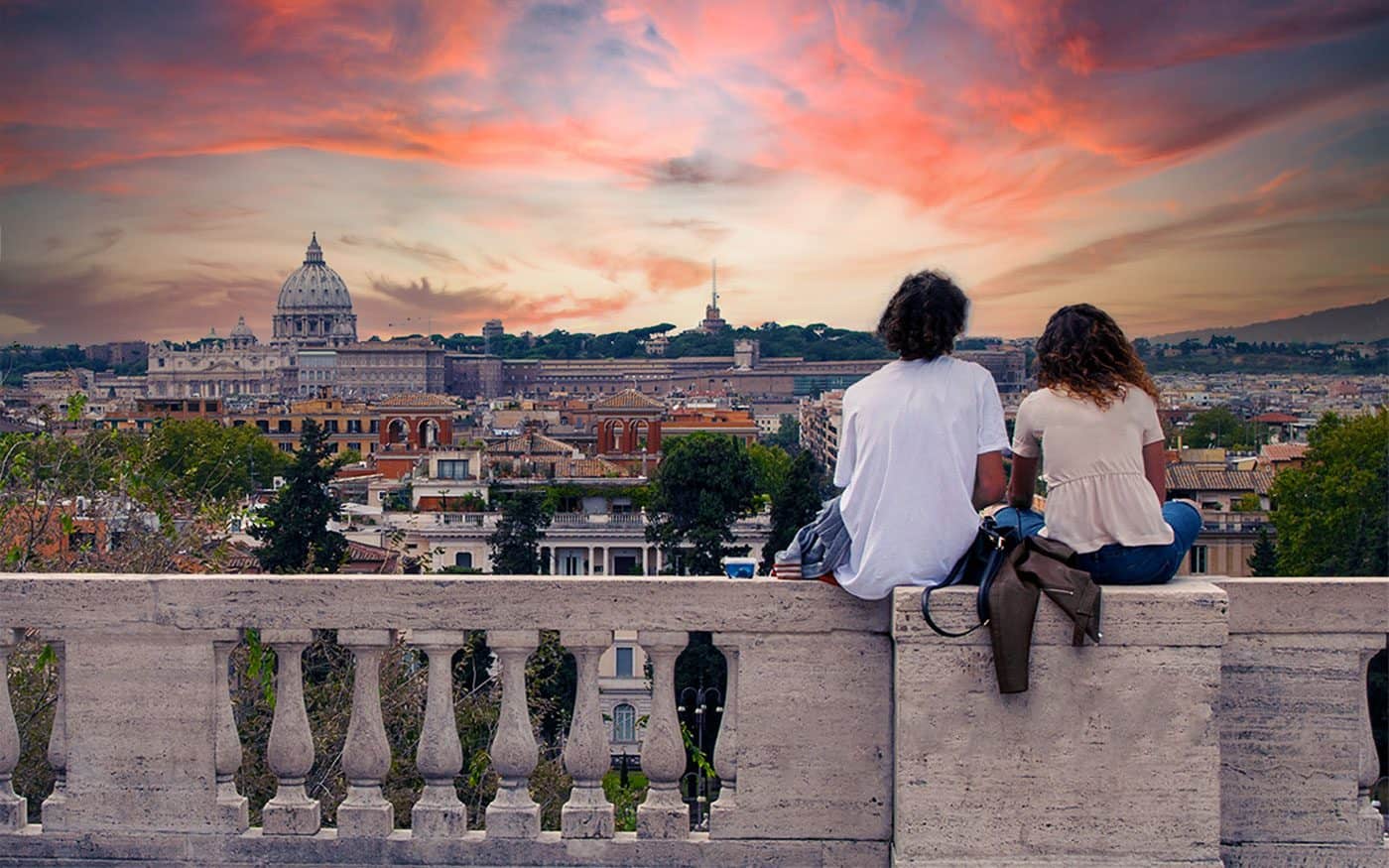
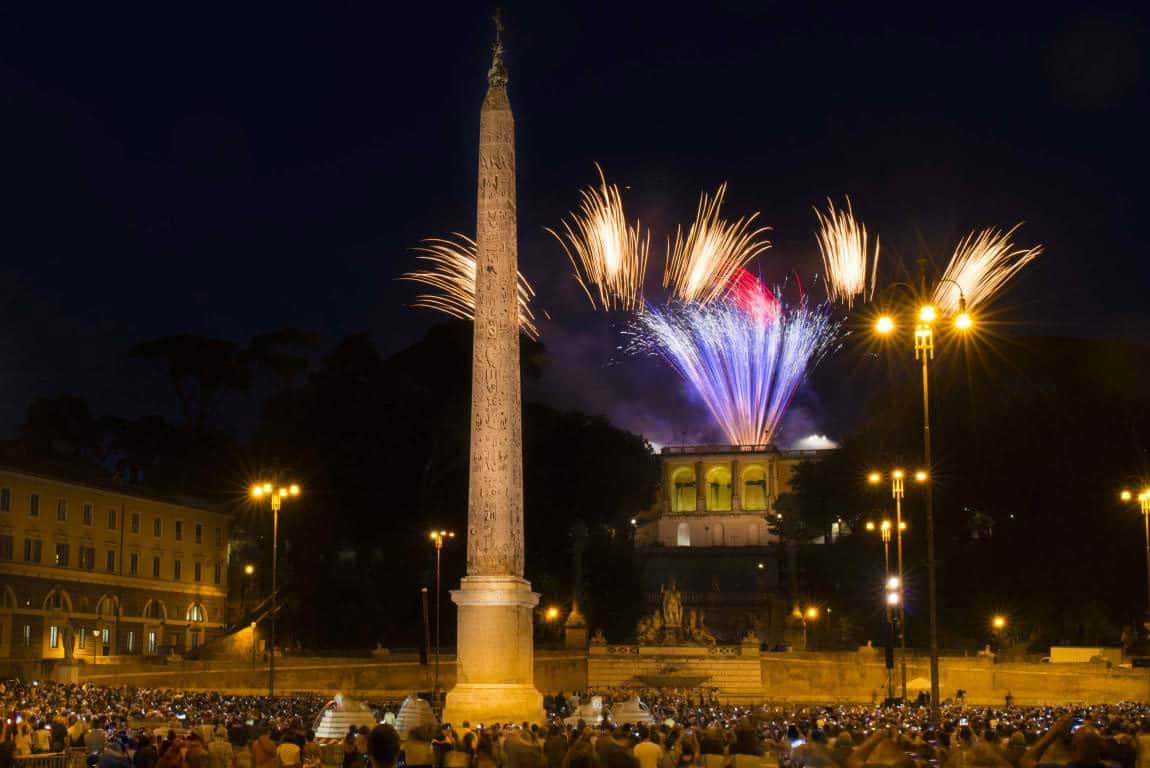
The view opens vertically over Piazza del Popolo below, with the Flaminio Obelisk in the center and the two twin churches that close off the Tridente. Toward the northwest you can make out the Prati neighborhood, the dome of Saint Peter's, Castel Sant'Angelo and the hill of Monte Mario. Farther left, the Janiculum. Toward the east and southeast, the line of rooftops leads to the Quirinal, the Altar of the Fatherland and the Capitoline Hill. On the horizon, to the southwest, the skyscrapers of Eur appear on clear days. This combination makes the Pincio one of the most complete panoramic viewpoints in the city, and unlike the Janiculum, you can reach it from the center without any effort.
A warning: the terrace faces west. In the morning the light comes from behind you and the view looks flat. From three in the afternoon on, the city lights up, and at sunset it becomes something else. Anyone with only one afternoon in Rome who wants a free view won't find anything better.
The Cairoli Brothers Monument
At the end of Viale del Pincio, in the center of a small open space, the bronze monument to the Cairoli brothers, Enrico and Giovanni, was erected in 1883 from a model by Ercole Rosa. It commemorates the deaths of the two Garibaldini in the clash at Villa Glori on October 23, 1867, during the campaign in the Agro Romano for the liberation of Rome organized by Giuseppe Garibaldi. Enrico died on the spot, Giovanni from his wounds. It is one of Rome's best-executed Risorgimento bronzes. The composition avoids the rhetoric of the equestrian monument and focuses on the body of the wounded brother, with a realism that in 1883 was still daring.
The Fountain of Moses and the Monument to Raphael
Aligned with the piazzale, inside a tree-lined exedra, stands a circular fountain erected by Ascanio Brazzà and inaugurated in 1868. At the center, the sculpture group depicts the infant Moses entrusted by his mother to the waters of the Nile: a biblical subject in a secular stroll, an academic taste perfectly in line with papal Rome in its final years. On the right side of the open space behind the lookout, by contrast, stands the small statue of Raphael, made in 1838 by Achille Stocchi, which depicts the painter in troubadour dress according to a Romantic iconography now very far from the historical Raphael. Looking at it today helps you understand how the nineteenth century imagined the Renaissance, not how the Renaissance was.
The Pincio Busts, the Line of Illustrious Men
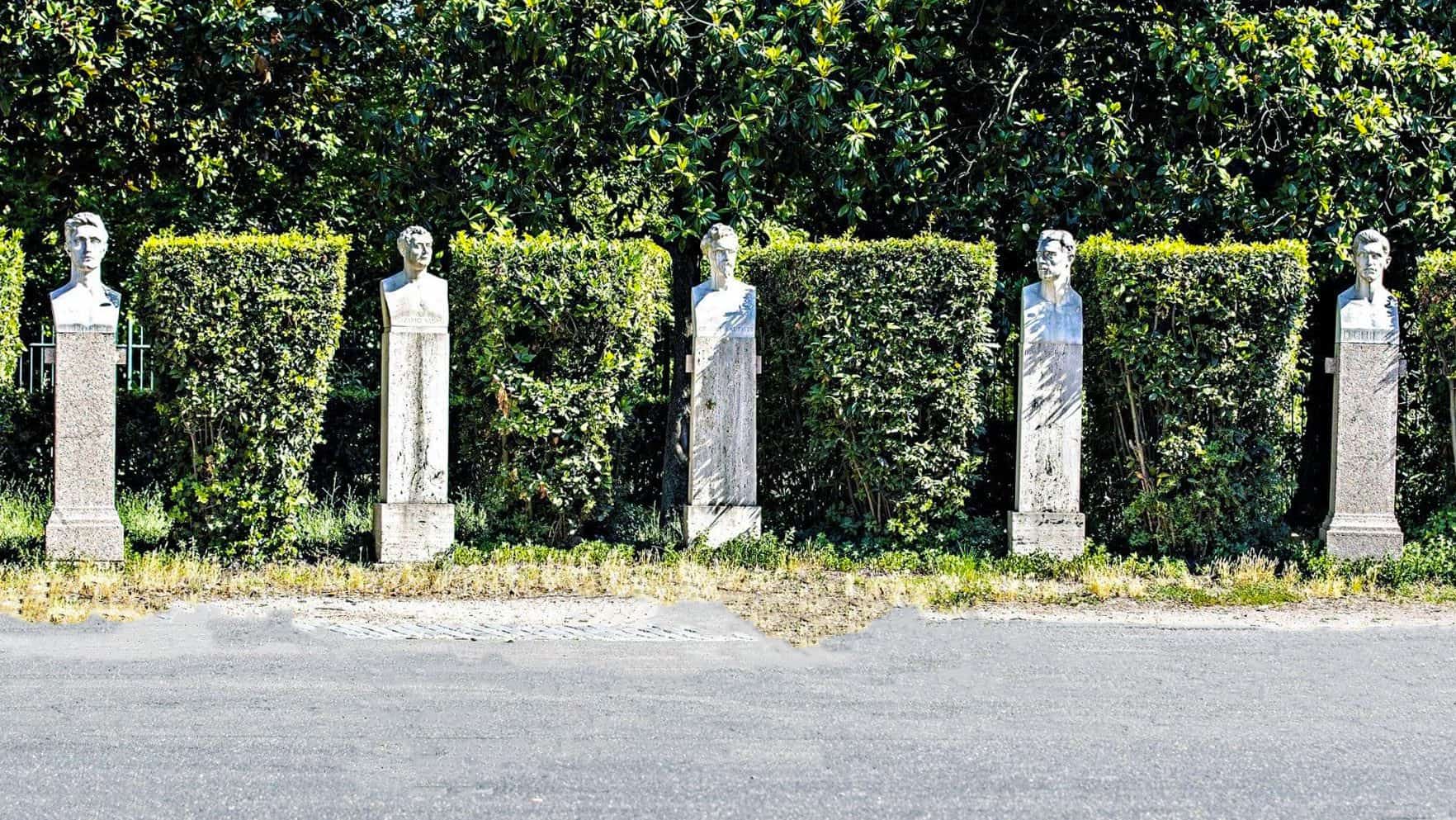
Along the Pincio's avenues runs a series of commemorative busts of illustrious Italians, perhaps the hill's most distinctive furnishing. The idea was born in 1849 under the Roman Republic, which commissioned 52 of them as an outdoor secular pantheon. The Republic fell before they could be installed, and it was Pius IX who took up the project, establishing a commission for the placement of the sculptures on June 2, 1851. It's a story worth telling in full: a pope who inherits and completes the ideological monument of his enemies, changing its meaning without changing its forms.
The number grew over time. In the late 1960s, the figures depicted were 228. The Sovraintendenza Capitolina today lists 229 busts. The difference is explained by later additions and by pieces removed and reinstated after damage. Because the Pincio busts have been a recurring target of vandalism since 1863, noses are struck especially, and in some cases it comes to decapitation. A large part of those you see are copies, and this reduces the artistic damage but not the economic or civic damage.
Three women are admitted to the line: Vittoria Colonna, Saint Catherine of Siena and Grazia Deledda. Three out of more than 200. You don't need a militant commentary to record the fact, just count.
The Bust of Angelo Secchi and the Sighting of the Rome Meridian
One of these busts hides a scientific story that almost no visitor knows. In 1860 the target of the Astronomical Observatory of the Collegio Romano was placed on the Pincio, near the Casina Valadier, at the request of its director, the Jesuit astronomer Angelo Secchi, for determining the meridian of Rome. Originally it was just a checkered wooden tablet, later rebuilt in marble and set into a column fitted with a hole that allowed it to be lit at night. In 1878, when Secchi died, his bust was placed on the column, surrounded by a small garden. Damaged in 1960, the target was restored in 2001 and still performs its function. The Pincio, therefore, is not just a walk: it is a fixed point of Roman astronomical cartography. Secchi, after all, was the first to classify stars by their spectra, and it's worth knowing that his pointing instrument was a public garden.
Viale dell'Orologio and the Pincio Hydrochronometer
Viale dell'Orologio takes its name from the water clock, the hydrochronometer, one of the most unusual objects in Rome. The mechanism is due to Father Giovan Battista Embriaco, a Dominican friar from Ceriana, who developed it in 1867 and presented it at the Universal Exhibition in Paris that same year. In 1873 the clock was built by the firm Fratelli Granaglia of Turin and placed in its current position, at the center of an artificial pond, protected by an iron railing.
The turret that houses it is the work of Gioacchino Ersoch, city architect of Swiss origin. It takes the form of a wooden structure, but it is made of cast iron, cast to look like tree trunks, with a rustic effect that the 1800s loved very much. The mechanism is purely hydraulic: water falls alternately into two small basins, and their tipping drives the movement of the dials, with no springs or weights.
The clock fell into serious disrepair. The restoration was carried out by the ELIS School of Rome at no cost to the Comune between 2006 and 2007, and the machine started working again on June 29, 2007. It's worth walking up close and staying silent for 30 seconds: the sound of the water tipping the basins is the only original mechanical sound you can still hear in a Roman garden. If I had to point out just one thing to see at the Pincio besides the panorama, I'd point to this one.
The Reservoir and the Elevator Building
Nearby is the Serbatoio, whose structure dates to the period between 1812 and 1814, at the time of the works for the Acqua Marcia. The cladding of sheet metal with lozenges and pseudo-wood panels is due to Gioacchino Ersoch, the same architect as the clock turret, and gives the building a look that recalls Swiss Alpine architecture. For a long time the building housed a xylotheque, that is, an orderly collection of wood samples. These details show how much the Pincio, in the 1800s, was also a place of study and not just a place of leisure.
Viale dell'Obelisco: Antinous on the Pincio
Viale dell'Obelisco largely keeps the original layout by Valadier, who had designed a fusion of the Italian garden, geometric and pruned, and the English romantic garden, with tree masses and curved paths. In the middle of the avenue stands the obelisk that Emperor Hadrian had inscribed in honor of Antinous, the young man from Bithynia who drowned in the Nile in 130 and was deified at the emperor's wish.
The pink granite monolith measures 9.24 meters of shaft and reaches 17.26 meters with base and star. The hieroglyphs carved on its four faces tell of Antinous's death, his deification, the founding of the city of Antinopolis and the establishment of the cult of Osiris-Antinous. In practice, they are the official birth certificate of a religion wanted by an emperor for his own private grief. The obelisk was found broken into three pieces in 1589 near the present-day Porta Maggiore, outside the Aurelian Walls. In 1633 the Barberini moved it to the garden of their palace. It then passed to Pope Clement XIV and ended up in the Cortile della Pigna in the Vatican. In 1822 Pope Pius VII had it restored and erected here, on the level of the public promenade, with the assistance of the architect Marini.
Four moves in three and a half centuries. It's worth stopping to think about it: the oldest object on the Pincio is also the one that has traveled the most, and the Napoleonic garden took it as a cultural trophy, just as the ancient Romans had done with Egypt.

The Casina Valadier, the Pivot of the Whole Walk
The whole upper area of the hill is organized around the Casina Valadier, in Piazza Bucarest. Valadier reworked a pre-existing seventeenth-century casino, the Casino Della Rota, and transformed it into a building with a cubic volume and an elegant semicircular colonnade of the Ionic order, with interiors decorated in Pompeian style. Construction took place between the 1810s and the 1830s. The year 1813 cited by some sources refers to the start of work on the pre-existing casino, while the building's final form came later. The architect set his private residence there, in a position that his contemporaries compared to the quarterdeck of the ship commanded by Nelson at Trafalgar. He died before he could live there.
The building immediately became a public café and a place for contemplating the city. It was popular throughout the 1800s, then fell into such decline that it served as the park caretaker's house. From 1920 it went back to operating as a restaurant. During World War II it was occupied by German soldiers, it enjoyed a new happy period after the war, and it closed in 1990 after a series of disastrous management changes. It reopened on June 19, 2004, after a complete restoration.
Today the Casina Valadier works mainly as a venue for events, weddings and private and corporate receptions, with the Sala degli Specchi, the Sala Romana, the executive floor and the terraces overlooking the green space. Availability of a café or restaurant open to the public changes over time. If you plan to sit there for a coffee, make a phone call or check the venue's official website before you head up. Personally, I suggest looking at it from outside, walking around it to appreciate the colonnade, and then spending your time elsewhere. The value of the Pincio is in the garden, not in the wine list.

Viale del Belvedere and Viale Valadier: the Ancient Statues of the Pincio
Coming back to the square and turning right onto Viale del Belvedere, you reach a tree-lined exedra that holds the bust of Giuseppe Valadier, a fitting tribute to the man who designed everything you've seen so far. In a niche along the same avenue is the so-called dry fountain, with a fake grotto with stalactites and four columns with Ionic capitals above the balustrade. Some historical sources date it to the 1800s, but the attribution is not settled.
Aesculapius, Cybele, Polyhymnia and Abundance
On Viale Valadier you come across the statue of Aesculapius, the god of medicine. The body dates to the last 40 years of the 4th century, while the head that was fitted onto it belongs to a different period, following an antiquarian assembly common in Rome during the restorations of the 18th and 19th centuries. Iconographic documents show it already in this position in the 1830s. At the end of the avenue the statue of Cybele was placed, dating to the Antonine age, that is, the 2nd century. Cybele, together with the statues of Polyhymnia and Abundance, was kept at the Palazzo dei Conservatori on the Capitoline Hill, from which it was removed after 1848. The three sculptures were moved to the Pincio in 1846, while Polyhymnia and Abundance are today in front of the entrance to Villa Medici, where they had been found near the rear entrance. The fact that the dates of transfer and removal from the Capitoline collections don't line up perfectly in the available sources is an honest signal. The movement of sculptures in mid-19th-century Rome was such that the archive, in more than one case, can't keep up.
Enrico Toti, Galileo, the Fontana dell'Anfora
At the intersection of Viale dell'Orologio and Viale Valadier stands the monument to Enrico Toti, made by Arturo Dazzi in 1922, with squared-off volumes in line with the sculptural taste of the early postwar period. In 1887, the commemorative column dedicated to Galileo Galilei was placed on Viale di Trinità dei Monti. In the open area behind the Casina Valadier and Villa Medici, however, is the Fontana dell'Anfora, with a nude female figure holding an amphora in full Liberty style, a work by Amleto Cataldi from 1912. Three monuments, three different Italys in 25 years: the nation that claims Galileo against papal Rome, the one that honors the maimed volunteer of the Great War, and the one that treats itself to a decorative sculpture with no message.
The Pincio Before the Pincio: the Collis Hortulorum
Many important families of late-Republican Rome had homes and gardens here, the horti. The documentation is uneven: some presences are attested, others remain tradition or hypothesis, and it's best to tell them apart. Scipio Aemilianus and, according to a less certain tradition, Pompey are said to have had properties on the hill. Certain instead is the presence of the Horti Lucullani, built by Lucullus with the spoils of the victory over Mithridates in 63 BC. Right there, in AD 48, Messalina, wife of the emperor Claudius, was killed: the horti had been taken from their owner Valerius Asiaticus through scheming, and they were also her tomb. It's hard to find a place of pleasure that became a scene of death so quickly.
On the hill there also stretched the Horti Sallustiani, originally belonging to the historian Sallust, then passed to the imperial estate and unified with the Lucullan horti in a single property called in Pincis. The Horti Pompeiani. And the Horti Aciliorum, of the Acilii family. Because of the thickening of these residences the hill was called in antiquity Collis Hortulorum, the hill of the little gardens. That a nineteenth-century public promenade was born exactly on the hill of the Roman aristocracy's private gardens is one of those continuities that Rome produces without meaning to.
Where the Name Pincio Comes From
The present name derives from the Pincii, one of the families that occupied the hill in the 4th century. Their villa, together with those of the Anicii and the Acilii, extended over the northern part of the hill, and a remnant of the substructures of these residences is still visible: the Muro Torto, the irregular stretch that supports the hill above the avenue of the same name. In the map of Rome of 1593 the area was indicated as Sepulcrum Neronis alias Muro Torto. In the 5th century AD a great imperial palace arose here, the Pinciano, which gave the hill the role of residence of power in late antiquity.
Regio VII Via Lata
The Pincio was part of Regio VII Via Lata, the seventh of the 14 regions of Augustan Rome, later classified in the Regionary Catalogues of the mid-4th century. It took its name from Via Lata, today's Via del Corso, and extended from it eastward, from the Porta Fontinalis of the Servian walls to the Porta Flaminia of the Aurelian walls, up to the slopes of the Quirinal, including the hill entirely.
In the Augustan age the region saw intense urbanization: Agrippa had the Campus Agrippae built there, dedicated in 7 BC, a villa and his own tomb, while his sister Polla promoted the Porticus Vipsania. Near today's Piazza Santi Apostoli stood the barracks of the 1st cohort of the vigiles, and not far away the Forum Suarium, the pork market that supplied the city. During the 2nd century the strip along Via Lata turned into a densely built-up zone: occasional excavations have yielded remains of large multi-story brick insulae, with pillared porticoes and shops opening onto the street. Among these buildings there must have been the Catabulum, seat of the imperial postal service, near the church of San Marcello.
In the 3rd century too building activity remained intense. Under Gordian III the sources record the erection of a portico a thousand feet long, almost three kilometers, on the slopes of the Quirinal: the total absence of remains has cast doubt on the truth of the report, and I record it as such. Documented instead is the great Temple of the Sun raised by Aurelian from 273 between Via del Corso and Piazza San Silvestro, surrounded by porticoes under one of which was based the free distribution of wine, the vinum fiscale. The Regionary Catalogues also mention in region VII a portico of Constantine, perhaps belonging to the complex of the nearby Baths of Constantine.
The Tomb of Nero, the Poplars and the Birth of Santa Maria del Popolo
At the foot of the Pincio, toward Piazza del Popolo, stood the tomb of the gens Domitia, where Nero's ashes were laid. The emperor took his own life in 68 in the suburban villa of the freedman Phaon, physically helped by his secretary Epaphroditus because he lacked the resolve to complete the act alone. His ashes were collected by his nurses and by Acte and brought to the family tomb, within sight of the hill.
From there arises one of the most tenacious Roman legends. The origin of the name of Piazza del Popolo is uncertain, but the plausible etymological root is the Latin populus, which means poplar: according to tradition, where the piazza now opens there grew a grove of poplars belonging to Nero's tomb. A tree was also planted on the tomb, and in the medieval imagination the grove became the gathering place of ghosts, witches and demons, with Nero's at their head. To exorcise the area Pope Paschal II, according to tradition, had the tree cut down, the emperor's bones burned and, at the expense of the Roman people, a chapel built over the sepulcher: from that chapel was born the church of Santa Maria del Popolo. The Madonna was "del Popolo," and the piazza became "del Popolo." The double etymology, botanical and civic, is probably the reason why the name took root.
Don't ask me to choose between the two explanations. The first is philologically solid, the second is the one Romans believed for eight centuries, and in the history of a city even a collective belief is a fact.

How the first public garden in Rome came about
From late antiquity to the end of the eighteenth century the hill remained practically uninhabited. The Nuova Topografia di Roma by Nolli shows it occupied by the large vineyard with farmhouse of the Augustinians of Santa Maria del Popolo, by the gardens and vineyard of Villa Medici and by the gardens of the convent of the Minimi, which Nolli calls French and the Roman people called Paolotti, attached to Trinità dei Monti. A hill of orchards and convents, 200 meters from the most crowded center in Europe.
Valadier had already proposed a plan for the layout of Piazza del Popolo to Pius VI as early as 1794, which included, among other things, two cavalry barracks flanking the gate. But the idea of turning the entire hill into a public garden, to give space and breathing room to a people who for centuries had lived crowded on the banks of the Tiber, and at the same time glory to the emperor, was the French, who occupied Rome from February 2, 1808 to May 11, 1814. The brief occupation left many projects and few works started, but the pairing of Piazza del Popolo and the Pincio was among those, and the men who held the city's urban development in their hands remained the same even after: Canova and Valadier at the head.
In June 1816 the plan for Piazza del Popolo drawn up by Valadier in collaboration with Louis-Martin Berthault, architect and landscape designer to the empress Josephine, was approved, and Berthault revised the layout according to French taste. In about eight years the present piazza and the vast garden of the hill were built. Valadier drew up the design of the actual garden between 1810 and 1818, and the building sites continued well beyond: the Pincio promenade took its present appearance in the period between 1810 and 1908, when the overpass over the Muro Torto joined it to Villa Borghese. In the 1860s Francesco Vachez intervened, introducing the curved paths in the English taste that are still walked today.
The result is an urban project of the first order. Valadier linked the most beautiful hill in the city to Porta Flaminia and the piazza in a single neoclassical whole, overcoming the difference in level with the two switchbacks that climb converging halfway up the hill from the eastern side of the piazza, and with a gently sloping avenue, today Viale Gabriele d'Annunzio, which skirts the bas-reliefs, the fountain and the three tall niches up to the terrace. He also designed the botanical screen of palms and evergreen shrubs that overlooks the ramps toward the piazza, and that is the reason the Pincio, seen from below, looks higher than it is. The urban element of the piazza was connected to the landscape element of the garden with a precision that had few comparisons in Italy at the time.
It's also worth correcting a widespread misunderstanding: the public garden wanted by Napoleon is the Pincio, not Villa Borghese. The Borghese park remained private property of the family until the State acquired it at the beginning of the twentieth century and then transferred it to the Comune di Roma. The two gardens are adjacent, connected since 1908, but they have different histories.
The Pincio with kids and the Teatro San Carlino
The Pincio works very well with kids, much better than most places in the center. The San Carlino puppet theater is in Viale dei Bambini, a few dozen meters from the terrace: it has been on the hill since 1993 and has a permanent venue, entirely in wood, opened in 2004. Shows are scheduled on Saturdays and Sundays, with afternoon times and a Sunday matinee repeat in late morning. The recommended age starts at two, tickets are bought online on the theater's website or at the box office, and online booking allows you to change the date up to a few hours before. Schedules and times change from season to season, so it's best to check the program before showing up.
Around the theater there are a playground, bike paths and rental of bicycles and rickshaws, which is probably the most fun way to cross the promenade with little kids. A few minutes' walk away, already inside Villa Borghese, are the Bioparco, the Casa del Cinema and the museo Carlo Bilotti in the Aranciera. Half a day at the Pincio with small children fills up without effort and without spending almost anything.
How much it costs to visit the Pincio and how much time it takes
The walk and the terrace cost nothing. There is no ticket office, no booking, and no closing time. You only pay for what you choose to consume or use: the puppet theater, bike rental, the refreshment stands, and the Casina Valadier for anyone organizing an event. Public restrooms are located along the walk.
I'm clear about timing: 40 minutes is enough to go up, look out, and come back down. Two hours are needed to do it properly, that is, to read the three perspectives, count a few busts, reach the hydrochronometer, walk around the Casina, and exit toward Trinità dei Monti. If you add Villa Borghese, plan on half a day. If you add the Galleria Borghese, which requires mandatory booking with timed entry slots, plan on a full day, and it's best to book the gallery first and keep the Pincio as your closing stop at sunset.
Accessibility at the Pincio
The walkways were designed from the start for carriage traffic, and this left a legacy of wide paths and gentle slopes: anyone using a wheelchair or a stroller finds better conditions on the hilltop than in the historic center. The climb from Piazza del Popolo involves a steady push but no steps if you follow Via Gabriele d'Annunzio. The side staircases are shortcuts, not required routes. Anyone who wants to avoid the climb entirely can arrive on level ground from the Villa Borghese side, entering from Viale delle Magnolie. Some stretches are packed dirt and become uncomfortable after rain. I can't promise anything about how the elevators on Viale dell'Orologio work: they need to be checked on site.
What's Around the Pincio in 10 Minutes
The hill's location is its second great advantage. Heading west, you reach Piazza del Popolo, with the church of Santa Maria del Popolo and its two Caravaggio paintings, and the northern gate of the city, the Porta del Popolo. Heading south, you come out at Trinità dei Monti and the staircase leading to Piazza di Spagna and the Fontana della Barcaccia. Toward the Tiber, about 10 minutes' walk from Piazza del Popolo, you reach the Ara Pacis and the Mausoleum of Augustus. Toward the east, inside Villa Borghese, the Etruscan Museum of Villa Giulia and the Galleria Borghese. There is no comparable density in Europe of serious things to see around a free lookout.
When to Go to the Pincio and When to Avoid It
The best time is late afternoon, always. On scirocco days, haze swallows the horizon and the Eur skyscrapers disappear: if you want long views, go after a day of tramontana, when the air is clear and even the outline of the Alban Hills is visible. Avoid Sunday afternoons in May and September, when the terrace becomes impassable with tourists, couples, and wedding photographers. Avoid New Year's, when the area is subject to ordinances and restrictions. In winter the Pincio is splendid and almost empty around 4 in the afternoon, with low light that lights up the brick of Prati.
What to Eat Around the Pincio
On the hill, refreshment stands are few and meant for passersby. Anyone who wants a good meal heads down toward Via del Babuino and Via Margutta or toward the Campo Marzio district, where the choice is wide and prices vary enormously within 100 meters. My professional advice is simple: bring something from home to the Pincio or buy it at one of the rosticcerie in the Tridente, and eat on the benches, looking out over the city. A supplì and a slice of pizza bianca on the terrace are worth more than any table with a view. Be sure to avoid the drink vendors on the terrace on summer evenings: arbitrary prices and no guarantee.
The Many Pincios of Italy
In many Italian cities there are panoramic parks named Pincio, in homage to the Roman one: from Assisi to Bologna, Perugia, Ancona, Rieti, Urbino, Civitavecchia, and more. This fact shows how widely the formula invented by Valadier has served as a model: a tree-lined lookout overlooking the lower city, reachable on foot, open to everyone, and without a ticket. In the 19th century, when most European urban gardens were still fenced off and reserved, this was a radical idea.
A Curiosity About the Pincio
The most beautiful curiosity of the hill has nothing to do with the statues or the view: it's about time. At the Pincio, time is measured with water, and it has been for over 150 years. The hydrochronometer designed by Father Giovan Battista Embriaco in 1867 uses no springs, no weights, and no electricity: two basins fill alternately, tip over by gravity, and with that movement advance the dials. Embriaco presented the device at the 1867 Universal Exposition in Paris, where it aroused curiosity as an example of hydraulic engineering applied to timekeeping. In 1873, the Fratelli Granaglia of Turin built the example you can still see, and the machine was set in the center of a small artificial pond, protected by a railing.
The clock's housing deserves almost as much attention as the mechanism. It looks like a Swiss kiosk built from tree trunks, but it is actually cast iron, shaped to imitate wood by Gioacchino Ersoch, the Roman architect who in the same period designed the Testaccio slaughterhouse. A fake rustic piece in metal that houses a water clock: the perfect expression of nineteenth-century taste, which loved to disguise technology as nature.
There's more. The clock stopped working, fell into serious disrepair, and would have remained a ruin if a technical institute, the Scuola ELIS di Roma, had not restored it between 2006 and 2007 at no cost to the city's coffers. It started working again on June 29, 2007. If you pass the basin and don't hear the click of the water, wait a minute: here, time arrives at intervals. And tell the kids about it, because it's the only physics lesson you can give for free in the middle of a garden.
Something no one tells you about the Pincio
No guide tells this, yet the Pincio is a point on Rome's astronomical map. In 1860, the Jesuit astronomer Angelo Secchi, director of the Observatory of the Collegio Romano, asked for and obtained that a sight be placed on the hill, near the Casina Valadier: a fixed reference to be sighted with the observatory's instruments to determine Rome's meridian. Originally it was a simple checkered wooden tablet. Later it was remade in marble and set into a column, fitted with a hole that allowed it to be lit for nighttime observations.
When Secchi died in 1878, his bust was placed on the same column, surrounded by a small garden. The monument was damaged in 1960 and restored in 2001, and the sight still performs the function for which it was created. This means that one of the most anonymous sculptures on the walk, in front of which thousands of people pass every day, is actually a scientific instrument still in use.
Angelo Secchi was no ordinary astronomer: he was the first to classify stars by their spectrum, paving the way for modern astrophysics, and his observations of Mars introduced the term canali that would fuel a century of fantasies. That his earthly reference point is a bust in a public garden, and not a tower or a monumental pillar, says something very Roman about the way this city treats its science: it mixes it into the stroll and then forgets it.
In our view, of all the busts on the Pincio, this is the only one worth a deliberate detour. The others are a patriotic catalog. This one is a machine.
My advice for visiting the Pincio
Go up from Piazza del Popolo, not from Villa Borghese, and go up late. The first tip concerns the design: Valadier built the ramps like a crescendo, with the three perspectives that prepare the final view. Anyone arriving from above, from the park side, runs right into the terrace unprepared and misses the entire architecture of the story. The second concerns the light: the terrace faces west, so in the morning the panoramic view is backlit and flat, while from three in the afternoon on the city warms up, and in the hour before sunset the bricks of Prati and the travertine of Saint Peter's turn orange.
Third: give yourselves two hours, not 40 minutes. The difference between a visit and a stop lies entirely in the details you only see by stopping. The three perspectives with Hygieia, Fama and the loggia of the Acqua Vergine, the red granite basin on the second switchback, which is an imperial piece, the hydrochronometer, the Secchi column, the obelisk of Antinous. Five deliberate stops are worth more than 20 photographs.
Fourth, and for me the decisive one: plan your exit, not just your entrance. From the Pincio you leave toward Viale di Villa Medici, go down to Trinità dei Monti, and arrive at Piazza di Spagna. It's the most elegant descent in Rome and closes the afternoon the right way. Anyone who turns back to Piazza del Popolo retraces the same route and wastes half an hour.
A practical warning: bring water and comfortable shoes but not open sandals, because the dirt paths are muddy after rain. And if you have kids, check the schedule at the Teatro San Carlino first: a visit to the Pincio that ends with a puppet show is the best way to get a six-year-old to accept a day of monuments.
Another well-known fact, yet rarely mentioned
Everyone knows the Pincio is Rome's first public garden. Few remember that it was wanted neither by a pope nor by the city council, but by a foreign occupying administration. The idea of turning the entire hill into a garden open to everyone came from the French, who occupied Rome from February 2, 1808 to May 11, 1814, and it arose from a double aim: to give air and space to a people long crammed into the bends of the Tiber, and at the same time to build glory for the emperor. In Napoleonic culture, the public garden was a tool of government just as much as a road or a barracks.
The empire fell in 1814, the French left, and the project remained. The restored papal government inherited it and brought it to completion with the same men who had launched it, Canova and Valadier above all. In June 1816, the plan for piazza del Popolo drawn up by Valadier with Louis-Martin Berthault, landscape architect to Empress Josephine, was approved: a Napoleonic plan carried out under Pius VII. The square on the terrace is still called piazzale Napoleone I today, and no one has ever bothered to change it.
The little-cited detail is exactly this: papal Rome of the 1800s, which presented itself as a bulwark against revolutionary modernity, applied the program in urban planning without substantial changes. Pius IX went further: in 1851 he took up and completed the project of busts of illustrious Italians, commissioned in 1849 by the Roman Republic, that is, by the revolutionary government that had driven him out of Rome. He inherited the secular pantheon of his opponents and turned it into a papal monument. Anyone walking among those busts is walking inside a forced reconciliation between two Italies that had been shooting at each other two years earlier.
The Right Photo to Take at the Pincio
The photo everyone takes is the one from the terrace balustrade, with piazza del Popolo below and the dome of St. Peter's in the background. It's a good photo, but it's the same as everyone else's, and it has one serious technical flaw: from there the square looks flattened, and the Flaminio Obelisk, which is the pivot of the whole composition, gets lost in the pattern of the paving.
The right photo is a different one and requires two adjustments. First, move from the central balustrade toward the left side of the belvedere, facing the square: from there the obelisk enters on a diagonal, the two twin churches separate, and the Porta del Popolo closes the frame in the background, giving the scene back the depth Valadier had designed. Second, wait for the hour before sunset: the low light lights up the travertine, lengthens the shadows of the palm trees on the ramps, and turns a documentary view into an image.
If you have patience, take the reverse shot too, that is, the Pincio seen from piazza del Popolo: the three overlapping perspectives, the big niches, the backdrop of palms above the ramps. It's the image that explains the project, and almost no one takes it because everyone looks up only while climbing.
Two minor subjects that reward you more than the terrace: the hydrochronometer in its cast-iron tower, photographed from the railing of the pond with the reflection of the water, and the Obelisk of Antinous backlit at the end of the day, with the hieroglyphs in shadow and the sky behind. One tip from a professional: the terrace is crowded at every hour, and if you want a photo without a crowd, you have to show up early in the morning and accept the worse light, or give up and put people inside the frame, as Roman photography of the 1800s did.
Some Important Events That Happened Here in History
The first significant documented event is a political murder. In the Horti Lucullani, on the northern flank of the hill, in 48 AD Valeria Messalina, third wife of the emperor Claudius, was killed. The gardens had been taken from their owner, Valerio Asiatico, through a rigged trial, and he was forced to commit suicide: Messalina wanted them, got them, and died there shortly after on her husband's orders. A pleasure garden that becomes the scene of an execution within a few years.
The second concerns Nero. The emperor took his own life in 68, and his ashes were placed in the tomb of the Domitian gens at the foot of the hill, toward today's piazza del Popolo. From there comes the long medieval story of the haunted grove and the intervention of Pope Paschal II, who according to tradition had the tree that had grown on the tomb cut down, the bones burned, and a chapel built, the origin of the church of Santa Maria del Popolo. On the map of Rome from 1593 the area was still marked as Sepulcrum Neronis alias Muro Torto: the memory of the place has survived 15 centuries.
The third event is the French occupation of Rome, from February 2, 1808 to May 11, 1814, which gave birth to the idea of a public garden and set in motion the transformation of the hill. The fourth is the approval, in June 1816, of the Valadier and Berthault plan for piazza del Popolo and the Pincio, under the restored papacy of Pius VII: the administrative act that produced the landscape visible today.
The fifth is 1822, when Pius VII had the Obelisk of Antinous raised here, found broken into three pieces in 1589 near Porta Maggiore and having passed through the Barberini gardens and the Cortile della Pigna in the Vatican. The sixth is June 2, 1851, when Pius IX established the commission that began placing the busts of illustrious Italians, commissioned in 1849 by the Roman Republic. The seventh is 1873, with the hydrochronometer placed in its current position and, that same year, the equestrian statue of Vittorio Emanuele II placed on the third perspective, later removed in 1936 to make room for the Acqua Vergine display by Raffaele De Vico.
The eighth is 1908, the year of the overpass over the Muro Torto that linked the Pincio to Villa Borghese and changed forever how people crossed the greenery of central Rome. The ninth, minor but significant, is June 29, 2007, when the water clock restored by the ELIS School started working again after decades of silence.
Who Has Passed Through the Pincio
The first name is Lucullus, the general who, with the spoils of the war against Mithridates, won in 63 BC, built here the horti that bear his name and that gave the hill its reputation as a place of luxury. After him came Valeria Messalina, wife of Claudius, who passed through here and died here in 48 AD. Sallust, the historian of Catiline's conspiracy, had his gardens here, which later became part of the imperial estate.
Hadrian never lived on the hill, but he left here the most personal object of his reign: the obelisk inscribed for Antinous, the young man who drowned in the Nile in 130 and was deified at his wish. The hieroglyphs tell of the founding of Antinopolis and the cult of Osiris-Antinous. There is no monument in Europe that documents an emperor's mourning with equal precision.
Among the popes, there are three decisive moments. Pius VII, who approved the project in 1816 and had the obelisk erected in 1822. Pius IX, who began placing the busts in 1851 and wanted the red granite basin moved from Piazza San Marco. Before them, according to tradition, Paschal II, who was involved in the story of Nero's tomb.
On the side of the artists and architects, the list is long and verifiable. Giuseppe Valadier, who designed the garden between 1810 and 1818 and built his own house there without ever living in it. Louis-Martin Berthault, landscape architect to Empress Josephine, co-author of the 1816 plan. Antonio Canova, who in the Rome of those years held the reins of artistic policy and acquisitions. Achille Stocchi, Felice Baini, Filippo Gnaccarini and Alessandro Massimiliano Laboureur, authors of the sculptures of the perspectives. Ercole Rosa, author of the Cairoli monument of 1883. Amleto Cataldi, who signed the Anfora fountain in 1912. Arturo Dazzi, author in 1922 of the monument to Enrico Toti. Raffaele De Vico, the architect of Rome's gardens, who in 1936 transformed the loggia into the display of the Acqua Vergine. Gioacchino Ersoch, who designed the turret of the hydrochronometer and the cladding of the Reservoir. Francesco Vachez, who in the 1860s introduced the curving English-style paths.
Among the scientists, Angelo Secchi, who from 1860 used the hill as a sighting point for the meridian of Rome and who has been commemorated here with a bust since 1878. Among the memorable by contrast, the brothers Enrico and Giovanni Cairoli, who never passed through the Pincio while alive but have been present here since 1883 with the bronze by Ercole Rosa that commemorates the clash at Villa Glori in 1867.
And then the anonymous crowd, which is the real reason the hill exists: the Romans who from 1820 onward used these ramps as an outdoor salon, the Grand Tour travelers who arrived through Porta del Popolo and, as their first gesture, climbed up to look at the city from above, the carriages for which the avenues were designed wide. The Pincio was not born for an illustrious man. It was born for the promenade, and it remains the most successful monument Rome has ever dedicated to an activity with no purpose.
Quick Questions About the Pincio
How Much Does It Cost to Enter the Pincio
Nothing. The promenade and the terrace are a public park with free admission, with no ticket office and no booking.
What Are the Pincio's Opening Hours
The Sovraintendenza Capitolina lists the promenade as always open. There is no closing time for the gates, unlike other historic parks in Rome.
How to Get to the Pincio by Public Transportation
Metro Line A, Flaminio stop, which opens onto Piazzale Flaminio next to Porta del Popolo. From there, you climb on foot up the ramps. In the same square, tram 2 and the regional railway to Civita Castellana and Viterbo both have their terminus. Surface bus routes change over time, so it's best to check the current route before you leave.
How Much Time You Need to Visit the Pincio
40 minutes to climb up, look out and come back down. Two hours for a well-done visit, including the three perspectives, the busts, the hydrochronometer and the obelisk. Half a day if you continue into Villa Borghese.
Is the Pincio Wheelchair Accessible
The top of the hill is wide and largely flat, because the avenues were built for carriages. The climb from Piazza del Popolo along via Gabriele d'Annunzio has no steps but requires continuous effort. The most comfortable flat entrance is from viale delle Magnolie, on the Villa Borghese side. Some sections are dirt paths.
Where Exactly Is the Pincio Terrace
On Piazzale Napoleone I, at the top of the ramps that climb from Piazza del Popolo. Reference address: Salita del Pincio, rione Campo Marzio.
What Is the Best Time for the Panorama from the Pincio
Late afternoon, because the terrace faces west. In the hour before sunset the raking light lights up Prati and the dome of St. Peter's. After a day of tramontana wind the visibility reaches the Alban Hills.
Can You Take Photographs at the Pincio
Yes, freely and without limits for personal use. For professional photo shoots and video filming in public areas, the authorizations required by Roma Capitale apply: ask the competent offices before organizing a set.
How Many Busts Are There at the Pincio
The Sovraintendenza Capitolina gives 229. At the end of the 1960s the figures represented were 228. There are three women: Vittoria Colonna, Saint Catherine of Siena and Grazia Deledda.
Does the Pincio Water Clock Still Work
Yes. Restored by the ELIS School between 2006 and 2007, it went back into operation on June 29, 2007. The mechanism is the one devised by Father Giovan Battista Embriaco in 1867 and built in 1873 by the Granaglia Brothers of Turin.
What Is the Difference Between the Pincio and Villa Borghese
They are two adjoining gardens but of different origin. The Pincio is the public garden designed by Valadier starting in the 1810s on the initiative of the French administration. Villa Borghese was for centuries the private property of the Borghese family and became a public park only in the 1900s. The two have been connected since 1908 by the overpass over the Muro Torto.
Is the Pincio Good for Children
Very. There are a playground, bicycle and rickshaw rental, wide open spaces and the San Carlino puppet theater in Viale dei Bambini, a few dozen meters from the terrace.
When Are the Shows at the San Carlino Theater
On Saturday and Sunday, with afternoon repeats and a morning one on Sunday. The recommended age starts at two. The program changes from season to season and tickets are bought on the theater's website or at the box office: check the schedule before going.
Can You Get a Coffee at Casina Valadier
Casina Valadier today operates mainly as a venue for events, weddings and private and corporate receptions. Public opening for a café or restaurant varies: contact the venue directly or check its official website before counting on it.
Do You Need to Book to Go Up to the Pincio
No. No reservation, no capacity limits, no ticket.
Where Do You Park Near the Pincio
The area is a limited traffic zone and the spots on the surface are scarce and paid. Whoever arrives by car does well to leave it in a park-and-ride served by the metro and reach Flaminio on line A, avoiding the historic center altogether.
What Is the Pincio Obelisk
It is the obelisk that the emperor Hadrian had inscribed in memory of Antinous in the 2nd century: a 9.24-meter shaft of pink granite, 17.26 meters with base and star. It was found in 1589 near Porta Maggiore, passed to the Barberini in 1633 and then to the Vatican, and was raised here by Pius VII in 1822.
Why Isn't the Pincio One of the Seven Hills of Rome
Because in the Rome of the origins it remained outside the urban perimeter. It was included only with the construction of the Aurelian walls, between 270 and 273.
What Can You See from the Pincio Terrace
Piazza del Popolo in the foreground, then the Prati district, the dome of St. Peter's, Castel Sant'Angelo and Monte Mario to the northwest, the Janiculum to the west, the Quirinal, the Altare della Patria and the Capitoline to the east and southeast, and the skyscrapers of EUR on the horizon to the southwest on clear days.
Is the Pincio Dangerous in the Evening
The hill is frequented until late evening in the warm season and the terrace stays lively. As in any urban park, after dark it's best to stay on the main, lit paths and avoid the more isolated side avenues toward the Muro Torto.
Are There Restrooms at the Pincio
Yes, the Sovraintendenza Capitolina reports the presence of restrooms and two refreshment points along the promenade.
What to See Near the Pincio
Piazza del Popolo and Santa Maria del Popolo at the base of the ramps, Trinità dei Monti and Piazza di Spagna on the opposite side, Villa Medici along the route, Villa Borghese with the Galleria Borghese and the Villa Giulia museum beyond the overpass, the Ara Pacis and the Mausoleum of Augustus toward the Tiber.
If I had to point out a single place to someone arriving in Rome for the first time with two free hours before dinner, I would recommend this hill without hesitation, and not for the view: for the fact that a part of the city designed 200 years ago so people could walk there without paying anything still works exactly as it was designed. Go up late, walk slowly, stop in front of the water clock and forget about hurrying. Anyone organizing a serious Roman itinerary will find professional support at TourLeaderPro Roma, while those accompanying foreign friends can rely on the English guides from ItalyPlanner on things to see in Rome and the three-day Rome itinerary. For groups, companies and custom experiences, the reference is TourLeaderPro for private experiences in Rome.
Article written by the editorial team of TourLeaderPro, contact them for Tours and Private/Corporate/V.I.P. Experiences.
Planning a trip to Rome? The English guides for visiting the city are on ItalyPlanner.com.