Aqua Virgo aqueduct
In short. The Aqua Virgo, the aqueduct Romans have called Acqua Vergine for centuries, doesn't have a single ticket office because it isn't a monument: it's an infrastructure more than 20 kilometers long that runs underground through half the city.
The Aqua Virgo, the aqueduct Romans have called Acqua Vergine for centuries, doesn't have a single ticket office because it isn't a monument: it's an infrastructure more than 20 kilometers long that runs underground through half the city. There are three places where you can see it without paying anything, all in the Trevi rione and all a few minutes from each other: the three travertine arches on Via del Nazareno, at the intersection with Via dei Due Macelli, visible from the street at any hour, the remains preserved in the basements of the department store at the corner of Via del Tritone and Via dei Due Macelli, accessible during the store's opening hours, and the Trevi Fountain, which is the terminal exhibit of the Aqua Virgo. The underground stretch you can visit for a fee is the Archaeological area of the Vicus Caprarius, la Città dell'Acqua, at Vicolo del Puttarello 25. It is open Tuesday to Sunday 11.00-17.00, closed on Mondays, with €4.00 full price, €2.50 reduced (Roma Pass holders, university students aged 18-25, teachers, journalists, law enforcement officers), €1.00 for young people aged 14 to 17, free for under-14s, and an audio guide for €3.50. Booking is required on weekends and holidays and recommended on weekdays, by phone at +39 339 7786192 or also by text message, available Tuesday to Sunday from 10 to 16. The Sovraintendenza Capitolina also runs a stretch of the aqueduct in the Trevi rione, with booking required at 060608, groups of up to 20 people, €4.00 full price and €3.00 reduced, and free admission for residents of Rome and the Metropolitan City and for MIC Card holders. It currently appears to be closed for works, so check availability on the Sovraintendenza's website or by phone before you go. You can get there by Metro Line A, Barberini stop (400 meters) or Spagna, on the surface, buses 62 and 160 stop on Via del Tritone, at the Tritone/Barberini and Tritone/Fontana di Trevi stops.
Anyone who wants to place the Acqua Vergine within the water system of the Urbe will find a wider context on the Aqueducts Park page, where the conduits that entered the city from the south run outdoors for kilometers: the exact opposite of what the Aqua Virgo does, which gets very little sun.

What Is the Aqua Virgo - Acqua Vergine aqueduct
The Aqua Virgo is the sixth of the 11 great aqueducts built for Ancient Rome and the only one that never stopped working. This is not brochure talk: the water that flows out of the Trevi Fountain today arrives by gravity from the same springs on Via Collatina that Agrippa's engineers tapped in 19 BC, through a conduit whose route has remained essentially the same. The other 10 ancient aqueducts died out between the 6th and 9th centuries, reduced to ruins good enough for Grand Tour illustrators. This one didn't. It has changed its skin, lost parts, received cast iron and then concrete pipes, but the hydraulic principle that keeps it going is still the one from 2,045 years ago.
The difference from the aqueducts everyone photographs in the Roman countryside is precisely the lack of spectacle. The Aqua Virgo doesn't have the arches stretching as far as the eye can see of the Aqua Claudia, and it doesn't have the silhouette that closes the horizon toward the Castelli. It runs hidden, 30 or more meters deep, carved into tufa, averaging a meter and a half wide, with a gradient so slight it is almost imperceptible. It is an engineering work that deliberately chose not to be seen. Our opinion is that it is the most interesting aqueduct of all precisely for this reason: the others you admire, but this one you need to understand.
The Name of the Aqua Virgo - Acqua Vergine Aqueduct and the Girl of Via Collatina
Sextus Julius Frontinus, curator aquarum under Nerva and Trajan, writes in his treatise on the aqueducts that the name comes from a specific episode: some soldiers looking for water received directions to certain springs from a girl. They dug at the indicated spot and found an abundant vein. A small sacred building near the spring held, again according to Frontinus, a painting that told the scene. This is the ancient version, reported by an official who had the administration's records at hand, and it should be taken for what it is: a tradition already established in the 1st century AD, not a documented fact.
Alongside this is an older technical explanation, the one plumbers like: the water was called virgin for its purity and lightness, because it was low in limestone and because it was not contaminated by inflows. The two readings do not exclude each other. The second one, moreover, has material evidence worth more than any etymology: the very low limestone buildup is exactly why this conduit did not become blocked over 20 centuries, while aqueducts that carried hard water choked themselves under layers of concretion dozens of centimeters thick.
The Aqua Virgo Aqueduct in 10 Numbers
Frontinus measured the aqueduct in Roman paces, and his figures are the basis for everything we know. Total length: 14,105 paces, which, at a pace of about one and a half meters, comes to just over 20 kilometers. Of these, 12,865 paces are underground in the conduit and only 1,240 paces are above ground, divided between 540 paces of substructures and 700 paces of arches inside the city. Put plainly, 92 percent of the route never sees daylight.
The water was captured at the eighth milestone of Via Collatina, in a damp area enclosed by a concrete wall, at an elevation of about 24 meters above sea level. The flow recorded by Frontinus is 2,504 quinariae, a unit of measure based on the cross-section of a gauge-five nozzle. It is commonly converted to about 1,200 liters per second and just under 104,000 cubic meters per day. Distribution, again according to the curator aquarum, went to public works at 1,457 quinariae, to the imperial household at 509, to private concessions at 338 and to the suburbs at 200, through a network of 18 castella, the distribution tanks spread along the route.
The conduit is on average one and a half meters wide, lined with cocciopesto, and in many stretches it is still walkable. Outside the city it runs 30 or 40 meters below ground level, and at the height of Viale Romania it reaches 43 meters. The average gradient is given as about 30 centimeters per kilometer. 30 centimeters. Over 1,000 meters. Anyone who has tried to level a washing machine drain hose understands what it means to hold that grade for 20 kilometers inside a dark tunnel, dug by hand, with service shafts rising vertically every few dozen meters to ventilate the site and lower materials.
A Curiosity About the Aqua Virgo Aqueduct
The real curiosity is not the maiden of the legend, which everyone tells by now. It is a different one, and it concerns the date. The Aqua Virgo entered service on June 9, 19 BC, under the consulship of Gaius Sentius Saturninus and Quintus Lucretius Vespillo, and it is the only Roman aqueduct whose exact opening day we know. Frontinus records it with the precision of an administrator who has an archive in front of him: not the year, not the season, the day. For a public work of the Augustan age, that is a rare stroke of documentary luck.
The interesting detail is not the date itself, but what it tells us about how Agrippa built. 12 years earlier, in 33 BC, Agrippa had brought the Aqua Iulia into the city during his aedileship, a minor office that a former consul was not supposed to accept, and which he took precisely to get his hands on the water network and the sewers. By 19 BC the situation had changed. Agrippa was the second man in the empire, he had won at Actium, he had married Julia, Augustus's daughter, and he was completing a building program that had already produced the Pantheon, the Saepta, the Basilica of Neptune and his baths in the Campus Martius. The aqueduct came last, like the tile that holds the rest together. A monumental district without running water does not hold up, and Agrippa knew that before he laid the first stone.
There is also a detail that always amuses groups. June 9 was, in the Roman calendar, the day of the Vestalia, the festival of Vesta: the goddess of the hearth, served by virgin priestesses who drew spring water every day for the rites, and who were forbidden to use aqueduct water. Opening an aqueduct called Virgo on the day of the Vestalia is a coincidence that no ancient source comments on, and that no serious historian would dare turn into intention. It remains one of those symmetries that happen in Rome too often to always be random, and it should be taken for what it is: a suggestion, not proof.

Marcus Vipsanius Agrippa and the Birth of the Aqua Virgo Aqueduct
Who Was the Man Behind the Aqua Virgo Aqueduct
Marco Vipsanio Agrippa was born around 63 BC into an obscure family. He grew up alongside the young Octavian and became his right-hand man in everything: fleet commander, land general, urban planner, son-in-law. At Actium, in 31, it was he who maneuvered the ships while Octavian watched. In Rome, he restored the sewers, aqueducts and streets, with an administrative audacity that ancient writers recall with admiration and a bit of bewilderment. When he died, in 12 BC, Augustus read his funeral eulogy in public and had his ashes placed in the emperor's own mausoleum: an honor that not even his blood relatives received.
Agrippa's relationship with water is almost obsessive. During his aedileship in 33 BC he had 700 public basins, 500 fountains and 130 distribution castles built, and he paid for the maintenance of the network out of his own pocket. At his death he left the State a team of specialized slaves, the familia aquaria, which Augustus turned into the first permanent public hydraulic maintenance service in European history. The Aqua Virgo is the last and most refined of his hydraulic works. It wasn't meant to quench the thirsty outskirts. It was meant to make a brand-new neighborhood built to impress work.
Why the Aqua Virgo - Aqua Virgo aqueduct heads for Campo Marzio
The original destination is explicit in the sources: the Terme di Agrippa, Rome's first large public thermal complex, begun around 25 BC and inaugurated in 12, in the area today between via di Santa Chiara, via dei Cestari and corso Vittorio Emanuele II, just north of largo di Torre Argentina. Before 19 BC those baths ran on whatever could be collected on site. From 19 on, they had an aqueduct all to themselves.
The Augustan Campo Marzio, after all, is a constant construction site: Agrippa's Pantheon, the Saepta Iulia for voting, the Basilica di Nettuno, the porticoes, the horti. It was an urban planning propaganda effort that needed running water for the fountains, the baths, the gardens and the large body of water Agrippa had dug beside his baths. Without the Aqua Virgo, that neighborhood would have remained a dry stage set.
Rome's first public baths and the Aqua Virgo - Aqua Virgo aqueduct
The Terme di Agrippa introduced to Rome a model that would last three centuries: the thermal building as a free or nearly free place, open to everyone, where people washed, trained, chatted and talked politics. The fire of 80 AD badly damaged them. Titus, Domitian and Hadrian restored them, and work was done on them again in the Severan age and under Maxentius. One fragment of that complex survives that anyone can see for free: half of a circular hall incorporated into modern buildings, which Romans have called the Arco della Ciambella for centuries. It stands on via dell'Arco della Ciambella, a few steps from the Pantheon. Thousands of people walk past it every day without looking up. It's worth a detour of 30 seconds: it's the only piece of wall still standing of the building the Aqua Virgo was built for.
The Stagnum Agrippae and the Euripus of the Aqua Virgo - Aqua Virgo aqueduct
Beside the baths, Agrippa had an artificial body of water made, the Stagnum Agrippae, in a natural depression between today's corso Vittorio Emanuele II and via dei Nari, with walled banks. It worked as a natatio, meaning an open-air swimming pool attached to the thermal complex, and it received water from several sources: local springs, the Amnis Petronia that came down from the Quirinal, and the Aqua Virgo. From the pond a channel, the Euripus, about one kilometer long, ran roughly along the route of today's corso Vittorio Emanuele II and emptied into the Tiber at the height of today's Ponte Vittorio. Ancient sources call it the Euripus Virginis, the channel of the Virgin, precisely because the water was that of Agrippa's aqueduct.
On that channel and that lake, Romans used to dive in at New Year's, a ritual meant to bring good luck, which writers like Ovid and Seneca recall with the air of people who have seen plenty of it. After the 1st century the pond was filled in and the area became a square. Today nothing of it is visible. Anyone walking along corso Vittorio has no clue they're standing above the largest artificial body of water in Campo Marzio. It's the kind of detail that makes one walk different from another walk.
One thing nobody tells you about Aqua Virgo - Aqua Virgo aqueduct
The claim that the Aqua Virgo fed a naumachia, meaning a basin for simulated naval battles, is one of the things you hear repeated most confidently in front of the Trevi Fountain. It's false, and it's worth understanding why, because the real story is more interesting than the mistake.
The naumachia of Augustus really existed: an enormous artificial basin, dug in Trastevere, where in 2 BC a naval battle with thousands of men was staged. But to fill it, Augustus had a dedicated aqueduct built, the Aqua Alsietina, which brought to Rome a water that Frontinus judges without mincing words to be unhealthy and that was never distributed to the population. The curator aquarum even writes that he doesn't understand what reason could have led such a shrewd prince to bring that water into the city, and he concludes that Augustus probably did it precisely so as not to touch the reserve of good water. Translated into modern terms: second-class water was used for the naumachia, kept strictly separate from the drinking water network.
The Aqua Virgo, by contrast, carried one of the city's most prized waters and served a monumental neighborhood. The body of water it fed, the Stagnum Agrippae, was a thermal pool, not a naval arena: people swam in it, dined beside it, and floating stage sets were staged on it, but fleets in miniature were a different matter and a different aqueduct. When you hear someone recount the naumachia in front of the Barcaccia, know that they are confusing two different works that are a kilometer and a half apart.
The second little-known fact is more practical and concerns maintenance. Frontinus notes that the Virgo, unlike other aqueducts, had no true reservoir: the intake structure was a network of galleries that intercepted springs and water veins and channeled them into the main channel. This means the Aqua Virgo was never a pipe, but an organism: it grows in flow along its route by collecting secondary waters, and its maintenance consists above all of keeping the tributary galleries clean. That's why, when the Renaissance popes wanted to put it back into service, the hardest part of the work was not repairing the arches in the city, but finding underground, 10 kilometers from the walls, the original water intakes that no one had seen for centuries.
The Salone Springs and the Aqua Virgo - Aqua Vergine aqueduct
Where the Aqua Virgo - Aqua Vergine aqueduct begins
The waters of the Aqua Virgo are captured in the alluvial plain on the left side of the Aniene, at the eighth mile of via Collatina, in what ancient sources call the Agro Lucullano and which since the 11th century has been called Salone. We are east of the city, beyond the Grande Raccordo Anulare, in a landscape that today alternates warehouses, vegetable gardens, quarries and farmhouses. The elevation is very low, around 24 meters above sea level: a fact that, as we'll see, explains the oddity of the route all by itself.
There is no single spring, with its beautiful spring welling up from a rock. There is instead an extensive system of water veins and outcropping springs, which Roman engineering harnessed with a network of transverse galleries functioning as underground tributaries. The water was channeled into the main conduit or into an artificial basin, which existed until the 19th century and regulated the flow with a dam. Frontinus describes the intake point as a marshy place surrounded by an enclosure of concrete masonry. Those who have visited the area with speleologists describe spaces where water enters from every side, and the sound is that of a living cave.
The Salone area today, at the Acqua Vergine springs
The spring complex is still active and under the control of the city's water utility, so it isn't visited the way a museum is: access is regulated, often reserved for speleological associations and organized groups with permission. In the vicinity you'll find the cave di Salone, a landscape of ponds and embankments that over the years has become a stretch of eastern Roman countryside, rarely visited by tourists but often by photographers.
Above the ancient springs rises today a structure that doesn't go unnoticed: the Salone piezometric tower, a modern reservoir about 50 meters high built by the water utility to pressurize the water destined for the Historic Center. It's the point where the history of the ancient aqueduct and that of the modern one physically meet, a few dozen meters apart. In our view it is one of the most eloquent places in Rome and one of the least visited: two technologies separated by 20 centuries that draw from the same basin.
Why those springs and not others
The choice was not a convenient one. The waters of Salone are low in calcium salts, and therefore not very encrusting, and for a masonry conduit meant to last, this is the decisive quality. Aqueducts carrying hard waters, such as the Anio Vetus, filled with concretions that reduced the useful cross-section and forced periodic chiseling of the walls. The Virgo's channel, by contrast, has reached us with its cross-section practically intact. The price to pay was the low elevation of the spring, which required a very long and winding route. Agrippa's technicians chose water quality and the durability of the work, and accepted lengthening the route by several kilometers. It's wise to be wary of design choices that seem absurd: they almost always hide a constraint we no longer see.
The Aqua Virgo route - Acqua Vergine aqueduct, section by section
From Salone to Portonaccio
Leaving the intake area, the conduit runs along via Collatina toward the city. This stretch is entirely underground, cut into the tufa bed where the ground allows and built in masonry where the ground is less solid. The depth of the tunnel varies between 30 and 40 meters. This isn't whim: the gradient has to stay almost level while the ground level rises and falls. Every time the ground rises, the conduit sinks. Every time the ground drops, the conduit climbs back toward the surface.
The route reaches the Portonaccio area, a neighborhood that Romans today associate with the Tiburtina station and traffic, and continues toward Pietralata. Here the aqueduct makes its only outdoor appearance in its non-urban section.
Pietralata, the Fosso della Marranella and the elevated stretch
To cross the Fosso della Marranella, the conduit leaves the underground and runs for about 320 meters on elevated arches, on a structure of reticulate masonry in tufa. It is the longest visible non-urban stretch of the entire aqueduct and also the least visited. It stands in a green area of the Pietralata neighborhood, far from the tourist circuits, and can be reached on foot from via di Pietralata. Anyone who goes finds a Roman wall in the grass, with no imposing signs and no ticket office.
Serious advice: if you have half a morning and want to see a piece of ancient Rome without a soul around, this is the place. Wear closed shoes, go in full daylight and not alone, because the setting is on the outskirts and the tall grass hides the ground. It's worth it because it's the only spot where you can see from the outside how the wall carrying the water was built: reticulate facing, concrete core, channel on top.
Nomentana, Salaria and Villa Ada
Past the Marranella, the aqueduct bends and reaches via Nomentana, then via Salaria. This is where the route stops heading west and starts curving south, forming that very wide arc that strikes anyone who looks at the map. The conduit passes under the area of today's Villa Ada and under the Parioli neighborhood, where it reaches the greatest documented depths: at the height of viale Romania, the tunnel runs 43 meters below the road surface.
It's a fact worth keeping in mind when you walk around there. Under the plane trees of the Parioli, at the depth of a 14-story building turned upside down, water has been flowing for 2,000 years on its way to the Trevi Fountain.
Villa Giulia, the Muro Torto and the entrance into the city
From the Parioli the aqueduct descends toward the Villa Giulia area, where the National Etruscan Museum is now housed, and crosses the land that would become Villa Borghese. The actual entrance into the urban perimeter takes place in the Muro Torto area, the stretch of wall that closes the villa to the north and gets its name from its slope.
Just before the Pincio, the conduit meets the piscina limaria, the settling basin where the water slows down and deposits the sand it carries. It was a standard feature of Roman hydraulics and the reason the water reaching the city was clear. Under the Pincio, within the grounds of Villa Medici, a spiral staircase in excellent condition survives, which Romans call the Chiocciola del Pincio and which descends to the underground speco. It is not an ordinary visiting route: it's a technical access, open only on special occasions and with a guide.
The city stretch on arches of the Aqua Virgo - Acqua Vergine aqueduct
From here on begins the part Romans have always seen: the conduit leaves the underground and continues on substructures and then on arches for the last 1,240 passi, a little over 1,800 meters. Frontinus specifies that the arches begin under the Horti di Lucullo, that is, under the Pincio, and end in the Campus Martius in front of the Saepta, the voting enclosure.
The urban route crosses the area of today's via del Tritone, touches via del Nazareno, crosses the via del Corso at the height of Palazzo Sciarra with a monumental arch, continues along via del Caravita, piazza di Sant'Ignazio and via del Seminario, where the last distribution castle stood, and ends near the Pantheon, at the Baths of Agrippa. A secondary branch carried water to Trastevere.
Why the Aqua Virgo - Acqua Vergine aqueduct takes that absurd detour
Looking at the map, the route seems like a whim: from via Collatina you could enter the city in a straight line, yet the aqueduct climbs north to the Salaria and then comes back down. There are three reasons, and they are all technical.
The first is the elevation. With a spring at 24 meters above sea level and a gradient of 30 centimeters per kilometer, the channel cannot afford to cross the hills that the shortest route would have met. It would have had to dig very deep tunnels or build pressurized siphons, solutions the Romans knew but that were expensive and prone to failure. It was better to lengthen the route and follow the contour lines.
The second is the users. The wide arc to the north allowed the aqueduct to serve the northern suburbs of the city, which until then had no water supply. Of the 2,500 quinariae counted by Frontinus, 200 lay just outside the walls.
The third is urban planning. Entering from the north, the aqueduct reaches the Campus Martius without having to cross the densely built neighborhoods of the center, where every meter of arcade would have meant expropriations, demolitions and lawsuits. Anyone who has ever tried to start a construction site in central Rome knows the problem is never the land. It's the owners.
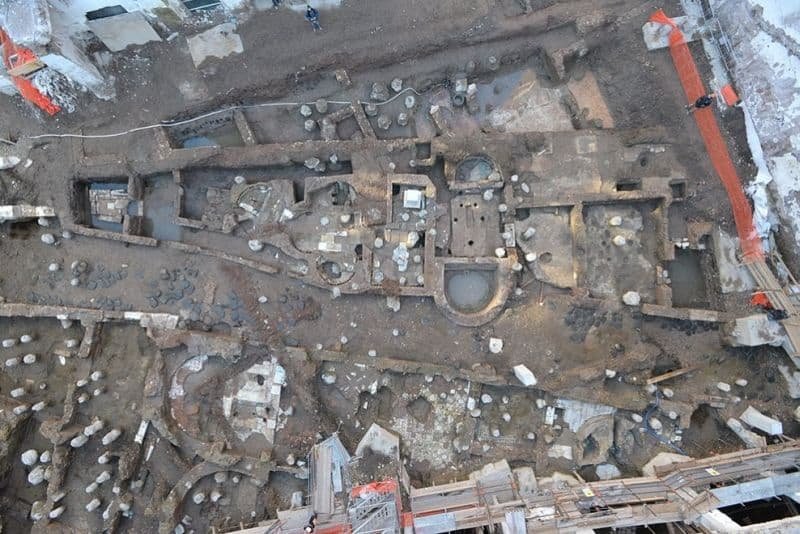
The advice I give you for visiting Aqua Virgo - Acqua Vergine aqueduct
There is one piece of advice, and it goes against everyone's instinct: don't start at the Trevi Fountain. Start on via del Nazareno, which is the only place where the Aqua Virgo shows itself for what it is, a Roman wall that carries water, and not for what it has become, a backdrop for photographs.
Here is an itinerary anyone can do on their own in a little under an hour and a half. Start at piazza Barberini, go down via del Tritone and turn onto via del Nazareno. On the right, set four or five meters below the modern street level, three arches in travertine rusticated blocks appear, with the inscription of Claudius's restoration above them. They are there, behind a railing, with no ticket and no line. Look at them from the opposite sidewalk to grasp the difference in level between ancient and today's Rome. That difference is the real history of the city.
From there, head back toward via del Tritone and enter the basements of the department store at the corner of via dei Due Macelli, where other remains of the channel were found during renovation work. They are preserved today and visible to the public during the store's opening hours. Then go down toward Palazzo Sciarra, on the Corso, beneath which two travertine fornices of the aqueduct are preserved. Access depends on the initiatives of the foundation based in the palace, so check each time. Knowing they are there changes how you see that stretch of road. Take the chance to slip into the nearby Galleria Sciarra, a Liberty-style courtyard that has nothing to do with the aqueduct and is one of the most beautiful spots in the neighborhood.
Only at the end do you reach the Trevi Fountain, and by then you look at it with different eyes: not as a Baroque fountain, but as the terminal tap of a 20-kilometer-long work. If you have an extra hour, finish with the descent to the Vicus Caprarius at vicolo del Puttarello 25, where you can see the structures of an imperial house and the castellum aquae of the aqueduct. The right order is this: first the engineering, then the stagecraft. Done the other way around, the Baroque swallows everything and nothing of the aqueduct remains.
One last recommendation, less romantic. The Trevi area is the most congested point of the Historic Center: between nine and 10 in the morning you can walk, but from 11 on you queue just to stand still. If you have to pick a time, choose eight in the morning or the evening after 23:00. The arches on via del Nazareno, on the other hand, are deserted at any hour of the day, which says a lot about how tourism works in Rome.
The remains of the Aqua Virgo - Acqua Vergine aqueduct visible today
The three arches of the Aqua Virgo on via del Nazareno
They are the best known piece and the easiest to see. Three arches in travertine rusticated blocks, at the intersection of via del Nazareno and via dei Due Macelli, belonging to the urban section on arcades. The rustication, meaning the rough treatment of the block surfaces, is typical of hydraulic construction from the Claudian period and also has an aesthetic value: it gives the work a deliberately severe look, of infrastructure and not of monument.
An inscription on the front records the restoration commissioned by the emperor Claudius in 46 AD, who repaired the damage caused by Caligula's works. It is one of those texts that reveal how the Roman state worked better than any chronicle: an emperor putting his own name on a wall to say he had fixed an aqueduct broken by a predecessor.
The ancient walking level, as you can see, was several meters below the current one. It's not a mysterious phenomenon. It is the result of 20 centuries of collapses, Tiber floods, fill, rubble and reconstructions that have gradually raised the ground level of the historic center. At that spot the difference in level is easier to read at a glance than in many archaeological digs that charge admission.
The arches of the Aqua Virgo under Palazzo Sciarra
Under Palazzo Sciarra, on Via del Corso, two travertine arches of the aqueduct are preserved, found in the 19th-century excavations and now restored and put on show in the basement of the building, home to a cultural foundation. It is the only place where you can walk next to an arch of the Aqua Virgo with the ancient floor under your feet. Access is not continuous and follows the calendar of the foundation's events. It's best to check availability before showing up.
The underground of Via del Tritone
During the construction of the department store at the corner of Via del Tritone and Via dei Due Macelli, significant remains of the channel came to light. They were preserved in situ and integrated into the basement floor of the building. You can see them for free during commercial opening hours. It is the most curious case of Roman urban archaeology of recent decades: a piece of Augustan aqueduct among the shelving, with museum lighting and no ticket. It's a successful solution, much more than certain locked-down, invisible underground displays.
The open-air stretch in Pietralata
320 meters of structure in tufa opus reticulatum that span the Fosso della Marranella, in the Pietralata neighborhood. It's the longest and least known stretch outside the city, in a neighborhood green area. It has no services, no staff, no opening hours: it's a Roman wall in the middle of a meadow.
The Chiocciola del Pincio and the channel of the Aqua Virgo
In the grounds of Villa Medici, under the Pincio, a spiral staircase in excellent condition descends to the underground channel. It's an ancient service access, readapted over the centuries, that lets you reach the channel without opening a shaft. It is not on the villa's ordinary visiting route and can only be seen on special occasions.
The Arch of Claudius and the Aqua Virgo - Aqua Virgo aqueduct
The story is one of those worth telling in full. At the point where the aqueduct had to cross Via Lata, that is present-day Via del Corso, at the height of Palazzo Sciarra, the Romans built an arch like many others. Between 51 and 52 AD, however, that functional arch was turned into a triumphal arch dedicated to Claudius to celebrate the conquest of Britain in 43.
The monument was faced, decorated with statues of the imperial family and military trophies, and fitted with an inscription celebrating the emperor for having received the surrender of 11 British kings without suffering losses and for being the first to bring barbarian peoples across the Ocean under Rome's rule. A brazen and brilliant piece of political communication: you take a piece of hydraulic infrastructure and turn it into propaganda, without spending a sesterce on the foundations.
Nothing of the arch remains in place. The fragments recovered over time are kept in several locations: in the Palazzo dei Conservatori and in Palazzo Nuovo on the Capitoline, in the Galleria Borghese, and a relief with praetorians is in the Louvre in Paris. An arch of the aqueduct, identified in the 19th-century excavations, is preserved in the basement of Palazzo Sciarra. Strolling along the Corso, at the height of the palace, you walk exactly under the point where the water of the Virgo crossed the street inside a triumphal arch.
The ancient restorations of the Aqua Virgo - Aqua Virgo aqueduct
Tiberius, Caligula and Claudius
An aqueduct is a machine that wears out. The first documented intervention is by Tiberius in 37 AD, 56 years after the inauguration. Next, between 45 and 46, comes the restoration by Claudius, the one recorded by the inscription on Via del Nazareno, made necessary by the damage caused by Caligula's building sites. It's worth dwelling on this point: Caligula had started building works in that area that had compromised the arches, and his successor had to put the structure back in order and say so publicly. Maintenance, in Roman administration, was a political matter.
Constantine, Theodoric and late antiquity
After the 2nd century the news thins out, but the network continues to be looked after. The sources mention interventions from the age of Constantine and then by Theodoric, the Ostrogothic king who between the end of the 5th and the beginning of the 6th century took care to keep the aqueducts of Rome in working order as an act of legitimizing his own power. Under Theodoric the city still works: the baths are open, the fountains spout, the water administration still has staff and regulations.
That world ends suddenly a few decades later, and it ends for military reasons.
Another well-known fact, yet rarely cited
Everyone knows that the Goths cut Rome's aqueducts. What almost no one explains is what that meant in practical terms for the city, and why the Aqua Virgo alone managed to get back on its feet while the other 10 stayed down for good.
In 537, during the siege of Rome by the Gothic king Vitiges, the aqueducts were cut outside the walls. It was not an act of vandalism. It was a tactical decision. By cutting the conduits, the city lost its running water, the mills that ground grain stopped, and the defenders lost the baths, which were the main hygiene facility for a besieged population. The immediate result was the end of the public Roman baths, which after that date never reopened with their original function. The long-term result was the movement of the population from the hills toward the bend of the Tiber, where people could draw water from the river and wells. This is why medieval Rome abandoned the Palatine, the Aventine and the Caelian and crowded into the Campo Marzio.
The Aqua Virgo survived for a simple and decisive reason: it was almost entirely underground. An aqueduct on arches can be demolished with a few blows of a pickaxe. A gallery 40 meters deep cannot. There was damage and the flow was interrupted, but the structure remained largely intact and recoverable. It was Pope Adrian I, between 772 and 795, who ordered the first major medieval restoration, at a time when the papacy was regaining control of the city's practical government. In the 12th century, the Comune di Roma also got involved. Then came the popes of the Renaissance, who made that water the foundation of modern Rome.
Here's the point: the survival of the Aqua Virgo is not a miracle. It is the result of design choices made in 19 BC. It survived because it was invisible, and because it carried water that did not leave deposits. The two qualities that made it the least spectacular of the aqueducts are exactly the ones that made it last.
The Renaissance Restoration of the Aqua Virgo - Acqua Vergine aqueduct
Nicholas V, Leon Battista Alberti and 1453
The first documented Renaissance restoration is by Pope Nicholas V, the humanist pope who in 1453 had the conduit repaired and the terminal outlet at Trevi rebuilt. A payment from that year records 200 ducats for work on the Trevi water outlet, and Giorgio Vasari credits the pope with restoring the Acqua Vergine conduit, which had been broken. Leon Battista Alberti worked on the site as a consultant, and Bernardo Rossellino was the executor. These two names are enough to show how much that restoration mattered in the program to refound the city that Nicholas V wanted.
The Trevi outlet built back then was a plain basin set against a wall, very far from the staging we see today. For the pope, the point was not aesthetics. It was bringing running water to a neighborhood that lacked it and reactivating a symbol of continuity with Imperial Rome. A pope who puts an aqueduct of Agrippa back into service declares, without writing it down, that he is the rightful heir of the Caesars.
Sixtus IV and the work of the 1400s
Work continued under Paul II, between 1466 and 1467, and under Sixtus IV in the 1470s. A payment from October 1472 documents the demolition of ancient structures to recover marble for the new arches of the aqueduct. This was a normal practice at the time and is unthinkable today, a reminder of how Renaissance Rome built itself by taking apart the Imperial city. Chronicles credit Sixtus IV with bringing the water from the Quirinal to the Trevi fountain at his own expense.
Pius IV, Antonio Trevisi and the search for the lost springs
The decisive restoration is the one begun by Pope Pius IV around 1560. The problem was serious: for centuries the aqueduct had no longer reached the original springs at Salone, settling for intermediate intakes with reduced flow, and the conduit within the city was partly clogged with rubble. Pius IV entrusted the job to the engineer Antonio Trevisi, whom the Camera Apostolica records also as Antonio Treviso, with the task of finding and reconnecting the ancient intakes.
It was a long and complicated worksite, carried out largely underground, by feel, following blocked tunnels and collapsed shafts. The work to reconnect the original springs began in 1561. On the Comune's side, oversight of the work passed to Giacomo Della Porta, architect of the Popolo Romano, who would later design almost all of the fountains for this water.
Luca Peto and 1570
The story was told by Luca Peto, a jurist and Capitoline conservator, who published a treatise in Rome in 1570 devoted entirely to the restoration of the Acqua Vergine conduit. It is a valuable text because it was written by someone who followed the work from the administrative side and knew its costs, disputes and technical difficulties. On August 16, 1570, under the papacy of Pius V, the restoration was officially completed, and the water returned to flow at Trevi at the flow rate of the ancient springs.
This date matters more than it seems. From 1570 on, the historic center of Rome once again had abundant running water, and within 30 years Giacomo Della Porta filled the district with public fountains. The Rome of fountains, the one everyone photographs, was born from a hydraulic project carried out in the dark 10 kilometers from the walls.
The Popes of the 1600s and 1700s
After Pius V, maintenance continued under Paul IV, Benedict XIV and Pius VI, while in 1840 the network was expanded. Every papacy worked on some stretch, added an intake or repaired a collapsed vault. The history of the Acqua Vergine from the 16th century to today is one of continuous maintenance, not heroic but very effective. That is how an infrastructure is kept alive for 20 centuries.
The Water Displays of the Aqua Virgo Aqueduct
In Roman technical language, a water display is the monumental fountain that ends an aqueduct and publicly announces its arrival. The Aqua Virgo has one very famous example and a series of lesser sister fountains that deserve the same attention.
Trevi Fountain, the Terminal Water Display of the Aqua Virgo Aqueduct
The Trevi Fountain is the terminal water display of the aqueduct. Before the present one, there were other arrangements, starting with the medieval one and the one of Nicholas V. In 1640 Gian Lorenzo Bernini developed a design for Urban VIII that remained on paper. The decisive competition was launched by Pope Clement XII in 1732 and won by Nicola Salvi. Work continued until 1762 and was completed by Giuseppe Pannini, who partly modified the rockwork. The materials are travertine, marble, plaster, stucco and metals.
The name Trevi is debated. Some derive it from a place name recorded in the 12th century, others from the triple outflow of the water of the original fountain. One detail almost nobody notices: high on the facade there are two reliefs. One shows the young woman pointing out the spring to the soldiers. It is not generic decoration. It is the founding legend of the aqueduct, carved in stone above its end point. Anyone who passes by without looking up misses the meaning of the whole monument.
A firm and unpopular opinion: Trevi Fountain seen at 11 in the morning is not worth the time it takes to get there. Seen at seven, with the sun low and 30 people in total, it is one of the three or four finest urban sights in Europe. It is the same fountain. Only the hour changes.
The Barcaccia in Piazza di Spagna
The Barcaccia Fountain, at the foot of the steps of Piazza di Spagna, is fed by the Aqua Virgo and solves a technical problem with a poetic invention. At that point the water pressure from the aqueduct is very low, because the elevation is almost the same as the conduit: a vertical jet would have been impossible. The solution was a half-sunken boat, with water spilling over its edges instead of spouting. The hydraulic limitation becomes the subject of the work.
The fountain is the work of the Berninis, with the main part of the design attributed to Pietro Bernini and with the collaboration of his son Gian Lorenzo. It was built in the 1620s for Urban VIII, whose coat of arms with bees appears on the basin. This is the right place to explain to a group what it means to work with a gravity-fed aqueduct: the water arrives at the height it has, not the height one would like.
The Fountains of Piazza Navona
The fountains of Piazza Navona are fed by the Aqua Virgo. The two side fountains, today known as the Fountain of the Moor and originally the Fountain of the Calderari, later the Fountain of Neptune, were built by Giacomo Della Porta in the 1570s, right after the aqueduct restoration was completed. They are direct products of the works under Pius IV and Pius V. The Fountain of the Four Rivers by Gian Lorenzo Bernini came much later, in the mid-1600s, and uses the same conduit.
Anyone who wants to see what lies beneath the square can go down to the Stadium of Domitian underground. The elongated shape of the square is that of the arena, and the fountains of the Virgin occupy its axis.
The Fountain of the Terrina
The Fontana della Terrina, which Romans call the zuppiera (soup tureen) of Corso Vittorio, is fed by the Acqua Vergine through a secondary conduit that served the Campus Martius district. It was designed by Giacomo Della Porta and built between 1590 and 1595 for Campo de' Fiori, where it stayed until the end of the 19th century. It was then removed to make room for the monument to Giordano Bruno, ended up in storage and in 1924 was relocated to Piazza della Chiesa Nuova, in front of Santa Maria in Vallicella, where it stands today.
The travertine lid that earns it the nickname was added in 1622 to stop the market vendors from washing their goods in it. Along the rim runs an inscription that has become proverbial in Rome: AMA DIO E NON FALLIRE, FA DEL BENE E LASSA DIRE (Love God and do not fail, do good and let them talk). A fountain that dispenses moral advice because people were using it badly: it doesn't get more Roman than that.
The Fontanella del Facchino
On the facade of a building on Via Lata, a few meters from the Corso, a figure of a man in 16th-century dress holds a little barrel from which a thread of water flows. It is the Fontanella del Facchino, one of Rome's talking statues, fed by the Acqua Vergine and made in the last quarter of the 16th century, with the execution traditionally attributed to the painter Jacopo del Conte. It represents an acquarolo, that is, one of those men who before the aqueduct was restored sold water door to door with barrels.
The meaning is more beautiful than the monument. At the moment when the Acqua Vergine flows again and public fountains make the acquarolo's trade useless, the city puts on the wall the statue of the man who did that trade, and puts in his hand a little barrel that pours water for free. It's a monument to its own professional extinction, almost five centuries ahead of any contemporary debate.
The Other Fountains of Giacomo Della Porta
Between 1570 and the end of the century Della Porta designed for the Acqua Vergine an impressive series of public and semi-public fountains: in Piazza del Popolo, in Piazza Colonna, in Piazza della Rotonda in front of the Pantheon, in Piazza Navona, in Piazza Mattei with the turtles added later, in Via del Babuino, in Via della Scrofa. Many were moved, remade or reassembled over the centuries, but the matrix is the same: a unified urban furnishing project financed by the return of the water.
It's worth comparing it with the twin operation carried out on the other bank of the river, where the Acqua Paola Fountain crowns in glory the Trajan aqueduct restored by Paul V. Two aqueducts, two monumental displays, two strategies for representing papal power. The difference is that the Acqua Paola is a triumphal arch that looks down on the city from above. The Acqua Vergine, true to its nature, arrives stealthily and shows itself only at the end, inside a courtyard enclosed between three streets.
The Fontana del Nicchione and the Extension of 1936
In 1936 the Acqua Vergine network was extended toward the Pincio, and the terminal display of that extension is the Fontana del Nicchione, below the Pincio. It is a little-cited 20th-century page and useful to remember that the aqueduct is not a frozen relic: it has continued to be extended and modified until the day before yesterday.

The Right Photo to Take at Aqua Virgo - Acqua Vergine Aqueduct
The right photo is not the Trevi Fountain. 200 million people have already taken that one and it adds nothing. The right photo is on Via del Nazareno, and it should be set up like this.
You stand on the sidewalk opposite the arches, as far as possible from the railing, and frame vertically including three elements: the Roman arches at the bottom, sunk below street level, the wall of the modern building above them, and a slice of sky. The composition works because it tells in a single frame the five or six meters of difference in level between the Rome of Augustus and the Rome of now. If a parked scooter also enters the frame above the arch, all the better: it's the most honest photograph you can take of this city.
On the light: that stretch of street is narrow and in shade almost all day. The good hours are early morning, when the light reflected from the pale walls lights the travertine without harsh contrasts, and overcast days, which here help instead of ruining. The overhead sun of noon splits the image in two, with black arches and a blown-out sky: to be avoided.
On equipment: you need a moderate wide-angle lens, because there is little room to step back. With a phone, use the main lens and not the ultra-wide mode, which distorts the arches and makes them look small. If you have a small tripod, the evening after sunset that wall with the warm street lighting gives surprising results, with exposures of one or two seconds.
Second photo, for those who want something rare: the stretch of Pietralata in opus reticulatum, photographed at an angle with the low late-afternoon sun. The side light brings out the reticulated pattern of the tufa blocks like a textile weave, and within 10 minutes you go from an anonymous wall to a designed surface. It's an image almost nobody has, and this, today, is already a good reason to take it.
Third option, the most difficult: the underground conduit, which can only be photographed during guided tours and only where it's allowed. There you need high ISO, an auxiliary light source and the discipline of not using direct flash, which flattens everything. Always ask before taking pictures: in managed underground sites, the photography rules change from one site to another.
Some important events that happened here in history
June 9, 19 BC
The water enters the city for the first time under the consulship of Gaius Sentius Saturninus and Quintus Lucretius Vespillo. Rome, at that moment, has only recently stopped being a republic and is learning to be an empire. Agrippa gives the city an aqueduct that feeds the first free public baths in Roman history: a political gesture as well as a technical one, because it establishes that water and hygiene are a service owed to the people and not a privilege.
The banquet of Tigellino on the Stagnum fed by the Aqua Virgo
Under Nero, the body of water also fed by the Aqua Virgo becomes the setting for one of the most talked-about parties of antiquity. The praetorian prefect Ofonio Tigellino organizes a lavish, licentious banquet for the emperor, set on the water, with a raft pulled by boats and floating stage sets. Tacitus leaves a famous account of it, written with that mix of disgust and fascination that makes his prose unmatched. This is not frivolous anecdote: it is proof that the Stagnum Agrippae, and therefore the aqueduct that supplied it, had become part of the spectacle of imperial power.
43 AD and Britannia
The conquest of Britannia by Claudius did not happen along the aqueduct, but this is where it is celebrated. Between 51 and 52 the arch that crosses via Lata is turned into a triumphal arch, with statues, trophies and an inscription boasting the surrender of 11 British rulers. For the Romans who passed by, the water flowing above their heads literally came from the other side of the known world.
46 AD: Claudius's restoration
The restoration made necessary by Caligula's works is carved in stone, and the plaque is still legible on via del Nazareno. It is one of the few cases where someone today can read, on site and in the original, an emperor's declaration about a hydraulic maintenance job carried out almost 2,000 years ago.
537: the siege of Vitiges
The cutting of the aqueducts during the Gothic siege is the moment when ancient Rome ends as an urban organism. The baths shut down, the mills stop, the city contracts toward the river. The Aqua Virgo is interrupted like the others, but survives in its buried structure: it is the only one that, centuries later, can be returned to without having to rebuild it from scratch.
1453: the return of water under Nicholas V
The restoration promoted by Nicholas V, with Leon Battista Alberti as consultant and Bernardo Rossellino as executor, brings running water back to Trevi. It is the first act of Renaissance Rome as a livable city: without that worksite, the Historic Center could not have grown as it later did.
August 16, 1570: the reconnection of the springs
With the completion of the works begun by Pius IV and concluded under Pius V, the aqueduct once again captures the original springs at Salone. The flow multiplies and within a generation the center fills with public fountains. This is the date that created the Rome of fountains as we know it.
1622: the lid on the Terrina
A small episode, of great significance. The fountain in Campo de' Fiori is closed with a travertine lid because merchants were using it improperly. An urban police measure that today reads as a piece of social history: public water was a contested and regulated resource.
1732 and 1762: the Trevi Fountain
The competition called by Clement XII and won by Nicola Salvi opens the worksite that will give the aqueduct its definitive image. 30 years of work, an architect who dies before seeing the work finished, a successor who modifies the rockwork. The result is the most photographed fountain on the planet and the best lesson in urban stage design ever carried out in Rome.
1889 and 1924: the Terrina in exile
The Terrina fountain leaves Campo de' Fiori at the end of the 19th century to make room for the monument to Giordano Bruno, remains dismantled in the municipal warehouses, and reappears in Piazza della Chiesa Nuova in 1924. An Acqua Vergine fountain that spends 30 years in a storage depot is a reminder of how fragile heritage is, even when it seems untouchable.
1936: The extension toward the Pincio
The network is extended and the Nicchione mostra is created. The aqueduct continues to be a living infrastructure, not a relic.
1961: The end of drinkability
The year the water of the old conduit is declared non-drinkable, due to infiltration of polluted surface water and the structural failures of the channel, and it is destined for irrigation and monumental fountains. It is the date that separates the ancient Acqua Vergine, now fountain water, from the new Acqua Vergine, which feeds the taps.
The water of the Aqua Virgo - Acqua Vergine aqueduct: quality and potability
Why this water has stayed clean for 20 centuries
The decisive technical feature is the low content of dissolved calcium salts. A water that is not very encrusting doesn't deposit concretions on the walls of the speco and doesn't choke it. This is the material reason why the Aqua Virgo has reached us with its useful section almost intact, while other ancient conduits closed on their own. The lightness of the water, which the ancients praised by gastronomic and medical criteria, has proven to be the best maintenance guarantee possible.
Is the water from the Trevi Fountain drinkable?
No. The water circulating in the old conduit was declared non-drinkable in 1961, and since then it has been destined for irrigation and for feeding monumental fountains. The cause is twofold: on one hand, the extremely violent urbanization of the postwar period polluted the aquifers and the channel, and on the other, the ancient conduit shows subsidence and collapses that favor stagnation and infiltration. A large part of the ancient structures, moreover, has in the meantime been replaced by cement pipes.
The practical rule for visitors is simple: you don't drink from the monumental mostre of the ancient Acqua Vergine, and where the operator deems it necessary, this is posted on site. From the public drinking fountains of the historic center, the so-called nasoni, you can drink without hesitation, because those are served by the city's drinking water network. When you find a historic fountain with no signs and you have a doubt, the rule is the same as always: drink from the nasoni, not from the monumental basins.
What Acqua Vergine means today
The name has stuck to two different things, and this causes confusion. Acqua Vergine antica is the historic conduit, not drinkable, that feeds the fountains. Acquedotto Vergine Nuovo is the contemporary system that captures the same springs of Salone, treats them and pressurizes them for human consumption. The same geological origin, two separate systems, two different destinies.
The Acquedotto Vergine Nuovo
An Acqua Vergine aqueduct from the 1930s
Between 1932 and 1937 a new aqueduct intended for drinking use is built, drawing from the Salone springs along Via Collatina, with a maximum availability of around 500 liters per second. The logic is the opposite of the ancient one: where the Romans exploited gravity and accepted a very long route, twentieth-century engineering lifts the water mechanically and sends it into the city by the shortest path.
The piezometric tower and the pressure main
The captured waters converge in a mixing structure, from which they are lifted through two cast iron pipes with a diameter of 600 millimeters up to a piezometric tower about 50 meters high. From there a pressure main about 12.7 kilometers long leaves and reaches the Villa Umberto reservoir, that is, today's Villa Borghese, from which the historic center's network branches out. The flow rate of the main reaches 1,200 liters per second.
The comparison is instructive. The ancient aqueduct covers 20 kilometers with a slope of 30 centimeters per kilometer and no external energy. The modern one covers 12 kilometers and 700 meters with two pumps and a 50-meter tower. The first has been working for 2,000 years and doesn't consume electricity. The second is faster and safer from a health standpoint. They are two philosophies, and neither one is trivial.
Why the old one was not decommissioned
Because it is needed. Rome's monumental fountains consume considerable quantities of water, and feeding them treated drinking water would be a waste that is hard to justify. The old conduit continues to do what it has always done, with a use suited to the current quality of its water: irrigating urban greenery and feeding the historic mostre. It is a rare case of a 2,000-year-old infrastructure repurposed rather than demolished.

Il tracciato dell'Aqua Virgo attraversa Roma quasi interamente sotto terra
Who has passed through the Aqua Virgo - Acqua Vergine aqueduct
The ancients who passed through the Aqua Virgo
The first name is that of Marco Vipsanio Agrippa, who commissioned, paid for and inaugurated the aqueduct on June 9, 19 BC. Alongside him, inevitably, is Augustus, who was the political sponsor of that building program and who turned water into a tool for building consensus. Tiberius in 37 and Claudius between 45 and 46 worked on the channel, and Claudius left his name carved on an arch that is still there. Caligula passes through this story as an unintentional wrecker: his construction sites damaged the structure, and it fell to his successor to fix it.
Nero and his prefect Ofonius Tigellinus appear on the Stagnum fed by this water, at the feast described by Tacitus. Sextus Julius Frontinus, curator aquarum under Nerva and Trajan at the end of the 1st century, is the man who left us the numbers: without his treatise we would know neither the length, nor the flow rate, nor the day of the inauguration. Then Constantine and, at the end of antiquity, Theodoric, the Ostrogoth who kept Rome's aqueducts alive for as long as he could.
The popes who put the Acqua Vergine back into service
Adrian I, between 772 and 795, orders the first major restoration after the Gothic disaster. Nicholas V in 1453 brings the water back to Trevi with Leon Battista Alberti and Bernardo Rossellino. Paul II and Sixtus IV follow, and above all Pius IV, who in 1560 sets in motion the decisive project, and Pius V, under whom the work is completed on August 16, 1570. Then Urban VIII, who commissioned the Barcaccia and asked Bernini for a design for Trevi that stayed on paper, Clement XII, who launched the competition of 1732, and Benedict XIV and Pius VI, who kept up the maintenance.
The artists and engineers of the Acqua Vergine
Antonio Trevisi, the engineer commissioned by the Apostolic Camera to find the lost springs, is the least famous and perhaps the most important: without his work underground, none of the fountains we admire would exist. Luca Peto, a jurist and Capitoline conservator, wrote its chronicle in 1570. Giacomo Della Porta designed most of Rome's public fountains for this water between 1570 and the end of the century. Pietro Bernini and Gian Lorenzo Bernini sign the Barcaccia. Gian Lorenzo returns to the Acqua Vergine with the Fountain of the Four Rivers. Nicola Salvi and Giuseppe Pannini build the mostra di Trevi. Jacopo del Conte is the name tradition links to the fountain of the Facchino.
Travelers and cinema
From the eighteenth century on, the mostra di Trevi enters the required repertoire of the Grand Tour: they draw it, engrave it, copy it. In the twentieth century it becomes one of the most reproduced images in the world thanks to cinema, which made it the backdrop of scenes that stayed in the collective imagination. On this, one fact is enough: none of those directors ever filmed the aqueduct, they filmed the fountain. The infrastructure that makes the scene possible stays invisible even when it is extremely famous. That is the fate of the Aqua Virgo, after all, for 2,000 years.
Visiting the tunnels of the Aqua Virgo - Acqua Vergine aqueduct
Vicus Caprarius, the City of Water
It is the most accessible underground site and the best suited for anyone who wants to understand the relationship between the aqueduct and the city. The archaeological area is at vicolo del Puttarello 25, about a hundred meters from the Trevi Fountain, and it came to light during the renovation work at the former Trevi cinema. It preserves the structures of an imperial-age domus and the castellum aquae of the Vergine aqueduct, that is, one of the distribution tanks from which water was divided among the users of the neighborhood.
The published hours are Tuesday to Sunday, 11.00-17.00, closed on Mondays. Tickets: full €4.00. Reduced €2.50 for Roma Pass holders, university students aged 18 to 25, teachers, journalists and law enforcement officers. €1.00 for young people aged 14 to 17. Free for children under 14 and for university students of archaeology. Audio guide €3.50. The site is underground and capacity is limited, so booking is mandatory on weekends and public holidays and in any case recommended on weekdays too: book by calling +39 339 7786192, also by message, available Tuesday to Sunday from 10 to 16. Before setting out, it's always best to check hours and fares on the official website of the Vicus Caprarius.
Professional opinion: four euros to see a castellum aquae in situ is among the best money spent in the Historic Center. The visit lasts between 20 and 40 minutes, it isn't strenuous, and it shows you exactly the missing link between the underground conduit and the fountains on the surface.

The section managed by the Sovraintendenza Capitolina
The Sovraintendenza Capitolina manages a section of the aqueduct in the Trevi rione, which can be visited with mandatory booking at 060608, in groups of a maximum of 20 people, with tickets at 4,00 euros full price and 3,00 reduced, and free entry for residents of Rome and the Metropolitan City and for MIC Card holders. The guided tour is not included in the cost and must be arranged separately. At the moment the site is closed for works: access conditions should be checked on the Sovraintendenza Capitolina page dedicated to the Aqua Virgo aqueduct or by phone.
Caving visits and the Salone springs
The long stretch of the speco and the catchment area are not tourist sites: they are covered with caving associations and research groups, in agreement with the water utility, with proper equipment and limited numbers. Anyone who wants to learn about this kind of tour can start with the profiles published by Sotterranei di Roma on the Aqua Virgo springs, which also document the Salone piezometric tower.
Three rules apply to visits underground. First: go only with someone who has permission, never on your own, because entering an active water conduit without authorization is dangerous and illegal. Second: you need shoes with grooved soles, boots when indicated, and clothes you don't mind getting dirty. Third: the temperature underground stays constant at around 15 degrees all year, with very high humidity, so in summer bring a sweatshirt and in winter you don't need a down jacket.
A walking itinerary along the traces of the Aqua Virgo - Acqua Vergine aqueduct
First stop: Piazza Barberini and via del Tritone
Start at the Barberini stop on metro line A. From Piazza Barberini, where Bernini's Triton Fountain is fed by another aqueduct, go downhill on via del Tritone. It's useful precisely as a point of comparison: two fountains 400 meters apart, served by two different networks, with jets of different heights because the water arrives at a different elevation.
Second stop: the arches of via del Nazareno
Turn left onto via del Nazareno and you'll reach the three travertine arches with the Claudia inscription. 10 minutes standing here are worth half an hour in line somewhere else. Look at how the blocks are cut, the rustication, and the difference in level compared to the street.
Third stop: the underground of via del Tritone
Go back 200 meters and go down to the basement level of the department store at the corner with via dei Due Macelli, where the remains of the conduit are preserved and lit. Free entry during store hours.
Fourth stop: Palazzo Sciarra and the Galleria Sciarra
From via del Tritone, head down toward the Corso to Palazzo Sciarra, under which the two arches of the aqueduct are preserved. Even if you can't go down into the underground, the alley leading to the Galleria Sciarra is worth the detour: the frescoed late 19th-century courtyard is one of the most photogenic interiors in the rione.
Fifth stop: the Trevi Fountain and the Vicus Caprarius
Reach Trevi from the upper side, look at the bas-reliefs with the story of the maiden, then go down via vicolo del Puttarello for the visit to the castellum aquae. Anyone with energy left can continue toward via del Seminario and piazza di Sant'Ignazio, along the route of the last urban stretch, and finish at the Pantheon, where the aqueduct ended at the Baths of Agrippa.
Sixth stop, for the most curious: the Arco della Ciambella
From the Pantheon, five minutes on foot is enough to reach via dell'Arco della Ciambella and see the surviving curved wall of the Baths of Agrippa. It's the logical end point of the itinerary: the purpose for which the whole structure was conceived.
The Aqua Virgo - Acqua Vergine aqueduct with children
It works better than you might think, as long as you explain it as a machine rather than a history lesson. Kids immediately like the idea that the water of the Trevi Fountain comes from 20 kilometers away, flowing on its own, without pumps, with a slope of 30 centimeters every 1,000 meters. The game I suggest to parents is simple: ask the child to guess, in front of the fountain, where the water comes from and how long it takes. Then you go down to the Vicus Caprarius and see the reservoir.
Visits to the Vicus Caprarius are free for children under 14, last only a short time and have no demanding routes, so they hold the attention of the youngest kids well. The arches on via del Nazareno are outdoors and don't require silence or discipline. The Pietralata stretch, however, I would avoid with small children: it's a green area with few facilities.
A practical tip for summer: the Trevi area in August, at noon, is a trap of heat and crowds. With children, go early in the morning, bring water, and plan a stop in the shade.
Accessibility of the Aqua Virgo - Acqua Vergine aqueduct
The picture is uneven, and it's worth knowing this in advance. The arches on via del Nazareno can be seen from the street and are reachable by wheelchair, with the caveat that the sidewalks in the Trevi rione are narrow, often occupied, and have sanpietrini in several places. The underground areas of via del Tritone have the department store's elevators and are the easiest option for anyone with mobility issues.
The underground archaeological areas, by their nature, involve stairs and narrow passages. Anyone with particular needs should check in advance directly with the site, because conditions change from one space to another. Caving visits to the speco are not accessible.
At the Trevi Fountain the problem is not architectural but crowding: the square is stepped, and at peak hours the pressure of the crowd makes any movement difficult. Anyone using a wheelchair or stroller should do their best to get there before 09:00 in the morning.
When to see the Aqua Virgo - Acqua Vergine aqueduct
The arches on via del Nazareno are always visible and have no season. The Pietralata stretch is at its best in spring and autumn, with the low light of late afternoon and low grass. The underground areas have a constant temperature and are the right choice on scorching days or during heavy rain.
For the Trevi Fountain the rule is simple: before 08:00 in the morning or after 23:00, never in between. Avoid holiday long weekends, Easter week, and late-August days. If you're in town in the off season, between November and February, the same square can be visited in civilized conditions even in the middle of the day.
The best moment of all, for anyone who loves this city and isn't in a hurry, is a January morning after rain: the wet travertine of via del Nazareno turns honey-colored and there's no one there.
What's around the Aqua Virgo - Acqua Vergine aqueduct
Within a 10-minute walk of the arches on via del Nazareno, a substantial part of the Historic Center is concentrated. Heading north, you climb to piazza di Spagna with the Barcaccia and, past the staircase, to the Pincio and Villa Borghese: the same aqueduct runs underground along that route. Heading south, you go down to the Trevi Fountain and from there to the Corso, piazza Colonna, the Pantheon, and largo di Torre Argentina.
If you want to broaden the topic of aqueducts, there are two destinations worth a full day: the Aqueducts Park, where the arches run outdoors for kilometers, and the Acqua Paola Fountain on the Janiculum, a display of the Trajan aqueduct restored in the 17th century. On the museum side, the Crypta Balbi tells the story of the layering of the Campo Marzio from antiquity to the Middle Ages better than any other place, that is, exactly the area served by the Aqua Virgo.
A brief history of the Aqua Virgo - Acqua Vergine aqueduct
It's worth putting together in a few lines a story 2,000 years long, because it is the story of Rome itself told through a pipe. In 19 BC, Agrippa brings light water drawn from the east into the city, to run the first free public baths in Roman history. For five centuries the aqueduct works quietly, repaired by Tiberius, Claudius, Constantine, and Theodoric. In 537 the Goths cut the conduits and Ancient Rome goes out, but the Aqua Virgo, buried, survives. Adrian I repairs it in the 8th century, the Comune in the 12th century, Nicholas V in the 15th century, Pius IV and Pius V in the 16th century, up to the reconnection of the original springs in 1570.
From that point on, water flowed abundantly and Rome filled with fountains: first Della Porta's, then the Barcaccia, then the Fountain of the Four Rivers, and finally the great Trevi display. In the 20th century the aqueduct was extended toward the Pincio and, between 1932 and 1937, a new aqueduct was built to tap the same springs for drinking water. In 1961 the water in the ancient conduit was declared non-potable and assigned to fountains and irrigation. Today the Aqua Virgo still works exactly as it did under Augustus, by gravity, with a minimal gradient, and feeds the most photographed fountains in the world.
Quick Questions About the Aqua Virgo Aqueduct
What Is the Aqua Virgo Aqueduct
It is a Roman aqueduct inaugurated in 19 BC by Marcus Vipsanius Agrippa, known in Italian as the Acquedotto dell'Acqua Vergine. It is the only one of the 11 great aqueducts of ancient Rome that has remained in continuous operation to this day.
How Long Is the Aqua Virgo Aqueduct
Frontinus gives 14,105 Roman paces, just over 20 kilometers. Of these, 12,865 paces are in underground tunnel and 1,240 paces are above ground, divided between 540 paces of substructures and 700 paces of arches in the city.
Where the Aqua Virgo Begins
The water is captured in the Salone area, at the eighth milestone of Via Collatina, east of Rome, beyond the Grande Raccordo Anulare ring road, at about 24 meters above sea level. There is no single spring, but a system of springs and aquifer veins gathered by tunnels.
Why It Is Called Aqua Virgo
Two explanations have always coexisted. Frontinus reports the tradition of the young woman who pointed out the springs to soldiers searching for water, remembered in a painting in a sacred building near the spring. The other explanation is technical and concerns the purity and lightness of the water, which is low in limestone.
When the Aqua Virgo Aqueduct Opened
June 9, 19 BC, under the consulship of Gaius Sentius Saturninus and Quintus Lucretius Vespillo. It is the only Roman aqueduct whose exact opening date we know.
Which Fountains Does the Aqua Virgo Feed Today
Trevi Fountain, which is its terminal water display, the Barcaccia in Piazza di Spagna, the fountains of Piazza Navona, the Terrina Fountain in Piazza della Chiesa Nuova, the small Facchino fountain on Via Lata and other historic displays in the center, as well as the Nicchione fountain below the Pincio.
Can You Drink the Water From Trevi Fountain
No. The water from the ancient conduit was declared non-potable in 1961 and is intended for irrigation and monumental fountains. For drinking, people use the nasoni, the public fountains connected to the city's drinking water network.
Where to See the Arches of the Aqua Virgo Aqueduct
The three arches of rusticated travertine blocks on Via del Nazareno, at the intersection with Via dei Due Macelli, are visible from the street for free at any hour. Other remains are in the basement of the large department store on Via del Tritone and under Palazzo Sciarra, where two arches are preserved.
How Much Does It Cost to Visit the Underground Aqueduct
The Vicus Caprarius archaeological area costs 4.00 euros for a full ticket, 2.50 euros reduced, and 1.00 euros for young people aged 14 to 17, and it is free for children under 14. The section run by the Sovraintendenza Capitolina costs 4.00 euros for a full ticket and 3.00 euros reduced, with free admission for residents and MIC Card holders.
Do You Need to Book to See the Aqua Virgo Aqueduct
For the Vicus Caprarius, booking is required on weekends and public holidays and recommended on weekdays, at +39 339 7786192. For the section run by the Sovraintendenza Capitolina, booking is required at 060608. The arches on Via del Nazareno need no booking.
How Long Does the Aqua Virgo Visit Take
The descent to the Vicus Caprarius takes 20 to 40 minutes. The full walking route between Via del Nazareno, the underground area on Via del Tritone, Palazzo Sciarra, Trevi and the Pantheon takes an hour and a half without stops and two and a half hours at a relaxed pace.
Can You Take Photos at the Aqua Virgo Aqueduct
Outdoors, no problem at all. In underground archaeological areas the rules vary from site to site. Ask at the entrance. In any case, direct flash is almost always discouraged or forbidden.
The Aqua Virgo Aqueduct Is Wheelchair Accessible
The arches on Via del Nazareno can be seen from the street, with narrow sidewalks and uneven paving. The underground area on Via del Tritone is served by the building's elevators. Underground archaeological sites involve stairs and narrow passages, so it is best to check in advance with each individual site.
The Aqua Virgo Aqueduct Is Suitable for Children
Yes, if you present it as a hydraulic machine. The visit to the Vicus Caprarius is short and free for children under 14. The outdoor section at Pietralata, on the other hand, is a green area with few facilities and is less suitable for little ones.
Why the Aqueduct Runs Almost Entirely Underground
Because the source sits at a very low elevation, about 24 meters above sea level, and with a gradient of 30 centimeters per kilometer, the conduit could not afford to cross the hills along the shortest route. The underground route and the great arch to the north served to maintain the gradient and to supply the northern suburbs.
What is the gradient of the Aqua Virgo - Acqua Vergine aqueduct
Current estimates place it at around 30 centimeters per kilometer, one of the lowest gradients among Roman aqueducts, made necessary by the modest elevation of the springs.
Who built the Aqua Virgo - Acqua Vergine aqueduct and why
Marcus Vipsanius Agrippa, son-in-law and right-hand man of Augustus, to supply the Baths of Agrippa in the Campus Martius and the monumental complex he was building in that district, including the Stagnum and the Euripus canal.
What was the Stagnum Agrippae of the Aqua Virgo
A large artificial body of water dug beside the Baths of Agrippa, between the present-day corso Vittorio Emanuele II and via dei Nari, that worked as a swimming pool attached to the baths. From it ran the Euripus, a canal about one kilometer long that emptied into the Tiber.
The Aqua Virgo - Acqua Vergine aqueduct fed a naumachia
No. Augustus's naumachia stood in Trastevere and was served by the Alsietino aqueduct, built specifically with water that Frontinus considered unhealthy and that was not distributed to the population. The body of water also fed by the Vergine was the natatio of the Baths of Agrippa.
What happened to the Aqua Virgo in 537
During the siege of Rome, the Gothic king Vitiges had the aqueducts outside the walls cut. It was a military choice: without running water, baths and mills stopped. The Aqua Virgo, buried for almost all of its route, suffered damage but remained recoverable, and was restored by Pope Adrian I between 772 and 795.
Who restored the Aqua Virgo in the Renaissance
Nicholas V in 1453, with advice from Leon Battista Alberti and work carried out by Bernardo Rossellino. Then Paul II and Sixtus IV. The decisive project is the one started by Pius IV around 1560, entrusted to engineer Antonio Trevisi, with municipal oversight by Giacomo Della Porta and the chronicle of Luca Peto. The work was completed on August 16, 1570, under Pius V.
What is the difference between the Acqua Vergine antica and the Acquedotto Vergine Nuovo
The Acqua Vergine antica is the historic conduit, not drinkable since 1961, that feeds fountains and urban greenery. The Acquedotto Vergine Nuovo, built between 1932 and 1937, draws from the same springs at Salone, pumps the water to a piezometric tower, and pressurizes it into the Villa Borghese reservoir for drinking water use.
How much water the Aqua Virgo - Acqua Vergine aqueduct carried
Frontinus records 2.504 quinariae, commonly converted to about 1.200 liters per second and just under 104.000 cubic meters per day, distributed through 18 castella serving public works, the imperial household, private concessions and the suburbs.
What is a castellum aquae of the Aqua Virgo
It is the distribution reservoir where the aqueduct's water was collected and then divided among the different users through calibrated outlets. One of these reservoirs, linked to the Aqua Virgo, can be visited at Vicus Caprarius, at vicolo del Puttarello 25.
Why the Barcaccia does not have a tall jet
Because at that point the water pressure from the Aqua Virgo is very low, the elevation of the square being nearly equal to that of the conduit. The half-sunken boat, with water spilling over its edges, turns a hydraulic limit into a formal invention.
Where is the Terrina fountain of the Aqua Virgo
In piazza della Chiesa Nuova, along corso Vittorio Emanuele II, in front of Santa Maria in Vallicella. It was built by Giacomo Della Porta between 1590 and 1595 for Campo de' Fiori and moved at the end of the 19th century. The lid with the inscription dates to 1622.
What is the small Facchino fountain of the Aqua Virgo
A wall fountain on via Lata, a few meters from the Corso, featuring the figure of a water carrier holding a small barrel. It is fed by the Aqua Virgo, dates to the last quarter of the 16th century, and is one of Rome's talking statues.
Can you walk through the underground speco of the Aqua Virgo
Only with authorized groups and caving associations working in agreement with the water utility, with proper equipment and limited numbers. Entering an active water conduit on your own is dangerous and prohibited.
What is the best time to see the Aqua Virgo
The arches on via del Nazareno can be seen all year. For the Trevi Fountain, early morning or late evening is best, and so is the low season between November and February. The underground areas, at a constant temperature, are the right choice in summer and on rainy days.
What is the connection between the Aqua Virgo - Acqua Vergine aqueduct and the Parco degli Acquedotti
No direct route connection: the conduits that entered the city from the southeast, such as the Anio Vetus, the Marcia, the Claudia and the Anio Novus, run through the Parco degli Acquedotti. The Aqua Virgo enters from the north and is almost entirely underground. Comparing the two sites remains the best way to understand how different the technical solutions used by the Romans could have been.
Our verdict on the Aqua Virgo - Acqua Vergine aqueduct
There is a moment when a visit stops being a list and becomes a story. With the Aqua Virgo, that moment almost always comes on Via del Nazareno, in front of three arches nobody photographs, when someone looks up at the buildings and realizes that the water of the world's most famous fountain has been flowing underneath there for 2,000 years without anyone pushing it.
If I could give only one piece of advice to readers, it would be this: spend an hour on the aqueduct before spending 10 minutes at the fountain. Go early, be patient with the crowds in the Trevi district, go down to the castellum aquae on Vicolo del Puttarello, and then come back up to the surface. You will see the same city with an extra layer of depth. And if one day you find yourself in Pietralata with the low sun, in front of 320 meters of reticulate work in the middle of the grass, you'll know you're in one of the very few spots in Rome where antiquity still has nobody around it.
Article written by the editorial team at TourLeaderPro. Contact them for Private/Corporate/V.I.P. Tours and Experiences.
Planning a trip to Rome? English-language guides to visiting the city are on ItalyPlanner.com.