Acqua Paola Fountain
In short. There are monuments you earn with the effort of a climb, and then they repay you all at once, without apologizing for the wait.
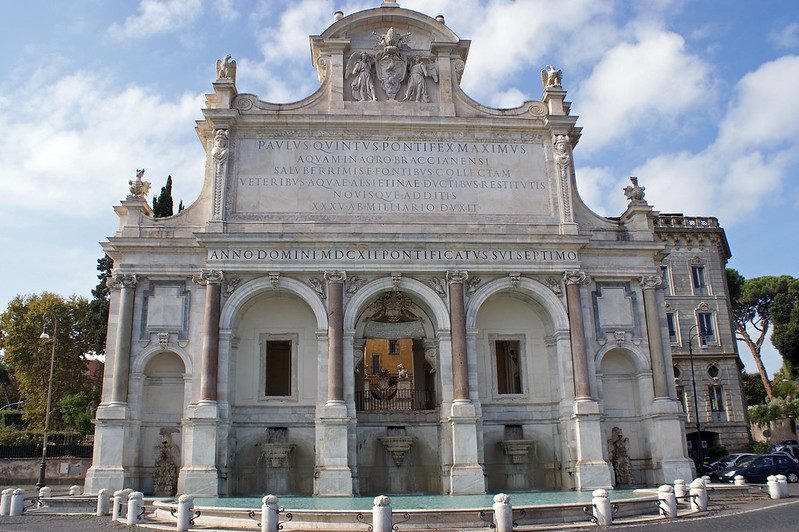
There are monuments you earn with the effort of a climb, and then they repay you all at once, without apologizing for the wait. The Acqua Paola Fountain is exactly that: you arrive on Via Garibaldi out of breath, turn the last bend, and find in front of you a wall of white marble as tall as a church facade, with five arches, six granite columns, and a quantity of water you don't expect from a city that has always managed its water with strict bookkeeping. The Romans, who have a gift for brutal brevity, christened it the Fontanone. It's not an affectionate quirk: it's a technical description.
This page tells the story of the Acqua Paola Fountain starting from the water and not from the marble. Because the marble is the consequence, the water is the cause. And because behind this theatrical scenery there is one of the most ambitious hydraulic operations of the Rome of the popes, a story of engineering dressed up as spectacle, with an inscription error in plain sight, six columns torn from St. Peter's, and a view that in 2013 opened an Oscar-winning film.
Acqua Paola Fountain: what you are really looking at
The first thing to make clear is that the Acqua Paola Fountain is not a fountain in the ordinary sense of the word. It's a mostra. In the technical vocabulary of Rome, a mostra is the monumental terminus of an aqueduct, the point where water carried for dozens of kilometers finally shows itself to the public, after an invisible journey made of buried channels, siphons, inspection wells, and masonry arches. The mostra is, literally, the moment when the infrastructure allows itself a show. Everything you see here, the arches, the columns, the attic with the inscription, the dragons and the eagles, exists for one reason only: to tell the city that the Pope has put an aqueduct back into operation.
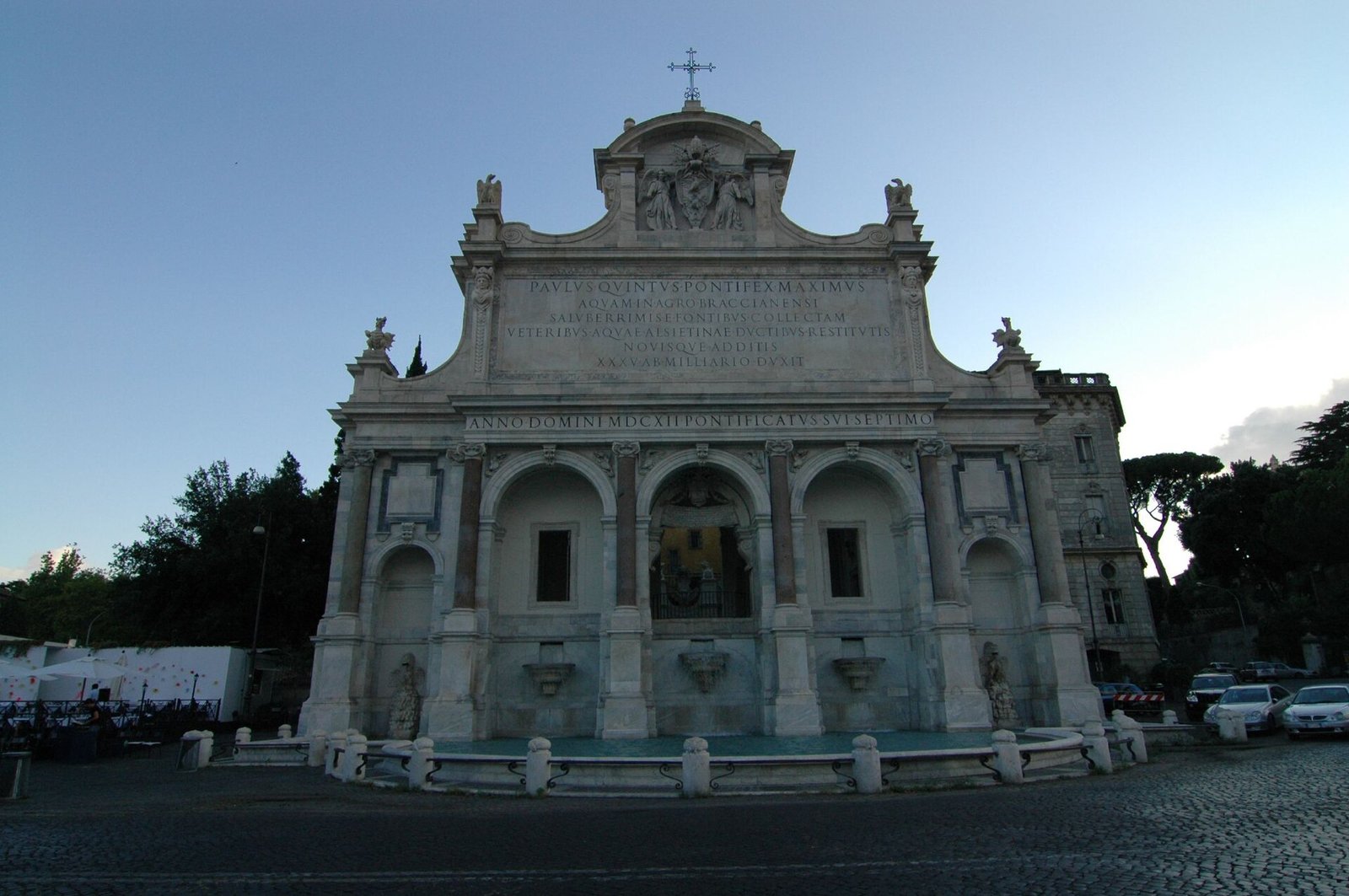
This distinction isn't pedantry. It changes the way you look at the monument. If you consider it a decorative fountain, it will seem out of proportion, almost arrogant. If you consider it the signboard of a public work, everything adds up: the monumental scale is proportioned to the importance of the work, not to the basin. It's the same logic by which the facade of a 19th-century train station is grander than the waiting room it contains. The message matters more than the function.
The structure of the Acqua Paola Fountain in three lines
The front is made up of five arches: three in the center, larger, and two at the sides, smaller and closed off as niches. The arches are marked off by six granite columns, four of red granite and two, the outer ones, of gray granite. Above runs an attic with the large dedicatory inscription and the coat of arms of Paul V held up by two angels, the work of Ippolito Buzio. At the sides, dragons and eagles: the heraldry of the Borghese, repeated with the persistence of someone who wants to be remembered. At the bottom, a semicircular marble basin that spreads out over a rectangular base and collects everything.
That basin, though, wasn't there at the beginning. It's an addition from almost 80 years later, and we'll come back to it because it's the most interesting piece of the monument's biography: proof that the Acqua Paola Fountain wasn't born the way you see it, but was corrected along the way by an architect who had understood that something was missing.
Why the Romans call it the Fontanone
The nickname has been documented for centuries and has become the common name: if in a bar in Trastevere you ask for directions to the Acqua Paola Fountain, they'll answer "ah, the Fontanone" anyway. There's no irreverent intent. Rome has an established tradition of affectionate nicknames for monuments. The Colosseum itself owes its name to a colossal statue that no longer exists, and Pasquino is a mutilated statue that became a satirical institution. The Fontanone entered this family for the simplest reason in the world: it's big.
A curious detail: the nickname ended up spreading into the neighborhood's affective place names. The bend in the road, the square, the lookout, everything is identified with "the Fontanone." It's one of those cases where architecture becomes geography, and the monument stops being an object and becomes a place.
Where the Acqua Paola Fountain is and how to get there
The Acqua Paola Fountain is on Via Garibaldi, on the side of the Janiculum that looks toward Trastevere, just above the San Pietro in Montorio complex and a short distance from Porta San Pancrazio. It's a position chosen intelligently: not at the top of the hill, where it would have been invisible from the city, but on the flank, at a point where the road makes a bend and the monument presents itself head-on to whoever is climbing. Whoever decided where to put it knew perfectly well that the surprise effect is part of the design.
On a first visit it's best to make the climb on foot from Trastevere, even if it takes effort. The reason is dramaturgical: the Acqua Paola Fountain works like a plot twist, and plot twists need a build-up. If you come from above, going down from the Janiculum, you see it at an angle and lose half the effect.
The climb from Trastevere to the Acqua Paola Fountain
The classic route starts from Piazza Trilussa or Piazza Sant'Egidio, takes Via della Scala, continues toward Porta Settimiana, and then climbs Via Garibaldi. The road climbs with a series of hairpin bends that cut across the flank of the hill. It's not a flat stroll and I won't pretend to sell it as one: you go up steadily for about 20 minutes, with some stretches of narrow sidewalk and with traffic passing close by. Comfortable shoes, not beach sandals.
Halfway up you meet San Pietro in Montorio, with Bramante's Tempietto in the adjacent courtyard, which is one of the most important works of Renaissance architecture of all. It's worth a 20-minute stop even just to catch your breath in a courtyard that taught the central plan to half of Europe. Then you set off again, pass more bends, and at a certain point, on the right, the white wall appears.
The easy alternative for reaching the Acqua Paola Fountain
If you don't feel like climbing on foot, there are reasonable alternatives. The Janiculum is served by road connections that go up the hill, and if you arrive by taxi you can be dropped off right on the square. Another strategy I often recommend: go up one way and come down the other. You go up by vehicle to the upper part of the hill, walk the Janiculum promenade on the flat to the Fontanone, and then walk down toward Trastevere, which going downhill is a whole different story. The advantage is double: you save your legs and you reach Trastevere at the right time for dinner.
A practical warning: the Janiculum is a hill, not a neighborhood full of services. Up here you don't find the same density of bars, drinking fountains, and shops that you find in the center. Bring water, especially in summer, because despite the impressive amount of water flowing in front of you, you can only quench your thirst with what you brought.
The Trajan aqueduct before the Acqua Paola Fountain
To understand the Fontanone you have to go back 1,500 years. The water that arrives here comes from the northwest, from the area of Lake Bracciano, the Lacus Sabatinus of the ancients, and covers a distance on the order of 25 Roman miles, largely in an underground channel. This route isn't a 17th-century invention. It's the ancient Aqua Traiana, the aqueduct built by the Emperor Trajan and inaugurated in the early years of the second century AD, designed to serve the right bank of the Tiber, that is, the area we now call Trastevere and the Vatican.
Ancient Rome had 11 main aqueducts, and the right bank was the poor relative of the system: farther from the springs of the Aniene, less served, more dependent on wells and the river. The Aqua Traiana solved the problem by bringing good-quality water from springs fed by the Sabatine basin. It was an enormous infrastructure investment and, like all enormous infrastructure investments, it had a long life and then a quiet decline.
The collapse of the water system and Rome's long drought
Over the course of the early Middle Ages the Roman aqueducts progressively stopped working. It wasn't a single catastrophic event but a long process: wars, sieges, lack of maintenance, channels clogging with limestone deposits, arches collapsing and not being rebuilt. A city that in the second century received enormous quantities of water found itself, in the central centuries of the Middle Ages, depending almost entirely on the Tiber and on wells. This is the deep reason why medieval Rome huddled in the bend of the river: not out of nostalgia, but out of thirst.
At this point it helps to look at the city's topography. The hills, which in antiquity were inhabited and served by the aqueducts, were depopulated. The Campus Martius, flat and close to the river, filled up. The urban shape of Rome for almost a millennium was dictated by hydraulics. It's a lesson that holds for all cities: water decides where people live, much more than aesthetics.
Why putting an aqueduct back into operation was a political act
From the 15th century onward the popes understood that restoring the ancient aqueducts was the most effective gesture for tying their name to the city. There is no public work more popular than water. An obelisk you admire, a street you walk, but water you drink every day, and at every sip you remember who brought it to you. Nicholas V put the Acqua Vergine back into operation in the mid-15th century. Sixtus V, at the end of the 16th century, built the Acqua Felice, which carries his given name, Felice Peretti.
When Camillo Borghese became pope with the name Paul V, in 1605, the field was open on only one front: the right bank of the Tiber. Trastevere, the Borgo, and the Vatican were still poorly served. Restoring the ancient Trajan aqueduct meant conquering that front and completing the work of his predecessors. This is where the Acqua Paola Fountain comes from.
Paul V Borghese and the birth of the Acqua Paola Fountain
Camillo Borghese, a Roman from a family originally from Siena, ascended to the papal throne in 1605 and remained there until 1621. He is a pope art historians know very well because his pontificate coincides with a formidable acceleration of Rome's Baroque building activity: the facade of St. Peter's by Carlo Maderno, the Pauline Chapel in Santa Maria Maggiore, the consolidation of the Borghese family's power and wealth, with that cardinal nephew, Scipione, who would put together one of the most extraordinary art collections ever gathered by a private individual.
In the logic of this pontificate, the aqueduct is not an administrative detail: it is the linchpin of an image strategy. Paul V had the Trajanic route restored between 1608 and 1610, buying or negotiating the rights to the springs in the territory of Bracciano, and renamed the water with his own pontifical name. From Traiana it became Paola. It is a gesture of appropriation perfectly in line with the mentality of the era: the restorer has a right to the name as much as the founder.
The name that replaces another name
It is worth pausing a second on this naming operation, because it is more sophisticated than it looks. Paul V does not erase Trajan: the inscription on the Acqua Paola Fountain explicitly claims the recovery of an ancient work. The message is not "I built this aqueduct," the message is "I am the legitimate heir of the one who built it." It is the rhetoric of renovatio, the papacy presenting itself as the direct continuator of imperial greatness, with the moral advantage of faith.
Notice that this rhetoric still works today. Nobody calls this monument "the monumental fountain of the restored Trajanic aqueduct." Everyone calls it the Acqua Paola Fountain, or Fontanone. The pope's name has won out over the emperor's name with 400 years of head start and keeps winning every time someone types the address into a phone.
Water as an instrument of government
There is a less romantic and more concrete aspect: water was an economic resource. The concession of water to private individuals, convents, noble palaces, mills and workshops was a form of power and income. Whoever controlled the aqueduct controlled an important part of the economic life of a neighborhood. Trastevere, with its craft activities, its wool workshops, its tanneries and its mills, had a thirst for water that went well beyond drinking.
When you look at the Acqua Paola Fountain as a stage set you have to keep in mind that behind that wall there was a distribution system with water towers, secondary conduits, meters and written concessions. The marble is the shop window. The warehouse is hidden, and the warehouse was lucrative.
Giovanni Fontana and Flaminio Ponzio: the designers of the Acqua Paola Fountain
The design of the monumental fountain was entrusted to two professionals who represented two complementary skills. Giovanni Fontana was, first of all, a hydraulics specialist: the elder brother of that Domenico Fontana who moved the Vatican obelisk in 1586 under Sixtus V, he belonged to a family of architect-engineers from Ticino that in those years practically monopolized Rome's major hydraulic building sites. Flaminio Ponzio, a Lombard, was instead the Borghese family's trusted architect, the man of the Pauline Chapel in Santa Maria Maggiore and of an important part of the family palace.
The pair works exactly as you would expect: one knows how to get the water there and at what pressure, the other knows how to make the pope appear. In the Acqua Paola Fountain both skills can be seen, and seen separately. The hydraulic body is at the back. The rhetoric is at the front. The masterpiece lies in the fact that the join is not noticeable.
Who the Fontanas were, a water dynasty
The surname is almost a trick of fate. The Fontanas came from the region of the Lombard and Ticino lakes, an inexhaustible reservoir of building workers that for centuries supplied Rome with master builders, stucco workers, stonecutters and architects. They were people who knew how to run a building site: calculate quantities, organize crews, solve problems as the work went on. Domenico went down in history for the obelisk, Giovanni for the water. Carlo Fontana, whom you will find later in this entry as the author of the 1690 basin, belonged to the next generation of the same family and professional network.
This dynastic continuity explains why the Acqua Paola Fountain, although it has two construction phases 80 years apart, does not look schizophrenic. Whoever put their hands on the monument at the end of the 1600s spoke the same technical language as whoever had built it at the beginning. That is not nothing: in architecture, late tampering is usually visible from afar.
Flaminio Ponzio and his death midway through the work
Ponzio died in 1613, when the mostra was substantially complete in its main part but the complex was not yet entirely finished. His passing left the field to Giovanni Fontana and, in general, to the Borghese team. It's worth remembering because it reminds us of something we often forget in front of monuments: ancient building sites lasted years and architects died. The authorship of a building is almost always more collective and more bumpy than the plaque tells.
A useful exercise: imagine being Ponzio in 1612, with the Pope asking for quick timelines, the workers asking for materials, marbles arriving from different quarries and ruins, and the water pressure that has to be right on the first try because a mostra that sputters is a political disaster. The marble calm of the result hides a building site that had very little calm about it.
The 1610-1612 building site of the Acqua Paola Fountain
The work on the mostra is concentrated between 1610 and 1612, with the completion of the finishing touches and the surrounding arrangements in the years immediately following, up to 1614. The inscription on the attic carries the date 1612 and the seventh year of the pontificate of Paul V, which is how papal epigraphy dates events: not only the year of the Lord, but also the year of reign, because the time of a pontificate is a unit of measure in itself.
Two years for a work of this scale is very little, and it's no accident: the Rome of Paul V worked at paces that seem unreal to us today, with hundreds of workers, supplies organized like assembly lines, and an unscrupulous use of already worked material. It's precisely the shortcut of reuse that allows the speed.
How an aqueduct mostra was built in the 17th century
The procedure was, simplifying a lot, this: you built a sturdy retaining wall, able to hold both the thrust of the hill's soil and the weight of the cladding. Behind the wall you organized the water collection chamber, with the pipes and the vents. In front you applied the marble and travertine cladding, with the projecting columns and the entablature. The water outlets were positioned last, calculating the pressures.
The hardest part, technically, wasn't the marble: it was the air. A conduit that carries a considerable volume of water and discharges it into a mostra has to get rid of trapped air, otherwise the flow becomes irregular and water hammer is produced that within a few months destroys the pipes. The 17th-century hydraulic engineers knew the problem well and solved it with settling chambers and vents. When you hear the steady, constant noise of water falling into the basin, you're listening to the result of that calculation.
The travertine, the marble, and the lime
The front of the Acqua Paola Fountain combines white and polychrome marbles with travertine, which is the Roman stone par excellence, quarried mostly in the Tivoli area. Travertine has a quality the Romans have always appreciated: it ages well, gets dirty in a dignified way, and holds up to water better than many marbles. The white marble, instead, gives the light. The combination produces the effect by which the monument looks brighter than its surroundings even on overcast days.
A detail to observe: run a finger, gently and only where you're allowed to get close, over the surfaces exposed to the jet and over the sheltered ones. The first are smoothed by the water and covered with limestone deposits. The second preserve the original workmanship better. The monument carries on it the map of four centuries of washing.
The triumphal arch architecture of the Acqua Paola Fountain
The declared model of the Acqua Paola Fountain is the Roman triumphal arch. Not a specific arch, but the type: base, order of columns, openings, attic with inscription. Whoever knows the Arch of Constantine or the Arch of Septimius Severus recognizes the scheme immediately. The citation is deliberate, explicit, almost didactic. The Pope who restores the imperial aqueduct presents himself with the architectural emblem of imperial triumph.
There are, though, two substantial differences from the ancient archetype, and they are differences that tell the story of the 17th century. The first is that this arch isn't passed through: it's set against the hill, the openings lead nowhere, they are containers of water. The second is that the proportions were recalibrated to be read from far away and from below, that is, from Trastevere and the city, not only by whoever passes in front.
An arch you don't pass through
This point deserves attention because it's the most elegant key to reading the monument. The ancient triumphal arch is a machine for passage: the victor passes under it, the procession goes through it, the gate separates a before and an after. Here the passage is denied and replaced by another movement: that of the water, which comes out instead of passing through. The metaphor is turned upside down. It isn't the man who passes through the structure, it's the water that comes out of it.
The three central arches of the Acqua Paola Fountain aren't blind doors out of design laziness: they are mouths. The structure is a face, and the arches are the part that speaks.
The lesson of the Acqua Felice and the leap in scale
The direct precedent is the monumental fountain of the Acqua Felice in Piazza San Bernardo, built under Sixtus V in the late 1580s, with the famous and much-debated Moses in the central niche. That fountain already has the scheme of the triumphal arch with three archways and an attic. The Acqua Paola Fountain takes that model and expands it: five arches instead of three, free-standing columns of ancient granite instead of pilasters, and above all a radical choice on the level of content.
The radical choice is this: no statues in the arches. Where the Acqua Felice puts Moses, the Acqua Paola Fountain puts water. It is a decision of surprising modernity, because it shifts the starring role from the biblical story to the natural element. The result is that the monument never really ages: iconographic fashions change, falling water does not.
The six columns of the Acqua Paola Fountain and the old Basilica of St. Peter
The six granite columns that mark the rhythm of the facade are, for me, the most moving piece of the Acqua Paola Fountain, and almost nobody notices them. Four are red granite, two, the side ones, gray granite. They were not quarried for this monument. They come from the old Basilica of St. Peter, the Constantinian basilica, that is, the building founded in the fourth century over the apostle's tomb and gradually demolished during the 1500s to make room for the new St. Peter's.
Let's stop a moment on this fact, because it is enormous. These columns saw Charlemagne's coronation on Christmas night of the year 800. They saw the pilgrims of the year 1000, the medieval Holy Years, the return of the papacy from Avignon. They went through 1,200 years of history inside the most important church of Western Christendom, and then ended up holding up an entablature above a basin of water on the Janiculum. It is one of the most extraordinary trajectories a piece of stone can have.
What demolishing the Constantinian basilica meant
The demolition of the old St. Peter's was an enormous cultural trauma, and not everyone in the Rome of the 1500s agreed. There were those who argued that the memory of early Christianity was being destroyed for architectural vanity. The demolition was long, debated, carried out in parts while the new basilica rose around the old one. The recovered material, columns, marbles, capitals, slabs, was set aside, cataloged and gradually reused in other Roman building sites.
The Acqua Paola Fountain is one of the recipients of that heritage. When you look at the columns you are looking at one of the few visible things, standing and in the open air, that remain of the building where the identity of the Church of Rome was formed. It is an architectural relic, and it stands there without a sign.
How to recognize ancient granites
Red granite and gray granite were materials imported from Egypt in the imperial age, quarried in the eastern desert and transported by the Nile and by sea with a logistical organization that still baffles engineers today. They are extremely hard stones, very difficult to work with ancient tools, and for that reason a symbol of power: owning monolithic granite columns meant having access to an imperial system of extraction and transport.
By eye you recognize them by the crystalline grain, by the lack of the veining typical of marbles and by the way they reflect light: granite doesn't light up like white marble, it stays more opaque and deeper. If you approach the Acqua Paola Fountain on a day of low raking sun, you will see the feldspar crystals light up in pinpoints. It is an effect marble never produces.
The reused marble: the Forum of Nerva, the Temple of Minerva and the Acqua Paola Fountain
The columns are not the only reused material. The white and polychrome marbles that clad the Acqua Paola Fountain come in large part from the area of the Forums, and in particular from the Forum of Nerva, the so-called Forum Transitorium, and from the Temple of Minerva that stood there. In the 1600s the ruins of the Forums were still, largely, an open-air quarry: the ground level was much higher than today, the area was partly occupied by vegetable gardens and houses, and taking worked marble was a normal and authorized practice.
The Temple of Minerva was, until the 1600s, one of the best-preserved ancient buildings in the area of the Forums. It was largely dismantled precisely in these years, under Paul V, and its marble was scattered among several building sites. Whoever visits the Forum of Nerva today sees very little of that temple: two surviving columns set against the enclosure wall, the Colonnacce, and little else. The rest is gone, and some of it is here.
The practice of reuse, explained without scandal
The modern temptation is to be outraged. I always resist this temptation, for two reasons. The first is anachronistic: applying to a 1610 building site the conservation sensibility born in the 1800s and codified in the 1900s is an error of method. The second is more interesting: reuse was for centuries the main mechanism of survival of ancient materials. A reused column is a column that still exists. A column left on the ground in a field becomes lime.
Lime kilns devoured more Roman antiquity than all the building popes put together. Burned white marble produces excellent-quality lime, and for centuries statues, slabs, and capitals ended up in the fire to make mortar. From this point of view, the reuse in the Acqua Paola Fountain saved that marble. I'm not saying it to absolve Paul V: I'm saying it because it's the documented truth of how what we see was preserved.
Recognizing reuse with the naked eye
There are clues that let you spot ancient material even without being an archaeologist. The first is mismatch: pieces with slightly different thicknesses, tones, and finishes, assembled so as to make up a unified surface. The second is the presence of cut moldings, that is, ancient profiles trimmed to fit a new position. The third is the quality of the workmanship: certain cuts and certain surfaces have a precision that in the 17th century was no longer economically worth achieving.
Looking at the Acqua Paola Fountain with this filter transforms the visit. You stop seeing a white wall and start seeing a collage: a piece of Forum here, a piece of St. Peter's there, all held together by the will of a pope and the skill of two architects. It's a time machine made of reassembled fragments.
The inscription of the Acqua Paola Fountain and the mistake about Trajan
Along the attic runs a large inscription in capital letters that celebrates Paul V, the water brought from the territory of Bracciano, the restoration of the ancient channels, and the date: 1612, seventh year of the pontificate. It's a text written to be read from far away, with tall letters and calibrated spacing. Roman monumental epigraphy is a highly refined discipline and this inscription is a textbook example: the size of the characters grows and shrinks to balance the perspective reading from below.
There is, however, a problem, and it's the funniest problem of the Acqua Paola Fountain. The inscription contains a historical error. The text attributes the water brought to the wrong aqueduct: it speaks of the recovery of the ancient structures by referring to the Alsietina aqueduct, the Aqua Alsietina, brought to Rome by Augustus from Lake Martignano, while the channel actually restored and reused is the Aqua Traiana, with its intake in the Sabatine lake basin, that is, Bracciano.
How an error carved in marble is born
The mix-up is understandable. In the 17th century the archaeology of aqueducts was a science in its infancy: people worked from ancient literary sources, in particular Frontinus's treatise on the aqueducts of Rome, and from empirical surveys in the channels. Two aqueducts that both come from the northwest, both from lake basins in the Sabatine area, both heading to the right bank of the Tiber, are easily confused if you don't have modern cartography and can't follow the route precisely.
But there's a detail that makes the error even more ironic. The Aqua Alsietina had, in antiquity, a terrible reputation: Frontinus himself writes that its water was not good to drink and that it served mostly for Augustus's naumachia, that is, to fill a basin for naval shows, and for non-drinking uses. Taking credit for restoring the Alsietina was, from the propaganda point of view, exactly the thing not to do. Luckily for Paul V, the water that was flowing was the good one.
The error nobody has corrected in four centuries
The point I find most fascinating is that the error has never been corrected. No later pope, no restoration, no commission had the wrong word chiseled away. It would have been technically simple. It didn't happen. And it didn't happen because at a certain point the inscription stopped being an informational document and became a monument itself: a historical object that is preserved as it is, mistakes included.
It's the most elegant way a monument can teach you intellectual humility. The Rome of the popes, which had the best scholars in Europe at its disposal, carved into marble a mistake that any student today would correct with a 30-second search. Take it as a reminder: even certainties carved in stone need to be checked.
The inscription added at the end of the 17th century
On the Acqua Paola Fountain there isn't just one inscription. When at the end of the 17th century the monument was modified with the addition of the large basin, the intervention was commemorated with a second epigraph that recalls Alexander VIII Ottoboni, a Venetian, and the second year of his pontificate, with the date 1690. It's a constant custom in the Rome of the popes: every intervention leaves its signature, and monuments become layers of successive claims.
Finding the two inscriptions and reading them in sequence is a recommended exercise. The first is the voice of the founder, pompous and triumphal. The second is the voice of the corrector, drier. Together they tell you that a monument is never finished: it's only temporarily stopped.
The dragons and the eagles: Borghese heraldry on the Acqua Paola Fountain
If you start counting the dragons and eagles on the Acqua Paola Fountain, you can't stop. They are the Borghese family's heraldic emblem: an eagle above and a dragon below, repeated at every scale and in every material, from the monumental coat of arms of the attic to the smaller reliefs, down to the details of the water spouts. Anyone who knows Rome recognizes them everywhere: at Santa Maria Maggiore, in the Vatican, on the facade of St. Peter's, in Palazzo Borghese, in the suburban villa that today houses the Galleria Borghese.
There is an old Roman joke that deserves to be remembered with philological precision: the facade of St. Peter's, completed under Paul V, carries his name at the top in enormous letters, and over the centuries the awkwardness of reading the Borghese pope's name in place of the apostle's has become proverbial. Like it or not, that pontificate branded Rome like few others. The Acqua Paola Fountain is part of the same program of systematic signing of the city.
The Borghese dragon, an animal with a biography
The dragon of the Borghese arms is not a generic monster from a medieval bestiary. It is a codified heraldic animal, with a recurring pose and proportions, which in the Roman 1600s becomes a kind of logo. The sculptors who worked for the Borghese had fixed models and replicated them on commission, with minimal variations. It is interesting to observe how the dragon changes depending on the material and position: on a frieze up high it is synthetic and readable, on a close-up relief it becomes more elaborate.
On this monument the heraldic animals also have a hydraulic or pseudo-hydraulic function: some water spouts are treated as heads of hybrid creatures, between wolf and dragon, following a repertoire that joins the family coat of arms to the Roman tradition of mascarons. This is the point where the noble emblem and the technical function overlap.
The angels of Ippolito Buzio
On the attic, the pontifical coat of arms of Paul V is held up by two angelic figures sculpted by Ippolito Buzio, a Lombard sculptor active in Rome between the late 1500s and the first decades of the 1600s. These are figures to be looked at with binoculars or the zoom of your phone, because their position makes them almost invisible in the overall view. They have a solid, late-Mannerist quality, with ample drapery and measured gestures: not yet Bernini's theatricality, but already the search for a gesture that reads from afar.
Notice that this is the only human, or quasi-human, figure in the entire monument. In an era when Roman fountains were filling up with river gods, tritons and sea monsters, the Acqua Paola Fountain remains almost empty of bodies. The renunciation of statuary is its strongest stylistic signature.
Carlo Fontana and the single basin of 1690
We come to the twist. For almost 80 years the Acqua Paola Fountain did not have the large basin you see today. In its place there were five separate small basins, one for each arch, which collected the water and gave it back in an orderly, fragmented way. In 1690, under the pontificate of Alexander VIII Ottoboni, the architect Carlo Fontana redesigned the lower front of the monument, replacing the five basins with a single large semicircular marble basin, set on a rectangular base.
It is an intervention that in words seems minor and in fact rewrites the monument. The five small basins divided the water into five separate events. The single basin unifies them into one mirror. The sound changes, the reflection changes, the perception of the quantity of water changes radically. Carlo Fontana did not add an accessory: he changed the ending of the composition.
Why the single basin works better
The design reasoning, in our judgment, is the following. The front of the Acqua Paola Fountain is vertical, articulated, full of elements that fragment the gaze: columns, arches, cornices, coats of arms. With five small basins below, the fragmentation continued all the way to the ground and the composition never found a point of rest. The single basin introduces a large continuous horizontal line that closes the design and gives it a base.
Then there is the optical effect of the sheet of water. A wide, still surface reflects the front and doubles it. On windless days, the wall is mirrored in the basin and the monument seems twice as tall. The five small basins could not produce this effect: too small, too agitated by the jets. Fontana understood that the monument needed a mirror, not five bowls.
The risk of a late correction
Modifying a famous monument 80 years after its construction is a high-risk operation. Famous architectures develop an aura of untouchability and whoever lays hands on them is judged severely. Carlo Fontana got away with it because he worked by subtraction and unification, not by adding decorative elements. He removed five things and put in just one, larger and simpler. It is the most difficult strategy and the most effective.
A useful thought experiment: imagine that instead of the single basin they had added a sculptural group, a Neptune, some river gods. The monument would have become just another Baroque fountain, related to a hundred others. Instead it stayed what it was: a wall of water. The restraint of the correction is the reason it still has a personality of its own today.
The five original small basins of the Acqua Paola Fountain
It's worth imagining what the monument looked like between 1612 and 1690, because it's an exercise that helps you understand the evolution of taste. Five basins in a row, of modest size, each under its own arch. The water came out, fell into a basin, overflowed. The whole had a measured rhythm and a more severe character, more Renaissance than Baroque.
The logic of the five basins was also practical: smaller basins are cleaned better, emptied faster, and let you work on one without putting all the others out of use. In the daily management of an aqueduct mostra, with the limestone deposits, the leaves, the dust, modularity is a real advantage. The single basin is more beautiful and harder to maintain. It's an aesthetic choice paid for in maintenance.
The sources that tell us the original state
We know what the Acqua Paola Fountain looked like before 1690 thanks to the engravings and views that document Rome in the 17th century. The papal city was, at the time, one of the most profitable publishing subjects in Europe: pilgrims and travelers bought prints the way we buy photographs today, and engravers' workshops produced views in series. Thanks to this market we have an extraordinary visual archive of Roman monuments before later changes.
Comparing a 17th-century view with the present state is one of the most instructive exercises you can do on this monument. The base changes, the context changes (Via Garibaldi did not look the way it does now), and above all the perception of scale changes. In the old prints the Fontanone appears isolated in an almost rural landscape, with vegetable gardens and vineyards around it. The hill was countryside.
What is lost and what is gained with a modification
Every intervention on an ancient monument is a trade-off. With the single basin the Acqua Paola Fountain gained monumentality, reflection, compositional unity, and that quality of theatrical backdrop that makes it photogenic. It lost the original modular rhythm, the finer articulation of the base, and part of the direct relationship with those who came close to the water. The small basins were more on a human scale. The basin is more on the scale of the city.
There's no judgment to give. But there is one thing to understand: the monument we see is the result of two eras and two different intelligences. The early 17th century gave it the structure and the message. The end of the 17th century gave it the ending. It's a work for four hands separated in time, and it works.
The Acqua Paola Fountain and the Acqua Felice: the mostre of the papal aqueducts
To really understand this monument you have to put it in a series. The Rome of the popes built, over a little more than a century and a half, a system of monumental mostre that mark the return of water to the city. Each one corresponds to an aqueduct and a pontificate. They are, in a sense, the emblems of a program of urban rebirth.
The first chapter is the Acqua Vergine, the only ancient aqueduct that never completely stopped working, restored in the mid-15th century and then again in the following centuries. Its definitive mostra will be, in the 18th century, the Trevi Fountain. The second chapter is the Acqua Felice of Sixtus V, with the mostra at Piazza San Bernardo, finished at the end of the 1580s. The third is the Acqua Paola, with this mostra on the Janiculum. Three aqueducts, three pontificates, three monuments.
The Moses of Piazza San Bernardo, or how not to make a statue
The mostra of the Acqua Felice has in its central niche a colossal Moses that over the centuries has become the object of fierce criticism and a very rich anecdotal tradition. The figure is considered out of proportion, awkward in its pose, and unconvincing in its relationship with the architecture. It's the classic example brought up when talking about sculpture that can't stand up to its own frame.
The Acqua Paola Fountain, built a little more than 20 years later, carefully avoids the problem: no statues in the niches. No documents show a direct causal link. But it's a fact that the following monument chose the opposite path, and that's a datum worth observing without forcing it into an explanation.
What all the papal mostre have in common
There are recurring elements in all the mostre of the Roman aqueducts. The first is the scheme of the triumphal arch or of the architectural facade. The second is the dedicatory inscription in a dominant position, with the name of the pope and the year of the pontificate. The third is the repeated heraldic coat of arms. The fourth is the strategic position: the mostra is placed where there's a square or a widening that lets you see it, and where a point of the city needs marking.
The fifth element, less obvious, is that every monumental fountain is also a distribution point. From here the water was divided out toward the neighborhood. The Acqua Paola Fountain fed a network that went down toward Trastevere and served public fountains, convents, palaces and productive activities. The beauty was the shop window of a capillary and invisible function.
Trevi Fountain and the Acqua Paola Fountain: two ways of closing an aqueduct
The most useful comparison for a visitor is with the Trevi Fountain, which almost everyone has already seen or will see. They are two aqueduct fountains, they have the same institutional function and they are very far apart in solution. Trevi, built in the 1700s by Nicola Salvi, is a theater: there is an artificial cliff, there is Oceanus, there are sea horses, there is an explicit mythological story and a stage set that fits into the facade of the palace.
The Acqua Paola Fountain is the opposite: no story, no figure, no cliff. Only architecture and water. Trevi keeps you for an hour looking at details. The Fontanone hits you in three seconds and then leaves you in peace. They are two different philosophies of the public monument: one Baroque in the full sense, theatrical and narrative, the other classicist, abstract, almost minimalist three centuries ahead of its time.
The difference you hear with your ears
There is a difference no photograph conveys and which is instead decisive: the sound. At Trevi the water makes noise in a thousand different ways, broken by the rocks, by the jets, by the drops. Here the sound is more uniform, deeper, more like that of a continuous waterfall. If you sit on the low wall and close your eyes for a minute, you hear a constant low note, with very few variations.
This sound is the reason the Acqua Paola Fountain is one of the most relaxing places in Rome. Uniform water noise is a natural acoustic masker: it covers the traffic, it covers voices, it lowers the perception of urban noise. It is the same principle as white noise generators, achieved 400 years earlier with marble and gravity.
Why the Fontanone is less crowded than Trevi
The short answer is: the climb. The long answer is that mass tourism distributes itself according to the law of least effort, and every significant change in elevation works as a filter. Trevi sits in the middle of a flat route linking the Pantheon, Piazza di Spagna and the Corso. The Fontanone requires a conscious decision and 20 minutes of climbing. The result is that here, even in high season, you have room to stand and to look.
I consider this the best news I can give to anyone visiting Rome in summer. There is a first-rate monument, with a first-rate panorama, that can be visited without elbowing anyone. It costs a climb. It is worth every step.
Lake Bracciano, Lake Sabatino and the water of the Acqua Paola Fountain
The water you see falling made a long journey. The historic catchment basin is the Sabatine one, that is, the area of Lake Bracciano, northwest of Rome, in a territory of volcanic origin where the springs are many and abundant. The historic conduit runs for a distance on the order of 25 Roman miles, that is, a little under 40 kilometers, largely underground, with stretches in tunnels dug into the tuff and stretches on arches.
The territory of Bracciano was, at the start of the 1600s, dominated by the Orsini, and Paul V's operation involved negotiations and acquisitions of rights to the waters. It is an aspect that is always forgotten: behind every great hydraulic work there is a chapter of law and land negotiation, no less complicated than the engineering. Water is a legal asset before it is a physical one.
Why an ancient aqueduct can be reused
Roman aqueducts were designed to last and to be maintained. The conduit, the specus, could be inspected, had access shafts at regular intervals and a slope calculated with millimeter precision over kilometers of route. Even after centuries of abandonment, a course like that remains legible and in many stretches recoverable: you clean out the deposits, rebuild the collapsed vaults, intercept the springs.
The 1600s restoration did not entirely follow the ancient route: at several points variants were chosen, new stretches were built, intakes were modified. It is a restoration in the practical sense of the term, making the thing work, not in the modern philological sense. But the principle holds: the Rome of the popes was able to drink because the Rome of the emperors had built well.
The quantity of water and the effect on the Romans
The sources of the period insist on the abundance of the Acqua Paola. For a city that had lived centuries of water scarcity on the right bank, the arrival of a constant and generous flow was a social event before it was a technical one. New public fountains, new concessions, new productive activities: the neighborhood changed metabolism.
The quality of the Acqua Paola was, however, the object of criticism right away, and not all of it unfair: coming from a lake and volcanic basin, and collecting different contributions along the way, it didn't have the excellent reputation of the Acqua Vergine or the Marcia. For industrial use and for washing it was perfect. For drinking, the Romans have always had their preferences, and they expressed them with the frankness that distinguishes them.
The mills, the workshops, and the economy of water in Trastevere
One of the most concrete and least told aspects of the Acqua Paola Fountain is that its aqueduct didn't serve only for drinking. The water that arrived on the Janiculum had, besides the domestic share, a productive destination: it powered mills and workshops along the slope of the hill and in the fabric of Trastevere. The drop in elevation between the Janiculum and the plain below supplied the energy. The Acqua Paola supplied the flow.
This transformed the neighborhood. Where there's hydraulic energy, activities are born: grain mills, fulling mills for fabrics, tanneries, and in the course of the 19th and early 20th centuries also more modern plants. For a period, between the beginning of the 20th century and its first decades, the water of the Paola system even powered a hydroelectric plant. The papal aqueduct reached the threshold of the industrial age while keeping its driving function.
The relationship between beauty and production
The point deserves attention, because it breaks a separation that is taken for granted. We tend to consider monuments as aesthetic objects and infrastructure as functional objects, and to keep them in separate categories. The Acqua Paola Fountain shows that for centuries the two things were the same thing. The marble wall we photograph was the terminal of a system that turned the millstones.
There's an urban planning lesson in this. Cities that work don't separate beauty from work: they make them coincide. The Fontanone is beautiful because it's useful, and its usefulness was told through a stage set. It's a model of public commissioning that we still miss.
What remains today of the productive system
Of the fabric of mills and workshops on the Janiculum, little is visible to the passerby. Some traces can be read in street names, in masonry, in repurposed structures. It's a heritage of industrial archaeology that is often undervalued, which coexists with the monumental heritage without having the same recognition. When you walk along Via Garibaldi and the streets that go down toward Trastevere, try reading the buildings by looking for what isn't noble: service walls, odd openings, inexplicable changes of level. They often tell about the water.
It's a harder and less gratifying reading than that of the monuments, but it gives back a truer city. The Rome of the popes wasn't only domes and facades: it was also an economy that ground, wove, and tanned, and that needed exactly what comes down from the Janiculum.
The garden behind the Acqua Paola Fountain
Few know it and even fewer go: behind the mostra of the Acqua Paola Fountain there's a green space. The back of the monument isn't a simple blind wall set against the hill, but an area laid out as a garden, with the rear of the structure revealing its nature as a building more than a backdrop. It's one of those places that flip your perception: from the front the Fontanone is a surface, from behind it's a volume.
The accessibility of this space varies over time and is tied to management choices and maintenance work. So I won't give you information on hours or entry, which would risk being wrong. But I'll tell you to check at the time of your visit, because when it's open it's one of the most unusual experiences on the Janiculum: looking at the Acqua Paola Fountain from behind, that is, from the side no photograph ever shows.
Why the back of a monument tells the truth
It's worth looking at the back too. Facades lie, it's their job: they're made to convince. Backs don't: they're made to work. Behind the water mostra are the service structures, the masonry without cladding, the construction logic without disguise. That's where you understand how a building is made.
In the case of the Acqua Paola Fountain this is particularly true because the monument is, in fact, the decorative lid of a hydraulic system. Seeing the back means seeing the system. It's like going behind the scenes of a theater: you lose a little magic and gain a lot of understanding.
The greenery of the Janiculum around the monument
The whole hill is characterized by vegetation with a precise identity of its own: holm oaks, pines, laurels, hedges, and that filtered light that on summer days makes the Janiculum 10 degrees more livable than the center. The greenery isn't decorative, it's climatic. When Romans come up here in August they do it for a physical reason, not an aesthetic one.
Around the Fontanone the vegetation also does compositional work: it frames the monument, softens its impact when seen from far away, and creates that contrast between the white of the marble and the dark green that is, at bottom, the classic palette of the Roman landscape painted by the vedutisti for three centuries.
The view from the square of the Acqua Paola Fountain
Turn around. It's the simplest and most effective advice I can give you. Most visitors arrive, look at the monument, photograph the monument, and leave. But the square in front of the Acqua Paola Fountain looks out on one of the most complete views of Rome: in front of you, below the parapet, Trastevere opens up, then the Tiber, then the historic center, and on the horizon the hills.
From here you can pick out the domes one by one. The big one on the right of the view is the Pantheon, which you can make out in the compact fabric. The Vittoriano is unmistakable for its whiteness. The bell tower of Santa Maria in Trastevere is within reach, almost under you. And with a bit of attention you can spot the dome of Sant'Andrea della Valle, the one of San Carlo ai Catinari, and farther off the hills of the Castelli. It's a lesson in Roman topography in five minutes.
How to read the skyline from here
The recommended method is by concentric rings. First ring: what's below you, that is, Trastevere, with its low roofs, terraces, Romanesque bell towers. Second ring: the line of the Tiber, which you can guess from the trees and bridges more than from the water. Third ring: the historic center, a sea of tiled roofs with domes emerging like islands. Fourth ring: the historic periphery and the hills.
This exercise, done at the beginning of a stay in Rome, is worth more than any map. It gives you the sense of real distances, which in Rome are always shorter than they seem when you walk. From here you understand that the historic center is, all in all, small: it's an oval you can cover on foot.
The play of light through the hours
The view from the Fontanone changes radically with the hour. Early in the morning the light comes from the east, that is, from in front of you: the city is backlit, with the domes in silhouette and a golden haze. It's beautiful but hard to photograph. In the afternoon the light rotates and starts to illuminate the facades: it's the moment when details read best. At sunset the sun is behind you and sets the brick and marble of the city on fire: it's the time for the best photographs.
The flip side is that the monument itself, facing east, is in the opposite condition: the Acqua Paola Fountain gets light on the front in the morning and goes into shade in the afternoon. View and monument therefore have different best hours. If you have time for only one visit, the ideal compromise is late afternoon: the marble is still readable in soft shade and the city begins to light up.
The Janiculum promenade around the Acqua Paola Fountain
The Acqua Paola Fountain isn't an isolated point: it's a stop on a route. The Janiculum promenade is one of the great 19th-century Roman promenades, a system of panoramic avenues that runs along the ridge of the hill, populated by marble busts of Garibaldians who look at the city with stern expressions and with noses often battered by decades of bad weather.
Those busts aren't generic decoration: they're a political monument. They represent the fighters of the Roman Republic of 1849 and were placed as an open-air pantheon of the Risorgimento. Walking the avenue reading the names is a lesson in Italian history condensed into one kilometer. There are Italians, but also foreigners who rushed to fight: the Roman Republic was an international affair.
Piazzale Garibaldi and the equestrian monument
A little farther up, at the highest point of the route, there's the large equestrian monument to Giuseppe Garibaldi, inaugurated at the end of the 19th century, with the general on horseback looking toward the city. Its placement is anything but random: it stands exactly where the fighting took place, and its orientation has been the object of readings and urban legends for more than a century.
Still farther up, or rather a little way off, there's the monument to Anita Garibaldi, Giuseppe's wife, shown on horseback with a pistol in one hand and a newborn in the other. It's one of the most unusual equestrian statues in Europe, and her remains rest beneath it. It's worth the detour, if you have time: it's one of the rare occasions when 19th-century public sculpture manages to be dramatic without being rhetorical.
The noon cannon
On the Janiculum, every day at noon, a blank cannon shot marks the hour. It's a tradition established in the second half of the 19th century to standardize the time signal of the bells of Roman churches, which each rang on their own with chaotic results. The shot is heard across half the city and for Romans it's a kind of collective clock.
If you're at the Fontanone around noon, wait. The boom arrives dry, echoes off the walls of Trastevere, and sends the seagulls into flight. It's not a show organized for tourists: it's an administrative custom that became folklore. You can feel the difference.
1849, the siege, and the Acqua Paola Fountain
Now we get to the most dramatic chapter in the monument's biography. In 1849, after the flight of Pope Pius IX, the Roman Republic was proclaimed in Rome, governed by a triumvirate that included Giuseppe Mazzini. It was a very brief and extraordinary experience: a constitution among the most advanced in Europe, the abolition of the death penalty, freedom of worship. It lasted a few months.
To restore papal power, a French expeditionary corps intervened, which laid siege to the city from the west, that is, exactly from this side. The Janiculum became the front line. The French batteries bombarded the republican defenses, and the hardest fighting took place between Porta San Pancrazio, the villas on the hill, and this strip of land. The Acqua Paola Fountain was in the middle of the battle.
The damage from the bombardment
The monument was hit. The French cannons damaged the structure and its cladding, and it took years before it was put back in order: a restoration is documented in 1859, 10 years after the siege. It's a fact I recommend keeping in mind while looking at the front: that apparently intact surface has been through a war.
The villas of the Janiculum paid an even higher price: some were devastated, others demolished or deeply transformed. The green and peaceful landscape you walk through today is, in part, a 19th-century reconstruction of what the siege had leveled to the ground. The Janiculum we see is a healed battlefield.
Why the fighting happened right here
The reason is purely geographic and it's worth explaining because it makes the whole hill legible. The Janiculum dominates Rome from the west: whoever controls the ridge controls the artillery over the city. It's the same reason the city walls were extended up here in the 17th century, under Urban VIII, with that bastioned system still recognizable in the surviving stretches. The hill was never just a lookout: it was first of all a military position.
When you walk on the Janiculum with this key, everything changes meaning. The walls, the bastions, the gate, the layout of the villas, even the width of the 19th-century avenues are explained by military history. And the Fontanone, which stands on the flank of the hill, is a witness to it all: first as the emblem of papal power, then as a target.
The Museum of the Roman Republic and Garibaldian memory
A few minutes' walk from the Acqua Paola Fountain, at Porta San Pancrazio, there's a museum dedicated to the Roman Republic of 1849 and to Garibaldian memory. It's housed in the structure of the gate itself, rebuilt after the damage of the siege, and tells the months of the Republic with documents, images, objects, and a display that has been progressively renewed over the years.
I recommend it to anyone with 30 or 40 minutes to give it, because it perfectly completes the visit to the Fontanone. You see the monument, you understand it was bombarded, and then you enter the place that explains by whom and why. It's one of those rare cases where the urban itinerary has a natural narrative consequence.
Why 1849 matters more than people think
The Roman Republic is often dismissed as a parenthesis. It isn't. It was the political laboratory in which an important part of the Risorgimento ruling class was formed, it was the moment Garibaldi gained the international fame that would serve him 11 years later in Sicily, and it was an event followed by the European press with enormous attention. The defense of Rome was a military defeat and an image victory.
Then there's the human detail: among the defenders were very young volunteers, students, craftsmen, idealistic foreigners. Many died on these slopes. The busts along the promenade are the marble translation of that sacrifice, and the fact that today we walk past them eating a gelato takes nothing away from the seriousness of the thing. If anything, it's exactly what they were fighting for.
The Janiculum as a place of memory
Few areas of Rome concentrate so many layers of memory in so little space. There's the ancient memory of the imperial aqueduct, the papal one of the 17th century with the Acqua Paola Fountain, the Risorgimento one of 1849, the 19th-century one of the monumental promenade, and a 20th-century memory made of burials, plaques, and commemorations. The hill is a vertical stratigraphy of Italian history.
It's best to walk it slowly and read the plaques. Rome is a city that has been writing on walls for 2,000 years, and most visitors don't read a line. It's enough to stop five times in a kilometer to take home five stories.
The restorations of the Acqua Paola Fountain over the centuries
A monument made of water is a monument condemned to perpetual maintenance. Water is stone's worst enemy: it washes away, deposits limestone, seeps into joints, freezes and splits. The Acqua Paola Fountain has come through four centuries thanks to an uninterrupted series of interventions, some of which are documented precisely.
After Carlo Fontana's modification at the end of the 17th century, the main steps are a restoration in the mid-19th century, in the years immediately following the damage of the 1849 siege, an intervention in the 1930s, work in the 1950s, and a major conservation project in the early 2000s. To these are added more recent cleaning and maintenance interventions. It's a chronology that tells, between the lines, the history of heritage protection in Italy.
The limestone problem
Water that flows continuously over a marble surface leaves deposits of calcium carbonate that over time form compact encrustations, yellowish or brown in color. These deposits have a double nature: they protect the stone underneath by creating a barrier, but they completely alter the reading of the surface and, when they detach, they take away pieces of original marble too.
Removing limescale is one of the most delicate operations in restoring a fountain. Methods that are too aggressive wear away the stone. Methods that are too mild get no results. The compromise modern conservation has adopted is gradualness: you remove enough to restore legibility, you leave what is needed so as not to attack the surface. It is a philosophy of moderation that also applies well outside restoration.
Invisible maintenance
Behind the Acqua Paola Fountain you see running there is a daily job nobody notices: checking flow rates, cleaning the basins, checking the spouts, managing the recirculation, removing leaves and debris. It is a job with little glamour and absolutely essential. A water monument abandoned for six months becomes a green, foul-smelling tub.
When you happen to find the monument with the basins empty for maintenance, the typical visitor's reaction is disappointment. It is better to do the opposite: it is a very rare opportunity. The Acqua Paola Fountain without water shows the bottom of the basin, the spouts, the geometry of the pool, all things normally invisible. If it happens to you, look at it carefully: you are seeing something almost nobody sees.
The Acqua Paola Fountain and cinema: The Great Beauty
In 2013 Paolo Sorrentino opened The Great Beauty with a sequence shot right here. The film opens on the Janiculum, with the Fontanone filling the frame and the water running, before the camera moves to the panorama and to the encounter between the tourists and the city. That opening sequence, with the choir and the play between sacred and profane, immediately entered the collective imagination of contemporary Italian cinema.
The film won the Oscar for best foreign-language film in 2014, in addition to many other international awards. And the Acqua Paola Fountain, which was already known and loved by Romans, gained a new global fame. Since then, some of the visitors arrive here with the film in their head, looking for the shot.
Why Sorrentino chose this place to begin
Without claiming to read a director's mind, a few technical observations can be made. The Acqua Paola Fountain is, for the camera, a perfect backdrop: a wide, horizontal, luminous surface, with a continuous and uniform movement that fills the frame without distracting. It is the ideal background for a scene that has to establish a tone before it even tells anything.
Then there is the meaning: opening a film about Rome with water flowing in a monument of the 1600s built on an aqueduct of antiquity is a statement of poetics. The film is about stratification, inherited beauty, a city that keeps working through magnificent inertia. Hard to find a more fitting image.
The other appearances of the Acqua Paola Fountain on screen
The Fontanone has a long filmography. It appears in many Italian and international productions, including the James Bond film Spectre from 2015, and in very popular Italian TV series. The reason is always the same: it is a ready-made set, recognizable, with a panorama built in and without the logistical complications of shooting in a crowded central piazza.
I always find it amusing to observe how cinema has rewritten the hierarchy of Roman monuments. Until a few decades ago the Fontanone was, for the average tourist, a secondary entry in the guidebooks. Today it is a desired stop for people who couldn't say who Paul V was but recognize the shot. Cinema did for the Acqua Paola Fountain what engravings did in the 1700s: it made it a circulating image.
The Acqua Paola Fountain in art and veduta painting
Before cinema there were prints. From the 1600s to the 1800s the Acqua Paola Fountain was a recurring subject of views, engravings and drawings produced for the market of Grand Tour travelers. Rome was the obligatory destination of the European aristocratic education, and the typical souvenir was not the fridge magnet but the engraved print, bought in a shop and brought home to document the trip.
In these images the Fontanone appears in a context very different from the present one: surrounded by vegetation, with the road less defined, with the countryside reaching almost up against it. The hill was largely occupied by villas, vineyards and convents. The present building density, and the layout of the avenues, are largely from the 1800s and 1900s.
The Grand Tour and the construction of the image of Rome
The Grand Tour didn't just bring travelers to Rome: it built the idea of Rome that we still have. Which monuments are important, from which angle they're viewed, in what light, with what ruin in the foreground: all of this was codified by generations of engravers and vedutisti who standardized the gaze. When we take a photograph of a Roman monument today, most of the time we are repeating a composition invented in the 18th century.
The Acqua Paola Fountain played a minor role compared to the Colosseum or the Pantheon in this canonization, but it wasn't absent. Its modern fortune, culminating in the cinematic image, rests on a long-lasting visual tradition.
What to look for in an old view of the Fontanone
If you happen to see an old print of the Acqua Paola Fountain, look at three things. First: is there the single basin or the five small basins? That dates the view before or after 1690. Second: what's the context? The degree of urbanization tells the era. Third: are there human figures, and what are they doing? In old views the monument is almost always populated by people working, carrying water, talking. The fountain was a place of daily life, not an object to contemplate.
This third observation is the most important. We have turned into aesthetic objects things that were infrastructure in common use. Remembering that, in front of the Fontanone, helps you look at it with more respect and less reverence.
How to read the Acqua Paola Fountain in 10 minutes
If you have little time, here is a quick reading route. It's not a list of things to see: it's a sequence of looks, in order, that makes you understand the monument without needing any further explanation.
First look, from far away, as you arrive: you take in the overall form, the five-opening triumphal arch, the attic, the basin. Second look, as you get closer: the six granite columns, the difference between the four red ones and the two gray ones. Third look, raising your eyes: the inscription, with the date 1612 and the name of Paul V. Fourth look, searching for details: the dragons and the eagles, everywhere. Fifth look: the water, where it comes out and where it goes.
The sixth look, the one almost nobody takes
The sixth look is downward, into the basin. Look at the reflection. On a calm day you'll see the front upside down, the columns descending downward, the sky entering the marble. It's the only way to see the Acqua Paola Fountain twice at the same time, and the reason Carlo Fontana's choice to unify the basins was so intelligent.
The seventh look, finally, is behind you: the city. But I leave that for last because it's the right farewell. You look at the monument, you understand where the water comes from, and then you turn to look at the city that water has quenched for four centuries. It's a closing of meaning, not just a view.
The questions to ask yourself while looking
Three questions to keep in mind. First: where does this water come from? Answer: from the Sabatine basin, 40 kilometers to the northwest, through a channel that follows an imperial aqueduct. Second: where does this marble come from? Answer: from the Forum of Nerva, from the temple of Minerva, from the old basilica of St. Peter. Third: why is it so big? Answer: because it's not a fountain, it's a signboard.
Whoever can answer these three questions has understood the Acqua Paola Fountain better than most of the people who walk past it. The rest are details, however fascinating.
The Acqua Paola Fountain in the seasons and at different times of day
An outdoor monument is a different monument every time. Here are the best moments to see the Acqua Paola Fountain, and why.
Spring is the most balanced season: clear light, fresh vegetation, temperatures that make the climb pleasant, and clean air that makes the view sharp all the way to the hills. Summer has the advantage of the hill's relative coolness and very long evenings, but pays for it with the heat of the climb and the haze that often flattens the view. Autumn has the best light of all for the view, with those clear days after the thunderstorms. Winter gives you the monument almost empty and a city that lights up early.
Early morning at the Fontanone
If I had to choose just one moment, I'd choose early morning on an autumn weekday. The light arrives raking from the east, the marble takes on a warm color, there's almost nobody, and the noise of the water is the only sound. Rome, at that moment, looks like a city still waking up and you're watching it from your own balcony.
There's also a practical reason: in the morning the time slot of the organized groups hasn't arrived yet, and the road is less busy. The noise of cars on Via Garibaldi is the only serious flaw of this place, and early morning is when it bothers least.
The evening and the artificial light
In the evening the Acqua Paola Fountain is lit and its character changes completely: the white becomes golden, the shadows of the columns lengthen, the water takes on an almost solid look. It's the most romantic moment and the one most frequented by Romans, who come up here for the night view of the city.
A common-sense recommendation: the area is quiet but it is still an isolated place and poorly lit in some stretches of the avenues. The rule is the same as for any urban park in any city: in the evening you stay in the frequented areas, you avoid deserted side paths, and you keep an eye on your things. That said, the Janiculum in the evening is one of the Roman experiences I recommend most.
What to see near the Acqua Paola Fountain
The Fontanone doesn't deserve a visit on its own: it deserves to be the center of an afternoon. Within a 10 or 15 minute walk there are things that, put together, make up one of the densest and least crowded itineraries in Rome.
Going down, San Pietro in Montorio with Bramante's Tempietto: a perfect rotunda a few meters in diameter that rewrote the history of Western architecture, built at the beginning of the 16th century on the spot traditionally indicated as the site of St. Peter's martyrdom. Going up, the Janiculum promenade, the monument to Garibaldi, the monument to Anita, and the noon cannon. Toward the west, Porta San Pancrazio, the museum dedicated to the Roman Republic, and the entrance to Villa Doria Pamphilj, the largest historic park in Rome.
Villa Doria Pamphilj, the big park a short walk away
Whoever still has energy after the Fontanone should seriously consider Villa Doria Pamphilj. It's an enormous park, with lawns, pine groves, small lakes, the 17th-century Casino del Bel Respiro, and a network of avenues that allows walks of hours. It's where Romans go to run, to bring their kids, to have picnics on Sunday. It's not a tourist park: it's a real urban park, and for that reason valuable to know.
The combination I recommend most often is this: morning at the Fontanone and on the Janiculum promenade, light lunch, afternoon at Villa Pamphilj, down to Trastevere for an aperitivo. It's a Roman day that touches none of the tourist lines of the center and gives back a much more livable city.
Trastevere, down the slope
The natural descent from the Fontanone leads to Trastevere, a neighborhood with two quite distinct souls. There's the part north of Viale Trastevere, with Piazza Santa Maria in Trastevere and its basilica with extraordinary mosaics, the most crowded and the most touristy. And there's the part to the south, more residential, with Piazza San Cosimato, the market, and a social fabric that holds on. The second is the one I recommend to anyone who wants to understand something about the neighborhood.
The practical advice: come down from the Janiculum in late afternoon, go into Santa Maria in Trastevere when the light starts to fall and the apse mosaics light up, then go to dinner. The sequence view-basilica-dinner is the best end to a day the neighborhood can offer.
Practical tips for visiting the Acqua Paola Fountain
Let's go through the concrete questions, the ones asked most often. The visit to the Acqua Paola Fountain takes place outdoors, from the street and from the square in front: it's an urban monument, not a site with a ticket office. This means you can look at it at any time, and the real constraint isn't the hours but the light and the traffic.
For up-to-date information on any openings of the space behind it, on maintenance work under way, or on cultural initiatives, it's best to check with the institutional channels of the City of Rome at the time of your visit. I prefer not to give you data that could be out of date: nothing ruins a day like information two years old.
Realistic visit times
For the Acqua Paola Fountain alone: 15 minutes, if you really look at it. Allow 20 or 25 if you sit down, look at the view, and enjoy the sound of the water. If you include it in an itinerary that takes in San Pietro in Montorio, the Janiculum promenade, and the monument to Garibaldi, allow a good two hours. If you add Villa Pamphilj or the museum at Porta San Pancrazio, you've filled the afternoon.
The climb from Trastevere takes 20 to 25 minutes at an easy pace, with stops. The descent, 12 or 15. Whoever has mobility problems should consider arriving from above or by taxi: the square in front of the monument is flat and accessible, but the climb that leads to it is not.
What to bring and what to avoid
Bring water, especially from May to September. Bring shoes with decent soles: the sampietrini and the sloping stretches punish smooth soles. Bring a hat if you climb during the middle hours of a summer day: the last stretch of Via Garibaldi is exposed. If you have a camera, bring a wide-angle lens, because the front is wide and up close it doesn't fit in the frame.
Avoid scheduling the visit in the middle hours of a July day: the climb in those conditions isn't a walk, it's an endurance test. Avoid treating the basin as a swimming pool or a drinking fountain: it's a protected monument and the water isn't meant for direct consumption. Avoid, above all, arriving, taking one photo, and leaving. It would be like going into a bookstore to smell the paper.
Frequently asked questions about the Acqua Paola Fountain
Here are the most frequent questions, with short, verifiable answers. They're the same ones I hear on site, asked almost always in the same order.
Why is it called Acqua Paola Fountain and not Trajan Fountain
Because it takes its name from the water it delivers, and the water takes its name from Pope Paul V Borghese, who financed its restoration between 1608 and 1610. The Roman convention is constant: the Acqua Vergine, the Acqua Felice, the Acqua Paola, the Acqua Marcia. The name of the ancient aqueduct, Aqua Traiana, has stayed in the technical and archaeological literature but not in common use.
How old is the Acqua Paola Fountain
The monumental mostra dates to 1610-1612, with completions up to 1614: so it's a little over four centuries old. But its granite columns are almost 2,000 years old, coming from the old basilica of St. Peter, and the cladding marbles come from the area of the Forums. The age of a Roman monument is always a question with several answers.
Can you visit the inside of the Acqua Paola Fountain
The monument is an aqueduct mostra and has no interior spaces to visit in the museum sense of the term. There is, however, a green area at the back, whose accessibility varies and is tied to management choices: it's best to check at the time. The front of the monument is freely visible from the street and the square.
Is the water of the Acqua Paola Fountain drinkable
The water that feeds Rome's monumental fountains is not, in general, meant for direct consumption, unlike that of the public drinking fountains, the famous nasoni, which is potable mains water. The practical rule is simple: you drink from the nasoni, you look at the monuments.
What is the difference between Fontanone and Acqua Paola Fountain
None: they are the same monument. Fontanone is the popular Roman nickname, Acqua Paola Fountain is the official name, and in technical sources you also find the expression "mostra dell'Acqua Paola." If you ask for directions on site, all three work.
A curiosity about the Acqua Paola Fountain
The last curiosity concerns the six granite columns. They weren't quarried for this monument: they come from the facade of the old basilica of St. Peter, the Constantinian building founded in the fourth century and demolished during the 16th century to make room for the new basilica. Four are red granite, two gray granite.
It's worth stopping to think about what that means. For over 1,000 years these columns were part of the most important church of Western Christendom. They witnessed the great events of European history that took place in that basilica, from imperial coronations to medieval jubilees. Then the basilica was taken apart, the material was set aside, and in 1610 six of those columns were hoisted onto a hill to hold up an entablature above a basin of water. Nobody has ever celebrated them for what they have been.
The nice thing is that no sign says so. You can walk past the Acqua Paola Fountain a hundred times without suspecting it. And it's exactly for this reason that it's the best curiosity: because it turns a decorative element into a first-rate historical relic, and does it without needing to add anything, just by telling where it comes from. Next time you look at them, try to imagine what they saw before they got here.
One thing nobody tells you about the Acqua Paola Fountain
That the monument has a mistake carved in the marble, in letters half a meter tall, for more than 400 years, and that nobody has ever corrected it. The inscription on the attic, which celebrates Paul V and the water brought from the territory of Bracciano, gets wrong the identification of the ancient aqueduct that was recovered: it refers to the Alsietina, the Augustan aqueduct that brought water to Rome from Lake Martignano, while the channel actually restored is the Trajan one, with its intake in the Sabatine basin.
The tastiest part is the flip side. The Aqua Alsietina had, among the ancients, a terrible reputation: its water wasn't considered good to drink, it served mostly for non-drinking uses and to fill the basin of Augustus's naumachia. Publicly claiming, in a monumental inscription meant to last forever, the restoration of precisely that aqueduct was, in terms of propaganda, a glaring own goal. Luckily for Paul V, the water that arrived was the good one and nobody noticed enough to spoil his party.
No later pontiff, no restoration, no commission ever had the wrong word chiseled away, and technically it would have been simple. The reason is that at a certain point the inscription stopped being information and became a historical document: it is preserved as it is, mistakes included. I find it one of the most elegant lessons in intellectual humility that Rome knows how to give. The city that invented monumental rhetoric keeps on display, at the most visible point of one of its masterpieces, a mistake it never had the courage or the desire to erase.
The advice I give you for visiting the Acqua Paola Fountain
Walk up from Trastevere, and go in the late afternoon. I know it's the most tiring advice possible and that there are easy ways to get up here. But the Acqua Paola Fountain is built to be seen by someone arriving from below, turning the last bend of Via Garibaldi out of breath. The surprise effect is part of the design: the architects placed it exactly at that point so that it would open up in front of whoever was climbing. If you arrive from above, you see it at an angle and miss half the monument.
Late afternoon is the right choice for a double reason of light. The front of the fountain faces east: in the morning it's lit head-on and the marble dazzles, flattening the details. In late afternoon it's in soft shade, and the columns, cornices, and reliefs take on volume. At the same time, the view behind you receives the low sun from the west and the city lights up in that ocher color that is the reason painters moved here for three centuries. View and monument have different best hours, and late afternoon is the best compromise between the two.
The second piece of advice, the one nobody follows and that makes all the difference: stay at least 10 minutes. Sit on the low wall, turn your back to the street, and do nothing. The uniform noise of the water falling into the basin covers the traffic and produces an effect of sound isolation you won't find anywhere else in Rome this central. It's the most restful place in the city, and rest takes time. Whoever arrives, shoots, and leaves in 90 seconds has seen a photograph, not a monument.
One last practical suggestion: plan the descent. The best way to end this visit is to walk down toward Trastevere when the light fades, go into Santa Maria in Trastevere while the apse mosaics light up with the evening illumination, and then have dinner in the neighborhood. The climb-view-basilica-dinner sequence is the most complete Roman day you can build without setting foot in a line.
Another well-known fact, yet rarely cited
That the Acqua Paola Fountain as you see it today is not the one of 1612. The monument was born with five separate small basins, one under each arch, which collected the water in a fragmented and orderly way. The large semicircular marble basin that today dominates the base of the front is an addition of 1690, made by Carlo Fontana under the pontificate of Alexander VIII Ottoboni, almost 80 years after construction.
It's a fact found in any serious entry and that almost nobody tells, perhaps because it seems like a technical detail. It isn't at all: it's the modification that made the monument what it is. The five small basins divided the water into five separate events and extended the vertical fragmentation of the front all the way to the ground. The single basin introduces a large continuous horizontal line that closes the composition, gives it a base, and, above all, creates a sheet of water wide enough to reflect the whole front. On days without wind the monument doubles in its own reflection. With five tubs agitated by the jets that effect was impossible.
There's also a less noble and more concrete aspect worth knowing: the single basin is more beautiful and less convenient. Five small basins are cleaned better, emptied faster, and let you work on one without putting the others out of use. In an aqueduct mostra, with limestone deposits accumulating constantly, modularity is a real operational advantage. Carlo Fontana chose beauty and sent the bill to maintenance, which has been paying it punctually for three and a half centuries.
A thought experiment: imagine that in 1690 they had decided to add a sculptural group, a Neptune, some river gods, as was customary. The Acqua Paola Fountain would have become one Baroque fountain among many, related to a hundred others. Instead it stayed what it was: a wall of water with no figures. The restraint of that late correction is the reason that, four centuries later, it still has a personality unlike any other.
The right photo to take at the Acqua Paola Fountain
The photo everyone takes is the front view, centered, from three meters away, with the phone held vertically. The result is almost always disappointing for two technical reasons: the monument is wide and up close it doesn't fit in the frame, and the white surface overexposes, losing every detail of the cornices. If you want that photo, step back as far as possible toward the opposite side of the square, hold the phone horizontally, and tap the screen on the brightest point of the marble to force the exposure meter to darken.
But the right photo, the one nobody takes, is a different one: frame the reflection in the basin. Get close to the edge, lower the phone almost to the surface of the water, and compose so that the lower half of the frame holds the upside-down front. On a calm day you get a symmetrical image in which columns and arches descend downward and the sky enters the marble. It's the only way to photograph the same monument twice in the same shot, and it's the visual proof of why Carlo Fontana unified the basins.
The third photo I recommend is the farewell one, and it requires turning around. Put the parapet of the square in the foreground, blurred, and let the focus fall on the city: Trastevere below, the Tiber, the historic center, the domes. If you shoot in late afternoon with the sun behind you, you have the light on the right side and you get that layered depth that is the mental image we all have of Rome. It's the photograph you'll look at most often once you're back home.
A note on the cinematic shot. Many arrive looking for the opening of La Grande Bellezza, and it's worth knowing that this image works because it fills the frame with water alone, with no sky and no context: the camera is close and low, the backdrop is a surface of marble with moving water. If you want to come close to that result, forget the overall view and look for a detail: a single arch, a single column, a single water spout. The monument photographs better in pieces than whole, and it's something that holds for many wide, low architectures.
Some important events that happened here in history
The first great event is the inauguration itself, in 1612. The arrival of water on the right bank of the Tiber after centuries of shortage was a social fact before it was a technical one. Trastevere, the Borgo, and the areas served by the new network changed their metabolism: new public fountains, new concessions to palaces and convents, new availability for productive activities. For a city that had lived for a thousand years counting on wells and the river, the opening of an aqueduct mostra was the equivalent of the inauguration of strategic infrastructure: it was celebrated, written about, carved in marble.
The second event is the transformation of 1690, when the monument was modified by replacing the five original small basins with the large single basin, under Alexander VIII Ottoboni. This step too was commemorated with its own inscription, which recalls the Venetian pope and the second year of his pontificate. It's the moment when the Acqua Paola Fountain takes on the appearance we know, and when the Roman rule is confirmed by which every intervention leaves its epigraphic signature.
The third event, and the most dramatic, is the siege of 1849. After the proclamation of the Roman Republic and the flight of Pius IX, a French expeditionary corps laid siege to the city from the west. The Janiculum became the front line and the hardest fighting concentrated between Porta San Pancrazio, the villas of the hill, and this strip of land. The monument was hit by French artillery and suffered damage that required a restoration documented in 1859, 10 years later. That surface which today appears intact has been through a war.
The fourth chapter is the long history of 20th-century maintenance, with interventions in the 1930s, in the 1950s, and a major conservation project in the early 2000s, followed by further cleaning operations. They are less spectacular events but no less decisive: a water monument survives only if someone takes care of it permanently. The fifth, finally, is very recent and of a completely different nature: in 2013 the opening sequence of La Grande Bellezza, shot here, projected the Acqua Paola Fountain into the world's cinematic imagination, and the film won the Oscar for best foreign-language film. A monument can gain new fame 400 years after its birth: it happened here.
Who has passed through the Acqua Paola Fountain
The first names, obviously, are those of the protagonists of the building site. Camillo Borghese, Pope Paul V, who wanted the work and gave it his name. Flaminio Ponzio, the family's trusted architect, who died in 1613 with the site still open. Giovanni Fontana, the hydraulic engineer of the Ticino dynasty that had already supplied Rome with its ablest engineers. Ippolito Buzio, the Lombard sculptor who signed the angels holding the coat of arms on the attic. And then, 80 years later, Carlo Fontana, the man who rewrote the monument's ending with the single basin, and Alexander VIII Ottoboni, the Venetian pope who took the epigraphic credit for it.
Then there are the travelers. From the 17th to the 19th century the Janiculum was an almost obligatory stop for those doing the Grand Tour: English aristocrats, German artists, French writers, Dutch engravers. The hill offered the overall view of the city needed to get oriented before going down to visit it, and the Acqua Paola Fountain was the natural resting point on that route. The engraved views that circulated across Europe were born from these site visits, and they built the image of Rome we still carry in our heads today without knowing it.
Then there are the fighters. In 1849 the volunteers of the Roman Republic passed over these slopes, and in many cases died: Italians from everywhere, students, craftsmen, but also foreigners who rushed for an idea. Giuseppe Garibaldi commanded the defense of the Janiculum and right here built the international fame that would serve him 11 years later. The marble busts lined up along the promenade are the translation into stone of that passage: each of those names went through these parts in circumstances far less peaceful than ours.
And then there is the 20th century and our own, with cinema. Italian and international crews have passed through here, from Paolo Sorrentino's to those of the big genre productions that used the Fontanone as a ready-made backdrop. But above all, and I say it without rhetoric, Romans pass through here: those who come up on summer evenings looking for coolness, those who bring their kids to see the noon cannon, those who stop at the parapet after a bad day to look at the city and put things back in proportion. A monument survives four centuries not because it's beautiful, but because people keep using it. The Acqua Paola Fountain is still, after all this time, a place where Romans really go.
Article written by the editorial team of TourLeaderPro, contact them for Private/Corporate/V.I.P. Tours and Experiences.
Planning a trip to Rome? The guides in English to visit the city are on ItalyPlanner.com.
Contact Information
Via Garibaldi,
Roma Roma Città, Roma Città