Mausoleum of Augustus
In short. The Mausoleum of Augustus is in Piazza Augusto Imperatore, 00186 Rome, in the Campo Marzio district, with pedestrian access from Via di Ripetta side and from Largo San Carlo al Corso.
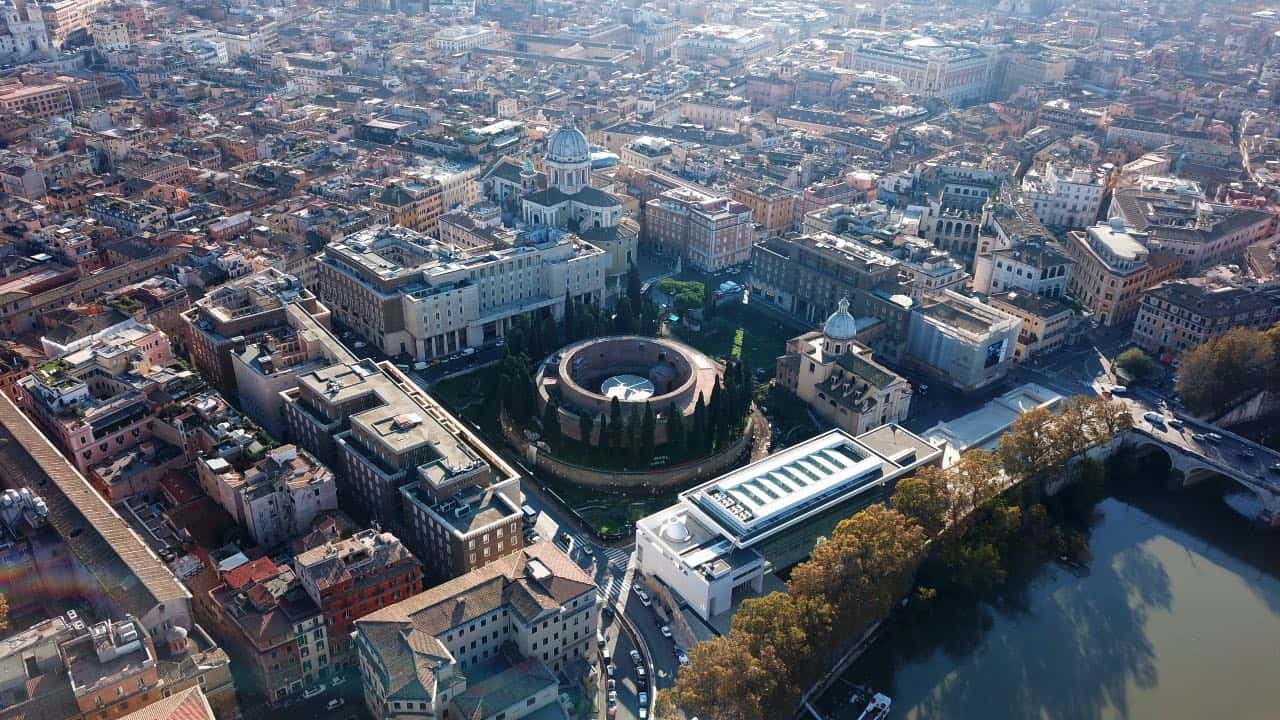

The Mausoleum of Augustus is in Piazza Augusto Imperatore, 00186 Rome, in the Campo Marzio district, with pedestrian access from Via di Ripetta side and from Largo San Carlo al Corso. The square around it has been open, free and walkable at any hour since June 2025, when it was handed back to the city after five years of construction work. The interior of the tomb, however, cannot be visited: the monument is closed to the public, and the restoration and museum work, funded by the TIM Foundation and supplemented by Bulgari's contribution for the exhibition design, is indicated as finishing by 2026, when the Mausoleum will become a museum with an interior route designed by the studio of Rem Koolhaas. You get there by Metro line A, Spagna stop (about 700 meters along Via dei Condotti and Via Tomacelli) or Flaminio stop (about 900 meters through Piazza del Popolo and Via di Ripetta). On the surface the area is served by lines 70, 81, 87, 492, 628, 990 and C3 at the Ripetta stop, lines 119, 628 and C3 at the Tomacelli stop, and the 628 at the Lungotevere Marzio stop. The reference call center for information and bookings for municipal sites is 060608, open every day from 9:00 to 19:00. The fares of the last opening period, between 2021 and 2022, were in the order of €4 or €5 for a full-price ticket with a €1 presale fee, with free admission for MIC card holders. The price list for the reopening will be published by the Sovrintendenza Capitolina together with the visit calendar, and should be checked on the official website before you set out.
If you're putting together a walk in the historic center, the full picture of things to see in the area is in the guide to Rome's museums, and exactly 100 meters from here is the Ara Pacis Museum, which is open every day and tells the other half of the Mausoleum's story.

Where the Mausoleum of Augustus is and how to really get there
The geography of this place fools almost everyone. The Mausoleum of Augustus occupies the center of a rectangular square built around it in the 1930s, in a spot of the northern Campo Marzio that for 20 centuries was periphery, then river port, then a very dense neighborhood of houses, then an urban void. Coming from Via del Corso you don't see it until you're inside: the rationalist buildings closing the square to the east and north act as a screen, and the monument appears all at once, at the bottom of a drop of six meters below the modern street level.
The walking route to the Mausoleum of Augustus
From the Spagna stop on Metro line A the best route is not the shortest but the most legible: you go down Via dei Condotti to Via del Corso, cross it, take Via Tomacelli, and at the first bend you're already on the flank of San Carlo al Corso, with the Mausoleum on your right. It's less than 10 minutes at a normal pace. From Flaminio, instead, it's best to enter Piazza del Popolo and take Via di Ripetta, the street that once led to the river port: the road runs straight and at a certain point widens onto the square. If you're arriving from Piazza di Spagna without hurry you can do the same thing by way of Via Margutta and Via del Babuino, which is a longer route and infinitely more beautiful.
Getting to the Mausoleum of Augustus by bus
The useful stops are three, and they all have names that confuse even Romans. The Ripetta stop, served by lines 70, 81, 87, 492, 990 and C3 in addition to the 628, is 170 meters from the edge of the square. The Tomacelli stop, with the 119, the 628 and the C3, is even closer, 130 meters. The 628 also stops on Lungotevere Marzio, at the level of the ancient port of Ripetta, 150 meters away. The 119 is a small electric bus that circles the Tridente and for people with walking difficulties it's the best choice, because it drops you practically in front of the church.
Getting there by car: the advice is don't
The square is inside the limited traffic zone of the historic center and free street parking doesn't exist. The closest parking spots reserved for people with disabilities are at Lungotevere Prati 22, Lungotevere dei Mellini 7 and Via Marianna Dionigi 2, all across the river, between 200 and 300 meters away, reached by crossing Ponte Cavour. For everyone else, the most sensible garage is the one at Piazzale Flaminio or in the Tridente, and you end up on foot anyway. The truth is that a monument 200 meters from the Corso is not reached by car: it's reached by walking, and by walking you also gain the scenery.
Hours, tickets and booking for the Mausoleum of Augustus
Here we need to be precise, because the confusion online is enormous and there are still sites selling admissions as if the monument were open. The situation is this: the square can be visited freely, the tomb cannot.
The square is open and free
Since June 6, 2025 Piazza Augusto Imperatore can again be walked across in its full extent, after a €6 million intervention backed by the TIM Foundation on a design by the Urbs et Civitas group led by architect Francesco Cellini, winner of the 2006 international competition. Two wide ramps connect the street level with the level of the monument, one toward Via di Ripetta and one toward San Carlo al Corso, and at the southern end a pavilion with a cafe and information point has been built. Anyone who wants to see the Mausoleum up close, walk around it, photograph it, understand how big it is, can now do it for free, at any hour, with no ticket and no booking. The outer perimeter of the enclosing wall reads very well, you can almost touch the courses of ancient brick with your hands, and for the first time in almost a century the monument is not a fenced-off hole in the middle of traffic.
The interior of the Mausoleum of Augustus is closed
Visits to the interior spaces are suspended. The museum work site, started in June 2025, is worth just over €7 million in total and has an expected duration of 18 months: redoing the electrical, lighting, surveillance and climate-control systems, restoring the burial chamber, creating a green ring-shaped route inside the structure, arranging the finds recovered in the excavations of the square. Among them are late antique structures, mosaics, a boundary stone and a marble head of a female deity, which will find a place inside the monument instead of ending up in storage. The date given for the opening of the museum is the end of 2026.
How much the visit to the Mausoleum of Augustus cost and how long it lasted
In the opening period between 2021 and 2022 the visit was limited: 10 people at a time, entries every half hour, individuals on the hour and guided groups on the half hour, duration of about 50 minutes, booking required. The ticket was €4 in the first season and €5 in the following one, with a €1 presale fee and a €1 reduction for the eligible categories. For residents of Roma Capitale and MIC card holders admission was free. Those numbers are there to give an idea of the order of magnitude, not to plan a visit: the reopening will bring a new price list and a new booking system, which the Sovrintendenza Capitolina will publish on its own website.
A warning about tickets sold online
The domain that hosted the website dedicated to the restoration no longer belongs to the project and today redirects to content that has nothing to do with Roman archaeology. Anyone looking for official information must go through the Sovrintendenza Capitolina ai Beni Culturali or the 060608 call center. It's a boring detail, but it avoids leaving your data with some random site believing you're booking a visit that nobody can provide at the moment.
What exactly is the Mausoleum of Augustus
It is the family tomb of the first emperor of Rome, and it is the largest circular tomb known in the ancient world. 87 meters in diameter, exactly 300 Roman feet, a masonry drum faced with white marble topped by an earth mound planted with evergreen trees, with a colossal statue of Augustus in gilded bronze on top. A mound, that is, the most archaic form of burial that Latium knew, that of the Etruscan kings and the princes of the early Iron Age, built however with the most modern building technique of its time and with a facing of Greek marble. This is the key to reading the whole monument and it's worth keeping in mind while looking at it: Augustus took the funerary language of the most ancient kings and carried it out with the means of a Hellenistic building site, saying two opposite things at once, that he was an ancient Roman and that he was the master of the Mediterranean.
It was not an individual tomb. It was a dynastic tomb, and this, in the Rome of 28 BC, was a very heavy political statement. The republic that Augustus claimed to have restored did not provide for dynasties. The great families had their family tombs, of course, but nobody had ever built a monument 87 meters in diameter to hold the ashes of their relatives in order of succession. Anyone entering the northern Campo Marzio and seeing that artificial mountain understood without need of explanation that the power of that man would be passed on to his descendants. And in fact it was.
Why it's called a mausoleum and not a tomb
The word comes from Mausolus, the satrap of Caria who died in 353 BC, for whom his widow Artemisia had a tomb built at Halicarnassus so immense that it entered the list of the seven wonders of the world. From that proper name came a common noun that indicates any monumental tomb. That the Romans called Augustus's tomb a mausoleum is in itself political information: it means they perceived it as a monument of a royal, oriental, dynastic type. Strabo, who wrote in Greek under Tiberius, uses exactly this word.
The Mausoleum of Augustus and the memory of Alexander the Great
In the summer of 30 BC, after entering Alexandria in Egypt following the deaths of Antony and Cleopatra, Octavian asked to see the body of Alexander the Great. The visit to the Sema, the burial enclosure of the Macedonian conqueror, is one of the most often told episodes of his biography. That monument, which according to the prevailing reconstructions had a circular plan, stayed in his mind. Two years later, during his sixth consulship, he began to build his own, and the reference was obvious enough that it didn't need to be explained to his contemporaries. Let's be honest: the link between the two tombs is a reading by modern scholars, coherent and widely shared, not a sentence written by an ancient author. No source says that Augustus copied Alexander. But no ancient source needed to say it.
28 BC: Politics Inside a Tomb
The dates matter more than usual here. In 32 BC Octavian makes a gesture without precedent in Roman history: he has the will of Mark Antony, deposited in Rome with the Vestals, handed over to him and reads it publicly before the assembly. In the document Antony recognized the children he had with Cleopatra as his heirs. It was the final blow. Octavian got war declared on Egypt, that is, on a foreign queen, and not on a Roman citizen, and this formal distinction allowed him to fight a civil war while presenting it as a national war. The next year, on September 2 of 31, Agrippa's fleet won at Actium. In the summer of 30 Alexandria fell. In 29 Octavian celebrated the triple triumph in Rome. In 28 he opened the construction site of his own tomb.
The message is clear and needs no subtitles: the victor of Actium would be buried in Rome, among the Roman people, inside a public park open to everyone, and not in the East. The tomb becomes the architectural sequel to the propaganda campaign of 32. There is also a hypothesis, supported by some scholars and not by an ancient document, that the construction site was opened before the battle, in the years of the break with Antony, precisely to answer the accusation of orientalism aimed at his rival. It's a fascinating reconstruction and one to handle with care: the ancient sources, Suetonius first among them, place the start of the works in the sixth consulship, that is, in 28. The political meaning, in any case, doesn't change one bit.
The Garden Open to the People Around the Mausoleum of Augustus
There's a detail that almost no guide tells and that is actually the real stroke of genius of the whole operation. Augustus did not just build the tomb: he opened to the public the groves and walks that surrounded it. The northern Campus Martius, until then an area for military drills and flood-prone land, became a park. Romans went there to stroll, to sit in the shade, to bring their children. The ruler's funerary monument was the center of a city garden: the death of the sovereign, literally, offered shade to the living. It's an operation to win consent that no Hellenistic king had ever thought of, and it explains why for two centuries nobody ever questioned that monument.
Our opinion: if the Mausoleum looks like a silent ruin to us today, it's because the garden was taken away. The monument was never meant to be an isolated object in the middle of a paved void. It was a green artificial hill inside a wood. The 1930s layout planted it in the center of an empty square and made it incomprehensible for 80 years. The 2025 work, with the ramps that stitch the levels back together, is the first serious attempt to put a city around it again instead of a fence.
The Structure of the Mausoleum of Augustus, Ring by Ring
What you see today is the masonry shell of a building that had at least three stacked levels and was entirely clad in marble. To understand it you have to take it apart in your mind, from the outside toward the center.

The Travertine Base
At the bottom there is a travertine base 12 meters high, which formed an outer cylinder 300 Roman feet in diameter. At the top, according to the most accredited reconstruction, ran a Doric frieze of metopes and triglyphs, that is, a Greek architectural order applied to an Italic mound. The travertine came from the quarries of Tivoli and the workmanship was of the highest quality. Almost nothing remains of that cladding: it was carried off stone by stone over 15 centuries, and part of it ended up in the lime kilns of the nearby river port of Ripetta, where the marble was burned to make building lime. It's the fate of half of ancient Rome, but here it has a particular effect, because it means that pieces of Augustus's tomb became mortar for the houses of the neighborhoods.
The Seven Concentric Rings of the Mausoleum of Augustus
On top of the base rests the circular building proper, made up of seven concentric rings connected to each other by radial walls. Two more lines of walls formed a second series of compartments. The system wasn't meant to create livable rooms. It was meant to build a wall cage able to hold the enormous weight of the earth mound above without settling and without lateral thrust. The rings can still be seen today, and they are the most impressive thing you can read from the top of the piazza: a wheel of concentric walls in brick and concrete work, with the voids between one ring and the next filled with earth. Anyone who has seen Hadrian's Villa or the substructures of the great sanctuaries of Lazio recognizes the logic at once.
The entrance corridor and the barrier wall
The original entrance was on the south, that is, on the side that now faces San Carlo al Corso Church, and it led into a long corridor. At the end of the corridor opened the first walkable space: a sector shaped like an arc of a circle, faced by a wall of great height and thickness clad in travertine, in which two entrances opened. That wall, preserved today only in a minimal part, was not a simple partition. It formed the substructure of a drum that emerged from the mound and created a second tier visible from outside. The Mausoleum, put differently, was not a smooth hill. It was a building on stacked levels, with at least two cylinders of decreasing diameter one above the other, ringed by columns, and the vegetation began only from the highest level.
The circular cella and the three niches
Beyond the wall opens a walkable annular corridor that supported the cella, also circular, with an axial entrance and three symmetrical niches placed at the axes. The urns went in the niches. The number is significant: three niches plus the entrance means a four-part organization of space, that is, a geometry designed to be read as cosmic order, not as a funerary archive. Whoever entered saw a circular, measured room, with the ashes of the imperial family arranged according to a rule.
The central pillar and the tomb of Augustus
At the exact center of the cella is a large hollow pillar, which contained a small square room. That room is, in all likelihood, the tomb of Augustus. The likelihood becomes near certainty if you consider that the pillar held up, at the top of the mound, the bronze statue of the emperor: the vertical axis of the monument connected the ashes underground and the gilded image above the trees, exactly on the same line. It's an architectural idea of remarkable strength, and it's worth stopping to think about it when you look at it from the top of the piazza: the point you see at the center of the rings is the point where the body and the simulacrum were.
How tall was the Mausoleum of Augustus
On the overall height, reconstructions differ and there is no certain number. Scholars' proposals range between 40 and 50 meters approximately including the mound, to which the colossal statue was added. The indications that circulate on some popularizing sheets speak of a statue 30 meters tall, which is an obvious misunderstanding: 30 meters was, if anything, an overall height of the monument with its top, not the measure of the bronze. Better to say what is known: the mass was comparable to a modern building of 12 or 15 floors, and it dominated the whole northern Campus Martius, which was flat and largely open.
The mound of evergreen trees
Above the wall structure there was earth, and on the earth evergreen trees. Strabo describes them explicitly. The most recent hypotheses, also discussed in the public debate of 2025 on the cypresses, lean toward low, regular species, perhaps boxwoods, arranged in an orderly design rather than a wild wood. The reference model was the Etruscan mounds of Cerveteri and Tarquinia, covered with earth and vegetation, and through them an idea of burial that went back to the centuries before the founding of the republic. Once again: the oldest possible form, built with the most modern technique available.
The two obelisks of the Mausoleum of Augustus, now at the Quirinal and the Esquiline
In front of the entrance to the tomb, on either side of the corridor, stood two obelisks of red Aswan granite brought from Egypt. They were not inscribed pharaonic obelisks. They were smooth monoliths, cut and transported in the imperial age, probably placed here under Domitian, that is, a century after the construction of the Mausoleum. They served to mark the threshold and to repeat, in an Egyptian key, the message of conquest.
They fell at an unspecified date, probably in the early Middle Ages, and broke. They remained buried under meters of earth and rubble for centuries. In the 16th century excavations at the foot of the monument brought them back to light, and from there begins a story that carried them to the two most solemn places in the Rome of the popes.
The Esquiline obelisk
The first of the two was raised by Sixtus V in 1587 behind the basilica of Santa Maria Maggiore, in the piazza that today bears the name of Esquilino. Sixtus V is the pope who redesigned Rome with obelisks: he used them as monumental road signs, vanishing points visible from afar to orient pilgrims among the great basilicas. Planting in front of the Marian basilica the monolith that had watched over the tomb of the first emperor was a gesture of conscious Christian appropriation, and not even a very subtle one.
The Quirinal Obelisk
Its twin had to wait two centuries. It was raised in Piazza del Quirinale only in 1786, at the will of Pius VI and to a design by the architect Giovanni Antinori, who placed it between the colossi of the Dioscuri, creating one of the most famous views in Rome. The shaft measures 14.63 meters, and with the base the whole reaches 28.94 meters. The sources differ on the precise date of the discovery of the two monoliths, which some place in 1519 and others in 1527. The prudent fact is that they came back to light in the first decades of the 1500s, during the works that were transforming the Ripetta area. Before arriving at the Quirinal, this one passed through the demolition site of the 16th-century hospital of San Rocco, in Ripetta, dismantled between 1772 and 1776.
The advice, for those who like connections: go see the two obelisks after passing by the Mausoleum, on the same day. They are the only two original elements of the monument that can still be seen standing today, intact and outdoors. All the rest of the cladding is scattered. They are not. Going up to the Quirinal at sunset and knowing that this granite saw Augustus's funeral procession pass completely changes the way you look at the square.
The Pillars with the Res Gestae in Front of the Mausoleum of Augustus
In front of the entrance, besides the obelisks, there were two pillars. On them were fixed bronze tablets inscribed with the official autobiography of Augustus, the text we know as the Res gestae divi Augusti, that is, the deeds accomplished by the divine Augustus. Suetonius tells us that the will and the attached documents were deposited with the Vestals and read in the senate after his death. Among them was the index of his deeds, which the emperor wanted engraved on bronze tablets to be placed in front of his own tomb.
What the Res Gestae Say
They are 35 paragraphs written in the first person, in a dry, almost bureaucratic Latin, listing offices, honors, gifts, public works, shows given, peoples subdued, provinces pacified, soldiers discharged and money spent out of his own pocket. There isn't a line of lyrical self-celebration: it's bookkeeping. The document begins with the age of 19, when he raised a private army, and closes with the conferral of the title of father of the fatherland. The form is that of an account, and for that very reason it works: the reader has the impression of facing facts, not praise. As a piece of political communication it remains unsurpassed after 2,000 years.
Why the Surviving Copy Is in Ankara
The bronze tablets of the Mausoleum no longer exist. They were torn off and melted down, in all probability during the sack of 410 or in the centuries immediately after, when bronze was worth much more than memory. The text was saved because it had also been copied elsewhere, engraved on the stone of the temples dedicated to Rome and Augustus in the provinces. The most complete version is the one from the temple of Rome and Augustus at Ankara, in Galatia, which is in Latin with a Greek translation alongside. Scholars call it the Monumentum Ancyranum and it is the reason we can read the emperor's autobiography today. Other fragments come from Apollonia and from Antioch in Pisidia. It's a lesson on the fragility of precious materials: the bronze of Rome vanished, the stone of the province remained.
The Res Gestae Wall Next to the Mausoleum of Augustus
There is a way to read that text while staying in the piazza. On the Lungotevere side, up against the Ara Pacis Museum, runs a long travertine wall with the Res Gestae engraved in Latin. It's not an ancient piece: it was made in 1938 as part of the pavilion designed by Vittorio Ballio Morpurgo to house the Augustan altar, on the occasion of the bimillennium of Augustus's birth. When that pavilion was demolished to make room for Richard Meier's museum, inaugurated in 2006, the Res Gestae wall was the only element kept from the old building, and today it is integrated into the semi-basement level of the new one. You can read it for free from the outside, walking along the sidewalk. For those who studied Latin in high school it's one of the few places in Rome where you can do a public reading of an ancient text leaning on the wall.

Who Is Buried in the Mausoleum of Augustus
The list of the people laid to rest in here is the story of the first imperial dynasty told backward, that is, in order of death. And it's an impressive story, because the tomb began to fill up long before its patron ended up in it, and it filled up above all with young people.
Marcellus, the First, in 23 BC
The first to be laid in the Mausoleum was Marcus Claudius Marcellus, son of Octavia and nephew of Augustus, who had given him in marriage to his own daughter Julia and had made him his designated heir. He died in 23 BC, at a little over 20, probably of one of the epidemics that struck Rome in summer. It was a very hard blow. Augustus dedicated to him the theater that still bears his name today, and Virgil, in the sixth book of the Aeneid, reserved for him the verses in which Anchises shows Aeneas the shade of the young man destined to die early. Ancient tradition says that Octavia fainted during the reading. Together with Marcellus, in the same period, Atia the Elder, the mother of Augustus, was laid to rest.
Agrippa, the Man Who Won at Actium
Marcus Vipsanius Agrippa died in 12 BC. He was the lifelong friend, the general who had won the battle of Actium, the builder of the first Pantheon, of the Aqua Virgo aqueduct and of the baths of the Campus Martius, the son-in-law of Augustus after the death of Marcellus. That his ashes were received in the dynastic tomb, and not in the tomb of his own family, says everything about the role he had. He is the only person not belonging to the gens Iulia by birth to occupy that place on his own merits.
Octavia the Younger, the Sister
Octavia, sister of Augustus and mother of Marcellus, died in 11 BC. It was her brother who personally delivered the funeral oration, and the bier was carried to the Mausoleum. Her personal story is one of the hardest in the family: wife of Mark Antony in a political marriage, repudiated for Cleopatra, and then guardian of the children Antony had had with the queen. Rome remembered her as a model of dignity, and Augustus treated her as such.
Drusus the Elder, Dead on the Rhine
Nero Claudius Drusus, son of Livia and brother of Tiberius, a general much loved by the soldiers, died in 9 BC in Germany from the consequences of a fall from a horse. The body was brought back to Rome across half of Europe and laid in the Mausoleum. The senate decreed for him the hereditary surname Germanicus, which passed to his son.
Gaius and Lucius Caesar, the Two Lost Grandsons
They were the sons of Agrippa and Julia, adopted by Augustus as heirs. Lucius died in Marseille in AD 2, Gaius in Lycia in 4, both very young, both while on their way to military postings. Their ashes returned to Rome and ended up here. The loss of the two boys forced Augustus, by then old, to adopt Tiberius: that is, to hand the empire to the Claudian branch of the family. Anyone who looks at the Mausoleum as a monument of triumph should remember that for its patron it was above all a place of repeated mourning.
Augustus, in AD 14
He died at Nola on August 19 of the year 14, at 76. Suetonius tells of the journey of the body with an almost chronicle-like detail: from Nola to Bovillae at night, because of the heat, and then into the city. In Rome there were two funeral orations, one delivered by Tiberius in front of the temple of the Divine Julius in the Forum, the other by Drusus the Younger, son of Tiberius, from the top of the old rostra. Then the senators lifted the bier and carried it on their shoulders to the Campus Martius, where the body was cremated. An old praetorian swore he had seen the emperor's ghost rise to heaven from the flames of the pyre, and that oath was the basis of his deification. The most influential men of the equestrian order, in tunics, without belts, barefoot, gathered the ashes and laid them in the tomb.
Germanicus and Drusus the Younger
Germanicus, son of Drusus the Elder and nephew of Tiberius, died at Antioch in AD 19 amid suspicions of poisoning that were never cleared up. His widow Agrippina the Elder crossed the Mediterranean with her husband's urn in her arms and landed at Brindisi, welcomed by an enormous crowd. Tacitus made it one of the most intense pages of the Annals. The urn arrived at the Mausoleum. Drusus the Younger, natural son of Tiberius, died in 23, also in suspicious circumstances, and was laid here.
Livia and Tiberius
Livia Drusilla, wife of Augustus for 52 years, died in AD 29 at more than 80 and was buried in the Mausoleum. Tiberius, her son and successor of Augustus, died at Misenum in 37 and his ashes joined hers. With them the tomb now held two entire generations of a family that had split into two branches and that had consumed an impressive number of heirs.
Caligula's Family
Caligula, just risen to power in 37, made a highly calculated political gesture: he went in person to recover the ashes of his mother Agrippina the Elder and of his brothers Nero Caesar and Drusus Caesar, who had died in exile or in prison during the reign of Tiberius, and brought them to the Mausoleum. With that journey he presented himself as the son who repairs a wrong and brings his dead home. Later his sisters Drusilla and Julia Livilla were also laid there, and finally, after the assassination of 41, Caligula himself.
Claudius, Poppaea and the Last Julio-Claudians
The ancient sources indicate the Mausoleum also for Claudius, who died in 54 and was deified by the senate, and for Poppaea Sabina, second wife of Nero, who died in 65 and was embalmed rather than cremated according to the Eastern custom. For some of these burials the documentation is less solid than for others, and it's worth saying so: the list of the last Julio-Claudians is reconstructed by cross-checking Tacitus, Suetonius and Cassius Dio, and the three do not always say the same thing.
Nerva, in 98, the Last of All
The tomb remained in use well beyond the extinction of the dynasty. The last to be laid there was Nerva, the elderly emperor who had reigned just 16 months and who had had the wisdom to adopt Trajan. He died in January of 98. With him the Mausoleum of Augustus closes: 126 years after the laying of the first stone, the dynastic tomb of the first princeps receives the man who inaugurates succession by adoption. It's a chronological coincidence that has the flavor of the closing of a book.
Where the Later Emperors Ended Up
Trajan was cremated and his ashes were laid in a golden urn at the base of Trajan's Column, inside the pedestal, in the middle of the Forum, which was a privilege without precedent. Hadrian understood that the old tomb was full and built a new one on the other bank of the Tiber: that monument is today called Castel Sant'Angelo and it received the ashes of the emperors of the second century. Rome's two imperial mausoleums look at each other from one bank to the other, a little over a kilometer apart, and tell the same idea one and a half centuries apart.
Who Never Entered the Mausoleum of Augustus
The exclusions, in a dynastic tomb, weigh as much as the inclusions. More, in fact, because an exclusion is always a sentence.
Julia the Elder, the Daughter
Julia, the only daughter of Augustus, wife of Marcellus, then of Agrippa, then of Tiberius, mother of Gaius and Lucius, was banished in 2 BC to the island of Ventotene on charges of adultery and scandalous conduct, in a trial that had a lot of politics in it and little morality. She died at Reggio Calabria in AD 14, a few months after her father, and Augustus had left instructions that she not be buried in his mausoleum. It's the harshest detail of the whole story: the man who had built the greatest family tomb of the ancient world kept out of it his own only daughter.
Nero
The last of the Julio-Claudians also stayed out. Nero, who died by suicide in 68, was laid in the tomb of his paternal family, the Domitii Ahenobarbi, on the Pincian Hill, in the area where Santa Maria del Popolo Church stands today. Medieval popular tradition, which had a confused memory of that tomb, went so far as to tell of ravens and haunting spirits on the hill, and the legend of the driving out of Nero's demon is at the origin of the founding of the church. That the most gossiped-about emperor of Rome stayed out of the family tomb and ended up inside a Christian legend is one of those symmetries this city produces on its own.
Strabo's Description: How the Mausoleum of Augustus Looked to Its Contemporaries
We have an eyewitness description, written by a Greek geographer who saw the monument when it was new. Strabo, in the fifth book of the Geography, writes: the most notable of the monuments is the so-called Mausoleum, a great mound of earth, raised near the river on a high round base of white marble, completely shaded by evergreen trees up to the top, on which was the statue of Caesar Augustus in gilded bronze. And under that mound were the burial chambers of him, of his relatives and of his closest friends. Behind, he adds, there is a large sacred grove that offers splendid walks. And in the middle of the field there is an enclosure, also of white marble, built around the crematorium of Augustus, with a circular iron railing and poplars inside.
It's worth rereading that passage carefully, because it contains information that archaeology alone could not have given. First: the color. White marble base, dark green of the trees, gold of the statue. Second: the ustrinum, the cremation enclosure, was a separate building, in the middle of the field, with poplars inside, and so the imperial funeral rite occupied two distinct places connected by a processional route. Third, and this is the point that always gets missed: in the tomb there were also the closest friends, that is, people outside the family. In a society where the tomb defined belonging, this means that Augustus used his own funerary monument to build a new category, that of men bound to the princeps by a personal bond instead of a blood tie.
The Sack of 410 and the Long Plundering of the Mausoleum of Augustus
The monument stopped being a living tomb at the end of the first century and slowly began to be abandoned. The decisive blow came in August 410, with the sack of Rome by Alaric's Goths. The urns were opened, the precious metals carried off, the bronze tablets of the Res Gestae torn from the pillars and melted down, the ashes scattered. From that moment the Mausoleum becomes what it would remain for 1,000 years: a quarry.
The mechanism was simple and ferocious. The facing marble was pulled off and taken to the lime kilns of the port of Ripetta, 200 meters away, where by burning it turned into lime for mortars. The travertine was reused as it was in new buildings. The lead of the clamps was recovered. The monument, stripped layer after layer, was reduced to the bare skeleton of concrete, which nobody wanted because it was good for nothing: and that is why it has reached us. Rome has kept of antiquity only what was too inconvenient to recycle.
To this were added the floods of the Tiber, which in that stretch regularly reached the monument and raised the ground level by tens of centimeters at a time. Over the centuries the walking level of the area rose by several meters, and the Mausoleum found itself progressively buried: what the Romans of the 1500s saw was a stump of hill ringed with ancient walls, sticking out of a neighborhood.
The Urn of Agrippina the Elder Used as a Grain Measure
There is one object that survived the plundering, and the reason it survived is almost comic. The burial urn of Agrippina the Elder, mother of Caligula, was reused in the Middle Ages as a measure for weighing grain: a hole was cut in the bottom to make it a bushel, and it was precisely this new function that saved it from destruction. Today the monument with its inscription is kept in the circuit of the Capitoline Museums, in the rooms of the Tabularium. The inscription records that here were the bones of Agrippina, daughter of Marcus Agrippa, granddaughter of the divine Augustus, wife of Germanicus Caesar, mother of Gaius Caesar Augustus Germanicus, princeps. A woman defined entirely through the men of her life, and whose urn has come down to us because it served to measure the grain of a neighborhood market.
The Colonna Fortress: The Mausoleum of Augustus in the Middle Ages
In the 12th century the Colonna family turned what was left of the tomb into a stronghold. It was a perfectly ordinary practice in medieval Rome: baronial families seized ancient ruins and used them as ready-made bases for their own towers and bastions. The Colosseum became the fortress of the Frangipani, the Theater of Marcellus became the palace of the Savelli, the mausoleum of Hadrian was already a papal castle. The Mausoleum of Augustus, with its rings of masonry meters thick and its circular plan, was the perfect site for a castle.
The Colonna stronghold was dismantled in 1167, according to tradition after the clash between the family and the Roman commune. What interests us here is another, lesser-known fact: for almost the whole Middle Ages the area was subject to flooding, the neighborhood around it was inhabited by the poor, and the monument was not continuously recognized as the tomb of Augustus. Knowing that the first emperor lay down there was a learned notion, not a matter of common sense.
Charlemagne's Sarcophagus, a Misunderstanding 1,000 Years Long
The most striking misunderstanding concerns a sarcophagus. In the Middle Ages it was believed that Augustus's personal tomb was a Roman marble sarcophagus decorated with the abduction of Proserpina. The object had nothing to do with the Mausoleum, because it is from a much later period, the third century AD, but the belief was deeply rooted. In 1167 the emperor Frederick Barbarossa had it taken to Germany to lay Charlemagne's remains in it worthily, the founder of the new Germanic empire, on the occasion of his canonization. The sarcophagus is still kept in the treasury of the cathedral of Aachen.
Stop for a second on this chain of events. A German emperor of the 12th century takes from Rome a sarcophagus he believes to be Augustus's, to legitimize the burial of Charlemagne, to legitimize in turn his own empire. An error of archaeological attribution becomes the symbolic foundation of the Holy Roman Empire. The history of ancient art is full of misunderstandings like this, but few have had such lasting political consequences.

The Orsini, the Soderini and the Garden Above the Tomb
At the beginning of the 1500s the monument passed to the Orsini, in particular starting in 1512 with Franciotto Orsini. The neighborhood, meanwhile, was being repopulated: the port of Ripetta was working, houses were multiplying, the value of land was rising. The building speculation on the houses built up against the Mausoleum also made the price rise of the materials and statues that kept being extracted from the ruin to be resold. An ancient monument, in that Rome, was worth as much as a mineral deposit.
Then came the Soderini, the Florentine family of which Cardinal Francesco was a member, and with them the Mausoleum changed its purpose completely. The ruin was turned into a pleasure garden, a place of leisure far from the crowded part of the city. Terraces and flower beds were laid out on the concentric rings, and the antiquities coming out of the excavations were placed in the garden: statues, inscriptions, architectural fragments. It was the fashion of the time, the antiquities garden, and the Mausoleum was the ideal setting.
Think about it for a moment. Between the 1500s and the 1600s the tomb of the first emperor was a private garden where cardinals took guests to stroll among the statues. It wasn't neglect: it was a form of cultured, almost affectionate reuse, which however brought the definitive loss of much of the original layout. Modern conservation of monuments was born precisely from the rejection of this practice, but without the Soderini garden the Mausoleum would probably have been demolished and reduced to lime like everything else.
The Corea Amphitheater: Bulls, Buffalo Cows and Fireworks Above the Tomb of Augustus
Around the middle of the 1700s the garden and the palace built up against the northern side of the monument became the property of the Marquises Correa, a family of Portuguese origin. The name of the place, in the Roman pronunciation that tends to simplify the double r, became Corea, and that is how Romans still call it: Corea amphitheater.
The Spanish tenant Bernardo Matas had the idea that would change the history of the place for a century and a half. Inside the circular void of the Mausoleum he built temporary wooden structures, stands and boxes, and organized shows there. Bulls and buffalo cows, jousts, horseback tournaments, feats of strength, fireworks. The new arena was inaugurated on July 3, 1780. The capacity varied, according to the testimonies, between 1,000 and 3,000 spectators.
The Roman Bullfight Inside the Mausoleum of Augustus
The bull hunt was one of the best-loved popular shows of papal Rome, and the Mausoleum, with its already circular shape and its walls already in place to serve as a seating bowl, was the ideal location. In season, the public climbed the wooden steps built over the ancient rings and watched fights between men and animals right above the cella where the ashes of Augustus, Livia and Germanicus had been laid. The overlap carries a symbolic violence that still leaves you speechless today: nobody, at that time, perceived it as a sacrilege.
The season of the bullfights ended by decision of the church authority. During the pontificate of Pius VIII, between 1829 and 1830, shows with animals and fireworks were abolished, to make room for daytime entertainments judged more decorous. From 1802 the property had passed to the Apostolic Chamber. In July 1810 the space had already been converted into a theater for spoken plays in daylight. In 1819, during the celebrations for the visit to Rome of the emperor Francis I of Austria, the architect Giuseppe Valadier built over the arena a velarium that collapsed after a very short time. The detail makes you smile, and it serves as a reminder that even the great neoclassical architects got their calculations wrong.
From the Umberto I Amphitheater to the Augusteo: When the Mausoleum of Augustus Was Rome's Concert Hall
After 1870, with Rome as the capital, the property was acquired by Count Telfener, administrator of the royal family's assets, who renamed it Anfiteatro Umberto I in honor of the king and gave it an openly theatrical character. The management had mixed fortunes and the structure fell into decline.
The turning point came in 1907, when the Municipality of Rome acquired the property and renovated it according to the safety regulations of the time, turning it into a permanent concert hall. The credit for the operation goes largely to the Accademia Nazionale di Santa Cecilia, which needed a home for its orchestra. On February 16, 1908, the inaugural concert was held, conducted by Giuseppe Martucci. The season of the Augusteo began.
Hundreds of Concerts Inside the Emperor's Tomb
For 28 years the hall carved out inside the Mausoleum of Augustus was the main symphonic venue in Italy and one of the most important in Europe. Hundreds upon hundreds of works were performed there, with the participation of the greatest musicians of the time. Arturo Toscanini, Gustav Mahler, Igor Stravinsky and Pietro Mascagni passed through the podium of the Augusteo. In the memory of Romans the place wasn't called the Mausoleum: it was called the Augusteo, or also the Teatro Augusto, and for two entire generations it was the place where you went to hear music.
This, for me, is the most extraordinary page in the history of the monument, and the one foreign visitors have the most trouble believing. There was a famous acoustic. There was a subscription audience. There were the Italian premieres of works we now consider classics of the 20th century. All of it inside the masonry structure of a tomb built in 28 BC. No other European capital has ever done anything like it.
May 13, 1936: The Last Concert
The series of concerts ended on May 13, 1936. Then the demolitions began. The Augusteo was dismantled to bring the ancient building back to light, and the Accademia di Santa Cecilia lost its hall within a season. The irony of the episode is worth recording: to give the Romans back the tomb of Augustus, they destroyed the place where the Romans had gathered for 30 years. Preservation choices are always also choices about what a city wants to remember, and in 1936 Rome decided to remember the empire and forget its own concerts.
Piazza Augusto Imperatore: the regime's building site
The 1931 master plan provided for the isolation of the Mausoleum. Work started in 1934 and was of an urban violence hard to imagine today. About 120 buildings were demolished over an area of about 28,000 square meters: houses, shops, a whole fabric of alleys layered across the Middle Ages, the Renaissance and the Baroque, including the old San Rocco hospital. The uncovering of the ancient building and the arrangement of the area were entrusted to the firm Tudini e Talenti and went on between 1936 and 1940.
The design of the new piazza was by Vittorio Ballio Morpurgo, who drew the three large Rationalist blocks that close it on three sides, built in 1938 for the social security agencies, with porticoes, mosaics, reliefs and inscriptions in Latin. The piazza was inaugurated in 1938, to coincide with the 2,000th anniversary of the birth of Augustus, celebrated by the regime as a founding date. The work on the complex, in reality, dragged on and stopped for good only in 1952.
The Mausoleum of Augustus as a political tool
There's no need to beat around the bush: the operation was ideological before it was archaeological. Mussolini presented himself as the heir of Augustus, and the piazza was meant to build a visual and symbolic axis between the founder of the empire and the regime. On the same building site Morpurgo's pavilion for the Ara Pacis was built, reassembled in record time precisely for the anniversary, and on its side the text of the Res Gestae was carved. The sequence was designed to be read like a speech: the tomb of the prince, the altar of peace, the account of the deeds.
The urban result is what you still see today, and for decades it was judged a failure even by people who had no intention of making political polemic. A piazza too big, unbalanced, without functions, with the monument at the bottom of a pit and fenced off. Only the intervention completed in 2025 began to remedy it, not by demolishing anything but by stitching the levels together with ramps and giving the piazza back an everyday use.
The cypresses of 1938 and the 2025 controversy
Around the monument, in the 1930s, during the architectural arrangement overseen by Antonio Muñoz, cypresses were planted. According to reconstructions published in the recent debate, the planting was hurried and tied to the 1938 celebrations, that is, to Hitler's visit to Rome and the Augustan 2,000th anniversary. Those cypresses stayed there for almost 90 years and became part of the urban landscape that everyone knew.
In the autumn of 2025 they were cut down as part of the restoration and museumization works. The reasons given by the agencies were the presence of seriously diseased and unstable specimens, the damage the root systems were causing to the ancient walls, the safety of visitors and workers, and the need to make the structure legible for the new display. A notable public protest arose from it, with political inquiries, complaints to the Court of Auditors and social media campaigns. On January 13, 2026 an inter-institutional table on the matter was held at the Ministry of Culture. The agreements between the agencies provide for replanting with smaller cypresses of Italian varieties instead of imported cultivars.
An opinion that will be unpopular: those cypresses were not ancient, were not Augustan and were damaging the monument. They are the last visible legacy of the 1938 staging. Whoever defends them defends the landscape of their own childhood, which is legitimate and very human, but doesn't defend the Mausoleum. That said, the way the felling was communicated to the city was terrible, and the agencies brought part of the protest on themselves.
The decades of closure and the restoration of the Mausoleum of Augustus
After the uncovering of the 1930s the monument entered a very long season of neglect. Fenced off, overrun by spontaneous vegetation, occasionally opened for improvised initiatives, closed again. For generations of Romans the Mausoleum was a round hole full of grass and cats at the bottom of a piazza where nobody went. Those who lived around it crossed it with their eyes without registering it.
The real restorations began in 2008. The first phase concentrated on the interior, with a stratigraphic excavation meant to delimit the original structure and recover it, and with the building of temporary structures to shelter the archaeological materials that lay in the open outside the burial cella. The excavations made it possible, through the examination of the elements found, to work out a more reliable reconstruction of the look of the structure. The later interventions concerned the consolidation of the less stable parts and the securing of the area.
The TIM Foundation Project
In 2014 the city council approved a €12 million intervention on the piazza, meant for the redoing of the paving, new trees and decorations and the creation of a seating area for shows. At the beginning of 2017 the TIM Foundation launched the restoration project of the monument itself, accompanying it with a dedicated website to follow its progress. The works ended during 2020. It is the intervention that made the reopening possible, and it is, in size and continuity, one of the most substantial private funding efforts for Roman archaeology in recent decades.
The Reopening of March 1, 2021
The Mausoleum of Augustus reopened to the public on March 1, 2021, after 14 years of closure, with visits by reservation only and free until the following April 21, that is, until the Birth of Rome. It was one of the very few happy cultural events of that spring, and the reservations sold out in a few hours. Those who managed to get in during those months saw something nobody had seen in half a century: the entrance corridor, the inner ring, the cella, the central pillar.
What You Could See Inside the Mausoleum of Augustus
We have to be clear on one point, because it's the main cause of disappointment among visitors. What you see inside, that is, the brick structures and the marble plaques with the names of the Julio-Claudians, is largely the result of the reconstruction of the 1930s. There are no urns, no ashes, no ancient decorations in place. The inscriptions set into the walls of the cella are 20th-century copies and additions meant to make legible a space that had been emptied 15 centuries earlier.
This takes nothing away from the experience, however, if you approach it with the right expectations. The value of the visit inside is spatial, not about objects: you walk inside a ring 87 meters in diameter, you sense the thickness of the walls, you find yourself at the geometric center of a building that was the pivot of the first emperor's propaganda. You don't go to see finds, you go to understand a scale. And the scale, in person, is impressive.

The New Piazza of 2025 and the Museum of the Mausoleum of Augustus
On June 6, 2025, the new Piazza Augusto Imperatore, pedestrianized and redeveloped, was handed over to the city. The intervention, backed by the TIM Foundation with €6 million, which the foundation called its most important commitment in the cultural field since its birth, was designed by the Urbs et Civitas group led by Francesco Cellini, winner of the international competition announced in 2006. 19 years between the competition and the ribbon cutting: that too is part of the monument's history.
What Changed Around the Mausoleum of Augustus
The two wide ramps that connect the modern level with the ancient one are the real invention of the project. One goes down toward Via di Ripetta, the other toward San Carlo al Corso Church. Together they turn an enclosure into a route. At the southern edge a pavilion with a café and an information point was built. Consolidation work was done on the foundations of the surrounding buildings and the sewer network was redone, which in a piazza of that size is not a detail. The ancient travertine walking level, from the first century, was brought to light, and it can now be read in the new paving. The excavations yielded late antique structures, mosaics, a boundary marker and a marble head of a female deity, and the choice was to display them inside the monument instead of sending them to storage.
The Museum Designed by Rem Koolhaas
The museum installation project was entrusted to the studio of Rem Koolhaas, with a contribution of €700,000 from the Bulgari group foundation. The conservative restoration plan was overseen by Sebastiano La Manna. The overall cost of the museum development comes to a little more than €7 million, for an expected duration of the works of 18 months starting in June 2025. The future visitor route will include an inner green ring, the restored burial cella, the new systems and the display of the recovered materials. The date given for the opening is the end of 2026.
In our judgment, if the museum is delivered as designed, the Mausoleum of Augustus will become one of the three or four most visited archaeological sites in the Historic Center, and the area between Ripetta and the Corso will completely change its tourist weight. Anyone who organizes Roman itineraries would do well to take this into account starting now, because within a few months booking here will become as complicated as booking the Galleria Borghese.
The Mausoleum of Augustus and the Ara Pacis: Two Monuments, One Project
A hundred meters from the tomb, on Lungotevere in Augusta at the corner with Via Tomacelli, is the Ara Pacis Museum. The two monuments today seem close by chance. In reality they are two pieces of the same speech, even if in antiquity they were not in the same spot.
What Links the Two Monuments
The Ara Pacis Augustae was decreed by the senate in 13 BC and consecrated in 9, to celebrate Augustus's return from the campaigns in Spain and Gaul and the peace obtained. It stood along Via Flaminia, in a sector of the Campus Martius that also included the great sundial with the Montecitorio obelisk as its gnomon. The dynastic tomb, the altar of peace and the sundial formed a single system: the birth, the peace, the time and the death of the princeps organized in one piece of city. The altar was reassembled in the 1930s and moved next to the Mausoleum, and since then the two monuments have faced each other.
Visiting the Ara Pacis Today
The Ara Pacis Museum is open every day from 9:30 to 19:30, with last entry one hour before closing, and it is closed on May 1 and December 25. On December 24 and 31 the hours are reduced. The address is Lungotevere in Augusta at the corner with Via Tomacelli, and the call center number is 060608. There are three entrances: the museum one on the Lungotevere at street level, the exhibition one at Via di Ripetta 180 with a ramp, and the auditorium one at Via di Ripetta 190. The practical advice is banal and it works: as long as the tomb stays closed, visit the Ara Pacis, go out onto the museum's northern terrace and look down at the Mausoleum from there. It's the best vantage point there is right now, and almost nobody knows it.
What to See Around the Mausoleum of Augustus Within a 10-Minute Walk
This is one of the densest areas of Rome and the monument should be part of a route, not visited alone.
The Neighborhood's Churches
On the side of the piazza is the Basilica of Santi Ambrogio e Carlo al Corso, the church of the Lombards of Rome, with its enormous dome and the heart of Saint Charles Borromeo kept in a reliquary behind the altar. On the opposite side is San Girolamo dei Croati, national church of the Croatian community, and a little farther on San Rocco, which recalls the hospital demolished in the 1700s. Three churches in 200 meters, three different communities: that was how the Rome of the rioni worked.
The Tridente and the Lungotevere
Five minutes away is Piazza del Popolo with the Flaminio obelisk and the twin churches, and inside Santa Maria del Popolo Church there are two Caravaggios and the Chigi Chapel designed by Raphael. In the opposite direction you go down Via del Corso toward Piazza Colonna and Montecitorio, where the obelisk you see today in front of the Chamber was the gnomon of Augustus's sundial. Toward the river, the Lungotevere leads to Ponte Cavour and, a little beyond, to Castel Sant'Angelo, that is, to the mausoleum that took the place of this one.
A Half-Day Augustan Itinerary
The recommended route, when the weather allows, is this: start from the Mausoleum, go into the Ara Pacis, walk up the Lungotevere to Ponte Cavour only to see the monument from afar beyond the trees, come back in and take Via di Ripetta toward Piazza del Popolo, climb up to the Pincio to look at the Campus Martius from above, and finish by going down to Piazza di Spagna. Three full hours, almost all outdoors, with a single ticket to pay. Those who want to extend it can continue to the Pantheon, which still bears Agrippa's inscription on its pediment, and close the circle: the builder and his princeps, half a kilometer from each other.
The Mausoleum of Augustus with Children
With children it works better than you'd think, and for a precise reason: the shape. A circle 87 meters wide filled with concentric rings looks like a maze seen from above, and from the ramps of the new piazza you can see it very well. All you have to do is ask a child to count the rings and the visit becomes a game. The story to tell is that of the golden statue on top of the mountain of trees, which could be seen from all over the Campus Martius: it's an image children grasp right away, much more than the dynastic chronology.
With middle and high school kids the strong theme is another: bullfighting. Telling them that above the tomb of the emperor, 250 years ago, bulls were fought in front of 2,000 people always produces a reaction. From there it's easy to get to the concept of stratification, which is the hardest thing to explain and the most useful thing to understand about Rome. The monument is not simply ancient: it is ancient, medieval, Renaissance, 18th-century, 20th-century, all at once.
Accessibility of the Mausoleum of Augustus
The current piazza is completely accessible: the two ramps connecting the street level with the level of the monument were designed precisely to overcome the difference in height without steps, and the paving is regular. Those who move in a wheelchair can reach the perimeter of the tomb and go around it without barriers.
On the interior, the picture that held in the last period of opening was more complicated: the visit route included many flights of stairs, and the central area of the monument with dedicated educational panels was reserved for people with reduced mobility. The museum project under way provides for a new route, and the final accessibility conditions will be those the Superintendency publishes when the museum opens. For those arriving by car, the nearest reserved parking spots are across the river, at Lungotevere Prati 22, Lungotevere dei Mellini 7 and Via Marianna Dionigi 2.
When to go to the Mausoleum of Augustus and when to avoid it
As long as the visit is only from the outside, the time of day matters a lot. The best light on the ancient brick is in the late afternoon, when the sun comes in low from the west, beyond the river, and the walls turn orange. The worst light is that of a summer noon, which flattens everything and on top of that cooks you: the piazza has little shade, and with the cypresses cut it has even less.
The most beautiful moment of all, for those who live in Rome and can choose, is early on a winter Sunday morning. The piazza is empty, the neighborhood sleeps, you hear the bells of San Carlo Church and the monument is looked at in silence. To avoid, on the other hand, are the peak shopping hours on the Corso on December weekends, when Via Tomacelli and Via di Ripetta become impassable and nobody has the head to look at a mound from 2,000 years ago.
A curiosity about the Mausoleum of Augustus
The most beautiful curiosity is not about the emperor but about a woman who died in exile and a grain market. In the Mausoleum had been placed the urn of Agrippina the Elder, daughter of Agrippa and Julia, wife of Germanicus, mother of Caligula: one of the toughest figures of the early imperial age, who openly defied Tiberius and ended up confined on Ventotene, where she starved to death in 33 AD. When the tomb was looted and emptied, her urn should have vanished like everything else. Instead it was saved for the most prosaic reason imaginable: someone, in the Middle Ages, drilled a hole in the bottom and turned it into a measure for grain. A hollow block of marble, with the right capacity, was exactly what a neighborhood market needed to measure wheat. The funerary monument of an imperial princess became a bushel.
The piece has come down to us intact and is now in the circuit of the Capitoline Museums, in the rooms of the Tabularium, with its inscription still perfectly legible: the bones of Agrippina, daughter of Marcus Agrippa, granddaughter of the divine Augustus, wife of Germanicus Caesar, mother of Gaius Caesar Augustus Germanicus, princeps. Everything that materially remains of the burials of the Mausoleum of Augustus, therefore, was preserved because it stopped being a tomb and became a work tool. It's a lesson in preservation: in Rome what survives is what keeps being useful for something. Fine marbles ended up in lime kilns, inscribed slabs became steps, sarcophagi became troughs and fountain basins. Roman archaeology is made in large part of objects saved by reuse, not by respect.
One thing nobody tells you about the Mausoleum of Augustus
That the Mausoleum of Augustus, for almost 30 years, was the most important concert hall in Italy, and that Romans went there on Sunday afternoons in their good coats. It's not a joke and it's not a detail of erudition: it is a full phase in the life of the monument, lasting from 1908 to 1936, with continuous symphonic programming and a public of subscribers. Inside the cylinder of ancient masonry a hall had been built, the Augusteo, with tiers of seating, boxes, a stage and an acoustic that the musicians of the day praised. The Accademia Nazionale di Santa Cecilia had its home there. The inaugural concert, on February 16, 1908, was conducted by Giuseppe Martucci. In the following years Arturo Toscanini, Gustav Mahler, Igor Stravinsky and Pietro Mascagni stepped onto that podium.
The almost ignored fact is how it ended. The series of concerts closed on May 13, 1936, not because of an economic problem but because of a decision of archaeological policy: the ancient monument had to be freed, and so the hall had to be demolished. Rome found itself without its auditorium from one day to the next, and the Accademia had to fend for itself. In the public debate of the time the matter passed almost smoothly, because the Augustan bimillennium of 1938 justified everything. Today no plaque, no panel, nothing in the piazza tells this story to the passerby. Anyone who arrives and sees a circular ruin has no way of knowing that their grandfather heard the Ninth Symphony in that ruin. If the new museum development has the courage to tell the story of the Augusteo too, and not only the Julio-Claudian dynasty, it will be an intelligent museum. If it skips that chapter, it will be one more missed opportunity.
My Advice for Visiting the Mausoleum of Augustus
The practical advice, as long as the interior stays closed, is to treat it as an outdoor monument and study it from three different points within the same hour. First point: the upper level of the piazza, on Via di Ripetta side, where you take in the whole circumference and grasp the size. Second point: the bottom of the ramp, leaning against the masonry, where you see the brick up close, tell the modern rebuilding from the ancient construction and gauge with your eyes the thickness of the structures. Third point, and this is the real advice: the northern terrace of the Ara Pacis Museum, which looks out exactly onto the Mausoleum and which in the museum's layout is often ignored by visitors, who go in, look at the altar, buy a postcard and leave. From up there you read the plan of concentric rings better than from any other accessible point.
The second piece of advice is about time. Don't come here in a rush between two stops. This is a monument that gives nothing away at first glance: it's a brick cylinder in a piazza of the 1930s, and whoever passes through in three minutes leaves convinced of having seen an ordinary ruin. You need 20 real minutes, better 40, and you need to have the sequence in your head: the green mound with the golden statue, the public garden around it, the obelisks at the sides of the door, the bronze tablets with the Res Gestae. If you don't rebuild that scene mentally, the place will seem empty to you. Third piece of advice, a contrarian one: when the museum opens, don't book the first week. Go after a month, when the route has been broken in and the entry caps are looser. The rush to be among the first, at a monument that took a century to reopen, makes little sense.
Another Well-Known Fact, Yet Rarely Cited
That the two obelisks that today stand tall in Piazza del Quirinale and in Piazza dell'Esquilino, in front of the Presidential Palace and behind Santa Maria Maggiore Church, are the only pieces of the Mausoleum of Augustus still visible standing anywhere in the city. Insiders know it, the guides write it, and despite this almost none of the people who photograph those two monoliths every year know they are facing the furnishings of a tomb's door.
The story is this. The two obelisks of red Aswan granite were brought from Egypt and placed at the sides of the tomb's entrance, probably in the Flavian age, a century after construction. They fell and broke at an unspecified time, stayed buried and were found again in the first decades of the 1500s during works in the Ripetta area: the sources vary between 1519 and 1527 and it's best not to get attached to a single date. Sixtus V had one raised in 1587 behind Santa Maria Maggiore Church, within his great urban design that used obelisks as reference points for pilgrims. The other stayed on the ground for two centuries, passed through the demolition site of the hospital of San Rocco in Ripetta, dismantled between 1772 and 1776, and was finally erected in Piazza del Quirinale in 1786 at the will of Pius VI, to a design by Giovanni Antinori, between the two colossi of the Dioscuri. It measures 14.63 meters of shaft and 28.94 meters with the base.
The rarely cited fact, then, is that the tomb of Augustus still exists, but taken apart and distributed around the city: the structure in Piazza Augusto Imperatore, Agrippina's urn at the Capitoline Museums, the two obelisks on the two hills, the text of the Res Gestae engraved on a wall of 1938. Rome doesn't preserve monuments: it recycles them and scatters them.
The Right Photo to Take at the Mausoleum of Augustus
The photo everyone takes is the frontal one from the edge of the piazza, with the monument at the center of the frame and the Rationalist buildings at the sides. It almost never works, for a technical reason: the Mausoleum is 87 meters wide and only a few tens of meters tall, so in a horizontal frame it becomes a low, monotonous strip, squeezed between the sky and the paving. The result is a photograph that tells nothing about the scale of the monument.
The right photo is a different one, and you have to look for it from above. From the north terrace of the Ara Pacis Museum you look at the tomb from a raised, slightly lateral point: from there the concentric rings read like a drawing, the radial walls become spokes, and the circular structure reveals its own geometry. With a moderate wide-angle lens and late-afternoon light, when the low sun from the west carves the shadows between one ring and the next, you get the only image that really explains how the monument is built. If you have a camera with any pretensions, take a long exposure with the aperture stopped down, resting the camera on the parapet: you need the depth of field, because the foreground and the background are almost 200 meters apart.
The second photo I recommend is instead a very close-up one, and you take it from the bottom of the new ramp: a detail of the masonry, with the ancient brick and the modern repairs meeting in the same frame. It's a photograph that nobody will like on social media and that instead says everything about the monument: two different building languages, 2,000 years apart, leaning against each other. Skip the group selfie with the monument behind you in the flat light of noon, because at that hour the brick turns gray and in a photo it looks like any old retaining wall.
Some Important Events That Happened Here in History
The first is the funeral of Augustus, in September of AD 14. The body arrived from Nola, carried at night because of the heat, with a stop at Bovillae, then Rome. Two orations were held in the Forum: Tiberius spoke in front of the Temple of the Divine Julius, Drusus the Younger from the top of the ancient Rostra. Then the senators lifted the bier onto their shoulders and carried it on foot to the Campus Martius, where the pyre was already ready inside the enclosure of the ustrinum. An old Praetorian soldier swore under oath that he had seen the image of the emperor rise to the sky from the flames, and that statement provided the formal basis for the deification decreed by the senate. The ashes were collected by the most distinguished of the Roman knights, who according to Suetonius showed up in a tunic, without a belt and barefoot, and were placed in the cella.
The second event is the return of Caligula with the urns of his family, in AD 37. As soon as he came to power, the young emperor sailed in person to recover the ashes of his mother Agrippina the Elder and his brother Nero Caesar and brought them in procession to the Mausoleum. It was a political gesture built down to the detail: he presented himself as the son who was making amends for the injustices of the previous reign and putting the imperial family back together in the tomb of the founder.
The third is the sack of Alaric in August 410, when the tomb was broken into and emptied, the bronze tablets of the Res Gestae torn off and melted down, the ashes scattered. The fourth is 1167, the year Frederick Barbarossa took to Germany the sarcophagus that was believed to be Augustus's, to make it the tomb of Charlemagne at Aachen, and the year the Colonna fortress on the Mausoleum was dismantled.
The fifth is July 3, 1780, the inauguration of Bernardo Matas's arena: from that day, for half a century, bulls and buffalo cows were fought inside the Mausoleum in front of an audience of up to 2,000 people. The sixth is February 16, 1908, the first Augusteo concert, conducted by Giuseppe Martucci. The seventh is May 13, 1936, the last concert before the demolitions. The eighth is 1938, the year of the Augustan bimillennium and of the inauguration of Morpurgo's piazza. The ninth is March 1, 2021, the reopening after 14 years. The tenth is June 6, 2025, the handover of the new piazza and the start of the museum construction site. 10 dates in 2,000 years, and no two look alike.
Who Has Passed Through the Mausoleum of Augustus
Through the door of this monument have passed, dead, almost all the protagonists of the first imperial dynasty: Marcellus in 23 BC, Agrippa in 12, Octavia in 11, Drusus the Elder in 9, Lucius Caesar in AD 2, Gaius Caesar in 4, Augustus in 14, Germanicus in 19, Drusus the Younger in 23, Livia in 29, Tiberius in 37, and then Caligula's sisters and mother, Caligula himself after the assassination of 41, and according to the sources also Claudius in 54 and Poppaea Sabina in 65. The last was Nerva, in January of 98.
Just as many names have passed through it alive. Strabo, the Greek geographer from Amasia, who described the newly built monument in his Geography and left us the only reliable image of its original appearance. Frederick Barbarossa, or at least his envoys, in 1167. The Colonna, who turned it into a fortress in the 12th century, and the Orsini, who became its owners from 1512 with Franciotto Orsini. Cardinal Francesco Soderini, who made a garden of antiquities there. The Correa marquises, from whom the Roman name Corea comes, and their Spanish tenant Bernardo Matas, who opened the arena there in 1780. Giuseppe Valadier, who in 1819 set up a velarium over it for the visit of Emperor Francis I of Austria, and saw it collapse soon after.
Then come the musicians, and it's the list I like best: Giuseppe Martucci on the podium at the inaugural concert of 1908, and in the following years Arturo Toscanini, Gustav Mahler, Igor Stravinsky, Pietro Mascagni. For almost 30 years, anyone who mattered in European music passed through the tomb of Augustus to conduct an orchestra. In the political twentieth century, Mussolini passed through, who made this monument a manifesto of the regime, and so did the Rome of 1938, which celebrated here the bimillennium of the princeps's birth with the just-finished piazza and the cypresses planted in a hurry. Then silence, decades of fencing and neglect, and finally the thousands of people who since March 2021 have booked to set foot inside the ring again, using up the available spots within a few hours. Not every monument in Rome has such a disconnected list of visitors: emperors, barons, gardener cardinals, bullfighters, orchestra conductors and dictators.

Quick Questions About the Mausoleum of Augustus
Can you visit the Mausoleum of Augustus today?
Not the interior: visits are suspended and the monument is affected by the restoration and museum-fitting construction site. The piazza around it, on the other hand, has been open, pedestrian and free since June 2025, and lets you walk around the tomb and go down to the ancient level via two ramps.
When does the Mausoleum of Augustus reopen?
The date given by the bodies following the construction site is the end of 2026, with the opening of the new museum. The works, started in June 2025, have an expected duration of 18 months. The final calendar and the booking procedures will be published by the Sovrintendenza Capitolina.
How much is a ticket for the Mausoleum of Augustus?
Right now no ticket is on sale, because the interior can't be visited. In the last period of opening, between 2021 and 2022, the full-price ticket was €4 in the first season and €5 in the second, with €1 of presale fee and a €1 reduction for the eligible categories. The reopening rates will be different and should be checked on the official website.
Where is the Mausoleum of Augustus?
In Piazza Augusto Imperatore, 00186 Rome, in the Campo Marzio rione, between Via di Ripetta, Via Tomacelli and Lungotevere in Augusta. The main pedestrian access is from Via di Ripetta side.
How do you get to the Mausoleum of Augustus by public transport?
On Metro Line A, get off at Spagna, about 700 meters on foot, or at Flaminio, about 900 meters along Via di Ripetta. On the surface, lines 70, 81, 87, 492, 628, 990 and C3 stop at Ripetta, lines 119, 628 and C3 at Tomacelli, and the 628 also on Lungotevere Marzio.
How long does a visit to the Mausoleum of Augustus take?
Under the last management, the guided visit of the interior lasted about 50 minutes. For the current outside walk, from the piazza and the ramps, allow 20 to 40 minutes if you want to stop to look at the masonry and read the perimeter.
Do you need to book to visit the Mausoleum of Augustus?
For the piazza, no, you walk in freely. For the interior, when it reopens, booking will most likely be mandatory: it was in 2021 and 2022 too, with entries limited to 10 people at a time every half hour.
Is the Mausoleum of Augustus wheelchair accessible?
The piazza is, and it was designed precisely for that: the two ramps overcome the difference in level without steps. The interior route used until 2022, on the other hand, included many flights of stairs, and for people with reduced mobility only the central area with educational panels was reserved. The conditions of the new museum route will be published at the opening.
Can you take photos at the Mausoleum of Augustus?
Outside, yes, freely, and that's what you do now. For the interior, the rules will be set with the new installation. Under the last management, photography without flash and without a tripod was allowed.
What is the difference between the Mausoleum of Augustus and Castel Sant'Angelo?
They are the two imperial mausoleums of Rome. Augustus's is from 28 BC, circular, 87 meters in diameter, and received the Julio-Claudian dynasty up to Nerva. Hadrian's, built a century and a half later on the other bank of the Tiber, received the emperors of the second century and, transformed into a papal fortress, became Castel Sant'Angelo. The first was stripped to the bone, the second survived because it stayed useful as a castle.
Who is buried in the Mausoleum of Augustus?
Augustus, Marcellus, Agrippa, Octavia the Younger, Atia the Elder, Drusus the Elder, Gaius and Lucius Caesar, Germanicus, Drusus the Younger, Livia Drusilla, Tiberius, Agrippina the Elder with her sons Nero Caesar and Drusus Caesar, Caligula's sisters, Caligula himself and, according to the sources, also Claudius and Poppaea Sabina. The last was Nerva, in AD 98. Nothing remains of the ashes: they were scattered in the sack of 410.
Why isn't Julia, Augustus's daughter, buried here?
Because her father expressly forbade it. Julia had been banished in 2 BC on a charge of adultery, in a trial with strong political overtones, and she died in Reggio Calabria in AD 14. Augustus's testamentary provision excluded her from the dynastic tomb.
What are the Res Gestae divi Augusti?
Augustus's official autobiography in 35 paragraphs, an account of offices, expenses, works and conquests that the emperor had engraved on bronze tablets set up on two pillars in front of the entrance to the Mausoleum. The Roman tablets were melted down. The text has survived thanks to the copies engraved in the provinces, above all the one from the Temple of Rome and Augustus in Ankara.
Where can you read the Res Gestae in Rome?
On the travertine wall built against the Ara Pacis Museum, along the Lungotevere: it was built in 1938 as part of Vittorio Ballio Morpurgo's pavilion and kept when that pavilion was replaced by Richard Meier's museum, inaugurated in 2006. You can read it for free from the street.
Where did the obelisks of the Mausoleum of Augustus end up?
One in Piazza dell'Esquilino, behind Santa Maria Maggiore Basilica, raised again by Sixtus V in 1587. The other in Piazza del Quirinale, erected in 1786 at the wish of Pius VI to a design by Giovanni Antinori, between the colossi of the Dioscuri: it measures 14.63 meters of shaft and 28.94 meters with the base.
Is the Mausoleum of Augustus included in the MIC card?
The monument is part of the circuit of municipal sites, and in the last period of opening MIC card holders got in for free. The MIC card is the annual pass reserved for people who live or study in Rome and the metropolitan city, and it gives access to the civic museums. The conditions that will apply at the reopening will be confirmed by the Sovrintendenza.
Is the Mausoleum of Augustus good for kids?
Yes, and it works well precisely from the outside: from the ramps of the piazza you can see the concentric rings, and the structure looks like a labyrinth drawn on the ground. The story of the golden statue above the hill of trees and the one about the 18th-century bullfights inside the emperor's tomb are the two that grab them most.
How big is the Mausoleum of Augustus?
87 meters in diameter, equal to 300 Roman feet. It is the largest circular tomb known from the ancient world. The travertine base was 12 meters high. The original overall height, with the mound and the statue, is not certain and scholars' reconstructions differ.
Why did the Mausoleum of Augustus stay closed for so long?
Because after the uncovering in the 1930s the monument was never equipped for visits and stayed fenced off for decades. The restorations started in 2008, the TIM Foundation project in 2017, the reopening in March 2021 and the new closure a little more than a year later, to make room for the construction site of the piazza and then the one for the museum fitting.
What was the Augusteo?
The concert hall built inside the Mausoleum, active from February 16, 1908 to May 13, 1936, main home of the orchestra of the Accademia Nazionale di Santa Cecilia. It was demolished to bring the ancient building back to light. Even earlier, from 1780, the same space housed the Corea amphitheater, with bullfights, jousts and fireworks.
What can you see inside the Mausoleum of Augustus?
The entrance corridor, the wall rings, the annular corridor, the circular cella with the three niches and the central pillar that contained Augustus's burial chamber. The visible brick structures and the plaques with the names of the Julio-Claudians are in large part reconstructions from the 1930s: there are no ancient urns or furnishings.
Is entry free on the first Sunday of the month?
The free first Sunday applies to the open civic museums. As long as the Mausoleum stays closed the question doesn't arise. When it reopens, whether it's included in the calendar of free openings will need to be checked on the Sovrintendenza's official website.
Is there a bar or a refreshment point near the Mausoleum of Augustus?
Yes, at the southern end of the piazza a pavilion with a café and an information point has been built, inaugurated with the new layout of June 2025. Around it, between Via di Ripetta, Via Tomacelli and the Corso, the choice of bars and restaurants is wide and the prices are those of the Tridente.
What is there to see near the Mausoleum of Augustus?
The Ara Pacis Museum 100 meters away, the Basilica of Santi Ambrogio e Carlo al Corso on the side of the piazza, San Girolamo dei Croati Church and San Rocco Church a short walk away, Piazza del Popolo and Santa Maria del Popolo Church five minutes away, the Pincio for the view from above, Piazza Colonna and Montecitorio going down the Corso, Castel Sant'Angelo beyond Ponte Cavour.
How long does it take to see the Mausoleum of Augustus and the Ara Pacis together?
About two hours: 40 minutes for the outside walk around the tomb and for reading the Res Gestae wall, a good hour for the museum of the altar, including the time on the terrace that overlooks the Mausoleum.
Is it true that bullfights were held inside the Mausoleum of Augustus?
Yes. From 1780 the tenant Bernardo Matas built wooden stands inside the circular void of the monument and organized shows there with bulls and buffalo cows, jousts and fireworks, for an audience that according to accounts reached between 1,000 and 3,000 people. The shows with animals were abolished during the pontificate of Pius VIII, between 1829 and 1830.
Why is the Mausoleum of Augustus lower than street level?
Because the walking level of the city has risen by several meters over the centuries, through the floods of the Tiber and the accumulation of rubble. The ancient travertine floor, brought back to light, is now marked out in the paving of the piazza, and the two ramps of the 2025 project are there precisely to bridge that difference in level.
The Verdict on the Mausoleum of Augustus
For many years this piazza was a source of embarrassment for anyone showing it to visitors. You arrived, you looked at a circle of bricks full of weeds behind a fence, you told the story and you left. For a few months now the situation has really changed: the piazza works, you can walk around the monument, the ancient level can be read under your feet. It's not a visit yet, it's an inspection, but it's already something different.
My final advice is to come now, before the museum opens. In a few months there will be lines here, entry limits, schedules to respect and reservations gone in half an hour. Today there's a half-empty piazza with the tomb of Rome's first emperor in it and nobody telling you where to look. Take advantage: bring the text of the Res Gestae printed out, read it leaning against the wall on the Lungotevere, then go up to the piazza and try to imagine the green mound with the golden statue on top. When it reopens, and it will reopen, this place will go back to being what it was: the most political monument Rome ever built.
Article written by the editorial team of TourLeaderPro, contact them for Private/Corporate/V.I.P. Tours and Experiences.
Planning a trip to Rome? The English guides for visiting the city are on ItalyPlanner.com.