Stadio Olimpico
In short. The Stadio Olimpico is at Piazza Lauro de Bosis 15, in Rome, inside the Foro Italico complex, on the right bank of the Tiber at the foot of Monte Mario.
The Stadio Olimpico is at Piazza Lauro de Bosis 15, in Rome, inside the Foro Italico complex, on the right bank of the Tiber at the foot of Monte Mario. You get there by metro line A to Flaminio and then tram 2 to the terminus at Piazza Mancini, or by line A to Ottaviano and from there bus 32, which also passes through Piazzale Clodio and gets off at Piazzale della Farnesina. From Lepanto, bus 280 runs to Piazza Mancini, and from Tiburtina station there is the 168. By car you leave the Grande Raccordo Anulare at exit 6, toward Flaminia, then follow the signs for the Foro Italico. The Stadio Olimpico Tour costs €15 plus presale fees. You book it on the sales channel indicated by the official Sport e Salute website or at the ticket office at Via dei Gladiatori 2, which is open every day from 10:00 to 18:00 with last entry at 17:30. It lasts between 40 and 45 minutes and is closed on match days. Visitors enter from the Monte Mario driveway, at Viale dei Gladiatori 1, where there is also free parking. Children under six enter free but must still pick up a ticket at the ticket office. For Roma and Lazio matches, for rugby and for concerts the ticket office is another matter, and tickets are bought from the authorized seller that the clubs and the venue indicate on their official websites.
The complex is public: it is run by Sport e Salute S.p.A., a company wholly owned by the Ministry of Economy and Finance, which took the place of Coni Servizi in 2019. This is not a bureaucratic detail. It means that the biggest venue in Rome, the one everyone simply calls the Olimpico, belongs neither to Roma nor to Lazio: the two teams play there under concession, and this is the reason why the stadium wears neither the yellow-and-red colors nor the white-and-sky-blue ones, and why every Sunday it has to be dressed and undressed depending on who plays at home.

Anyone who comes here for the first time almost always makes the same mistake: they enter from the nearest parking lot, watch the match or the concert, leave and go. They miss the best part. The Stadio Olimpico is not an isolated building on the outskirts. It is the heart of a monumental complex from the 1930s, the Foro Italico, which is worth a walk even on an ordinary day, without a ticket and without a crowd. The marble obelisk, the 60 statues of the Stadio dei Marmi, the black-and-white mosaics of the Piazzale dell'Impero and the Ponte Duca d'Aosta are five minutes on foot from the turnstiles, and they are free.
Where the Stadio Olimpico is and how to really get there
The formal address is Piazza Lauro de Bosis 15, postal code 00135, Della Vittoria district, on the right bank of the Tiber just upstream of Milvian Bridge. The geography matters more than the address: the stadium occupies the narrow plain between the river and the southern slopes of Monte Mario, and this bottleneck explains everything that happens in the two hours before and the hour after an event. The access roads are few, the riverside roads are one-way and fill up fast, and 80,000 people don't clear out at the same speed at which they gather.
The Stadio Olimpico by metro and tram 2
The simplest way, and the one I recommend to anyone who doesn't know Rome, is the combination of metro plus tram. You take line A, the red one, and get off at Flaminio, the stop under Piazza del Popolo. At the exit, on the square, is the terminus of tram 2: you board and ride to the opposite terminus, Piazza Mancini. From there to the stadium it is a quarter of an hour's walk across the Ponte Duca d'Aosta, with the Foro Italico opening up in front of your eyes. It is the most scenic route and the most predictable: tram 2 has its own right-of-way for almost the whole route along Via Flaminia and doesn't get stuck in traffic like the buses.
A practical warning worth more than a lot of generic advice: at event peak hours tram 2 runs full and the runs bunch up. If you are in a group and want to be relaxed, board at Flaminio with 40 minutes of margin beyond what seems necessary to you. On the way back, instead, it is best to do exactly the opposite: walk slowly toward Piazza Mancini and let the first wave pass, and take the tram when the line at the terminus has dissolved.
The buses to the Stadio Olimpico and the Piazzale Clodio hub
The second route is the bus. From line A you get off at Ottaviano and take the 32, which goes up Viale Angelico, touches Piazzale Clodio and arrives at Piazzale della Farnesina, under the Ministry of Foreign Affairs, a short walk from the stadium. Piazzale Clodio is a hub worth knowing: it is the big space in front of the courthouse, with several lines converging toward the Foro Italico, and it is often the last point where you can get on a vehicle with some free seats when the flow toward the stadium has already started. Those who know the neighborhood walk there from Prati in 20 minutes and board there.
Third option: line A to Lepanto and bus 280, which takes you to Piazza Mancini along the riverside roads. From the east of the city the 168 from Tiburtina station works well. Those arriving on line B, the blue one, must change at Termini and move to line A toward Battistini, and from there choose one of the three solutions just described. There is no metro stop right next to the Stadio Olimpico: anyone who tells you otherwise is pointing you to a stop at least two and a half kilometers away.
The Stadio Olimpico by car: exits, parking and uncomfortable truths
By car you arrive from the Grande Raccordo Anulare, exit number 6, Flaminia, then follow the signs for the Foro Italico. Those coming down the A1 from Milan, Bologna and Florence take the Raccordo and continue toward Flaminia. Those coming from the A24 and A25, the Pescara, Teramo and L'Aquila axis, enter the Raccordo and head toward the A1, then repeat the route just described. Those coming up the A2 from Naples do the same. From Fiumicino airport you take the Raccordo toward Cassia and Flaminia and exit at number 6.
That said, a piece of advice: on event days the car is the worst choice. The free parking lot on Viale dei Gladiatori exists and is very convenient for the Tour, when the stadium is empty. On match and concert days that area is closed or reserved, the riverside roads become a funnel and getting out easily takes an hour. If you really must use the car, leave it beyond Ponte Milvio or around Piazza Mancini and do the last stretch on foot. The time you lose walking you make back 10 times over on the way out.
Getting to the Stadio Olimpico on foot, the way nobody chooses
The most beautiful pedestrian route starts from Piazza del Popolo, goes up Via Flaminia or follows the Tiber along Lungotevere Flaminio, passes in front of the MAXXI and the Auditorium Parco della Musica, brushes past the Teatro Olimpico and reaches the Ponte Duca d'Aosta in a little under an hour. It is a walk that crosses 100 years of Roman architecture in one go: the rationalist Flaminio, the square by Zaha Hadid, the acoustics of Renzo Piano, and then the travertine of the Foro Italico. A shorter and equally pleasant alternative goes by the Ponte della Musica, which connects the Flaminio district to the right bank and comes out a few hundred meters from the stadium.
The Stadio Olimpico inside the Foro Italico
To understand the Stadio Olimpico you have to understand where it was put. The complex was born as the Foro Mussolini, conceived by Enrico Del Debbio in 1927 and built starting the following year at the urging of Renato Ricci, then undersecretary for National Education and head of the Opera Nazionale Balilla. The choice of site came after discarding three alternatives, in the Tiburtina area, at Casal Palocco and in the Parioli: here there was a swamp to reclaim, but there was also Monte Mario behind it, and the Belle Arti office put the hill under protection precisely so that it would remain a natural green backdrop behind the complex. That restriction still holds: the Monte Mario Reserve is the reason why, looking at the stadium from the south, behind the stands you see woods and not apartment blocks.
The obelisk and the Piazzale dell'Impero of the Foro Italico
The entrance avenue is dominated by a Carrara marble monolith 17.5 meters tall, quarried in a single block and transported to Rome with a logistical undertaking that at the time was told as an epic. It still bears the letters of the original dedication carved on it. In 2015 its removal was discussed, and the proposal ran aground against the opinion of those who maintained that a monument must be read, not erased. In our view that opinion was right, and the Foro Italico is one of the few places in Italy where you can explain the architecture of the Fascist era without reticence and without nostalgia, simply by looking at it.
Behind the obelisk opens the Piazzale dell'Impero, a long carpet of black-and-white mosaics that leads to the fountain of the Sfera and to the entrance of the stadium. The mosaics are a catalog of athletes, allegories and inscriptions: you walk on them, literally, and it takes about 10 minutes to do them all at a slow pace. It is the only open-air museum in Rome where nobody will ask you for a ticket and where, nine days out of 10, you will be almost alone.
The Stadio dei Marmi Pietro Mennea, next to the Stadio Olimpico
A few dozen meters from the Olimpico is what, for many, is the most beautiful piece of the Foro Italico: the Stadio dei Marmi, designed by Enrico Del Debbio in 1928. It is a track-and-field ground surrounded by white Carrara marble stands, on which look out 60 marble statues of athletes, plus four more in bronze kept in the Palazzo H. Almost all of them were donated by the Italian provinces, which in 1935 numbered 94, and on the pedestal of each is carved the name of the donor province: the four bronze ones came from Trento, Udine, Genoa and Viterbo.
Since September 12, 2013, the Stadio dei Marmi has been named for Pietro Mennea, who held the 200 meter world record for 17 years. In 2024 it served as a warm-up area for the athletes of the European Championships, and from 2025 it has been part of the circuit of the Internazionali d'Italia tennis tournament. Go at sunset: the raking light on the white marble has an effect that no midday photograph captures.
The Casa delle Armi and the other architecture around the Stadio Olimpico
The complex holds some of the most studied architecture of 20th-century Italy. The Palazzo delle Terme, the work of Costantini between 1930 and 1936, houses the swimming pools and the RAI Auditorium, with mosaics by Giulio Rosso and Gino Severini. The Accademia di Scherma, or Casa delle Armi, was designed by Luigi Moretti between 1934 and 1936 and is considered one of the absolute masterpieces of Italian rationalism, a block of white marble cut with a precision that still leaves visiting architects speechless today. Then there is the Palazzo H, seat of the former men's Fascist academy, and the building of the Istituto superiore di educazione fisica, later become a university.
The Ponte Duca d'Aosta, the monumental entrance to the Stadio Olimpico
The bridge that connects the Flaminio district to the Foro Italico is not just any bridge: it is the entrance gate conceived by the designers, in line with the obelisk. It was signed by the architect Vincenzo Fasolo with the structural engineer Antonio Martinelli. Work began on June 21, 1936, and the bridge was inaugurated on March 26, 1939. It is reinforced concrete entirely clad in Tivoli travertine, measures 222.3 meters in length and 30 in width, with 21 meters of roadway and two sidewalks of 4 meters each. At the four corners rise as many marble-clad pillars, decorated with high reliefs that tell of the battles of the First World War fought on the Sile, the Piave, the Tagliamento and the Isonzo. It is dedicated to Emanuele Filiberto of Savoy-Aosta, commander of the Third Army.
Cross it on foot, not by bus. It is the way it was built for, and the only one in which the framing works: you climb onto the back of the bridge, the Tiber flows below, and ahead opens the axis of marble, obelisk, stadium.
The history of the Stadio Olimpico, from the Cipressi to the Centomila
The Stadio Olimpico you see today is the fourth or fifth stadium built on that same rectangle of land, depending on how picky you want to be. No other Italian venue has a similar layering, and almost nobody tells it in full.
1928-1932: the Stadio dei Cipressi
The first venue was born together with the Foro, designed by Enrico Del Debbio with the structural engineer Achille Pintonello and the firm Speroni. It was called the Stadio dei Cipressi because of the trees that surrounded it, and was inaugurated on November 4, 1932 with a big youth gymnastics event, together with the other first structures of the complex. It was sized for 100,000 spectators and had an enormous lawn, about 20,000 square meters, that is roughly 200 meters by 100: perfect for rallies and gymnastic displays, terrible for soccer, because the distance between the stands and the field made the view very remote. Anyone who complains today about the running track that pushes the stands away from the pitch should know that, compared with 1932, we are already very close.
1933-1937: the Luigi Moretti building site
Between 1933 and 1937 the venue was taken up and restructured by Luigi Moretti, with the collaboration of Angelo Frisia and again the engineer Pintonello, and it became the backdrop of the regime's great choreographies. These are the years in which the stadium works more as a political stage than as a sports venue, and it is the phase that most marked the perception of the place: whoever arrives here with a vague idea of Italian history recognizes it right away, even without being able to name it.
The war, the Allied motor pool and the abandonment
With the war everything stops. The area is abandoned and, after 1944, Allied troops use it as a motor pool: military vehicles parked where the most photographed lawn in Italy would later grow. It is the chapter that almost all guides skip, and that instead explains why, when work resumed at the end of the 1940s, nobody spoke of restoration but of reconstruction.
1951-1953: the Stadio dei Centomila
In 1949 CONI decided to complete the venue. The project passed through the hands of Cesare Valle and Carlo Roccatelli, and on the death of the latter it was Annibale Vitellozzi who brought it to completion. The result was a structure entirely in reinforced concrete clad in travertine, which cost roughly 3.4 billion lire of the time: major axis 319 meters, minor axis 189 meters, total height under 18 meters, of which 13 above street level and 4.5 underground, for an occupied area of about 33,500 square meters.
That height figure is the key to understanding the original project. Vitellozzi and his team did not want a building that could be seen: they wanted a bowl dug into the ground, low, that would leave Monte Mario as a backdrop and not steal the scene from the Foro. The 1953 stadium was barely visible, arriving from the bridge. It was renamed Stadio dei Centomila for the maximum capacity planned, and with that name it entered the imagination of two generations of Romans.
May 17, 1953: the inauguration of the Stadio Olimpico
The official inauguration took place on May 17, 1953, in the presence of the head of state Luigi Einaudi. The match was Italy against Hungary, the return leg of the 1948-53 International Cup, and it went very badly: the Hungarians of the Aranycsapat, the golden team of Puskás, won 3-0 with a goal by Nándor Hidegkuti and a brace by Ferenc Puskás. On the same day, inside the stadium, the sixth stage of the Giro d'Italia, Napoli-Roma, finished. It was an unrepeatable afternoon for its density of sport, and perhaps the best calling card possible for a venue destined to host everything.
The current name arrived soon after, with the award to Rome of the Games of the XVII Olympiad: from Stadio dei Centomila to Stadio Olimpico.
1960: the Rome Olympics at the Stadio Olimpico
On August 25, 1960 the Stadio Olimpico hosted the opening ceremony of the Games. They were the Olympics that changed the international image of postwar Italy, and on the Olimpico track pages of track and field were written that are still studied. Livio Berruti ran the 200 meters tying the world record both in the semifinal and in the final, with 20.5 seconds, and won gold wearing the dark glasses that became an icon. Wilma Rudolph, who had had polio as a child, won three golds. Otis Davis finished the 400 meters in 44.9 seconds, Herb Elliott the 1500 in 3 minutes 35.6 seconds.
For honesty's sake it must be said that the most famous Olympic marathon of those Games, the one won barefoot by Abebe Bikila, did not finish here: it started from the Campidoglio and ended at the Arch of Constantine, by torchlight. The Olimpico hosted the track, not the road.
1988-1990: the reconstruction for the World Cup
The most debated chapter in the history of the Stadio Olimpico is the renovation for Italia 90. The venue was the main stadium of the World Cup, and radical work was needed. The group of designers was imposing: Annibale Vitellozzi himself, the architect Maurizio Clerici, the engineer Paolo Teresi and the engineer Antonio Maria Michetti for the structures, with the firm Cogefar carrying out the work. Between 1987 and 1990 the plan changed several times, and costs swelled to nearly 450 billion lire.
In the end the venue was almost entirely demolished and rebuilt. Only a part of the outer facade of the Tribuna Tevere survived, which was raised with new stands. The curves were brought nine meters closer to the field, finally gaining a decent view. During the 1989-90 season, with the building site open, Roma and Lazio played their home matches at the Flaminio stadium.
The Stadio Olimpico's Teflon roof
The piece of engineering that today defines the silhouette of the Olimpico is the roof, and it deserves to be told well because almost nobody looks at it. The consulting was by the engineering firm Majowiecki of Bologna, and the solution adopted is a radial tensile structure. An outer ring, a lattice girder with a triangular profile, runs at 29 meters of height supported by 16 pylons, 12 of steel and four of reinforced concrete. An inner ring is made of 12 steel cables of 87 millimeters in diameter. Between the two rings work 78 pairs of cables, with a total overhang of 45 meters, and stretched over them is the Teflon and fiberglass membrane that gives that dazzling white visible from half the city. The roof alone cost about 160 billion lire.
That it is a remarkable work is beyond question. That it overturned the original project, equally so: the raising of the stands and the white sail erased the idea of a low, discreet stadium, sunk into the ground, that Del Debbio first and Vitellozzi then had pursued for 60 years. Today the Olimpico is seen from Monte Mario, from the Parioli, from the Gianicolo. In 1953 nobody saw it. The verdict is clear: from the point of view of the spectator's experience it was an enormous gain, from the point of view of the relationship with the Foro Italico it was a loss that will never be recovered.
At the end of the work the capacity exceeded 82,922 seats, with blue plastic seats without backs and two big screens mounted inside the curves, already built in 1987 for the World Athletics Championships. The renovated Olimpico hosted the first five matches of Italy at the World Cup and the final of July 8, 1990 between West Germany and Argentina, 1-0 on a penalty by Andreas Brehme six minutes from the end, in front of 73,603 spectators.
2007-2008: bringing the Stadio Olimpico up to code
In 2007 a second renovation plan started, this time entirely interior, to bring the venue up to UEFA standards ahead of the Champions League final of May 27, 2009. The work closed in 2008 and included bringing the structures up to code, improving security, redoing the locker rooms and press room, completely replacing the seats, new high-definition digital big screens, setting back the benches, partial removal of the plexiglass barriers between the stands and the field, more refreshment points and redone restrooms. The capacity dropped to the current numbers. The result was the confirmation of the Stadio Olimpico in UEFA category 4, the highest.
Today the Olimpico is one of four Italian stadiums in that category, together with the Olimpico Grande Torino, the Allianz Stadium in Turin and the Giuseppe Meazza in Milan, and it is the only Italian venue with a UEFA Elite ranking, the one that allows it to host the finals of the major continental club competitions.

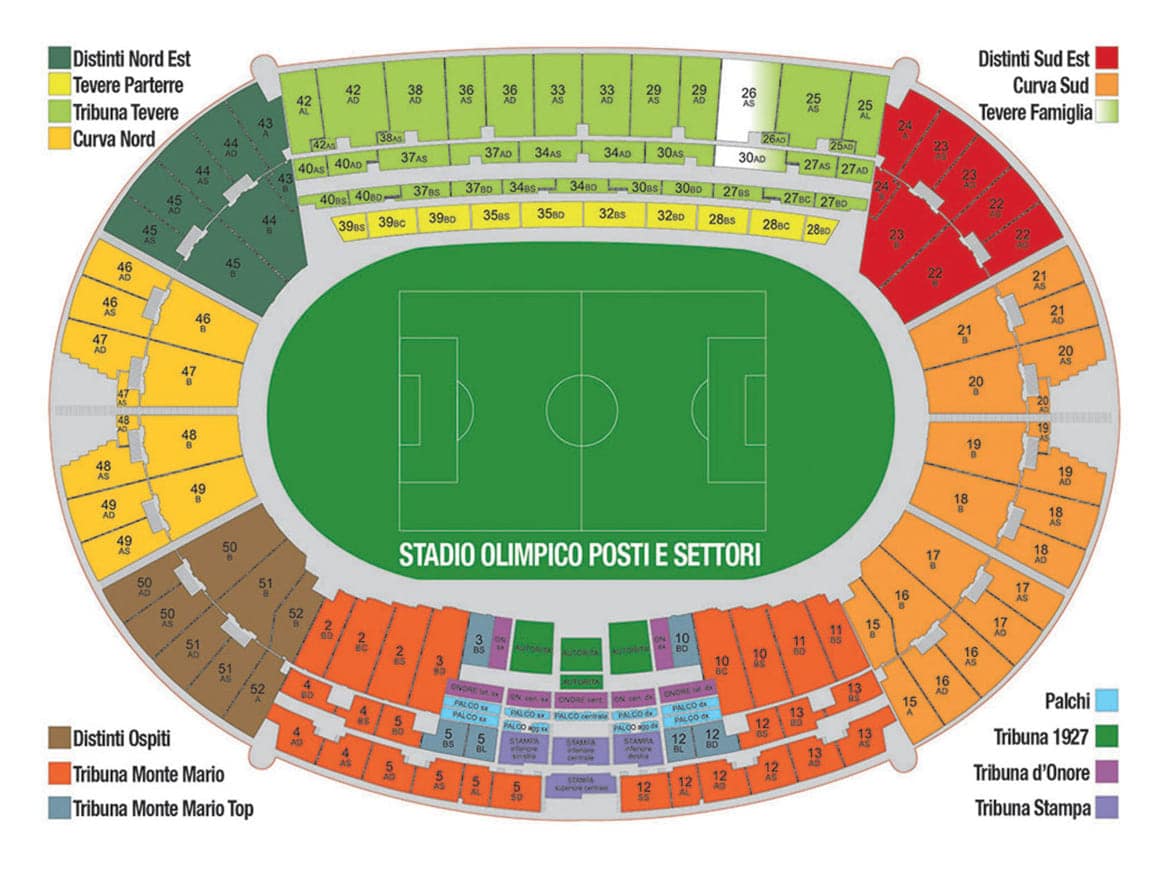
Sectors and capacity of the Stadio Olimpico
The approved capacity of the Stadio Olimpico is 70,634 seats, which makes it the second Italian venue by capacity after the Meazza in Milan. There are 33 entrances, distributed by sector. Understanding how the ring is organized is the difference between buying the right ticket and spending 90 minutes wondering why you can't see well.
The Tribuna Monte Mario of the Stadio Olimpico
It is the main stand, the western one, on the hill side, and has about 14,266 seats. Inside it is concentrated the whole honor area: the Tribuna d'Onore Centrale, divided into Centrale Sinistra, Centrale and Centrale Destra. The Tribuna d'Onore Laterale, with Laterale Sinistra and Laterale Destra. The Tribuna Autorità, split into Autorità Sinistra, Autorità Centrale and Autorità Destra. The Tribuna Autorità CONI, five rows of armchairs colored blue, red, yellow, green and black, the colors of the Olympic rings. The Boxes, central and lateral. The Super Boxes. There are then two hospitality areas, called Corporate and Piazza Italia.
A detail that always amuses visitors on the Tour: the armchairs of the authorities stand and of the CONI authorities stand are electronically heated and equipped with an LCD touch screen with the live television broadcast of the match. Yes, you watch the match on television while you have it right in front of your eyes. And yes, it happens that someone does it.
The Tribuna Tevere of the Stadio Olimpico
It is the eastern stand, the one toward the river, with about 16,527 seats, the largest sector of the venue. It is divided into Tribuna Tevere and Tribuna Tevere TOP, the latter in the central portion. It is the sector that keeps, behind its back, the only piece of the 1953 stadium that survived the 1990 demolition: a part of the outer facade. If you have a ticket for the Tevere, arrive half an hour early and walk the outside loop looking up: that travertine saw Puskás.
The Distinti of the Stadio Olimpico
These are the four sectors that join the curves to the stands, and together they hold a little under 23,000 seats: Distinti Nord Est with about 5,636 seats, Distinti Nord Ovest with about 5,597, Distinti Sud Ovest with about 5,765, Distinti Sud Est with about 5,702. The Nord Ovest works as the away sector in Roma's home matches, the Sud Ovest as the away sector in Lazio's. It is the most curious aspect of the cohabitation: the same ring changes function depending on who plays at home, and the internal signage is reconfigured match by match.
Curva Nord and Curva Sud of the Stadio Olimpico
The two curves hold about 7,500 seats each. The Curva Nord is the historic sector of Lazio's organized fans, the Curva Sud that of Roma. They are the two sectors that give the Olimpico its acoustic fame: when a curve starts up, the sound bounces off the Teflon membrane and comes back amplified, an effect that doesn't exist in open stadiums. Those who have played here always tell it the same way: it's not the volume, it's the fact that the noise comes from above.
Press stand and total of the sectors
The Tribuna Stampa has 553 positions. Adding up the sectors just listed you reach 69,046 seats, while the total approved capacity of the venue is the 70,634 cited above: the difference comes from the technical and service positions and those for spectators with disabilities, which don't fall within the ordinary breakdown and are counted separately. For the visit and for buying a ticket, the updated map published on the official website of the venue and on those of the clubs always applies.

The Stadio Olimpico Tour: what you really visit
For years going into the Olimpico without a match was impossible. Today it no longer is, and the Stadio Olimpico Tour is one of the most underrated visits in Rome: it costs as much as a sandwich and a coffee in the center and takes you into spaces that no curve ticket will ever show you.
The route of the Stadio Olimpico Tour
The visit begins at the Tunnel of Legends, the corridor where memorabilia, jerseys and objects of the protagonists who passed through here are displayed, from Francesco Totti to Giorgio Chinaglia. It continues into the mixed zone, the area where the players meet journalists after the match and where the most awkward interviews in the history of sport take place. Then the locker rooms, the trophy room, and finally the moment everyone is waiting for: walking onto the field, which the route calls Be a Hero, coming out of the tunnel toward the pitch. You access a delimited area of artificial grass in front of the benches, marked off by barriers, and from there you go up into the stands. The visit ends at the stadium store and the bistro.
How much the Stadio Olimpico Tour costs and how long it lasts
The basic ticket costs €15 plus presale fees, with reductions for groups and schools. The Tour runs every day from 10:00 to 18:00, with last entry at 17:30, and lasts between 40 and 45 minutes. Groups enter every half hour accompanied by a hostess. On match days the Tour is not held, because the venue is entirely devoted to producing the event: check the Roma and Lazio calendar before booking, it is the only real mistake you can make.
Booking is done online on the official sales channel indicated by Sport e Salute, at the affiliated sales points, or in person at the ticket office at Via dei Gladiatori 2, open every day from 10:00 to 18:00 except on match days. Visitors enter from the Monte Mario driveway, at Viale dei Gladiatori 1, to the left of the ticket office. The parking lot on Viale dei Gladiatori is free, but during the Internazionali d'Italia tennis tournament, from the beginning of May, it is best to leave the car at Lungotevere Maresciallo Diaz.
The Stadio Olimpico Tour with children and in a wheelchair
Children under six enter free, but the ticket must still be picked up at the ticket office: it is a formality used for counting attendance and which, if skipped, stops you at the turnstile. Family reductions, at the moment, are not offered. The route is wheelchair accessible in the Entrance, Tunnel of Legends, Mixed Zone, Locker Rooms, Field and Bar sections. The restrooms are at the end of the route, and this is a detail that those traveling with small children would do well to consider before going in.
On the photography front, access to the field is only with a ticket and accompanied by the guide: you can take photos, but within the rules of the group and in the permitted area. Nobody takes a penalty kick from the spot.

Roma and Lazio: two teams, one Stadio Olimpico
Since 1953, apart from the very brief interruptions due to building work, the Olimpico has hosted the home matches of the two biggest professional teams of the capital, Rome and Lazio. It is a rare condition in Europe for a stadium of this size, and it produces consequences that the foreign visitor struggles to understand: neither club owns the venue, both rent it, and every element of identity has to be assembled and disassembled.
The Rome derby at the Stadio Olimpico
The Roma-Lazio derby is the only day of the year when the Olimpico is full in both curves with different fan groups, and it remains one of the most intense sporting spectacles in Europe. The choreography is prepared for weeks, the ring is split in half, and the acoustic temperature rises to levels that are never reached in ordinary matches. If you happen to be in Rome on derby day and don't have a ticket, know that the whole city changes rhythm: the transport toward the Foro Italico is stormed from 3 in the afternoon, the center empties out, and in the bars of Prati and Testaccio it feels like being inside the stadium.
Going to see a match at the Stadio Olimpico: how it works
The ticket is personalized and must be bought through the official channels of the clubs or the authorized seller they indicate on their websites. The ID is needed at the turnstile. The gates open well in advance, generally a couple of hours before kickoff, and it is worth using that time: the line at the checks in the last half hour is the main reason people miss the first minutes. You can't bring in glass bottles, flagpoles beyond the permitted size, long umbrellas and blunt objects. The precise rules change from season to season and are published together with the ticket.
A tip that holds for all matches: the best sector for quality and price is not the honor stand but the Tribuna Tevere in the central portion. You see the whole field, you are facing the benches, and in the afternoon you have the sun at your back instead of in your eyes. The central Monte Mario is more prestigious and costs a lot more: the difference in view, from a purely sporting point of view, doesn't justify the jump in price.
Rugby at the Stadio Olimpico and the Six Nations
Since its opening the venue has hosted international 15-a-side rugby matches, at first only occasionally. The first big occasion was 1954, with the European Cup final between France and Italy, closed 39-12 for the French in front of about 25,000 spectators. Then, for decades, Italian rugby had its home at the Flaminio stadium.
The turning point is 2012: the Federazione Italiana Rugby leaves the Flaminio and moves the home matches of the Six Nations to the Olimpico. The first match was on February 11, 2012 against England, lost 19-15. From 1954 to 2024 the Stadio Olimpico hosted a total of 41 matches of the national team, 32 of them in the Six Nations.
Anyone who has never been to a rugby match at the Olimpico should do it at least once, and not for the rugby. The Six Nations crowd is the exact opposite of the soccer one: fans mixed on the same stands, families, Welsh and Irish singing in line at the beer stand together with Romans, no separation of sectors. It is the only day when the Stadio Olimpico can be visited bringing a six-year-old child without thinking twice. February days are cold: dress as if you were going to stand still for three hours, because that is exactly what you will do.

Track and field at the Stadio Olimpico
If the soccer history of the Olimpico is known to everyone, the track and field history is much less so, and is worth at least as much. The track measures 507 meters of total perimeter length with its moat, 2 meters wide and 1.90 deep.
The Golden Gala Pietro Mennea at the Stadio Olimpico
The Golden Gala was born in 1980 on the initiative of Primo Nebiolo, then president of FIDAL. The first edition was held on August 5, 1980 and brought 74,000 spectators to the stadium, 54,000 of them paying: numbers that today seem invented and that tell how much track and field weighed in the Italian sports culture of the time. Since 1982 it has been a fixed appointment on the calendar, skipped only in 1990 because of the soccer World Cup. Since 2010 it has been the Rome stage of the Diamond League, and since 2013 it has been named for Pietro Mennea.
The great world records set at the Stadio Olimpico
At the 1987 World Athletics Championships the Olimpico saw two records destined to last. Carl Lewis ran the 100 meters in 9.93 seconds, a new world record. And the Bulgarian Stefka Kostadinova jumped 2.09 meters in the high jump, one of the longest-lasting records in all outdoor track and field. Even earlier, in 1974, the stadium had hosted the European Championships, and in 1981 the World Cup of track and field.
The 2024 European Athletics Championships at the Stadio Olimpico
From June 7 to 12, 2024 the Stadio Olimpico hosted the European Athletics Championships, 50 years after the 1974 edition. 48 national federations took part with 1,559 athletes, 798 men and 761 women. Some events, such as the half marathon and the 20 kilometer race walk, were held on city routes outside the stadium. Those who were there remember above all one thing: the return of a track and field crowd to a stadium that had lost the habit.
Concerts at the Stadio Olimpico
Since the 1990 renovation the Stadio Olimpico has become steadily one of the great Italian music arenas. The enclosed shape and the Teflon roof act as a sounding box, and the field allows stage configurations that work much less well in stadiums with an uncovered track.
The attendance record at the Stadio Olimpico
The best-attended concert in the history of the venue remains that of Claudio Baglioni on June 6, 1998, as part of the Da me a te tour. The technical reason is simple and worth understanding: the stage was set up in the center of the field and the audience surrounded it at 360 degrees, filling the whole ring without blind sectors. In that configuration the stadium reaches numbers that no soccer match reaches, because there are no seats with the view blocked by the back of the stage. By comparison, the highest certified attendance for a sporting event at the Stadio Olimpico is 78,886 spectators, recorded on May 12, 1974 for Lazio-Foggia 1-0, with 18,392 Lazio season-ticket holders and 60,494 paying.
Going to a concert at the Stadio Olimpico: what to know
There are essentially two configurations. With the stage on a short side, the field is divided into numbered sectors and an area without seats in front of the structure, and the curves opposite the stage often stay closed. With the central stage, the whole ring can be sold. Before buying the ticket always look at the map for the specific event, because the same sector name can correspond to very different experiences depending on the setup.
The most useful advice concerns the exit. 90,000 people leaving at the same time toward two bridges and three surface lines produce a jam that lasts over an hour. Those who have a train to catch at Termini should allow 90 minutes from the lights going out, not 30. Those who can, wait 20 minutes seated in the stands: you still get out before those who stood up at the last chord, and you avoid the crush at the turnstiles.
The summer program of the Foro Italico overlaps with that of the other big Roman spaces: those looking for live music in the city will find alternatives at the Auditorium Parco della Musica and at the Palazzo dello Sport in EUR, which covers the winter when the stadium is occupied by the league season. Among the big events announced at the Olimpico are the residency of Vasco Rossi, the stadium tour of Olly, that of the Pinguini Tattici Nucleari, the return of Laura Pausini and the date of Achille Lauro. Dates, times and availability should always be checked on the official event pages.
The European finals played at the Stadio Olimpico
Few arenas in the world have hosted as many decisive matches. The list deserves to be read in full, because it is the reason why the Olimpico has the UEFA Elite ranking.
The European Cup and Champions League finals at the Stadio Olimpico
May 25, 1977: Liverpool beat Borussia Mönchengladbach 3-1, the English club's first European title. May 30, 1984: Liverpool against Roma, 1-1 after extra time and an English win on penalties. It was the first final in the history of the competition decided by penalties, and it was played in the home of the losing team: anyone who was in Rome that night never forgot it. May 22, 1996: Juventus against Ajax, 1-1 and penalties for the black-and-whites, 4-2. May 27, 2009: Barcelona beat Manchester United 2-0, the final for which the work of the year before had been done.
UEFA Cup, Coppa Italia and Intercontinental Cup
In 1991 the UEFA Cup final saw Roma beat Inter 1-0 in the return leg in front of 70,900 spectators, without however overturning the 2-0 of the first leg in Milan. Since 2008 the Stadio Olimpico has been the designated venue of the Coppa Italia final, with the sole exception of 2020, when the health emergency imposed a different organization. In 1973 the venue also hosted the Intercontinental Cup final between Independiente and Juventus, 1-0 for the Argentines in front of 22,000 spectators.
The European Championship finals and the 2020 European Championship
The Stadio Olimpico has hosted two continental finals for national teams. On June 10, 1968 the replayed final of the European Championship was played here, after the 1-1 of the first match: Italy beat Yugoslavia 2-0 and won its first European title. On June 22, 1980 it was the turn of the final between West Germany and Belgium, 2-1 for the Germans.
40 years later, for the 2020 European Championship played in 2021 without a single host country, the Olimpico hosted the opening ceremony and the opening match. On June 11, 2021 Italy beat Turkey 3-0 in front of about 16,000 spectators, the maximum allowed by the health rules of that moment. Italy-Switzerland 3-0, Italy-Wales 1-0 and the quarterfinal England-Ukraine 4-0 followed. It was a strange and unrepeatable tournament, with the stadium at a quarter of its capacity and a noise that, those who were there swear, was deafening all the same.
What to see around the Stadio Olimpico
Within a 20-minute walk of the Stadio Olimpico there is more than you would imagine, and it is worth building half a day around it instead of arriving only for the event.
To the north, five minutes away, is Ponte Milvio, the bridge of the battle of 312 between Constantine and Maxentius, today an area of bars and evening strolling. Behind the stadium rises Monte Mario, the highest hill in Rome, with its nature reserve and trails that climb among the holm oaks. On the summit is the Monte Mario Observatory, and from up there the panorama takes in the dome of St. Peter's and the white sail of the Olimpico in the same glance. Crossing the Tiber you enter the Flaminio district, with Zaha Hadid's MAXXI, Renzo Piano's Auditorium Parco della Musica and the Teatro Olimpico, which shares only the name with the stadium. To the south you quickly descend to Prati and Vatican City: from the stadium to St. Peter's it is a little over 30 minutes on foot along the river.
Anyone who wants to understand how old the very idea of a stadium is in Rome should then make a detour to the center and go down into the underground of the Stadium of Domitian, under Piazza Navona: there you see the foundations of a venue for athletic competitions inaugurated around AD 85, with an estimated capacity of around 30,000 seats. 1,900 years separate those stands from those of Viale dei Gladiatori, and the function is the same.
Frequently asked questions about the Stadio Olimpico
Where exactly is the Stadio Olimpico?
The Stadio Olimpico is at Piazza Lauro de Bosis 15, 00135 Rome, inside the Foro Italico complex, on the right bank of the Tiber between the slopes of Monte Mario and the river, just upstream of Ponte Milvio. The access roads are few because the stadium occupies a narrow plain between the river and the hill.
How much does the Stadio Olimpico Tour cost?
The basic ticket for the Stadio Olimpico Tour costs €15 plus presale fees. Reductions are offered for groups and schools, while children under six enter free.
How many seats does the Stadio Olimpico have?
The Stadio Olimpico has an approved capacity of 70,634 seats, which makes it the second Italian venue by capacity after the Meazza in Milan. There are 33 entrances, distributed by sector of the ring.
Which teams play at the Stadio Olimpico?
Roma and Lazio play their home matches at the Stadio Olimpico, since 1953 apart from brief interruptions due to building work. It is a rare condition in Europe for a stadium of this size, because neither club owns the venue: both rent it.
Is it better to visit the Stadio Olimpico on a match day?
No, for a first visit it is not worth going to the Stadio Olimpico on a match day, because in that case you see the stadium full but you see almost nothing of the rest. It is better to choose any Tuesday in October or March, at 10 in the morning, with the Tour booked the evening before.
What events does the Stadio Olimpico host besides soccer?
Besides soccer, the Stadio Olimpico hosts Six Nations rugby since 2012, when the Federazione Italiana Rugby left the Flaminio stadium, and track and field with the Golden Gala Pietro Mennea, born in 1980 on the initiative of Primo Nebiolo. Since the 1990 renovation it has also become one of the great Italian music arenas.
What does the Stadio Olimpico Tour include?
The Stadio Olimpico Tour begins at the Tunnel of Legends, the corridor where the memorabilia are displayed, and lets you see spaces that no curve ticket would ever show you. It costs as much as a sandwich and a coffee in the center and is one of the most underrated visits in Rome.
What is there to see near the Stadio Olimpico?
Five minutes from the Stadio Olimpico is Ponte Milvio, the bridge of the battle of 312 between Constantine and Maxentius, today an area of bars and evening strolling. Behind the stadium rises Monte Mario, the highest hill in Rome, with its nature reserve.
For those organizing the day with a group or with clients, the combination that works best is Foro Italico in the morning, Stadio Olimpico Tour in mid-morning, lunch at Ponte Milvio and the afternoon at the MAXXI. It is an itinerary that the TourLeaderPro team in Rome often builds for corporate groups and incentives, and one that holds up well even in the July heat because it alternates shaded outdoor spaces and air-conditioned interiors.
A curiosity about the Stadio Olimpico
The best curiosity about the Stadio Olimpico is not about a match but about a leap in scale that nobody tells: this venue was designed three times by different people with three opposite ideas of what a stadium should be, and the three ideas still coexist today within the same perimeter.
Del Debbio, in 1928, was thinking of a bowl for 100,000 people with a field of 20,000 square meters, suited to gymnastic rallies: a space to be looked at from above, where the geometry of bodies counted more than the contest. Vitellozzi, Valle and Roccatelli, between 1951 and 1953, overturned the idea: a very low stadium, under 18 meters of total height, with four and a half meters dug below street level, conceived to disappear into the landscape and leave Monte Mario as a backdrop. Majowiecki and Vitellozzi himself, in 1990, did the exact opposite: they raised the stands, mounted a lattice girder at 29 meters and stretched over it a white sail visible from the whole city.
The result is that the Stadio Olimpico is the only great European venue where you can read, in a single building, the passage from the stadium as political scenography to the stadium as discreet infrastructure and finally to the stadium as television icon. And there is a physical piece that testifies to the leap: a portion of the outer facade of the Tribuna Tevere, the only structure that survived the 1990 demolition. Anyone who walks the outside of the stadium on the river side can touch it. It is the last travertine of 1953 still standing, and no plaque marks it.
Something nobody tells you about the Stadio Olimpico
Nobody tells you that at the Stadio Olimpico a scudetto was decided in a single match, and that it happened only once in the whole history of the Italian league. In 1964, at the end of the season, Bologna and Inter finished the tournament level at the top. There were no goal difference criteria to settle the matter, and the Federation ordered a playoff on neutral ground: it was played at the Olimpico, and Bologna won 2-0. It is the first and so far only playoff for the title in the history of Serie A, and it took place here, on this field.
The second thing that is almost never said concerns the cohabitation of Roma and Lazio, and it has a very concrete implication for anyone buying a ticket. The Distinti sectors change function depending on the home team: the Distinti Nord Ovest is the away sector when Roma plays, the Distinti Sud Ovest when Lazio plays. It means that the very same seat, with the same number, can be among the home fans one Sunday and in the sector reserved for the opponents the next. Anyone who buys without checking which of the two teams plays at home risks ending up in the wrong sector, and at the turnstiles there is no room for negotiation.
The third, for engineering enthusiasts: the roof does not rest on the stadium. It is suspended, held up by 16 external pylons and kept in shape by 78 pairs of steel cables working in tension between the outer ring and the inner one, the latter made of 12 cables of 87 millimeters. The original design of the roof was a different one, and it was rejected after an appeal to the Lazio TAR. The sail that everyone photographs is, literally, a plan B.
The advice I give you for visiting the Stadio Olimpico
The advice is only one, and it goes against everyone's instinct: don't come to the Stadio Olimpico for the first time on a match day. Come on any Tuesday in October or March, at 10 in the morning, with the €15 Tour ticket booked the evening before.
The reason is practical. On an event day you see the stadium full, which is exciting, but you see nothing: you enter through a gate, go up to a sector, watch 80 minutes of soccer or two hours of concert and leave in a flood of people. You don't see the locker rooms, you don't see the trophy room, you don't see the Tunnel of Legends, you don't walk on the edge of the field, you don't stop to look at how the 29-meter lattice girder over your heads is made. And above all you don't see the Foro Italico, because on a match day the area is fenced off and managed for the flow.
On a Tuesday morning, instead, the perfect program is this: arrive with tram 2 at Piazza Mancini around 9:30, cross the Ponte Duca d'Aosta on foot, devote 40 minutes to the Piazzale dell'Impero and the Stadio dei Marmi, enter the 10:30 Tour, come out around 11:15, walk around the outside of the stadium on the Tiber side to see the piece of 1953 facade, and finish with lunch at Ponte Milvio. It is three and a half hours, it costs a €15 ticket plus lunch, and it gives you back 100 years of Italian history.
I add a seasonal recommendation. From the beginning of May the Foro Italico is occupied by the Internazionali d'Italia tennis tournament: the area is lively but congested, the parking lot on Viale dei Gladiatori becomes unusable and it is best to fall back on Lungotevere Maresciallo Diaz. In July and August, on the contrary, the complex is half empty and the white marble reflects considerable heat: if you come in summer, move before 11:00 or after 18:00.
Another well-known fact, yet rarely cited
Everyone knows that the Stadio Olimpico hosted the 1990 World Cup final. Almost nobody remembers that that final, on July 8, 1990 between West Germany and Argentina, was the first in the history of the World Cups to record a sending-off. Actually two: the Argentines Pedro Monzón and Gustavo Dezotti left the field in that order. Until that afternoon no player had ever been sent off in a World Cup final, and the not very glorious record belongs to this field.
The match ended 1-0 with a penalty by Andreas Brehme six minutes from the end, in front of 73,603 spectators. Diego Armando Maradona left the field crying, filmed by every television in the world. It was an ugly final, the poorest in goals in the history of the tournament up to then, and precisely for that reason it has stayed imprinted: the image of Maradona in tears on the Olimpico field is one of the most reproduced photographs of 20th-century soccer.
The second very well-known fact never cited in full concerns 1984. Everyone knows that Roma lost a European Cup final at home. Few know that the one on May 30, 1984 was the first final of the competition decided by penalty kicks. Before then, in case of a tie after extra time, the match was replayed. Liverpool and Roma inaugurated here the penalty lottery in the top European club competition, and Liverpool won 4-2 from the spot after the 1-1. A piece of the rules of modern soccer made its debut at the Stadio Olimpico.
The right photo to take at the Stadio Olimpico
The photograph that almost everyone attempts is the one from the inside, from your own seat, with the green field and the white sail above. It almost always turns out badly: the contrast between the shaded field and the lit membrane blows out the whole upper part of the image, and the result is a green rectangle under a burnt-out patch. If you really want that shot, take it with the match underway but in late-afternoon light, not at midday, and set the exposure on the roof instead of on the field: the green will come out darker, but the pattern of the cables will remain readable.
The right photo, though, is another one, and it's free. You take it from the Ponte Duca d'Aosta, standing on the uphill sidewalk, looking toward the Foro Italico. In a single frame come the Tiber, the travertine of the bridge, the 17.5-meter Carrara marble obelisk and, behind, the white silhouette of the Stadio Olimpico with Monte Mario closing the background. It is the perspective for which the bridge was designed in 1936 by Vincenzo Fasolo, in line with the stele: you are using, without knowing it, the framing that the architects had in mind. The best light is that of late afternoon in winter, when the low sun comes from the west and lights up the marble.
The second photo I recommend is taken at the Stadio dei Marmi, and it's not a panorama: it's a detail. Choose one of the 60 statues, get close to the pedestal and frame together the body of the athlete and the name of the province that donated it. The result is a portrait that tells the Italy of 1935 better than any caption, and it works very well in vertical. Third option, for those with breath and legs: climb the trails of the Monte Mario reserve to a viewpoint and photograph the stadium's sail from above, with the dome of St. Peter's in the same frame. It is the only framing that really shows how much that roof changed the skyline of the city.
Some important events that happened here in history
On November 4, 1932 the first venue, the Stadio dei Cipressi, is inaugurated with a youth gymnastics event together with the other structures of the Foro. On May 17, 1953, in front of the President of the Republic Luigi Einaudi, the Stadio dei Centomila is inaugurated with Italy-Hungary 0-3 and, the same afternoon, with the finish of the Napoli-Roma stage of the Giro d'Italia. On August 25, 1960 the Olimpico hosts the opening ceremony of the Games of the XVII Olympiad, and in the following days Livio Berruti ties the world record in the 200 meters and Wilma Rudolph wins three golds.
On June 7, 1964, in a single-match playoff that remains unique in the history of Serie A, Bologna beat Inter 2-0 and win the scudetto. On June 10, 1968 Italy beat Yugoslavia 2-0 in the replayed final of the European Championship and win the first continental title of its history. On May 12, 1974 Lazio-Foggia records the venue's highest certified attendance, 78,886 spectators, on a day worth the white-and-sky-blue scudetto. On May 25, 1977 Liverpool win here their first European Cup.
Then there is a date that in Rome is never cited lightly. On October 28, 1979, before the derby, a rocket launched from the stands hits and kills Vincenzo Paparelli, a Lazio fan, seated in the Curva Nord next to his wife. He is the first death in Italian stadiums from an act of violence between fan groups, and it marks a watershed in the history of fan culture and in the regulations on venue security. In the Curva Nord a plaque remembers him. Anyone who goes to the Stadio Olimpico should know that the iron rules on bringing in pyrotechnic material, which today slow the lines at the turnstiles, also originate from that afternoon.
On May 30, 1984 the European Cup final between Roma and Liverpool is decided on penalties for the first time. In 1987 the World Athletics Championships hand the stadium two world records, the 9.93 seconds of Carl Lewis and the 2.09 meters of Stefka Kostadinova. On July 8, 1990 West Germany beat Argentina 1-0 in the World Cup final. In 1994 a Mafia-style attack planned against the carabinieri on duty outside the venue fails: the court records place it among the actions of the season of massacres, and the fact that it did not explode is, in all likelihood, the reason why very few remember it.
On May 27, 2009 Barcelona beat Manchester United 2-0 in the Champions League final. On June 11, 2021 the stadium hosts the opening ceremony of the European Championship and Italy-Turkey 3-0, with capacity limited to about 16,000 spectators. On March 22, 2023 Roma-Barcelona in the Women's Champions League brings 39,454 people into the stands, an Italian attendance record for a women's soccer match. From June 7 to 12, 2024 the venue hosts the European Athletics Championships with 1,559 athletes from 48 federations.

Who has passed through the Stadio Olimpico
The list of those who have walked this field is as long as the history of European sport in the second half of the 20th century, and it is best ordered by generations.
The first big name is Ferenc Puskás, who on the day of the inauguration, May 17, 1953, scored two of the three Hungarian goals together with Nándor Hidegkuti: the Aranycsapat, the golden team that the following year would lose the World Cup final in Bern, christened the new stadium with a lesson in soccer. Watching was the President of the Republic Luigi Einaudi.
Then come the athletes of the 1960 Games. Livio Berruti, the man from Turin with the dark glasses who tied the 200 meter world record twice in one afternoon. Wilma Rudolph, the American sprinter who as a child had overcome polio and who here won three gold medals. Otis Davis and Herb Elliott, record holders in the 400 and the 1500. In 1987 the giants of track and field came back: Carl Lewis, who set here the 100 meter world record with 9.93 seconds, and Stefka Kostadinova, whose 2.09 in the high jump has stood for decades. And of course Pietro Mennea, who is today the guardian spirit of this complex: the Stadio dei Marmi has borne his name since 2013 and the Golden Gala is named for him.
On the soccer side, the Olimpico has seen practically everyone pass through. Diego Armando Maradona, who played here as an opponent with Napoli and who here, on July 8, 1990, cried after the lost World Cup final. Franco Baresi, Marco van Basten, Ruud Gullit in the big league clashes of the 1980s and 1990s. Lionel Messi and Andrés Iniesta, who on May 27, 2009 lifted the Champions League here with Barcelona, beating the Manchester United of Cristiano Ronaldo. Andreas Brehme, whose penalty of July 8, 1990 decided a World Cup.
And then there are the local ones, who in Rome weigh more than all the others put together: Francesco Totti, whose memorabilia open the Tunnel of Legends of the Tour, and Giorgio Chinaglia, the center forward of the 1974 scudetto Lazio, whose material is displayed in the same corridor. They are the two names that, in this stadium, divide the city and together define it.
On the music front the most cited passage remains that of Claudio Baglioni, who on June 6, 1998 filled the ring with the stage in the center of the field, but the list of the great international tours that have passed through here from the 1990 renovation onward is endless. Finally, the heads of state: from the Einaudi of 1953 onward, the Olimpico is the place where the Republic presents itself to sport, from the Olympic ceremonies of 1960 to the Coppa Italia finals of today.
Quick questions about the Stadio Olimpico
Where exactly is the Stadio Olimpico?
At Piazza Lauro de Bosis 15, 00135 Rome, inside the Foro Italico complex, on the right bank of the Tiber between the slopes of Monte Mario and the river, just upstream of Ponte Milvio.
How much does the Stadio Olimpico Tour cost?
The basic ticket costs €15 plus presale fees. Reductions are offered for groups and schools. Children under six enter free but must pick up the ticket at the ticket office.
How long does the visit to the Stadio Olimpico take?
The Tour lasts between 40 and 45 minutes. Groups enter every half hour accompanied by a hostess. Counting the wait and the time in the store, it's best to allow a good hour.
What are the hours of the Stadio Olimpico Tour?
Every day from 10:00 to 18:00, with last entry at 17:30. On match days the Tour is not held because the venue is entirely devoted to producing the event.
Do you need to book to visit the Stadio Olimpico?
Yes, the visit works by reservation until the hourly capacity runs out. You book online on the sales channel indicated by the official Sport e Salute website or at the ticket office at Via dei Gladiatori 2.
Where do you enter for the Stadio Olimpico Tour?
From the Monte Mario driveway, at Viale dei Gladiatori 1, to the left of the ticket office.
What is the capacity of the Stadio Olimpico?
The approved capacity is 70,634 seats, the second in Italy after the Meazza stadium in Milan. There are 33 entrances.
Is the Stadio Olimpico wheelchair accessible?
The Tour route is accessible in the Entrance, Tunnel of Legends, Mixed Zone, Locker Rooms, Field and Bar sections. For sporting and music events, reserved seats and access arrangements are requested directly from the organizer or the host club.
Can you go down onto the field at the Stadio Olimpico?
With the Tour you access a delimited area of artificial grass in front of the benches, marked off by barriers, and always accompanied by the guide. The real playing field cannot be walked on.
Can you take photos inside the Stadio Olimpico?
Yes, during the Tour you can take photos, but access to the field is only with a ticket and in the company of the guide, within the permitted area. For events the organizer's rules apply, which as a rule ban professional equipment.
How do you get to the Stadio Olimpico by public transport?
Metro A to Flaminio and then tram 2 to Piazza Mancini. Or Metro A to Ottaviano and bus 32, which passes through Piazzale Clodio. Or Metro A to Lepanto and bus 280. From Tiburtina station there is the 168. If you travel on line B, change at Termini.
Is there a metro stop at the Stadio Olimpico?
No. No metro line reaches the Foro Italico: the closest stop on line A is still a couple of kilometers away and the last stretch is covered by tram or bus.
Where do you park at the Stadio Olimpico?
For the Tour there is the free parking lot on Viale dei Gladiatori. From the beginning of May, during the Internazionali d'Italia tennis tournament, it is best to use Lungotevere Maresciallo Diaz. On match and concert days the car is the worst choice.
Which sector should you choose for a match at the Stadio Olimpico?
The central Tribuna Tevere offers the best balance of view and price: the whole field in front of you, benches opposite and the sun at your back in the afternoon. The curves are the sectors of the organized fans, the Distinti join curves and stands, the Monte Mario is the honor stand.
Why do Roma and Lazio play in the same stadium?
Because the venue is public and neither club owns it: it belongs to the State and is run by Sport e Salute S.p.A., a company owned by the Ministry of Economy and Finance. Both teams have used it under concession since 1953.
What is the attendance record at the Stadio Olimpico?
For a sporting event the highest certified attendance is 78,886 spectators, on May 12, 1974 for Lazio-Foggia. The best-attended concert ever is that of Claudio Baglioni on June 6, 1998, with the stage in the center of the field.
When does the national rugby team play at the Stadio Olimpico?
On the Six Nations home days, between February and March. Italy has moved its home matches here since 2012, after leaving the Flaminio stadium.
Is the Stadio Olimpico suitable for children?
The Tour, yes, without reservations: it is short, it is all covered or in the shade and the field part thrills everyone. Among the events, the Six Nations matches are the most suitable for families, because the fans are not separated and the atmosphere is relaxed.
What is the difference between the Stadio Olimpico and the Stadio dei Marmi?
They are two distinct venues within the same complex. The Stadio Olimpico is the big covered arena with 70,634 seats. The Stadio dei Marmi Pietro Mennea is the track-and-field ground surrounded by 60 Carrara marble statues, designed by Enrico Del Debbio, a few dozen meters away and open to visit freely from the outside.
Can you visit the Foro Italico for free?
Yes. The Piazzale dell'Impero with its mosaics, the obelisk, the exterior of the Stadio dei Marmi and the architecture of the complex can be walked freely. The ticket is needed only for the Stadio Olimpico Tour and for events.
Where do you buy tickets for matches and concerts at the Stadio Olimpico?
On the official channels of the host club or the event organizer, and from the authorized seller they indicate on their websites. The match ticket is personalized and an ID is needed at the turnstile.
What is the best time to visit the Stadio Olimpico?
The in-between seasons. October, November, March and April offer good light for photographs, comfortable temperatures and a complex that is not crowded. May is taken up by the Internazionali tennis tournament, July and August are scorching on the white marble.
The conclusion on the Stadio Olimpico
The Stadio Olimpico is, in our view, the most misunderstood place in the city. Those who don't love soccer skip it, convinced it is a matter for fans. Those who love soccer come only on Sunday and see nothing else. Both are wrong. Here you read a century of Italian history in three overlapping layers: the scenographic utopia of the 1930s, the sober reconstruction of the postwar period, the television explosion of 1990. All inside a perimeter you can walk in 20 minutes and which, on a weekday, is almost deserted.
If I had to give a single indication, it would be this: book the 10:30 Tour on an autumn Tuesday, arrive an hour early and walk on the mosaics of the Piazzale dell'Impero before going in. €15, three hours, and you leave knowing things that most Romans don't know. To dig deeper before leaving, the English guides on what to see in Rome and the 3-day itinerary help fit the Foro Italico in with the rest of the city, while those organizing groups, incentives or corporate experiences can talk about it directly with the TourLeaderPro professionals.
Article written by the editorial team of TourLeaderPro, contact them for Private/Corporate/V.I.P. Tours and Experiences.
Planning a trip to Rome? The English guides to visiting the city are on ItalyPlanner.com.