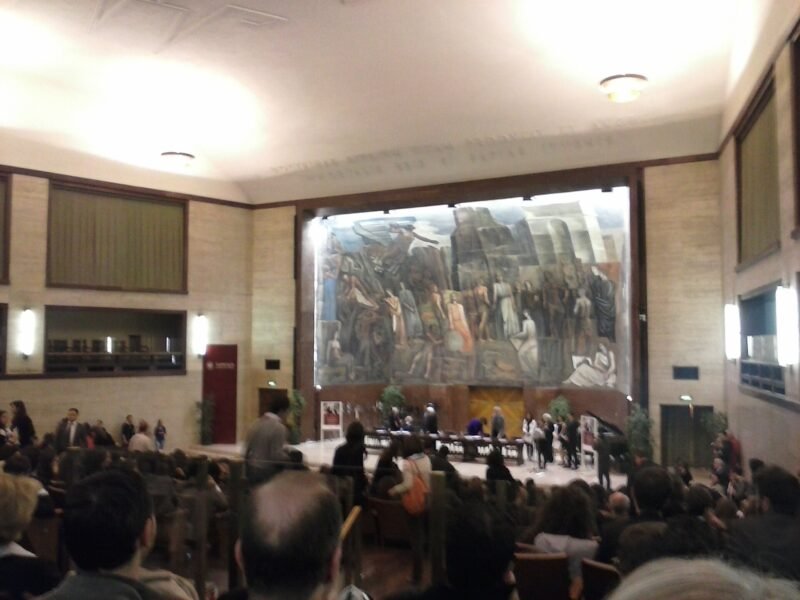
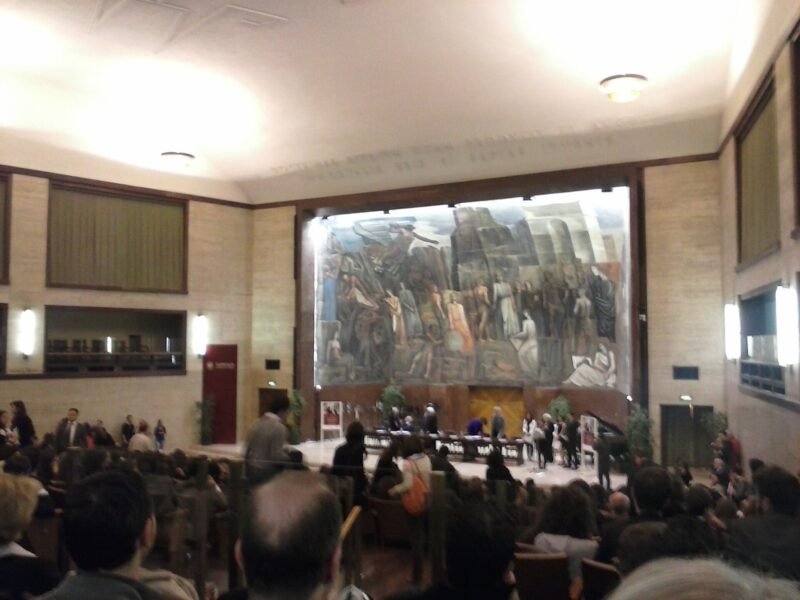
Marc-André Hamelin at the Aula Magna of the Sapienza, January 23, 2027
In short. The Canadian pianist Marc-André Hamelin plays on Saturday, January 23, 2027 at 17:30 in the Aula Magna of the Palazzo del Rettorato of the Sapienza, University City, Piazzale Aldo Moro 5 (00185 Rome), for the Calliope cycle of the IUC Season.
The Canadian pianist Marc-André Hamelin plays on Saturday, January 23, 2027 at 17:30 in the Aula Magna of the Palazzo del Rettorato of the Sapienza, University City, Piazzale Aldo Moro 5 (00185 Rome), for the Calliope cycle of the IUC Season. The program runs from Enescu to Weinberg, from Chopin to Debussy, up to Earl Wild's Seven Virtuoso Etudes on Gershwin songs. You get to the Aula Magna by metro line B, Policlinico or Castro Pretorio stops, by trams 3 and 19 or on foot from Termini station. For concerts you enter, including on foot, only from Piazzale Aldo Moro 5. IUC Season tickets cost 26 euros in the first section, 21 in the second and 15 in the third, plus a 10% presale fee, with 8 euros for under-30s and 5 euros for under-18s. They are bought at the IUC office at Lungotevere Flaminio 50, by phone, at the Aula Magna box office from an hour before and on the authorized presale network indicated by the official concert page.
The New York Times, quoted by the IUC, called him a performer with an almost superhuman technique. Hamelin returns to the IUC with a recital that is a portrait: the virtuoso who has recorded 92 albums for Hyperion, the explorer of forgotten repertoires, the composer. A Saturday afternoon in January, in a hall with a Sironi fresco, for one of the great pianists of our time.
Marc-André Hamelin at the IUC: the January 23 recital
Marc-André Hamelin's recital is scheduled for Saturday, January 23, 2027 at 17:30 in the Aula Magna of the Sapienza, in the Calliope cycle of the IUC Season 2026/2027, and marks the pianist's return to the Istituzione Universitaria dei Concerti.
The Calliope cycle
The Calliope cycle gathers the Saturday afternoon concerts, at 17:30, and is designed for those who prefer music before dinner. It bears the name of the muse of epic poetry, alongside the Tuesday evening Minerva cycle.
One of the three great recitals of the season
In the IUC Season 2026/2027 the major piano recitals are three: Hamelin on January 23, Angela Hewitt on February 20, Roger Muraro on April 6. Those who can choose only one, in our view, would do well not to skip this one.
A week of recitals
The concert falls between two events of the Minerva cycle: on Tuesday the 19th Mario Brunello with solo cello, on Tuesday the 26th the Janoska Ensemble in its Rome debut. Three concerts in a week, all in the same hall.
The program: from Enescu to Gershwin
Marc-André Hamelin's program includes Carillon nocturne from George Enescu's Pièces impromptues Op. 18, Mieczysław Weinberg's Sonata No. 5 in C minor Op. 58, Chopin's Sonata No. 2 in B-flat minor Op. 35, three pieces from the second series of Debussy's Images and Earl Wild's Seven Virtuoso Etudes on Gershwin songs.
Enescu, Carillon nocturne
The recital opens with a piece by George Enescu, who lived from 1881 to 1955, taken from the Pièces impromptues Op. 18. The title announces a page of nocturnal bells: a beginning of atmosphere more than virtuosity.
Weinberg, Sonata No. 5
Mieczysław Weinberg, who lived from 1919 to 1996, is the least obvious choice in the program. The Sonata No. 5 in C minor Op. 58 fits Hamelin's passion for little-played 20th-century repertoire, the same the IUC credits him with in its presentation.
Chopin, Sonata No. 2
The Sonata No. 2 in B-flat minor Op. 35 is the classical heart of the recital. Hamelin has played several times at the Chopin festivals in Bagatelle in Paris, Duszniki and Valldemossa: the Chopin repertoire belongs to him as much as the rare one.
Debussy, Images second series
From the second series of Images, Hamelin plays Cloches à travers les feuilles, Et la lune descend sur le temple qui fut and Poissons d'or. The bells return, after Enescu's: the program has a precise sonic thread.
Earl Wild, Seven Virtuoso Etudes on Gershwin songs
The recital closes with Earl Wild's 1973 collection. Wild was an American composer of the 20th century who lived from 1915 to 2010. The IUC describes it as a virtuoso transcription of some of George Gershwin's most famous songs, between the technique of romantic virtuosity and jazz rhythms. It is the ideal finale for a pianist like Hamelin.
Who Marc-André Hamelin is
Marc-André Hamelin is a Canadian pianist and composer born in Montréal on September 5, 1961, with 11 Grammy Award nominations. He teaches at the New England Conservatory in Boston.
Beginnings in Montréal
He began studying piano at five. His father, a pharmacist and amateur pianist, introduced him as a boy to the music of Charles Valentin Alkan, Leopold Godowsky and Kaikhosru Shapurji Sorabji: three composers who marked his repertoire. He studied at the École de musique Vincent d'Indy in Montréal with Yvonne Hubert and then at Temple University in Philadelphia with Harvey Wedeen.
Carnegie Hall
In 1985 he won the Carnegie Hall International Competition for American Music, and in 1988 he made his recital debut at Carnegie Hall. In 1989 he received the Virginia Parker Prize. Since then he has played regularly in the Wigmore Hall's Masterconcert series, in the International Piano Series at the Southbank Centre in London and every year at the Herkulessaal in Munich.
The explorer of repertoires
He is known for his attention to lesser-known composers of the late 19th and early 20th centuries, such as Max Reger, Leo Ornstein, Nikolai Roslavets, Georgy Catoire and Paul Dukas, and to composer-pianists such as Alkan, Godowsky, Sorabji, Scriabin, Kapustin, Liszt, Medtner and Rzewski. In 1994 he recorded Adolf von Henselt's Piano Concerto with the BBC Scottish Symphony Orchestra and Martyn Brabbins.
Hyperion and the awards
He records exclusively for Hyperion Records, with which he has so far released 92 albums, according to the IUC presentation. His recording of Godowsky's Studies on Chopin's Études won the 2000 Gramophone Instrumental Award. In 2004 he received the Cannes international record prize. He has won seven Juno Awards, the latest in 2012 for an album of Liszt sonatas. He is an Officer of the Order of Canada and a Knight of the National Order of Québec.
The composer
The IUC notes that Hamelin is also a well-known composer, with over 30 works. Among them are the 12 Études in all the minor keys, completed in 2009 and published by C. F. Peters, a cycle of seven pieces titled Con Intimissimo Sentimento and a transcription of Zequinha de Abreu's Tico Tico no Fubá.
The critics
In 2000 Alex Ross wrote in the New Yorker that Hamelin's legend was destined to grow. In 2015 Zachary Woolfe, in the New York Times, praised his clarity and control, which in him do not rule out sensitivity.
Hamelin live: festivals, concerts and great feats
Marc-André Hamelin is one of the most present pianists at international festivals: among others Bad Kissingen, Belfast, the Cervantino, La Grange de Meslay, the Husum Piano Rarities, Lanaudière, Ravinia, La Roque d'Anthéron, the Ruhr Piano Festival, Snape Maltings, Mänttä and Turku, besides the Chopin festivals in Bagatelle, Duszniki and Valldemossa.
Busoni's Concerto
On March 31, 2001 he played Busoni's Piano Concerto, with male chorus in the finale, at the Sibelius Hall in Lahti with the Lahti Symphony Orchestra. On June 21 of the same year he took it up again in Geneva with the Orchestre de la Suisse Romande, and then with the City of Birmingham Symphony Orchestra conducted by Mark Elder. On January 25, 2003 he performed it in Dallas with Andrew Litton.
Saint-Saëns and Medtner
In 2005 he played Saint-Saëns's Fourth Concerto at the Grand Teton Music Festival with Yan Pascal Tortelier, in 2006 the Fifth with the Bochumer Symphoniker and Steven Sloane, and in 2012 Medtner's Second Concerto in Moscow with the National Philharmonic of Russia and Dmitry Vasiliev.
Tokyo 1997
On December 14, 1997, at Casals Hall in Tokyo, he presented a recital that says a lot about how he builds programs: a Haydn sonata, Godowsky's Studies on Chopin's Études, Alkan's Concerto for solo piano, pages by Gnattali, Shchedrin and Eckhardt-Gramatté, and a study of his own. The Rome recital, with Chopin alongside Weinberg and Earl Wild, follows the same logic.
Chamber music
Besides recitals, Hamelin recorded Brahms's Piano Quartets with the Leopold String Trio, and in 2020, during the pandemic, he played in a streamed Naumburg Orchestral Concerts concert with the violinist Lara St. John and the Ulysses Quartet.
A curiosity about Marc-André Hamelin at the Aula Magna of the Sapienza, January 23, 2027
The nicest curiosity of this recital is a calendar crossing. Four days earlier, on Tuesday, January 19, in the same Aula Magna Mario Brunello plays two sonatas for solo cello by Mieczysław Weinberg. On Saturday the 23rd Hamelin plays the same composer's Sonata No. 5 for piano. In less than a week the IUC offers its audience three sonatas by a rarely performed composer, on two different instruments. Those who follow both concerts come away with a small portrait of Weinberg.
The second curiosity concerns his father. It was a pharmacist and amateur pianist who introduced little Marc-André to the music of Alkan, Godowsky and Sorabji, composers that many professional pianists never take on. The taste for rare repertoire, which the Rome recital shows with Enescu and Weinberg, is thus born at home, before the conservatory.
Third: Hamelin plays Gershwin in the version of another composer-pianist, Earl Wild. It is a choice consistent with his history: he has always given attention to pianists who wrote for their own instrument, and he is one of them himself.
The Aula Magna of the Rettorato
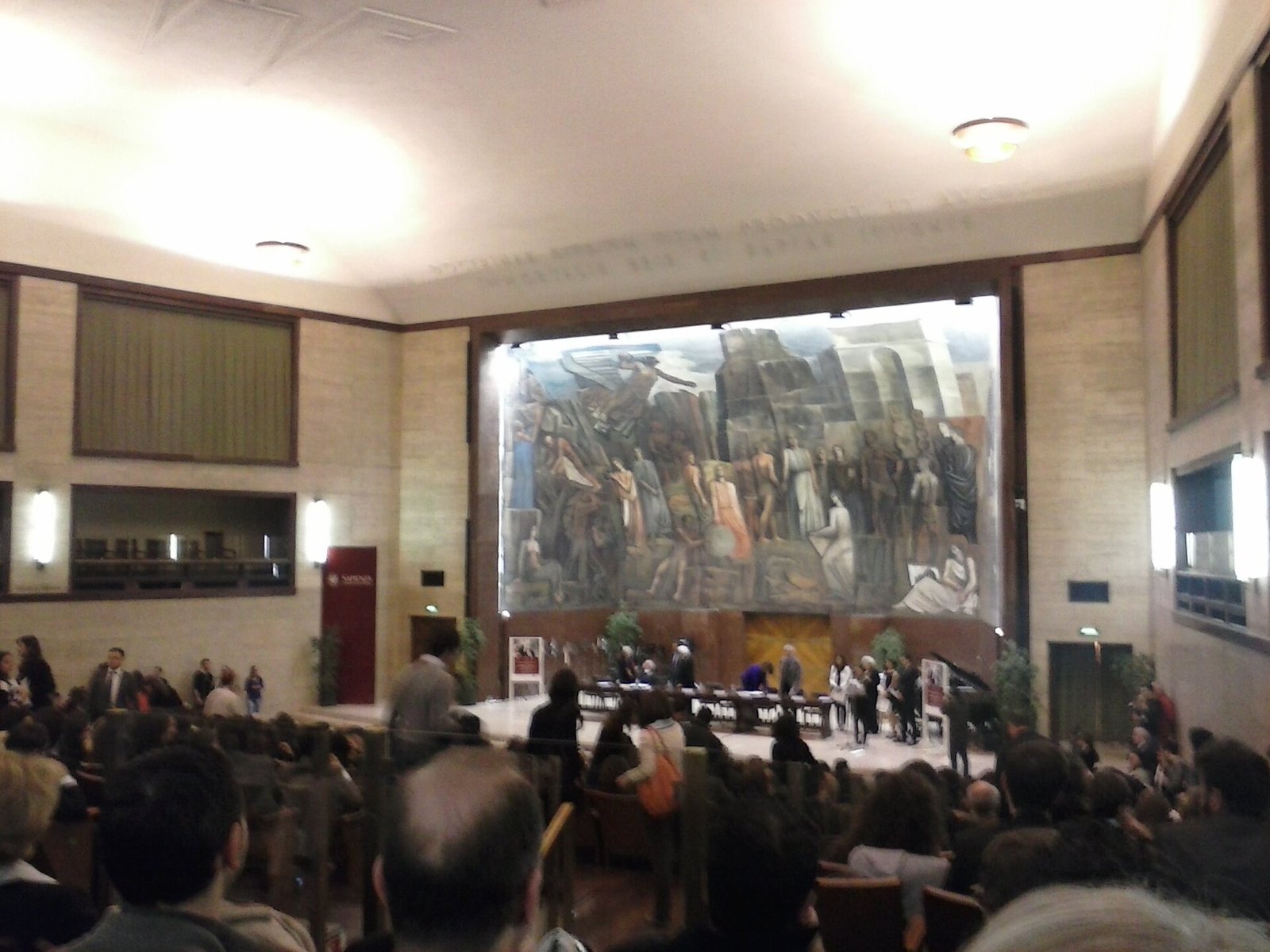
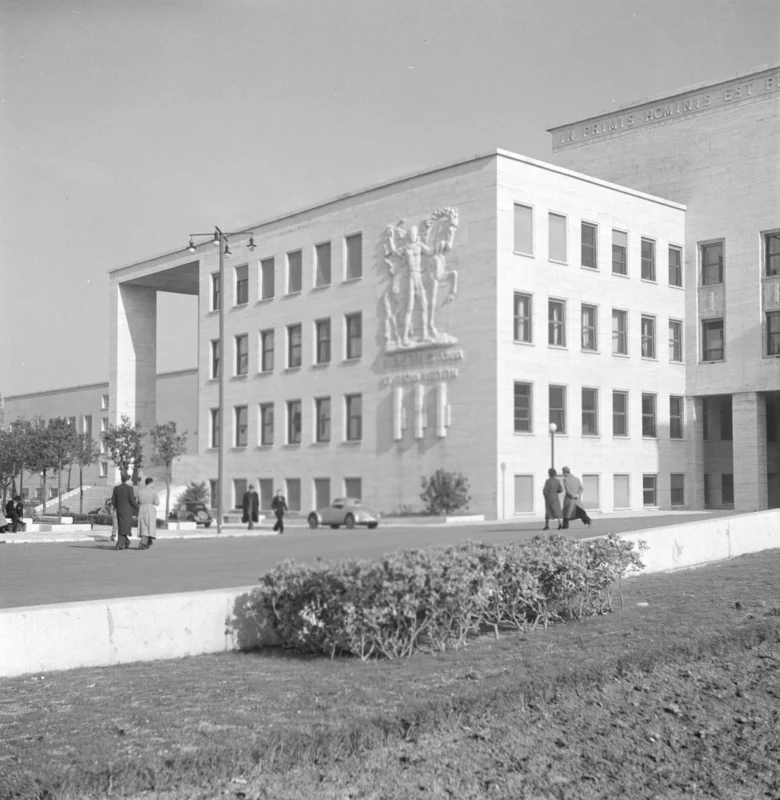
The hall of Hamelin's recital is the Aula Magna of the Palazzo del Rettorato, the heart of the Sapienza University City designed by Marcello Piacentini, built between 1933 and 1935 and inaugurated on March 31, 1935 in the presence of Victor Emmanuel III.
Piacentini and the Rettorato
Piacentini gave the Rettorato the place of honor at the end of the great entrance avenue. The building holds the rector's offices, the Biblioteca Alessandrina and the Aula Magna. In front, at the center of a pool, is Arturo Martini's bronze Minerva.
Sironi behind the piano
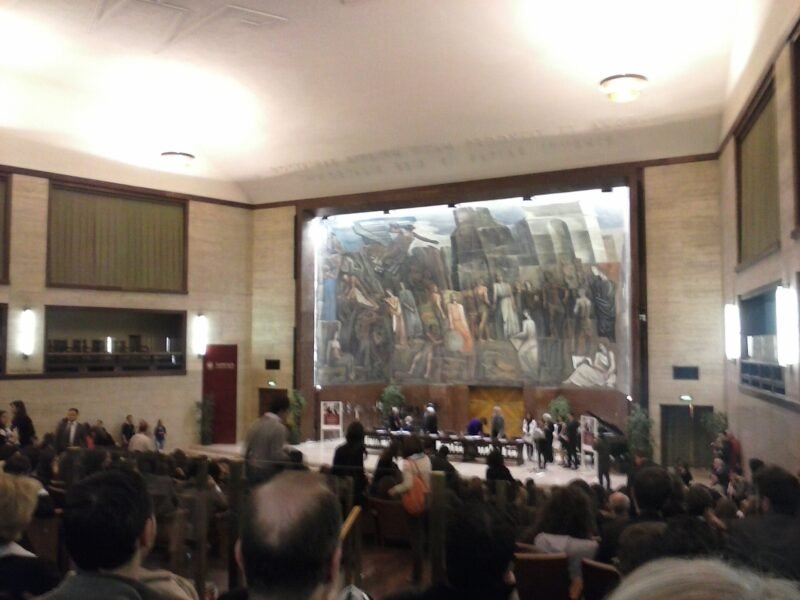
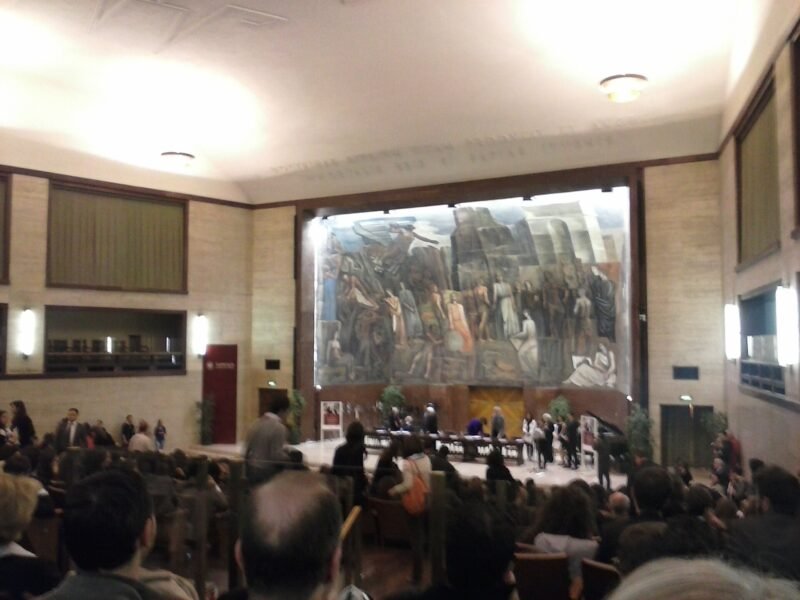
On the back wall of the Aula Magna is Mario Sironi's 1935 fresco, L'Italia tra le arti e le scienze. Hamelin's piano will sound in front of one of the great painting cycles of Italian 20th-century art: few concert halls in the world offer a similar backdrop.
The campus architects
The surrounding buildings were entrusted to leading architects: Gio Ponti for Mathematics, Giuseppe Pagano for Physics, Pietro Aschieri for Chemistry, Giovanni Michelucci for Mineralogy, Gaetano Rapisardi for Letters and Law. The monumental entrance on Piazzale Aldo Moro is by Arnaldo Foschini.
Museums a few steps away
Arriving early you can visit the MLAC, in the same Rettorato, or the Gipsoteca and the Giuseppe Sergi Museum of Anthropology, checking their hours first.
Something nobody tells you about Marc-André Hamelin at the Aula Magna of the Sapienza, January 23, 2027
The first thing few people know is that for IUC concerts there is free parking inside the University City, open to cars, motorcycles, bicycles, taxis and vehicles with a disability permit, with access from Piazzale Aldo Moro 5 from about an hour before the start. The IUC specifies that for reasons beyond its control it may not be available every time.
The second is that the only access to concerts, including on foot, is the one at Piazzale Aldo Moro 5. Those coming from San Lorenzo or from Viale dell'Università who try another gate risk finding it closed: better to go straight to Foschini's monumental entrance.
The third concerns prices. For a recital of this level, the ticket for an under-30 costs 8 euros in any section, the first included. A young pianist who wants to see Hamelin's hands up close on Earl Wild's Etudes spends less than a lunch.
The advice I give you for visiting Marc-André Hamelin at the Aula Magna of the Sapienza, January 23, 2027
My advice is to arrive with the Gershwin songs in mind that give rise to Earl Wild's Etudes, at least the best known. Those who recognize the melody beneath the ornamentation understand the transcriber's game at once and enjoy the virtuosity instead of enduring it.
Second: choose a seat on the keyboard side. In a piano recital seeing the hands changes the experience, and with Hamelin, whom critics describe as having uncommon clarity and control, the show is visual too.
Third: make the most of the afternoon. The 17:30 recital leaves the evening free. Arriving earlier you cross the campus in the last light, and after the concert San Lorenzo is a few minutes away for dinner.
Finally, for those who love rare music, it is worth hearing Brunello the Tuesday before as well: the comparison between Weinberg's sonatas for cello and the one for piano is an occasion that rarely repeats.
Tickets for Hamelin at the IUC
The ticket for Marc-André Hamelin's recital costs 26 euros in the first section, 21 in the second and 15 in the third, plus a 10% presale fee. Under-30s pay 8 euros and under-18s 5 euros, in any section.
Reductions
With the Family Card, for two parents with at least one child under 14, each parent pays 10 euros and each child 5. For the Sapienza and partner institutions and universities prices drop to 21, 17 and 12 euros. A carnet of at least six concerts of your choice gives a 10% discount. Reductions cannot be combined.
Where to buy
Tickets are bought at the IUC office at Lungotevere Flaminio 50, Monday to Friday from 10:00 to 13:00 and from 14:00 to 17:00, closed on Tuesday during the season. By phone at 06 3610051 and 06 3610052. At the Aula Magna box office, which opens an hour before the concert. Online on the presale network indicated on the IUC website, where the Carta del Docente can also be used.
A recital to book ahead
For a name like Hamelin, it is best not to rely on the last-minute box office: Saturday afternoon is the most convenient time for many families and for audiences coming from outside Rome.
How to get to the Aula Magna for Hamelin's recital
For Hamelin's recital at the Aula Magna of the Sapienza the main options are metro line B, Policlinico or Castro Pretorio stops, trams 3 and 19, or the walk from Termini station. You enter only from Piazzale Aldo Moro 5.
By metro
From the Policlinico and Castro Pretorio stops on line B it is a few minutes' walk to the entrance on Piazzale Aldo Moro.
By tram
The 19 connects the University City with the Policlinico and Viale delle Belle Arti, the 3 with Porta Maggiore, San Giovanni and the Colosseum. Both cross San Lorenzo.
From the station
Those arriving by train for the Saturday concert leave Termini on the side facing Via Marsala and reach Piazzale Aldo Moro in a quarter of an hour on foot.
By car
The Sapienza's free internal parking, from the entrance at Piazzale Aldo Moro 5, opens about an hour before concerts, with no guarantee of availability for every date.
Another well-known fact, yet rarely mentioned
It is well known that in its early years the IUC hosted some of the greatest pianists of the 20th century: Nikita Magaloff, Wilhelm Backhaus, Edwin Fischer, Alfred Cortot, Wilhelm Kempff, Géza Anda, Aldo Ciccolini. Less often cited is how precarious those beginnings were. Piero Rattalino recounts, in the history published by the IUC, that in the postwar years the institution had to stand in line for everything, even for a good piano, because instruments in good condition were rare.
Today the piano is the protagonist of the season, with Hamelin, Hewitt, Muraro and Zlata Chochieva with the 27 Chopin études. The hall that in 1945 struggled to find a worthy instrument now hosts one of the most celebrated virtuosos in the world.
A second little-cited fact: the Aula Magna was declared unsafe in 1968, and for 25 years the IUC's public season lived mostly at the Auditorio San Leone Magno. Only from 1993/94, after the agreement of October 3, 1992, have concerts all returned here.
How to plan the afternoon
For the 17:30 recital it is best to be at Piazzale Aldo Moro around 17:00. The box office opens an hour before, and the route from the entrance to the Rettorato takes a few minutes.
The avenue and the Minerva
From Foschini's entrance you follow the avenue to the Minerva square. The Rettorato is the building at the end, and the box office for subscriptions is under the portico.
After the recital
A Saturday afternoon recital leaves the evening free: the right moment for dinner in San Lorenzo, a few minutes on foot, or for going back to the center by metro line B.
The right photo to take at Marc-André Hamelin at the Aula Magna of the Sapienza, January 23, 2027
The right photo is taken before the recital: the grand piano alone onstage, the lid open, and behind it Sironi's fresco. It is an image that brings together music, university and the 20th century, and tells the spirit of the IUC better than any poster. During the concert, no photographs.
The second is taken arriving along the avenue, with Arturo Martini's Minerva at the center of the pool and the Rettorato in the background. At 17:00 in late January the light fades fast: those who arrive a little earlier find the travertine still lit by the last sun.
The third is on the way out, with the campus lit and Foschini's monumental entrance seen from inside: an almost metaphysical image, perfect for closing the day.
Some important events that took place here in history
The University City was inaugurated on March 31, 1935 in the presence of Victor Emmanuel III. In the same year Mario Sironi completed the fresco of the Aula Magna. On July 19, 1943 the first Allied bombing of Rome hit San Lorenzo and also damaged the campus, along with the Policlinico Umberto I, the Verano and the Basilica of San Lorenzo fuori le mura.
In 1946 the Istituzione Universitaria dei Concerti was born from a group of Sapienza students. In the 1959/60 season the Aula Magna hosted Nikita Magaloff's complete Chopin and Wilhelm Kempff's 32 Beethoven sonatas: two piano feats that made the IUC a national reference. In the same years the IUC gave its trust to Maurizio Pollini after his victory at the Chopin Competition in Warsaw, when very few institutions reconfirmed him.
In 1968 the Aula Magna was declared unsafe. The agreement of October 3, 1992 brought the whole season back here from 1993/94. On October 17, 2026 the 82nd season opens there, of which Hamelin's return is one of the piano peaks.
Who has passed through Marc-André Hamelin at the Aula Magna of the Sapienza, January 23, 2027
For a pianist, stepping onto the Aula Magna stage means following a precise line. Here for the IUC played Nikita Magaloff, who in 1959/60 performed the complete Chopin there, Wilhelm Kempff, with the 32 Beethoven sonatas, and then Wilhelm Backhaus, Edwin Fischer, Alfred Cortot, Géza Anda, Aldo Ciccolini and Maurizio Pollini.
Through the same hall have also passed the greats of the other instruments: Yehudi Menuhin, Georg Kulenkampff, Gioconda De Vito, Adolf Busch, Pierre Fournier, Andrés Segovia, the Quartetto Italiano, the young Salvatore Accardo and Uto Ughi. And those who built and painted it: Marcello Piacentini, Mario Sironi, Arturo Martini.
Hamelin's Chopin, with the Sonata No. 2, is thus heard in the hall where Magaloff played the complete Chopin. In the 2026/2027 season Angela Hewitt, Roger Muraro, Mario Brunello, Tabea Zimmermann and the Quartetto di Cremona also pass through the same stage.
The IUC, a concert society born at the university
The Istituzione Universitaria dei Concerti, which organizes Hamelin's recital, was born in 1946 from an idea of Sapienza students that matured at the end of 1945, alongside the university sports, film and theater centers.
A new public
In the account of Piero Rattalino, artistic director from 1969/70, the postwar years brought into the hall a new public of students, young workers and professionals for whom the old concert societies were no longer enough. From that demand came a season that from its first year rested on three pianists: Magaloff, Backhaus, Fischer.
Today
The 2026/2027 season is the 82nd: 35 concerts between October and May, recitals, quartets, baroque, jazz and choral music, with some of the lowest prices in Rome for young people. The piano, where everything began, remains the house instrument.
Accessibility, families and students
The IUC Season has one of the most favorable price policies in Rome: 8 euros for under-30s, 5 for under-18s, and the Family Card with 5 euros for each child under 14.
Reduced mobility
Vehicles with a disability permit can use the Sapienza's internal parking, entering from Piazzale Aldo Moro 5. For seats in the hall and routes it is best to phone the IUC first.
With children
The Saturday afternoon Calliope cycle is the one best suited to families, and the Gershwin finale can win over even a kid who doesn't know Chopin. For a small child the recital remains long.
Students
For Sapienza students under 35 the UNIIUC subscription costs 50 euros for the whole season and 30 for a single cycle: the Calliope cycle with Hamelin and Hewitt is worth the cost on its own.
San Lorenzo, Verano and Porta Maggiore
The University City borders San Lorenzo, a working-class district born between 1884 and 1888 outside the Aurelian Walls and today the main university district of Rome, with streets named after the ancient Italic peoples and the former Pastificio Cerere turned into an art center.
The basilica and the cemetery
Before a 17:30 recital there is time to visit San Lorenzo fuori le mura, one of the seven pilgrimage churches of Rome, and the nearby Verano Cemetery.
With tram 3
Tram 3 takes you in a few minutes to Porta Maggiore and then to Holy Cross in Jerusalem, for those who want to pair the concert with a walk in the less trodden Rome.
Where to eat after the recital
San Lorenzo, a stone's throw from the Aula Magna, offers trattorias, pizzerias, osterias and student venues, with prices generally lower than the historic center.
Saturday dinner
A recital starting at 17:30 leaves the dinner hour free. On Saturday night San Lorenzo is full of young people and the tables at the best-known trattorias must be booked in good time.
An aperitivo
Alternatively, an aperitivo on Via dei Volsci, Via dei Sabelli or Largo degli Osci, 10 minutes on foot from Piazzale Aldo Moro, before heading back.
January in Rome: the Saturday of concerts
On Saturday, January 23, 2027 Rome offers two major events almost at the same time: Hamelin at 17:30 in the Aula Magna and, at 18:00, the last of Tugan Sokhiev's three evenings at Auditorium Parco della Musica, with Bach, Taneyev and Tchaikovsky. It is impossible to follow both on the same day: those who want both can choose Thursday or Friday for Sokhiev.
The weather
In late January evenings are cold and the University City avenue is exposed: better a heavy coat, especially on the way out.
Frequently asked questions about Hamelin at the IUC
When does Marc-André Hamelin play in Rome?
Marc-André Hamelin plays on Saturday, January 23, 2027 at 17:30 in the Aula Magna of the Sapienza, Piazzale Aldo Moro 5, for the Calliope cycle of the IUC Season 2026/2027. It is a solo piano recital.
What is Hamelin's program?
Hamelin's recital at the IUC includes Enescu's Carillon nocturne, Weinberg's Sonata No. 5 Op. 58, Chopin's Sonata No. 2 Op. 35, three pieces from Debussy's Images second series and Earl Wild's Seven Virtuoso Etudes on Gershwin songs, from 1973.
How much do tickets cost?
Tickets for Hamelin's recital cost 26 euros in the first section, 21 in the second and 15 in the third, plus a 10% presale fee. Under-30s pay 8 euros and under-18s 5 euros in any section. The Family Card provides 10 euros per parent and 5 per child.
Where do you buy tickets?
Tickets for Hamelin are bought at the IUC office at Lungotevere Flaminio 50, by phone at 06 3610051 or 06 3610052, at the Aula Magna box office from an hour before and online on the presale network indicated by the IUC's official website.
Who is Marc-André Hamelin?
Marc-André Hamelin is a Canadian pianist and composer born in Montréal in 1961, with 11 Grammy nominations, seven Juno Awards and 92 albums for Hyperion. He is famous for his virtuosity and for exploring rare repertoires, from Alkan to Godowsky.
How do you get to the Aula Magna of the Sapienza?
You get to the Aula Magna of the Sapienza by metro line B, Policlinico or Castro Pretorio stops, by trams 3 and 19 or on foot from Termini. For IUC concerts the entrance, including for pedestrians, is only from Piazzale Aldo Moro 5.
Is the recital suitable for young people?
Hamelin's recital, on Saturday afternoon, suits a teenager who studies piano or loves music: the finale with Gershwin's songs is rousing. For under-18s the ticket costs 5 euros in any section.
The final advice on Hamelin at the IUC
A virtuoso celebrated by international critics, a program that brings together Chopin and Weinberg, Debussy and Gershwin, a hall with Sironi's fresco and a ticket that costs young people 8 euros: in our view it is the piano recital of the Roman winter. The advice is to book early, choose a seat on the keyboard side and, if possible, hear Brunello the Tuesday before as well, for a comparison on Weinberg that rarely repeats.
Article written by the editorial team of Tour Leader Pro, contact them for Private/Corporate/V.I.P. Tours and Experiences.
Planning a trip to Rome? The English-language guides to visiting the city are on ItalyPlanner.com.
Contact Information
Nearby
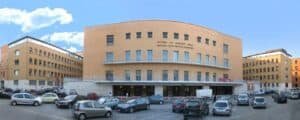
 Sapienza University City100 m
- Aula Magna of Sapienza University100 m
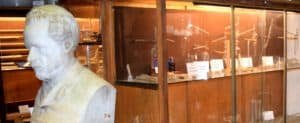
- Primo Levi Chemistry Museum100 m
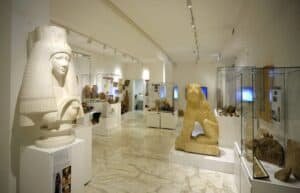
- Museo del Vicino Oriente, Egitto e Mediterraneo100 m
- Museo Laboratorio d’Arte Contemporanea, MLAC100 m
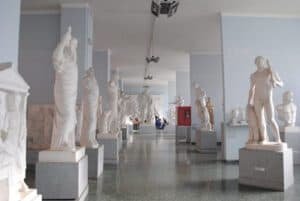
- Gipsoteca – Museum of Classical Art100 m
Upcoming events nearby
- Renata Prunas. Materia risorta at the MLAC of Sapienza, October 8 to November 5, 2026100 m
- IUC Concert Season 2026-2027 at Aula Magna della Sapienza, October 17, 2026 to May 8, 2027100 m
- Mario Brunello at the Aula Magna of the Sapienza, January 19, 2027100 m
- Janoska Ensemble at Aula Magna, Sapienza University, January 26, 2027100 m
You might also like
- Angela Hewitt at Aula Magna della Sapienza, February 20, 2027
- Lagwagon at Hacienda Roma, February 25, 2027
- Lucie Horsch, Metamorphosis at the Aula Magna of the Sapienza, February 6, 2027
- Kyle Alessandro at Monk in Rome, January 27, 2027
- ANNA at the Palazzo dello Sport in Rome, December 19, 2026
- Irama at Palazzo dello Sport in Rome, December 12, 2026