Angela Hewitt at Aula Magna della Sapienza, February 20, 2027
In short. Angela Hewitt at Aula Magna Sapienza: the Canadian pianist plays on Saturday, February 20, 2027, at 17:30 in the Aula Magna of the Palazzo del Rettorato at Sapienza, Città universitaria, Piazzale Aldo Moro 5 (00185 Rome), for the…
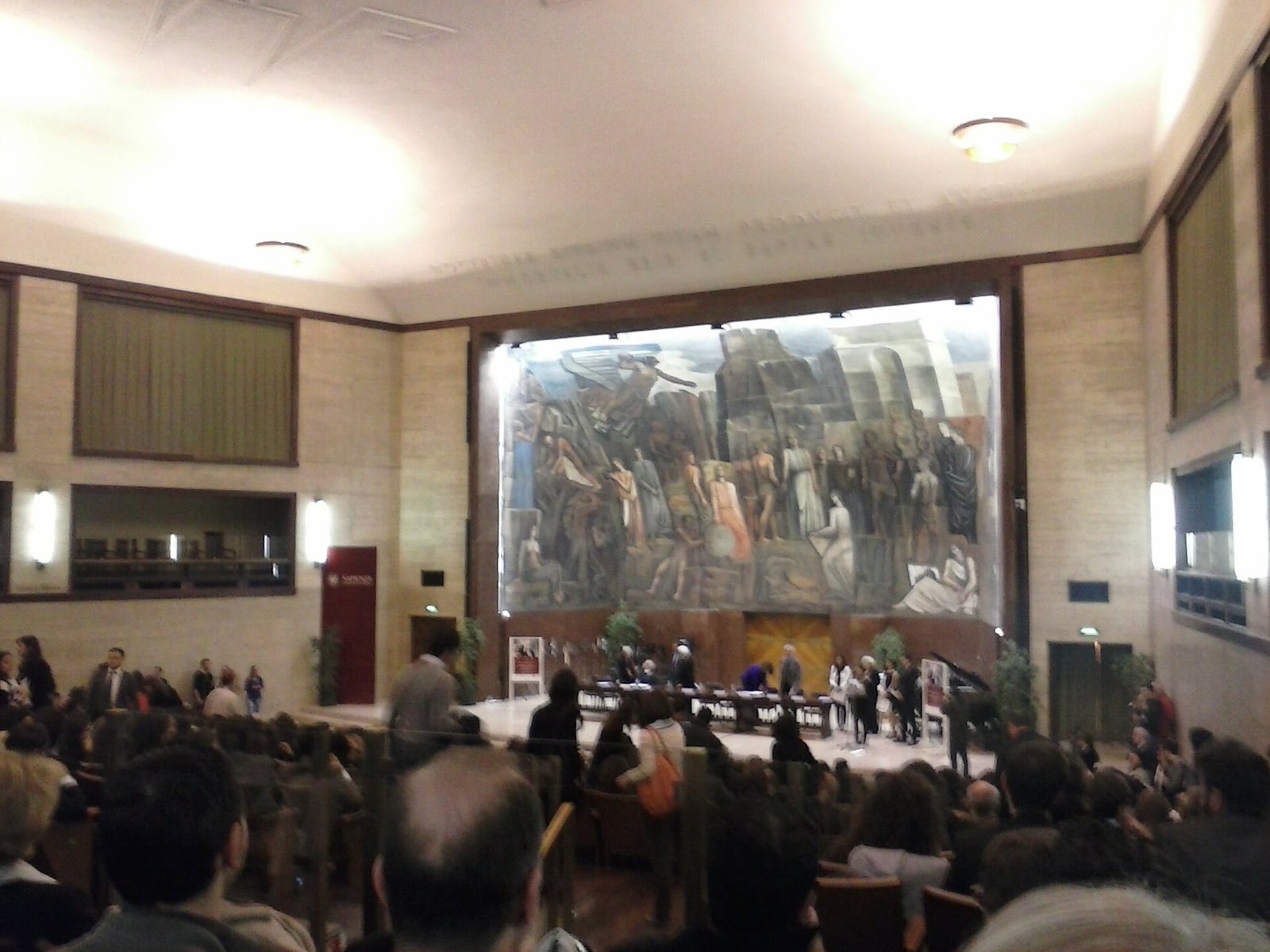
Angela Hewitt at Aula Magna Sapienza: the Canadian pianist plays on Saturday, February 20, 2027, at 17:30 in the Aula Magna of the Palazzo del Rettorato at Sapienza, Città universitaria, Piazzale Aldo Moro 5 (00185 Rome), for the Calliope cycle of the IUC Season 2026/2027. The program includes four Sonatas by Domenico Scarlatti, Johann Sebastian Bach's Partita No. 4 in D major BWV 828 and three major pieces by Chopin: the Three Mazurkas op. 50, the Fantasy in F minor op. 49 and the Scherzo No. 2 op. 31. You get to the Aula Magna by metro B, stops Policlinico or Castro Pretorio, by trams 3 and 19 or on foot from Termini station. For concerts, the only entrance, even on foot, is Piazzale Aldo Moro 5. Tickets for the IUC Season cost €26 in the first section, €21 in the second and €15 in the third, plus a 10% presale fee, with €8 for under 30s and €5 for under 18s. They can be bought at the IUC office at Lungotevere Flaminio 50, by phone, at the Aula Magna box office from one hour before and on the authorized presale circuit indicated on the official concert page.
Gramophone welcomed her into its Hall of Fame in 2015. According to the IUC's presentation, her Bach recordings make her one of the composer's leading interpreters today. Hewitt is a regular guest of the Istituzione Universitaria dei Concerti, and she returns to the Aula Magna with a program built on two composers born in the same year, 1685, and on a Chopin at the height of his maturity. A Saturday afternoon in February, under Sironi's fresco.
Angela Hewitt at the IUC: the February 20 recital
Angela Hewitt's recital is scheduled for Saturday, February 20, 2027, from 17:30 to about 20:00, according to the schedule given by the IUC, in the Aula Magna of Sapienza, as part of the Calliope cycle of the IUC Season 2026/2027.
The Calliope cycle
The Calliope cycle brings together the Saturday afternoon concerts, always at 17:30, and is designed for those who prefer music before dinner. It takes its name from the muse of epic poetry and runs alongside the Minerva cycle on Tuesday evenings, at 20:30.
One of the season's great recitals
In the IUC Season 2026/2027 there are three major solo piano recitals: Marc-André Hamelin on January 23, Angela Hewitt on February 20 and Roger Muraro on April 6. Hewitt is the only one of the three to put Bach at the center, the composer with whom she has linked her name.
A pianist at home here
The IUC now calls her a regular of the season. For the Aula Magna audience, Hewitt's return has become a fixed appointment, and this year's program confirms it: Bach, Scarlatti and Chopin are the three composers on whom the pianist has built her discography.
The program: Scarlatti, Bach and Chopin
Angela Hewitt's program includes Domenico Scarlatti's Sonatas K 491, K 377, K 208 and K 14, Johann Sebastian Bach's Partita No. 4 in D major BWV 828, and Fryderyk Chopin's Three Mazurkas op. 50, Fantasy in F minor op. 49 and Scherzo No. 2 in B-flat minor op. 31.
Four Scarlatti Sonatas
The recital opens with Domenico Scarlatti, who lived between 1685 and 1757. The IUC describes the four Sonatas chosen as a showcase of his extraordinary inventiveness: the fanfare accents of K 491 in D major, the driving rhythm of K 377 in B minor, the famous K 208 in A major and the virtuosic agility of the youthful K 14 in G major. Four short pieces, four different characters.
Bach, Partita No. 4
The center of the program is Partita No. 4 in D major BWV 828, published by Bach in 1728 in the Clavier-Übung I. The IUC calls it monumental: it opens with a solemn and sumptuous Overture in the French style and continues with a succession of stylized dances, all built on contrapuntal writing. It is the repertoire in which Hewitt has moved for more than 30 years.
Chopin, Three Mazurkas op. 50
The second part is devoted to Chopin, who lived between 1810 and 1849. It opens with the Three Mazurkas op. 50, published in 1842. According to the IUC's presentation, in these pages the stylization of the Polish folk dance reaches a very high level of harmonic and polyphonic complexity.
Chopin, Fantasy op. 49
Next comes the Fantasy in F minor op. 49, built on a dense contrast of themes that springs from a solemn opening march. It is one of the broadest and freest pieces of the mature Chopin.
Chopin, Scherzo No. 2
The concert closes with Scherzo No. 2 in B-flat minor op. 31, one of the most famous pieces in the Chopin repertoire. A brilliant finale for a program that begins with the lightness of Scarlatti and passes through the architecture of Bach.
Why this program works
Angela Hewitt's recital pairs two composers born in the same year, 1685, and a third, Chopin, whose mazurkas the IUC describes as pages of very high polyphonic complexity: a contrapuntal legacy in dialogue with Bach.
Two twins of 1685
Scarlatti and Bach were both born in 1685, as the dates in the IUC program recall. On one side the short sonata, a single piece concentrated on one idea, on the other the Partita, a great architecture of dances opened by an Overture. Putting them one after the other means hearing two opposite ways of thinking about the keyboard in the same historical moment.
From harpsichord to modern piano
Scarlatti and Bach wrote for the keyboard instruments of their time, not for today's grand piano. Hewitt is famous precisely for showing that their music can live on a contemporary instrument without losing clarity: her Bach cycle for Hyperion was recorded entirely on the piano.
The thread of dance
The thread that ties the program together is dance: the stylized dances of Bach's Partita, Chopin's Polish mazurka, the fanfares and driving rhythms of Scarlatti's sonatas. In our view it is a recital you listen to with your body before you listen to it with your head.
Who Angela Hewitt is
Angela Hewitt is a Canadian pianist born in Ottawa on July 26, 1958, famous above all for her interpretations of Bach. She is a Companion of the Order of Canada and an Officer of the Order of the British Empire.
A childhood in music
She is the daughter of Godfrey Hewitt, born in Yorkshire, for many years choirmaster of Christ Church Cathedral in Ottawa. Her dual citizenship, Canadian and British, comes from him. She began studying piano at three with her mother and at five she won a scholarship. As a child she also studied violin with Walter Prystawski, recorder with Wolfgang Grunsky and classical dance with Nesta Toumine.
Toronto and Ottawa
She gave her first full recital at nine at the Royal Conservatory of Music in Toronto, where she studied from 1964 to 1973 with Earle Moss and Myrtle Guerrero. She then refined her studies with the French pianist Jean-Paul Sevilla at the University of Ottawa.
The competitions
In 1975 she won the Chopin Young Pianists' Competition in Buffalo and a Bach competition in Washington. In 1978 she won the piano section of the CBC radio competition, and in 1979 third prize at the Robert Casadesus competition, today the Cleveland International Piano Competition. In 1980 she won the Dino Ciani competition in Milan and received an honorable mention at the 10th Chopin Competition in Warsaw. In 1985 she won first prize at the Toronto International Bach Piano Competition, which opened the door to a recording for Deutsche Grammophon.
Paris and London
From 1978 to 1985 she lived in Paris. Then she moved to London, which has been her main residence ever since. In 2005 she was the star of the Christmas broadcasts devoted to Bach by the BBC.
Angela Hewitt and Bach: a cycle that lasted 11 years
Angela Hewitt's Bach cycle for Hyperion began in 1994 and ended in 2005, and includes all of Bach's main keyboard works. It is the work that made her an international reference.
The world tour of the Well-Tempered Clavier
The whole 2007/2008 season was devoted to complete performances of the Well-Tempered Clavier in the major cities of the world. For the occasion Hyperion released a DVD of hers about performing Bach on the piano.
The Art of Fugue and the Goldbergs
Her recording of the Art of Fugue was released on October 17, 2014. In 2016 came a new recording of the Goldberg Variations. The Hyperion catalog also includes Bach's Flute Sonatas with Andrea Oliva, from 2013, and the anthology Angela Hewitt plays Bach from 2010.
Beyond Bach
Her discography includes music by François Couperin, Rameau, Messiaen, Chabrier, Ravel, Schumann, Beethoven, Chopin, Debussy and Fauré. In 2002 she released the complete piano works of Ravel, in 2012 Debussy, in 2013 Fauré, in 2015 Liszt's Sonata and in 2016 a record of Scarlatti Sonatas, the same composer with whom she opens the Rome recital.
The concertos with orchestra
She recorded two albums of Mozart concertos with the Orchestra da Camera di Mantova and a third with the National Arts Centre Orchestra of Ottawa conducted by Hannu Lintu. With Lintu and the Deutsches Symphonie-Orchester Berlin she also recorded Schumann's Piano Concerto.
Awards, honors and her Fazioli
Angela Hewitt was named Gramophone Artist of the Year in 2006, received the MIDEM Classical Award as instrumentalist of the year in 2010 and entered the Gramophone Hall of Fame in 2015.
The honors
In 1986 the Canadian Music Council named her artist of the year. In 2000 she became an Officer of the Order of Canada and on December 30, 2015 a Companion, the highest rank. In 2002 she received the National Arts Centre Award, in 2003 the first BBC Radio 3 Listener's Award of the Royal Philharmonic Society, and on June 17, 2006 she was named an Officer of the Order of the British Empire. She is a member of the Royal Society of Canada and holds honorary degrees from seven universities.
The four-pedal piano
Since 2002 she has played Fazioli pianos. Her F278 with four pedals, one of a kind, was dropped by movers in January 2020 and judged beyond repair by the company's founder himself, Paolo Fazioli. In January 2021 Hewitt chose a new one from among five instruments made available to her.
The Trasimeno Music Festival
In July 2005 she founded the Trasimeno Music Festival, in the province of Perugia, of which she is still artistic director. Her bond with Italy, then, is not only the one with the IUC audience.
A curiosity about Angela Hewitt at Aula Magna Sapienza, February 20, 2027
The best curiosity of the program is a matter of the calendar. Domenico Scarlatti and Johann Sebastian Bach were both born in 1685. Hewitt puts them side by side, first the four Sonatas and then the Partita: in a good half hour you hear the two ways in which the same generation thought about the keyboard, Scarlatti's short and lightning-quick sonata and Bach's suite of dances.
The second curiosity is about the instrument. Angela Hewitt has played Italian Fazioli pianos for more than 20 years. Her historic instrument, an F278 with four pedals, was destroyed in an accident during transport in 2020, news that went around the international press. A year later the pianist chose another one, from among five examples prepared for her.
Third: Hewitt's career, today tied to Bach, started from a Chopin competition. In 1975 she won the Chopin Young Pianists' Competition in Buffalo, and in 1980 she received an honorable mention at the Chopin Competition in Warsaw. The Chopin of the second half of the recital, then, is not a concession to the audience. It is a return to the origins.
The Aula Magna of the Rettorato
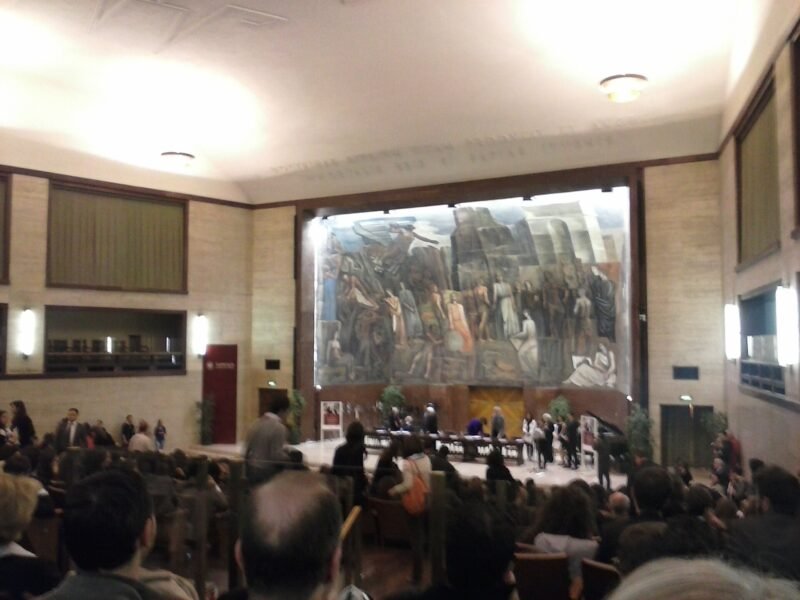
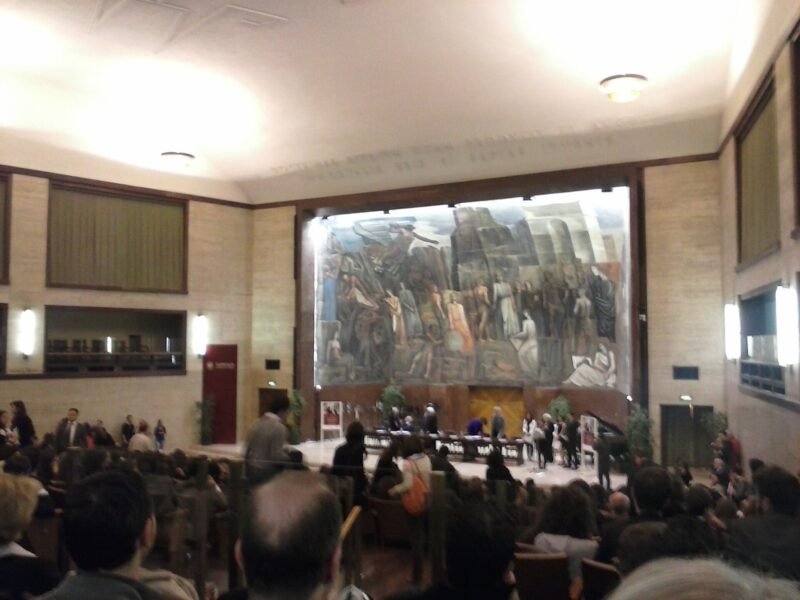
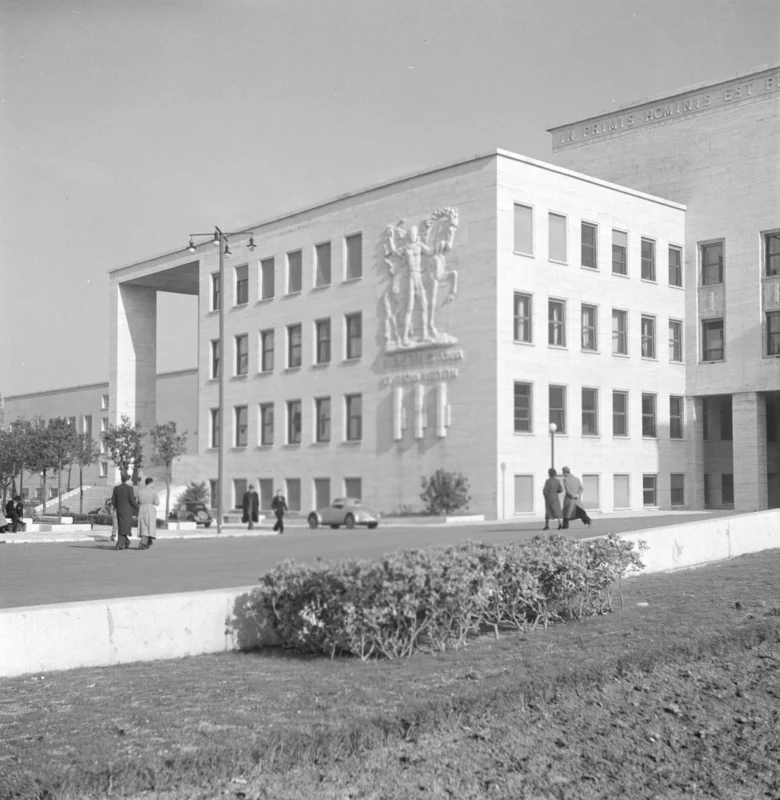
The hall of Angela Hewitt's recital is the Aula Magna of the Palazzo del Rettorato, at the center of the Sapienza university city designed by Marcello Piacentini, built between 1933 and 1935 and opened on March 31, 1935 in the presence of Victor Emmanuel III.
Piacentini's Rettorato
Piacentini gave the Rettorato the place of honor, at the end of the great avenue that starts from the entrance. The building houses the rector's offices, the Biblioteca Alessandrina and the Aula Magna. In front, in the middle of a pool, stands Arturo Martini's bronze Minerva.
Sironi's fresco
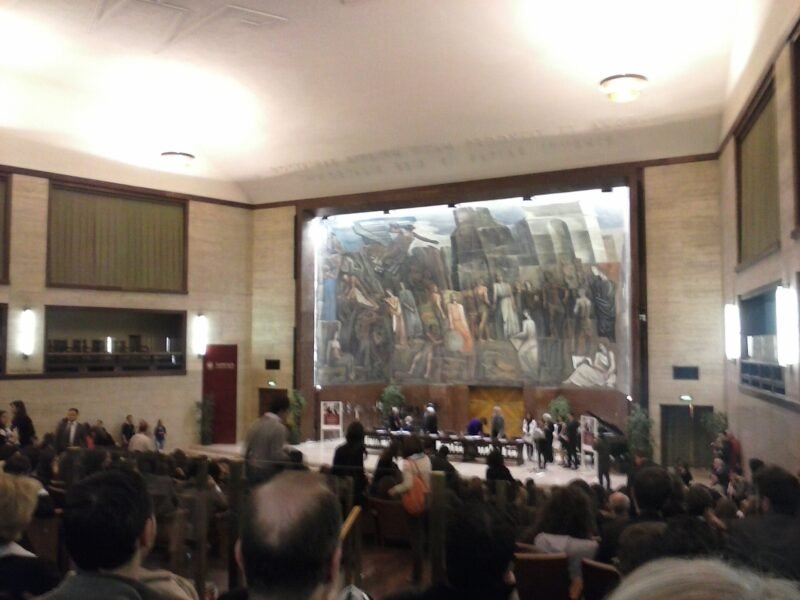
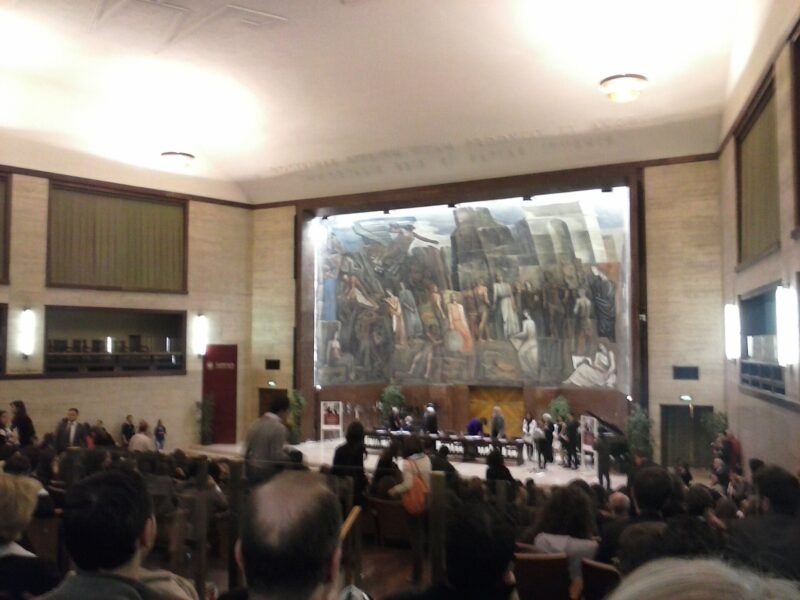
The back wall is occupied by Mario Sironi's 1935 fresco, L'Italia tra le arti e le scienze. Hewitt's piano will sound in front of one of the great painted cycles of the Italian twentieth century, in a curious dialogue between Bach's geometry and the monumentality of the 1930s.
A campus of architects
The surrounding buildings were entrusted to leading architects: Gio Ponti for Mathematics, Giuseppe Pagano for Physics, Pietro Aschieri for Chemistry, Giovanni Michelucci for Mineralogy, Gaetano Rapisardi for Literature and Law. The monumental entrance on Piazzale Aldo Moro is the work of Arnaldo Foschini.
Before the concert
If you arrive early you can visit the MLAC, in the same Rettorato, or the Gipsoteca of Sapienza, checking the Saturday opening hours first.
Something nobody tells you about Angela Hewitt at Aula Magna Sapienza, February 20, 2027
The first thing few people know is that for IUC concerts there is free parking inside the university city, open to cars, motorcycles, bicycles, taxis and vehicles with a disability permit, with access from Piazzale Aldo Moro 5 from about one hour before the start. The IUC warns that, for reasons beyond its control, it may not be available every time. Better to see it as an opportunity, not a certainty.
The second is that the only entrance to the concerts, even on foot, is Piazzale Aldo Moro 5. The university city has several gates, on Viale dell'Università, on Viale Regina Elena and toward San Lorenzo, but on Saturday afternoon anyone who tries a different entrance risks finding it closed and having to walk around the campus.
The third is about prices. For a recital of this level, with a pianist in the Gramophone Hall of Fame, the ticket for an under 30 costs €8 in any section, including the first. For an under 18, €5. Few concerts in Rome offer such a ratio between quality and price for young people, and anyone studying piano would do well to take advantage of it.
My advice for visiting Angela Hewitt at Aula Magna Sapienza, February 20, 2027
My advice is to listen, before the concert, to at least the Overture of Partita No. 4 in one of Hewitt's recordings. It is a long and solemn piece, with a slow introduction and a fast fugue. Recognizing it in the hall lets you follow the interplay of the voices instead of being swept away by it.
Second: give your attention to the four Scarlatti Sonatas, which open the program and risk looking like a warm-up. They are not. They are very short pieces, and for that very reason every detail counts: the fanfares of K 491, the run of K 377, the melody of K 208, the lightness of K 14.
Third: choose a seat on the keyboard side. In Bach and Scarlatti, seeing the hands helps you understand which voice sings and which one supports it, and Hewitt has a clarity of articulation that is worth watching up close.
Finally, take advantage of the time. The 17:30 recital leaves the evening free. If you arrive early you cross the campus in the last light of February, and after the concert San Lorenzo is a few minutes away for dinner.
Tickets for Angela Hewitt at the IUC
A ticket for Angela Hewitt's recital costs €26 in the first section, €21 in the second and €15 in the third, plus a 10% presale fee. Under 30s pay €8 and under 18s €5, in any section.
The discounts
With the Family Card, designed for two parents with at least one child under 14, each parent pays €10 and each child €5. For Sapienza and affiliated organizations and universities, prices drop to €21, €17 and €12. The carnet of at least six concerts of your choice gives a 10% discount. Discounts cannot be combined.
Where to buy
Tickets can be bought at the IUC office at Lungotevere Flaminio 50, Monday to Friday from 10:00 to 13:00 and from 14:00 to 17:00, closed on Tuesday during the season. By phone at 06 3610051 and 06 3610052. At the Aula Magna box office, which opens one hour before the concert. Online on the presale circuit indicated on the IUC website, where you can also use the Carta del Docente.
Student subscriptions
For Sapienza students under 35, the UNIIUC subscription costs €50 for the whole season and €30 for a single cycle. The Calliope cycle, with Hamelin and Hewitt a month apart, is worth the price on its own.
How to get to the Aula Magna for Hewitt's recital
For Angela Hewitt's recital at Aula Magna Sapienza the simplest options are metro B, stops Policlinico or Castro Pretorio, trams 3 and 19, or a walk from Termini station. You enter only from Piazzale Aldo Moro 5.
By metro
From the Policlinico and Castro Pretorio stops on line B it is only a few minutes on foot to the Piazzale Aldo Moro entrance.
By tram
The 19 connects the university city to Policlinico and Viale delle Belle Arti, the 3 to Porta Maggiore, San Giovanni and the Colosseum. Both go through San Lorenzo.
From Termini station
If you arrive by train, you leave Termini on Via Marsala side and reach Piazzale Aldo Moro in about a quarter of an hour on foot. For Saturday afternoon and evening return schedules, it is best to check the ATAC route planner.
By car
Sapienza's free internal parking lot, from the Piazzale Aldo Moro 5 entrance, opens about one hour before the concerts, with no guarantee of availability on every date.
Another well-known fact, yet rarely mentioned
It is well known that Angela Hewitt is one of the great Bach interpreters of our time. Less often mentioned is that her Bach path began with a competition: the Toronto International Bach Piano Competition of 1985, whose first prize included a recording for Deutsche Grammophon. From there began the long work that, from 1994 to 2005, led her to record all the composer's main keyboard works for Hyperion.
A second rarely mentioned fact is about her training. Before concentrating on the piano, Hewitt studied violin, recorder and classical dance. The link with dance, in particular, returns in the Rome program: the stylized dances of the Partita, Chopin's mazurkas. People who watch her play Bach often notice a sense of rhythm with something choreographic about it.
Third: her father, Godfrey Hewitt, was for decades choirmaster of Christ Church Cathedral in Ottawa. The pianist therefore grew up inside church choral music, even before she grew up inside the piano.
How to organize the afternoon
For the 17:30 recital it is best to be at Piazzale Aldo Moro around 17:00. The box office opens one hour before, and the walk from the entrance to the Rettorato takes a few minutes.
The avenue and the Minerva
From Foschini's entrance you walk the avenue to the Minerva square. The Rettorato is the building at the far end, with the staircase and the portico.
The length
The IUC gives a schedule from 17:30 to 20:00. The program, divided between Scarlatti and Bach on one side and Chopin on the other, therefore takes up the afternoon until dinner time.
After the recital
On leaving, around 20:00, San Lorenzo is a few minutes' walk away for dinner. If you are heading back to the center you can take metro B at Policlinico or Castro Pretorio.
The right photo to take at Angela Hewitt at Aula Magna Sapienza, February 20, 2027
The right photo is taken before the recital: the grand piano alone on stage, the lid open, and behind it Sironi's fresco. An image that brings together music, university and the twentieth century, and tells the spirit of the IUC better than any poster. During the concert, no photos: in Bach a click in the silence can be heard.
The second is taken coming along the avenue, with Arturo Martini's Minerva in the middle of the pool and the Rettorato in the background. At 17:00 in late February the light is already longer than in January, and the travertine of the campus takes on the warm tones of sunset.
The third is on the way out, with the avenues lit and Foschini's monumental entrance seen from the inside: an almost metaphysical image, which closes a day of music well.
Some important events that happened here in history
The university city was opened on March 31, 1935 in the presence of Victor Emmanuel III. In the same year Mario Sironi completed the fresco of the Aula Magna. On July 19, 1943 the first Allied bombing of Rome hit San Lorenzo and also damaged the campus, along with the Policlinico Umberto I, the Verano and the basilica of San Lorenzo fuori le mura.
In 1946 the Istituzione Universitaria dei Concerti was born, from a group of Sapienza students. In the 1959/60 season the Aula Magna hosted Nikita Magaloff's complete Chopin piano works and Wilhelm Kempff's 32 Beethoven sonatas, two feats that made the IUC a national reference. In those same years the IUC put its trust in the young Maurizio Pollini after his victory at the Chopin Competition in Warsaw.
In 1968 the Aula Magna was declared unsafe and nine concerts were canceled. For years the public season lived mostly at the Auditorio San Leone Magno. The agreement with the university of October 3, 1992 brought all activity back here from 1993/94. On October 17, 2026 the 82nd season opens here, with 35 concerts until May 8, 2027. Hewitt's recital is one of its high points.
Who has been through Angela Hewitt at Aula Magna Sapienza, February 20, 2027
For a pianist, stepping onto the stage of the Aula Magna means joining a precise line. Here, for the IUC, played Nikita Magaloff, who in 1959/60 performed the complete Chopin, Wilhelm Kempff, with the 32 Beethoven sonatas, and then Wilhelm Backhaus, Edwin Fischer, Alfred Cortot, Géza Anda, Aldo Ciccolini, Maurizio Pollini.
The greats of other instruments have passed through the same hall: Yehudi Menuhin, Georg Kulenkampff, Gioconda De Vito, Adolf Busch, Pierre Fournier, Andrés Segovia, the Quartetto Italiano, the young Salvatore Accardo and Uto Ughi. And those who built and decorated it: Marcello Piacentini, Mario Sironi, Arturo Martini.
Hewitt's Chopin can therefore be heard in the hall where Magaloff played the complete Chopin, and her Bach in the hall where Edwin Fischer was among the pianists of the IUC's first seasons. In the 2026/2027 season Marc-André Hamelin, Roger Muraro, Mario Brunello, Tabea Zimmermann and the Quartetto di Cremona also pass through the same stage.
The IUC, a concert society born at the university
The Istituzione Universitaria dei Concerti, which organizes Angela Hewitt's recital, was born in 1946 from an idea of Sapienza students that took shape at the end of 1945, alongside the university centers for sport, cinema and theater.
A new audience
In the account of Piero Rattalino, artistic director from 1969/70, the postwar period brought into the hall a new audience of students, young workers and professionals, for whom the old concert societies were no longer enough. From that demand came a season that in its first year rested on three pianists: Magaloff, Backhaus and Fischer.
Today
The 2026/2027 season is the 82nd: 35 concerts between October and May, recitals, quartets, baroque, jazz and choral music, with some of the lowest prices in Rome for young people. The piano, from which everything began, remains the house instrument, and Hewitt is one of the performers most tied to this history.
Accessibility, families and students
The IUC Season has one of the most favorable pricing policies in Rome: €8 for under 30s, €5 for under 18s and the Family Card with €5 for each child under 14.
Reduced mobility
Vehicles with a disability permit can use Sapienza's internal parking lot, entering from Piazzale Aldo Moro 5. For seats in the hall and routes, it is best to phone the IUC first.
With children
The Saturday afternoon Calliope cycle is the best suited to families. Scarlatti's Sonatas, short and brilliant, can capture even a beginner kid. Bach's Partita and Chopin's Fantasy demand more concentration. For a small child the recital remains long.
Piano students
For those studying piano the recital is almost a lesson: Scarlatti, Bach and Chopin are three pillars of conservatory programs, and hearing them from a performer of this level, for €8, is an opportunity that doesn't come often.
San Lorenzo, Verano and Porta Maggiore
The university city borders San Lorenzo, a neighborhood that grew up between 1884 and 1888 outside the Aurelian Walls and is today the main university neighborhood of Rome, with streets named after ancient Italic peoples.
The basilica and the cemetery
Before a 17:30 recital there is time to visit San Lorenzo fuori le mura, one of the seven pilgrimage churches of Rome, and the nearby Verano Cemetery.
With tram 3
Tram 3 takes you in a few minutes to Porta Maggiore, for those who want to pair the concert with a walk in a less beaten-track Rome.
Where to eat after the recital
San Lorenzo, a short walk from the Aula Magna, offers trattorias, pizzerias, osterias and student venues, with prices generally lower than those of the historic center.
Saturday dinner
A recital that ends around 20:00 leads straight to dinner time. On Saturday night San Lorenzo is full of young people, and tables at the better-known trattorias need to be booked in time.
An aperitivo
Alternatively, an aperitivo in the streets around Via dei Volsci and Largo degli Osci, a 10-minute walk from Piazzale Aldo Moro, before heading back.
February in Rome: the week of music
The week of Hewitt's recital is dense with music: from Thursday, February 25 to Saturday, February 27 the Accademia di Santa Cecilia offers Beethoven's Missa Solemnis at Auditorium Parco della Musica, conducted by Fabio Luisi, in the bicentenary year of the composer's death. Anyone who loves the classical repertoire can build a late February between the Aula Magna and the Auditorium.
The weather
In late February Roman evenings are still cold and often damp, and the avenue of the university city is exposed to the wind. A heavy coat is better, especially on the way out.
Frequently asked questions about Angela Hewitt at the IUC
When does Angela Hewitt play in Rome?
Angela Hewitt plays on Saturday, February 20, 2027 at 17:30 in the Aula Magna of Sapienza, Piazzale Aldo Moro 5, for the Calliope cycle of the IUC Season 2026/2027. It is a solo piano recital, expected to end around 20:00.
What is Angela Hewitt's program?
Angela Hewitt's recital at the IUC includes Scarlatti's Sonatas K 491, K 377, K 208 and K 14, Bach's Partita No. 4 in D major BWV 828, and Chopin's Three Mazurkas op. 50, Fantasy op. 49 and Scherzo No. 2 op. 31.
How much do tickets for Angela Hewitt cost?
Tickets for Angela Hewitt's recital cost €26 in the first section, €21 in the second and €15 in the third, plus a 10% presale fee. Under 30s pay €8 and under 18s €5 in any section. The Family Card provides €10 per parent and €5 per child.
Where can you buy tickets?
Tickets for Angela Hewitt can be bought at the IUC office at Lungotevere Flaminio 50, by phone at 06 3610051 or 06 3610052, at the Aula Magna box office from one hour before, and online on the presale circuit indicated on the IUC's official website.
Who is Angela Hewitt?
Angela Hewitt is a Canadian pianist born in Ottawa in 1958, famous for the cycle of Bach's keyboard works recorded for Hyperion between 1994 and 2005. She has been in the Gramophone Hall of Fame since 2015 and directs the Trasimeno Music Festival, which she founded in 2005.
How do you get to the Aula Magna of Sapienza?
You get to the Aula Magna of Sapienza by metro B, stops Policlinico or Castro Pretorio, by trams 3 and 19 or on foot from Termini. For IUC concerts the entrance, even on foot, is only from Piazzale Aldo Moro 5.
Is the recital suitable for kids?
Angela Hewitt's recital, on a Saturday afternoon, suits a kid who studies piano or loves music: Scarlatti, Bach and Chopin are composers met early in lessons. For under 18s the ticket costs €5 in any section.
The final advice on Angela Hewitt at the IUC
One of the great Bach players of our time, a program that puts together the two twins of 1685 and the most mature Chopin, a hall with Sironi's fresco and a ticket that costs €8 for young people: in our view it is one of the most complete piano recitals of the Roman winter. My advice is to book early, listen first to the Overture of Partita No. 4, choose a seat on the keyboard side and let Scarlatti's four Sonatas do their job: opening the ears for everything else.
Article written by the editorial team of Tour Leader Pro, contact them for Private/Corporate/V.I.P. Tours and Experiences.
Planning a trip to Rome? The English guides to visiting the city are on ItalyPlanner.com.
Contact Information
Nearby
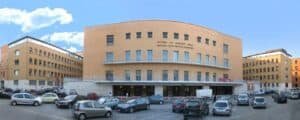
 Sapienza University City100 m
- Aula Magna of Sapienza University100 m
- Primo Levi Chemistry Museum100 m
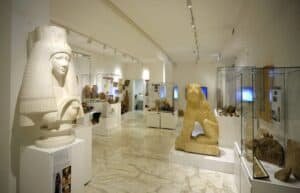
- Museo del Vicino Oriente, Egitto e Mediterraneo100 m
- Museo Laboratorio d’Arte Contemporanea, MLAC100 m
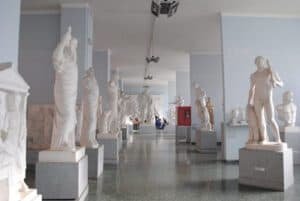
- Gipsoteca – Museum of Classical Art100 m
Upcoming events nearby
- Renata Prunas. Materia risorta at the MLAC of Sapienza, October 8 to November 5, 2026100 m
- IUC Concert Season 2026-2027 at Aula Magna della Sapienza, October 17, 2026 to May 8, 2027100 m
- Mario Brunello at the Aula Magna of the Sapienza, January 19, 2027100 m
- Marc-André Hamelin at the Aula Magna of the Sapienza, January 23, 2027100 m
You might also like
- Janoska Ensemble at Aula Magna, Sapienza University, January 26, 2027
- Lucie Horsch, Metamorphosis at the Aula Magna of the Sapienza, February 6, 2027
- Kyle Alessandro at Monk in Rome, January 27, 2027
- Talco Freek Tour 2027 at Hacienda Roma, April 2, 2027
- The Devon Allman Project at CrossRoads Live Club: March 26, 2027
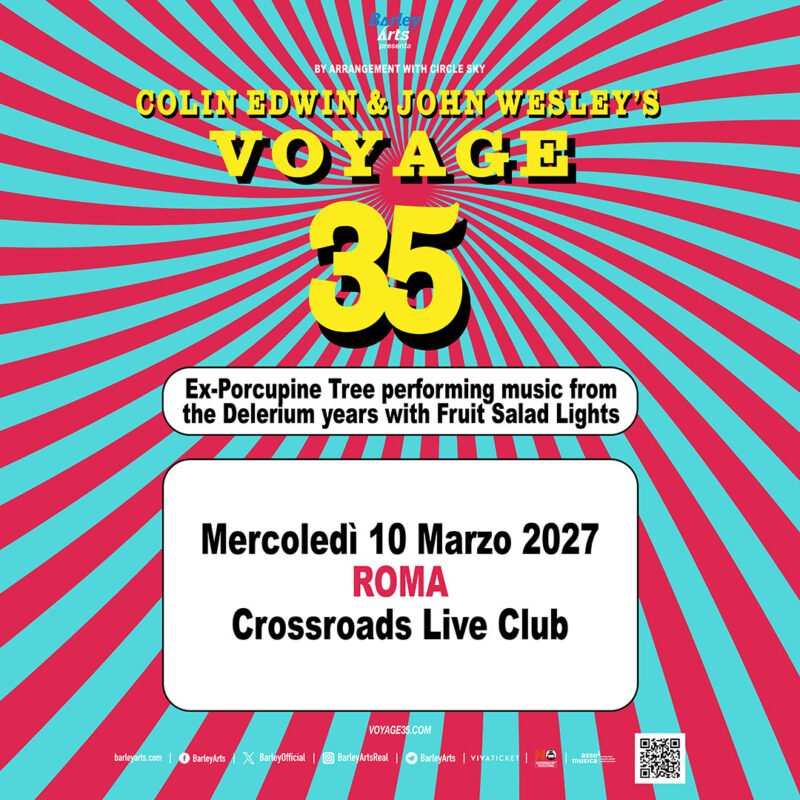
- Voyage 35 (ex Porcupine Tree) at CrossRoads Live Club, March 10, 2027