Sapienza University City
In short. The Sapienza University City is at Piazzale Aldo Moro 5, in Rome, and is run by Sapienza University of Rome.
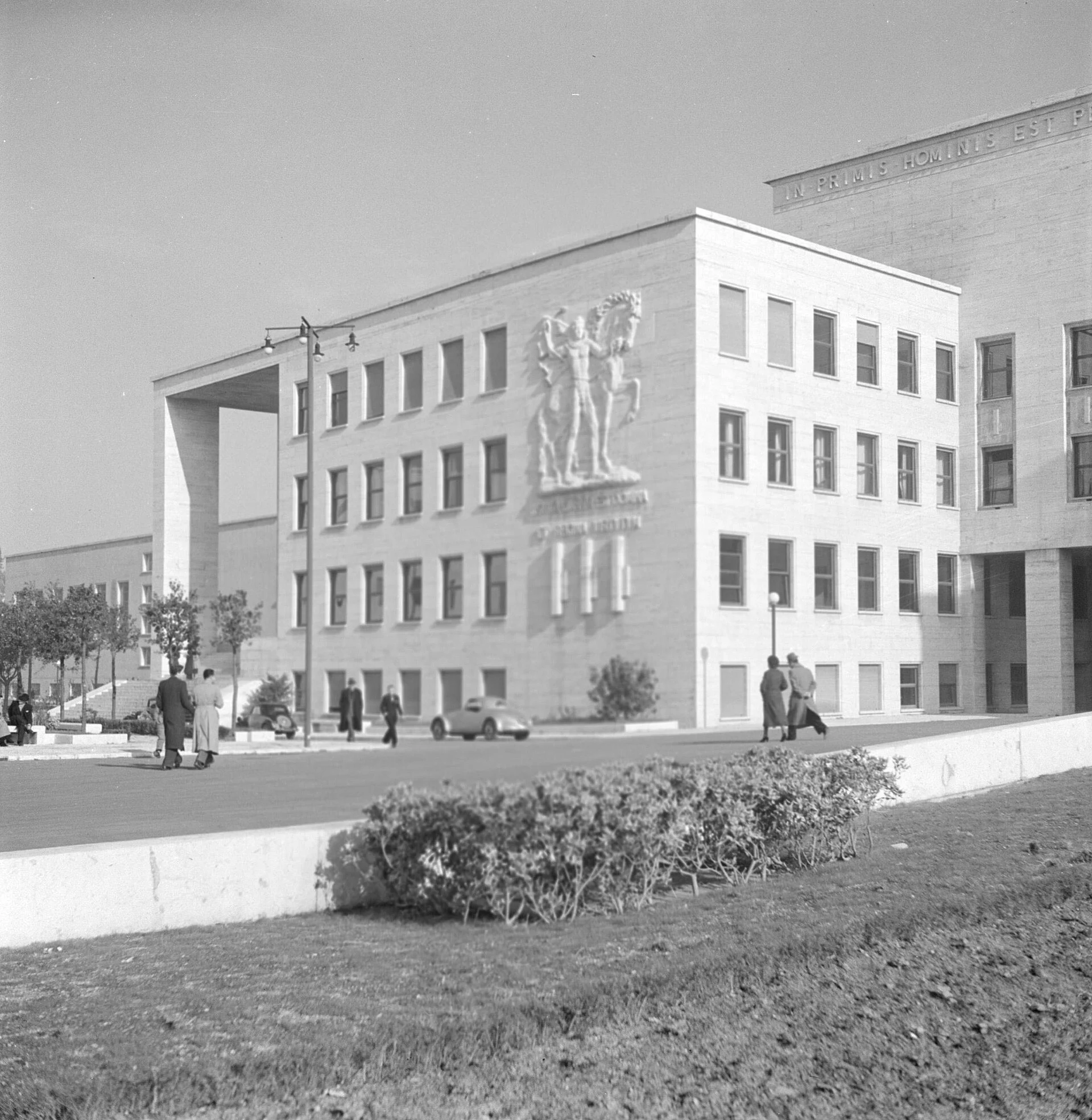
The Sapienza University City is at Piazzale Aldo Moro 5, in Rome, and is run by Sapienza University of Rome. You can walk through the campus without a ticket, while the official guided visit, the university's Sapienza Tour service, costs €5 per person, is reserved for groups of 10 to 40 participants and is booked through the dedicated office, Monday to Friday between 9:00 and 18:00. It is a fully working university, not a museum.
The draw is the architecture. Between 1932 and 1935 Marcello Piacentini coordinated here a team of designers that included Giuseppe Pagano, Gio Ponti, Giovanni Michelucci, Pietro Aschieri, Giuseppe Capponi, Gaetano Rapisardi, Arnaldo Foschini and Gaetano Minnucci. The result is the regime's great university work site, inaugurated on October 31, 1935. Inside are a bronze Minerva six meters tall, a mural painting by Mario Sironi and a large part of the university's museums.
The practical information on visits, museums, concerts and transport comes from the official pages of Sapienza, of its museum network, of the Istituzione Universitaria dei Concerti and of ATAC, consulted on September 28, 2026. The university doesn't publish gate hours meant for outside visitors and the museums change days and opening times with the academic calendar. Before you go, write or phone the official contacts given further on, especially if you're coming with a group.

Where it is and what you see
The university city occupies a large enclosure between the Policlinico Umberto I and the Verano Cemetery, with the monumental entrance on Piazzale Aldo Moro. The university itself places it in the San Lorenzo district, a few minutes on foot from Termini Station and not far from Tiburtina. The city's tourist portal describes it as a city within the city, with more than 40 buildings to find your way among with the map.
You enter through the propylaea designed by Arnaldo Foschini and in front of you is the avenue that leads straight to the Minerva square and to Piacentini's Rectorate Building. It's an axis designed to impress, symmetrical, with the faculty buildings arranged on either side like theater wings. The first view works and it's the image almost everyone has in mind when they think of Sapienza. But it's only the starting point, and not even the best one.
Around the axis are the buildings that matter in the history of 20th-century Italian architecture: Giuseppe Pagano's Institute of Physics, Gio Ponti's School of Mathematics, Pietro Aschieri's Institute of Chemistry, the Botany Institutes by Giuseppe Capponi, Mineralogy and General Physiology by Giovanni Michelucci. Gaetano Rapisardi designs Law and Letters, the two big buildings near the square. Each speaks its own language within a shared design.
The campus is organized for those who study there, not for those who visit. The buildings have codes like CU014 or CU016 that serve the administration and help the tourist little, and the reading of the spaces you have to bring from home. The exteriors, the porticoes, the square with the fountain and the statue, the tree-lined avenues are always in view. The interiors you see in pieces: atriums during lectures, museums in their hours, the Aula Magna only during events.
A few numbers to grasp the scale. In the virtual exhibition published on its own site, the university describes itself as the largest in Europe, with 67 departments and 145,000 enrolled students. Not all of them study here, because Sapienza has sites scattered around the city and in Lazio, but the University City remains the center. At peak lecture hours the Minerva square looks like a station concourse, and you should factor that in.
How to get in, what it costs and who runs it
The main pedestrian access is at Piazzale Aldo Moro 5. The operator doesn't publish specific rules for people who aren't enrolled, nor gate hours aimed at visitors. Monday to Friday, from 8:00 to 20:00, the University City's Presidio Service is active: five staff who walk the perimeter, give information, and watch vehicle traffic, parking areas and the presence of unauthorized street vendors and leafleting.
The guided visit is booked only through the official channel, the university's Sapienza Tour page, the service that designs and accompanies visits to the heritage. It costs €5 per person, applies to groups of 10 to 40 participants, runs Monday to Friday between 9:00 and 18:00 and is paid by bank transfer. The contacts are 06 4991 0791, 06 4969 0304 and valorizzazionepatrimonio@uniroma1.it. The route is declared accessible to people with mobility disabilities.
The service is designed for groups, associations, tour operators and guides. The operator doesn't indicate a formula for the individual visitor, so if you're alone or as a couple, ask the office if you can join an already formed group. Alternatively, a free stroll through the open spaces on a weekday remains the simplest solution and costs nothing. The university museums have their own rules, which you'll find further on museum by museum.
A campus full of people studying calls for a bit more care than an archaeological park. You don't go into classrooms during lectures, you don't photograph students without asking, you don't take seats in the libraries. The study rooms open in the evening and at night, for example, are reserved for enrolled students with a student card. A visitor who treats the faculty like a gallery is noticed right away and disturbs those who are working.
For everything that isn't published, the right channel is the university switchboard, 06 49911, or the Presidio mailbox, presidiocu@uniroma1.it. For the museums write to the museum network, polomusealesapienza@uniroma1.it, which has its offices in building CU011. The operator doesn't indicate a tourist information point: the CIAO service you find under the portico of the Rectorate is meant for students, and should be used with discretion.
A curiosity about the Sapienza University City
The Minerva arrived before the inauguration. According to the reconstruction published by the university's museum network, Arturo Martini's bronze, lost-wax cast between 1934 and 1935, was placed in the central square on April 21, 1935, more than six months before the official ceremony. Six meters of statue on a tall concrete base clad in porphyry, at the center of a rectangular fountain designed by Eugenio Montuori.
Martini prepared two sketch models. The plaster one has been lost, the bronze one is today at the National Gallery of Modern and Contemporary Art, in Valle Giulia. Piacentini was enthusiastic about it and in a letter to the sculptor, reproduced in the university's document, calls him a magician. The statue then waited 60 years for its first conservation restoration, which came only in 1996.
The second restoration was presented on November 18, 2024. Under the direction of museology professor Eliana Billi, the restorers washed the surface with distilled water and detergent and protected it with acrylic resin and wax, removing the old protective coatings that had made it dull. The green you see today is the natural green of the bronze's oxidation, not a layer of dirt to be cleaned off.
Then there's the student tradition, which is another matter. Among the students, for generations, a superstition has circulated that looking the Minerva in the eyes before graduating would bring bad luck in exams. No university document mentions it, it has no birth date and everyone tells it their own way. It's university folklore and should be taken as such: ask three students sitting on the steps and you'll get three different versions.
One thing nobody tells you about the Sapienza University City
The Mario Sironi painting in the Aula Magna, Italy between the Arts and the Sciences, for decades was not Sironi's. In the early 1950s, according to the reconstruction published by the university, the painter Carlo Siviero repainted it to eliminate everything that could allude to the regime. Sironi was still alive. His great mural for the Roman university was corrected by a colleague, with a brush, a few years after the end of the war.
What disappeared: a figure on horseback, whom the university indicates as probably Mussolini, and an inscription with the date XIV of the Fascist era. The Roman arch and the eagle were scaled down, the faces of the figures heavily altered. The result was a painting with the figures in their places and the wrong hand, and for decades whoever sat in the Aula Magna looked at a Sironi rewritten by another painter.
The subject remained. In the center Italy, around her the disciplines in figure: Astronomy, Mineralogy, Botany, Geography, Architecture, Letters, Painting and History, a woman seen from behind with an open book. In the background a triumphal arch with the eagle and a winged Victory with a sword. More than 90 square meters of painting in the apse of the hall, executed in the summer of 1935.
The real restoration begins in July 2015, after a partial conservation intervention in the 1980s. It is carried out by the Istituto superiore per la conservazione e il restauro and Sapienza, with scientific heads Marina Righetti and Gisella Capponi, through a long campaign of diagnostic investigations and microchemical analyses. On November 23, 2017 the painting is returned to the Aula Magna in the presence of President of the Republic Sergio Mattarella, as part of the celebrations for the campus's 80 years.
What nobody tells you is that the painting is a document about the postwar period as much as about Fascism. It tells how republican Italy decided to treat the art of the regime: not by destroying it, by correcting it. The volume Sironi svelato, edited by Eliana Billi and Laura d'Agostino for Campisano Editore, reconstructs the whole story. Whoever looks at it today should know this, because in front of that wall you also read a story of erasures.
The project and the architects, building by building
The project starts in 1932 and ends in three years, a time that in Rome today sounds like science fiction. Marcello Piacentini is chief architect and general director and designs the Rectorate Building. Around him the museum network lists Giuseppe Pagano and Gio Ponti, who came from the Turin-Milan axis, Giovanni Michelucci from Florence, Pietro Aschieri, Giuseppe Capponi, Gaetano Minnucci, Arnaldo Foschini and Gaetano Rapisardi from Rome. A team that mixed different generations and schools.
Piacentini, the most powerful designer in the Rome of those years, keeps for himself the Rectorate and the general layout: the axis, the square, the hierarchy of buildings. The others design the individual institutes within an overall plan that decides positions and relationships. That is why the complex looks unified even though the hands are many, and why the differences between one building and another, once seen, are never forgotten.
Giuseppe Pagano's Institute of Physics, from 1934, is the piece that architects come to see on purpose. Pagano was one of the most radical voices of Italian rationalism, far from the simplified classicism that Piacentini liked. Having him on the same team shows how wide, in the mid-1930s, the space for debate was within official architecture. For those interested in physics, the link with the university's Physics Museum comes naturally.
Gio Ponti's School of Mathematics, also from 1934, is the most recognizable building after the Rectorate. Ponti, who came from design and the applied arts, builds a volume that breaks from the rigor of the neighboring institutes with a curved body on the front. If you have time to look calmly at only one building on the campus, choose this one and walk around it before going into the atrium, when the faculty is open.
Pietro Aschieri designs the Institute of Chemistry, 1934, now home to the department that also hosts the Primo Levi Chemistry Museum. The Florentine Giovanni Michelucci designs Mineralogy, from 1933, and General Physiology. Giuseppe Capponi designs the Botany Institutes between 1932 and 1935. They are buildings less photographed than the Rectorate and much more instructive, because they show how each designer interpreted the same rules.
Arnaldo Foschini designs the monumental entrance on Piazzale Aldo Moro and, farther inside, the Institute of Hygiene and the Orthopedic Clinic. Gaetano Rapisardi designs the buildings of the Faculty of Law and of Letters. The city's tourist portal places them among the academic signatures, set against the rationalist ones of Pagano and Michelucci. Telling the two families apart by eye, as you walk, is the first exercise to do and the most useful.
An opinion against the grain of almost all the guides: the axis of honor with the Minerva and the Rectorate is the least interesting part of the University City. It is well-built regime stage scenery and little else, designed for rallies and official photographs. The architecture that made school is found on the sides, in the scientific institutes. Whoever takes the photo of the statue and leaves has seen the cover and left the book on the table.
My advice for visiting the Sapienza University City
Come on a weekday, mid-morning, during the semester. It seems counterintuitive, because a campus full of students seems less visitable than an empty one. It's the opposite: with the faculties open, the porticoes crowded and the Presidio on duty, the University City works for what it was built for, and Piacentini's idea is understood much better than in the silence of a holiday.
Follow a precise order. Enter through the propylaea, walk the axis to the Minerva without lingering too much, then branch out toward the side institutes. Mathematics, Physics, Chemistry, Botany, Mineralogy: look at them one by one, asking yourself what they have in common and what separates them. An hour spent like this, with the university map in hand, is worth more than an afternoon spent reading manuals of 20th-century architecture.
Fit the walk together with a museum open that day. On Monday and Friday, for example, the museum network's pages list the Museum of Origins and the Museum of Etruscan and Italic Antiquities as open from 9:00 to 19:00, while the Museum of Classical Art indicates opening Monday to Friday from 8:00 to 20:00. Check each museum's page the day before, because that's where extraordinary closures appear.
If you have a group of at least 10 people, book Sapienza Tour well in advance. €5 a head for a tour organized by the university is a price no private visit can match, and the route covers the Rectorate, Chemistry, Physics, Mathematics, the chapel and the Minerva. With groups of adults interested in the 20th century it works even when someone arrives skeptical about the architecture of the Fascist period.
The most convenient way to see the Sironi painting without waiting for a special visit is to buy a ticket for a concert of the Istituzione Universitaria dei Concerti, which has its season in the Aula Magna. For the 82nd season the Under30 ticket costs €8 and the full price runs from €15 to €26 plus the presale fee. The box office in the Aula Magna opens one hour before the concert: arrive early and look at the apse calmly.
The Sapienza museums inside and around the campus
The Sapienza Museum Network is the system that coordinates the university museums, organized in five disciplinary areas. The site lists 19 of them, not all inside the University City enclosure. The same contacts page warns that the museums open to the public in different ways and on different days. The individual museum pages give hours and contacts but, except for the cases noted below, the operator doesn't indicate an admission fee.
The Museum of Classical Art, the university's great plaster cast gallery, is at the back of the Letters and Philosophy building and holds plaster casts of Greek sculptures. The official page indicates opening Monday to Friday from 8:00 to 20:00. The published contacts are 06 4991 3960 and mac@uniroma1.it. It's the easiest museum to fit into a walk, because it has the widest time slot.
Also at the back of Letters are the Museum of Origins, dedicated to the earliest history of humankind, from the first stone tools to bronze swords, and the Museum of Etruscan and Italic Antiquities, with works, crafts, texts and scale reproductions of the great monuments. Both indicate opening Monday and Friday from 9:00 to 19:00 and Wednesday from 16:00 to 19:00.
The Giuseppe Sergi Museum of Anthropology is on the second floor of the Anthropology building and tells the story of human evolution and primate variability through bones. It opens Monday, Thursday and Friday from 9:30 to 13:30, Tuesday also from 14:30 to 18:30, Wednesday also from 14:30 to 15:30. The published phone is 06 4991 2495.
The Museum of the Near East, Egypt and the Mediterranean, with its entrance at the back of the Rectorate, displays finds from Sapienza's archaeological missions. It opens Tuesday and Thursday from 10:00 to 17:00 by reservation, mandatory for groups of at least six people, at mvoem@uniroma1.it. The Contemporary Art Laboratory Museum, under the portico of the Rectorate, opens only during exhibitions, Monday to Saturday from 15:00 to 19:00.
The University Museum of Earth Sciences, in building CU005, holds tens of thousands of minerals, rocks and fossils. During the renovation work under way, entry for individuals is free, groups of up to 25 people with a guided visit pay €110, and booking is mandatory for everyone. The Chemistry Museum, in building CU014, receives visitors by appointment requested at museodichimica@uniroma1.it.
The network also includes the Battista Grassi Museum of Comparative Anatomy, the Museum of Pathological Anatomy, the Museum of the History of Medicine, the Museum of Art and Mineral Deposits, the Herbarium Museum and the Botanical Garden. Some are outside the enclosure, and each has its own hours to check on its page.
The Aula Magna and the Sironi painting: how to see it
The Aula Magna is at the center of the Rectorate Building, which in turn is the hub of the University City, and the Sironi painting occupies its apse. It is not a museum space with opening hours: it is the hall for ceremonies, conferences and concerts. The operator doesn't publish free-visit hours for the painting, and showing up at the door hoping to find it open is a bet almost always lost.
There are three ways. The first is the group visit with Sapienza Tour, which includes the Rectorate. The second is the special visits that the university announces from time to time: on May 14, 2025, for example, a talk with a guided visit to the painting was held in the Aula Magna at 16:00, with mandatory booking through an online form. The third is a concert of the university season.
The season of the Istituzione Universitaria dei Concerti takes place in the Aula Magna. Tickets are bought at the box office at Lungotevere Flaminio 50, on Monday, Wednesday, Thursday and Friday from 10:00 to 13:00 and from 14:00 to 17:00, online on the circuit indicated by the institution, by phone at 06 3610051, or at the Aula Magna one hour before the concert. The full program is published on the site.
There remains Open House Roma, the free festival that opens buildings that are usually closed. The 2026 edition ran from May 16 to 24 with more than 220 places, and Sapienza appeared among the sponsoring bodies. Which campus buildings enter the program changes from year to year: check the festival's site in spring and book as soon as the calendar opens, because visits by reservation have limited places.
Another well-known fact, yet rarely cited
Sapienza wasn't born here, and everyone knows that. What is little cited is how recent the move is. The university was founded in 1303 by Boniface VIII with the bull In suprema praeminentia dignitatis, as the Studium Urbis. From 1431, when Pope Eugene IV acquired buildings in the Sant'Eustachio district, the seat stayed in the center for five centuries, in the complex of Sant'Ivo alla Sapienza. The University City is less than 100 years old.
The name too has a less linear history than it seems. According to the university's history page, the recovery of the name Sapienza is due to rector Antonio Ruberti, an engineer, who brought the university back to the center of Italian university policy. Recovery, precisely: it means that for a stretch of the 20th century that name had fallen out of official use. The brand that seems eternal today is the result of a relatively recent choice.
The least cited fact concerns the professors. In 1931 the regime imposed an oath of loyalty on university teachers, on pain of suspension from teaching. Across Italy 12 refused, and four were from Sapienza: the historian of Christianity Ernesto Buonaiuti, the orientalist Giorgio Levi Della Vida, the mathematician and physicist Vito Volterra, the historian of antiquity Gaetano De Sanctis. They all lost their posts, four years before the inauguration of the new seat.
Put the dates together and the picture changes. The University City is inaugurated in 1935 with grand ceremonies in the presence of the royal family, after the university had removed four professors who had refused to swear. In 1938 the racial laws arrive. When you walk among these buildings you are looking at the public face of a university that, behind the new facades, was losing part of its best people.
The right photo to take at the Sapienza University City
The photo everyone takes is the Minerva from below with the Rectorate behind. Go ahead and take it, but know it's the least original. The right photo is Gio Ponti's School of Mathematics taken at a three-quarter angle, so that the curved body of the front works against the straight lines of the surrounding buildings. It's the image that tells the campus better than any statue, and few people take it.
Second framing: Pagano's Institute of Physics, head-on and from far away, looking for symmetry. Here the secret is not to get too close. The rationalist facades work through proportion and the rhythm of the windows, and a strong wide-angle lens distorts them until they're unrecognizable. Stay at a distance, use a normal focal length and wait for the avenue to empty in the dead moment between one class change and the next.
If you still want the Minerva, take it from the side, with the silhouette against the sky, and leave the Rectorate out. After the 2024 restoration the bronze has regained its natural green and in the light of late afternoon it looks much better than at noon. Don't climb on the edge of the basin and don't step into the water: it's a recently restored monument, and the fountain is not a photo set.
A rule of respect that counts more than any technical advice: students are not extras. If you need people in the photo to give scale to the buildings, shoot from far away, with no recognizable faces, or ask permission. Don't point the lens into classrooms or laboratories. And leave the drone at home: the campus is full of people and borders a large hospital.
One last warning. In the open space near the Faculty of Law there is the plaque in memory of Marta Russo, struck at that spot on May 9, 1997. It is not a place for a souvenir photo. If you pass in front of it, stop for a moment and move on. The same goes for the memorial stone dedicated to Vittorio Bachelet in the Political Science building, in front of which the university holds its commemorations.
How to get there
The simplest way is metro line B. The Policlinico station, opened on December 8, 1990 with the extension of the line from Termini to Rebibbia, serves the area of the Policlinico Umberto I, which borders the campus. Alternatively get off at Castro Pretorio, also on line B, and continue on foot. From both stops the entrance on Piazzale Aldo Moro is reached by a short flat walk.
From Termini you can also walk, and the university itself puts the University City a few minutes from the station. Exit on Via Marsala side and head toward San Lorenzo. It's an urban walk with nothing remarkable along the way, but it makes you understand how close to the center the campus was already in 1935. If you arrive by train at Tiburtina, which the university indicates as not far, you can cross San Lorenzo on foot.
On trams it's worth being precise, because old maps mislead. Lines 3 and 19 have historically served the Policlinico area, but the service status published by ATAC shows the 3 running only between Porta Maggiore and Trastevere station, with replacement buses between Porta Maggiore and Valle Giulia, and the 19 entirely replaced by buses. As of September 28, 2026, therefore, no tram reaches the University City.
The bus lines that run on Viale Regina Elena, Viale dell'Università and Piazzale del Verano change route with the work sites and with the tram replacements, and the operator updates the details week by week. Before leaving, check the route on the ATAC site or on the Roma Mobilità planner, entering Piazzale Aldo Moro as the destination, and trust the indication of the day.
Don't come by car. The neighborhood is congested during class hours, parking around it is a chronic problem and the parking areas inside the enclosure are watched by the Presidio service precisely because they are contested. If you have no alternative, leave the car near a metro line B station far from the center and do the last stretch underground. You arrive sooner and save yourself half an hour of circling around the Verano.
Some important events that took place here in history
The project takes shape in 1932, the Minerva is placed on April 21, 1935 and the University City is inaugurated on October 31, 1935, in the presence of King Victor Emmanuel III, with grand ceremonies. On the date of the inauguration the sources do not fully agree: the one reported here is the one indicated by the university's museum network. Sironi's painting is executed in the summer of the same year, to be ready for the opening.
In 1938 Enrico Fermi receives the Nobel Prize just as the regime has promulgated the racial laws. His wife is Jewish: after collecting the prize in Stockholm, Fermi emigrates to New York. In the same months his student Emilio Segrè stays in the United States, having graduated with him at Sapienza in 1928. The following year Franco Modigliani also leaves Rome for the United States, a law graduate from here and future Nobel laureate in economics in 1985.
On April 27, 1966 the student Paolo Rossi dies on the steps of Letters and Philosophy during a raid by right-wing students, as the university's history page recalls. Students and professors occupy several faculties in protest, nonviolently, and for the first time in the university's history a rector, Ugo Papi, is forced to resign. It is the prologue to the season that arrives two years later.
In February 1968 the faculties are occupied. On March 1 the clashes with the police that go down in history as the Battle of Valle Giulia take place in front of the Faculty of Architecture, which is not in the University City but at Valle Giulia, near Villa Borghese. On March 16 militants of the Movimento sociale italiano led by Giorgio Almirante and Giulio Caradonna storm the Faculty of Letters, occupied by left-wing students.
In 1969, under the pressure of the protest, the government liberalizes access to the university. On February 17, 1977, with the university occupied, the general secretary of the CGIL Luciano Lama climbs onto a truck turned into a stage to speak to the students. After about half an hour the protest degenerates into clashes, with about 100 injured. The episode remains in memory as the expulsion of Lama and marks the break between the student movement and the union.
On February 12, 1980 Vittorio Bachelet, professor of Administrative Law at Political Science and vice president of the High Council of the Judiciary, is killed by the Red Brigades on the stairs of his faculty, at the end of a lecture. He had been national president of Catholic Action in the years of the Council. The university commemorates him in front of the memorial stone in the Political Science building, and the history page also recalls Ezio Tarantelli, killed in 1985.
On May 9, 1997 Marta Russo, a 22-year-old Law student, is struck on the path between Law, Statistical Sciences and Political Science and dies a few days later. The family authorizes the donation of her organs. The judicial case closes in 2003 with final sentences. Today a plaque recalls her at the place where it happened, and a study room and a graduation prize on the themes of legality carry her name.
On November 23, 2017 the restored Sironi painting is returned to the Aula Magna in the presence of President Mattarella. In 2020 Sapienza elects Antonella Polimeni, the first woman rector in more than 700 years of the university's history. On November 18, 2024 the restoration of the Minerva is presented. These are the recent stages of a complex that keeps coming to terms with its own memory, one piece at a time.
Who has passed through the Sapienza University City
Marcello Piacentini, first of all. Chief architect of the work site, author of the Rectorate and of the general layout, the dominant figure of Roman architecture of the period. Here he gave the most successful proof of his method: coordinating different designers within a single plan and keeping the ceremonial piece for himself. Whoever wants to see where that method went next should look at EUR.
Giuseppe Pagano, Gio Ponti, Giovanni Michelucci, Pietro Aschieri, Giuseppe Capponi, Arnaldo Foschini, Gaetano Rapisardi, Gaetano Minnucci. Eight names that, lined up, give a portrait of 1930s Italian architecture with all its tensions between rationalism and classicism. The Casa dello studente, designed between 1933 and 1935 by a group that included Saverio Muratori, belongs to the same program.
Mario Sironi, the painter who in the summer of 1935 covered the apse of the Aula Magna, and Arturo Martini, the sculptor of the Minerva. Two artists whom the regime had chosen as official voices and whom art history has since judged well beyond that season. Alongside them we should remember Carlo Siviero, the painter who repainted Sironi in the postwar period: a minor episode, but decisive for understanding what you see today.
Enrico Fermi, who stayed in Rome until 1938, and with him Emilio Segrè and Franco Modigliani, all of whom left for the United States within a year. For the Roman season of physics before the move to the campus you have to go to Via Panisperna, to the Centro Enrico Fermi. Here what remains is Pagano's institute, which tells by contrast how modern that school was.
Luciano Lama, the CGIL secretary who in February 1977 came to speak to the students and left contested, after seeing his own rally turn into a clash. With him pass through here the thousands of students of '68 and '77, anonymous, who filled these squares. The University City is also the place where a generation measured its own ideas.
Vittorio Bachelet, jurist, professor, man of the institutions, and Marta Russo, a 22-year-old student. Two people who passed through here to teach and to study and whom the university remembers with a memorial stone, a plaque, a study room and a graduation prize. The right way to name them on a page like this is simple: say who they were and what they did here, and leave the rest to the history books.
And then President Sergio Mattarella, present in 2017 at the return of the Sironi painting, and Antonella Polimeni, the first woman elected to lead the university, in 2020. The entrance square carries the name of Aldo Moro. But the most constant presence remains that of the students, generation after generation, who cross the avenue every morning without raising their eyes to the statue, as the superstition would have it.
When it is closed and what not to expect
The University City has no tourist hours. The Presidio service works Monday to Friday from 8:00 to 20:00, and outside that slot the operator doesn't say how visitor access works. On weekends, holidays and in the breaks of the academic calendar the campus changes face, and the museums close. If your interest is the interiors, count only on weekdays.
The network's museums have their own closures, published on their pages. Between the end of 2025 and the start of 2026, for example, several museums set up in the Letters and Rectorate buildings stayed closed from December 22 to January 5, while the Museum of Anthropology indicated a closure from December 12 to January 12. Before planning a visit around the holidays, always check.
Don't expect services designed for the tourist. The operator doesn't indicate audio guides, ticket offices or bookshops dedicated to visitors, and the information points are aimed at those who study. The campus lives at the pace of lectures, not at that of visits. The reading of the buildings comes from the guide, if you book Sapienza Tour, or from what you bring with you.
On accessibility the published information concerns Sapienza Tour, whose route is declared accessible to people with mobility disabilities. For the individual museums the information has to be asked case by case, because some are on the upper floors of buildings, like the Museum of Anthropology on the second floor. Write first to the museum or to the museum network and have them tell you the best entrance and route.
Where to eat nearby
Around the University City people eat mostly in San Lorenzo, the neighborhood that has lived off its students for almost a century. It's both a stroke of luck and a trap: next to honest trattorias and cheap places designed for those on an out-of-town student's budget there are venues built for the evening passing trade, where quality counts less than volume. The signs for telling them apart are the same ones that hold in the rest of Rome.
First sign: photographs of the dishes on the menu displayed outside. A place that needs to show you the picture of a carbonara is talking to someone who doesn't know what it is, and that isn't someone who lives in the city. Laminated menus with the portions photographed under a yellow light, translated into five languages, are the sign of a kitchen built for people who won't come back.
Second sign: the lady rolling out pasta dough in the window or on the sidewalk. It's theater, not a guarantee of quality. Fresh pasta done well is prepared in the kitchen, in the morning, away from the dust of the street. When you find it staged in front of the entrance, a visual lure designed to stop the passerby is at work, and the final bill usually takes it into account.
Third sign: someone at the door inviting you in. A place that has to get customers by stopping them in the street has no regulars, and regulars are the only guarantee there is. The same goes for kitchens open without a break from morning to late at night: a real kitchen stops, because it has a crew that needs to rest and prepare the next service.
Fourth sign: items with no price, vague labels like dish of the day, different price lists between the dining room and the outside tables. Ask the price before ordering, always. About the chains you find identical in five squares of the center I'll say only this, without malice: they are convenient and predictable, but Romans don't go there, and the students of San Lorenzo even less, because for that money they eat better two streets away.
The criterion is to look at who is sitting there and in what language they order. If at lunch on a weekday there are students, professors, Policlinico nurses and people from the neighborhood, you've found it. So you don't have to go by trial and error, I keep our list of the places where we eat up to date, a public unsponsored map that changes when the places change.
What to pair it with in a day
The most natural pairing is on foot. From the campus you head out toward the Verano and the Basilica of San Lorenzo fuori le Mura, then go down toward Santa Bibiana and Porta Maggiore, where you also find the underground basilica. It's half a day of a less obvious Rome, between railway, walls and working-class neighborhoods.
Toward the north the loop leads to Porta Pia and Villa Torlonia, with the Casino Nobile that was Mussolini's residence: a pairing that makes sense precisely after seeing the architecture of the regime. Whoever continues along the Nomentana reaches the Mausoleum of Santa Costanza, with its 4th-century mosaics.
Toward Termini you have the National Central Library at Castro Pretorio, the Baths of Diocletian, Palazzo Massimo and Piazza della Repubblica. For those who want to stay with everyday life, Esquiline Hill with the New Market and Pigneto are one stop away.
If you have a passion for the 20th century you can build a multi-day itinerary. After Piacentini's campus come the Foro Italico and the Square Colosseum at EUR, then the industrial landscape of Ostiense with the Gasometer and the former Porto Fluviale. For the memory of the war you need the Historical Museum of the Liberation and Forte Bravetta.
Anyone traveling with high-school-age kids has a rare opportunity: showing them a real university before choosing one. A morning between the Minerva square, a science museum and the neighborhood cafeteria tells more than any orientation day. Then you finish in the center, at Sant'Ivo, where the same university lived for five centuries, and the route comes back to the starting point.
Frequently asked questions
Can the Sapienza University City be visited freely?
The campus at Piazzale Aldo Moro 5 can be walked through without a ticket, but the operator doesn't publish specific rules for non-enrolled people nor gate hours for visitors. The Presidio service is active Monday to Friday from 8:00 to 20:00. The interiors are seen during lectures, in the museums according to their hours and with the visits organized by the university.
How much does the official guided visit cost?
The Sapienza Tour service costs €5 per person, is reserved for groups of 10 to 40 participants and runs Monday to Friday between 9:00 and 18:00, by reservation. It is paid by bank transfer. The official contacts are 06 4991 0791, 06 4969 0304 and the address valorizzazionepatrimonio@uniroma1.it. The route is declared accessible to people with mobility disabilities.
Can you see Mario Sironi's painting in the Aula Magna?
There are no free-visit hours. The painting Italy between the Arts and the Sciences can be seen with the Sapienza Tour group visits, in the special visits that the university announces from time to time by reservation, or by attending a concert of the Istituzione Universitaria dei Concerti season, which is held right in the Aula Magna and has Under30 tickets at €8.
Who designed the University City?
The coordination was by Marcello Piacentini, chief architect and author of the Rectorate. Working with him were Giuseppe Pagano on the Institute of Physics, Gio Ponti on the School of Mathematics, Pietro Aschieri on Chemistry, Giovanni Michelucci on Mineralogy and Physiology, Giuseppe Capponi on Botany, Arnaldo Foschini on the entrance and on Hygiene, Gaetano Rapisardi on Law and Letters, as well as Gaetano Minnucci.
When was it inaugurated?
The university's museum network indicates October 31, 1935, with ceremonies in the presence of King Victor Emmanuel III and the royal family. The project had started in 1932 and Arturo Martini's statue of Minerva had been placed in the central square as early as April 21, 1935. Sironi's painting in the Aula Magna was executed in the summer of the same year, right before the opening.
Are the Sapienza museums paid?
The museum network's pages give hours and contacts, but for most museums the operator doesn't indicate an admission fee. The University Museum of Earth Sciences states free entry for individuals during the works in progress and €110 for groups with a guide. Some museums receive visitors only by reservation, so write before going.
How do you get there by public transport?
By metro line B, getting off at Policlinico or at Castro Pretorio and continuing on foot to Piazzale Aldo Moro, or on foot from Termini, which the university indicates as a few minutes away. According to the ATAC service status, trams 3 and 19 do not currently reach the area, replaced by buses. For buses check the route of the day on the ATAC or Roma Mobilità site.
Where is the Minerva statue and what does it represent?
Arturo Martini's Minerva stands at the center of the square in front of the Rectorate Building, on a tall porphyry-clad base inside a rectangular fountain by Eugenio Montuori. It is a six-meter bronze cast by the lost-wax method between 1934 and 1935, a symbol of the university. The latest restoration was presented on November 18, 2024.
Who wrote this page
The page comes from the editorial team of Tour Leader Pro, the Rome-based outfit that designs itineraries, visits and cultural events across Rome and Lazio. Fees, museum hours, visit conditions and transport status reported here come from the official sources cited in the text, as of the date given at the top. Since this is a university campus with a variable calendar, check them again before you leave and let us know what you find changed.
Lining up a day on 20th-century Rome means fitting together university museums with different hours, visits reserved for groups, aule magne open only for events and tram lines replaced by buses, for yourself or for a group of 40 people. If you're facing this kind of puzzle, on Tour Leader Pro you'll find working materials designed for those who guide and for those who organize on their own.
For the wider picture, that is regional trains and seasonal timetables, airports, rentals, travel between one province and another and destinations in Lazio outside central Rome, from the Castelli to the volcanic lakes of the north, the Tyrrhenian coast and the villages of the interior, a useful resource for putting together a multi-day itinerary is Italy Planner.