Mausoleum of Santa Costanza
In short. The Mausoleum of Santa Costanza is at number 349 on Via Nomentana, inside the monumental complex of Sant'Agnese fuori le Mura, a little over two kilometers from the Aurelian Walls and Porta Pia.
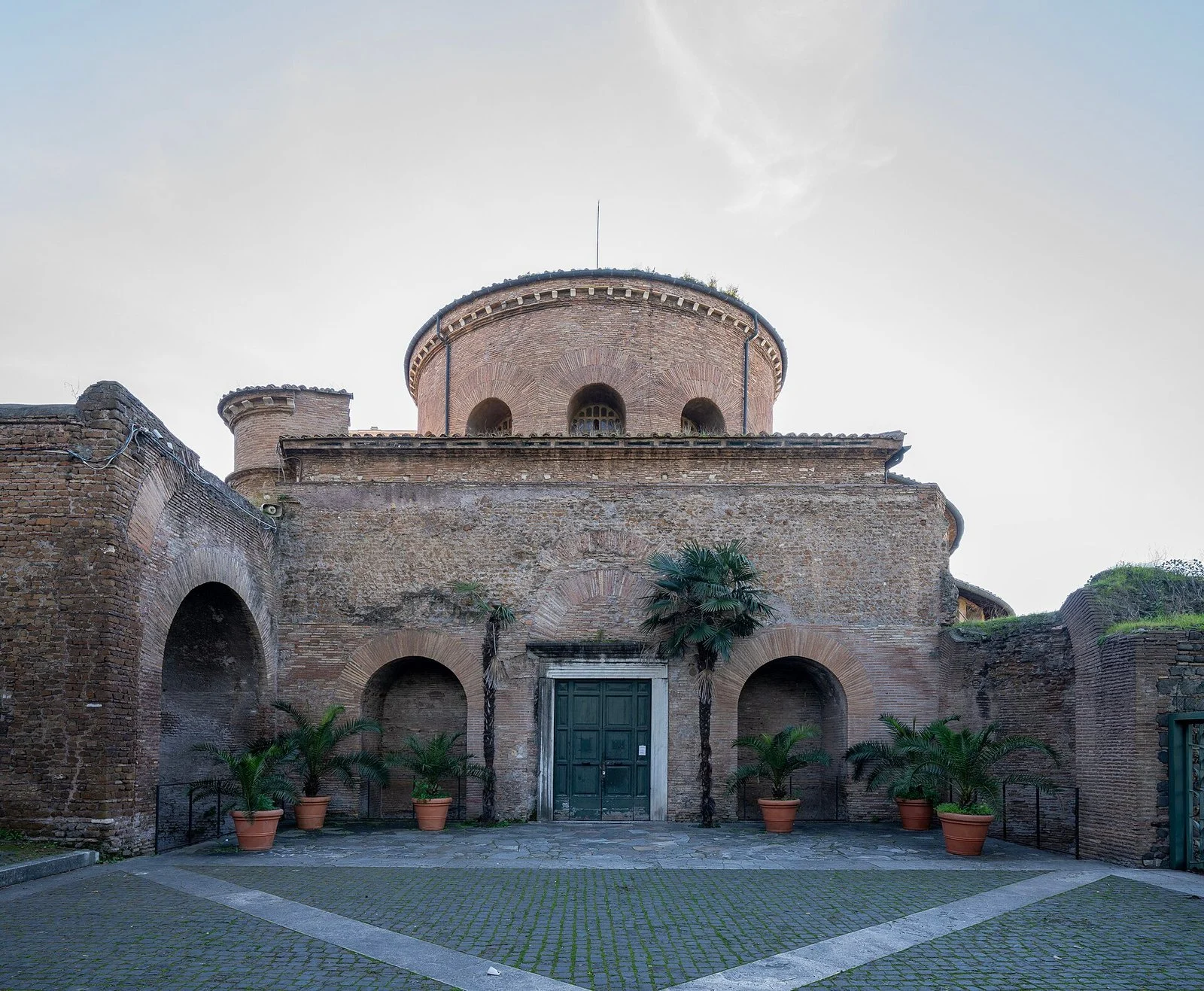
The Mausoleum of Santa Costanza is at number 349 on Via Nomentana, inside the monumental complex of Sant'Agnese fuori le Mura, a little over two kilometers from the Aurelian Walls and Porta Pia. It's a circular building of the fourth century AD, built as a tomb for a daughter of the emperor Constantine, and it preserves in the annular vault of its ambulatory one of the oldest cycles of mosaics to survive in Rome: vine shoots climbing on a white ground, erotes harvesting and treading grapes, birds, amphorae, still lifes, half-length portraits enclosed in medallions. Almost no tourist puts it on the schedule, and yet anyone who studies late antique art considers it a required stop, because here you see the moment when the figurative repertoire of the ancient world slips into the Christian one without it being possible to say where one ends and the other begins. The basilica of Sant'Agnese fuori le Mura, which stands in the same enclosure, already has a dedicated entry on this site: here we talk about the mausoleum, that is the round building constructed beside it, which has a history, a function and a decorative apparatus all its own. The lines that follow tell who had it built, how it is made, what the mosaics really depict, where the porphyry sarcophagus is today (the original is no longer here) and how to organize the visit.
Where the Mausoleum of Santa Costanza is and how to get there
The Mausoleum of Santa Costanza is at Via Nomentana 349, in the Trieste district, inside the monumental complex of Sant'Agnese fuori le Mura, and the complex has two separate entrances: the one at Via Nomentana 349, high above street level, and the one at Via di Sant'Agnese 3, on the opposite side, more convenient for those arriving by subway. Knowing which of the two gates to use saves quite a few minutes, because the two entrances are at different levels and connecting them on foot means going around the whole block.
By subway
The reference stop is Sant'Agnese-Annibaliano, on the B1 branch of the subway, the one that splits off from line B at Bologna station and heads up toward Conca d'Oro and Jonio. Anyone getting off at Annibaliano is practically on top of the complex: the entrance the parish indicates for those arriving by subway is the one at Via di Sant'Agnese 3, a few steps from the station exit. It's by far the simplest solution for those starting from the center, because it avoids the surface traffic of the Nomentana, which at rush hour is one of the most congested stretches in the northern quadrant of the city.
By bus
From the historic center, and in particular from Piazza Venezia, the line indicated by the complex itself is the 60 Express. From Termini the line is the 90. In both cases the stop to watch for is Nomentana/XXI Aprile, and from there you enter by the gate at Via Nomentana 349. The two lines run along the Nomentana in the direction of the outskirts and also serve the stretch of the neighborhood that hosts Villa Torlonia, which makes it possible, for those with half a day available, to line up two very different stops along the same street.
What the Mausoleum of Santa Costanza really is: an imperial tomb, not a church
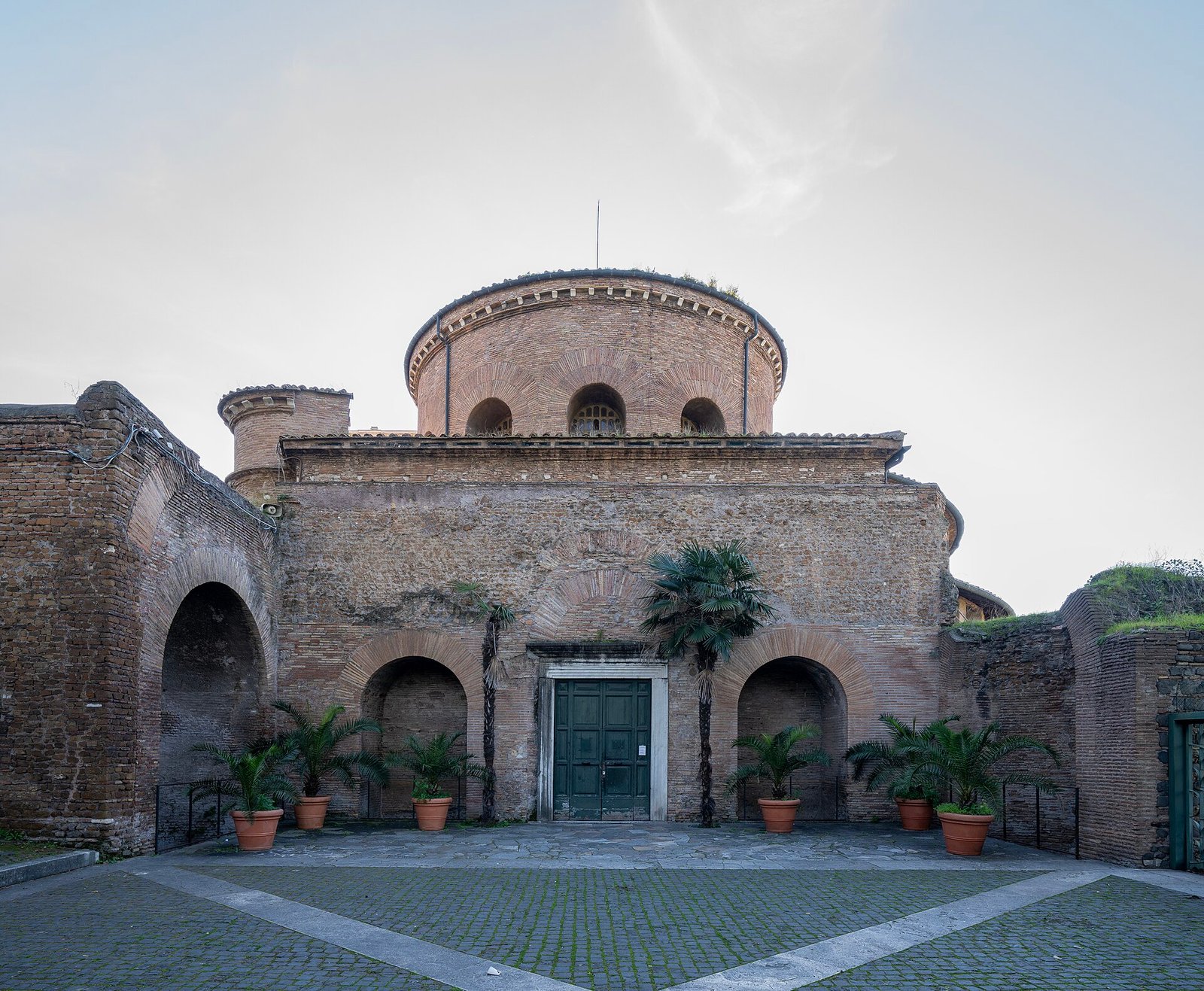
The Mausoleum of Santa Costanza was born as a private funerary building of the imperial family, not as a place of worship: it was built to house the burial of Constantina, daughter of Constantine the Great, and became an independent church only centuries later, when the original function was by then a distant memory. It's a distinction worth keeping in mind throughout the visit, because it explains the plan, explains the position and also explains the choice of mosaic subjects, which are not those you would expect from a church and which for centuries led visitors to think something else entirely.
Who Constantina was, the woman it was built for
Constantina, also called Constanza in later sources, was the daughter of Constantine I and Fausta, and the proposed birth dates range between 307 and 317. In 335 she married her cousin Hannibalianus, who bore the grandiose title of king of kings and lord of the peoples of Pontus and who was killed in 337, right after the death of Constantine, in the dynastic settling of scores that followed. Left a widow, she stayed away from public life for more than a decade, then around 350 her brother Constantius II arranged a second marriage for her with Constantius Gallus, created Caesar for the East. She died in 354, struck by a sudden fever while traveling toward her brother, in a place in Bithynia, and her body was brought back to Rome and laid in the mausoleum she had had built on the Nomentana.
The fierce judgment of Ammianus Marcellinus
It must be said clearly that the portrait of her left by the main ancient source, the historian Ammianus Marcellinus, is not at all that of a saint. Ammianus describes her as a woman of boundless pride and uses a very harsh expression for her, comparing her to a Fury in mortal form who ceaselessly fed her husband's wrath, accusing her of having pushed Gallus to order executions and even of having accepted money in exchange for convictions. It's a partisan judgment, and modern historians read it taking into account the political context in which Ammianus wrote, but the fact remains that no contemporary source presents her as a figure of holiness. Her transformation into a saint is a medieval phenomenon, built much later on an entirely different legendary framework.
Why a mausoleum right beside Agnes's tomb
The choice of site was no accident. On Via Nomentana there already stood, inside an underground cemetery in use since at least the second century, the tomb of Agnes, the very young Roman martyr venerated in Rome since late antiquity. Building your own tomb beside the tomb of a martyr, in what scholars call burial ad sanctos, was a very widespread practice in the Christian world of the fourth century: it was believed that physical closeness to the martyr's body brought a spiritual benefit to the deceased on Judgment Day. On the same imperially owned land Constantina also had a large funerary basilica erected, today reduced to ruins, and the mausoleum was conceived from the start as part of that complex, not as an isolated building.
The double-ring structure: dome, paired columns and vaulted ambulatory
The Mausoleum of Santa Costanza has a circular central plan with a maximum diameter of about 22.50 meters, organized on two concentric rings: a tall, bright interior space covered by a dome, and around it a lower, darker annular corridor, the ambulatory, covered by an annular barrel vault. The passage between the two rings is through a colonnade of 12 pairs of granite columns arranged radially, all reused, topped by composite marble capitals also salvaged from older buildings.
The two rings and the play of light
The effect this scheme produces is the real reason the building appears in every handbook of late antique architecture. Whoever enters finds themselves immediately in the ambulatory, a narrow, low space with no windows of its own, lit only by reflection. Looking toward the center, beyond the columns, they see instead a column of light pouring from above through the windows of the drum. The contrast between the half-light of the outer ring and the brightness of the central space is not accidental but a design choice, the same principle that governs other late antique central-plan buildings, from the rotunda of the Anastasis in Jerusalem, Constantinian archetype of the family, to Santo Stefano Rotondo, the great rotunda on the Caelian Hill built a century later.
The 12 pairs of columns
The columns are paired, that is coupled, and arranged radially, with the long axis pointing toward the center of the building: a solution that makes it possible to support at once the arches of the inner ring and the vault of the ambulatory, and that gives the colonnade an unexpected depth. The number 12 has drawn the attention of scholars, who have read in it a possible reference to the 12 apostles, but it must be said that the symbolic reading is not proven and that 12 is also a very convenient number from the geometric point of view for dividing a circumference into equal parts. The columns are granite and come from earlier Roman buildings, as do the composite capitals that top them: the systematic reuse of ancient materials is the norm on Roman building sites of the fourth century, and it's the same logic seen in the Arch of Constantine by the Colosseum.
The dome and the 12 windows
The central space is covered by a dome built with a typically Roman construction technique, based on ribs arranged along the meridians and on solid brick arches, and the drum that supports it is opened by 12 arched windows that create a continuous band of light at the level of the springing. The documented materials for the walls include exposed brick, tuff and pumice, the latter evidently chosen to lighten the weight of the roof structures, a device that Roman builders knew well and applied regularly in great vaults, starting with that of the Pantheon.
A curiosity about the Mausoleum of Santa Costanza
Throughout the Renaissance and for a good part of the modern age this building was not known as a Christian church but as the Temple of Bacchus, and the educated visitors who entered it were convinced they were inside a repurposed pagan sanctuary. The belief did not come from ignorance: it came from what was seen on the walls. A mosaic cycle dominated by vine shoots, by erotes gathering bunches of grapes and pressing them in vats, by carts carrying grapes, by amphorae and still lifes, in a round building with ancient reused columns, had every appearance of being the remains of a temple dedicated to the god of wine. And the porphyry sarcophagus that then still stood inside the building, entirely decorated with vine scrolls and harvesting erotes, only strengthened the impression.
A misunderstanding that protected the monument
That misunderstanding had an interesting side effect: it made the building an object of study for architects and artists, who drew and surveyed it with care precisely because they considered it a rare example of an ancient round temple surviving almost intact. Antonio da Sangallo the Elder, in the 1500s, for example documented the opening of side doors in the building, and the body of sixteenth-century drawings concerning the mausoleum is today one of the most precious sources for reconstructing what the decoration was like before the losses of later centuries. Without that antiquarian interest, fueled by a misunderstanding, much of what we know would simply have been lost.
A saint the Roman Martyrology does not record
The second part of the curiosity concerns the name. The woman buried here, Constantina, was never canonized through a formal procedure, and her name does not appear in the Roman Martyrology. Veneration as Santa Costanza became established mainly from the 1500s, relying on a medieval hagiographic legend that the Legenda Aurea tells at length: Constanza supposedly fell ill with leprosy and was healed by praying at the tomb of Agnes, took a vow of chastity and converted her betrothed Gallicanus. It is popular tradition crystallized in literary form, not historical reconstruction: the Constantina of the ancient sources is another person, and the name itself wavers in the documents between Constantina, Costanza and Constantia.
The mosaics of the ambulatory: 11 panels among vine shoots, grape harvest and still lifes
The annular vault of the ambulatory of the Mausoleum of Santa Costanza preserves 11 mosaic panels on a white ground, datable to the mid-fourth century, and this is the core for which the building is famous among art historians. It is one of the very few Roman mosaic cycles of that century to survive in its original location, and its importance comes from the fact that it documents the decoration of a building commissioned by the imperial family at a crucial moment, the one in which the figurative language of the ancient world begins to be used in a Christian context.
The symmetrical scheme of the 11 fields
The arrangement is not accidental but strictly mirrored: starting from the central panel, the fields correspond in pairs on the two sides of the ring. According to the most widespread description in the literature, the initial panel presents a geometric motif. The second and the 11th, a starry decoration with dolphins. The third and the 10th, animals, erotes and figures of bacchantes. The fourth and the ninth, the grape-harvest scenes with half-length portraits. The fifth and the eighth, a motif of roundels with figures. The sixth and the seventh, still lifes with flowers, fruit, amphorae and birds of Hellenistic flavor. Walking along the ambulatory means traveling twice, in opposite directions, the same sequence: a symmetry you grasp only by making the complete circuit.
The harvest of the erotes
The two grape-harvest panels are the most photographed and the most discussed. On a white ground run vine shoots laden with bunches that wind into scrolls, and among the shoots move small winged child figures, the erotes, busy with the whole cycle of the harvest: they pick the bunches, load them onto carts drawn by oxen, unload them into vats, tread them with their feet. It is a precise and realistic representation of agricultural labor, not an abstract allegory, and its presence in a tomb is nothing strange in the ancient world, where the grape harvest was one of the most frequent subjects of funerary decoration, tied to the idea of abundance, of the natural cycle and of rebirth.
The portraits inside the medallions
Inside the same grape-harvest panels appear half-length portraits enclosed in clipei, that is inside circular frames. The current identification, reported by the literature but cautious, sees in these figures Constantina and her husband, according to some reconstructions Hannibalianus: they would thus be portraits of the deceased inserted into the decorative cycle of their own tomb. It must be said that the identification is not certain and that other scholars prefer to read the busts as generic figures, allegorical or seasonal in character. In a building that has already lost almost all of its sculptural apparatus, a mosaic portrait of the patrons would in any case be a document of the first importance, and it's worth looking for it with your eyes even knowing that the question remains open.
How Christian are these mosaics already: an open debate
The question that has accompanied the Mausoleum of Santa Costanza for centuries is if its mosaic decoration should be read as pagan, as Christian, or as something that doesn't fit neatly in either box, and the scholarly literature has no unanimous answer. It's worth setting out the arguments of the different positions instead of choosing one and presenting it as settled, because the question is one of the main reasons this building continues to be studied.
The arguments of those who read the repertoire as Dionysiac
Those who stress the pagan matrix start from the evidence: in the ambulatory cycle there is no unequivocal Christian symbol, no crosses, no monograms, no gospel scenes. What does appear instead are erotes, bacchantes, vine shoots and grape-harvest scenes, that is the whole iconographic kit associated in the ancient world with the cult of Dionysus and Bacchus. The entry of the Vatican Museums dedicated to the sarcophagus that stood in this building speaks openly of a Dionysiac theme, and notes that the same theme was mirrored in the mosaic decoration of the mausoleum. To this is added the historical fact that the cycle was made in decades when the imperial court was Christian but Roman society was still largely pagan, and in which Julian, brother-in-law of Constantina, would soon attempt a restoration of the traditional cults.
The arguments of those who read the grape harvest as Eucharistic
On the opposite side it is observed that the vine shoot and wine are, in the Christian language of the origins, central and very rich images of meaning, tied to the Eucharist and to the parable of the vine and the branches, and that in the Roman catacombs the grape harvest appears regularly in indisputably Christian contexts. Those who support this reading point out that the naturalistic motifs, the birds, the fruit and the still lifes refer to an idea of beauty and abundance that in Christian funerary decoration represents the promise of Paradise, and that the repertoire of the catacombs, including those of Priscilla, uses exactly the same figurative vocabulary in the same decades. From this point of view the mausoleum would not be pagan, but simply Christian in a phase when Christianity had not yet developed a figurative repertoire of its own and distinct.
Why the question is perhaps badly posed
The position that today gathers the most consensus among specialists is that the stark alternative between pagan and Christian is a modern imposition on a reality that worked differently. In Rome in the mid-fourth century a Christian patron of the highest rank commissioned from Roman workshops the decoration of their own tomb, and those workshops worked with the repertoire they knew, the same one they would have used for a villa or for a non-Christian tomb. The meaning of a vine shoot depended on who looked at it and on the context, not on an iconographic code fixed once and for all, and the same image could work on several levels. What you see in the vault is the moment when an ancient repertoire is inherited without a break by a new patronage, and the ambiguity itself is the historical fact to record.
Something nobody tells you about the Mausoleum of Santa Costanza
The dome you see today, plastered and with no mosaic decoration, is the result of a loss that occurred in the modern age and is perfectly documented: in 1620 the late antique mosaics that covered it were removed and replaced with modest fresco wall paintings. Responsibility for the intervention is attributed by the literature to Cardinal Fabrizio Verallo, and the reason given was that the mosaics threatened to come loose and collapse. It means that today's visitor sees less than half of the original decorative apparatus: the vault of the ambulatory remains, the decoration of the cap is gone, and that was the focal point of the whole building.
The watercolors of Francisco de Hollanda
What was up there we know because a Portuguese artist, Francisco de Hollanda, copied the decoration of the dome in watercolor during his stay in Rome, between 1538 and 1540, that is a good 80 years before the destruction. Those sheets are today the decisive document for reconstructing the lost iconography, and they are a reminder of how much the history of ancient art depends on chance: if de Hollanda had not passed through here with his album, we would know practically nothing about the dome of the mausoleum.
What the dome depicted
According to the sixteenth-century copies the cap was organized in concentric registers. In the lower band ran river scenes with fishing cupids. Above, an order of caryatids and acanthus scrolls converged toward a central clipeus covered by a shell-shaped canopy. And on two circular orders of medallions unfolded stories from the Old and New Testament. Among the subjects recognized in the copies the literature lists Susanna and the elders, Tobias, the sacrifice of Cain and Abel, the sacrifice of Elijah on Mount Carmel, perhaps Lot welcoming the angels, Moses bringing water from the rock and perhaps Noah building the ark, besides the miracle of the centurion in the upper register. It's a fact that weighs heavily in the debate on the nature of the decoration, because it shows that the building, besides the vine shoots and erotes of the ambulatory, had on the dome an explicit biblical program: anyone who reads the mausoleum as essentially pagan has to reckon with this.
The lost opus sectile of the drum
The loss does not concern only the mosaics of the dome. The walls of the drum were faced in opus sectile, that is with inlays of fine marbles cut and composed into a design, and of this apparatus too only indirect testimony remains in the sixteenth-century drawings. In 1938 and 1939 an intervention directed by Guglielmo De Angelis d'Ossat removed the interior plaster of the drum, bringing the ancient masonry back to light: the bare, material look that strikes anyone who raises their eyes today is therefore not the original look, but the result of a twentieth-century restoration choice that favored the legibility of the structure over the reconstruction of the surface.
The mosaics of the two niches: traditio legis and traditio clavium
Besides the vault of the ambulatory, the Mausoleum of Santa Costanza preserves two mosaics of explicitly religious subject in the niches that open on the sides of the annular corridor, and these two panels are considered among the oldest Christian monumental depictions in Rome. They are also, in all likelihood, the works whose dating is most debated within the building.
The handing over of the law
In the first scene, known as traditio legis, an adult, bearded Christ, in a purple robe, hands the scroll of the law to Saint Peter, who receives it covering his hands with his cloak as a sign of respect, exactly as a document was received from the emperor's hands in court ceremonial. It is one of the founding iconographic schemes of Roman Christian art, because it transfers onto Christ the visual language of imperial power and at the same time affirms the primacy of the church of Rome. The gesture of the veiled hands is the detail to look for: it says much more than any caption about how fourth-century Christianity pictured the relationship between divine authority and ecclesiastical authority.
The handing over of the keys and peace
In the second scene, called sometimes traditio clavium and sometimes traditio pacis, a young, beardless Christ appears in glory above the clouds, standing on a little hill from which the four rivers of Paradise gush, and a scroll bears the inscription DOMINUS PACEM DAT followed by the monogram of Christ. At the sides Peter and Paul appear in adoration, flanked by two stylized buildings and by palm trees. The presence in the same building of a bearded Christ and a beardless Christ is a fact that art historians always stress, because it shows how in the fourth and fifth centuries the iconography of Christ was not yet fixed in a single type.
A disputed dating
Here a significant divergence among the sources must be honestly pointed out. Part of the Italian literature dates these two mosaics to the same season as the annular vault, or shortly after, indicating around 360. Other literature, and in particular the Anglo-Saxon strand, considers them much later and proposes the fifth or even the seventh century, stressing that the question is widely debated. There is no dating inscription that settles the problem, and the discussion is played out on stylistic arguments and iconographic comparisons. Complicating the reading is the fact that both these mosaics and those of the ambulatory were restored between 1834 and 1840 and then in 1843, with criteria very different from today's: telling the ancient tessera from the nineteenth-century one by the naked eye is a job for specialists. Anyone who reads a flat date on a panel or in a guidebook should know it is a choice among hypotheses, not an established fact.
The advice I give you for visiting the Mausoleum of Santa Costanza
The most useful advice concerns the schedule, because the Mausoleum of Santa Costanza has split hours with a long midday closure, and showing up at the wrong moment means finding the gate closed. According to what is published on the website of the parish of Sant'Agnese fuori le Mura, the mausoleum is open to visitors every day from 09:00 to 12:00 and from 15:00 to 18:00. It's a schedule worth rechecking before leaving anyway, because church complexes change their opening windows for holidays, celebrations and construction work, and at the time this information was gathered the website noted that the basilica of Sant'Agnese was under restoration.
Religious services block access
The second practical point is that access to the mausoleum is denied during religious services, and the same rule applies to the basilica: it is stated explicitly in the visitor information. It's not a formality, because the complex is a living parish, with Masses, weddings and funerals, and it regularly happens that a building announced as open is temporarily inaccessible. Anyone short on time should avoid Sunday morning and the stretches just before major holidays.
How to combine the mausoleum, the basilica and the catacombs
The mausoleum is visited together with the rest of the complex, though each element has its own rules. The basilica of Sant'Agnese is listed as open to visitors Monday to Saturday from 09:00 to 12:00 and from 15:00 to 19:00, and on Sunday only from 15:00 to 19:00. The catacombs of Sant'Agnese, on the other hand, can only be visited with a guided tour: the catacombs office is listed as open Monday to Saturday from 10:00 to 13:00 and from 15:00 to 18:00, closed on Sunday, January 1, Easter, August 15, Christmas and the morning of religious holidays. The guided tours last about 30 minutes, are held in Italian, English, German and French, admit a maximum of 20 people per turn, and booking is mandatory for groups of more than 10 people. Wheelchair users cannot access the catacombs, while the mausoleum and the basilica are at ground level.
How much it costs and how much time you need
According to the rates published by the complex, the ticket for the catacombs is €10.00 full price and €7.00 reduced, with reductions for minors between 7 and 16 years old, for students of archaeology, architecture and art history up to 25 years old with documentation and for clergy, and with free entry for children up to 6 years old and for disabled visitors with a companion. There is also a private guided tour of the whole complex, of about 60 minutes, which gives access to parts normally closed such as the women's gallery of the basilica and the archaeological area of the Constantinian basilica, with group rates starting from €80.00 for up to 5 people. Bookings are made by email or through the portal indicated by the complex, not by phone. For the mausoleum alone 20 or 30 minutes are enough. For the full complex, catacombs included, it's best to allow at least an hour and a half.
The porphyry sarcophagus: the original is in the Vatican Museums, here there is a copy
The red porphyry sarcophagus that held the burial is no longer in the Mausoleum of Santa Costanza: the original is kept in the Vatican Museums, in the Greek Cross Room of the Museo Pio Clementino, and what you see in the building on the Nomentana is a copy. It's a point many guides pass over, and anyone arriving hoping to find the original object in front of them deserves to know before the trip and not after.
What you see on site today
In the mausoleum there is a reproduction, described by the sources as a plaster copy, which still lets you get an idea of the notable size of the object and of its decorative apparatus. It should also be noted that the copy visible today is in the ambulatory, while the original placement of the sarcophagus was in all likelihood in a niche of the ring or in any case at the center of the building, where the altar now stands: the current position therefore does not reproduce the ancient arrangement. Another reproduction is in the Museum of Roman Civilization.
Porphyry, a stone reserved for emperors
The choice of material is, by itself, a piece of historical information. Red porphyry was reserved by the Romans for use by the imperial family, because its color was the purple of power, and it came from a single known quarry, Mons Porphyrites in the eastern desert of Egypt: it's an extremely hard stone, very difficult to work and very expensive to transport. A sarcophagus of that size carved entirely in porphyry is therefore an object only the court could afford, and by itself it confirms the dynastic commission of the whole complex, in the same way that the purple of the Colossus of Constantine speaks the language of imperial power through scale and material.
The journey of the sarcophagus
The story of its movements is adventurous. Between 1467 and 1471 the sarcophagus was taken to Piazza San Marco, in Rome, and later brought back. The final transfer to the Vatican took place at the end of the 1700s at the wish of Pope Pius VI, and here the sources give two slightly different years: the entry of the Vatican Museums gives 1790, while the chronology published by the Sant'Agnese complex and part of the specialist literature give 1791. What the sources do agree on is the most memorable detail of the operation: to drag that block of porphyry to the Vatican it took a team of 40 oxen. The four lions that support it today in the Greek Cross Room are not ancient but eighteenth-century, the work of the sculptor Francesco Antonio Franzoni, and are part of the museum display wanted in those years.
Another well-known fact, yet rarely cited
Next to the mausoleum, on the side facing the inside of the complex, stretch the ruins of an enormous building that almost no visitor asks about: the Constantinian basilica of Sant'Agnese, a building that according to surveys measured about 40.30 by 98.30 meters, that is a size comparable to that of the great early Christian basilicas of Rome. Anyone who enters thinking the church of the complex is the medieval one at the end of the courtyard has no idea that next to the mausoleum stood a building four times larger, today reduced to perimeter walls.
What a circiform basilica is
The Constantinian basilica belonged to a particular type, the one archaeologists call circiform basilica or ambulatory basilica: with three aisles, but with the side aisles that instead of stopping against the back wall continued around the apse and rejoined, forming a continuous ring. The resulting plan recalls that of a circus, hence the name. Rome preserves several examples in ruined state, all connected to martyrs' burials along the great consular roads, and all datable to the Constantinian era: it's one of the most characteristic families of buildings of fourth-century Rome, recognized and classified as such only in the 1900s.
Not a church in the modern sense, but a covered cemetery
The function of these buildings has to be understood well so as not to misread what you see. They were not churches meant for ordinary liturgy, but large covered cemeteries: they housed the burials of the faithful who wanted to be interred near the martyr and hosted funeral banquets and the annual Mass on the anniversary of the martyr's death. The floor was densely occupied by tombs, and the building served to protect from rain the refrigerium, the social practice that took place in the open around the tombs. The same logic explains other suburban funerary complexes of Rome tied to the catacombs, from the Catacombs of San Callisto on the Appian Way to the complex of San Lorenzo fuori le Mura on Via Tiburtina.
The right photo to take at the Mausoleum of Santa Costanza
The photograph worth the trip to the Mausoleum of Santa Costanza is that of the annular vault of the ambulatory, framed from below following the curve of the corridor: it's the only image that conveys together the mosaic, the curvature of the vault and the rhythm of the paired columns. The difficulty is technical, because the ambulatory is dark and the vault is close. A second image that always works is that of the interior seen from the ambulatory toward the center, with the paired columns against the light and the light coming down from the drum: it explains the double-ring scheme all by itself.
How to set up the shot of the vault
It's best to lean against the outer wall of the ambulatory and aim upward on a diagonal, not perpendicular: framing the vault at an angle gives you the curve of the ring, which is the real protagonist, while a shot at 90 degrees gives a flat rectangle that could be any floor. With a phone, lock the focus on the mosaic and raise the exposure slightly, because the white ground of the tesserae fools the automatic metering and leads to underexposure. Even better, rest the phone on a stable surface and use the self-timer, to avoid the camera shake that in low light ruins almost everything. The mausoleum remains a place of worship inside an active parish: no shooting during services, to which visitors' access is in any case forbidden, and on the rules for flash and tripod it's best to ask on site, because no clear regulation appears to be published for this building. Direct flash on an ancient mosaic is in any case a bad idea, because it flattens the relief of the tesserae and eliminates exactly the surface effect that makes the mosaic interesting.
The relationship with the Sant'Agnese fuori le Mura complex
The Mausoleum of Santa Costanza is not an isolated monument but a piece of a monumental complex that includes at least five distinct elements: the catacombs of Sant'Agnese, the ruins of the Constantinian basilica, the mausoleum itself, the basilica of Honorius I and the later convent and parish buildings. Understanding how these pieces fit together is the key to organizing the visit well, because each has different hours, access arrangements and in some cases tickets.
The basilica of Honorius I and its apse mosaic
The church now called Sant'Agnese fuori le Mura is the one built in the seventh century by Pope Honorius I over the tomb of the martyr, a building with three aisles and a women's gallery, that is with the upper gallery reserved for women, and with a famous apse mosaic from the age of Honorius. There is already a dedicated entry on this basilica on this site, to which we refer you for its history, the mosaic and the architectural details: the difference between the two pages is sharp, because one tells of the Byzantine church of the seventh century and this one tells of the imperial tomb of the fourth, two buildings separated by a good three centuries and by entirely different functions. Anyone visiting the complex sees them in the same half hour, but they are two stories that need to be kept distinct.
The annual closures to allow for
A practical fact almost no guide reports: the catacombs have periods of scheduled annual closure, and when they are closed the guided tours are suspended too. For 2026 the complex has announced closure from August 10 to 17, from November 16 to December 6 and on December 31, and has also warned that the basilica of Sant'Agnese was under restoration. This is information that changes from year to year and is best verified with the complex before leaving.
Some important events that happened here in history
The chronology of the Mausoleum of Santa Costanza covers 17 centuries, from its construction in the fourth century to the restorations of the 1900s, and knowing it helps read the building as a stratification instead of a fixed object. The dates that follow are those documented by the chronology published by the Sant'Agnese complex and by the current literature. Where the sources diverge, the divergence is noted.
The fourth century: construction
Between 337 and 350, according to the complex's chronology, Constantina had her own mausoleum and the great basilica built near the martyr's hypogeum. Other sources narrow the construction of the mausoleum to between 340 and 345, and for the basilica indicate a range between 337 and 351. In 354 Constantina died in Bithynia and was buried here. Later her sister Helena, wife of the emperor Julian, who died around 360, was also laid here, and the news of the double burial goes back to Ammianus Marcellinus.
The 1200s and 1300s: altar and pulpit
Pope Alexander IV had an altar built, and had what were believed to be the remains of Constantina removed from the larger sarcophagus, placing them under the central altar. On the date the sources waver between 1254 and March 12, 1256. In 1387 a marble pulpit was erected in the building, a sign that the mausoleum had by then fully entered ordinary liturgical use as a church.
The 1400s and 1500s: the sarcophagus travels, the artists draw
Between 1467 and 1471 the porphyry sarcophagus was transported to Piazza San Marco and later brought back. In the 1500s the building becomes an object of systematic study by architects and artists: Antonio da Sangallo the Elder documents the opening of side doors, and between 1538 and 1540 Francisco de Hollanda copies the dome mosaics in watercolor, in all likelihood the single most precious act in the documentary history of this monument.
The 1600s: the excavations and the loss
Around 1600 Alessandro de' Medici, future Pope Leo XI, carried out excavations in the area and had the access road to the mausoleum laid out. In 1606 the smaller sarcophagus was moved to the left transept of St. Peter's. In 1620 the greatest loss occurs: the late antique mosaics of the dome were eliminated at the wish of Cardinal Fabrizio Verallo, because they were considered unsafe, and replaced with frescoes of modest quality.
The 1800s and 1900s: restorations and excavations
Between 1834 and 1840, and then in 1843, the mosaics of the ambulatory and the niches were restored. Between 1938 and 1939 Guglielmo De Angelis d'Ossat removed the interior plaster of the drum, bringing the ancient masonry back into view. Between 1946 and 1958 excavations confirmed the hypothesis on the location of the ancient Constantinian basilica, closing a topographical question open for centuries. In 1992 an excavation identified under the present building an earlier structure, perhaps a baptistery, and this find reopened the debate on the chronology: there are those who maintain it is premature to say the mausoleum was erected between 337 and 350 for Constantina and by Constantina, and those who propose linking the visible building to her sister Helena.
Who has passed through the Mausoleum of Santa Costanza
The list of people documented in or around the Mausoleum of Santa Costanza runs through 17 centuries and includes members of the Constantinian dynasty, popes, Renaissance artists and twentieth-century archaeologists. It's a list that tells well how, over the centuries, the reason for entering a building like this changes.
The popes
The list of pontiffs documented in the complex is long. Boniface I, who celebrated Easter there in 418. Symmachus, under whom the last great restoration of the Constantinian basilica is dated, between 498 and 514. Honorius I, who between 625 and 638 built the new basilica. Nicholas I, who celebrated Mass there in 865. Alexander IV, tied to the construction of the altar and the translation of the remains. Leo XI, who as a cardinal under the name Alessandro de' Medici carried out excavations in the area around 1600. And Pius VI, who at the end of the 1700s took the sarcophagus to the Vatican. No other monument in Rome gathers in so little space an equally continuous papal sequence, and the reason is simple: the complex has uninterruptedly guarded the tomb of one of the most venerated martyrs of the city, just as happens at St. John Lateran for the cathedral of the bishop of Rome.
The artists and architects of the Renaissance
Antonio da Sangallo the Elder documented the transformations of the building in the 1500s, and Francisco de Hollanda, a Portuguese artist who arrived in Rome in the full Renaissance, copied between 1538 and 1540 the dome mosaics that would be destroyed 80 years later. Around them gravitates the whole circle of antiquarians and draftsmen who in the 1500s systematically surveyed the Roman ruins, and who on entering here were convinced they were in a temple of Bacchus. Their presence explains why such a rich sixteenth-century graphic documentation exists for this building, and why the central-plan architecture that fascinated Renaissance designers found in monuments like this a reservoir of ancient models to study.
Frequently asked questions about the Mausoleum of Santa Costanza
Where is the Mausoleum of Santa Costanza?
The Mausoleum of Santa Costanza is at Via Nomentana 349, in Rome, inside the monumental complex of Sant'Agnese fuori le Mura, in the Trieste district. The complex has two entrances: the one at Via Nomentana 349, indicated for those arriving by bus, and the one at Via di Sant'Agnese 3, more convenient for those arriving by subway at the Sant'Agnese-Annibaliano stop.
What are the hours of the Mausoleum of Santa Costanza?
The Mausoleum of Santa Costanza is listed as open to visitors every day from 09:00 to 12:00 and from 15:00 to 18:00, according to what the Sant'Agnese fuori le Mura complex publishes. Access is in any case forbidden during religious services, and it's best to recheck the hours with the site before the visit, because they change on holidays and for works.
How much does it cost to visit the Mausoleum of Santa Costanza?
The Mausoleum of Santa Costanza is part of a parish complex and no separate admission fee is published for visiting it. The ticket published by the complex concerns the catacombs of Sant'Agnese, visitable only with a guide, and is €10.00 full price and €7.00 reduced. There are also private visits of the whole complex with group rates. It's best to ask the complex for confirmation.
How do I get to the Mausoleum of Santa Costanza by public transport?
You get to the Mausoleum of Santa Costanza by subway line B1, Sant'Agnese-Annibaliano stop, then entering from Via di Sant'Agnese 3. Alternatively the complex indicates bus 60 Express from Piazza Venezia and the 90 from Termini, with the Nomentana/XXI Aprile stop and entrance from Via Nomentana 349.
Is the sarcophagus seen in the Mausoleum of Santa Costanza the original?
No, the sarcophagus visible in the Mausoleum of Santa Costanza is a copy. The original in red porphyry is kept in the Vatican Museums, in the Greek Cross Room of the Museo Pio Clementino, where it was transported at the end of the 1700s at the wish of Pope Pius VI. The sources give the year as 1790 or 1791, and agree that transport required a team of 40 oxen.
Are the mosaics of the Mausoleum of Santa Costanza Christian or pagan?
The mosaics of the Mausoleum of Santa Costanza are at the center of a debate scholars have not closed: the vault of the ambulatory shows vine shoots, harvesting erotes and still lifes, that is a repertoire the ancient world associated with Dionysus, while the niches preserve two explicit Christian scenes and the lost dome, known from the sixteenth-century drawings, bore biblical stories. The most widespread reading today is that the two categories, at that historical moment, were not yet separate.
Is the Mausoleum of Santa Costanza suitable for children and accessible?
The Mausoleum of Santa Costanza is at ground level and is a single, intimate space, so it lends itself to a short visit with children too, bearing in mind that it is a place of worship and silence is needed. The catacombs of Sant'Agnese, on the other hand, are an underground environment with stairs, and the complex states that wheelchair users cannot access them.
What is the difference between the Mausoleum of Santa Costanza and the basilica of Sant'Agnese?
The Mausoleum of Santa Costanza is a round imperial tomb of the fourth century, while the basilica of Sant'Agnese fuori le Mura is the three-aisle church built by Pope Honorius I between 625 and 638 over the tomb of the martyr. They are two distinct buildings within the same complex, separated by about three centuries, and on this site they have two different entries.
One last piece of advice for those planning the itinerary
The Mausoleum of Santa Costanza works better as a stop on a half day on the Nomentana than as an isolated destination: the natural combination is mausoleum, ruins of the Constantinian basilica, basilica of Honorius I and, for those with time who book, the catacombs, with a possible extension toward Villa Torlonia and the Coppedè district. It's an itinerary almost entirely on foot, served by the subway, and it gives back a Rome different from that of the big circuits of the center: less crowded, less signposted and with at least one monument, this one, that elsewhere would be the city's main attraction.
Anyone lining up several stops in a Roman day, crossing this visit with other places off the beaten track, will find useful planning tools at Tour Leader Pro, while for getting oriented on connections and destinations in Lazio as a whole, Italy Planner is a good resource.