Arch of Constantine
In short. The Arch of Constantine stands in Rome on Via di San Gregorio, at the corner with Piazza del Colosseo, in the pedestrian zone between the Flavian Amphitheatre and the slopes of the Palatine.

The Arch of Constantine stands in Rome on Via di San Gregorio, at the corner with Piazza del Colosseo, in the pedestrian zone between the Flavian Amphitheatre and the slopes of the Palatine. The address to give the taxi driver is simply Piazza del Colosseo. You can look at it for free, at any hour of the day or night, because the arch is outside the fence of the Colosseum Archaeological Park, and you can walk around all four of its sides without a ticket or a reservation. The inside of the attic is not open to visits. You only need a ticket if you want to go on into the Colosseum, the Forum and the Palatine afterward, with prices and booking on the Park's official website. To get there by metro, take line B to the Colosseo stop and exit onto Piazza del Colosseo. The arch is 200 meters away. Above ground, lines 51, 75, 87, 117 and 118 stop at the same square, while the 75 and 81 stop on Via di San Gregorio and Via Celio Vibenna, on the south side, a minute from the arch openings. Tram 3 has a Colosseo stop. Driving isn't worth it: the entire area is closed to private traffic, and the closest parking is paid parking around Via Labicana and the Celio. A full visit to the arch takes 40 minutes. To do it properly, with binoculars and your head tilted back, plan on a good hour.
The Arch of Constantine is the natural gateway to the museums and monuments of Rome that tell the story of the Empire. Those who read it well before climbing up to the Colosseum or the Forum enter afterward with different eyes. And for visitors coming from abroad, ItalyPlanner has an English guide dedicated to the Arch of Constantine.
What the Arch of Constantine Is
The Arch of Constantine is a triumphal arch with three passageways: a central one, 6.50 meters wide and 11.45 meters high, flanked by two smaller side passageways. The façade measures 21 meters in height including the attic, about 25.9 meters in width (some measurements give 25.70) and 7.40 meters in depth. It is the largest of the three triumphal arches that survive in Rome. The other two are the Arch of Titus, erected between roughly 81 and 90, and the Arch of Septimius Severus, dated 202-203, both inside the Roman Forum. Compared with those two, the Arch of Constantine has one more quality that makes it unique: besides being a monument, it is a real museum of official Roman sculpture, extraordinary in its richness and importance, because its walls hold reliefs from four different periods, from the age of Trajan to that of Constantine. Anyone who knows how to read them sees two centuries of Roman art history in a single glance.
The location was no accident. The arch stands between the Palatine and the Caelian Hill, on the final stretch of the ancient triumphal route: Via Triumphalis, which climbed from the Circus Maximus toward the Colosseum before bending along Via Sacra to reach the Capitoline Hill. Every victorious general, from the Republic onward, had passed this way. Building the arch at this spot meant joining that line.
One detail that surprises: about the Arch of Constantine, as about the Arch of Titus, ancient literary sources almost never speak. What we know for certain comes largely from the long dedication inscription, repeated identically on the two main faces of the attic, and from excavations and studies over the last two centuries. A monument this huge, and an almost total silence from writers: it is one of the most telling oddities in Roman Archaeology.

Why the Arch of Constantine Was Built: Ponte Milvio and the Decennalia
The Arch of Constantine was dedicated by the Senate and the Roman people to commemorate Constantine I's victory over Maxentius at the Battle of Milvian Bridge, fought on October 28, 312, a few kilometers north of the city, along the Tiber. It was inaugurated in 315, for the decennalia, the emperor's 10 years of reign. The most widely accepted date for the dedication is July 25, 315. Three years of construction for a monument of this size is very little, and that is one of the reasons a large part of the decoration was taken from older monuments, as we will see.
The political point needs to be stated clearly, because it explains everything else. Maxentius was no ordinary usurper. He was a tetrarch on equal footing with Constantine, had ruled from Rome for six years, and had been well liked by Romans precisely because he exercised power from the ancient capital, bringing back a building boom the city had not seen in decades, from the Basilica of Maxentius to the circus on Via Appia. Constantine, the winner of a civil war, therefore had to establish the legitimacy of his succession before a city that had loved the loser. The solution was ideological: to present himself as the restorer of the happy age of the second century, the age of the "good emperors" Trajan, Hadrian and Marcus Aurelius. This is why the reliefs of those three emperors were set into the arch, with their heads reworked to give them Constantine's features. The message was clear to anyone passing under the arches: the heir of the great emperors has returned.
Constantine, Christianity and the Arch of Constantine
Hagiographic tradition tells of the appearance of the Cross to Constantine before the Battle of the Milvian Bridge, and the historian Eusebius of Caesarea reports the episode. But at the time the Arch of Constantine was built, the emperor had not yet made any sympathy for Christianity public. In 313 he had reaffirmed freedom of worship for all the peoples of the Empire, only in 325 would he take part in the Council of Nicaea. The inscription on the attic contains the disputed phrase instinctu divinitatis, "by divine inspiration," which has fueled debates lasting a century among scholars. It is likely that the allusion was deliberately obscure, and that Constantine maintained a calculated equidistance between the religions, also for reasons of political interest. Monotheism appeared to him as a possible ideological basis for imperial power, similar in this to the dynastic cult of Sol Invictus, but the decisive step had not yet been taken.
The arch itself shows this. Among its reliefs appear scenes of sacrifice to different pagan deities, in the Hadrianic roundels, busts of deities are set into the side passageways, other deities were carved on the keystones. Yet one absence weighs more than all these presences: among the panels reused from the monument of Marcus Aurelius, precisely the three that depict the triumph and the Capitoline sacrifice were left out, that is, the highest ceremony of the pagan state religion, and those three panels are today in the Capitoline Museums, in the Palazzo dei Conservatori. Whoever decided what to put up and what to leave in storage knew exactly what they were doing. In our view, the Arch of Constantine is neither a Christian nor a pagan monument. It is the monument of a man who did not yet want to choose, and that makes it much more interesting than a manifesto.
How the Arch of Constantine Is Built
The piers of the Arch of Constantine are in marble ashlar masonry, that is, squared blocks stacked dry-laid, the attic, which contains an accessible space inside, is instead in brick-and-concrete masonry, faced on the outside with marble blocks. The white marbles used are of different qualities, reused indiscriminately from older monuments, and a large part of the architectural elements and sculptures are also reused. The material came from warehouses and depots in Rome and nearby areas: a massive reuse of spolia from different periods and origins, adapted and reworked for the assembly.
The architectural structure closely follows the Arch of Septimius Severus in the Roman Forum, in front of Trajan's Markets: three arches framed by projecting columns on tall plinths. Some decorative themes, such as the Victories in the spandrels of the central arch, are also taken from the same model. The entablature of the main order is made of reused straight elements, dated to the Antonine or early Severan age, supplemented with Constantinian copies for the projecting elements above the columns, carved with more care on the front than on the sides. The Corinthian capitals, always Antonine, the rudented shafts in giallo antico marble, and the column bases are reused. The capitals and bases of the pilasters behind them are Constantinian copies, while the shafts of the pilasters, probably also ancient, were almost all replaced during the restorations of the eighteenth century. The impost molding of the central arch dates from the Domitianic period, with later reworking. The archivolts of the central arch and all the plain elements are from the Constantinian period: cornices and plinths, frieze, architrave and bases of the main order, archivolts and impost moldings of the side arches, which have simplified moldings and a course that is not always aligned. Anyone who puts their nose one meter from the plinth sees lines that don't line up: it is the signature of a worksite that was in a hurry.
The hypothesis of an older arch beneath the Arch of Constantine
Excavations in the foundations carried out in the late 1990s and early 2000s have reopened a serious question: according to some scholars, the structure may have been built already in the Hadrianic age and then heavily reworked in the time of Constantine, with the moving of the columns, the rebuilding of the attic and the insertion of the large Trajanic frieze. In this reading, the Hadrianic roundels would have been on the arch from the very first construction. Another school of thought has proposed that Constantine completed an arch begun by Maxentius. Against the idea of an original placement of the roundels, however, stands one material fact: their frames were reworked to fit the new position, and this hardly fits with a simple rearrangement. The question is open. On this page I give the traditional reading, which remains the most widespread, but anyone who loves archaeology should know that beneath the Arch of Constantine there is still a question without a definitive answer.
The inscriptions of the Arch of Constantine
At the center of the attic, on both faces, the Arch of Constantine bears the same dedicatory inscription:
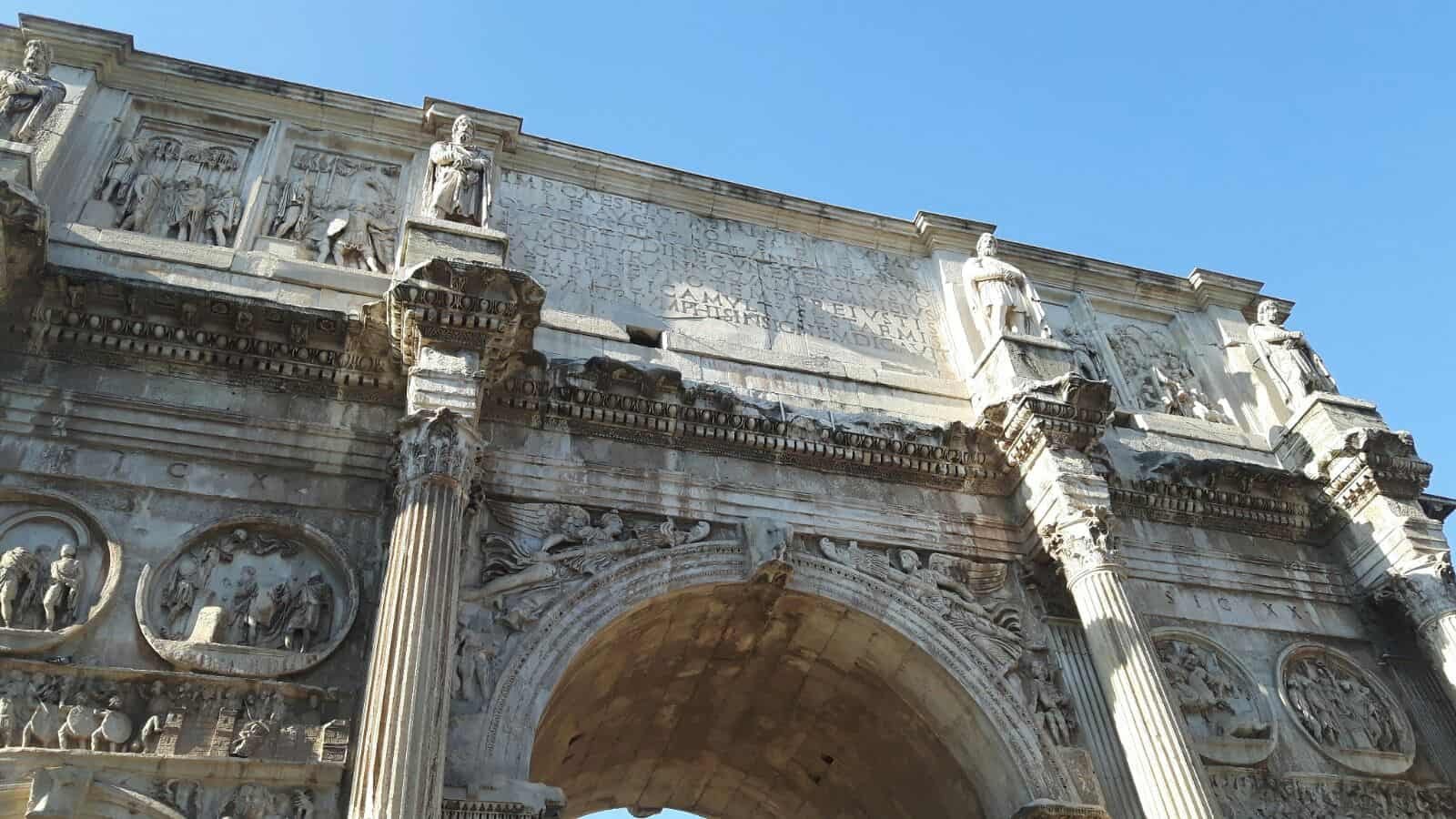
| (LA)«IMP(eratori) · CAES(ari) · FL(avio) · CONSTANTINO · MAXIMO · P(io) · F(elici) · AVGUSTO · S(enatus) · P(opulus) · Q(ue) · R(omanus) · QVOD · INSTINCTV · DIVINITATIS · MENTIS · MAGNITVDINE · CVM · EXERCITV · SVO · TAM · DE · TYRANNO · QVAM · DE · OMNI · EIVS · FACTIONE · VNO · TEMPORE · IVSTIS · REM-PUBLICAM · VLTVS · EST · ARMIS · ARCVM · TRIVMPHIS · INSIGNEM · DICAVIT ·» | (IT)«To the emperor Caesar Flavius Constantine Maximus Pius Felix Augustus, the Senate and the Roman people, because, through divine inspiration and the greatness of his spirit, he avenged the state in one single moment with his army, through a just war, both against the tyrant and against all his faction, dedicated this arch, distinguished by triumphs.» |
| (CIL VI, 1139 = ILS 694) | |
The letters were originally gilded bronze, set into the holes that can still be seen. Today one can only see the groove. The word «tiranno» refers to Maxentius, who is never named: the damnatio of his name was as much a political weapon as the sword. Other inscriptions are found on the inner walls of the central passageway, LIBERATORI · VRBIS and FVNDATORI · QVIETIS, «to the liberator of the city» and «to the founder of tranquility», and above the side passageways: on the north facade VOTIS · X · VOTIS · XX, on the south facade SIC · X · SIC · XX. These last ones refer to the celebration of the decennalia and the wish for the vicennalia, the festivities for 10 and 20 years of reign: in practice, a wish carved in marble, «so for 10, so for 20».
The decorative scheme of the Arch of Constantine, level by level
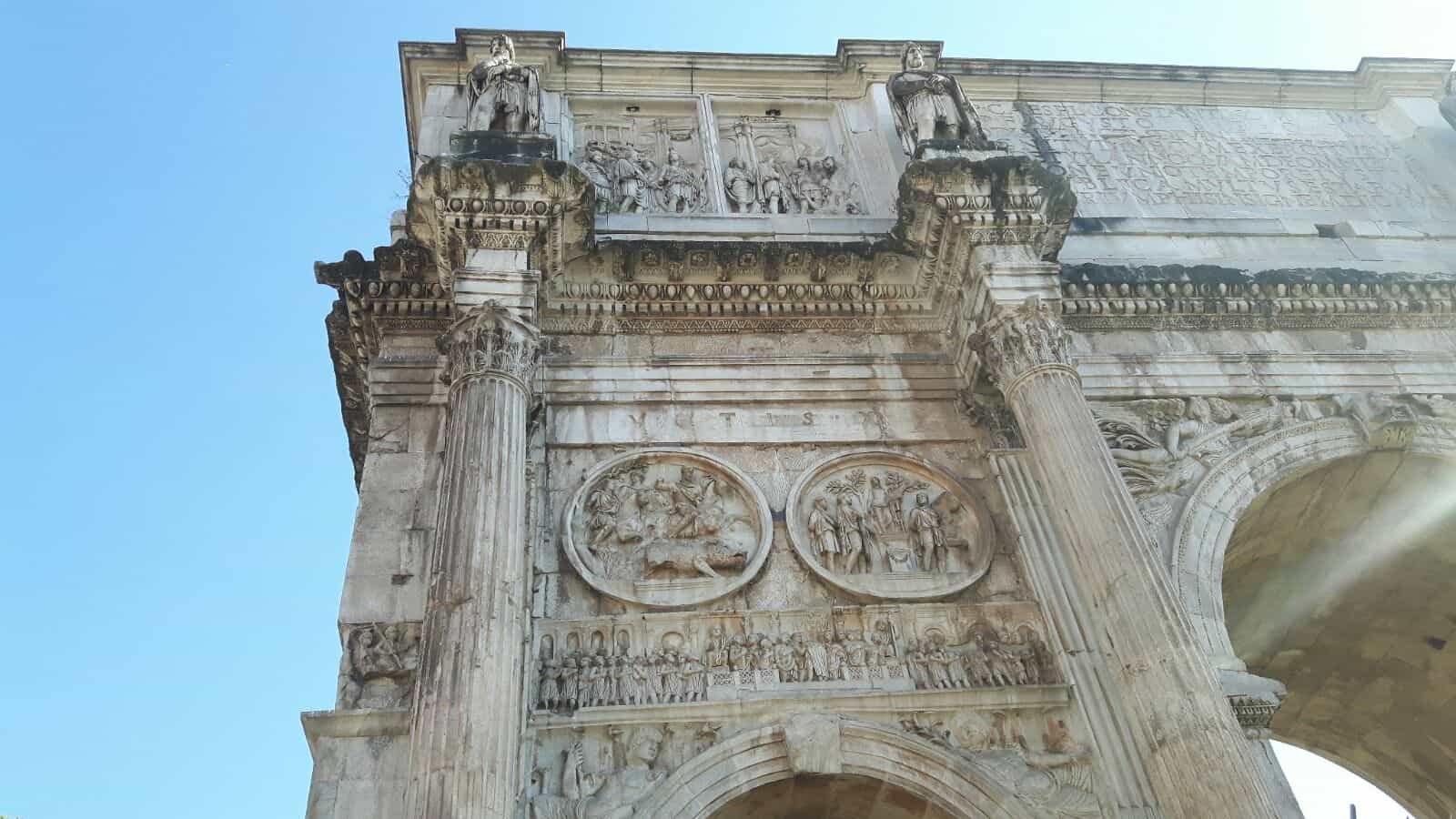
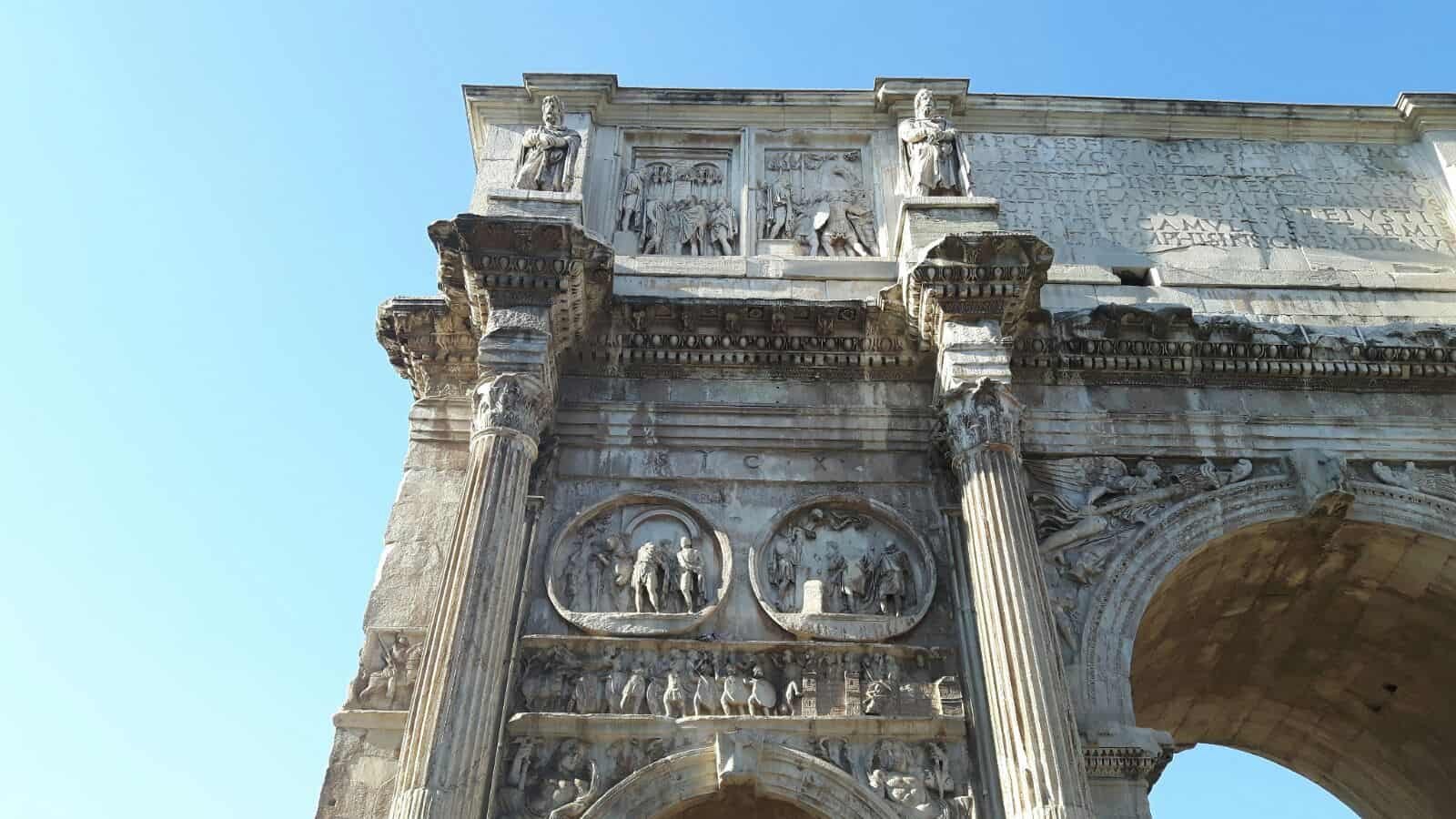
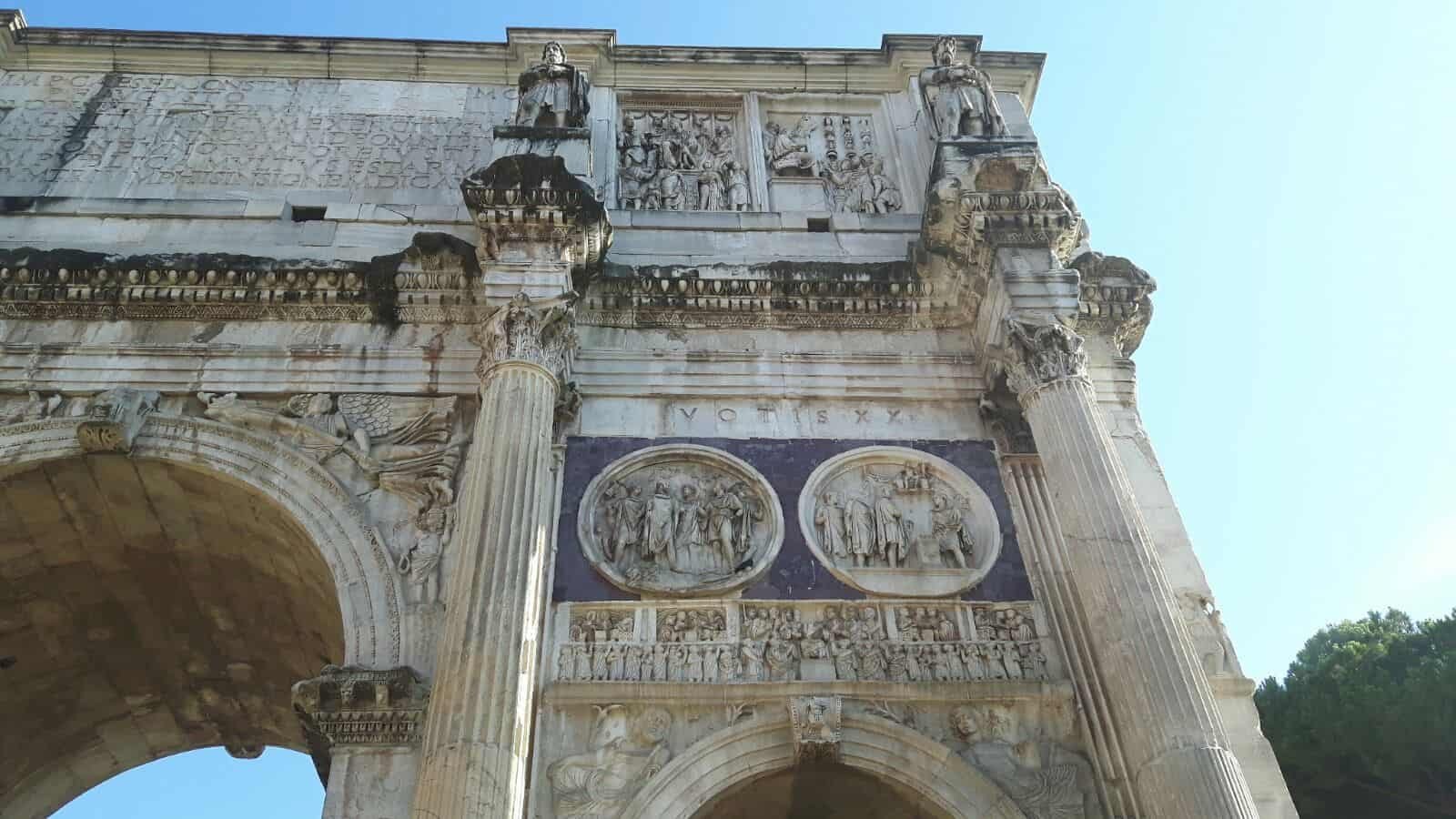
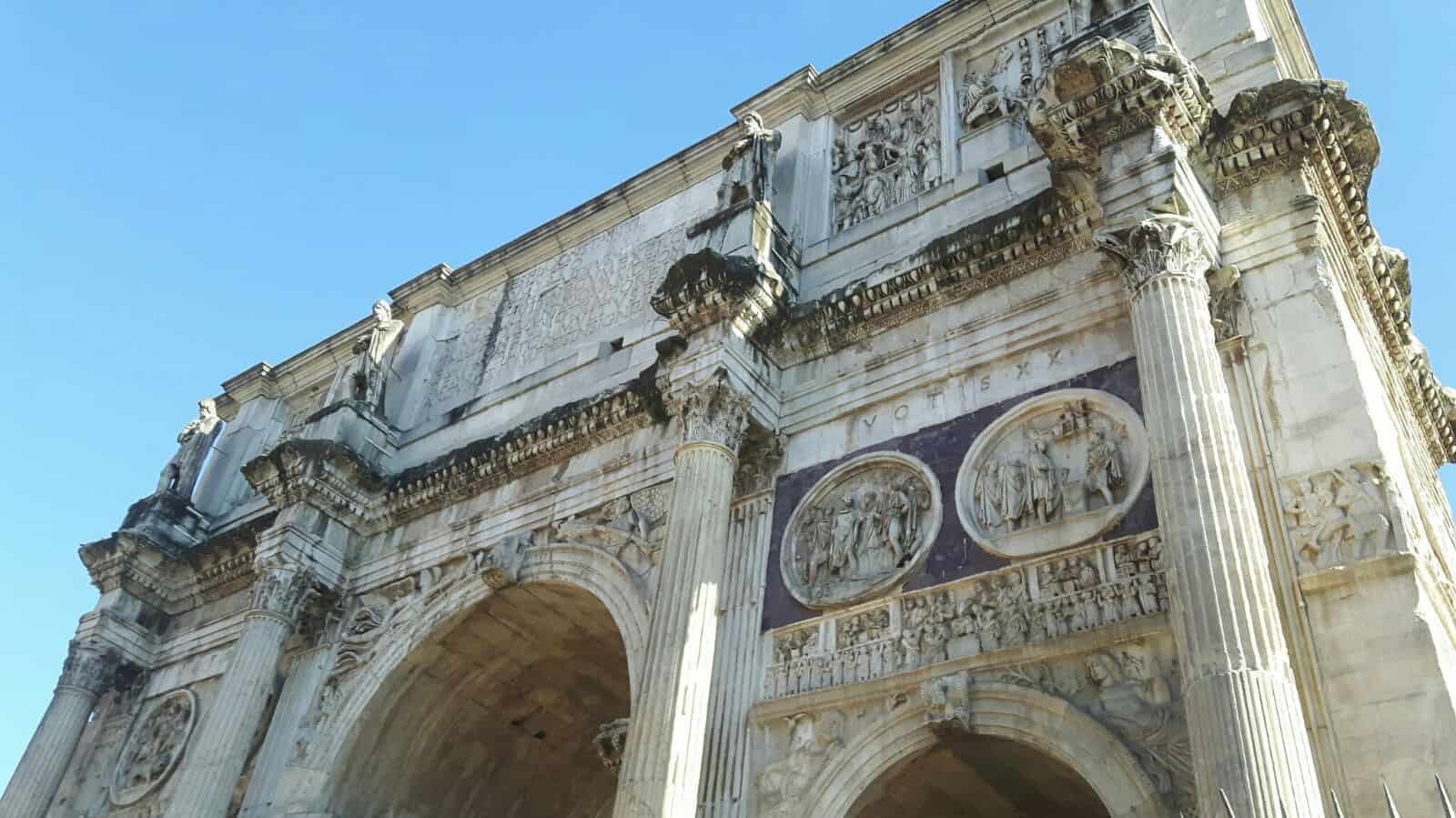
Before going into the details, it's worth fixing the map, because the Arch of Constantine is read from top to bottom and by period. At the top, the attic, in the center of the major sides, the broad inscription appears, flanked by pairs of rectangular reliefs from the age of Marcus Aurelius. On the minor sides of the attic, slabs of a Trajanic frieze are set into the walls, and other slabs of it are found in the passage of the major passageway. Above the columns, on the attic, stand the freestanding statues of Dacian prisoners in pavonazzetto marble, also Trajanic. At the lower level, on the main sides, above the two minor passageways, are placed pairs of roundels from the Hadrianic era, once framed by slabs of red porphyry. On the minor sides, at the same height, the series of Hadrianic roundels is completed by two roundels made specifically in the Constantinian era. Below the roundels runs a long bas-relief frieze, carved on the blocks in the Constantinian age, which wraps around all four sides. Other Constantinian bas-reliefs are found above the arches (Victories and Rivers) and on the plinths of the columns.
Why the Arch of Constantine reuses the reliefs of other emperors
The reused reliefs recall the figures of the "good emperors" of the 2nd century, Trajan, Hadrian and Marcus Aurelius, and for propaganda purposes the figure of Constantine was assimilated to them. The use of salvaged material from ancient monuments, which became customary precisely from these years, was dictated, at least in the choice of what to place on the Arch of Constantine, by symbolic values more than practical ones. Quotations from the most beloved emperors were taken, and their heads were reworked to look like Constantine, who presented himself as their direct heir. In carving the new heads, now largely replaced by 18th-century restorations, with some gaps in the Aurelian panels, some were fitted with the nimbus, the luminous disc that is the ancestor of the halo, as surviving traces show. It was the symbol of imperial maiestas, and only later would it become a sign of Christian sanctity. It is possible that in the four Hadrianic roundels with sacrifice scenes, the heads also depicted Licinius, Constantine's colleague, or Constantius Chlorus, his father.
The reliefs are arranged, together with those made specifically for the arch, symmetrically on the two facades (north and south) and on the two short sides (east and west). As is typical of Roman arches decorated with reliefs, on the outer facade, facing south toward those entering the city, scenes of war prevail. On the inner facade, facing north toward the city, scenes of peace prevail. It is a precise grammar. If you have only 10 minutes, look at the south side for the army and the north side for good government.
The Great Trajanic Frieze on the Arch of Constantine
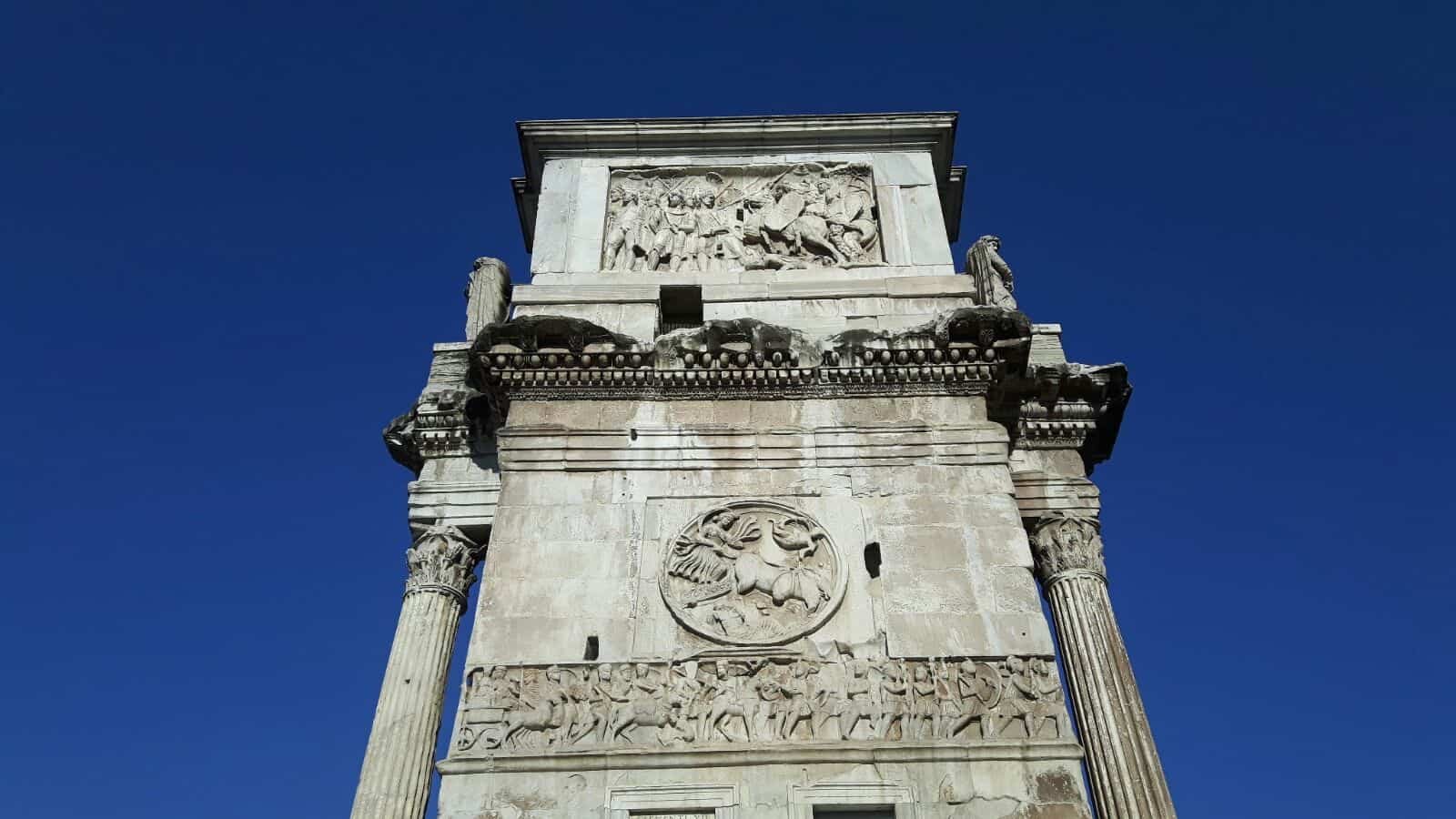
A total of eight slabs from a single large frieze about three meters high, with battle scenes, in Pentelic marble, that is, Greek, from the quarries of Attica, are reused on the Arch of Constantine. Pairs of adjacent slabs make up the four relief panels placed on the side walls of the central passageway and on the short sides of the attic. The frieze depicted the deeds of Trajan in the campaigns of conquest of Dacia (102-107) and probably came from the Forum of Trajan, perhaps from the Basilica Ulpia or from a building in the complex. It must have been completed by other slabs, partly lost and partly identified in fragments preserved in the Louvre, the Antiquarium Forense and the Galleria Borghese. The reconstruction of its overall length and the identification of its original location are still debated. The emperor's heads on the reused slabs were all reworked as portraits of Constantine. Casts of the slabs are reassembled in their unity at the Museo della Civiltà Romana, in EUR, which I recommend to anyone who wants to see the whole story at eye level.
The Scenes of the Trajanic Frieze on the Arch of Constantine
In the matching parts on the Arch of Constantine, the frieze shows, from right to left, the conquest of a Dacian village by Roman cavalry and infantry, who drive the prisoners ahead. In the background, soldiers in front of the village huts display the severed heads of the barbarians. The prisoners are pressed from the other side by a cavalry charge led by the emperor himself, followed by the standard-bearers and the horn players. Finally, Trajan is seen entering Rome, crowned by a Victory and led toward the city by the personification of Virtus in Amazon dress. The panel that is most legible for a visitor is the one on the inner wall of the central passageway, because it is at the right height and in shade. Take the time to count the severed heads, a detail that official Roman art did not hide at all.
The Style of the Trajanic Frieze and the Comparison with the Column
The historical frieze, where the Dacians are clearly recognizable in their costumes, with their caps and long tunics, has been compared with the reliefs of Trajan's Column, to the point of suggesting that the same master worked on both. Here, however, the intent to faithfully reconstruct events and their chronological sequence is missing, even though some scenes resemble each other: scene 51 of the Column, in which Trajan receives the heads of two Dacian chiefs, and the cavalry charge scenes. If it is the same hand, at least in the drawings and the concept, we are still facing two different contents, narrative-chronicle on the Column and celebratory-symbolic on the frieze, expressed in different languages, despite unmistakable common traits such as the outline groove around the figures, some compositional schemes, and the portrayal of defeated barbarians as worthy opponents. The presence of the adventus scene, the return, which is absent from the Column, forms a kind of continuation of the story of Trajan's deeds. The style is "baroque-like": a crowded and complex composition, rich chiaroscuro, and a remarkable sense of space given by elements that are not set against a flat background but float at different depths, heads, trees, spears. For anyone who knows the Column, seeing the comparison in person is a free lesson in art history.
The Dacians of the Arch of Constantine
Also from Trajan's Forum come the eight statues of Dacian prisoners in pavonazzetto marble, a white marble veined with violet and quarried in Phrygia, set on bases of cipollino marble on the attic, aligned with the columns. At a height of 20 meters, they look down with composed dignity, their hands crossed in front of them, and they are the visible proof that Constantine wanted Trajan at his side: in Trajan's Forum these figures decorated the attic of the porticoes, and anyone in Rome in 315 knew it. The heads and hands of the sculptures, and one of the figures entirely in white marble, are due to the eighteenth-century restoration by Pietro Bracci. Look at that all-white figure: it is the easiest to spot, and it's a good exercise in understanding how free an eighteenth-century restoration could be.
The Hadrianic Roundels of the Arch of Constantine
Eight circular reliefs from the age of Hadrian, over two meters high, are set above the side archways on both facades of the Arch of Constantine, placed two by two in a rectangular field that was originally covered with porphyry slabs, the red stone of Egypt reserved for emperors: imagine the white roundels on a dark red background, and you'll understand the intended effect. The dating to the Hadrianic period rests on stylistic factors, on the choice of scenes and above all on the presence, at least three times, of the well-known figure of Antinous, the young man loved by Hadrian, who died in the Nile in 130 and was deified. The date of the work is fixed between 130 and 138, the year of the emperor's death.
The Scenes of the Hadrianic Roundels
The roundels alternately depict hunting scenes (departure for the hunt, bear, boar and lion hunts) and scenes of sacrifice to pagan deities, each linked to one of the hunts: Silvanus, Diana, Apollo, Hercules. Here too the emperor's heads were reworked: on the roundels of the south facade as portraits of Constantine in the sacrifice scenes and of Licinius or Constantius Chlorus in the hunting scenes, and vice versa on the north facade. A nimbus was added to Constantine's effigies, which by then belonged to imperial majesty. Two or three figures flank the emperor, on horseback in two of the hunting reliefs and on foot in the others. The compositions are carefully arranged around the imperial figure and the backgrounds are essential, following the conventions of Hellenistic art: tree foliage, an arch symbolizing the departure. The execution is very fine, as shown by the drapery, the heads and the attention to detail. Completely absent is the emphasis and narrative engagement of the Trajanic frieze, here resolved in restrained composure. The hunting theme, which Hadrian himself revived, is connected to the heroic exaltation of the ruler following a scheme that goes back to Alexander the Great and is typical of ancient Eastern civilizations. The reason for the presence of the four rural sacrifices remains more uncertain. For me the roundels are the most beautiful part of the Arch of Constantine, and also the most underrated: people photograph the statues of the Dacians and ignore eight masterpieces of classical sculpture within sight.
Where the Roundels of the Arch of Constantine Come From
The origin of the roundels is debated. The most widely accepted hypothesis is a monument dedicated to Antinous located on the Palatine. Less likely is an origin from the Temple of the Divine Trajan or from an arch at the entrance to that temple, because hunting scenes would be incompatible with a posthumous monument. There is also the hypothesis, mentioned above, that the roundels were originally on the arch itself, Hadrianic in the first construction and reassembled and redecorated in Constantine's time. However, the reworking of the frames for insertion in the new position seems to contradict it. Anyone who wants to see other Hadrianic sculpture of this level has only one choice: Hadrian's Villa in Tivoli, where the same cultured hand produced an entire world.
The Marcus Aurelius Panels on the Arch of Constantine
On the attic, on either side of the inscription, eight rectangular reliefs more than 3 meters high are set into the wall. They depict episodes from the campaigns of Marcus Aurelius against the Quadi and the Marcomanni, the Germanic peoples of the Danube who were definitively defeated in 175. The emperor's heads were also reworked here, probably as portraits of Constantine and Licinius. The heads visible today, however, are from the eighteenth-century restoration and depict Trajan, because at the time the reliefs were attributed to that emperor. Three other reliefs, similar in size but with some stylistic differences, may also be part of the same series. They are now displayed at the Palazzo dei Conservatori on the Capitoline Hill. In any case, the same subject of the campaigns and the constant presence, behind the emperor, of a figure identified as Tiberius Claudius Pompeianus, son-in-law and for a certain period successor in pectore of Marcus Aurelius, point to a common origin for all the reliefs.
South Facade of the Arch of Constantine: The Four War Panels
On the south facade, from left to right, the current order of the panels follows the reconstruction of the Marcomannic Wars.
- Rex datus, the presentation to the emperor of a submissive barbarian chief. Marcus Aurelius, accompanied by Pompeianus, presents the barbarian group with the new tributary king who has submitted to him, perhaps Furzius. In the background is a building of the camp, and behind the barbarians are aquiliferi with the standards.
- Captivi, the prisoners brought before the emperor. Marcus Aurelius and Pompeianus, on a low tribunal in the presence of soldiers with vexilla, judge a barbarian prince with thick, raven-black hair, who is pushed toward them with his hands tied behind his back. In the background is a tree. The curious detail is that the soldiers escorting the prisoners appear, judging by the symbols on their shields, to belong to legio I Adiutrix, stationed at Brigetio in the time of Marcus Aurelius, or to legio II Adiutrix, stationed at Aquincum, today's Budapest. The prisoner would therefore be a chief of the Quadi, perhaps Ariogaesus, the people who faced precisely that stretch of the Danubian limes between the two legionary fortresses.
- Adlocutio, the address to the soldiers. The emperor speaks to the troops from the suggestum, the raised platform. Behind him is Pompeianus.
- Lustratio, the sacrifice in the camp. Marcus Aurelius, in the sacrificial toga with his head veiled, celebrates the suovetaurilia, the sacrifice of a pig, a sheep and a bull, at a portable altar. He is assisted by a camillus and surrounded by soldiers, signiferi and tubicines. Behind him, between two aquiliferi, is Pompeianus once again.
North Facade of the Arch of Constantine: The Four Peace Panels
- Adventus, the emperor's arrival in Rome. Marcus Aurelius, over whose head a Victory flies with a wreath, is flanked by Mars and Virtus, who invite him to enter through the Porta Triumphalis. In the background are the deities of the temples near the gate, in the sacred area of Sant'Omobono at the foot of the Capitoline Hill: Mater Matuta and Fortuna Redux, with the Temple of Fortuna on the left.
- Profectio, the departure from Rome. The emperor in traveling dress stands between the Genius Senatus and the Genius Populi Romani on the left, and a group of soldiers with vexilla is on the right. Below, the reclining figure is the personification of a road inviting the emperor. In the background the Porta Triumphalis can be made out. Beyond the profile of the restored head of Marcus Aurelius, the face of Pompeianus is visible.
- Liberalitas, the distribution of money to the people. The emperor in a toga sits on the sella curulis, on a very high podium. There are also an attendant on the left who hands out the materials of the congiarium, and a togate man whose facial features are well characterized, perhaps the urban prefect Lucius Sergius Paulus. Behind them, two figures stand on a step: the one on the right is Pompeianus, and the other is perhaps Claudius Severus, also a son-in-law of Marcus Aurelius and a consul. In the background is a colonnade, perhaps the Basilica Ulpia. Below are the figures of the people, including some children, among whom the man seen from behind looking up and the father with his son sitting on his shoulders stand out for their compositional originality. It is the panel that visiting children love most, and I understand why.
- Submissio o Clementia, the submission of a barbarian chief. The emperor, with Pompeianus behind him, stands on a high podium in front of soldiers and aquiliferi with the signa. With a gesture of clemency, he pardons a barbarian prince who protects his young son with an arm on his shoulder.
Where the Aurelian Panels of the Arch of Constantine Come From
The 12 original reliefs, eight here and three on the Capitoline plus one lost, perhaps came from a triumphal arch dedicated to Marcus Aurelius, now vanished. Alternatively, they were linked to the celebratory complex erected in honor of the emperor by his son Commodus in Campo Marzio. Today only the Column of Antoninus remains there, in Piazza Colonna. The famous bronze equestrian statue of Marcus Aurelius perhaps also belonged to that complex. Paul III placed it in the center of Piazza del Campidoglio in 1538, and today it is sheltered in the Capitoline Museums. The order of the panels in the original monument was different from today's. On the Arch of Constantine, the reliefs were not arranged in narrative order. They were arranged according to the division of the two facades by theme, war on the south and peace on the north, also seeking overall effects, such as placing the departure (Profectio) next to the arrival (Adventus), which thus present a continuous background of buildings.
The Master of the Exploits of Marcus Aurelius
The panels, attributed to the so-called Master of the Exploits of Marcus Aurelius, are among the most significant works of the artistic turning point of Commodus's era. The space is designed to work with the viewer's point of view, and the elements of the relief are arranged as if air really circulated between them, as in the banners hanging in front of the architecture in the background. This spatial approach was unknown to the Greek world, and Rome had already tried it in the reliefs of the Arch of Titus, though less consistently. The anonymous artist mastered the Hellenistic technique and never strayed from its furrow, but he bent it to formal values that were typically Roman. His reliefs also show pity and involvement for the condition of the defeated, as on Trajan's Column. A fine example is the group in the relief with the barbarian leader, suppliant and sick, supported by a young man. The scenes are honorary, not triumphal, because the Senate did not grant the emperor a triumph on his return from the campaigns of 171-172. From the analysis of the subjects, the reliefs can be dated to 173, and they go as far as describing future events, imagined by the senators, such as the Liberalitas, which in fact did not take place in that form.
The Eighteenth-Century Restoration of the Aurelian Panels
The eight heads of the emperor and other missing heads of secondary figures are restorations. Pietro Bracci made them in the eighteenth century, during the papacy of Clement XII Corsini, according to the most widely accepted reconstruction, in 1732-1733. Bracci, the sculptor of the Trevi Fountain, also remade the heads and arms of the Dacians. A word of caution: many guides tell visitors, "look at the face of Marcus Aurelius," but the faces you see today on the attic of the Arch of Constantine are eighteenth-century portraits of Trajan. The real Marcus Aurelius, with his philosophical beard, is found in the three panels on the Capitoline.
The Constantinian Roundels of the Arch of Constantine: the Sun and the Moon
On the short sides of the Arch of Constantine, the cycle of roundels is completed by two circular reliefs carved specifically in Constantine's era. On the east side, Sun-Apollo on the quadriga rises from the sea. On the west side, Moon-Diana drives a biga that dips into the Ocean. The two reliefs frame the emperor's victory in a cosmic dimension. The Sun in the east and the Moon in the west mark the beginning and the end of the day, and between the two, in the middle, runs the story of the war. The Sol Invictus was the dynastic deity dear to Constantine before the Christian turn, and the choice to place him on the side where the real sun rises is no minor coincidence. Stylistically, the two roundels are of lower quality than the Hadrianic ones, and the close comparison with the eight ancient roundels a few meters away is merciless. Look at them in sequence and you'll understand in a minute what had changed in two centuries.
The Constantinian Frieze of the Arch of Constantine
Above the side passageways and below the Hadrianic roundels runs a continuous frieze, just under a meter high, which also continues on the short sides of the monument with the connection of corner elements. It was carved directly onto the blocks of the masonry during Constantine's era, slightly projecting. It is one of the most significant works of Constantinian art because it clearly shows a series of elements that broke with the classical tradition. The story concerns the war against Maxentius and the celebration of the victory in Rome. It begins on the western short side and continues around the Arch of Constantine counterclockwise, ending at the northwest corner. Anyone who wants to follow it must walk around the arch in that direction: starting from the side facing the Palatine, then the south side toward Via di San Gregorio, then the east side toward the Colosseum, and finally the north side.
Departure from Milan (Profectio), West Side
Below the roundel with the Luna-Diana, Constantine sits on a chariot with a cathedra and is preceded by foot and mounted troops. The equipment identifies the regular legionaries and the auxiliaries, with horned helmets, and the dromedarii, soldiers mounted on camels. Some soldiers carry statuettes of Sol Invictus and Victoria in their hands. Milan was the imperial residence from which Constantine set out in the spring of 312. The frieze begins there.
Siege of Verona (Obsidio), south side
Constantine appears on the left between two protectores divini lateris, the bodyguards, while a flying Victory crowns him. In the center is the group of besieging soldiers, legionaries, horned soldiers, and Moorish archers. On the right are the city walls, drawn smaller, above which the besieged appear, made up of praetorian troops, some ready to hurl stones at the attackers. A soldier of Constantine moves along beneath the walls, watched by the enemy, and another falls headfirst from the fortifications. The cities are drawn on a reduced scale compared with the figures. It's not incompetence, it's hierarchy.
Battle of Ponte Milvio (Proelium), south side
On the far left is the Ponte Milvio with a personification of the Tiber leaning out, while Constantine's soldiers pass between Virtus and Victory. Following them are the slaughter and drowning of Maxentius's cataphracts, the heavily armored heavy cavalry, at the hands of Constantine's cavalry. On the far right, trumpeters of the victorious army call the troops back. Maxentius drowned in the Tiber that day, and the frieze does not show it. The defeated are a mass that sinks.
Arrival in Rome (Ingressus), east side
The scene pairs with the departure on the opposite side and shows the emperor's entry into the Urbe, which took place on October 29, 312, the day after the battle. The emperor on the chariot is on the left and advances toward the city gate, preceded by horsemen wearing the Pannonian cap, infantry with weapons or standards, and cornicines, that is, the palatine and legionary troops, the horned soldiers, and the Moorish archers.
Speech from the Rostra in the Roman Forum (Oratio), north side
The scene takes place in the Roman Forum. In the background, the Basilica Julia, the Arch of Tiberius, the Rostra with the imperial platform, the Decennalia monument of the Tetrarchs, and the Arch of Septimius Severus are probably recognizable. The emperor, missing his upper part, sits in the center, rigidly frontal and enlarged hierarchically. The crowd and the sides of the Forum are composed in reversed perspective. On either side of the platform are statues of Hadrian, on the right, and Marcus Aurelius, on the left: the good emperors, once again, as guarantors. This is the panel to study the longest of all, and it is easy to see from the Colosseum side.
Distribution of Money to the People (Congiarium or Liberalitas), north side
The episode took place on January 1, 313, and even five modules of hierarchical proportion were used to depict it. On the first level, the emperor, seated in the center on the throne in a rigidly frontal pose, towers over everyone. On the second, the members of the entourage on the same loggia, who are in turn larger than the officials in the side loggias, form the third level. On the fourth, figures in toga contabulata, low down near the emperor, are either suppliants or intent on receiving the gift from the emperor's hands with veiled hands. On the fifth, in the lower band, is the anonymous mass of recipients, caught with a raised hand to receive, and shown in a reversed perspective that turns around figures who should be turning their backs. In the raised loggias with curtains, perhaps the Porticus Minucia or the Forum of Caesar, officials are seen recording the largesse and taking money from the chests. It is a scene of imperial accounting carved in marble. No other Roman monument shows so well how the state's generosity worked.
The Style of the Constantinian Frieze: The Birth of Late Antique Art
The Constantinian frieze, to be read as a continuous narrative marked by the individual episodes, continues the Roman tradition of historical relief, yet it departs from it sharply in style, marking the abandonment of the naturalism of Hellenistic origin in favor of a more markedly symbolic character. The figures are stocky, with heads slightly out of proportion to the bodies. The scenes are massed and crowded, and they show a loss of interest in the isolated individual figure, typical of Greek vision. Compared with tradition, the use of the drill grows, creating deeper cuts and therefore darker shadows in sharp contrast with the lit areas. The contour line is favored over real volumetric substance, and the faces with large, staring eyes are marked by a pronounced expressionism.
In the Oratio scene, the emperor sits in the center, raised on the rostrum, the only figure facing front apart from the two statues of his predecessors. He takes on a sacred significance, like a god showing himself to the faithful, isolated in his own transcendent dimension, emphasized by the figure's slightly larger size. It is one of the very first cases in Rome of proportions organized by hierarchy, a feature that will become typical of Early Christian and medieval art: the size of the figures no longer depends on their position in space but on their importance. Another notable element is the loss of spatial relationships. The background shows the monuments of the Roman Forum as they were visible at the time, but their placement is not realistic with respect to the place where the scene happens, the Rostra. Indeed, they are aligned and parallel to the surface of the relief. Even more unusual is the "reversed perspective" of the two side groups of commoners, who should be standing in front of the rostrum but are instead rotated and squeezed to either side.
These are all features of Late Antique art, which anticipates medieval art and in turn had been partly anticipated by the "plebeian" and "provincial" current that intertwines with official art throughout the evolution of Roman art. In this period, that art form reaches Rome because the ruling class itself, landowners, wealthy merchants, officers and the emperors themselves, come from the provinces. The departure from Greek naturalistic research, on the other hand, led to a more immediate reading and easier interpretation of images. For a long time, this production was seen as a clear example of decline. Broader studies have shown that these tendencies were not new, but had already been present for centuries in the provincial territories. Their emergence in official art was the reverse of a process of artistic radiation from the center to the periphery, with the inevitable return of tendencies from the peripheries to the center, as has happened in other eras. A clear-cut opinion: anyone who dismisses the Constantinian frieze as "ugly" has not understood what they are looking at. It is the first chapter of European medieval art, carved beside the last chapter of classical art, on the same wall.
The other Constantinian sculptures of the Arch of Constantine
Other sculptural decorations made in the Constantinian era complete the Arch of Constantine, and they are the ones the visitor has closest to their eyes.
- The reliefs on the plinths of the columns, paired symmetrically: on the front, Victories writing on shields or holding palm branches, and trophies with eastern and northern barbarian prisoners. On the sides of the lateral archways, northern and eastern prisoners alone or with Roman soldiers. On the sides of the central archway, soldiers with signa, or else Sol Invictus and Victoria.
- The eight busts on slabs set into the masonry of the side passages, not all of them preserved, with imperial portraits and figures of deities.
- The winged Victories with trophies and the Genii of the Seasons in the spandrels, the triangular spaces left over above the central archway.
- The personifications of rivers in the spandrels of the side archways.
- The keystone sculptures with deities: on the side archways, Mars, Mercury and the Genius populi Romani. On the central archway, Roma and the Quies Rei Publicae, the Quiet of the State, which echoes the "fundatori quietis" of the inscription inside.
The Constantinian allegorical figures are in the classicist style of the revival of the figurative tradition wanted by Constantine, but their content has been emptied out. The form shows weariness, as had already happened in the base of the Decennalia of Diocletian in the Forum. The volume is flattened, and the rendering easily slides into the drawn and calligraphic, as in the drapery of the Victories. Compared with the historical frieze, animated by the lively stereometry of the Tetrarchic age, a different style can be noticed. Overall, however, all the Constantinian reliefs seem to have come out of the same urban workshop. From that workshop must also have come the craftsmen engaged in decorating the basilica of Maxentius and some pagan and Christian sarcophagi, such as the Sarcofago dogmatico in the Vatican Museums, throughout the first 30 years of the 4th century. Look at the plinths of the columns on the south side in mid-morning, with raking light: the barbarian prisoners wearing trousers and Phrygian caps are a meter and a half off the ground, and nobody looks at them.
The Arch of Constantine from the Middle Ages to today
The Arch of Constantine was never fully buried and never forgotten: it has reached us standing because in the Middle Ages it was absorbed into the fortifications of the Frangipane family, who controlled the whole area from the Colosseum to the Palatine, and an arch turned into a tower is not demolished. With the Renaissance it became a model again: architects measured it, painters drew it, popes restored it. In 1536 Paul III Farnese had Charles V's triumphal procession, returning from the victory at Tunis, pass under its arches, and to open the road for the procession, medieval houses and churches between the arch and the Capitoline were demolished, under the direction of the antiquities commissioner Latino Giovenale Manetti. In the 18th century came the restorations of Clement XII and Pietro Bracci. In the 19th century the area was cleared of buildings and excavated down to the ancient level, so that today the arch stands on a square lower than the modern street. The straight stretch of via di San Gregorio, opened in the 1930s as via dei Trionfi, turned it into the scenic backdrop that everyone photographs. Between 2021 and the following years, the Colosseum Archaeological Park carried out cleaning and restoration campaigns on the surfaces, side by side, removing invasive vegetation and integrating the stucco fills with the colors of the marbles. On September 3, 2024, during a downpour, lightning struck the arch and brought down some fragments, all of which were recovered and secured by the Park. If you find scaffolding on one face, it's not a problem: walk around to the other side, the Arch of Constantine always has at least three sides to show.
A curiosity about the Arch of Constantine
In 1530 a young man from Italy's most powerful family, Lorenzino de' Medici, the future murderer of Duke Alessandro, was driven out of Rome for having cut off, just for fun, the heads of some reliefs on the Arch of Constantine, in a night of vandalism that scandalized the city and Pope Clement VII, who was a Medici himself. The act went down in the chronicles as the prank of a bored 20-year-old, but for the arch it was serious damage: the mutilated heads stayed that way for two centuries and were only partly restored in the 18th century, when Pietro Bracci remade the faces of the emperors and the minor figures. The most curious detail in front of the attic is that the restorer, not knowing the panels were from Marcus Aurelius, carved the heads with the features of Trajan. So the vandalism of a Medici and the scholarly mistake of a Corsini pope together produced the face we look at today. One more curiosity: when Charles V passed under the Arch of Constantine in 1536, six years after Lorenzino's prank, the monument still bore the wounds of that night. A witness to the procession, Zanobio Cessino, noted the emperor's astonished delight at the sight of his predecessor's monument, evidently paying no attention to the missing heads.
One thing nobody tells you about the Arch of Constantine
Inside the attic of the Arch of Constantine there is a room. The crown of the monument, which from outside looks like a solid block of marble, is actually a structure of masonry and concrete faced with marble slabs, and inside it runs an accessible space, reached by an internal staircase that starts from the pier. In antiquity it served maintenance workers and perhaps ceremonies. In the Middle Ages, when the arch was a Frangipane tower, that space became a useful lookout post. Today archaeologists and restorers use it, and the videos of the worksite published by the Colosseum Archaeological Park show exactly the climb up the scaffolding to that level. It isn't open to visitors, but knowing it exists changes the way you look at the arch: the eight statues of the Dacians don't sit on a solid block but on the roof of a room. Second thing almost nobody mentions: the Hadrianic roundels were originally set into a background of red porphyry, of which only traces of the slabs survive. The white on white we see today is a faded version of the original contrast, like looking at a color photograph printed in black and white. Third thing: the current order of the eight Aurelian panels is not the one they were conceived with, and the monument they were taken from has never been found. Anyone who tells you with certainty that "they came from the arch of Marcus Aurelius" is stating a hypothesis, authoritative but unproven.
The advice I give you for visiting the Arch of Constantine
Bring binoculars, even a small pair, and arrive before nine in the morning. The binoculars tip is worth more than any ticket: the important reliefs of the Arch of Constantine, the Aurelian panels and the Dacians are 20 meters up, and to the naked eye you see indistinct figures. With eight-power binoculars you can read the faces, the insignia and the symbols on the shields of the legio Adiutrix, and the arch becomes a book. Timing matters because the north facade, facing the Colosseum, is the most legible and gets the best light early in the morning and late in the afternoon, while the south facade, facing via di San Gregorio, is in full sun at midday and the reliefs flatten out. Also, at eight-30 the Colosseum square is almost empty. By 11 it's an anthill of groups and vendors. Walk counterclockwise starting from the west side, toward the Palatine, following the Constantinian frieze in the order it was conceived: departure from Milan, Verona, Ponte Milvio, entry into Rome, speech from the Rostra, distribution of money. It's a 40-minute route that no organized group takes, because groups look at the arch for three minutes from the Colosseum side and then move on. If you want a visit with a real guide, one who can tell the Hadrianic tondi from the Constantinian ones and the Trajanic frieze from the Aurelian, TourLeaderPro organizes private experiences in Rome for small groups with licensed guides, and for large groups it offers a professional tour escort service. Last tip, the most important: visit the Arch of Constantine before the Colosseum, not after. After two hours in the amphitheater, nobody has eyes left for a frieze.
Another well-known fact, yet rarely mentioned
Everyone knows the Arch of Constantine is made of pieces taken from other monuments. Few stop to consider what that means in terms of time. Between the Battle of Ponte Milvio, October 28, 312, and the dedication of the arch, July 25, 315, less than three years passed. A monument 21 meters tall, with hundreds of marble blocks, eight colossal statues and about 40 reliefs, was designed, assembled and inaugurated in 33 months. No ancient worksite, with the means of the time, could have carved that quantity of marble from scratch in so little time. Reuse was not only an ideological choice. It was also a scheduling necessity, because the decennalia fell in 315 and the arch had to be ready. The second well-known and rarely mentioned fact concerns the heads: on the entire Arch of Constantine there is not a single intact ancient head of Constantine. The heads reworked in the 4th century on the Trajanic, Hadrianic and Aurelian reliefs were in turn mutilated over the centuries, by medieval Vandals to Lorenzino de' Medici, and largely replaced in the 18th century. The authentic portrait of Constantine in Rome is seen elsewhere: in the colossal head in the courtyard of the Palazzo dei Conservatori, at the Capitoline Museums, a remnant of the statue that sat in the Basilica of Maxentius. The third fact: Rome's three triumphal arches are a few minutes' walk from one another, and the Arch of Constantine is the only one of the three that you can see without a ticket. You can find an English guide to this and the other monuments in the Forum on ItalyPlanner, Roman Forum.
The right photo to take of the Arch of Constantine
The classic photo of the Arch of Constantine is taken from the Colosseum square, from the north side, with the arch in the foreground and the Palatine behind. It's beautiful, but everyone takes it, and at midday it's backlit. The right shot is a different one: go up onto the terrace beside the Colosseum, on the via dei Fori Imperiali side, or stand on the raised sidewalk of via di San Gregorio, and frame the arch at three-quarters with the Colosseum behind. From there you see together the south facade, with the war scenes, and the east side with the Sun tondo, and the two massive structures, arch and amphitheater, overlap in the same image. The best time for this shot is late afternoon, an hour before sunset, when the low sun from the west lights the marble with a warm color and the reliefs cast shadow. Anyone with a telephoto lens, even just the phone's zoom, should aim at the Dacians on the attic against the sky. Eight dark figures in pavonazzetto on a blue background, lined up, make the most unusual photo you can bring home from the Arch of Constantine. At night the arch is lit, and the photo from the Colosseum side, with the amphitheater lit behind, is spectacular but hard to take without a tripod. A mistake I see everyone make: photographing the central passageway from below, vertically. You get a distorted doorway. Step back 30 meters.
Some important events that took place here in history
On July 25, 315, the Senate dedicated the Arch of Constantine during the emperor's decennalia, and Constantine himself, who had arrived in Rome for the occasion, passed under the fornices of the monument that bore his name. It was one of his last visits to the city, which he would soon abandon for the new capital on the Bosphorus. In the centuries that followed, with the transfer of the court and the invasions, the district emptied out and the arch became a fortress of the Frangipane family. On April 5, 1536, the procession of Charles V of Habsburg, emperor and king of Spain, returning from the conquest of Tunis, entered Rome from Via Appia and passed under the Arch of Constantine, then under the Arch of Titus and that of Septimius Severus. The route had been cleared by Paul III, who demolished medieval buildings to make way for it. It was the last triumph in the ancient style celebrated on this street. In 1732-1733, under Clement XII, Pietro Bracci restored the statues and the heads of the reliefs. On September 10, 1960, the Arch of Constantine was the finish line of the marathon at the Games of the XVII Olympiad. The race started from the steps of the Capitoline Hill, passed along Via Appia Antica, and ended on the straightaway of Via dei Trionfi, where temporary stands had been built for 12 thousand spectators. It was won barefoot by Ethiopian Abebe Bikila, with an Olympic record, and he was the first athlete from sub-Saharan Africa to win an Olympic gold medal. It was one of the most powerful images of the twentieth century: an Ethiopian soldier of the imperial guard winning beneath the monument of a Roman emperor, 25 years after the Italian invasion of Ethiopia. On September 3, 2024, lightning struck the arch during a violent storm, bringing down fragments that were promptly recovered. Among all these events, the most memorable remains Bikila. Anyone who wants to understand why should look at the photographs of that evening, with the arch lit by torches.
Who has passed through the Arch of Constantine
Everyone who mattered in Rome from the fourth century on has passed through this arch, in the literal sense, because the street that runs through it is Via dei Trionfi and then the main road between the Celian Hill and the Forum. Constantine in 315, for the dedication. The Frangipane family in the twelfth century, who lived in it as a tower. Lorenzino de' Medici in 1530, who mutilated it. Charles V in 1536, who passed through it in triumph with Pope Paul III waiting for him. Clement XII and Pietro Bracci, who restored it in the 1730s. Giovanni Battista Piranesi, who etched it several times in the eighteenth century for his Vedute di Roma, and with him generations of Grand Tour artists, for whom the Arch of Constantine beside the Colosseum was the Roman view par excellence. The canvases of Venetian and northern landscape painters of the eighteenth century, with the arch in the foreground, are in museums across half of Europe. The archaeologists and architects of the nineteenth century who freed it and measured it. Abebe Bikila, on September 10, 1960, who crossed the finish line barefoot under the arch. The archaeologists of the excavation campaigns of the 1990s, who went down into the foundations and reopened the question of the monument's age, and the restorers of the Archaeological Park who have cleaned it one side at a time since 2021. And every day, tens of thousands of visitors walk past it on their way to the Colosseum without looking up. If you've read this far, you won't be among them.
How to really visit the Arch of Constantine
The Arch of Constantine has no ticket office, opening hours or lines, and that is exactly why nobody really visits it. The route I recommend takes an hour. You start on the north side, from Piazza del Colosseo, reading from top to bottom: inscription, Aurelian panels of peace, Dacians, Hadrianic roundels with sacrifices and hunts, Constantinian frieze with the Oratio and the Liberalitas, Victories of the spandrels, plinths. Then the east side, facing the Colosseum, with the roundel of the Sun and the Ingressus. Then the south side, from the sidewalk of Via di San Gregorio, with the Aurelian war panels, the siege of Verona and the Milvian Bridge. Finally the west side, facing the Palatine, with the Moon and the Profectio. You walk through the central fornix on foot, and this is the moment to look at the inner walls: the two slabs of the Trajanic frieze and the inscriptions Liberatori Urbis and Fundatori Quietis. The side fornices retain the busts in their niches. With a guide who knows the arch, the visit becomes a lesson on the entire art of Rome. ItalyPlanner offers an English-language guida completa al Colosseo that explains how to combine the two visits, and TourLeaderPro can include the arch in a tour privato o aziendale di Roma antica.
The Arch of Constantine with children
The Arch of Constantine is one of the most child-friendly monuments in the whole Historic Center of Rome, and for a simple reason: you walk around it, you don't go inside, and it's full of figures that tell stories. For children aged six and up, I always suggest three games. The first: count the Dacians on the attic, eight of them, and find the one that's all white, redone in the 18th century. The second: on the Constantinian frieze on the south side, look for the soldier falling headfirst from the walls of Verona and the Tiber River looking out from the bridge. The third: on the Liberalitas panel, on the north side up high, spot the dad with the child on his shoulders using binoculars. Older kids get the lion hunt on the roundels and the story of the boy who cut off heads in 1530. It always works. The area is pedestrian-only and traffic-free, but the paving is irregular sampietrini, and strollers need to be carried with patience. There are no public restrooms right nearby. The closest ones are inside the Colosseum for ticket holders, and in the bars on Via dei Fori Imperiali and del Celio. For a full day with children, the best combination is the arch, the Colosseum from the outside, and then the Circus Maximus, where they can finally run around.
Accessibility of the Arch of Constantine
The Arch of Constantine is at the level of the pedestrian square, with no steps, and it can be reached by wheelchair from the Colosseo station on metro line B, which has an elevator, and from the bus stops on Piazza del Colosseo. The surface is sampietrini and, in some stretches, packed dirt, so the wheelchair will bump along but without any real obstacles. A full circuit of all four sides is possible, with the one caveat that the south side is bounded by a low fence and should be viewed from the sidewalk on Via di San Gregorio. Passing through the central passageway is allowed for pedestrians and wheelchairs. For blind and visually impaired visitors, the arch has no tactile models on site. Some exist in the city's museums. Night lighting makes the arch visible and photographable even after sunset, and the square is busy at all hours.
How Much the Arch of Constantine Costs and How to Save
The Arch of Constantine costs nothing. You can see it from outside, from every side, at any hour, without a ticket. The real savings are in what's around it. The ticket for the Parco Archeologico del Colosseo, which covers the Colosseum, Roman Forum and Palatine Hill, is bought on the Parco's official website, which also lists the authorized reseller, and it's worth booking ahead because the Colosseum's time slots sell out. Full price and discounts for European Union citizens aged 18 to 25 should be checked on the official website before your visit, because they change. On the first Sunday of the month, entry to state sites is free, with very long lines. That day, the arch, which is always free, is the only thing you can see without waiting. If you also want to see the three missing Aurelian panels and the colossal head of Constantine for free, you need to go to the Capitoline Museums, which are free for Rome residents on the first Sunday of the month. The full list of free museums in Rome is useful for planning a day at no cost. Be wary of anyone in the square selling "skip-the-line tickets for the Arch of Constantine." They don't exist, because there is no entrance.
What Is Around the Arch of Constantine Within a 10-Minute Radius
The Arch of Constantine is at the heart of the densest archaeological area in Europe. 100 meters away, the Colosseum. Right behind it, the Palatine entrance on Via di San Gregorio, with the Domus Augustana and the Orti Farnesiani. 5 minutes away, the Roman Forum with the Arch of Titus and the Basilica of Maxentius, where the colossal statue of Constantine sat. On the Oppian Hill, the Domus Aurea of Nero, which can only be visited by reservation. On the Celian Hill, 10 minutes on foot, the Case Romane del Celio beneath the Basilica of Saints John and Paul and, a little farther on, the Basilica of San Clemente with its three overlapping levels. Toward the Tiber, the Circus Maximus. If you want to understand where the Dacians came from and the Trajanic frieze, head up in 15 minutes to Trajan's Markets and the Column. If you want to see the three Aurelian panels left out of the arch and Constantine's head, go up to the Capitoline Hill. If you have only one day, the right order is: Arch of Constantine, Colosseum, Forum, Capitoline Hill. In that order, the arch is the premise. In reverse, it's an afterthought.
When to Visit the Arch of Constantine and When to Avoid It
The best hours are early morning, between 8:00 and 9:30, and the last hour before sunset, the worst are between 11:00 and 15:00, when the groups queuing for the Colosseum fill the square and the light is flat. The best months are April, May, October, and the first half of November, with clear air and marble that takes on color. In July and August the sun on the square, with no shade, is punishing, so plan to visit at 8:00 in the morning or after 19:00. On the first Sunday of the month and on days with events at the Colosseum, the square is extremely crowded. During large events, such as concerts or celebrations at the Circus Maximus, the area may be fenced off: the ordinances are posted on the City of Rome's website. In light rain, however, the Arch of Constantine is beautiful and empty, and the wet marble shows the veins of the Dacian pavonazzetto better than any sunny day would.
What to Eat Near the Arch of Constantine
Around the Arch of Constantine, the square's cafés depend on passing tourists, and the prices show it, so it's worth walking 10 minutes. The right direction is the Monti district, past Via dei Fori Imperiali, with its trattorias and bakeries, or the Celio, toward Via di San Giovanni in Laterano, where you can eat authentic Roman food without frills. Look for the city's classic dishes: pasta alla gricia and carbonara, puntarelle with anchovies when in season, from November to March, Roman-style artichokes in spring, coda alla vaccinara and tripe on Saturdays, and supplì eaten standing up as a snack. If you're short on time, you'll find pizza al taglio and supplì on the streets of Celio and Monti at honest prices. Bring a water bottle: the nasoni, the cast-iron public fountains, are common in the area, and the water is good and free, just like the arch.
Quick Questions About the Arch of Constantine
How much does it cost to visit the Arch of Constantine?
Nothing. The Arch of Constantine can be viewed for free from all four sides, at any hour, it has no ticket office or entrance. You only pay to enter the Colosseum, the Forum, and the Palatine.
Do you need a reservation for the Arch of Constantine?
No. Reservations are needed for the Colosseum and the Archaeological Park, not for the arch, which stands outside the fence.
How long does a visit to the Arch of Constantine take?
A quick look takes 10 minutes, a full reading of all four faces, with binoculars, takes 40 minutes to an hour.
Where exactly is the Arch of Constantine?
Between the Colosseum and the Palatine, on Via di San Gregorio at the corner with Piazza del Colosseo, in the Celio district, in Rome.
How do I get to the Arch of Constantine by public transit?
Metro Line B to the Colosseo stop. Buses 51, 75, 87, 117, and 118 to the Colosseo stop, and 75 and 81 to the San Gregorio and Celio Vibenna stops. Tram three to the Colosseo stop.
Can you go inside the Arch of Constantine?
You walk through the three arches on foot. The inner chamber of the attic, with the staircase in the piers, is not open to the public.
How tall is the Arch of Constantine?
21 meters with the attic. It is about 25.9 meters wide and 7.4 meters deep. The central archway is 11.45 meters tall and 6.50 meters wide.
When was the Arch of Constantine built?
Between 312 and 315. It was dedicated in 315, on the occasion of 10 years of Constantine's reign. The most widely accepted date is July 25.
Why does the Arch of Constantine have sculptures from different eras?
Because much of the decoration was taken from monuments of Trajan, Hadrian, and Marcus Aurelius, to link Constantine with the good emperors of the second century and to finish the work in less than three years.
Are the heads of Constantine on the arch original?
No. The ancient heads reworked in the fourth century were mutilated over the centuries and largely replaced in the 18th century by Pietro Bracci. The faces on the Aurelian panels depict Trajan.
What does instinctu divinitatis on the Arch of Constantine mean?
"By divine inspiration": a deliberately ambiguous phrase that names no god, and that scholars read as a sign of Constantine's religious caution in 315.
Is the Arch of Constantine wheelchair accessible?
Yes. The square is pedestrian-only and has no steps, with a surface of sampietrini cobblestones. The Colosseo metro station has an elevator.
Is the Arch of Constantine suitable for children?
Very much so: there are no lines or entry gates, and the reliefs are full of scenes to find, from lion hunts to soldiers falling from the walls of Verona.
Can you take photos at the Arch of Constantine?
Yes, freely, including with a tripod. Drones are not allowed, because central Rome is a no-fly zone without authorization. The best light is early in the morning on the north side and at sunset on the south side.
Where can you park for the Arch of Constantine?
The area is closed to private traffic. The nearest paid parking lots are on the streets of the Celio and toward Via Labicana. The metro is the right choice.
Is the Arch of Constantine free on the first Sunday of the month?
It is always free. On the first Sunday of the month, the Colosseum, Forum, and Palatine are free, but the lines are very long.
What is the difference between the Arch of Constantine and the Arch of Titus?
The Arch of Titus, in the Forum, is more than two centuries older, has a single archway and reliefs carved specifically for it, while the Arch of Constantine has three archways, is much larger, and reuses sculptures from three earlier emperors. To see the Arch of Titus, you need the Forum ticket.
Where can you see the pieces of the Arch of Constantine that aren't on the arch?
The three excluded Aurelian panels are at the Palazzo dei Conservatori on the Campidoglio, the casts of the reassembled Trajanic frieze are at the Museo della Civiltà Romana in the EUR, and fragments of the frieze are at the Louvre, the Antiquarium Forense and the Galleria Borghese.
Why did the 1960 marathon finish at the Arch of Constantine?
The organizers of the Rome Olympics wanted a monumental finish line on Via dei Trionfi, with grandstands for 12,000 people. Abebe Bikila won it barefoot on September 10, 1960.
Was the Arch of Constantine damaged by the lightning strike in 2024?
On September 3, 2024, lightning brought down some fragments, which were recovered and secured by the Colosseum Archaeological Park. The arch is open to visitors as usual.
The Arch of Constantine doesn't reward people in a hurry, it rewards people who look up. Do it first, before the Colosseum, with a pair of binoculars in your pocket and an hour to spare, and it will be the Rome monument you remember best.
Article written by the editorial team of TourLeaderPro, contact them for Tours and Private/Corporate/V.I.P. Experiences.
Planning a trip to Rome? English-language guides to visiting the city are on ItalyPlanner.com.