Basilica of Maxentius
In short. The Basilica of Maxentius sits on the northern flank of the Roman Forum, on the Velia ridge, and the address under which the Colosseum Archaeological Park lists it is Clivo di Venere Felice, 00186 Rome.
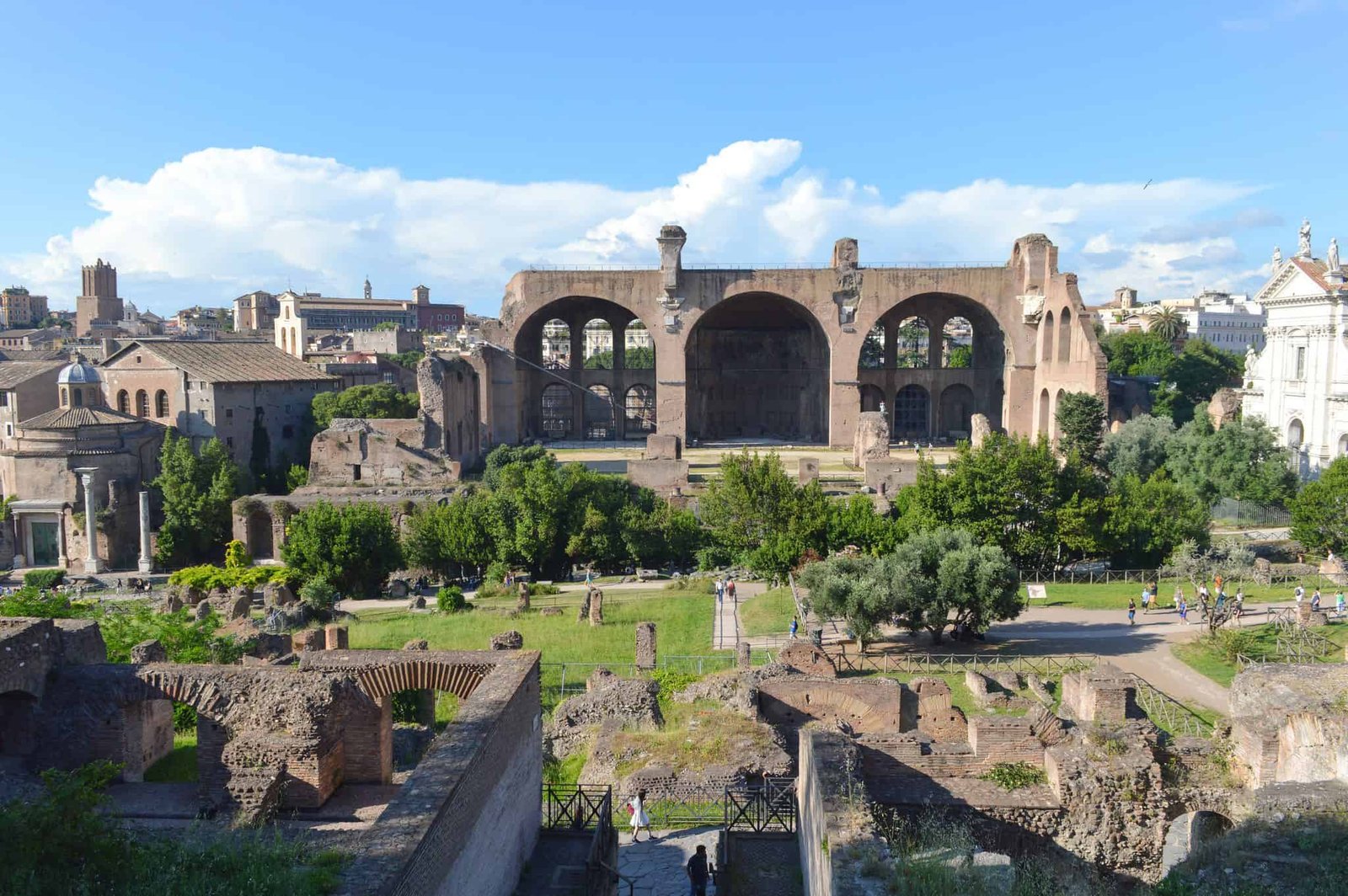
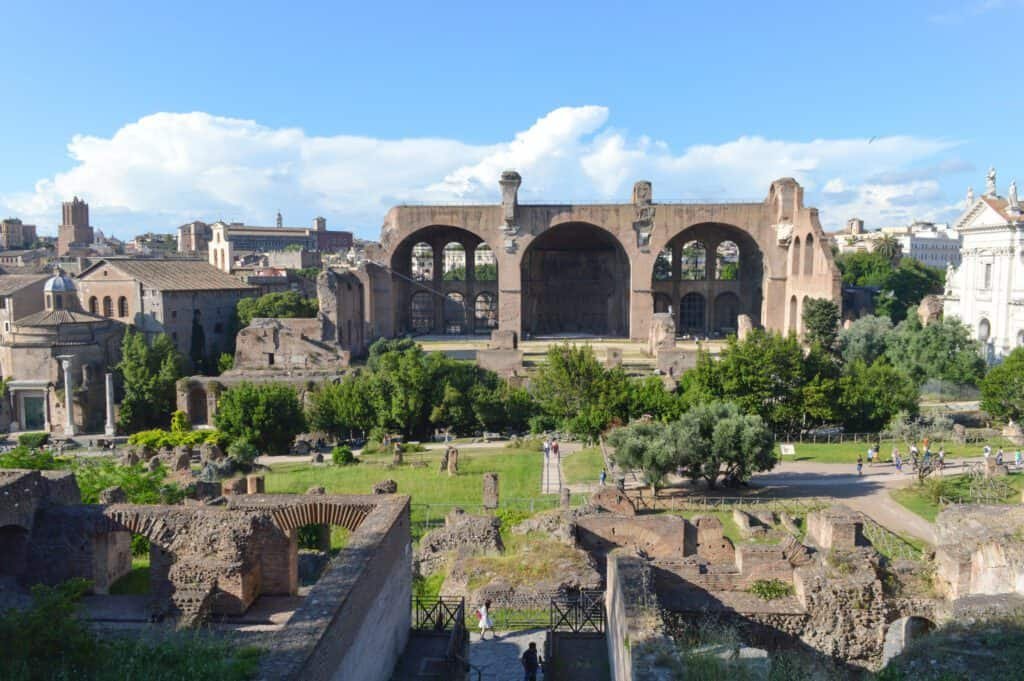
The Basilica of Maxentius sits on the northern flank of the Roman Forum, on the Velia ridge, and the address under which the Colosseum Archaeological Park lists it is Clivo di Venere Felice, 00186 Rome. It doesn't have its own ticket office: you enter by passing through the Roman Forum, and the access ticket is the Park's. The "Colosseo, Foro Romano, Palatino" ticket costs 18 euros full price and 2 euros reduced for European Union citizens between the ages of 18 and 25. It is valid for 24 hours and includes the first two tiers of the Colosseum, the Colosseum Museum, the Roman Forum with its museum, and the Palatine Hill. Those with the Roma Pass pay 11.50 euros. Anyone who isn't interested in the Colosseum and wants only the Forum and the Palatine gets the Forum Pass SUPER: 18 euros full price, 2 euros reduced for EU citizens between 18 and 25, a single entry, no obligation for a timed slot, but not usable on the first free Sunday of the month. The Roman Forum-Palatine area opens at 9:00. From March 29 to September 30, 2026, the last entry is at 18:15 and closing is at 19:15. From October 1 to 24, 2026, the last entry is at 17:30 and closing at 18:30. From October 25, 2026 to February 28, 2027, the last entry is at 15:30 and closing at 16:30. Annual closures: December 25 and January 1. Free admission on the first Sunday of the month, April 25, June 2 and November 4, and always free for people with disabilities and one companion. Timed reservations are mandatory for tickets that include the Colosseum. They're purchased on the Park's official portal, and the ticket is personal, so you'll need an ID at the gate. You can get there on Metro Line B, Colosseo stop, or Line C, Colosseo-Fori Imperiali stop. At street level, bus lines 51, 75, 81, 85, 87 and 118, and tram 3 serve the area.
If you're putting together a multi-day Roman itinerary, the rest of the list is on the Tourist Attractions in Rome page, where the Roman Forum shares space with everything around it.
Exactly Where the Basilica of Maxentius Is
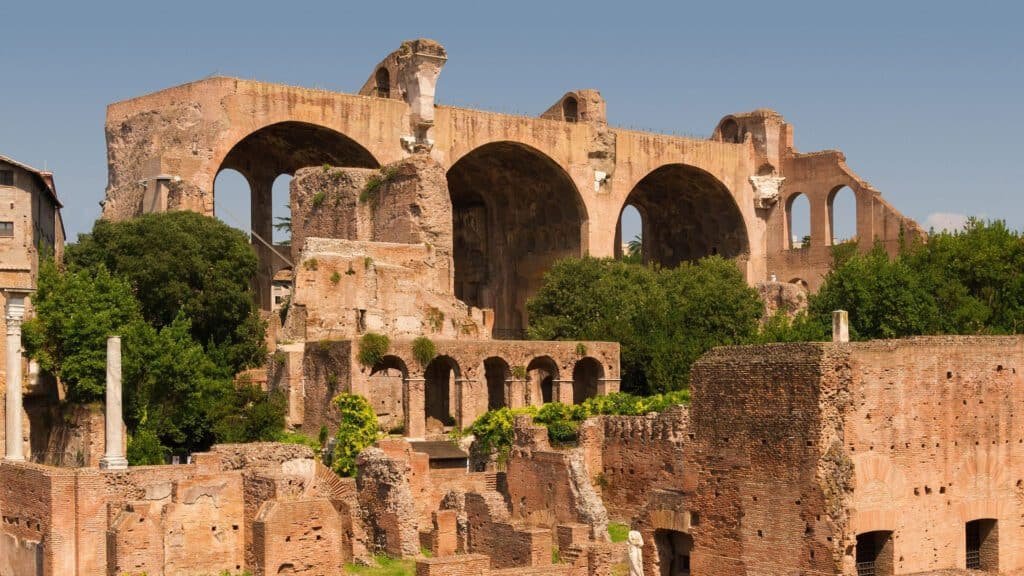
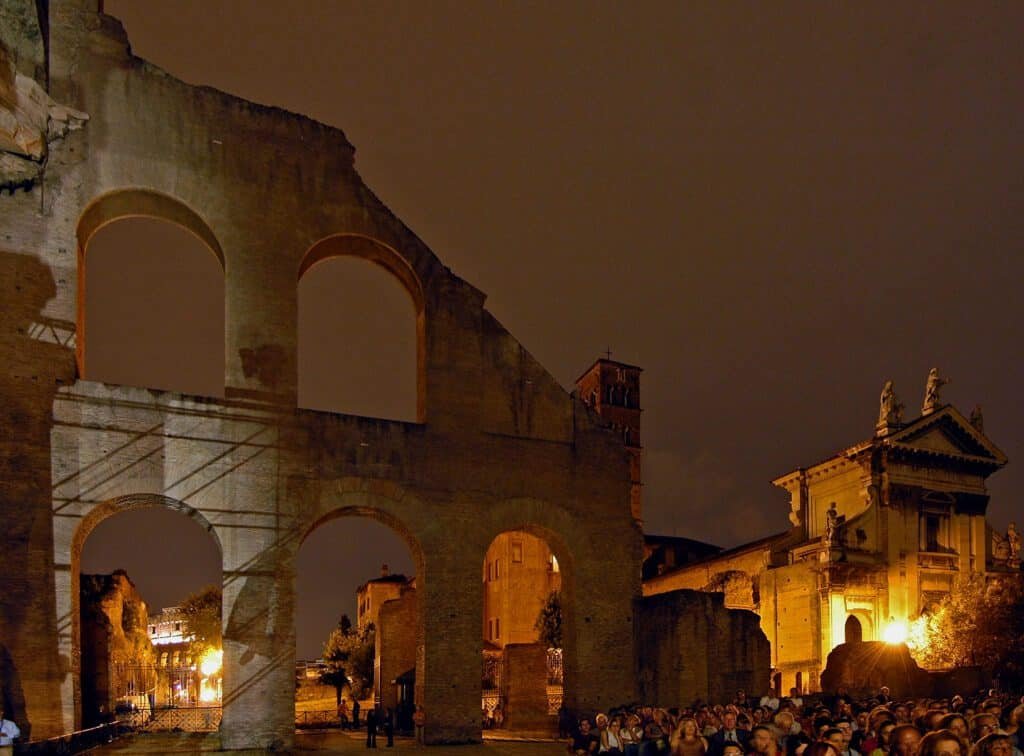
Anyone walking along Via dei Fori Imperiali toward the Colosseum finds it on their right, just before the intersection with Via del Colosseo, and almost always doesn't know what it is. There are three huge arches of red brick, open toward the road like three oven mouths, supported by piers that look like skyscrapers made by hand. The view from the street is the best you can get for free in Rome: no ticket needed, just the sidewalk.
The precise location is the Velia ridge, the saddle that connected the Palatine to the Esquiline and that today has largely disappeared, gouged first by 19th-century excavations and then by the opening of Via dell'Impero in the 1930s. Before those works, climbing from the Forum toward the Arch of Titus meant a real slope. Today the difference in height can still be read in the step of earth that holds up the basilica, but the eye struggles to reconstruct the ancient landscape. It's worth keeping in mind: the Basilica of Maxentius wasn't built on a valley floor, it was set on a rise, and this doubles the effect of dominance the building had over those arriving from the Forum.
The long side facing the modern road is the northern one. It's the only part still standing. The three large bays visible from above the street are not the main nave, as almost everyone believes, but the north side aisle. The central nave, the truly monstrous one, collapsed: the empty space that opens toward the Forum today was filled with concrete and marble. It often has to be explained twice, because people don't believe it the first time.
What the Basilica of Maxentius Really Was
First we need to clarify one word, because it trips everyone up. In Latin, basilica doesn't mean church. It indicates a covered civic building, a public hall for business, trials, assemblies, bankers, lawyers, and bureaucracy. Rome had many, from the Basilica Aemilia to the Basilica Julia, both in the Forum and visible during the same visit. The term later passed into Christian architecture because the floor plan lent itself to it, and that's why the word today evokes naves and altars. Here, in the fourth century, there was no altar at all.
The Basilica of Maxentius is the last and largest of the civic basilicas in Rome's monumental center. It closes a centuries-long series, and closes it with an architectural gesture that breaks with all earlier tradition. The Republican and Imperial basilicas were column halls with wooden ceilings and roofs, here wood disappears and the roof becomes a concrete vault. It's a building that resembles the cold room of a great imperial bath far more than a classical basilica, and the kinship is no accident: it was in the baths, from the Baths of Trajan onward, that Roman builders had learned to cover immense spaces without beams.
The administrative function of the building has been clarified by research in recent decades: the basilica is thought to have been the seat of the Urban Prefecture, that is, the office of the official who in the late empire effectively governed the city. In the course of the fourth century the Secretarium Senatus, the Senate's court, was also moved here. Translated: in here people judged, registered and commanded. The tribunal at the back of the apse was not scenery, it was a workplace.
The History of the Basilica of Maxentius
The essential chronology is short and dramatic. The construction site was opened by Maxentius, emperor in Rome from 306 to 312, around 308. Maxentius did not live to see it finished: on October 28, 312 he lost to Constantine at Ponte Milvio and drowned in the Tiber. Constantine inherited the city, inherited the construction site and brought it to completion, modifying it. The basilica changed dedication and changed name. In late sources and in the scholarly tradition it appears as Basilica Nova, Basilica Constantini, Basilica Constantiniana. The name of the real patron survives only in modern usage.
The Ground Before the Basilica of Maxentius
Before the Maxentian construction site the area was occupied by a service complex from the Domitianic period, and in particular by the Horrea Piperataria, the warehouses of pepper and spices. It's not a picturesque detail: it means that the most valuable spot at the entrance to the Forum, on Via Sacra, was used as a depot for luxury goods imported from the East, pepper, cinnamon, incense, goods that in Rome were worth as much as silver. A fire at the end of the third century cleared the ground. Maxentius built on top of it without too much regard, reusing part of the lower structures as foundation and as substructure: under the floor of the basilica, rooms of the warehouses survive, and it's one of the reasons the building is set on a podium.
Maxentius, the Builder History Erased
Maxentius had the bad luck of losing. Whoever loses, in Rome, gets scraped off the inscriptions and out of memory: it's the damnatio memoriae, and in his case it worked very well. And yet his six years in Rome are one of the most intense building periods of late antiquity: his is the reconstruction of the Temple of Venus and Roma after the fire, his the monumental complex on Via Appia with the circus and the mausoleum, his this basilica. Maxentius presented himself as the emperor who gave Rome back to the Romans, at a moment when the imperial court had already moved elsewhere and the city was losing its political centrality. The paradox is that the building with which he wanted to sign his own idea of Rome bears his name today only by archaeological convention: for 15 centuries it was called by other names, and no one attributed it to him.
Constantine and the Change of Signature
Constantine doesn't demolish, he appropriates. It's the cheapest and most effective way of doing propaganda: you take a construction site already laid out, you bring it to completion with a few variations, and you put your own name on it. The documented Constantinian variations are two and they are substantial. The first is the monumental entrance on the southern side, toward Via Sacra, with a portico of four porphyry columns. The second is the apse on the northern side, facing the new entrance, which shifts the axis of reading of the building from longitudinal to transverse. It must be said that an archaeological study from 2005 has put this division back in question, arguing that both the southern entrance and the northern apse already belonged to Maxentius's original project. The question is open and it's not a minor dispute: it concerns how much Constantine really changed and how much he limited himself to signing.
One thing, though, is certain and visible: in the western apse, at the end of the central nave, a colossal statue of the emperor was placed. The head was reworked so that the face of Maxentius would give way to that of Constantine. A block of marble as tall as a man, cut down to change the face of a dead emperor. I don't know a more direct image of what winning a civil war meant in antiquity.
The Architecture of the Basilica of Maxentius: The Measurements That Matter
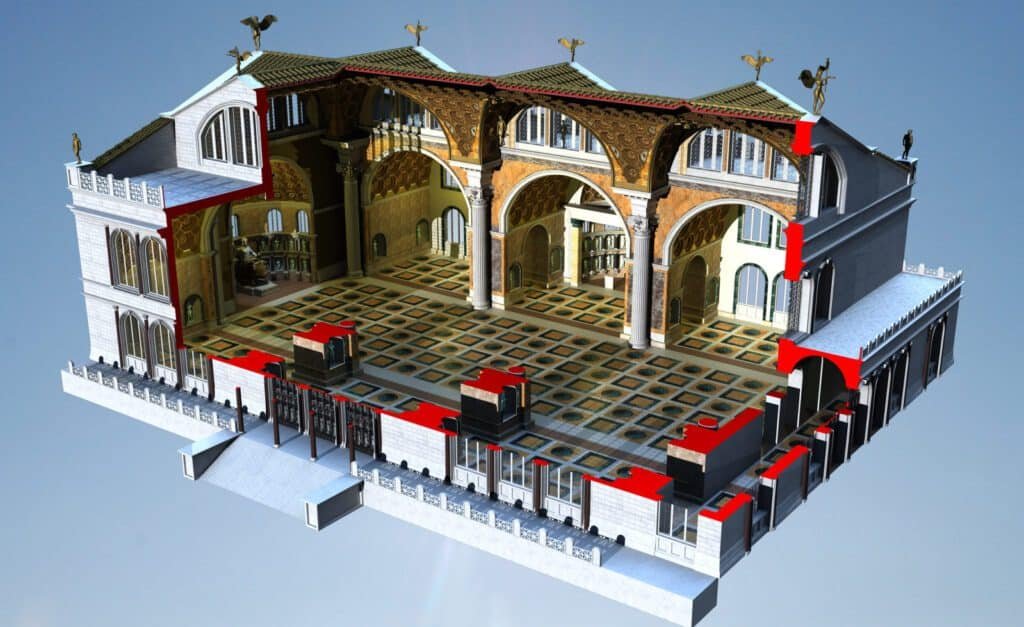
The numbers, in this case, are the story. The overall footprint is about 100 meters by 65. The central nave measured 80 meters in length by 25 in width and reached about 35 meters in height under the vaults. The side aisles were 16 meters wide and 24.5 high. Over a surface of about 2,000 square meters there was not a single supporting column in the middle: the space was completely free. To give the measure in modern terms: a 10-story building could stand in the central nave, and there would still be air above it.
The plan was rectangular, divided into three naves, with the central nave oriented east to west and ending in an apse at the west. The side aisles were not continuous corridors: they were divided by large transverse wall partitions that formed, on each side, three large communicating rooms. Those partitions are the structural key of the building, because they worked as buttresses and absorbed the thrust of the central vaults. Anyone looking at the basilica from Via dei Fori Imperiali sees exactly this system: three barrel-vaulted rooms, separated by thick walls, each one open toward the vanished central nave with a big arch.
The Three Groin Vaults of the Basilica of Maxentius
The central nave was covered by three enormous groin vaults in opus caementicium, Roman concrete, whose weight was carried by four large piers. Modern technical sources place the intrados of the vaults at around 35 meters and the springing line of the structure up to 39 meters above the walking surface. These are dimensions of a Gothic cathedral, reached a thousand years before Gothic cathedrals, and with a material that is not cut stone but cast conglomerate.
A groin vault is formed by the intersection of two perpendicular barrel vaults. The advantage is not aesthetic. The advantage is that it concentrates the weight on four points instead of on two continuous walls, and so it allows windows to be opened in the walls below the vault. In the Basilica of Maxentius, the central nave, taller than the side aisles, received light from a row of windows set in its upper part: the so-called clerestory, which would later become the lighting system of Christian basilicas and, centuries later, of Romanesque and Gothic churches. If you picture the light coming down from above in a large church, the idea started with buildings like this one.
The Barrel Vaults with Octagonal Coffers
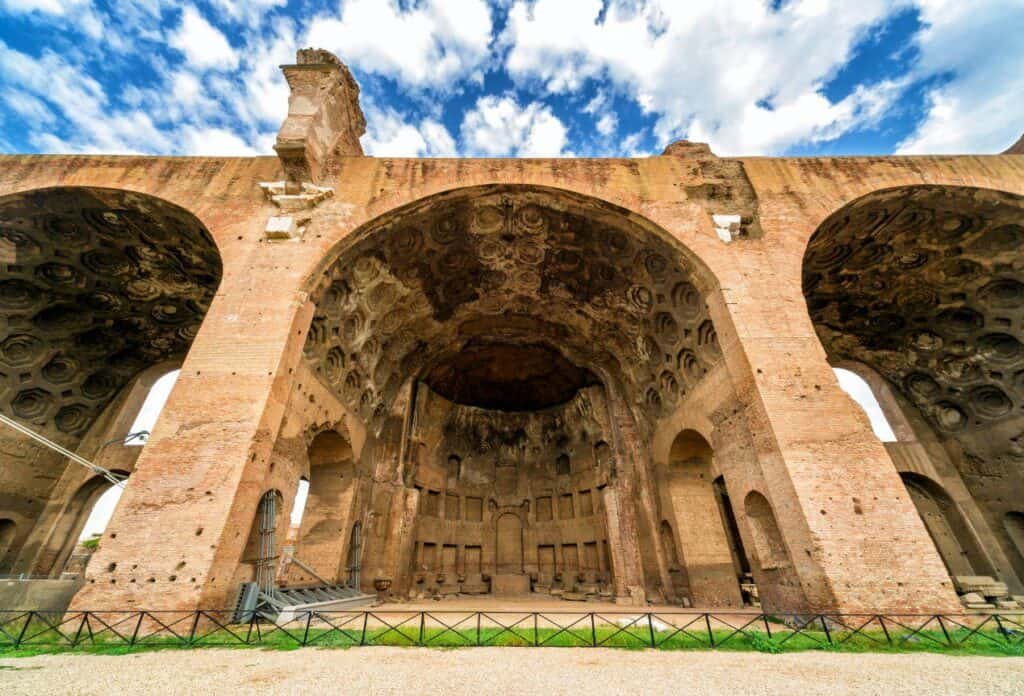
The side aisles were covered by coffered barrel vaults. This is the best-preserved part and the most beautiful. Look up under the three surviving bays and you can still see, crisp and clear, the octagonal coffers that lightened and decorated the intrados. They were made with shaped wooden formwork, pouring the concrete over molds that were later removed. The result is a surface that looks carved but was actually poured.
Look at them closely, because they are not decoration for its own sake. Each coffer removes material, and therefore weight, wherever weight is not needed for the structure, and it creates an optical effect of depth that makes the vault look higher than it is. The Romans had known this for at least two centuries, since the Pantheon onward. The difference is that here the octagonal coffers run along a barrel vault, not a dome, and the geometry is harder to lay out. Anyone who works in construction usually stops asking questions and starts taking photos when faced with these vaults.
The Eight Columns of Proconnesian Marble
At the base of the wall piers, set against their ends facing the central nave, stood eight monolithic Corinthian columns of Proconnesian marble, 14.5 meters high and with a circumference of about 5.4 meters. Proconnesian marble comes from the island of Marmara, in the Sea of Marmara, and is the white marble veined with gray that the late empire used by the ton. Monolithic means each shaft was a single block, quarried in Turkey, lowered into the sea, shipped by sea to Ostia, hauled up the Tiber, unloaded, and raised upright in the center of Rome. Eight times.
These were columns that held up nothing, or next to nothing. The load-bearing structure was the concrete piers and walls, and the columns served to ennoble the wall, to articulate the nave, to tell the visitor that this was an imperial building. It is a choice that late Roman architecture makes often, and that nineteenth-century purists found scandalous: the column reduced to decoration. To me, it looks instead like a sign of very high technical maturity. When the structure no longer needs the column, the column becomes language.
The Entrances of the Basilica of Maxentius
The main entrance of the original design was on the short eastern side, facing the Colosseum, preceded by a staircase that climbed the height difference of the podium. From there you entered a transverse corridor, a kind of long vestibule, which connected to the central nave through five arched openings. Whoever entered found, at the end of the 80-meter nave, the western apse with the colossal statue. A theatrical effect calculated down to the centimeter.
The second entrance is the southern one, opening onto Via Sacra, with a tetrastyle portico, that is, with four columns, whose shafts were red porphyry. Porphyry is not just any marble. It comes from a single Egyptian quarry, Mons Porphyrites in the Eastern Desert, and was reserved for imperial use. Four porphyry shafts on a portico meant, in late antique terms, that the emperor was the one opening that door. Tradition attributes this entrance to Constantine, while the 2005 study traces it back to the Maxentian design. In both cases the message remains: the basilica faced the road of the triumphal processions.
The Apses and the Tribunal
The western apse, at the far end of the central nave, was preceded by two columns and housed the colossal statue. The northern niche, the central one on the long side, was transformed into a second semicircular apse covered by a half-dome, with niches arranged on two levels and small aedicules supported by projecting brackets. At the back of this apse a podium was built in masonry: the tribunal, the raised bench from which justice was administered. The intervention is probably placed at the end of the 4th century, and it confirms the judicial purpose of the building in late antiquity.
The detail nobody looks at is behind. Inside the masonry, in the northwest corner, a spiral service staircase was set in, and five of its steps survive today. It served to reach the upper floors and the roofs for maintenance. Five steps in a building of 100,000 cubic meters: that is what remains of the daily life of those who worked there, and it is worth as much as an entire vault.
How the Romans Built the Basilica of Maxentius
If there is one chapter worth your attention, it is this one, because it explains why the building is still standing after 17 centuries of earthquakes, fires and open-air stone quarrying.
Roman Concrete
The opus caementicium is a conglomerate made of binder and aggregates. The binder is lime mortar mixed with pozzolana, the volcanic sand of the Lazio volcanic districts, from the Alban Hills to the Sabatini Mountains, which gives the mixture hydraulic properties. It sets even without air and resists water. The aggregates are the caementa, chips and rubble of stone thrown in layers inside the formwork. In imperial-age structures, builders deliberately varied the type of aggregate with height. Heavy stones such as travertine and flint went at the bottom, where resistance is needed. Lightweight materials such as tufa, and above all volcanic scoria and fragments of amphorae, went at the top, where every extra kilo is a problem for the vault. It is materials engineering done without a laboratory, learned from experience accumulated from one building site to the next.
Bricks, Centering and Setting Time
The outer facing is in opus latericium, bricks arranged in regular courses. Anyone who looks at the basilica from Via dei Fori Imperiali sees brick and thinks the building is made of brick. That is not the case. The brick is a skin a few centimeters thick, serving as permanent formwork and as the finishing surface. Behind it is the mass of concrete. The lion's share of the work is also done by the large bipedal bricks, those two Roman feet per side, about 59 centimeters, used to form relieving arches inside the masonry and to distribute the loads.
The vaults were poured over wooden centering, curved scaffolding that held up the fresh mass until the lime set. This is where the site becomes dizzying. Building three groin vaults at 35 meters high required a forest of timber and precision carpentry, assembled and dismantled three times. We don't know the name of a single carpenter who worked on the Basilica of Maxentius, and this is one of the reasons I find it not very serious to tell ancient architecture as if emperors built it. Maxentius signed his name. The ones who did the building were people we know nothing about.
Why the Central Nave Collapsed
The question always comes up. The short answer: because it was the highest part, the most stressed and the least counteracted. A groin vault exerts an oblique thrust outward. In the central nave that thrust was countered by the masonry walls of the side aisles, but the system stays in balance only until a seismic movement shifts the piers by a few centimeters. At that point the geometry fails, and a concrete vault of that size is unforgiving. The side aisles, lower and covered with barrel vaults, with massive walls and smaller bays, held up. The north aisle has been standing for 1,700 years. Its sisters did not.
The Colossus of Constantine, the Statue of the Basilica of Maxentius
In the western apse sat a colossal statue about 12 meters tall. It was not a single block. It was an acrolith, that is, a composite statue, with the bare parts, head, arms, legs and feet, carved from marble, and the rest of the body built on a wooden core covered with gilded bronze to simulate the garments. It is a technique of economy and logistics: marble is used where skin shows, and everything else is built the way you build a boat.
The surviving marble parts are nine fragments of 4th-century Parian marble, resurfaced in 1486 and kept since the 16th century in the courtyard of the Palazzo dei Conservatori, at the Capitoline Museums. The head alone measures 2.60 meters, the foot 2 meters, and there is a hand with the index finger pointing up that has become one of the most reproduced images of Roman antiquity. Anyone who has set foot on the Capitoline has come face to face with it. Few people know that those pieces come from here, from a building you can see from the same square if you look toward the Forum.
The Face That Changes Hands
What makes this statue a political document and not just a work of art is the reworking. The colossus was conceived for Maxentius. After 312, the face was reworked with the features of Constantine. This is not an isolated case in Roman history, quite the opposite, it was a common practice: imperial heads were carved one from another the way a hat is reshaped. But here the scale makes the gesture almost comic and at the same time frightening. A sculptor climbed onto a scaffold with a chisel to redo the cheekbones of a face as wide as a door.
The enormous, wide-open eyes, with incised pupils and a gaze turned upward, are not a stylistic flaw, as the art historians of the classicist school claimed. They are the language of Late Antiquity, which abandons naturalistic portraiture and seeks abstraction: the emperor doesn't have to look like a man, he has to look like an idea. Anyone who comes from the Palazzo Nuovo, where there are Republican-era portraits with wrinkles and warts, and then enters the courtyard of the Palazzo dei Conservatori, measures four centuries of the history of taste in 30 seconds.
The Reconstructed Colossus in the Gardens of Villa Caffarelli
From February 6, 2024, a full-scale reconstruction of the statue, about 13 meters tall, is on display in the garden of Villa Caffarelli, at the Capitoline Museums. It was made by the Factum Foundation for Digital Technology in Preservation with the Sovrintendenza Capitolina and the Fondazione Prada, starting from ultra-high-resolution three-dimensional photogrammetric scans of the 9 original fragments. The project was first presented in Milan between November 2022 and February 2023. The materials are resin and polyurethane with marble dust, gold leaf and plaster, mounted on a removable aluminum core. Entry to the garden is free, and the hours listed are 9.30-18.30.
A blunt opinion: go after the Forum, not before. If you look at the reconstruction with a fresh mind, it remains a nice, colorful giant. But if you arrive having just seen the empty apse of the basilica, you understand what a provincial official must have felt when he walked in there to ask for a license. The page dedicated to Il Colosso di Costantino ai Musei Capitolini covers the whole project in detail.
The Column of the Basilica of Maxentius in Piazza Santa Maria Maggiore
Of the eight columns of Proconnesian marble, only one was still standing in the 1600s. Pope Paul V Borghese took it. In 1613 he had it removed from the ruins, transported across the city, and raised in the center of the square in front of Santa Maria Maggiore, where it still stands. This is the Column of Peace: a fluted Corinthian shaft over 14 meters long, the tallest piece of Roman antiquity that can be seen standing upright outside an archaeological area.
The design of the monument and the fountain at its base is by Carlo Maderno, nephew of Domenico Fontana, the architect who had already done the job of moving obelisks in Rome. At the top was placed a bronze Virgin and Child, modeled by Guillaume Berthélot and cast by Orazio Censore. The base, in marble and travertine, bears eagles and winged dragons, the heraldic emblems of the Borghese. The dates in the sources don't agree: the transport is attributed to 1613, the erection of the monument to 1614, and the completion of the fountain to the following year. Think of it as an operation lasting two or three years, which is the most honest thing to say.
The name gives away the misunderstanding we'll see shortly: the column is called the Column of Peace because it came from the so-called Temple of Peace, and that temple never existed on that spot. A seventeenth-century pope planted a piece of an imperial building in a Christian square, believing it was something else. It's the whole history of Rome in a single object.
Why That Column Is Still There and Not in the Basilica
People often ask me this, and it's a fair question: why don't they bring it back? Because in the meantime the column has itself become a historic monument, part of the urban design of one of Rome's major squares, and the object of Marian devotion documented for four centuries. Removing it would mean erasing the history of its move, which is history too. Modern restoration works this way: it doesn't return things to a presumed original state, it preserves the layers. Those who find the choice questionable have arguments. In our view it's the right one, and it's nice that in Rome the pepper, the porphyry and the papacy share the same biography of a piece of marble.
Earthquakes, Collapses and Spoliation of the Basilica of Maxentius
Ruin is not an event, it's a process lasting 1,000 years. The phases can be reconstructed in broad lines.
Earthquakes
The hardest blow comes from the earthquake of 847, which according to the current reconstruction destroyed the southern and central parts of the building: the south aisle and the central vaults. A second seismic event, in 1349, the one that brought down half the city of Rome and split the outer flank of the Colosseum, toppled what remained of the roof over the central nave. After 1349 the Basilica of Maxentius was already what we see today: three northern bays standing and an enormous expanse of rubble.
Anyone who wants to gauge the violence of that earthquake has a point of comparison 200 meters away: the southern wall of the Colosseum, the one that's missing. Same year, same tremor. Medieval Rome had no means to rebuild anything, and didn't even try.
Spoliation
After the collapse, the ruins became a quarry. The marble from the facings ended up in lime kilns: marble was burned to make construction lime, and that's how nearly all the prestige surfaces of ancient Roman art disappeared. The floor slabs of colored marble, the capitals, the shafts, the cornices: all removed, reused, and burned. What remains is concrete and brick, materials that weren't worth carting away.
Renaissance sources document material removed from the complex for the great papal construction projects, and the story of the 1613 column is the last official, documented, and signed act of a centuries-old practice. One fact helps put it in context: in the Middle Ages, limestone and ancient marble were the main mineral resource available inside the walls. Anyone who accuses the popes of vandalism should remember that before the popes, everyone else had already had the same idea, and that the only reason the basilica still exists is that Roman concrete doesn't burn or crumble.
Ruins as Landscape
Between the 15th and 19th centuries the basilica became one of the standard subjects of Roman vedutismo. It appears in engravings, in architects' drawings, and in paintings by Northern landscape artists who came to Rome to learn about light. A broken building, colonized by grass, its coffered vaults still legible: it was the perfect emblem of 18th-century reflection on the transience of empires. When the English Grand Tourists arrived, they already knew it by heart from prints before even seeing it.
A Thousand Years of Mistaken Identity: The Temple of Peace That Never Was
For much of the Middle Ages and throughout the modern era, the Basilica of Maxentius was not called that. They called it the Templum Pacis, the Temple of Peace. The identification was wrong by about 200 meters and two and a half centuries: the real Temple of Peace, the complex built by Vespasian after the Jewish War and inaugurated in 75, lies farther north, on the side of the Imperial Forums, where Via dei Fori Imperiali runs today and the remains brought to light next to the Trajan's Markets and the Museum of the Imperial Forums. The confusion arose because the most imposing ruins in the area were these, so they were attributed to the most famous building that the sources mentioned.
The mix-up was not harmless. In medieval tradition, the Temple of Peace was the building where the Romans had deposited the loot from the Temple in Jerusalem after 70: the menorah, the table of the Showbread, the sacred furnishings brought to Rome by Titus and carved on the relief of the Arch of Titus, which stands 200 meters from here. For centuries, anyone walking past these vaults believed they were looking at the building that had swallowed the Temple's treasure.
The Legend of the Sibyl, Augustus, and the Collapsed Temple
Over that mix-up, a long-lived Christian legend settled, which circulated in the Mirabilia Urbis Romae, the medieval guides to the city. In its common form, the story goes that the Romans had built a temple destined to last until a virgin gave birth, and that the building collapsed on the night of Christ's birth. The same tradition links Augustus to the Sibyl, who supposedly announced to him the coming of a king greater than himself. It's legend, not history: no ancient source attests it, and the building's chronology, from the Maxentian period, makes it impossible. But it explains why for centuries pilgrims paused here with a certain emotion, and why the column that ended up at Santa Maria Maggiore, topped by a Virgin with the Child, was chosen from among these ruins. Paul V knew very well what he was doing: he took the column of the pagan temple that collapsed at Christ's birth and put the Madonna on top of it. First-rate propaganda.
Antonio Nibby, Carlo Fea, and the Dispute That Set Things Straight
The correct identification of the building came in the early 19th century thanks to Antonio Nibby, a Roman archaeologist and topographer, who carried on a lively controversy on the matter with Carlo Fea, commissioner of antiquities of Rome. Nibby understood that the ruins were not a temple, but the basilica built by Maxentius and completed by Constantine, and proposed that the western apse faced an eastern entrance. On this second point, later research has partly corrected him, but the main recognition is his and has held up.
It's worth pausing for a moment on the nature of the dispute. Nibby and Fea were not arguing out of academic vanity. They were arguing because, under the French administration and then under the papal restoration, systematic excavations of the Roman Forum had begun, and deciding what a building was meant deciding how to dig it up and how to restore it. Ancient topography, in those years, was an applied science with immediate consequences on the ground. Anyone who wants to understand how modern archaeology was born will find in this dispute a textbook case.
The Basilica of Maxentius and the Renaissance Architects
Between the Quattrocento and the Cinquecento, this ruin becomes a school. Architectural historiography identifies it as a design reference for a precise line of buildings: Sant'Andrea in Mantua by Leon Battista Alberti, the designs for the new St. Peter's, San Nicolò di Carpi, and the churches of Andrea Palladio. The reason is technical before it is aesthetic. Renaissance architects faced a problem that medieval Italian architecture had never tackled in those terms: covering a very wide nave with a masonry vault, without wooden tie beams, and holding back its thrust.
The Basilica of Maxentius was the only surviving example, measurable and climbable, of how the Romans had solved that problem. Not a drawing, not a literary description: the real thing, with its coffered barrel vaults still standing and its buttress walls exposed. Architects surveyed it, drew it and calculated its thicknesses. The subject that obsessed them was the behavior of the caementicium, a material they no longer knew how to make with those performance levels, and that they tried for decades to imitate.
Why St. Peter's Owes Something to the Basilica of Maxentius
When the construction site of the new St. Peter's opened in the early 16th century, there was only one question on the table: how high and how wide can you go with masonry. In Rome, the only possible answer was one, and it stood 700 meters from the Vatican as the crow flies. The nave of Sant'Andrea in Mantua, which predates it by half a century, has a coffered barrel vault that openly declares the kinship. And it is through the lesson of the great Roman vaults, this one included, that the sequence passes which leads to Michelangelo's dome.
Here it's worth stopping, because the history of architecture is full of enthusiastic attributions that the documentation does not support. What can be said with certainty is that the Basilica of Maxentius was measured, drawn and debated by Italian Renaissance architects as one of the fundamental models of large scale, and that recent studies of its vaults as a source for architects have reconstructed this fortune in detail. The rest are fascinating hypotheses to tell in front of the ruins, provided you say they are hypotheses.
Excavations and the Modern Basilica of Maxentius
The building's current appearance is the result of two centuries of interventions. The 19th-century excavations cleared the area of its fill and restored the ancient levels, making Nibby's identification possible. Between the 19th and 20th centuries, the surviving structures were consolidated several times, which was essential, because a barrel vault without its original buttresses is an unstable structure.
The most violent transformation came in the 1930s with the opening of Via dell'Impero, today Via dei Fori Imperiali. The demolition cut through the urban fabric that had built up against the ruins and isolated the monument, making it visible from the street like a backdrop. It's the image we all know, and it should be said that it is a constructed image: the ancient basilica was never an isolated object in a meadow. It was packed into a very dense neighborhood.
What Recent Research Has Said
Toward the end of the 20th century and in the early 2000s, a multidisciplinary investigation studied the monument from the point of view of materials, structures and stability, and produced the reconstruction that is today the reference. The most significant result concerns the phases: both the southern entrance on Via Sacra and the northern apse, which tradition attributed to Constantinian modifications, would already belong to the original Maxentian design. If the data holds up, Constantine inherited a building much more defined than was thought, and his intervention is reduced to completion and the statue.
In recent years the area of the Horrea Piperataria under the basilica has returned to the center of archaeological attention, because it holds a stratification running from the Republican era to the late Empire within a few meters of depth. It's not material you can see from the usual visitor route, but it explains why, while walking toward the Arch of Titus, you sometimes come across fences and construction sites. There's still a lot to read under that lawn.
The Roman Forum around the Basilica of Maxentius
Nobody visits this building alone, and it would be a mistake to try. The basilica is the last great monument in the Forum valley as you head toward the Colosseum, and the stretch of Via Sacra that runs in front of it is the busiest in the whole archaeological area.
The Temple of Romulus and the Saints Cosmas and Damian
Immediately to the west, built against the basilica, is the round building with the ancient bronze door still working on its original hinges: the so-called hall of the Temple of Divus Romulus, dedicated by Maxentius himself to his son Valerius Romulus, who died very young around 309. The two-leaf bronze door is one of the very rare ancient fittings preserved in place in Rome, and the lock still works. Behind it is the Basilica of Saints Cosmas and Damian, which in the 6th century took over the hall and rooms of the Forum of Peace and preserves one of the most important apse mosaics of early medieval Rome.
The Arch of Titus and the climb up the Velia
To the east, where Via Sacra climbs toward the Palatine, is the Arch of Titus, erected by Domitian after the death of his brother Titus in 81 to commemorate the capture of Jerusalem, with its two reliefs in the inner passageway: the triumphal procession with the sacred vessels and the menorah on one side, the emperor on a quadriga on the other. It's a two-minute walk from the basilica, and it's worth seeing with the chapter on the Temple of Peace confusion in mind: the arch that shows the loot and the building that people believed held it for 1,000 years are within sight of each other.
The Temple of Venus and Rome
Climbing further toward the Colosseum, there is the large platform of the Temple of Venus and Rome, the largest temple in the city, built by Hadrian and rebuilt by Maxentius himself after the fire of 307. The temple's two facing apses are clearly visible from the Colosseum side. It is the second major Maxentian building project in the area: anyone who wants to understand this emperor's construction program should look at the two buildings together, because they came from the same office and in the same years.
The Roman Forum museum and the Palatine
The Park ticket includes the museum set up in the Forum area and the climb up to the Palatine Hill with the Palatine Museum. I suggest keeping at least an hour for the hill: from the eastern terraces of the Palatine you look down on the Basilica of Maxentius from above and from behind, and it's the only spot where you can really read the plan, with the three bays of the north aisle and the empty space of the central nave.
A curiosity about the Basilica of Maxentius
The curiosity I like best involves a vanished trade and a number: the foot. The marble foot of the colossus kept in the courtyard of the Palazzo dei Conservatori measures two meters, and on its top it still bears the trace of a sandal. So far, that's the textbook fact. The part almost nobody tells is that for centuries this foot was not considered a work of art but a piece of street furniture. The colossus fragments were moved to the Capitoline in the 15th century, shortly after they were found, and displayed in the courtyard as a civic trophy of the Comune di Roma: the city reclaiming the emperor's image to make it a symbol of its own authority.
There's more. Those fragments are among the very few pieces of ancient sculpture in Rome that have never seen a storeroom: since the 15th century they have stayed outdoors, in the same courtyard, exposed to rain and to the hands of passersby. Five and a half centuries of uninterrupted display is a record no other colossal Roman marble can claim, and it explains the state of the surfaces: anyone expecting museum-style whiteness will find them surprisingly worn. Ruins that stay among people for 20 generations stop being artifacts and become part of the city's furniture.
The second curiosity is technical, and I find it just as beautiful. In the large Roman vaults, builders deliberately lightened the concrete as it rose toward the top, replacing heavy aggregate with light materials: volcanic slag, tuff, and at many sites fragments of empty amphorae. That means the most daring ceilings of antiquity are, in large part, stuffed with the shards of Mediterranean trade, the wine and oil containers that arrived from the provinces and, once emptied and smashed, never went back. If I had to choose a single image to explain what the imperial economy was, I'd choose this one: an empire building its roof out of its own packaging.
One last note, for those who love numbers. The covered space without intermediate supports is about 2,000 square meters, with a span that no European builder will attempt again for centuries. In medieval Italy there is no comparable secular hall, and the great vaulted naves of the Renaissance come, as we've seen, from direct study of buildings like this one. It's worth repeating in front of the ruins: the achievement isn't size in itself, it's having achieved it without a single column in the middle.
Something Nobody Tells You About the Basilica of Maxentius
That the most spectacular part of the visit, for a large part of the year, isn't seen from inside the archaeological area but from outside, for free, and at a specific time. The three surviving barrel vaults face north, toward Via dei Fori Imperiali. This means direct sun almost never reaches the coffers, and the interior stays in diffused light. But in the hours before sunset, in spring and summer, raking light strikes the northern flank at an angle, and the bricks light up with a red that midday never gives back. Inside the Forum, at that point, you've already been made to leave. From the sidewalk of Via dei Fori Imperiali, you haven't.
Here's the practical point that no paper guidebook mentions: the internal route through the Roman Forum does not pass inside the basilica. The three bays are fenced off and are seen from outside, from Via Sacra or from the upper walkway. Access to the interior happens only on special occasions, when the area is set up for events. Anyone who enters the Forum expecting to walk under the vaults ends up disappointed, and that disappointment is avoided by knowing it in advance. This takes nothing away from the visit: from below, at the point where Via Sacra runs alongside the podium, the perspective effect is even better, because you see the building from below, the way the people who went there to file lawsuits saw it.
Third little-known fact: the level of the ancient floor. The floor of the basilica is much higher than Via Sacra, because the building sits on a podium that reuses the substructures of the earlier warehouses. The difference in level accounts for something that always surprises visitors, namely that the ruins look small in photographs and giant in person: anyone photographing from above, from the modern road, flattens several meters of height difference without realizing it.
Finally, there's a matter of names worth taking home with you. In everyday speech you'll hear this building called Basilica of Maxentius, Basilica of Constantine and Basilica Nova, and all three are legitimate names with different histories. The first refers to the patron, the second to the person who completed it and signed it, and the third was how it was distinguished from the old basilicas of the Forum in late antiquity. If you hear someone correcting someone else about which is the right name, you can safely say they're both right.
The Basilica of Maxentius at the 1960 Olympics
The most incredible twentieth-century chapter in this building's history is sporting, and it usually surprises Romans too. At the XVII Olympiad, held in Rome from August 25 to September 11, 1960, the Basilica of Maxentius was an official competition venue. Wrestling took place here.
How a Ruin Becomes a Sports Hall
The technical solutions were developed in November 1959. Under the vaults of the main apse, three platforms with mats were placed. Around them, scaffolding was erected, along with stands for the public and stands for the press, a special lighting system for evening sessions, and 20 telephone booths for journalists. About 400 square meters of services were allocated to the athletes, with eight showers, seven bathrooms and five sinks. The Greco-Roman wrestling tournament was held from August 26 to 31, with eight weight categories, the freestyle wrestling tournament ran from September 1 to 6, also with eight categories.
What That Choice Meant
The 1960 Olympics were the great story of an Italy emerging from postwar reconstruction, and the organizers deliberately chose to have athletes compete and run inside antiquity: wrestling here, gymnastics at the Baths of Caracalla, and the marathon finishing at night under the Arch of Constantine, where Abebe Bikila ran barefoot. It wasn't archaeology, it was communication: showing the world that Rome could use its own ruins as a contemporary stage set without asking anyone's permission.
A not-so-gentle judgment: today a choice like that would be unthinkable, and rightly so. Setting up stands and floodlights inside a late antique structure without its buttresses means introducing loads and vibrations into a fragile body. In 1960 the conservation sensibility was different, and so were the rules. That said, those black-and-white images of wrestlers under the coffers remain some of the most extraordinary photographs Rome produced in the twentieth century, and I don't disown them. It's worth looking them up before you come: they change the way you look at the apse.
The Advice I Give You for Visiting the Basilica of Maxentius
The advice is just one thing, and it goes against everyone's habit: enter the Roman Forum from Via dei Fori Imperiali entrance, not the one near the Colosseum, and walk the valley downhill, leaving the basilica for last. The reason has to do with storytelling. If you arrive from the Colosseum, the Basilica of Maxentius is the first thing you see. You look at it with your eyes still full of the amphitheater, and it looks like a broken wall to you. If instead you first pass the Basilica Aemilia, the Curia, the Temple of Antoninus and Faustina, the houses of the pontiffs, and climb along Via Sacra, by the time you get here you have already seen six centuries of Roman construction, and you suddenly understand that this building belongs to another era and another technology. In archaeology, the difference between a piece of wall and a revelation is almost always the order in which you look at things.
Second piece of advice, about timing. The best light on the basilica from inside the site is in the late afternoon, and this clashes with the general rule of visiting the Forum early to avoid the heat. In summer, the solution is to split your visit: the Colosseum or Palatine in the early morning, a long break indoors during the central hours, then back to the Forum for the last two hours of opening. The 24-hour ticket allows this, if you bought the combined one. If you have the Forum Pass SUPER, which is single entry, you have to choose instead. In that case, go in the afternoon.
Third piece of advice, and maybe the most useful. Bring a small pair of binoculars or use the zoom on your phone to look at the coffers of the vaults. From the ground, with the naked eye, the octagonal coffers look like a regular pattern and nothing more. Zoomed in, you can see the traces of the formwork, the pour joints, the spots where the concrete has enclosed pieces of brick. That is where the building stops being a postcard and becomes a construction site. A quick look through binoculars is enough to change the mood even of the most bored.
Fourth: don't dismiss the basilica in five minutes just because you can't go inside. Give it a real 20 minutes, walking along the stretch of Via Sacra that runs beside it, and stopping at least at three different points. From the east you can read the depth of the bays. From the center you understand the width. From the west, toward the Temple of Romulus, you can sense the position of the apse with the colossus. Three stops, three different buildings.
Fifth, about your shoes and the ground. The Roman Forum is paved with basoli, uneven, going up and down, with stretches of gravel. Smooth soles on the ancient basoli, with the morning damp, slip like on ice. This is not a minor detail: in the archaeological area, the most frequent accidents happen right there, on a wet slab, to people in elegant sandals.
Another well-known fact, yet rarely mentioned
That this is not Constantine's basilica in the sense that the Constantinian Christian basilicas are, and that confusing the two leads to a serious historical misunderstanding. In the same two decades in which he completed the Basilica of Maxentius, Constantine started the great Christian building projects in Rome: the Lateran, the basilica over the tomb of Peter in the Vatican, San Paolo on Via Ostiense, San Lorenzo, the large suburban cemetery complexes. But those are churches, they are outside the monumental center or on its edges, and they are built with a different scheme: aisles on columns, a wooden roof, a transept. The building type is that of the traditional civil basilica, not that of Maxentius's vaulted basilica.
Put bluntly: the Christian basilica does not descend from this building. It descends from the older civil basilicas. The Basilica of Maxentius is a typological dead end. It is the technical peak of Roman architecture and, at the same time, its end: after it, for economic and political reasons before technical ones, nobody in Rome will build anything similar again. Concrete with pozzolana goes out of common use, the workers scatter, and the ability to pour vaults of that span is lost for a thousand years. Anyone looking at these three bays is looking at the last building of the great Roman construction era, not the first of a new one.
There is a second well-known fact that almost nobody connects. Maxentius's damnatio memoriae worked so well that, for centuries, manuals had to use the name of his enemy to refer to his largest building. If today we call it the Basilica of Maxentius, the credit goes to nineteenth-century archaeology, which restored the authorship of the project against 15 centuries of the opposite usage. It is one of the few cases in which a scientific discipline has given a loser back the signature on a work. I think it's worth saying out loud when you're standing in front of it.
Third well-known and little-visited fact: the building kept working for the city even as a ruin. Its walls served as a retaining wall, a property boundary, a foundation for medieval constructions, and a shelter. The area between the Forum and the Colosseum, before the demolitions, was inhabited, cultivated as gardens and vineyards, and crossed by herds. The nineteenth-century name of the Forum valley, Campo Vaccino, meaning field of cows, says it all: the political center of the ancient world was for centuries a pasture with ruins inside it. Anyone arriving today and finding a fenced archaeological area has to make an effort to imagine it, but the views by painters of the seventeenth and eighteenth centuries show it without mercy.
The Right Photo to Take at the Basilica of Maxentius
There are three, and they're all different from each other. I'll list them in order of difficulty.
The first is the photo everyone takes and almost everyone gets wrong: the three vaults seen head-on from the sidewalk on Via dei Fori Imperiali. They get it wrong because they shoot it horizontally, from far away, including the road and the cars. The right way is to get close to the railing, line up with the central arch, hold the phone vertically, and use the widest lens you have, including a bit of lawn at the bottom to give scale. If someone is walking along the edge of the fence, wait for them to enter the frame: without a human figure, those vaults don't convey any sense of size. The good light is late afternoon, when the sun hits the bricks at an angle from the west. At noon the north side is flat and gray.
The second is the photo from below, from inside the archaeological area, taken from Via Sacra looking up. Here the subject is not the whole building but the relationship between the podium and the arch: place the edge of the podium in the lower third of the frame and let the arch fill everything else. You get an awkward, lopsided photo, which is exactly the effect the building produced. I also recommend shooting a detail of the octagonal coffers with the zoom: it's the image that, months later, helps your friends understand why you were so excited.
The third is the best and the least crowded: from the top of the Palatine, from the terraces that look north, above the Arch of Titus. From up there the basilica can be seen in plan, with its three bays lined up and the empty central nave in front, and in the background the Vittoriano and the rooftops of the Forums come into view. It's the only shot that explains the building's shape instead of just showing its flank. You get there by climbing from the Forum toward the Palatine and keeping to the right after the Arch of Titus. It's a 20-minute walk, and every step is worth it.
A technical warning that applies to all three. On clear days the contrast between the shaded brick and the sky is brutal, and phones blow out the highlights. If your device allows it, lower the exposure by one stop and recover the shadows afterward: Roman brick has a range of reds that is completely lost in an overexposed photo. And please, no warm filters. That color is already there.
Some Important Events in the History of This Place
A building that spans 17 centuries accumulates a chronicle. In chronological order, here are the documented events that really change how the monument is read.
308: Construction Begins
Maxentius orders construction on the site of the Horrea Piperataria, cleared by a fire. It is the most ambitious civic project started in Rome in at least a century and a half, at a time when the empire's political capital had already effectively moved elsewhere, between Milan, Trier, and Nicomedia. Building a basilica of that size in the Forum meant declaring that Rome was still Rome. It was also, it should be said, a political bet that the patron lost.
October 28, 312: Milvian Bridge
The battle was fought north of the city, on the Tiber, not on this hill. But it's the event that decides the building's fate. Maxentius dies, Constantine enters Rome, and the construction site changes hands along with the city. Within a few years the colossal statue meant for the defeated man is reworked with the victor's face, and the building takes the name of its new owner. If you're looking for a place in Rome where you can see the results of that day firsthand, this is the first one.
Fourth Century: The Basilica Becomes a Court
Over the course of the fourth century the building houses the seat of the Urban Prefecture and, at a later stage, the Secretarium Senatus, the tribunal of the Roman Senate. At the end of the century, the tribunal's podium is built in masonry in the northern apse. It's a fact worth picturing: until the final decades of the Western Empire, trials were held under these vaults, sentences were handed down, and senators were summoned. The administrative life of late antique Rome passed through here.
847: The First Major Collapse
According to the current reconstruction, the earthquake of 847 brought down the southern and central part of the complex. It's the same quake that, in Roman tradition, damaged many ancient buildings in the center. From that point on, the Basilica of Maxentius is no longer a building: it's an inhabited, colonized, and reused ruin.
1349: The Second Earthquake
The tremor that strikes central Italy on September 9, 1349 brings down in Rome what remained of the central nave's vault. It's the same event that detaches the southern outer ring of the Colosseum, the one still missing today. Rome in those years was a city of perhaps 20,000 inhabitants, without a pope, reduced to a camp among the ruins: nobody gathered a single stone. From that date the monument's appearance is, in essence, the current one.
1486: The Colossus Resurfaces
In the area of the basilica, fragments of the colossal marble statue are found: nine pieces of Parian marble, including the head at 2.60 meters, a foot two meters long, and a hand with the index finger raised. They are taken to the Capitoline Hill and displayed in the courtyard of the Palazzo dei Conservatori, where they still are today. It is one of the finds that fueled the antiquarian enthusiasm of the Roman Renaissance, in the same decades when the Domus Aurea and the Laocoön resurface.
1613: the last column goes
Pope Paul V has the only one of the eight Proconnesian marble columns still standing removed and raised in Piazza Santa Maria Maggiore, where it becomes the Column of Peace, with Carlo Maderno's fountain at its base and the bronze Virgin on top. It is the last documented removal from the monument, and also the most elegant: instead of burning the marble in a kiln, it is set back up somewhere else.
Early 19th century: the name of Maxentius returns
Antonio Nibby correctly identifies the ruins as the basilica begun by Maxentius and completed by Constantine, in dispute with Carlo Fea. A misunderstanding that lasted more than 1,000 years comes to an end. It sounds like a fact for scholars only. In reality, it changes how the entire eastern sector of the Forum is excavated and described.
1930s: the opening of via dell'Impero
The clearing of the district between the Capitoline and the Colosseum isolates the basilica and puts it in view of anyone driving by. The monument gains its modern image and loses its urban context. It is one of the most debated operations in 20th-century Roman urban planning, and anyone who judges it has to hold both things together: without that cut, no one would see these vaults today, with that cut, layers were erased that will never come back.
August 26 - September 6, 1960: fighting under the vaults
The Olympic Greco-Roman and freestyle wrestling events take place here, with stands, floodlights and mats set up under the apse. 17 centuries after the last trial, the building becomes a public place again, with the public inside.
Summer 2026: music returns to the Basilica of Maxentius
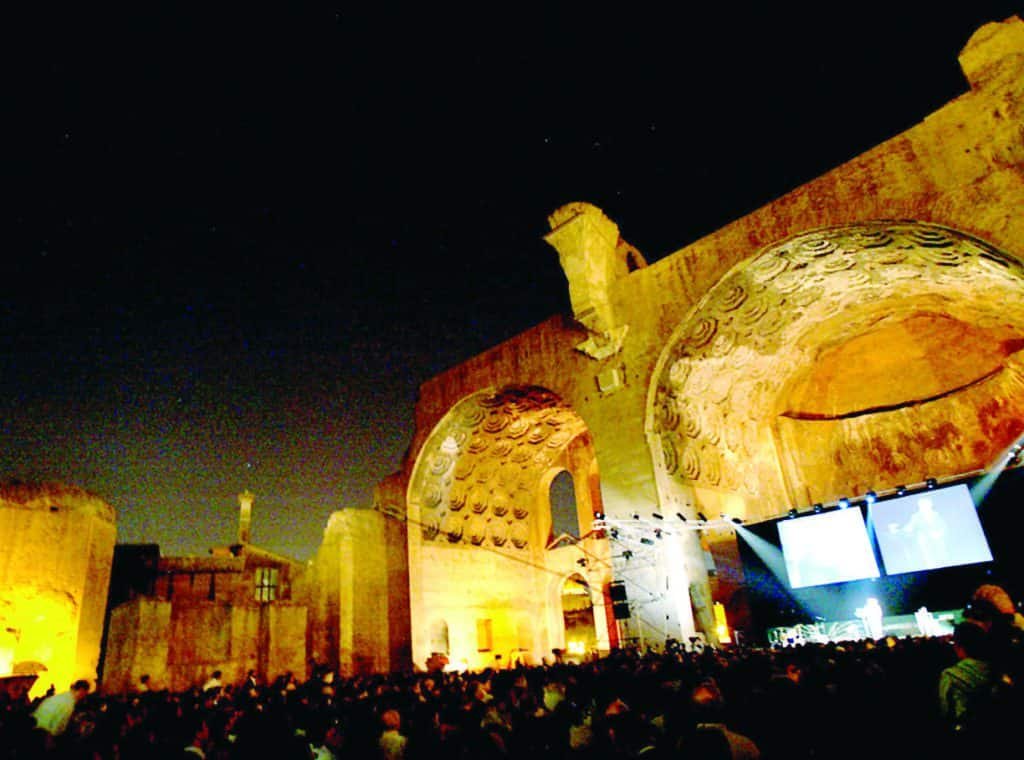
From July 2 to 29, 2026, the Accademia Nazionale di Santa Cecilia brings its summer season back to the Basilica of Maxentius after 47 years away, with evening concerts at 21:00. Anyone who remembers Rome's summers in the 1970s knows what that means: for a generation, listening to symphonic music in that spot was normal, and then it no longer was for half a century.
Who has passed through the Basilica of Maxentius
The list is long and covers very different jobs. I'll take the ones I can say something concrete about.
The emperors
Maxentius first of all, who had his construction site and his vision of the city here, and who died in 312 without seeing the roof finished. Constantine, who completed the building and put his own name on it, and whose image, 12 meters tall, dominated the western apse for a length of time we cannot measure. After them, the Western emperors of the 4th and 5th centuries who, on their rare visits to Rome, passed along the via Sacra: the basilica was one of the buildings the imperial ceremonial went through.
Prefects and senators
The real daily visitors were the officials. The urban prefect, the highest civil office in late antique Rome, had his offices here. Senators sat here as a court when the Secretarium Senatus was moved into the building. Among the urban prefects of the late 4th century are the great names of the Roman aristocracy, the cultured and conservative class that in those same years defended the ancient religious traditions against the Christian court. Every day, walking under these vaults, the ruling class of a city that was changing religion passed through.
The popes
Paul V Borghese is the one who left the most visible mark, carrying off the column in 1613. But the relationship between the papacy and these ruins is long and prosaic: for centuries the area belonged to church institutions, was granted for use, cultivated, and leased. For a long time, the largest monument in the Forum was a piece of property.
The architects
Between the 15th and 16th centuries, the basilica was a classroom for generations of designers. Leon Battista Alberti, when he conceived the vaulted nave of Sant'Andrea in Mantua, was working from a Roman repertoire of which this building was the largest piece. The architects working on the designs for the new St. Peter's confronted here, by measuring it, the problem of the large vaulted span. Andrea Palladio, who returned to Rome several times to survey the antiquities, included in his own repertoire the building that everyone at the time called the Temple of Peace. The design legacy of the basilica is documented by architectural historiography and concerns a line running from Mantua to Carpi to the churches of the Veneto.
The engravers and Grand Tour travelers
In the 18th century the ruins enter the canon of Roman views, and Giovanni Battista Piranesi engraves them among his views of Rome under the traditional name Temple of Peace. His plates have shaped the European image of antiquity more than any treatise, and that's why Grand Tour travelers arrived in the Forum valley already knowing what to look for. In the 18th and 19th centuries, painters, draftsmen and architects from half of Europe set up their easels in front of these vaults. Travel literature of the period, from Goethe onward, makes the walk between the Capitoline, the Forum and the Colosseum the quintessential Roman experience.
The archaeologists
Antonio Nibby and Carlo Fea, rivals, are the two names who return the building to real history in the 19th century. After them came generations of topographers and restorers: the reconstruction of the monument's structures and stability that is accepted today comes from a collective study published in the early 2000s, which involved engineers and archaeologists and rewrote the chronology of its phases.
The athletes and the musicians
In the summer of 1960, wrestlers from half the world passed through here, with their coaches and 20 journalists on the phone. In the summer of 2026, the musicians of the Accademia Nazionale di Santa Cecilia and their guests are coming. If there is one thread that ties together the late antique law court, the Olympic platforms and the orchestra, it's that this building has always worked as a container for audiences. It was born for that.
Concerts at the Basilica of Maxentius
For a generation of Romans, the Basilica of Maxentius was above all a place of music. Between the 1930s and the late 1970s, the ruins hosted summer seasons of symphonic concerts, with the stage set up under the vaults and the audience seated in the vanished nave. Then that chapter closed, and for decades anyone passing by in the evening in front of the lit bays found them empty.
The return of Santa Cecilia
From July 2 to July 29, 2026, the Accademia Nazionale di Santa Cecilia brings its summer season back to the Basilica of Maxentius after 47 years. Performances begin at 21. The announced schedule includes, among other evenings, the opening on July 2 with pianist Alexander Malofeev and conductor Manfred Honeck, the Four Seasons danced to choreography by Mourad Merzouki on July 4, film music by Alexandre Desplat on July 9, the Verdi gala on the 15th, Rhapsody in Blue with Stefano Bollani and Daniel Harding on the 17th, a Chopin nocturne with pianist Martina Meola on the 21st, Mozart's Requiem on the 24th, and the closing on the 29th with Handel and Vivaldi performed by Concerto Köln. The schedule and box office information can be checked on the website of the Accademia Nazionale di Santa Cecilia. The detailed program is also described on the page for Santa Cecilia a Massenzio.
How a concert at the Basilica of Maxentius works
I speak from experience of Rome evenings in archaeological sites, and there are a lot of them. First thing: outdoor acoustics in a ruin are a compromise, and the technicians work with amplification. Anyone looking for the sound of a concert hall will be puzzled, anyone who accepts that the value of the evening is the combination of music and place comes away happy. Second thing: bring something to put over your shoulders even in July, because when the sun goes down the breeze coming down from the Palatine cools the area more than you'd expect. Third: arrive early, because the checks at the entrance of an archaeological area are slower than at a theater, and the seats are numbered but the path to reach them is long.
The tip: if the concert starts at 21, show up around 20. Not just for the line. The light fading over the brick between 20 and 21, in July, is the most beautiful part of the evening, and it's worth the ticket on its own.
How to visit the Basilica of Maxentius today
The regular visit takes place from inside the Roman Forum archaeological area, with a ticket for the Parco archeologico del Colosseo. There is no entrance dedicated to the monument alone, no separate ticket, and no ticket office on site.
The route
Entering from the access on Via dei Fori Imperiali, you go down into the Forum valley, follow Via Sacra east, and after the Temple of Antoninus and Faustina and the Temple of Romulus complex you arrive below the northern side of the basilica. The path runs along the podium. From there, the route continues toward the Arch of Titus and the climb to the Palatine, or toward the exit in the direction of the Colosseum. If you enter from the Colosseum side, the basilica is the first large monument you meet going up Via Sacra.
How much time you need
For the Basilica of Maxentius alone, 20 minutes is enough, and that's the right amount of time if you really look at it, stopping at three different points and looking up at the coffered ceilings. For the Roman Forum as a whole, plan on two hours, or three if you read the panels and visit the museum. Add a good hour for the Palatine. If you also have the Colosseum, the day is full, and my advice is to split it into two half-days, using the 24-hour validity of the combined ticket.
Can you go inside the vaults?
No, not on the regular route. The bays are fenced off and are viewed from outside. The interior opens for events, installations and special visits organized by the Park, which should be checked case by case on the official website. Knowing this in advance avoids disappointment and helps you plan your stop better.
Do you need a guide?
I'm answering as a professional, so with the honesty the question calls for: for the Roman Forum, yes, for the basilica alone, no. The Forum without someone to tell its story is a field of stones in which 90 percent of visitors can't tell a temple from a warehouse. The Basilica of Maxentius, on the other hand, explains itself, because it's the only building in the area that has kept its volume: you can see what it was. If you have to decide where to invest your storytelling budget, spend it on the rest of the Forum and on the Palatine.
How much does it cost to visit the Basilica of Maxentius and how to save money
The cost is that of the Park ticket, and there are two useful combinations.
The first is the "Colosseo, Foro Romano, Palatino" ticket: €18 full price, €2 reduced for European Union citizens aged 18 to 25, €11.50 with the Roma Pass, €14 for members of the Friends of the Park program. It's valid for 24 hours and includes the first two levels of the Colosseum with the panoramic terraces, the Colosseum Museum, the Roman Forum with its museum, and the Palatine. The Colosseum is visited with a booked time slot and a stated stay of 75 minutes.
The second is the Forum Pass SUPER: €18 full price, €2 reduced for EU citizens aged 18 to 25, free for holders of the Park's Membership Card. It allows a single entry to the Roman Forum and Palatine area, includes the SUPER sites, the Domus Tiberiana and the Forum museum, does not require an hourly booking, and does not include the Colosseum. Pay attention to one specific condition: it can't be used on the first free Sunday of the month.
Free admission
Entry is free on the first Sunday of every month, on April 25, June 2 and November 4. It's free for anyone under 18 of any nationality, and for people with disabilities with a companion. The first Sunday of the month is free but very crowded: personally I don't recommend it for those visiting Rome for the first time with only a few hours to spare, while I recommend it for those who live in the city and can afford to come back.
The cheapest way to see the Basilica of Maxentius
€0, from the sidewalk on Via dei Fori Imperiali. I'm saying this without irony: the north flank, which is the preserved part, is better seen from outside than from inside. Anyone with just one afternoon in Rome who has to choose between the Colosseum and the Forum can look at the basilica from the street, understand it, photograph it, and spend the ticket money elsewhere. This isn't a shortcut for lazy tourists, it's a topographical fact.
The Basilica of Maxentius with children
It works, and better than almost everything else in the Forum. The reason is simple: children need volumes, not floor plans. In front of a broken column two meters tall nothing happens, in front of an arch 25 meters tall, everything happens.
The game that works best with kids is the measuring one. Ask the child to guess how many children standing on each other's shoulders it would take to reach the top of the big arch, then do the math together, knowing that the side vaults reach 24.5 meters. The answer, 16 or 17 children, always has the same effect. Second game: look for the octagonal coffers and count the rows. Third, the best one: tell them about the colossus's two-meter foot and then, if the tour continues to the Capitoline Hill, go see it for real. A promise kept is worth more than 10 educational panels.
Practical warnings. The Roman Forum has no shade, you get water at the drinking fountains the Park has set up in the area, the ground is uneven, and strollers don't push well over the basoli paving stones. With small children, a baby carrier or a baby carrier backpack beats a stroller by a long way. In summer, from 12 to 16, the Forum valley is an oven: with children, go in the early morning or in the last part of the afternoon, no exceptions.
Accessibility at the Basilica of Maxentius and the Roman Forum
The Colosseum Archaeological Park has worked a lot on this front, and the data can be verified on the official website. In the Roman Forum and Palatine area there are alternative routes to the paved route of Via Sacra, designed for people with mobility difficulties, and elevators that connect the different levels between the Forum, the Palatine and the Colosseum. Three main entrances are accessible to people in wheelchairs. Five wheelchairs are available at the main entrances to the Forum and Palatine, and three at the Colosseum. There is also an electric shuttle service for wheelchair users, by reservation.
For visitors with visual impairments, the Park has installed 11 tactile panels with architectural stories and has produced a tactile volume dedicated to the history of Rome, along with guided tours led by specialized staff. For visitors with hearing impairments, tours in Italian Sign Language are available with certified guides, and content in LIS and ASL is included in the Park's official app. The area has about 70 benches, 10 drinking fountains, eight accessible restrooms with changing tables, and 11 defibrillators.
About the monument itself, though, one concrete point needs to be made: the Basilica of Maxentius is viewed from the walkway of Via Sacra, which is flat in that stretch but has an uneven surface. The most comfortable view of all for visitors with mobility problems remains the one from the sidewalk on Via dei Fori Imperiali, which is paved, level, and free of barriers. This isn't a consolation: for once, it's the best viewpoint and also the most accessible one.
When to Visit the Basilica of Maxentius and When to Avoid It
Seasons
The best months for the Forum valley are April, May, October, and November. In April and May the archaeological area is green, the light lasts long, and the temperature lets you stand for three hours. In October and November the crowds thin out, the low afternoon light lasts from midday on, and the brick of the basilica looks its best. July and August are hard: no shade, stones reflecting the heat, and anyone who arrives at 13 with a straw hat and a half-liter bottle of water will be struggling within 20 minutes. January and February are underrated: the visit is good, the photos are good, and the early closing at 16.30 forces a compact tour that is often the best one.
Times of Day
The Roman Forum and Palatine open at 9.00. Those who enter at opening have about an hour in an area that is almost empty, and in summer it's the only civilized way to visit. The afternoon, from 16 on, empties out again and gets the best light. The central hours, between 11 and 15, are the worst for crowds and for photos.
Days to Avoid
The first Sunday of the month, when admission is free, brings long lines and congested routes. The spring bridge days, April 25 and June 2, combine free admission with holidays: they are the two worst days of the year. Monday, on the other hand, is a good day, because many museums in the city are closed while the Archaeological Park stays open, and those who arrive early find fewer organized groups than usual.
The Evening
The side of the basilica on Via dei Fori Imperiali is lit at night, and the evening walk from the Colosseum to the Capitoline Hill is one of the things I recommend most often to anyone with just one free evening in Rome. It costs nothing, takes half an hour, and the basilica lit from below, with its vaults in shadow and its warm brick, is a sight that holds its own against any paid interior.
Things to See Around the Basilica of Maxentius Within 10 Minutes on Foot
The short radius around this spot contains a density of monuments that has no equal in Europe. Here is the list, with real walking times.
Inside the Archaeological Area
The Arch of Titus, two minutes to the east, with reliefs of the Jewish triumph. The Temple of Romulus with its ancient bronze door, one minute to the west. The Temple of Antoninus and Faustina, built into the church of San Lorenzo in Miranda, with the grooves on the shafts that tradition attributes to attempts to pull the columns down with ropes. The House of the Vestals and the Temple of Vesta, three minutes. The Curia Iulia, the seat of the Senate, four minutes to the west. The Palatine with the Palatine Museum, 10 minutes uphill.
Just Outside
The Colosseum, five minutes on foot to the east, and the Arch of Constantine beside it, the largest triumphal arch in Rome, erected in 315 for Constantine's decennial and therefore strictly contemporary with the completion of the basilica. Seeing them in the same afternoon is the best way to understand Constantine's program in Rome.
The Mamertine Prison at the foot of the Capitoline Hill, eight minutes. The Trajan's Markets and the Museum of the Imperial Forums, 10 minutes going up Via dei Fori Imperiali. The Cordonata Capitolina and the Capitoline Museums, 12 minutes, where the circle closes with the fragments of the colossus. The Altar of the Fatherland, 12 minutes, with the panoramic terrace from which you can see the whole Forum valley from above.
A Bit Farther, but Worth the Walk
The Domus Aurea on the Oppian Hill, 15 minutes, open with guided tours by reservation on the days set by the Park. The Domus Romane di Palazzo Valentini, 15 minutes, to understand how people lived in a grand house in the center. The Circus Maximus, 12 minutes from the opposite side of the Palatine. And, for those who want to complete the portrait of the patron, the Villa of Maxentius on Via Appia Antica, with the circus and the mausoleum of his son Romulus: it is the other great construction project of the same emperor, outside the city, and it is preserved much better than this one.
The Basilica of Maxentius in Contemporary Culture
Few Roman ruins have had such an intense second life. The three bays have served as the backdrop for symphony concerts for decades, as an Olympic venue in 1960, as a setting for film shoots, and as the cover image of architecture history textbooks across half the world. The reason is always the same: it is the only monument in the Forum that offers a huge, unbroken vertical wall, and so it works as a theatrical backdrop.
In the repertoire of twentieth-century architecture, its descendants run deeper than most people think. The large vaulted halls of nineteenth-century and early twentieth-century railway stations, with their coffered barrel vaults on massive piers, openly look to this model: the main hall of the old Pennsylvania Station in New York, demolished in 1963, was its most celebrated quotation. When people say that Roman architecture has lasted through the centuries, they usually mean something vague, here it means a precise design, copied and adapted to shelter thousands of travelers from the rain.
One last observation. The Basilica of Maxentius is the Roman monument that visitors photograph the most without knowing what it is. You see dozens of them, every season, standing on the sidewalk with their phones raised toward the three vaults, convinced they are framing a piece of the Colosseum. It's not their fault: from the street there is no sign that explains it.
Quick Questions About the Basilica of Maxentius
Where Is the Basilica of Maxentius
In the Roman Forum, on the slope of the Velia, along the south side of Via dei Fori Imperiali, between the Temple of Romulus and the Arch of Titus. The address under which the Colosseum Archaeological Park lists it is Clivo di Venere Felice, 00186 Roma.
How Much Does a Ticket for the Basilica of Maxentius Cost
There is no ticket for the monument alone. You enter with the passes of the Colosseum Archaeological Park: the "Colosseo, Foro Romano, Palatino" ticket costs €18 full price and €2 reduced for EU citizens between 18 and 25 years old, the Forum Pass SUPER, which includes the Roman Forum and the Palatine without the Colosseum, costs €18 full price and €2 reduced for EU citizens between 18 and 25 years old.
Can You See the Basilica of Maxentius for Free
Yes, from the outside. The preserved north side, with the three barrel vaults, can be seen very well from the sidewalk of Via dei Fori Imperiali without paying anything. It is also the best photo spot. For the rest, the Park's free admission rules apply: first Sunday of the month, April 25, June 2, November 4, visitors under 18, people with disabilities and one companion.
What Are the Hours for the Basilica of Maxentius
Those of the Roman Forum-Palatine area, which opens at 9.00. From March 29 to September 30, 2026, the last entry is at 18.15 and closing is at 19.15, from October 1 to 24, 2026, last entry is at 17.30 and closing at 18.30, from October 25, 2026 to February 28, 2027, last entry is at 15.30 and closing at 16.30. Closed on December 25 and January 1.
Do You Need a Reservation to Visit the Basilica of Maxentius
A timed-entry reservation is mandatory for tickets that include the Colosseum. The Forum Pass SUPER, which gives access to the Roman Forum and the Palatine, does not require a timed reservation. Tickets are personal, and you may be asked for an ID at the entrance.
Can You Go Inside the Basilica of Maxentius
On the standard route, no: the three surviving bays are fenced off and are viewed from outside, from Via Sacra. The interior is opened for special events and displays.
How Much Time Do You Need to Visit the Basilica of Maxentius
20 minutes for the monument, really looking at it from three different points. Two or three hours for the whole Roman Forum, and one more hour for the Palatine.
Why It's Called the Basilica of Maxentius and Also the Basilica of Constantine
Because construction was started by Maxentius around 308 and completed by Constantine after 312. In late sources it appears as Basilica Nova, Basilica Constantini and Basilica Constantiniana, the name of the original patron was recovered by nineteenth-century archaeology.
How big was the Basilica of Maxentius
About 100 meters by 65 in overall footprint. The central nave measured 80 meters by 25 and reached about 35 meters in height. The side aisles were 16 meters wide and 24.5 meters high. The covered area without intermediate supports was about 2,000 square meters.
What remains of the Basilica of Maxentius today
Only the northern nave, with its three large bays covered by coffered barrel vaults and the masonry walls that divide them. The central and southern naves have collapsed.
Why the Basilica of Maxentius collapsed
Earthquakes. The earthquake of 847 brought down the southern and central parts. The one in 1349, the same one that detached the outer flank of the Colosseum, brought down what was left of the central vault. Later spoliation did the rest, carrying off marble, columns and cladding.
Where the columns of the Basilica of Maxentius ended up
Scattered, except one. Of the eight Corinthian columns of Proconnesian marble, 14.5 meters tall, the only one still standing in the 17th century was moved to Piazza di Santa Maria Maggiore by Pope Paul V in 1613. It still stands there today and is called the Column of Peace.
Where the colossal statue of the Basilica of Maxentius is
The marble fragments are at the Capitoline Museums, in the courtyard of the Palazzo dei Conservatori: among them the 2.60-meter head, a two-meter foot and the hand with the index finger raised. Since February 2024, a full reconstruction of the statue, about 13 meters tall, has been on display in the garden of Villa Caffarelli, next to the museum, with free admission.
Who was Maxentius
An emperor who ruled over Rome and Italy from 306 to 312, son of Maximian. He was defeated by Constantine at the Milvian Bridge on October 28, 312, and drowned in the Tiber. He was a great builder: the Basilica of Maxentius, the rebuilding of the Temple of Venus and Rome, and the villa with the circus on Via Appia Antica are his.
Why the Basilica of Maxentius was called the Temple of Peace
Because of an identification error that lasted more than 1,000 years. In the Middle Ages and the early modern period, the ruins were attributed to the Temple of Peace of Vespasian, which is actually located farther north, on the side of the Imperial Forums. The correction came in the early 19th century with Antonio Nibby.
The Basilica of Maxentius was a church
No. In Latin, basilica refers to a covered civic building, used for business and trials. Here were the offices of the Urban Prefecture and, in the 4th century, the court of the Senate.
Can you take photos at the Basilica of Maxentius
Yes, amateur photography is allowed in the Park area. The three shots I recommend are the frontal one from the sidewalk of Via dei Fori Imperiali, the one from below along Via Sacra, and the one from above, from the Palatine terraces above the Arch of Titus.
The Basilica of Maxentius is wheelchair accessible
The Roman Forum area has alternative routes to Via Sacra paving stones, elevators between levels, three accessible main entrances, wheelchairs available on loan and an electric shuttle service by reservation. Still, the monument can be viewed from the outside, and the most comfortable view of all is still the one from the sidewalk of Via dei Fori Imperiali, which is level and barrier-free.
There are restrooms and drinking fountains
Yes. The Park lists accessible restrooms with a changing table and around 10 drinking fountains spread around the area, in addition to a considerable number of seats. In summer, that is the difference between a pleasant visit and an hour of suffering.
How to get to the Basilica of Maxentius
By Metro Line B, Colosseo stop, or by Line C, Colosseo-Fori Imperiali stop. Above ground, bus lines 51, 75, 81, 85, 87 and 118 and tram 3 serve the area. On foot, it's five minutes from the Colosseum and 12 from Piazza Venezia.
Can you park near the Basilica of Maxentius
Badly, and I'll say so clearly: the area is inside the limited traffic zone of the Historic Center, and street spaces are very few and paid. With a car, it's best to leave it in a park-and-ride lot along the metro lines and get there by metro.
What's the difference between the Basilica of Maxentius and the Basilica Julia
The Basilica Julia, begun by Caesar in the Forum, is a traditional basilica with aisles on piers and columns and a timber roof, and today only its foundations and floor level remain. The Basilica of Maxentius is three centuries later, is vaulted in concrete and retains its volume. They are two different technical worlds, and that is why one can be seen and the other has to be imagined.
What's the difference between the Basilica of Maxentius and the Villa of Maxentius
They are two complexes of the same emperor at opposite points of the city. The basilica is in the Roman Forum. The villa with the circus and the Mausoleum of Romulus is on Via Appia Antica, at the third mile, and has its own ticket and route.
There are concerts at the Basilica of Maxentius
Yes. From July 2 to July 29, 2026, the Accademia Nazionale di Santa Cecilia holds its summer season here, with concerts starting at 21, after 47 years away from the site. Dates and box office should be checked on the Academy's website.
The Basilica of Maxentius is suitable for children
Very much so. It's the building in the Forum that children understand at once, because it has volume and not just a floor plan. Watch out for the heat and the uneven ground: with the youngest ones, a baby carrier backpack is better than a stroller.
The best time to go
April, May, October and November, at the 9.00 opening or in the last two hours before closing. Avoid the midday hours in summer, the first free Sunday of the month and the free-admission days of April 25 and June 2.
Is the Basilica of Maxentius worth a visit
Yes, and for a specific reason: it's the only building in the Roman Forum where you can sense the interior space of ancient architecture instead of rebuilding it in your imagination. Anyone who visits the Forum without stopping here comes away with a collection of broken columns. Anyone who stops understands what the Romans were as builders.
The final advice on the Basilica of Maxentius
If I had to name only one spot in the Roman Forum where you should stop for five minutes in silence, I would choose this one, under the north side, with the central arch above your head. Not because it's the most famous monument in the valley, which it isn't, and not even the most beautiful, which is debatable. It's because it's the only one that doesn't ask you to imagine anything. The whole Roman Forum is an exercise in mental reconstruction: that step was a temple, that column supported a portico, that rectangle of grass was the seat of the Senate. Here, no. Here the air is still inside the building, the vault is overhead, the coffers are in their place, and the concrete from 17 centuries ago is holding. Take someone there who tells you that antiquity is a matter of ruins, and watch his face. Then, the next day, go up to the Capitoline Hill to see the foot.
Article written by the editorial team at TourLeaderPro, contact them for Tours and Private/Corporate/V.I.P. Experiences.
Planning a trip to Rome? English-language guides for visiting the city are on ItalyPlanner.com.