Santa Cecilia at Massenzio 2026: Concerts Among the Ruins of the Forum
In short. For one summer month the Accademia Nazionale di Santa Cecilia moves great music inside the ruins of the Basilica of Maxentius, on the edge of the Roman Forum: colossal fourth-century vaults as a backdrop, the Palatine behind, darkness…
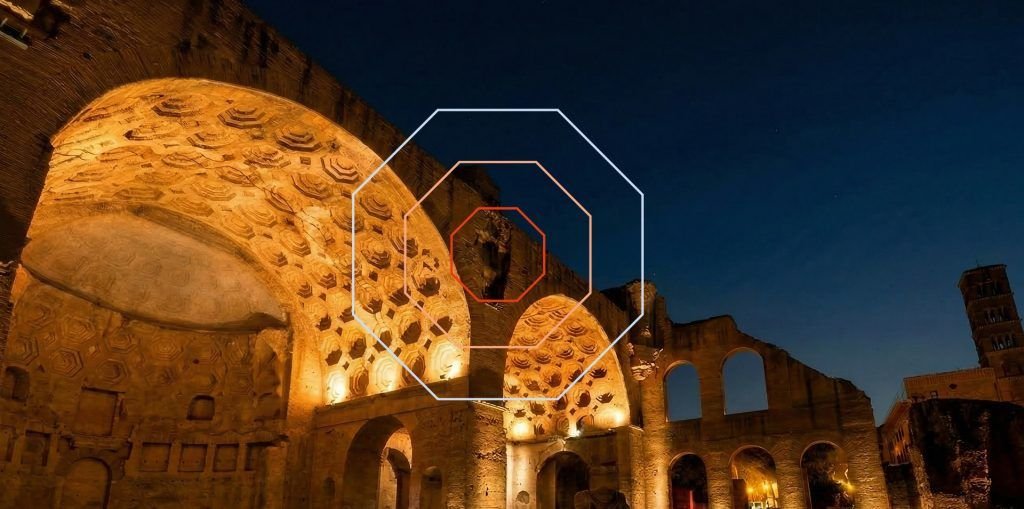
For one summer month the Accademia Nazionale di Santa Cecilia moves great music inside the ruins of the Basilica of Maxentius, on the edge of the Roman Forum: colossal fourth-century vaults as a backdrop, the Palatine behind, darkness falling over the Forums while the orchestra tunes. The 2026 edition is listed for the month of July, from the 2nd to the 29th, inside the Colosseum Archaeological Park.

There are places in Rome where the music comes after the architecture, and this one is at the top of the list. Before the first instrument enters, those seated in the audience spend 20 minutes looking up, because the three surviving vaults of the Basilica of Maxentius look like nothing else in the city. They are enormous, blind, marked by the octagonal coffers that the plaster lost centuries ago, and the artificial light of the stage turns them into a backdrop that no set designer could build. Then the music starts, and the thing happens that makes this series different from any indoor concert: the sound spreads upward and toward the Forum, and over your head pass the swifts, the gulls and, every so often, a plane descending toward Fiumicino.
The formula is simple and has held up for decades: the oldest musical institution in the city takes its season out of its hall, and takes it into an imperial monument that on its own, during the day, is visited with the ticket of the Colosseum Archaeological Park. The result is an evening that works on two registers at once, that of the concert and that of the nighttime archaeological visit. Below you'll find how the series is set up, how the space is laid out, how entry works, how to get there, how accessible it is and what is worth seeing before or after, with the warning that follows right away: it is September, and the Roman summer of music has already closed.
What Santa Cecilia at Massenzio Is and Where It Takes Place
The series is the summer offshoot of the programming of the Accademia Nazionale di Santa Cecilia. During the year the Academy's orchestra and chorus work in their home, the Auditorium Parco della Musica in the Flaminio neighborhood, where the institution has been since 2003. In summer, when the halls close and the city empties of Romans and fills with visitors, part of the production moves outdoors. The Basilica of Maxentius is the site of this move: an archaeological hall inside the Colosseum Archaeological Park, facing Via dei Fori Imperiali, a few dozen meters from the Arch of Titus and a short walk from the Colosseum.
The practical address is that of the Colosseum Archaeological Park, with access from the Fori Imperiali side. Those who arrive for the first time tend to look for a facade, a monumental entrance, a lit ticket booth. There is nothing like that: you enter through a service gate of the archaeological area, walk along a stretch of gravel and paving stones, and the basilica suddenly appears on the right, gigantic, with the stage built inside. This progression is part of the experience, and it's best to arrive with time to live it instead of rushing through it.
The name of the series puts together two things that in the minds of Romans already travel as a pair: Santa Cecilia, that is, the Academy, and Massenzio, that is, the monument. The formula has so entered usage that in the city people simply say "I'm going to Massenzio" and everyone understands what is meant, exactly as "I'm going to Caracalla" means going to the summer opera at the Baths of Caracalla. They are the two poles of Roman summer music inside an ancient monument, with two different characters: Caracalla is opera and big numbers, Massenzio is symphonic and chamber music, with a more intimate audience.
The canonical period is July. For the 2026 edition the calendar indicated covers the month from the 2nd to the 29th, so four full weeks of evenings spread out without covering every night. The length has been the same for years: one month, no more, because August in Rome empties the concert audience too and because an outdoor production inside an archaeological area has costs and constraints that don't allow long seasons.
A detail to keep in mind right away: the series occupies a monument that during the day is open to visitors of the Park. This means that setting up the stage, the seating and the sound system is a seasonal operation, authorized, reversible and supervised. It is not a theater that opens and closes its doors, it is a light building site that is installed in June inside a protected site, runs in July and is taken down right afterward. Everything the public perceives as inconvenience, from the mandatory routes to the unnumbered seating in certain sections, comes from there.
The Status of the 2026 Edition in September
Clarity is needed here, because the worst thing you can do with a summer series is leave the reader in doubt. Today is September. If the calendar of the 2026 edition closes on July 29, as indicated, this year's concerts at the Basilica of Maxentius are over by more than a month. Those arriving in Rome now and looking for an evening under those vaults won't find it: the stage is taken down, the area has returned to its daytime function as a visitable archaeological site and the Academy's programming has returned to the halls of the Parco della Musica, where the autumn season has already started.
This doesn't make reading this far useless, for two reasons. The first is that the Basilica of Maxentius remains visitable during the day with the ticket of the Colosseum Archaeological Park, and seeing it without the stage is a different experience but not a lesser one: you read the plan better, you understand the size of the vanished central hall, you walk on the ancient floor without rows of chairs in the middle. The second is that a series with this continuity has an excellent chance of returning next summer, and anyone planning a trip to Rome for next summer does well to know how it works, when to look, what to expect.
On one point it is worth being explicit: dates, titles, conductors, soloists and prices of the future edition cannot be deduced from the one just ended. The series changes its program every year, and no later calendar appears to be published at the time of writing. The only source that counts is the Accademia Nazionale di Santa Cecilia through its official channels, together with the communications of the Colosseum Archaeological Park regarding access and hours of the area. Everything that circulates before the official announcement, in the months when the program doesn't exist yet, is reconstruction.
Anyone reading in autumn or winter with the idea of booking still has a sensible strategy: keep an eye on the Academy's channels the following spring, and in the meantime keep in mind that July in Rome is the month when outdoor series overlap. On the evening you can't find a seat at Massenzio, there is almost always something else under the stars in the city, from the outdoor cinemas along the Tiber to the concerts at the Casa del Jazz.
The Accademia Nazionale di Santa Cecilia, Over Four Centuries of Music
To understand what it means to have Santa Cecilia inside an imperial basilica, it helps to know what Santa Cecilia is. It is not a festival created for the occasion nor a production label: it is one of the oldest musical institutions in the world, and its date of birth is documented. In May 1585 Pope Sixtus V issued the bull Ratione congruit, which made official the creation of the Congregation of Musicians under the invocation of the Blessed Virgin and of Saints Gregory and Cecilia. It was not an orchestra, it was a guild: Roman musicians joining together with both artistic and charitable aims, the way trade confraternities worked then.
The names that appear at the origin are enough to explain the weight of the undertaking. Among the promoters are Giovanni Pierluigi da Palestrina, the man who gave shape to Roman sacred polyphony, and Luca Marenzio, the most widely circulated madrigalist of his generation across Europe. The point deserves emphasis: the institution that today sends a symphony orchestra into the ruins of the Forums was born in the Rome of the Counter-Reformation, among composers who wrote for the basilicas and for the cardinals' chapels.
The first century of life is a wandering. From 1585 to 1685 the congregation changed six different church seats, starting from the church of the Pantheon, until settling for good at San Carlo ai Catinari. 100 years, six moves: anyone who knows Rome knows it is a path that crosses the historic center from one end to the other, and that each stop corresponds to a different balance between the guild of musicians and the church institutions that hosted it.
The modern turning point comes in the nineteenth century. From 1830, under the leadership of Luigi Rossi, the congregation transformed profoundly: in 1838 it became Congregation and Academy, then Pontifical Academy, and above all it opened to categories until then excluded, admitting leading European musicians as honorary members. It is the passage from professional guild to cultural institution, the one that makes everything else possible.
From 1895 the Academy acquired a permanent orchestra and chorus and regular concert seasons, developing in parallel advanced training programs and the music school. In 1998 it became a foundation. Today it brings together about a hundred academicians, a symphony orchestra and chorus of international standing, and since 2003 it has operated at the Auditorium Parco della Musica Ennio Morricone, the musical citadel designed in the Flaminio neighborhood.
Keeping these two extremes together helps in reading the summer series. When the orchestra plays inside the Basilica of Maxentius, an institution founded in 1585 performs in a building finished around 313. The distance between the two events, about 1,270 years, is greater than the distance that separates us from the founding of the Academy. Rome often has this effect of flattened perspective, and in that audience it does so in a particularly brutal way.
The saint's name, then, has a precise Roman geography. Cecilia is the patron saint of music through a late-antique tradition, and her place in the city is the Basilica of Santa Cecilia in Trastevere, with Stefano Maderno's statue under the altar. Anyone who wants to close the circle between the series and its name has the right stop there, on the other side of the river. Then there is the Conservatorio Santa Cecilia, which is a distinct thing from the Academy even though it shares the name and a long common history: the conservatory is the state music school, the Academy is the foundation with orchestra, chorus and academicians.
The Basilica of Maxentius as a Concert Space
Now the container, because here the container matters at least as much as the content. The Basilica of Maxentius, also called the Basilica Nova or Basilica of Constantine, is the last great civil building constructed in the Roman Forum, and in size it is the largest. It was not a church: basilica in Latin means a covered public hall, meant for the administration of justice and for business, and this one in particular was the reception hall of imperial power in the monumental heart of the city.
The structure you see today is a part of the whole, and understanding this radically changes the perception of the space. The three gigantic barrel vaults that serve as the backdrop to the stage are not the building: they are one of the two side aisles, the northern one. The central hall, much wider and much taller, was covered by three groin vaults supported by eight monolithic marble columns, and it collapsed. So the audience that sits inside the basilica occupies, literally, the side corridor of a building whose main hall no longer exists. Looking up toward the open sky and imagining that there was still another level of covering there is the mental exercise that does justice to the scale of the monument.
The octagonal coffers of the vaults are the visual signature of the space. They served two purposes at once: lightening the weight of the masonry, because a coffered vault weighs less than a solid one, and articulating the surface with a geometric rhythm that receives light differently depending on the hour. By day the sun crosses them at a slant and draws a checkerboard of shadows that keeps changing. In the evening, under the concert floodlights, they become a suspended grid that seems to float above the orchestra. No set designer would design something like that for a symphonic concert, and in fact it ended up there for other reasons, 1,700 years earlier.
The material is the other key to reading it. Opus caementicium, the conglomerate the Romans used the way we use concrete, is the real protagonist: what you see today is the bare structure, stripped of the marble cladding and the stuccoes that covered it entirely. The basilica was a luxurious hall, not a cavern of bricks. When you listen to a concert in there, keep in mind that the gray and the red of the brickwork are not the original color of the hall: they are the color of its skeleton.
On the acoustic side, a space like this is both a gift and a problem. The gift is the reverberation of the vaults, which gives the sound back with a long, enveloping tail, especially on the strings and the brass. The problem is that an open-air hall loses by definition everything that goes upward, and that the area sits in the middle of a living city. The solution is amplification, with a system tuned to return balance without turning the concert into a stadium event. Those who arrive used to the dry, surgical rendering of a modern concert hall must allow for a difference: here you hear an orchestra inside an architecture, not inside a box designed for sound.
The background noise, then, is part of the package. Via dei Fori Imperiali runs a few meters away, traffic never stops entirely, the swifts in July make a remarkable racket at sunset and the sirens go by. Those who experience it as a disturbance will struggle. Those who accept it as part of the context will discover that music inside an ancient city sounds different, and that this is exactly why it's worth being there.
The capacity of a setup like this remains limited compared with the large Roman summer venues. It is a limit imposed by the monument: inside a protected archaeological area you can't put up just any stands and you can't multiply the rows at will. The practical consequence is that seats run out, and that the series has historically had the profile of an event to book in advance rather than to decide at the last minute. Anyone who wants to see the building alone, without seating and without a stage, has the option of the daytime visit: the page dedicated to the Basilica of Maxentius explains how to fit it into the route through the Forum.
A Curiosity About Santa Cecilia at Massenzio 2026: Concerts Among the Ruins of the Forum
The curiosity concerns the eight columns that are no longer there, and in particular one of them, which instead still exists and can be seen for free, in another part of the city, standing in the middle of a piazza.
The central hall of the basilica was marked out by eight monolithic columns of Proconnesian marble, oversized even by Roman standards. When the building collapsed they ended up on the ground and stayed there for centuries, half buried, as happened to all ancient material before someone decided to reuse it. One of these columns was recovered at the beginning of the seventeenth century and raised again elsewhere by the will of Pope Paul V: it stands today in Piazza Santa Maria Maggiore, in front of the basilica, with a bronze Madonna on top.
This means that anyone who has walked in Piazza Santa Maria Maggiore, perhaps without noticing, has already seen a piece of the Basilica of Maxentius. The column that holds up the Virgin is the only one still standing of the colonnade that covered the hall where the series is held today. The papal reuse of ancient materials is one of the common threads of modern Rome, and this is one of the most spectacular cases: a load-bearing element of an imperial hall that becomes the base of a Marian monument a kilometer and a half away.
There is a corollary worth keeping in mind during the concert. When you look at the emptiness above the orchestra and try to imagine the vanished roof, the yardstick is not abstract: just remember that column in the piazza, its height, its diameter, and multiply it by eight. The hall those columns supported was more than twice as tall as the side vaults that serve as a backdrop today. The audience seated under the three surviving vaults finds itself, so to speak, on the main floor of an apartment building that has lost its penthouse.
A small note on historical method, because the literature here is vast and not always in agreement: the reconstruction of the building phases of the basilica, of the original orientation of the entrance and of the later Constantinian intervention, with the shift of the axis and the opening of a new access from the Forum side, has been a matter of archaeological debate for more than a century. Current syntheses agree on the general lines, less on the details. Those who want to go deeper will find in the Imperial Forums Museum and in the rooms of the Palatine Museum the material context to understand what is being discussed.
How the Program of a Summer Series at Massenzio Is Built
A clear premise is needed here: the lineup changes every year, and inventing titles, conductors, soloists or program pairings would be a terrible service. What can be described, and what the traveler really needs, is the logic by which an outdoor summer program is built, because that logic is stable and lets you understand in advance what kind of evening to expect.
The first constraint is space. An unroofed Roman basilica is not a concert hall: the stage has limited depth, the orchestra has a maximum footprint beyond which you can't go, and the logistics of setting up inside an archaeological area don't allow complicated changes of setup from one evening to the next. This naturally pushes toward ensembles that adapt, and toward a program that alternates full-ensemble evenings with chamber or solo evenings.
The second constraint is the audience. A summer series in an archaeological site has a much more mixed audience than a winter season: next to the subscriber who follows the orchestra all year sits the foreign visitor who bought the ticket because they wanted to see the Forum at night, and the Roman who brings visiting friends. A program built only for the first type of spectator wouldn't work, and a program built only for the second would betray the institution. The middle path produces lineups that put together recognizable great symphonic repertoire, choral pieces, chamber appointments and forays outside the classical perimeter.
The third constraint is length. Outdoors, in July, starting in early evening, the concert has to end in reasonable time, both for the audience's trip home and to respect the hours agreed with the archaeological area. Hence the tendency toward compact evenings, often without an intermission or with a short one.
The fourth element is not a constraint but a possibility, and it is what makes these series interesting even for those who rarely attend classical music: the place allows pairings that in a hall would have a different meaning. A program of early music inside a late-antique building, a twentieth-century piece under fourth-century vaults, a choral evening in a space born for imperial justice. The context adds a level of reading that no modern hall can offer.
What to do in practice, then, when the program of an edition comes out. Three operational tips. First: read the whole lineup before choosing, because in a short series the most sought-after evenings sell out first and are often not the ones with the most famous titles. Second: check the ensemble, because an evening with orchestra and chorus and an evening with a string quartet in the same space are two very different experiences, and in the second case the relationship between sound and architecture is more intimate and, in some ways, more surprising. Third: always verify the start time on the ticket, because in July the difference between 20:30 and 21:30 means playing with the sky still light or in full darkness, and it completely changes the scenic effect of the lit vaults.
One last warning on this chapter: prices. They vary by section and by type of evening, and can't be deduced from one edition to the next. The only reliable reference remains the Academy's official box office. Be distrustful on principle of unofficial resellers, which for limited-capacity events in a tourist city are a constant and costly phenomenon.
Something Nobody Tells You About Santa Cecilia at Massenzio 2026: Concerts Among the Ruins of the Forum
What is almost never said is that the highlight of the evening begins before the concert, and depends on when you arrive.
The typical audience enters at the last minute, ticket in hand and out of breath, sits down and waits for the orchestra. Those who arrive early, in the window from the opening of the gates to the start of the concert, find themselves walking inside the Roman Forum at sunset, with very few people around, at an hour when the archaeological area is normally not accessible to visitors. That stretch of the route, between the entrance gate and the basilica, is in effect a nighttime visit of the Forum that nobody sells as such and that is included in the concert ticket.
The difference in light, within 40 minutes, is enormous. The travertine and marble of the Forums go from ocher to pink to gray, the columns lose volume and become silhouettes, and the Palatine overhead stands out against a sky that in July stays light for a long time. Then the artificial lights of the site come on and the scene changes again. Those who arrive when it's already dark miss this whole sequence and see only the last frame.
The second little-mentioned element concerns temperature. July in Rome, during the day, is heavy. In the evening, inside an archaeological area of stone and without buildings that act as a thermal buffer, the heat accumulated by the surfaces is given back slowly. At nine in the evening you can be comfortable, around 11 the stone has given up its heat and the air coming down from the Palatine arrives. It is not cold, but a drop that surprises those who dressed only for the afternoon heat. A light shirt to put on top, in your bag, solves it.
Third element: the ground. You walk on gravel, ancient paving stones, uneven stretches and a few ramps. In the dark, with museum lighting that points at the monuments and not at the paths, the surface is treacherous. Thin-heeled shoes in there are a terrible idea, and it's not a question of elegance: the heel gets stuck between the paving stones. The audience at Roman summer concerts is full of elegant people in the wrong footwear leaving with a limp, and it's a spectacle that repeats every summer.
Fourth and last: the trip home. At the exit, just before midnight, the whole audience leaves together through the same gate and pours onto Via dei Fori Imperiali. Taxis at that spot and that hour are contested, ride-booking apps go to surge pricing, and the subway stop at Colosseo, if the line is still running, absorbs the wave with some difficulty. Those who thought ahead start walking toward Piazza Venezia or toward the side Forums and find the situation much calmer after five minutes on foot.
How Entry Works
The concert ticket must be clearly distinguished from the site ticket, because it is the most frequent source of misunderstanding.
The concert ticket is issued by the Accademia Nazionale di Santa Cecilia through its own official box office, and entitles you to enter the area on the evening of the performance, to follow the marked route to the basilica and to occupy the indicated seat. It is not a ticket for the Colosseum Archaeological Park and does not allow you to roam freely around the Forum or climb the Palatine: the evening route is delimited and supervised, and this is entirely normal inside a protected area of that importance.
The ticket of the Colosseum Archaeological Park, conversely, is the one needed to see the Basilica of Maxentius by day together with the Roman Forum, the Palatine and the Colosseum. It is a timed entry ticket, with a time slot to choose at purchase, and the Basilica of Maxentius is part of it at no extra charge because it lies along the main route of the Forum. Those who arrive in Rome off-season and still want to see the space of the series go through here.
Some practical notes that apply to the concert evening. The gates open well ahead of the start, precisely because the internal route takes time. It is worth taking advantage of it. The entrance check includes a bag search, so bulky backpacks and travel luggage are a problem: those arriving straight from the station would do well to leave their suitcases first. Glass bottles and rigid containers almost never get through the checks at this kind of event, while a plastic water bottle in July is practically a necessity.
On seating: in a temporary setup inside a monument, the sections are what the structure allows, and the quality of the view changes quite a bit from one point of the hall to another. The general rule, in a space as narrow and long as a side aisle, is that the central rows offer the best compromise between closeness to the stage and the ability to take in the whole of the vaults at a glance. The very first rows bring you closer to the orchestra but force you to keep your neck tilted back to see the architecture, which is half the reason you are there.
On the weather: outdoor shows in July in Rome are almost always carried through, because rain is rare, but a summer thunderstorm can change the evening. The conditions for postponement or cancellation are indicated on the ticket and on the organization's official channels, and they are the only thing that counts in case of problems. No third-party information replaces that communication.
One last recommendation, trivial but useful: the name on the ticket. For events with limited capacity the box office may require that the ticket holder match the ID. If you are buying for others, pay attention to the ways of assigning the name provided at the time of purchase.
My Advice for Visiting Santa Cecilia at Massenzio 2026: Concerts Among the Ruins of the Forum
There is only one piece of advice: build the day around the concert, don't squeeze the concert into an already full day.
The wrong way to experience an evening at Massenzio is to arrive at 20:30 after walking nine hours among the Vatican, the Pantheon and the Trevi Fountain, with your legs in pieces and your head saturated. In those conditions the orchestra becomes background and the vaults become a wall. The right way is to keep the afternoon free, or fill it with something light and nearby, arrive rested and give the route inside the Forum the time it deserves.
In concrete terms, the day that works best is this. Morning devoted to the archaeological area proper, with the Park ticket: Colosseum at opening, then Roman Forum and Palatine, passing in front of the Basilica of Maxentius and looking at it by day, without the stage, with the plan readable. A slow lunch and an afternoon in the shade, preferably indoors and air-conditioned: a museum, a rest at the hotel, anything that takes your legs out of the sun. Then a light, early dinner, because eating heavy before a concert in July is the surest way to fall asleep by the second movement. Finally the entrance gate, well ahead of time.
Seeing by day the same building that in the evening will serve as a concert hall is not a repetition, it's the trick that multiplies the value of the evening. By day you understand the plan, you see the three apses, you measure by eye the emptiness of the central hall, you read the relationship with Via Sacra and with the Arch of Titus. In the evening all of this becomes silent context behind the music, and whoever did the walk-through recognizes it even in the dark.
Second piece of advice, minor but concrete: dinner. The area around the Forums is one of the most touristy in the city, and the average quality in front of Via dei Fori Imperiali is what it is. Going up toward the Monti district, a few hundred meters from the entrance gate, the ratio between price and plate changes for the better. It is also a pleasant walk in the late afternoon, with the uphill streets in shade.
Third: don't bring bulky cameras. The entrance check, the space under the chair and the rules on filming during the concert make heavy equipment more of a nuisance than an advantage. For the kind of photography you do there, the phone is more than enough, as I explain further on.
How to Get There
The Basilica of Maxentius is in the archaeological heart of Rome, and this is both an advantage and a complication: every means of transport gets there, but none arrives exactly in front.
The subway is the simplest solution. Line B has a stop dedicated to the Colosseum, which opens practically at the foot of the amphitheater, and from there to the entrance area of the Forums it's a few minutes' walk on a flat, well-lit route. For the evening trip back, though, what counts is the closing time of the service, which in certain time slots and on certain days of the week is earlier: those who count on the subway to return to the hotel after a concert that ends late must check the last useful run beforehand, otherwise they find themselves outside with an idea of transport that no longer exists.
Buses serve the area from several directions, with terminals and interchange hubs concentrated between Piazza Venezia and the Colosseum. The night network covers the main routes with much lower frequencies, so the same warning applies: find out before, not after. In many cases, for those staying in the center, the best solution remains walking. From the Forums area you reach the Monti district on foot in 5 minutes, Piazza Venezia in 10, the Pantheon in 20, Trastevere in a good half hour passing under the Campidoglio and along the Theater of Marcellus.
Tram number 3 and the lines that go through Viale Aventino and Circo Massimo offer an interesting alternative to those staying toward the Aventine or Testaccio. From the Circus Maximus area you reach the Forums area with a short, slightly uphill walk, which in the evening is one of the most beautiful walks in the city.
The car is the worst choice. Via dei Fori Imperiali and the whole surrounding area fall under a strongly limited traffic regime, surface parking is scarce and expensive, and the electronic gates fine without mercy anyone who enters without authorization. Those coming from outside Rome should reason correctly: leave the car in a park-and-ride along a subway line and complete the trip by public transport. The interchange stations on Line B, in the southbound and northbound directions, exist exactly for this.
The taxi works well going and badly coming back. Going, just get dropped off at the Colosseum or Largo Corrado Ricci. Coming back, as already said, the simultaneous outflow of the audience creates a concentrated demand that the service can't absorb right away. Walking away a few minutes before calling is the strategy that works.
Those arriving from Termini station have two reasonable options: subway Line B with no transfer and a few stops, or 25 minutes on foot downhill via Via Cavour, which in summer, in the late afternoon, is a very pleasant walk and lets you detour to San Pietro in Vincoli to see Michelangelo's Moses before the concert, if the church's hours allow it.
Another Well-Known Fact, Yet Rarely Cited
The well-known fact is that the basilica is called that of Maxentius but Constantine finished it, and that this detail, which all the books report, has a political consequence that almost nobody spells out when telling the story of the monument.
Maxentius ruled Rome in the early years of the fourth century and launched an ambitious building program in the monumental center, with this hall as its flagship. In 312 he was defeated and died in the clash with Constantine at the gates of the city. The building, still under construction, passed to the winner, who completed it with modifications and claimed the credit. Hence the double name under which the basilica appears in the literature: Basilica of Maxentius and Basilica of Constantine, depending on which phase one wants to emphasize.
The little-cited consequence is that this is one of the clearest cases of political rewriting of urban space in antiquity. Constantine did not demolish his rival's work: he finished it, shifted its axis and entrance, and placed his own colossal image in it. The message for those who entered was direct and needed no captions: the loser's project is concluded under the sign of the winner. The same logic can be read a few meters away in the Arch of Constantine, where the reuse of reliefs from monuments of earlier emperors builds a dynastic continuity that in fact did not exist.
There is a second aspect, less ideological and more technical, equally well known and equally little told: this building is the link between Roman bath architecture and the architecture of the great Christian basilicas. The plan with a central hall covered by groin vaults, side aisles with transverse barrel vaults and a terminal apse was not born in churches: it was born in the halls of the imperial baths, where similar structures covered the reception spaces. Anyone who has seen the Baths of Caracalla recognizes the scheme immediately. And anyone who enters St. Peter's or any great Renaissance church is looking, a millennium and a half later, at the descendant of this structural solution, studied and measured by the architects of the fifteenth and sixteenth centuries on these very ruins.
Put brutally: the Basilica of Maxentius is an open-air architecture manual, and the fact that a concert is held inside it is almost a detail. Almost.
Accessibility
The subject has to be approached honestly, because Roman archaeological areas have real constraints and generic information does damage.
The Archaeological Park of the Colosseum has worked over the years on accessible routes, with equipped stretches and solutions for overcoming the main differences in level, and the monument is included in itineraries designed also for those with mobility difficulties. That said, the setting remains an archaeological site: the ground is made largely of ancient basalt paving, gravel and packed earth, the differences in level are many, and the evening lighting is designed to show off the monuments, not to make the route legible for those who walk with difficulty.
Anyone with specific needs, for themselves or for someone they are accompanying, should do one thing only and do it before buying: contact directly the box office of the Accademia and the Park's reception service, explain the concrete situation, ask which gate to use, if there is an easier route for the evening, where the reserved seats are and how the assistance works. The answers change depending on that year's setup and are the only reliable information.
A few practical points that hold in general for an evening in that area. The walking distances from the entrance to the seat are not short, and need to be counted twice, there and back. The return happens in the dark and with many people moving in the same direction, a condition that makes any assisted movement more tiring. The seating of a temporary setup rarely offers comfortable backs and armrests, and the time spent seated generally exceeds an hour and a half. Toilets in an archaeological site are in temporary stations, not always close, and their accessibility has to be checked on the spot.
For sensory disabilities, outdoor amplification can create difficulty for those who use hearing aids, while the visibility of the stage depends a great deal on the sector: in a narrow, long nave, those with vision problems get real benefit from the rows closest in, which must be requested at the time of purchase and not afterward.
Those traveling with small children have to reckon with the schedule: a concert that starts late in the evening and ends close to midnight, in a place where you sit properly and in the dark, is not the most suitable solution for children below a certain age. Many festivals also set a minimum entry age. Better to check it beforehand than to argue about it at the gate.
The right photo to take at Santa Cecilia a Massenzio 2026, concerts among the ruins of the Forum
The photograph everyone tries to take is the stage with the lit vaults behind it, taken from your own seat. It almost always comes out badly, for simple technical reasons: the stage is much brighter than the vaults, the phone exposes for the light and the archaeological backdrop sinks into black. The result is a white rectangle in the middle of a dark smear, that is, exactly the opposite of what the eye saw.
The right photograph is taken beforehand, and it isn't about the concert. It is taken along the entrance route, in the golden half hour between sunset and dark, when the natural light and the site's artificial light have roughly the same intensity. In that window the vaults of the basilica still have volume, the sky has a color, and the contrast stays manageable. All you need is a phone held steady, with the exposure lowered slightly by tapping the screen on the brightest part of the masonry.
The framing that works best is vertical, taken from below, with the sequence of the three vaults receding in depth toward the right and a piece of sky at the top. Vertical works because the space is tall and narrow, and because it lets you include both the floor and the top of the masonry, giving the scale of the building. With a human being in the foreground, even a small one, the photograph gains measure and stops being an abstract wall.
The second photo you shouldn't skip is not the basilica but the context. Turning toward the Forum, from the route, you frame in a single shot columns, arches and the profile of the Palatine above. It is the photograph that tells where you are, and it is worth more than 10 close-up shots of the stage. With the sky in its blue phase, that is, 20 or 30 minutes after sunset, that scene looks excellent even with a phone.
Common-sense rules during the concert: no flash, ever, for any reason, no lit screen in the middle of the dark, because it can be seen from 30 rows away and ruins the experience for anyone behind, and no prolonged video recording, which besides being normally forbidden produces unusable files with saturated audio. The photograph is taken before the start and, if allowed, at the final applause. In between, you listen.
One last idea for those with time the next day: come back to see the same point in daylight and photograph it again. The day-and-night diptych of the same vault is the best memento you can take away, and it shows in two images what in words takes a paragraph.
What is around, from the Roman Forum to the Colosseum and the Palatine
The Basilica of Maxentius stands in the densest point of monuments in Europe, and anyone coming for a concert has around them, within a radius of 500 meters, material for three days of visiting.
The Roman Forum is the immediate context. The basilica faces Via Sacra, the road that crosses the whole area and that triumphal processions traveled going up toward the Campidoglio. A few steps away are the Arch of Titus, the church of Santa Francesca Romana with its Romanesque bell tower, and the Temple of Venus and Roma on the side toward the amphitheater. The Forum has no dedicated page in our archive, but it is visited with the Archaeological Park ticket and is inseparable from the route that leads to the monument.
The Colosseum is two minutes' walk away. Those who see it in the evening from the outside, lit up, with fewer crowds than in the daytime, understand why it remains the most visited monument in Italy. The interior visit requires a timed ticket and it's best to book it for the morning, away from the heat and the afternoon crush.
The Palatine is the hill that overlooks the basilica. You climb it from the Forum, and the climb pays off with one of the best views over the whole of the Forums and the Circus Maximus. Up there are the imperial residences, the Farnese Gardens and the Palatine Museum, which gathers the materials from the excavations of the hill and lets you put a face to the spaces you cross outdoors.
The Arch of Constantine stands between the basilica and the amphitheater, and it is the necessary reading alongside the monument of the series: same emperor, same communication strategy, same date.
On the other side of Via dei Fori Imperiali open the forums of the imperial age, with the Trajan's Markets and the Imperial Forums Museum, which tell their architecture with reconstructions and original materials. It is the right visit for a hot morning, because a substantial part of the route is indoors.
You reach the Campidoglio in 10 minutes: Michelangelo's piazza, the Capitoline Museums with their terrace over the Forum, the staircase of Santa Maria in Aracoeli and, on the opposite front, the Altar of the Fatherland. Going down toward the river instead, you meet the Forum Boarium with the two Republican temples and the Mouth of Truth.
For those who still have energy and want to stay on the Maxentius theme, there is a precise trip outside the walls: the Villa of Maxentius on the Appian Way, with the circus, the mausoleum and the remains of the palace. It is the same patron as the basilica, in a completely different context, and it closes the circle on an emperor who left more traces in Rome than his short reign would lead you to imagine.
Some Important Events That Took Place Here in History
The first event is the building site itself. Between the end of the first decade of the fourth century and the years immediately after, in an area of the Forum previously occupied by service structures, the largest hall ever built in the monumental center of Rome takes shape. For the city, which for decades had not seen a public work of this scale in the Forum, it was a notable fact in itself.
The second is the clash of 312 between Maxentius and Constantine at the gates of Rome, which ends with the death of the former and the entry into the city of the latter. It is the episode that changes the fate of the building and, in a wider perspective, the relationship between the empire and Christianity. The basilica is the most imposing material testimony of that handover.
The third is the Constantinian completion, with the modification of the original layout, the opening of a new entrance from Via Sacra side and the construction of a second apse. In the western apse a colossal statue of the emperor was placed, of which some large fragments have come down to us, now displayed in the courtyard of the Capitoline Museums: the head, a hand, a foot, parts of the legs. Anyone who has seen those fragments and then enters the basilica has the yardstick to imagine what it meant to stand in front of the intact original inside that hall.
The fourth is the collapse. The sources and the archaeological literature attribute the fall of the central roof to seismic events of the medieval period, with one earthquake in particular, remembered for the middle of the fourteenth century, indicated as chiefly responsible for the disaster. From that moment on the basilica is what we see: three side vaults standing and a great void beside them.
The fifth is the modern reuse of the materials, of which the column raised in Piazza Santa Maria Maggiore at the beginning of the seventeenth century is the most conspicuous episode. It is the phase in which the monument stops being an abandoned ruin and becomes a prestige quarry, and at the same time a study model for architects.
The sixth is the excavation, arrangement and clearing work on the area between the nineteenth and twentieth centuries, which gave the Forum its current appearance with the opening of the great artery that crosses it. It is an urban planning story debated to this day, because that road solved a connection problem and created one of fracture between the Republican forums and the imperial ones.
The seventh is the contemporary season of performances. The Basilica of Maxentius has entered the Roman cultural calendar as a stage space for summer events, and the permanent presence of the Accademia Nazionale di Santa Cecilia has made it one of the places that define summer in the city. The fact remains, curious for a building born as a courthouse, that today its most visible public function is that of a concert hall for a few weeks a year.
Who Has Passed Through Santa Cecilia at Massenzio 2026: Concerts Among the Ruins of the Forum
The question has two answers, one 2,000 years long and one a few decades long, and it's best to keep them separate.
On the monument's side, the protagonists of the moment when the Roman Empire changes skin have passed through here. Maxentius, who started the building site and did not see it finished. Constantine, who completed it, rewrote its orientation and placed his own colossal image in it. After them, for centuries, the people of a city that kept living among these structures, reusing them as a warehouse, as a quarry, as a topographic landmark. Then the architects of the Renaissance, who came to measure the vaults with a plumb line to understand how to build a roof of that span, and whose notes ended up in the great churches of the following centuries. Then the travelers of the Grand Tour, who drew these ruins until they became one of the most reproduced images in Europe, and the archaeologists of the nineteenth and twentieth centuries who restored its plan.
On the musical institution's side, the names that appear at the origin of Santa Cecilia are of the first rank: Giovanni Pierluigi da Palestrina and Luca Marenzio among the promoters of the Congregation of 1585, Pope Sixtus V as author of the founding bull, Luigi Rossi as architect of the nineteenth-century transformation that opened the institution to Europe. From 1838 onward the Academy welcomed leading European musicians as honorary members, and in the twentieth century it became one of the reference orchestras on the international scene, with a history of conductors and soloists that runs through the whole century.
Who conducted, who played and what was performed in the individual editions at the Basilica of Maxentius is a matter for the Academy's official programs, and reporting names without the lineup of that year in front of us would mean fabricating information. The solid fact is another, and it is already enough: the orchestra and chorus that play in that space are those of an institution founded in 1585, inside a building finished around 313. In the world there are very few pairings of this kind.
Quick Questions
Can the 2026 series still be seen?
No. The calendar indicated for the 2026 edition covers the month of July, from the 2nd to the 29th, and in September it is listed as concluded. The setup is taken down at the end and the area returns to its daytime function as an archaeological site.
Can you still visit the Basilica of Maxentius?
Yes. It is included in the route of the Roman Forum and is visited with the ticket of the Colosseum Archaeological Park, during the area's opening hours. Without the stage and without chairs, the plan of the building reads much better.
Where do you buy concert tickets?
At the official box office of the Accademia Nazionale di Santa Cecilia and on its channels. The concert ticket is different from the Archaeological Park's visitor ticket and does not replace it.
How long does a concert last?
It depends on the program of the individual evening. For outdoor series in July the typical length stays contained, often without an intermission or with a short one, for reasons tied to the area's closing time.
How do you get to the Basilica of Maxentius by public transport?
Subway Line B, Colosseo stop, and a few minutes on foot. Alternatively a bus toward Piazza Venezia or the Colosseum, or a tram and other transport from the Circus Maximus area. The car is not recommended because of the limited traffic regime.
What should you wear?
Closed shoes with a flat sole, because you walk on gravel and ancient paving stones even in the dark, and something light to put on top: after 23:00 the temperature drops more than you would imagine.
Is it suitable for children?
It depends on age and on the hour. A concert that ends close to midnight, seated and in the dark, works poorly below a certain age, and many series set a minimum entry age. It should be checked before purchase.
Does the concert take place if it rains?
The conditions for postponement or cancellation are indicated on the ticket and communicated by the organization. In July in Rome rain is rare, but a summer thunderstorm can change the evening.
Can you take photographs?
Before the start yes, and it's worth taking advantage of the half hour between sunset and dark. During the performance the rules of the evening apply: no flash, no lit screens, no prolonged recording.
What is the best seat in the audience?
The central rows, because in a narrow, long aisle they let you see the stage and the vaults together. The very first rows bring you closer to the orchestra but take the architecture out of view, which is half the reason you are there.
The final piece of advice is the one I repeat in front of those vaults to everyone I accompany: that place has to be looked at twice, by day and by night, because they are two different buildings. By day the Basilica of Maxentius is a fourth-century engineering problem, with its plan, its apses, its bare conglomerate and the memory of a vanished hall. At night, with an orchestra below and the Forum behind, it becomes something else: the proof that in Rome ruins are not museum monuments but spaces still usable, that keep doing what they were born to do, namely gathering people under a vault. That today those people gather to listen to music instead of for a court case is, all things considered, an improvement.
Frequently Asked Questions About Santa Cecilia at Massenzio 2026, Concerts Among the Ruins of the Forum
Where are the Santa Cecilia at Massenzio concerts held?
The Santa Cecilia at Massenzio concerts are held at the Basilica of Maxentius, also called the Basilica Nova or Basilica of Constantine, the last great civil building constructed in the Roman Forum, in the archaeological heart of Rome. The series is the summer offshoot of the programming of the Accademia Nazionale di Santa Cecilia.
Can the 2026 series still be seen in September?
No, the Santa Cecilia at Massenzio 2026 series is concluded as of September: the edition's calendar covers the period from July 2 to 29, 2026, so this year's concerts at the Basilica of Maxentius ended more than a month ago and the stage has already been taken down.
Can you still visit the Basilica of Maxentius?
Yes, the Basilica of Maxentius, the summer venue of the Santa Cecilia at Massenzio concerts, can be visited all year: it is included in the route of the Roman Forum and is visited with the ticket of the Colosseum Archaeological Park.
What is the Accademia Nazionale di Santa Cecilia?
The Accademia Nazionale di Santa Cecilia, which organizes the summer series at Massenzio, is one of the oldest musical institutions in the world: it was born in May 1585, when Pope Sixtus V issued the bull Ratione congruit that made official the creation of the Congregation of Musicians. Its usual home is the Auditorium Parco della Musica in the Flaminio neighborhood.
How do you tell the concert ticket from the archaeological site ticket?
For the Santa Cecilia at Massenzio concerts, the concert ticket is issued by the Accademia Nazionale di Santa Cecilia through its own official box office and entitles you to enter the area on the evening of the performance, following the marked route to the basilica. It is not a daytime visitor ticket for the Archaeological Park.
How do you get to the Basilica of Maxentius?
The Basilica of Maxentius, the venue of Santa Cecilia at Massenzio, is most easily reached by subway Line B, Colosseo stop, which opens practically at the foot of the amphitheater. From there to the entrance area of the Forums it is a few minutes' walk on a flat route.
Is the area of the Basilica of Maxentius accessible to people with mobility difficulties?
The Colosseum Archaeological Park, which includes the Basilica of Maxentius where Santa Cecilia at Massenzio is held, has worked over the years on accessible routes, with equipped stretches and solutions for overcoming the main differences in level, while remaining an archaeological site with real constraints of terrain.
Article written by the editorial team of TourLeaderPro, contact them for Private/Corporate/V.I.P. Tours and Experiences.
Planning a trip to Rome? The English-language guides for visiting the city are on ItalyPlanner.com.