Conservatorio S. Cecilia
In short. The Conservatorio di Musica Santa Cecilia occupies a historic building on Via dei Greci, in the heart of the Campo Marzio district, halfway between Piazza di Spagna and Via del Corso.
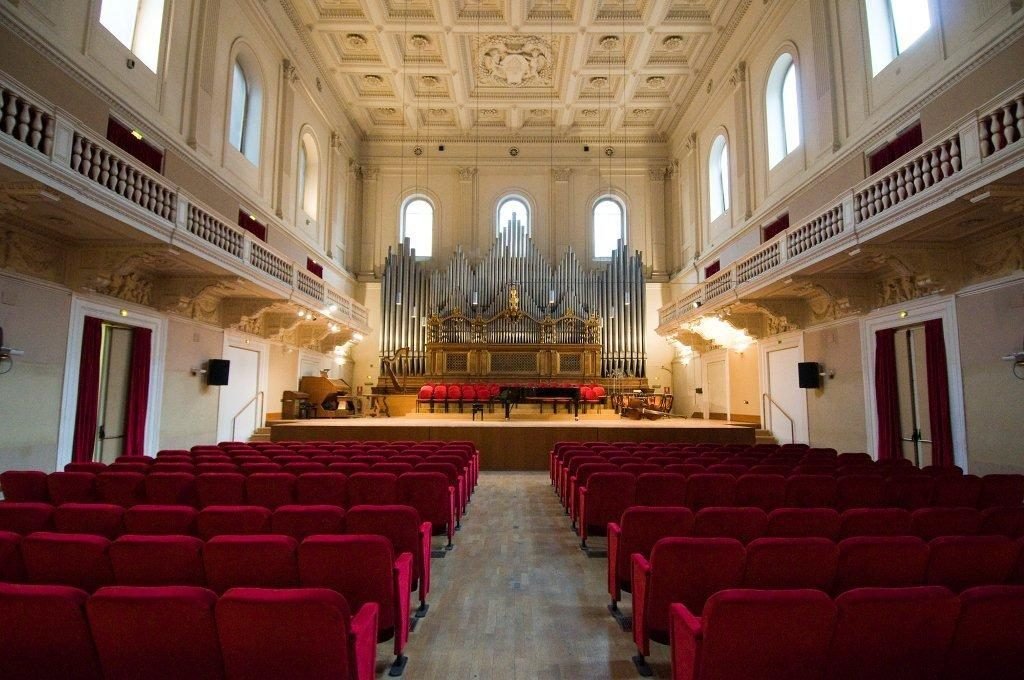
The Conservatorio di Musica Santa Cecilia occupies a historic building on Via dei Greci, in the heart of the Campo Marzio district, halfway between Piazza di Spagna and Via del Corso. It is the state institution that for a century and a half has trained instrumentalists, singers, composers and conductors, and it is a different thing from the Accademia Nazionale di Santa Cecilia, the concert institution that today is based at the Auditorium Parco della Musica: two bodies born from the same 19th-century root and today separate, with different tasks and different seats, which the distracted visitor systematically confuses. Here the two things are kept distinct from the start, because it is the most common misunderstanding about this corner of Rome. To get your bearings in the rest of the district, the pages on Piazza di Spagna, Via del Corso and Piazza del Popolo are also worth reading.
Where the Conservatorio S. Cecilia is and how you really get there
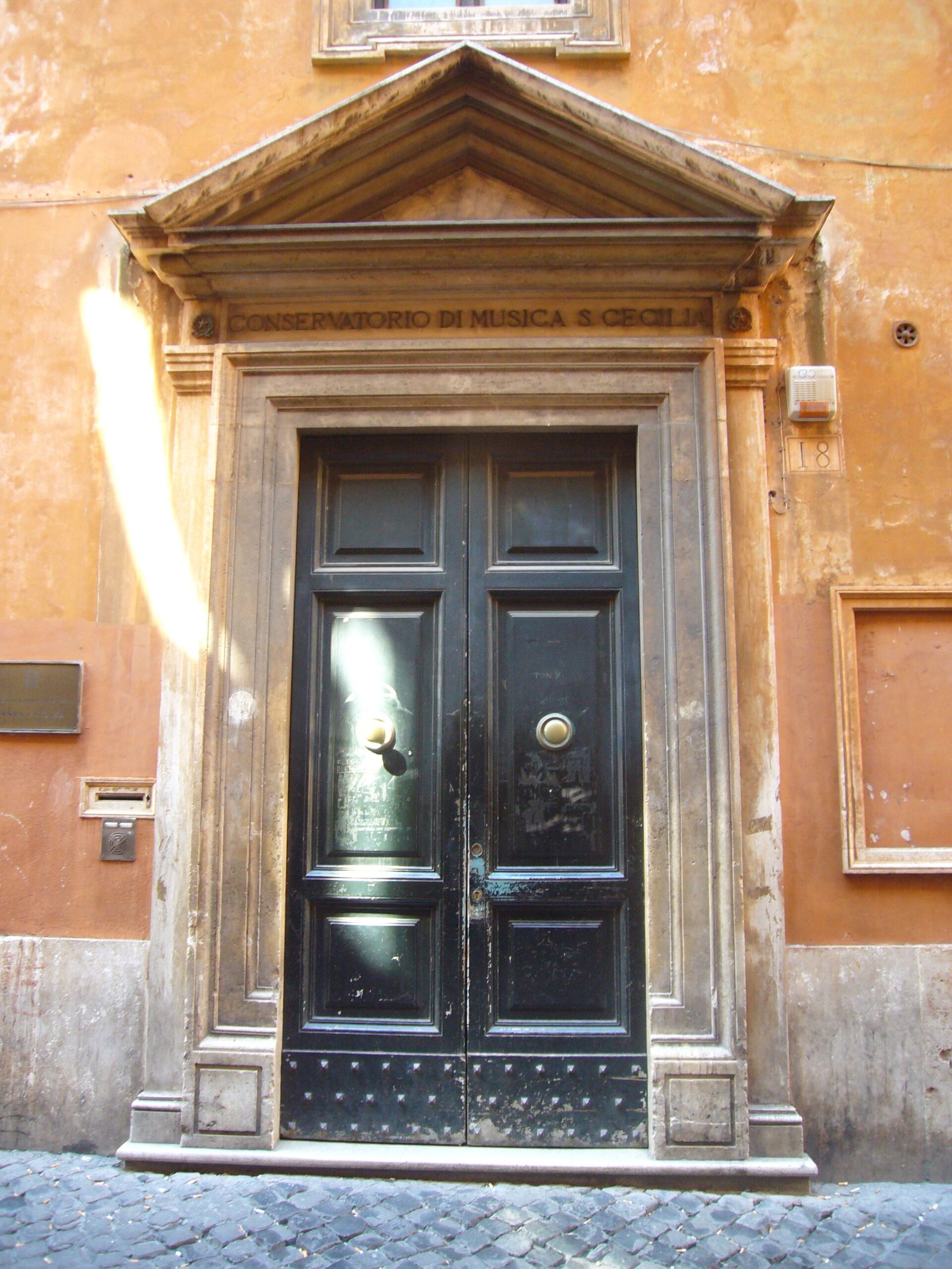
The address is Via dei Greci 18, 00187 Rome, on the stretch that links Via del Babuino to Via Margutta, a few steps from the Arco dei Greci and the church of Sant'Atanasio. It is a narrow, quiet street of Campo Marzio, wedged between two much busier axes: Via del Corso to the east, Via del Babuino to the west, with Piazza di Spagna about 500 meters away and Piazza del Popolo a little farther in the opposite direction. Anyone looking for the conservatory starting from one of the two most photographed monuments of Rome therefore finds it a walk of five or seven minutes, no more.
By metro and on foot to the Conservatorio S. Cecilia
The simplest way to get there remains the metro. The Spagna station of line A is at a comfortable walking distance: coming out in Piazza di Spagna, you head up toward Via del Babuino and turn onto Via dei Greci after the initial stretch of the street, or you pass through Via Vittoria. The route is all flat, in a pedestrian district dense with shops, art galleries and small hotels, and takes a few minutes even walking unhurried. Alternatively, from the Flaminio station of the same line A, which serves Piazza del Popolo, the conservatory is reached by going down Via del Babuino in the opposite direction.
By bus and surface transport
Campo Marzio is served by the electric lines on reduced routes that run in the historic center and link Piazza del Popolo, the Tridente and Piazza Venezia, as well as the ordinary lines that pass along Via del Corso and the nearby Lungotevere. Anyone arriving by bus from the rest of the city makes the last stretch on foot anyway, because no line physically enters Via dei Greci: it is too narrow a street for a public vehicle to run along it. It's therefore best to get off at the nearest stop on Via del Corso or at Piazza San Silvestro and complete the route on foot, which in this part of Rome is almost always the fastest solution.
By car and the parking problem
Arriving by car is the least practical choice. Via dei Greci falls within the limited traffic zone of the historic center of Rome, active in the time slots set by the city, and access without authorization carries a fine recorded by the electronic gates. The street-level parking in the area is paid and very scarce. The most realistic solutions are the garage car parks around Piazza di Spagna and Via Veneto, from which you continue on foot, or, for those coming from outside Rome, one of the park-and-ride lots connected to metro line A, leaving the car outside the limited traffic ring and completing the trip by metro. Anyone with an evening concert in the Sala Accademica would do well to allow for parking the same time they spend on the concert itself, because in this part of the historic center finding a free spot at the last minute, particularly on nights when there is a crowded event, almost always takes longer than expected.
By train and from the airport
Anyone arriving in Rome by train gets off at Termini station and continues by metro line A to Spagna, then completes the route on foot as described above: in practice it is the quickest way to link the city's main railway station to Via dei Greci, avoiding the surface traffic of the historic center. From both Roman airports, Fiumicino and Ciampino, the direct connections lead to Termini or to the main stations of line A, from which the trip to the Conservatorio takes a few additional minutes by metro.
What the Conservatorio S. Cecilia really is: distinct from the Accademia
Here things need to be made clear, because it is the point on which almost all the generalist sources slip. In Rome there are two different institutions bearing the name of Santa Cecilia, born from the same historical root but today separate by statute, seat and function, and a third expression, the Sala Accademica, that belongs to one of the two but is often attributed to the other.
The Conservatorio, a state teaching institution on Via dei Greci
The Conservatorio di Musica Santa Cecilia is an institute of higher artistic and musical education, the kind that in the Italian system is indicated by the acronym AFAM, equated by regulation to a university. It awards first-level and second-level academic diplomas in instrument, voice, composition, conducting, electronic music, jazz and music education, with a student population following multi-year programs under the guidance of a permanent faculty. The historic and main seat is that of Via dei Greci 18, the conservatory also has a branch seat in Rome, at the former Reali Equipaggi barracks at Sant'Andrea delle Fratte, operating since the 2013-2014 academic year, and a second branch seat in Rieti, at Villa Battistini, active since the 2008-2009 academic year. It is, in essence, a school: you enter here as a student and leave with a qualification.
The Accademia Nazionale, a concert institution now at the Parco della Musica
The Accademia Nazionale di Santa Cecilia is something else entirely. It is the concert institution, direct heir of the Congregation of Musicians founded in the 1500s, today a music production foundation with a permanent symphony orchestra and chorus, a concert season of its own, a museum of musical instruments and a highly specialized activity for young musicians who already hold a diploma. Since the opening of the Auditorium Parco della Musica, the large complex designed by Renzo Piano in the Flaminio district, the Accademia has had its permanent seat there, its own concert halls and its own offices. It does not award conservatory diplomas and has nothing to do, from the administrative point of view, with the institute on Via dei Greci: they are two different bodies, with two different budgets, two different boards of directors and two physical seats kilometers apart from each other.
The Sala Accademica on Via dei Greci: it belongs to the Conservatorio
The third element that generates confusion is the Sala Accademica, the large historic hall inside the building on Via dei Greci, where concerts, recitals, festivals and ceremonies are held. Anyone reading the name on posters often thinks of the Accademia Nazionale, but the Sala Accademica belongs administratively and physically to the Conservatorio: it is the historic hall of the teaching institute, not a seat of the concert body of the Parco della Musica. It happens that events organized in collaboration with other Roman musical bodies take place there, but the ownership of the space remains the Conservatorio's. Keeping this distinction firm avoids the most frequent mistake among those looking for a concert of the Accademia Nazionale by typing the wrong address, or vice versa.
Via dei Greci building: from 19th-century Rome to today's institute
The history of the institution that today occupies Via dei Greci begins well before the current seat. Its roots reach back to the Congregazione de' Musici di Roma, formed in the 1500s under the invocation of Santa Cecilia, patron saint of music, which for centuries was the reference point for the category of Roman musicians: anyone who wanted to work as a maestro di cappella in the Papal States had to pass an exam before the Congregation. It is from this ancient guild that descend, by different paths, both today's Accademia Nazionale and, indirectly, the musical culture from which the Conservatorio would be born centuries later.
1869 and 1870: the first public music school in Rome
Until the second half of the 19th century, Rome, capital of a state that had made sacred and liturgical music its natural terrain, had no public music school comparable to those already active in Naples, Milan or Paris. The gap was filled on the initiative of two musicians, the pianist Giovanni Sgambati and the violinist Ettore Pinelli, who obtained a space to give free courses starting in 1869. The official inauguration took place on May 23, 1870, when Cardinal Camillo Di Pietro decreed the opening of two schools, with 10 students each: it is the founding act of Roman public music education, at a delicate moment of transition for the city, which in that very year ceased to be the capital of the Papal States and entered the Kingdom of Italy.
1886 and 1895: the Liceo Musicale and the Sala Accademica
Growth was rapid. In 1886 a royal decree approved the statute of the Liceo Musicale, which already counted 43 teachers and 315 students spread over more than 30 courses: in under 20 years the school born with 20 enrolled had become an institute of considerable size. In 1893 the drama section split off from the Liceo and took a path of its own, which would in time lead to the birth of the Accademia Nazionale d'Arte Drammatica. In 1895 Queen Margherita inaugurated the Sala Accademica inside the building on Via dei Greci, a space of about 795 square meters with a capacity of up to 1,200 seats, designed from the start to unite teaching and public concerts under the same roof.
1911 and 1919: autonomy and nationalization
In 1911 the Liceo Musicale became an autonomous moral body, a step that consolidated its identity as distinct from the ancient Accademia from which it had sprouted. The decisive step came in 1919, when a reform of the national school system nationalized the institute and renamed it Conservatorio di Musica Santa Cecilia: it is the formal act that definitively separates, on the administrative level, the state music school from the ancient concert institution, even though the two realities remain linked by the same name and the same remote origin. From that moment the building on Via dei Greci became the seat of a state conservatory in every respect, comparable by statute to the other great Italian conservatories.
An urban building that doesn't betray what it contains
From Via dei Greci the building presents a sober facade, in line with the rest of the street, without colonnades or monumental pediments to signal from afar what it holds. It is a choice forced by the context: 19th-century Campo Marzio was already a densely built district when the school settled there, and there was no room to invent a scenic front like that, to make a better-known Roman comparison, of the Teatro dell'Opera or of the modern Auditorium of the Parco della Musica. The contrast between the discreet exterior and the interior, with the great Sala Accademica able to host over 1,000 people and the body of classrooms, offices, library and historic archive spread over several levels, is probably the aspect that most surprises anyone entering for the first time accompanied to a concert, after walking along a street that seemed to promise something else entirely.
The branch seats today
The institute has grown over time beyond the borders of the historic seat. Since 2008-2009 there has been a branch seat in Rieti, at Villa Battistini, while since 2013-2014 Rome itself has a second seat, carved out of the former Reali Equipaggi barracks near Sant'Andrea delle Fratte, a few minutes on foot from Via dei Greci. The double Roman seat lets the Conservatorio host a number of classrooms and activities much greater than the 19th-century building alone could contain: Via dei Greci remains, however, the symbolic and administrative heart of the institute, the one that anyone searching identifies first.
The masters who taught on Via dei Greci
Behind a building anonymous from the street, for 150 years an important part of the history of Italian music has moved. Retracing the names of the teachers who taught on Via dei Greci helps to understand why the Conservatorio S. Cecilia is not just a place of passage for anonymous students, but a real junction between generations of musicians.
Sgambati and Pinelli, founders turned first teachers
Giovanni Sgambati and Ettore Pinelli did not limit themselves to asking for the space for the first two free schools of 1870: they were also their first teachers, of piano and of violin respectively. Sgambati came from a musical path marked by his association with Franz Liszt, in Rome from 1861, who supported him and introduced him to a European repertoire, that of the German school, then little known in post-unification Italy dominated by melodrama. It was Sgambati himself, together with Liszt, who first introduced pages of Richard Wagner to the Roman public, and who conducted Italian premieres of Beethoven symphonies. Bringing that instrumental culture, not only operatic, into a classroom on Via dei Greci was the founding choice that gave the future conservatory a precise identity from the first day.
Respighi, teacher and first state director
In January 1913 Ottorino Respighi moved to Rome to take the chair of composition at the Liceo Musicale di Santa Cecilia. Among his students of those years were composers such as Vittorio Rieti and Ennio Porrino. With the transformation of the institute into a state conservatory, Respighi became its first director, a post he held until 1926, when he decided to leave the administrative office, little suited to his temperament, to return to devoting himself mainly to composition. He did not abandon teaching, however: he continued to give an advanced composition course in the same institute until 1935, staying tied to Via dei Greci for over 20 years in all, first as a teacher and then as a director.
Casella, the piano in the years of the Great War
Returning to Italy during the years of the First World War after a long period of training in Paris, Alfredo Casella began teaching piano at the Conservatorio Santa Cecilia, bringing to Via dei Greci a direct experience of the European musical avant-gardes of the early 20th century, from the Parisian circle frequented by Debussy and Ravel to the later experiments. His presence in those years helped make the Roman conservatory a place open to international musical debate, at a time when Italian music was looking for a path of its own beyond the 19th-century operatic tradition.
Petrassi, from Via dei Greci to the Accademia: the same person, two different institutions
The teaching career of Goffredo Petrassi tells, better than any theoretical explanation, the difference between the two institutions named after Santa Cecilia. Petrassi taught composition at the Conservatorio on Via dei Greci from 1940 to 1960, training among others Ennio Morricone, Aldo Clementi and Franco Donatoni. In 1960, when that assignment ended, he moved on to give advanced composition courses at the Accademia Nazionale di Santa Cecilia, which he kept until 1978: same name in the title of the two bodies, same master, but two administratively separate institutions, with different tasks, at two distinct moments of his long teaching career. If a concrete example is needed to grasp the distinction explained at the start, Petrassi's teaching trajectory is probably the clearest of all.
A curiosity about the Conservatorio S. Cecilia
Few, strolling between Piazza di Spagna and Via del Corso, imagine that behind the facade of a residential district hides a concert hall able to hold over 1,000 people, built when that zone of Rome was already densely built up and there was no room for a square or a monumental courtyard. The Sala Accademica, inaugurated in 1895 in the presence of Queen Margherita, was born precisely with this constraint: to fit inside a pre-existing urban building without betraying the ambition of a great concert hall. The result is one of those Roman places you discover only by going in, because from the street Via dei Greci gives no hint of anything like it.
There is also a detail few connect: the name of the street has nothing to do with music, but with the Collegio dei Greci wanted by Pope Gregory XIII in the 1500s to host students of the Greek rite in communion with Rome, complete with an arch suspended over the street to link the college to the nearby church of Sant'Atanasio. The Conservatorio settled centuries later in a street that already bore a name tied to another story of education and welcome, that of students who came from far away: a thin but real thread between two educational institutions born 300 years apart on the same street.
One thing nobody tells you about the Conservatorio S. Cecilia
Almost no tourist guide writes it, so we write it here: the Sala Accademica is not a museum or a monument to visit at fixed hours, it is a living hall, and this means that access depends entirely on the calendar of teaching and concert activities. Anyone who shows up on Via dei Greci hoping to walk in as you would into a church or a state museum often ends up in front of a closed door, not out of bad luck but because the Conservatorio is first of all a working school, with lessons, exams and rehearsals that occupy the spaces for most of the day. The right way in is to have a ticket for a concert on the program, or to seize the occasions, not at all rare during the academic year, when the institute opens its doors for festivals, series or free-admission days.
Second thing few know: the great organ kept in the Sala Accademica is not a silent museum piece, but an instrument fully in use for the daily teaching of organ students, as well as for concerts. So it happens that, walking past the door on a weekday afternoon, you hear the notes of an organ study filtering out onto the street: a free acoustic privilege that the passing tourist, unaware of what that building holds, generally doesn't even stop to listen to.
Third thing, useful to anyone planning a trip well ahead: demand for tickets to the most anticipated events, in particular the concerts tied to the organ festivals and the opening nights of the season, can sell out weeks ahead, even though the Sala Accademica doesn't appear among the big programs advertised across the city. It is a paradoxical effect of the place's low tourist visibility: whoever knows it well, a Roman or a music lover who came from elsewhere, knows to move ahead of time, while whoever discovers it at the last minute risks finding everything sold out precisely because of the hall's reduced capacity compared with a large auditorium.
My advice for visiting the Conservatorio S. Cecilia
The most useful advice is to organize the visit around a real event, not around a simple pass by the door. Before heading to Via dei Greci it's worth checking the Conservatorio's public calendar, which lists student concerts, end-of-course recitals, the festivals hosted in the Sala Accademica and the organ series tied to the Walcker Tamburini: a good part of these events is free or by free offering, and it is the simplest way to really get inside the building instead of limiting yourself to photographing its facade.
Anyone planning a day in the Roman Tridente can combine the Conservatorio effortlessly with the rest of the district: a morning devoted to Piazza di Spagna and the Trinità dei Monti staircase, a pass along Via del Corso for shopping, and in the late afternoon or evening a concert on Via dei Greci, when the streets of the center empty of day-trippers and only residents and those with a ticket in their pocket remain. Our opinion is that a concert in the Sala Accademica is worth more than any audio guide for understanding what it truly means, for this city, to have been for centuries a capital of music even before one of figurative art.
A second piece of advice, less obvious: if your interest is specifically the historic organ, find out a few weeks ahead about the presence on the program of an organ festival or a cycle of concerts dedicated to the instrument. Those are the occasions when the Walcker Tamburini is truly put to the test across its full range of stops, much more than in an ordinary recital by students just starting out on the instrument, and they are also the nights when the Sala Accademica tends to fill with enthusiasts who came from outside Rome precisely for that occasion.
A practical warning: always check, before leaving home, whether the event you want to attend requires a reservation or a ticket bought in advance. The Conservatorio's halls do not have the capacity of a large auditorium, and the most requested concerts, in particular those tied to the organ festivals, fill the Sala Accademica well in advance.
The courses and life of the Conservatorio S. Cecilia today
The Conservatorio di Musica Santa Cecilia is today an institute of higher artistic and musical education organized by departments, which cover the whole spectrum of contemporary music training: voice, music education, jazz, electronic music, bowed and plucked string instruments, wind instruments, keyboards and percussion, theory and composition. Within these departments coexist first-level academic courses, equated to a three-year bachelor's degree, and second-level courses, equated to a master's degree, as well as specialization master's programs in fields such as the management of musical heritage and the interpretation of contemporary music.
A state school, not a museum
It is useful to repeat it because the confusion with the Accademia Nazionale often arises right here: the Conservatorio is not a body that organizes concert seasons as its primary purpose, but a state school that trains professional musicians through years of study, exams and diplomas. The concerts, recitals and festivals held in the Sala Accademica are largely a direct expression of this teaching activity: it is the students, under the guidance of the teachers, who go on stage more often than happens in a professional production hall. Anyone attending an end-of-year recital is witnessing, in a sense, an open work site of the Italian classical music of tomorrow.
Admissions, fees and hours: information to always check on site
The admission procedures, the number of places available for each course, the amount of enrollment fees and the hours of the administrative offices change from one academic year to the next and are published by the institute itself on the occasion of its calls. Anyone evaluating a course of study, or even just wanting to know whether on a given day the office is open to the public, must refer directly to the Conservatorio's official communications: any figure or hour read elsewhere, including here, should be considered indicative and not current unless given with the precise source and date.
The library and the historic archive
Besides the classrooms and the Sala Accademica, the building on Via dei Greci holds a music library and a historic archive that gather scores, manuscripts and documents relating to the 150 years of the institute's activity, a heritage that supports daily teaching and also serves musicological research on the composers and performers who passed through these classrooms. Access to these spaces, as for the rest of the building, follows the hours and procedures of a specialist library, designed first of all for students and scholars rather than for the occasional visitor, and it is therefore useful to find out the consultation conditions in advance before showing up.
How admissions work, in general terms
As in all Italian conservatories, access to the academic courses goes through an admission exam that assesses the candidate's instrumental or vocal preparation, plus a theory and solfège test for those who have not already followed a certified musical path. The preparatory courses, designed for those who approach the study of music at school age, remain a distinct channel from the actual academic courses, with different entry requirements. The dates of the admission sessions, the exam programs required for each instrument and the places available change from one academic year to another and should always be checked on the calls published by the institute in the period before enrollment opens.
Another well-known fact, yet rarely cited
That Rome was for centuries a leading musical center everyone knows, in the abstract. What is cited less often is how much that centrality was concentrated in the very district where the Conservatorio stands today. Campo Marzio, between the 1500s and the 1800s, hosted churches with permanent musical chapels, colleges dedicated to training singers and instrumentalists, workshops of lute makers and music printers: an ecosystem made of maestri di cappella, papal singers and students moving between one church and another in the same district, long before the modern idea of the conservatory as a single building dedicated to teaching existed.
The second thing rarely cited is the surprising continuity of this fabric. When in 1870 Sgambati and Pinelli opened the first two free schools, they were not inventing a Roman musical tradition from nothing: they were finally giving a public and secular home to a culture that already existed in the city for centuries, scattered among churches, congregations and private teaching. The Conservatorio on Via dei Greci, in this sense, is not so much the birth of art music in Rome as its first modern institutionalization in a single place, able to award a diploma recognized by the State instead of a simple recommendation from one master to another.
Third element, even subtler: the separation between the teaching Conservatorio and the concert Accademia, which today appears so sharp, was anything but a given in the 19th century. The two souls, that of the school and that of the public concert, grew for a long time intertwined, under the same name and partly in the same spaces, before the reforms of the early 20th century separated them into two distinct bodies with statutes and seats of their own. Understanding this common origin helps explain why, even today, the distracted visitor keeps confusing the two institutions: the confusion has real historical roots, it is not just a problem of contemporary communication.
The right photo to take at the Conservatorio S. Cecilia
The photograph that best tells this place is not the facade on Via dei Greci, which from the street reveals little of its interior: it is the shot from inside the Sala Accademica during a concert, with the main pipe of the great Walcker Tamburini organ dominating the back of the hall and the audience gathered in orderly rows in a space more intimate than its history lets you imagine. It is an image that almost no tourist takes home from Rome, because it requires being there at a precise moment, with a concert ticket, and not simply passing by with a camera around your neck.
For those who limit themselves to a daytime pass, the honest photo is that of the closed door and the institute's plaque on a narrow, quiet street, in sharp contrast with the river of tourists flowing a few dozen meters away on Via del Corso: it is the right image because it tells the truth of the place, a place of daily study hidden inside the most crowded center of Rome, not a monument designed to be photographed from outside.
Some important events that happened here in history
The first founding event is the opening of the two free schools decreed by Cardinal Camillo Di Pietro on May 23, 1870, with 10 students each: an act small in numbers but enormous in consequences, because it marks the birth of the first public music school of Rome as capital, in the very year of the passage from the Papal States to the Kingdom of Italy.
The second important moment is 1886, when a royal decree approved the statute of the Liceo Musicale and certified its growth: 43 teachers and over 300 students, in less than two decades from its founding. It is the year in which the school stopped being a private experiment and became a structured public institute.
The third is 1895, the inauguration of the Sala Accademica in the presence of Queen Margherita of Savoy: from then on the building on Via dei Greci was no longer only a place of lessons, but also a space destined for public concerts, a function it keeps today.
The fourth is 1919, the year of nationalization and renaming as Conservatorio di Musica Santa Cecilia, the administrative act that definitively separates the teaching institute from the ancient concert Accademia.
The fifth event directly concerns the symbol instrument of the Sala Accademica: in May 1966 the organist Fernando Germani inaugurated the great Walcker Tamburini organ after the enlargement that had taken it from 39 to 83 sound stops, an intervention that makes it one of the most important instruments in Italy for organ teaching. The sixth, more recent, is the restoration and modernization of the same organ completed in 2008 by the Walcker firm, which replaced its electromechanical systems with a modern electronic control, leaving the historic sound-producing part of the instrument intact.
Who passed through the Conservatorio S. Cecilia
The list of those who trained on Via dei Greci covers a good part of 20th-century Italian music. Among composers, Nino Rota graduated in composition in 1929 and would become in the following years one of the most famous film musicians in the world. Bruno Maderna graduated in 1940 and would be among the protagonists of the European musical avant-garde of the postwar period. Aldo Clementi earned his piano diploma in 1946 and his composition diploma in 1954, before becoming one of the most original voices of contemporary Italian composition. Ennio Morricone studied trumpet and composition under Goffredo Petrassi, on a path that starts right from this building before leading him to become one of the most performed film composers in the world.
Among conductors, Carlo Maria Giulini earned his composition diploma in 1939 and his conducting diploma in 1941, opening the way to an international career among the most prestigious of the second half of the 20th century. Franco Mannino, admitted to studies already at 16, developed here a many-sided training as composer, pianist and conductor that accompanied him throughout his career.
Among voices, the Conservatorio saw pass through it singers who became legends of international opera: the tenor Beniamino Gigli studied under Enrico Rosati and debuted in 1914. The tenor Giacomo Lauri Volpi trained with Antonio Cotogni and debuted in 1919. The soprano Mariella Devia earned her singing diploma here before a long career in the major opera houses. The Korean soprano Sumi Jo studied at the conservatory between 1983 and 1985, specializing in voice and keyboards before becoming one of the most requested voices of the coloratura repertoire. Sergio Perticaroli, a student of Renzo Silvestri, built here the piano training that would lead him to a long concert and teaching career.
It is also worth recalling a name that belongs more to cinema than to music: Anna Magnani studied piano at the conservatory for a couple of years before steering her career toward theater and film, remaining nonetheless, for that brief period, one of the students who passed through the same classrooms of Via dei Greci.
Among the names tied to the composition class taught by Ottorino Respighi in the 1910s and 1920s are the composer Vittorio Rieti, who would continue his career between Europe and the United States, and Ennio Porrino, later active as a composer and teaching director in other Italian conservatories. They are less known to the general public than Rota or Morricone, but they confirm how much the composition chair on Via dei Greci was, throughout the first half of the 20th century, an almost obligatory passage for anyone intending to make art music their profession in Italy.
When to visit the Conservatorio S. Cecilia: concerts and periods of activity
The Conservatorio follows the calendar of a school institute, with an academic year concentrated between October and June and a summer break in which ordinary teaching activity is greatly reduced. It is in these months, from October to June, that the calendar of concerts, recitals and festivals in the Sala Accademica is densest, and therefore the period when it is really worth planning a visit tied to an event. In high summer, when much of Rome is overrun by tourists and the ordinary concert halls cut back activity, the Conservatorio follows the same slowing rhythm, and anyone aiming for this period risks finding the building at reduced operation.
Among the moments to mark in the diary, when they appear in the year's program, are the festivals dedicated to the historic organ of the Sala Accademica, which gather Italian and international organists around the Walcker Tamburini instrument, and the spring end-of-course recitals, often free admission, which offer the simplest chance to hear the students of the different departments in a single program concentrated in a few weeks. The updated calendar, with the real dates of each season, should always be checked on the institute's official channels before organizing the visit.
A mistake to avoid: confusing the Conservatorio's program with the Accademia's
It's worth repeating here too, under the calendar heading: anyone searching online for Santa Cecilia events very easily finds the symphonic season of the Accademia Nazionale at the Auditorium Parco della Musica, much more publicized and aimed at a wide public, and much more rarely the specific program of the Conservatorio on Via dei Greci, smaller in size and partly tied to the teaching calendar. Before booking a ticket or arranging a trip, it's worth checking carefully which of the two official sites you are on, because the physical address of the evening changes completely: on one side the Flaminio district, on the other the heart of the Tridente between Piazza di Spagna and Via del Corso.
What's around the Conservatorio S. Cecilia
The district surrounding Via dei Greci is probably the densest in attractions of all Rome within a few minutes on foot. A step away is Piazza di Spagna, with the Barcaccia Fountain at the foot of the staircase and the church of Trinità dei Monti at the top. Not far away runs Via dei Condotti, the axis of Roman luxury shopping, while Via del Babuino, onto which the initial stretch of Via dei Greci opens, is the street of art galleries and antiques.
In the opposite direction, toward the north, the Tridente leads to Piazza del Popolo, with the basilica of Santa Maria del Popolo and the works of Caravaggio kept inside it, and from there you can continue to the gardens of the Pincio and Villa Borghese, which overlook the square from above. Climbing toward the top of the hill you also meet Villa Medici, seat of the French Academy in Rome, another place where art and education have lived side by side for centuries, in a zone of Rome where cultural institutions are concentrated as in few other districts of the city. Toward the south, following Via del Corso, you reach in a walk the Trevi Fountain, Piazza Navona and the Pantheon.
For anyone who, after a concert on Via dei Greci, wants to explore the history of Roman music from another point of view, it's worth a stop at the National Museum of Musical Instruments, which gathers historic instruments from all over Italy and from other eras, or at the Auditorium Parco della Musica, seat of the Accademia Nazionale, to complete in a single day the picture of the two souls of Roman art music: the one studied on Via dei Greci and the one listened to at the Parco della Musica.
Quick questions about the Conservatorio S. Cecilia
Where exactly is the Conservatorio S. Cecilia?
At Via dei Greci 18, in the Campo Marzio district, between Piazza di Spagna and Via del Corso, in Rome.
Is the Conservatorio S. Cecilia the same thing as the Accademia Nazionale di Santa Cecilia?
No. The Conservatorio is the state institute of higher musical education based on Via dei Greci. The Accademia Nazionale is the concert institution with a permanent orchestra and chorus, today based at the Auditorium Parco della Musica. They are two distinct bodies, born from the same 1500s historical root but separate by statute and seat for over a century.
Does the Sala Accademica belong to the Conservatorio or the Accademia?
It belongs to the Conservatorio. It is the historic hall of the building on Via dei Greci, inaugurated in 1895, where concerts, recitals and festivals tied to the institute's teaching activity are held.
How do you get to the Conservatorio S. Cecilia by metro?
The most convenient stop is Spagna, on line A, from which you reach Via dei Greci in a few minutes on foot going up toward Via del Babuino.
Can you visit the Conservatorio without going to a concert?
The building doesn't work like a museum with fixed hours: it is a working school, and access depends on the calendar of lessons, exams and concerts. The simplest way in remains attending a scheduled event.
What is the great organ of the Sala Accademica?
It is the Walcker organ, built in 1894 with 39 stops and enlarged in the 1960s by the Tamburini firm to 83 sound stops, inaugurated in its new configuration by the organist Fernando Germani in May 1966 and restored in 2008.
When was the Conservatorio S. Cecilia founded?
The first two free schools opened on May 23, 1870 on the initiative of Giovanni Sgambati and Ettore Pinelli. The institute took on the statute of Liceo Musicale in 1886, became an autonomous moral body in 1911 and was nationalized under the name Conservatorio di Musica Santa Cecilia in 1919.
What diplomas does the Conservatorio S. Cecilia award?
First-level and second-level academic diplomas, equated respectively to a three-year bachelor's degree and a master's degree, in the departments of voice, music education, jazz, electronic music, bowed and plucked string instruments, wind instruments, keyboards and percussion, theory and composition.
Are there other seats besides Via dei Greci?
Yes, in Rome there is a branch seat at the former Reali Equipaggi barracks near Sant'Andrea delle Fratte, active since the 2013-2014 academic year, and a seat in Rieti, at Villa Battistini, active since the 2008-2009 academic year.
Which famous musicians graduated here?
Among many others, the composers Nino Rota, Bruno Maderna, Aldo Clementi and Ennio Morricone, the conductors Carlo Maria Giulini and Franco Mannino, the singers Beniamino Gigli, Giacomo Lauri Volpi, Mariella Devia and Sumi Jo.
How much does enrollment at the Conservatorio S. Cecilia cost?
Enrollment fees, admission requirements and the number of places available vary each academic year and are published by the institute in the official calls: any figure read elsewhere should be checked directly on the Conservatorio's channels before relying on it.
Is the Conservatorio S. Cecilia open in summer?
Ordinary teaching activity follows the academic calendar, concentrated between October and June, with a sharp slowdown in the summer months. The best period for a concert or recital therefore remains the current academic year, not the high tourist season.
What is the difference between the district where the Conservatorio is and Piazza di Spagna?
No real distance: Via dei Greci is part of the same urban fabric as the Roman Tridente, about 500 meters from Piazza di Spagna, but it is a side street, narrow and residential, much quieter than the tourist flow crossing the square and the Trinità dei Monti staircase.
Which of the best-known musicians taught at the Conservatorio S. Cecilia?
Among others, the founders Giovanni Sgambati and Ettore Pinelli, the composer Ottorino Respighi, who was also its first state director, the pianist and composer Alfredo Casella and Goffredo Petrassi, who taught composition from 1940 to 1960, training among others Ennio Morricone.
Why does the name of the street have nothing to do with music?
Because Via dei Greci takes its name from the Collegio dei Greci wanted by Pope Gregory XIII in the 1500s for students of the Greek rite, centuries before the building housed the music school: the coincidence between two different stories of education, at different times, on the same street, is purely a matter of place names.
Can you listen to the students' lessons or rehearsals?
Free access to ordinary lessons is not provided, but it happens that you hear from the street the rehearsals of organ or instrument students during the building's opening hours: it is not an organized service, simply a consequence of being next to a living music school in the heart of Rome.
What is the difference between the Conservatorio and the preparatory courses for children and teenagers?
The preparatory courses are an introductory path designed for those who approach the study of music at school age, with requirements and programs different from those of the first- and second-level academic courses, which remain the professional path equated to university.
The verdict is that the Conservatorio S. Cecilia remains one of the least told places of the Roman Tridente, even though it holds 150 years of Italian musical history inside a building that from the street promises nothing of the kind. Anyone who settles for the showcase of Via dei Condotti misses a piece of Rome that is worth, literally, an evening of listening: the difference between looking at the Tridente from outside and sitting in the Sala Accademica listening to an organ that has been playing since 1894.
Frequently asked questions about the Conservatorio S. Cecilia
Where is the Conservatorio S. Cecilia?
The Conservatorio S. Cecilia is at Via dei Greci 18, in the Campo Marzio district of Rome, on the stretch that links Via del Babuino to Via Margutta, a few steps from the church of Sant'Atanasio. Piazza di Spagna is about 500 meters away.
Is the Conservatorio S. Cecilia the same thing as the Accademia Nazionale di Santa Cecilia?
No, the Conservatorio S. Cecilia does not coincide with the Accademia Nazionale di Santa Cecilia: they are two distinct institutions, born from the same historical root but today separate by statute, seat and function. The Conservatorio is the state teaching institution based on Via dei Greci, while the Accademia Nazionale is the concert institution with its own orchestra.
Can you visit the Conservatorio S. Cecilia?
The Sala Accademica of the Conservatorio S. Cecilia is not a museum or a monument to visit at fixed hours: it is a living hall, and access depends entirely on the calendar of teaching and concert activities. Anyone who shows up hoping to walk in as in a church or a state museum risks finding a closed door.
How do you get into the concerts of the Conservatorio S. Cecilia?
To attend an event at the Conservatorio S. Cecilia it's best to check the institute's public calendar, which lists student concerts, end-of-course recitals, the festivals hosted in the Sala Accademica and the organ series tied to the Walcker Tamburini, and to organize the visit around a specific appointment.
When was the Conservatorio S. Cecilia born?
The Conservatorio S. Cecilia was born from the opening of the two free schools decreed by Cardinal Camillo Di Pietro on May 23, 1870, with 10 students each, marking the birth of the first public music school of Rome as capital, in the very year of the passage from the Papal States to the Kingdom of Italy.
Who studied at the Conservatorio S. Cecilia?
Among those trained at the Conservatorio S. Cecilia are composers central to 20th-century Italian music: Nino Rota, who graduated in composition in 1929 and later became a famous film musician all over the world, Bruno Maderna, who graduated in 1940 and was a protagonist of the European musical avant-garde of the postwar period, and Aldo Clementi.
When is the best time for a visit to the Conservatorio S. Cecilia?
The Conservatorio S. Cecilia follows the calendar of a school institute, with the academic year concentrated between October and June and a summer break in which ordinary teaching activity is greatly reduced. It is in these months, from October to June, that the calendar of concerts, recitals and festivals in the Sala Accademica is densest.
Article written by the editorial team of TourLeaderPro, contact them for Private, Corporate and V.I.P. Tours and Experiences. For a day organized in the Roman Tridente, between Piazza di Spagna and Campo Marzio, with a licensed tour guide, start from the TourLeaderPro contact page. Tour operators building cultural and musical itineraries in Rome will instead find the consulting service in the section dedicated to tour operators.
Planning a trip to Rome? The English guides to visiting the city are on ItalyPlanner.com. For those who want to organize Piazza di Spagna area at its best there is the guide to the best day trips from Rome, while those who want to discover the rest of the historic center on foot, starting right from the Tridente and Piazza di Spagna, will find a convenient starting point in the page dedicated to day trips and itineraries from Rome.
Contact Information
Via dei Greci , 18
Roma Roma Città, Roma Città