National Museum of Musical Instruments
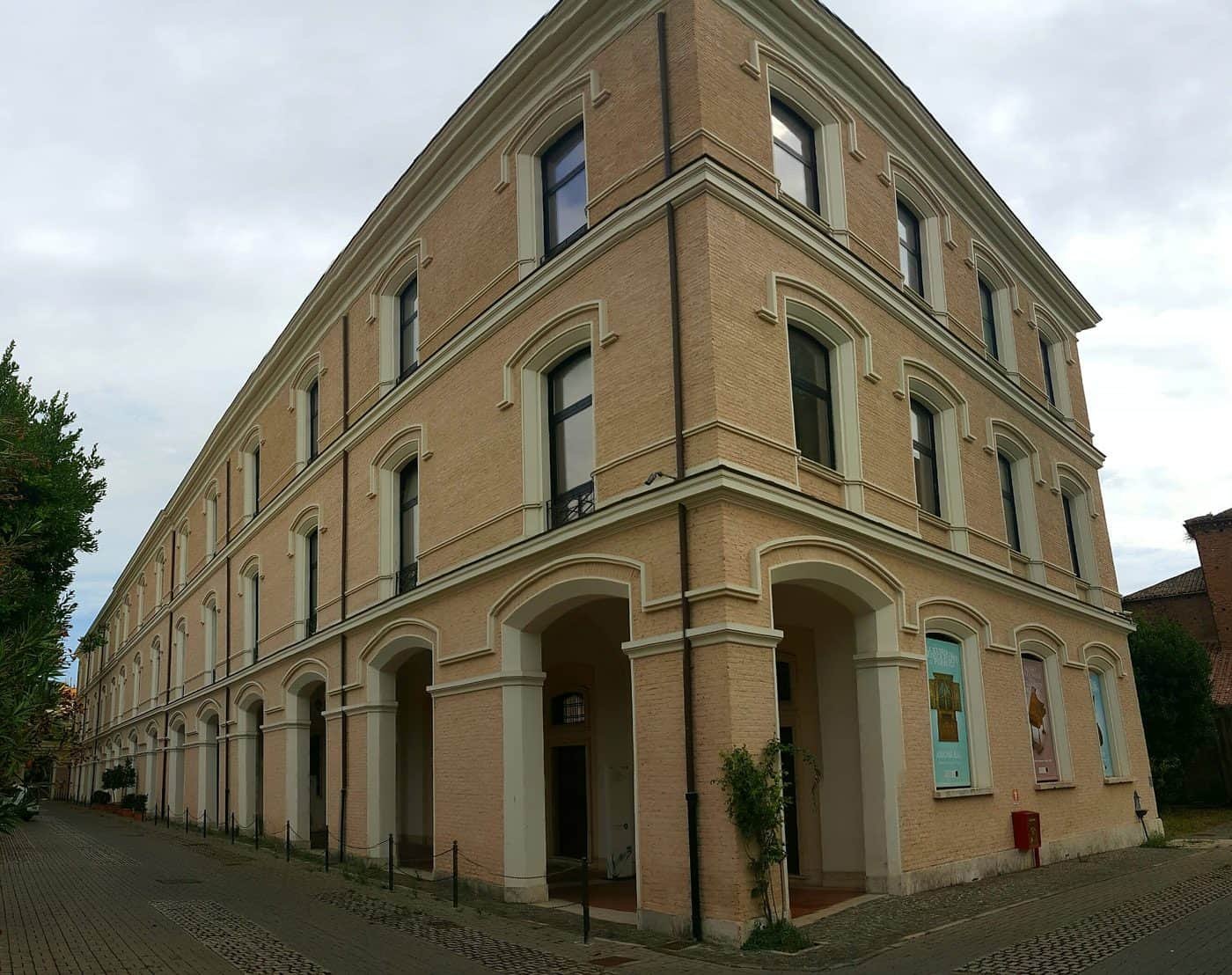
In short. The National Museum of Musical Instruments is in Rome at Piazza di Santa Croce in Gerusalemme 9/A, with the entrance next to the basilica of the same name, at the far eastern end of the Esquiline Hill district and right up against the Aurelian Walls.
The National Museum of Musical Instruments is in Rome at Piazza di Santa Croce in Gerusalemme 9/A, with the entrance next to the basilica of the same name, at the far eastern end of the Esquiline Hill district and right up against the Aurelian Walls. It opens Tuesday through Sunday from 9:30 to 19:30, last entry at 19:00, and closes on Mondays, December 25 and January 1. The full ticket costs €6, the reduced ticket €2 for European Union citizens between 18 and 25 years old. Admission is free for under-18s and on the first Sunday of the month. Tickets are bought at the automatic kiosk on site or with the Musei Italiani app, and reservation by email is mandatory for groups of 10 participants and up, for school groups and for music events. The phone is 06 7014796, the email address dms-rm.museostrumenti@cultura.gov.it. You get there by metro line A, San Giovanni stop, and an eight or 10 minute walk along Viale Carlo Felice, by bus 649, stop on Via Santa Croce in Gerusalemme, or by trams 5 and 14 to Porta Maggiore, then five minutes on foot along Viale Castrense. If you come by car, you can find parking on the avenue too: the blue parking lines in the area are less ferocious than in the center, but on Saturday afternoons the square fills up.
The museum is state-run and part of the system described on the page dedicated to Rome's state museums, with which it shares electronic ticketing, ministerial free admissions and the calendar of special openings. Those who prefer a wider overview, including municipal and private collections, will find it on the general page about Rome's museums.
Where the National Museum of Musical Instruments Is and Why the Location Matters
The address says Piazza di Santa Croce in Gerusalemme, and that alone should put the distracted visitor on guard: this is no ordinary neighborhood. The museum occupies a building bordering the area of the so-called Sessorium, the imperial residence that between the 3rd and 4th centuries extended over this whole corner of the city, and that included a private amphitheater, a circus, baths and a palace. The basilica next door was born inside a hall of that palace. The walls that close off the horizon to the south are the Aurelian Walls, which here incorporated the Castrense Amphitheater, turning it into a bastion. A museum of musical instruments planted in the middle of all this looks like an accident of state-property bureaucracy, and in part it is. But the result is that you visit a collection of flutes, harps and harpsichords with 18 centuries of urban stratification at your back.
Getting to the National Museum of Musical Instruments by Public Transport
The simplest route remains metro line A to San Giovanni: from there you exit toward Piazza di Porta San Giovanni, take Viale Carlo Felice, which is wide, tree-lined and straight, and in under 10 minutes you arrive beneath the facade of Santa Croce. This is a stretch I recommend walking even for those who could take surface transport, because Viale Carlo Felice is one of the few straight 19th-century Roman avenues that lets you see two basilicas in perspective, the Lateran behind you and Santa Croce ahead. Bus 649 stops on Via Santa Croce in Gerusalemme, so practically at the doorstep. Trams 5 and 14, which leave from Termini, go as far as Porta Maggiore: from there you run alongside Viale Castrense and reach the square in five minutes, with the advantage of passing by the outer flank of the Roman amphitheater wedged into the walls.
The National Museum of Musical Instruments for Those Arriving from Termini
If you're staying near the station, you can consider it a nearby museum: from Termini station it is a little more than two kilometers, walkable in 25 minutes via Piazza Vittorio and Via Emanuele Filiberto, or in a quarter of an hour by tram. It's a walk worth doing at least once, because it crosses the real Esquiline Hill district, the one of markets and signs in Chinese and Bengali characters, and ends in front of a Baroque facade. The contrast is more instructive than many guidebooks.
Tickets, Hours and Reservations at the National Museum of Musical Instruments
Six euros. That's the full price, and for what's inside it is one of the most honest figures you pay in Rome. The reduced ticket at €2 is for European Union citizens between 18 and 25 full years old. Under 18 you get in free, with ID in hand because they ask for it at the entrance. On the first Sunday of the month admission is free for everyone, under the ministerial formula valid for state institutes. Ticketing works with an automatic kiosk at the entrance and with the Musei Italiani app, the same one used for the ministry's other museums: if you're not comfortable with the screen you'll still find staff available, but it's good to know that here there is no big-museum line and you're through the machine in two minutes.
When to Book a Visit to the National Museum of Musical Instruments
For the individual visitor, reservation isn't needed. It is needed, and mandatory by email, for groups of 10 participants and up, for schools and for the music events the museum hosts in its rooms. This is a detail fellow tour escorts regularly forget, and it produces unpleasant scenes on the sidewalk: a group of 15 people that shows up without notice simply doesn't get in. The address is dms-rm.museostrumenti@cultura.gov.it and the phone 06 7014796. A tip: if you're escorting a group, write at least a week ahead and specify whether you intend to have something played, because the word concert in a museum of antique instruments opens different procedures.
Who Runs the National Museum of Musical Instruments
Ownership is the State's. Management has changed hands several times in the last 10 years, following the ministry's reorganizations: from December 2014 the museum was entrusted to the Polo museale del Lazio, from December 2019 to the structure that gathers the state museums of the city of Rome, today the Direzione Musei nazionali della città di Roma. The additional services, that is ticketing, guided tours and educational activities, are entrusted to a concessionaire. It sounds like bureaucratic news and instead explains a lot: a small museum inside a directorate that must also take care of Castel Sant'Angelo and Galleria Spada gets the attention it gets, and this shows in the displays, which alternate meticulously kept rooms with rooms that are waiting their turn.
Evan Gorga, the Tenor Who Ruined Himself Collecting
Here begins the part that makes this museum different from every other music museum in Europe. Because the collection was not born from a court, a conservatory or a noble bequest: it was born from the obsession of one man, named Gennaro Evangelista Gorga and known to the opera world as Evan Gorga.
From Broccostella to Teatro Regio: A Lightning Career
Gorga was born on February 6, 1865 in Brocco, today Broccostella, in Ciociaria, then in the province of Terra di Lavoro and today in the province of Frosinone. He studied singing, debuted on January 1, 1895 at the Teatro Comunale di Cagliari in Ambroise Thomas's Mignon, in the part of Guglielmo Meister, and just 13 months later found himself on the most exposed stage a young tenor could wish for. On February 1, 1896, at the Teatro Regio in Turin, the world premiere of Giacomo Puccini's La Bohème was staged, with Arturo Toscanini on the podium. Rodolfo, the penniless poet who in the first act burns his own drama to heat the garret, was him. The critics that evening were hostile, the audience was not, and history has sided with the audience.
Then comes the thing nobody can fully explain. Gorga repeats Rodolfo across half of Italy for three years and in January 1899, after a performance in Verona, leaves the stage. He was 34 years old. No documented vocal mishap, no scandal: he just leaves. And starts buying.
30 Collections, 150,000 Objects
The word collector, applied to Gorga, is reductive. The man put together some 30 distinct collections for over 150,000 pieces: musical instruments, certainly, but also toys, terracottas, traveling pharmacies, surgical instruments, scales, weapons, archaeological finds, glass, textiles. He bought from antique dealers, from junk dealers, from the clandestine digs that were casually practiced back then, from ruined families. In 1911, for the celebrations of the 50th anniversary of the Unification of Italy, he exhibited his still-young music collection at Castel Sant'Angelo: already 1,000 pieces. That same year the American financier John Pierpont Morgan offered him 2 million lire for the entire collection. Gorga refused.
That refusal is the psychological key to the whole story. A man who had wanted to get rich would have sold. Gorga wanted the collection to stay whole and stay in Italy, and to achieve that he bled himself dry. He rented 10 interconnecting apartments on Via Cola di Rienzo, in the Prati district, and filled them to the ceiling, turning them into a private historical music museum. He paid rents he couldn't afford, bought things he couldn't afford, and kept buying.
The Collapse, the Seizure and the 1950 Law
In 1929 the collections were placed under restriction and administrative seizure. The State recognized the value of that heritage and at the same time stopped the collector, by then buried in debt, from scattering it. 20 years of negotiations followed, closing in 1949 with an agreement between Gorga and the Italian State, made enforceable by the law of June 30, 1950. The State acquired the collections, took on the debts, guaranteed the old tenor a small lifetime pension and set up 10 annual scholarships. Gorga died in Rome on December 5, 1957 and rests at Verano. He was 92 years old and didn't have a penny.
A blunt opinion: Gorga wasn't an eccentric, he was a man with the right idea and no sense of measure. He had understood before anyone else that everyday objects, toys, surgeons' instruments, shepherds' flutes, were worth as much as statues. He was wrong only about the method. The museum you're about to visit is the monument to that insight and to that disaster at the same time.
Where Gorga's other collections ended up
The musical instruments are the part that found a home of its own, but the other collections didn't vanish. They were scattered across Italian museums according to the logic of expertise. The materials on the history of medicine, with the traveling pharmacies and surgical instruments, went to the Sapienza university museum dedicated to the history of medicine. The archaeological finds went to the National Roman Museum and other institutions. Anyone who visits Palazzo Massimo alle Terme or the Baths of Diocletian is also looking, without knowing it, at pieces that passed through the hands of a tenor from Ciociaria.
Before Gorga: Athanasius Kircher and the lost collections
There is an illustrious ancestor of this collection, and it's worth naming because he explains why a museum of musical instruments arrived so late in Rome. The German Jesuit Athanasius Kircher, who lived from 1602 to 1680, was a professor of mathematics, physics and Oriental languages at the Roman College and the author in 1650 of that musical encyclopedia, the Musurgia universalis. He had gathered in the College a prodigious museum: natural specimens, Etruscan and Roman antiquities, ethnographic objects brought by the missions, machines of his own invention and musical instruments. It was the Baroque Wunderkammer par excellence, founded in 1651 starting from a donation.
With the capture of Rome in 1870 and the seizure of church property, that museum became state property, and in 1913 a ministerial decree authorized its definitive dispersal: the Etruscan and Italic antiquities to Villa Giulia, the Roman materials to the National Roman Museum, the medieval and Renaissance pieces to Castel Sant'Angelo and Palazzo Venezia, prehistory and ethnography later moved to EUR. Kircher's musical collection dissolved in that transfer. When Gorga starts buying, at the beginning of the 20th century, Rome has just finished dismantling its one great museum of instruments. It's a coincidence that helps explain the urgency with which that man collected.
The home of the National Museum of Musical Instruments: Palazzina Samoggia
The building that houses the museum is called Palazzina Samoggia and it is one block of the old Principe di Piemonte barracks, the military complex that occupied the whole area up against the walls. It isn't a historic palace in the sense that the palaces of Via Giulia are. It's utilitarian architecture, plain, with regular windows and rectangular rooms, exactly what an army unit needed. The museum moved in and opened to the public in 1974, after years of restoration, cataloguing and arrangement.
Luisa Cervelli and the birth of the National Museum of Musical Instruments
If Gorga is the collector, Luisa Cervelli is the person who turned 3,000 piled-up objects into a museum. A scholar and civil servant, she fought for years so that this material would find a home, be restored and be cataloged with scientific criteria instead of heaped up by type. She is the one responsible for the first arrangement of the rooms and for the acquisition, in the following years, of pieces Gorga didn't have: the Barberini harp, the piano by Bartolomeo Cristofori, the 16th-century crumhorns by Weier, the clavicytherium. Put bluntly: without Cervelli, the Gorga collection would have stayed in a state warehouse and today we would know it only from the inventories.
What you see and what stays in storage
The numbers describe a museum that displays a minority of what it owns. The institution's sources speak of about 3,000 instruments in the collection and about 800 on display, spread over about 18 rooms on the first floor. The rest is in storage, and not out of laziness: old instruments made of wood, gut and skin need climate conditions and spaces that a building like this can offer only within certain limits. The installation grew in successive phases and some sections waited a long time for their own space. Anyone who enters knowing this avoids the typical disappointment of those who expect the instrument museum of Brussels or Berlin: here the ratio between the quantity on display and the quality of the individual pieces is reversed, you see fewer things but some are unique in the world.
The Route Through the National Museum of Musical Instruments, Section by Section
The layout follows two intertwined criteria, chronology and instrument family, and this produces a visit that moves forward in time and goes back every now and then to gather a category. It is not the most linear route I have seen, but it has one virtue: it forces you to compare objects that are far apart and to understand that the history of instruments is not a straight line of improvements, it is a thicket of attempts, most of which came to nothing.
The Archaeological Section of the National Museum of Musical Instruments
You start from antiquity, and this is the section that surprises those who arrive expecting to find violins. Here there are terracotta whistles, bronze bells, plectrums of bone and ivory, rattles, sistrums, crotala. Small objects, often ugly, almost always for ritual or domestic use rather than for concerts. The sistrum, for example, is the instrument of the cult of Isis: a metal frame crossed by little bars that jingle when you shake it, which came to Rome with the Egyptian religion and became familiar to anyone who frequented the sanctuaries of Isis in the Campus Martius. The crotala are castanets of metal or wood that dancers wore on their fingers. The bone plectrums were used to pluck the strings of the cithara. They are worn, and the wear is the most moving part of the display case, because it is the only physical trace of a hand that played 2,000 years ago.
The section includes Etruscan and Italic materials as well as Roman ones, and it allows for a reflection: of all the ancient music, which we know was everywhere in homes, theaters, rites and armies, practically nothing remains in sound and very little in objects, because wood, cane, gut and skin do not survive the centuries. Bronze and terracotta remain. It is like judging a people's cooking by its metal spoons.
The Middle Ages and the Renaissance at the National Museum of Musical Instruments
The jump is abrupt, because between late antiquity and the 15th century the material record is almost silent and the rooms have to work by placing things side by side. The piece that holds up the whole section is a trumpet dated 1461: a metal instrument of refined workmanship, survived by a lucky chance, and one of the oldest brass instruments kept in an Italian museum. Look at it against the light if you can: the hand-made soldering of the bell has an irregularity that no modern instrument has.
Around it are lutes, rebecs, viols da braccio and da gamba, recorders of different sizes, cornetti. The cornetto in particular deserves a stop: it is a wooden instrument covered in leather, with a cup mouthpiece like a trumpet but finger holes like a flute, dominant in Italian sacred music between the 16th and 17th centuries and then almost entirely gone when the violin took its place. In the rooms of the museum you can see examples, together with the crooked cornamuti, wind instruments with a folded tube of 16th-century workmanship attributed to Weier, which are among the acquisitions made after the Gorga collection.
Keyboard Instruments and the Invention of the Piano
This is the technical heart of the museum and the section for which the trip is worth it even from outside Rome. There are spinets, harpsichords, virginals, a claviciterio, that is, a harpsichord with the case raised vertically like a wardrobe, a rare and cumbersome form that solved one problem of space and created three of mechanics. There are positive and regal organs, the portable instruments that accompanied services in chapels without a fixed organ.
And there's the piece that specialists come to see from half the world away: the piano by Bartolomeo Cristofori dated 1722. Cristofori, born in Padua and harpsichord maker at the court of Ferdinando de' Medici in Florence, solved around 1700 the problem nobody had solved in two centuries: how to make an instrument with plucked strings, and therefore unable to vary the intensity of the sound, play soft and loud depending on the force of the finger. The solution was to strike the strings with covered hammers, and to do it with an escapement mechanism that moved the hammer away right after the blow, leaving the string free to vibrate. Every piano that exists descends from that device, from the upright in your home to the concert Steinway. The instruments built by Cristofori that have come down to us can be counted on one hand, and one is in this building behind Santa Croce in Gerusalemme, in a room where on most days there is nobody else. I find it one of the most embarrassing and most beautiful disproportions in Italian heritage.
Hans Mueller's harpsichord and the records of the National Museum of Musical Instruments
In the same exhibition area there is a German harpsichord signed Hans Mueller and dated 1537, which the institution's sources and popular literature indicate as the oldest known harpsichord. Caution is required with absolute records in organology, because every attribution depends on the authenticity of the engraved date and on how far the instrument has been reworked over the centuries. The fact remains that this is an object from the early 16th century, that is from an era when the harpsichord was still an instrument of the aristocratic chamber and not the continuo instrument it would become with the Baroque. The case, the decorations, the layout of the stops tell of a moment when the form was not yet standardized.
The Barberini harp, the most photographed piece in the National Museum of Musical Instruments
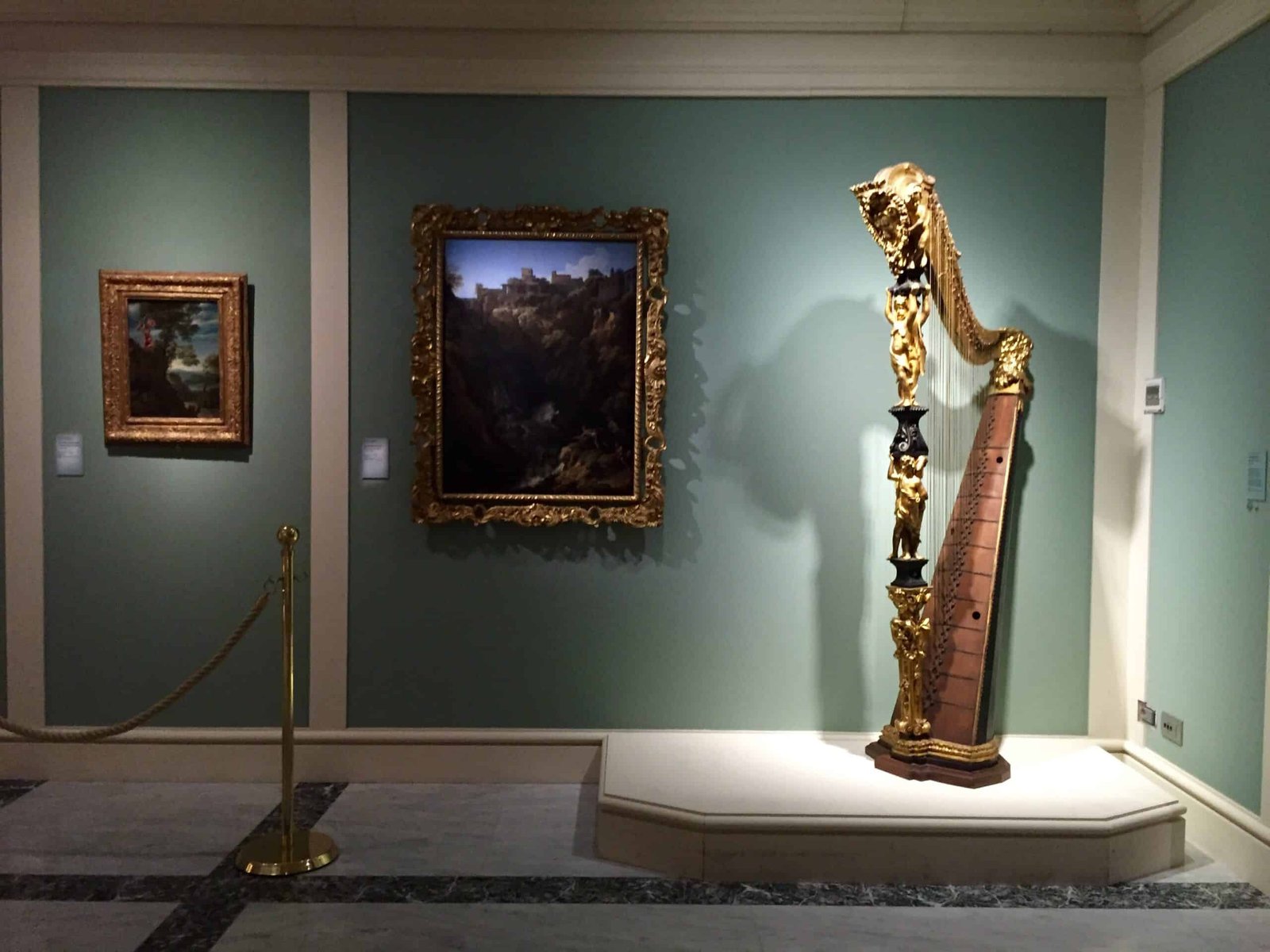
If there is one object that earns the poster, it's the Barberini harp. It is a triple harp, that is with three parallel rows of strings that made it possible to play altered notes without pedals, from the early 17th century. The proposed datings range between 1620 and the early 1630s. The column and the body are carved and gilded with an exuberance that belongs to the Rome of the Barberini, and they carry the heraldic bees of the family, the same ones you see everywhere in the city, from the baldachin of St. Peter's to the fountains.
Its story crosses with a famous painting. Giovanni Lanfranco painted, before 1634, a Venus playing the harp, now in the Galleria Nazionale d'Arte Antica at Palazzo Barberini. The instrument depicted in the painting bears the bees and corresponds to this harp. The patron of the painting was Marco Marazzoli, a Roman musician and composer known as Marco dell'Arpa, who at his death left the instrument to Cardinal Antonio Barberini. To have the object in one room and the painting that portrays it 2 kilometers away is a rare piece of luck. I recommend to anyone with a day to spend the morning at the museum and the afternoon at Palazzo Barberini, in that order, because seeing the object first and then its painted image has a very different effect from the reverse.
The string instruments of the National Museum of Musical Instruments
The string section doesn't compete with Cremona, and it would be absurd to expect it to. It offers one thing, though, that you don't see well in Cremona: the variety of forms before the violin won. Viols with sloping shoulders and flat backs, violas d'amore with sympathetic strings under the fingerboard, rebecs, lire da braccio. A visitor who knows only the modern string quartet discovers here that for at least two centuries the field was crowded with competing solutions, with different tunings, numbers of strings and bowing techniques, and that the victory of the violin family was a selection, not a natural evolution. There are also instruments connected to the figure of Benedetto Marcello, the Venetian patrician and composer of the Estro poetico-armonico, and the link with a name from the great history of music gives those objects a density that wood alone would not have.
Wind instruments and church instruments
Transverse flutes in boxwood and ivory, Baroque oboes, bassoons, early-model clarinets, serpents. The serpent is the instrument that makes kids laugh and deserves respect instead: a long conical wooden tube covered in leather, folded into an S shape, with a cup mouthpiece and finger holes like a flute, used for centuries in churches to support the low voices of the choir. When the Roman musical chapels sang falsobordone, there was often a serpent underneath. The section on sacred instruments also includes portative and positive organs, small bells, processional instruments: a functional repertoire, built to accompany rites and not to perform, and one that lets you understand how a Roman church really sounded before the 19th century.
Folk instruments and music on the move
Zampogne, ciaramelle, organetti, tamburelli, putipù, triccheballacche, jaw harps. The section dedicated to folk instruments is the one Romans look at most fondly, because they recognize the zampogna of the shepherds who came down to the city in December to play the novena in front of the sacred shrines. They came from Abruzzo and Ciociaria, the same villages Gorga came from, and the coincidence is no accident: a collector who knew that world from the inside gathered objects that no city museum would have considered worthy of a display case.
Next to it is a section the museum calls music on the move, dedicated to band, parade and procession instruments: brass folded to be carried on the shoulder, military drums, instruments built to be played while marching. It's a part often neglected by hurried visitors and yet it tells the social function of music in Italy better than any room of harpsichords, because for the great majority of Italians, up to a century ago, live music was exactly this: the band passing by.
The non-European instruments of the National Museum of Musical Instruments
Africa, Oceania, the Americas and Asia are represented by a collection of instruments that arrived in Italy by the most varied routes, religious missions, world fairs, the antiques market. Slit drums, musical bows, gourd zithers, cane flutes, idiophones of carved wood. The section should be viewed with the honesty of knowing what it is: a 19th- and early 20th-century collection, formed with the criteria of that era, in which the exotic counted as a category. That said, some pieces are remarkable organologically and allow an instructive comparison with the European display cases next door: the same acoustic idea, the string stretched over a body, solved in 20 different ways on three continents.
Giovanni Sgambati's salon, reconstructed in the museum
There is a room that moves the visit to another emotional register. The museum keeps and has reconstructed the salon-study of Giovanni Sgambati, a Roman pianist and composer who lived between 1841 and 1914, a pupil and friend of Franz Liszt, founder with Ettore Pinelli of the first permanent Roman orchestra and one of the promoters of the Liceo musicale that would become the Santa Cecilia Conservatory. The salon was in Piazza di Spagna and Liszt and Richard Wagner passed through those rooms. Sgambati was the musician who brought great European instrumental music back to Rome, in a city that in the 19th century lived almost only on opera and sacred music.
Seeing the furniture, the piano, the objects of that study put back together inside a state museum has a strange effect, a bit like theater. But it's the room where I best understand why this museum exists: instruments alone are mute tools, while a setting gives back the scene, that is the people who played and those who listened.
The 20th century, mechanical instruments and Giacomo Balla's Ciac-ciac
The collection reaches up to the last century with music boxes, hand-cranked organetti, mechanical and automatic instruments from the 19th and 20th centuries, the machine that replaces the performer. And it keeps an object that art-loving Romans come looking for specifically: the Ciac-ciac, an instrument built and painted by Giacomo Balla. Italian Futurism took noise seriously as musical material, with Luigi Russolo's intonarumori and with the experiments of the Roman circle, and Balla, who was the painter of the movement in Rome, applied to a sound object the same grammar of colors and lines of force as his canvases. A museum that begins with Roman crotals and ends with a Futurist painting a percussion instrument has, whether it declares it or not, a strong idea of what music is.
The National Museum of Musical Instruments and Santa Croce in Gerusalemme
On leaving the museum you are a few steps from the facade of Holy Cross in Jerusalem, one of the seven pilgrimage churches of Rome and one of the oldest and most disguised buildings in the city. It was born in the 4th century inside a room of the Sessorian Palace, the imperial residence of Helena, mother of Constantine, to house the relics of the Passion that tradition holds she brought from Jerusalem. The Baroque cladding you see today, with the concave facade and the elliptical atrium, dates from the 18th century, but the ancient structure is still legible inside, and the Chapel of Saint Helena keeps mosaics of great quality.
The relationship between the two places isn't only one of proximity. The museum occupies the perimeter of a complex that was imperial, then monastic, then military, then state-owned: the same area, reused for four different functions in 17 centuries. It's best to visit the basilica before or right after the museum, because it takes 30 minutes and completes the picture.
The Castrense Amphitheater behind the National Museum of Musical Instruments
Behind the basilica, wedged into the Aurelian Walls, there is a Roman amphitheater that almost no tourist sees. The Castrense Amphitheater dates to the early 3rd century, probably built between 218 and 222 under Elagabalus, and was part of the Sessorian Palace: it was the private amphitheater of the imperial court. Its ellipse measures 88 meters on the major axis and 75.80 on the minor. When Aurelian had the walls built, in the 270s, the building was cut in half and turned into an advance bastion, with the arches of the facade walled up. In the 16th century Pope Paul IV had the upper tiers torn down. Today the inner arena is occupied by the monastery's vegetable garden and a visit is not routine. What you can always see, for free, is the outer side, from Viale Castrense, and it's already one of the least crowded archaeological sights in Rome. Go at the end of the day, when the brickwork catches the light.
How to visit the National Museum of Musical Instruments
One hour is the right measure for a normal visit, an hour and a half if you stop at the keyboards as they deserve, two hours for those who read all the captions and have some musical expertise. The route is on one floor, in a sequence of connecting rooms, and doesn't require retracing your steps. There's no café inside and no restaurant, which you can't hold against a museum of this scale. The essential services are there.
The practical advice is this: don't approach it as a museum of masterpieces, where you run from one famous piece to the next. Approach it as a collection, reading the display cases by family and comparing the objects with each other. The Cristofori and the Barberini harp are worth the ticket on their own, but the real richness here is the dozens of minor instruments that let you reconstruct how music was made in Italy before the age of recording.
The National Museum of Musical Instruments with kids
It works, and it works better than parents expect. A museum of instruments has a structural advantage over painting museums: every object in the display case is recognizable as a thing made to make noise, and kids get that without explanations. The sections that hold their attention longest are the folk instruments, with zampogne and tamburelli, the non-European one and the mechanical instruments. Duration is on your side: one hour is exactly how long an eight-year-old can stay on their feet.
Two warnings for school groups. First: nothing is touched, and in a museum where everything seems to beg to be played the frustration is real, so it's better to prepare them beforehand. Second: the museum organizes educational activities and hosts musical events, and a visit that happens to coincide with a live performance changes level completely. It's worth asking when you book. Under 18 you get in free, so the cost for a family with two children stays at €12.
Accessibility of the National Museum of Musical Instruments
The building is a 20th-century service block, so the logic of the routes is simpler than in a historic palace, and the exhibition route runs on a single level, with no interior steps between the rooms. People with disabilities and their companion are included in the free admissions provided for state institutions. For anyone with specific needs, the safest way to get organized remains contacting the museum in advance at 06 7014796 or at dms-rm.museostrumenti@cultura.gov.it, which also lets you arrange any assistance at the entrance.
Photos and behavior in the rooms
In Italian state institutions, photography without flash and without a tripod for personal use is normally allowed. The specific conditions are indicated at the ticket office. Flash is the enemy of varnished woods and gilded decorations, and on instruments four or five centuries old the ban has serious conservation reasons, not whims. As for touching: never. The varnish of a 16th-century harpsichord reacts to the sweat of fingers in an irreversible way.
When to go to the National Museum of Musical Instruments
This is a museum that knows no crowds, and that's its luxury. On weekdays, especially Tuesday and Wednesday mornings, you can cross three rooms without meeting anyone. On Saturday afternoon there's a bit of Roman foot traffic. On the first Sunday of the month, with free admission, a larger crowd arrives but still manageable. In summer the rooms offer the trivial and decisive advantage of being indoors while outside Viale Castrense is an oven.
The time I recommend is late morning, around 11:00, for two practical reasons: the natural light in the rooms is at its best and you come out at the right time to continue toward the Lateran. If instead the goal is photographing the exterior, with the basilica and the walls, the good window is late afternoon.
Things to see around the National Museum of Musical Instruments
The square offers an unusual concentration of serious things within a 10-minute walk. On the same side, at number 9, is the Museo Storico della Fanteria, which occupies another block of the old complex and regularly hosts major temporary exhibitions: two museums at the same address, and almost nobody who visits both on the same day. Walking west along Viale Carlo Felice, in 10 minutes you reach the Basilica of San Giovanni in Laterano, the cathedral of Rome and mother of all churches, with its Cosmatesque cloister and the Constantinian baptistery.
Across from the Lateran is the Holy Stairs with the Sancta Sanctorum, the private chapel of the popes with the acheiropoieton icon: a place you visit in half an hour and that few foreign tourists know. To the north, a quarter of an hour away, are Porta Maggiore and the tomb of the baker Eurysaces, and from there you enter the great walk along the Aurelian Walls. Anyone who still has energy and half an hour of tram can close the music-themed day at the Galleria Spada or, with a different logic, follow the thread of Roman music to the Auditorium Parco della Musica.
Other music places in Rome
Anyone whose organological curiosity is still burning has two other destinations in the city. The first is the Museum of Musical Instruments (MUSA) of the Santa Cecilia Conservatory, a collection different in origin and in approach, tied to teaching and to the history of the institution. The second is the Rome Opera House, where the history of instruments stops being a display-case fact and goes back to being sound. A two-day itinerary that puts together the museum on Piazza Santa Croce, the MUSA and a performance at the Costanzi is the best way to tell Rome to a visitor who loves music.
A curiosity about the National Museum of Musical Instruments
The curiosity concerns the refusal of 2 million lire. In 1911 Evan Gorga exhibited at Castel Sant'Angelo, for the 50th anniversary of Italian Unification, his musical collection still in formation: about 1,000 pieces. That exhibition had an effect the tenor hadn't foreseen. Among the visitors came the entourage of John Pierpont Morgan, the American financier who in those years was buying European art by the truckload and was building the library and collections now famous in New York. The offer was 2 million lire for the whole block.
To understand the figure: 2 million lire in 1911 was a fortune capable of setting a man and his family up for life. Gorga already had liquidity problems, rented 10 apartments he couldn't afford and bought objects every day that he would pay for who knows how. He said no.
The reason handed down is that he didn't want to see the collection broken up and taken out of Italy. The result was that in the following years his situation collapsed, that in 1929 the collections ended up under administrative seizure, and that the man died in 1957 living on a small public pension. With Morgan's 2 million, today Cristofori's piano and half a museum would be seen in Manhattan, and the Rome of music museums would be a desert. The museum on Piazza Santa Croce in Gerusalemme exists because a provincial former tenor, against all economic reason, decided that his collection had to stay in Italy. It's a thought I recommend carrying with you throughout the visit: it changes the way you look at the display cases.
Something nobody tells you about the National Museum of Musical Instruments
That the musical instruments were the small part. In the guides you always read the phrase Gorga collection as if the tenor had collected flutes and violins. The reality is that the collections put together by that man numbered about 30, for more than 150,000 objects, and that musical instruments were one sector among many. In the other crates there were toys, terracottas, traveling pharmacies, surgical instruments, scales, glassware, archaeological finds, textiles.
The practical consequence is that whoever visits this museum sees a fragment of a much bigger and much crazier enterprise, and that the other fragments are scattered across half of Italy: the medical and surgical material went to the university museum dedicated to the history of medicine, the archaeology ended up in the Roman state collections. There is no place where you can see the Gorga collection as Gorga saw it, that is all together in 10 apartments on Via Cola di Rienzo, with the corridors reduced to passages between the piles.
The second thing almost nobody says concerns the numbers of the display. The museum keeps about 3,000 instruments and displays about 800. That means two thirds of the collection is in storage, and that what's visible is a selection, one moreover conditioned by the available space and by the conservation needs of fragile materials like gut, skin, ivory and thin wood. Anyone who walks in expecting the encyclopedic museum is thrown off. Anyone who walks in knowing they're looking at a reasoned choice understands much more. And also understands why every so often a room is being transformed: a small institution inside a large directorate works in phases, and phases last.
The advice I give you for visiting the National Museum of Musical Instruments
Take 90 minutes and organize them the opposite way from what would come naturally. The temptation, as soon as you walk in, is to run to the keyboards for the Cristofori and to the Barberini harp, that is to the two pieces you've already seen in photographs. Do it at the end. Start instead from the archaeological section, with the crotals, the sistra and the worn plectra, and let the visit build up by accumulation. By the time you reach the 1722 piano you'll have in your eyes 2,000 years of attempts to make a string vibrate, and that hammer mechanism will look to you like the brilliant solution it actually is. Seen first, instead, it's just a brown wooden box.
Second piece of advice, less romantic but useful: bring headphones and a couple of recordings on your phone. A museum of instruments has a structural problem, which is silence. Listening to three minutes of a harpsichord sonata in front of a harpsichord, or a Field nocturne in front of a fortepiano, fills a gap no caption can fill. It's not an amateur trick: musicologists do it too.
Third piece of advice, the one nobody gives: pair the visit with Palazzo Barberini on the same day or in the same week. Seeing the Barberini harp here and then Lanfranco's painting that portrays it there is one of those experiences that stay with you, because it's rare to be able to put the object and its 17th-century representation in front of your eyes. Finally, if you're leading a group, write in advance: without a reservation, groups of 10 or more don't get in, and the square is beautiful but not enough to justify an hour's wait.
Another well-known fact, yet rarely cited
That Bartolomeo Cristofori invented the piano is a notion from a middle-school textbook. What is cited far less is the technical reason why the invention was necessary, and without that reason the notion stays inert.
In the harpsichord the string is plucked by a plectrum mounted on a jack. The plectrum caught it and released it always with the same energy, whatever the force of the finger on the key. A precise musical limitation followed: the harpsichord produces a sound of fixed intensity, and nuances are obtained with stops, coupled keyboards and articulation devices, not with touch. For two centuries composers wrote taking this constraint into account. Cristofori, harpsichord maker at the Medici court of Ferdinando de' Medici in Florence, replaced the plectrum with a covered hammer that strikes the string and invented the device that really counts, the escapement: right after the blow, the hammer detaches from the mechanism and falls back, leaving the string free to vibrate without staying in contact with the wood. The instrument could finally play soft and loud, and the name it was given, gravicembalo col piano e forte, described the novelty exactly.
The well-known fact, then, has a rarely cited tail: the invention wasn't an immediate success. For decades musicians kept preferring the harpsichord, the fortepiano remained a court curiosity and only toward the end of the 18th century, with the generation of Mozart and then Clementi, did it become the dominant instrument. Cristofori died in 1731 without seeing the victory of his idea. One of the instruments he built is in this Roman building, and it's the most important thing you can see in all of the eastern Esquiline Hill.
The right photo to take at the National Museum of Musical Instruments
Inside, the photograph that works is only one and it isn't the one everybody takes. Everybody looks for the frontal shot of the Barberini harp, which is gilded, tall and fills the frame. It always comes out flat, because gilding under museum lighting flattens the volumes. The photo that's worth it is the detail of the heraldic bees carved on the column, in raking light, against a dark background. It tells of the Barberini family, it tells of the Rome of Urban VIII and it has a recognizable graphic subject. Check at the ticket office for the conditions for taking photos: without flash and without a tripod is the normal rule in state institutions, and in these rooms flash is banned for conservation reasons I fully share.
The second shot to take home is the mechanics of the Cristofori piano, if the display shows it: the row of hammers, the light wood, the geometry of the device. It's a photograph that explains something, and it's worth 10 room panoramas.
Outside, though, the best photo of the day is taken with your back to it. Leave the museum, turn left and take Viale Castrense: from there you see the outer side of the Castrense Amphitheater built into the Aurelian Walls, with the walled-up arches emerging from the 3rd-century brickwork. In the late afternoon the raking light carves out the masonry and the color turns burnt orange. It's an image very few tourists have, because nobody passes that way, and it puts together in a single frame an imperial amphitheater, a defensive wall of 271 and a Constantinian basilica. If you have a wide-angle lens, use it. If you only have your phone, step back 20 meters.
Some important events that happened here in history
The first event is the oldest and concerns the ground. At the beginning of the 3rd century, probably between 218 and 222, under Elagabalus, the Castrense Amphitheater rose in this area, the private arena attached to the imperial palace called the Sessorium: 88 meters of major axis, 75.80 of minor axis, a spectacle building for the court, not for the people. 50 years later, with the construction of the Aurelian Walls in the 270s, that same amphitheater was cut in half, the arches of the facade were walled up and the structure went from a place of leisure to a military bastion. Few transformations tell better the passage from a self-confident empire to an empire that shuts itself in behind a wall.
The second event is from the 4th century: Helena, mother of Constantine, lives in the Sessorian Palace and has the room set up there that will become the basilica of Santa Croce in Gerusalemme, meant to house the relics of the Passion that tradition holds she brought from the Holy Land. From that moment this corner of Rome enters the geography of pilgrimage and never leaves it.
The third is from the 16th century and destructive: Pope Paul IV has the upper tiers of the amphitheater torn down, reducing it to what you see today from the avenue.
The fourth is recent and directly concerns the museum. Between 1929, the year of the administrative seizure of the Gorga collections, and 1949, the year of the agreement with the State made enforceable by the law of June 30, 1950, the story plays out that brings the collection into the public heritage. And in 1974, after years of restoration and cataloguing carried out under the impetus of Luisa Cervelli, Palazzina Samoggia finally opens to the public as the National Museum of Musical Instruments. A building born to house an army unit becomes the home of 3,000 instruments: in the history of this area, yet another reuse.
Who has passed through the National Museum of Musical Instruments
The name that comes first is naturally that of Evan Gorga, who is the involuntary founder of this museum. His voice resounded at the Teatro Regio in Turin on February 1, 1896, with Arturo Toscanini on the podium, in the world premiere of La Bohème: Gorga was the first Rodolfo in history. Whoever looks at the display cases is looking at objects bought with the earnings and then with the debts of that man.
The second name is Luisa Cervelli, the scholar who obtained the home, the restoration and the scientific cataloguing of the collection and who added decisive acquisitions to it. Without her there would be no museum, and the fact that her name stays out of the guides says a lot about how Italy remembers its cultured civil servants.
Then there are the figures who arrive here by proxy, through the objects. Cardinal Antonio Barberini, nephew of Urban VIII, who inherited the harp from the composer Marco Marazzoli, called Marco dell'Arpa. Giovanni Lanfranco, who painted that harp before 1634 in the Venus now at Palazzo Barberini. Bartolomeo Cristofori, harpsichord maker at the court of Ferdinando de' Medici, maker of the 1722 piano. Benedetto Marcello, the Venetian patrician of the Estro poetico-armonico, tied to some instruments in the collection. Giacomo Balla, who painted the Futurist Ciac-ciac.
Finally there is a room that brings two giants of 19th-century Europe into the museum. The salon-study of Giovanni Sgambati, a Roman pianist and composer, pupil and friend of Franz Liszt, was in Piazza di Spagna and was reconstructed here: Liszt and Richard Wagner passed through those rooms. The furniture is the same, the walls are not, and this kind of move always raises some museographic doubts. But the historical fact holds up, and crossing that threshold knowing who entered it makes the visit something else.
Quick questions about the National Museum of Musical Instruments
How much is a ticket to the National Museum of Musical Instruments?
The full ticket costs €6. The reduced ticket is €2 and is reserved for European Union citizens aged 18 to 25 inclusive.
What are the opening hours of the National Museum of Musical Instruments?
Tuesday to Sunday from 09:30 to 19:30, with last entry at 19:00. On Monday the museum is closed.
On which days is the National Museum of Musical Instruments closed?
Every Monday, December 25 and January 1, plus extraordinary closures ordered by the ministry. Before setting out from far away it's worth checking the museum's official website.
Is admission to the National Museum of Musical Instruments free?
Yes in two cases: for anyone under 18, always, with an ID document, and for everyone on the first Sunday of each month, under the ministerial formula valid for state institutions.
Where exactly is the National Museum of Musical Instruments?
At Piazza di Santa Croce in Gerusalemme 9/A, in Rome, postal code 00185. The entrance is next to the basilica of Santa Croce in Gerusalemme.
How do you get to the National Museum of Musical Instruments by metro?
Take Line A, San Giovanni stop, and walk about 10 minutes along Viale Carlo Felice. The same stop is also served by Line C.
Which buses and trams stop near the National Museum of Musical Instruments?
Bus 649 stops on Via Santa Croce in Gerusalemme. Trams 5 and 14, which leave from Termini, arrive at Porta Maggiore, about five minutes on foot along Viale Castrense.
How long does a visit to the National Museum of Musical Instruments take?
One hour for a normal visit, an hour and a half for those who stop at the keyboards, two hours for those who read all the captions and have musical expertise.
Do you need to book to visit the National Museum of Musical Instruments?
Not for individual visitors. Booking by email is instead mandatory for groups of 10 participants or more, for school groups and for musical events.
Where do you buy tickets for the National Museum of Musical Instruments?
At the automatic kiosk at the museum entrance or through the Musei Italiani app of the Ministry of Culture.
Is Bartolomeo Cristofori's piano really here?
Yes. The museum keeps a piano by Bartolomeo Cristofori dated 1722, one of the very few instruments by the inventor of the piano to have survived to this day.
What is the Barberini harp kept at the National Museum of Musical Instruments?
A triple harp from the early 17th century, carved and gilded, with the heraldic bees of the Barberini family. It belonged to the composer Marco Marazzoli, called Marco dell'Arpa, who left it to Cardinal Antonio Barberini, and it is the instrument portrayed in Giovanni Lanfranco's Venus Playing the Harp, now at Palazzo Barberini.
How many instruments does the National Museum of Musical Instruments display?
About 800 pieces on display out of a collection of about 3,000 instruments held, spread over about 18 rooms.
Who was Evan Gorga?
Gennaro Evangelista Gorga, called Evan, a tenor born in Brocco, today Broccostella, on February 6, 1865 and died in Rome on December 5, 1957. He was the first interpreter of Rodolfo in Puccini's La Bohème in 1896 and ruined himself collecting more than 150,000 objects, among them the instruments that form the core of the museum.
Is the National Museum of Musical Instruments suitable for kids?
Yes, and it's one of the Roman museums that work best with little ones, because the objects are recognizable and the visit is short. The sections on folk, non-European and mechanical instruments are the ones that capture them most.
Is the National Museum of Musical Instruments accessible to people with disabilities?
The exhibition route runs on a single level. For specific needs it's best to contact the museum in advance at 06 7014796 or at the dedicated email address, which also lets you arrange assistance at the entrance.
Can you take photos at the National Museum of Musical Instruments?
In Italian state institutions, photography for personal use without flash and without a tripod is normally allowed. The specific conditions are indicated at the ticket office.
Can you play the instruments on display?
No. The instruments are protected assets and largely very fragile. The museum does host musical events with live performances, though: when you book, it's worth asking for the calendar.
What is the difference between this museum and the MUSA of the Santa Cecilia Conservatory?
The museum on Piazza Santa Croce in Gerusalemme is a state museum and comes from the private collection of Evan Gorga, with a time span running from antiquity to the 20th century. The MUSA is the Conservatory's collection, tied to the history of the institution and to teaching: different instruments, a different approach, its own hours and access procedures.
Does the National Museum of Musical Instruments have a bar or restaurant?
No, and for a museum of this scale that's normal. The places on the square and on Via Santa Croce in Gerusalemme solve the problem in two minutes on foot.
What can you visit near the National Museum of Musical Instruments?
In order: the basilica of Santa Croce in Gerusalemme next door, the Museo Storico della Fanteria at the same address, the exterior of the Castrense Amphitheater from Viale Castrense, San Giovanni in Laterano and the Scala Santa 10 minutes away, Porta Maggiore a quarter of an hour away.
Can you visit the Castrense Amphitheater together with the museum?
The interior of the amphitheater today corresponds to the vegetable garden of the monastery attached to the basilica and has no regular opening. The outer side built into the Aurelian Walls, on the other hand, can be seen freely from Viale Castrense.
What is the best day to visit the National Museum of Musical Instruments?
Tuesday or Wednesday morning, when the rooms are practically empty. The first Sunday of the month brings more people because of the free admission, but never reaching the crowding of the big museums.
Is the museum part of a circuit with other state museums?
It is managed within the directorate that brings together the state museums of the city of Rome, along with institutions like Castel Sant'Angelo and the Galleria Spada. Ministerial free admissions and extraordinary openings apply in the same way.
How much time do you need to combine the museum and the basilica of Santa Croce?
A full two hours covers both well: an hour and a half at the museum and half an hour in the basilica, including the Chapel of Saint Helena. Adding the Lateran makes a full morning.
It's a museum where you stay longer than planned in front of a display case of chipped flutes, and you realize that the poorest objects are the ones that tell the most. If I had to give a single reason to come all the way out here, it wouldn't be the 1722 piano, however much it is a piece of world history. It would be the fact that for €6, in an hour, you cross the history of how humans tried to make sound with whatever they had at hand, and that you do it in silent rooms where nobody will rush you. In Rome today, that's a rare privilege. Go in the morning, early, and leave on foot toward the Lateran.
Article written by the editorial team of TourLeaderPro, contact them for Private/Corporate/V.I.P. Tours and Experiences.
Planning a trip to Rome? The English guides for visiting the city are on ItalyPlanner.com.