Museum of Musical Instruments (MUSA)
In short. The Museum of Musical Instruments (MUSA) is the museum of the Accademia Nazionale di Santa Cecilia and occupies a gallery of the Auditorium Parco della Musica Ennio Morricone, Viale Pietro de Coubertin 30, 00196 Rome, Flaminio district.
The Museum of Musical Instruments (MUSA) is the museum of the Accademia Nazionale di Santa Cecilia and occupies a gallery of the Auditorium Parco della Musica Ennio Morricone, Viale Pietro de Coubertin 30, 00196 Rome, Flaminio district. The entrance opens in the foyer of the Sala Santa Cecilia, the largest of the three concert halls. Admission is free. In the central part of the season, roughly from October and November to June, the gallery is open every day from 11.00 to 16.00. In July and September you can enter only by appointment, with a paid guided visit and a minimum of eight participants. In August the museum is closed. Hours change with the concert season and during events the exhibition spaces may be inaccessible, so a phone call before leaving home is worth the bus ticket: the museum management answers at +39 06 80242382 and +39 06 80242332, and the email address is museo@santacecilia.it. You get there by metro A to Flaminio and then tram 2 toward Piazza Mancini, or by buses 53, 910, 168 and 982. If you come by car there are two paid parking lots, one open-air and one covered, both with spaces reserved for people with disabilities. This page is part of our collection dedicated to the museums of Rome.
This gallery has been open since February 2008, and the scene at the entrance repeats the same way. People walk in thinking they'll find a courtesy display case, a kind of decorative appendix to the concert, and 10 minutes later they're standing in front of the Stradivari violin with their nose two centimeters from the glass. The MUSA is not big and doesn't pretend to be: about a hundred and 30 instruments and some 50 luthier's tools are on display in the gallery, while the Academy's collection exceeds 500 pieces. But the density of history per square meter is very high, and admission costs nothing. If I had to name the best ratio between what you learn and what you spend in all of Rome, the MUSA would make the top three without discussion.
The big mix-up: the Museum of Musical Instruments (MUSA) is not the National Museum of Musical Instruments
Let's start with the mistake I see made every week, because it costs half a day to whoever makes it. Rome has two musical instrument museums, eight kilometers apart, with different collections, different owners, different tickets and different hours. Confusing them is very easy, since the names resemble each other almost word for word.
The first is the MUSA, that is the Museum of Musical Instruments of the Accademia Nazionale di Santa Cecilia, at the Auditorium, in the north quadrant of the city. It belongs to a private institution under public law, the Fondazione Accademia Nazionale di Santa Cecilia, and holds the collection that institution put together over four centuries through bequests, gifts from musicians and purchases. Free admission.
The second is the National Museum of Musical Instruments, which is on the other side of Rome, in Piazza di Santa Croce in Gerusalemme 9/a, inside the Palazzina Samoggia, next to the basilica of Santa Croce, 10 minutes on foot from San Giovanni. It's a state museum, it depends on the Direzione Musei nazionali della città di Roma, you pay for the ticket and the core of the collection is something else entirely: it comes from the immense collection of Evan Gorga, a tenor and obsessive collector, which entered the state's holdings on September 27, 1949. There you find the Barberini harp and a piano by Bartolomeo Cristofori, the acknowledged father of the piano. The instruments kept number about 3,000 and those on display are counted in the hundreds, spread over a long sequence of rooms on a single floor.
The practical rule: if you're looking for the 1690 Stradivari violin and the luthier's workshop in plain view, go to the MUSA at the Auditorium. If you're looking for the Barberini harp, the Cristofori and an encyclopedic collection that starts from antiquity, go to Santa Croce in Gerusalemme. They aren't competing museums: they're two different chapters of the same story, and whoever truly loves the subject visits both, on two separate days. Doing them the same afternoon is possible only on paper, because the crossing from Flaminio to Porta Maggiore alone eats 40 minutes.
Why two museums and not one
The reason is historical and worth telling, because it explains the character of the two collections. The Academy's collection is born from inside the Roman musical world: instruments donated by musicians, bequests from noble families, materials that arrived together with scores and memorabilia in an institution that since 1585 has brought together the music professionals of Rome. It's a collection made by musicians for musicians, and it shows: the pieces of high luthiery prevail, the ones a player would gladly pick up.
The collection at Santa Croce in Gerusalemme is born instead from a private collector, Gorga, who accumulated objects with an encyclopedic hunger and kept his collections spread over 10 Roman apartments. The state took over the holdings together with the debts. The result is a larger, more heterogeneous collection, with specimens that interest mostly the organologist. Two opposite logics, two different museums. Whoever mixes up the names ends up at Porta Maggiore looking for the Stradivari, and doesn't find it.

How to get to the Museum of Musical Instruments (MUSA)
The Auditorium sits in a fold of Rome that tourists rarely cross: Flaminio, between the 1960 Olympic Village and the bend of the Tiber. It's not the historic center and doesn't pretend to be. But it's well served, and whoever knows which line to take gets there from Piazza di Spagna in barely 20 minutes.
By metro and tram
The classic combination is metro A to Flaminio, exit on Piazzale Flaminio, and then tram 2 toward Piazza Mancini. The 2 runs along Viale Tiziano, skirting the whole Auditorium area: from the central stops of the line the entrance is a few minutes' walk, and if you have doubts just follow the crowd getting off at the same stop on concert evenings. Alternatively, for those coming from the north quadrant, the Euclide stop of the Roma-Nord railway leaves you within walking distance.
A warning that saves nerves: on the evenings of big concerts tram 2 fills beyond all reason, and the return toward Piazzale Flaminio after 23.00 can become a small endurance test. If you visit the museum in the afternoon, as is obvious since it closes at 16.00, the problem doesn't arise.
By bus
The official lines indicated by the Auditorium are four: the 910, which links Termini to Piazza Mancini and is the one I recommend to those arriving by train. The 53, between Piazza Mancini and Largo Chigi, very convenient for those starting from the Tridente. The 982, between Viale XVII Olimpiade and the Quattro Venti station. The 168, between Largo Maresciallo Diaz and the Tiburtina station. The 910 from Termini is the best choice for those with suitcases, because it avoids transfers.
On foot and by bike
From the Ponte della Musica, which spans the Tiber with a white arch inaugurated in 2011, to the entrance of the Auditorium it's less than 10 minutes' walk: whoever stays in Prati or around Piazza Mazzini gets there faster on foot than waiting for a bus. The Tiber bike path passes underneath, and in spring it's the best way to arrive. From the historic center, instead, the walk is long: from Piazza del Popolo it's a little under four kilometers along Viale Tiziano, a good 40 minutes of walking without stops.
By car
Two paid parking lots, one open-air and one covered multistory, both with spaces reserved for people with disabilities. On concert evenings they fill up. On a weekday afternoon, which is the museum's hours, you find a space without trouble. The neighborhood around has blue lines almost everywhere.
How much time you need to visit the Museum of Musical Instruments (MUSA)
Let's answer with numbers. A fast visitor, who looks at the cases without stopping to read, is out in 25 minutes. A normal visitor, who reads the panels and stops in front of the main pieces, takes 40 minutes. Whoever uses the multimedia stations to hear the sound of the instruments, and whoever stops to watch the luthier at work behind the glass of the workshop, easily reaches an hour and a quarter.
My recommendation is to count an hour and to add the half hour of the archaeological museum under the cavea, in the same complex and also free. Two very different museums a hundred meters apart, both without a ticket: an afternoon like that, in Rome, doesn't come along often. If you then stay for an evening concert, the day is complete and it will have cost you only your transit fare and the hall ticket.
Who owns the Museum of Musical Instruments (MUSA): the Accademia Nazionale di Santa Cecilia
To understand what you're looking at inside those cases you have to know whose the instruments are, and the answer goes far back in time. The owner is the Accademia Nazionale di Santa Cecilia, which is at once the oldest musical institution in Rome and one of the oldest in the Western world still active. It was Pope Sixtus V who founded it, with the bull Ratione congruit of 1585, giving legal form to a Congregation of Musicians placed under the invocation of the Blessed Virgin and of Saints Gregory and Cecilia. Two patrons for two functions: Gregory the Great for liturgical chant, Cecilia for music in general.
The point that almost always escapes is that the Congregation was not born as a concert academy, but as a guild. It brought together the professional musicians of Rome, protected their interests, exercised a form of control over the practice of the trade and assisted members in difficulty. In 1716 Pope Clement XI made membership mandatory for anyone who wanted to practice as a professional musician in Rome: whoever wasn't enrolled simply couldn't work. This explains why the history of the members includes all the great names who passed through the city.
The six churches and the later sites
For three centuries the institution had no building of its own and relied on one church after another, with a sequence that is almost an itinerary through the historic center. The first site was Santa Maria ad Martyres, that is the Pantheon, from 1585 to 1622. Then came San Paolino alla Colonna from 1622 to 1652, the basilica of Santa Cecilia in Trastevere from 1652 to 1661, San Nicola dei Cesarini from 1661 to 1663, the church of the Maddalena from 1663 to 1685 and finally San Carlo ai Catinari, where the Congregation stayed until 1848.
Then came the move to a civil building: in 1853 the Palazzo Camerale on Via di Ripetta, and later the former convent of the Ursulines on Via Vittoria, acquired in 1876. From ecclesiastical guild to lay institution in 20 years. The name followed the same arc: Congregation and Academy from 1838, Pontifical Academy, then Royal Academy after the end of temporal power in 1870, finally National Academy.
1895, the year that changes everything
If I had to choose a single date in the history of the institution that owns the MUSA, I'd choose 1895. In that year the Academy equips itself with a permanent choir and orchestra and begins to organize regular concert seasons: it stops being a professional register and becomes a musical enterprise. From then on it needs halls, and the halls keep changing. The concerts were held first in the Sala Accademica on Via dei Greci, from 1895 to 1908. Then at the Augusteo, the hall carved out inside the Mausoleum of Augustus, from 1908 to 1936. Then at the Teatro Adriano from 1936 to 1946. Then at the Teatro Argentina, a stone's throw from Largo di Torre Argentina, until 1958. Then at the Auditorio Pio on Via della Conciliazione. Six moves in a century, all dictated by the same chronic lack: Rome did not have a real concert hall.
Behind 1895 there is a man, Count Enrico di San Martino Valperga, president of the Academy from 1895 to 1949, a 54-year term. Under his presidency were born the Conservatory of Music, the Eleonora Duse acting school that would become the Accademia nazionale d'arte drammatica Silvio D'Amico, and the Centro Sperimentale di Cinematografia. A cultural leader with a capacity for founding institutions that today seems like science fiction.
From the 1998 foundation to the Auditorium
In 1998 the Academy turns into a foundation. Between 1990 and 2000 the number of annual concerts goes from about 100 to 200 and 50. In 2003 the artistic, administrative and museum structure moves to the Auditorium Parco della Musica. In 2005 the Bibliomediateca opens. In February 2008 the Museum of Musical Instruments (MUSA) opens. The cycle of moves closes after 400 and 18 years. The legal seat, however, stays where it was: Via Vittoria 6, in the Tridente.
The line of music directors says the rest: Bernardino Molinari from 1912 to 1944, Fernando Previtali from 1953 to 1973, Igor Markevitch from 1973 to 1975, Giuseppe Sinopoli from 1983 to 1987, Daniele Gatti from 1992 to 1997, Myung Whun Chung from 1997 to 2005, Antonio Pappano from 2005 to 2023 and Daniel Harding since 2024. The instruments of the MUSA are the material memory of this chain.
The Santa Cecilia Conservatory on Via dei Greci and the roots of the Museum of Musical Instruments (MUSA)
Here we arrive at the chapter that no guidebook ever tells, and that instead explains why the collection has the shape it has. The Academy's collection of instruments was not born at the Auditorium: it was born in the Tridente, inside the block of buildings between Via dei Greci and Via Vittoria, where today you still find the state Conservatory of Music Santa Cecilia, at Via dei Greci 18.
The school was born in 1875 on the initiative of Giovanni Sgambati and Ettore Pinelli, two Roman musicians who wanted to give the city music teaching on a par with that of the conservatories of the North. It was the Academy's music school, that is an internal body. It became an autonomous entity in 1911 and in 1919 was constituted as a state conservatory, separating definitively from the parent institution. From that moment two distinct bodies have lived in the same block: the Academy with its collection and its archive, the Conservatory with its school and its library.
When in 2003 the Academy moved to the Auditorium, the instruments followed it. The Conservatory's historic library stayed on Via dei Greci. This is why whoever looks for the MUSA in the Tridente doesn't find it: it moved, and its old home became the home of another institution.
Via dei Greci: the name, the college, the arch over the street
It's worth stopping for a moment on the street, because it is one of the most singular in the Tridente. Via dei Greci takes its name from the Greek College, conceived by Leo X and built by Gregory XIII on September 13, 1576 for the Greek community settled in Rome. The college trained young priests of the Greek rite. The main portal opens onto Via del Babuino at number 149, with a layout redesigned in 1769. Over the centuries the direction passed from the Jesuits to the Dominicans, the Benedictines, the Redemptorists.
Cardinal Giulio Antonio Santoro had a church built for that community, Sant'Atanasio, to a design by Giacomo della Porta. And here comes the detail to notice: the church and the college are connected by an arch that spans Via dei Greci, so that the seminarians could pass from one to the other without setting foot in the street. Look up as you walk toward number 18 and you see it over your head. On the facade of the college there are still a plaque of Clement XIII from 1769, recalling restoration and enlargement, and the coat of arms of Gregory XIII with the Boncompagni dragon.
A street of 200 meters that holds together a sixteenth-century pontifical college, a nineteenth-century conservatory and an arch designed to keep your feet dry. Rome often works like this: the layering is not vertical, it's within reach, and almost nobody looks at it.
The Sala Accademica and the Walcker organ
Inside Via dei Greci complex is the Sala Accademica, built in 1894 to a design by the architect Pompeo Coltellacci and inaugurated in 1895. Good acoustics, a capacity of about 12 hundred people and, above all, a monumental organ. The original instrument was built in 1894 by the Walcker firm, founded in 1780, and had 39 stops. In the early 1960s the Tamburini firm enlarged it radically: from the 39 Walcker stops it went to 83 sounding stops, with all the octave, super-octave and sub-octave couplers, for a total of 100 and 23 tabs. Fernando Germani inaugurated the enlarged instrument in May 1966. In 2008 the restoration and modernization went back to Walcker, with the replacement of the old electromechanical control units with electronic ones.
A tip for organ lovers: the Sala Accademica is not a museum and has no visiting hours, but it hosts an intense concert and teaching activity, including organ series. The way in is to go to a concert. Many are free or priced like a university cafeteria, and the program can be found on the website of the Conservatorio di Santa Cecilia.
The Conservatory library: 300 thousand items and 10 thousand manuscripts
Via dei Greci library deserves a paragraph of its own, because it is one of the most important music collections in Italy and almost nobody knows it exists. It was established on February 27, 1875, when the Regia Accademia di Santa Cecilia appointed its first librarian, Adolfo Berwin. Berwin found about 80 volumes on the shelves. 80. The turning point came with the auction purchase of the rich library of the maestro Alessandro Orsini.
Today the holdings are of another order of magnitude: about 300 thousand library items, eight incunabula, 300 and 12 sixteenth-century editions, 10 thousand manuscripts, 300 and 20 periodicals, 4,000 phonographic media among vinyl records, compact discs and audio and video cassettes, including recordings of concerts from the 1950s to the 1970s. Among the autographs are pages by Palestrina, Mendelssohn, Liszt, Donizetti and Rossini.
Two pieces impress more than all the others. The first is a Rossini manuscript of Il viaggio a Reims, which resurfaced in 1983 after remaining ignored for a century and a half: the rediscovery made it possible to stage again an opera thought to be largely lost. The second is a score by Pietro Raimondi, in a format of 108 by 80 centimeters, containing three oratorios written to be performed simultaneously, one on top of the other, in a single blended sound. In 1852 they were actually performed, with 400 musicians. An experiment that today seems an idea of the twentieth-century avant-garde and instead is mid-nineteenth-century Rome.
The reading room opens Monday, Wednesday and Friday from 9.30 to 19.00, Tuesday and Thursday from 9.30 to 16.30, Saturday from 9.30 to 14.00. Consultation of rare materials is by appointment and the contact is biblioteca@conservatoriosantacecilia.it. It's not a tourist visit: it's a working library. But a musician, a musicologist or a student spending a few days in Rome should know about it.
The musical Tridente around Via dei Greci
Whoever wants to understand where the MUSA comes from would do well to dedicate an hour to the quadrilateral between Via del Corso, Via del Babuino, Via Vittoria and Via dei Greci. The legal seat of the Academy is at Via Vittoria 6, in the former convent of the Ursulines founded by Camilla Borghese Orsini. The building passed to the Italian state, was restored in the eighteenth century to designs by Mauro Fontana and Pietro Camporese and enlarged when it became the academic seat. The small deconsecrated church of Santi Giuseppe e Orsola was the institution's first concert hall, and in 1893 passed to the Accademia nazionale d'arte drammatica. Today Via Vittoria complex hosts the master's programs and the legal seat of the Foundation.
It means that within a radius of 200 meters, between Piazza di Spagna and Via del Corso, the conservatory, the drama academy and the first Roman symphonic season were born. Walking past today you see shops and tourists. The rest is below the surface. For anyone interested in music, this walk should be done before the MUSA, because at the Auditorium you then look at the instruments with different eyes.
The collection of the Museum of Musical Instruments (MUSA): the numbers and the logic
Let's line up the figures, because they help understand what to expect. The Academy's collection includes more than 500 pieces among instruments, accessories, objects and memorabilia. In the gallery, that is in the space you visit, about 100 and 30 instruments and some 50 luthier's accessories are on display, the latter housed in the workshop in plain view where the luthiers in charge of conservation work. The rest is in storage, as in any serious museum, and rotates over time.
The declared chronological and geographical coverage is ambitious: five centuries of history across Europe, Asia and Africa, art music ancient and modern, Italian folk music, non-European ethnic music. In practice the center of gravity is just one, and it's the pieces of the Italian luthier tradition from the seventeenth to the twentieth century. The rest works as a crown, with some important dives toward China, Japan and Yemen.
The route follows an organological logic, that is by families of instruments: you start with strings, first plucked and then bowed, move on to winds, arrive at harps, lyres and psalteries, and close with keyboards. It's a textbook order, and it has an enormous teaching advantage: it places side by side objects that come from very distant worlds but share the same physical principle, and the close comparison brings out technical and structural similarities that no explanation in words would make as evident.
A firm opinion: ordering by families is the right choice, but it penalizes those who arrive without a background. If you can't tell a lute from a theorbo, the risk is reading the cases like a catalog. The solution exists and is within reach: ask at the reception for the sound guide and listen to the examples while you walk. The museum designed it for exactly this, and most visitors don't use it.
The route of the Museum of Musical Instruments (MUSA) section by section
The plucked strings
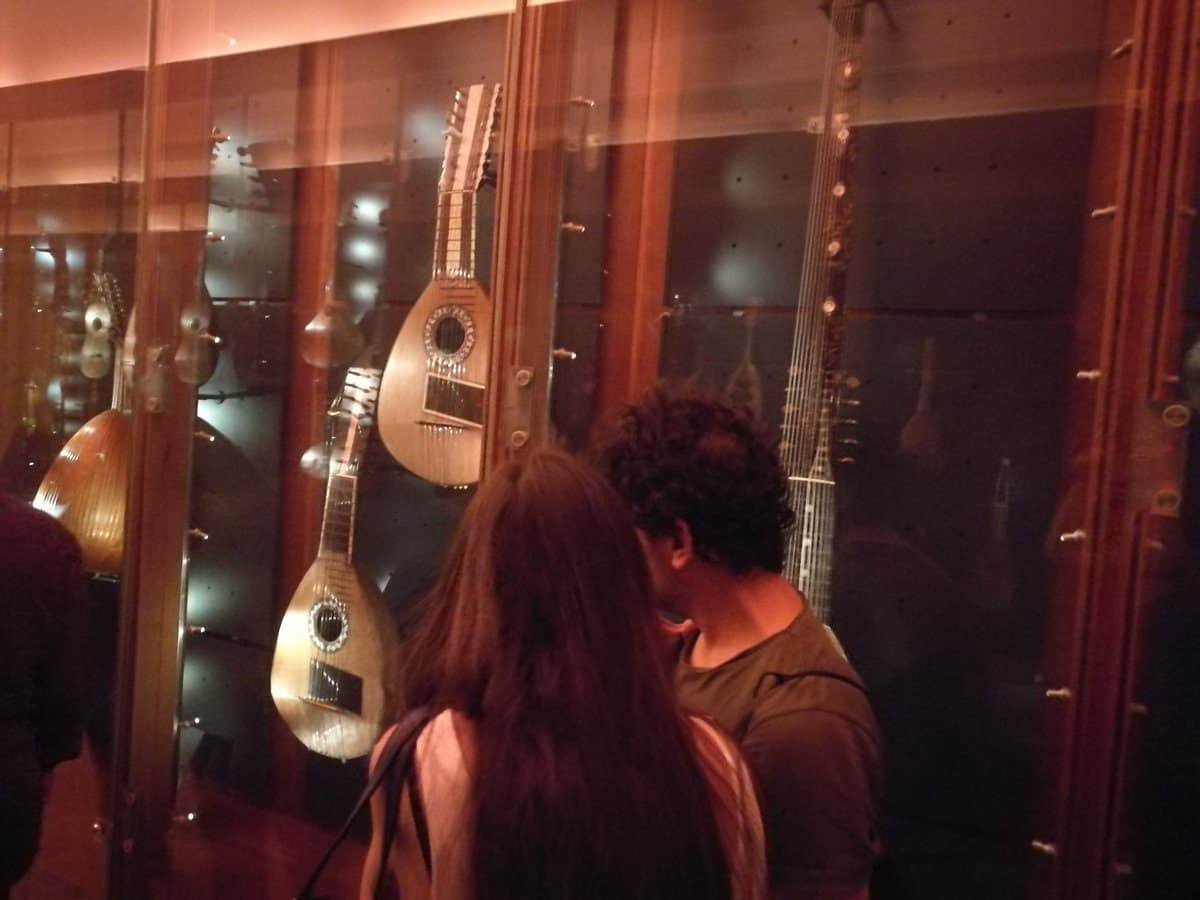
You begin with the plucked string instruments, the family in which Italy gave its best between the sixteenth and eighteenth centuries: lutes, theorbos, archlutes, guitars, mandolins, mandolas, mandolones. It's the section that surprises most those who expected only violins, because it shows an instrumental world that has almost vanished from modern concert practice and that in Rome was daily bread.
Look at the sound boxes: the staves fitted together, the depth of the shell, the rosettes carved directly into the soundboard. A seventeenth-century lute rosette is fretwork on wood a few millimeters thick, and one slip of the blade means throwing away weeks of work. No photographic reproduction conveys the finesse of that cut: you have to have the case in front of you and the right light.
The 1690 Stradivari Toscano violin, the piece everyone looks for
The most famous piece in the collection is a violin by Antonio Stradivari of 1690, called the Toscano. It was made for the Grand Prince Ferdinando de' Medici and was part of the so-called Medici quintet, a set of instruments commissioned by the Florentine court. Its history as a collector's item took it far from Italy for a long time. It returned in 1953 and since then has belonged to the Accademia Nazionale di Santa Cecilia.
Why it's important, beyond the name. The year 1690 belongs to the phase in which Stradivari experiments with a more elongated model, with flatter arching, freer lines and a sturdy construction that anticipates the maturity of the golden period. It is one of the best-preserved specimens known, and preservation is the real reason for its documentary value: the Hill brothers, in their 1889 monograph, wrote that looking at it lets you imagine yourself a contemporary of the great master and see and touch one of his violins in the state in which it left the workshop.
What to look at in front of the display case, concretely. The varnish, first of all: color and transparency, the way the maple back responds to the light under the layer of varnish. Then the f-holes, that is the resonance openings, and the cut of their eyelets. Then the scroll, where the luthier's hand is recognized like a signature. And finally the purfling, the double strip of wood inlaid along the edge: on a Stradivari it runs with a regularity that doesn't seem achieved by hand.
An honest warning: an instrument in a display case is mute, and a mute violin is half a violin. The Toscano is played on special occasions and has a discography. Hearing it recorded before you go to see it changes the visit radically. Frank advice: find a recording to listen to the night before. Then look at it. It is no longer an object, it is a sleeping instrument.

David Tecchler, the Bavarian who became Rome's luthier
Next to the Stradivari, the collection holds instruments by David Tecchler, and for the Roman public this is the name worth taking home. Tecchler was born in Lechbruck in 1666, trained in the Augsburg area and in 1698 moved to Rome, where he stayed until his death in 1748. 50 years of workshop in the same city. He is the luthier who gave Rome a school.
His output is known above all for cellos and double basses, considered among the best of their time, but he also built violas, violins and plucked instruments. An archlute of his from 1725 is kept at the Metropolitan Museum in New York. The style is hybrid, and this is the interesting point: in the construction you recognize together the Germanic matrix of his training and the Italian taste of the environment in which he worked. Tecchler instruments today circulate among international soloists and reach prices in the millions.
At the MUSA one of his violas is kept, and this allows an exercise I recommend to anyone who has half an hour: compare the wood, the proportions and the varnish of Tecchler with those of the Stradivari on display a little further on. Two hands, two schools, two decades apart. Anyone who has never looked at an instrument up close starts to see after this comparison.
The Roman mandolones of Gaspar Ferrari
Then there is a section that no other museum in the world can display in the same way, and it is that of the Roman mandolones built by Gaspar Ferrari, who was the originator of that type of instrument. The Roman mandolone was hugely popular in 18th century Rome and today is almost unknown even to many professional musicians: a city instrument, tied to a local practice, vanished together with the practice that had generated it.
If I had to name the cultural reason why it's worth coming all the way here, I would point to this display case even before the Stradivari. The Stradivari can be seen elsewhere too, in other collections and in other cities. The Roman mandolone instead tells the music of this city in a way no other object can: it was the instrument of serenades and private academies, the ordinary sound of a Rome that no longer exists. Stop two minutes longer in front of those elongated bodies and try to imagine the timbre.
The private collection of Margherita of Savoy
Part of the collection comes from a specific bequest: the private collection of plucked instruments of Queen Margherita of Savoy, left to the Academy in her will. Among these pieces there is a mandolin by David Tecchler, and the coincidence is the kind that makes you smile: the Bavarian luthier who worked for papal Rome ends up in the personal collection of the first queen of Italy.
Margherita played, and the mandolin in the second half of the 19th century was a fashionable instrument in aristocratic salons, with a very rich instrumental output that is today almost entirely forgotten. Her collection is not a court whim: it is the document of a widespread musical taste, that of the Italian bourgeoisie and nobility between the 19th and 20th centuries. A bequest worth double, for the instruments and for what it says about those who owned them.
Harps, lyres and psalteries
The section of harps, lyres and psalteries is the least visited and, for a curious eye, one of the most instructive. Here the museum shows the physical kinship between objects that seem to belong to separate worlds: the string stretched on a frame, the body that amplifies, the hand that plucks. Forms change, cultures change, the principle remains.
Psalteries, in particular, are instruments the public almost never recognizes: trapezoidal body, strings stretched horizontally, played with plectrums or small hammers. From that family descend, by different routes, both the harpsichord and the piano. Looking at a psaltery and then turning toward a keyboard is a lesson in the history of musical technology that lasts 30 seconds.
The wind instruments
The wind section collects wooden and brass instruments that document the evolution of mechanisms between the eighteenth and nineteenth centuries: the passage from simple holes to the key system, the arrival of valves in the brasses, the standardization of pitches. On these objects the industrialization of music can be read almost graphically: instruments built by hand by a craftsman become, in a century, serial products with patents and catalogs.
A detail to notice: look at the dark woods of the bores, boxwood and ebony, and then the ivory or bone rings at the joints. They are not decorations. They served to keep the wood from splitting from the moisture of breath. The beauty of these instruments is almost always a by-product of a technical necessity, and this holds for the whole museum.
The keyboard instruments
The route closes with the keyboards, and it's the section where the non-specialist public stops most willingly, because it recognizes the shapes. Harpsichords, spinets, historic pianos: the mechanics change, the logic of the interface has stayed the same for five centuries. On the historic pianos you can clearly see the difference from the modern piano: a wooden frame or one with partial metal reinforcements instead of the cast-iron frame, thinner strings, lower tension, differently covered hammers, shorter keyboards. The result is a lighter, drier sound, much less powerful.
Whoever has in mind today's concert piano and listens to the recording of a period instrument almost always makes the same face. Then they understand that Mozart and Beethoven wrote for those machines, not for a contemporary grand, and start to hear their music differently. It's the gift this museum gives without asking anything in return.
The non-European instruments: China, Japan, Yemen
The collection includes instruments from China, Japan and Yemen, as well as materials documenting Italian folk music and non-European ethnic music. It's not a courtesy ethnographic section: the juxtaposition with European instruments is exactly the point of the exhibition route, which invites you to read the technical similarities between objects born 10 thousand kilometers apart.
A long-necked Yemeni lute and a Roman theorbo solve the same acoustic problem with parallel solutions. Traditions are told apart precisely in the close comparison, and this is the intelligent way to arrange a collection of instruments. Many musical instrument museums in Europe haven't understood this yet.
The luthier's workshop in plain view
Inside the gallery opens a workshop in plain view, with some 50 luthier's tools on display, where the luthiers in charge of conserving the collection work. It's not a stage set: it's the real maintenance workshop, and during opening hours you often find someone at the bench.
Practical tip number one for those visiting the MUSA: if you find the luthier at work, stop. 10 minutes spent watching how a soundboard is thinned or how animal glue is prepared are worth all the museum's panels put together. The gouges, the curved-sole planes, the small knives, the calipers, the gluing clamps: they are tools almost identical to those Tecchler used in the eighteenth century, and the reason is simple. For that work technology has found nothing better.
The multimedia stations and the sound guide
The exhibition is complemented by audiovisual systems and interactive multimedia stations, which allow you to deepen your knowledge of music from different points of view, and by a guide on a portable device with about 20 illustrated and sound examples tied to the instruments on display.
Here a criticism is due: the interactive stations of museums age faster than the display cases, and in a museum opened in 2008 this shows. But the essential function, hearing the sound of the instruments you look at, remains irreplaceable. Use them. A museum of musical instruments where you hear nothing would be a contradiction in terms, and this one avoids it.
The activities of the Museum of Musical Instruments (MUSA) beyond the visit
The museum doesn't live on display cases alone. It organizes guided visits, educational workshops for children and adults aimed at both schools and private visitors, themed concerts, conferences, seminars and exhibitions. The series I point out most gladly is the Martedì MUSA, concerts held in the museum gallery by students of the Academy's advanced courses: introduction at 17.30, concert at 18.00, with a presentation dedicated to the program or to the museum's instruments. No reservation is needed and admission is free until places run out.
Listening to chamber music among the display cases of an instrument museum, for free, a stone's throw from a hall of 28 hundred seats, is one of those things that exist in Rome and that almost nobody takes advantage of. Places are few and go quickly: it's best to arrive by 17.15. The program is on the website of the Accademia Nazionale di Santa Cecilia, together with the calendar of the symphonic season.
The Bibliomediateca, the neighbor of the Museum of Musical Instruments (MUSA)
In the same complex, since 2005, is the Academy's Bibliomediateca, which is where the MUSA finds its written and sound documentation. It holds the entire library heritage of the Academy, about 100 and 20 thousand volumes and issues, with scores, monographs and music periodicals. The manuscripts are about 7,000, almost all cataloged. The editions prior to 1830 are about 15 hundred. Digitization has already covered 14 hundred and 50 manuscripts and about 400 early editions.
Then there are the sound archives, with record collections of vinyl, lacquer discs and digital media and recordings conducted by Toscanini, Furtwängler and Karajan. The photographic archive, with documentation of the twentieth-century concert seasons and portraits of musicians going back to the nineteenth century. An art collection of about 100 pieces among paintings, drawings, sculptures and prints. And the institution's historical archive, which starts from 1651 and arrives at today. The reading room is open Monday to Friday from 11.00 to 17.00. The contact is bibliomediateca@santacecilia.it, the phone 06 80242332.
The Ethnomusicology Archives, Nataletti, Carpitella and Alan Lomax
Inside the Bibliomediateca is kept the collection I consider the least known treasure of the whole complex. In 1948 Giorgio Nataletti founded in Rome the Centro Nazionale Studi di Musica Popolare, under the auspices of the Accademia di Santa Cecilia and of RAI: a research institute on song and music of oral tradition, on the model of those that already existed abroad.
Through that center passed Diego Carpitella, the man who made ethnomusicology an academic discipline in Italy. In 1954 and 1955 Carpitella traveled the peninsula together with the American Alan Lomax, the most important collector of folk music of the twentieth century, recording work songs, liturgical songs, tarantellas, lullabies, funeral laments. Those reels are the sound photograph of a peasant Italy that was about to disappear, and in many cases they are the only surviving testimony of extinct repertoires. In 1973 Carpitella organized the first national conference of ethnomusicological studies, in 1984 he fully restarted the center's activities, in 1989 he became its curator, changing its name to Ethnomusicology Archives, and directed it until his death in 1990.
Today the collection holds over 11 thousand recordings of traditional music and about 7,000 documents on Italian folk music, with particular density on the center and south, on Sicily, on Sardinia and on Mediterranean liturgical songs. Since 2005 it can be consulted here, at the Parco della Musica. The paradox is delightful: inside a building by Renzo Piano clad in lead, in a district built for the 1960 Olympics, the voice of an Italy of reapers and fishermen is preserved. If you are interested in folk music, this is the reason you should come to Rome.
The Auditorium Parco della Musica, the building that houses the Museum of Musical Instruments (MUSA)
You can't understand the MUSA without understanding the container. The Auditorium Parco della Musica Ennio Morricone is the largest music complex built in Italy in the twentieth century and one of the largest in Europe: about 55 thousand square meters between Flaminio and Parioli, next to the Olympic Village and Villa Glori. The design is by Renzo Piano, who won the invitational competition in 1993. The acoustics were entrusted to Jürgen Reinhold of the Müller BBM firm of Munich, the landscape to Franco Zagari.
The Sala Sinopoli opened on April 21, 2002 with 11 hundred and 33 seats. The rest of the complex opened on December 21 of the same year. The three halls have deliberately different sizes: the Sala Santa Cecilia with about 28 hundred seats for the big symphonic repertoire, the Sala Sinopoli for intermediate ensembles, the Sala Petrassi with 600 and 73 seats for chamber and contemporary music, plus the Teatro Studio with 300 and eight seats. Outside, the open-air cavea holds about 3,000 spectators. In 2020 the Rome city council approved naming the whole complex after Ennio Morricone.
The shape of the scarabs
The three halls are three separate volumes, with a brick base and an exterior covering of lead sheets, arranged around the open-air amphitheater. The shape has caused debate since day one: Romans call them the scarabs, and indeed the lead shells recall elytra. It's not a unitary building, it's a small artificial landscape of metal hills with a Greek theater in the middle.
Our opinion: the idea of separating the halls into three distinct bodies was a functional stroke of genius, because it allows three simultaneous concerts without one disturbing another, and it's the reason the Auditorium has become a place alive every day and not a temple that opens two evenings a week. Aesthetics aside, that lead has oxidized well: in 2002 it was light gray, today it has a darker and warmer patina. Buildings that age well are rare.
The Sala Santa Cecilia and the 26 cherrywood shells
The largest hall, the one in whose foyer the museum opens, deserves two technical words. It occupies about 34 hundred square meters for a volume of about 30 thousand cubic meters, with a stage of 300 and 36 square meters and an orchestra seating area of 12 hundred. The load-bearing structure of the roof is in laminated wood beams joined by stainless steel components.
The acoustic ceiling is formed by 26 American cherry shells suspended above the seating and adjustable: they govern the reflection of sound and allow the hall to be adapted to the repertoire. The declared reverberation time is two seconds and two tenths, a high value, designed for the big symphonic repertoire and for choir. The orchestra and balconies are clad in wood, and the seats rise on terraced steps that surround the stage.
Practical translation for those going to a concert: in this hall the sound is wide and enveloping, and the pianissimos arrive. But the definition of the attacks gets a bit lost in the farthest rows. If you buy a ticket for a symphonic program, spend a few euros more and take a seat in the front half of the stalls or in the first side balconies. For chamber music, instead, the Petrassi is something else.

The Roman villa under the cavea
Now the part almost nobody associates with an auditorium. In 1995, while digging for the foundations, the remains of a large suburban villa came to light at the foot of the Parioli hills, near the ancient Via Flaminia and the Tiber. The construction site stopped, the project was modified and the cavea was rotated so as not to destroy the find. A rare case in which archaeology won without blocking the work.
The chronological sequence of the site is impressive. In the sixth century BC there was a modest farm here with living and production areas. In the fifth century the building expands and becomes a rich rural villa. Between the fourth and third centuries BC the residential quarter and the service quarter are better separated. Between the third and second centuries the construction becomes an imposing rural residence, with an atrium and impluvium. In the Augustan age, in the first century AD, further enlargements arrive. In the second century AD the complex is abandoned and intentionally demolished. 800 years of continuous life, read on a single dig.
The remains are preserved at foundation level and emerge at about four meters deep: you can recognize the residential structures, the service areas, the oil presses, the wells and the storerooms. The Archaeological Museum set up in the complex presents wooden models of the architecture and ceramic finds, with reconstructions of rooms such as kitchens and ovens, and a second section dedicated to the finds from the territory between the Aurelian Walls, the Aniene and the Tiber. Admission is free during opening hours, with winter hours from October to March from 11.00 to 18.00, Sundays and holidays from 10.00 to 18.00, and summer hours from April to October from 10.00 to 20.00.
Whoever visits the MUSA and doesn't go down here too is wrong twice: because it's free and because it's a hundred and 50 meters away. Line up the two museums in the same afternoon and you'll have covered 26 hundred years in 90 minutes.
A curiosity about the Museum of Musical Instruments (MUSA)
The real curiosity concerns an object that is not at the MUSA, and that explains better than any other the environment this collection comes from. In the library of the Santa Cecilia Conservatory, on Via dei Greci, a score by Pietro Raimondi in a format of 108 by 80 centimeters is kept. It's not a manuscript that is large out of vanity: it is large because it contains three distinct oratorios, written so that they can be performed either separately or all three together, superimposed, like a single sound organism. In 1852 the dress rehearsal of that idea was actually staged, with 400 musicians.
Raimondi was a contrapuntist of Neapolitan training, a man who considered musical writing a problem of combinatorial engineering. That undertaking is not a folkloric anecdote: it's the extreme end point of a contrapuntal tradition that in Rome had a very long history, the one that begins with Palestrina and passes through the Roman polyphonic schools of the seventeenth century. A century before the avant-gardes, an Italian composer was writing music designed to be performed in simultaneous layers.
The second curiosity concerns the collection of instruments and its mixed origin. The Academy's collection was not born from a single purchase but from successive layerings, with a decisive weight of private bequests: Queen Margherita of Savoy left in her will her personal collection of plucked instruments, which also included a mandolin built by David Tecchler. It means that part of what you look at in the display cases of the Auditorium was actually played, in a salon, by hands we know by name. They are not anonymous archaeological finds: they are objects with a biography.
The third, and I say it because it's the question visitors ask most often when they discover that admission is free: a museum with a Stradivari is not financed by tickets. It is financed because it belongs to a foundation that lives on the concert season, on members, on public contributions and on private patronage, and that considers the museum part of its cultural mission. Free admission is a choice, not a fallback. In a city where getting into almost anywhere costs from 12 to 20 euros, it's worth saying.
One thing nobody tells you about the Museum of Musical Instruments (MUSA)
That the museum closes at 16.00. It seems a trivial detail and instead it's the piece of information that ruins more visits than any other, because it contradicts the mental image everyone has of the Auditorium: a place that lives in the evening. The instrument gallery doesn't. In the central part of the season it opens at 11.00 and closes at 16.00, and whoever arrives at 17.00 thinking of taking a look before the concert finds the lights off. It happens often, always at the same hour, always with the same incredulous face.
The second thing nobody tells you concerns summer. In July and September the museum doesn't open to the free public: you can enter only by appointment, with a paid guided visit and a minimum of eight participants. In August it is closed entirely. Which means that the period of peak tourist presence in Rome coincides with the period of minimum accessibility of the museum. Whoever comes to the city in July or August and wants to see the Stradivari has to organize ahead, phone, form a group. It's not impossible, but it can't be improvised.
Third thing, and this is the most insidious: on the occasion of particular events the exhibition spaces may not be accessible to the public, even during opening hours. The Auditorium is a machine that hosts conventions, recordings, television shoots and set-ups, and the foyer of the Sala Santa Cecilia, where the museum entrance opens, is used for receptions and ceremonies. When that happens, the gallery closes. There is no public calendar of these closures, and the only way to avoid them is a phone call to the museum management number the same day.
Fourth, minor but useful: the Bibliomediateca has different hours from the museum, Monday to Friday from 11.00 to 17.00. If you come to consult the collections, and not just to look at the display cases, the two schedules don't coincide and on Saturday the library isn't there. Whoever plans a study trip has to keep this in mind.
Let's put the four things together in a single line: the MUSA is a weekday-afternoon museum, from October to June, with a confirmation phone call the same morning. Follow this formula and you never go wrong.
My advice for visiting the Museum of Musical Instruments (MUSA)
The main advice is to flip the mental order with which you approach this place. Almost everyone thinks of the museum as filler before the concert. Do the opposite: build the afternoon around the museum and treat the rest as a side dish. In practice, arrive around 14.30, unhurried, on a weekday. The museum opens at 11.00 but the morning is the time of school groups and educational groups, and a not-so-large gallery with 30 kids inside is no pleasure. Early afternoon is almost always half empty.
Second piece of advice: before entering, stop five minutes at the reception and ask for the sound guide. It's a portable device with about 20 illustrated examples, and it turns a silent stroll into a lesson. It's worth repeating because it's the most frequent mistake: most visitors don't ask for it and then leave saying the museum is small. The museum is not small, it's concentrated, and without the audio you perceive half of it.
Third piece of advice, for those traveling with someone who understands nothing about music and comes to make you happy. Don't start from the Stradivari. Start from the luthier's workshop: the tools, the bench, the raw wood, the varnish. Anyone, even the most resistant, understands manual work. When you've built that bridge, go to the display cases and the conversation opens by itself. It's a trick that saves many visits.
Fourth: count on the archaeological museum under the cavea, which is free and takes barely half an hour. The best sequence is instrument museum, coffee in the Auditorium gallery, archaeological museum, then a walk on the Ponte della Musica at sunset. Four stops, zero euros in tickets, three full hours.
Fifth, and I care about this one. If you can make the visit coincide with a Tuesday, do it and stay. The Martedì MUSA are concerts by students of the advanced courses inside the museum gallery, with introduction at 17.30 and concert at 18.00, free admission until places run out and no reservation required. Listening to a quartet among the display cases of a musical instrument museum is an experience no expensive ticket will give you. Arrive at 17.15 if you want to sit.
One last piece of advice, the kind that makes the difference between a visit and a day out: bring headphones and a smartphone with a few recordings already downloaded. Listen to the Toscano before you look at it, listen to a baroque mandolin in front of Ferrari's mandolones, listen to a historic piano in front of the keyboards. Do it and you'll leave feeling you've understood something. Don't, and you'll have seen some wooden objects behind glass.
Another well-known fact, yet rarely mentioned
The Accademia Nazionale di Santa Cecilia and the Conservatorio di Santa Cecilia have been two distinct, separate institutions since 1919. Everyone knows they exist. Almost nobody knows they aren't the same thing, and every year the confusion produces a small disaster of wrong trips, calls to the wrong number and wasted visits.
The story in brief. The Accademia, founded in 1585, opened a music school within itself in 1875, at the initiative of Giovanni Sgambati and Ettore Pinelli, in a building in the Tridente. The school grew, became independent in 1911, and in 1919 was constituted as a state conservatory, separating definitively from the body that had generated it. Since then the Accademia has been a private-law foundation with an orchestra, a chorus, a concert season, advanced training courses, an archive, a library and a museum. The Conservatorio is a state institute of advanced musical education that answers to the ministry and awards degrees.
There are three practical consequences, and they're worth lining up. The first: the address. The Conservatorio is at Via dei Greci 18, in the Tridente, five minutes from Piazza di Spagna. The Accademia operates at Viale Pietro de Coubertin 30, in Flaminio, and keeps its registered office at Via Vittoria 6. Two addresses four kilometers apart.
The second: the libraries. There are two, and that's why researchers get lost. The Conservatorio library, on Via dei Greci, holds about 300,000 book units, eight incunabula, 312 sixteenth-century editions, 10,000 manuscripts and 4,000 sound recordings. The Accademia's Bibliomediateca, at the Auditorium, holds about 120,000 volumes and issues, 7,000 manuscripts, the historical archive from 1651 and the Archives of Ethnomusicology. Whoever is looking for a Rossini autograph has to know which of the two to go to, otherwise they cross Rome for nothing.
The third: the instruments. The collection you see today at the MUSA belongs to the Accademia and followed the Accademia in its 2003 move. It was never a collection of the Conservatorio, even though for decades it lived on the same block. Whoever goes to Via dei Greci expecting to find the Stradivari won't find it, and whoever goes to the Auditorium expecting to find the Walcker organ of the Sala Accademica won't find that either.
The well-known fact, then, is that Rome has two Santa Ceciliae. The rarely mentioned corollary is that the heritage was divided along with them, and that to see everything you have to make two trips. It's a detail that surprises almost everyone.

The right photo to take at the Museo degli Strumenti Musicali (MUSA)
First the technical problem, because in an instrument museum it's always the same one: the glass. The display cases are lit with warm, raking light, the instruments are varnished and shiny, and the result is that 90 percent of the photos taken here contain the photographer's reflection. The solution isn't flash, which makes everything worse and isn't allowed in many museums. The solution is to put the lens almost against the glass, so the body of the camera or phone works as a lens hood, and shoot in ambient light with a high ISO. Set the ISO by hand if you can: in these conditions the automatic settings almost always get it wrong.
The photo I recommend isn't the whole violin. The whole violin, in the display case and seen from three-quarters, always comes out the same and always mediocre. The right photo is a detail: the Stradivari's scroll, with the spiral winding into the shadow, or one of the f-holes, or the pierced rosette of a seventeenth-century lute. A well-framed detail tells the story of the craftsman's work. A wide shot only tells you that you went to the museum.
The second shot I recommend is inside the open luthier's workshop. The tools lined up on the bench, the round-soled planes, the clamps, the gouges, the light cutting across the worktop. It's a perfect still life, and there's no glass in front of it when the workshop is open. If the luthier is at work, ask first with a gesture: he usually says yes, as long as you don't use flash and don't disturb him.
Third shot, and this one leaves the museum. Go out to the foyer of the Sala Santa Cecilia and photograph the wood of the ceiling and the curved walls. Then go up toward the central square and frame the three lead shells with the cavea in the middle. The best light for the exteriors is late morning in winter, when the low sun lights up the patina of the lead and brings out its warm grays. On overcast days, on the other hand, the complex comes out flat: it's a building that needs directional light.
General rule: in an instrument museum, the best photograph is the one that makes you want to hear the sound. A detail of a soundboard, a taut string, a keyboard worn by use. If someone looking at your photo thinks of music and not of wood, you've taken the right photograph.
Some important events that happened here in history
The place where the museum stands today has a layering of events that few people line up, and it's worth doing, because it covers 25 centuries.
The first event is very ancient and concerns the land. In the 6th century BC, when Rome was a city of huts and first temples, there was a farm here with living and working areas. Over the following centuries that farm grew into an imposing rural villa, with an atrium and an impluvium, and kept operating until the 2nd century AD, when it was abandoned and deliberately demolished. 800 years of farming life at the gates of the city, on land that today hosts symphonic concerts.
The second event is from 1995 and is the discovery of that villa during the excavations for the foundations of the Auditorium. It was a discovery that could have sunk the building site, and instead it turned into a change to the project: the cavea was moved and rotated to save the structures, and the remains were turned into a museum on the spot. In the history of Rome's great twentieth-century building sites, it's one of the few cases where archaeology and architecture came to an agreement without either one losing.
The third event is April 21, 2002, the opening of the Sala Sinopoli, followed on December 21 of the same year by the inauguration of the rest of the complex. Rome had a real concert hall again after 66 years. The city had lost the Augusteo in 1936, when the Mausoleum of Augustus was cleared of later additions and the hall carved out inside it was demolished. From then on the Santa Cecilia orchestra had lived as a nomad, between the Teatro Adriano, the Teatro Argentina and the Auditorio Pio. 2002 closes that long parenthesis.
The fourth event is 2003, with the transfer of the Accademia's entire artistic, administrative and museum structure to the Parco della Musica: the end of a cycle of moves that began in 1585 at the Pantheon and continued through six churches, a chamber palace and a former convent.
The fifth is 2005, with the opening of the Bibliomediateca and the simultaneous availability on site of the Archives of Ethnomusicology, the ones founded in 1948 as the Centro Nazionale Studi di Musica Popolare.
The sixth is February 2008, the inauguration of the gallery of the Museo degli Strumenti Musicali (MUSA) in the spaces designed by Renzo Piano. From that moment the Accademia's collection, which for over a century had remained essentially reserved for insiders, became visible to anyone who walks in, free of charge.
The seventh is from 2020, when the Capitoline assembly approved naming the entire complex after Ennio Morricone, who died that year. The most performed Roman composer in the world gives his name to the building that hosts the orchestra of his city.
A personal observation on this chronology. There are places in Rome where the history is all ancient and ends. Here the sequence is continuous and arrives at yesterday. Within 200 meters you go from an archaic farm to a contemporary concert hall with no break, and the curious thing is that nobody tells visitors. Once you know this story, you look at the lawn of the cavea differently.
Who has passed through the Museo degli Strumenti Musicali (MUSA)
The question has two answers, and it's worth distinguishing them: who passed through the instruments, and who passed through the place.
Let's start with the instruments, because it's the most fascinating answer. The Toscano violin was built in 1690 for the Granprincipe Ferdinando de' Medici, son of Grand Duke Cosimo III, one of the most important musical patrons in the Europe of his time. Leading musicians worked at his court, and the invention of the piano also matured in that environment. Ferdinando commissioned a set of instruments from Stradivari, and the Toscano was part of it. After a long collecting history, the instrument returned to Italy in 1953 and entered the Accademia's holdings.
Then there's David Tecchler, who kept a workshop in Rome from 1698 to 1748. He isn't a name that passed through the museum. He's a name that built part of what the museum displays. Tecchler worked for important clients of papal Rome, and his cellos are today among the strings of international soloists. The Accademia's collection holds a viola of his.
There's Gaspar Ferrari, the inventor of the Roman mandolone, an instrument that was hugely popular in eighteenth-century Rome and that today you see almost only here. And there's Margherita di Savoia, the first queen of Italy, who played plucked instruments and left her private collection to the Accademia in her will, which included a mandolin by Tecchler.
On the other side, that of the musicians who passed through the owning institution, the list is the kind that leaves you breathless. Among the historic members of the Congregation and later of the Accademia are Giovanni Pierluigi da Palestrina, who was the absolute pinnacle of that world, Arcangelo Corelli, who lived and worked in Rome for 40 years and published here the works that would found the European violin school, Niccolò Jommelli, and later Gioachino Rossini, Gaetano Donizetti, Franz Liszt, Felix Mendelssohn, Hector Berlioz and Charles Gounod. In 1774 the first woman was admitted, the Roman composer Maria Rosa Coccia, who was then just over 15: a fact that in the context of the papal eighteenth century is sensational.
Then there are the conductors who have led the Accademia's orchestra and who have therefore frequented these halls: Bernardino Molinari, Fernando Previtali, Igor Markevitch, Giuseppe Sinopoli, Daniele Gatti, Myung Whun Chung, Antonio Pappano for 18 seasons, and since 2024 Daniel Harding. Add the soloists who cross the foyer of the Sala Santa Cecilia every year to get to the stage, and you understand that the museum sits exactly on the daily path of the greatest instrumentalists in the world.
A detail that makes you smile: in the museum's gallery, on Tuesday afternoons, the students of the advanced courses play. 20-year-olds performing 10 meters from a Stradivari, in the same institution that had Corelli among its members. I don't know many places in the world where the continuity of a craft is this evident.
How to really visit the Museo degli Strumenti Musicali (MUSA)
Hours, seasonality and closures
The basic rule is that the museum follows the concert season. In the central part of the year, roughly from October and November until June, the gallery is open every day from 11.00 to 16.00. In July and September you can enter only by appointment, with a paid guided tour and a minimum of eight participants. In August it's closed. On the occasion of particular events the exhibition spaces may not be accessible, even during regular hours.
Since the information on seasonality varies from one official source to another between October and November as the starting month, it's always best to confirm by phone at +39 06 80242382 and +39 06 80242332 or by writing to museo@santacecilia.it. The calendar of the Auditorium and that of the Accademia are the only reliable references for the current week.
Booking and guided tours
For a self-guided visit during opening hours you don't need to book and you don't need a ticket: you just walk in. For guided tours, on the other hand, booking is mandatory, the tour is paid and the group must be at least eight people. Schools have dedicated routes and educational workshops, for both children and adults, and these must be arranged with the museum's management.
The practical advice for families and small groups who want the guide: team up with other visitors. Eight people isn't many, and in the periods when the museum opens only by appointment this is the only way. Whoever travels alone and still wants some accompaniment can fall back on the portable audio guide, which covers about 20 instruments with illustrated examples.
Accessibility at the Museo degli Strumenti Musicali (MUSA)
The museum is accessible to people with disabilities, and this is one of the concrete advantages of being inside a building designed in the 1990s and opened in 2002. The Auditorium has elevators, dedicated routes and reception staff available for assistance. Routes are provided for blind visitors, and the parking lots have reserved spaces.
That said, I'll add a clarification as a professional: accessible doesn't mean equally comfortable for everyone. The complex is large and the internal distances between the parking lot, the central square and the foyer of the Sala Santa Cecilia are measured in hundreds of meters. Whoever has trouble walking but doesn't use a wheelchair should be dropped off as close as possible to the entrance of the Sala Santa Cecilia and not the general one. The reception staff will point out the shortest route if you ask.
The Museo degli Strumenti Musicali (MUSA) with children
It works well, better than you'd expect, and for two reasons. The first is the open luthier's workshop: the tools, the wood shavings, the wood and a craftsman at work are a language children understand without any mediation. The second is the sound component: the instruments can be listened to, and a museum where you hear something beats a museum where you only look.
The museum organizes educational workshops for schools and private groups, which must be booked. For a self-guided visit with children between six and 12, the realistic length is 40 minutes. Beyond that, attention drops. My suggestion is to turn the visit into a hunt: have them look for the smallest instrument, the biggest one, the one with the most strings, the one that comes from the farthest away. It always works.
After the museum, the cavea and the lawns of the Auditorium are an open space where children can run, and for a family day in Rome that's gold. If you're looking for a day designed entirely for them, the reference in the city remains Explora, the children's museum, which is a few tram stops toward the center.
Coat check, cafe, services
The complex has a coat check, a cafe, a restaurant, a bookshop and a store. The museum has its own area with the Accademia's publications. It's best to leave bulky backpacks and long umbrellas behind, because the display cases are close together and in tight spaces a man with a backpack on his shoulders is a public hazard. The cafe in the central gallery is a good place to stop between the instrument museum and the archaeological one.
When to go and when to avoid
The best time is early afternoon on a weekday between November and March, when the Auditorium is alive but not crowded and the low winter light makes the exteriors photogenic. The worst time is a weekday morning in spring, when school groups fill the gallery, and of course summer, when the museum opens only by appointment or stays closed.
Another interesting window is concert evenings, but only for those holding a ticket: the museum is closed at that hour, but the foyer of the Sala Santa Cecilia is open and at least lets you see the space. If you have to choose, though, choose the afternoon: the open museum is worth infinitely more than the lit-up foyer.
What to see around the Museo degli Strumenti Musicali (MUSA)
Within 10 minutes on foot
The Archaeological Museum and the Roman villa of the Auditorium are inside the complex, free, and already described above: they're the first thing to add. A little further on, on Via Guido Reni, is the MAXXI, the national museum of 21st-century arts designed by Zaha Hadid: seven minutes on foot from the Auditorium, and the natural completion of a day devoted to contemporary Roman architecture. Two buildings signed by two Pritzker winners 500 meters from each other don't come along often.
Toward the river is the Ponte della Musica, reserved for pedestrians and cyclists, which connects Flaminio to the Foro Italico. Crossing it at sunset, with the Tiber below and pines on both sides, is one of the best walks in this part of Rome. From the other bank you reach the Stadio Olimpico and the Foro Italico complex in a few minutes.
A little farther
Heading down toward the center along Viale Tiziano and Viale del Muro Torto you enter Villa Borghese, and on its northern edge is the National Etruscan Museum of Villa Giulia, which houses the Sarcophagus of the Spouses and remains, in our judgment, the most underrated museum in Rome. Not far away, in the Belle Arti palace on Viale delle Belle Arti, is the Galleria Nazionale d'arte moderna e contemporanea.
Whoever wants to close the circle with this story should take the 53 and get off at the Tridente: Piazza del Popolo, then Via del Babuino, then Via dei Greci with the Conservatorio and the Arco di Sant'Atanasio, then Via Vittoria, then Piazza di Spagna and the climb to Trinità dei Monti. An hour's walk that lines up all the places the MUSA comes from. It's an itinerary for enthusiasts, and it works better going from the Auditorium toward the center than the other way around.
The Museo degli Strumenti Musicali (MUSA) or the Museo Nazionale: which to choose
People ask me this constantly and it deserves a straight answer. If you have only half a day and you're interested in lutherie, meaning the art of building bowed and plucked instruments, go to the MUSA: the Toscano Stradivari, Tecchler's viola, Ferrari's mandolones and the open workshop have no equivalents, admission is free and the visit is short. If instead you're interested in the history of instruments as a discipline, with the encyclopedic coverage that runs from antiquity to the 19th century, go to the National Museum of Musical Instruments on Piazza di Santa Croce in Gerusalemme, where the Gorga collection offers numbers the MUSA doesn't have, the Barberini harp and a piano by Bartolomeo Cristofori.
If you have a whole day and you're an enthusiast, do both, but in this order: the Museo Nazionale in the morning first, then the MUSA in the early afternoon, because the second closes at 16.00 and the first doesn't. The mistake I see made most often is the reverse order, which ends with finding the Auditorium gallery closed.
I'll add a piece of advice on expectations, because it matters more than logistics. The Museo Nazionale is a museum of quantity: room after room, dense display cases, an immense material catalog. The MUSA is a museum of quality and selection: few pieces, excellent ones, with a contemporary display layout and a sound component. They're two different experiences, and whoever expects one and finds the other is disappointed for the wrong reason.
One last thing, for those who watch their wallet: the MUSA is always free during opening hours, and that rightfully places it among the destinations on our page on free museums in Rome. The Museo Nazionale is paid, with the discounts provided for state museums.
Quick questions about the Museo degli Strumenti Musicali (MUSA)
Where is the Museo degli Strumenti Musicali (MUSA)
At the Auditorium Parco della Musica Ennio Morricone, Viale Pietro de Coubertin 30, 00196 Rome, in the Flaminio neighborhood. The entrance to the gallery opens in the foyer of the Sala Santa Cecilia.
How much is a ticket to the Museo degli Strumenti Musicali (MUSA)
Nothing: during regular opening hours admission is free. Guided tours by appointment, on the other hand, are paid and require a minimum of eight participants.
What are the hours of the Museo degli Strumenti Musicali (MUSA)
In the central part of the season, roughly from October and November to June, every day from 11.00 to 16.00. In July and September only by appointment for guided tours. In August closed. It's best to confirm by phone, because during events the spaces may remain inaccessible.
Do I need to book to visit the Museo degli Strumenti Musicali (MUSA)
For a self-guided visit during regular hours, no. For a guided tour, yes, and you must reach a group of at least eight people.
How long does a visit to the Museo degli Strumenti Musicali (MUSA) take
From 25 minutes for someone who walks fast to an hour and a quarter for someone who uses the audio guide and stops at the luthier's workshop. The realistic average is 40 minutes.
What's the difference between the MUSA and the Museo Nazionale degli Strumenti Musicali
They're two different museums in two different neighborhoods. The MUSA belongs to the Accademia Nazionale di Santa Cecilia, is at the Auditorium in Flaminio and is free. The Museo Nazionale is state-run, is on Piazza di Santa Croce in Gerusalemme next to the basilica, has a much larger collection that grew out of Evan Gorga's collection, and is paid.
Is the Museo degli Strumenti Musicali (MUSA) the one at the Conservatorio on Via dei Greci
No. The Conservatorio statale di musica Santa Cecilia, at Via dei Greci 18, has been an autonomous institution since 1919 and holds a historic library of very great value, but the collection of instruments belongs to the Accademia and has been at the Auditorium since 2003. The two institutions have the same name and intertwined histories, but they are separate bodies.
Is there really a Stradivari at the Museo degli Strumenti Musicali (MUSA)
Yes. It's the violin called the Toscano, from 1690, built for the Granprincipe Ferdinando de' Medici and belonging to the Medici quintet. It returned to Italy in 1953 and is owned by the Accademia Nazionale di Santa Cecilia.
How many instruments are on display at the Museo degli Strumenti Musicali (MUSA)
In the gallery about 130 instruments, plus about 50 lutherie accessories in the open workshop. The Accademia's whole collection exceeds 500 pieces among instruments, accessories, objects and relics.
Can you take photographs at the Museo degli Strumenti Musicali (MUSA)
Photographs without flash are normally tolerated in the exhibition spaces of the Auditorium's museums. For uses other than personal ones and for filming, it's best to ask at reception. Flash, in any case, is useless on varnished instruments and harmful to the result.
Is the Museo degli Strumenti Musicali (MUSA) wheelchair accessible
Yes, the museum is accessible and the Auditorium has elevators, dedicated routes, assistance staff and parking with reserved spaces. The internal distances of the complex are long, though: it's best to ask for the shortest route to the foyer of the Sala Santa Cecilia.
Is the Museo degli Strumenti Musicali (MUSA) suitable for children
Yes, above all thanks to the open luthier's workshop and the sound stations. The museum organizes educational workshops for children and adults, for schools and private groups, by reservation. For a self-guided visit with children, allow 40 minutes.
Is admission free on the first Sunday of the month
The first-Sunday free admission applies to the state and civic museums that adopt that measure. At the MUSA the question doesn't arise, because admission is free every day it's open.
How do you get to the Museo degli Strumenti Musicali (MUSA) by public transport
Metro A to Flaminio and then tram 2 toward Piazza Mancini. Alternatively, buses 910 from Termini, 53 from Largo Chigi, 168 from Tiburtina station and 982 from Quattro Venti station. The Euclide stop on the Roma-Nord railway is another possibility.
Is there parking at the Auditorium
Yes, two paid parking lots, one open-air and one covered multistory, both with spaces reserved for people with disabilities.
How long is the wait in line at the Museo degli Strumenti Musicali (MUSA)
Practically never. With no ticket office, and since it's a museum not much visited by mass tourism, you walk right in. The only wait happens when a large school group is there at the same time.
Can you visit the Museo degli Strumenti Musicali (MUSA) before an evening concert
No, because the gallery closes at 16.00. Whoever has a ticket for the evening can still cross the foyer of the Sala Santa Cecilia, where the museum entrance is, and see the space from outside.
Are there concerts inside the Museo degli Strumenti Musicali (MUSA)
Yes. The Martedì MUSA series brings the Accademia's advanced-course students into the museum gallery, with an introduction at 17.30 and a concert at 18.00. No booking is needed and admission is free until seats run out.
What can you see near the Museo degli Strumenti Musicali (MUSA)
The Archaeological Museum and the Roman villa under the cavea, in the same complex and free. The MAXXI, seven minutes on foot. The Ponte della Musica and the Foro Italico toward the river. Villa Giulia and the Galleria Nazionale going down toward Villa Borghese.
Does the Museo degli Strumenti Musicali (MUSA) have a shop
Yes, there's a point of sale with the Accademia's publications. The Auditorium complex also hosts a bookshop, a cafe and a restaurant.
Can you play the instruments on display
No. The historic instruments are kept in display cases and maintenance is entrusted to the luthiers of the in-house workshop. Listening happens through the multimedia stations and the audio guide, which offer recorded examples.
Where can you consult the Accademia's music archives
At the Bibliomediateca, in the same Auditorium complex, open Monday to Friday from 11.00 to 17.00. It holds about 120,000 volumes and issues, 7,000 manuscripts, the historical archive from 1651 and the Archives of Ethnomusicology with over 11,000 recordings of traditional music.
And where is the Conservatorio library
At Via dei Greci 18, in the historic seat of the Conservatorio Santa Cecilia. It holds about 300,000 book units, eight incunabula, 312 sixteenth-century editions, 10,000 manuscripts and 4,000 sound recordings, with autographs of Palestrina, Mendelssohn, Liszt, Donizetti and Rossini. Rare materials are consulted by appointment.
Is the Museo degli Strumenti Musicali (MUSA) worth the trip to Flaminio
If you're interested in music, yes, without hesitation: it's free, you can visit it in an hour, it contains pieces you don't see elsewhere and it's a hundred meters from a second free museum. If music means nothing to you, then the trip is justified only by combining it with the MAXXI or a concert.
The final verdict on the Museo degli Strumenti Musicali (MUSA)
This gallery works for everyone: professional musicians, groups of students, couples on their honeymoon, and people who walk in only because it's raining. Nobody has left bored, and for a niche museum that's a result worth more than any admissions statistic. The reason, I think, is that musical instruments are objects that speak even to those who know nothing about music: they're handcrafted wood, they're artisan labor, they're shapes that follow a precise function and hide a sound.
If I had to say what's missing, I'd say one thing only: a live performance every day. The museum does it on Tuesdays with the students' concerts, and those are the days when this place gives its best. On the other days, the silence of the display cases remains a bit of a suspended opportunity. But it's a lover's criticism, not an enemy's.
Go on a midweek afternoon in winter, ask for the audio guide, stop in front of the workshop until the luthier looks up, then go down to the archaeological museum under the cavea and come out onto the Ponte della Musica when the sun is low. It will have cost you zero euros and it will stay with you more than many days of 50-euro tickets. Rome, now and then, gives gifts.
Article written by the editorial team of TourLeaderPro, contact them for Private/Corporate/V.I.P. Tours and Experiences.
Planning a trip to Rome? The English guides to visiting the city are on ItalyPlanner.com.