Holy Stairs
In short. The Holy Stairs is located at Piazza di San Giovanni in Laterano, 14, 00184 Rome, on the eastern side of the Lateran complex, in a standalone building facing the north facade of the basilica.
The Holy Stairs is located at Piazza di San Giovanni in Laterano, 14, 00184 Rome, on the eastern side of the Lateran complex, in a standalone building facing the north facade of the basilica. It can be reached on foot in a few minutes from the Metro A San Giovanni station, or by the tram 3 and several bus lines that terminate or stop at Piazza di Porta San Giovanni, including the 16, 81, 85 and 87. The Porta San Giovanni interchange remains the most convenient reference point. Climbing the 28 steps of the Holy Stairs on your knees is free. You only pay for the visit to the Sancta Sanctorum, the papal chapel at the top, with a full ticket of €3.50 and a reduced ticket of €3.00 (children aged 6 to 18, students, people over 65 and groups of more than 20 people). The Holy Stairs is open to the public Monday to Saturday from 6:00 to 13:30 and from 15:00 to 18:30 (from November to March the afternoon closing is earlier, at 18:00), and on Sundays and holidays from 7:00 to 13:30 and from 15:00 to 18:30, with last entry 30 minutes before closing. The Sancta Sanctorum keeps shorter hours, Monday to Saturday 9:00 to 13:30 and 15:00 to 17:15, while on Sundays and religious holidays it opens only in the afternoon, from 15:00 to 17:15. Individual visitors don't need to book: the ticket for the Sancta Sanctorum is bought on site, at the sanctuary's custody office. Booking by email is only for large groups. The sanctuary's reference number is 329 751 1111, and its official website, where you can check hours and special closures before leaving, is scala-santa.com.
The sanctuary is run by the Passionist Fathers and is part of the large religious complex of the Lateran. Those who spend a morning in the area usually combine the Holy Stairs with the nearby St. John Lateran Basilica, Rome's cathedral, which stands right beside it.

Where the Holy Stairs Is and How to Get There
The Holy Stairs occupies a standalone building on the side of Piazza di San Giovanni in Laterano that faces the Aurelian Walls, a few tens of meters from the basilica and the Lateran Baptistery. The facade, designed under Sixtus V by Domenico Fontana, is recognizable by the five-arched portico that supports an attic with the dedicatory inscription. It is the entrance door to the vestibule where the five flights of stairs begin.
The simplest way to get there is the metro. Line A, San Giovanni stop, drops you off at Piazza di Porta San Giovanni, and from there it's five minutes on foot along the walls. The tram 3, which connects Trastevere and the Colosseum with the San Giovanni neighborhood, stops in the same square. The Porta San Giovanni bus hub is served by many city lines that cross the center and the southern neighborhoods. Those arriving by car will find parking complicated, as in the whole area, so it's better to leave the car farther away and finish the trip by metro. The square in front of the Holy Stairs is wide and largely pedestrian, so the walk over is easy even for those with a stroller.
Opening Hours and Tickets for the Holy Stairs and the Sancta Sanctorum
It's worth keeping two things separate, since they are often confused. The Holy Stairs as such, that is, the climb on your knees up the 28 steps, is always free and requires no ticket. It's an act of devotion open to anyone during the sanctuary's opening hours. The ticket is only needed to enter the Sancta Sanctorum, the papal chapel at the top of the stairs, which is closed off by a grille and can be visited separately.
Holy Stairs hours are 6:00-13:30 and 15:00-18:30 Monday to Saturday, and 7:00-13:30 and 15:00-18:30 on Sundays and holidays, with the afternoon closing moved earlier to 18:00 from November to March. The last entry is set 30 minutes before closing. The Sancta Sanctorum is open Monday to Saturday from 9:00 to 13:30 and from 15:00 to 17:15, and on Sundays only in the afternoon, from 15:00 to 17:15. The Sancta Sanctorum ticket costs €3.50 full and €3.00 reduced. For groups of more than 20 people, the reduced rate applies per participant. Since hours change between summer and winter and may be adjusted for liturgical celebrations and feasts, the practical advice is to check the sanctuary's official website in the days before your visit.
What Is the Holy Stairs
The Holy Stairs is a staircase of 28 steps that Christian tradition identifies with the staircase of Pontius Pilate's praetorium in Jerusalem, the one Jesus is believed to have climbed and descended during the trial that preceded the crucifixion. For this reason it is no ordinary staircase: it is considered a relic of the Passion, and the faithful climb it on their knees, one step at a time, as an act of penance and meditation on Christ's journey to Calvary.
The degree of certainty needs to be stated clearly. That the 28 steps are physically the ones Jesus stepped on belongs to tradition, not to documented history: it is an ancient devotional belief, attested since at least the year 1000, not a verifiable fact. What is historically established, however, is the role this staircase played for centuries. In the Lateran palace, the popes' residence for about a thousand years, the staircase led to the pope's private chapel, the Sancta Sanctorum, and this very role as the access to the most sacred place in the papal palace explains the veneration surrounding it. The Holy Stairs, in short, is both a relic according to faith and a monument of medieval papal ceremonial.
The History of the Holy Stairs: From Saint Helena to Sixtus V
The Tradition of Saint Helena and Jerusalem
According to the account handed down from the Middle Ages, the staircase was supposedly brought from Jerusalem to Rome by Saint Helena, mother of the emperor Constantine, around 326, on the same journey to the Holy Land to which tradition links the discovery of the Cross. Helena supposedly gathered the relics of the Passion in Palestine, and among them the staircase of the Roman governor's palace where Jesus was questioned by Pilate. It is the same legendary story that gave rise to the nearby basilica of Holy Cross in Jerusalem, where Helena is said to have deposited the earth of Golgotha and fragments of the Cross. Here too it is a devotional tradition, valuable for understanding Roman spirituality but not to be passed off as chronicle.
The Lateran Palace and the Sancta Sanctorum
To understand the Holy Stairs, you have to picture the Lateran before Sixtus V. Until the popes returned from Avignon, the Lateran Patriarchate was the papal residence, a labyrinth of halls, oratories and chapels that grew over the centuries. The staircase we call Holy today was one of the palace's grand staircases, and it led to the pope's private chapel, dedicated to Saint Lawrence and called the Sancta Sanctorum because it housed the most venerated relics of Christendom. When the popes returned to Rome they found the old palace in ruins, and within a few decades it was decided to tear it down.
The 1589 Move and Domenico Fontana
It was Sixtus V, the pope who between 1585 and 1590 redesigned half of Rome, who ordered the demolition of the old Patriarchate and the construction of a new palace. In doing so he wanted to save the three most sacred nuclei of the complex: the Holy Stairs, the chapel of the Sancta Sanctorum and the great mosaic of the Triclinium of Leo III. In 1589 the pope's trusted architect, Domenico Fontana, dismantled the staircase and moved it from the Lateran palace to the specially erected building, placing it in front of the surviving chapel. Tradition says that, so as not to profane it, the 28 steps were reassembled starting from the top, so that the workers never had to set foot on them. Since then the Holy Stairs has stood in the position we know today, at the center of five parallel flights.

The 28 Steps of the Holy Stairs
The Marble, the Grooves and the Walnut Covering
The steps of the Holy Stairs are 28, made of white marble of Eastern origin. For centuries the faithful climbed them on their knees with no protection, and the constant contact with the knees and lips of pilgrims carved real grooves into the marble, still visible today. To stop that wear, in 1723, during the pontificate of Innocent XIII, the steps were covered with boards of walnut wood: this is the covering the visitor touches today when climbing, while the original marble remains hidden and protected beneath the boards. At three steps the wood is pierced by a metal grille that lets you glimpse the marble and, according to devotion, the spots where the blood of Christ would have fallen.
The Four Side Staircases
The Holy Stairs in the strict sense is only the central one. Alongside it run four side ramps, two on the right and two on the left, built for going down and for the passage of those who don't make the penitential climb. The rule is simple and ancient: the central staircase is climbed only on the knees, never standing, and to come back down or to reach the Sancta Sanctorum without kneeling, the side ramps are used. These stairs too are decorated with a large cycle of late sixteenth-century frescoes, so that the whole vestibule forms one single great story told in images.

The restoration of the Holy Stairs and the rediscovered marble steps
The major work carried out at the sanctuary is one of the most fascinating chapters in the recent history of the monument. The restoration project, promoted by the Passionists from 1990 together with the Governorate of the Vatican City State, was entrusted to the Restoration Laboratory for Paintings and Wooden Materials of the Vatican Museums, coordinated by Paolo Violini. The restoration of the frescoes had begun in 2000 and proceeded in stages over the years, until it came to include, between 2018 and 2019, the staircase itself and the four side ramps.
The most extraordinary moment came when, in order to complete the work on the wood attacked by woodworm, the walnut cladding was temporarily removed and the original marble of the 28 steps became visible for the first time in about 300 years. For several weeks the faithful were able to climb on their knees directly over the bare marble, an experience not seen since the eighteenth century, until Pentecost Sunday, June 9, 2019. Then the wood, restored, was put back in its place and the marble was again under protection. The intervention was made possible by a private bequest, that of Lucia Caprara, and by the support of the patrons of the Vatican Museums. Visitors to the Holy Stairs today no longer see the uncovered marble, but they know that beneath the restored boards lies the stone that generations of pilgrims have worn down.
The restoration did not concern only the staircase. Over the years, the vast cycle of frescoes in the vestibule, the four side ramps and the rooms of the upper chapel were also recovered, in a project carried out with the techniques of the Vatican laboratories and divided into successive phases: the work on the paintings had started around 2000 and continued through the following decade, before reaching the intervention on the staircase proper. It was one of the most demanding recoveries carried out outside the Vatican walls, and it restored to the sanctuary a legibility that had been lost under centuries of dust, humidity and candle smoke. For today's visitor the result is evident: the colors of the frescoes are bright, the decorative scheme can once again be read in full, and the Holy Stairs have regained the sumptuous appearance that Sixtus V had wanted to give it at the end of the sixteenth century. Knowing the story of the restoration helps you look at the place with different eyes: what seems simply ancient is in fact the result of a long and patient conservation effort that is still recent.
The Sancta Sanctorum: the holiest chapel
At the top of the Holy Stairs opens the Sancta Sanctorum, officially the chapel of San Lorenzo in Palatio, the ancient private chapel of the popes. Over the arch that leads into it runs the inscription that sums up its fame: Non est in toto sanctior orbe locus, that is, there is no place in the whole world more holy than this one. For centuries the chapel remained practically inaccessible, closed off by a sturdy grille: it was viewed from the threshold at the top of the stairs, without the possibility of entering. Today it is visited with a ticket, but the grille remains, and the feeling of standing before a private and intact space is still there.
The acheiropoietos icon of the Savior
At the center of the Sancta Sanctorum, above the altar, the acheiropoietos icon of the Savior, the Santissimo Salvatore, is venerated. Acheiropoietos is a Greek word meaning not painted by human hand. Tradition holds that the image was begun by the evangelist Luke and finished by an angel. Scholars date it between the 5th and 6th centuries, and some propose a later Byzantine origin. What is certain is that it is one of the oldest and most revered sacred images in Rome. In the 13th century Innocent III had it covered with a silver plate, and over the centuries the icon has been protected by precious coverings that leave only the face uncovered. Throughout the Middle Ages the image was at the center of a famous night procession on Ferragosto, when it was carried through the streets of Rome to meet the icon of the Madonna.
The thirteenth-century frescoes and the Cosmatesque floor
The current appearance of the chapel dates back to Niccolo III, the pope who, after the earthquake of 1277, had it restored and decorated, giving it the Gothic look that still characterizes it today. The walls are covered by a cycle of thirteenth-century frescoes of great importance: in the pendentives of the vault, the four evangelists, and on the walls, Christ enthroned among angels, Pope Niccolo III kneeling as he offers the model of the chapel, accompanied by Saints Peter and Paul, and the stories of the martyrs, the martyrdom of Peter and Paul, the stoning of Saint Stephen, the martyrdom of Saint Lawrence, the beheading of Saint Agnes and the episode of Saint Nicholas with the three maidens. The floor is a splendid example of Cosmatesque art, the work of the Roman marble workers who signed with the formula Magister Cosmatus fecit hoc opus, with its inlays of porphyry and serpentine arranged in rotae and geometric designs.
The Relics and Treasure of the Sancta Sanctorum
Under the altar of the chapel was kept a chest of cypress wood full of relics, a treasure accumulated over the centuries and considered among the most important of medieval Christianity: among the objects handed down, tradition listed even sandals attributed to Jesus and the skulls of saints such as Agnes and Prassede. Many of these materials, together with the precious furnishings, reliquaries and enameled crosses, are today preserved and displayed in the Vatican, at the Sacred Museum of the Apostolic Library. Anyone who wants to see those objects will find them along the route of the Vatican Museums. In the chapel remain the altar, the grate, the icon and its aura of inviolability.

The Late Sixteenth-Century Frescoes of the Holy Stairs
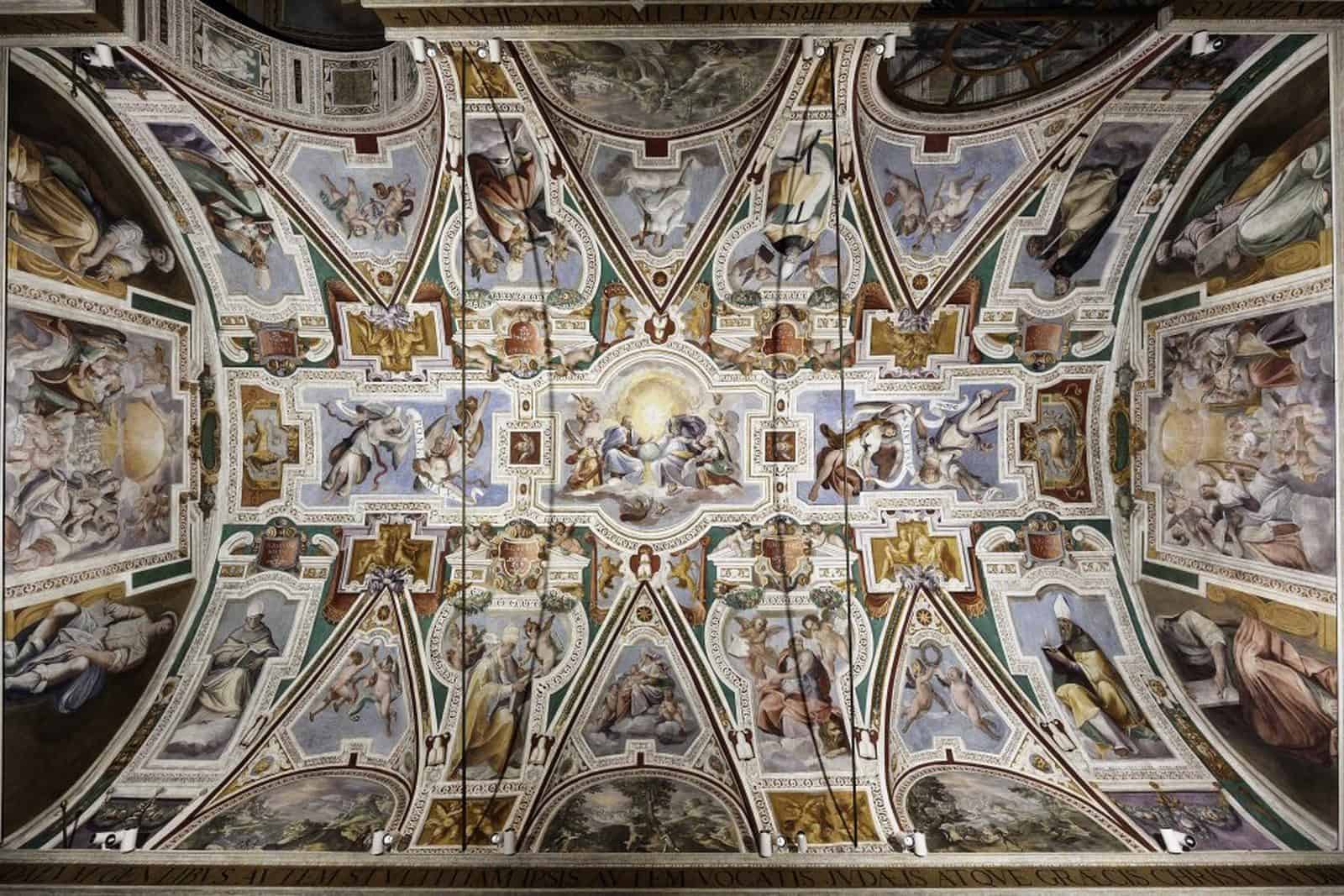
When Sixtus V built the new building, the vestibule with the five ramps was decorated in very quick time, between 1587 and 1588, by a large team of painters under the direction of Cesare Nebbia and Giovanni Guerra, the same coordinators of the great Sistine decorative projects in the Vatican and at the Lateran. Among others, Andrea Lilli, Giovan Battista Ricci and Paris Nogari took part in the campaign: names of the so-called Sistine school, prolific artists who worked in series but with remarkable consistency of narrative.
The iconographic program is not accidental: looking up, you encounter the stories of the Old Testament as prefigurations, and above all the great narrative of the Passion of Christ, which accompanies the faithful on the climb, letting them relive through images the stages that the staircase itself represents. It is an enormous cycle, little known compared to the Vatican Stanze but of extraordinary extent, which the restoration has brought back to vivid colors. It's worth looking up often while you go up or down the side ramps: the vault and the walls are entirely painted.
The Sculptures and Atrium of the Holy Stairs
At the foot of the Holy Stairs, in the atrium, two nineteenth-century sculptural groups by Ignazio Jacometti greet the visitor: the Ecce Homo, Christ shown to the crowd, and the Kiss of Judas, the moment of betrayal in the Garden of Olives. They are works from the middle of the 19th century, designed to introduce the theme of the Passion even before the pilgrim begins to climb, and placed right at the start of the ramps like a figurative threshold. Other devotional sculptures from the nineteenth century are added to them. The whole, between the marbles at the entrance and the frescoes along the climb, makes the atrium of the Holy Stairs a space designed in every detail to lead the visitor from the square to the mystery of the upper chapel.
Climbing the Holy Stairs on Your Knees: Devotion and Indulgence
The devotional practice linked to the Holy Stairs is precise. The central staircase is climbed exclusively on your knees, one step at a time, often stopping on each one for a prayer or meditation on the Passion. The Church grants to those who make the climb under the required sacramental conditions, namely confession, communion and prayer according to the intentions of the pope, the Plenary Indulgence, applicable to oneself or to a deceased person. Anyone who is unable to climb on their knees, due to age or health, can obtain the same spiritual fruit by meditating in front of the staircase.
The custody of the sanctuary has been entrusted since the middle of the 19th century to the Passionist Fathers, the congregation founded by Saint Paul of the Cross, whose mission is precisely the remembrance of the Passion of Christ. It was Pius IX who entrusted the place to them in perpetuity. Even the non-believing visitor is welcomed without problems, provided they respect the recollection of those who pray. It is good to remember that, before being a monument, the Holy Stairs is a living place of worship, frequented every day by pilgrims who climb slowly and in silence.
How to Visit the Holy Stairs
The visit is shorter than the site's fame would suggest, but it should be planned around what you want to do. Anyone who only wants to see the staircase and climb one of the side ramps needs a quarter of an hour. Those who make the penitential climb on their knees take much longer, because it proceeds slowly and with pauses, and during busy hours an orderly line forms on the lowest step. Adding the visit to the Sancta Sanctorum and a stop in front of the frescoes, you can comfortably reach one hour.
The natural route is this: you enter from the atrium, look at the Jacometti groups, choose whether to climb the central staircase on your knees or walk up one of the side staircases, reach the upper landing from which you look into the Sancta Sanctorum through the grille, and if you have a ticket, enter the chapel. The practical advice is not to treat the Holy Stairs as a quick stop: a few minutes is enough to see it, but here the value lies in the slow pace, in observing the grooves in the marble through the grilles, and in looking at the painted cycle that wraps around the ramps.
The Holy Stairs with Children
The Holy Stairs is also a place suited to a family visit, provided you explain its meaning first. You can tell children the story of the 28 steps brought from Jerusalem, of the marble worn by the knees of pilgrims and hidden under wood, of the treasure hidden in the chapel behind the grille: these are strong images, and they make an impression. Climbing on your knees is not suitable for the youngest children, but nothing prevents you from walking up a side ramp with them and looking into the Sancta Sanctorum. The outdoor square, wide and pedestrian, allows a comfortable break between the Holy Stairs and the Lateran Basilica. The only recommendation is the usual one for places of worship: speak in a low voice and show respect for those who are praying.
Accessibility of the Holy Stairs
The question of accessibility at the Holy Stairs deserves frankness. The central staircase, by its nature, is an obstacle: you climb it on your knees and it cannot be climbed in any other way. The side ramps still allow everyone to reach the upper level and look into the chapel, but they remain stairs all the same. For anyone with mobility difficulties or who uses a wheelchair, the best solution is to inquire in advance at the sanctuary about access options to the Sancta Sanctorum and the routes available. Devotion, moreover, explicitly includes those who cannot climb: the Church recognizes the same spiritual value in meditation carried out in front of the staircase. For up-to-date details on access, it's best to contact the sanctuary directly.
When to Go to the Holy Stairs
The times when the Holy Stairs is most crowded are Lent and especially the Easter period, when climbing on your knees draws huge numbers of the faithful, and on Good Friday the staircase becomes the destination of a continuous pilgrimage. If you're looking for quiet and short lines, avoid those weeks and choose a weekday, preferably early in the morning, when the sanctuary opens at six and the light comes in low on the frescoes. Jubilee years also bring an extraordinary influx, because the Holy Stairs has always been one of the destinations of pilgrim devotion in Rome. During the central hours of holidays you climb in line, one step at a time: a condition that for many is part of the experience, but that those visiting for historical and artistic interest will prefer to avoid.
What to See Around the Holy Stairs
The Holy Stairs is the heart of one of the richest hubs of Rome. A few steps away is the St. John Lateran Basilica, the pope's cathedral and the oldest basilica in the West, with its Cosmati cloister and the Baptistery. Also nearby, toward the walls, Holy Cross in Jerusalem, the other church linked to the relics of the Passion brought by Sant'Elena, is about 10 minutes on foot. If you have more time, you can head toward the Celio, where you can visit the Case Romane del Celio and the San Clemente Basilica with its three stacked levels, or the Basilica of Santi Quattro Coronati with the chapel of San Silvestro. Continuing on, you reach the Colosseum, the Domus Aurea, and San Pietro in Vincoli with Michelangelo's Moses. Toward the south, beyond the walls, are the Baths of Caracalla, while on the Esquiline Hill the great Basilica of Santa Maria Maggiore ideally closes the route of the papal basilicas, together with San Lorenzo fuori le mura.
Other Holy Stairs Around the World
The Holy Stairs in Rome are the venerated original, but they're not the only ones. Over the centuries the model spread across Europe, and many replicas were created to allow the faithful who couldn't reach Rome to carry out the same penitential devotion. There are copies in Jerusalem, Prague, Naples, Siena, Lourdes, Mantua, Turin and in many other places, often built next to Marian shrines or religious houses. Each one reproduces the 28 steps and the practice of climbing on your knees, with the related indulgence granted under the same conditions. Their existence shows how powerful a model the Roman Holy Stairs were in the Catholic devotional imagination, capable of generating copies across half a continent. Knowing that the stairs in Rome are the progenitor of this family adds weight to the visit: when you climb here, you climb the step from which all the other stairs took shape. In front of the central staircase, it's worth remembering that generations of pilgrims who would never see Rome prayed on imitations of these same 28 steps.
Devotion and pilgrimages to the Holy Stairs
The Holy Stairs have always been one of the fixed points of the Roman pilgrimage. From the Middle Ages on, those who came to Rome for a Jubilee almost always included the climb of the stairs in their itinerary, along with the visit to the great basilicas. The practice has a precise ritual: you start from the lowest step, kneel, climb one step at a time, stopping on each one for a prayer or for meditation on a moment of the Passion, and so you reach the landing in front of the Sancta Sanctorum. Many pilgrims kiss the steps at the three grates that let you glimpse the marble. Devotion intensifies at the high points of the liturgical year: during Lent and above all on Good Friday the stairs become the destination of an uninterrupted flow of the faithful, and the sanctuary often extends its hours to welcome everyone.
One aspect needs to be underlined, because it surprises those who arrive with only a tourist's curiosity: the Holy Stairs are not a frozen monument, but a fully living place of worship. On any weekday you'll find people of every age and background climbing slowly in silence, and this recollected rhythm is an integral part of the experience of the place. Those who visit out of historical or artistic interest are welcome, as long as they respect the atmosphere of prayer: the unwritten rule is to move slowly and quietly, and to use the side stairs if you don't intend to make the penitential climb.
The Triclinium of Leo III and the saved fragments of the Lateran
When Sixtus V ordered the demolition of the old Patriarchate, he decided to save three elements: the Holy Stairs, the chapel of the Sancta Sanctorum and the great mosaic of the Triclinium of Leo III. The triclinium was the great banquet hall of the Carolingian papal palace, commissioned by Pope Leo III around 800, the years of his alliance with Charlemagne. Of its mosaic decoration, what remains today, in the square in front of the Holy Stairs, is an 18th-century reconstruction set on an exedra, which depicts Christ among the apostles and scenes with Saint Peter, the pontiff and the sovereign: a direct reference to the relationship between the papacy and the empire. As you walk across the square, it's worth stopping for a few minutes to look at this mosaic wall: it's the third of the three surviving fragments of that vanished palace, and it completes the historical picture of the Holy Stairs. Together, stairs, chapel and mosaic are all that remains, isolated and reset by Sixtus V, of the ceremonial heart of the medieval Lateran.
Why the Holy Stairs are unique in Rome
Rome is full of churches, chapels and relics, and yet the Holy Stairs are like nothing else. Their uniqueness comes from the intersection of three elements that rarely coexist in the same place. First, it's a relic that you use: not an object locked in a case to look at, but a staircase that the faithful physically climb with their own body, on their knees, coming into direct contact with the venerated material. Second, above it, it houses one of the oldest and for a long time inaccessible chapels in Rome, the Sancta Sanctorum, with its icon of the Savior and its 13th-century frescoes. Third, it is both a monument and an active place of worship, where historical and artistic value is added to devotion practiced every day. Add to this the story of the marble hidden under the wood and rediscovered for a few weeks in 2019, and you'll understand why the Holy Stairs stay with you. It's not a museum, it's not only a church: it's a device of faith built around a gesture, that of climbing slowly, one step at a time, toward the place that an inscription declares the holiest in the world.
The meaning of the 28 steps of the Holy Stairs
The number of steps is not random in devotion: there are 28, and tradition identifies them with the ones that led up from the courtyard of the praetorium to the hall where Jesus was judged by Pontius Pilate. Climbing them on your knees means symbolically retracing Christ's path toward condemnation, and for this reason the climb is always accompanied by meditation on the moments of the Passion. Each step becomes a station, a place to stop, pray and reflect, so that the staircase turns into a spiritual path marked step by step. This physical dimension is what sets the Holy Stairs apart from any ordinary relic: you don't just look at it, you pass through it with your body, enduring the strain on your knees against the wood as a small participation in the suffering being commemorated. It's worth arriving knowing this, because it changes the way you look at the people climbing slowly: they are not simply visiting a monument, they are performing an ancient gesture centuries old. Even the non-religious visitor, knowing the meaning of the 28 steps, better understands the reason for that recollected rhythm that fills the whole vestibule, and sees why people here climb in silence and never in a hurry.
Practical Tips for Climbing the Holy Stairs
A few practical pointers make a visit to the Holy Stairs more peaceful. You're in a sanctuary, so the rules for places of worship apply: shoulders and knees covered, phone on silent, voice low. If you plan to make the penitential climb on your knees, you should expect that 28 wooden steps taken this way will test your joints: many pilgrims bring a small padding with them or wear comfortable trousers, and there's nothing improper about doing so. The climb takes time and should not be rushed, also out of respect for those climbing in front of and behind you, you don't step over or pass anyone who is praying. Anyone visiting for study or curiosity can walk up one of the side ramps without any problem, keeping silent. At the entrance, it's worth looking at the nineteenth-century sculpture groups in the atrium before you start the climb, because they introduce the theme of the Passion and give meaning to what you are about to do. Finally, keep in mind the two ticket arrangements: the stairs are free, the Sancta Sanctorum has a separate ticket that you pay on site, and it's a minimal supplement that more than pays for access to the chapel.
The Fresco Cycle of the Holy Stairs in Detail
The painted cycle that covers the vestibule of the Holy Stairs deserves a closer reading than it usually gets. Carried out in just two years, between 1587 and 1588, by a true workshop of painters directed by Cesare Nebbia and Giovanni Guerra, it is one of the largest decorative ensembles of Sistine Rome, comparable in scale to the great Vatican projects of the same years. The logic of the program follows the climb: the walls and vaults of the ramps tell the stories of salvation, from the Old Testament prefigurations up to the cycle of the Passion, which accompanies those who climb toward the upper chapel almost like a narrative path told in images. Don't expect the hand of a single genius: here what mattered was the coherence of the story and speed of execution, and artists such as Andrea Lilli, Giovan Battista Ricci and Paris Nogari worked side by side on a unified design. The restoration of recent decades has returned to the colors a brilliance that for centuries had remained smothered under dirt and the smoke of candles. The right way to look at this cycle is to walk slowly up one of the side ramps with your gaze raised, letting the scenes follow one another: that is when the vestibule of the Holy Stairs reveals itself to be, besides a place of devotion, a great figurative machine of the Counter-Reformation.
A Curiosity About the Holy Stairs
The curiosity that almost nobody knows concerns the way the staircase was reassembled in 1589. When Domenico Fontana moved it from the old Lateran palace to the new building, a problem arose that was entirely theological: how to move, step by step, a staircase that no one was supposed to walk on with their feet. The solution handed down by the chronicles was to assemble it from the top down, placing the upper steps first and then gradually the lower ones, so that the workers were never forced to rest their feet on a step already in place. It's a detail that says a great deal about the obsessive care with which the sixteenth century treated relics: it wasn't enough to move the staircase, it had to be moved without ever violating it. There is also a second particular that escapes most people: the steps you climb today are not marble, but wood. The true marble, the venerated one, has been under the walnut boards since 1723, and it resurfaces only in the three small grates that pilgrims kiss along the climb. Those who think they are touching the stone of the Passion with their knees are actually touching an eighteenth-century covering put there precisely to protect it.
One Thing Nobody Tells You About the Holy Stairs
The thing no plaque explains is that the Holy Stairs are only the surviving piece of a vanished world. The building that houses them is not ancient. It is a late sixteenth century Sistine construction, put up in a hurry to save three fragments of the Lateran Patriarchate, the real palace of the medieval popes, which Sixtus V had razed to the ground. So when you enter the sanctuary, you are not walking into a medieval papal palace. You are entering a case built specifically around what was chosen to be kept from that palace: the staircase, the chapel of the Sancta Sanctorum and, a little further on, the mosaic of the Triclinium of Leo III. Everything else, halls, loggias, chapels layered over the centuries, was demolished. There is a second practical detail that surprises many visitors: climbing the staircase is completely free, and you pay only to enter the chapel at the top. Quite a few arrive convinced they have to buy a ticket for the stairs and hesitate in front of the entrance. You don't need one. Devotion is open to everyone, and the ticket covers only the Sancta Sanctorum.
My advice for visiting the Holy Stairs
My advice is to come to the Holy Stairs early in the morning on a weekday, right when it opens, and to take the time to climb at least one of the side ramps with your head up, looking at the frescoes. Many people focus only on the central staircase and the pilgrims on their knees, and don't notice that the whole vestibule, vault and walls, is an enormous painted cycle from the late sixteenth century, recently restored. That is the visual treasure of the place, and you only enjoy it by lifting your head and walking slowly. My second piece of advice is not to skip the ticket for the Sancta Sanctorum. It costs little, just over three euros, and it lets you enter one of the oldest and most inaccessible chapels in Rome, for centuries visible only through a grate. Those who limit themselves to the staircase and leave without seeing the icon of the Savior and the thirteenth century frescoes miss the most precious destination. Last warning: avoid Lent and Holy Week if you want quiet, because during those days the line on the first step never ends.
Another well-known fact, yet rarely mentioned
It is well known that the Holy Stairs have 28 steps, but the detail that makes that number so impressive is almost never added: they are the same 28 steps for centuries, and dozens of generations have knelt on them until they wore grooves into the marble. The grooves visible beneath the grates are not a flaw in the stone. They are the physical imprint of millions of knees and kisses, the slow wear of devotion made material. And this, more than any relic, is what strikes anyone who looks carefully. There is also a historical fact that is often repeated but almost always incomplete: tradition attributes the arrival of the staircase in Rome to Saint Helena in 326, but it must be said honestly that this is a devotional tradition, not a documented fact. The first person should not confuse faith and history. The staircase has been venerated for 1,000 years as Pilate's staircase, and this is certain and verifiable. That it is physically that staircase belongs to belief, not to the documents. Knowing this takes nothing away from the power of the place. If anything, it helps you understand it better.
The right photo to take at the Holy Stairs
The right photo at the Holy Stairs is not a close-up of the steps, which with their wooden covering don't look good, but the wide shot of the vestibule from the back of the atrium, which frames the five parallel ramps in perspective with the pilgrims kneeling on the central staircase and the frescoed vault coming down over their heads. It is the image that best conveys the feel of the place: the slow movement of the climb, the symmetry of the ramps, the painted sky above. If you want a more intimate detail, point instead upward, to the grate of the Sancta Sanctorum seen from the upper landing, with the icon of the Savior appearing in half-light beyond the bars. It is a photograph that tells centuries of inaccessibility in a single shot. Two practical and necessary warnings: this is an active place of worship, so no flash and no poses that disturb those who are praying, and inside the Sancta Sanctorum, any indications about photography must be respected. The best light for the vestibule is early morning, when it comes in raking and lights up the restored frescoes.
Some important events that happened here in history
The first major event is the earthquake of 1277, which damaged the papal chapel and prompted Nicholas III to rebuild it and have it decorated, giving it its Gothic look and the cycle of thirteenth-century frescoes that we still see today behind the grate. The second, decisive one is the demolition of the Lateran Patriarchate, ordered by Sixtus V, and the resulting transfer of the Holy Stairs in 1589 by Domenico Fontana, who saved the staircase, the chapel and the mosaic of the Triclinium from the demolition of the old palace. In 1723, under Innocent XIII, a less spectacular but crucial event for preservation took place: the marble steps, by then worn down by grooves, were covered with the walnut boards that still protect them today. The most recent chapter is the major restoration by the Vatican Museums, completed between 2018 and 2019: to complete the work, the wooden covering was removed and the original marble became visible to the faithful for the first time in about 300 years, until Pentecost on June 9, 2019, when the restored wood was put back in place. Each of these stages has left a tangible mark on the monument you visit today.
Who Has Passed Through the Holy Stairs
Over 1,000 years, popes, saints and pilgrims from every part of Europe have climbed these 28 steps. For centuries the upper chapel was the private chapel of the popes, who kept the most precious relics of Christianity there, and the staircase has been climbed by countless faithful during every Jubilee, when Rome filled with pilgrims headed to the great basilicas. The most famous figure tradition links to the Holy Stairs is Martin Luther. During his stay in Rome, around 1510, the future reformer supposedly climbed the staircase on his knees, as was the custom, and it was from that experience, according to the account he himself handed down years later, that his first doubts about the value of penitential practices and indulgences would have arisen. It is an episode reported by Luther himself, so it belongs more to memory and tradition than to documented facts, but it remains one of the most fascinating knots between the history of Rome and the Reformation. Alongside him, devotion to the stairs has drawn figures such as Pius IX, who in the mid-19th century entrusted its custody to the Passionists, and generations of saints and popes who came here to pray. Still, every famous face counts for less than the anonymous crowd that has been climbing slowly for centuries: it is they, the nameless pilgrims, who wore down the marble.

Quick Questions About the Holy Stairs
How Much Does It Cost to Climb the Holy Stairs?
Climbing the Holy Stairs on your knees is free and does not require a ticket. You only pay to visit the Sancta Sanctorum, the chapel at the top, with a full ticket of €3,50 and a reduced ticket of €3,00.
What Are the Holy Stairs Opening Hours?
The Holy Stairs is open Monday through Saturday from 6:00 to 13:30 and from 15:00 to 18:30, and on Sundays and holidays from 7:00 to 13:30 and from 15:00 to 18:30. From November to March the afternoon closing is brought forward to 18:00. The last entry is 30 minutes before closing.
What Are the Sancta Sanctorum Opening Hours?
The Sancta Sanctorum opens Monday through Saturday from 9:00 to 13:30 and from 15:00 to 17:15. On Sundays and religious holidays it is closed in the morning and opens only in the afternoon, from 15:00 to 17:15.
Do You Have to Climb the Holy Stairs on Your Knees?
The central staircase is climbed only on your knees, as an act of devotion. Those who do not want to or cannot kneel use one of the four side ramps, which still lead to the level of the Sancta Sanctorum.
How Many Steps Does the Holy Stairs Have?
The Holy Stairs has 28 marble steps, today covered with walnut wood to protect them. The original marble is visible only through three small grates along the climb.
Why Are the Steps Covered With Wood?
The walnut wood covering was applied in 1723 under Innocent XIII to protect the marble, which by then had been worn by the grooves left by pilgrims' knees over the centuries.
Can You Still See the Original Marble Steps of the Holy Stairs?
The original marble became fully visible only during the restoration completed in 2019, until Pentecost on June 9 of that year. Today the wood is back in place and the marble can be glimpsed only through the grates.
Do You Need to Book to Visit the Holy Stairs?
Individual visitors do not need to book: tickets for the Sancta Sanctorum are bought on site. Email reservations are only for large groups.
What Is the Sancta Sanctorum?
It is the ancient private chapel of the popes, dedicated to Saint Lawrence, located at the top of the Holy Stairs. It houses the acheropita icon of the Savior and thirteenth-century frescoes commissioned by Nicholas III, and it is enclosed by a grate.
What Is the Acheropita Icon of the Savior?
It is an image of Christ venerated as not painted by human hands, according to the tradition that began with Saint Luke and was completed by an angel. Scholars date it between the 5th and 6th centuries. Innocent III had it covered in silver in the 13th century.
How do I get to the Holy Stairs?
By Metro A, San Giovanni stop, a few minutes on foot, by tram 3 and several bus lines that stop at Piazza di Porta San Giovanni. The address is Piazza di San Giovanni in Laterano 14.
How long does a visit to the Holy Stairs take?
To see the stairs and climb one of the side ramps, a quarter of an hour is enough. Climbing on your knees takes much longer, and adding the Sancta Sanctorum and the frescoes, you can comfortably reach an hour.
Is the Holy Stairs suitable for children?
Yes, as long as you explain to them the meaning of the place. Climbing on your knees is not suitable for the youngest children, but you can walk up one of the side ramps and look into the chapel.
Is the Holy Stairs wheelchair accessible?
The stairs are still an obstacle, even on the side ramps. Anyone with mobility difficulties should check in advance with the sanctuary about the routes available. The Church recognizes the same spiritual value in meditation performed in front of the stairs.
Can I take photos at the Holy Stairs?
In the vestibule you can photograph without flash and without disturbing those who are praying. Inside the Sancta Sanctorum, you must follow any posted rules about filming. You are in an active place of worship.
What does climbing the Holy Stairs mean for a Catholic?
Those who climb the 28 steps on their knees under the required sacramental conditions receive a Plenary Indulgence, which can be applied to themselves or to a deceased person. It is a penitential act of meditation on the Passion of Christ.
Who looks after the Holy Stairs?
Since the middle of the 1800s, the care of the sanctuary has been entrusted to the Passionist Fathers, the congregation dedicated to remembering the Passion, at the wish of Pius IX.
What is the best time to visit the Holy Stairs?
Early in the morning on a weekday, right when it opens. Avoid Lent and Easter week, when the line of people climbing on their knees is continuous, and Jubilee years, which are very crowded.
What is the difference between the Holy Stairs and San Giovanni in Laterano?
They are two separate buildings close to each other. San Giovanni in Laterano is the cathedral of Rome. The Holy Stairs is the sanctuary that houses the staircase of the Passion and the chapel of the Sancta Sanctorum, in a separate building across from the basilica.
What is there to see around the Holy Stairs?
The Basilica of San Giovanni in Laterano with the Baptistery, Santa Croce in Gerusalemme, and farther away the Celio with San Clemente, the Santi Quattro Coronati, the Colosseum and the Domus Aurea.
If I had to say in one sentence why it is worth climbing the Holy Stairs, I would say that few places in Rome bring history and lived faith this close together: the marble worn down by knees, the frescoes uncovered beneath centuries of grime, the icon that for 1,000 years no one could approach. Go early, climb slowly, look up at the painted vault, and look through the grate of the Sancta Sanctorum: it is there, in that silence, that you realize you are in one of the most intense places in the city.
Article written by the editorial team at TourLeaderPro, contact them for Tours and Private/Corporate/V.I.P. Experiences.
Are you planning a trip to Rome? English-language guides for visiting the city are available at ItalyPlanner.com.