Basilica of the Most Holy Four Crowned Saints
In short. The Basilica of the Most Holy Four Crowned Saints is at Via dei Santi Quattro 20, 00184 Rome, on the slopes of the Caelian Hill, exactly halfway between the Colosseum and San Giovanni in Laterano.
The Basilica of the Most Holy Four Crowned Saints is at Via dei Santi Quattro 20, 00184 Rome, on the slopes of the Caelian Hill, exactly halfway between the Colosseum and San Giovanni in Laterano. Entering the basilica costs nothing. turismoroma.it doesn't list any ticket, and admission to the church is free. For the 13th-century cloister and the Oratory of San Silvestro, the official site of the Aula Gotica project writes, word for word, that "payment of an offering is appreciated for access": a free-will offering, and none of the official sources gives an amount. For the Oratory of San Silvestro, you ring at the monastery door. The Augustinian nuns' site says, again word for word, "ring the bell at the monastery's reception to visit it." Opening hours: according to monacheagostinianesantiquattrocoronati.it, the basilica is open Monday to Saturday 6.30-12.45 and 15.15-19.30, Tuesday afternoon only 15.15-15.30 and then 17.00-19.30, and Sunday 6.45-12.00 and 15.30-19.30. The site aulagoticasantiquattrocoronati.it, which is also official, instead lists 6.30-12.45 and 15.30-20.00. These are two official sources that don't say the same thing. The Oratory of San Silvestro opens in the morning Monday to Saturday, and here too the numbers shift: the nuns write 10.00-12.00, turismoroma.it writes 9.30-12.00, and the Aula Gotica site writes 9.30-12.15. In the afternoon, 16.00-17.30, all three sources list it as not guaranteed. The cloister opens Tuesday to Friday in the morning, and on Wednesday and Friday in the afternoon too. The Aula Gotica is a separate matter: it can only be visited on set dates, by booking via email at archeocontesti@gmail.com, and costs €10.00 per person. You can get there by metro: since December 16, 2025, Line C has opened the Colosseo/Fori Imperiali and Porta Metronia stations, and from Colosseo you can change to Line B. Basilica phone: 06 70475427, tourist information mobile: 335 4952 48, email: monachess4@gmail.com. If you're planning a route through the Celio and the Lateran, nearby you'll find San Clemente Basilica and St. John Lateran Basilica, and to plan the rest, you'll find everything under tourist attractions.
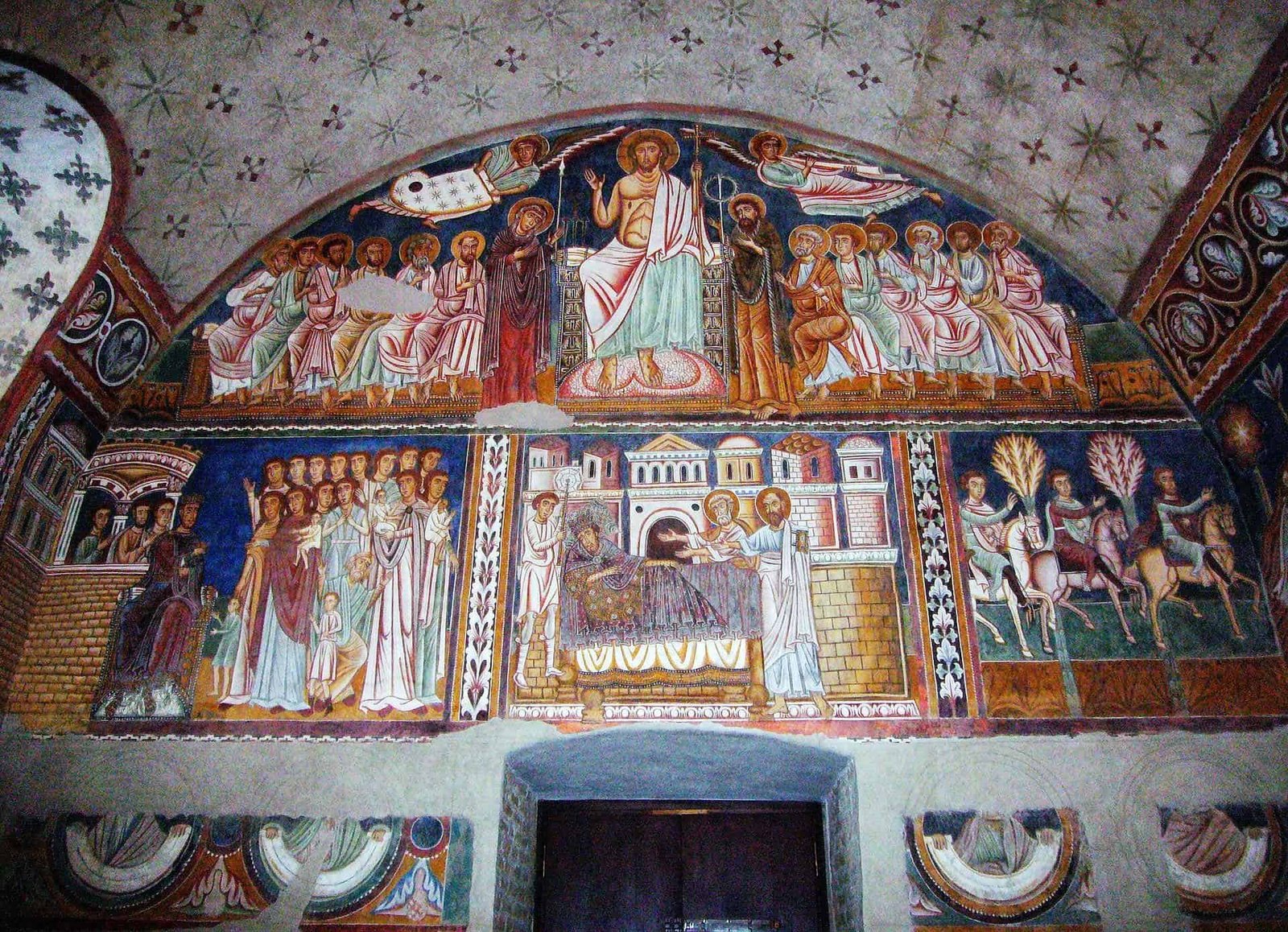
First thing to understand: you're not entering a museum here, you're entering someone else's house
This is the point that shapes the whole visit, and no guide states it clearly enough. The Basilica of the Most Holy Four Crowned Saints isn't an archaeological site with a ticket booth, a turnstile, and a uniformed guard. It's a working cloistered monastery: since March 12, 1564, Augustinian nuns have lived here, and they still do. That means the opening hours are those of a religious community, not a tourist office. A door that opens this morning may stay closed tonight because there's a funeral, a retreat, an illness, or a liturgical feast. The nuns' official site spells this out for the afternoon of the oratory: opening "is not guaranteed." In its May 20, 2014 press release announcing public access to the Aula Gotica, the Ministry of Culture said the same thing in institutional language: visits are spaced out because they must respect "the rules of monastic life." Some days everything is open, and some days you can only see the basilica. If you go expecting something is owed to you, you'll be disappointed. If you go knowing you're asking for permission, it usually works out just fine.
The hours, one by one, and why two official sites don't match
The basilica: the monacheagostinianesantiquattrocoronati.it site, tourist information page, says Monday to Saturday 6.30-12.45 and 15.15-19.30, with Tuesday afternoon split into 15.15-15.30 and 17.00-19.30, and Sunday 6.45-12.00 and 15.30-19.30. The aulagoticasantiquattrocoronati.it site, on the page dedicated to visiting the monastery, says 6.30-12.45 and 15.30-20.00. Both sources are official and refer to the same complex. The difference is in the afternoon opening: a quarter hour earlier or later, and half an hour more in the evening. The Oratory of San Silvestro: the nuns list 10.00-12.00 Monday to Saturday, turismoroma.it 9.30-12.00 Monday to Saturday, and aulagotica 9.30-12.15. Afternoon 16.00-17.30, Monday to Sunday, not guaranteed, and on this all three agree. The cloister: the nuns list Tuesday to Friday 9.30-12.00, plus Wednesday and Friday 15.30-17.30. turismoroma.it is identical, adding that it is also accessible on days the Aula Gotica is open. aulagotica says Wednesday and Friday, with hours 9.30-11.45 and 15.00-17.30. No third source resolves the contradiction. The practical advice is simple and it works: set your alarm to arrive at 10.00 sharp on a Wednesday or a Friday, which is the only window all the sources agree on for the basilica, oratory, and cloister together.
How much it costs to enter the Basilica of the Most Holy Four Crowned Saints
The basilica is free. None of the official sources lists a ticket for entering the church, and turismoroma.it doesn't report one either. The cloister and the oratory run on donations, and the official site's exact wording is "a donation is appreciated for access." No official site gives an amount, so bring some coins and use your judgment, keeping in mind that the money supports a monastery and a monumental complex with no ticket office. The only firm figure is for the Aula Gotica: €10.00 per person, with the option to add a voluntary donation to the monastery, as stated on the information and booking page of aulagoticasantiquattrocoronati.it.
How to Get to the Basilica of the Most Holy Four Crowned Saints
The address is Via dei Santi Quattro 20, and the fact that it isn't a square already tells you a lot: the basilica has no forecourt, just a large door on a narrow street that climbs uphill. The major change compared with any printed guide published before 2026 is the metro. On December 16, 2025, as romamobilita.it documents, the Colosseo/Fori Imperiali and Porta Metronia stations on Line C were opened: at Colosseo, Line C connects with Line B, and Porta Metronia is the next stop on the Caelian Hill side. First and last trains from Colosseo and Pantano are at 5.30 and 23.30 from Sunday to Thursday, while on Friday and Saturday they run from 5.30 to 1.30. From Colosseo station, go up via Labicana and then take Via dei Santi Quattro. A good 10 minutes, a real uphill climb and not a token slope. The Aula Gotica website lists the Manzoni station on Line A or the Colosseo station on Line B as reference points. As for buses: the lines that pass the via Labicana stop at the height of Via dei Santi Quattro are not listed on an official ATAC page. The only bus line confirmed by an official source is the 218, which romamobilita.it reports as modified, with five new stops around Porta Metronia station, including Piazza San Giovanni in Laterano: from there to the basilica it's five or six minutes on foot, on level ground. Check atac.roma.it on the day itself, because routes in this area change every time there is a pedestrianization near the Forums.

How to Really Get Into the Oratory of San Silvestro
This is the part that scares people, and it's actually very simple: you just need to know how it works. The Oratory of San Silvestro is not inside the church: you reach it from the first courtyard, the one you find right after the entrance tower. There is no custodian, and there is no ticket office. The official website of the Augustinian nuns says to ring the bell at the monastery's porter's lodge to visit it. Ring, wait, and a nun you can't see will answer: the Augustinian nuns of the Most Holy Four Crowned Saints are cloistered, and the handover of keys and offering happens through the revolving opening of the parlor, not face to face. The oratory is opened for you, leave the offering, go in. There is no guide, no audio, no panel explaining anything: you stand in front of a cycle of 13th-century frescoes alone, in silence, and that is exactly why it's worth it. If you're late in the morning and find it closed, don't push it and don't ring five times. Come back another day. All official sources state that the afternoon is not guaranteed: if you count on it and it doesn't work out, the nuns are not to blame.
The Donation of Constantine Painted on the Wall
Inside the Oratory of San Silvestro is the cycle of frescoes that alone justifies the trip. It dates from the 13th century, in a Byzantinizing style, and tells the Stories of Pope Silvester and Emperor Constantine I, taken from the Actus Silvestri. The piece that matters is the Donation of Constantine: the emperor handing the pope temporal power over Rome and the West. Turismoroma.it, although it is an institutional portal, describes it precisely for what it is, that is, apocryphal. The document it is based on, the so-called Constitutum Constantini, was debunked as a forgery in the 15th century by Lorenzo Valla. But these walls were painted two centuries earlier, when that story was still the legal basis of papal power, and they were painted right here, a few hundred meters from the Lateran, which was then the seat of the popes, inside the palace of a cardinal who stood in for the pope in the city. It is not decoration. It is a political manifesto in fresco, placed in a room where cardinals and ambassadors passed through, in years when the papacy was clashing with Emperor Frederick II. Looking at it knowing this completely changes the experience: you are reading an argument, not admiring figures. In the presbytery there are also frescoes attributed to Raffaellino da Reggio and dated 1574, with the stories of the martyrdom of the four crowned saints: three centuries later, same place, different hand, different language.
The 13th-Century Cloister, and Who Signed It
The cloister of the Most Holy Four Crowned Saints dates to the first half of the 13th century and was built by the marble worker Pietro de Maria, one of those names Romans hardly know, though he built half of medieval Rome. It's a Cosmatesque cloister: paired small columns, round arches, and reused marble pieces, worked and repurposed. The Vatican's entry on the Lenten station simply calls it "the ancient cloister built by the Cosmatesque marble workers." In the middle is a basin, around it is a garden tended by the nuns, and from the cloister you enter the Oratory of Santa Barbara. What stands out, if you arrive from the noise of Via Labicana, is the quiet. There's no noise. You hear water and birds, and you're 400 meters from the Colosseum. The cloister is open Tuesday to Friday in the morning, and on Wednesday and Friday in the afternoon too, with the time differences between sources already listed. My advice is to go on a Wednesday morning, the day all three official sources show both the cloister and the oratory open.
The Aula Gotica: dates, booking, price, limits
Here the details are precise because the dedicated site publishes them clearly. In 2026 the Aula Gotica is open for visits on eight weekends: January 23 and 24, February 6 and 7, April 24 and 25, May 12 and 13, June 12 and 13, September 18 and 19, October 23 and 24, and November 13 and 14. Entry times are at fixed slots: 9.00, 10.00, 11.00, 12.00, 13.00, 15.00, 16.00, 17.00, and 18.00. To book, write to archeocontesti@gmail.com, stating the number of participants, your preferred date and time, and a phone number. The cost is €10.00 per person, with an optional donation to the monastery. Each slot admits a maximum of 20 people, and the visit is led by a guide in Italian. An important warning from the official site: the Aula Gotica doesn't have suitable access for people with serious mobility disabilities, because you reach it by stairs. Eight weekends a year, 20 places per slot. Do the math, and you'll see why it makes sense to book weeks ahead, not on Thursday for Saturday.
What's inside the Aula Gotica
The hall sits on the first floor of the Torre Maggiore and was the most important room in the cardinal's palace. Banquets and receptions were held there, and justice was administered. According to the project's official site, the measurements are nine meters by 17.50 meters, with a height of 11.50 meters. Turismoroma.it mentions 300 square meters of frescoes. According to the official site, the painted cycle was carried out between 1235 and 1247, commissioned by Cardinal Stefano Conti, nephew of Innocent III and cardinal of Santa Maria in Trastevere. The subjects form an encyclopedic program: the months of the year with the matching farming and craft activities, the liberal arts (Grammar, Geometry, Music, Mathematics, Astronomy), the seasons and the winds, a seascape, the zodiac signs, the virtues and beatitudes, biblical figures and saints. Turismoroma.it adds the presence of vices and virtues and of Solomon as supreme judge. The background against which all of this stands out is blue, made with azurite, a pigment that was extremely expensive back then and that served to show, without saying it, how wealthy the patron was.
1996: the frescoes under seven layers of plaster
The story of the rediscovery is the part everyone tells and almost nobody tells well. The Aula Gotica frescoes were found in 1996. Turismoroma.it specifies that they were hidden under seven layers of blue plaster, and that they had stayed there for about 800 years. They hadn't been destroyed. They had been covered, which in restoration is the difference between life and death. The recovery took years. The Ministry of Culture's press release of May 20, 2014, published on cultura.gov.it, documents work funded by the company Arcus for €150,000, which covered work on the Cosmatesque cloister and the operations needed to make the Aula Gotica visitable. From June 2014 the hall has been open to the public by reservation, and the first dates were June 17 and 18 and July 15 and 16, 2014. It is often said that the frescoes were "recently rediscovered." The precise facts are that they were found in 1996, and that since June 2014 there has been a public calendar of bookable visits, which has reached eight weekends in 2026.
The attribution of the frescoes: what the sources say
For the frescoes of the Gothic Hall you sometimes read that "the name of Jacopo Torriti has been put forward," but none of the official sources gives that name. The official website aulagoticasantiquattrocoronati.it speaks of the work of several artists and indicates the Maestro Ornatista, the Terzo Maestro and, probably, Giunta Pisano. Turismoroma.it attributes the cycle to the Terzo Maestro di Anagni. These are two formulations compatible with each other, because the Terzo Maestro cited by the site and the Terzo Maestro di Anagni cited by turismoroma are evidently the same artistic personality, but neither of the two names Torriti. Medieval attributions change as the restoration advances and the literature settles: what seemed plausible in the past is no longer what the official sources write.
Who the Four Crowned Saints Were, and Why the Names Don't Match
Here the sources diverge. A list attributed to the Pontifical Academy of the Cultors of Martyrs indicates the four titular saints as Castorius, Symphorian, Claudius and Nicostratus. The Lenten station entry published on vatican.va instead lists Clemens, Simpronian, Claudius and Nicostratus. Two names out of four coincide, two don't. If you need the fact for serious work, go to the hagiographic source, not to a travel site. The legend, the one on which the sources agree, says they were four Christian marble workers put to death under Diocletian for refusing to carve pagan idols. A second tradition speaks of four, or five, soldiers likewise martyred and buried near the tombs of earlier martyrs. Vatican.va specifies that they were buried ad Duas Lauros, on Via Labicana, not far from the imperial residence. The liturgical memorial falls on November 8.
Why the Marble Workers, the Building Guilds and Freemasonry
If they were stonecutters and died for not carving, you can work out the next step yourselves: in the Middle Ages the Four Crowned Saints become the patrons of the building guilds, and have remained so for the masonry trades, with traditions still alive in Bologna and Florence. From there the chain reaches Freemasonry, which made the art of building its whole symbolic apparatus: the Quatuor Coronati research lodge of London, which bears exactly the name of these four saints, still holds its annual festival on November 8, the day of the liturgical memorial. It's one of those threads that cross 17 hundred years without breaking: four craftsmen killed in Rome under Diocletian, a medieval guild of masons, a 19th-century London lodge that studies the history of masonry. The Basilica of the Santissimi Quattro Coronati is the head of this thread, and it is perhaps the reason why in this church you happen to meet visitors who come from very far away and who are not there for tourism.

From the Roman Domus to the Titulus Aemilianae
Under everything you see there is a house. From the 4th century the complex occupies the site of a rich aristocratic residence of the late antique period, facing the ancient Via Tuscolana, whose course corresponds to today's Via dei Santi Quattro: when you climb that street you are walking on an ancient route, not on a modern road. The original apsed hall of the residence was converted into a Christian place of worship before 499, the date of the first attestation of the titulus Aemilianae, which early medieval sources identify several times with the church of the Santi Quattro. Turismoroma.it places the foundation of the basilica in the middle of the 5th century AD on the remains of a Roman domus. It's worth pausing a moment on this passage, because it is the model of almost all the titular churches of Rome: they are not born on empty ground, they are born inside a private house donated to the Christian community, and for centuries they carry the name of the owner instead of the saint. Aemiliana was a lady, not a martyr. The location mattered: the hill is high, you dominate the valley, and above all you are a step from the Lateran, which was then the seat of the papacy. Whoever controlled this piece of the Caelian was in the control room of Christendom.
Leo IV and the Carolingian Basilica
The first great building campaign dates to the 9th century. Pope Leo IV, who reigned from 847 to 855, turned the building into a large three-aisled basilica with a crypt, a quadriporticus and a tower on the facade. Turismoroma.it counts it among the most important basilicas of Carolingian Rome, and the description is accurate. These are the years when Rome rebuilds itself after the Saracen sack of 846 and the papacy redraws the city in dialogue with the Frankish empire. The fortification of the complex dates from this period: the crypt, the entrance tower, back then decorated both inside and out, and the first courtyard with the first buildings for the clergy. The tower you see today as you arrive from Via dei Santi Quattro is, in essence, Leo IV's tower. You walk under it without thinking, and you're passing through an entrance 1,200 years old. Try stopping for a second under the arch and looking up. The traces of the decoration are gone, but the mass of the masonry is the same, and it looks like no other Roman church facade.
1084, Robert Guiscard and the burned city
Then disaster strikes. In 1084 the Norman soldiers of Robert Guiscard, who came to Rome to free Pope Gregory VII, besieged by Henry IV, sack and burn the area between the Caelian Hill and the Lateran. The church of the Santissimi Quattro Coronati burns. Turismoroma.it writes that the original building was completely rebuilt after the fire of 1084 that devastated the city. It wasn't a local episode. That fire is one of the events that changed the face of Rome forever, and the stretch between the Colosseum, the Caelian and the Lateran came out of it worst. If you're wondering why so many churches in this area have a Romanesque phase built between 1090 and 1130, the answer is right there. San Clemente, 300 meters away, has the same scar: the abandoned early Christian lower basilica and the upper one rebuilt on top. Walking from San Clemente to the Santissimi Quattro Coronati means walking inside the perimeter of a fire from 1084.
Paschal II rebuilds it smaller: how the second courtyard came to be
The rebuilding was the work of Pope Paschal II, who reigned from 1099 to 1118, and the choice he made is the most interesting thing in the whole history of this place. He didn't rebuild the basilica as it was. He made it smaller, reducing it to just the western half of the former central nave. The space that used to be the eastern part of the nave became today's second courtyard, the one you cross to get to the church. The two side aisles were absorbed: the right one into the palace of the titular cardinal, the left one into the monastery founded by Paschal II himself. The Vatican's entry for the Lenten station church says it in one line: Paschal II dedicated the basilica to the four martyrs while reducing its original area. That's why, when you walk in, you get that odd feeling of crossing two courtyards before you find the church. Those courtyards were the church. You're walking inside the floor plan of Leo IV's basilica, in the open air. It's one of the few chances in Rome to measure by steps the difference between a 9th-century building and its 12th-century rebuild, just by counting the meters between the tower and the door.
Sassovivo, the Benedictines and the priory of 1138
One detail explains how the medieval Church really worked. From 1138 the monastery founded by Paschal II became a priory of the Benedictine abbey of Santa Croce di Sassovivo, near Foligno. In other words, the Roman complex depended on a mother house in Umbria. In the 11th and 12th centuries Sassovivo was a monastic power with dozens of dependencies spread across Umbria, Marche, Lazio and even Dalmatia, and the Santissimi Quattro Coronati was its bridgehead in Rome. That's not a scholar's footnote. It means that for almost four centuries whoever governed this corner of the Caelian answered to an abbot 150 kilometers away, and that the monks living here were Benedictines, not Augustinians. The Augustinian nuns, the ones here today, arrived much later. If you look at the cloister and think of an Augustinian place, you're off by 400 years. The Benedictines built that cloister and used it.

Cardinal Stefano Conti and the fortified palace
The 13th century is when this place becomes what you see. Cardinal Stefano Conti, the pope's vicar in the city, nephew of Innocent III and cardinal of Santa Maria in Trastevere, had a large palace built here before 1246, with towers and frescoed rooms. What remains of that palace are the Chapel of San Silvestro and the Aula Gotica. Turismoroma.it describes the 13th-century expansion as the addition to the complex of the monastic dormitory, the cloister, and a fortified cardinal's palace dominated by the Torre Maggiore. It's worth understanding the context. These were the years of the clash between the papacy and Emperor Frederick II, and Rome was a city where aristocratic families fought each other from tower to tower. A cardinal who builds a palace with towers 400 meters from the Lateran isn't doing architecture. He's taking a position. The complex still looks like a fortress today, and that's not an optical illusion. It was a fortress. If you come from the Colosseum valley and look up, that compact wall mass with the tower on its facade reaches you before you even read the name on the door.
Cardinal Carillo, Martin V, and the papal seat of the 15th century
A chapter almost nobody tells. After the Avignon Captivity, when the popes returned to Rome and found the Lateran in ruins, the complex of the Most Holy Four Crowned Saints was declared a papal seat by Pope Martin V. In the 15th century, Cardinal Carillo financed major restorations, as shown by the inscription with his coat of arms set into the wall of the first courtyard, under the tower. That inscription is still there. Walk under it and look up to the left. For a few years, then, this was one of the places from which the universal Church was governed. Then the papal seat moved permanently to the Vatican, and the complex's importance declined within a generation. Turismoroma.it summarizes the shift in a dry way: after the papal move to Avignon came decline, until the transformation commissioned by Pius IV in 1564. It's a pattern that repeats in Rome: a place central for two centuries becomes peripheral not because the place itself changes, but because the center moves.
March 12, 1564: the Augustinian nuns, the orphans, and the enclosure
The date is precise: on March 12, 1564, at the wish of Pope Pius IV, the complex was entrusted to the cloistered Augustinian nuns and turned into a girls' orphanage. Turismoroma.it calls it by its historical name, the Conservatorio delle Zitelle, and specifies that the Augustinian nuns have lived there for more than 450 years. All the rooms overlooking the courtyard were converted into dormitories for the orphans. Stop for a moment on this: the rooms you see today as medieval architecture were for centuries dormitories for girls without families. The complex stopped being a palace of power and became a charitable institution, and that very downgrade saved it. Nobody demolished it to build a Baroque palace, and nobody remodeled it into a museum. They used it, plastered it, and whitewashed it, and under that plaster the frescoes stayed, which resurfaced in 1996. Work was also done in the 17th century: the apse vault was frescoed, and part of the first courtyard was rebuilt.
Antonio Munoz and the medieval restoration of the 20th century
At the beginning of the 20th century, Antonio Munoz enters the picture. He was the architect and art historian who redesigned half of monumental Rome between the two world wars. Thanks to his restorations, the medieval appearance of the basilica, the entrance tower, the cloister, and the Chapel of San Silvestro was restored. This is a piece of news to read carefully, because the word "restore" always hides a choice. Munoz belonged to a school that removed modern additions to recover a presumed original state, which means that what you see today is, in part, a Middle Ages interpreted by the 20th century. This holds for the Santissimi Quattro Coronati just as it does for Santa Sabina all'Aventino, another Munoz project. It's not a flaw, it's a fact that changes how you look at the surfaces. The structure is authentic, and the cleanliness you read today is a choice made a century ago. Anyone who says time stood still here hasn't read the restoration history.
What you see inside the basilica
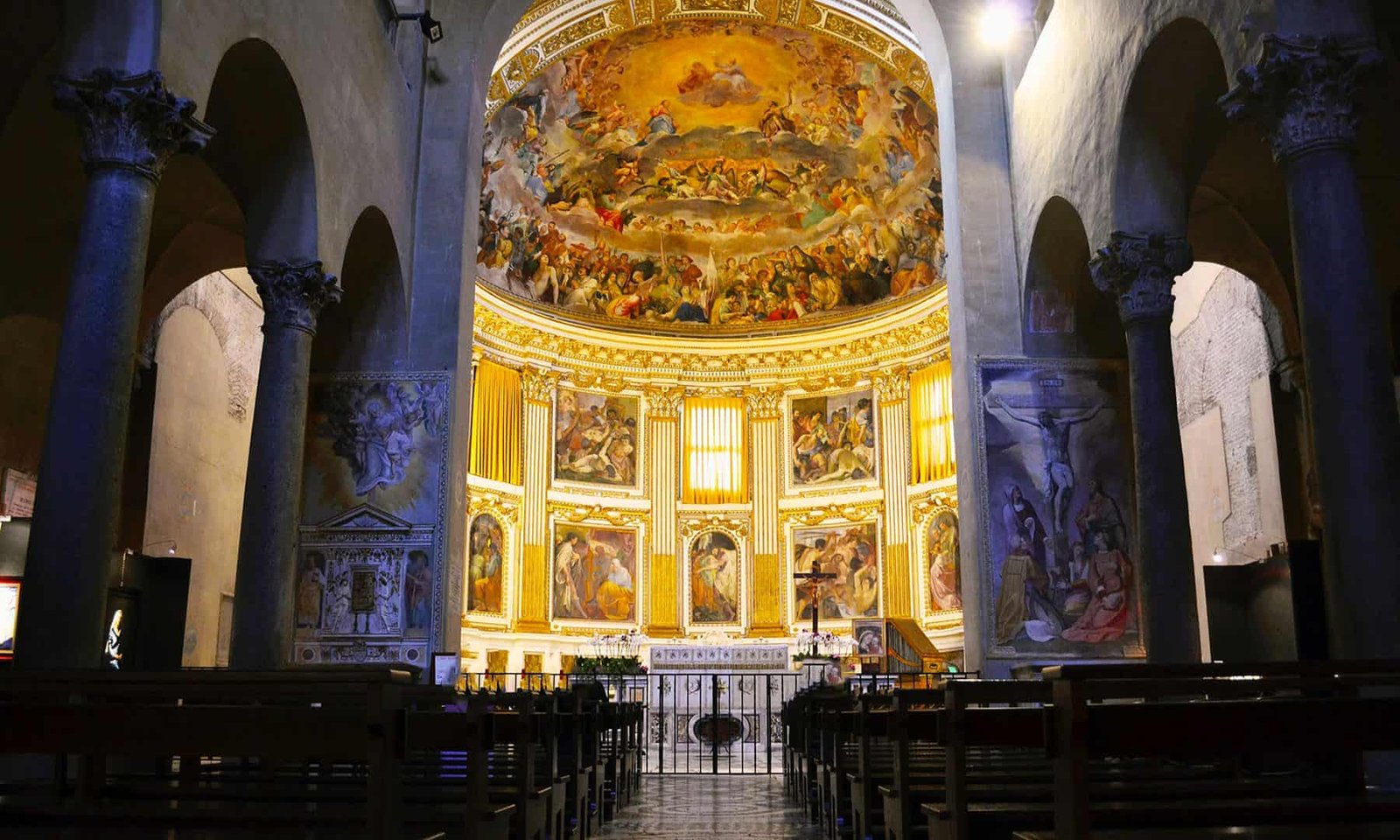
Let's move on to what you have in front of you when you enter the church. The interior has three naves, with matronea set on columns from Roman imperial monuments, as turismoroma.it specifies. The capitals are spolia: they come from other ancient buildings, were detached and put back here, and if you look at them one by one you notice they are not all the same. The floor is Cosmatesque, original, with large discs of marble and porphyry and polychrome mosaics made with fragments of ancient marbles. The apse is a unique case in Rome: it embraces all three naves, instead of closing only the central one, and it is the direct consequence of the reduction ordered by Paschal II, who found himself having to close with a half-dome a space born to be narrower. The apse frescoes are the work of the Florentine painter Giovanni da San Giovanni and depict the story of the Coronati. And then there are the matronea, the galleries above the side aisles: those of the Santissimi Quattro Coronati are the last matronea built in Rome. After these, nobody built any more. They are a piece of the history of architecture that ends, and it is right there above your head.

The Oratories of Santa Barbara and San Nicola
Inside the monastery there are two chapels of notable historical and artistic interest that almost nobody mentions. The Oratory of Santa Barbara is reached from the cloister, so it is on the possible tour if the cloister is open. The Oratory of San Nicola is not: originally it faced the right nave of the basilica, today it is part of the monastic enclosure and the interior cannot be visited, except for rare exceptions that the nuns publish on their website on the tourist information page. The dedication to Nicholas is conventional: an oratory dedicated to Nicholas is cited in the Liber Pontificalis together with those of Sixtus and Barbara in connection with the basilica, but the identification with this room is a reconstruction by scholars, not a documentary certainty. It is the kind of nuance that guides always skip and that instead shows how art history is done: you put together a name found in a 9th-century source with an existing room, and you accept that it is a hypothesis. If you care about seeing it, the only honest way is to keep an eye on the nuns' website.
The Positive Organ and the Head of Saint Sebastian
Two singular objects. The first is the wing positive organ, probably the work of the Testa organ builders, datable to the second half of the 17th century, intact in its original characteristics, with 9 stops for a total of 380 pipes. An intact 17th-century wing positive organ is a rarity: most instruments of that era were rebuilt, enlarged or thrown away in the 19th century. The second is the reliquary that holds the head of Saint Sebastian, while the rest of the body lies in the basilica above the catacombs that bear his name, on the Appia Antica. If you want to close the circle, the page on the other end of this story is Catacombs of San Sebastiano and the basilica is San Sebastiano fuori le Mura. The division of relics between two churches four kilometers apart is not an anomaly, it was the norm: a martyr's body was capital, and it was divided to multiply the places of worship.
The Calendar Room and the Hall of the Pentaforas
Two rooms that deserve an extra line. The Calendar Room is the antechamber of the parlor and is adorned with a 13th-century fresco: turismoroma.it describes it exactly that way. The parlor, in a cloistered monastery, is the room where the nuns speak with the outside through a grate, so you are talking about the threshold between two worlds, decorated in the 1200s. The Hall of the Pentaforas takes its name from the five-light windows, the pentaforas precisely, that mark its wall. These are rooms that are not seen on the ordinary visit and that fall within the routes of the opening days of the Gothic Hall: if you book one of those eight weekends, ask expressly what the tour includes, because the content of the special openings changes from one year to the next and no official source fixes it once and for all.

The Masses and Liturgical Life
If you want to see the place alive and not just visit it, the mass schedules are the most useful information. The nuns' site publishes the monastic day: on weekdays, Office of Readings at 6.30, Lauds at 7.45, the canonical hours spread between 8.30 and 15.15, Vespers at 18.30, and Holy Mass and the Rosary at 19.00. On Sunday and on solemnities, the main Mass is at 11.00, and at 18.00 there are Vespers and Eucharistic Adoration. Turismoroma.it lists Mass times that are consistent with these: weekdays at 19.00, Saturdays and pre-holidays at 19.00, Sundays and holidays at 11.00. However, the English version of the same turismoroma.it page adds a 7.45 Mass for Saturdays and holidays, which doesn't appear in the Italian version. That's a small inconsistency within the same source. My practical advice is that Vespers at 18.30, sung by a cloistered community in a nearly empty 12th-century church, is one of the most beautiful and least known things you can do in Rome without paying a euro. It isn't a show, so it's best to behave accordingly: you walk in, sit toward the back, and don't take photos.
The Lenten station and November 8
Two dates to mark if you want to catch the basilica on its busiest days. The first is the Monday of the Fourth Week of Lent, when the Lenten station is celebrated here. The entry on vatican.va, which describes exactly this station at the Santi Quattro Coronati, confirms it. Lenten stations are a liturgical route dating back to the early Middle Ages, and even today they bring a celebration each day of Lent to a different church in Rome, following a calendar set centuries ago. The second is November 8, the liturgical memorial of the Four Crowned Saints, when the titular church is at its busiest. And, as already mentioned, the London lodge that bears their name holds its annual festival 3,000 kilometers away. If you can choose when to come, one of these two days shows you the Basilica of the Most Holy Four Crowned Saints for what it is: a church that functions, not a monument.
With children
Honest verdict: it works better than you'd expect, but under certain conditions. The basilica itself is short, 10 minutes is enough, and kids like the Cosmatesque floor because it's full of circles and shapes that look like a game. The cloister is the highlight: there's a garden, there's water, you're outdoors, and you don't have to stay quiet like in church. What the youngest kids can't handle is the Oratory of San Silvestro, a dark room with frescoes that need explaining, and above all the Aula Gotica, a group guided tour with a maximum of 20 people. Bringing a six-year-old means ruining the visit for them and the other 19. From ages 11 or 12 onward, though, the Aula Gotica works very well, because the months with farming activities, the zodiac signs, and the liberal arts are like a medieval comic book, and they read as one. Watch out for the stairs: the complex has plenty, and there are no elevators, so a stroller is a real problem here.
Accessibility: what is known and what isn't
The certain fact, stated by the project's official site, is that the Aula Gotica doesn't have suitable access for people with serious mobility disabilities, because you reach it by stairs. It's on the first floor of the Torre Maggiore, and there's no elevator. For the basilica, the cloister, and the Oratory of San Silvestro, none of the official sources publishes a detailed accessibility guide. Turismoroma.it generally refers to the "Roma accessibile" section of its portal, without giving measurements, steps, or alternative routes for this complex. If you have a mobility issue, the right move is to call 06 70475427 or the tourist information mobile 335 4952 48 and ask ahead. From what you can see on site, though there's no official data, Via dei Santi Quattro is uphill, and between the street and the church there are two courtyards and some changes in level. It's not a flat route.
When to go: days, hours, light
The best day is Wednesday, and that's not a romantic opinion. It's the only day, along with Friday, when all the official sources list the basilica, the cloister, and the Oratory of San Silvestro as open together, both morning and afternoon. The best time is between 10.00 and 12.00, the window where the three sources converge for the oratory even on the most restrictive reading. The best light for the basilica is late afternoon, when it comes through the high windows and cuts across the Cosmatesque floor from the side, making the porphyry discs stand out. The cloister looks best early in the morning, when the sun hits only one side of the colonnade and the shadow does the rest. In August, be careful: the nuns' site indicates that in summer the cloister opens only on certain days, 9.30-12.00, so if you come in midsummer, assume the afternoon is closed and plan for the morning. In winter, on the other hand, the oratory at 16.00 with little natural light is harder to read. The Byzantine-style frescoes need light.
What's nearby, on foot
This is one of the areas in Rome with the highest density of things to see per square meter, and almost everything can be done on foot. 300 meters away, heading down toward Via Labicana, is San Clemente Basilica
, with its three overlapping levels and the Mithraeum at the far end. Keep going and you reach the Colosseum and the Arch of Constantine, which, together with the Donation of Constantine fresco right next to it, makes a pairing that's worth the detour. On the Oppian Hill, across Via Labicana, is the Domus Aurea, and a little further up, San Pietro in Vincoli with Michelangelo's Moses. In the opposite direction, five minutes south, you reach the Basilica of Saint John Lateran and the Holy Stairs, and a little beyond, Holy Cross in Jerusalem. On the Caelian Hill, a few minutes away, are the Case Romane del Celio, beneath the Basilica of Saints John and Paul. If you have time left and want to stay with Cosmatesque floors and mosaics, head up toward the Esquiline as far as the Basilica of Santa Prassede and Santa Maria Maggiore. To put together a two-day itinerary, it's best to start with My Journey.

A Curiosity About the Basilica of the Most Holy Four Crowned Saints
The most beautiful curiosity concerns the courtyards. When you enter, before reaching the church, you cross two of them, and most visitors experience them as a nuisance, an open-air corridor to get through quickly. Yet they are actually the most extraordinary part of the complex, because the second courtyard is the basilica. Literally: when Pope Paschal II rebuilt the church after the fire of 1084, he reduced it to just the western half of the old central nave, and the eastern half, the part he did not rebuild, remained as open space. You walk inside the perimeter of Leo IV's basilica, under the sky, and don't realize it. This may perhaps be the only case in Rome where the perspective error works in the visitor's favor: you think you're outside, but you're inside. In our view, this detail should be on a panel at the entrance, but there isn't one. Try stopping in the middle of the second courtyard, looking at the facade of the current church, and imagining that wall isn't there: what you see is the true length of the Carolingian basilica, and it leaves you speechless at how large it was.
Something Nobody Tells You About the Basilica of the Most Holy Four Crowned Saints
That you ring the bell and wait. No guide writes it down with the clarity it needs, and as a result hundreds of people a year get all the way here, enter the church, look around, find no sign for the Oratory of San Silvestro, and leave convinced it's closed. It isn't closed: you have to ring at the monastery's porter's lodge, as the nuns' website states word for word, leave an offering, and have them open it for you. On the other side is a cloistered community, so the nun who answers you is not visible, and the handover happens through the opening in the parlor. The second thing nobody says is that this procedure is not a token donation: that money is the only income of a monumental complex with no ticket office, no sponsors, and no bookshop. The third thing nobody says is that if you find it closed in the afternoon, it's not a service failure. It's a religious community with other things to do, and all the official sources state it plainly: afternoon opening not guaranteed. Factor that in and you'll leave happy.
The Advice I Give for Visiting the Basilica of the Most Holy Four Crowned Saints
There's only one piece of advice: make two trips, not one. First trip, any Wednesday or Friday morning, arrive at 10.00, basilica, cloister, Oratory of San Silvestro, offering, an hour and a half in total, zero reservations, zero fixed costs. Second trip, one of the eight weekends in 2026 when the Aula Gotica opens, with a reservation sent by email to archeocontesti@gmail.com several weeks in advance, 10 euros per person and a guide in Italian. Anyone who tries to do everything in one go ends up spending two hours at a place that needs four, and above all risks finding the cloister closed, because on Aula Gotica days the regular hours are cancelled. There's also a secondary tip that's worth its weight in gold: don't come here right after San Clemente. San Clemente is dense, layered, spectacular, and it leaves your brain full. The Most Holy Four Crowned Saints ask for silence and attention, and if you arrive tired, you'll only take in a third of it. Do the opposite: here first, early in the morning, then San Clemente.
Another Well-Known Fact, Yet Rarely Mentioned
That this place was a papal seat. Historians know it, it's written on the information panels, and almost nobody ever says it out loud: in the XV century, after the popes returned from Avignon, when the Lateran was in pitiful condition and the Vatican was not yet what it would become, Pope Martin V declared the complex of the Most Holy Four Crowned Saints a papal seat. That is, for a period, the command center of the Catholic Church was behind that tower on via dei Santi Quattro. Cardinal Carillo financed the necessary restorations, and his inscription with the coat of arms is still set into the wall of the first courtyard, under the tower: it's a plaque nobody looks at, and it certifies an enormous fact. Then history moved three kilometers toward the Vatican, and this place went back to being an outlying monastery inside the walls. What strikes you is how little it took: two or three generations, and a place that governed Christendom had become an orphanage for poor girls.
The Right Photo to Take at the Basilica of the Most Holy Four Crowned Saints
The right photo isn't the facade and it isn't the apse. It's the cloister, shot from under the portico, with the paired columns blurred in the foreground and the garden in focus in the background: that Cosmatesque geometry of the XIII century, with the basin in the center, is the most photogenic thing in the complex and holds up very well even with a phone. Time of day: morning, between 9.30 and 11.00, when the sun cuts diagonally and half the colonnade stays in shade. Second photo, if you want: the climb up via dei Santi Quattro with the entrance tower at the end, taken from below, which gives back the look of a fortress. Third, inside the church, the Cosmatesque floor shot almost from ground level, with the large porphyry discs in perspective. Two serious warnings. In the Oratory of San Silvestro, ask before taking photos, because you got in thanks to someone's courtesy and not with a ticket. In the Aula Gotica, follow what the guide tells you: the frescoes have just been restored, flash is out of the question, and the visit is short and is worth more with your eyes than with a screen. Our opinion: here the best photo is the one you don't take, namely standing still in the cloister for five minutes without pulling anything out of your pocket.
Some Important Events That Happened Here in History
Here are the dates that matter. Before 499: the first document that attests the titulus Aemilianae, later identified with this church. Middle of the V century: foundation of the basilica on the remains of a Roman domus. Middle of the IX century, under Pope Leo IV (847-855): monumental reconstruction with three naves, a crypt, a quadriportico and a tower on the facade, and fortification of the complex. 1084: Norman soldiers of Robert Guiscard sack and burn the area, and the church burns. Between 1099 and 1118: Pope Paschal II rebuilds it, reducing the basilica to the western half of the old central nave. 1138: the monastery becomes a priory of the Benedictine abbey of Santa Croce di Sassovivo near Foligno. Between 1235 and 1247: Cardinal Stefano Conti has the Aula Gotica frescoed. Before 1246: the cardinal's palace is completed, with towers and frescoed rooms. First half of the XIII century: the marble worker Pietro de Maria creates the Cosmatesque cloister. XV century: Pope Martin V declares the complex a papal seat, Cardinal Carillo finances the restorations. March 12, 1564: Pope Pius IV entrusts the complex to the Augustinian cloistered nuns and turns it into an orphanage for girls. 1574: the frescoes of the oratory's presbytery, attributed to Raffaellino da Reggio. XVII century: frescoed apse basin and rebuilding of part of the first courtyard. Early XX century: restorations by Antonio Munoz. 1996: discovery of the Aula Gotica frescoes under seven layers of plaster. May 20, 2014: the Ministry announces the opening to the public of the Aula Gotica, with restoration financed by Arcus for €150.000. First visits on June 17 and 18, 2014. December 16, 2025: the Colosseum/Imperial Forums station on Metro C opens, changing how you get here.
Who Has Passed Through the Basilica of the Most Holy Four Crowned Saints
The list is heavier than the place lets on, and it includes only those the sources actually link to this complex. Pope Leo IV, who in the mid-9th century turns it into a large fortified basilica. Pope Paschal II, who rebuilds it in reduced form after 1084 and founds the monastery. Cardinal Stefano Conti, nephew of Pope Innocent III and cardinal of Santa Maria in Trastevere, vicar of the pope in the city, who builds the palace there and has the Aula Gotica frescoed between 1235 and 1247. The marble worker Pietro de Maria, who signs the cloister. Cardinal Carillo, who pays for the restorations in the 15th century and leaves his coat of arms set into the wall of the first courtyard. Pope Martin V, who declares the complex a papal seat. Pope Pius IV, who on March 12, 1564, hands it over to the Augustinian nuns. The Florentine painter Giovanni da San Giovanni, author of the apse frescoes with the story of the Four Crowned Saints. Raffaellino da Reggio, to whom the frescoes of the oratory's presbytery are attributed, dated 1574. The organ builders Testa, probable makers of the 17th-century positive organ. Antonio Munoz, the architect who restores its medieval appearance in the early 20th century. And the anonymous artists of the Aula Gotica, whom the official sources call the Master Ornatista and the Third Master, with the probable presence of Giunta Pisano. Plus, continuously for more than 450 years, generations of cloistered Augustinian nuns and thousands of orphan girls who had a bed here.
Quick questions about the Basilica of the Most Holy Four Crowned Saints
Where exactly is the Basilica of the Most Holy Four Crowned Saints?
At Via dei Santi Quattro 20, 00184 Rome, on the slopes of the Caelian Hill, between the Colosseum and San Giovanni in Laterano. The address is confirmed by both the Augustinian nuns' site and turismoroma.it.
How much does it cost to enter the Basilica of the Most Holy Four Crowned Saints?
Entering the church is free: none of the official sources mention a ticket. For the cloister and the Oratory of San Silvestro, the official site says a donation is welcome, without specifying an amount. The Aula Gotica costs €10.00 per person.
What are the basilica's opening hours?
The two official sources don't match. The nuns' site lists Monday to Saturday 6.30-12.45 and 15.15-19.30, Tuesday afternoon 15.15-15.30 and 17.00-19.30, and Sunday 6.45-12.00 and 15.30-19.30. The Aula Gotica site lists 6.30-12.45 and 15.30-20.00. Better to call ahead.
How do you visit the Oratory of San Silvestro?
You ring at the monastery's reception, as the Augustinian nuns' site states word for word, leave an offering, and they open the door for you. The nuns are cloistered, so contact happens through the parlor grille, not face to face.
How much should you give as an offering for the Oratory of San Silvestro?
No official source gives an amount. The exact wording is that a payment of an offering is appreciated for access. Bring a few coins and decide for yourself.
What are the Oratory of San Silvestro's hours?
Mornings, Monday to Saturday, but the sources differ. The nuns list 10.00-12.00, turismoroma.it 9.30-12.00, and the Aula Gotica site 9.30-12.15. All three list the afternoon 16.00-17.30 as not guaranteed.
What are the cloister's hours?
Tuesday to Friday in the morning, and Wednesday and Friday afternoons too. The nuns list 9.30-12.00 and 15.30-17.30, and the Aula Gotica site lists 9.30-11.45 and 15.00-17.30. In summer the cloister opens on limited days, 9.30-12.00.
Do I need to book to visit the basilica?
No, the church doesn't need a booking, and it's free. You only need to book for the Aula Gotica, by emailing archeocontesti@gmail.com.
When can you visit the Aula Gotica in 2026?
On eight weekends: January 23-24, February 6-7, April 24-25, May 12-13, June 12-13, September 18-19, October 23-24, and November 13-14. Entry slots are at 9, 10, 11, 12, 13, 15, 16, 17, and 18.
How many people fit into each Aula Gotica slot?
A maximum of 20 people per slot, with a guide in Italian, according to the project's official site.
How do you book the Aula Gotica?
By email to archeocontesti@gmail.com, stating the number of participants, your preferred date and time, and a phone number. With eight weekends a year and 20 spots per slot, write weeks ahead.
Is the Aula Gotica accessible to people with mobility difficulties?
No. The official site states that the Aula Gotica doesn't have suitable access for people with serious mobility disabilities, because you reach it by stairs and it's on the first floor of the Torre Maggiore.
How do you get there by metro?
Since December 16, 2025, Line C has opened the Colosseo/Fori Imperiali station, where it connects with Line B, and the Porta Metronia station. The Aula Gotica site also lists the Manzoni stop on Line A. From Colosseo it's about 10 minutes on foot, uphill.
Which buses go nearby?
The only line confirmed by an official source is the 218, which romamobilita.it lists with new stops around Porta Metronia, including Piazza San Giovanni in Laterano, a five or six minute walk away. Lines on Via Labicana aren't listed for that stop on an ATAC page. Check atac.roma.it.
Until what time does Metro C run?
First and last departures from Colosseum and Pantano are at 5.30 and 23.30 from Sunday to Thursday. On Friday and Saturday they run from 5.30 to 1.30, according to romamobilita.it.
How long does it take to visit everything?
For the basilica, cloister and Oratorio di San Silvestro, allow a relaxed hour and a half. Adding the Aula Gotica on an opening day, you can easily reach three hours. The advice is to split it into two separate visits.
Can you take photographs?
In the church and in the cloister, usually yes, without flash and with common sense. In the Oratorio di San Silvestro, ask first, because you enter thanks to the availability of the nuns. In the Aula Gotica, follow the guide's instructions. These are recently restored frescoes.
Are there still nuns living here?
Yes. The Augustinian cloistered nuns have lived in the monastery since March 12, 1564. turismoroma.it writes that they have been living there for over 450 years. The complex is not a museum. It is an inhabited religious house.
What's the difference between the basilica and the monastery?
The basilica is the church open to the public. The monastery is the cloistered part, where people live and where you do not enter, except for the rooms opened on guided tours. The cloister and the Oratorio di San Silvestro are in between. They are visited with the nuns' permission.
What is the Donation of Constantine painted in the oratory?
It is the scene, taken from the Actus Silvestri, in which the emperor Constantine hands Pope Silvester the temporal power over Rome. The document it was based on is apocryphal, as turismoroma.it also points out. But in the thirteenth century it served to support the papacy's claims, and that is why it was painted here, a few hundred meters from the Lateran.
Why are they called the Four Crowned Saints?
According to legend, they were four Christian marble workers killed under Diocletian for refusing to carve pagan idols. A second tradition speaks of four or five soldiers martyred and buried near their tombs. Their liturgical memorial falls on November 8.
What are the names of the four saints?
Here the sources diverge. A list attributed to the Pontificia Academia Cultorum Martyrum gives Castorio, Sinfroniano, Claudius and Nicostratus. The entry published on vatican.va writes Clemente, Simproniano, Claudius and Nicostratus. If you need the detail to be precise, go to the hagiographic source.
When were the frescoes of the Aula Gotica discovered?
In 1996, under seven layers of blue plaster according to turismoroma.it, after remaining covered for about 800 years. The restoration was long, and opening to the public by reservation began in June 2014.
Who painted the frescoes of the Aula Gotica?
The project's official website speaks of more than one artist: the Maestro Ornatista, the Terzo Maestro and probably Giunta Pisano. Turismoroma.it attributes the cycle to the Terzo Maestro di Anagni. The name of Jacopo Torriti, sometimes read, is not confirmed by any of the official sources.
How big is the Aula Gotica?
The hall measures 9 meters by 17.50 and is 11.50 meters high, according to the official website. Turismoroma.it speaks of 300 square meters of frescoes.
Why is the basilica's apse considered unique in Rome?
Because it spans all three aisles instead of closing only the central one. It is a consequence of the reduction of the church wanted by Paschal II after the fire of 1084, and it has no other examples in the city.
What are the matronea and why do they matter here?
They are the galleries above the side aisles, reserved for women in medieval churches. Those of the Most Holy Four Crowned Saints, built during Paschal II's reconstruction, are the last matronea built in Rome.
Is the visit suitable for children?
The basilica and the cloister are, and the cloister is a big hit because you're outdoors. The Aula Gotica works for children from 11-12 years old, less before. Watch out for stairs and changes in level. With a stroller, it's complicated.
Are there Mass times?
The nuns' website lists Vespers at 18.30 and Holy Mass with Rosary at 19.00 on weekdays. On Sunday, it lists Mass at 11.00 and Vespers with Adoration at 18.00. Turismoroma.it reports weekday and pre-holiday Masses at 19.00 and Sunday Masses at 11.00. The English version of the same entry adds a Mass at 7.45 on Saturdays and on holidays, which does not appear in the Italian version.
Is there a particular day to come?
Two. The Monday of the Fourth Week of Lent, when the Lenten station is celebrated here according to the entry published on vatican.va, and November 8, the liturgical memorial of the Four Crowned Saints.
Can you see the Oratorio di San Nicola?
Normally no. It is included in the monastic enclosure. The nuns publish the rare exceptions on the tourist information page of their website.
What is kept in the basilica's reliquary?
The head of Saint Sebastian. The rest of the body is in the basilica above the catacombs that bear his name, on Via Appia Antica.
How far is it from San Clemente and the Colosseum?
San Clemente is about 300 meters away. The Colosseum is about 10 minutes on foot, downhill. San Giovanni in Laterano is five or six minutes in the opposite direction.
Is it worth coming if I only have half a day in Rome?
If it's your first half day in Rome, no: go see the Colosseum. If it's your third or fourth time in the city and you want to understand what Rome was like in the 13th century, then this is one of the three or four right places, and it costs nothing.
Are there services, a bar, or a bookshop?
No. There's no ticket office, no bookshop, no café. It's a monastery. The nearest bar is down Via Labicana or toward Piazza San Giovanni in Laterano.
How do you contact the complex?
Phone 06 70475427, tourist information mobile 335 4952 48, email monachess4@gmail.com, according to the turismoroma.it listing. For the Aula Gotica, write to archeocontesti@gmail.com instead.
The Basilica of the Most Holy Four Crowned Saints is the right place to find out if someone wants to see Rome or just photograph it. Nothing comes to meet you. There's no sign, no line, no turnstile, not even a guard to say good morning. There's a climb, a tower that looks like a castle gate, two quiet courtyards that are really the basilica that no longer exists, and a door you have to ring and then wait at. Whoever waits walks into a 13th-century room where the pope's power is painted on the wall the way one paints an idea, and then into a cloister where the noise of the Colosseum, 400 meters away, simply disappears. Whoever doesn't wait leaves convinced everything is closed. The nuns have been here since 1564, the Aula Gotica frescoes stayed hidden for 800 years and came back to light only in 1996, and the complex keeps doing nothing to draw attention to itself. Do this: go on a Wednesday morning, at 10, calmly, with a few coins in your pocket. Then send an email and book the Aula Gotica for one of the eight weekends on the next calendar. It will cost you €10 and a climb, and it will stay with you longer than many €30 tickets.