Basilica of Saints John and Paul on the Caelian Hill
In short. The Basilica of Saints John and Paul on the Caelian Hill is at Piazza dei Santi Giovanni e Paolo 13, 00184 Roma, at the top of the Caelian Hill, and the first thing to clarify is that this place has two different visits with two different entrances.
The Basilica of Saints John and Paul on the Caelian Hill is at Piazza dei Santi Giovanni e Paolo 13, 00184 Roma, at the top of the Caelian Hill, and the first thing to clarify is that this place has two different visits with two different entrances. You enter the church from the piazza, through the eight-column portico. The Roman Houses of the Caelian Hill, the archaeological complex underneath, are entered through another door, on Clivo di Scauro, are a museum with their own ticket office and cannot be reached by passing through the nave. Hours of the basilica according to the official website of the Passionists who look after it, basilicassgiovanniepaolo.it: from 8:30 to 12:45 and from 14:00 to 17:00, with the note that in the wedding season, from May to October, it may stay open until 18:30. turismoroma.it reports the same hours. None of the sources indicates a ticket to enter the church: the ticket concerns only the underground museum. Roman Houses of the Caelian Hill: full price €8, reduced €6, reservation fee €2, hours 10:00-16:00 with the ticket office closing at 15:00 (caseromanedelcelio.it, official website, and cultura.gov.it, which confirms the same figures). On opening days the official sources don't say the same thing: the official website and coopculture.it write "Monday to Sunday and holidays," so every day, closed only on January 1 and December 25. cultura.gov.it and turismoroma.it instead write Monday, Wednesday, Friday, Saturday, Sunday and holidays, that is, closed on Tuesday and Thursday. Before heading to the Caelian Hill on a Tuesday, phone. Phone of the Roman Houses 06 70454544, email info@caseromane.it. Reservations for individuals prenotazioni@coopculture.it, tel. 06 39967755 Monday to Friday 10:00-13:00. Groups tour@coopculture.it. Schools edu@coopculture.it. The rector of the basilica, named on the official website as Father Graziano Leonardo, answers at 351 8161314 and at the email basilica.gioepaolo@passiochristi.org. You get there by metro B, Circo Massimo stop or Colosseo stop, a 10-minute uphill walk from both. Tram 3. Buses 85, 87, 117, 175, 186, 271, 571, 673, 810, Colosseo stop (list from the "how to get there" page of the official website of the Roman Houses, confirmed by coopculture.it). Booking isn't needed for the church. For the underground museum it is mandatory only for groups and schools, individuals can just show up but do well to buy online. If you're putting together an underground tour of Rome, this visit pairs well with the Roman Houses of the Caelian Hill, the Catacombs of Rome and the Basilica of San Clemente, which is the other great layered site of the area.
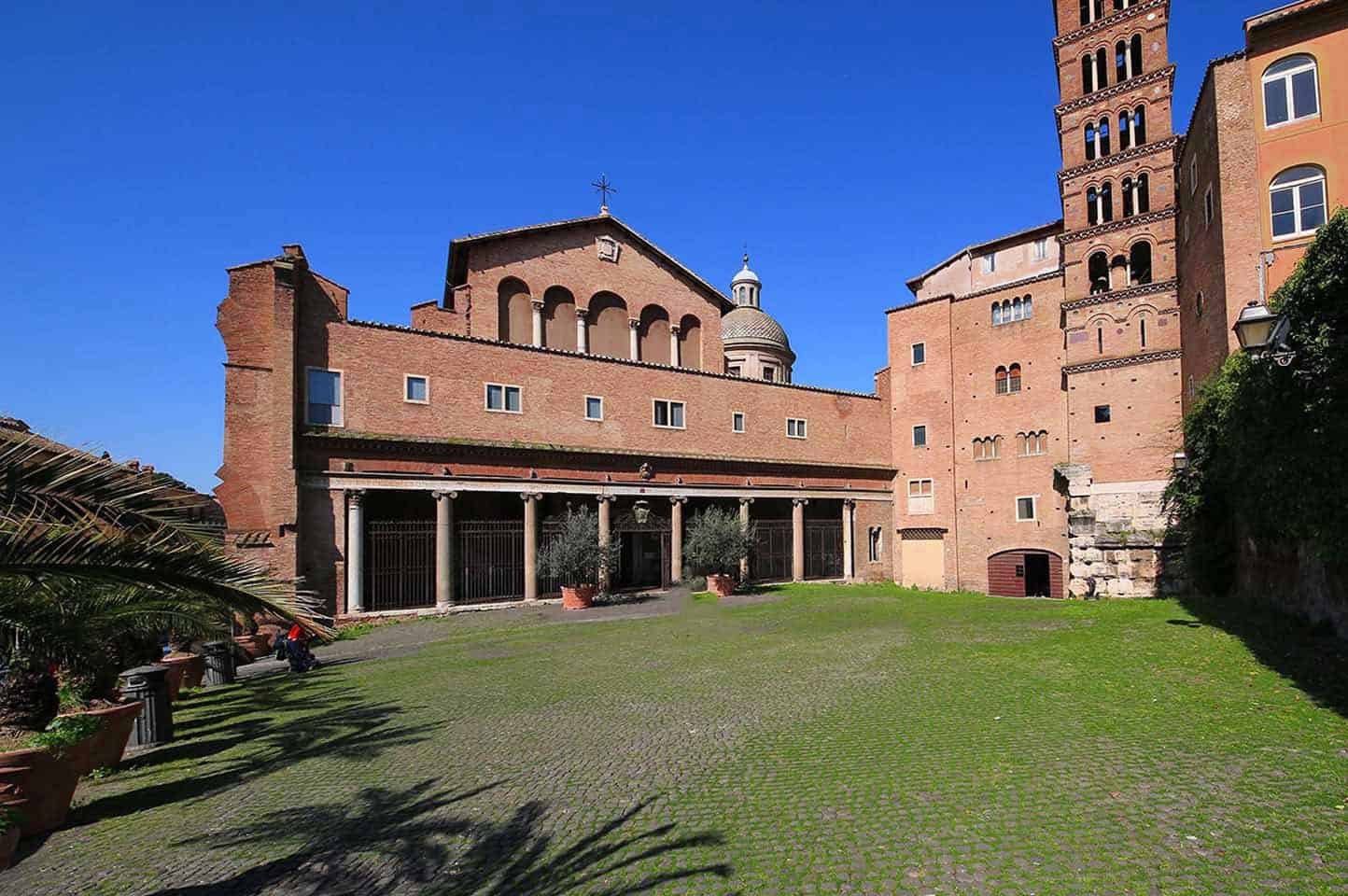
Two addresses, two tickets: the basilica and the Roman Houses are not the same visit
This is confusion number one. You still read that "at the end of the right nave is the access to the underground rooms of the basilica." The correct fact is another: the entrance to the Roman Houses of the Caelian Hill is from Clivo di Scauro, the little downhill street that runs along the side of the church, and the "info and reservations" page of the official website caseromanedelcelio.it writes it in black and white, "Clivo di Scauro adjacent to Piazza Santi Giovanni e Paolo." turismoroma.it also says the main access is from Clivo di Scauro. The description of the route on the official website starts from the Portico on Clivo di Scauro and continues into the rooms cataloged with the letters from A to J. So: whoever enters the church from the piazza sees the church, and that's all. Whoever wants to see the Roman domus has to go out, turn the corner, go down the clivo and pay the ticket. It's 200 meters of walking and two completely different experiences. The practical advice is to reverse the order from how everyone does it: first the underground, then the church. The underground has tighter hours (10:00-16:00, ticket office until 15:00) and the church stays open for you until 17:00, so if you get the order wrong you risk finding the ticket office closed.
A curiosity about the Basilica of Saints John and Paul on the Caelian Hill
Above the head of anyone who enters this basilica hang chandeliers that come from a New York hotel. It is not a tour-guide legend: Vatican News writes it in its entry on this station church, recounting that Cardinal Francis Joseph Spellman, archbishop of New York and titular of this basilica, in the 1950s had the facade brought back to early Christian forms and added in the nave crystal chandeliers from the Waldorf Hotel in New York. It is one of those details that overturns your perception of the place: you are looking at a building with foundations in insulae of the 1st and 2nd century AD, walls of the 5th century, a portico of the 12th and a bell tower that rests on the podium of the temple of the divine Claudius, and above you is mid-20th-century American ballroom lighting. The Basilica dei Santi Giovanni e Paolo al Celio is like that, in layers that do not hide one another. On the exact date of Spellman's intervention the sources do not agree to the day: 1951 is often read, romasegreta.it speaks of a restoration of 1950-1952, Vatican News limits itself to "in the 1950s". We are within a three-year span, and whoever gives you a flat date without citing the source is making it up.
The Clivo di Scauro, the Roman road you still walk on
The Clivo di Scauro is the thing that in Rome should be famous and instead few people know it. It is a living Roman road. Not a stretch of paving inside a fence with a sign, not a fragment preserved under glass: a downhill street where cars and scooters pass, with a row of brick arches above it that span it from one side to the other like buttresses. Romasegreta.it explains that the street preserves the ancient name, Clivus Scauri, that the route is documented in medieval sources starting from the 8th century and confirmed by inscriptions of the imperial age, and that its construction is attributed to a member of the family of the Aemilii Scauri, probably Marcus Aemilius Scaurus, censor in 109 BC. The arches you see were rebuilt in the medieval age but in all likelihood already existed in antiquity, and until the 16th century they had a second order above, later lost. Vatican News says the same thing in one line: the Clivus Scaurii still preserves the original Roman route. Walking under it is free, takes three minutes, and in our judgment is the most beautiful piece of the whole Celio. The late-afternoon light enters it sideways and the arches cast on the wall of the Case Romane bands of shadow that are exactly the ones seen by whoever passed there in the 15th century. Do it before or after the visit, but do it on foot and slowly, without the phone in your hand for the first 100 meters.
Something nobody tells you about the Basilica dei Santi Giovanni e Paolo al Celio
The man who in 1887 found the Case Romane digging under this church and the man who heard confessions and guided Saint Gemma Galgani spiritually bear the same name, and neither of the two official sources links them. The official site caseromanedelcelio.it writes that the complex "was discovered in 1887 by Father Germano di S. Stanislao, rector of the Basilica". Vatican News, in its entry on the basilica, writes that in the church is buried the venerable Father Germano Ruoppolo, confessor of Saint Gemma Galgani, the mystic from Lucca who has an altar here in the left nave with a stained-glass window donated by Pius XII. Father Germano di San Stanislao and Father Germano Ruoppolo could be the same person: the baptismal name and the religious name of the same Passionist. But careful, it is a hypothesis of reading, not a verified fact: neither of the two official sources says it explicitly. If the hypothesis is right, then in the Basilica dei Santi Giovanni e Paolo al Celio is buried the man who gave it back its underground. A rector who was looking for the tomb of two martyrs and found half a Roman block. Vatican News gives for Father Germano Ruoppolo the dates 1882-1970, which do not fit with the discovery of 1887: those dates, as they stand on the page, turn out to be inconsistent.
The history of the basilica, from 398 on, as it reads on the walls
Here is the story. Under the present church there stood, between the 1st and 2nd century AD, modest insulae, rental tenements. In the 3rd century the block was merged into a single large residence. After 398 the senator Byzantius, or his son Pammachius, built here the place of worship that would later become a basilica: the earlier building had been used as a domus ecclesiae by a Christian community. Up to here Vatican News confirms it. The first documentary citation is in the acts of the synod held by Pope Symmachus in 499, where the church appears as Titulus Pammachii, or Titulus Byzantii: confirmed by Vatican News. Then come the troubles, and there are three, all confirmed: the sack of the Visigoths of Alaric I in 410, the earthquake of 442, the plundering by the Normans in 1084. On the later reconstruction the sources diverge. One tradition attributes to Pope Paschal II, so between 1099 and 1118, the addition of the bell tower and the portico in place of the original narthex. Vatican News places the intervention generically "between the 11th and 12th century". Romasegreta.it speaks of a complete reconstruction in the 12th century under Cardinal Theobald. These are three versions that do not exclude each other but do not coincide either: the phase is that one, the patron is not. In 1216 Cardinal Cencio Savelli, future Pope Honorius III, modified the portico creating the upper gallery and the Cosmatesque portal: this is written by turismoroma.it and confirmed by Vatican News for the date of the gallery. Then the 18th century, with restorations inside that turismoroma.it places generically in the 18th century. The name of Cardinal Fabrizio Paolucci with the year 1715 also circulates, a traditional datum not confirmed by an official source. Finally the 20th century of Spellman and the early Christian facade. Six phases, almost 1,600 years, and the notable thing is that they can all still be seen at once from the square.
The Romanesque bell tower and the temple of the divine Claudius beneath it
The bell tower of the Basilica dei Santi Giovanni e Paolo al Celio is, according to turismoroma.it, among the most beautiful in the city, and it is built on the remains of the temple of the emperor Claudius. Vatican News adds the technical detail: decorated with majolica basins and mullioned windows, erected above the podium of the temple of the divine Claudius. Romasegreta.it goes even further into the matter and describes two construction phases, the first two stories in the 12th century and another five stories in the 13th, with mullioned windows on small columns, disks of porphyry and serpentine, ceramic plates of Byzantine taste, and three bells dated 1580, 1714 and 1849. If you add up the phases you get seven stories. The most interesting point is another one. The temple of the divine Claudius, the Claudianum, was an enormous sacred precinct that occupied the summit of the Celio. When they stopped using it as a temple they did not raze it, they built on top of it. The Romanesque bell tower is literally a Christian building resting on a platform of imperial cult. This is Rome: it is not demolished, it is reused. Look at it from below, from the Clivo di Scauro, and then look at it from the square: they are two different bell towers, because from the square you miss the ancient base and from the clivo you miss the bell chamber. It is worth the two minutes of walking to see it from both sides. And it is worth remembering that the majolica basins set into the masonry were the medieval way of saying that the city traded with the East: precious ceramic put outside, on the wall, where everyone saw it and nobody stole it because it was walled in.
The advice I give you for visiting the Basilica dei Santi Giovanni e Paolo al Celio
Go there early in the morning, between 8:30 and 10:00, and start with the church. The reason is practical and not poetic: the basilica opens at 8:30 and the Case Romane at 10:00, so in that first hour and a half you have the nave practically empty and you save yourself the wait. Then at 10:00 you go down to the Clivo di Scauro, buy the ticket, do the underground, and come out around noon with still three quarters of an hour of the church open if you want to go back with different eyes, because after seeing the domus you read the nave in another way. Second piece of advice: if you go on the weekend, consider the guided visit. The official site caseromanedelcelio.it indicates for individuals a fixed departure on Saturday, Sunday and holidays at 11:30, in Italian, at the price of €15 including the visit, the entrance ticket and booking fees. Here there is a second contradiction between official sources: cultura.gov.it instead reports educational visits on Sunday and holidays at 11:15 at a cost of €5 plus the entrance ticket. A time that differs by a quarter of an hour and a price structured differently. Check at the time of booking. Alternatively there are audio guides at €5, in Italian and English. Third piece of advice, the most banal and the most ignored: wear shoes with a sole that grips. The Clivo di Scauro is sloped and paved, and below you go down and up by stairs and ramps. Whoever arrives in flip-flops in July regrets it at the third step.
What you see inside the basilica, aisle by aisle
From the square you enter under a portico of eight Ionic columns with the entablature that carries the dedicatory inscription to the two martyrs (Vatican News). Above the portico runs the gallery of 1216. The portal is framed by a Cosmatesque frame, surmounted by an eagle with spread wings and flanked by two crouching lions: this is how both turismoroma.it and Vatican News describe it. Romasegreta.it adds a detail that the other two do not give, namely that the eagle is clutching a rabbit. Inside, three naves. Turismoroma.it notes the 16th-century coffered ceiling, romasegreta.it dates it to 1589 and counts 16 columns in the present interior. Careful, because here is a number that has to be explained and not copied: you often read of 12 columns that supported 13 arches, but that figure refers to the ancient basilica, not to the one you see today, where the original columns are partly incorporated in the pillars built over them. The two figures do not contradict each other, they tell of two buildings 1,000 years apart. In the floor of the central nave, says Vatican News, a slab would mark the exact point of the martyrdom of the two saints: look for it, people walk on it without knowing. The high altar keeps in a porphyry basin the relics of the martyrs. In the apse is the Christ the Redeemer in glory with the heavenly court, a fresco of 1588 by Pomarancio, that is Niccolò Circignani: turismoroma.it attributes it to Pomarancio, romasegreta.it signs it Circignani, and it is the same person called by two names. On the side aisles open the chapels: romasegreta.it counts five on the left and four on the right. The chapel of Saint Paul of the Cross, on a Greek-cross plan, is dated by the same source to 1862 and holds the remains of the founder of the Passionists. In the right aisle there is also the altar of Saint Gabriel of Our Lady of Sorrows, in the left that of Saint Gemma Galgani, with the historiated stained-glass window donated by Pius XII (Vatican News).
Another well-known fact, and yet rarely mentioned
This basilica does not belong to the Church. It belongs to the Italian State. The Case Romane del Celio, one reads on the cultura.gov.it entry, are property of the Fondo Edifici di Culto of the Ministry of the Interior, and the basilica complex appears in the list of FEC churches. The Fondo Edifici di Culto is the body that manages the ecclesiastical heritage taken over by the State with the 19th-century suppression laws: about 800 churches across Italy, many of them among the most visited in the country, which are publicly owned and given in use for worship. Very few people know it, and it changes the way you look at things: the restorations, the maintenance, the consolidation works on the Clivo di Scauro are not paid for by a parish, they are paid for by the Ministry of the Interior. Again cultura.gov.it notes that the site of the Case Romane holds the Herity certification, the system for evaluating the quality of management of cultural heritage open to the public. It is a bureaucratic detail that says something concrete: someone measures how this place is kept, and that does not happen everywhere. The basilica meanwhile continues to be served by the Passionists, who received it in 1773 from Pope Clement XIV (Vatican News): the church belongs to the State, the custody to a religious congregation, the museum below is run by CoopCulture. Three different parties on the same block, and it is also for this reason that the information on hours and tickets circulates in different versions.
The Case Romane del Celio: more than 20 rooms, four phases, a museum of its own
Going down under the Basilica dei Santi Giovanni e Paolo al Celio means entering a piece of Roman city that remained standing because a church was built over it. The official site speaks of more than 20 underground rooms on several levels, partly frescoed, with paintings datable between the 3rd century AD and the medieval age. You often read of "20 painted rooms, belonging to at least five different buildings dated between the 1st and 4th century": the number holds, the dating of the frescoes does not. According to the official site caseromanedelcelio.it the structures start from the 2nd century but the preserved paintings run from the 3rd century to the Middle Ages, and there is at least one cycle of the 9th century. The phases of use identified by the official site are four and it is worth learning them before going down, because it is the only way to understand what you are looking at. Phase one, beginning of the 2nd century: a luxury two-story residential building with a bath complex. Phase two, beginning of the 3rd century: an insula is built, a multi-story tenement divided into rental apartments. Phase three, end of the 3rd and beginning of the 4th century: a single owner acquires the whole block and keeps the ground floor as a noble residence. Phase four, mid-4th century: the complex is identified as the domus of the martyrs, the home of Saints John and Paul. In four rooms you have four centuries of Roman social history: from the small villa with private baths, to the working-class apartment block, to the reconquest of the block by a rich man, to the house that becomes Christian memory. Few places in Rome let you read this sequence so clearly.
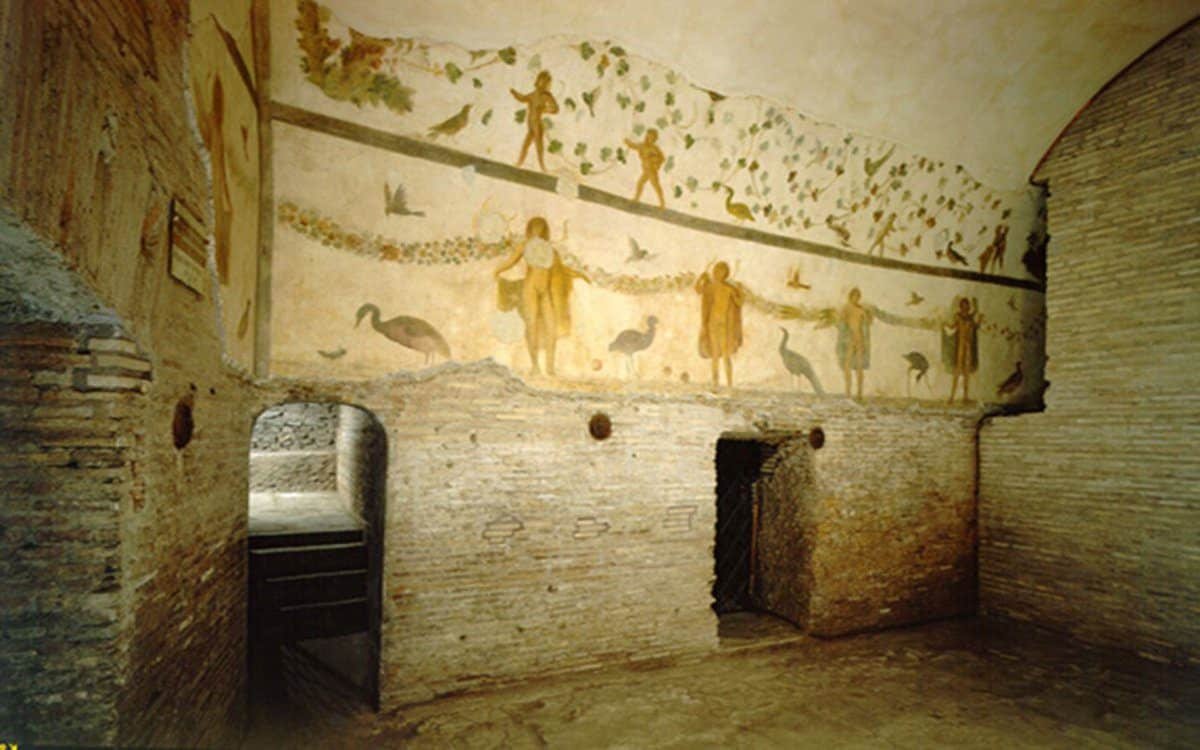
The frescoes of the Case romane, room by room
The route, says the official site, starts from the Portico on Clivo di Scauro and goes through rooms cataloged from A to J. The rooms worth looking for, with the names the official source uses, are these. The Oratory of the Savior, with a 9th-century Christological cycle and scenes of the Passion: it's the latest part and the most explicitly Christian. The Room of the Genii, lined with marble, with figures of winged genii and grape-harvest scenes. The Room of the Faux Marbles, with decorations on three registers from the early 4th century that imitate opus sectile, that is painted marble pretending to be cut marble, something the Romans did when the money ran out or when real opus sectile weighed too much. The Antechamber, where you can recognize the god Apis and two bacchantes. The Room of the Orant, named for the female figure in a long tunic with arms outstretched in prayer. The Nymphaeum, with a mythological scene set in a marine context, with erotes. The identification is often given as certain: "an elegant 3rd-century fresco with Proserpina and other deities among cherubs in a boat." In reality the identification is disputed: the official site lists among the possible interpretations both a marine Venus and the return of Proserpina from Hades between Bacchus and Ceres. Saying "it's Proserpina" is not the same as saying "it could be Proserpina or Venus." Then the Confessio, a small place of worship with 4th-century decorations depicting martyrdom and figures of orants. Tradition speaks of a confession in the cryptoporticus behind the Clivus Scauri, with the Beheading of Crispus, Crispinianus and Benedicta, but those names don't appear on the official source, which describes generically scenes of martyrdom and orants: traditional information, not confirmed. Finally the Cella Vinaria, turned into a storeroom, where amphorae were found. The route ends with the Antiquarium, which gathers Roman and medieval materials from the excavations carried out between 1887 and 1936: alabaster busts, glass cups, Byzantine ceramics, medieval frescoes of the 12th century. There is also talk of "a small museum of the basilica" where the remains of mosaic, fresco and stucco from the apse would have ended up. Most likely this is the Antiquarium, but no source says so explicitly, so the connection is probable, not certain.
The right photo to take at the Basilica of Saints John and Paul on the Celian Hill
The right photo is not the facade. The facade is beautiful, orderly, early Christian made new again in the 1950s, and everyone shoots it from the square with the sun in their face and a flat result. The right photo is taken from Clivo di Scauro, halfway down the descent, turning back: from there you frame in one shot the row of brick arches spanning the street, the wall of the Case romane on the right and the bell tower rising above everything. It's a photo that tells three eras in a single frame and needs no caption. The right time is late afternoon, when the light comes in low from the west and the arches become a sequence of parallel shadows on the paving. Alternatively, if you go in the morning, the second good photo is inside the portico: stand under the entablature, put your back against the church wall and shoot along the row of the eight Ionic columns, with the square opening up at the far end. You get a narrow, deep perspective that gives the idea of how ancient this entrance is. Third option, for those with patience: the slab in the floor of the central nave, the one that according to Vatican News marks the spot of the martyrdom. Photographed from above, from over it, with your own shoes out of the frame, it's the most eloquent image you can take away from here. Inside the Case romane, instead, ask about the photo rules at the ticket office: a written policy on photography underground does not appear to be published by the official sources.
Some important events that took place here in history
In 362, according to tradition, the two brothers John and Paul, high officials who had served Constantia, daughter of Constantine, are killed in their house on the Celian Hill during the reign of Flavius Claudius Julian, the emperor the Christians called the Apostate, and buried inside their own home. This is the version reported by both Vatican News and turismoroma.it, with the caution that it is hagiographic tradition and not documented chronicle. After 398 the senator Byzantius or his son Pammachius have the place of worship built. In 410 the Visigoths of Alaric I arrive and the church is damaged. In 442 an earthquake hits it again. In 499 Pope Symmachus holds the synod in which the church is mentioned for the first time as Titulus Pammachii. In 1084 the Normans sack the neighborhood and the basilica is smashed to pieces again. Between the 11th and 12th centuries comes the reconstruction, with portico and bell tower. In 1216 Cardinal Cencio Savelli, who will become Honorius III, redoes the portico and the portal. In 1588 Pomarancio paints the apse. The year after, according to romasegreta.it, the coffered ceiling is put in. In 1773 Pope Clement XIV assigns the basilica to the Passionists (Vatican News). In 1775 Saint Paul of the Cross dies here, having spent his last years in the basilica. In 1887 Father Germano digs under the church looking for the tomb of the martyrs and finds the domus. Between 1887 and 1936 the excavations continue that fill the Antiquarium. In the 1950s Cardinal Spellman restores the early Christian facade. In November 2020 the Jubilee of the Passionists for the third centenary of the congregation begins here, closed on January 1, 2022 (Vatican News). And every year, in Lent, the basilica becomes a station church again: the same source documents a station Mass at 16:30 for the Friday of the first week of Lent in 2021. The times of the Lenten stations change from year to year and should be checked on the calendar of the Vicariate.
Who has passed through the Basilica of Saints John and Paul on the Celian Hill
Saint Paul of the Cross, born Paolo Francesco Danei, born in 1694 in Monferrato and died in 1775, founder in 1720 of the Congregation of the Passion of Jesus Christ, lived the last years of his life here and rests here, in a chapel of the right aisle. Vatican News writes it. Saint Gabriel of the Sorrowful Virgin, 1838-1862, the Passionist from Assisi venerated above all in Abruzzo and the Marche, has an altar in the right aisle. Saint Gemma Galgani, 1878-1903, the mystic from Lucca, has an altar in the left aisle and many of her relics are kept in the basilica, including her autograph biography. The historiated stained-glass window above her altar was donated by Pius XII. Her confessor, the Venerable Father Germano Ruoppolo, is buried here. Cardinal Cencio Savelli, later Pope Honorius III, had a hand in it in 1216. Cardinal Francis Joseph Spellman, Archbishop of New York, was titular cardinal of this basilica and had it restored in the mid-1900s. The painter Niccolò Circignani, known as Pomarancio, worked here in 1588. Pope Clement XIV handed it over to the Passionists in 1773. And over the centuries dozens of cardinals have succeeded one another in the cardinalatial title of Saints John and Paul. The name of the current titular holder should be checked in the Annuario Pontificio or on the pages of the College of Cardinals on vatican.va.
The pipe organs, the big one and the small one
The main pipe organ stands on the choir loft on the inner facade wall. It was reportedly built by the firm Morettini in 1856, modified by the same firm in 1902 and enlarged in 1964 by the firm Tamburini with opus 469. It has electric action, 50 stops on three manuals and pedal. In the Chapel of Saint Paul of the Cross there would be a positive organ built in 2017 by the firm L'Organaria reusing material from the Tamburini organ opus 453 of 1962, which stood on the choir loft of the chapel itself. Warning: this is traditional information, not confirmed by an official source. The website of the Passionists who look after the basilica has no page on the organs, turismoroma.it doesn't mention them, and neither does Vatican News. The official site does state that all Masses with the congregation are celebrated in the Chapel of Saint Paul of the Cross and not in the main nave: weekday at 17:00 from Tuesday to Friday, vigil at 17:00 on Saturday and on solemnities, Sunday and holiday at 11:45 from the first Sunday of September to the last Sunday of June. If you come in summer, the Sunday Mass at 11:45 might not be held. That July to August window isn't covered on the site.
Accessibility, children, and the real length of the visit
On the accessibility of the Case Romane there is a precise official datum, on the guided visits page of the site caseromanedelcelio.it: the site is accessible, with the exception of the Confessio room for visitors with motor disabilities or reduced mobility. It is honest and useful information, because it means that the bulk of the route can be done but one room cannot. Visitors with a certified disability get free entry. On the accessibility of the basilica above, on the other hand, the sources say nothing: there is a flight of steps from the square to the portico and no indications about ramps or alternative entrances appear, so it is best to phone the rector before going. On timing: no official source declares an average length for the visit to the underground. The rooms number more than 20 across several levels, the weekend guided visit starts at 11:30 and the ticket office closes at 15:00, so give yourselves a good hour of margin at the very least. On the internal temperature, which in the catacombs is a standard datum, nothing official appears here: it is an underground space, bring something light to put over your shoulders even in July. With children: under 6 do not pay, from 6 to 14 pay the reduced rate of €6. The route has stairs and narrow passages, so the stroller is a problem. A child who walks, however, has fun here, because it is a house and not a museum of display cases, and the stories of winged genies, bacchantes and amphorae in the wine cellar work well at eight years old.
What's around: the Celio on foot in half a day
The Celio is the hill that Romans themselves cross at a run to get somewhere else, and they are wrong. Starting from the Basilica dei Santi Giovanni e Paolo al Celio you can put together a walk that does not exceed three kilometers. Going down from the Clivo di Scauro you reach in five minutes the Circus Maximus and the Baths of Caracalla, which in summer are also the stage for open-air opera. Toward the other side, 10 minutes on foot, are the Arch of Constantine and the Colosseum, with the entrance to the Palatine and the Domus Aurea a short distance away. Staying on the hill, the Basilica of Santi Quattro Coronati and the San Clemente Basilica complete the triptych of the underground sites of the Celio: San Clemente in particular is the other great vertical stratification of the area, with basilica, early Christian church and mithraeum one under the other, and anyone who has seen the Case Romane understands it at once. Then there is Villa Celimontana, the park around the corner where in summer there is open-air jazz and where you can sit for free in the shade after the underground. Further down, toward the Lateran, the St. John Lateran Basilica. Anyone who wants to extend toward the Appia finds the Parco Appia Antica and the Catacombs of San Callisto, which remain the obligatory benchmark for understanding how much the Case Romane are something else compared to an underground cemetery.
Quick questions about the Basilica dei Santi Giovanni e Paolo al Celio
How much does it cost to enter the Basilica dei Santi Giovanni e Paolo al Celio?
None of the official sources indicates a ticket to enter the church. The ticket concerns only the Case Romane del Celio, the underground archaeological museum, which has a separate entrance from the Clivo di Scauro and costs €8 full price, €6 reduced, plus €2 booking fee.
What are the opening hours of the basilica?
From 8:30 to 12:45 and from 14:00 to 17:00, according to the official site basilicassgiovanniepaolo.it and turismoroma.it. From May to October, in the wedding season, the official site notes that it may stay open until 18:30.
What are the opening hours of the Case Romane del Celio?
From 10:00 to 16:00, with the ticket office closing at 15:00. On the days, the official sources contradict each other: the official site and coopculture.it say every day, cultura.gov.it and turismoroma.it say closed on Tuesday and Thursday. Check before you leave.
Are the Case Romane del Celio closed on Tuesday?
It depends on the source. The official site caseromanedelcelio.it writes "from Monday to Sunday and holidays". Cultura.gov.it and turismoroma.it write that non-holiday Tuesdays and Thursdays are closing days. When in doubt, call 06 70454544 or write to info@caseromane.it.
Do you enter the Case Romane from the church?
No. You enter from the Clivo di Scauro, the downhill street that runs along the side of the basilica.
Do I need to book?
For the basilica, no. For the Case Romane, booking is mandatory only for groups and schools. Individuals can book by writing to prenotazioni@coopculture.it or buy online at coopculture.it.
How do I get there by public transport?
Metro B, Circo Massimo stop or Colosseo stop, then a 10-minute uphill walk. Tram 3. Buses 85, 87, 117, 175, 186, 271, 571, 673, 810, Colosseo stop. List from the official site of the Case romane, confirmed by coopculture.it.
What is the exact address?
The basilica is at piazza dei Santi Giovanni e Paolo 13, 00184 Rome. The Case romane are on Clivo di Scauro, adjacent to the same square, same postal code.
How long does the visit take?
No official source declares an average length. The underground rooms are over 20 on several levels. The weekend guided tour starts at 11:30 and the ticket office closes at 15:00, so allow at least a good hour for the underground and half an hour for the church.
Is there a guided tour?
Yes, but the official sources give two versions. The official site lists for individuals a fixed departure on Saturdays, Sundays and holidays at 11:30, in Italian, at €15 including the tour, ticket and booking fees. Cultura.gov.it lists educational tours on Sundays and holidays at 11:15 at €5 plus the ticket. Check when you book.
Are there audio guides?
Yes, at €5, in Italian and English, according to the guided tours page of the official site.
Who is entitled to the reduced ticket?
According to the official site: groups of more than 12 people, visitors with a private guided tour, schools without a guide service, children from 6 to 14. The reduced fare costs €6.
Who gets in free?
Children under 6, school groups with a guide, tour guides, certified visitors with disabilities, journalists, students of archaeology, art history, cultural heritage and architecture, FEC employees and accompanying teachers of schools on a guided visit. List from the official site.
How much does it cost for a group or a school class?
The official site lists €10 for groups with a minimum of 12 and a maximum of 25 people, and €5 for schools with a minimum of 12 and a maximum of 25 students, in both cases with the entrance ticket excluded.
Is it accessible for people with mobility difficulties?
The official site states that the archaeological site is accessible except for the Confessio room for visitors with motor disabilities or reduced mobility. For the basilica above there are no official indications: there is a flight of steps from the square to the portico, so it's best to phone the rector at 351 8161314.
Is it suitable for children?
The underground is, from eight years old up it works very well because it's a house and not a row of display cases. A stroller is a problem, though, with stairs and narrow passages. Under 6 you don't pay.
Can you take photographs?
In the basilica and on Clivo di Scauro, yes, no problem. For the Case romane no official source reports a written policy, so ask at the ticket office before going down.
Is it cold down there?
It's an underground space, so cooler than the street even in summer, but no official source gives a temperature in degrees. Bring something light to put over your shoulders.
What's the difference from the Basilica of San Clemente?
San Clemente is a vertical stratification on three levels: medieval church, early Christian basilica, Roman Mithraeum, one under the other. Here instead you go down into a Roman residential block, with apartments, private baths, a nymphaeum and a wine cellar, which then becomes Christian memory. San Clemente tells the history of worship, the Celian Hill tells the history of living.
What's the difference from the catacombs?
The catacombs are underground cemeteries dug outside the walls along the consular roads. The Case romane del Celio are houses, inside the walls, under a church. There are no mass burials and no bones on display: there are rooms, frescoes and floors.
Are there bones or burials visible?
No source describes ossuaries or burials in view along the route of the Case romane. In the basilica, according to Vatican News, the relics of the martyrs are kept in a porphyry basin under the high altar, and the remains of Saint Paul of the Cross rest in the chapel dedicated to him.
Why is it called Clivo di Scauro?
Because it keeps the ancient name, Clivus Scauri, and its construction is attributed to a member of the Aemilii Scauri family, probably Marcus Aemilius Scaurus, censor in 109 BC. Romasegreta.it writes it.
Can you visit the bell tower?
No source indicates a climb to the bell tower open to the public. You look at it from outside, from the square and from Clivo di Scauro.
What is the bell tower built on?
On the remains of the temple of the Emperor Claudius, the Claudianum. Both turismoroma.it and Vatican News say so, and the latter specifies "above the podium of the temple of the deified Claudius."
Who painted the apse?
Niccolò Circignani, known as Pomarancio, in 1588, with a Christ the Redeemer in glory and the heavenly court. Turismoroma.it calls him Pomarancio, romasegreta.it signs him Circignani: it's the same person.
Who looks after the basilica today?
The Passionists, that is the Congregation of the Passion of Jesus Christ, who received it in 1773 from Pope Clement XIV according to Vatican News. Ownership, however, belongs to the Fondo Edifici di Culto of the Ministry of the Interior, as cultura.gov.it indicates.
What time are the Masses?
According to the official website of the Passionists: weekday at 17:00 from Tuesday to Friday, vigil at 17:00 on Saturday and on solemnities, Sunday and holiday at 11:45 from the first Sunday of September to the last Sunday of June. All in the Chapel of Saint Paul of the Cross.
Can you get married there?
Yes, the basilica celebrates weddings and has a section of its site dedicated to them. Turismoroma.it lists ceremony times of 10:30, 15:30 and 17:30 from April to September, and 10:30, 15:00 and 17:00 from October to March. The rector receives visitors, again according to turismoroma.it, on Wednesday, Thursday and Saturday from 9:00 to 12:00 and from 15:30 to 17:00.
Is it a station church?
Yes. Vatican News documents a station Mass here in the first week of Lent. The times change every year and should be checked on the calendar of the Vicariate of Rome.
How old is what you see below?
The structures start from the early 2nd century AD with a two-story residential building with private baths, and run up to the medieval period with the 9th-century frescoes of the Oratory of the Savior. That's four phases of use, listed on the official site.
Is it worth paying €8?
In our opinion, yes. Eight euros for 20 frescoed rooms of an intact Roman house under a basilica is an honest price, especially compared with what you pay a hundred meters away for the Colosseum. If you have an hour, spend it.
Can you see just Clivo di Scauro without paying?
Yes. Clivo di Scauro is a public street, you walk it for free, and the brick arches spanning it can be seen and photographed without a ticket. It's the most beautiful free part of the whole complex.
Why go up there
The Celian Hill is the hill people climb only by mistake, coming out of the Colosseum on the wrong side, and the Basilica of Saints John and Paul on the Celian Hill is the reason it's worth climbing on purpose. It's not the most beautiful church in Rome, it's not even the richest, and above your heads there's a chandelier that came from a New York hotel. But it's one of the very few places where you can touch with your own hand the way this city built itself on top of itself: a 3rd-century rental apartment block that becomes a rich man's house, that becomes the house of two martyrs, that becomes a church, that becomes the seat of a congregation, that becomes property of the Ministry of the Interior, with a bell tower resting on the podium of an imperial temple and a Roman street running down through the middle of all this with cars still driving on it. If you have half a day and want to understand Rome instead of collecting it, this is the address. Go early, bring the right shoes, and before leaving make that phone call about opening days. On this the official sources don't agree with each other, and the risk is finding the door closed on Clivo di Scauro.