Villa Celimontana
In short. There are places in Rome you win by elbowing your way through, standing in line with a ticket in hand and the breath of 300 people on your neck.

Villa Celimontana, the park Rome keeps to itself
There are places in Rome you win by elbowing your way through, standing in line with a ticket in hand and the breath of 300 people on your neck. And then there is Villa Celimontana, which you reach by climbing a gentle ramp from Piazza della Navicella, passing through a travertine gateway and noticing, after 20 steps, that the noise of the city has gone quiet, as if someone had turned down a knob. This isn't a poetic effect: it's topography. The Celian Hill is a real hill, with one side dropping toward the Valley of the Camenae and the Baths of Caracalla, and the villa perches on its western summit, protected by ancient walls, tall trees and a kind of luck that is worth more than gold in Rome: being next to the Colosseum without being the Colosseum.
It's one of the right places for those who have already seen everything, or for when they have seen too much and need to put the pieces back together. Villa Celimontana sits at the top of that hierarchy. Not because it's the most spectacular one. It isn't, and anyone chasing the postcard look will find it more easily on the Pincio or the Aventine, but because it's the place where Rome stops performing. There's nothing to sell here, no lines, no turnstiles. There is an Egyptian obelisk that nobody looks at, an ancient marble collection, a large part of which has flown away over the centuries, a small 16th-century palace that today holds maps and explorers' diaries, and a lawn where families from the neighborhood spread their blankets on Sunday afternoons as if the Colosseum, 700 meters away, were another city.
The official name, the one you read in guidebooks, is Villa Celimontana. The old name, the one still used by older Romans and all the scholarly literature, is Villa Mattei al Celio. Changing a garden's name almost always means its owner has changed, and in this case the owners changed several times: a Roman baronial family, a Spanish prince who fell out of favor, a Princess of the Netherlands, a German banker, and finally the city. Every owner left a mark, and the somewhat contradictory beauty of Villa Celimontana lies exactly there: it's a 16th-century Italian-style garden that let itself be tousled by a 19th-century romantic park, and neither of the two has entirely won.
Why Villa Celimontana deserves more than half an hour
The temptation, when you arrive here after the Colosseum, is to cross the park in 10 minutes toward San Gregorio al Celio and treat it as a scenic shortcut. It's a mistake you see people make constantly. Villa Celimontana isn't a corridor: it's a palimpsest. Under the paths are the walls of a complex from the Flavian and Trajanic periods. At the edges is the barracks of the Fifth Cohort of the vigiles, the firefighters of ancient Rome. Just outside the railing, the Basilica Hilariana surfaces, home to a religious college that has nothing to do with Christianity. And in the middle, above everything, is an obelisk of Ramesses II that got here by way of Heliopolis, a temple of Isis, the Aracoeli staircase and a construction accident that gave rise to one of the city's most macabre legends.
If you spend an hour and a half at Villa Celimontana, and I suggest doing it in the late afternoon, when the light comes in low through the plane trees, you'll leave feeling you've read a chapter of Roman history that almost never appears in travel itineraries. And, not a small detail, with rested legs.
Exactly where Villa Celimontana is
Villa Celimontana occupies the western summit of the Celian Hill, within the rione of the same name, in Municipio I. The monumental entrance, the one everyone uses, opens onto Via della Navicella, next to the basilica of Santa Maria in Domnica, a few meters from the Navicella fountain that gives the street its name. A second entrance, more discreet and much more beautiful to use on the way out, is on the Clivo di Scauro, today Via di San Paolo della Croce, the ancient Roman road that descends between the arches toward the Santi Giovanni e Paolo. There is also an access from Piazza dei Santi Giovanni e Paolo which, ironically, more or less corresponds to the original main entrance: in the 16th century people entered from the north, and the sequence of avenues and vistas was designed for those arriving from that side.
To the south the villa overlooks the Semenzaio di San Sisto Vecchio, the historic nursery of the municipal Servizio Giardini: if you see orderly rows of potted plants from the southern boundary wall, it's not an illegal private garden, it's the place where for decades a large part of Rome's ornamental greenery has been grown. To the west the view falls on the Valley of the Camenae and the complex of the Baths of Caracalla, and on clear days, from the right spots, you can catch glimpses that are worth the climb.
The Celian Hill: a hill few people know they've crossed
The Celian Hill is one of the seven hills, but it's the most discreet of the group. The Palatine has the imperial palaces, the Aventine has the keyhole and the orange garden, the Capitoline has Michelangelo. The Celian Hill has very old churches, convents, hospitals, barracks and an almost suspicious silence. In antiquity it was a luxury residential area and also a military zone. In the Middle Ages it emptied out and filled with vineyards and vegetable gardens. From the 16th century, Roman families built suburban villas there, taking advantage of the good air and the low price of land. Villa Celimontana is the most intact survivor of that period, and that's why it's worth understanding where it comes from.
The Connection to the Colosseum and San Giovanni
One of the most useful things about Villa Celimontana, if you're planning a day out, is its position as a link between sites. From the Colosseum, it takes a good 10 minutes or more to climb up, passing either the Basilica dei Santi Quattro Coronati or Santo Stefano Rotondo. From San Giovanni in Laterano, you get there by walking along via della Navicella in about 15 minutes. From the Circus Maximus, you go up via di San Gregorio and enter from the side of the clivo di Scauro. This means Villa Celimontana can work as a strategic break on three different routes, and you don't need to set aside a separate trip for it.
How to Get to Villa Celimontana
The metro is the simplest option. Line B stops at the Colosseo and Circo Massimo, and from either station you walk up with a pleasant stroll. Line C, which serves the area with the Colosseo and Porta Metronia stops, has made the Celian Hill much easier to reach than it was just a few years ago. From Porta Metronia, you climb toward via della Navicella and enter through the monumental gateway.
If you prefer staying above ground, there are bus lines that climb from the Colosseum and San Giovanni toward the Celian Hill. The tram along the San Giovanni axis drops you off within a comfortable walk. My practical advice, though, is something else: whatever you take, do the last five minutes on foot, choosing the right street. Coming up from via di San Paolo della Croce, under the arches of the clivo di Scauro, completely changes the experience compared with arriving directly at the gate on via della Navicella. It's the difference between entering a theater through the service door and entering through the foyer, with the one twist that here the service door is the nicer one.
By Car, by Bike, on Foot
Driving is the worst idea: we're inside the limited traffic zone of the historic center, and parking spots are a mirage. Cycling works well for people with trained legs, because the climb to the Celian Hill is short but steep. Once at the top, the internal paths are comfortable. On foot, finally, Villa Celimontana is the natural place to rest on a route that includes the Colosseum, Santo Stefano Rotondo, the Santi Quattro Coronati and the basilica dei Santi Giovanni e Paolo.
Hours and Access
The park follows the rules of Rome's historic municipal gardens: it opens at 7.00 and closes at sunset, so the hours get longer in summer and shorter in winter. Before planning an evening visit, especially during event seasons, always check the official announcements. Rome's park hours change with the time change and with maintenance needs, and the only thing worse than finding a gate closed is finding it closed after you've already made the climb.
Before Villa Celimontana: the Ancient Celian Hill Under the Paths
Whenever you walk through a Roman park, it's worth remembering that the ground level is a recent convention. At Villa Celimontana, you walk over a site that, in the Flavian and Trajanic periods, was occupied by massive buildings. Some of their walls survive, now buried under the leveling of the ground and only partly visible on the southern side. If you have an eye for walls, you'll notice the brick fragments that surface here and there, built into the terraces as if they had always been there to hold up a hedge.
The most distinctive presence is that of the castra of the fifth cohort of the vigiles. The vigiles were the corps set up by Augustus for night watch and firefighting: 7,000 men divided into 14 cohorts, each responsible for two regions of the city. The fifth was based here, on the Celian Hill, and its barracks are one of the reasons the area left such dense archaeological traces. There is something pleasingly circular about the fact that the hill where ancient firefighters camped is today one of the coolest and shadiest spots in the center.
The Basilica Hilariana, the College That Wasn't a Church
In 1889, while digging just outside the villa's perimeter, the Basilica Hilariana came to light. The word "basilica" risks misleading you about this building: it is not a church but the headquarters of a college, that of the dendrophori, the "tree bearers," linked to the cult of Cybele and Attis. The founder was Manio Publicio Ilaro, a pearl merchant, margaritarius, who used money earned in the luxury trade to fund an association building and left his own name on it, as was common back then and, all things considered, as is still done today with donor plaques.
What makes the Basilica Hilariana memorable is its mosaic floor, with an apotropaic image against the evil eye at the entrance. The message, translated into contemporary language, went roughly like this: whoever enters here with good intentions will find the gods on their side, whoever enters with envy in their pocket will regret it. It's the kind of detail that makes you smile and, at the same time, understand Roman religious mentality better than 20 pages would: practical, contractual, superstitious.
The dolmen that isn't a dolmen
Inside Villa Celimontana, in a corner of the garden, you come across a structure that everyone calls "the dolmen": three large blocks arranged to form a trilithon, with the look of a megalithic monument that ended up on the Celian Hill by mistake. It isn't prehistoric and it was never a dolmen. It's an assemblage made with some remains coming from the Basilica Hilariana itself, arranged according to a nineteenth-century taste for ruins reassembled in an evocative way. It's worth knowing its origin, because otherwise you risk telling your travel companions about a Roman prehistory that never existed.
Ciriaco Mattei and the birth of Villa Celimontana
The modern history of Villa Celimontana begins with a completely ordinary agricultural sale. In 1553, a plot of land planted as a vineyard, worked by the Paluzzelli family, passed to the Mattei family for a thousand gold scudi. A thousand scudi, for a Roman baronial family in the sixteenth century, was not a crazy sum. You bought a vineyard on the Celian Hill the way today you buy a country house an hour outside the city, with the idea of going there in summer and making a good impression on your friends.
The leap in quality came with Ciriaco Mattei, the patron who turned the real estate deal into a cultural project. It was he who wanted the vineyard to become a villa in the full Renaissance sense of the word: a casino nobile, regular gardens, perspective avenues, fountains, and above all a collection of antiquities displayed outdoors, among hedges and niches, like a museum without a roof. The landscaping work was completed in 1581, and from that moment Villa Mattei on the Celian Hill entered the circuit of essential stops for anyone in Rome who mattered, or wanted to matter.
What "villa" meant in sixteenth-century Rome
You have to let go of the contemporary idea of a villa as a big house with a garden. In Rome in the second half of the sixteenth century, the suburban villa was a precise social instrument: it served to host, to impress, to display antiquarian culture, to offer cardinals a place for conversation far from the rigidity of the city palace. Whoever owned a villa owned a theater where they could stage their own rank. The Mattei understood this perfectly, and the Celian Hill offered the advantage of being both close and secluded: a quarter of an hour on horseback from the Lateran, but with the silence of the countryside.
The Mattei, a family that left their name everywhere
The Mattei are one of those families you keep running into in Rome without noticing. Their name is on the square and the palace where the Fontana delle Tartarughe performs its miracle of lightness, it's on a street in the center, it's on the residences that dotted the city. They were barons with curial posts, patrons with taste, collectors who were aggressive in the best sense of the word. Ciriaco was among the most refined, and his villa on the Celian Hill was the family's masterpiece when it came to gardens, just as the palace on Via dei Funari was when it came to urban architecture.
The patron and the artist
A patron of Ciriaco Mattei's stature didn't just sign checks. He chose, debated, imposed. It was his patronage that brought here the casino nobile designed by Jacopo Del Duca, one of Michelangelo's pupils and collaborators, a Sicilian architect and sculptor who had worked on the Ciborio del Santissimo Sacramento and who carried the master's lesson within him. This is no minor detail: it means the small palace at the center of Villa Celimontana belongs, by direct descent, to the highest season of sixteenth-century Roman architecture.
The sixteenth-century garden of Villa Celimontana
Ciriaco Mattei's garden was organized according to the principles of the Italian garden: perspective axes, geometric compartments, terraces that exploited the natural slope of the hill, focal points made of fountains, statues and, of course, the obelisk. The visitor did not stroll at random. They were guided along paths that offered them, one after another, carefully calculated views. At the end of an avenue, the visitor found a fountain. Turning a corner, an ancient statue. Climbing an embankment, a view over the Roman countryside.
The seventeenth-century views that have reached us show a garden much more rigid and much more "readable" than the current one, with square compartments and trees planted in rows. Looking at them is the only way to understand how deep the nineteenth-century reworking was. The park we walk through today keeps the general layout and its monuments, but it has lost its strict geometry in favor of rolling lawns, informal groups of trees and winding paths.
The garden as an outdoor museum
The most notable feature of the Villa Mattei was the systematic display of antiquities in the greenery. Statues, sarcophagi, cippi, inscriptions, altars, columns, architectural fragments: everything was placed according to a display plan that today we would call curatorial. The garden served as a showcase, but also as a book: whoever walked through it received a lesson in Roman history in images. Of the original marbles, as we will see, only a remnant is left here. But some presences, like the columns, the funerary monument dedicated to a certain Marcus Larcius by his wife and several headless statues, continue to dot the lawns and recall how the whole was conceived.
The Logic of Water
A Roman garden without water is half a garden, and on a hill water is a technical problem before an aesthetic one. Villa Celimontana solved the question by tapping the available conduits and organizing fountains, basins and water features that in the 16th and 17th centuries made up the real luxury of the property. The hydraulic reading of a historic garden is almost always the key to understanding its compositional choices: where there is pressure you can make a spout, where there isn't you make a reflecting pool or a dripping grotto.
The Obelisk of Villa Celimontana, the Thirteenth Witness
If I had to point to a single object to justify a visit to Villa Celimontana, I would point to the obelisk. Rome has 13 ancient obelisks, more than any other city in the world, Egypt included. 12 everyone knows: St. Peter's, Piazza del Popolo, the Lateran, Montecitorio, Piazza Navona, Trinità dei Monti, Minerva, the Quirinal, the Esquiline, the Pincio, Villa Torlonia, Piazza della Rotonda. The thirteenth is here, on a wooded mound, with no crowd, no guides with little flags, not even a sign that does it justice. It is the most neglected and, for a certain kind of traveler, the most fascinating.
The monolith dates to the time of Ramesses II and is fragmentary: only the upper half is original, 2.68 meters tall, while the rest is restoration. With the completion, the base and the globe that tops it, the whole reaches 12.23 meters, which explains why to the naked eye it seems more imposing than the ancient part really is. The Romans, with their usual ability to cut any solemnity down to size, nicknamed it "lo spiedino" (the skewer).
From Heliopolis to the Caelian: A Journey of 3,000 Years
The journey of this obelisk is a lesson in Mediterranean history. It is born in Egypt, tied to the solar cult. It is brought to Rome and placed in a sanctuary of Isis, one of the places where the capital of the empire indulged its fascination with Egypt. With the end of the ancient world it ends up among the ruins. In the Middle Ages it is found on the Capitoline, next to the side passage of the basilica of Santa Maria in Aracoeli, where it appears in 16th-century drawings that show it still standing beside the church.
In 1582 the Roman Senate gave it to Ciriaco Mattei, who had it transported to the villa on the Caelian. The installation was completed in the immediately following years. In the 19th century, after the change of ownership and within the new arrangements of the garden, the obelisk was raised again and placed in its present position, on the small rise that still hosts it today. Since then no one has touched it again, and the reasons, as we will see, are not only technical.
Why the Donation of 1582 Was Not Just Any Gift
Giving an obelisk to a private citizen may seem, today, an extravagant gesture. In the 16th century it had a precise logic. The monolith lay in precarious condition, required transport and erection costs that no administration wanted to bear, and aristocratic munificence worked exactly like this: public power handed a cumbersome asset to a rich private person, who paid for its recovery and in exchange gained prestige. The result, in this case, was the preservation of a unique piece that otherwise would have ended up burned to lime in a kiln, as happened to so many ancient marbles.
The Legends of the Obelisk of Villa Celimontana
Roman obelisks attract legends like streetlamps attract moths, and the one at Villa Celimontana has collected two particularly tenacious ones. The first concerns the last 19th-century move. The story goes that during the lifting operations the ropes gave way and the base fell on a worker, crushing his arms. To free him, the tradition says, it was necessary to amputate his arms on the spot, which stayed under the block. Since then, the tale continues, no one has had the courage to propose moving the monument again, and that man's arms would still lie down there.
The second legend is of a completely different tone and concerns the sphere that crowns the monolith: it supposedly contains the ashes of the emperor Augustus. This belief also circulated about other Roman obelisks and globes, fueled by the notion that a metal container placed on top of an ancient monument must necessarily hold something. Augustus's ashes were kept in the Mausoleum that bears his name, in the Campus Martius, and their fate after the ancient plundering is unknown. But the appeal of the sphere remains intact, and every time I point it out, someone raises their phone and tries to photograph it against the light, hoping for who knows what.
How to Handle a Legend Without Lying
Stories like this should be told without passing them off as documented truth. The formula is simple: what is being told, who tells it, and what we actually know for certain. In the case of the Villa Celimontana obelisk, we know for certain its Egyptian origin, its Ramesside dating, the donation to Ciriaco Mattei in 1582, its medieval placement at the Aracoeli and the nineteenth-century rearrangement. The rest is folklore, and it is valuable folklore, because it shows how Romans have lived with and digested their own monuments.
The 13th Obelisk and the Game I Always Suggest
A game for the most competitive: list the ancient obelisks of Rome. People almost always get to eight or nine, someone gets to 11, nobody, ever, has named Villa Celimontana. It is the perfect monument for the traveler who wants to go home with a card to play in social settings. I'll add that Roman obelisks are divided between ancient ones imported from Egypt, Roman-made ones with imitation hieroglyphs, and modern ones. That distinction makes the conversation far more interesting than a simple list.
Saint Philip Neri and Villa Celimontana
There is a thread of devotion running through Villa Celimontana that explains why this garden is not just a matter of marble and vistas. Ciriaco Mattei was close to Philip Neri, the Florentine priest who founded the Oratory in Rome and whom the city has adopted as its own home saint with a familiarity no other patron has ever had. Philip Neri did not preach from above: he laughed, mocked, threw people off balance, led young men to walk and sing through the streets, and turned penance into an outing.
His most successful invention was the visit to the Seven Churches: a pilgrimage on foot that touched San Pietro, San Paolo fuori le mura, San Sebastiano, San Giovanni in Laterano, Santa Croce in Gerusalemme, San Lorenzo fuori le mura and Santa Maria Maggiore. A good 20 kilometers, often covered in a single day, with music, stops, outdoor meals and plenty of conversation that we would today call cultural animation. The route passed through the Celian Hill, and the Mattei villa became one of the rest and refreshment stops for pilgrims.
The Saint Who Rested in the Shade
Local tradition holds that Philip Neri stopped here to rest in the shade of the villa's trees while the pilgrims ate and caught their breath. In the garden, a tree linked to the saint's memory is still pointed out, and anyone who knows Roman devotion knows that trees of this kind, such as the holm oak of San Filippo or the fig of this or that convent, are less botany and more collective memory: when the specimen dies, another is planted, and the story goes on.
What interests me most is what this tradition says about the relationship between aristocracy and devotion in Counter-Reformation Rome. Opening one's villa to a procession of pilgrims was not occasional charity: it was a reputational investment in a city where holiness was the strongest currency. At the same time, it was probably sincere affection too, because Philip Neri had the rare ability to win affection even from the powerful people he teased.
The Rome of the Seven Churches, Then and Now
The pilgrimage of the Seven Churches still exists and continues to be walked, especially in spring. Walking it, even just in part, is one of the best ways to understand the city's sacred geography: you pass through neighborhoods, remaining countryside and walls, and you discover that Rome is much bigger than tourist maps suggest. In that account, Villa Celimontana is the stop that lets you reach the Lateran with your legs still in good shape.
The Palazzetto Mattei, the Built Core of Villa Celimontana
At the end of the entrance avenue you come to the casino nobile, which everyone calls Palazzetto Mattei. It is a restrained building, without showy displays, with the kind of elegance that in sixteenth-century Rome signaled self-assurance: there was no need to shout, it was enough to proportion the openings well. The work is by Jacopo Del Duca, trained in Michelangelo's circle, and it preserves its original layout despite later alterations.
The little palace was not a permanent residence but a place for stays and entertaining. The rooms were used to receive guests, to display pieces from the collection, and to offer relief from the summer heat. The logic of a villa casino is the opposite of that of an urban palace: there, the family's privacy is protected, while here the enjoyment of company is organized. Anyone who looks at it today with a distracted eye sees an ochre-colored building enclosed by trees. Anyone who looks at it knowing what it was sees the stage machinery of a sixteenth-century villa.
The interiors and their fate
As almost always happens with noble villas that have changed hands many times, the original furnishings have been dispersed for a long time, and the interiors have undergone functional adaptations. The current use, which I'll talk about shortly, has nonetheless had an enormous merit: it has kept the building from being abandoned or distorted. A historic palace that houses a library and an archive is a palace that lives, that is heated in winter and monitored all year round.
The relationship between the building and the garden
Palazzetto Mattei was the visual hinge of the sixteenth-century garden: the avenues converged toward it, and the views opened out from it. With the nineteenth-century landscape transformation, this relationship softened, and today the building appears more as a presence among the trees than as the geometric center of the whole. If you want to recover the original logic, position yourself on the axis of the main facade and try to imagine low hedges, gravel, statues in a row, and no tall trees interrupting the view. The villa changes face in an instant.
The antiquities collection of Villa Celimontana and its dispersal
Here we need to tell a story that ends badly, but one that is typical of the fate of Roman collections. Ciriaco Mattei and his descendants assembled, across the villa and the family palaces, a collection of antiquities of European importance: statues, reliefs, sarcophagi, busts, inscriptions. Many pieces were displayed outdoors in the garden, others inside the casino. For two centuries the Mattei collection was a stop on the route of cultivated travelers, antiquarians, and artists who came to Rome to study the ancient world by drawing it.
Then came economic difficulties, inheritance divisions, and the great antiquities market of the eighteenth and nineteenth centuries, which was for Rome what a high tide is to a sandcastle. Many finds from the collection were sold to the Vatican Museums, where they remain today. Others took different paths and ended up in Italian and foreign collections and museums. The garden, which had been conceived as an exhibition container, gradually emptied of its best pieces.
What remains today in Villa Celimontana
Enough remains to understand, not enough to be moved the way Grand Tour travelers were. Columns, altars, cippi, a monument probably funerary, dedicated to Marcus Larcius by his wife, headless statues, and a few architectural fragments continue to stand in the middle of the lawns, often without a sign, often mistaken for décor. It's worth spending a few minutes looking for them on purpose: the park changes in your perception, because what seemed like decoration reveals itself as a document.
The surprise of a double face
Among the collecting episodes linked to this villa, there is one I particularly love. During works commissioned by the Spanish owner in the early nineteenth century, an ancient double-faced sculpture unexpectedly came to light, one of those two-headed herms in which people have wanted to recognize Seneca and Socrates. This is the kind of find that still happens in Rome: you dig to redo a sewer and you find a philosopher. The difference, back then, was that the philosopher went straight into the private collection of whoever owned the land.
Why dispersal is not just a loss
To those who are outraged by marbles that ended up elsewhere, one can offer a counterargument. The dispersal of Roman collections was a tragedy for the integrity of the complexes, but it was also the reason ancient art is today known across all of Europe. A piece that leaves a private garden and enters a public museum gains in conservation, in study, and in accessibility what it loses in context. It is not a consolation, it is a balance sheet.
Fountains, nymphaea and grottoes of Villa Celimontana
Water is the most fragile memory of a historic garden. Statues can be moved and trees can be replanted, but a hydraulic system that stops working becomes, within a few decades, an incomprehensible ruin. Villa Celimontana preserves a repertoire of fountains and water structures that, although scaled down from the original apparatus, makes it possible to reconstruct the logic of a sixteenth- and seventeenth-century garden.
The most photographed is the Fountain of the Palms, which takes its name from the vegetation around it and is one of the most recognizable corners of the park: a basin, a discreet jet, and the palm trunks rising behind it. Elsewhere you'll find the Fountain of the Shell, with its basin shaped like a valve, and the remains of minor arrangements spread along the paths. There is also the memory of a Fountain of the River, with its reclining river figure, which was a required topos of Roman gardens: the river stretched out on its elbow, the urn pouring water, the learned quotation of the ancient statues of the Nile and the Tiber.
Nymphaeums and Grottoes: Coolness as a Luxury
In sixteenth-century Rome, the artificial grotto, or nymphaeum, was the true luxury of a villa. Usually built on the side of a slope and lined with calcareous sponges, shells and rustic mosaics, it housed spurts of water, statues and water games designed to soak unsuspecting guests. It served two purposes: to amaze and to cool. In a Roman summer without air conditioning, a damp, shady room where water dripped was the place any cardinal would have wanted to be at noon.
At Villa Celimontana, structures of this type are partly lost, partly absorbed into the terraces, and partly recognizable only to those who know what to look for. Walking along the retaining walls on the south side, you notice niches, blocked-up openings and masonry with nothing ornamental about it: they are the skeletons of a system that once produced wonder.
Bernini on the Celian Hill: The Fountains That Are Gone
Among the bitterest facts is this one: some of the villa's fountains were the work of Gian Lorenzo Bernini, commissioned by the Mattei, and have been destroyed. This fact is recorded in the art-historical literature on Bernini's fountains, and it is one of those cases where art history works like archaeology, reconstructing from documents what can no longer be seen. Picturing a young Bernini designing water games on the Celian Hill, a few hundred meters from the Colosseum, helps you understand how dense the network of patrons holding Baroque Rome together was.
Knowing about a loss is not useless: it is the best way to look at what remains with different eyes. Absence, told well, is more eloquent than many presences.
The Monumental Portal of Villa Celimontana
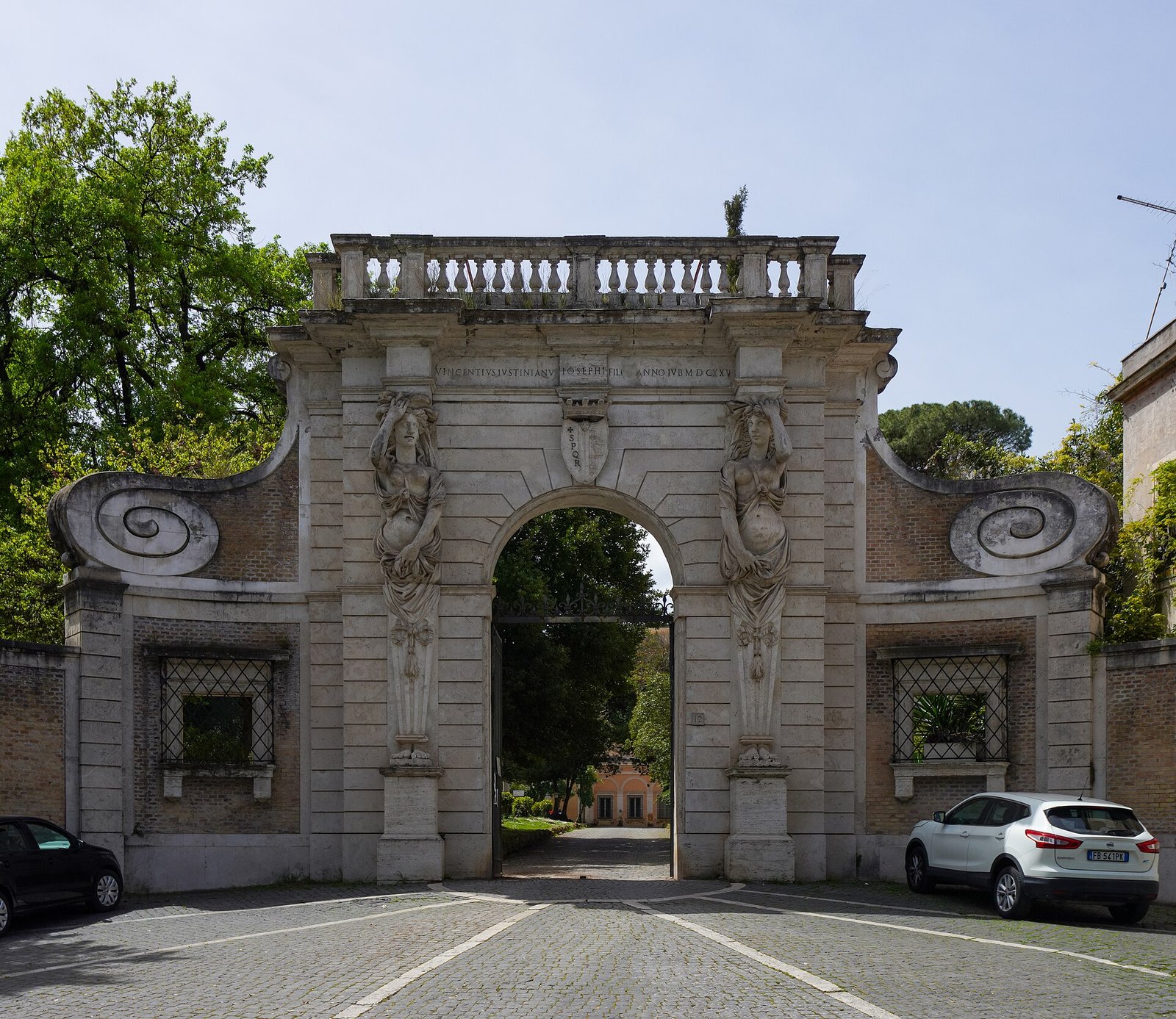
The large portal that leads into the villa from via della Navicella has a curious history: it was not born here. It comes from Villa Giustiniani Massimo, also called Villa Massimo Lancellotti, which once stood near via Matteo Boiardo and was erased by building work. When that villa disappeared, the portal was taken down and rebuilt at Villa Celimontana in 1931, where it works very well as a scenic entrance.
On the inner side you can recognize the coat of arms of the Massimo family, evidence of its origin, and on the adjacent wall an inscription tells the story of the move. It's a detail worth reading: it is one of the few cases in which a Roman monument explains its own migration by itself, instead of leaving visitors with the illusion that it has always been there.
A Roman Habit: Moving Things Around
The story of the portal sheds light on a constant practice of modern and contemporary Rome: the moving of architectural elements from one site to another. Columns, portals, fountains, obelisks and even entire buildings have moved around the city, following the fortunes of owners and the city plans. Villa Celimontana is a small catalog of this: the obelisk comes from the Capitoline Hill after coming from Egypt, the portal comes from the Esquiline Hill, and the ancient marbles come from different excavations. In this sense, the park is a storehouse of migrations.
Enter by the Portal, Leave by the Clivo
The directorial advice is simple: enter through the monumental portal, which prepares you with the right solemnity, and leave from the side of the Clivo di Scauro, which returns you to the city in the most beautiful way possible, under ancient arches, with the apses of the churches in front of you. Doing the opposite works less well: you arrive tired at the highlight and exit onto a busy road.
The Fall of the Mattei and the New Owners of Villa Celimontana
In 1802 the Mattei family lost ownership of the villa. It is a date that marks the end of a cycle two and a half centuries long and the start of a whirl of transfers that would change the face of the garden. The reasons are the classic ones of the Roman patriciate of the old regime: debts, fragmented inheritances, land incomes that can no longer cover the costs of representation, and a political season, the Napoleonic one, that upends every certainty.
From 1813 to 1830 the owner was Manuel Godoy, the Spanish politician and nobleman who had been the most powerful man in Spain with the title Prince of the Peace and who ended his days in exile. Godoy bought the villa from Count Alessandro Pianciani and entrusted the restoration work to the Catalan architect Antonio Celles y Azcona. It was during this work that the two-headed herm that has been discussed resurfaced. An exile who buys a Roman villa and finds an ancient sculpture inside it is a subject that seems written by a novelist, and yet it is a documented account.
Marianne d'Orange-Nassau and the Dutch Chapter
On June 7, 1851, the villa was bought by Marianne d'Orange-Nassau, aunt of William III of the Netherlands, a princess with a scandalous biography by the standards of the time: separated, independent, mother of a son born out of wedlock, Johannes Willem van Reinhartshausen, who had come into the world in Cefalù and whom the mother took with her to Rome. The Celian Hill, with its distance from the courts and its secluded beauty, was the perfect place for a woman who had decided to live by her own rules.
This phase includes the transformation of the garden in a landscape sense, that is, the choice to replace the geometry of the Italian garden with the apparent naturalness of the English park: undulating lawns, groups of trees, curving avenues, viewpoints. It was the taste that dominated Europe in the mid-1800s, and Villa Celimontana absorbed it deeply. In the account of nineteenth-century properties, the Mannings also appear, in one of those brief passages that the records register and collective memory forgets.
Richard von Hoffmann, the Last Private Owner
In 1869 the villa passed to Richard von Hoffmann, Baron of Bavaria, who was its last private owner and who around 1870 sponsored further works, this time in the neo-Gothic style. Neo-Gothic in a Roman garden may make purists turn up their noses, but it has to be seen in the context of the time: the picturesque ruin, the medieval reference, and the romantic atmosphere were ingredients that a fashionable villa had to have.
Under the Hoffmanns, Villa Celimontana became a place of receptions and international hospitality, frequented by the cosmopolitan society that filled post-unification Rome. It was, in a sense, its last phase of private life: within a few decades it would become everyone's property.
How Villa Celimontana Became Public
The turning point came with the First World War and its legal consequences. In 1921 the Italian State, as a victorious power, expropriated the villa from the Hoffmanns under the rules that targeted the property of citizens of a former enemy country located on national territory. It is an episode that today seems brutal and that at the time was common practice across Europe: wars are not fought only on battlefields, but also in land registries.
From 1926 the villa was granted for free and in perpetuity to the Comune di Roma, and from 1928 it became a public park in every respect. In little less than a decade, a private garden built for a baronial family of the sixteenth century and passed through the hands of a Spanish prince, a Dutch princess and a Bavarian baron became the neighborhood courtyard of the residents of the Celian Hill. I don't know many stories that sum up three and a half centuries of Europe so well in a small patch of land.
The Concessions That Saved the Complex
The formula of free and perpetual use has had lasting consequences. The Palazzetto Mattei is granted to the Società Geografica Italiana, which has its seat there. The section between the Arch of Dolabella and the basilica of Santa Maria in Domnica is granted to the former Stazione Chimico-Agraria Sperimentale di Roma, now merged into the Consiglio per la ricerca in agricoltura e l'analisi dell'economia agraria. This division explains why some parts of the complex are not freely accessible and why, while walking, you come across gates and fences that at first glance seem arbitrary.
A Public Park with a Scientific Vocation
I find it remarkable that, of all the possible fates, Villa Celimontana ended up hosting institutions devoted to knowledge: geography, experimental agronomy. It could have become the seat of a ministry, a luxury hotel, a school. Instead it has remained a place where maps and plants are studied, which, for a garden born as a theater of erudition, is a form of unintentional coherence.
The Società Geografica Italiana at Villa Celimontana
Inside the Palazzetto Mattei, since 1926, the Società Geografica Italiana has its seat. It is one of those nineteenth-century societies born when geography was a frontier science and at the same time a tool of national policy: societies were founded, expeditions were financed, maps were drawn, and distant territories were debated with the same passion that today goes into satellite data. The Society, founded in 1867, moved to Rome in the years that immediately followed and has worked on the Celian Hill for well over a century.
Through the Società Geografica Italiana, the palazzetto also hosts international bodies in the field, including the network of European geographical societies and the permanent secretariat of the International Geographical Union. This means that in a sixteenth-century building constructed for the pleasure of a baronial family, meetings are held today that concern the discipline of geography on a global scale. Rome is full of these overlaps, but they are rarely so clear-cut.
The Library and Archives
The library of the Società Geografica Italiana is one of the least known treasures of the city: books, atlases, maps, periodicals, archive collections and photographic material documenting more than a century and a half of exploration, cartography and territorial studies. For scholars it is a goldmine. For curious visitors it shows that geography was never just a school subject but a cultural enterprise with its controversies, its ambitions and its dark areas.
Access to the library and archives follows its own rules and does not match the park's hours. Anyone who wants to consult them should check with the institution in advance. Even if you stay outside, though, knowing what that building holds changes the way you look at it. A small palace is just a small palace until you learn that inside are the papers of people who crossed deserts and glaciers.
Geography and Colonial Memory
It would be dishonest to tell the story of the European geographic societies of the 19th century without saying that exploration was closely tied to colonial expansion. The expeditions brought knowledge and, at the same time, paved the way for political and economic interests. Mentioning this does not take anything away from the scientific value of the materials preserved here. On the contrary, it makes them historical documents with two layers, useful for studying both the territories explored and the gaze of those who explored them. This is the kind of awareness that separates a cultured visit from a nostalgic one.
Santa Maria in Domnica, the Navicella and Villa Celimontana
Villa Celimontana and the basilica of Santa Maria in Domnica are two faces of the same place: you enter the park by passing along the side of the church, and for centuries the fates of the two properties have been intertwined. The basilica stands on the top of the Celian Hill, in Piazza della Navicella, and is the seat of a cardinal title established in the 7th century by Pope Agatho. An earlier church already stood near the barracks of the fifth cohort of the vigiles, and it is mentioned in the acts of the synod of Pope Symmachus in 499.
The decisive reconstruction is owed to Pope Paschal I, in the years between 818 and 822, in a period of artistic renewal that brought the great mosaic back to Rome. The church's apse preserves one of the most beautiful mosaic cycles in the city: the Virgin enthroned, surrounded by a crowd of angels, with the commissioning pope kneeling and touching her foot, recognizable by the square halo that in medieval iconography indicated a living person. Anyone who visits Villa Celimontana and skips Santa Maria in Domnica, when it is open, is leaving the most precious piece of the area on the table.
Why It's Called "in Domnica"
The name has been debated for centuries. One interpretation derives it from dominicum, meaning "of the Lord," a term used for buildings of worship. Another links it to the name of a woman, Ciriaca, said to have lived nearby, whose name also means "belonging to the Lord." Both hypotheses are plausible and neither has been proven. It is one of many cases in which Roman place-name history keeps a mystery under a word we say without thinking.
The Marble Ship in Front of the Church
The basilica's other name, "Santa Maria alla Navicella," comes from the marble ship sculpture placed in front of the church. The original was an ancient boat, probably an ex voto linked to the military presence in the area. A votive ship is not at all strange next to a barracks, where vows for safety were fulfilled. That ancient piece was lost, and the little ship we see today was remade in the time of Pope Leo X, in a project that also included the basilica's new Renaissance facade, designed by Andrea Sansovino in the second decade of the sixteenth century.
The Navicella fountain is one of those minor monuments that Romans use as a meeting point without really seeing them anymore. It's worth stopping for 30 seconds to look at how the boat is treated. It is not a model ship. It is an idea of a ship, simplified until it becomes a sign. And then, looking up, you meet the basilica's portico with five arches and the coats of arms in the tympanum, including those of the Medici cardinals who held the title throughout the sixteenth century.
The Link with the Medici and the Mattei
The story of the basilica next to Villa Celimontana is a small treatise on the power of families. The cardinal title passed for decades to the Medici: Giovanni di Lorenzo, future Leo X, Giulio di Giuliano, future Clement VII, then Giovanni di Cosimo I, who died very young, and finally Ferdinando, made a cardinal at 14 years old and later grand duke of Tuscany, to whom the basilica's ceiling is owed. In the 17th century it was Duke Mattei, owner of the adjacent villa, who had the building with a tower constructed against the north flank of the church. Expanded several times, it has housed some rooms of the experimental agricultural institution since 1934.
The Arch of Dolabella next to Villa Celimontana
A few steps from the entrance to the villa, on today's Via di San Paolo della Croce, you pass through the Arco di Dolabella, one of the most underrated ancient monuments in Rome. It is an arch made of travertine blocks, erected in 10 AD by the consuls Publio Cornelio Dolabella and Gaio Giunio Silano, in connection with the rebuilding of a gate in the Republican walls of the Celian Hill. It has stood for 2,000 years, and today motorbikes drive under it.
Its second life is even more interesting than the first. In the Neronian age, the arch was used as a support for the branch of the Claudian Aqueduct that carried water toward the Palatine. The Neronian arches, of which impressive stretches remain in the area, connect right here. A commemorative monument recycled as a hydraulic pier is a perfect example of the practical mindset of the Romans, who respected the past when it was useful and reused it when they needed it more.
The Clivo di Scauro, the oldest road in the neighborhood
Going down from the arch, you take the Clivo di Scauro, today Via di San Paolo della Croce. It is a Roman road that keeps its ancient route and is crossed by a series of large brick arches, built in the Middle Ages to counter the pressure from the buildings on either side. Walking beneath them, with the Basilica of Santi Giovanni e Paolo on your right and the convent walls on your left, is one of the most cinematic experiences in central Rome, and it's no coincidence that more than one film has been shot here.
Beneath the Basilica of Santi Giovanni e Paolo lie the famous Roman houses of the Celian Hill, a complex of imperial-era rooms with paintings. They are visited separately, and they tell the story of ancient domestic life better than any reconstruction. It's worth combining a visit to Villa Celimontana with this descent: from the aristocratic 16th-century garden to the 2nd-century Roman house, it's a 10-minute walk.
San Tommaso in Formis and the mosaic above the door
On the edge of the complex you'll find San Tommaso in Formis, with its portal topped by a 13th-century mosaic showing Christ between two freed slaves, one white and one Black. It is the emblem of the Order of the Trinitarians, founded to ransom prisoners. The name "in Formis" comes from the formae, that is, the conduits of the aqueduct that run right beside it. It's 200 square meters of layered history that almost no one looks at, and it sits exactly on the route of anyone leaving Villa Celimontana from the right side.
The Trees of Villa Celimontana
A historic park can also be read through its trees, and those of Villa Celimontana reveal at least three different eras. There are the plane trees, which form shady avenues and belong to the culture of the 19th-century park. No 16th-century Italian garden would have put a plane tree in the middle of a geometric compartment, whereas the 19th-century landscape style adopted them for their broad crowns and rapid growth. There are the holm oaks, the quintessential Mediterranean trees, evergreen and dark, capable of withstanding the Roman summer drought and producing the dense shade that Romans have called "ombra buona" for centuries.
And there are the palms, which came to Rome as a 19th-century exotic fashion and have become part of the urban landscape to the point that today no one perceives them as foreign. The palm fountain of Villa Celimontana owes its name to them, and the group around it is one of the most recognizable corners of the park. It's worth remembering that the palms in Italian cities went through a very harsh crisis in recent decades because of the red palm weevil, and that every adult specimen that survived is the result of constant treatments.
Pines, cypresses and the Roman skyline
There are also plenty of umbrella pines, the tree that more than any other defines the skyline of Rome. Their umbrella-shaped crowns, slanted trunks, and needles that make a surf-like sound in the wind form the soundtrack of any Roman park. Cypresses, upright and austere, act as a counterpoint, and they have historically been used to mark axes and boundaries. The combination of pines, holm oaks, cypresses and plane trees is exactly what gives Villa Celimontana its mixed atmosphere, a bit of ancient Rome and a bit of a northern villa transplanted into the sun.
Greenery as maintenance, not as nature
Historic parks shouldn't be called "nature." They aren't. They are man-made works, just as much as a facade or a fresco, and like man-made works they require constant restoration. Pruning, plant treatments, replacing aging specimens, managing the lawns, and dealing with roots that lift the paths are all technical work. When a tree is felled in a Roman park, the public reaction is almost always outrage. In most cases, though, it is a compromised specimen that risked falling on someone. Villa Celimontana has had its share of these interventions, and it will continue to have them.
The minor flora that no one looks at
Between the flower beds and the retaining walls grows wild vegetation that produces tiny blooms in spring: sorrels, speedwells, mallows, poppies in the unmown meadows. It is the same vegetation that fills the ruins of Rome, and in the nineteenth century it inspired an entire literary genre, with botanists publishing the flora of the Colosseum by listing hundreds of species growing among the stones. If you walk through in March or April, look down. The Celian Hill still has that kind of richness.
The Seasons of Villa Celimontana
Every park has a season when it's at its best, and Villa Celimontana has two. The first is full spring, between late March and May, when the lawns are still green, the light is clear, and the temperature lets you sit without looking for shade at all costs. The second is late autumn, between October and November, when the plane trees turn yellow, the light gets lower, and the park takes on a melancholy tone that goes very well with the ancient marbles scattered across the grass.
Summer in Rome is a different matter. Between June and August the heat is serious, and the only sensible strategy is to move early in the morning or after six in the evening, staying under the trees. That said, it's precisely in summer that Villa Celimontana has historically offered something few Roman parks offer: evening life, with live music and people sitting in the dark under the trees. Winter, finally, is the season of the residents: dogs, joggers, strollers, benches taken by people reading in the midday sun.
Light, and How to Use It
Here's a technical tip for anyone who likes to look closely: the best light at Villa Celimontana arrives in the late afternoon, when the sun sinks toward the west and passes low between the trunks, lighting the obelisk from one side only and stretching shadows across the lawns. Early morning has a different advantage, almost total silence, but the light is flatter. At midday, in summer, the park is an oven with a few islands of coolness. In winter, by contrast, midday is the most pleasant hour.
After the Rain
If you happen to be in Rome and it rains, don't cancel Villa Celimontana. Wait for it to stop and go right after. Roman parks after a downpour have a smell of earth and bay laurel that is worth the trip, the marbles darken and show the reliefs more clearly, and the number of people plummets. It's one of the few concrete advantages of bad weather in a city that otherwise goes into crisis when it rains.
The Villa Celimontana Jazz Festival
For a generation of Romans, the name "Celimontana" means one thing only: jazz. For years, on summer evenings, the park turned into an outdoor venue with a stage, chairs, a bar, and an audience that came from all over the city. The festival, organized by the cultural association that bears the villa's name, hosted Italian and international musicians and helped, together with a few other events, to define the model of the Roman summer: using historic spaces as performance venues in the months when the city would otherwise be deserted.
The cultural value of the operation was twofold. On one hand, it brought quality music into an informal setting, with affordable tickets and without the rigidity of the concert hall. On the other, it brought thousands of people into a historic park that many had never visited until then. I know middle-aged Romans who discovered the obelisk of Villa Celimontana while going to hear a quartet, and who saw it for the first time lit from below, with the double bass in the background.
Interruptions, Returns, Controversies
The history of the festival has not been linear. Series held inside historic parks live in a permanently unstable balance among three needs: protecting the site, the right to rest of those who live nearby, and the economic sustainability of the organizers. As soon as one of these three hardens, the whole setup falls apart. So jazz on the Celian Hill has gone through suspensions, moves to other venues, partial returns and restarts, with a string of citywide controversies each time.
The same dynamic repeats itself in several Roman villas, and in our view the problem is not the music but the way events are set up: heavy structures, excessive volume, trampling of roots, improvised bars. Where setups are light and volumes are controlled, coexistence holds up. Where a historic garden is turned into an open-air disco, it fails. Villa Celimontana has tried both versions.
Not Just Jazz
Since the summer of 2012, the park has also hosted a series devoted to classical music, "I Classici in Villa", organized by another association. The cultural programming at Villa Celimontana has therefore changed over time, and anyone visiting Rome in summer would do well to check what is scheduled for the current year, rather than assuming a lineup that may have changed. Events in Roman parks are announced late and change often. It is an anthropological trait, not an occasional flaw.
Going to a Concert Here: What to Expect
If you happen to visit on an evening with music, the experience has its own rules. You go in at sunset, when the park still has good light. You walk under the trees to the stage area. You sit on chairs that are not always comfortable. And at some point you realize that overhead, in the dark, there are the pines, and that the Colosseum is only a few hundred meters away. It is a kind of pleasure you don't buy with a ticket. It comes from the place.
Villa Celimontana as a neighborhood park
One of the things I like most about Villa Celimontana is that it has never stopped being a place people actually use. At eight in the morning there are dogs and runners. Around 10 the strollers and grandmothers arrive. At lunchtime you see office workers and students with their sandwiches, sitting on the low walls. In the afternoon the central lawn fills with children, balls and families. At sunset the runners come back, a species with two-phase habits. On weekends the density goes up without ever becoming annoying, because the space is generous and well spread out.
This daily life is the best guarantee of preservation. A park that is used is a park that is watched. Damage gets noticed right away, bad behavior has witnesses, and the city administration receives reports. The gardens that fall into ruin are almost always the empty ones. So if you find Villa Celimontana full of shouting children, think of that noise as the sound of preventive maintenance.
With children
For those traveling with children, Villa Celimontana is a strategic resource. There is open space, there is shade and benches, there is a playground, and above all there is the chance to stop without spending money. After three hours of Colosseum and Roman Forum, with the heat and the tiredness, half an hour of free running on the grass can save the whole family's day. I'll add a practical detail that also applies to adults: bring water, or count on the Roman drinking fountains, the "nasoni," which supply free drinking water.
Running, reading, doing nothing
The inner paths form a loop that the neighborhood runners know by heart. Those who prefer to read will find well-placed benches, some in full sun in winter and others under the foliage in summer. Those who want to do nothing, a category I respect deeply, will find few places in the center that are as suitable: no one will ask you to spend money, no one will rush you, and the sound of traffic reaches you muffled by the walls and the vegetation.
Dogs, bicycles and good manners
The park is very heavily used by the dogs of the neighborhood. The municipal rules on leashes and on picking up waste apply here as they do elsewhere and, it should be said, they are followed better than average. Bicycles may ride on the main paths with common sense. The advice is to get off the saddle in areas where children are playing. These are obvious points, but the difference between a livable park and a contested one comes down to exactly these obvious points.
Why Villa Celimontana remains one of the least crowded parks in the center
People often ask me how it's possible that, 700 meters from the Colosseum, the most visited monument in Italy, there is a garden where on a Tuesday afternoon in May you meet 20 people in total. The answer is made of three ingredients.
The first is topography. Villa Celimontana sits at the top of a climb, and the climb is the most effective anti-crowd filter ever devised. Mass tourism moves on flat ground, along predictable routes: the Colosseum, the Forums, Piazza Venezia, the Trevi Fountain. The second ingredient is the absence of a recognizable photographic icon. The park has no view that circulates in images of the city, so it does not appear on lists of things to do. The third is the lack of a ticket office. Paradoxically, free places get less promotion, because no one has a commercial interest in promoting them.
The advantage of being the second park
Within a radius of one and a half kilometers there are very strong competitors: the Colle Oppio, the Giardino degli Aranci on the Aventine, the municipal Roseto, the Circus Maximus. Each has a card to play, the view, the roses, the size, and Villa Celimontana does not. Its card to play is the atmosphere, a quality that is hard to photograph and impossible to sum up in a caption. As a result, those who get there have almost always been looking for it, and this changes the makeup of the public: fewer passersby, more people who know where it is.
How long it will last
I am moderately optimistic. Line C of the metro has brought the Celian Hill closer, and the increase in visitors is noticeable compared with 10 years ago. But the structure of the park, large, articulated, with many shady areas and many corners, absorbs visitors well. For Villa Celimontana to lose its character, something radical would have to happen: a paid attraction, a permanent installation, an organized flow. For now, none of that is on the horizon.
A walking itinerary that includes Villa Celimontana
Here is an itinerary that works both for those with half a day and for those with a full day. You start at the Colosseum, not to go inside but to use it as a landmark, and you climb toward Via Labicana and then toward the Santi Quattro Coronati, a fortified complex with an oratory frescoed with the legend of Constantine and Silvester and, among the most delicate Cosmatesque cloisters in Rome. From there you continue toward Santo Stefano Rotondo, a round-plan church from the fifth century, the only one in the city, with a cycle of 16th-century frescoes of martyrdoms of a harshness that should be announced in advance to sensitive visitors.
From Santo Stefano you cross Via della Navicella, look at the marble boat, enter Santa Maria in Domnica for the mosaic of Paschal I, and finally pass through the portal of Villa Celimontana. In the park, spend the time you need on the obelisk, the small palace, the fountains and the scattered marbles. Exit from the side of the Clivo di Scauro, pass under the Arch of Dolabella, look at the Trinitarians' mosaic at San Tommaso in Formis, and go down between the arches as far as Santi Giovanni e Paolo, with the possible descent to the Roman houses of the Celian Hill.
The Variations
Those with more time can extend toward San Gregorio al Celio and then toward the Circus Maximus, ending with a view of the Palatine. Or they can climb back toward San Giovanni in Laterano, with the baptistery and the Scala Santa. Those with less time can cut the itinerary down to Santo Stefano Rotondo, Santa Maria in Domnica and Villa Celimontana, which fit into a small handkerchief of land and take a good hour and a half.
Practical Note on Church Opening Hours
The weak point of this itinerary is the opening hours of the religious buildings, which in Rome follow their own logic, often closing during the central hours of the day and opening according to the communities that look after them. I suggest checking in advance and building the route so that the park, always open during daytime hours, works as a flexible element. If a church is closed, wait in the garden instead of losing the afternoon.
Villa Celimontana and the Other Historic Villas of Rome
To place Villa Celimontana in the general picture, it's worth comparing it with its sisters. Villa Borghese is enormous, museum-like, well equipped, and it absorbs crowds: it is the urban park par excellence. Villa Doria Pamphilj is the largest in the city, with agricultural landscapes and distances like country roads. Villa Torlonia is the most eccentric, with its architecture and its 20th-century memory. Villa Ada is wild and domestic at once. Villa Sciarra, on the Janiculum, is the most intimate and the most flowery.
Villa Celimontana stands out from all of them for one reason: it is the one where the ancient stratification is densest in relation to its surface. In a few tens of thousands of square meters coexist an Egyptian obelisk, remains from the Flavian and Trajanic ages, the memory of a barracks of the vigiles, a 16th-century building in the Michelangelesque school, a 19th-century landscape layout and a century-old public use. It is a small park with an enormous biography.
If You Have Time for Only One Villa
If time is very short and you want a spectacular park with a museum of worldwide standing inside, go to Villa Borghese. If you want to walk for hours in the greenery, go to the Pamphilj. If you want to understand how a Renaissance suburban villa worked and at the same time breathe ancient Rome without lines, come here. It's not a contest. These are different tools for different needs, and recognizing that is already half the work of anyone organizing a trip.
The Celian Hill as an Alternative to the Crowded Center
I'll extend the reasoning to the whole rione. On days when the historic center is impassable, because of bridges, holidays or major events, the Celian Hill remains walkable. Its churches receive a fraction of the center's visitors, the sidewalks are free, and the bars have no lines. Villa Celimontana is the natural center of gravity of this alternative, the place where people meet and rest between one stop and the next.
Villa Celimontana in Views and Visual Memory
The Villa dei Mattei was drawn, engraved and described for centuries, and those images are today our time machine. A 17th-century view gives us back the garden with its compartments, the rows of trees, the casino at the center and the obelisk as a vertical marker. The print collections devoted to Roman villas included it among the obligatory stops. The draftsmen who came to Rome to study antiquity filled their sketchbooks with marbles from the Mattei collection.
Comparing those images with the present state is an exercise I recommend to anyone who really wants to understand a historic garden. You discover that the load-bearing structure, meaning the changes in level, the walls, the position of the buildings and the main axes, has survived, while everything that is plant and movable has changed. It is the general rule of parks: stone endures, the plant turns over, and the furnishings migrate.
The Villa as a Literary Subject
In nineteenth- and twentieth-century travel literature, the Celian Hill appears as a place of silence and ruins, the area where foreign visitors went to find a melancholy Rome, the opposite of the ceremonial one. Villa Celimontana, with its marble pieces scattered in the grass and its cypresses, matched exactly the image that audience was looking for. Today the park is better kept and less ruined than it was then, but in the early morning, with low mist between the trunks, that atmosphere returns intact.
Historic Photographs and Popular Memory
From the first decades of public opening, there are photographs showing Romans in jackets and hats strolling along the paths, children seated on the grass, and families posing in front of the obelisk. They are minor but valuable documents: they record the moment when an aristocratic garden became a common good, and the ease with which the city made it its own. Rome has a particular ability to turn privileges into habits.
The Bust of Paul Harris and the Twentieth-Century Memories of Villa Celimontana
Among the minor monuments in the park, there is one that always surprises people: the bust of Paul Harris, the Chicago lawyer who founded Rotary International in 1905. What is an American lawyer doing in a Roman garden on the Celian Hill? The answer lies in a practice that was very widespread in the twentieth century, placing busts and commemorative plaques donated by associations, committees and institutions in public parks. Rome's gardens are full of them: patriots, poets, benefactors, figures linked to anniversaries and twin-city agreements.
These monuments are often ignored or dismissed with condescension, but they make up an archive of the city's associative life. Each bust represents a group that at some point wanted to leave a trace of itself in public space, and their distribution tells the social history of an era better than many essays. At Villa Celimontana, the Harris bust shares the space with marble pieces that are 2,000 years old: a coexistence that, if you think about it, is the very definition of Rome.
The Avenue Dedicated to Cardinal Spellman
Among the park's paths, there is one named after Cardinal Spellman, Archbishop of New York, a figure of enormous weight in relations between the Church and the United States in the twentieth century. This dedication also belongs to the same logic: the internal street naming of Roman parks is a sediment of diplomatic, religious and associative relations. Walking while reading the signs is a somewhat indirect way of studying contemporary history.
The Layers You Don't See
Many twentieth-century changes to the complex are not visible to someone strolling through: adaptations of buildings, reconstructions of building wings, assignments of portions to different institutions. The nineteenth-century wing on the north side of the Basilica of Santa Maria in Domnica, for example, was rebuilt in 1932 to create parish rooms. These are changes that rarely make it into tourist accounts, yet they explain the current form of what we see.
Conservation, Restoration and the Fragility of Villa Celimontana
A historic park in the center of a capital is a chronic patient. The problems are well known: soil compaction from foot traffic, roots breaking through and lifting the paths, mature trees reaching the end of their life cycle, ancient walls exposed to water seepage, stone furnishings attacked by smog and black crusts, fountains with plumbing systems that need to be redone. At Villa Celimontana all of these problems are present, and maintenance proceeds through successive interventions, with the inevitable fenced-off areas.
The most underestimated fragility concerns ancient marble left outdoors. A statue or an altar exposed for centuries to the weather and urban pollution suffers irreversible losses: the surfaces erode, the details disappear, the salts crystallize inside the stone. This is one of the reasons why, in historic European parks, many originals have been moved into protected environments and replaced with copies. Every time you see an ancient fragment in a lawn, remember that it is paying the rent for its visibility.
The Difficult Balance Between Use and Events
The question of events in a historic park deserves an honest discussion. Events bring visitors, resources and attention. If they are poorly managed, they bring damage: concentrated foot traffic, heavy vehicles on the lawns, structures anchored to the ground, litter, noise. The solution is not to ban them but to regulate them, and the quality of an administration is measured precisely by its ability to write and enforce precise technical rules. Over the last decades, Villa Celimontana has been a testing ground for this tension, with mixed results.
What the Visitor Can Do
Not much, but not nothing. Stay on the paths when the lawns are wet, don't climb on ancient marble to take photos, don't carve anything, take your trash with you even when the bins are full, and avoid lighting anything. These are simple gestures that, multiplied by hundreds of thousands of visits each year, determine the condition of the park. The care of a place is not an administrative abstraction: it is the sum of individual behavior.
Accessibility and Visiting Villa Celimontana
Villa Celimontana is a sloping park, and that needs to be stated clearly for anyone with mobility difficulties. The entrance from Via della Navicella leads onto a gently rising avenue. The main paths are generally passable, but the surface is partly dirt and gravel, and after rain it can become uncomfortable. The obelisk area sits on a rise and requires climbing a height difference. Anyone using a wheelchair or stroller can still enjoy much of the park by staying on the main avenues.
Amenities: public drinking fountains provide drinking water, benches are plentiful and spread around, and shade is abundant. For everything else (bars, restrooms, information points), don't take anything for granted and plan ahead before leaving the park, where the neighborhood offers the usual local businesses. I won't name any venues, because they open and close so quickly that any list would be useless.
How much time you need
30 minutes is enough to cross the park with a stop at the obelisk. An hour lets you see the small palace, the main fountains and the scattered marbles. An hour and a half, taking your time, lets you add Santa Maria in Domnica and the exit from the Clivo di Scauro. If you add the nearby churches, you can easily fill a full half day, which is how I recommend using this area.
Mistakes to avoid
The first mistake is coming at noon in August, when Roman heat cancels any pleasure. The second is crossing the park without looking for the obelisk, which isn't visible from every point and has to be reached on purpose. The third is assuming the small palace can be visited like a museum. It houses an institution with its own access rules, and it isn't an exhibition hall open to anyone passing by. The fourth, and most common, is treating Villa Celimontana as a break rather than a stop in its own right.
The viewpoints of Villa Celimontana
The park has no equipped panoramic terrace, and anyone looking for a postcard view will be disappointed. It does have a series of glimpses that, taken together, are worth more than a lookout. From the western edge, between the trunks, openings reveal the Valle delle Camene and the large complex of the Baths of Caracalla. From the northern side, wherever the vegetation allows, you can catch bell towers, domes and the profiles of buildings that tell the story of the city's layout. From the obelisk mound you dominate the garden itself, and this is perhaps the most interesting viewpoint of all, because it is the one the monument was designed for.
It should be said that these glimpses change a lot with the seasons. In winter, when the plane trees lose their leaves, you see things that are completely hidden in summer. Anyone who visits the park in January discovers perspectives that simply don't exist in July. That's one more reason not to dismiss the winter visit as a reduced version of the summer one. It's a different visit.
The game of elevations
Villa Celimontana is built on terraces, and it helps to notice the different levels. You enter at one level, climb to the level of the small palace, climb again to the obelisk mound, descend toward the lawns, and go further down toward the exit onto the Clivo di Scauro. In the original design, each change in elevation corresponded to a change of scene. Anyone who walks attentively can reconstruct the logic of the 16th-century garden under the 19th-century remodeling without needing a floor plan.
Silence, measured
A small experiment: stop in the middle of the park and list the sounds. Birds, leaves, distant voices, the occasional dog, and traffic reduced to a murmur come up. The noise you'd expect 700 meters from the Colosseum almost never appears. The credit goes to the boundary walls, the trees and the elevation: a park on top of a hill, enclosed by thick masonry, works like an acoustic chamber. It's a quality you appreciate especially after half a day in the historic center.
The name, the rione and the identity of Villa Celimontana
The double name, Villa Mattei al Celio and Villa Celimontana, deserves a note. The first is dynastic and tells you who commissioned it. The second is topographical and derives from the adjective for the hill: Caelimontium, the "Celian Hill." When the villa stopped belonging to the Mattei, the family name lost its meaning, and the place name gradually took over, more suitable for a property belonging to everyone. The small palace, however, kept its old name, and this mismatch has crystallized in everyday use: you walk in Villa Celimontana and meet in front of the Palazzetto Mattei.
The Celio rione is one of Rome's smallest and least populated, largely occupied by religious, hospital and military complexes and by archaeological areas. This makeup explains its atmosphere: few shops, few shop windows, many tall walls, many closed doors. It's a neighborhood you cross without meeting almost anyone, and for that reason it produces a strange feeling in visitors, almost suspension, which in Rome you find in only a few other areas.
The Celio in the mental maps of Romans
To a Roman, the Celian Hill is "around San Giovanni" or "behind the Colosseum," rarely an independent place. For this reason too, Villa Celimontana is less famous than it deserves to be: it lacks a strong label. Those who live there, however, know it very well and defend it with the attachment typical of people who own something rare. Neighborhood assemblies on matters concerning the park are well attended, and the controversies over summer events also stem from this sense of collective ownership.
A composite identity, and that's fine
You often hear people complain that Villa Celimontana is neither an intact Renaissance garden nor a coherent landscape park. That's true, and it is exactly what makes it interesting. Places that pass through four centuries without being frozen become layered documents. Those restored until they are brought back to a presumed original form become reconstructions. I prefer the document, even when it is harder to read.
A curiosity about Villa Celimontana
The best-known curiosity concerns the nickname of the obelisk. Romans call it "lo spiedino" ("the skewer"), and this is not a recent affectation: it is the way the city has always treated its monuments, reducing them to household objects. The same language that christened St. Peter's Basilica "er cupolone" and other famous buildings "il facciarosa" or "la macchina da scrivere" could not spare an Egyptian monolith set on a tree-covered mound. That an obelisk of Ramesses II, which survived 3,000 years of history, a temple of Isis, the Aracoeli staircase and two relocations, ends its career being called a rosticceria dish is a lesson in humility that should be handed out at the entrance to every art city.
Behind the nickname, however, there is an interesting technical fact: the disproportion. The ancient part of the monolith measures 2.68 meters, while the whole, with additions, base and globe, reaches 12.23 meters. This means that much of what we see is not Egyptian, but an assembly that gives the fragment the vertical dignity it deserves. It is a declared restoration, of a kind that today would provoke endless debate and that back then was the norm: it was completed, integrated and set upright again.
I'll add a second curiosity, a numerical one. Rome has 13 ancient obelisks, more than Egypt itself in terms of monuments visible in a single city, and this is because the empire practiced a systematic policy of transport and reuse for centuries. Bringing an obelisk from Heliopolis to Rome required ships built specifically for the purpose, and raising it was an engineering feat celebrated as a triumph. Villa Celimontana holds the 13th, the one that closes the list and that almost no one knows how to name: a small luxury for connoisseurs.
Finally, there is the curiosity of its journey. This monolith has passed through Egyptian solar religion, the cult of Isis in Rome, medieval neglect beside a Franciscan church on the Capitoline, the Renaissance generosity of a baron collector, the nineteenth-century relocations and finally the life of a public park where children play a few meters from its base. Few objects in the world have changed function so many times while remaining materially themselves.
Something no one tells you about Villa Celimontana
No one will tell you that the garden you are looking at is, to a large extent, an absence. The Mattei collection of antiquities, which was the real reason this place appeared in Grand Tour guides, is gone: many pieces ended up in the Vatican Museums, and others took different paths toward Italian and foreign collections and museums. What remains on the lawns, columns, altars, cippi, headless statues and the funerary monument dedicated to Marco Larcio by his wife, is the storeroom leftovers of a collection that was one of the most admired in Europe. Walking here knowing this is a completely different experience from walking here ignorant of it.
The second thing almost no one tells you concerns Bernini. The specialist literature on Berninian fountains records that some of the villa's fountains were the work of Gian Lorenzo Bernini, commissioned by the Mattei, and that they were destroyed. There is nothing to see, no sign, no recognizable trace on a stroll. Yet knowing that the greatest sculptor of the Baroque worked with water in this garden changes the way you look at every surviving basin. Art cities are almost always told through what they have, telling them also through what they have lost is more honest and, in the end, more instructive.
Third recurring omission: the villa is not entirely accessible. Parts of the complex are granted for use to institutions, the small palace to the Società Geografica Italiana, and the area between the Arco di Dolabella and Santa Maria in Domnica to the agricultural research body that succeeded the old Stazione Chimico-Agraria Sperimentale. This explains the gates, the internal fences and the sectors that look abandoned but are simply reserved. Many visitors leave convinced they have seen the whole park, they have seen the public part, which is the larger one but not all of it.
There's one last detail that Romans themselves ignore: the monumental entrance portal didn't originate here. It comes from a vanished villa on the Esquiline and was reassembled in this position in 1931. Anyone who walks through thinks they're crossing the original threshold of the sixteenth-century villa, when in fact they're passing through a piece of a different history, saved from demolition and successfully recycled. The wall inscription beside it tells the story, but no one reads it.
The Advice I Give You for Visiting Villa Celimontana
The main advice is to reverse the direction everyone else takes. Don't use Villa Celimontana as a break after the Colosseum: use it as a starting point. Arrive early, when the park has just opened and the light is still slanting, give it one full hour with no photo goals, and only after that head down toward the major monuments. The difference is huge: you enter ancient Rome after having tuned in, instead of looking for a respite from a crowd that has already used up all its energy.
Second tip, on the route: enter through the monumental portal on via della Navicella and exit from the clivo di Scauro. This choice turns a walk into a narrative, because the exit delivers you to the Arch of Dolabella, the mosaic of the Trinitarians at San Tommaso in Formis, and the descent between the medieval arches down to Santi Giovanni e Paolo. In 10 minutes of walking you cross through the 1st century, the Middle Ages and the Baroque without paying a ticket.
Third tip, practical and underrated: bring water, a hat in summer, and don't count on facilities inside. The park is generous with shade and benches, not with infrastructure. The city, just outside, provides everything else, but inside it's best to be self-sufficient. If you're traveling with children, know that this is one of the few spots in the center where they can run freely, and that, on a day in Rome, has a value no paid attraction can match.
Fourth and last: deliberately look for the obelisk. It isn't visible from every point in the park, and many visitors leave without having seen it, which is a bit like leaving a museum without having found its main painting. Climb the mound, walk around it, look at the base and the sphere at the top, and take the time to tell whoever is with you where that granite block comes from. It is the only thing in the whole villa worth a detour, even with tired legs.
Another Well-Known Fact, Yet Rarely Mentioned
It's well known that Rome has more ancient obelisks than any other city in the world, and guides present it as a list-style curiosity. What is rarely cited is the practical consequence of this primacy: for centuries the city has practiced a technology for transporting and raising enormous masses of granite, first in imperial times with specially built ships, then in the modern age with the papal construction sites that set the fallen monoliths upright again. Villa Celimontana takes part in this story with a minor and instructive episode: a fragment recovered, integrated, moved several times, and finally placed where it stands today through an operation that, according to popular tradition, ended badly for at least one worker.
Equally well known, and equally little explored, is that the Celian Hill was home to the barracks of the fifth cohort of the vigiles. Everyone cites the vigiles as "Rome's firefighters," but few remember that they were also night police, that they were organized along military lines, and that each of the 14 cohorts guarded two regions of the city. Their barracks were important buildings, with courtyards, living quarters, warehouses and shrines for worship. The fact that the basilica of Santa Maria in Domnica stands near one of these barracks is no coincidence: Christian buildings often settled into existing structures, reusing walls and spaces.
Third fact, well known and rarely cited: the villa has been public since 1928, and it was granted to the Comune in 1926, after being expropriated in 1921 from its German owner as property of a citizen of a former enemy country. This chain of events is dismissed in a single line in the information sheets, yet it tells a page of European history. Rome is full of public properties whose origins lie in wartime events, requisitions, suppressions of religious orders and aristocratic bankruptcies: the generosity with which the city today offers its parks for free has much less idyllic legal passages behind it.
Finally, a fact that gets repeated everywhere without any conclusions being drawn from it: the small palace houses the Società Geografica Italiana. Put that way, it sounds like an administrative note. Spelled out in full, it means that inside a sixteenth-century building, in a Roman public park, there are cartographic holdings, archives of expeditions and a specialized library, and that the same address also hosts coordinating functions for European and international geography. It is one of the least publicized concentrations of knowledge in the city.
The Right Photo to Take at Villa Celimontana
The right photo is not the one of the obelisk taken from the front, which is almost always disappointing: the monument is tall, the rise it stands on is covered in trees, and the frontal shot flattens everything into a pale shaft against a white sky. The right photo is taken from below, at an angle, climbing a few steps along the side of the little hill in the late afternoon, when the raking light catches only one side of the granite and separates it from the dark background of the foliage. In that framing you can read together the vertical line of the monolith, the green and the slope of the ground, that is, the three elements that define this place.
The second shot I recommend is the one of the palm fountain. It's the most recognizable corner of the park and works well both with the full morning light and with the afternoon shade. The trick is to get lower: photographed at eye level it looks banal, but photographed from a lower position it gains depth, because the water enters in the foreground and the palms rise out of the frame, giving the impression of a garden larger than it is.
The third photo, the one nobody takes, is the avenue of plane trees against the light, with figures walking reduced to silhouettes. It takes a winter afternoon, with the low sun at the far end of the avenue and the aligned trunks cutting the light. It is the kind of image that conveys the atmosphere of the park much better than any monument, and because it isn't recognizable, it makes the viewer ask where it was taken: the best possible definition of a successful photograph.
A warning, instead, about what doesn't work. Palazzetto Mattei is hard to photograph well because the vegetation has grown and the original perspectives no longer exist. If you care about it, look for a point in line with the main facade and accept that the framing will be partial. And, please, don't climb on the ancient fragments to get the perfect shot: those marbles are 2,000 years old and are not a pedestal.
Some important events that took place here in history
The first event is from 1553: the purchase of the vineyard, worked by the Paluzzelli, by the Mattei family for 1,000 gold scudi. It is the founding act, the one that turns farmland into a project. The completion of the landscaping work, in 1581, marks the moment when the villa becomes what it will be admired for over two and a half centuries: a garden-museum, a place of aristocratic hospitality and antiquarian display.
The second event is from 1582: the donation of the obelisk to Ciriaco Mattei by the Roman Senate, followed by its transport and erection in the garden. It is the act that gives the villa its symbol and places it within the monumental history of the city, not only within that of private residences. The monolith would later be raised to its current position in the 19th century, during the reorganizations promoted by the new owners.
The third block of events is from the 19th century and concerns the changes of ownership. The Mattei lost the villa in 1802. It was then bought by Manuel Godoy, who held it from 1813 to 1830 and who promoted restorations entrusted to the Catalan architect Antonio Celles y Azcona, with the chance discovery of an ancient double-faced sculpture. The next purchase was made on June 7, 1851, by Marianne d'Orange-Nassau. In 1869 the villa passed to Richard von Hoffmann, the last private owner, who around 1870 promoted interventions in the neo-Gothic style. Between these transfers lies the transformation of the garden in a landscape sense, that is, the shift in paradigm that produced the park we see today.
The fourth event is 1889: the discovery of the Basilica Hilariana with its mosaics, built by Manio Publicio Ilaro, which restores to the area a piece of its religious and associative past. The fifth is 1921, with the expropriation of the Hoffmanns by the State. The sixth is 1926, with the concession for free and perpetual use to the Municipality of Rome and the installation of the Società Geografica Italiana in Palazzetto Mattei. The seventh is 1928, when the villa becomes, in every respect, a public park. 1931 adds the reassembly of the monumental portal from the vanished Villa Giustiniani Massimo, and the 1930s bring the adjustments of the buildings along the side of the basilica of Santa Maria in Domnica.
Finally, the events of our time: the summer concert season that has made the name Villa Celimontana familiar to those who had never set foot on the Celian Hill, with its interruptions and its returns, and the launch in the summer of 2012 of a series dedicated to classical music. They are minor episodes compared with the earlier centuries, but they are the ones that have shaped the emotional bond between contemporary Romans and this garden.
Who has passed through Villa Celimontana
Among those who passed through Villa Celimontana, first of all, is Ciriaco Mattei, the patron who made it what it is, and with him the network of artists and craftsmen who worked on the project: Jacopo Del Duca, trained in Michelangelo's circle and author of the casino nobile. For the fountains that are now lost, there is Gian Lorenzo Bernini, called in by the family. These names place this garden, both in terms of patronage and execution, at the heart of the Rome that was inventing its own modern language.
Filippo Neri passed through here with the pilgrims on the visit to the Seven Churches, and with him an anonymous crowd of Romans who found rest here along the way. Local tradition remembers the saint who would stop in the shade of the villa's trees, and that is enough to make Villa Celimontana a place of popular devotion as well as aristocratic culture.
The titular cardinals of the basilica next door have passed through here too, and especially the Medici. Giovanni di Lorenzo, the future Leo X, entrusted Andrea Sansovino with the facade of Santa Maria in Domnica and the fountain in front of it, the Navicella. Giulio di Giuliano, the future Clement VII, also came. Giovanni di Cosimo I, who died very young, was another. Ferdinando, made a cardinal at 14 and later Grand Duke of Tuscany, is the one to whom the ceiling of the basilica is owed. For centuries, the villa and the church shared the same neighborhood and the same visitors.
Manuel Godoy passed through here, the very powerful Prince of the Peace of Spain who ended up in exile. He spent part of his long fall here. In 1813 he also obtained the adjacent church, committing to keep it open for worship, but he gave it back to the Holy See with the Restoration. Marianne d'Orange-Nassau passed through here as well, a Dutch princess and owner from 1851, who brought with her the son born outside of marriage. Richard von Hoffmann passed through too, a Bavarian baron and the last private owner, who filled the villa with international guests before European history took it from him.
Geographers and explorers have passed through here, and they still do. Since 1926, Palazzetto Mattei has been home to the Società Geografica Italiana, and its halls have hosted lectures, expedition presentations, scientific discussions and international meetings. In the garden, a bust commemorates Paul Harris, the American lawyer who founded Rotary International, and an avenue bears the name of Cardinal Spellman, archbishop of New York. And every day, the Romans of the Celian Hill pass through here. They are the most distracted heirs of all this history and its most effective custodians.
Quick Questions About Villa Celimontana
Where Villa Celimontana Is Located
It occupies the western summit of the Celian Hill, in Municipio I. The monumental entrance, the one everyone uses, is on Via della Navicella, beside the basilica of Santa Maria in Domnica. A second entrance, more discreet, is on the clivo di Scauro, today Via di San Paolo della Croce, and there is also access from Piazza dei Santi Giovanni e Paolo. From the Colosseum, you climb for about 10 minutes or a bit more.
How to Get to Villa Celimontana
The subway is the simplest option. Line B stops at the Colosseum and at Circo Massimo, and from either one you walk up. Line C serves the area with the Colosseum and Porta Metronia stops, and from Porta Metronia you head up toward Via della Navicella. On the surface, there are buses that go up from the Colosseum and from San Giovanni. Driving is the worst idea, because you're inside the limited traffic zone.
When Villa Celimontana Is Open
The park follows the rule for Rome's municipal historic gardens: it opens at 7.00 and closes at sunset, so hours get longer in summer and shorter in winter. They also change with daylight saving time and with maintenance needs. Before planning an evening visit, especially during event seasons, it's worth checking the official announcements. The palazzetto houses the Società Geografica Italiana and has its own access rules.
How Much Time You Need for a Visit
30 minutes is enough for a crossing with a stop at the obelisk. In an hour, you can see the palazzetto from the outside, the main fountains and the marble pieces scattered across the lawns. With an hour and a half, add Santa Maria in Domnica and the exit onto the clivo di Scauro. If you add the nearby churches, you reach a full half day. The obelisk isn't visible from every point in the park and has to be looked for on purpose, climbing up the montagnola.
Is Villa Celimontana Good for Kids
Yes, it's one of the few areas in the center where kids can run freely. You'll find open space, shade, benches and a play area with equipment, and you can stop without spending anything. After the Colosseum and the Roman Forum, half an hour on the grass saves the day. Bring water or count on the nasoni, the drinking fountains that provide free potable water. Don't take bars or restrooms for granted, and plan ahead for them outside the park.
When It's Best to Go
The best seasons are two: full spring, from late March through May, and late autumn, from October through November. In summer, move early in the morning or after six in the afternoon, staying under the canopy, and avoid midday in August. The most beautiful light comes in the late afternoon, when the sun slants low between the trunks. Early morning has almost total silence in its favor. In winter, the most pleasant hour is midday.
Article written by the editorial team of TourLeaderPro, contact them for Tours and Private/Corporate/V.I.P. Experiences.
Planning a trip to Rome? The English-language guides to visiting the city are on ItalyPlanner.com.