Roman Houses of the Celian Hill
In short. You visit the Roman Houses of the Celian Hill from the entrance on Clivo di Scauro, the small uphill street next to Piazza dei Santi Giovanni e Paolo, in the Celian Hill district of Rome, postal code 00184.
You visit the Roman Houses of the Celian Hill from the entrance on Clivo di Scauro, the small uphill street next to Piazza dei Santi Giovanni e Paolo, in the Celian Hill district of Rome, postal code 00184. The site occupies the underground of the Basilica of Saints John and Paul, on the hill that rises between the Colosseum and the Circus Maximus. You get there by Metro Line B, Colosseo or Circo Massimo stop, and then a five-minute uphill walk, by tram 3, or by buses 51, 85, 87, 117, 118, 175, 186, 271, 571, 673, 810 toward the Colosseum area. The full ticket costs €8, the reduced ticket €6 (groups of more than 12 people, children ages 6 to 14, those buying guided visits, school groups without a guide service). Booking, where required, adds €2. Admission is free for children under 6, for people with a certified disability, for licensed tour guides, for journalists and for students of archaeology, art history, cultural heritage and architecture. The frescoes are one of the best-preserved groups of late-antique Rome, and this is why the climb is worth it.
The hours change with the season and it's not wise to trust your memory: the complex is open Monday to Sunday and on holidays from 10:00 to 16:00, closed on January 1 and December 25, with the ticket office closing one hour earlier. Before setting out, check days and time slots on the official website caseromanedelcelio.it, which also manages bookings and educational visits. Whoever arrives beneath the basilica finds a compact route, partly at mid-height on a staircase, partly in low, frescoed rooms: plan on a visit of about an hour, comfortable shoes and a light jacket even in summer, because underground the temperature stays low.
To build a day around the Celian Hill you can also read about the Basilica of San Clemente, the other great multi-level excavation in the area, and widen your view with my journey page to organize your stops.
What the Roman Houses of the Celian Hill are
The name Roman Houses of the Celian Hill refers to the remains of a Roman residential complex preserved under the Basilica of Saints John and Paul. It's not a single house and it's not a catacomb: it's an urban block, a piece of the ancient city that stayed sealed for centuries under the floor of a church. Together with the excavations under San Clemente, the Roman Houses of the Celian Hill are one of the most intense places of underground Rome, and they owe it to two rare qualities put together: the state of preservation of the painted plaster and the artistic and religious value of what it tells.
Where to buy tickets. The Roman Houses of the Celian Hill are owned by the Fondo Edifici di Culto of the Ministry of the Interior, with CoopCulture tickets and bookings from the official website caseromanedelcelio.it. Tourist information is also available at 060608, which is the city's channel for the monuments in the area. Checked on September 28, 2026.
The complex holds more than four centuries of life and puts before your eyes, room after room, the passage and coexistence between the pagan world and the Christian one. The domus, also called the house of the martyrs John and Paul, hold some of the most beautiful late-antique frescoes that have come down to us. Father Germano di San Stanislao, then rector of the basilica, brought them back to light at the end of the 1800s by digging beyond the small cell that made up the martyrium, that is, the place of the deposition and the relics of the titular saints. In this way more than 20 rooms were rediscovered and slowly freed, 13 of them frescoed. The site has been open to the public since 2002.
Whoever goes down today walks inside a readable stratification: walls of different eras, different uses, overlapping remodelings. The Roman Houses of the Celian Hill are not a museum built at a table, they are the city that fossilized under another city. Every wall carries the marks of its time: the working-class masonry of the 2nd century, the painted covering of the 3rd, the Christian interventions of the 4th, the infills and foundations of the 5th, up to the modern shoring of the restoration. Learning to tell these layers apart, even only in broad strokes, is the key that turns a series of dark rooms into a story. Whoever goes down with this curiosity comes out with the impression of having read the biography of a building, from its birth as a rental apartment block to the long sleep under the church.

The history of the Roman Houses of the Celian Hill, building by building
Two working-class insulae on Clivo di Scauro
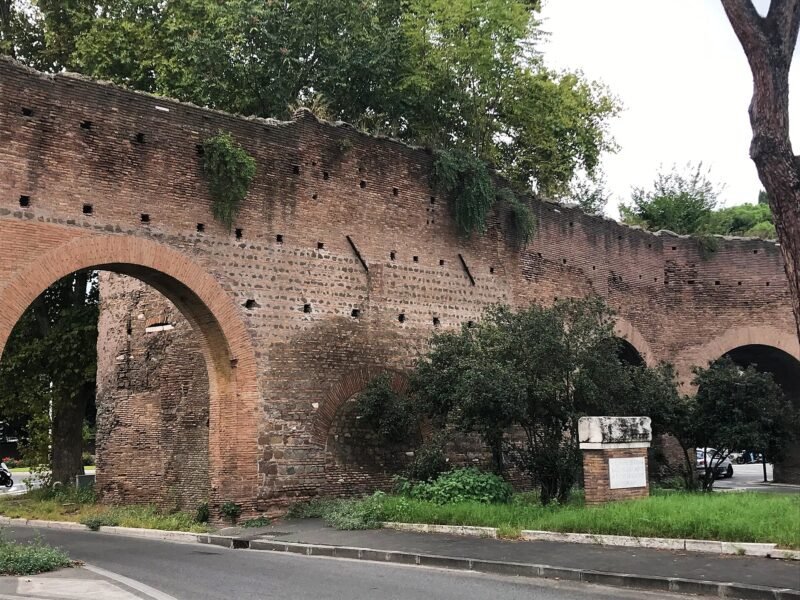
At the beginning, in the 2nd century, there was no stately residence here but two income-producing buildings, two working-class insulae facing the street. The first dates to around 111, with a balneum, that is, a small bath complex, on the ground floor and the dwellings on the upper floors. The second is from the following century and had shops and storerooms on the ground floor, with dwellings above. Traces of those shops remain in the arches, now walled up, that mark the flank of the basilica along Clivo di Scauro, and even the marks of two floors of windows remain. It's the vertical, crowded Rome of the rental apartment blocks, the one you usually don't see because it was demolished or buried.
From the 3rd-century domus to the Christian titulus
In the 3rd century the two buildings and their dependencies were merged into a single property. The inner courtyard was turned into a nymphaeum, the rooms were covered with elegant frescoes: the two working-class insulae had become a stately domus. It's the moment when the house changes social class, and the walls declare it.
In the 4th century the complex passed to the family of the senator Bisante, in Latin Byzas, who established a Christian titulus there, that is, one of the early house churches: the Titulus Byzantis. The title then passed to his son Pammachius and took the name Titulus Pammachii, around the end of the century. Under the same roof, within a few decades, a nymphaeum with pagan deities and a Christian place of worship live side by side: this is the reason why the site is so often cited by scholars of late antiquity.
The basilica above the house, and the long oblivion
In the 5th century, with the founding of the upper basilica, the Roman rooms were largely obliterated: some buried, others filled with earth, still others absorbed as foundation structures of the church. The house disappeared under the nave and stayed there for over a thousand years. Only at the end of the 1800s, in 1887, did Father Germano di San Stanislao begin to dig and bring the forgotten rooms back to light. The restoration, long and cautious, ended with a museum display that exhibits and describes the restored rooms together with the materials found on site.
The martyrs John and Paul and the martyrium
The name of the basilica, and by extension the popular name of the house, comes from two martyrs, John and Paul. Hagiographic tradition has them as court officials put to death in Rome in their own home during the persecution under the emperor Julian, around 362, and buried in the house where they were killed. Here the historian's caution is required: the story belongs to tradition, not to a contemporary document, and should be taken for what it is, a cult narrative that gave shape to the place. What is instead material and visible is the spot where the faithful came to pray: the confessio, with the small window that connected the church with the space of the relics.
The strength of the Roman Houses of the Celian Hill lies precisely in this overlap. Under a medieval church floor there are the painted walls of a pagan house. Inside the pagan house there's the memory of a nascent Christian cult. And above all this there is still today a basilica where services are held. Few stratigraphies in Rome say so sharply how one civilization built itself on top of another without wiping it out completely.

The visit route, room by room
The merit of the Roman Houses of the Celian Hill is that almost nothing is reconstructed: you look at the original plaster, with its colors, in the measured light of the underground rooms. Here are the rooms in the order in which you meet them and in which they're worth looking at.
The nymphaeum with the marine megalography
The most famous room of the Roman Houses of the Celian Hill is the ancient courtyard turned into a nymphaeum. On the walls runs a megalography, that is, a large fresco with almost life-size figures, with a marine subject: the scene depicts Proserpina's return from Hades, with the sea deities as her procession. The real protagonists are two female figures stretched out on a rock, read by scholars as Ceres and Proserpina, the mother and daughter of the Eleusinian myth of the return to light. The painting measures about three meters by five and dates to the 3rd century, the moment when the house becomes a stately domus. In front of this wall it's worth stopping for a long time: this is where you understand what Roman domestic luxury was, even before the complex was Christianized. The myth chosen is no accident in a water room like the nymphaeum: Proserpina, abducted by Pluto and destined to spend half the year in the underworld and half on earth, is the deity who sets the rhythm of the seasons and the cycle of the return to light. Surrounding her with sea deities, in a hall where water splashed for fun and for coolness, meant turning the wall into a small cosmic theater. Looking closely you recognize the bodies stretched out on the rock, the mobility of the drapery, the tones of the background: it's painting designed to amaze guests, the same function we give today to a large painting in the living room at home.
The room of the genii and the ephebes
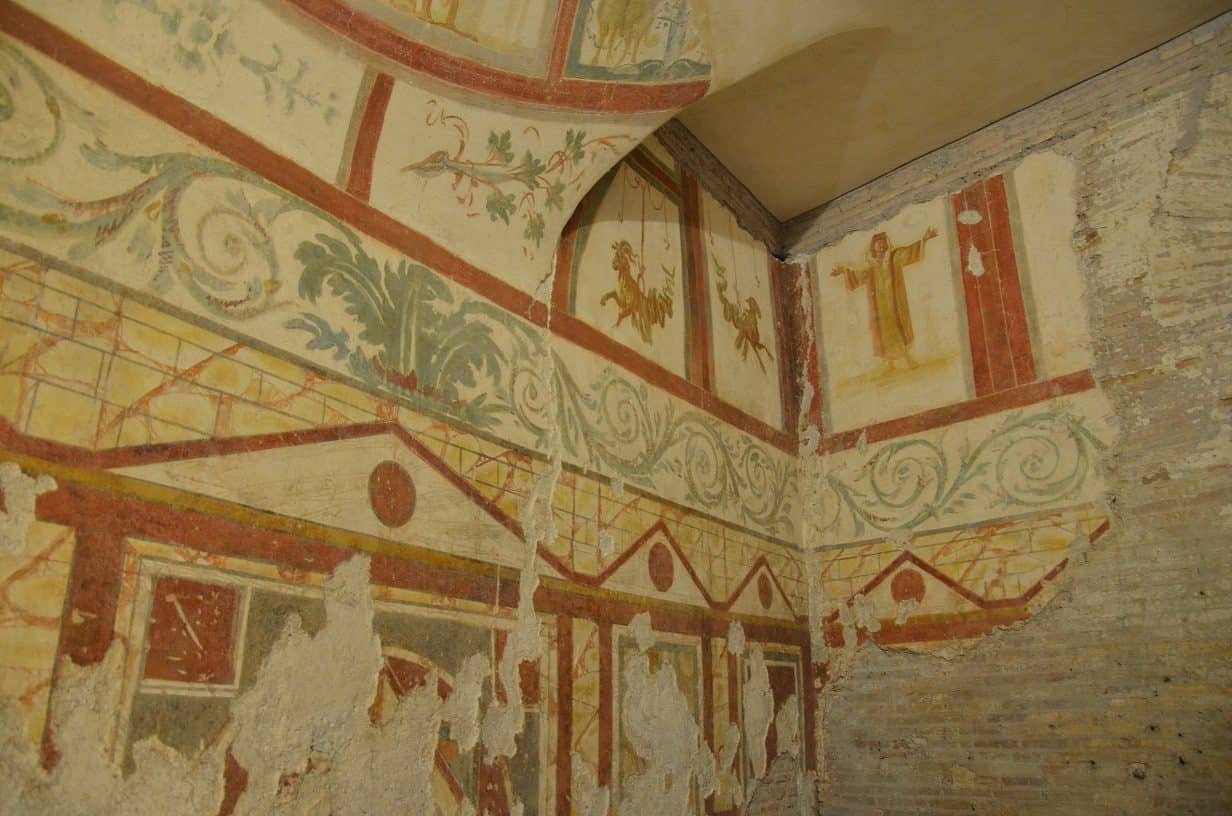
In the so-called room of the genii the decoration is organized in two superimposed registers. In the upper frieze run grape-harvesting erotes, winged cupids caught in the act of the harvest among vine scrolls. In the lower register you can count 10 nude ephebes holding a polychrome garland, while small birds fly across the painted space. It's a joyful painting, of refined taste, with festoons of flowers and fruit held up by winged genii: the house that portrays itself as rich, cultured and serene. Look at it as a catalog of late-antique elegance, because that is exactly what it wanted to be.
The hall of the orant and the first Christian signs
In the hall of the orant the decoration favors candelabra, plant elements, animals, fauns and human figures. At the center of scholars' attention is a figure with arms open in an act of prayer, the orant precisely, read as a sign of the Christian use of the house already in the 4th century. Here the complex shows its double soul: the decorative grammar is still the pagan one, but the gesture of prayer announces the new faith that has settled under the same roof.
The confessio and the three cavities in the tufa
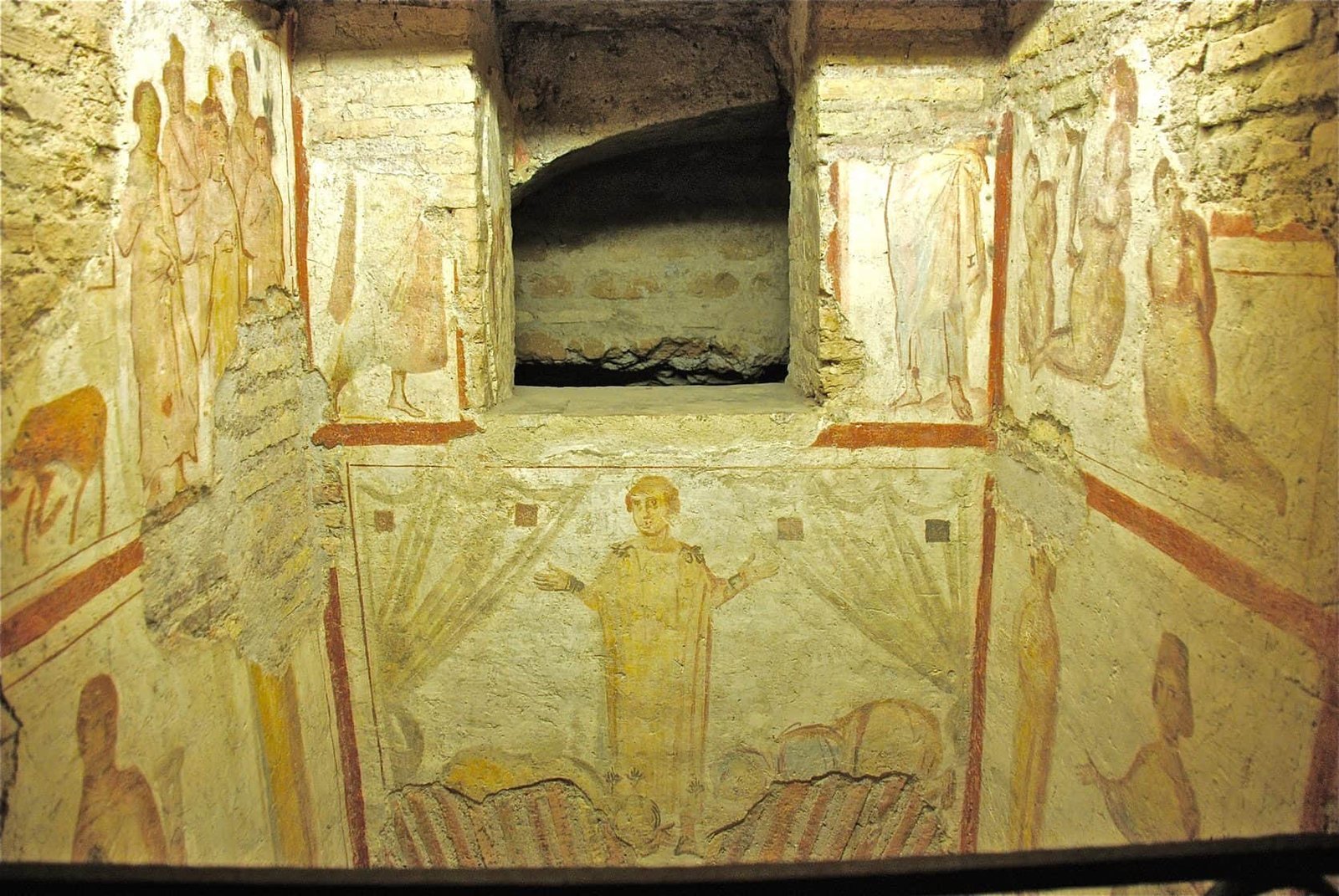
Halfway up the stairs a small niche opens, the confessio, one of the most important rooms from the religious point of view. Its frescoes, dating to the second half of the 4th century, depict a sacrifice scene linked to the martyrdom, and this is why tradition ties it to the titular saints. Under the niche, in the natural tufa, three cavities open, interpreted as tombs. It's the devotional heart of the site, the point toward which, from the church above, the faithful directed their prayer.
The medieval oratory of the Savior
The oratory of the Most Holy Savior, from the medieval period, is decorated with frescoes on Christological subjects. The most notable image is a crucifixion with Christ dressed in a long blue tunic between the figures of Mary and Saint John: a rare depiction of Christ clothed on the cross, following a convention of Eastern origin that is not common in Rome. This room marks the moment when the ancient house, by now buried, continues nonetheless to be used as a sacred space.
The Antiquarium
The route ends with the Antiquarium, the small collection that displays the materials recovered during the excavations: amphorae, oil lamps, ceramics and fragments that tell of the daily life of the rooms before they were buried. It's not the spectacular part of the visit, but it's the one that gives back the everyday: the objects that were really used in these rooms.

The state of preservation of the frescoes of the Roman Houses of the Celian Hill
One of the things that strikes people most when they go down is the state of the plaster. We're not talking about faded fragments but about surfaces where the color holds, the outlines can be read, the scenes can be followed. This depends on an almost paradoxical circumstance: the burial that in the 5th century erased the house from view was also what saved it. Buried and protected by the stable humidity of the underground, the frescoes did not suffer the centuries of light, candle smoke and alterations that have worn away so much ancient painting that stayed in use. When Father Germano rediscovered them, he found them in conditions that surprised scholars. In our view, anyone who loves Roman painting finds on the Celian Hill a lesson that the Palatine, where much less remains, cannot offer.
The Titulus Byzantis and the house churches of Rome
To truly understand the Roman Houses of the Celian Hill you need to know what a titulus was. In Rome in the early Christian centuries, before the city filled up with great basilicas, worship was organized inside the homes of the wealthier faithful: an owner made his rooms available for assemblies and for prayer, and that house became a titulus, literally a place registered under a person's name, who was responsible for it and guaranteed it. The tituli were the backbone of Rome's first church organization, the ancestor of the parishes, and many titular churches in the center still preserve, in their name, the memory of the founder. The case of the Celian Hill is among the clearest: the house passed to the senator Bisante, who established the Titulus Byzantis there, and then to his son Pammachius, hence the Titulus Pammachii. It's not only a modern deduction: it's the same continuity of worship that saved the building, because a house that became a sacred place is protected, not demolished. The Roman Houses of the Celian Hill let you touch this delicate passage with your hand, the moment when a persecuted religion begins to organize itself inside the domestic walls of the ruling class, before having temples of its own. It's a piece of history that is usually studied in books and that here you walk through.
The late-antique painting of the Roman Houses of the Celian Hill
From the point of view of art history, the frescoes of the Roman Houses of the Celian Hill are a precious sample of a poorly represented period: the 3rd and 4th centuries, that is, late antiquity, when Roman painting slowly abandons classical naturalism and heads toward the more stylized forms of the Christian world. In the nymphaeum the marine megalography still belongs to the cultured, mythological taste of the aristocratic domus: ample figures, flowing drapery, the repertoire of the sea populated by deities. In the room of the genii the decoration with festoons, cupids and grape harvests continues a decorative language rooted in the painting of the imperial age, the kind you see in Pompeii and in the houses of the Palatine. With the hall of the orant and with the confessio, instead, another register comes onstage: the praying figure, the sacrifice scene, the themes that shortly afterward will dominate Christian art. Having these two worlds under the same plaster, a few meters apart, makes the site a small visual anthology of the passage between two eras. Whoever has already seen Pompeian painting will find on the Celian Hill the next generation. Whoever knows Christian mosaics will find here their premises. Looking at the frescoes in this key, as stages of a transition and not as isolated decorations, is the best way not to reduce the visit to a parade of beautiful walls.
Clivo di Scauro and the urban context
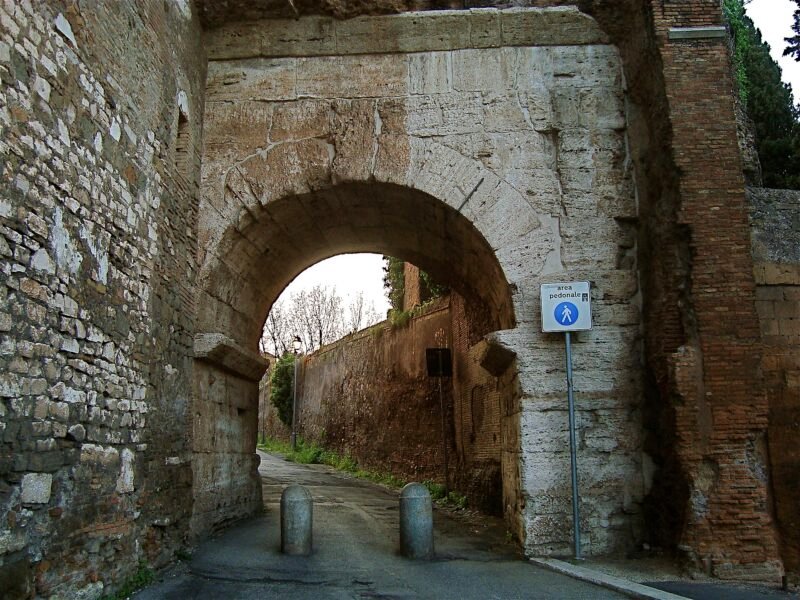
Before or after the visit, look up at the street you enter from. Clivo di Scauro is an ancient Roman road, and the stretch under the basilica is spanned by a succession of reinforcing arches that join the two sides and support the structures above. The walled-up arches you see in the flank of the church were originally the shops of the insula: the story told underground continues here on the surface, on the walls. Above rises the Romanesque bell tower, from the 12th century, decorated with glazed ceramic disks, one of the most beautiful in Rome. The basilica above preserves a coffered ceiling from the 1500s and, in the apse, a fresco from the late 1500s. The Celian Hill is a quiet hill, little trodden by mass tourism: coming out of the Roman Houses of the Celian Hill you find yourself in a strangely calm corner of the city, a couple of steps from the Colosseum and yet away from the crush.
The Basilica of Saints John and Paul above the Roman Houses of the Celian Hill
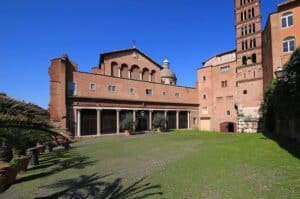
It's worth spending a few minutes on the church that covers the site, too, because it tells the sequel to the story you read underground. The Basilica of Saints John and Paul was founded in the 5th century right above the house of the martyrs, and since then it has gone through all the ages of Rome. On the outside the Romanesque bell tower of the 12th century dominates, tall and slender, decorated with glazed ceramic disks that take on color at sunset: it's one of the most elegant in the city. The interior preserves a coffered ceiling from the modern age and, in the apse, a large painted decoration from the late 1500s. The basilica is run by the Passionists, the congregation whose general house stands next to it, on the hill: it's this continuity of religious custody that for centuries protected, above and below the floor, a place that would otherwise have been lost. Whoever visits the Roman Houses of the Celian Hill and then goes up into the church makes, in a few minutes, the same vertical journey that time has stacked up here: the pagan house, the original cult, the medieval basilica, the devotion still alive. It's the most natural way to close the circle.
A curiosity about the Roman Houses of the Celian Hill
The least obvious curiosity concerns that very nymphaeum with Proserpina and the sea deities. In a house that within a few generations becomes the seat of a Christian titulus, the most sumptuous wall remains dedicated to a pagan myth, the return from Hades, that is, the return from death to life. The theme, for a house that shortly afterward will keep the memory of two martyrs, is an almost dizzying coincidence: the same concept of rising from the darkness runs through the Eleusinian myth and the new faith. The Christian inhabitants did not erase the pagan fresco, they left it where it was. The Roman Houses of the Celian Hill thus preserve, on the same walls and a few meters apart, the Proserpina who returns from the underworld and the confessio of the martyrs: two different ways, one mythological and one Christian, of saying the same hope. It's a coexistence that no hurried guide will tell you about, and that is instead the key to understanding the whole site. Whoever goes down looking only for the painting takes home half the meaning. Whoever looks at the two scenes side by side understands why archaeologists and historians of religion keep coming back here.
Something nobody tells you about the Roman Houses of the Celian Hill
What almost nobody explains is that what you visit today as the refined rooms of a stately domus began as working-class rental housing, the least noble kind there was. The two insulae of the 2nd century were rental apartment blocks with a public bath and shops on the ground floor, the type of building where middle-class and poor Rome lived, not senators. Only in the 3rd century did a single owner buy both, knock down the dividing walls, turn the courtyard into a nymphaeum and have the walls painted: the wealth came later, on top of a humble structure. Looking at the frescoes you tend to imagine an aristocratic villa conceived that way from the start, and instead you walk inside a working-class apartment building promoted to a luxury residence. There's more: in the flank of the basilica the arches of the shops still survive, walled up, and even two rows of windows from the inhabited floors. It's the proof, rare in Rome, of how a rental apartment block really worked, and of how the same masonry could change social class within a century. The Roman Houses of the Celian Hill, in short, don't tell only of luxury: they tell of the mobility of an urban block.
The advice I give you for visiting the Roman Houses of the Celian Hill
My advice is to go down slowly and not to treat the site as a stop to tick off between the Colosseum and the Circus Maximus. The rooms are compact and dimly lit: if you rush in, the frescoes will tell you nothing, if you give them 10 minutes each they begin to talk. Go on a weekday when it's open and in the first part of the morning, right at opening: the inside temperature stays cool all year, and with few visitors in front of the nymphaeum you see much better. Bring a light jacket even on Ferragosto. Before leaving, check days and hours on the official website caseromanedelcelio.it, because the calendar can change and on January 1 and December 25 the site is closed: showing up without checking is the surest way to find the gate shut. If you're traveling with little time, plan on a full hour and combine the visit with the nearby Basilica of San Clemente, so you can see in half a day the two best multi-level excavations on the Celian Hill. Avoid squeezing the visit between two fixed-time bookings elsewhere instead: down here you feel good only if you don't look at the clock.
Another well-known fact, yet rarely mentioned
It's often repeated that the Roman Houses of the Celian Hill preserve 13 frescoed rooms out of more than 20 rediscovered, and the figure is true. What is rarely added is that their survival is due to a very late and by no means obvious act: the rediscovery at the end of the 1800s was not a public excavation campaign but the initiative of a religious man, Father Germano di San Stanislao, rector of the basilica, who in 1887 began to dig beyond the cell of the martyrium to understand what was under his church. It could have ended like so many 19th-century discoveries, with the frescoes detached, dismembered and scattered among collections. Instead the rooms were preserved on site, and more than a century later patient restoration made them visitable in their context, together with the materials of the Antiquarium. It's a rare case in which the house and its objects have not been separated: you visit the whole, not the fragment. This explains why the visit to the Roman Houses of the Celian Hill leaves such a unified impression, while elsewhere you see detached walls hanging in museums, deprived of the place that gave them meaning.

The right photo to take at the Roman Houses of the Celian Hill
The photo that brings home the sense of the place is the one of the nymphaeum, the marine megalography with Proserpina and the gods reclining on the rock. It's the widest and best-preserved wall, and in a wide shot it conveys the scale of the decoration, three meters by five, which no close-up can capture. Stand facing it head-on, wait for the group in front to move, and let a piece of the adjacent wall enter the frame too: the contrast between the figured scene and the background gives the measure of the room. The light is low and warm, so hold the camera steady, lean on the doorframe or a stable surface, and rely on long exposures instead of the flash, which is forbidden here and would flatten the colors anyway. A second photo worth the trip is the vertical one of the confessio halfway down the stairs, with the niche and, if the setup allows it, a hint of the three cavities in the tuff below: it tells the double nature of the place in a single shot, house and tomb. On the way out, on Clivo di Scauro, look for the large arches that span the street with the Romanesque bell tower in the background: it's the photo that ties the underground to the living city above it. Remember to check the rules on photos at the entrance, because conditions can change.
Some Important Events That Happened Here in History
The first event is the transformation of the third century: the merging of two working-class insulae into a single noble domus, with the courtyard turned into a nymphaeum and the walls covered in frescoes. It isn't a news event, but it is the event that gives the place its artistic face. The second is the establishment, in the fourth century, of the Christian titulus by the senator Byzantius and then his son Pammachius: the Titulus Byzantis becomes the Titulus Pammachii toward the end of the century, and the house enters the network of Rome's house churches. The third, according to tradition, is the martyrdom of Saints John and Paul around 362, during the persecution of Julian: an episode that belongs to the memory of worship more than to documented history, but which determined everything that came after. The fourth event goes in the opposite direction: in the fifth century the construction of the upper basilica buries the Roman rooms, filling them with earth and using them as a foundation. For over a thousand years the house disappears. The fifth and last is the rediscovery: in 1887 Father Germano di San Stanislao digs beneath his basilica and brings the forgotten rooms back to light. The return of the site to visibility, with the opening to the public in 2002 after a long restoration, closes a cycle that began almost 18 centuries earlier.
Who Has Passed Through the Roman Houses of the Celian Hill
The first name worth tying to this place is Pammachius, a Roman senator and leading figure of aristocratic Christianity in the fourth century, who inherited the titulus here from his father Byzantius and gave it his own name. Pammachius was a friend and correspondent of Saint Jerome, who addressed several letters to him: through him this house enters the circle of the great senatorial families that converted to Christianity in the years of its rise. The decisive figure for the modern history of the site is instead Father Germano di San Stanislao, the Passionist religious and rector of the basilica who led the excavations at the end of the 19th century and returned the rooms to public knowledge. Over the house, through the centuries, has passed the whole community that officiated at the Basilica of Saints John and Paul, entrusted in modern times to the Passionists themselves, whose generalate house stands next door. And then there are the two protagonists who give their name to everything, the martyrs John and Paul: tradition has them as court officials who lived and were killed in this very house, and it is their memory that saved from oblivion, in the form of a sacred place, an entire block of ancient Rome. Even without chasing anecdotes about emperors and passing artists, the chain of real people tied to the Roman Houses of the Celian Hill, from the Christian senator to the archaeologist friar, is enough to give the site a human density that few ruins possess.

Getting to the Roman Houses of the Celian Hill
The entrance is on Clivo di Scauro, next to Piazza dei Santi Giovanni e Paolo, on the Celian Hill. The most convenient metro station is Colosseo, on line B, from which you walk up in around 10 minutes. Alternatively there's the Circo Massimo stop, also line B, on the opposite side of the hill. Tram 3 passes through the area, along with a long series of buses heading to the Colosseum area, including 51, 85, 87, 117, 118, 175, 186, 271, 571, 673, 810. If you're arriving by car, keep in mind that the Celian Hill is inside the limited traffic zone of the historic center and that street parking is scarce: public transport is by far the best choice. From the Colosseum the climb is short but steep, so allow a few extra minutes if you're walking with children or with mobility difficulties.
The Roman Houses of the Celian Hill with Children
The site works well with curious kids: going underground, walking among the painted walls and leaning over the confessio has an adventurous quality that grabs them. The rooms, though, are low, dimly lit and connected by stairs, so with strollers it's awkward and with very young children you need to pay a bit of attention. Admission is free under 6 and reduced from 6 to 14. The official website also offers educational visits on holidays, designed for families and school groups: if you're traveling with school-age children, it's worth checking the calendar. The advice is to tell the little ones, before going down, the story of the two brothers and the house that sinks beneath the church: it turns an archaeological visit into a hunt for details.
Accessibility and Services
The Roman Houses of the Celian Hill are an underground site with stairs and rooms on different levels, and this sets accessibility limits for those with mobility difficulties: admission is free for people with a certified disability, but it's best to contact the facility in advance through the official website to check what can actually be walked on the day of the visit. At the entrance there's a small bookshop. Don't expect big refreshment services inside: the neighborhood, however, offers cafes and trattorias a short distance away, both toward the Colosseum and toward Santo Stefano Rotondo.
How Much the Roman Houses of the Celian Hill Cost and How to Save
The full ticket is €8 and the reduced ticket €6, with a possible reservation surcharge of €2. The reduced price applies to groups of more than 12 people, to children from 6 to 14 years old, to those who buy a guided visit and to school groups without a guide service. Free admission is provided for children under 6, for people with a certified disability and their companion, for licensed tour guides, for journalists and for university students of archaeology, art history, cultural heritage and architecture. The real saving, more than in the few euros of the ticket, lies in not wasting the trip: by checking days and hours in advance you avoid the risk of finding it closed, and by booking the Sunday educational visits you add a lot of content for a modest cost. Tickets are bought through the official channel listed on the site's own website: beware of unofficial resellers.
What to See Near the Roman Houses of the Celian Hill
The Celian Hill and the valley below concentrate some of the richest sites in Rome within a few minutes' walk. A short distance away is the Basilica of San Clemente, with its extraordinary multi-level excavation down to the Mithraeum, a natural complement to this visit. Toward the Colosseum open the Domus Aurea of Nero on the Oppian Hill and, a little farther on, the Roman Domus of Palazzo Valentini. Staying on the hill you reach the Basilica of Santi Quattro Coronati and the green Villa Celimontana. Heading downhill toward the Circus Maximus you reach the Baths of Caracalla, and on the other side the Colosseum, the Palatine Hill and the nearby Circus Maximus. If you love underground Rome, you can continue the theme with the Catacombs of San Callisto on the Appian Way or with the Crypta Balbi, one of the four museums that tell the story of urban layering.
The Roman Houses of the Celian Hill on the Map of Underground Rome
Rome is a city on several floors, and not only in the figurative sense. Below the modern walking level you find others, stacked like the pages of a book closed for centuries. The Roman Houses of the Celian Hill are one of the most readable chapters of this book, and together with a few other places they let you physically descend back in time. The difference from the catacombs is substantial: here you don't visit a cemetery dug outside the walls, but a piece of inhabited city, with its houses, its baths, its shops, left sealed beneath a church. If you want to build a themed itinerary on underground Rome, you can line up, besides this site, the excavations beneath San Clemente with their Mithraeum, the Crypta Balbi with its reading of medieval layering, and the catacombs of the Appian Way for the funerary side. Each stop lights up a different aspect of the subsoil: the house, the temple, the warehouse, the tomb. The Celian Hill is the house, and it is perhaps the most intimate of all, because it preserves the painted walls of rooms where people really lived. Walking through it with this awareness, as a tile of a larger mosaic, changes the quality of the visit.
Practical Tips for Visiting the Roman Houses of the Celian Hill
A few concrete tips. The interior light is deliberately low to protect the plaster, so give your eyes a couple of minutes to adjust as soon as you go down, before judging that the frescoes can hardly be seen: after the first room the eye adapts and the colors emerge. Don't touch the walls, not even with your fingertips: the salt on your skin is among the worst enemies of ancient paint. Keep your bags in front of you in the narrow passages, because the rooms are tight and the stairs steep. If you come in summer after walking in the sun between the Colosseum and the Circus Maximus, the temperature change at the entrance is remarkable: a light jacket is not an affectation. Allow some margin in your timing, because the neighborhood deserves a walk above ground too, among the Romanesque bell tower, the arches of Clivo di Scauro and the quiet of Piazza dei Santi Giovanni e Paolo. And if you can, avoid visiting the Roman Houses of the Celian Hill as the last stop of an already full day: arriving tired, in a place that asks for attention and silence, is the surest way not to understand it.
When to Go and When to Avoid the Roman Houses of the Celian Hill
The best time is early morning on an open weekday, when the few visitors let you linger in front of each fresco without hurry. Since it's an underground space, the interior stays cool even on the hottest days: in summer it's one of the most comfortable visits in the center, while the outdoor areas of the Colosseum bake in the sun. Avoid trying to visit on closing days, on January 1 and December 25, and at peak times if they coincide with the arrival of guided groups, which quickly fill the rooms in the narrow spaces. On long weekends and in periods of maximum tourist crowds it's best to book so as not to risk waiting. One last seasonal caution: winter hours are shorter than summer ones, so checking the official website before leaving is always the right move.
Quick Questions About the Roman Houses of the Celian Hill
Where are the Roman Houses of the Celian Hill?
They're on the Celian Hill, in the subsoil of the Basilica of Saints John and Paul. The entrance is on Clivo di Scauro, next to Piazza dei Santi Giovanni e Paolo, postal code 00184, in Rome, between the Colosseum and the Circus Maximus.
How much is the ticket for the Roman Houses of the Celian Hill?
The full ticket costs €8 and the reduced ticket €6, with a possible reservation surcharge of €2. There are several free admission categories, including children under 6 and people with a certified disability.
What are the opening hours of the Roman Houses of the Celian Hill?
The site opens Monday to Sunday and on holidays from 10:00 to 16:00, closed on January 1 and December 25, with the ticket office closing an hour earlier. Hours vary with the season: it's best to check them on the official website caseromanedelcelio.it before the visit.
Are the Roman Houses of the Celian Hill open on Tuesday?
Yes: according to the official website the Houses are open Monday to Sunday and on holidays, closed on January 1 and December 25. Since the calendar can change with holidays and seasons, always check the official website before going.
How long does the visit to the Roman Houses of the Celian Hill take?
A careful visit takes about an hour. Those who want to linger on the nymphaeum and the confessio may take a few more minutes. Those short on time can count on a quick but still complete visit, since the route is compact.
Do I need to book for the Roman Houses of the Celian Hill?
For an individual visit booking isn't always required, but it's recommended in periods of greater crowds and for the educational visits. You make it through the official website, with a small surcharge.
How do I get to the Roman Houses of the Celian Hill by public transport?
By metro line B, stops Colosseo or Circo Massimo, and then a short walk uphill. By tram 3. By many buses heading to the Colosseum area, including 51, 85, 87, 117, 118, 175, 186, 271, 571, 673, 810.
Can you take photos in the Roman Houses of the Celian Hill?
In general photos without flash are allowed, but flash and tripods may be forbidden to protect the frescoes. Check the rules in force at the entrance on the day of the visit.
Are the Roman Houses of the Celian Hill wheelchair accessible?
The site is underground, with stairs and rooms on several levels, so accessibility is limited. Admission is free for people with a certified disability: it's best to contact the facility in advance to check which route is actually passable.
Are the Roman Houses of the Celian Hill suitable for children?
Yes, with some care: the rooms are low and dimly lit and there are stairs. Admission is free under 6 and reduced from 6 to 14, and on holidays the official website offers educational visits designed for families too.
What is the difference between the Roman Houses of the Celian Hill and the excavations of San Clemente?
Both are multi-level excavations on the Celian Hill, but the Roman Houses of the Celian Hill mainly preserve frescoed domestic rooms of a late-antique house, while beneath San Clemente you descend to a Mithraeum and to Roman structures of a different nature. They're complementary and can be visited well in half a day.
Why are they called the Roman Houses of the Celian Hill?
Because they're the remains of Roman houses, that is, of an ancient residential complex, located on the Celian Hill beneath the Basilica of Saints John and Paul. The popular name ties them to the two martyrs for whom the church above is named.
How many frescoed rooms do the Roman Houses of the Celian Hill have?
More than 20 rooms have been rediscovered, 13 of them frescoed. Among the most important are the nymphaeum with the marine scene, the Room of the Genii, the Hall of the Orant, the confessio and the medieval Oratory of the Savior.
What does the most famous fresco of the Roman Houses of the Celian Hill depict?
The most famous scene is the marine megalography of the nymphaeum, which depicts the return of Proserpina from Hades among the sea gods, with two female figures reclining on a rock read as Ceres and Proserpina. It can be dated to the third century and measures about three meters by five.
Who discovered the Roman Houses of the Celian Hill?
The rooms were brought back to light at the end of the 19th century, in 1887, by Father Germano di San Stanislao, rector of the Basilica of Saints John and Paul, who dug beyond the cella of the martyrium. The site has been open to the public since 2002.
Is there an Antiquarium in the Roman Houses of the Celian Hill?
Yes. The route ends with an Antiquarium that displays the materials recovered in the excavations, such as amphorae, oil lamps and ceramics, restoring the daily life of the rooms before they were buried.
Is it cold inside the Roman Houses of the Celian Hill?
The interior temperature stays cool all year, since it's an underground space. In summer that's an advantage, while in the other seasons a light jacket is advisable even when it's warm outside.
What is the confessio of the Roman Houses of the Celian Hill?
It's a small niche that opens halfway down the stairs, with frescoes from the second half of the fourth century tied to the martyrdom and, below, three cavities dug in the tuff interpreted as tombs. It's the devotional point of the site, toward which the faithful of the basilica above directed their prayer.
What is Clivo di Scauro?
It's the ancient Roman street onto which the entrance of the Roman Houses of the Celian Hill faces. The stretch beneath the basilica is spanned by a series of reinforcing arches, and in the side of the church you can recognize the bricked-up arches of the ancient shops of the insula.
Are the Roman Houses of the Celian Hill the same as the Basilica of Saints John and Paul?
Yes: they're the Roman residential complex preserved in the subsoil of the Basilica of Saints John and Paul. They're visited from a separate entrance on Clivo di Scauro, but they're physically beneath the church.
Is entry free on the first Sunday of the month at the Roman Houses of the Celian Hill?
The free first Sunday initiative applies to state museums, while this site is owned by the Fondo Edifici di Culto of the Ministry of the Interior and has its own ticket office run by CoopCulture. To know whether free days are planned, it's best to check directly on the official website.
How early should you arrive at the Roman Houses of the Celian Hill?
Since it isn't a site with lines comparable to those of the Colosseum, a few minutes early is enough. In periods of maximum crowds or for the educational visits, however, booking in advance through the official website protects you from waiting.
Is it worth visiting the Roman Houses of the Celian Hill?
If you love Roman painting and layered Rome, yes, definitely: few places in the city offer such well-preserved late-antique frescoes in their original context, away from the crowds of the big monuments.
The Verdict on the Roman Houses of the Celian Hill
My opinion is firm: the Roman Houses of the Celian Hill are one of the most underrated visits in Rome. They don't have the fame of the Colosseum or the lines of the Domus Aurea, and that's exactly why you enjoy them. Those looking for monumental spectacle may be disappointed by the compact spaces. Those looking for real ancient painting, with the color still alive on the wall that saw it born, find here one of the few Roman chances to have it in front of you without glass and without detachment. Give it a full hour, on a quiet morning, and go out to look at the arches of Clivo di Scauro: you'll realize you've walked through 1,800 years held together by a single block.
Article written by the editorial team of TourLeaderPro. Contact them for Private/Corporate/V.I.P. Tours and Experiences.
Planning a trip to Rome? The English guides for visiting the city are on ItalyPlanner.com.
Contact Information
Nearby
 Basilica of Saints John and Paul on the Caelian Hill100 m
- Antiquarium of the Celian Hill100 m
- Caelian Hill300 m
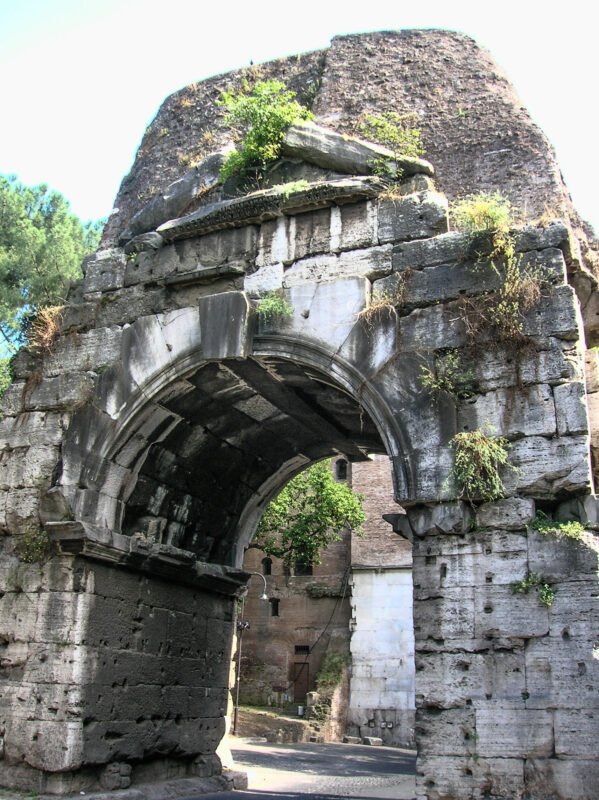
- Arch of Dolabella300 m
- Villa Celimontana300 m
- Alexanderplatz Jazz Club300 m


Upcoming events nearby
- We Run Rome 2026 at the Baths of Caracalla, December 31, 2026600 m
- Domus Aurea Highlights 2026 at the Domus Aurea: March 19 to December 17, 2026600 m
- Circo Maximo Experience 2026 at the Circus Maximus, until December 31, 2026600 m
- Harry Styles: Together, Together: Circo Massimo, August 7 and 8, 2027600 m