Museo Storico della Fanteria
In short. The Museo Storico della Fanteria is at Piazza di Santa Croce in Gerusalemme 9, in the Esquilino district, inside the large military block that occupies the northern side of the square, next to the Museo Storico dei Granatieri di…
The Museo Storico della Fanteria is at Piazza di Santa Croce in Gerusalemme 9, in the Esquilino district, inside the large military block that occupies the northern side of the square, next to the Museo Storico dei Granatieri di Sardegna and the Museo Nazionale degli Strumenti Musicali. Before you set out, the thing that matters has to be said: the permanent museum of the Army, the one with the 35 rooms, the Shrine and the war flags, has no ordinary public opening today, and institutional and specialist sources list it as closed since 2023 for works. Visits are arranged with the Management by calling 06 7027971, and admission to the military museum, when granted, is free. The tourist portal of Roma Capitale gives museodeigranatieri@gmail.com as the email contact.
What is almost always open instead, with long hours and a paid ticket, is something else entirely: the big-draw temporary exhibitions that a private organizer sets up inside the same building. They are two distinct entities that share only the address. When you read a poster that says Museo Storico della Fanteria and a ticket of €13 or €15, that ticket gives you access to the exhibition, not to the collections of the Infantry Corps. Whoever arrives convinced they will see the helmets and finds the canvases, or the other way around, leaves angry. It is the most frequent misunderstanding in the whole Santa Croce area.
For the current exhibition, the hours in use in recent years are from 9:30 to 19:30 Monday to Friday and from 9:30 to 20:30 on Saturdays, Sundays and holidays, with last entry 30 minutes before closing. The rates applied to the big exhibitions are €13 for the full ticket on weekdays, €15 on holidays, €10 reduced, €5 for school groups, free for children up to five years old, plus €1.50 in presale fees. Group bookings go through prenotazioni@navigaresrl.com and the number 351 8403634. The calendar changes from season to season: check on the organizer's website which exhibition is on for the day you want to go, because between one exhibition and the next the building stays closed even for weeks.
One note that is worth more than many others and that concerns your wallet: the Museo Storico della Fanteria is an entity of the Italian Army, so it is not a civic museum and it is not a state museum of the Ministry of Culture. The MIC card, which is valid for the system of the Musei Civici di Roma Capitale, is useless here. And the free Sundays of the state circuit, which are valid two steps from here for the Museo Nazionale degli Strumenti Musicali, touch neither the military museum nor the private exhibitions hosted in its building. If someone tells you otherwise, they haven't looked at who owns the property.
If you are putting together a half-day itinerary on this side of the city, the page on the tourist attractions of Rome helps you fit the stops together. Below, in any case, you will find everything you need to understand what this museum really holds and why its story is one of the most curious among Rome's museums.
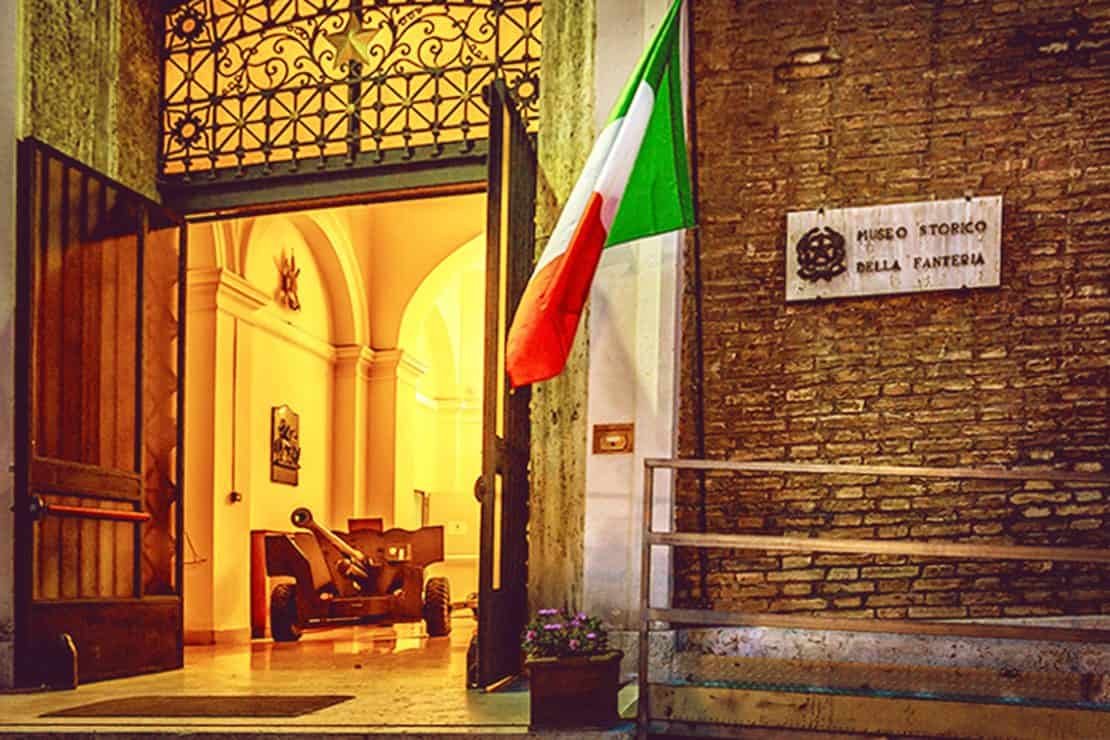
What you can visit today at the Museo Storico della Fanteria
The building at Piazza di Santa Croce in Gerusalemme 9 has two parallel lives, and understanding which of the two you are crossing is the premise of any successful visit.
The permanent museum of the Army
The first life is the institutional one. The Museo Storico della Fanteria was born as a corps museum: it collects, arranges and displays the material memory of the Italian Infantry, from the pre-unification 19th century to the War of Liberation. It is organized into three main sectors, weapons, flags and uniforms, and consists of a Management office, a library with an attached historical archive, a Shrine, 35 exhibition rooms and five galleries and entrance halls. A big museum, to give you the idea: bigger than quite a few civic museums that have lines outside the door. Since June 28, 1986 it has had the status of Armed Force Entity, and this means it does not depend on a city councilor's office or on a superintendency, but on the Army's chain of command. From this come its elastic hours, its prolonged closure and its complete free admission: it doesn't sell tickets because it is not a cultural business, it is a unit.
The sources that document the complex today agree in listing it as closed to the public since 2023, with part of the spaces given over to art exhibitions. Anyone with a study reason, a regimental tie or an organized group can try to arrange access with the Management: the number 06 7027971 is the one given by the institutional listings. Historically the museum also opened on June 2, for the Festa della Repubblica, and that is still the occasion on which it is worth checking if the gate swings open.
The temporary exhibitions in the building of the Museo Storico della Fanteria
The second life is recent and commercial. For some years a private company that produces and sets up art exhibitions, Navigare Srl, with its registered office in Palermo at Via Principe di Villafranca 57 and a representative office in Milan at Corso Magenta 85, has used the building's exhibition spaces for large monographic exhibitions. They are subway-poster exhibitions, with names that fill the weekends: Miró, Dalì, Gauguin, Picasso, Matisse, Caravaggio, and before that Warhol. The public comes in through the same gate, climbs the same grand staircases, and for this reason all the electronic ticketing agencies register the venue under the name of the military museum. From this follows a confusion that has lasted for years and that nobody has bothered to clear up on the facade.
Two different ticket offices, two different worlds
The practical rule is simple and sums up like this: if you pay, you are entering an art exhibition. If you don't pay, you are entering the Army museum. The exhibition ticket does not include the Infantry's historical rooms, and the visit to the military museum, when it is possible, gives no right to any discount on the exhibition. Not even the staff on duty at the exhibition has the authority to open the Shrine for you. They are two separate chains of responsibility, with two separate phones.
In our judgment the military museum, when it reopens, is worth twice the exhibition of the moment, because exhibitions of Miró and Caravaggio can be seen in 10 Italian cities a year, while 35 rooms of Italian war flags exist in only one place in the world. If you happen to be in Rome in the months when the gate is open only for art, make do with it without illusions, and plan the real visit for when the Army reopens its rooms.
Where the Museo Storico della Fanteria is and how to get there
The exact address and the building
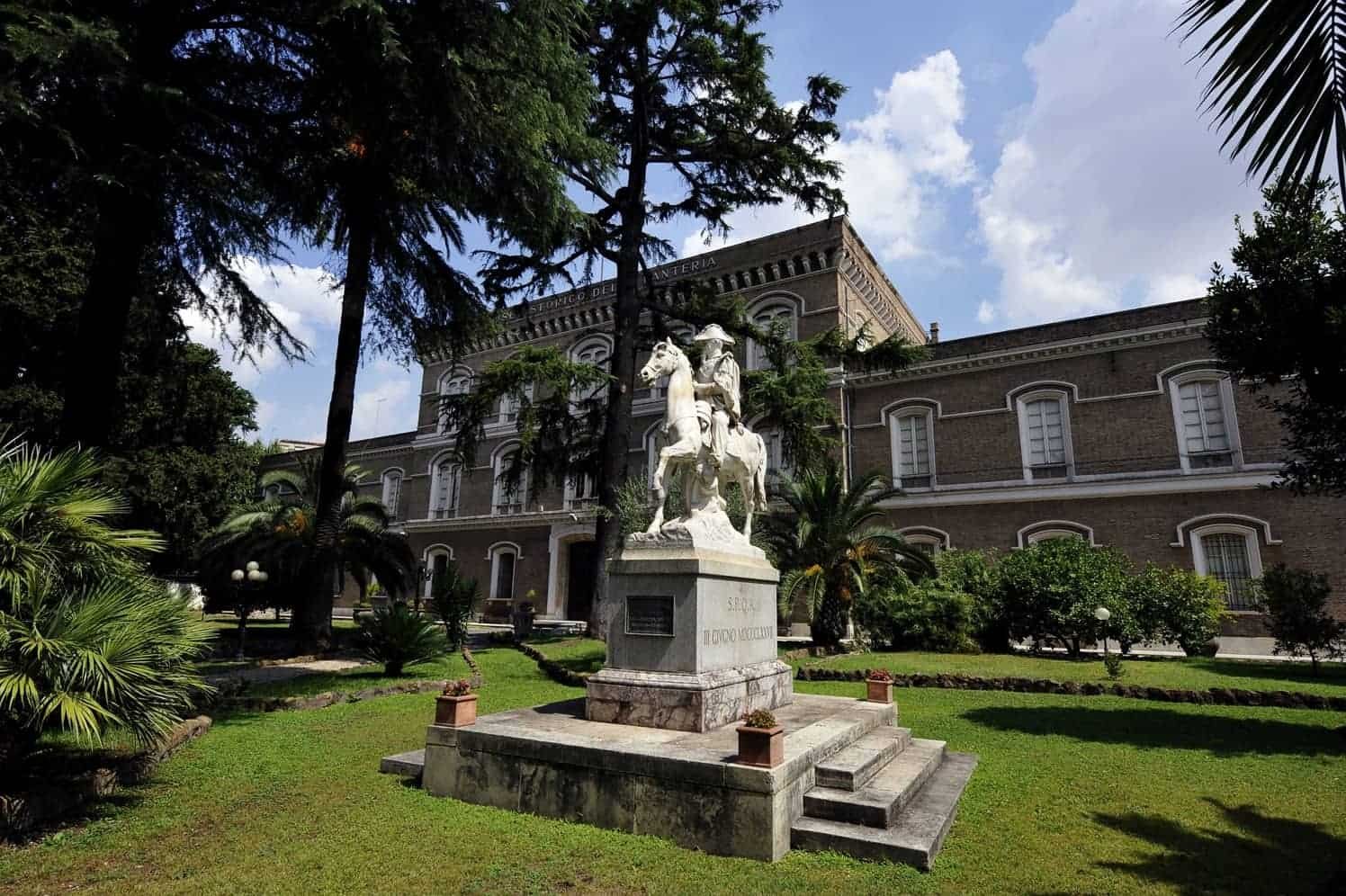
The address is Piazza di Santa Croce in Gerusalemme 9, Esquilino district. Street number 9 identifies the building block of the military museum. Number 9/A, next door, is the Museo Nazionale degli Strumenti Musicali. At numbers 7 and 8 is the Museo Storico dei Granatieri di Sardegna. At 12 is the basilica of Santa Croce in Gerusalemme. Four different institutions in a front a few dozen meters long, with four intercoms and four schedules that never coincide. The tourist portal of Roma Capitale describes the building as a three-story Liberty-style structure, and the definition fits: the facade has that sober, geometric decoration of the early 1900s, when the square was organized as a military hub.
Metro, bus and tram for the Museo Storico della Fanteria
The most solid reference is San Giovanni station, served by Metro Line A and Line C: from there you reach Piazza di Santa Croce in Gerusalemme with a flat walk of a little over 10 minutes, passing in front of the side facade of the Lateran and taking Viale Carlo Felice, the tree-lined straight road that joins the two basilicas. Alternatively, get off at Manzoni on Line A and walk south.
On surface transport an honest recommendation is needed: the tram network of this area has been a moving construction site for months, with suspended lines, stretches replaced by buses and temporary terminals that change from week to week among Porta Maggiore, Termini and Largo Preneste. Before leaving home, check the line on the Roma Servizi per la Mobilità portal, because the number you have in mind might today be a bus with a different route. The walk from the metro, on the other hand, never changes, and that is why it is the recommended choice.
On foot from San Giovanni and from Porta Maggiore
From Piazza di San Giovanni in Laterano there is only one route and you can't get it wrong: Viale Carlo Felice all the way down, and the square opens with the Baroque facade of the basilica on the right and the military front on the left. It is about 700 meters. From Porta Maggiore you arrive skirting the Aurelian Walls along Viale Castrense. It is the route I prefer, because it lets you see from the outside the great brick hemicycle of the Castrense Amphitheater built into the wall curtain, which is the archaeological reason why this square exists. If you come on foot from Termini station, allow a good half hour across the Esquilino, with a possible stop at the Nuovo Mercato Esquilino.
Piazza di Santa Croce in Gerusalemme and the area of the Museo Storico della Fanteria
No museum can be understood without its ground, and the ground of this museum is one of the most layered in Rome.
The Sessorium under your feet
The square occupies the southeastern sector of the ancient city, where the imperial house owned a residence called the Sessorium, or Sessorian Palace. It was a complex of great extent, with reception halls, baths and a private amphitheater, and it was the Roman home of Helena, mother of Constantine. From that residence was born the basilica of Santa Croce in Gerusalemme, carved out of one of the halls of the palace. In the area of the military compound that houses the museum there survive wall remains attributed precisely to the Sessorian Palace, and this is one of the reasons why the enclosure is so stingy with access: below and inside there are protected archaeological structures. Whoever enters the museum walks, literally, over the floor of a 4th-century imperial court.
The Castrense Amphitheater and the Aurelian Walls
The most readable ancient building of the area is the Castrense Amphitheater, datable between 218 and 222 AD, in the Severan age, and tied to the same Sessorian complex. Its ellipse measures 88 meters on the major axis and 75.80 meters on the minor axis: a court amphitheater, not a building for the people. the Aurelian Walls cut it in half 50 years after its construction and made it a bastion, walling up the arches of the facade and turning a place of spectacle into a defensive structure. The upper orders were pulled down in the 16th century by will of Pope Paul IV. Today the inside of the arena is occupied by the vegetable garden of the monastery of Santa Croce, recreated as a monastic garden in 2004. From the sidewalk of Viale Castrense you can see its perfect curve, and nobody stops to look at it.
The Umberto I barracks and the military hub of the Esquilino
The present face of the square is instead 20th-century and military. The Umberto I barracks dates to 1903, the Museo Storico dei Granatieri di Sardegna was inaugurated in the 1920s in the presence of Victor Emmanuel III, the Museo Nazionale degli Strumenti Musicali arrived in 1974 in a building of the same compound, and the decorative fountain at the center of the square dates to 1928, part of the campaign that replaced the old cast-iron drinking fountains with travertine basins. This square, then, is a piece of Umbertine and Fascist Rome resting on an imperial palace and closed off by a 3rd-century wall. Few areas of the city tell so many eras at a glance, and almost no tourist gets there.
The history of the Museo Storico della Fanteria
The idea born from the regimental shrines
The idea of an Infantry museum was born at the end of the Great War, and it was born from below. It was the regiments of the Corps that began it, setting up in their respective barracks small shrines where they kept relics, tattered flags, photographs, objects of the fallen. They were hallway museums, often a display case and a plaque, but they held together the memory of a unit. The idea of gathering those collections into a single national museum was already circulating in the 1920s. Funds were missing, and above all a home was missing. The Second World War did the rest: the relics scattered across the barracks of Italy were largely lost or destroyed amid bombings, requisitions and the winter of 1943. The starting patrimony, when the project was resumed, was almost wiped out.
General Edoardo Scala and the rebuilding of the collections
In the postwar period the Army General Staff entrusted the task of recovering the material to General Edoardo Scala, born in Ragusa on June 30, 1884 and died in Palermo on January 14, 1964, major general of the Regio Esercito from July 19, 1939 and one of the most prolific military historians of 20th-century Italy. Scala is the author of the monumental Storia delle fanterie italiane, nine volumes published in Rome by the Tipografia regionale between 1950 and 1955: a work still cited in bibliographies today and which represents the intellectual backbone of the museum. The person who rebuilt the collections, in short, was the same person who was writing the history of the Corps. The museum is the child of those nine volumes, and it shows in the layout of the rooms, which follows a textbook sequence: origins, Risorgimento, specialties, colonies, world wars.
It must be said that the search was a patient hunt for scattered objects: donations from families, deposits from disbanded units, purchases on the antiques market, materials returned by Allied commands. There was no preexisting collection to reorder, there was a void to fill. For a historical museum it is an unusual condition and it explains why the holdings are so heterogeneous, with exceptional pieces next to serial materials.
Attilio Bruno, the home and the inauguration of 1959
In 1956 the task passed to General Attilio Bruno, and the problem Bruno solved was the one that had blocked all his predecessors: finding a building. The solution came from the compound of Piazza di Santa Croce in Gerusalemme, next to the already existing Museo Storico dei Granatieri di Sardegna, with the support of the military authorities and the Ministry of Defense. The building was fenced off and adapted, and the Museo Storico della Fanteria was inaugurated on November 11, 1959 by the President of the Republic Giovanni Gronchi. The date is no accident: November is the month of Victory, and November 4 remains the anniversary of National Unity and of the Armed Forces.
Armed Force Entity since 1986
On June 28, 1986 the museum became an Armed Force Entity, a step that changed its administrative status and placed it organically within the training structure of the Infantry Corps, with reference to the Infantry School. It is a bureaucratic detail that the visitor does not perceive, but it explains many things: the free admission, the absence of a ticket office, the hours of a military office instead of a museum, and how easily the opening to the public can be suspended when works are needed or when the staff is assigned elsewhere.
The 1990 restoration and the 2016 reopening
A renovation in 1990 reorganized the spaces in the form that the listings still describe today: three main sectors, 35 rooms, five galleries and entrance halls. After a further long closure for works, the museum became accessible again on September 9, 2016 with a display dedicated to the First World War. In those years the museum hosted the exhibition titled Bollettino 1268. Il confine di carta, dedicated to the Bulletin of Victory and to the cartography of the front, which remained open to visitors for a long time. Then, from 2023, the curtain came down again on the permanent collections, while the exhibition spaces began their second career as the venue for large art exhibitions.
The rooms of the Museo Storico della Fanteria, one by one
Here I describe the layout of the museum as it appears from the institutional listings and from the museum design consolidated after 1990. If and when the Management grants you access, this is the route you will find in front of you.
The three main sectors: weapons, flags, uniforms
The fundamental structure of the Museo Storico della Fanteria is threefold. The weapons sector covers the individual and unit armament of the Italian infantry, from the muzzle-loading weapons of the wars of independence to repeating rifles, machine guns, and the support weapons of the 20th century. The flags sector gathers the war banners of the regiments, and for those who know the subject it is the absolute heart of the collection: a regiment's flag is not a piece of cloth, it is the legal identity of a unit, and its medal record is the heraldic summary of everything that unit has done. The uniforms sector documents the evolution of the uniform, from the Piedmontese blue to the grey-green introduced in 1909, up to the camouflage of the second postwar period.
The Shrine of the Fallen of the Museo Storico della Fanteria
The Shrine is the space that gives meaning to everything else and it should be crossed in silence. It holds the Redentore sulla croce, a work by the sculptor Edmondo Furlan, placed right in the Shrine of the Fallen. It is the space where the museum stops being a collection of objects and becomes a place of memory: the infantry is the arm that has paid the highest price in every war fought by Italy, and an infantry shrine is a list that never ends. The recommendation, for those who enter with a school group: stop there five minutes before any technical explanation. Weapons are understood better afterward.
The rooms of the historical evolution of the Infantry
A first sequence of rooms tells the historical evolution of the Corps, from the origins of the permanent Italian armies to the formation of the national army. It is the most didactic part and also the most useful for those not familiar with the subject, because it explains how one passes from the militias of the pre-unification states to an infantry body organized in regiments, brigades and divisions. Here the model of the battle of Zama, which I discuss further on, works as an ideal prologue: infantry as a line of men on foot that decides a battle has existed for millennia.
The Risorgimento rooms at the Museo Storico della Fanteria
The Risorgimento occupies an autonomous section, and it is the one in which the museum dialogues with the rest of the city. The wars of independence, the Expedition of the Mille, the capture of Rome in 1870 are told with uniforms, weapons, documents and regimental relics. Whoever wants to explore this season further has in the city the Central Museum of the Risorgimento at the Vittoriano and the Institute for the History of the Italian Risorgimento. Comparing the civilian and the military narrative of the same events is one of the most instructive exercises you can do in Rome.
The specialties of the Corps
The infantry is not a single block, and this is the point the museum teaches best. The specialties of the Corps have different histories, uniforms, badges and traditions: the grenadiers, the bersaglieri, the alpini, the paratroopers, the lagunari, the tank crews, the line infantry. Each specialty has its own headgear, its own pace, its own band. The rooms dedicated to this theme are the ones where a visitor with no military history begins to tell an alpine hat from a bersagliere's fez, and suddenly all the Roman street names dedicated to regiments become readable.
The colonial specialties and the expeditionary corps
One section is dedicated to the colonial specialties and to the Italian expeditionary corps, from the African campaigns to missions beyond the national borders. It is the part of the museum that requires the most caution and the most context, because it displays materials from a historical season on which Italian public debate arrived late and with difficulty. Whoever leads a group in here has the duty to also tell the other side: the Italian colonial wars were wars of aggression, and a corps museum documents them from the point of view of those who fought them. The distinction between documenting and celebrating must be held firm by the visitor, because no caption will do it for them.
The First World War and the full-scale trench
The Great War section is the one that strikes first-time visitors most, and the credit goes to an extraordinary display: the full-scale reproduction of a trench of the Italian front. Not a little model, not a panel: a communication trench you walk into, with sandbags, boards, the loophole. It is an old-style museum device that still works perfectly, because a trench is understood with the body and not with the eyes. The visitor perceives the height, the narrowness, the field of view reduced to a slit. Around it, Adrian and Lipmann helmets, gas masks, mess tins, the model 1891 rifle, photographs of the Carso.
Put bluntly: that trench, by itself, is worth the detour to the Esquilino more than half of the paid exhibitions that have followed one another in the same building. If the museum reopens and you have an hour, go there and stay there.
The Second World War and the War of Liberation
The rooms of the Second World War cover the fronts on which the Italian infantry fought, from Greece to Russia to North Africa, and continue with the War of Liberation, that is, with the period from September 8, 1943 to the spring of 1945. It is the most delicate and most necessary section: here the story is of an army that breaks apart, pulls itself together and fights alongside the Allies with the combat groups. Whoever wants to follow that thread in occupied Rome will find their complementary stop in the Historical Museum of the Liberation of Rome, on Via Tasso, a few stops from here.
The armory of the Museo Storico della Fanteria
The armory is a technical room, and for enthusiasts it is the main attraction. It documents the evolution of individual armament: muzzle-loading rifles, the Carcano model 1891 in its variants, carbines for cavalry and special troops, service pistols, automatic weapons, weapons captured as war booty. The display criterion is the classic one of military museums, by typological and chronological series, which makes the room not very spectacular and very instructive. Whoever can't tell a triangular-blade bayonet from a flat-blade one leaves telling them apart.
Pennants, heraldic coats of arms, war flags and medal records
The vexillological and heraldic section is the least known and the most precious. Pennants, heraldic coats of arms, war flags and regimental medal records make up a visual archive that has no equivalent in Italy. Each flag carries its own medal record sewn on, and each medal corresponds to an action and to a decree. Reading a medal record means reading the entire biography of a unit: where it fought, how many times it was destroyed and reconstituted, what honors it received. It is the instrument that military museums master and civic museums ignore, and by itself it justifies the existence of a separate corps museum.
The library and the historical archive
The museum includes a library with an attached historical archive. It is not a place for a tourist visit, it is a working tool for researchers, thesis students, enthusiasts of regimental history and descendants looking for news of an ancestor. Access goes through the Management and has to be arranged. If you have at home a photograph of a grandfather in uniform and want to find out which regiment it was, this is the right place to ask.
The galleries and the entrance halls
To the 35 rooms are added five galleries and entrance halls, passage spaces that in the practice of military museums are not at all empty: they host bulky pieces, plaques, sculptural groups, large-format paintings. It is in the entrance halls that you meet the statue of the Partente, placed on the ground floor.
The model of the battle of Zama at the Museo Storico della Fanteria
Among all the pieces of the museum, the one people talk about most is a model: the three-dimensional reconstruction of the battle of Zama, fought in 202 BC between the Romans of Publius Cornelius Scipio and the Carthaginians of Hannibal. The choice to open a museum of the modern infantry with a Punic battle is not an erudite whim, it is a statement of method. Zama is the battle in which the Roman manipular infantry solves the problem of the war elephants by opening corridors between the maniples and letting them through, and in which the Numidian cavalry of Masinissa, gone over to the Roman side, closes the game behind the Carthaginian line. It is the demonstration that a battle is won by the order of the infantry even before the courage of individuals.
The model lets you see what no map manages to convey: the depth of the formations, the distance between the lines, the function of the velites, the interlocking of hastati, principes and triarii. For a school group it is the museum's most effective teaching tool, and for an adult it is the chance to understand why the Roman formation worked for three centuries. One observation: in front of Zama people stop twice as long as they spend in front of the weapons. The model always wins.
A historiographical warning should be added, because the Museo Storico della Fanteria is after all a 20th-century museum and its reconstructions reflect the state of studies at the moment they were made. The exact location of the Zama battlefield remains disputed among scholars, and the main ancient sources, Polybius and Livy, diverge on several tactical details. Look at the model as a reasoned reconstruction, not as a photograph.
The sculptures and paintings of the Museo Storico della Fanteria
Besides the relics, the museum keeps a core of works of art that arrived by donation or by purchase: paintings, drawings and sculptures. Two pieces are cited by all descriptions of the museum, and they are the two that everyone remembers on the way out.
The Partente by Poidimani
On the ground floor stands the statue of the Partente, a work attributed to B. Poidimani. The subject belongs to a type much practiced in Italian commemorative sculpture between the two wars: the soldier leaving, caught in the instant of parting. It is an iconography that must be read with care, because in the public statuary of those years the departing soldier is almost always a heroic and composed figure, while in the reality of the mass departures of 1915 and 1940 the farewell was something quite different. The statue is valuable as a document of the way Italy told itself the war, as well as a work in itself.
The Redentore sulla croce by Edmondo Furlan
In the Shrine of the Fallen is the Redentore sulla croce by Edmondo Furlan. The placement is anything but neutral: a crucifix inside a military shrine establishes a precise equivalence between the sacrifice of the soldier and that of Christ, and it is an iconographic choice that runs through all of Italian war memorialistics, from the war memorials of the villages to the great works of the Shrine of Redipuglia. Whoever visits the Shrine of the Museo Storico della Fanteria has in front of them, on a reduced scale, the same civil theology that informs the great Italian military ossuaries.
The temporary exhibitions at the Museo Storico della Fanteria: how they really work
Who organizes and who answers
The big exhibitions set up in the building are produced by a private operator, Navigare Srl, a company that deals with the production, organization and staging of art exhibitions, with its registered office in Palermo and a representative office in Milan. The exhibition venue is indicated with the name of the military museum, and this generates the misunderstanding mentioned above. For information, group bookings and guided visits to the exhibitions the reference is the address prenotazioni@navigaresrl.com and the number 351 8403634. The Management of the military museum, at 06 7027971, does not run the exhibitions and cannot give you information on tickets.
How much it costs to get into the exhibitions
The price list applied to the big exhibitions in recent years provides for €13 for the full ticket on weekdays and €15 on holidays and weekends, €10 reduced, €5 for school groups, free admission for children up to five years old, with €1.50 in presale fees for advance purchase. The ticket is bought at the box office or online through the authorized reseller indicated each time on the official website of the exhibition. Always check the price list of the individual exhibition: each show has its own, and prices change.
Hours of the exhibitions in the building of the Museo Storico della Fanteria
The hours in use are from 9:30 to 19:30 Monday to Friday and from 9:30 to 20:30 on Saturdays, Sundays and holidays, with last entry 30 minutes before closing. It is a wide schedule, which lets you fit the exhibition in at the end of the day after visiting the basilicas of the area. Watch out for the setup and teardown days between one exhibition and the next: in those periods the gate stays closed and there is nothing to see, neither art nor infantry.
What has been seen in this building in recent years
The recent program gives the measure of the phenomenon. In the building at Piazza di Santa Croce in Gerusalemme there have been a monographic show on Joan Miró titled Il costruttore di sogni, one on Salvador Dalì dedicated to the relationship between art and myth, one on Paul Gauguin, one on Pablo Picasso titled Il linguaggio delle idee, the show L'ultimo Matisse. Morfologie di carta, curated by Vittoria Mainoldi and centered on the papiers découpés of the painter's last season, and the exhibition Caravaggio e i maestri della luce, focused on the Caravaggesque revolution in lighting and on his followers, Italian and foreign, from Bartolomeo Manfredi to Orazio Gentileschi. Earlier, the second floor had hosted a display dedicated to Andy Warhol.
A judgment that not everyone will like: they are exhibitions built with middling loans and a lot of staging, suited to a general audience and much less to those who know the subject. If you have two hours in Rome and must choose between one of these monographic shows and the basilica of Santa Croce in Gerusalemme that is 50 meters away, choose the basilica without hesitation. If instead the exhibition is the excuse to get into a military building that is otherwise inaccessible, then the ticket makes sense in its own way.
Cards, passes and free admission at the Museo Storico della Fanteria
On this point an impressive amount of wrong information circulates, and it's worth setting the record straight.
The Museo Storico della Fanteria belongs to the Italian Army, that is, to the Ministry of Defense. It is not a civic museum of Roma Capitale and it is not a state museum of the Ministry of Culture. Three practical consequences follow. The first: the MIC card, the annual pass for residents that gives access to the system of the Musei Civici, has no value here, neither for the military museum nor for the paid exhibitions. The second: the free Sunday of the state circuit, the one that opens the Ministry of Culture's museums without a ticket, does not apply at this address. The third: when the military museum is accessible, admission is free for everyone regardless of any card, because the museum doesn't sell tickets.
The case of the neighboring National Museum of Musical Instruments, next door at number 9/A, is different: that one is state-run, the full ticket is €6, the reduced ticket for European Union citizens between 18 and 25 is €2, admission is free for those under 18 and it is free on the first Sunday of every month. Whoever looks for the free Sunday in this square finds it there and only there.
As for the passes of the exhibition organizer and third-party cards that promise discounts on temporary exhibitions, they are valid for the single exhibition and change with every edition: read the conditions on the website of the exhibition you want to see, because no general Roman card covers these exhibitions by contract.
A curiosity about the Museo Storico della Fanteria
The real curiosity is that this museum was born twice, and the second time it was born from zero. The original collections were not gathered by a collector or inherited from a royal house: they were the small shrines that the infantry regiments had built for themselves in the barracks after the Great War, a display case here, a plaque there, the relic of the captain fallen on the Carso kept in the officers' meeting room. That widespread network of micro-museums was the true starting patrimony. The Second World War wiped it out almost entirely: amid bombings, requisitioned barracks, disbanded units and the chaos after September 8, 1943, the relics were lost or destroyed.
When the General Staff resumed the project, it therefore had to entrust to a general the paradoxical task of rebuilding a material memory that no longer existed. The man chosen was Edoardo Scala, a Sicilian from Ragusa, major general and military historian, who in those same years was writing the nine volumes of his Storia delle fanterie italiane, published in Rome between 1950 and 1955. Scala went looking for the objects where they had ended up: in families, in the storerooms of commands, among veterans, on the antiques market. The Museo Storico della Fanteria is therefore a museum written first and set up afterward, where the layout of the rooms follows the table of contents of a book.
There is a second layer of curiosity, entirely Roman. The museum that gathers the memory of the Italian infantry ended up inside the perimeter of a 4th-century imperial palace, the Sessorium of Helena, mother of Constantine, and right up against an amphitheater turned into a bastion by the Aurelian Walls. A museum of soldiers built on a court residence and leaning against a late-antique fortification: the coincidence is so perfect that no guide ever tells it, busy as they are sending groups toward the Colosseum.
One thing nobody tells you about the Museo Storico della Fanteria
Nobody tells you that the name on the ticket and the name on the gate can mean two different things, and that this ambiguity is reason number one for the furious reviews you read online. Ticketing platforms register the exhibition venue under the name of the military museum, the posters in the metro carry the same wording, and whoever buys a ticket for a Picasso exhibition is in good faith convinced they are also entering the Army museum. They are not. The exhibition ticket opens the rooms that the organizer holds in concession, and nothing else. The same holds in the opposite direction: the visit arranged with the Management of the military museum does not get you into the exhibition for free.
The second thing nobody says is that the military museum, when it is open, is free. Free for everyone, with no reduced rates, no cards, no first Sunday of the month, because an Armed Force Entity has no ticket window. This completely changes the cost-benefit calculation of a morning in the area: if the Army's gate is open, that is the densest zero-cost visit in the whole southeastern sector of the city.
The third, and I say it because it really matters: you can't see the 35 rooms in half an hour. A military museum of this size, if you look at it seriously, asks for two full hours, and the armory and the vexillological section need more. Whoever treats it as a quick stop between the Lateran and Porta Maggiore walks through it without seeing it. Better to dedicate a whole morning to it and skip something else.
I add the last one, which concerns access: being a military compound, entry goes through a check. Bring a valid ID and allow for registration at the entrance. It is not a museum you walk into with a scarf around your neck and your hands in your pockets.
The advice I give you for visiting the Museo Storico della Fanteria
Advice number one is to phone first. It is not generic advice: it is the condition of possibility of the visit. The number of the Management, 06 7027971, is the one that appears on all the institutional listings, and guided visits to the permanent museum are carried out by prior agreement with the Management itself. Whoever turns up at the gate hoping it is open risks finding a guard who explains that today you can only enter the paid exhibition.
Advice number two concerns the date. June 2, Festa della Repubblica, is historically the day the museum opens to the public, and more generally military anniversaries are the best windows: November 4, the day of National Unity and the Armed Forces, and the celebrations of the Corps. If you have only one occasion a year to see the rooms, look for it there.
Advice number three is to build a coherent itinerary around the visit instead of isolating it. Within a radius of 300 meters you have the basilica of Santa Croce in Gerusalemme, the Castrense Amphitheater built into the Aurelian Walls, the Museo Nazionale degli Strumenti Musicali, the Granatieri museum. In 10 minutes of walking you add St. John Lateran and the Holy Stairs. In 15 you reach Porta Maggiore and the Neopythagorean underground basilica. This is the right way to use this square: not as a point, as a day.
Advice number four is practical and concerns shoes and light. The rooms of the military museum are big, the floors are hard, the lighting is the functional kind of 1990s displays. Dress comfortably and don't count on a café inside. Coffee is had outside, toward Via Eleniana or toward Viale Castrense.
Advice number five, the last, is to bring a notebook. The Museo Storico della Fanteria is a museum of short captions and eloquent objects: whoever notes down the numbers of the regiments they are interested in can then reconstruct at home, from printed sources, the complete history of an ancestor's unit. It is the kind of museum that keeps working after you have left.
Another well-known fact, yet rarely cited
The well-known fact is that the Aurelian Walls incorporated the Castrense Amphitheater. You read it in every handbook and it is repeated on every neighborhood visit. What almost nobody cites is the long-term urban consequence of that incorporation, which is precisely the reason why the Museo Storico della Fanteria is where it is.
When Aurelian, in the 270s, had the circuit built, his engineers reused every preexisting structure that had the right mass: aqueducts, tombs, public buildings. The Castrense Amphitheater, built just 50 years earlier between 218 and 222 as the private amphitheater of the Sessorian complex, with its ellipse of 88 meters by 75.80, was cut in two and turned into a bastion, with the arches of the facade walled up. From that moment the area inside the wall became a closed, secluded urban sector, with no through traffic. In the 16th century Pope Paul IV had the upper orders of the amphitheater pulled down, and the arena ended up being cultivated: today it hosts the vegetable garden of the monastery of Santa Croce, recreated as a monastic garden in 2004.
A secluded, walled urban sector, with large free surfaces and no speculative interest: in post-unification Italy that is exactly the profile barracks need. That is why between the 19th and 20th centuries this corner filled up with military installations, with the Umberto I barracks of 1903, and why the Granatieri museum first and the Infantry museum afterward found their home here. The military geography of Rome is not random: it follows the line of the walls, it occupies the voids the walls produced. Whoever walks along Viale Castrense sees 2,000 years of functional continuity, from Aurelian's bastion to the barracks' perimeter wall.
There is a corollary worth adding. The same logic also explains why the archaeology of this area is so little valorized: military ownership protected the ancient structures from building speculation and at the same time made them invisible to the public. The remains of the Sessorian Palace inside the compound have been in this condition for a century and a half. It is conservation by subtraction, the most typically Roman formula there is.
The right photo to take at the Museo Storico della Fanteria
The photograph that does justice to this address is not the one of the facade, and that is why the images in circulation are almost all disappointing. The three-story Liberty front of the Museo Storico della Fanteria is sober, orderly, and on such a wide square it flattens out: photographed head-on it gives back an ordinary public building.
The right photo is the one that holds two eras in the same frame. Position yourself on the southern sidewalk of the square, toward the basilica, and shoot the front of the military compound with, in the background or at an angle, the brick curve of the Castrense Amphitheater welded to the Aurelian Walls. You get in a single shot the 3rd century and the 20th, the bastion and the barracks, imperial Rome and Umbertine Rome. It is the photograph that explains the square without the need for a caption.
The second framing to look for is from the outside, on Viale Castrense: here the ancient wall runs high and continuous, with its brick facing, and in evening backlight the weave of the bricks reads excellently. Go in the hour before sunset, when the sun strikes from the west and the masonry goes from pink to orange. The same wall at noon is flat and gray.
Inside the museum, when access is granted, there is only one photograph to take home: the full-scale trench. Frame it from inside the communication trench, with the cut of sky above and the loophole at the end, avoiding the flash. It conveys the compression of the space much better than any frontal shot. For the war flags, instead, you need a steady hand and high sensitivity: they are kept in low light for conservation reasons, and the flash is forbidden as well as harmful. Check the filming rules at the entrance in any case, because in a military entity the photographic discipline is not decided by the visitor.
In the temporary exhibitions, finally, the rule changes again and depends on the lenders: some monographic shows allow photography without flash in all the rooms, others forbid it in the sections with borrowed works. Ask at the box office and spare yourself the scene with the guard.
Some important events that took place here in history
This piece of the city has a very long chronology, and it is worth putting it in line because it helps to understand why everything ended up like this.
Between 218 and 222 AD, in the Severan age, the Castrense Amphitheater is built as a venue for spectacles of the imperial Sessorian complex: an ellipse of 88 meters by 75.80, for private use, attached to the residence. Around the 270s the construction of the Aurelian Walls cuts the amphitheater and turns it into a bastion, walling up its arches. In the 4th century the Sessorium is the Roman residence of Helena, mother of Constantine, and from one of the halls of the palace the basilica of Santa Croce in Gerusalemme is born, destined to keep the relics of the Passion.
In the 16th century Pope Paul IV has the upper orders of the amphitheater pulled down, and from that moment it survives as an enclosure. The arena is assigned to cultivation, and the agricultural function lasts to our days: the present monastic garden was recreated in 2004.
The 20th century militarizes the square. In 1903 the Umberto I barracks rises. In the 1920s the Museo Storico dei Granatieri di Sardegna is inaugurated, in the presence of Victor Emmanuel III, the first corps museum of this block. In 1928 a travertine fountain is placed at the center of the square, as part of the campaign that replaced the 19th-century cast-iron drinking fountains.
At the end of the Great War the idea of a national Infantry museum is born, fed by the shrines that the regiments set up in their own barracks. The Second World War destroys or disperses that patrimony. In the postwar period the Army General Staff charges General Edoardo Scala with reconstituting the collections. In 1956 General Attilio Bruno takes over, and he identifies the home in this compound next to the Granatieri museum. On November 11, 1959 the President of the Republic Giovanni Gronchi inaugurates the Museo Storico della Fanteria.
On June 28, 1986 the museum becomes an Armed Force Entity, entering organically into the structure of the Infantry Corps. In 1990 a renovation reorganizes the spaces into the three main sectors and the 35 rooms that still define its layout today. On September 9, 2016, after a long closure for works, the museum reopens with a display dedicated to the First World War, and in those years it hosts the exhibition Bollettino 1268. Il confine di carta, dedicated to the Bulletin of Victory and to the cartography of the front.
From 2023 the permanent collection is listed as closed to the public, while part of the spaces is assigned to the big art exhibitions produced by a private operator. In the following years the monographic shows on Miró, Dalì, Gauguin, Picasso, Matisse and Caravaggio follow one another, and the name of the Museo Storico della Fanteria appears on the posters of half of Rome for reasons that have nothing to do with the infantry. It is the latest chapter, for now, of a story that lasts 18 centuries.
Who passed through the Museo Storico della Fanteria
The list of figures tied to this address begins long before the museum, and it is worth going through it in order.
The first is Helena, mother of the emperor Constantine, who in the 4th century lived in the Sessorian Palace on which the whole compound stands. She is the founding figure of the whole square: from her residence the basilica of Santa Croce was born, and tradition ties to her initiative the transport to Rome of the relics of the Passion. That Helena was physically here is documented by the sources on the Sessorium. The rest belongs to the hagiographic tradition and should be treated as such.
Then come, nameless, Aurelian's military engineers, who in the 270s decided to save time and money by incorporating the amphitheater into the circuit. It is a technical decision that determined the urban form of this sector to this day, and whoever walks along Viale Castrense is its direct heir.
In the 16th century the story ties in with Pope Paul IV Carafa, who ordered the pulling down of the upper orders of the Castrense Amphitheater. His is a presence by decree more than by stroll, but the truncated profile of the amphitheater bears his signature.
The 20th century brings the Savoy. Victor Emmanuel III was present at the inauguration of the Museo Storico dei Granatieri di Sardegna, in the 1920s, on the same square and in the same compound: the king of Italy in a corps museum is an image that says everything about the relationship between the dynasty and the Army.
The decisive figure for the Museo Storico della Fanteria, however, is Giovanni Gronchi, third president of the Italian Republic, who inaugurated the museum on November 11, 1959. Gronchi had been an infantry officer in the Great War and decorated for valor: his was not a ceremonial presence, it was the return of an infantryman to a museum of infantrymen.
Next to him we must remember the two generals who materially made the museum. Edoardo Scala, from Ragusa, major general, military historian and author of the nine volumes of the Storia delle fanterie italiane published between 1950 and 1955, rebuilt the collections starting almost from nothing. Attilio Bruno, who succeeded him in 1956, found the home and brought the project to port. They are the two names that would deserve a plaque at the entrance and that almost no visitor knows.
Finally, in recent years, the works of Joan Miró, Salvador Dalì, Paul Gauguin, Pablo Picasso, Henri Matisse, Andy Warhol and Michelangelo Merisi da Caravaggio have passed through these rooms, together with those of Bartolomeo Manfredi and Orazio Gentileschi. Not the painters, obviously, but their canvases: a Roman military building that within a few years hosts half the canon of European painting is a short circuit that deserves to be recorded.
The Museo Storico della Fanteria with children
If the military museum is accessible, it works very well with kids from eight years up, and it works for two precise reasons. The first is the model of the battle of Zama, which turns a textbook page into a visible strategy game: elephants, corridors between the maniples, Numidian cavalry at the back. The second is the full-scale trench, which you cross physically and which no child forgets. They are the two points on which to build the whole visit.
With the youngest, under six, the story changes: the weapon display cases are high, the captions technical, and the mourning component of the Shrine requires a preparation that isn't there at that age. In that case it's best to divert to the Museo Nazionale degli Strumenti Musicali next door, which with children is unbeatable.
A warning to parents: a corps museum displays instruments made to kill, and presenting them as collectibles without saying anything else is a shortcut that you pay for. Take five minutes in the Shrine and explain to your children that those names are 20-year-old kids. The rest of the visit becomes something else.
For school groups, finally, there is the reduced rate for the temporary exhibitions at €5 per student, while for the military museum the visit is arranged directly with the Management. School groups are historically the main audience of this museum.
Accessibility of the Museo Storico della Fanteria
The building spreads over three floors and the exhibition rooms are distributed vertically, which in early 20th-century military compounds means monumental staircases and elevators not always available to the public. The temporary exhibitions, which occupy the upper floors, have managed access over the years with solutions of their own: whoever uses a wheelchair or has mobility difficulties should make a preliminary call to the exhibition organizer, and for the military museum to the Management, to have the day's accessible route confirmed.
The outdoor square, fortunately, is flat and wide, with ample sidewalks and regular crossings. The stretch from San Giovanni along Viale Carlo Felice is entirely flat and is covered without changes in level. It is one of the most comfortable urban routes in Rome for those with walking difficulties, and this partly makes up for the unknowns of the building.
On services: in the military museum don't count on a coat check, bookshop or café, because it is not a museum equipped for mass tourism. In the temporary exhibitions, instead, coat check and bookshop are normally there, because they are part of the organizer's commercial package.
How long the visit to the Museo Storico della Fanteria lasts and when to go
For the permanent museum, allow two hours if you want to see the rooms with attention, an hour and a quarter if you concentrate on the Shrine, trench, Zama model and flag section. Whoever has specific interests in military history spends half a day there without noticing, and the armory alone can absorb 40 minutes.
For a temporary exhibition in the building allow a good hour and a half, including box office and coat check. On weekends, and in particular on Sunday afternoons, the big-draw monographic shows generate real lines at the entrance: if you can, choose a Tuesday or Wednesday morning.
On the season: the square is wide, open and shadeless, and in July and August at noon it is an oven. The best months are October, November, March and April, when the raking light makes the ancient masonry along Viale Castrense readable and the temperature lets you extend the walk to Porta Maggiore. Early winter afternoon, with the low sun, is the moment when this corner of Rome gives its best.
What is around the Museo Storico della Fanteria within 10 minutes on foot
The basilica of Santa Croce in Gerusalemme
50 meters from the museum's gate opens the concave facade of the basilica of Santa Croce in Gerusalemme, one of the seven pilgrimage churches of Rome, carved in the 4th century out of a hall of the Sessorian Palace and clothed in the 18th century in the late Baroque dress that we see today. The parish was established in 1910 by Pius X and inaugurated by Cardinal Respighi on March 13 of that year. The attached monastery has origins going back to the 10th century, and in 1999 a museum of sacred objects of historical and artistic interest was set up there. The Chapel of the Relics, which is the reason most visitors go in, is temporarily closed for urgent building works ordered by the Vicariate of Rome and the Ministry: find out beforehand, because the situation can change. The basilica remains in any case one of the most intense places on this side of the city.
The Museo Nazionale degli Strumenti Musicali
Next door, at number 9/A, the Museo Nazionale degli Strumenti Musicali displays over 3,000 pieces, in large part coming from the private collection of the tenor and collector Evan Gorga, from ancient instruments to contemporary ones. It opened in 1974 and is closed on Monday. From Tuesday to Sunday it keeps the hours 9:30-19:30. The full ticket is €6, the reduced one for citizens of the European Union between 18 and 25 is €2, and it is free under 18 and on the first Sunday of the month. The phone is 06 7014796 and the email address is dms-rm.museostrumenti@cultura.gov.it. It is one of the most underrated state museums in Rome, and with children it works better than any other museum in the area.
The Museo Storico dei Granatieri di Sardegna
At numbers 7 and 8, again on the square, is the museum of the oldest regiment of the Italian Army. It keeps Italian and foreign weapons, period photographs mostly of the First World War, topographic battle maps, flags and personal objects of the soldiers, as well as a Shrine of the Granatieri on which the names of over 8,500 fallen are engraved. Among the works on display are a statue depicting the meeting between Garibaldi and Victor Emmanuel II, busts and battle paintings. The hours given by the institutional listings are Monday to Thursday, from 9 to 12, with the phone 06 7028287. Since this too is a military entity, the preliminary call is not optional.
San Giovanni in Laterano and the Scala Santa
700 meters of tree-lined avenue separate the square from the cathedral of Rome. San Giovanni in Laterano, with its transept, the Gothic baldachin and the Cosmatesque cloister, and the Scala Santa with the Sancta Sanctorum on the opposite side of the square form the most important religious hub of the area. Whoever has half a day and wants an itinerary that holds together the sacred and the military, this is the natural route: you start from the Lateran, go down Viale Carlo Felice, and end at Santa Croce and the compound of the corps museums.
Porta Maggiore, the tomb of Eurysaces and the underground basilica
In the opposite direction, following the walls along Viale Castrense, you reach Porta Maggiore, where the monumental arch of the Aqua Claudia, the tomb of the baker Marcus Vergilius Eurysaces and the Neopythagorean underground basilica make up one of the most extraordinary and least frequented corners of Rome. The underground basilica is visited with limited admissions: check the access conditions first.
Piazza Vittorio and the Esquilino
Toward the north, barely a quarter of an hour away, begins the Esquilino of Piazza Vittorio, with its porticoes, the garden, the remains of the Trophies of Marius and the Porta Alchemica, the magic door of Marquis Palombara, sole survivor of a vanished villa. The Esquilino market is the right place to eat something serious at a low price before or after the visit.
Where to eat and drink near the Museo Storico della Fanteria
On Piazza di Santa Croce the offer is scarce and touristy. The practical advice is to move a little: toward Via Eleniana and Via La Spezia you find neighborhood bars and honest bakeries, toward Pigneto and Porta Maggiore the offer widens considerably. Avoid the tables with the view of the basilica: you pay for the panorama and eat worse.
The other military and historical museums of Rome
Whoever finds the Museo Storico della Fanteria interesting has in the city a network of museums of the same family, almost all free and almost all little visited. The Museo Storico dei Carabinieri, in Piazza del Risorgimento, tells the story of the Corps from its Savoy founding to today. The Museo Storico della Motorizzazione Militare, at the Cecchignola, keeps a collection of military vehicles that has no rival in Italy and includes ceremonial cars of enormous historical value. The Museo Storico della Liberazione on Via Tasso is the place of memory of the Nazi occupation of Rome and should be visited in silence. The Central Museum of the Risorgimento at the Vittoriano completes the picture on the civilian side.
On the archaeological front, for those who want to understand the ancient context of the Sessorium and the walls, the references are Palazzo Massimo alle Terme and the Baths of Diocletian, both a short walk from Termini, and the Crypta Balbi for the urban stratigraphy. If you prefer to plan the tour at leisure, the section Il mio viaggio lets you line up the stops.
Quick questions about the Museo Storico della Fanteria
Is the Museo Storico della Fanteria open?
The permanent collections of the Army are listed as closed to the public since 2023 for works. The building, however, continuously hosts paid temporary art exhibitions, which are open with regular hours. Before leaving, phone the Management at 06 7027971 for the military museum, and check the organizer's calendar for the exhibition.
How much does it cost to enter the Museo Storico della Fanteria?
The military museum, when accessible, is free for everyone. The temporary exhibitions set up in the same building, instead, have a ticket of their own: in recent years €13 full weekday, €15 full holiday, €10 reduced, €5 school groups, plus €1.50 presale.
Is the MIC card valid at the Museo Storico della Fanteria?
No. The MIC card is valid for the system of the Musei Civici di Roma Capitale, and this is an entity of the Italian Army, so it is not part of the circuit. It is not valid for the temporary exhibitions either, which belong to a private organizer.
Is it free on the first Sunday of the month?
No, because the free Sunday concerns the state museums of the Ministry of Culture. On the same square, however, the Museo Nazionale degli Strumenti Musicali is state-run and applies the free first Sunday.
Do you need to book to visit the Museo Storico della Fanteria?
For the military museum, yes: guided visits are carried out by prior agreement with the Management, by phoning 06 7027971. For the temporary exhibitions booking is not mandatory for individuals, but it is recommended on weekends and necessary for groups, via prenotazioni@navigaresrl.com or the number 351 8403634.
What is the address of the Museo Storico della Fanteria?
Piazza di Santa Croce in Gerusalemme 9, Esquilino district, Rome. Number 9/A, adjacent, is the Museo Nazionale degli Strumenti Musicali. Numbers 7 and 8 are the Museo Storico dei Granatieri di Sardegna.
How do you get to the Museo Storico della Fanteria by public transport?
The most reliable way is the metro: San Giovanni station, served by Line A and Line C, then 10 minutes on foot along Viale Carlo Felice. Surface transport in the area is affected by construction sites and bus replacements: check the line on the Roma Servizi per la Mobilità portal before going out.
How long does the visit to the Museo Storico della Fanteria last?
Two hours to see the 35 rooms of the permanent museum properly, an hour and a quarter for a selective visit on the Shrine, trench, Zama model and flags. For a temporary exhibition, an hour and a half.
Can you take photographs at the Museo Storico della Fanteria?
In the military museum filming has to be agreed at the entrance, and the flash is in any case forbidden on the flags for conservation reasons. In the temporary exhibitions the rule depends on the works' lenders and is communicated at the box office.
Is the Museo Storico della Fanteria wheelchair accessible?
The building is on three floors and in early 20th-century military compounds the elevators are not always available to the public. Phone beforehand, the Management for the museum and the organizer for the exhibition, to have the accessible route confirmed. The outdoor square and the route from San Giovanni are flat and comfortable.
Is the Museo Storico della Fanteria suitable for children?
From eight years up yes, and very much: the model of the battle of Zama and the full-scale trench are two highly effective teaching devices. Under six it's best to fall back on the Museo Nazionale degli Strumenti Musicali next door.
Is there a coat check or a café inside the Museo Storico della Fanteria?
In the military museum no: it is not equipped for mass tourism. In the temporary exhibitions coat check and bookshop are normally present, because they are part of the exhibition's commercial organization.
What is the difference between the Museo Storico della Fanteria and the exhibition held in the same building?
They are two completely different things that share the address. The museum is an Army entity with permanent collections and free admission. The exhibition is an art show produced by a private company, with a paid ticket, which occupies part of the spaces in concession. The exhibition ticket does not open the museum's rooms, and vice versa.
How many rooms does the Museo Storico della Fanteria have?
35 exhibition rooms, plus five galleries and entrance halls, as well as the Management, library with historical archive and Shrine. The layout is on three main sectors: weapons, flags, uniforms.
What is the most important thing to see at the Museo Storico della Fanteria?
The model of the battle of Zama of 202 BC, the full-scale reproduction of a First World War trench, the Shrine of the Fallen with the Redentore sulla croce by Edmondo Furlan, the statue of the Partente by Poidimani on the ground floor and the section of war flags with the regimental medal records.
When was the Museo Storico della Fanteria inaugurated?
On November 11, 1959, by the President of the Republic Giovanni Gronchi. On June 28, 1986 it became an Armed Force Entity, in 1990 it was renovated and on September 9, 2016 it reopened after works with a display on the Great War.
Does the Museo Storico della Fanteria open on June 2?
Historically yes: the Festa della Repubblica is the anniversary on which the museum has opened to the public. Given the closure in progress, confirm with a call to the Management before showing up.
Can you consult the historical archive of the Museo Storico della Fanteria?
The museum includes a library with an attached historical archive. Access is not touristic and has to be arranged with the Management: it is the right tool for those looking for news of a regiment or an ancestor.
Does the Museo Storico della Fanteria have parking?
There is no parking dedicated to the public. Parking in the area is paid and in the central hours it is complicated: the metro remains the most sensible choice.
Which exhibitions have been held in the building of the Museo Storico della Fanteria?
In recent years monographic shows on Joan Miró, Salvador Dalì, Paul Gauguin, Pablo Picasso, Henri Matisse and Caravaggio, as well as a display on Andy Warhol. They are produced by Navigare Srl and follow one another on a seasonal cadence.
How long is the wait in line at the Museo Storico della Fanteria?
For the military museum no line, because access is by appointment. For the big-draw exhibitions, on weekends and holidays, the line at the box office can exceed half an hour: buying in advance through the authorized reseller indicated on the exhibition's website avoids the problem.
Is there an audio guide or a guided tour at the Museo Storico della Fanteria?
For the military museum the visits take place with an escort, arranged with the Management. For the temporary exhibitions the organizer offers guided visits on a schedule and by booking for groups.
Is the Museo Storico della Fanteria inside a historic building?
It is in a three-story Liberty building inside the military compound of Piazza di Santa Croce in Gerusalemme, an area where wall remains attributed to the imperial-age Sessorian Palace survive. The square is closed to the southeast by the Aurelian Walls and the Castrense Amphitheater.
Is the Museo Storico della Fanteria worth visiting?
If the rooms are open, yes, and without discussion: it is one of the densest and least visited museums in Rome, and it is free. If only the paid exhibition is open, the answer depends on how much that painter interests you, because you will see nothing of the military collections.
We close with an answer for those wondering if the detour to Piazza di Santa Croce in Gerusalemme is worth it. Rome has a quantity of museums that live on lines and ticket sales, and it has a handful of museums that live on stubbornness. The Museo Storico della Fanteria belongs to the second category: born from the shards of a memory destroyed by war, rebuilt by a general who in the meantime was writing its history in nine volumes, free on principle and therefore fragile by destiny. When the gate reopens, go in. And if in the meantime you find only the billboard of an exhibition, take at least half an hour to walk around the block along Viale Castrense, to the point where Aurelian's wall swallows Elagabalus's amphitheater: that curve of bricks, free and open-air, tells you more about this square than any ticket.
Article written by the editorial team of TourLeaderPro, contact them for Private/Corporate/V.I.P. Tours and Experiences.
Planning a trip to Rome? The English guides for visiting the city are on ItalyPlanner.com.