Central Museum of the Risorgimento
In short. The Central Museum of the Risorgimento occupies the spaces carved out beneath the portico and propylaea of the monument to Vittorio Emanuele II, in Piazza Venezia, and you reach it from the entrance on Via di San Pietro in Carcere, the…

The Central Museum of the Risorgimento occupies the spaces carved out beneath the portico and propylaea of the monument to Vittorio Emanuele II, in Piazza Venezia, and you reach it from the entrance on Via di San Pietro in Carcere, the ramp that climbs the left side of the Vittoriano as you face the facade. It's open Monday to Sunday, from 09:30 to 19:30, last entry at 18:45. There is a single ticket for all the paid areas of VIVE, the Ministry of Culture institute that brings together the Vittoriano and Palazzo Venezia: €18 full price, €5 reduced for visitors between 18 and 25 years old, free for children under 18 and for people with disabilities, temporary exhibition included. The ticket is valid for seven days from issue and includes, besides the museum, the Panoramic Terrace, the Sommoportico and the National Museum of Palazzo Venezia. Every first Sunday of the month admission is free, but only for that day. Booking is not required. You can buy online from the official website vive.cultura.gov.it, which redirects to the institute's authorized reseller. Admission remains free for the Vittoriano, the Altare della Patria with the Tomb of the Unknown Soldier and the Large Garden of Palazzo Venezia. Contacts: Piazza San Marco 49, telephone 06 69994211, email vi-ve@cultura.gov.it.
If you're putting together an itinerary and need to place this museum within the rest of the city, the page on tourist attractions in Rome brings together the places of the monumental center, and the page on the Altar of the Fatherland covers the part of the complex you can visit without a ticket.
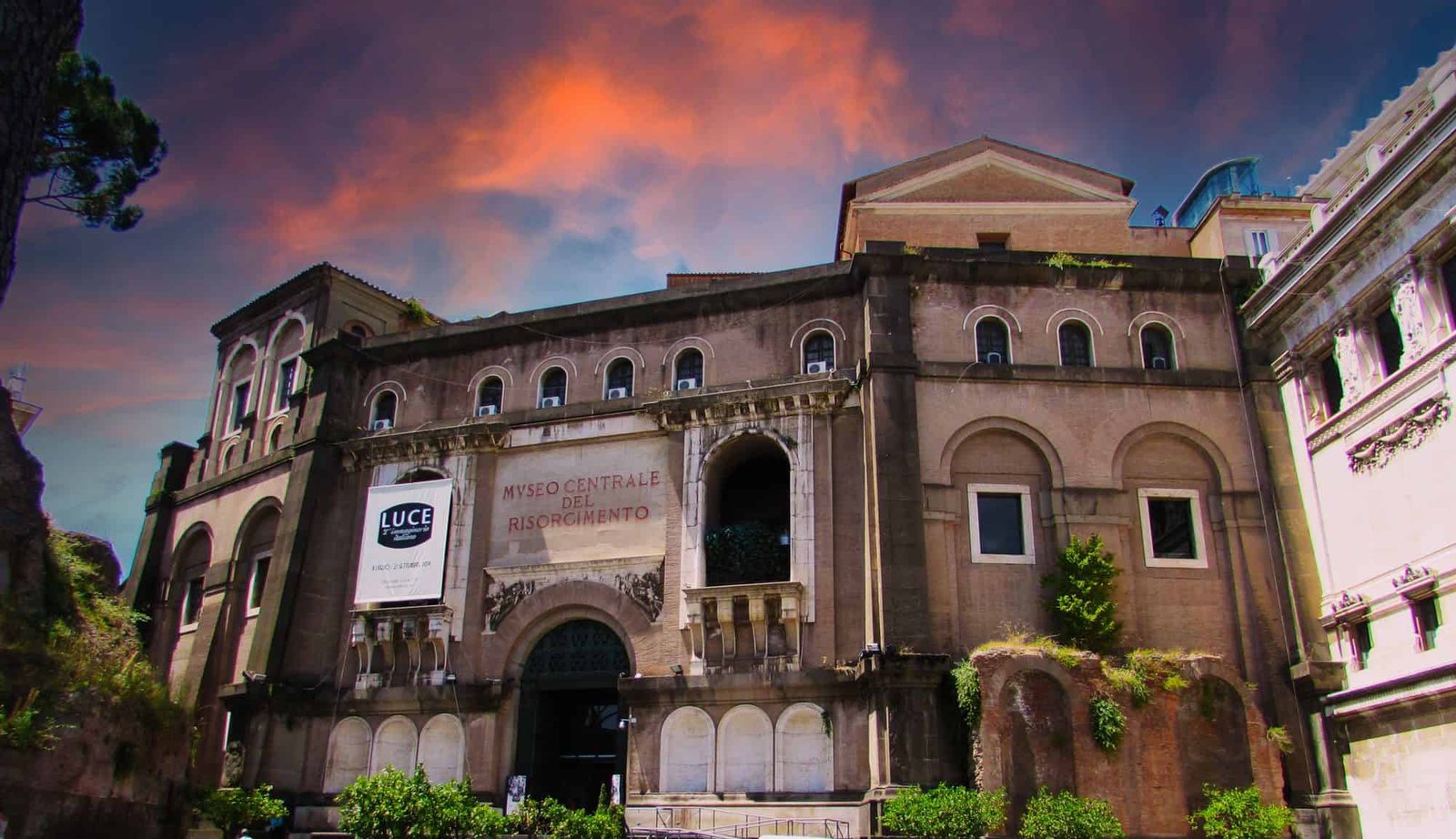
Where the Central Museum of the Risorgimento is and how to get there
The monument to Vittorio Emanuele II is one of the most photographed and least understood buildings in Rome. Millions of people photograph it from below, climb the steps up to the Altare della Patria, maybe take the elevator to the terrace, and come back down with no idea that beneath that Botticino marble stage set there is a national museum with hundreds of thousands of documents in its archive. The reason is mundane and almost entirely topographical: the entrance doesn't open onto the monumental staircase, where the flow of visitors converges, but onto a side street going uphill that almost no one takes by chance.
The address and the entrance on Via di San Pietro in Carcere
Via di San Pietro in Carcere is the ramp that, from the left side of Piazza Venezia as you face the monument, climbs toward the Capitoline Hill alongside the flank of the Vittoriano. It takes its name from the Church of San Giuseppe dei Falegnami and from the Mamertine Prison that stand next to it, a little further up. The access to the Central Museum of the Risorgimento opens along this ramp, shared with the Ala Brasini, the building wing that hosts the temporary exhibitions. If you arrive from Piazza Venezia, keep to the left of the monument, get past the bus stop and take the climb: it's barely 200 meters, but you have to do it on foot and with a minimum of attention, because the sidewalk narrows.
It's worth saying right away, because it's the most frequent mistake I see people make: you don't enter from the central staircase. If you climb the steps in front of the Altare della Patria, you end up in the free route of the monument, which is beautiful and costs nothing, but doesn't lead to the museum. You have to go back down and turn the corner. If you come from above, from the Capitoline Hill, you walk down the ramp and find the entrance on the right: it's the most comfortable way, and it lets you combine the museum visit with the Capitoline Museums in the same morning.
The Central Museum of the Risorgimento by metro and by tram
Piazza Venezia has no metro stop. It's one of the oddities of central Rome: the most central square in the city is served only by surface transport, for a precise reason, the archaeological density of the subsoil that has made the construction site of Line C a very long story. The nearest useful stop on Line B is Colosseo: from there you walk up Via dei Fori Imperiali for about 700 meters, a quarter of an hour at an easy pace, with the view opening onto the Forums on your right and onto Trajan's Markets on your left. It's a walk worth the time it costs, and among other things it prepares you for the visit better than any introduction.
Alternatively, the Cavour station on Line B leaves you about one kilometer away, with a descent along Via Cavour and Via dei Fori Imperiali. Line A doesn't serve the area: getting off at Barberini or Repubblica still means a 20-minute walk or a transfer. Tram 8, which connects Trastevere and the Gianicolense area to the center, ends at Piazza Venezia and drops you practically in front of the monument: if you're staying in Trastevere or below the Janiculum, that tram is the most direct way.
The buses to the Central Museum of the Risorgimento
Piazza Venezia is a surface hub: through it and along the streets that converge on it, Via del Plebiscito, Via del Teatro Marcello, Via dei Fori Imperiali, many urban lines pass. The stops change name and position fairly often, because the construction site of Metro Line C has changed the terminals and the directions of travel several times. The practical advice is to set your destination to Piazza Venezia and to check the active stop on the same day on the public transport operator's app: taking for granted a list of numbers read months earlier is the surest way to get off in the wrong place.
On foot to the Central Museum of the Risorgimento
Central Rome is best crossed on foot, better than any other way, and Piazza Venezia is the point where all the main routes converge. From the Pantheon it's 12 minutes along Via del Corso or, better, along Via di Torre Argentina and Via del Plebiscito. From the Trevi Fountain barely 10 minutes. From Piazza Navona a quarter of an hour. From the Colosseum, as mentioned, 15 minutes along Via dei Fori Imperiali. From Piazza del Campidoglio three minutes, walking down the ramp. If you arrive from Termini, you can walk the whole of Via Nazionale in 25 minutes, and it's not wasted time.
By car, by taxi, by scooter
You can't arrive by car: the area is a limited traffic zone and Piazza Venezia has been progressively closed to private traffic. The taxi drops you at the start of Via del Teatro Marcello or on Via dei Fori Imperiali, depending on how the detours of the moment are organized. Scooters and bicycles are parked in the marked areas along Via dei Fori Imperiali. On the sanpietrini of the climb to the Capitoline Hill, instead, it's better to get off and push. One detail no one mentions: the museum entrance is uphill and the paving is uneven, so anyone with difficulty walking does well to be dropped off as close as possible and to ask the staff for assistance.
Hours, tickets and entrances of the Central Museum of the Risorgimento
The hours of the Central Museum of the Risorgimento
The regular schedule is continuous: Monday to Sunday, from 09:30 to 19:30, with last entry at 18:45. There's no weekly closing day, which makes this museum one of the few serious resources in Rome for Monday, the day when a large part of the civic and state collections pull down the shutters. In the summer season the institute runs evening openings: in 2026 they are planned, on selected dates between June 5 and September 27, from 19:30 to 23:30 with last entry at 22:45. The exact dates of the evenings change from year to year and should be checked on the official website before you set out.
A warning that will save you some irritation: the spaces of the complex have their own hours, which don't always coincide. The Vittoriano and the Large Garden of Palazzo Venezia follow the general schedule with free admission. The Library of Archaeology and Art History, which is based in Palazzo Venezia with a branch at the Collegio Romano, is open Monday to Friday with library hours, 08:30-18:30 for the main site and 08:30-14:30 for the branch. If you come to consult the archive of the Institute for the History of the Italian Risorgimento, you have to make a separate appointment: the study room is not the museum.
How much the Central Museum of the Risorgimento costs
There is only one ticket and it opens the whole paid perimeter of VIVE. Full price €18, temporary exhibition included. Reduced €5 for visitors from 18 to 25 years old. Free for those under 18, for people with disabilities and for the other categories set by the Ministry of Culture. With that ticket you enter the Panoramic Terrace, the Sommoportico, the Central Museum of the Risorgimento and the National Museum of Palazzo Venezia, and you get access to the Library of Archaeology and Art History.
The feature that really changes the economic calculation is the seven-day validity. It isn't a day ticket: you enter one place today and the others on the following days, within the week. This lets you split the visit, which is exactly what I recommend doing. €18 for an elevator ride and half an hour of museum is expensive. €18 for the terrace at sunset one day, the Central Museum of the Risorgimento at leisure another day and Palazzo Venezia on a third day is a real bargain. Few people take advantage of it because few read the condition printed on the ticket.
The first Sunday of the month at the Central Museum of the Risorgimento
Every first Sunday of the month admission is free. The free admission is valid only that day and does not extend to the following days: it's the only case where the seven-day rule doesn't apply. On value our opinion is firm: for the Panoramic Terrace the free first Sunday is a trap, because the line for the elevators becomes unbearable and the lost time is worth more than the €18 saved. For the Central Museum of the Risorgimento, instead, it works very well. The free-Sunday crowd concentrates on the big names, and the Risorgimento rooms stay walkable even when there's a line outside. It's one of the few places in the center where the first Sunday of the month is better to visit than usual.
Do you need to book for the Central Museum of the Risorgimento
You don't. You buy at the ticket office and go in. Online booking, available from the official website through the institute's authorized reseller, makes sense in three cases: on long weekends, when the Vittoriano ticket office builds up lines. For groups, who have to announce themselves anyway. On summer evenings, which have limited capacity. For a weekday visit during regular hours, going to the window is simpler and doesn't cost a presale fee.
What you can visit for free at the Vittoriano
It helps to be clear about the free perimeter, because many pages online confuse it. Free admission applies to: the monumental staircase and the intermediate terraces, the Altare della Patria with the statue of the goddess Roma and the Tomb of the Unknown Soldier, the changing of the guard that takes place every hour, the Large Garden of Palazzo Venezia. Paid are: the Central Museum of the Risorgimento, the Panoramic Terrace reached by the elevators, the Sommoportico, the National Museum of Palazzo Venezia and the temporary exhibitions included in the ticket. The Vittoriano Ala Brasini has its own exhibition program, which is worth checking before you go up.
Services, cloakroom, restrooms
Food and drinks are not allowed in the VIVE spaces. The restrooms of the complex open with the ticket code. If you don't have a ticket, you pay €1 or show the receipt from the cafe. It's a solution that surprises many foreign visitors and it's best to know it in advance, especially with children. Backpacks and bulky luggage must be left in storage: the storage rules change with the alert level and with the exhibitions on, so anyone arriving from the station with a rolling suitcase should count on having to solve the problem before showing up at the checkpoint.
What the Central Museum of the Risorgimento is
The Central Museum of the Risorgimento is the national museum of the building of united Italy. It isn't a museum of battles and it isn't a gallery of patriotic paintings, although it contains both: it's a museum of documents, personal objects and symbols, built to tell how a geographical expression became a State. The time span runs from the end of the 1700s to the end of the First World War, and this extension is no accident. In the Italian political culture of the first decades of the 1900s, the war of 1915-1918 was read as the fulfillment of the Risorgimento, the fourth war of independence: the museum was born with that reading built into its statute, and it still keeps it in the architecture of the route.
The statute of the institute that governs it sets out the task in a formula that is worth reading in full, because it explains better than any paraphrase what this place sets out to do: to promote and facilitate studies on the history of Italy from the period preparatory to Unity and Independence until the end of the First World War, collecting documents, publications and relics, editing sources and memoirs, organizing scientific congresses. It's the definition of a research institute, before it is that of a museum. Anyone who goes in expecting a spectacular exhibition is left disoriented. Anyone who goes in knowing they are in an archive that has decided to show itself comes out enriched.
The venue is two large halls, a connecting gallery, the Sala Zanardelli and the galleries designed by Giuseppe Sacconi, now known as the Gallerie dell'Unità. They are underground spaces in the literal sense of the term, carved out beneath the portico and propylaea of the monument: no windows, artificial lighting, almost total silence. The temperature stays low even in July, which in Rome in summer is an argument in itself.
The birth of the idea: a Risorgimento museum for Rome
The history of this museum is as long as that of the monument that contains it, and in some ways more bumpy. It's worth telling in full, because it explains why the museum is what it is.
The 1880s and the first need
The need to give Rome too a Risorgimento museum took hold between 1880 and 1884. They were the years when the generation that had made Unity began to die, and with it papers, flags, uniforms and letters risked being scattered. Turin, Milan, Bologna and other cities already had Risorgimento collections, often born from civic exhibitions. Rome, the capital for little more than a decade, had nothing comparable. The promoters' reasoning was straightforward: if the capital was to legitimize itself, it had to preserve the memory of the process that had made it the capital.
Sacconi and the monument as a container
The decisive step was the meeting between this need and the construction site of the Vittoriano. The monument to Vittorio Emanuele II was born by the will of the Italian Government right after the king's death, in 1878, and after two competitions it was entrusted to the architect from the Marche Giuseppe Sacconi, who directed construction from 1885 to 1905, the year of his death. Sacconi had the idea of assigning the underground structures of the monument to the museum. It was not a fallback solution: in the logic of the project, the monument celebrated the king and the dynasty on the surface, and kept in its bowels the documents of the collective process. Botticino marble above, papers below.
The 1911 exhibition and the first core
In 1911, for the fiftieth anniversary of Unity, the Vittoriano was inaugurated by Vittorio Emanuele III and hosted a major exhibition on the Risorgimento curated by Vittorio Fiorini. It was on that occasion that the documents of the Risorgimento Section of the Vittorio Emanuele II National Library were displayed for the first time: a core of letters of the Bandiera brothers, Cavour papers, Depretis papers, papers of Giuseppe La Farina. That exhibition, conceived as temporary, became the ordering criterion for everything that would come after: the chronological sequence by events and by protagonists that the visitor still walks through today descends, in a direct line, from the 1911 layout.
The Great War widens the field
The First World War changed the physiognomy of the project. Paolo Boselli, prime minister between 1916 and 1917 and a leading figure in Risorgimento associations, promoted the systematic collection of testimonies of the ongoing conflict, read as an ideal continuation of the wars of independence. From that moment the museum had two souls: the nineteenth-century one, made of conspiracies, exiles and battles, and the twentieth-century one, made of trenches, propaganda and mass mourning. The second arrived with such a weight of objects and documents that it required, in the following years, the construction of a new exhibition wing toward the Imperial Forums.
1935, the Institute and the Ala Brasini
In 1935 the Institute for the History of the Italian Risorgimento took the place of the dissolved National Society of the Risorgimento, founded in 1906, and the museum was realized at the same time. They are years in which the Fascist regime invested heavily in the symbolic continuity between the Risorgimento, the Great War and its own political project: reading those rooms without keeping the context in mind means losing half of their meaning. Armando Brasini worked on the extension toward Via dei Fori Imperiali, and the building wing still bears his name. In 1924 an exhibition dedicated to Mazzini had been organized at the Palazzetto Venezia by Mario Menghini. In 1949, for the centenary of the Roman Republic, the Ala Brasini hosted the Mazzinian exhibition that showcased what the institute's scholars called the most precious gem of the collections, the autographs donated by Ernesto Nathan.
1970: the museum really opens
The museum was inaugurated on October 2, 1970, for the commemoration of the centenary of the annexation of Lazio to the Kingdom of Italy. More than 60 years had passed between Sacconi's idea and the ribbon cutting. Between the completion of the structures and the opening, 35. Two years earlier, in 1968, the 14-18 gallery had been opened for the fiftieth anniversary of the end of the First World War. The 1970 arrangement took up the ordering criterion of the 1911 exhibition, favoring the chronological route and the environmental contextualization of the documents.
1979: the closure
It lasted nine years. In 1979 the museum closed as unsafe, following a flooding of the underground spaces, and for almost two decades the rooms were accessible only during temporary exhibitions. They are the years in which the whole Vittoriano went through its moment of least fortune: criticized by architectural critics, closed to the public for the most part, reduced in the collective imagination to a joke about the typewriter. Anyone who visited Rome in the 1980s remembers a barred monument and a museum of which all that was known was that it existed.
The return: from the 1990s to the 2011 refit
The reopening was gradual and was completed between the end of the 1990s and 2000, under the direction of Alberto Maria Arpino and the presidency of Giuseppe Talamo, with a layout organized by thematic areas. The setup you see today dates from 2011, the year of the 150th anniversary of Unity: the refit, completed under the presidency of Romano Ugolini, went back to the chronological sequence and integrated period films and sound materials into the route. The museum is now entrusted to VIVE, the autonomous institute of the Ministry of Culture that brings together the Vittoriano and Palazzo Venezia, while the Institute for the History of the Italian Risorgimento retains the scientific role, the archive and the library.
The Central Museum of the Risorgimento and the monument to Vittorio Emanuele II
The relationship between the museum and the monument that hosts it is the key to understanding both, and neither of the two can be explained on its own.
The Vittoriano was conceived as a dynastic monument. At the center, the equestrian statue of Vittorio Emanuele II. Above, the portico with the quadrigae of Unity and Liberty. At the sides, the propylaea. Everywhere, an iconographic program that lists the virtues and the regions of Italy. It's a building that speaks of a king and a monarchy. The museum carved out beneath it, instead, tells a collective process made of republican conspirators, exiles, journalists, Mazzinians, Garibaldians, very many of whom spent their lives fighting that same monarchy before accepting it as a tool. In the display cases of the Central Museum of the Risorgimento, the autographs of Giuseppe Mazzini, sentenced to death in absentia by the Kingdom of Sardinia, sit alongside the documents of Vittorio Emanuele II. This tension is not a flaw of the layout: it's Italian history reduced to the floor plan of a building.
There is also a practical consequence of this architecture. The museum occupies underground spaces of great height but limited width, with long galleries and two main halls. The visit is therefore linear, almost obligatory, and this helps anyone who fears getting lost. The drawback is the scarcity of natural light, which makes reading the documents tiring for anyone with vision problems: if you carry reading glasses, really bring them, because many captions and very many autographs are read up close.
One last observation, which is an opinion. The Vittoriano is still dismissed with condescension by a certain kind of critic, and the typewriter label has outlived whoever coined it. I find it a lazy judgment. Sacconi designed a scenographic device that works: the stepped climb, the pause at the Altare della Patria, the view that opens up. The underground museum is the part of the project that no one ever criticized, and it remains the least visited. A paradox that has lasted a century.
The visitor route of the Central Museum of the Risorgimento, section by section
The route is laid out according to a time sequence tied to individual events and to the figures who were their protagonists. It's the layout chosen in the 2011 refit, and it's the reason this museum reads well even without a guide: you enter from the 1700s and leave from 1918, in a line, with no detours. What follows is the list of the sections, each with what is told there and with what I recommend really looking at.
The Napoleonic period
It begins from the end of the 1700s, with the arrival of the French armies in Italy and with the three years of the Jacobin republics. It's the section that visitors cross fastest and that instead explains everything else. Before Napoleon the peninsula was a mosaic of States with different customs, currencies, weights, measures and codes. After 1796, millions of Italians experienced for the first time a uniform administration, compulsory conscription, a single civil code, a military career open to merit. The Napoleonic Kingdom of Italy, with Milan as its capital, lasted from 1805 to 1814 and produced a class of officers and officials that in 1820 and 1831 would be the backbone of the conspiracies.
Here too appears the tricolor in its first institutional form, adopted by the Cispadane Republic in January 1797 in Reggio Emilia. The museum keeps documentary material from those years, and anyone with the patience to read the proclamations notices something that school textbooks don't convey: modern Italian political language was born there, with those words, in those badly printed sheets.
The Congress of Vienna
The next section tells of the Restoration. Between 1814 and 1815 the victorious powers put the overthrown thrones back in place and redrew the peninsula: Austria directly annexed Lombardy-Venetia, installed branches of the Habsburgs in Florence, Modena and Parma, gave Rome back to the pope and Naples to the Bourbons. The Kingdom of Sardinia, enlarged with Liguria and therefore with Genoa, remained the only Italian State governed by an Italian dynasty.
The material on display in this part is necessarily documentary: edicts, maps, portraits of sovereigns. The advice for this section is to look at the maps. The cartography of the Restoration is the visual proof of what the geographical expression Metternich spoke of really meant, and understanding that design makes everything that happens in the following rooms much clearer.
The revolutionary uprisings of 1820-1821 and 1830-1831
Two waves, two failures, two generations of exiles. 1820-1821 is the season of the Carboneria: in Naples the uprisings force Ferdinand I to grant the constitution, in Piedmont the insurrection of March 1821 leads to the abdication of Vittorio Emanuele I and the regency of Carlo Alberto, and ends with Austrian intervention. 1830-1831 is the season of the insurrections in Emilia, in the Papal Legations and in the Duchy of Modena, also crushed by Austria.
This section keeps the materials of the trials and the sentences, and it's the point where the museum begins to show its documentary nature. Silvio Pellico and Piero Maroncelli, arrested in 1820 and sentenced to hard prison in the Spielberg fortress, are present in the collections with documents and relics. Le mie prigioni, which Pellico published in 1832 after his release, did more damage to Austria than a lost battle: it's one of the few statements on which historians of opposing schools agree.
Giuseppe Mazzini and Young Italy
The Mazzinian core is the most precious part of the collection, and it has to be said without caution. Mazzini, from Genoa, born in 1805 and died in Pisa in 1872, founded Young Italy in 1831 in Marseille, in exile. His proposal was radical in an era of secret societies: a nation one, independent, free, republican, built through the education of the people and insurrection. He spent 40 years between Marseille, Geneva and above all London, writing by hand thousands of letters, which are the raw material of Risorgimento historiography.
The Mazzinian correspondence kept by the institute is impressive, and includes the autographs donated by Ernesto Nathan, the follower of Mazzini who would become mayor of Rome in 1907. It was that core that was presented as the centerpiece of the 1949 exhibition in the Ala Brasini, for the centenary of the Roman Republic. Anyone visiting the Central Museum of the Risorgimento who has some familiarity with nineteenth-century handwriting should stop in front of those display cases longer than tiredness suggests: the tiny, nervous handwriting, full of corrections, says more about that man than any portrait.
Pius IX
Giovanni Maria Mastai Ferretti was elected pope in June 1846 and for two years was the most popular man in Italy. Amnesty for political prisoners, opening to the press, a State consultative council: the neo-Guelphism of Vincenzo Gioberti seemed to have found its protagonist, and for a moment the idea of an Italian confederation presided over by the pontiff appeared realistic. It lasted until the allocution of April 29, 1848, with which Pius IX distanced himself from the war against Austria. From that moment the other story began, the one that leads to the flight to Gaeta, to the Roman Republic and finally, in 1870, to the breach of Porta Pia.
The section dedicated to Pius IX is one of the most useful in the museum for a non-Italian audience, because it explains something that from abroad looks incomprehensible: why the process of Italian unification had the papacy as its final adversary, and why the Roman question poisoned relations between State and Church until the Lateran Pacts of 1929.
1848: the Five Days of Milan
The European 1848 explodes in Palermo on January 12, continues in Paris in February, in Vienna in March. In Milan the Five Days begin on March 18, 1848 and end on the 22nd with the retreat of Marshal Radetzky toward the Quadrilateral. Five days of urban fighting carried out by a population without an army, with barricades built from any material and with the famous paper balloons used to spread proclamations beyond the Austrian lines.
In the display cases dedicated to 1848, the museum lines up cockades, printed proclamations, improvised weapons and flags. It's the section where you best understand how much the revolution of 1848 was a communication phenomenon as well as a phenomenon of the streets: the amount of printed paper produced in those months in Italy has no precedent, and without that paper the Five Days would have remained a local event.
The Republic of San Marco
Venice rose up on March 17, 1848 and proclaimed the Republic of San Marco under the leadership of Daniele Manin and Niccolò Tommaseo. It held out against the Austrian siege until August 24, 1849, five months after the end of the Roman Republic: it was the last Italian city to give in, and it gave in to hunger and cholera, not to assault. In its final phase the Austrians attempted the first aerial bombardment in military history, launching balloons loaded with explosives over the city, with modest results and enormous symbolic value.
The section dedicated to the Republic of San Marco is short but worth a stop, because the Italian public knows the Roman 1849 much better than the Venetian one, and the disproportion is unfair. Manin died in exile in Paris in 1857 after joining the National Society, that is, after accepting the monarchical solution: it's one of the passages that the Central Museum of the Risorgimento documents most honestly.
The First War of Independence
Charles Albert declared war on Austria on March 23, 1848. The victories of Goito and Pastrengo were followed by the defeat at Custoza in July 1848 and, after hostilities resumed, by the rout at Novara on March 23, 1849, exactly a year after the declaration. Charles Albert abdicated that same evening in favor of his son Victor Emmanuel II and died in exile in Porto a few months later.
I recommend paying attention to the military materials in this section even if you don't like weapons: uniforms, sabers, muzzle-loading rifles and regimental flags are social documents. The cuts, the fabrics, the buttons tell what industry a small state managed to field, and the answer is: very little. The Kingdom of Sardinia fought the Austrian empire with the means of a third-rank power, and this detail explains 1859 better than any diplomatic analysis.
1849 and the Roman Republic
For Rome this is the decisive section. After the assassination of Pellegrino Rossi, on November 15, 1848, and Pius IX's flight to Gaeta, the Roman Constituent Assembly proclaimed the Republic on February 9, 1849. The triumvirate made up of Giuseppe Mazzini, Carlo Armellini and Aurelio Saffi governed the city for a few months, abolishing the death penalty and the tribunal of the Inquisition and producing a Constitution, approved on July 1, 1849, that remains one of the most advanced political texts of 19th-century Europe.
The military defense was entrusted to Giuseppe Garibaldi. The French expeditionary corps led by General Oudinot landed at Civitavecchia in April, was repelled on April 30 in front of Porta San Pancrazio and returned with enormously superior means. The fighting on the Janiculum, at the Vascello and at Villa Corsini between June 3 and 30, 1849 cost the lives of Goffredo Mameli, wounded on June 3 and dead on July 6 at age 21, and of Luciano Manara. Rome fell on July 3.
Anyone who wants to go deeper into this story after visiting the Central Museum of the Risorgimento has, a short distance away, the Museum of the Roman Republic and Garibaldian Memory, housed in Porta San Pancrazio, and the sites of the battle itself along the Janiculum promenade. The advice is to do the two visits on the same trip but not on the same day: the second amplifies the first only if you arrive rested.
Cavour and the Crimean War
Camillo Benso, Count of Cavour, prime minister of the Kingdom of Sardinia from 1852, understood before anyone else that the Italian question would not be solved by insurrections but by European diplomacy. Taking part in the Crimean War in 1855, sending 15,000 men into a conflict that did not concern Italy, was a cold, calculated move: it bought the small Kingdom of Sardinia a seat at the Congress of Paris of 1856, where Cavour put the Italian question before the great powers.
The Cavour papers are one of the historic documentary cores of the collection, present since the 1911 exhibition. They are also among the hardest documents for the visitor, because Cavour's handwriting is difficult and the language is often French. It is still worth stopping: anyone with even a little practice in diplomacy recognizes in those papers a political mind of the first rank, and understands why his sudden death, on June 6, 1861, only three months after the proclamation of the Kingdom, was one of the great misfortunes of Italian history.
Victor Emmanuel II and the Second War of Independence
The Plombières agreements of July 1858 between Cavour and Napoleon III prepared the war of 1859. Austria fell into the diplomatic trap and presented the ultimatum. The conflict was fought between April and July with the battles of Palestro, Magenta, San Martino and Solferino. The latter, on June 24, 1859, was a carnage that struck a young Swiss merchant passing through, Henry Dunant, and from that shock was born, five years later, the Red Cross. The armistice of Villafranca, signed by Napoleon III without consulting his allies, gave Lombardy to Piedmont and left Veneto to Austria: Cavour resigned in rage.
The section dedicated to Victor Emmanuel II is where the museum exhibits its own founding contradiction. The king who gives his name to the monument above our heads was a man of modest culture, brusque, devoted to hunting and mistresses, and at the same time a more skilled politician than later rhetoric has let on. The documents about him allow us to reconstruct his real profile, which is more interesting than the equestrian statue.
Garibaldi and the Expedition of the 1,000
The Garibaldi section is the emotional heart of the Central Museum of the Risorgimento and the reason many visitors come all the way here. The expedition of the 1,000 left Quarto in the night between May 5 and 6, 1860 with the steamships Piemonte and Lombardo, landed at Marsala on May 11, won at Calatafimi on May 15, entered Palermo on May 27, defeated the Bourbons at Milazzo on July 20 and crossed the Strait. Garibaldi entered Naples by train on September 7, 1860, practically alone, while the Bourbon army was still deployed. The meeting at Teano with Victor Emmanuel II, on October 26, 1860, closed the game.
Among the relics kept by the museum is the Album of the 1,000 by Alessandro Pavia, the Genoese photographer who in the years after the enterprise collected the portraits of the participants in the expedition. It is a first-rate iconographic source and a moving object, because it shows the real faces of men whom rhetoric has turned into categories. The museum also keeps a tricolor flag attributable to the expedition, from the steamship Lombardo, indicated as the oldest of its collections.
From Unification to Aspromonte
The Kingdom of Italy was proclaimed on March 17, 1861. Veneto and Rome were missing, and above all a shared idea of how to take them was missing. Garibaldi tried the way of fact: in August 1862 he landed in Calabria with the declared goal of marching on Rome, and on August 29 at Aspromonte he was confronted by the bersaglieri of the Italian army. There was a volley, Garibaldi ordered his men not to return fire and was wounded in the thigh and the right ankle. He was arrested and taken to the fort of Varignano, at La Spezia. The bullet was extracted in November by Ferdinando Zannetti.
Of that episode the museum keeps material testimony of rare force: the boots worn by the general at the moment he was wounded and the stretcher used to rescue him. They are objects that explain, better than a textbook chapter, how fragile and contradictory the relationship was between the new state and the man who had delivered it to them. A year earlier that general had conquered half the country. In August 1862 the army of that same country was shooting at him.
The Third War of Independence
In 1866 Italy went to war alongside Prussia against Austria. It went badly on the field: land defeat at Custoza on June 24, naval disaster at Lissa on July 20, where Admiral Persano lost two ironclads against an inferior Austrian fleet. The only Italian success was Garibaldi's in Trentino, at Bezzecca, on July 21, followed by the telegram ordering him to withdraw and by his one-word reply, "I obey," which entered the national vocabulary. Veneto came to Italy anyway, but by diplomatic means, as a French cession, with a plebiscite in October 1866.
The section dedicated to 1866 keeps military and documentary material, and includes the collection of toy soldiers representing the campaign. They are figurines by the thousands, arranged by unit: a piece of 19th-century collecting that today has value as a document on uniforms and on the organization of armies. Children like it, and this is one of the few points on the route where the museum really reaches a young audience.
1870: The Taking of Porta Pia
On September 20, 1870, at five in the morning, Italian artillery opened fire on the Aurelian Walls. The breach was opened shortly before 10 next to Porta Pia. The bersaglieri entered. Pius IX ordered surrender after a few hours to avoid bloodshed. The casualties were a few dozen on both sides. The plebiscite of October 2 sanctioned the annexation of Rome and Lazio to the Kingdom of Italy, and on February 3, 1871 the capital was transferred from Florence to Rome.
It's worth remembering, in front of these display cases, that the centenary of that annexation was the occasion chosen to finally inaugurate the museum, on October 2, 1970. The section keeps weapons, bersaglieri uniforms, documents and prints of the day. A detail that always strikes foreign visitors: the breach was opened in a stretch of wall where the ground was favorable, and the choice of the point had been agreed upon so as to limit damage. It was a fought battle, but also a political liturgy with agreed outcomes.
World War I
The last section is the one that surprises those who came in expecting to find only the 19th century. The Great War is in the museum in full right, for the ideological reason explained further up and because it was the war that supplied, with the Tomb of the Unknown Soldier, the definitive meaning of the monument above our heads. The section keeps helmets, trench objects, documents, photographs, the Victory Bulletin, personal relics of combatants. Among the major pieces is the MAS with which Luigi Rizzo sank the Austro-Hungarian battleship Szent Istvan in 1918.
The piece that stops everyone, however, is the gun carriage used to transport the Unknown Soldier in 1921. I'll come back to it later, because it deserves its own chapter.
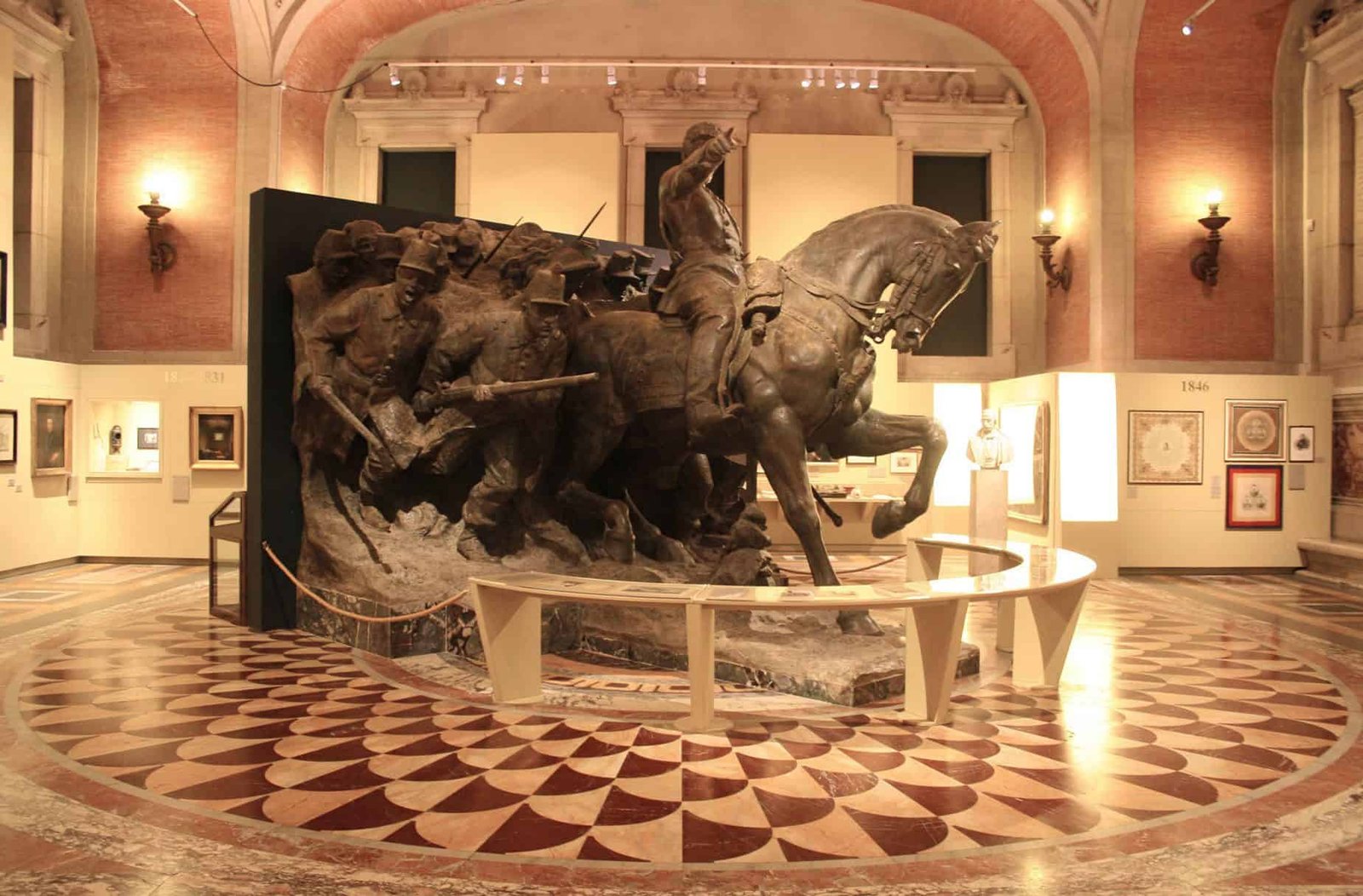
Period Films and Sounds of the Central Museum of the Risorgimento
Built into the visit route is an itinerary of rare period films, made in collaboration with Cinecittà Luce and the Centro Sperimentale di Cinematografia, Cineteca Nazionale. They are materials from the Historical Archive of the Istituto Luce documenting trench life, ceremonies, troop movements: black-and-white images, often shaky, which in the silence of the underground rooms have an effect that no display case can produce.
In the two large rooms you can also listen to a few original military pieces from the 19th century and World War I, selected by the Istituto Centrale per i Beni Sonori e Audiovisivi. It's an intelligent and underrated display choice: 19th-century military music was an instrument of propaganda and cohesion, and hearing it while looking at the regimental flags gives the visit a dimension that reading documents alone doesn't. Better not to walk through those rooms with phone earbuds in your ears.
The Garibaldi Relics of the Central Museum of the Risorgimento
If I had to name the reason the admission is worth it, I'd name this one: the Garibaldi collection. There is none comparable in Rome, and there are few in Italy.
Giuseppe Garibaldi's Blue Jeans
It's the piece the museum puts in the front row, and rightly so. It is the trousers worn by Garibaldi in 1860, during the Expedition of the 1,000 in Sicily. They are called blue jeans for the fabric: the so-called Genoa blue, a sturdy cotton cloth dyed with indigo obtained from woad, traditionally used for sailors' clothes. It is from that name, through the French bleu de Gênes, that the word everyone in the world uses today for a garment derives. The relic was donated by the children of the Hero of Two Worlds and carries tricolor ribbons applied around the buttons.
In front of this display case the reaction of groups is always curious. The Risorgimento seems schoolbook material until you see a pair of worn trousers, of normal size, belonging to a man who was 53 in 1860 and who had already fought in Brazil, in Uruguay, in Rome and in the Alps. No equestrian portrait produces the same effect.
The Aspromonte Boot and the Stretcher
The boots Garibaldi wore when he was wounded at Aspromonte, on August 29, 1862, are the other object nobody forgets. One of the two bears the bullet hole. Next to it, the museum keeps the stretcher with which the general was rescued and carried away from the site of the clash. They are almost unbearable objects in their concreteness, and they are the reason I maintain that this museum works better than its fame suggests.
It's worth adding the medical context, which is in itself a European story. The bullet lodged in the right ankle was the subject of international consultations, with French and English doctors weighing in from a distance. Ferdinando Zannetti managed the extraction in November 1862. For months Garibaldi's health was the matter of bulletins followed across Europe, with a popular participation that today we would associate with a star.
The Red Shirts
The red shirt is the Garibaldian symbol par excellence and the museum keeps examples. The origin goes back to the South American years: the Italian Legion formed by Garibaldi in Montevideo to defend the Republic of Uruguay adopted red shirts, and the most widespread historiographical tradition explains the choice by the availability of a batch of red wool shirts meant for the slaughterhouses of the Rio de la Plata, left unsold because of the trade blockade. The explanation is plausible and recurrent in the studies, but it should be taken as an established tradition and not as a definitively documented fact.
What is certain is the effect. A body of volunteers without regular uniform, recognizable from afar by a bright color, became the first modern example of visual identity applied to politics. The red shirt was imitated in half of Europe, and still today it remains one of the very few Risorgimento symbols immediately legible to anyone.
The 1846 Flag of the Italian Legion in Uruguay
It's one of the pieces the museum points out first to visitors, and it has a story that throws you. In 1846 Garibaldi was fighting at the head of the Italian Legion for the Republic of Montevideo. The flag of that unit bears at its center a volcano, usually identified with Vesuvius, on a dark ground: the meaning attributed to the emblem is the feeling of independence that burned in the breast of the exiles like magma inside a volcano.
An Italian banner born on the other side of the Atlantic, carried by men who were defending a South American republic and who 10 years later would make Italy. No object better tells the international dimension of the Risorgimento, which was a movement of exiles even before armies. If I had to pick a single piece of the museum to show a foreigner, I'd pick this one.
The Flag of the Steamship Lombardo
Among the flags of the collection is a tricolor attributable to the expedition of the 1,000, from the steamship Lombardo, which sailed from Quarto together with the Piemonte in the night between May 5 and 6, 1860. The museum indicates it as the oldest tricolor flag in its collections. The fabric is what you'd expect from a ship's flag of 1860: worn, faded, hand-sewn. The difference between this one and the celebratory flags is visible to the naked eye, and it's worth the stop.
The Album of the 1,000 by Alessandro Pavia
Alessandro Pavia, photographer, spent years collecting and reproducing the portraits of the participants in the expedition of the 1,000, composing an album that is today a fundamental source. The documentary value is evident: the list of the 1,000 was a matter of controversy for decades, with claims, exclusions and official lists corrected several times. The human value you grasp only by looking. They are faces of craftsmen, students, lawyers, doctors, sailors, many very young. Photography was still a recent technique in 1860, and these are among the first mass faces in Italian history.
Weapons, Flags and Uniforms of the Central Museum of the Risorgimento
The military component of the collection is vast and ordered chronologically together with the rest of the route, not isolated in an armory. It's a display choice I agree with: a muzzle-loading rifle from 1848 next to the proclamation that called to arms whoever would shoulder it says much more than 20 rifles lined up in a case.
The Weapons
You go from the edged weapons of the volunteer corps to the rifles of the wars of independence, up to the individual weapons of the Great War. The technological leap between the beginning and the end of the route is impressive and worth observing carefully: you begin with muzzle-loading, smoothbore weapons, with a rate of fire of two or three rounds a minute, and you end with machine guns and the heavy artillery of 1918. In a little more than a century European war changes nature, and the rooms of the museum show it with no need for comment.
A tip for those visiting with teenagers: weapons are the hook. No need to pretend otherwise. From there you move to the uniforms, from the uniforms to the photographs, from the photographs to the documents. It happens that kids come in bored and leave with sensible questions, and almost always the mental path begins in front of a saber.
The Flags
The flags are the other great chapter. Unit flags, banners of patriotic societies, tricolors sewn at home during the revolutionary days, standards of the Garibaldian legions. Every flag is a double document: it says which unit it belonged to and it says how that unit wanted to be seen. The tricolor, adopted for the first time by the Cispadane Republic in 1797, runs through the whole route changing shape, proportions and symbols at the center, from the Savoy coat of arms to the republican insignia of 1849.
Preserving textiles is a serious technical problem, and it is the reason the display case lighting is low and some flags rotate on display. Anyone arriving looking for a specific piece should reckon with this possibility: in museums of documents rotation is the rule, not the exception.
The Uniforms
The uniforms on display cover the armies that faced each other on Italian soil: Sardinian-Piedmontese, Austrian, Bourbon, papal, Garibaldian, Italian. Looking at them in sequence is an instructive exercise. Regular 19th-century armies dressed in bright colors because on the battlefield, amid the smoke of black powder, you had to recognize your own. The gray-green adopted by the Italian army in the early 20th century comes from smokeless powder and repeating rifles, which turned bright color into a death sentence. This too is a story you can read from the display cases, without reading a line.
The Autograph Documents Kept in the Central Museum of the Risorgimento
This is the museum of an archive, and the archive is its real wealth. The documentary and iconographic heritage of the Institute for the History of the Italian Risorgimento is one of the main sources for the study of Italy and the international context from the end of the 18th century to World War I.
The Autographs of Giuseppe Mazzini
The Mazzini correspondence is the most famous collection, enriched by the core of autographs donated by Ernesto Nathan. Mazzini wrote a great deal and wrote badly, in the calligraphic sense: dense lines, ink spared, margins full of additions. Anyone who stops in front of one of his autographs sees the method of a man who built a continental conspiratorial network by mail, in an age when mail was systematically opened by the police. Mazzini's letters traveled by trusted courier, in cipher, under false names, and this explains why the correspondence has required generations of philological work to be reconstructed.
The Papers of Cavour, Depretis and La Farina
The core first exhibited in 1911 included papers of Camillo Benso di Cavour, Agostino Depretis and Giuseppe La Farina, as well as the letters of the Bandiera brothers. They are the documents of politics, the kind practiced in offices and embassies, and they form the necessary counterweight to the Garibaldian part. La Farina, a Sicilian, was the great organizer of the Italian National Society, the structure that prepared the ground for monarchic unification: without that network the expedition of the 1,000 would have been an adventure, and would have ended like all earlier adventures.
The Garibaldian Papers and Correspondence
Among the collections kept are the Medici correspondence, the Crispi library and the archive of Jessie White Mario. The latter deserves more than a line. Jessie White, English, born in 1832, married the patriot Alberto Mario, followed Garibaldi as a nurse in the expedition of the 1,000 and at Aspromonte, was arrested in Genoa in 1857 for conspiratorial activity, and wrote all her life on politics and social misery, with investigations of the peasants of the Mezzogiorno that anticipate meridionalismo. That her archive is here is a detail that says a lot about the international and not only male nature of the Risorgimento.
The Documents of Victor Emmanuel II
The documentation relating to the sovereign and the court completes the institutional picture. These are useful papers for anyone who wants to understand how a newly born Kingdom was governed: appointments, correspondence, proclamations. It's the least spectacular part of the museum and the most valuable for scholars, and it remains available, besides in the display cases, in the archive's study room.
Prints, Paintings and Sculptures of the Central Museum of the Risorgimento
The iconographic collection is imposing, and its importance is often underrated by visitors. The archive keeps prints and photographs in the tens of thousands: the order of magnitude indicated by bibliographic reconstructions is about 35,000 pieces of printed and photographic material.
Popular Prints
The propaganda prints of the 19th century are the mass communication medium of the era, together with broadsheets. Portraits of patriots, battle scenes, allegories of turreted Italy, anti-Austrian and anticlerical satires: they circulated at low cost and shaped the imagination of a largely illiterate public. Looking at them carefully means understanding how a national feeling is built in the absence of compulsory schooling, extended railways and a common spoken language.
Paintings and Portraits
The Risorgimento painting kept in the museum includes portraits of the protagonists and historical scenes. It is not a picture gallery of masterpieces, and it would be dishonest to claim otherwise: it is painting of celebration, often well made and always with a precise political function. It should be looked at the way you look at an election poster from 160 years ago, with an eye to what the artist wanted you to believe.
Sculptures and Sketch Models
Among the works singled out by the museum are the sketch model of the memorial monument to General Enrico Cialdini and the fallen of the battle of Castelfidardo of September 18, 1860, and the bust of the gold medalist Gaetano Carolei. Sculptural sketch models are doubly interesting documents, because they show the design phase of monuments that were later erected in Italian squares and that we now look at without seeing them. The battle of Castelfidardo, fought in the Marche on September 18, 1860 between the Piedmontese army of Cialdini and the papal troops of the French general Lamoricière, opened to the Savoy army the road to the South and to the meeting with Garibaldi.
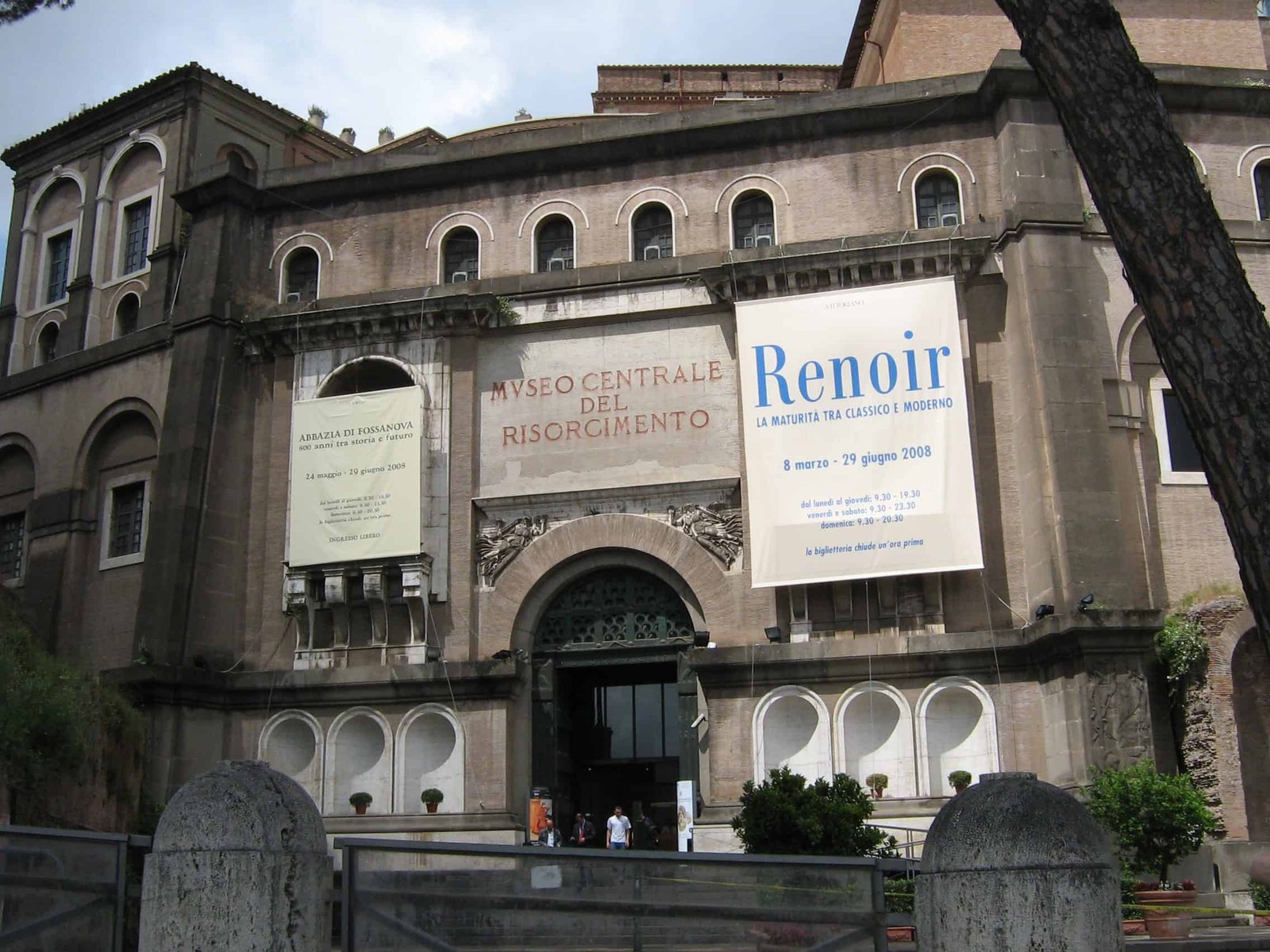
The Great War Room and the Unknown Soldier
The link between this museum and the Tomb of the Unknown Soldier is the thing I recommend keeping in mind from the first minute of the visit. The monument to Victor Emmanuel II changed meaning in 1921, and the museum that had been designed inside it changed meaning with it.
The 1921 Gun Carriage
In the room dedicated to the Great War is displayed the gun carriage used to transport the Unknown Soldier. It is the object that physically connects the museum to the tomb located a few meters above, at the Altar of the Fatherland, and its presence here is not decorative: it is the material proof of the ceremony by which the Vittoriano became the national shrine.
The Choice at Aquileia and the Journey
The story is known in its broad lines and is worth telling well, because the details make the difference. In October 1921 11 bodies of unidentified fallen were gathered, coming from 11 different theaters of war, and on October 27 they were brought to the basilica of Aquileia. The choice was entrusted to a mother: Maria Bergamas, of Gradisca d'Isonzo, mother of a missing irredentist second lieutenant, representing all the Italian women who had lost a son or a husband without a grave to weep over. The remaining 10 bodies were buried in the Cemetery of the Heroes behind the apse of the basilica, where Maria Bergamas was also buried later.
The chosen coffin traveled to Rome on a specially outfitted train, which crossed the peninsula at walking pace, stopping at stations, with crowds waiting at every stop. On November 4, 1921, the third anniversary of the victory, at the end of a solemn procession, the Unknown Soldier was entombed at the Vittoriano. From that day the monument stopped being only the celebration of a king and became the place of national mourning.
An observation. That train worked as no speech could have worked: it was the first time the whole of Italy, from the Alps to Sicily, took part at the same time in the same rite. The photographs of the packed stations kept in the archives are among the most striking documents of 20th-century Italy, and anyone who looks at them after walking through the Risorgimento rooms understands at once why that museum ends in 1918 and not in 1870.
The Changing of the Guard
Above the room, at the Altare della Patria, two soldiers stand guard at the tomb and the changing takes place every hour. It's free, lasts a few minutes and is seen very well from the Altare's terrace. I suggest timing your exit from the museum to one of these changes: going from the documents of 1921 to the honor guard within five minutes is the most effective thing you can do in this place, and it costs nothing.
The Shrine of the Flags, the Neighbor of the Central Museum of the Risorgimento
A clarification is needed here that straightens out a very widespread misunderstanding. The Sacrario delle Bandiere delle Forze Armate is a separate museum, which falls under the Ministry of Defense, and is not part of the Central Museum of the Risorgimento: it is located inside the Vittoriano, with access from Via dei Fori Imperiali side, and holds the war flags of the disbanded units of the Army, the standards of the decommissioned naval units of the Navy, and the banners of the Air Force, the Carabinieri, the State Police, the Guardia di Finanza and the Penitentiary Police. The Museo Sacrario della Marina alone holds hundreds of war flags, dozens of naval standards and hundreds of flag cases, from 1861 to the Second World War.
Among the pieces held is the flag that covered the coffin of the Unknown Soldier in 1921. From inside the Sacrario you reach the crypt of the tomb.
Since its management is different from that of the VIVE, opening hours and access arrangements do not match those of the museum and should be checked on the Ministry of Defense channels before showing up. Anyone interested in military history should plan a separate visit: the Sacrario is less crowded than the museum and has an effect, on people who did military service or have relatives who did, that no other room in Rome has.
The Istituto per la Storia del Risorgimento Italiano
The Central Museum of the Risorgimento is tied to the Istituto per la storia del Risorgimento italiano, a study and research body with an associative base and public legal personality, overseen by the Ministry of Culture and one of the five national historical Institutes of Italy. It is based in the Vittoriano complex, in Piazza Venezia, and it promotes the study of the Risorgimento and the long 19th century, from the age of revolutions to the First World War.
How It Is Organized
The Institute is run by a President, appointed by the competent Minister, assisted by a Presidency Council made up of 18 members: 13 university professors of Risorgimento History and related disciplines or scholars of recognized authority, and five members elected by the Consulta, which is in turn made up of the representatives of the Provincial Committees. The Council appoints a Vice President and a Secretary General, who serve for three years and can be renewed. The Presidency coordinates and promotes the Foreign Groups. All positions are honorary: the President and the Councilors receive no attendance fees, as the body states in its transparency obligations.
The network of Provincial Committees is the least visible and most interesting part of this architecture. They are local structures that keep archives, organize lectures and look after Risorgimento memory in their respective provinces: a capillary reach that no other Italian historical institute has to the same degree, and which descends directly from the Società nazionale del Risorgimento of 1906.
The Publications
The Institute publishes five series, Atti dei Congressi, Fonti, Memorie, Prospettive, Repertori, the journal Rassegna storica del Risorgimento and the Edizione nazionale degli Scritti di Giuseppe Garibaldi. Every two years it organizes an international Congress on themes and problems of Risorgimento history with the participation of Italian and foreign scholars. Anyone who works on 19th-century Italy knows the Rassegna: it is the reference journal of the discipline, and its complete run is one of the working tools of the library.
The Library and Archive of the Central Museum of the Risorgimento
The Institute has an archive that holds a documentary and iconographic heritage of the first importance for the study of Italy and the international context from the end of the 18th century to the First World War. It also holds the historical archive of the Institute itself, starting from its founding, and the documentation relating to the activity of the Provincial Committees. The order of magnitude of the manuscripts is measured in hundreds of thousands of pieces, and the iconographic part in tens of thousands of prints and photographs.
Who Can Consult Them
The reading room is open to scholars and to anyone with research to carry out, by appointment. It is not a tourist service and should not be confused with a visit to the museum: you get in on request, with a stated reason, during the set hours. Part of the archive can be consulted online, and the original paper card catalogs remain available in the room. Anyone preparing a thesis on 19th-century Italy should write ahead and plan a full day: the richness of the holdings is such that a two-hour visit only serves to understand how much time will really be needed.
The Library
The Biblioteca del Risorgimento gathers the specialist publishing on the period, with periodicals, pamphlets and publications of the time, and is flanked by a digital library. In Piazza Venezia complex there is also the Biblioteca di Archeologia e Storia dell'Arte, which falls under the VIVE and is based in Palazzo Venezia with a branch at the Collegio Romano: it is one of the largest art libraries in Europe, and you get in with the circuit ticket.
The Ala Brasini and the Temporary Exhibitions
The Ala Brasini is the 20th-century wing facing the Imperial Forums, built to give exhibition space to the collections of the Great War and now used for temporary exhibitions. It shares the entrance on Via di San Pietro in Carcere with the museum. Over the last 30 years it has become one of the most visited exhibition venues in Italy, with high-profile shows that have brought to the Vittoriano an audience that knew nothing about the Risorgimento.
On this the opinion is precise, and it's not the most diplomatic. The Ala Brasini exhibitions have often drawn more visitors than the permanent museum that hosts them, and the museum has benefited less than it could have. Anyone who comes in for an exhibition and holds a ticket that also includes the Risorgimento route would do well to spend the additional 40 minutes. The wing's schedule varies over the year and should be checked before going up, because at certain times the spaces are closed for installation.
The Panoramic Terrace Above the Central Museum of the Risorgimento
The ticket includes the Panoramic Terrace, that is, the roof of the portico, the one with the two bronze quadrigas representing Unity and Liberty. You get up to 70 meters high in elevators almost suspended in the void, which in about a minute clear the outline of the Santa Maria in Aracoeli Basilica. The view is 360 degrees.
Said without rhetoric: it's the best view of Rome, and I say so after trying almost all of them. Not because it's the highest, which it isn't, but because it's the most central. From up there you see the spine of Via dei Fori Imperiali pointing to the Colosseum, the Palatine, the dome of St. Peter's, the Quirinal, the rooftops of the Historic Center, Michelangelo's Capitoline Cordonata climbing toward the Campidoglio and, on the side, the bell tower of Santa Maria in Aracoeli. The right moment is the hour before sunset, when the travertine of the Forums turns orange.
Watch out for a detail that causes misunderstandings: the quadriga terrace with the elevators is paid, while the intermediate terraces of the monument, the ones you reach on foot by climbing the staircase, are free and still offer a nice view over Piazza Venezia and Via del Corso. If you have the museum ticket you have already paid for the ride up too: it would be a shame not to use it.
The Central Museum of the Risorgimento with Kids
A very frequent question, and the honest answer is: it depends on the age and on how you set up the visit.
Under six it doesn't make much sense. It's a museum of documents, with low lights, tall display cases and long texts: a small child gets bored in 10 minutes and the visit becomes an endurance contest for the adults. Between seven and 10 it works well if you pick a narrative thread and follow it, ignoring the rest. The best thread is Garibaldi: the red shirts, the blue canvas trousers, the boots with the bullet hole, the stretcher, the flags, the toy soldiers. A story of adventures, sea voyages and wounds, which holds the floor with no need for simplifications.
From age 11 up the museum becomes an excellent teaching tool, and I say so with conviction: the sections correspond almost exactly to the middle school history curriculum, and seeing the objects does more than reading 20 pages of a textbook. The fact that those under 18 get in free makes a family visit inexpensive: only the adults pay.
Three practical tips. First: the rooms are cool even in summer, so a light sweatshirt is useful. Second: food and drinks are not allowed, and the restrooms of the complex open with the ticket code, so it's best to get organized beforehand. Third: after the museum, the elevator ride up to the terrace is the perfect reward, and kids remember it more than any display case. Don't reverse the order, or you won't see the museum.
Accessibility at the Central Museum of the Risorgimento
The Vittoriano complex has worked a lot on accessibility and today it is, with some limits, one of the most practicable places in the Historic Center. At the entrance on the Aracoeli side a wheelchair stairlift and an elevator are in operation, and courtesy wheelchairs are available for anyone who needs one during the visit. At Palazzo Venezia the elevators go up to the second floor.
Real obstacles remain, though, and it would be foolish to keep quiet about them. The ramp of Via di San Pietro in Carcere is uphill and the paving is uneven. The museum route runs through underground galleries with differences in level. The internal signage could be better. Anyone with specific needs does well to call the institute's number ahead, 06 69994211, or to write to vi-ve@cultura.gov.it, to be told the most convenient access of the day and to arrange assistance. The staff on duty are used to these requests and handle them without problems.
On the sensory side, in recent years the museum has tried out tactile routes for visitors with visual disabilities, offered on scheduled dates. They are calendar initiatives, not permanent ones: anyone interested must check the schedule on the official website and book. Admission is free for visitors with disabilities.
How Long You Need for the Central Museum of the Risorgimento
I give three measures, all realistic, because the question doesn't have a single answer.
40 minutes is the minimum to go through the route without stopping to read, looking at the main objects: the flags, the Garibaldian relics, the Great War room. It's the visit of someone who has the ticket for the terrace and comes through here because it's included. Better than nothing, but it's little.
An hour and a half is the right length for a normal visit, reading the panels, stopping in front of the main display cases and listening to a few videos. It's the measure I recommend to anyone who has Rome to do in a few days and still wants to understand something.
Two and a half or three hours are for anyone with a real interest in the 19th century who wants to read the documents. They are full hours, the kind that tire you because they require continuous attention, and they should be scheduled at the start of the day, not at the end.
If you add the panoramic terrace and an exhibition at the Ala Brasini you easily get to half a day. The most useful suggestion, already given above, deserves repeating: the ticket is valid for seven days, so split it up. Museum on one day, terrace and Palazzo Venezia on another. Rome is not visited in a rush, and this complex least of all.
When to Go to the Central Museum of the Risorgimento and When to Avoid It
The best time is early morning on a weekday, right after the 9:30 opening. The museum is empty, the artificial light of the display cases works better when your eyes aren't coming in from full sun, and you're out in time to do the Campidoglio before lunch.
The second best time is late afternoon in winter, around 16:30. The underground rooms have no windows, so the time of day changes nothing for the museum, but it changes everything for the exit: you come out when it's almost dark and have the lit-up Vittoriano all to yourself.
To avoid: Saturday afternoon in high season, when the complex collects the tourist traffic of the center. The first Sundays of the month for the terrace, as already said. The days of major national ceremonies, April 25, June 2, November 4, when Piazza Venezia area is affected by closures and security details and access may change. On ceremony days the Vittoriano is a spectacle in itself, but the museum visit gets complicated.
One last point, for the Roman summer: between July and August the underground rooms of the Central Museum of the Risorgimento are among the coolest places in the center. With 40 degrees on the Imperial Forums, an hour and a half in these galleries is not a cultural fallback, it's a sensible choice.
What to See Around the Central Museum of the Risorgimento
Few museums in Rome have such a dense surrounding. From Via di San Pietro in Carcere, in 10 minutes on foot, you reach almost the whole ancient and modern monumental center.
On the Hill, a Couple of Steps Away
Going up the ramp you immediately reach the Capitoline Hill, with Michelangelo's piazza and the Capitoline Museums, the oldest public museum in the world. On the same side, the church of Santa Maria in Aracoeli is reached from the Aracoeli staircase or, more comfortably, from the side of the Capitoline square. Below, at the base of the rock, the Mamertine Prison and the church of San Pietro in Carcere occupy the site of the oldest prison in Rome.
Toward the Forums
On the other side of the monument, Via dei Fori Imperiali leads to Trajan's Markets and the Museum of the Imperial Forums, and in a quarter of an hour to the Colosseum. Trajan's Column is 200 meters from the museum entrance.
Piazza Venezia and Surroundings
On the piazza, the National Museum of Palazzo Venezia is included in the same ticket and deserves the time you give it: the 15th-century palace of Cardinal Pietro Barbo, later Pope Paul II, with the Sala del Mappamondo and the Giardino Grande. A little farther on, toward the Corso, the Doria Pamphilj gallery and the Church of the Gesù. For those who want to stay on the 19th-century thread, the Napoleonic Museum of Rome, in Palazzo Primoli near Piazza Navona, perfectly completes the first section of the route, and the Museum of the Roman Republic and Garibaldian Memory, on the Janiculum, completes the 1849 section.
Where to Eat Without Getting Hurt
A general rule valid for the whole area: move away. Piazza Venezia and Via dei Fori Imperiali are surrounded by businesses that live off passing trade, and the ratio between what you pay and what you eat is almost always unfavorable. Five minutes toward the Ghetto, toward Via dei Serpenti or toward Piazza Margana is enough to change the register completely. If you're short on time, a coffee at the counter and off you go: eating badly with a view of the Forums is still eating badly.
A Curiosity About the Central Museum of the Risorgimento
The curiosity I like best concerns a pair of trousers. Among the Garibaldian relics the museum displays the trousers worn by Giuseppe Garibaldi in 1860, during the Expedition of the 1,000, and calls them by the name everyone knows: blue jeans. It's not an advertising gimmick. The fabric is Genoa blue, a sturdy cotton cloth dyed with indigo obtained from woad, produced in Genoa and used for centuries for sailors' work clothes. In France that cloth was called bleu de Gênes, and from that expression, through English, the word jeans was born.
The detail isn't a bar anecdote, it's a small lesson in economic history. Genoa exported that cloth throughout Europe and to the Americas, where work fabric became, a century later, the most widespread garment on the planet. That the most famous historic example of this fabric is a pair of trousers worn by the leader of the 1,000, kept under the monument to Victor Emmanuel II, has something paradoxical about it. On the label of a garment that in the collective imagination is the symbol of America there is, at the origin, the name of an Italian city.
The relic was donated to the museum by Garibaldi's children and carries tricolor ribbons applied around the buttons: a touch of 19th-century devotion that today is both moving and amusing. In front of that display case, try to guess what you're looking at before reading the caption: almost no one gets it. It's the moment when the visit stops being a lesson and becomes a discovery, and it's worth the ticket price by itself.
I'll add a corollary that concerns the man, not the fabric. In 1860 Garibaldi was 53, with a past as a merchant navy commander, privateer and general in South America, and he dressed like a sailor because a sailor was what he had been. The poncho, the red shirt and the trousers of sturdy cloth weren't a costume: they were the work clothes of a man who had spent half his life at sea. His image, which 19th-century Europe turned into a romantic icon, comes from a practical wardrobe.
Something Nobody Tells You About the Central Museum of the Risorgimento
That the ticket is valid for seven days. It's written on the stub, it's stated on the official website, and practically nobody takes advantage of it. Nearly all visitors buy the ticket, go up to the terrace, glance at the museum and consider the matter closed within two hours. That's 18 euros badly spent.
The same ticket gets you into the Panoramic Terrace, the Sommoportico, the Central Museum of the Risorgimento, the National Museum of Palazzo Venezia and the Library of Archaeology and Art History, and you can do it on different days within a week. Anyone who spends four or five days in Rome holds, with that ticket, three serious visits and a view from above, at a cost per visit that no other pass in the Historic Center offers. The condition is trivial: keep the ticket and don't throw it in the trash on the way out, which a great many people do.
There's a second piece of information that almost nobody gives, and it's a practical one. This museum is open every day, Monday included. In Rome, Monday is the black day for visitors: many civic collections and several state museums close in rotation, and anyone in town with only one free day risks wandering around for nothing. The complex in Piazza Venezia, with the museum, the terrace and Palazzo Venezia, covers an excellent Monday all by itself. It's useful information for anyone who guides groups and has a Monday to fill.
Third thing, and it concerns the restrooms, which nobody ever mentions and which matters in practice. In the spaces of the complex, access to the restrooms is with the ticket code. Anyone without a ticket pays one euro or shows the café receipt. Food and drinks are not allowed inside. These are tiny details that become serious problems when you travel with children or with elderly people, and knowing them beforehand changes the day.
The advice I give you for visiting the Central Museum of the Risorgimento
The advice is one, and I'll put it without beating around the bush: go into the museum before going up to the terrace, and not the other way around.
The reason is psychological. Whoever goes up to the top first has already received their reward: the view, the photos, the thrill of the height. When they come back down into the underground galleries their head is elsewhere, they walk fast, they read nothing, and after 20 minutes they ask where the exit is. Whoever walks through the museum first goes onto the terrace with some baggage: they know why the monument was built, they know who the man on horseback was, they know why the tomb under the portico holds a soldier with no name. From up there they don't just look at the rooftops, they look at a city they have just understood.
Second piece of advice, just as practical: do the route in chronological order and don't skip the first two sections. Napoleon and the Congress of Vienna are the rooms everyone rushes through to get to Garibaldi, and they're the ones that make Garibaldi understandable. Without 1796 and without 1815, the Mille expedition remains a picturesque feat of arms. With those premises it becomes the final chapter of a process 60 years long.
Third: bring reading glasses, if you use them. It sounds like trivial advice and it's the most concrete of all. This is a museum of documents, the light in the display cases is deliberately low to preserve paper and fabrics, and a great deal of what there is to see is seen from 20 centimeters away. Sometimes someone gives up halfway through the visit for this reason alone.
Fourth and last: set aside a clean hour and a half, with no appointments afterward. The Risorgimento is not a subject you absorb while watching the clock. If you have only 40 minutes, go see the Garibaldi section and the Great War room and forget the rest: better two sections understood than 15 walked through.
Another well-known fact, yet rarely cited
That this museum was designed more than 60 years before it opened, and that it stayed closed for almost 20 years after opening, is written in every chronology and almost nobody tells it.
The numbers, lined up, are impressive. The need for a Risorgimento museum in Rome takes shape between 1880 and 1884. Giuseppe Sacconi, who directs the Vittoriano construction site from 1885, assigns the monument's underground spaces to the museum. In 1911, for the 50th anniversary of Unification, the Vittoriano is inaugurated and hosts the great exhibition that fixes the organizing criterion. In 1935 the Institute for the History of the Italian Risorgimento is born and the museum structures are built. The opening to the public comes on October 2, 1970. Nine years later, in 1979, a flood makes the rooms unusable and the museum closes. The reopening is completed between the late 1990s and 2000, and the current display dates from 2011.
Between the first idea and the first opening almost 90 years go by. Between the construction of the spaces and the ribbon cutting, 35. It's an exemplary Italian story, and I don't say it sarcastically: it's the story of a country that took a century to decide how to tell its own birth, and that in the meantime changed regime three times. Every re-display reflects the political climate of the moment. The one from 1970 favors chronology and contextualization. The one from the beginning of the century is organized by thematic areas. The one from 2011, in the year of the 150th anniversary, returns to chronology and introduces films and sounds.
There is a second fact just as well known and just as rarely cited: the extension of the story up to 1918. Nobody is surprised to find the Great War in a Risorgimento museum, yet it is a very strong interpretive choice, which goes back to Paolo Boselli and the war years and which the Fascist regime embraced with enthusiasm. Calling 1915-1918 the fourth war of independence means asserting that the process of unification is completed with Trento and Trieste and not with Rome. It's not a scholars' detail: it's the reason the monument above these rooms became the national shrine, and it's the reason the Unknown Soldier rests there and not elsewhere.
The Right Photo to Take at the Central Museum of the Risorgimento
Inside the rooms photography is possible, but it has to be handled with judgment: no flash, to protect paper and textiles, and no tripod without authorization. The display cases are reflective and the light is low: anyone photographing the documents will almost always get mediocre results, and would do better to just look.
The photograph I really recommend, the one nobody takes, is shot just outside the entrance, on the ramp of Via di San Pietro in Carcere. You stand with your back to the climb to the Campidoglio and frame the flank of the Vittoriano from below: you get a foreshortened perspective of the monument that nobody knows, because everyone photographs the front facade from Piazza Venezia. The very white botticino marble cuts the sky with a sharp diagonal, and in the foreground you can include the museum's portal. It's the photo that says where you really went, not the one that says you passed through Piazza Venezia like 10,000 others that day.
The second photo, if you have the ticket, is taken from the Panoramic Terrace at 70 meters, and it should be set up like this: bronze quadriga in the foreground on the left or on the right, dome of St. Peter's in the background. The two things together tell Rome better than any clean panorama. The right time is the one before sunset. The best period is between October and March, when the air is clearer and the sun sets earlier.
Third indication, for those with patience: the staircase of the Altare della Patria during the changing of the guard, which takes place every hour and is free. Position yourself on the left side of the Altare terrace, not head-on, and wait: the diagonal of the steps with the two soldiers in motion and the tricolor in the background is an image that always works. It's also the only moment when the solemnity of the monument stops seeming rhetorical and becomes a concrete fact, with two kids in uniform doing a shift of duty.
One last warning against the most common mistake. Don't try to photograph the whole Vittoriano from the middle of Piazza Venezia with your phone: it's too big, and you always get a flat, overexposed postcard. The monument should be photographed in parts, at an angle, or from above, from another point in the city. From Via dei Fori Imperiali, at the height of Trajan's Forum, around the first lights of evening, it comes out much better.
Some Important Events That Happened Here in History
The place that now hosts the museum has seen, in a century and a half, some of the densest moments of national history. I put them in order.
The construction site and the demolition of the hill. To build the Vittoriano, starting in 1885, an entire urban sector at the foot of the Campidoglio was gutted: convents, churches, medieval houses and the tower of Paul III disappeared, and part of the rock was cut away. It was one of the most drastic demolition operations of post-Unification Rome, contested even then. The spaces that now house the Central Museum of the Risorgimento were born inside that gutting.
The inauguration of 1911. On June 4, 1911, Victor Emmanuel III inaugurated the monument in the year of the 50th anniversary of Unification, with the building still incomplete. On that occasion the spaces intended for the museum hosted the great Risorgimento exhibition curated by Vittorio Fiorini, which presented to the public for the first time the documents of the Risorgimento Section of the Biblioteca Nazionale.
The entombment of the Unknown Soldier, November 4, 1921. It's the event that changed forever the meaning of the monument and of the museum carved out beneath it. The body chosen at Aquileia by Maria Bergamas on October 28, from among 11 coffins of unidentified fallen soldiers, arrived in Rome on a special train and was entombed at the Altare della Patria on the third anniversary of the victory. The gun carriage used for the transport is kept in the museum's Great War room.
The Mazzini exhibition of 1924 and the one of 1949. In 1924 Mario Menghini organized at the Palazzetto Venezia an exhibition devoted to Giuseppe Mazzini. In 1949, for the centenary of the Roman Republic, the Ala Brasini hosted the exhibition that presented to the public the Mazzini autographs donated by Ernesto Nathan, then considered the most precious part of the collections.
The opening of the 14-18 gallery, 1968. For the 50th anniversary of the end of the First World War the gallery devoted to the conflict was opened, the first core of the museum accessible to the public.
The museum's inauguration, October 2, 1970. The Central Museum of the Risorgimento opened for the commemoration of the centenary of the annexation of Lazio to the Kingdom of Italy. It closed a path begun with Sacconi more than 60 years earlier.
The flood and closure of 1979. The underground rooms were declared unusable and the museum closed. For almost 20 years the rooms were used only for temporary exhibitions. It is the darkest period of the complex, coinciding with the moment of least critical regard for the Vittoriano.
The reopening and the 2011 re-display. After the gradual reopening completed around 2000, the 150th anniversary of Unification led to the current display, with the return to chronological sequence and the integration of period films and sound materials.
The birth of VIVE. The complex is now entrusted to the autonomous institute of the Ministry of Culture that brings together the Vittoriano and Palazzo Venezia, with a single ticket and integrated programming. It is the most recent change and the one that most often creates confusion among visitors, because much of the information in circulation still refers to the previous arrangement.
Who has passed through the Central Museum of the Risorgimento
A museum of documents keeps, by definition, the traces of those who never set foot in it. But the Vittoriano complex has seen many people pass through, and it is worth distinguishing between those who left their papers here and those who actually walked through these rooms.
Giuseppe Sacconi is the first name. The architect from the Marche, winner of the second competition, directed the construction site from 1885 until his death in 1905, and it was he who conceived the underground spaces as the home of the museum. He saw neither the finished monument nor the museum open: the galleries that bear his name, today the Gallerie dell'Unità, are his signature on a work that outlived him by 65 years.
Vittorio Emanuele III inaugurated the Vittoriano on June 4, 1911. The grandson of the king to whom the monument is dedicated gave a strong acceleration to the construction site precisely so as to be able to inaugurate it in the year of the 50th anniversary, and presided over the ceremony in a building still under construction.
Maria Bergamas did not walk through these rooms, but no person is more tied than she to the meaning of this place. Mother of a missing irredentist second lieutenant, on October 28, 1921, in the basilica of Aquileia, among 11 coffins of unnamed fallen, she chose the one that would become the Unknown Soldier. She was buried next to the 10 remaining bodies, in the Cemetery of the Heroes behind the apse of the basilica.
Paolo Boselli, Prime Minister between 1916 and 1917 and president of the Risorgimento associations, promoted the systematic collection of testimonies of the Great War and was the man who extended the chronological boundary of the museum to 1918. Without him the Great War room would not exist.
Ernesto Nathan, a Mazzinian from the very first hour and mayor of Rome from 1907 to 1913, donated the core of autographs of Giuseppe Mazzini that remains the most precious holding of the collections. It was he, as mayor, who managed the 1911 celebrations and the opening of the monument.
Vittorio Fiorini curated the 1911 exhibition that fixed the organizing criterion of the museum. Mario Menghini organized in 1924 the Mazzinian exhibition at the Palazzetto Venezia. Giuseppe Talamo, historian and president of the Institute, and Alberto Maria Arpino, director, led the long climb back from the closure of 1979 to the reopening. Romano Ugolini, president, completed the 2011 re-display.
Then there are the protagonists who left their written life here. Giuseppe Mazzini, with a vast number of autograph letters. Camillo Benso di Cavour, with the diplomatic papers. Giuseppe Garibaldi, with the blue canvas trousers from Genoa, the boots pierced by the bullet of Aspromonte, the rescue stretcher, the flags of his legions. Vittorio Emanuele II, with the documents of the kingdom. Silvio Pellico and Piero Maroncelli, with the relics of the Spielberg. The Bandiera brothers, shot in the Vallone di Rovito in 1844, with the letters of the first documentary core. Jessie White Mario, the Englishwoman who followed Garibaldi as a nurse and who wrote about the Mezzogiorno with eyes that no Italian of the time had, with her personal archive. Alessandro Pavia, with the photo album of the Mille. Luigi Rizzo, with the MAS of 1918.
Finally, the visitor who has no name here. The tomb under the portico, a few meters above the Great War room, holds a soldier about whom nothing is known: not the name, not the regiment, not the region he came from. It is the only Italian monument dedicated to a real person about whom it was decided to know nothing, and this choice, made in 1921, remains one of the most intelligent in the symbolic history of the country.
Quick questions about the Central Museum of the Risorgimento
How much does a ticket to the Central Museum of the Risorgimento cost
The full ticket costs €18 and also includes the temporary exhibition. The reduced ticket costs €5 and is for visitors between 18 and 25. Admission is free for those under 18, for people with disabilities and for the other categories set by the Ministry of Culture. The ticket is a single one for the whole circuit and is valid for seven days from issue.
Is the Central Museum of the Risorgimento Free
No, today it is not. The museum is among the paid spaces of Piazza Venezia circuit, together with the Panoramic Terrace, the Sommoportico and the National Museum of Palazzo Venezia. Free admission applies instead to the Vittoriano, the Altare della Patria with the Tomb of the Unknown Soldier and the Giardino Grande of Palazzo Venezia. Admission to the museum becomes free every first Sunday of the month, and stays free all year for those under 18 and for people with disabilities.
What Are the Opening Hours of the Central Museum of the Risorgimento
Open Monday to Sunday, from 9:30 to 19:30, with last entry at 18:45. There is no weekly closing day. In the summer season there are evening openings on selected dates, with hours 19:30-23:30 and last entry at 22:45: the calendar of the evenings should be checked on the official website.
Where Is the Entrance to the Central Museum of the Risorgimento
The entrance opens onto Via di San Pietro in Carcere, the ramp that climbs from the left side of the Vittoriano as you face the facade from Piazza Venezia, and is shared with the Ala Brasini. You don't enter from the monumental staircase.
How Long Does a Visit to the Central Museum of the Risorgimento Take
40 minutes for a quick pass, an hour and a half for a normal visit with reading of the panels, two and a half or three hours for those who want to read the documents. Adding the Panoramic Terrace and an exhibition at the Ala Brasini gets you to half a day.
Do You Need to Book the Central Museum of the Risorgimento
No, booking is not mandatory: you buy at the ticket office and go in. It's worth booking online from the official website on long weekends, for groups and for the summer evening openings, which have limited capacity.
Does the Central Museum of the Risorgimento Ticket Include the Terrace
Yes. The same ticket gives access to the Panoramic Terrace reached by the elevators, the Sommoportico, the Central Museum of the Risorgimento and the National Museum of Palazzo Venezia, as well as the Biblioteca di Archeologia e Storia dell'Arte, and is valid for seven days from issue.
How Much Does It Cost to Go Up to the Top of the Vittoriano
The ride up to the Panoramic Terrace is included in the single €18 ticket, so you don't pay separately. The intermediate terraces of the monument, reachable on foot from the staircase, are instead free.
Can You Take Photos in the Central Museum of the Risorgimento
Yes, for personal use, but without flash and without a tripod. The flash ban serves to protect paper, textiles and historical photographs, which degrade with light. For professional shooting an authorization from the institute is required.
Is the Central Museum of the Risorgimento Wheelchair Accessible
Largely yes. At the entrance on the Aracoeli side a wheelchair stairlift and an elevator are in operation, and courtesy wheelchairs are available. Difficulties remain on the uphill outdoor ramp and on some internal differences in level: anyone with specific needs does well to call the institute's number beforehand to arrange the route and assistance. Admission for people with disabilities is free.
Is the Central Museum of the Risorgimento Suitable for Children
From age seven up, yes, following a narrative thread, and the best thread is the Garibaldian one: red shirts, blue canvas trousers, boots with the bullet hole, stretcher, flags, toy soldiers. Under six it makes little sense. Those under 18 get in free, so a family visit costs little.
Is the Central Museum of the Risorgimento Open on Monday
Yes, and it's one of its most useful features. In Rome many civic and state museums close in rotation on Monday: this complex is one of the best answers for anyone in town with a Monday to fill.
What Is the Difference Between the Central Museum of the Risorgimento and the Altare della Patria
The Altare della Patria is the central part of the monument to Victor Emmanuel II, with the statue of the goddess Roma and the Tomb of the Unknown Soldier, and is visited free by climbing the staircase. The Central Museum of the Risorgimento is the national museum carved out of the underground spaces beneath the portico and the propylaea, with a separate entrance on Via di San Pietro in Carcere and a paid ticket.
What Is the Difference Between the Central Museum of the Risorgimento and the Shrine of the Flags
They are two distinct institutions, with different management. The museum falls under the VIVE, an institute of the Ministry of Culture. The Sacrario delle Bandiere delle Forze Armate falls under the Ministry of Defense and holds the war flags of the disbanded units and of the decommissioned naval units, with access from Via dei Fori Imperiali side. The Sacrario's hours and entry arrangements should be checked on the Ministry of Defense channels.
What Can You See in the Central Museum of the Risorgimento
Autograph documents, flags, weapons, uniforms, prints, paintings, sculptures, photographs and personal relics of the protagonists, arranged along a chronological route that runs from the end of the 18th century to the First World War. Among the most famous pieces: the blue canvas trousers from Genoa worn by Garibaldi in 1860, the boots from the wounding at Aspromonte with the rescue stretcher, the flag of the Italian Legion in Uruguay from 1846, the Album dei Mille by Alessandro Pavia, the gun carriage used to transport the Unknown Soldier in 1921.
Does the Central Museum of the Risorgimento have an audio guide or guided tours
The schedule of guided tours and educational services changes over the course of the year and is published on the official website of the institute. The route can in any case be followed independently, with panels and captions in Italian and English. Anyone who wants a private guide can contact a tour leader or a licensed guide.
Are there films and audio in the Central Museum of the Risorgimento
Yes. The route integrates rare period films made in collaboration with Cinecittà Luce and the Centro Sperimentale di Cinematografia, Cineteca Nazionale, with images of trench life. In the two large rooms you can listen to original military pieces from the 19th century and the First World War selected by the Istituto Centrale per i Beni Sonori e Audiovisivi.
Can you consult the archive of the Central Museum of the Risorgimento
Yes, by appointment and for study purposes. The archive of the Institute for the History of the Italian Risorgimento holds a documentary and iconographic heritage among the most important in Italy for the period between the end of the 18th century and 1918, including the papers of the Provincial Committees. Part of it can be consulted online.
How long is the wait in line at the Central Museum of the Risorgimento
At the museum, almost nothing: it is one of the least crowded spaces in the monumental center. The line, when there is one, forms at the ticket office of the complex and at the terrace elevators, especially on weekends in high season and on the first Sundays of the month.
How do you get to the Central Museum of the Risorgimento by public transportation
Piazza Venezia has no metro stop. The nearest useful station is Colosseo on line B, about 15 minutes on foot along Via dei Fori Imperiali. Alternatively, Cavour, also on line B. Tram 8 arrives at the terminus in Piazza Venezia. Many city bus lines pass through Piazza Venezia and the streets that converge on it: it's best to check the active stop on the same day, because construction sites in the area often change the routes.
Can you visit the Central Museum of the Risorgimento with the Roma Pass
The conditions of tourist cards change from season to season and not all of them include the autonomous state museums. Before counting on a card, it's best to check the updated list of included sites on the official website of the card and on that of the institute.
Is there a cloakroom at the Central Museum of the Risorgimento
Backpacks and bulky luggage must be left, and the arrangements change with the exhibitions in progress and with the security rules of the moment. Anyone arriving from the station with a rolling suitcase should solve the problem before presenting themselves at the checkpoint. Food and drinks are not allowed in the spaces of the complex.
Are there restrooms at the Central Museum of the Risorgimento
Yes, in the complex. Access is with the ticket code. Anyone without a ticket pays one euro or shows the café receipt.
Is the Central Museum of the Risorgimento worth visiting
Yes, on two conditions. The first is having a minimum of interest in 19th-century history: anyone looking for artistic masterpieces will be disappointed, because this is a museum of documents and objects. The second is giving it at least an hour and a half. On these conditions it is one of the most underrated museums in Rome, and absolutely the best place in the city to understand how Italy was born.
What is VIVE
It is the autonomous institute of the Ministry of Culture that brings together the Vittoriano and Palazzo Venezia under a single direction, with a single ticket and integrated programming. It includes the Vittoriano with the Altare della Patria, the Panoramic Terrace, the Sommoportico, the Central Museum of the Risorgimento, the National Museum of Palazzo Venezia, the Giardino Grande and the Library of Archaeology and Art History.
What is the most famous piece in the Central Museum of the Risorgimento
The blue canvas trousers from Genoa worn by Giuseppe Garibaldi in 1860 during the Mille expedition, called blue jeans because of the fabric and donated to the museum by the general's children. They compete for first place with the boots from the wounding at Aspromonte and the Unknown Soldier's gun carriage.
Does the museum display the Unknown Soldier's flag
The flag that wrapped the Unknown Soldier's coffin in 1921 is kept at the Sacrario delle Bandiere delle Forze Armate, which is a separate institution with access from the side of Via dei Fori Imperiali. What is on display in the Central Museum of the Risorgimento is instead the gun carriage used to transport the body.
When is the best time to go to the Central Museum of the Risorgimento
Early in the morning on a weekday, right after the 9:30 opening, or late in the afternoon in winter. In summer the underground rooms are among the coolest places in the center. Avoid Saturday afternoons in high season and days of major national ceremonies, when Piazza Venezia area is affected by closures and security services.
This is the museum to recommend to anyone who says they've already seen Rome. It has no lines, no postcard masterpieces, no name that impresses people when you tell the story back home. What it does have is a pair of worn trousers, a boot with a hole in it, a flag with a volcano painted on it and a gun carriage: five objects that tell how a country was put together by flesh-and-blood people, many of whom died without seeing it finished. Whoever leaves here and climbs the steps up to the Altar of the Fatherland looks at that tomb differently from how they would have looked at it two hours earlier. That's exactly what a museum should do, and this one does it with modest means and without asking for applause.
Article written by the TourLeaderPro editorial team, contact them for Private/Corporate/V.I.P. Tours and Experiences.
Planning a trip to Rome? The English guides to visiting the city are on ItalyPlanner.com.